Posted on Stop the War Coalition http://stopwar.org.uk
Excerpt from
Patriotic Heresy vs. the New Cold War
By Stephen F. Cohen,
August 27, 2014 | This article appeared in the September 15, 2014 edition of The Nation.
——————————————————————————————–
[Note: This excerpt and the complete article have many important insights. It falls short, in my view, because it does not state that US policy has been to deliberately separate Ukraine from Russia through many means. Furthermore, it is not a 20-year history of interference. It is a 62-year history (and perhaps longer) at least since the close of World War II, of direct involvement-interference in Ukraine. The crisis in Ukraine was prepared and instigated by the US over many years. Now, especially with the appointment of John Tefft as ambassador to Russia, it looks like the US has moved to create a similar Maidan crisis in Russia.
Cohen also states in the complete article
I must also emphasize, we should exempt from this imperative young people, who have more to lose. A few have sought my guidance, and I always advise, “Even petty penalties for dissent in regard to Russia could adversely affect your career. At this stage of life, your first obligation is to your family and thus to your future prospects. Your time to fight lies ahead.”
This is a grave mistake. The youth of the 60s and 70s were vital participants in the protests on many issues, including in the civil rights movement. It was their courage, creativity, enthusiasm, and presence that was a major part of progress on the many issues. Some paid with their lives. Without their participation, which became their rite of passage, we might still be mired in Vietnam or apartheid in this country.
Enclaving our youth has become a societal fetish — imprisoning them and stunting their lives, while depriving society of their clearer vision, wisdom, and action. John Taylor Gatto talks, for example, in Weapons of Mass Instruction and Dumbing Us Down, of the horrible destruction our American school systems wreck on our children and our society.
In a very practical sense, with the crises and perils as we are facing, there may not be a future. We must have “all hands on deck” to face these very stubborn forces and problems in our world. It is imperative that we involve our youth in all these issues, including resolving this very dangerous situation in Ukraine.]
———————————————————————————————–
Twenty years of US policy have led to this fateful American-Russian confrontation. Putin may have contributed to it, but his role has been almost entirely reactive.
Everyone is entitled to their own opinions, but not to their own facts. The new Cold War orthodoxy rests almost entirely on fallacious opinions. Five of those fallacies are particularly important today.
Fallacy No. 1: Ever since the end of the Soviet Union in 1991, Washington has treated post-Communist Russia generously as a desired friend and partner, making every effort to help it become a democratic, prosperous member of the Western system of international security. Unwilling or unable, Russia rejected this American altruism, emphatically under Putin.
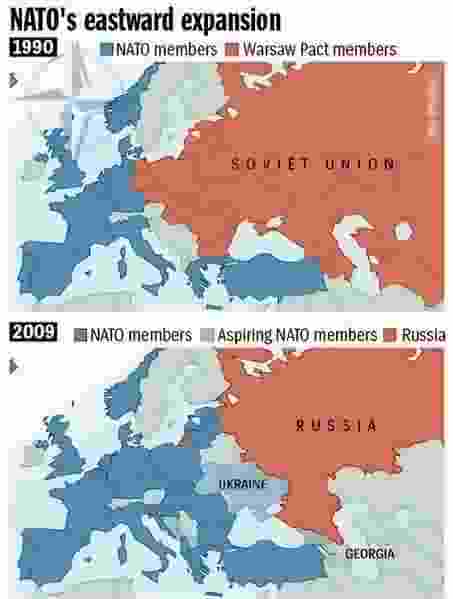
Fact: Beginning in the 1990s with the Clinton administration, every American president and Congress has treated post-Soviet Russia as a defeated nation with inferior legitimate rights at home and abroad. This triumphalist, winner-take-all approach has been spearheaded by the expansion of NATO—accompanied by non-reciprocal negotiations and now missile defense—into Russia’s traditional zones of national security, while in reality excluding it from Europe’s security system. Early on, Ukraine and, to a lesser extent, Georgia were the ultimate goals. As an influential Washington Post columnist explained in 2004: “The West wants to finish the job begun with the fall of the Berlin Wall and continue Europe’s march to the east…. The great prize is Ukraine.” He was echoed in 2013, on the eve of the current crisis, by Carl Gershman, head of the federally funded National Endowment for Democracy: “Ukraine is the biggest prize.”
Fallacy No. 2:There exists a “Ukrainian people” who yearn to escape centuries of Russian influence and join the West.
Fact: As every informed person knows, Ukraine is a country long divided by ethnic, linguistic, religious, cultural, economic and political differences—particularly its western and eastern regions, but not only those. When the current crisis began in 2013, Ukraine was one state, but it was not a single people or a united nation. Some of these divisions were made worse after 1991 by a corrupt elite, but most of them had developed over centuries.
Fallacy No. 3:In November 2013, the European Union, backed by Washington, offered Ukrainian President Viktor Yanukovych a benign association with European democracy and prosperity. Yanukovych was prepared to sign the agreement, but Putin bullied and bribed him into rejecting it. Thus began Kiev’s Maidan protests and all that has since followed.
Fact: The EU proposal was a reckless provocation compelling the democratically elected president of a deeply divided country to choose between Russia and the West. So too was the EU’s rejection of Putin’s counterproposal of a Russian-European-American plan to save Ukraine from financial collapse. On its own, the EU proposal was not economically feasible. Offering little financial assistance, it required the Ukrainian government to enact harsh austerity measures and would have sharply curtailed its longstanding and essential economic relations with Russia. Nor was the EU proposal entirely benign. It included protocols requiring Ukraine to adhere to Europe’s “military and security” policies—which meant in effect, without mentioning the alliance, NATO. In short, it was not Putin’s alleged “aggression” that initiated today’s crisis but instead a kind of velvet aggression by Brussels and Washington to bring all of Ukraine into the West, including (in the fine print) into NATO.
Fallacy No. 4: Today’s civil war in Ukraine was caused by Putin’s aggressive response to the peaceful Maidan protests against Yanukovych’s decision.
Fact: In February 2014, the radicalized Maidan protests, strongly influenced by extreme nationalist and even semi-fascist street forces, turned violent. Hoping for a peaceful resolution, European foreign ministers brokered a compromise between Maidan’s parliamentary representatives and Yanukovych. It would have left him as president, with less power, of a coalition reconciliation government until new elections this December. Within hours, violent street fighters aborted the agreement. Europe’s leaders and Washington did not defend their own diplomatic accord. Yanukovych fled to Russia. Minority parliamentary parties representing Maidan and, predominantly, western Ukraine—among them Svoboda, an ultranationalist movement previously anathematized by the European Parliament as incompatible with European values—formed a new government. They also revised the existing Constitution in their favor. Washington and Brussels endorsed the coup and have supported the outcome ever since. Everything that followed, from Russia’s annexation of Crimea and the spread of rebellion in southeastern Ukraine to the civil war and Kiev’s “anti-terrorist operation,” was triggered by the February coup. Putin’s actions have been mostly reactive.
Fallacy No. 5: The only way out of the crisis is for Putin to end his “aggression” and call off his agents in southeastern Ukraine.
Fact: The underlying causes of the crisis are Ukraine’s own internal divisions, not primarily Putin’s actions. The essential factor escalating the crisis since May has been Kiev’s “anti-terrorist” military campaign against its own citizens, now mainly in Luhansk and Donetsk. Putin influences and no doubt aids the Donbass “self-defenders.” Considering the pressure on him in Moscow, he is likely to continue to do so, perhaps even more directly, but he does not control them. If Kiev’s assault ends, Putin probably can compel the rebels to negotiate. But only the Obama administration can compel Kiev to stop, and it has not done so.
In short, twenty years of US policy have led to this fateful American-Russian confrontation. Putin may have contributed to it along the way, but his role during his fourteen years in power has been almost entirely reactive—indeed, it is a complaint frequently lodged against him by more hardline forces in Moscow.
Source: The Nation
 Free Ukraine Now