From Fort Russ
November 28, 2015 –
crimson alter, PolitRussia –
“Supreme Juncker in the black boot”
From Fort Russ
November 28, 2015 –
crimson alter, PolitRussia –
“Supreme Juncker in the black boot”

In 2014, US and EU installed its own hand-picked puppet regime in Kiev, Ukraine. This caused a chain of epic failures that have made many ardent cheerleaders for ‘regime change’ to question whether or not tipping over the elected government in 2014 was a very good idea.
The worst part of the whole operation was that US and EU central planners thought it prudent to activate and partner with NeoNazis and proto-fascist militants in order to achieve their short-term regime change goals. Once the coup d’etat had taken place in February 2014, western agents of change were stuck with a horrific political Frankenstein they had created.
While the battles have been raging in Syria and elsewhere, few in the west have been aware that the architects of instability have been busy opening up a new front for proxy, asymmetric warfare – in Crimea. To add to the shock and awe, western agents have brought together two of the worst groups of miscreants the world has ever known.

Counterpunch reports on the western media and government collusion in recent attacks on Crimea:
“Ever since the Maidan coup of February 2014, Western media and governments have all but incited violent actions by extremists against the Crimean people. Unknown to people in the West is the aforementioned, food transport blockade, ongoing since September 20. Western media has self-censored reports of that, including the central role played by the neo-Nazi Right Sector group.”
That’s not all…
Ever since then, Crimea has been the focal point of the NATO strategic offensive against Russia in the region. Most disturbingly recently, a GLADIO-style terror campaign seems to have targeted Crimea, and like clock-work, western media outlets in the process of inventing a tidy narrative in order to package what is clearly new campaign of terror that’s currently being unleashed in the region.

WASHINGTON’S PROXY: US planners would refer to working with Ukraine’s Nazis as a ‘necessary evil’ in order to achieve geopolitical objectives in the region.
After putting NeoNazi paramilitary groups to work terrorizing the Russian-speaking population in eastern Ukraine, even Kiev struggled to get them back under control. It seems someone has decided to put them to work doing another ‘off-the-books’ operation which requires a lot of deniability – terrorizing the population of newly independent Crimea peninsula.
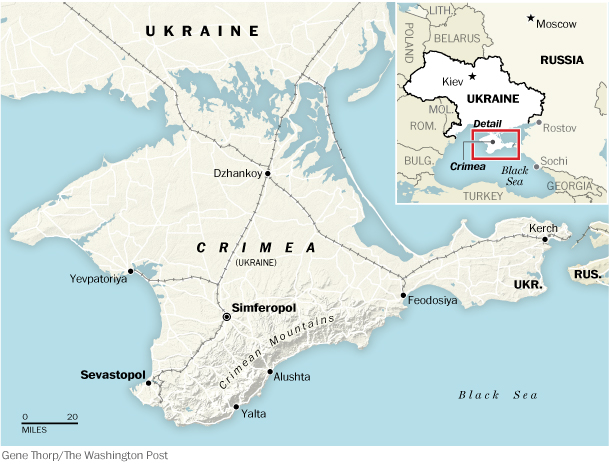
On Monday,the Crimea government declared a “State of Emergency” this week when Kiev-backed ‘nationalists’ blew up the country’s electrical infrastructure causing mass blackouts, with “Crimea is completely cut off,” says Director of Crimea Energy, Viktor Plakida, .
In what appears to be a true-to-form, classic false flag attack – a ‘Crimean Tatar’ flag was placed at the site of explosion. It’s more likely that the guiding hand of NATO Intelligence is active behind the scenes to intensify the situation.
Naturally, western media outlets are trying to frame the narrative as a ‘internal dispute’ between ethnic Tartars and ‘Russian speakers in Crimea’ (as part of the western media’s ongoing effort to isolate and demonize Russia at every turn). Still, a number of likely CIA-run editorial desks, and Mockingbird-type media outlets still refer to the Crimean referendum in winter of 2014 as “Russia’s bloodless invasion in February and March 2014”.
The reality on the ground is everyone’s worst nightmare come true: fighting has now begun between US-backed proxy militants and ethnic Russian and Russian-speaking forces as Washington and NATO continues to arm-up a flagging Ukrainian military, and supply their new ‘deniability brigades’, NeoNazis paramilitary platoons, Right Sector and Tatar militias, some of whom have been implicated in terrorist attacks in recent months.
CIA-NATO Dream Team: Nazis and ISIS Fighting Side-By-Side in Ukraine
Other US State Department-aligned foreign policy blogs have even admitted that US military Special Forces have been training new Ukrainian special forces, and seem to be ramping-up the rhetoric in the hopes of trigger more instability in the region.
Another disturbing development which has been all but blacked-out by US TV media, is that either CIA or NATO Intelligence (or both) appear to have drafted in Islamic Battalions, stocked with militant Chechens (likely many of the same fighters rotating through Syria fighting for ISIS), to help the US-backed regime in Kiev defeat Russian-speaking Rebels in eastern Ukraine.
So it’s another US-NATO proxy war beginning in Crimea.
As the US hasn’t done enough damage by funding and creating ISIS and other Jihadist terrorists in Syria.
Looks like Washington is really keeping busy these days…
Russians cannot afford to be naïve about Americans. The Americans who control power and policy in the United States have goals in conflict with most of the world, including Russia. The organizations that formulate and maintain the current iterations of the “America pre-eminent” philosophy, such as the Council on Foreign Relations, exist in a reality-less vacuum. They live to further their agenda and nothing else. There is no compromise, no room for discussion with opposing views. They have no mirrors for self-reflection and humility. These individuals are not just misguided; they are very, very dangerous to the rest of the world.
There are other Americans who make excellent choices to speak or moderate at international symposiums for peace due to their commitment to building peace and harmonious world community, respecting national sovereignty, multi-polarity, and speaking truth. They view other people as neighbors, not threats or competitors. They are humble, honest, reality-based, and well aware of America’s faults. They are not bound by prejudice or narrow interest. It is possible to collaborate with them to move our world towards peace and understanding.
Robert Legvold is not one of them. Robert Legvold’s background is with the Council on Foreign Relations and the Harriman Institute. He and his compatriots have absolutely nothing to do with the goals of Valdai. CFR’s recent report on China is one example of their supremacist philosophy.
Legvold was given the powerful and important role of moderating the final session at the Valdai Club with President Vladimir Putin in October. Why?
Below is the transcript of his long 11-minute speech, followed by the responses of President Putin and Jack Matlock.
Legvold refused to deal with the facts about American imperialism and foreign intervention. He wrote off American history as a distortion in other people’s perspective. That shows Legvold is a liar and a fool. Any school child can find reams of evidence and testimony from official government reports and think tank documents on American objectives, including from the CFR itself. Legvold’s stance also indicates pathology. Unfortunately, he is not alone.
Here is Legvold out of context:
“…it is not just misguided policy, but it is malevolent policy. The US foreign policy today is designed, in the case of Russia, to do genuine harm to Russia’s foreign policy interests, to contain Russia, to roll Russia back, to reduce its influence and to damage its strategic interests and stakes, both more broadly and within the immediate neighborhood. But even beyond that, that it is now a case of a US policy committed to regime change within Russia itself…”
If he had said this, he would have spoken the truth. Instead, he lied to the audience, and he did it with clever words.
In addition, he rudely and inappropriately excluded Mr. Larijani and Mr. Klaus in his remarks, choosing to focus on the United States-Russia relationship which he called the most important. The “me, me, me” focus was immature and embarrassing. And it was such a waste of time for those two men.
Why was he chosen to moderate? Was this an attempt at bridge-building by Valdai members? Instead of facilitating a productive back-and-forth discussion between panel members and the audience, Legvold hijacked the meeting. That’s inexcusable.
Russians and others must understand that these Americans smile, they have impressive titles and CVs, they know exactly what words to say to appeal to people or confuse them (“if you will forgive me and if you will indulge me”), but they will walk right over or through anyone. To understand these people, look at American history. Their friends are coup d’etat agents and financiers. They have an inflexible agenda, and they’re very self-focused.
There is no conceivable reason for having someone like Robert Legvold speak at Valdai. To do so interrupts Valdai’s important work.
Here are links to the video
http://en.kremlin.ru/events/president/news/50548/videos
http://en.kremlin.ru/events/president/news/50548
The other speakers on the panel were:
Complete transcript of President Putin’s remarks with some of Jack Matlock and Robert Legvold’s remarks https://freeukrainenow.org/2015/11/17/valdai-club-october-22-2015-president-putins-full-remarks/
Transcript at 1:24:06
Robert Legvold: Thank you, Ambassador Matlock. Thank you for reminding us of what was necessary and what worked in ending the Cold War and in many respects, what’s missing in our own day at this point.

Wall Street’s Council on Foreign Relations has issued a major report, alleging that China must be defeated because it threatens to become a bigger power in the world than the U.S.
This report, which is titled “Revising U.S. Grand Strategy Toward China,” is introduced by Richard Haass, the CFR’s President, who affirms the report’s view that, “no relationship will matter more when it comes to defining the twenty-first century than the one between the United States and China.” He says that the report he is publishing argues that “strategic rivalry is highly likely if not inevitable between the existing major power of the day and the principal rising power.” Haass says that the authors “also argue that China has not evolved into the ‘responsible stakeholder’ that many in the United States hoped it would.” In other words: “cooperation” with China will probably need to become replaced by, as the report’s authors put it, “intense U.S.-China strategic competition.
Haass gives this report his personal imprimatur by saying that it “deserves to become an important part of the debate about U.S. foreign policy and the pivotal U.S.-China relationship.” He acknowledges that some people won’t agree with the views it expresses.
The report itself then opens by saying: “Since its founding, the United States has consistently pursued a grand strategy focused on acquiring and maintaining preeminent power over various rivals, first on the North American continent, then in the Western hemisphere, and finally globally.” It praises “the American victory in the Cold War.” It then lavishes praise on America’s imperialistic dominance:
“The Department of Defense during the George H.W. Bush administration presciently contended that its ‘strategy must now refocus on precluding the emergence of any potential future global competitor’—thereby consciously pursuing the strategy of primacy that the United States successfully employed to outlast the Soviet Union.”
The rest of the report is likewise concerned with the international dominance of America’s aristocracy or the people who control this country’s international corporations, rather than with the welfare of the public or as the U.S. Constitution described the objective of the American Government: “the general welfare.”
The Preamble, or sovereignty clause, in the Constitution, presented that goal in this broader context:
”in order to form a more perfect union, establish justice, insure domestic tranquility, provide for the common defense, promote the general welfare, and secure the blessings of liberty to ourselves and our posterity.”
The Council on Foreign Relations, as a representative of Wall Street, is concerned only with the dominance of America’s aristocracy. Their new report, about “Revising U.S. Grand Strategy Toward China,” is like a declaration of war by America’s aristocracy, against China’s aristocracy. This report has no relationship to the U.S. Constitution, though it advises that the U.S. Government pursue this “Grand Strategy Toward China” irrespective of whether doing that would even be consistent with the U.S. Constitution’s Preamble.
The report repeats in many different contexts the basic theme, that China threatens “hegemonic” dominance in Asia. For example:
“China’s sustained economic success over the past thirty-odd years has enabled it to aggregate formidable power, making it the nation most capable of dominating the Asian continent and thus undermining the traditional U.S. geopolitical objective of ensuring that this arena remains free of hegemonic control.”
The report never allows the matter of America’s “hegemonic control” to be even raised. Thus, “hegemony” is presumed to be evil and to be something that the U.S. must block other nations from having, because there is a “traditional U.S. geopolitical objective of ensuring that this arena remains free of hegemonic control.” In other words: the U.S. isn’t being “hegemonic” by defeating aspiring hegemons. The report offers no term to refer to “hegemony” that’s being practiced by the U.S.
The report presents China as being supremacist, such as what (to quote again from the report) “historian Wang Gungwu has described as a ‘principle of superiority’ underwriting Beijing’s ‘long-hallowed tradition of treating foreign countries as all alike but unequal and inferior to China.’ Consistent with this principle, Henry Kissinger, describing the traditional sinocentric system, has correctly noted that China ‘considered itself, in a sense, the sole sovereign government of the world.’” America’s own ‘Manifest Destiny’ or right to regional (if not global) supremacy is not discussed, because supremacism is attributed only to the aristocracies in other countries, not to the aristocracy in this country.
Rather than the “general welfare,” this document emphasizes “U.S. Vital National Interests,” which are the interests of America’s aristocrats, the owners of America’s large international corporations.
This report urges:
“The United States should invest in defense capabilities and capacity specifically to defeat China’s emerging anti-access capabilities and permit successful U.S. power projection even against concerted opposition from Beijing. … Congress should remove sequestration caps and substantially increase the U.S. defense budget.”
In other words: the Government should spiral upward the U.S. debt even more vertically (which is good for Wall Street), and, in order to enable the increased ‘defense’ expenditures, only ‘defense’ expenditures should be freed from spending-caps. Forget the public, serve the owners of ‘defense’ firms and of the large international corporations who rely on the U.S. military to protect their property abroad.
The report says that China would have no reason to object to such policies: “There is no reason why a China that did not seek to overturn the balance of power in Asia should object to the policy prescriptions contained in this report.” Only a “hegemonic” China (such as the report incessantly alleges to exist, while the U.S. itself is not ‘hegemonic’) would object; and, therefore, the U.S. should ignore China’s objections, because they would be, by definition ‘hegemonic.’ Or, in other words: God is on our side, not on theirs.
“Washington simply cannot have it both ways—to accommodate Chinese concerns regarding U.S. power projection into Asia through ’strategic reassurance’ and at the same time to promote and defend U.S. vital national interests in this vast region.”
The authors make clear that U.S. President Obama is not sufficiently hostile toward China: “All signs suggest that President Obama and his senior colleagues have a profoundly different and much more benign diagnosis of China’s strategic objectives in Asia than do we.”
Furthermore, the report ends by portraying Obama as weak on the anti-China front: “Many of these omissions in U.S. policy would seem to stem from an administration worried that such actions would offend Beijing and therefore damage the possibility of enduring strategic cooperation between the two nations, thus the dominating emphasis on cooperation. That self-defeating preoccupation by the United States based on a long-term goal of U.S.-China strategic partnership that cannot be accomplished in the foreseeable future should end.”
The report’s “Recommendations for U.S. Grand Strategy Toward China” urges Congress to “Deliver on the Trans-Pacific Partnership, … as a geoeconomic answer to growing Chinese economic power and geopolitical coercion in Asia,” but it fails to mention that the Obama Administration has already embodied the authors’ viewpoint and objectives in the TPP, which Obama created, and which cuts China out; it could hardly be a better exemplar of their agenda. The authors, in fact, state the exact opposite: that Obama’s objective in his TPP has instead been merely “as a shot in the arm of a dying Doha Round at the World Trade Organization (WTO).” They even ignore that Obama had cut China out of his proposed TPP.
Furthermore, here is what President Obama himself told graduating West Point cadets on 28 May 2014:
“Russia’s aggression toward former Soviet states unnerves capitals in Europe, while China’s economic rise and military reach worries its neighbors. From Brazil to India, rising middle classes compete with us, and governments seek a greater say in global forums.”
He was saying that these future military leaders will be using guns and bombs to enforce America’s economic dominance. This is the same thing that the CFR report is saying.
His speech also asserted:
“I believe in American exceptionalism with every fiber of my being. … The United States is and remains the one indispensable nation. That has been true for the century passed and it will be true for the century to come.”
(That even resembles: “Henry Kissinger, describing the traditional sinocentric system, has correctly noted that China ‘considered itself, in a sense, the sole sovereign government of the world.’” Obama is, in a sense, saying that America is the “sole sovereign government in the world.”)
He made clear that China is “dispensable,” and that the U.S. must stay on top.
However, there is a difference between Obama and the CFR on one important thing: Obama sees Russia as the chief country over which the U.S. must dominate militarily, and China as the chief country to dominate economically. But in that regard, he is actually old-line Republican, just like his 2012 opponent Mitt Romney is. The only difference from Romney on that is: Obama wasn’t so foolish as to acknowledge publicly a belief that he shared with Romney but already knew was an unpopular position to take in the general election.
Furthermore, whereas the CFR report ignores the public’s welfare, Obama does give lip-service to that as being a matter of concern (just as he gave lip-service to opposing Romney’s assertion that Russia is “our number one geopolitical foe”). After all, he is a ‘Democrat,’ and the authors of the CFR report write instead as if they were presenting a Republican Party campaign document. No ‘Democrat’ can be far-enough to the political right to satisfy Republican operatives. The pretense that they care about the public is therefore far less, because the Republican Party is far more open about its support of, by, and for, the super-rich. Mitt Romney wasn’t the only Republican who had contempt for the lower 47%. But even he tried to deny that he had meant it. In that sense, the CFR’s report is a Republican document, one which, quite simply, doesn’t offer the public the lip-service that Obama does (and which he politically must, in order to retain support even within his own party).
Perhaps on account of the CFR report’s condemning Obama for not being sufficiently right-wing — even though he is actually a conservative Republican on all but social issues (where China policy isn’t particularly relevant) — the report has received no mention in the mainstream press, ever since it was originally issued, back in March of this year. For whatever reason, America’s ‘news’ media ignored the report, notwithstanding its importance as an expression of old-style imperialistic thinking that comes from what many consider to be the prime foreign-affairs mouthpiece of America’s aristocracy — the CFR. The report’s first coverage was on 2 May 2015 at the World Socialist Web Site, which briefly paraphrased it but didn’t even link to it. Then, two days later, Stephen Lendman wrote about the CFR report. He briefly paraphrased it and passionately condemned it. He did link to the report. But he didn’t note the WSWS article, which had first informed the public of the CFR report’s existence — an existence which, until the WSWS article, all of America’s ‘press’ had simply ignored.
The present article is the first one to quote the CFR report, instead of merely to paraphrase and attack it. The quotations that were selected are ones presenting the report’s main points, so that readers here can see these points stated as they were written, rather than merely as I have interpreted them. My interpretation is in addition to, rather than a substitute for, what the report itself says.
Investigative historian Eric Zuesse is the author, most recently, of They’re Not Even Close: The Democratic vs. Republican Economic Records, 1910-2010, and of CHRIST’S VENTRILOQUISTS: The Event that Created Christianity, and of Feudalism, Fascism, Libertarianism and Economics.
Coming on the heels of the terrorist attack in Paris, the mass shooting and siege at the Radisson Blu Hotel in Bamako, the capital of the African nation of Mali, is still further evidence of the escalation of terrorism throughout the world. While there has already been much written about the incident in both western and non-western media, one critical angle on this story has been entirely ignored: the motive.
For although it is true that most people think of terrorism as entirely ideologically driven, with motives being religious or cultural, it is equally true that much of what gets defined as “terrorism” is in fact politically motivated violence that is intended to send a message to the targeted group or nation. So it seems that the attack in Mali could very well have been just such an action as news of the victims has raised very serious questions about just what the motive for this heinous crime might have been.
International media have now confirmed that at least nine of the 27 killed in the attack were Chinese and Russian. While this alone would indeed be curious, it is the identities and positions of those killed that is particularly striking. The three Chinese victims were important figures in China’s China Railway Construction Corporation (CRCC), while the Russians were employees of Russian airline Volga-Dnepr. That it was these individuals who were killed at the very outset of the attack suggests that they were the likely targets of what could perhaps rightly be called a terrorist assassination operation.
But why these men? And why now?
To answer these questions, one must have an understanding of the roles of both these companies in Mali and, at the larger level, the activities of China and Russia in Mali. Moreover, the targeted killing should be seen in light of the growing assertiveness of both countries against terrorism in Syria and internationally. Considering the strategic partnership between the two countries – a partnership that is expanding seemingly every day – it seems that the fight against terrorism has become yet another point of convergence between Moscow and Beijing. In addition, it must be recalled that both countries have had their share of terror attacks in recent years, with each having made counter-terrorism a central element in their national security strategies, as well as their foreign policy.
And so, given these basic facts, it becomes clear that the attack in Mali was no random act of terrorism, but a carefully planned and executed operation designed to send a clear message to Russia and China.
The Attack, the Victims, and the Significance
On Friday November 20, 2015 a team of reportedly “heavily armed and well-trained gunmen” attacked a well known international hotel in Bamako, Mali. While the initial reports were somewhat sketchy and contradictory, in the days since the attack and siege that followed, new details have emerged that are undeniably worrying as they provide a potential motive for the terrorists.
It is has since been announced that three Chinese nationals were killed at the outset of the attack: Zhou Tianxiang, Wang Xuanshang, and Chang Xuehui.
Aside from the obviously tragic fact that these men were murdered in cold blood, one must examine carefully who they were in order to get a full sense of the importance of their killings. Mr. Zhou was the General Manager of the China Railway Construction Corporation’s (CRCC) international group, Mr. Wang was the Deputy General Manager of CRCC’s international group, and Mr. Chang was General Manager of the CRCC’s West Africa division. The significance should become immediately apparent as these men were the principal liaisons between Beijing and the Malian government in the major railway investments that China has made in Mali. With railway construction being one of the key infrastructure and economic development programs in landlocked Mali, the deaths of these three Chinese nationals is clearly both a symbolic and very tangible attack on China’s partnership with Mali.
In late 2014, Mali’s President Ibrahim Boubacar Keita traveled to China to attend the World Economic Forum in Tianjin. On the sidelines of the forum the Malian president sealed a number of critical development deals with the Chinese government, the most high-profile of which were railway construction and improvement agreements. Chief among the projects is the construction of an $8 billion, 900km railway linking Mali’s capital of Bamako with the Atlantic port and capital of neighboring Guinea, Conakry. The project, seen by many experts as essential for bringing Malian mineral wealth to world markets, is critical to the economic development of the country. Additionally, CRCC was also tapped to renovate the railway connecting Bamako with Senegal’s capital of Dakar, with the project carrying a price tag of nearly $1.5 billion.
These two projects alone were worth nearly $10 billion, while a number of other projects, including road construction throughout the conflict-ridden north of the country, as well as construction of a much needed new bridge in gridlock-plagued Bamako, brought the cumulative worth of the Chinese investments to near (or above) the total GDP for Mali ($12 billion in 2014). Such massive investments in the country were obviously of great significance to the Malian government both because of their economically transformative qualities, and also because they had solidified China as perhaps the single most dominant investor in Mali, a country long since under the post-colonial economic yoke of France, and military yoke of the United States.
It seems highly implausible, to say the least, that a random terror attack solely interested in killing as many civilians as possible would have as its first three victims these three men, perhaps three of the most important men in the country at the time. But the implausible coincidences don’t stop there.
Among the dead are also six Russians, all of whom are said to have been employees of the Russian commercial cargo airline Volga-Dnepr. While at first glance it may seem irrelevant that the Russian victims worked for an airline, it is in fact very telling as it indicates a similar motive to the killing of the Chinese nationals; specifically, Volga-Dnepr is, according to its Wikipedia page, “a world leader in the global market for the movement of oversize, unique and heavy air cargo…[It] serves governmental and commercial organizations, including leading global businesses in the oil and gas, energy, aerospace, agriculture and telecommunications industries as well as the humanitarian and emergency services sectors.” The company has transported everything from gigantic excavators to airplanes, helicopters, mini-factories, and power plants, not to mention heavy machines used in energy extraction.
This fact is significant because it is quite likely, indeed probable, that the airline has been transporting much of the heavy, oversized equipment being used by the Chinese and other developers throughout the country. In effect, the Russian crew was part of the ongoing economic development and foreign investment in the country. And so, their killing, like that of the CRCC executives, is a symbolic strike against Chinese and Russian investment in the country. And perhaps even more importantly, the attack was a symbolic attack upon the very nature of Sino-Russian collaboration and partnership, especially in the context of economic development in Africa and the Global South.
It would be worthwhile to add that Volga-Dnepr has also been involved in military transport services for NATO and the US until at least the beginning of the Ukraine conflict and Crimea’s reunification with Russia. Whether this fact has any bearing on the employees being targeted, that would be pure conjecture. Suffice to say though that Volga-Dnepr was no ordinary airline, but one that was integral to the entire economic development initiative in Mali. And this is really the key point: China and Russia are development partners for the former French colonial possession and US puppet state.
China, Russia, and Mali’s Future
China and, to a lesser extent, Russia have become major trading and development partners for Mali in recent years. Aside from the lucrative railroad and road construction projects mentioned above, China has expanded its partnerships with Mali in many other areas. For instance, in 2014 China gifted Mali a grant of 18 billion CFA (nearly $30 million) and an interest-free loan of 8 billion CFA (nearly $13 million). Additionally, China established a program that offers 600 scholarships to Malian students over the 2015-2017 period. Also, the Chinese government announced the construction of a training and educational center focused on engineering and the construction industry, as well as the completion of the Agricultural Technical Center in the city of Baguineda in Southern Mali, not far from the capital and population center of Bamako.
Of course, these sorts of Chinese offerings are only the tip of the iceberg as Beijing has also expanded its contracts with Mali in the transportation, construction, energy, mining, and other important sectors, including an agreement for China to construct at least 24,000 affordable housing units, making ownership of a decent home possible for many who would otherwise never have such an opportunity. Going further, as African Leadership Magazine reported in 2014:
Mali also relies on China to invest in new power plants to break the electricity crisis that is affecting the country. This is supposed to make available cheaper electricity for the industrial development…A hydroelectric dam will be built in the area of Dire in the North of the country; a hybrid power plant in Kidal in the North-East and another one in Timbuktu, which is in the North as well. Solar power plants will also be created in other parts of the country and all those infrastructures will be connected to the national grid of electricity… A factory of medicine production that is being constructed in the outskirts of the capital will be enlarged to be the largest in West Africa…More than 95 percent of the factory has been completed and it will be operating on January, 2015…Chinese banks that are not yet present in Mali are supposed to contribute to create small-scaled companies and industries.
To be sure, China is not offering such deals to Mali solely out of altruism and in the spirit of generosity; naturally China expects to enrich itself and ensure access to raw materials, resources, and markets in Mali now and in the future. This is the sort of “win-win” partnership forever being touted by China as the cornerstone of its aid and investment throughout Africa. Indeed, in many ways, Mali is a prime example of just how China operates on the continent. Rather than a purely exploitative investment model (the IMF and World Bank examples come to mind), China is engaging in true partnership. And, contrary to what many have argued (that China is merely a rival imperialist power in Africa), China’s activities in Africa are by and large productive for the whole of the countries where China invests, a few egregious bad examples aside.
China is a friend of Africa, and it has demonstrated that repeatedly throughout the last decade. And perhaps it is just this sort of friendship that was under attack in the Radisson Blu Hotel in Bamako.
Likewise Russia has been engaged in Mali, though certainly nowhere near the extent that China has. Russia was one of the principal contributors to the humanitarian relief effort in Mali after the 2012 coup and subsequent war against terror groups affiliated with Al-Qaeda. Russia provided much needed food, clothing, and basic medical aid, while also supplying more advanced, and essential, medical equipment to Malian hospitals desperately trying to cope with the flood of wounded and displaced people.
Additionally, Moscow became one of the major suppliers of weapons and other military materiel to Mali’s government in its war against terrorism in 2013. According Business Insider in 2013, Anatoly Isaikin, head of Russia’s state-owned arms exporter Rosoboronexport, “revealed that Moscow had recent military contacts with the government of Mali…He said small amounts of light weapons were already being delivered to Mali and that new sales were under discussion. ‘We have delivered firearms. Literally two weeks ago another consignment was sent. These are completely legal deliveries…We are in talks about sending more, in small quantities.’”
Finally, Mali has a longstanding cultural connection with Russia through the Soviet Union’s sponsorship of thousands of Malian students who studied in Soviet universities from the early 1960s through the 1980s. As Yevgeny Korendyasov of the Center for Russian-African Relations at the Russian Academy of Sciences explained, “We have had very close ties to Mali throughout recent history…Though overall financial estimates of Soviet aid received by Mali are hard to come by, Moscow’s involvement with the country was all-encompassing.” Indeed, the Soviets educated Malian officials and intelligentsia, as well as their children, developed local infrastructure, and mapped the country’s abundant natural resources. Such long-standing ties, moribund though they may seem today, still have a lasting legacy in the country.
While the world has been transfixed by terrorism from the downing of the Russian airliner in Egypt, to the inhuman attacks in Paris and Beirut, not nearly enough attention has been paid to the attack in Mali. Perhaps one of the reasons the episode has not gotten the necessary scrutiny and investigation is the seemingly endless series of terror attacks that have transfixed news consumers worldwide. Perhaps it is simply good old fashioned racism that sees Africa as little more than a collection of chaotic states constantly in conflict, with violence and death being the norm.
Or maybe the real reason almost no one has shined a light on this episode is because of the global implications of the killings, and the obvious message they sent. While media organizations seem to have deliberately ignored the implication of the attacks of November 20th in Mali, one can rest assured that Beijing and Moscow got the message loud and clear. And one can also rest assured that the Chinese and Russians are well aware of the true motives of the attack. The question remains: how will these countries respond?
Eric Draitser is an independent geopolitical analyst based in New York City, he is the founder of StopImperialism.org and OP-ed columnist for RT, exclusively for the online magazine “New Eastern Outlook”.
Terror in Mali: An Attack on China and Russia? One Third of the Victims were Russians and Chinese

Russia’s diplomats have been as busy as Russia’s military.
They have now obtained UN Security Council as well as Syrian government approval for Russia’s military campaign.
They have also got the UN Security Council to scotch the myth of the “moderate jihadis” once and for all.
Back in September, when it became clear the Russians were intending to act in Syria, Russia Insider predicted the Russians would try to get a Resolution from the UN Security Council to give additional legal cover for their military action.
This is in contrast to the US, which avoids the Security Council whenever it can, and which usually prefers to act unilaterally without a UN Security Council mandate.
Thus US bombing of the Islamic State in Syria was doubly illegal under international law because it was carried out without permission from either the UN Security Council or from the Syrian government.
Russia’s military action by contrast is completely legal. It has the permission of both the UN Security Council and the Syrian government for it.
It took weeks for the Russians to get their Security Council Resolution. This was because the US did everything it could to stand in the way. However, after weeks of hard work, Russia’s diplomats have finally got the Resolution Russia wanted.
What changed the position was the terrorist outrage in Paris.
After the Paris attack the French backed Russia’s proposal for a UN Security Council Resolution. At that point the US could no longer block it. The US cannot veto a Resolution backed by its own ally France, especially in the immediate aftermath of a terrorist attack.
Something that suggests some people in the US might be unhappy with this development is the absence from the Security Council table of one person who would normally be expected to be there for such an important vote.
This was Samantha Power – the US’s UN ambassador – a hardline liberal interventionist and one of the most aggressive voices within the US administration calling for regime change in Syria and confrontation with Russia.
Her relations with Vitaly Churkin, Russia’s exceptionally able UN ambassador, are said to be poisonous (see the photo at the top of original article).
It looks as if voting for the Resolution was more than Samantha Power could bear. That probably explains why she stayed away.
In her absence it was left to her deputy, Michele Sison – a career diplomat – to speak and vote for the US.
The full text of the Resolution – which is not limited to Syria – is below.
The UN has also released – along with the full text of the Resolution – a summary of the debate in the Security Council that preceded the vote.
The key words in the Resolution are these:
“(The Security Council) Calls upon Member States that have the capacity to do so to take all necessary measures, in compliance with international law, in particular with the United Nations Charter, as well as international human rights, refugee and humanitarian law, on the territory under the control of ISIL also known as Da’esh, in Syria and Iraq, to redouble and coordinate their efforts to prevent and suppress terrorist acts committed specifically by ISIL also known as Da’esh as well as ANF, and all other individuals, groups, undertakings, and entities associated with Al-Qaida, and other terrorist groups”
The Security Council has not only backed Russia’s military campaign (“all necessary means”), but it has also made clear that Russia is fully entitled to extend this campaign to “all other individuals, groups, undertakings, and entities associated with Al-Qaeda, and other terrorist groups”.
Russia is therefore fully authorised to bomb all the various jihadi groups in Syria that it is bombing.
Even the US has been forced to admit – at least in the Security Council – that the talk of Russia bombing the wrong people – the “moderate jihadis” – is nonsense.
Transcript of the Security Council’s Decision
“The Security Council,
“Reaffirming its resolutions 1267 (1999), 1368 (2001), 1373 (2001), 1618 (2005), 1624 (2005), 2083 (2012), 2129 (2013), 2133 (2014), 2161 (2014), 2170 (2014), 2178 (2014), 2195 (2014), 2199 (2015) and 2214 (2015), and its relevant presidential statements,
“Reaffirming the principles and purposes of the Charter of the United Nations,
“Reaffirming its respect for the sovereignty, territorial integrity, independence and unity of all States in accordance with purposes and principles of the United Nations Charter,
“Reaffirming that terrorism in all forms and manifestations constitutes one of the most serious threats to international peace and security and that any acts of terrorism are criminal and unjustifiable regardless of their motivations, whenever and by whomsoever committed,
“Determining that, by its violent extremist ideology, its terrorist acts, its continued gross systematic and widespread attacks directed against civilians, abuses of human rights and violations of international humanitarian law, including those driven on religious or ethnic ground, its eradication of cultural heritage and trafficking of cultural property, but also its control over significant parts and natural resources across Iraq and Syria and its recruitment and training of foreign terrorist fighters whose threat affects all regions and Member States, even those far from conflict zones, the Islamic State in Iraq and the Levant (ISIL, also known as Da’esh), constitutes a global and unprecedented threat to international peace and security,
“Recalling that the Al-Nusrah Front (ANF) and all other individuals, groups, undertakings and entities associated with Al-Qaida also constitute a threat to international peace and security,
“Determined to combat by all means this unprecedented threat to international peace and security,
“Noting the letters dated 25 June 2014 and 20 September 2014 from the Iraqi authorities which state that Da’esh has established a safe haven outside Iraq’s borders that is a direct threat to the security of the Iraqi people and territory,
“Reaffirming that Member States must ensure that any measures taken to combat terrorism comply with all their obligations under international law, in particular international human rights, refugee and humanitarian law;
“Reiterating that the situation will continue to deteriorate further in the absence of a political solution to the Syria conflict and emphasizing the need to implement the Geneva communiqué of 30 June 2012 endorsed as Annex II of its resolution 2118 (2013), the joint statement on the outcome of the multilateral talks on Syria in Vienna of 30 October 2015 and the statement of the International Syria Support Group (ISSG) of 14 November 2015,
“1. Unequivocally condemns in the strongest terms the horrifying terrorist attacks perpetrated by ISIL also known as Da’esh which took place on 26 June 2015 in Sousse, on 10 October 2015 in Ankara, on 31 October 2015 over Sinaï, on 12 November 2015 in Beirut and on 13 November 2015 in Paris, and all other attacks perpetrated by ISIL also known as Da’esh, including hostage-taking and killing, and notes it has the capability and intention to carry out further attacks and regards all such acts of terrorism as a threat to peace and security;
“2. Expresses its deepest sympathy and condolences to the victims and their families and to the people and Governments of Tunisia, Turkey, Russian Federation, Lebanon and France, and to all Governments whose citizens were targeted in the above mentioned attacks and all other victims of terrorism;
“3. Condemns also in the strongest terms the continued gross, systematic and widespread abuses of human rights and violations of humanitarian law, as well as barbaric acts of destruction and looting of cultural heritage carried out by ISIL also known as Da’esh;
“4. Reaffirms that those responsible for committing or otherwise responsible for terrorist acts, violations of international humanitarian law or violations or abuses of human rights must be held accountable;
“5. Calls upon Member States that have the capacity to do so to take all necessary measures, in compliance with international law, in particular with the United Nations Charter, as well as international human rights, refugee and humanitarian law, on the territory under the control of ISIL also known as Da’esh, in Syria and Iraq, to redouble and coordinate their efforts to prevent and suppress terrorist acts committed specifically by ISIL also known as Da’esh as well as ANF, and all other individuals, groups, undertakings, and entities associated with Al-Qaida, and other terrorist groups, as designated by the United Nations Security Council, and as may further be agreed by the International Syria Support Group (ISSG) and endorsed by the UN Security Council, pursuant to the statement of the International Syria Support Group (ISSG) of 14 November, and to eradicate the safe haven they have established over significant parts of Iraq and Syria;
“6. Urges Member States to intensify their efforts to stem the flow of foreign terrorist fighters to Iraq and Syria and to prevent and suppress the financing of terrorism, and urges all Members States to continue to fully implement the above-mentioned resolutions;
“7. Expresses its intention to swiftly update the 1267 committee sanctions list in order to better reflect the threat posed by ISIL also known as Da’esh;
“8. Decides to remain seized of the matter.
Lt. General Tom McInerney is an expert on handling threats from fighter jets.
McInerney served as:
In his role as Norad commander for Alaska, McInerney dealt with more Russian fighter jet incursions (which he calls “bear penetrations”) than anyone else in the world.
So McInerney knows how to tell innocent from hostile incursions by foreign fighter jets, standard rules of engagement of foreign fighter jets, how to read radar tracks, and the other things he would need to know to form an informed opinion about the shootdown of a foreign jet.
Yesterday, McInerney told Fox News – much to the surprise of the reporter interviewing him – that assuming the Turkish version of the flight path of the Russian jet is accurate, Russia wasn’t threatening Turkey, and that Turkey’s shoot down of the Russian jet “had to be pre-planned”, as the jet wasn’t in Turkish air space long enough for anything other than a premeditated attack to have brought it down [ED. if it was in Turkish air space].
McInerney is right … especially given that a U.S. official told Reuters that the Russian jet was inside of Syria when it was shot down:
The United States believes that the Russian jet shot down by Turkey on Tuesday was hit inside Syrian airspace after a brief incursion into Turkish airspace, a U.S. official told Reuters, speaking on condition of anonymity.
John McCain is allegedly involved in a plot to shoot down an American plane to blame on Russia (reported in Ukrainian Wikileaks).
From Real Clear Politics:
John McCain on Russian Airstrikes: Putin “Better Stay Out Of Our Way” In Syria
Posted on September 30, 2015
Sen. John McCain reacts to the news that Russia is conducting air strikes in Syria too.
SEN. JOHN McCAIN: This is a bad day. And it’s a time for American leadership.
It is time President Obama woke up to the realities in the world and reassert American leadership.
And that does not mean that we’re going to send thousands of ground troops back into Iraq or Syria. But it does mean that we develop a policy.
In the case of — I am told that these bombings, that the American government has said that American planes should not fly, and that, we have somehow approved of these airstrikes.
I do not know if that’s true or not. I hope that it’s not true.
What we should be saying to Vladimir Putin is that you fly, but we fly anywhere we want to, when and how we want to, and you’d better stay out of the way.
That’s the message that should be sent to Vladimir Putin.
So I hope that the American people understand how serious this is and that this rogue dictator named Vladimir Putin, who is a thug and a bully, can only understand a steadfast and strong American policy that brings American strength back. We are still the strongest nation in the world. Now it’s time for us to act like it.
This article by Ralph Peters is quoted in the previous article on Syria
http://www.globalresearch.ca/syria-and-conspiracy-theories-it-is-a-conspiracy/29596
A look behind the philosophy and practice of Americas push for domination of the world’s economy and culture.
From Parameters, Summer 1997, pp. 4-14: US Army War College
Constant Conflict
by Major Ralph Peters
There will be no peace. At any given moment for the rest of our lifetimes, there will be multiple conflicts in mutating forms around the globe. Violent conflict will dominate the headlines, but cultural and economic struggles will be steadier and ultimately more decisive. The de facto role of the US armed forces will be to keep the world safe for our economy and open to our cultural assault. To those ends, we will do a fair amount of killing.
We have entered an age of constant conflict. Information is at once our core commodity and the most destabilizing factor of our time. Until now, history has been a quest to acquire information; today, the challenge lies in managing information. Those of us who can sort, digest, synthesize, and apply relevant knowledge soar–professionally, financially, politically, militarily, and socially. We, the winners, are a minority.
For the world masses, devastated by information they cannot manage or effectively interpret, life is “nasty, brutish . . . and short-circuited.” The general pace of change is overwhelming, and information is both the motor and signifier of change. Those humans, in every country and region, who cannot understand the new world, or who cannot profit from its uncertainties, or who cannot reconcile themselves to its dynamics, will become the violent enemies of their inadequate governments, of their more fortunate neighbors, and ultimately of the United States. We are entering a new American century, in which we will become still wealthier, culturally more lethal, and increasingly powerful. We will excite hatreds without precedent.
We live in an age of multiple truths. He who warns of the “clash of civilizations” is incontestably right; simultaneously, we shall see higher levels of constructive trafficking between civilizations than ever before. The future is bright–and it is also very dark. More men and women will enjoy health and prosperity than ever before, yet more will live in poverty or tumult, if only because of the ferocity of demographics. There will be more democracy–that deft liberal form of imperialism–and greater popular refusal of democracy. One of the defining bifurcations of the future will be the conflict between information masters and information victims.
In the past, information empowerment was largely a matter of insider and outsider, as elementary as the division of society into the literate and illiterate. While superior information–often embodied in military technology–killed throughout history, its effects tended to be politically decisive but not personally intrusive (once the raping and pillaging were done). Technology was more apt to batter down the city gates than to change the nature of the city. The rise of the modern West broke the pattern. Whether speaking of the dispossessions and dislocations caused in Europe through the introduction of machine-driven production or elsewhere by the great age of European imperialism, an explosion of disorienting information intruded ever further into Braudel’s “structures of everyday life.” Historically, ignorance was bliss. Today, ignorance is no longer possible, only error.
The contemporary expansion of available information is immeasurable, uncontainable, and destructive to individuals and entire cultures unable to master it. The radical fundamentalists–the bomber in Jerusalem or Oklahoma City, the moral terrorist on the right or the dictatorial multiculturalist on the left–are all brothers and sisters, all threatened by change, terrified of the future, and alienated by information they cannot reconcile with their lives or ambitions. They ache to return to a golden age that never existed, or to create a paradise of their own restrictive design. They no longer understand the world, and their fear is volatile.
Information destroys traditional jobs and traditional cultures; it seduces, betrays, yet remains invulnerable. How can you counterattack the information others have turned upon you? There is no effective option other than competitive performance. For those individuals and cultures that cannot join or compete with our information empire, there is only inevitable failure (of note, the internet is to the techno-capable disaffected what the United Nations is to marginal states: it offers the illusion of empowerment and community). The attempt of the Iranian mullahs to secede from modernity has failed, although a turbaned corpse still stumbles about the neighborhood. Information, from the internet to rock videos, will not be contained, and fundamentalism cannot control its children. Our victims volunteer.
These noncompetitive cultures, such as that of Arabo-Persian Islam or the rejectionist segment of our own population, are enraged. Their cultures are under assault; their cherished values have proven dysfunctional, and the successful move on without them. The laid-off blue-collar worker in America and the Taliban militiaman in Afghanistan are brothers in suffering.
Syria and “Conspiracy Theories”: It is a Conspiracy
Essential reading.
By Felicity Arbuthnot
Global Research, September 04, 2013
Global Research [originally published 3 March 2012]
“We have met the enemy and he is us.” (Walt Kelly, 1913-1973.)
It was political analyst Mahdi Darius Nazemroaya, in November 2006, who wrote in detail(1) of US plans for the Middle East:
“The term ‘New Middle East’, was introduced to the world in June 2006, in Tel Aviv, by U.S. Secretary of State Condoleezza Rice (who was credited by the Western media for coining the term) in replacement of the older and more imposing term, the “Greater Middle East’ “, he wrote.
Sanity dictated that this would be a U.S. fantasy rampage too far and vast – until realization hit that the author of the map of this New World, planned in the New World’s “New World Order”, was Lt. Colonel Ralph Peters, who, in one of the most terrifying articles ever published, wrote in 1997:
“There will be no peace. At any given moment for the rest of our lifetimes, there will be multiple conflicts in mutating forms around the globe. Violent conflict will dominate the headlines …The de facto role of the US armed forces will be to keep the world safe for our economy and open to our cultural assault. To those ends, we will do a fair amount of killing.”(2) (My emphasis.)
At the time, Peters was assigned to the Office of the Deputy Chief of Staff for Intelligence, where he was responsible: “for future warfare.” His plans for Iraq worked out just fine – unless you are an Iraqi.
A month after Nazemroaya’s article was published, William Roebuck, Director for the Office of the State Department’s Bureau of Near Eastern Affairs, was composing an end of year strategy for Syria(3) from his study in the U.S. Embassy in Damascus, where he had been based between 2004-2007, rising to Deputy Chief of Mission.
The subject title was: “Influencing the SARG (Syrian Arab Regime Government) in the end of 2006.”
“The SARG ends 2006 in a much stronger position domestically and internationally (than in) 2005.” Talking of President Assad’s: “growing self-confidence”, he felt that this might lead to: “mistakes and ill-judged … decisions … providing us with new opportunities.” Whilst: “additional bilateral or multilateral pressure can impact on Syria”, clearly he had even more ambitious plans:
“This cable summarizes our assessment of … vulnerabilities, and suggests that there may be actions, statements and signals, that the USG (US Government) can send that will improve the likelihood of such opportunities arising .”
The proposals would need to be: “fleshed out and converted into real actions and we need to be ready to move quickly to take advantage of such opportunities.” (no, not a Le Carré, Forsyth, or Fleming, “diplomat” in Damascus.)
“As the end of 2006 approaches” wrote Roebuck, “Bashar appears … stronger than he has done in two years. The country is economically stable …regional issues seem to be going Syria’s way.”
However: “vulnerabilities and looming issues may provide opportunities to up the pressure on Bashar … some of these vulnerabilities “(including the complexities with Lebanon)”… “can be exploited to put pressure on the regime. Actions that cause Bashar to lose balance, and increase his insecurity, are in our interest.”
The President’s: “ mistakes are hard to predict and benefits may vary, if we are prepared to move quickly and take advantage of opportunities …”
A “vulnerability”, wrote Roebuck, was Bashar al Assad’s protection of: “Syria’s dignity and international reputation.” Pride and “protection”, clearly a shocking concept.
In the light of the proposed Tribunal in to the assassination of Lebanon’s former Prime Minister, Rafick Hariri (14th February 2005) killed with his friend, former Minister of Economy Bassel Fleihan and twenty colleagues and bodyguards, in a huge bomb, detonated under his motorcade, this “vulnerability” could be exploited.
Unproven allegations have pointed the finger at Israel, Syria, Hezbollah and myriad others, as behind another Middle East tragedy, but Roebuck regarded it as an: “opportunity to exploit this raw nerve, without waiting for the formation of the Tribunal.”
Another idea outlined under a further “vulnerability” heading, was the growing alliance between Syria and Iran. “Possible action”, was to: “play on Sunni fears of Iranian influence.” Although these were: “often exaggerated”, they were there to be exploited:
“Both the local Egyptian and Saudi missions here … are giving increasing attention to the matter and we should co-ordinate more closely with their governments on ways to better publicize and focus regional attention to the issue.” Concerned Sunni religious leaders should also be worked on. Iraq-style divide and rule model, writ large.
The “divide” strategy, of course, should also focus on the first family and legislating circle, with: “ targeted sanctions (which) must exploit fissures and render the inner circle weaker, rather the drive its members closer together.”
The public should also be subject to: “continual reminders of corruption … we should look for ways to remind …”
Another aspect to be exploited was: “The Khaddam factor.”
Abdul Halim Khaddam, was Vice President,1984-2005, and acting President in 2000, during the months beween Bashir al Assad’s accession and his father’s death.
Thought to have Presidential ambitions himself, there was a bitter split between Khaddam and al Assad after Hariri’s death. Allegations of treasonous betrayal by Khaddam have validity.
The ruling party, writes Roebuck: “…follow every news item involving Khaddam, with tremendous emotional interest. We should continue to encourage the Saudis and others to allow Khaddam access to their media … providing him with venues for airing the SARG’s dirty laundry.”
Morever, it was anticipated that: “an over reaction by the regime [would] add to its isolation and alienation from its Arab neighbours.”
On January 14th 2006, Khaddam had formed a government in exile, and had predicted the end of the al-Assad government by the year’s end.
He is currently regarded as an opposition leader, and has claimed, on Israel’s Channel 2 TV.(4) receiving money from the US and the EU to help overthrow the Syrian government.
The ever creative Mr Roebuck’s further plans included: “Encouraging rumours and signals of external plotting.” To this end: “Regional allies like Egypt and Saudi Arabia should be encouraged to meet with figures like Kaddam and Rifat (sic) al Assad, with appropriate leaking of the meetings afterwards. This … increases the possibility of a self-defeating over-reaction.”
Rifaat al Assad, Bashar’s uncle, was in charge of the Defence Brigade, who killed up to thirty thousand people in, and flattened much of, the city of Hama, in February 1982. So much for endlessly trumpeted concerns for: “human rights violations.” Rifaat al Assad lives in exile and safety, in London. Khaddam lives in Paris.(5)
Here is a serious cause for concern for the overthrow-bent: “Bashar keeps unveiling a steady stream of initiatives on reform and it is certainly possible he believes this is his legacy to Syria …. These steps have brought back Syrian expats to invest … (and) increasing openness.”
Solution? “Finding ways to publicly call into question Bashar’s reform efforts.” Indeed, moving heaven and earth to undercut them, is made clear.
Further: “Syria has enjoyed a considerable up-tick in foreign direct investment”; it follows: foreign investment is to be: “discouraged.”
In May of 2006, complains Roebuck, Syrian Military Intelligence protested: “what they believed were U.S. efforts to provide military training and equipment to Syria’s Kurds.” The Iraq model, yet again.
The answer was to: “Highlight Kurdish complaints.” This, however: “would need to be handled carefully, since giving the wrong kind of prominence to Kurdish issues in Syria, could be a liability for our efforts … given Syrian … civil society’s skepticism of Kurdish objectives.”
In “Conclusion”, this shaming, shoddy document states: “The bottom line is that Bashar is entering the New Year in a stronger position than he has been, in several years”, meaning “vulnerabilities” must be sought out. “If we are ready to capitalize, they will offer us opportunities to disrupt his decision-making, keep him off balance – and make him pay a premium for his mistakes.”
The cable is copied to: The White House, U.S. Secretary of State, U.S. Treasury, U.S. Mission at the UN, U.S. National Security Council, CENTCOM, all Arab League and EU countries.
The only U.S. Embassy which received a copy is that in Tel Aviv. William Roebuck worked at the Embassy in Tel Aviv (2000-2003) embracing the invasion of Iraq year.
In 2009, he was Deputy Political Consul In Baghdad: “leading efforts to support the critical 2009 Iraqi elections.” The “free and fair, democratic” ones, where people were threatened with the deaths of their children even, if they did not vote the “right” way.
The result was Nuri al Maliki’s premiership, complete with his murderous militias. The man under whose Ministry of the Interior, U.S. soldiers discovered tortured, starving prisoners.
The Damascus cable comes courtesy Wikileaks. Lt. Colonel Peters called, on Fox News, for founder, Julian Assange, to be assassinated. The forty second clip(6) is worth the listen.
The Colonel also writes fiction and thrillers under the name Owen Patterson. Perhaps he is living the dream.
Felicity Arbutnot is Global Research’s Human Rights Correspondent based in London
Notes
1. http://www.globalresearch.ca/index.php?context=va&aid=3882
2. http://www.informationclearinghouse.info/article3011.htm
3. http://wikileaks.cabledrum.net/cable/2006/12/06DAMASCUS5399.html
4. http://www.youtube.com/watch?v=COqBQYcrd9Q
5. http://www.globalresearch.ca/index.php?context=va&aid=29501
6. http://www.youtube.com/watch?v=rS5h59iZg3o