Three-minute memories triumph again: “Liberals” trounce “Conservatives” in the Canadian election – but the Corporation carries on, for now

This applies to U.S. voters as well.

From ITCCS.org
October 20, 2015
by Kevin D. Annett

Illusion is the most tenacious trait in humanity. History teaches but it has no pupils.

– Antonio Gramsci 

Two millenia ago, the emperors of the Chin dynasty developed the earliest known type of crowd control. An especially hated minister of the government would periodically be thrown to the mob and ripped to pieces, thereby satiating the restlessness and rage of the people while keeping Imperial power safely intact.

This system was later perfected into something we call voting.

I can’t say I was surprised yesterday when a majority Liberal government was appointed over the ashes of one of the most hated political regimes in Canadian history. That’s how the game works, after all: the old tag-team operation of manufactured change designed to convince the mob that it’s really achieved something by bringing in the new guy.

Like those similarly deposed rulers named “Pope” Benedict and President George Bush junior, Prime Minister Stephen Harper increasingly and expertly played his role of irredeemable villain in order to draw upon himself the hatred of a majority of the electorate, allowing his attractive, smiling Liberal replacement to be acclaimed and loved by the crowd simply for looking nicer. This kind of puppet show worked admirably for those other Villains’ appointed successors, President Obama and “Pope Francis”; and now it’s worked equally well for Justin Trudeau, that paltry reincarnation of his wife beating and child molesting father Pierre.

Meanwhile, the election game concluded, the Empire will carry on, for now: the mob “democratically” satiated, the Corporatocracy preserved.

Any Canadian who has the semblance of a political memory must find the entire thing more than repulsive, especially if we remember how the same apparent changing of the guard happened not so long ago after an equally despised Tory Prime Minister, Brian Mulroney, saw his party wiped out and reduced to two seats in Parliament on the wave of the same kind of Liberal landslide. Then, after years of the same kind of mob-ruled corruption, the Tories under Stephen Harper took over again with the same promising of goodness.

And so on.

I’ve always hated ping pong. It seems so mindless and repetitive – just like Canadian voting patterns. Strait jacketed by a two party bi-polarism, Canadians exhibit the cyclical behavior pattern of an untreated manic depressive, feverishly handing total power first to one palliative and then to another, and never learning a thing in the process. The farce is almost like American politics, except it’s a hell of a lot more boring north of the border.

Like mashed potatoes without the gravy, to quote Canuckophobe Billy Bob Thornton.

I don’t imagine any of this reality will register with the smug electorate who think they did something on October 19, even when their momentarily shiny and new Prime Minister stands up in Parliament and with all the other neophyte Pigs at the Trough takes his oath of loyalty not to those who elected him or to a Constitution, but to a senile pederast in London. But surely it’s time for those of us who call ourselves awakened to do something more than gripe about the tragic-comedy called Canada, Ltd.

Blasted out of my own accommodation to Canadiana by what I discovered up close about the masses of little corpses upon which this nation is built, I have called for a Republic for years now: not as a nice idea but as a moral and lawful necessity. It’s not a new call: MacKenzie, Papineau, my ancestor Philip Annett and lots of other folks tried unsuccessfully to create such a Republic in arms in 1837. But history and our own recent efforts show us the truth that regardless of what opinion polls will tell you, Canadians aren’t ready for self-government – including the ones who say they are.

Simply put, they lack the courage.

I’ve met and worked with a lot of smart, militant and good-hearted Canadians over the decades, but I know very few courageous ones. Many of the paper members of our fledgling Republic of Kanata movement are experts in common law court procedure and how to wangle yourself out of paying personal income taxes. Some of them even tepidly challenge the system as one man shows and become internet celebrities. But the valor and the consistent will that breaks down every obstacle and forces a revolutionary movement into being is rarely to be found in Canada.

We can, and do, blame our upbringing for this, of course. Who of us in Canadian schools didn’t have pumped into our vulnerable little brains the recurring refrain that we are not free citizens, but “loyal subjects” of someone calling herself a Queen? The hilariously accurate scene from the comedy “Canadian Bacon”, in which every Canuck in a crowd keeps saying “Sorry!” to the rowdy American who keeps slamming into all of them, tells it all, in a way. Canadian “niceness” is in reality just veiled over cowardice.

During the critical years from 2005 to 2008 when a few of us forced our home grown Genocide into mainstream consciousness, I couldn’t find many other Canadians to occupy churches with us. It was mostly aboriginals who did so, and a host of them paid for their courage with their lives. White Canada hung back and watched our actions in trepidation – especially the “progressives”. Still to this day, the idea that we, the people, have the power to nullify criminal institutions, convene our own courts and take back our country is one that frightens most Canadians – including those in our Kanata network.

In that sense, it’s perhaps small wonder that the recent October 19 election witnessed one of the biggest voter turnouts in Canadian history, if you believe the corporate media. “Change” for Canadians still means timidly handing over their authority to somebody else – even to unaccountable servants of a foreign criminal power, and to the real rulers like Power Corporation and the Bronfman and Desmarais families.

Nevertheless, as Sun Tzu reminds us, change and uncertainty is the only constant in the universe. There is a new spirit in the land, even here in Canada: but it can only be detected close up.

So, in closing, some words from the wise: when you see that spirit becoming embodied and emerging in your own neighborhood – in closed down crown courts and reclaimed property, in the citizen arrests of child rapists and criminally convicted church and state officials, and even in new Peoples’ Assemblies of local self-governance – be sure not to act like a Canadian. Don’t draw the curtains, or run for help to see if it’s all “legal”. Instead, have the fortitude to forget who you think you are and stand with us, and risk everything for our one improbable chance at liberty.

……………………..

October 20, 2015

Written from free territory in the Republic of Kanata

http://itccs.org/2015/10/20/three-minute-memories-triumph-again-liberals-trounce-conservatives-in-the-canadian-election-but-the-corporation-carries-on-for-now/

Posted under Fair Use Rules.

The Federal Reserve cartel: The eight families

Global Research, June 01, 2011
The Federal Reserve Cartel: The Eight Families

(Part one of a four-part series)

The Four Horsemen of Banking (Bank of America, JP Morgan Chase, Citigroup and Wells Fargo) own the Four Horsemen of Oil (Exxon Mobil, Royal Dutch/Shell, BP and Chevron Texaco); in tandem with Deutsche Bank, BNP, Barclays and other European old money behemoths. But their monopoly over the global economy does not end at the edge of the oil patch.

According to company 10K filings to the SEC, the Four Horsemen of Banking are among the top ten stock holders of virtually every Fortune 500 corporation.[1]

So who then are the stockholders in these money center banks?

This information is guarded much more closely. My queries to bank regulatory agencies regarding stock ownership in the top 25 US bank holding companies were given Freedom of Information Act status, before being denied on “national security” grounds. This is rather ironic, since many of the bank’s stockholders reside in Europe.

One important repository for the wealth of the global oligarchy that owns these bank holding companies is US Trust Corporation – founded in 1853 and now owned by Bank of America. A recent US Trust Corporate Director and Honorary Trustee was Walter Rothschild. Other directors included Daniel Davison of JP Morgan Chase, Richard Tucker of Exxon Mobil, Daniel Roberts of Citigroup and Marshall Schwartz of Morgan Stanley. [2]

J. W. McCallister, an oil industry insider with House of Saud connections, wrote in The Grim Reaper that information he acquired from Saudi bankers cited 80% ownership of the New York Federal Reserve Bank- by far the most powerful Fed branch- by just eight families, four of which reside in the US. They are the Goldman Sachs, Rockefellers, Lehmans and Kuhn Loebs of New York; the Rothschilds of Paris and London; the Warburgs of Hamburg; the Lazards of Paris; and the Israel Moses Seifs of Rome.

CPA Thomas D. Schauf corroborates McCallister’s claims, adding that ten banks control all twelve Federal Reserve Bank branches. He names N.M. Rothschild of London, Rothschild Bank of Berlin, Warburg Bank of Hamburg, Warburg Bank of Amsterdam, Lehman Brothers of New York, Lazard Brothers of Paris, Kuhn Loeb Bank of New York, Israel Moses Seif Bank of Italy, Goldman Sachs of New York and JP Morgan Chase Bank of New York. Schauf lists William Rockefeller, Paul Warburg, Jacob Schiff and James Stillman as individuals who own large shares of the Fed. [3] The Schiffs are insiders at Kuhn Loeb. The Stillmans are Citigroup insiders, who married into the Rockefeller clan at the turn of the century.

Eustace Mullins came to the same conclusions in his book The Secrets of the Federal Reserve, in which he displays charts connecting the Fed and its member banks to the families of Rothschild, Warburg, Rockefeller and the others. [4]

The control that these banking families exert over the global economy cannot be overstated and is quite intentionally shrouded in secrecy. Their corporate media arm is quick to discredit any information exposing this private central banking cartel as “conspiracy theory”. Yet the facts remain.

[http://globalresearch.ca/index.php?context=va&aid=20425
link for above book]

The House of Morgan

The Federal Reserve Bank was born in 1913, the same year US banking scion J. Pierpont Morgan died and the Rockefeller Foundation was formed. The House of Morgan presided over American finance from the corner of Wall Street and Broad, acting as quasi-US central bank since 1838, when George Peabody founded it in London.

Peabody was a business associate of the Rothschilds. In 1952 Fed researcher Eustace Mullins put forth the supposition that the Morgans were nothing more than Rothschild agents. Mullins wrote that the Rothschilds, “…preferred to operate anonymously in the US behind the facade of J.P. Morgan & Company”. [5]

Author Gabriel Kolko stated, “Morgan’s activities in 1895-1896 in selling US gold bonds in Europe were based on an alliance with the House of Rothschild.” [6]

The Morgan financial octopus wrapped its tentacles quickly around the globe. Morgan Grenfell operated in London. Morgan et Ce ruled Paris. The Rothschild’s Lambert cousins set up Drexel & Company in Philadelphia.

The House of Morgan catered to the Astors, DuPonts, Guggenheims, Vanderbilts and Rockefellers. It financed the launch of AT&T, General Motors, General Electric and DuPont. Like the London-based Rothschild and Barings banks, Morgan became part of the power structure in many countries.

By 1890 the House of Morgan was lending to Egypt’s central bank, financing Russian railroads, floating Brazilian provincial government bonds and funding Argentine public works projects. A recession in 1893 enhanced Morgan’s power. That year Morgan saved the US government from a bank panic, forming a syndicate to prop up government reserves with a shipment of $62 million worth of Rothschild gold. [7]

Morgan was the driving force behind Western expansion in the US, financing and controlling West-bound railroads through voting trusts. In 1879 Cornelius Vanderbilt’s Morgan-financed New York Central Railroad gave preferential shipping rates to John D. Rockefeller’s budding Standard Oil monopoly, cementing the Rockefeller/Morgan relationship.

The House of Morgan now fell under Rothschild and Rockefeller family control. A New York Herald headline read, “Railroad Kings Form Gigantic Trust”. J. Pierpont Morgan, who once stated, “Competition is a sin”, now opined gleefully, “Think of it. All competing railroad traffic west of St. Louis placed in the control of about thirty men.”[8]

Morgan and Edward Harriman’s banker Kuhn Loeb held a monopoly over the railroads, while banking dynasties Lehman, Goldman Sachs and Lazard joined the Rockefellers in controlling the US industrial base. [9]

In 1903 Banker’s Trust was set up by the Eight Families. Benjamin Strong of Banker’s Trust was the first Governor of the New York Federal Reserve Bank. The 1913 creation of the Fed fused the power of the Eight Families to the military and diplomatic might of the US government. If their overseas loans went unpaid, the oligarchs could now deploy US Marines to collect the debts. Morgan, Chase and Citibank formed an international lending syndicate.

The House of Morgan was cozy with the British House of Windsor and the Italian House of Savoy. The Kuhn Loebs, Warburgs, Lehmans, Lazards, Israel Moses Seifs and Goldman Sachs also had close ties to European royalty. By 1895 Morgan controlled the flow of gold in and out of the US. The first American wave of mergers was in its infancy and was being promoted by the bankers. In 1897 there were sixty-nine industrial mergers. By 1899 there were twelve-hundred. In 1904 John Moody – founder of Moody’s Investor Services – said it was impossible to talk of Rockefeller and Morgan interests as separate. [10]

Public distrust of the combine spread. Many considered them traitors working for European old money. Rockefeller’s Standard Oil, Andrew Carnegie’s US Steel and Edward Harriman’s railroads were all financed by banker Jacob Schiff at Kuhn Loeb, who worked closely with the European Rothschilds.

Several Western states banned the bankers. Populist preacher William Jennings Bryan was thrice the Democratic nominee for President from 1896 -1908. The central theme of his anti-imperialist campaign was that America was falling into a trap of “financial servitude to British capital”. Teddy Roosevelt defeated Bryan in 1908, but was forced by this spreading populist wildfire to enact the Sherman Anti-Trust Act. He then went after the Standard Oil Trust.

In 1912 the Pujo hearings were held, addressing concentration of power on Wall Street. That same year Mrs. Edward Harriman sold her substantial shares in New York’s Guaranty Trust Bank to J.P. Morgan, creating Morgan Guaranty Trust. Judge Louis Brandeis convinced President Woodrow Wilson to call for an end to interlocking board directorates. In 1914 the Clayton Anti-Trust Act was passed.

Jack Morgan – J. Pierpont’s son and successor – responded by calling on Morgan clients Remington and Winchester to increase arms production. He argued that the US needed to enter WWI. Goaded by the Carnegie Foundation and other oligarchy fronts, Wilson accommodated. As Charles Tansill wrote in America Goes to War, “Even before the clash of arms, the French firm of Rothschild Freres cabled to Morgan & Company in New York suggesting the flotation of a loan of $100 million, a substantial part of which was to be left in the US to pay for French purchases of American goods.”

The House of Morgan financed half the US war effort, while receiving commissions for lining up contractors like GE, Du Pont, US Steel, Kennecott and ASARCO. All were Morgan clients. Morgan also financed the British Boer War in South Africa and the Franco-Prussian War. The 1919 Paris Peace Conference was presided over by Morgan, which led both German and Allied reconstruction efforts. [11]

In the 1930’s populism resurfaced in America after Goldman Sachs, Lehman Bank and others profited from the Crash of 1929. [12] House Banking Committee Chairman Louis McFadden (D-NY) said of the Great Depression, “It was no accident. It was a carefully contrived occurrence…The international bankers sought to bring about a condition of despair here so they might emerge as rulers of us all”.

Sen. Gerald Nye (D-ND) chaired a munitions investigation in 1936. Nye concluded that the House of Morgan had plunged the US into WWI to protect loans and create a booming arms industry. Nye later produced a document titled The Next War, which cynically referred to “the old goddess of democracy trick”, through which Japan could be used to lure the US into WWII.

In 1937 Interior Secretary Harold Ickes warned of the influence of “America’s 60 Families”. Historian Ferdinand Lundberg later penned a book of the exact same title. Supreme Court Justice William O. Douglas decried, “Morgan influence…the most pernicious one in industry and finance today.”

Jack Morgan responded by nudging the US towards WWII. Morgan had close relations with the Iwasaki and Dan families – Japan’s two wealthiest clans – who have owned Mitsubishi and Mitsui, respectively, since the companies emerged from 17th Century shogunates. When Japan invaded Manchuria, slaughtering Chinese peasants at Nanking, Morgan downplayed the incident. Morgan also had close relations with Italian fascist Benito Mussolini, while German Nazi Dr. Hjalmer Schacht was a Morgan Bank liaison during WWII. After the war Morgan representatives met with Schacht at the Bank of International Settlements (BIS) in Basel, Switzerland. [13]

The House of Rockefeller

BIS is the most powerful bank in the world, a global central bank for the Eight Families who control the private central banks of almost all Western and developing nations. The first President of BIS was Rockefeller banker Gates McGarrah- an official at Chase Manhattan and the Federal Reserve. McGarrah was the grandfather of former CIA director Richard Helms. The Rockefellers- like the Morgans- had close ties to London. David Icke writes in Children of the Matrix, that the Rockefellers and Morgans were just “gofers” for the European Rothschilds. [14]

BIS is owned by the Federal Reserve, Bank of England, Bank of Italy, Bank of Canada, Swiss National Bank, Nederlandsche Bank, Bundesbank and Bank of France.

Historian Carroll Quigley wrote in his epic book Tragedy and Hope that BIS was part of a plan, “to create a world system of financial control in private hands able to dominate the political system of each country and the economy of the world as a whole…to be controlled in a feudalistic fashion by the central banks of the world acting in concert by secret agreements.”

The US government had a historical distrust of BIS, lobbying unsuccessfully for its demise at the 1944 post-WWII Bretton Woods Conference. Instead the Eight Families’ power was exacerbated, with the Bretton Woods creation of the IMF and the World Bank. The US Federal Reserve only took shares in BIS in September 1994. [15]

BIS holds at least 10% of monetary reserves for at least 80 of the world’s central banks, the IMF and other multilateral institutions. It serves as financial agent for international agreements, collects information on the global economy and serves as lender of last resort to prevent global financial collapse.

BIS promotes an agenda of monopoly capitalist fascism. It gave a bridge loan to Hungary in the 1990’s to ensure privatization of that country’s economy. It served as conduit for Eight Families funding of Adolf Hitler- led by the Warburg’s J. Henry Schroeder and Mendelsohn Bank of Amsterdam. Many researchers assert that BIS is at the nadir of global drug money laundering. [16]

It is no coincidence that BIS is headquartered in Switzerland, favorite hiding place for the wealth of the global aristocracy and headquarters for the P-2 Italian Freemason’s Alpina Lodge and Nazi International. Other institutions which the Eight Families control include the World Economic Forum, the International Monetary Conference and the World Trade Organization.

Bretton Woods was a boon to the Eight Families. The IMF and World Bank were central to this “new world order”. In 1944 the first World Bank bonds were floated by Morgan Stanley and First Boston. The French Lazard family became more involved in House of Morgan interests. Lazard Freres- France’s biggest investment bank- is owned by the Lazard and David-Weill families- old Genoese banking scions represented by Michelle Davive. A recent Chairman and CEO of Citigroup was Sanford Weill.

In 1968 Morgan Guaranty launched Euro-Clear, a Brussels-based bank clearing system for Eurodollar securities. It was the first such automated endeavor. Some took to calling Euro-Clear “The Beast”. Brussels serves as headquarters for the new European Central Bank and for NATO. In 1973 Morgan officials met secretly in Bermuda to illegally resurrect the old House of Morgan, twenty years before Glass Steagal Act was repealed. Morgan and the Rockefellers provided the financial backing for Merrill Lynch, boosting it into the Big 5 of US investment banking. Merrill is now part of Bank of America.

John D. Rockefeller used his oil wealth to acquire Equitable Trust, which had gobbled up several large banks and corporations by the 1920’s. The Great Depression helped consolidate Rockefeller’s power. His Chase Bank merged with Kuhn Loeb’s Manhattan Bank to form Chase Manhattan, cementing a long-time family relationship. The Kuhn-Loeb’s had financed – along with Rothschilds – Rockefeller’s quest to become king of the oil patch. National City Bank of Cleveland provided John D. with the money needed to embark upon his monopolization of the US oil industry. The bank was identified in Congressional hearings as being one of three Rothschild-owned banks in the US during the 1870’s, when Rockefeller first incorporated as Standard Oil of Ohio. [17]

One Rockefeller Standard Oil partner was Edward Harkness, whose family came to control Chemical Bank. Another was James Stillman, whose family controlled Manufacturers Hanover Trust. Both banks have merged under the JP Morgan Chase umbrella. Two of James Stillman’s daughters married two of William Rockefeller’s sons. The two families control a big chunk of Citigroup as well. [18]

In the insurance business, the Rockefellers control Metropolitan Life, Equitable Life, Prudential and New York Life. Rockefeller banks control 25% of all assets of the 50 largest US commercial banks and 30% of all assets of the 50 largest insurance companies. [19] Insurance companies- the first in the US was launched by Freemasons through their Woodman’s of America- play a key role in the Bermuda drug money shuffle.

Companies under Rockefeller control include Exxon Mobil, Chevron Texaco, BP Amoco, Marathon Oil, Freeport McMoran, Quaker Oats, ASARCO, United, Delta, Northwest, ITT, International Harvester, Xerox, Boeing, Westinghouse, Hewlett-Packard, Honeywell, International Paper, Pfizer, Motorola, Monsanto, Union Carbide and General Foods.

The Rockefeller Foundation has close financial ties to both Ford and Carnegie Foundations. Other family philanthropic endeavors include Rockefeller Brothers Fund, Rockefeller Institute for Medical Research, General Education Board, Rockefeller University and the University of Chicago- which churns out a steady stream of far right economists as apologists for international capital, including Milton Friedman.

The family owns 30 Rockefeller Plaza, where the national Christmas tree is lighted every year, and Rockefeller Center. David Rockefeller was instrumental in the construction of the World Trade Center towers. The main Rockefeller family home is a hulking complex in upstate New York known as Pocantico Hills. They also own a 32-room 5th Avenue duplex in Manhattan, a mansion in Washington, DC, Monte Sacro Ranch in Venezuela, coffee plantations in Ecuador, several farms in Brazil, an estate at Seal Harbor, Maine and resorts in the Caribbean, Hawaii and Puerto Rico. [20]

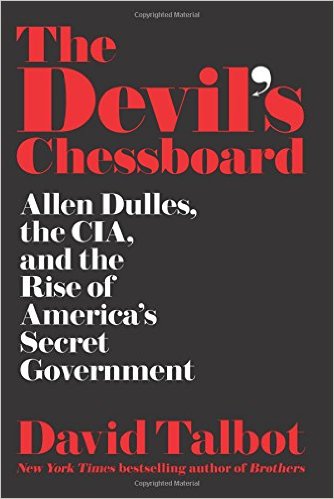
The Dulles and Rockefeller families are cousins. Allen Dulles created the CIA, assisted the Nazis, covered up the Kennedy hit from his Warren Commission perch and struck a deal with the Muslim Brotherhood to create mind-controlled assassins. [21]

Brother John Foster Dulles presided over the phony Goldman Sachs trusts before the 1929 stock market crash and helped his brother overthrow governments in Iran and Guatemala. Both were Skull & Bones, Council on Foreign Relations (CFR) insiders and 33rd Degree Masons. [22]

The Rockefellers were instrumental in forming the depopulation-oriented Club of Rome at their family estate in Bellagio, Italy. Their Pocantico Hills estate gave birth to the Trilateral Commission. The family is a major funder of the eugenics movement which spawned Hitler, human cloning and the current DNA obsession in US scientific circles.

John Rockefeller Jr. headed the Population Council until his death. [23] His namesake son is a Senator from West Virginia. Brother Winthrop Rockefeller was Lieutenant Governor of Arkansas and remains the most powerful man in that state. In an October 1975 interview with Playboy magazine, Vice-President Nelson Rockefeller- who was also Governor of New York- articulated his family’s patronizing worldview, “I am a great believer in planning- economic, social, political, military, total world planning.”

But of all the Rockefeller brothers, it is Trilateral Commission (TC) founder and Chase Manhattan Chairman David who has spearheaded the family’s fascist agenda on a global scale. He defended the Shah of Iran, the South African apartheid regime and the Chilean Pinochet junta. He was the biggest financier of the CFR, the TC and (during the Vietnam War) the Committee for an Effective and Durable Peace in Asia- a contract bonanza for those who made their living off the conflict.

Nixon asked him to be Secretary of Treasury, but Rockefeller declined the job, knowing his power was much greater at the helm of the Chase. Author Gary Allen writes in The Rockefeller File that in 1973, “David Rockefeller met with twenty-seven heads of state, including the rulers of Russia and Red China.”

Following the 1975 Nugan Hand Bank/CIA coup against Australian Prime Minister Gough Whitlam, his British Crown-appointed successor Malcolm Fraser sped to the US, where he met with President Gerald Ford after conferring with David Rockefeller. [24]

Next Week: Part II: Freemasons & The Bank of the United States

Notes

[1] 10K Filings of Fortune 500 Corporations to SEC. 3-91

[2] 10K Filing of US Trust Corporation to SEC. 6-28-95

[3] “The Federal Reserve ‘Fed Up’. Thomas Schauf. www.davidicke.com 1-02

[4] The Secrets of the Federal Reserve. Eustace Mullins. Bankers Research Institute. Staunton, VA. 1983. p.179

[5] Ibid. p.53

[6] The Triumph of Conservatism. Gabriel Kolko. MacMillan and Company New York. 1963. p.142

[7] Rule by Secrecy: The Hidden History that Connects the Trilateral Commission, the Freemasons and the Great Pyramids. Jim Marrs. HarperCollins Publishers. New York. 2000. p.57

[8] The House of Morgan. Ron Chernow. Atlantic Monthly Press NewYork 1990

[9] Marrs. p.57

[10] Democracy for the Few. Michael Parenti. St. Martin’s Press. New York. 1977. p.178

[11] Chernow

[12] The Great Crash of 1929. John Kenneth Galbraith. Houghton, Mifflin Company. Boston. 1979. p.148

[13] Chernow

[14] Children of the Matrix. David Icke. Bridge of Love. Scottsdale, AZ. 2000

[15] The Confidence Game: How Un-Elected Central Bankers are Governing the Changed World Economy. Steven Solomon. Simon & Schuster. New York. 1995. p.112

[16] Marrs. p.180

[17] Ibid. p.45

[18] The Money Lenders: The People and Politics of the World Banking Crisis. Anthony Sampson. Penguin Books. New York. 1981

[19] The Rockefeller File. Gary Allen. ’76 Press. Seal Beach, CA. 1977

[20] Ibid

[21] Dope Inc.: The Book That Drove Kissinger Crazy. Editors of Executive Intelligence Review. Washington, DC. 1992

[22] Marrs.

[23] The Rockefeller Syndrome. Ferdinand Lundberg. Lyle Stuart Inc. Secaucus, NJ. 1975. p.296

[24] Marrs. p.53

Dean Henderson is the author of Big Oil & Their Bankers in the Persian Gulf: Four Horsemen, Eight Families & Their Global Intelligence, Narcotics & Terror Network and The Grateful Unrich: Revolution in 50 Countries. His Left Hook blog is at www.deanhenderson.wordpress.com

Origins of the American Empire: Rockefellers, Rothschilds, Revolution, World Wars and World Order

Why does the West fear Russia, communism, and socialism? 

Russia, then and now, constituted the greatest potential competitive threat to American industrial and financial supremacy.”

“The gigantic Russian market was to be converted into a captive market and a technical colony to be exploited by a few high-powered American financiers and the corporations under their control.”
— Antony Sutton

Global Research, July 28, 2009
28 July 2009
[PDF]
This essay is Part 2 of “Global Power and Global Government.” Part 1, “The Evolution and Revolution of the Central Banking System”  published by Global Research can be viewed here:

Russia, Oil and Revolution

By the 1870s, John D. Rockefeller’s Standard Oil Empire had a virtual monopoly over the United States, and even many foreign countries. In 1890, the King of Holland gave his blessing for the creation of an international oil company called Royal Dutch Oil Company, which was mainly founded to refine and sell kerosene from Indonesia, a Dutch colony. Also in 1890, a British company was founded with the intended purpose of shipping oil, the Shell Transport and Trading Company, and it “began transporting Royal Dutch oil from Sumatra to destinations everywhere,” and eventually, “the two companies merged to become Royal Dutch Shell.”[1]

Russia entered into the Industrial Revolution later than any other large country and empire of its time. By the 1870s, “Russia’s oil fields, including those in Baku, were challenging Standard Oil’s supremacy in Europe. Russia’s ascendancy in natural resources disrupted the strategic balance of power in Europe and troubled Britain.” Britain thus attempted to begin oil explorations in the Middle East, specifically in Persia (Iran), first through Baron Julius de Reuter, the founder of Reuters News Service, who gained exploration rights from the Shah of Iran.[2] Reuter’s attempt at uncovering vast quantities of oil failed, and a man named William Knox D’Arcy took the lead in Persia.

By the middle of the 19th century, “the Rothschilds were the richest family in the world, perhaps in all of history. Their five international banking houses comprised one of the first multinational corporations.” Alfonse de Rothschild was “heavily invested in Russian oil at least forty years before William Knox D’Arcy began tying up Persian oil concessions for the British. Russian oil, which in the 1860s was already emerging as the European rival to the American monopoly Standard Oil, was the Baron [Rothschild]’s pet project.” In the early 1880s, “almost two hundred Rothschild refineries were at work in Baku,” Russia’s oil rich region.[3]

By the mid-1880s, “the Rothschilds were poised to become the chief oil supplier, not only to Europe but to the Far East,” however, “the Baku-Batum railroad was already proving inadequate to transport the volume of oil being produced. Another route was needed, and came in the form of the recently opened Suez Canal, which shortened the journey to the Far East by four thousand miles. Palestine was suddenly of interest to the Rothschilds as it provided access to the Suez.”[4] When the Egyptian government was bankrupt in 1874, British Prime Minister Benjamin Disraeli turned to his close friends, the Rothschilds, “for the colossal cash advance necessary” to buy shares in the Suez Canal Company.[5] By this time, the Rothschilds were already principle shareholders in the Bank of France,[6] and the Bank of England, sitting alongside other notable shareholders such as Baring Brothers, Morgan Grenfell and Lazard Brothers.[7]

The Rothschilds “had long been involved in developing Czarist Russia’s nascent industry and banking system, while that country’s growing network of railroads was largely financed by Rothschild-managed loans.”[8] When the Czar died, he was succeeded by his son, Czar Nicholas II, who instituted anti-Semitic pogroms, discriminating against Jews, which had the effect of stimulating a massive emigration of Jews out of Russia and Eastern Europe and into Western Europe. However, these East European and Russian Jewish émigrés grew up in a newly industrializing nation in which the tyranny of the government and collusion between it and powerful financial and industrial interests left the great majority of people dispossessed and incited more socialist tendencies in thought and action.

The English Rothschilds were very alarmed “when the socialist tendencies of the émigrés contributed to a massively disruptive tailors’ strike in the East End of London in 1888. A young Georgian communist who would become known to the world as Joseph Stalin was already organizing laborers to strike at the Rothschild oil interests in Batum.” The British Rothschilds were very concerned with this wave of Jewish immigrants into Western Europe and Britain, as they were intensely anti-Czarist and progressively socialist, and the Rothschilds were known for their heavy collaboration with the Czarist regimes of Russia. One potential solution considered to the problem of increased socialist-leaning Jewish immigrants in Britain was to institute restrictions on immigration. However, this would likely backlash, in the sense that it would be viewed as comparable to expulsion. So, Edmond Rothschild began his personal campaign to create a Jewish homeland in Palestine in order to create a release valve for Jewish émigrés to put their political action behind a new cause, and to promote them emigrating to Palestine, and out of Western Europe.[9]

On top of this, as the pre-eminent Zionist in Britain, his proposal for the creation of a Jewish homeland in Palestine served major economic interests of the Rothschilds and of the British Empire, in that several years prior, Rothschild bought the Suez Canal for the British, and it was the primary transport route for Russian oil. Palestine, thus, would be a vital landmass as a protectorate for British and Rothschild imperial-economic interests.

The Rothschilds, despite their overtly pro-Zionist and pro-Jewish rhetoric, did not stop their support of the Russian regime and economic activities within anti-Semitic Russia. In 1895, the Rothschilds, then one of the world’s leading producers and distributors of oil, “had gone so far as to co-sign an agreement with rival producers – including America’s Standard Oil [of Rockefeller interests] – to divide up world markets. It never took effect, presumably because of the opposition of the Russian government.” In 1902, the Rothschilds “entered into a partnership with Royal Dutch and Shell (soon to become a single global company) to form the Asiatic Petroleum Company for exploiting the fields of Southern Russia.”[10]

In the early 1900s, the Rothchilds were the primary oil interests in Russia, second in the world only to the Rockefellers. As industrialization was under way, conditions worsened for the great majority of Russian people. This spurred protests and riots, and a “young Stalin himself led the agitation against the Caucasian oil industry in general, [and] the Rothschilds in particular. Mass action by oil workers in Baku [the major oil fields in Russia] in 1903 was the spark that set off the first general strike across the Russian landmass.” Then with the Russian loss in the Russo-Japanese War of 1904, and further protests, came the Revolution of 1905. In the following years, the Rothschilds sold their Russian oil interests to Royal Dutch Shell, gaining significant shares in the international oil company.[11]

The specter of political and social instability within Russia was high and did not go without notice from international banking, oil, and industrial interests. Naturally, the international banking houses were keeping a close eye on developments within Russia. The Rothschilds had to lessen their overt involvement with Russia, as they could not maintain such a relationship with the most anti-Jewish nation in the world at the time, while also claiming to be the primary advocates of Jewish aspirations for a homeland. This is why they sold their Russian oil interests to Royal Dutch Shell, but then gained significant shares in the company itself. So while publicly cutting their ties with Russia, they still held massive interests in its industrial capacity. Following the Russo-Japanese War, the Rothschilds “refused to participate in underwriting a major loan, this at a time when Russia desperately needed funds to stabilize the regime.”[12]

So, in 1906, John D. Rockefeller stepped in to aid Czarist Russia, and offered $200,000,000, or “400,000,000 rubles for a concession for railroads from Tashkend to Tomsk and from Tehita to Polamoshna and a grant of land on both sides of the prospective lines.”[13] These international financiers were still clearly intent upon maintaining their interests within Russia.

However, the Russian governments refusal to allow the deal between the Rockefellers and Rothschilds and other major oil monopolies to divide up the world’s oil reserves, may well have spurred discontent among these powerful interests. If Russia refused to allow them to control all the oil and have a right to all oil, did this mean that Russia was planning on building a domestic oil industry? If this were the case, it could pose a threat to all the entrenched economic and financial interests, particularly those of the Rockefellers and Rothschilds, as Russia’s significant oil reserves and resources would allow it to possibly even surpass the United States in industrialization. Further, Czarist Russia became an increasingly unstable investment environment, controlled by an increasingly unpredictable monarchy.

The 1917 October Revolution “inspired workers’ uprisings in the oil fields against low wages and harsh working conditions. In 1919, Azerbaijan took advantage of the political unrest to declare sovereignty over the Baku fields. That same year SONJ [Standard Oil of New Jersey] made an agreement with the Azerbaijani government to purchase undeveloped land for exploration in the Baku region. Amidst the chaos, foreign oil companies rushed into Russia hoping to collect concessions at reduced rates. The Nobel brothers sold much of their operations to SONJ (today ExxonMobil) to build an alliance in 1920.”[14]

Antony C. Sutton, economist, historian and author, as well as research fellow at Stanford University’s Hoover Institution, wrote in Wall Street and the Bolshevik Revolution, that both fascist and communist systems are “based on naked, unfettered political power and individual coercion. Both systems require monopoly control of society. While monopoly control of industries was once the objective of J.P. Morgan and J.D. Rockefeller, by the late nineteenth century the inner sanctums of Wall Street understood that the most efficient way to gain an unchallenged monopoly was to ‘go political’ and make society go to work for the monopolists,” and that, “the totalitarian socialist state is a perfect captive market for monopoly capitalists, if an alliance can be made with the socialist powerbrokers.”[15] Thus, the major money powers of the west decided to put their money behind the creation of a totalitarian communist state in Russia, in order to create a captive economy, which they could exploit and remove from competition.

When the Revolution began, Trotsky was in New York, and was immediately granted an American passport by President Wilson, and then given a Russian entry permit and a British transit visa, in order to return to Russia and “carry forward” the revolution.[16] Trotsky, while traveling, was arrested in Canada, but was released as a result of British intervention.[17]

Trotsky traveled on board a ship in 1917, leaving New York, along with an interesting cast of fellow passengers, including “other Trotskyite revolutionaries, Wall Street financiers, American Communists, and a man named Charles Crane. Charles Richard Crane, former chairman of the Democratic Party’s finance committee, whose son, Richard Crane, was an assistant to U.S. Secretary of State Robert Lansing, played a significant part in what occurred in Russia. Former U.S. Ambassador to Germany, William Dodd, said that Crane, “did much to bring on the [Alexander] Kerensky revolution which gave way to Communism.” Kerensky was the second Prime Minister in the Russian Provisional Government, which followed the collapse of the Czarist government, and preceded the Bolshevik. Crane also thought that the Kerensky government “is the revolution in its first phase only.”[18]

The Revolution occurred in the midst of World War I, which broke out in 1914, and had all the major European powers at war. Morgan and Rockefeller interests, organized in Wall Street and centralized in the Federal Reserve Bank of New York, the most powerful of all the regional Federal Reserve Banks, used “the Red Cross Mission as its operational vehicle” in Russia at the time of the Bolshevik Revolution. The Red Cross Mission in Russia got its endowment from wealthy people such as J.P. Morgan, Mrs. E. H. Harriman, Cleveland H. Dodge, and Mrs. Russell Sage, and “in World War I the Red Cross depended heavily on Wall Street, and specifically the Morgan firm.” When the American Red Cross set up a mission to Russia, “William Boyce Thompson, director of the Federal Reserve Bank of New York, had ‘offered to pay the entire expense of the commission’.”[19] All expenses were paid for by William Boyce Thompson, who was a major stockholder in Chase National Bank, whose President had Thompson appointed head of the New York Fed.[20]

The Mission was primarily made up of lawyers, financiers, their assistants, people affiliated with Standard Oil and the Rockefeller’s National City Bank.[21] The Mission supported through a loan, the Provisional government of Alexander Kerensky, yet, William B. Thompson of the New York Fed “made a personal contribution of $1,000,000 to the Bolsheviki for the purpose of spreading their doctrine in Germany and Austria.” Interestingly, when the Bolsheviks took control, “The National City Bank branch in Petrograd had been exempted from the Bolshevik nationalization decree – the only foreign or domestic Russian bank to have been so exempted.”[22] Ultimately, the Red Cross mission in Russia “was in fact a mission of Wall Street financiers to influence and pave the way for control, through either Kerensky or the Bolshevik revolutionaries, of the Russian market and resources.”[23]

The American International Corporation (AIC), was “created in 1915 to develop domestic and foreign enterprises, to extend American activities abroad, and to promote the interests of American and foreign bankers, business and engineering.” It was created and controlled by Morgan, Stillman and Rockefeller interests, and its directors were affiliated with National City Bank (Rockefeller), the Carnegie Foundation, General Electric, the DuPont family, New York Life Insurance, American Bankers Association and the Federal Reserve Bank of New York. Members of its board financially supported the Bolsheviks and urged the US State Department to recognize the Bolshevik government.[24]

In 1920, Russian gold was being siphoned through Sweden, where it was melted down and stamped with the Swedish mint, funneled through the Federal Reserve Bank of New York and into Kuhn, Loeb & Company and Guaranty Trust Company (Morgan), two of the primary banking interests behind the creation of the Federal Reserve System. [25] During the civil war in Russia between the Reds and the Whites, while Wall Street financiers were aiding the Bolsheviks quietly, they also began to finance Aleksandr Kolchak (of the Whites) with millions of dollars, in order to ensure that whoever emerged victorious in the war, Wall Street would win.[26]

As Antony Sutton wrote, “Russia, then and now, constituted the greatest potential competitive threat to American industrial and financial supremacy,” and that, “The gigantic Russian market was to be converted into a captive market and a technical colony to be exploited by a few high-powered American financiers and the corporations under their control.”[27]

Eventually, the Bolsheviks emerged victorious, and Wall Street won. Under Stalin’s Five-Year Plans in the early 1930s, Soviet industrialization “required Western technology and expertise,” and in a “frequently overlooked contribution” that came “from abroad,” American firms aided in the industrialization of the USSR, including Ford, General Electric and DuPont,[28] with Standard Oil, General Electric, Austin Co., General Motors, International Harvester, and Caterpillar Tractor trading heavily with the Soviet Union.[29]

Standard Oil bought “gargantuan quantities of Red Oil,” General Electric received a $100,000,000 contract from the Soviet Union to build “the four largest hydroelectric generators in the world,” Austin Co., got a $50,000,000 contract to erect the City of Austingrad, “complete with tractor and automobile factories involving an additional $30,000,000 contract for parts and technical assistance with Ford Motor Corp.” On top of this, “Other [Soviet] business friends are General Motors, DuPont de Nemours, International Harvester, John Deere Co., Caterpillar Tractor, Radio Corp. and the U. S. Shipping Board, which sold the Reds a fleet of 25 cargo steamers.” Banks with close ties to the Russian economy included Chase National, National City Bank and Equitable Trust, all of which are either Rockefeller or Morgan interests.[30]

World War Restructures World Order

Continue reading

Bankers hate peace: all wars are bankers’ wars

“I spent 33 years and four months in active military service and during that period I spent most of my time as a high-class muscle man for Big Business, for Wall Street and the bankers. In short, I was a racketeer, a gangster for capitalism. I helped make Mexico and especially Tampico safe for American oil interests in 1914. I helped make Haiti and Cuba a decent place for the National City Bank boys to collect revenues in. I helped in the raping of half a dozen Central American republics for the benefit of Wall Street. I helped purify Nicaragua for the International Banking House of Brown Brothers in 1902-1912. I brought light to the Dominican Republic for the American sugar interests in 1916. I helped make Honduras right for the American fruit companies in 1903. In China in 1927 I helped see to it that Standard Oil went on its way unmolested. Looking back on it, I might have given Al Capone a few hints. The best he could do was to operate his racket in three districts. I operated on three continents.”
— U.S. Major General Smedley Butler

Global Research, March 26, 2015

As Lee Fang writesThe possibility of an Iran nuclear deal depressing weapons sales was raised by Myles Walton, an analyst from Germany’s Deutsche Bank, during a Lockheed earnings call this past January 27. Walton asked Marillyn Hewson, the chief executive of Lockheed Martin, if an Iran agreement could “impede what you see as progress in foreign military sales.” Financial industry analysts such as Walton use earnings calls as an opportunity to ask publicly-traded corporations like Lockheed about issues that might harm profitability.

Hewson replied that “that really isn’t coming up,” but stressed that “volatility all around the region” should continue to bring in new business. According to Hewson, “A lot of volatility, a lot of instability, a lot of things that are happening” in both the Middle East and the Asia-Pacific region means both are “growth areas” for Lockheed Martin.

The Deutsche Bank-Lockheed exchange “underscores a longstanding truism of the weapons trade: war — or the threat of war — is good for the arms business,” says William Hartung, director of the Arms & Security Project at the Center for International Policy. Hartung observed that Hewson described the normalization of relations with Iran not as a positive development for the future, but as an “impediment.” “And Hewson’s response,” Hartung adds, “which in essence is ‘don’t worry, there’s plenty of instability to go around,’ shows the perverse incentive structure that is at the heart of the international arms market.”

Former managing director of Goldman Sachs – and head of the international analytics group at Bear Stearns in London (Nomi Prins) – notes:

Throughout the century that I examined, which began with the Panic of 1907 … what I found by accessing the archives of each president is that through many events and periods, particular bankers were in constant communication [with the White House] — not just about financial and economic policy, and by extension trade policy, but also about aspects of World War I, or World War II, or the Cold War, in terms of the expansion that America was undergoing as a superpower in the world, politically, buoyed by the financial expansion of the banking community.

***

In the beginning of World War I, Woodrow Wilson had adopted initially a policy of neutrality. But the Morgan Bank, which was the most powerful bank at the time, and which wound up funding over 75 percent of the financing for the allied forces during World War I … pushed Wilson out of neutrality sooner than he might have done, because of their desire to be involved on one side of the war.

Now, on the other side of that war, for example, was the National City Bank, which, though they worked with Morgan in financing the French and the British, they also didn’t have a problem working with financing some things on the German side, as did Chase …

When Eisenhower became president … the U.S. was undergoing this expansion by providing, under his doctrine, military aid and support to countries [under] the so-called threat of being taken over by communism … What bankers did was they opened up hubs, in areas such as Cuba, in areas such as Beirut and Lebanon, where the U.S. also wanted to gain a stronghold in their Cold War fight against the Soviet Union. And so the juxtaposition of finance and foreign policy were very much aligned.

So in the ‘70s, it became less aligned, because though America was pursuing foreign policy initiatives in terms of expansion, the bankers found oil, and they made an extreme effort to activate relationships in the Middle East, that then the U.S. government followed. For example, in Saudi Arabia and so forth, they get access to oil money, and then recycle it into Latin American debt and other forms of lending throughout the globe. So that situation led the U.S. government.

Indeed, JP Morgan also purchased control over America’s leading 25 newspapers in order to propagandize US public opinion in favor of US entry into World War 1.

And many big banks, in fact, funded the Nazis.

BBC reported in 1998:

Barclays Bank has agreed to pay $3.6m to Jews whose assets were seized from French branches of the British-based bank during World War II.

***

Chase Manhattan Bank, which has acknowledged seizing about 100 accounts held by Jews in its Paris branch during World War II ….”Recently unclassified reports from the US Treasury about the activities of Chase in Paris in the 1940s indicate that the local branch worked “in close collaboration with the German authorities” in freezing Jewish assets.

The New York Daily News noted the same year:

The relationship between Chase and the Nazis apparently was so cozy that Carlos Niedermann, the Chase branch chief in Paris, wrote his supervisor in Manhattan that the bank enjoyed “very special esteem” with top German officials and “a rapid expansion of deposits,” according to Newsweek.

Niedermann’s letter was written in May 1942 five months after the Japanese bombed Pearl Harbor and the U.S. also went to war with Germany.

The BBC reported in 1999:

A French government commission, investigating the seizure of Jewish bank accounts during the Second World War, says five American banks Chase Manhattan, J.P Morgan, Guaranty Trust Co. of New York, Bank of the City of New York and American Express had taken part.

It says their Paris branches handed over to the Nazi occupiers about one-hundred such accounts.

One of Britain’s main newspapers – the Guardian – reported in 2004:

George Bush’s grandfather [and George H.W. Bush’s father], the late US senator Prescott Bush, was a director and shareholder of companies that profited from their involvement with the financial backers of Nazi Germany.

The Guardian has obtained confirmation from newly discovered files in the US National Archives that a firm of which Prescott Bush was a director was involved with the financial architects of Nazism.

His business dealings … continued until his company’s assets were seized in 1942 under the Trading with the Enemy Act

***

The documents reveal that the firm he worked for, Brown Brothers Harriman (BBH), acted as a US base for the German industrialist, Fritz Thyssen, who helped finance Hitler in the 1930s before falling out with him at the end of the decade. The Guardian has seen evidence that shows Bush was the director of the New York-based Union Banking Corporation (UBC) that represented Thyssen’s US interests and he continued to work for the bank after America entered the war.

***

Bush was a founding member of the bank [UBC] … The bank was set up by Harriman and Bush’s father-in-law to provide a US bank for the Thyssens, Germany’s most powerful industrial family.

***

By the late 1930s, Brown Brothers Harriman, which claimed to be the world’s largest private investment bank, and UBC had bought and shipped millions of dollars of gold, fuel, steel, coal and US treasury bonds to Germany, both feeding and financing Hitler’s build-up to war.

Between 1931 and 1933 UBC bought more than $8m worth of gold, of which $3m was shipped abroad. According to documents seen by the Guardian, after UBC was set up it transferred $2m to BBH accounts and between 1924 and 1940 the assets of UBC hovered around $3m, dropping to $1m only on a few occasions.

***

UBC was caught red-handed operating a American shell company for the Thyssen family eight months after America had entered the war and that this was the bank that had partly financed Hitler’s rise to power.

Indeed, banks often finance both sides of wars:

And they are one of the main sources of financing for nuclear weapons.

(The San Francisco Chronicle also documents that leading financiers Rockefeller, Carnegie and Harriman also funded Nazi eugenics programs … but that’s a story for another day.)

The Federal Reserve and other central banks also help to start wars by financing them. Thomas Jefferson and the father of free market capitalism, Adam Smith, both noted that the financing wars by banks led to more – and longer – wars.

And America apparently considers economic rivalry to be a basis for war, and is using the military to contain China’s growing economic influence.

Multi-billionaire investor Hugo Salinas Price says:

What happened to [Libya’s] Mr. Gaddafi, many speculate the real reason he was ousted was that he was planning an all-African currency for conducting tradeThe same thing happened to him that happened to Saddam because the US doesn’t want any solid competing currency out there vs the dollar. You know Gaddafi was talking about a gold dinar.

Continue reading

SF Chronicle: Eugenics and the Nazis — the California connection

Hitler and his henchmen victimized an entire continent and exterminated millions in his quest for a so-called Master Race.

But the concept of a white, blond-haired, blue-eyed master Nordic race didn’t originate with Hitler. The idea was created in the United States, and cultivated in California, decades before Hitler came to power. California eugenicists played an important, although little-known, role in the American eugenics movement’s campaign for ethnic cleansing.

Eugenics was the pseudoscience aimed at “improving” the human race. In its extreme, racist form, this meant wiping away all human beings deemed “unfit,” preserving only those who conformed to a Nordic stereotype. Elements of the philosophy were enshrined as national policy by forced sterilization and segregation laws, as well as marriage restrictions, enacted in 27 states. In 1909, California became the third state to adopt such laws. Ultimately, eugenics practitioners coercively sterilized some 60,000 Americans, barred the marriage of thousands, forcibly segregated thousands in “colonies,” and persecuted untold numbers in ways we are just learning. Before World War II, nearly half of coercive sterilizations were done in California, and even after the war, the state accounted for a third of all such surgeries.

California was considered an epicenter of the American eugenics movement. During the 20th century’s first decades, California’s eugenicists included potent but little-known race scientists, such as Army venereal disease specialist Dr. Paul Popenoe, citrus magnate Paul Gosney, Sacramento banker Charles Goethe, as well as members of the California state Board of Charities and Corrections and the University of California Board of Regents.

Eugenics would have been so much bizarre parlor talk had it not been for extensive financing by corporate philanthropies, specifically the Carnegie Institution, the Rockefeller Foundation and the Harriman railroad fortune. They were all in league with some of America’s most respected scientists from such prestigious universities as Stanford, Yale, Harvard and Princeton. These academicians espoused race theory and race science, and then faked and twisted data to serve eugenics’ racist aims.

Stanford President David Starr Jordan originated the notion of “race and blood” in his 1902 racial epistle “Blood of a Nation,” in which the university scholar declared that human qualities and conditions such as talent and poverty were passed through the blood.

In 1904, the Carnegie Institution established a laboratory complex at Cold Spring Harbor on Long Island that stockpiled millions of index cards on ordinary Americans, as researchers carefully plotted the removal of families, bloodlines and whole peoples. From Cold Spring Harbor, eugenics advocates agitated in the legislatures of America, as well as the nation’s social service agencies and associations.

The Harriman railroad fortune paid local charities, such as the New York Bureau of Industries and Immigration, to seek out Jewish, Italian and other immigrants in New York and other crowded cities and subject them to deportation, confinement or forced sterilization.

Continue reading

The takeover of agriculture by Bill Gates, Rockefeller, Monsanto etal; the “doomsday” seed vault, GMOs, and the policies of impoverishment

A chilling historical account of the ongoing takeover of world agriculture and food, and the ultimate destruction of freedom. It names the players. This is an important article to distribute widely.

http://www.globalresearch.ca/doomsday-seed-vault-in-the-arctic-2/23503

Global Research, April 24, 2014
Global Research 4 December 2007

This article was first published in December 2007.

One thing Microsoft founder Bill Gates can’t be accused of is sloth. He was already programming at 14, founded Microsoft at age 20 while still a student at Harvard. By 1995 he had been listed by Forbes as the world’s richest man from being the largest shareholder in his Microsoft, a company which his relentless drive built into a de facto monopoly in software systems for personal computers.

In 2006 when most people in such a situation might think of retiring to a quiet Pacific island, Bill Gates decided to devote his energies to his Bill and Melinda Gates Foundation, the world’s largest ‘transparent’ private foundation as it says, with a whopping $34.6 billion endowment and a legal necessity to spend $1.5 billion a year on charitable projects around the world to maintain its tax free charitable status. A gift from friend and business associate, mega-investor Warren Buffett in 2006, of some $30 billion worth of shares in Buffet’s Berkshire Hathaway put the Gates’ foundation into the league where it spends almost the amount of the entire annual budget of the United Nations’ World Health Organization.

So when Bill Gates decides through the Gates Foundation to invest some $30 million of their hard earned money in a project, it is worth looking at.

No project is more interesting at the moment than a curious project in one of the world’s most remote spots, Svalbard. Bill Gates is investing millions in a seed bank on the Barents Sea near the Arctic Ocean, some 1,100 kilometers from the North Pole. Svalbard is a barren piece of rock claimed by Norway and ceded in 1925 by international treaty (see map).

On this God-forsaken island Bill Gates is investing tens of his millions along with the Rockefeller Foundation, Monsanto Corporation, Syngenta Foundation and the Government of Norway, among others, in what is called the ‘doomsday seed bank.’ Officially the project is named the Svalbard Global Seed Vault on the Norwegian island of Spitsbergen, part of the Svalbard island group.

The seed bank is being built inside a mountain on Spitsbergen Island near the small village of Longyearbyen. It’s almost ready for ‘business’ according to their releases. The bank will have dual blast-proof doors with motion sensors, two airlocks, and walls of steel-reinforced concrete one meter thick. It will contain up to three million different varieties of seeds from the entire world, ‘so that crop diversity can be conserved for the future,’ according to the Norwegian government. Seeds will be specially wrapped to exclude moisture. There will be no full-time staff, but the vault’s relative inaccessibility will facilitate monitoring any possible human activity.

Did we miss something here? Their press release stated, ‘so that crop diversity can be conserved for the future.’ What future do the seed bank’s sponsors foresee, that would threaten the global availability of current seeds, almost all of which are already well protected in designated seed banks around the world?

Anytime Bill Gates, the Rockefeller Foundation, Monsanto and Syngenta get together on a common project, it’s worth digging a bit deeper behind the rocks on Spitsbergen. When we do we find some fascinating things.

The first notable point is who is sponsoring the doomsday seed vault. Here joining the Norwegians are, as noted, the Bill & Melinda Gates Foundation; the US agribusiness giant DuPont/Pioneer Hi-Bred, one of the world’s largest owners of patented genetically-modified (GMO) plant seeds and related agrichemicals; Syngenta, the Swiss-based major GMO seed and agrichemicals company through its Syngenta Foundation; the Rockefeller Foundation, the private group who created the “gene revolution with over $100 million of seed money since the 1970’s; CGIAR, the global network created by the Rockefeller Foundation to promote its ideal of genetic purity through agriculture change.

CGIAR and ‘The Project’

As I detailled in the book, Seeds of Destruction1, in 1960 the Rockefeller Foundation, John D. Rockefeller III’s Agriculture Development Council and the Ford Foundation joined forces to create the International Rice Research Institute (IRRI) in Los Baños, the Philippines. By 1971, the Rockefeller Foundation’s IRRI, along with their Mexico-based International Maize and Wheat Improvement Center and two other Rockefeller and Ford Foundation-created international research centers, the IITA for tropical agriculture, Nigeria, and IRRI for rice, Philippines, combined to form a global Consultative Group on International Agriculture Research (CGIAR).

CGIAR was shaped at a series of private conferences held at the Rockefeller Foundation’s conference center in Bellagio, Italy. Key participants at the Bellagio talks were the Rockefeller Foundation’s George Harrar, Ford Foundation’s Forrest Hill, Robert McNamara of the World Bank and Maurice Strong, the Rockefeller family’s international environmental organizer, who, as a Rockefeller Foundation Trustee, organized the UN Earth Summit in Stockholm in 1972. It was part of the foundation’s decades long focus to turn science to the service of eugenics, a hideous version of racial purity, what has been called The Project.

To ensure maximum impact, CGIAR drew in the United Nations’ Food and Agriculture Organization, the UN Development Program and the World Bank. Thus, through a carefully-planned leverage of its initial funds, the Rockefeller Foundation by the beginning of the 1970’s was in a position to shape global agriculture policy. And shape it did.

Financed by generous Rockefeller and Ford Foundation study grants, CGIAR saw to it that leading Third World agriculture scientists and agronomists were brought to the US to ‘master’ the concepts of modern agribusiness production, in order to carry it back to their homeland. In the process they created an invaluable network of influence for US agribusiness promotion in those countries, most especially promotion of the GMO ‘Gene Revolution’ in developing countries, all in the name of science and efficient, free market agriculture.

Genetically engineering a master race?

Now the Svalbard Seed Bank begins to become interesting. But it gets better. ‘The Project’ I referred to is the project of the Rockefeller Foundation and powerful financial interests since the 1920’s to use eugenics, later renamed genetics, to justify creation of a genetically-engineered Master Race. Hitler and the Nazis called it the Ayran Master Race.

The eugenics of Hitler were financed to a major extent by the same Rockefeller Foundation which today is building a doomsday seed vault to preserve samples of every seed on our planet. Now this is getting really intriguing. The same Rockefeller Foundation created the pseudo-science discipline of molecular biology in their relentless pursuit of reducing human life down to the ‘defining gene sequence’ which, they hoped, could then be modified in order to change human traits at will. Hitler’s eugenics scientists, many of whom were quietly brought to the United States after the War to continue their biological eugenics research, laid much of the groundwork of genetic engineering of various life forms, much of it supported openly until well into the Third Reich by Rockefeller Foundation generous grants.2

The same Rockefeller Foundation created the so-called Green Revolution, out of a trip to Mexico in 1946 by Nelson Rockefeller and former New Deal Secretary of Agriculture and founder of the Pioneer Hi-Bred Seed Company, Henry Wallace.

The Green Revolution purported to solve the world hunger problem to a major degree in Mexico, India and other select countries where Rockefeller worked. Rockefeller Foundation agronomist, Norman Borlaug, won a Nobel Peace Prize for his work, hardly something to boast about with the likes of Henry Kissinger sharing the same.

In reality, as it years later emerged, the Green Revolution was a brilliant Rockefeller family scheme to develop a globalized agribusiness which they then could monopolize just as they had done in the world oil industry beginning a half century before. As Henry Kissinger declared in the 1970’s, ‘If you control the oil you control the country; if you control food, you control the population.’

Agribusiness and the Rockefeller Green Revolution went hand-in-hand. They were part of a grand strategy which included Rockefeller Foundation financing of research for the development of genetic engineering of plants and animals a few years later.

John H. Davis had been Assistant Agriculture Secretary under President Dwight Eisenhower in the early 1950’s. He left Washington in 1955 and went to the Harvard Graduate School of Business, an unusual place for an agriculture expert in those days. He had a clear strategy. In 1956, Davis wrote an article in the Harvard Business Review in which he declared that “the only way to solve the so-called farm problem once and for all, and avoid cumbersome government programs, is to progress from agriculture to agribusiness.” He knew precisely what he had in mind, though few others had a clue back then— a revolution in agriculture production that would concentrate control of the food chain in corporate multinational hands, away from the traditional family farmer. 3

A crucial aspect driving the interest of the Rockefeller Foundation and US agribusiness companies was the fact that the Green Revolution was based on proliferation of new hybrid seeds in developing markets. One vital aspect of hybrid seeds was their lack of reproductive capacity. Hybrids had a built in protection against multiplication. Unlike normal open pollinated species whose seed gave yields similar to its parents, the yield of the seed borne by hybrid plants was significantly lower than that of the first generation.

That declining yield characteristic of hybrids meant farmers must normally buy seed every year in order to obtain high yields. Moreover, the lower yield of the second generation eliminated the trade in seed that was often done by seed producers without the breeder’s authorization. It prevented the redistribution of the commercial crop seed by middlemen. If the large multinational seed

companies were able to control the parental seed lines in house, no competitor or farmer would be able to produce the hybrid. The global concentration of hybrid seed patents into a handful of giant seed companies, led by DuPont’s Pioneer Hi-Bred and Monsanto’s Dekalb laid the ground for the later GMO seed revolution. 4

In effect, the introduction of modern American agricultural technology, chemical fertilizers and commercial hybrid seeds all made local farmers in developing countries, particularly the larger more established ones, dependent on foreign, mostly US agribusiness and petro-chemical company inputs. It was a first step in what was to be a decades-long, carefully planned process.

Under the Green Revolution Agribusiness was making major inroads into markets which were previously of limited access to US exporters. The trend was later dubbed “market-oriented agriculture.” In reality it was agribusiness-controlled agriculture.

Through the Green Revolution, the Rockefeller Foundation and later Ford Foundation worked hand-in-hand shaping and supporting the foreign policy goals of the United States Agency for International Development (USAID) and of the CIA.

One major effect of the Green Revolution was to depopulate the countryside of peasants who were forced to flee into shantytown slums around the cities in desperate search for work. That was no accident; it was part of the plan to create cheap labor pools for forthcoming US multinational manufactures, the ‘globalization’ of recent years.

When the self-promotion around the Green Revolution died down, the results were quite different from what had been promised. Problems had arisen from indiscriminate use of the new chemical pesticides, often with serious health consequences. The mono-culture cultivation of new hybrid seed varieties decreased soil fertility and yields over time. The first results were impressive: double or even triple yields for some crops such as wheat and later corn in Mexico. That soon faded.

The Green Revolution was typically accompanied by large irrigation projects which often included World Bank loans to construct huge new dams, and flood previously settled areas and fertile farmland in the process. Also, super-wheat produced greater yields by saturating the soil with huge amounts of fertilizer per acre, the fertilizer being the product of nitrates and petroleum, commodities controlled by the Rockefeller-dominated Seven Sisters major oil companies.

Huge quantities of herbicides and pesticides were also used, creating additional markets for the oil and chemical giants. As one analyst put it, in effect, the Green Revolution was merely a chemical revolution. At no point could developing nations pay for the huge amounts of chemical fertilizers and pesticides. They would get the credit courtesy of the World Bank and special loans by Chase Bank and other large New York banks, backed by US Government guarantees.

Applied in a large number of developing countries, those loans went mostly to the large landowners. For the smaller peasants the situation worked differently. Small peasant farmers could not afford the chemical and other modern inputs and had to borrow money.

Initially various government programs tried to provide some loans to farmers so that they could purchase seeds and fertilizers. Farmers who could not participate in this kind of program had to borrow from the private sector. Because of the exorbitant interest rates for informal loans, many small farmers did not even get the benefits of the initial higher yields. After harvest, they had to sell most if not all of their produce to pay off loans and interest. They became dependent on money-lenders and traders and often lost their land. Even with soft loans from government agencies, growing subsistence crops gave way to the production of cash crops.5

Since decades the same interests including the Rockefeller Foundation which backed the initial Green Revolution, have worked to promote a second ‘Gene Revolution’ as Rockefeller Foundation President Gordon Conway termed it several years ago, the spread of industrial agriculture and commercial inputs including GMO patented seeds.

Gates, Rockefeller and a Green Revolution in Africa
With the true background of the 1950’s Rockefeller Foundation Green Revolution clear in mind, it becomes especially curious that the same Rockefeller Foundation along with the Gates Foundation which are now investing millions of dollars in preserving every seed against a possible “doomsday” scenario are also investing millions in a project called The Alliance for a Green Revolution in Africa.

AGRA, as it calls itself, is an alliance again with the same Rockefeller Foundation which created the “Gene Revolution.” A look at the AGRA Board of Directors confirms this.

It includes none other than former UN Secretary General Kofi Annan as chairman. In his acceptance speech in a World Economic Forum event in Cape Town South Africa in June 2007, Kofi Annan stated, ‘I accept this challenge with gratitude to the Rockefeller Foundation, the Bill & Melinda Gates Foundation, and all others who support our African campaign.’

In addition the AGRA board numbers a South African, Strive Masiyiwa who is a Trustee of the Rockefeller Foundation. It includes Sylvia M. Mathews of the Bill & Melinda Gates Foundation; Mamphela Ramphele, former Managing Director of the World Bank (2000 – 2006); Rajiv J. Shah of the Gates Foundation; Nadya K. Shmavonian of the Rockefeller Foundation; Roy Steiner of the Gates Foundation. In addition, an Alliance for AGRA includes Gary Toenniessen the Managing Director of the Rockefeller Foundation and Akinwumi Adesina, Associate Director, Rockefeller Foundation.

To fill out the lineup, the Programmes for AGRA includes Peter Matlon, Managing Director, Rockefeller Foundation; Joseph De Vries, Director of the Programme for Africa’s Seed Systems and Associate Director, Rockefeller foundation; Akinwumi Adesina, Associate Director, Rockefeller Foundation. Like the old failed Green Revolution in India and Mexico, the new Africa Green Revolution is clearly a high priority of the Rockefeller Foundation.

While to date they are keeping a low profile, Monsanto and the major GMO agribusiness giants are believed at the heart of using Kofi Annan’s AGRA to spread their patented GMO seeds across Africa under the deceptive label, ‘bio-technology,’ the new euphemism for genetically engineered patented seeds. To date South Africa is the only African country permitting legal planting of GMO crops. In 2003 Burkina Faso authorized GMO trials. In 2005 Kofi Annan’s Ghana drafted bio-safety legislation and key officials expressed their intentions to pursue research into GMO crops.

Africa is the next target in the US-government campaign to spread GMO worldwide. Its rich soils make it an ideal candidate. Not surprisingly many African governments suspect the worst from the GMO sponsors as a multitude of genetic engineering and biosafety projects have been initiated in Africa, with the aim of introducing GMOs into Africa’s agricultural systems. These include sponsorships offered by the US government to train African scientists in genetic engineering in the US, biosafety projects funded by the United States Agency for International Development (USAID) and the World Bank; GMO research involving African indigenous food crops.

The Rockefeller Foundation has been working for years to promote, largely without success, projects to introduce GMOs into the fields of Africa. They have backed research that supports the applicability of GMO cotton in the Makhathini Flats in South Africa.

Monsanto, who has a strong foothold in South Africa’s seed industry, both GMO and hybrid, has conceived of an ingenious smallholders’ programme known as the ‘Seeds of Hope’ Campaign, which is introducing a green revolution package to small scale poor farmers, followed, of course, by Monsanto’s patented GMO seeds. 6

Syngenta AG of Switzerland, one of the ‘Four Horsemen of the GMO Apocalypse’ is pouring millions of dollars into a new greenhouse facility in Nairobi, to develop GMO insect resistant maize. Syngenta is a part of CGIAR as well.7

Move on to Svalbard

Now is it simply philosophical sloppiness? What leads the Gates and Rockefeller foundations to at one and the same time to back proliferation of patented and soon-to-be Terminator patented seeds across Africa, a process which, as it has in every other place on earth, destroys the plant seed varieties as monoculture industrialized agribusiness is introduced? At the same time they invest tens of millions of dollars to preserve every seed variety known in a bomb-proof doomsday vault near the remote Arctic Circle ‘so that crop diversity can be conserved for the future’ to restate their official release?

It is no accident that the Rockefeller and Gates foundations are teaming up to push a GMO-style Green Revolution in Africa at the same time they are quietly financing the ‘doomsday seed vault’ on Svalbard. The GMO agribusiness giants are up to their ears in the Svalbard project.

Indeed, the entire Svalbard enterprise and the people involved call up the worst catastrophe images of the Michael Crichton bestseller, Andromeda Strain, a sci-fi thriller where a deadly disease of extraterrestrial origin causes rapid, fatal clotting of the blood threatening the entire human species. In Svalbard, the future world’s most secure seed repository will be guarded by the policemen of the GMO Green Revolution–the Rockefeller and Gates Foundations, Syngenta, DuPont and CGIAR.

The Svalbard project will be run by an organization called the Global Crop Diversity Trust (GCDT). Who are they to hold such an awesome trust over the planet’s entire seed varieties? The GCDT was founded by the United Nations Food and Agriculture Organisation (FAO) and Bioversity International (formerly the International Plant Genetic Research Institute), an offshoot of the CGIAR.

The Global Crop Diversity Trust is based in Rome. Its Board is chaired by Margaret Catley-Carlson a Canadian also on the advisory board of Group Suez Lyonnaise des Eaux, one of the world’s largest private water companies. Catley-Carlson was also president until 1998 of the New York-based Population Council, John D. Rockefeller’s population reduction organization, set up in 1952 to advance the Rockefeller family’s eugenics program under the cover of promoting “family planning,” birth control devices, sterilization and “population control” in developing countries.

Other GCDT board members include former Bank of America executive presently head of the Hollywood DreamWorks Animation, Lewis Coleman. Coleman is also the lead Board Director of Northrup Grumman Corporation, one of America’s largest military industry Pentagon contractors.

Jorio Dauster (Brazil) is also Board Chairman of Brasil Ecodiesel. He is a former Ambassador of Brazil to the European Union, and Chief Negotiator of Brazil’s foreign debt for the Ministry of Finance. Dauster has also served as President of the Brazilian Coffee Institute and as Coordinator of the Project for the Modernization of Brazil’s Patent System, which involves legalizing patents on seeds which are genetically modified, something until recently forbidden by Brazil’s laws.

Cary Fowler is the Trust’s Executive Director. Fowler was Professor and Director of Research in the Department for International Environment & Development Studies at the Norwegian University of Life Sciences. He was also a Senior Advisor to the Director General of Bioversity International. There he represented the Future Harvest Centres of the Consultative Group on International Agricultural Research (CGIAR) in negotiations on the International Treaty on Plant Genetic Resources. In the 1990s, he headed the International Program on Plant Genetic Resources at the FAO. He drafted and supervised negotiations of FAO’s Global Plan of Action for Plant Genetic Resources, adopted by 150 countries in 1996. He is a past-member of the National Plant Genetic Resources Board of the US and the Board of Trustees of the International Maize and Wheat Improvement Center in Mexico, another Rockefeller Foundation and CGIAR project.

GCDT board member Dr. Mangala Rai of India is the Secretary of India’s Department of Agricultural Research and Education (DARE), and Director General of the Indian Council for Agricultural Research (ICAR). He is also a Board Member of the Rockefeller Foundation’s International Rice Research Institute (IRRI), which promoted the world’s first major GMO experiment, the much-hyped ‘Golden Rice’ which proved a failure. Rai has served as Board Member for CIMMYT (International Maize and Wheat Improvement Center), and a Member of the Executive Council of the CGIAR.

Global Crop Diversity Trust Donors or financial angels include as well, in the words of the Humphrey Bogart Casablanca classic, ‘all the usual suspects.’ As well as the Rockefeller and Gates Foundations, the Donors include GMO giants DuPont-Pioneer Hi-Bred, Syngenta of Basle Switzerland, CGIAR and the State Department’s energetically pro-GMO agency for development aid, USAID. Indeed it seems we have the GMO and population reduction foxes guarding the hen-house of mankind, the global seed diversity store in Svalbard. 8

Why now Svalbard?

We can legitimately ask why Bill Gates and the Rockefeller Foundation along with the major genetic engineering agribusiness giants such as DuPont and Syngenta, along with CGIAR are building the Doomsday Seed Vault in the Arctic.

Who uses such a seed bank in the first place? Plant breeders and researchers are the major users of gene banks. Today’s largest plant breeders are Monsanto, DuPont, Syngenta and Dow Chemical, the global plant-patenting GMO giants. Since early in 2007 Monsanto holds world patent rights together with the United States Government for plant so-called ‘Terminator’ or Genetic Use Restriction Technology (GURT). Terminator is an ominous technology by which a patented commercial seed commits ‘suicide’ after one harvest. Control by private seed companies is total. Such control and power over the food chain has never before in the history of mankind existed.

This clever genetically engineered terminator trait forces farmers to return every year to Monsanto or other GMO seed suppliers to get new seeds for rice, soybeans, corn, wheat whatever major crops they need to feed their population. If broadly introduced around the world, it could within perhaps a decade or so make the world’s majority of food producers new feudal serfs in bondage to three or four giant seed companies such as Monsanto or DuPont or Dow Chemical.

That, of course, could also open the door to have those private companies, perhaps under orders from their host government, Washington, deny seeds to one or another developing country whose politics happened to go against Washington’s. Those who say ‘It can’t happen here’ should look more closely at current global events. The mere existence of that concentration of power in three or four private US-based agribusiness giants is grounds for legally banning all GMO crops even were their harvest gains real, which they manifestly are not.

These private companies, Monsanto, DuPont, Dow Chemical hardly have an unsullied record in terms of stewardship of human life. They developed and proliferated such innovations as dioxin, PCBs, Agent Orange. They covered up for decades clear evidence of carcinogenic and other severe human health consequences of use of the toxic chemicals. They have buried serious scientific reports that the world’s most widespread herbicide, glyphosate, the essential ingredient in Monsanto’s Roundup herbicide that is tied to purchase of most Monsanto genetically engineered seeds, is toxic when it seeps into drinking water.9 Denmark banned glyphosate in 2003 when it confirmed it has contaminated the country’s groundwater.10

The diversity stored in seed gene banks is the raw material for plant breeding and for a great deal of basic biological research. Several hundred thousand samples are distributed annually for such purposes. The UN’s FAO lists some 1400 seed banks around the world, the largest being held by the United States Government. Other large banks are held by China, Russia, Japan, India, South Korea, Germany and Canada in descending order of size. In addition, CGIAR operates a chain of seed banks in select centers around the world.

CGIAR, set up in 1972 by the Rockefeller Foundation and Ford Foundation to spread their Green Revolution agribusiness model, controls most of the private seed banks from the Philippines to Syria to Kenya. In all these present seed banks hold more than six and a half million seed varieties, almost two million of which are ‘distinct.’ Svalbard’s Doomsday Vault will have a capacity to house four and a half million different seeds.

GMO as a weapon of biowarfare?

Now we come to the heart of the danger and the potential for misuse inherent in the Svalbard project of Bill Gates and the Rockefeller foundation. Can the development of patented seeds for most of the world’s major sustenance crops such as rice, corn, wheat, and feed grains such as soybeans ultimately be used in a horrible form of biological warfare?

The explicit aim of the eugenics lobby funded by wealthy elite families such as Rockefeller, Carnegie, Harriman and others since the 1920’s, has embodied what they termed ‘negative eugenics,’ the systematic killing off of undesired bloodlines. Margaret Sanger, a rapid eugenicist, the founder of Planned Parenthood International and an intimate of the Rockefeller family, created something called The Negro Project in 1939, based in Harlem, which as she confided in a letter to a friend, was all about the fact that, as she put it, ‘we want to exterminate the Negro population.’ 11

A small California biotech company, Epicyte, in 2001 announced the development of genetically engineered corn which contained a spermicide which made the semen of men who ate it sterile. At the time Epicyte had a joint venture agreement to spread its technology with DuPont and Syngenta, two of the sponsors of the Svalbard Doomsday Seed Vault. Epicyte was since acquired by a North Carolina biotech company. Astonishing to learn was that Epicyte had developed its spermicidal GMO corn with research funds from the US Department of Agriculture, the same USDA which, despite worldwide opposition, continued to finance the development of Terminator technology, now held by Monsanto.

In the 1990’s the UN’s World Health Organization launched a campaign to vaccinate millions of women in Nicaragua, Mexico and the Philippines between the ages of 15 and 45, allegedly against Tentanus, a sickness arising from such things as stepping on a rusty nail. The vaccine was not given to men or boys, despite the fact they are presumably equally liable to step on rusty nails as women.

Because of that curious anomaly, Comite Pro Vida de Mexico, a Roman Catholic lay organization became suspicious and had vaccine samples tested. The tests revealed that the Tetanus vaccine being spread by the WHO only to women of child-bearing age contained human Chorionic Gonadotrophin or hCG, a natural hormone which when combined with a tetanus toxoid carrier stimulated antibodies rendering a woman incapable of maintaining a pregnancy. None of the women vaccinated were told.

It later came out that the Rockefeller Foundation along with the Rockefeller’s Population Council, the World Bank (home to CGIAR), and the United States’ National Institutes of Health had been involved in a 20-year-long project begun in 1972 to develop the concealed abortion vaccine with a tetanus carrier for WHO. In addition, the Government of Norway, the host to the Svalbard Doomsday Seed Vault, donated $41 million to develop the special abortive Tetanus vaccine. 12

Is it a coincidence that these same organizations, from Norway to the Rockefeller Foundation to the World Bank are also involved in the Svalbard seed bank project? According to Prof. Francis Boyle who drafted the Biological Weapons Anti-Terrorism Act of 1989 enacted by the US Congress, the Pentagon is ‘now gearing up to fight and win biological warfare’ as part of two Bush national strategy directives adopted, he notes, ‘without public knowledge and review’ in 2002. Boyle adds that in 2001-2004 alone the US Federal Government spent $14.5 billion for civilian bio-warfare-related work, a staggering sum.

Rutgers University biologist Richard Ebright estimates that over 300 scientific institutions and some 12,000 individuals in the USA today have access to pathogens suitable for biowarfare. Alone there are 497 US Government NIH grants for research into infectious diseases with biowarfare potential. Of course this is being justified under the rubric of defending against possible terror attack as so much is today.

Many of the US Government dollars spent on biowarfare research involve genetic engineering. MIT biology professor Jonathan King says that the ‘growing bio-terror programs represent a significant emerging danger to our own population.’ King adds, ‘while such programs are always called defensive, with biological weapons, defensive and offensive programs overlap almost completely.’ 13

Time will tell whether, God Forbid, the Svalbard Doomsday Seed Bank of Bill Gates and the Rockefeller Foundation is part of another Final Solution, this involving the extinction of the Late, Great Planet Earth.

Notes

1 F. William Engdahl, Seeds of Destruction, Montreal, (Global Research, 2007).
2 Ibid, pp.72-90.
3 John H. Davis, Harvard Business Review, 1956, cited in Geoffrey Lawrence, Agribusiness, Capitalism and the Countryside, Pluto Press, Sydney, 1987. See also Harvard Business School, The Evolution of an Industry and a Seminar: Agribusiness Seminar, http://www.exed.hbs.edu/programs/agb/seminar.html.
4 Engdahl, op cit., p. 130.
5 Ibid. P. 123-30.
6 Myriam Mayet, The New Green Revolution in Africa: Trojan Horse for GMOs?, May, 2007, African Centre for Biosafety, www.biosafetyafrica.net.
7 ETC Group, Green Revolution 2.0 for Africa?, Communique Issue #94, March/April 2007.
8 Global Crop Diversity Trust website, in http://www.croptrust.org/main/donors.php.
9 Engdahl, op. cit., pp.227-236.
10 Anders Legarth Smith, Denmark Bans Glyphosates, the Active Ingredient in Roundup, Politiken, September 15, 2003, in organic.com.au/news/2003.09.15.
11 Tanya L. Green, The Negro Project: Margaret Sanger’s Genocide Project for Black American’s, in www.blackgenocide.org/negro.html.
12 Engdahl, op. cit., pp. 273-275; J.A. Miller, Are New Vaccines Laced With Birth-Control Drugs?, HLI Reports, Human Life International, Gaithersburg, Maryland; June/July 1995, Volume 13, Number 8.
13 Sherwood Ross, Bush Developing Illegal Bioterror Weapons for Offensive Use,’ December 20, 2006, in www.truthout.org.

The passing of Michael Meacher, British MP, advocate for 9/11 truth. “This War on Terrorism is Bogus”

A statesman dies.
Echoing Ian Henshall below, the full details of Michael Meacher’s death must be made public.
Michael_Meacher_MP
Michael Meacher
Global Research, October 25, 2015
Reinvestigate 9/11 22 October 2015

Michael Meacher, who died yesterday, was in many ways the intellectual powerhouse behind the insurrection that saw Jeremy Corbyn elected leader of the Labour Party this summer.

He was one of the few politicians to attend the Parliamentary debate on money creation, he gave a stirring speech at the protests when UK hosted the secretive Bilderberg Group, and he was the only mainstream politician to raise questions about the 911 attacks, with a 2003 article in the Guardian headed “This War on Terrorism is Bogus”.

His 911 stance led to an aggressive character assassination campaign by the US London Embasssy. Later, when he planned a showing of the 911 sceptic movie Loose Change in the House of Commons it was cancelled at the last moment while Michael said privately that he feared violent repercussions.

In recent weeks he was active again behind the scenes, supporting a 911 family member who is seeking a new inquest. At a private Commons meeting last autumn he seemed in excellent health. He said he did not feel anything like his age and might stand again for Parliament.

News reports have given no details of the cause of Michael’s unexpected death beyond a statement from Peter Dean, his constituency office manager, who said: “We are extremely sad and it has been quite a short illness he has had and we just don’t know the details at present”.

Ian Henshall an organiser of Reinvestigate 911 said: “I hope that, to put to rest any lingering doubts, his aides will take a close look and divulge full details of what happened.

Even more importantly, I hope the Corbyn leadership recognises the urgent need to replace Michael with someone who understands the big issues and is sceptical of the veracity of news reports in the Western media.

CONTACT

Ian Henshall <crisisnewsletter@pro-net.co.uk>

Reinvestigate 9/11 campaign <info@reinvestigate911.org>

Reinvestigate 9/11 email list <reinvestigate911-l-subscribe@reinvestigate911.org>

http://www.911forum.org.uk/board/viewtopic.php?p=171161#171161additional info…

*      *      *

Some of Michael’s comments…

Last twenty tweets from Michael’s deleted twitter account @MichaelMeacher restored

http://www.bilderberg.org/meacher_twitter.html

Michael Meacher MP – on 9/11, The PNAC & Peak Oil

https://www.youtube.com/watch?v=0atrw3640yo

This War on Terrorism is Bogus

Michael Meacher

The 9/11 attacks gave the US an ideal pretext to use force to secure its global domination

Saturday 6 September 2003 12.15

BST Last modified on Friday 3 October 2014 09.56 BST

http://www.theguardian.com/politics/2003/sep/06/september11.iraq

Massive attention has now been given – and rightly so – to the reasons why Britain went to war against Iraq. But far too little attention has focused on why the US went to war, and that throws light on British motives too. The conventional explanation is that after the Twin Towers were hit, retaliation against al-Qaida bases in Afghanistan was a natural first step in launching a global war against terrorism. Then, because Saddam Hussein was alleged by the US and UK governments to retain weapons of mass destruction, the war could be extended to Iraq as well. However this theory does not fit all the facts. The truth may be a great deal murkier.

We now know that a blueprint for the creation of a global Pax Americana was drawn up for Dick Cheney (now vice-president), Donald Rumsfeld (defence secretary), Paul Wolfowitz (Rumsfeld’s deputy), Jeb Bush (George Bush’s younger brother) and Lewis Libby (Cheney’s chief of staff). The document, entitled Rebuilding America’s Defences, was written in September 2000 by the neoconservative think tank, Project for the New American Century (PNAC).

The plan shows Bush’s cabinet intended to take military control of the Gulf region whether or not Saddam Hussein was in power. It says “while the unresolved conflict with Iraq provides the immediate justification, the need for a substantial American force presence in the Gulf transcends the issue of the regime of Saddam Hussein.”

The PNAC blueprint supports an earlier document attributed to Wolfowitz and Libby which said the US must “discourage advanced industrial nations from challenging our leadership or even aspiring to a larger regional or global role”. It refers to key allies such as the UK as “the most effective and efficient means of exercising American global leadership”. It describes peacekeeping missions as “demanding American political leadership rather than that of the UN”. It says “even should Saddam pass from the scene”, US bases in Saudi Arabia and Kuwait will remain permanently… as “Iran may well prove as large a threat to US interests as Iraq has”. It spotlights China for “regime change”, saying “it is time to increase the presence of American forces in SE Asia”.

The document also calls for the creation of “US space forces” to dominate space, and the total control of cyberspace to prevent “enemies” using the internet against the US. It also hints that the US may consider developing biological weapons “that can target specific genotypes [and] may transform biological warfare from the realm of terror to a politically useful tool”.

Finally – written a year before 9/11 – it pinpoints North Korea, Syria and Iran as dangerous regimes, and says their existence justifies the creation of a “worldwide command and control system”. This is a blueprint for US world domination. But before it is dismissed as an agenda for rightwing fantasists, it is clear it provides a much better explanation of what actually happened before, during and after 9/11 than the global war on terrorism thesis. This can be seen in several ways.

First, it is clear the US authorities did little or nothing to pre-empt the events of 9/11. It is known that at least 11 countries provided advance warning to the US of the 9/11 attacks. Two senior Mossad experts were sent to Washington in August 2001 to alert the CIA and FBI to a cell of 200 terrorists said to be preparing a big operation (Daily Telegraph, September 16 2001). The list they provided included the names of four of the 9/11 hijackers, none of whom was arrested.

It had been known as early as 1996 that there were plans to hit Washington targets with aeroplanes. Then in 1999 a US national intelligence council report noted that “al-Qaida suicide bombers could crash-land an aircraft packed with high explosives into the Pentagon, the headquarters of the CIA, or the White House”.

Fifteen of the 9/11 hijackers obtained their visas in Saudi Arabia. Michael Springman, the former head of the American visa bureau in Jeddah, has stated that since 1987 the CIA had been illicitly issuing visas to unqualified applicants from the Middle East and bringing them to the US for training in terrorism for the Afghan war in collaboration with Bin Laden (BBC, November 6 2001). It seems this operation continued after the Afghan war for other purposes. It is also reported that five of the hijackers received training at secure US military installations in the 1990s (Newsweek, September 15 2001).

Instructive leads prior to 9/11 were not followed up. French Moroccan flight student Zacarias Moussaoui (now thought to be the 20th hijacker) was arrested in August 2001 after an instructor reported he showed a suspicious interest in learning how to steer large airliners. When US agents learned from French intelligence he had radical Islamist ties, they sought a warrant to search his computer, which contained clues to the September 11 mission (Times, November 3 2001). But they were turned down by the FBI. One agent wrote, a month before 9/11, that Moussaoui might be planning to crash into the Twin Towers (Newsweek, May 20 2002).

All of this makes it all the more astonishing – on the war on terrorism perspective – that there was such slow reaction on September 11 itself. The first hijacking was suspected at not later than 8.20am, and the last hijacked aircraft crashed in Pennsylvania at 10.06am. Not a single fighter plane was scrambled to investigate from the US Andrews airforce base, just 10 miles from Washington DC, until after the third plane had hit the Pentagon at 9.38 am. Why not? There were standard FAA intercept procedures for hijacked aircraft before 9/11. Between September 2000 and June 2001 the US military launched fighter aircraft on 67 occasions to chase suspicious aircraft (AP, August 13 2002). It is a US legal requirement that once an aircraft has moved significantly off its flight plan, fighter planes are sent up to investigate.

Was this inaction simply the result of key people disregarding, or being ignorant of, the evidence? Or could US air security operations have been deliberately stood down on September 11? If so, why, and on whose authority? The former US federal crimes prosecutor, John Loftus, has said: “The information provided by European intelligence services prior to 9/11 was so extensive that it is no longer possible for either the CIA or FBI to assert a defence of incompetence.”

Nor is the US response after 9/11 any better. No serious attempt has ever been made to catch Bin Laden. In late September and early October 2001, leaders of Pakistan’s two Islamist parties negotiated Bin Laden’s extradition to Pakistan to stand trial for 9/11. However, a US official said, significantly, that “casting our objectives too narrowly” risked “a premature collapse of the international effort if by some lucky chance Mr Bin Laden was captured”. The US chairman of the joint chiefs of staff, General Myers, went so far as to say that “the goal has never been to get Bin Laden” (AP, April 5 2002). The whistleblowing FBI agent Robert Wright told ABC News (December 19 2002) that FBI headquarters wanted no arrests. And in November 2001 the US airforce complained it had had al-Qaida and Taliban leaders in its sights as many as 10 times over the previous six weeks, but had been unable to attack because they did not receive permission quickly enough (Time Magazine, May 13 2002). None of this assembled evidence, all of which comes from sources already in the public domain, is compatible with the idea of a real, determined war on terrorism.

The catalogue of evidence does, however, fall into place when set against the PNAC blueprint. From this it seems that the so-called “war on terrorism” is being used largely as bogus cover for achieving wider US strategic geopolitical objectives. Indeed Tony Blair himself hinted at this when he said to the Commons liaison committee: “To be truthful about it, there was no way we could have got the public consent to have suddenly launched a campaign on Afghanistan but for what happened on September 11″ (Times, July 17 2002). Similarly Rumsfeld was so determined to obtain a rationale for an attack on Iraq that on 10 separate occasions he asked the CIA to find evidence linking Iraq to 9/11; the CIA repeatedly came back empty-handed (Time Magazine, May 13 2002).

In fact, 9/11 offered an extremely convenient pretext to put the PNAC plan into action. The evidence again is quite clear that plans for military action against Afghanistan and Iraq were in hand well before 9/11. A report prepared for the US government from the Baker Institute of Public Policy stated in April 2001 that “the US remains a prisoner of its energy dilemma. Iraq remains a destabilising influence to… the flow of oil to international markets from the Middle East”. Submitted to Vice-President Cheney’s energy task group, the report recommended that because this was an unacceptable risk to the US, “military intervention” was necessary (Sunday Herald, October 6 2002).

Similar evidence exists in regard to Afghanistan. The BBC reported (September 18 2001) that Niaz Niak, a former Pakistan foreign secretary, was told by senior American officials at a meeting in Berlin in mid-July 2001 that “military action against Afghanistan would go ahead by the middle of October”. Until July 2001 the US government saw the Taliban regime as a source of stability in Central Asia that would enable the construction of hydrocarbon pipelines from the oil and gas fields in Turkmenistan, Uzbekistan, Kazakhstan, through Afghanistan and Pakistan, to the Indian Ocean. But, confronted with the Taliban’s refusal to accept US conditions, the US representatives told them “either you accept our offer of a carpet of gold, or we bury you under a carpet of bombs” (Inter Press Service, November 15 2001).

Given this background, it is not surprising that some have seen the US failure to avert the 9/11 attacks as creating an invaluable pretext for attacking Afghanistan in a war that had clearly already been well planned in advance. There is a possible precedent for this. The US national archives reveal that President Roosevelt used exactly this approach in relation to Pearl Harbor on December 7 1941. Some advance warning of the attacks was received, but the information never reached the US fleet. The ensuing national outrage persuaded a reluctant US public to join the second world war. Similarly the PNAC blueprint of September 2000 states that the process of transforming the US into “tomorrow’s dominant force” is likely to be a long one in the absence of “some catastrophic and catalyzing event – like a new Pearl Harbor”. The 9/11 attacks allowed the US to press the “go” button for a strategy in accordance with the PNAC agenda which it would otherwise have been politically impossible to implement.

The overriding motivation for this political smokescreen is that the US and the UK are beginning to run out of secure hydrocarbon energy supplies. By 2010 the Muslim world will control as much as 60% of the world’s oil production and, even more importantly, 95% of remaining global oil export capacity. As demand is increasing, so supply is decreasing, continually since the 1960s.

This is leading to increasing dependence on foreign oil supplies for both the US and the UK. The US, which in 1990 produced domestically 57% of its total energy demand, is predicted to produce only 39% of its needs by 2010. A DTI minister has admitted that the UK could be facing “severe” gas shortages by 2005. The UK government has confirmed that 70% of our electricity will come from gas by 2020, and 90% of that will be imported. In that context it should be noted that Iraq has 110 trillion cubic feet of gas reserves in addition to its oil.

A report from the commission on America’s national interests in July 2000 noted that the most promising new source of world supplies was the Caspian region, and this would relieve US dependence on Saudi Arabia. To diversify supply routes from the Caspian, one pipeline would run westward via Azerbaijan and Georgia to the Turkish port of Ceyhan. Another would extend eastwards through Afghanistan and Pakistan and terminate near the Indian border. This would rescue Enron’s beleaguered power plant at Dabhol on India’s west coast, in which Enron had sunk $3bn investment and whose economic survival was dependent on access to cheap gas.

Nor has the UK been disinterested in this scramble for the remaining world supplies of hydrocarbons, and this may partly explain British participation in US military actions. Lord Browne, chief executive of BP, warned Washington not to carve up Iraq for its own oil companies in the aftermath of war (Guardian, October 30 2002). And when a British foreign minister met Gadaffi in his desert tent in August 2002, it was said that “the UK does not want to lose out to other European nations already jostling for advantage when it comes to potentially lucrative oil contracts” with Libya (BBC Online, August 10 2002).

The conclusion of all this analysis must surely be that the “global war on terrorism” has the hallmarks of a political myth propagated to pave the way for a wholly different agenda – the US goal of world hegemony, built around securing by force command over the oil supplies required to drive the whole project. Is collusion in this myth and junior participation in this project really a proper aspiration for British foreign policy? If there was ever need to justify a more objective British stance, driven by our own independent goals, this whole depressing saga surely provides all the evidence needed for a radical change of course.

Copyright Michael Meacher, The Guardian, 2003

Excerpt from “The Devil’s Chessboard”: CIA plots in France

JFK Assassination Plot Mirrored in 1961 France: Part I

Global Research, October 23, 2015
Who.What.Why. 20 October 2015

First published by WhoWhatWhy

As you watch, perhaps with alarm, as thousands of refugees from Muslim countries make their way through Europe in a seemingly endless parade, you may be wondering if some of them will end up living near you, and how this might affect your life.

If you step back and look at the bigger picture, you will see the situation in reverse: how much the dominating presence of those from the western world has affected the daily lives of people living in Muslim countries.

What the colonial powers have done in Muslim countries is well known. Less well known are the machinations of Allen Dulles and the CIA in one of these colonial powers, France.

Without the knowledge or consent of President John F. Kennedy, Allen Dulles orchestrated the efforts of retired French generals, rightwing French, Nazi sympathizers, and at least one White Russian, to overthrow Charles de Gaulle, who wanted to give Algeria its independence. Dulles et al feared an independent Algeria would go Communist, giving the Soviets a base in Africa.

And there was another reason to hang onto Algeria: its natural resources. According to the US Energy Information Administration, it is “the leading natural gas producer in Africa, the second-largest natural gas supplier to Europe outside of the region, and is among the top three oil producers in Africa.”

We note with great interest that the plot to bring down Charles De Gaulle — the kind of people involved, the role of Allen Dulles, the motive behind it — all bear an eerie similarity to the circumstances surrounding the assassination of John F. Kennedy. But that is another story.

As we have said earlier, Dulles’s job, simply put, was to hijack the US government to benefit the wealthy. And in this fascinating series of excerpts from David Talbot’s new biography on Dulles, we see how his reach extended deeply into the government of France.

WhoWhatWhy Introduction by Milicent Cranor

This is the first of a three-part series of excerpts, from Chapter 15 (“Contempt”) of The Devil’s Chessboard: Allen Dulles, the CIA, and the Rise of the American Secret Government. by David Talbot, HarperCollins Publishers, 2015.

PLOTS, PANIC, AND RUMORS OF CIA INVOLVEMENT

It was Cuba that created the first fracture between Kennedy and his national security chain of command. But while the Bay of Pigs was still dominating the front pages, the CIA mucked its way into another international crisis that required the president’s urgent attention. The Cuba invasion has all but erased this second crisis from history. But the strange events that occurred in Paris in April 1961 reinforced the disturbing feeling that President Kennedy was not in control of his own government.

Paris was in turmoil. At dawn on Saturday morning, April 22, a group of retired French generals had seized power in Algiers to block President Charles de Gaulle from settling the long, bloody war for Algerian independence. Rumors quickly spread that the coup plotters were coming next for de Gaulle himself, and that the skies over Paris would soon be filled with battle-hardened paratroopers and French Foreign Legionnaires from Algeria. Gripped by the dying convulsions of its colonial reign, France braced for a calamitous showdown.

After de Gaulle was elected president in 1958, he sought to purge the French government of its CIA-connected elements. Dulles had made heavy inroads into France’s political, cultural, and intelligence circles in the postwar years.

The threat to French democracy was actually even more immediate than feared. On Saturday evening, two units of paratroopers totaling over two thousand men huddled in the Forest of Orleans and the Forest of Rambouillet, not much more than an hour outside Paris. The rebellious paratroopers were poised for the final command to join up with tank units from Rambouillet and converge on the capital, with the aim of seizing the Élysée Palace and other key government posts.

By Sunday, panic was sweeping through Paris. All air traffic was halted over the area, the Metro was shut down, and cinemas were dark. Only the cafés remained open, where Parisians crowded anxiously to swap the latest gossip.

Continue reading

‘Have you any common sense?’ – Putin confronts BBC journalist’s stupid questions

putinmain
The excerpt below is from a lengthy press conference given by Vladimir Putin on December 18, 2014.

As Russia Insider remarked at the time:

Two questions, Dear Readers:

Is there any Western leader capable of standing up, without Teleprompter, and answering a mass of questions, some softball, some hostile, for several hours?

Given the recent expulsion of Giulietto Chiesa from Estonia for daring to question the Party Line, do “Western values” even permit Western leaders to be asked question like Simpson’s? [1]

This video has been viewed over one million times.

John Simpson, BBC: Western countries almost universally now believe that there’s a new Cold War and that you, frankly, have decided to create that. We see, almost daily, Russian aircraft taking sometimes quite dangerous manoeuvres towards western airspace. That must be done on your orders; you’re the Commander-in-Chief. It must have been your orders that sent Russian troops into the territory of a sovereign country – Crimea first, and then whatever it is that’s going on in Eastern Ukraine. Now you’ve got a big problem with the currency of Russia, and you’re going to need help and support and understanding from outside countries, particularly from the West. So can I say to you, can I ask you now, would you care to take this opportunity to say to people from the West that you have no desire to carry on with the new Cold War, and that you will do whatever you can to sort out the problems in Ukraine? Thank you!

Vladimir Putin: Thank you very much for your question. About our exercises, manoeuvres and the development of our armed forces. You said that Russia, to a certain extent, contributed to the tension that we are now seeing in the world. Russia did contribute but only insofar as it is more and more firmly protecting its national interests. We are not attacking in the political sense of the word. We are not attacking anyone. We are only protecting our interests. Our Western partners – and especially our US partners – are displeased with us for doing exactly that, not because we are allowing security-related activity that provokes tension.

Let me explain. You are talking about our aircraft, including strategic aviation operations. Do you know that in the early 1990s, Russia completely stopped strategic aviation flights in remote surveillance areas as the Soviet Union previously did? We completely stopped, while flights of US strategic aircraft carrying nuclear weapons continued. Why? Against whom? Who was threatened?

So we didn’t make flights for many years and only a couple of years ago we resumed them. So are we really the ones doing the provoking?

So, in fact, we only have two bases outside Russia, and both are in areas where terrorist activity is high. One is in Kyrgyzstan, and was deployed there upon request of the Kyrgyz authorities, President Akayev, after it was raided by Afghan militants. The other is in Tajikistan, which also borders on Afghanistan. I would guess you are interested in peace and stability there too. Our presence is justified and clearly understandable.

Now, US bases are scattered around the globe – and you’re telling me Russia is behaving aggressively? Do you have any common sense at all? What are US armed forces doing in Europe, also with tactical nuclear weapons? What are they doing there?

Listen, Russia has increased its military spending for 2015, if I am not mistaken, it is around 50 billion in dollar equivalent. The Pentagon’s budget is ten times that amount, $575 billion, I think, recently approved by the Congress. And you’re telling me we are pursuing an aggressive policy? Is there any common sense in this?

Are we moving our forces to the borders of the United States or other countries? Who is moving NATO bases and other military infrastructure towards us? We aren’t. Is anyone listening to us? Is anyone engaging in some dialogue with us about it? No. No dialogue at all. All we hear is “that’s none of your business. Every country has the right to choose its way to ensure its own security.” All right, but we have the right to do so too. Why can’t we?

Finally, the ABM system – something I mentioned in my Address to the Federal Assembly. Who was it that withdrew unilaterally from the ABM Treaty, one of the cornerstones of the global security system? Was it Russia? No, it wasn’t. The United States did this, unilaterally. They are creating threats for us, they are deploying their strategic missile defence components not just in Alaska, but in Europe as well – in Romania and Poland, very close to us. And you’re telling me we are pursuing an aggressive policy?

If the question is whether we want law-based relations, the answer is yes, but only if our national economic and security interests are absolutely respected.

We negotiated WTO accession for 19 years or so, and consented to compromise on many issues, assuming that we are concluding cast-iron agreements. And then… I will not discuss who’s right and who’s wrong (I already said on many occasions that I believe Russia behaved the right way in the Ukrainian crisis, and the West was wrong, but let us put this aside for now). Still, we joined the WTO. That organisation has rules. And yet, sanctions were imposed on Russia in violation of the WTO rules, the international law and the UN Charter – again unilaterally and illegitimately. Are we in the wrong again?

We want to develop normal relations in the security sphere, in fighting terrorism. We will work together on nuclear non-proliferation. We will work together on other threats, including drugs, organised crime and grave infections, such as Ebola. We will do all this jointly, and we will cooperate in the economic sphere, if our partners want this.

The transcript and video of the entire press conference are here:

http://en.kremlin.ru/events/president/news/47250

[1] http://russia-insider.com/en/2014/12/19/2048

Turkish whistleblowers corroborate story on false-flag sarin attack in Syria

Such bravery by these whistleblowers. 
Global Research, October 23, 2015
Counter Punch 23 October 2015

Recep Tayyip Erdogan Erdogan

This is quite the bombshell delivered by two CHP deputies in the Turkish parliament and reported by Today’s Zaman, one of the top dailies in Turkey.

It supports Seymour Hersh’s reporting that the notorious sarin gas attack at Ghouta was a false flag orchestrated by Turkish intelligence in order to cross President Obama’s chemical weapons “red line” and draw the United States into the Syria war to topple Assad.

If so, President Obama deserves credit for “holding the line” against the attack despite the grumbling and incitement of the Syria hawks at home and abroad.

And it also presents the unsavory picture of an al-Qaeda operatives colluding with ISIL in a war crime that killed 1300 civilians.

I find the report credible, taking into full account the fact that the CHP (Erdogan’s center-left Kemalist rivals) and Today’s Zaman (whose editor-in-chief, Bulent Kenes was recently detained on live TV for insulting Erdogan in a tweet) are on the outs with Erdogan.

Considering the furious reaction it can be expected to elicit from Erdogan and the Turkish government, the temerity of CHP and Today’s Zaman in running with this story is a sign of how desperate their struggle against Erdogan has become.  Note that the author is shown only as “Columnist: Today’s Zaman”.

I expect the anti-Erodgan forces hope this will be a game changer in terms of U.S.and European support for Erdogan.

It will be very interesting to see if and how the media in the U.S. covers this story.  In case it doesn’t acquire enough “legs” to make into US media, I attach the full Zaman piece below:

CHP deputies: Gov’t rejects probe into Turkey’s role in Syrian chemical attack

Two deputies from the main opposition Republican People’s Party (CHP) have claimed that the government is against investigating Turkey’s role in sending toxic sarin gas which was used in an attack on civilians in Syria in 2013 and in which over 1,300 Syrians were killed.

CHP deputies Eren Erdem and Ali Şeker held a press conference in İstanbul on Wednesday in which they claimed the investigation into allegations regarding Turkey’s involvement in the procurement of sarin gas which was used in the chemical attack on a civil population and delivered to the terrorist Islamic State in Iraq and the Levant (ISIL) to enable the attack was derailed.

Taking the floor first, Erdem stated that the Adana Chief Prosecutor’s Office launched an investigation into allegations that sarin was sent to Syria from Turkey via several businessmen. An indictment followed regarding the accusations targeting the government.

“The MKE [Turkish Mechanical and Chemical Industry Corporation] is also an actor that is mentioned in the investigation file. Here is the indictment. All the details about how sarin was procured in Turkey and delivered to the terrorists, along with audio recordings, are inside the file,” Erdem said while waving the file.

Erdem also noted that the prosecutor’s office conducted detailed technical surveillance and found that an al-Qaeda militant, Hayyam Kasap, acquired sarin, adding: “Wiretapped phone conversations reveal the process of procuring the gas at specific addresses as well as the process of procuring the rockets that would fire the capsules containing the toxic gas. However, despite such solid evidence there has been no arrest in the case. Thirteen individuals were arrested during the first stage of the investigation but were later released, refuting government claims that it is fighting terrorism,” Erdem noted.

Over 1,300 people were killed in the sarin gas attack in Ghouta and several other neighborhoods near the Syrian capital of Damascus, with the West quickly blaming the regime of Bashar al-Assad and Russia claiming it was a “false flag” operation aimed at making US military intervention in Syria possible.

Suburbs near Damascus were struck by rockets containing the toxic sarin gas in August 2013.

The purpose of the attack was allegedly to provoke a US military operation in Syria which would topple the Assad regime in line with the political agenda of then-Prime Minister Recep Tayyip Erdoğan and his government.

CHP deputy Şeker spoke after Erdem, pointing out that the government misled the public on the issue by asserting that sarin was provided by Russia. The purpose was to create the perception that, according to Şeker, “Assad killed his people with sarin and that requires a US military intervention in Syria.”

He also underlined that all of the files and evidence from the investigation show a war crime was committed within the borders of the Turkish Republic.

“The investigation clearly indicates that those people who smuggled the chemicals required to procure sarin faced no difficulties, proving that Turkish intelligence was aware of their activities. While these people had to be in prison for their illegal acts, not a single person is in jail. Former prime ministers and the interior minister should be held accountable for their negligence in the incident,” Şeker further commented.

Erdem also added that he will launch a criminal complaint against those responsible, including those who issued a verdict of non-prosecution in the case, those who did not prevent the transfer of chemicals and those who first ordered the arrest of the suspects who were later released.

UN Secretary-General Ban Ki-moon announced in late August that an inquiry had been launched into the gas attacks allegedly perpetuated by both Assad’s Syrian regime and rebel groups fighting in Syria since the civil war erupted in 2011.

However, Erdem is not the only figure who has accused Turkey of possible involvement in the gas attack. Pulitzer Prize winner and journalist, Seymour M. Hersh, argued in an article published in 2014 that MİT was involved with extremist Syrian groups fighting against the Assad regime.

In his article, Hersh said Assad was not behind the attack, as claimed by the US and Europe, but that Turkish-Syrian opposition collaboration was trying to provoke a US intervention in Syria in order to bring down the Assad regime.

Peter Lee edits China Matters and writes about Asia for CounterPunch.