Terror attack in Nice: Open letter to President Hollande, the French Republic’s Frankenstein

Global Research, July 16, 2016

President Hollande, after this terrorist attack that has rocked our country, you addressed the nation with emotion and dignity, expressing your compassion for the victims.  We assume you have been well informed as you were able to immediately point the finger of blame at the perpetrators and you called upon France to display unity and solidarity against the “islamist terrorism”. You called upon us to close ranks and to harness all our energies in confronting this terrible threat.

But this entirely legitimate call for national cohesion, when our country is feeling so vulnerable, should not prohibit citizens from questioning your policies. From the day you were elected, you have claimed to be ceaselessly combatting terrorism. But in reality, you appear to be doing exactly the opposite.

Instead of combatting evil you have been focusing your efforts against those who are truly fighting it. You tell us you are fighting terrorism but you never cease your demonization of and campaign against Syria and Bashar al Assad.

You condemned this sovereign state to the horrors of the same criminals who open fire upon our cafes and restaurants, this sovereign state detested by your American-Zionist allies because it refuses to bow down to their diktat. The Jihadist mercenaries were looking for a target and you cynically gave them Damascus.

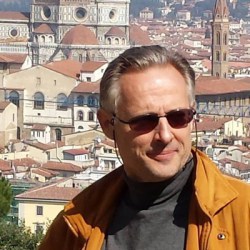
Image right: Prof. Bruno Guigue

Yes, thousands of young people have been brainwashed by your war propaganda and persuaded to take up arms against this despised state that you dream of bombing into oblivion. It is your foreign affairs minister, Laurent Fabius who launched this mission when he declared that Bashar al Assad does not deserve to live and that the Syrian Al Qaeda [Al Nusra Front] were doing a “good job” in Syria.

You can try to conceal your responsibility, but we all can see now how these attacks committed in France are a direct result of your failed foreign policy. Why are there no attacks in Italy, Argentina or Japan? Are the French being collectively punished for your refusal to co-operate with Syrian intelligence to identify the french jihadists and prevent their return to France?

Do our compatriots know that you expressly forbid the transfer of funds to the majority of the Syrian people living in government held areas inside Syria? Do they know that you have never once expressed your sorrow for the multitude of Syrian victims of Al Qaeda atrocities or that you persist in the imposition of sanctions upon these people enduring relentless mass terrorist attacks?

You decided to play a role in the Syrian conflict and you sugar-coated your involvement with humanitarian pretexts which are now collapsing like a house of cards, exuding the acrid stench of hydrocarbons. You have dragged France into a swamp which should have been avoided at all costs and you have exposed your people to a boomerang effect bringing with it, unimaginable devastation. You have brought home the violence that you and your neo-colonialist allies have unleashed.

Do you think the French will thank you especially once they have unraveled the truth of this dramatic event?

Mr Hollande, when the dust has settled on this drama, and the compassion photo-shoot is over, the patriotic unity celebrations finished, are you once more going to award medals to the bankrollers of terror? Overtly condemning terrorism while covertly entertaining its Saudi sponsors. The US has its Frankenstein in George W Bush, the sorcerer’s apprentice of geopolitical chaos. You are his equal – you are France’s own Frankenstein.

By affiliating France with a mafioso, manipulated, sectarian “rebellion”, thinking you were boxing clever while on the ropes, you have fed the monster that is now extending its tentacles into France. You allied yourself with DAESH while they were fighting Assad but condemned them after the first executions of westerners in Iraq. Thus you nourished resentment among these criminals from whom you seemed to expect greater understanding.

You have been advised by pseudo-experts whose intellectual independence is entirely dependent upon how much you pay them, so its impossible for you to extricate yourself from your errors without being overruled. Instead, you continue to throw dust in our eyes with the “State of Emergency” and to “windmill” your little arms. We are nine months away from the elections where, of course,  you will try to manipulate the facts.

Your legacy will be the rotting fruit of your political ineptitude, the manifestation of your incompetence as a minister who confuses Saddam Hussein with Bashar al Assad, an absurdity that does not even raise a smile on this day of universal grief.

Translation by Vanessa Beeley for 21st Century Wire.

The original article can be consulted at arretsurinfo.ch

Bruno Guigue is a French author and political analyst born in Toulouse 1962. Professor of philosophy and lecturer in international relations for highter education. The author of 5 books including  Aux origines du conflit Israélo-Arabe, l’invisible remords de l’Occident (L’Harmattan, 2002).

U.S State Department’s collective madness: Launch military strikes against Syrian army

Global Research, June 18, 2016
Consortium News 18 June 2016

More than 50 U.S. State Department “diplomats” sent a “dissent” memo urging President Obama to launch military strikes against the Syrian army, another sign that Foggy Bottom has collectively gone nuts, writes Robert Parry.

Over the past several decades, the U.S. State Department has deteriorated from a reasonably professional home for diplomacy and realism into a den of armchair warriors possessed of imperial delusions, a dangerous phenomenon underscored by the recent mass “dissent” in favor of blowing up more people in Syria.

Some 51 State Department “diplomats” signed a memo distributed through the official “dissent channel,” seeking military strikes against the Syrian government of Bashar al-Assad whose forces have been leading the pushback against Islamist extremists who are seeking control of this important Mideast nation.

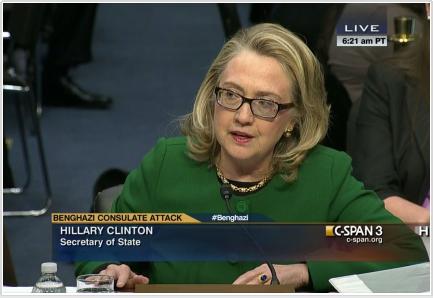
Secretary of State Hillary Clinton testifies before Congress on Jan. 23, 2013, about the fatal attack on the U.S. mission in Benghazi, Libya, on Sept. 11. 2012. (Photo from C-SPAN coverage)

Secretary of State Hillary Clinton testifies before Congress on Jan. 23, 2013, about the fatal attack on the U.S. mission in Benghazi, Libya, on Sept. 11. 2012. (Photo from C-SPAN coverage)

The fact that such a large contingent of State Department officials would openly advocate for an expanded aggressive war in line with the neoconservative agenda, which put Syria on a hit list some two decades ago, reveals how crazy the State Department has become.

The State Department now seems to be a combination of true-believing neocons along with their liberal-interventionist followers and some careerists who realize that the smart play is to behave toward the world as global proconsuls dictating solutions or seeking “regime change” rather than as diplomats engaging foreigners respectfully and seeking genuine compromise.

Even some State Department officials, whom I personally know and who are not neocons/liberal-hawks per se, act as if they have fully swallowed the Kool-Aid. They talk tough and behave arrogantly toward inhabitants of countries under their supervision. Foreigners are treated as mindless objects to be coerced or bribed.

So, it’s not entirely surprising that several dozen U.S. “diplomats” would attack President Barack Obama’s more temperate position on Syria while positioning themselves favorably in anticipation of a Hillary Clinton administration, which is expected to authorize an illegal invasion of Syria — under the guise of establishing “no-fly zones” and “safe zones” — which will mean the slaughter of young Syrian soldiers. The “diplomats” urge the use of “stand-off and air weapons.”

These hawks are so eager for more war that they don’t mind risking a direct conflict with Russia, breezily dismissing the possibility of a clash with the nuclear power by saying they are not “advocating for a slippery slope that ends in a military confrontation with Russia.” That’s reassuring to hear.

Risking a Jihadist Victory

There’s also the danger that a direct U.S. military intervention could collapse the Syrian army and clear the way for victory by Al Qaeda’s Nusra Front or the Islamic State. The memo did not make clear how the delicate calibration of doing just enough damage to Syria’s military while avoiding an outright jihadist victory and averting a clash with Russia would be accomplished.

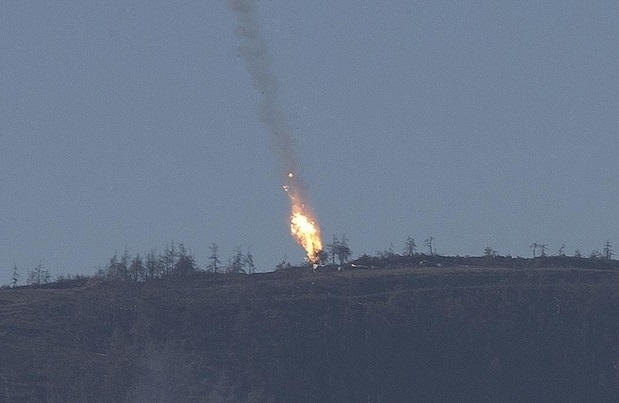
Video of the Russian SU-24 exploding in flames inside Syrian territory after it was shot down by Turkish air-to-air missiles on Nov. 24, 2015.

Video of the Russian SU-24 exploding in flames inside Syrian territory after it was shot down by Turkish air-to-air missiles on Nov. 24, 2015.


Presumably, whatever messes are created, the U.S. military would be left to clean up, assuming that shooting down some Russian warplanes and killing Russian military personnel wouldn’t escalate into a full-scale thermonuclear conflagration.

In short, it appears that the State Department has become a collective insane asylum where the inmates are in control. But this madness isn’t some short-term aberration that can be easily reversed. It has been a long time coming and would require a root-to-branch ripping out of today’s “diplomatic” corps to restore the State Department to its traditional role of avoiding wars rather than demanding them.

Though there have always been crazies in the State Department – usually found in the senior political ranks – the phenomenon of an institutional insanity has only evolved over the past several decades. And I have seen the change.

I have covered U.S. foreign policy since the late 1970s when there was appreciably more sanity in the diplomatic corps. There were people like Robert White and Patricia Derian (both now deceased) who stood up for justice and human rights, representing the best of America.

But the descent of the U.S. State Department into little more than well-dressed, well-spoken but thuggish enforcers of U.S. hegemony began with the Reagan administration. President Ronald Reagan and his team possessed a pathological hatred of Central American social movements seeking freedom from oppressive oligarchies and their brutal security forces.

During the 1980s, American diplomats with integrity were systematically marginalized, hounded or removed. (Human rights coordinator Derian left at the end of the Carter administration and was replaced by neocon Elliott Abrams; White was fired as U.S. ambassador to El Salvador, explaining: “I refused a demand by the secretary of state, Alexander M. Haig Jr., that I use official channels to cover up the Salvadoran military’s responsibility for the murders of four American churchwomen.”)

The Neocons Rise

As the old-guard professionals left, a new breed of aggressive neoconservatives was brought in, the likes of Paul Wolfowitz, Robert McFarlane, Robert Kagan and Abrams. After eight years of Reagan and four years of George H.W. Bush, the State Department was reshaped into a home for neocons, but some pockets of professionalism survived the onslaughts.

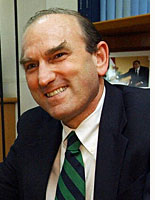
Former Assistant Secretary of State Elliott Abrams, who was a leading neocon inside President George W. Bush's National Security Council.

Former Assistant Secretary of State Elliott Abrams, a leading neocon.

While one might have expected the Democrats of the Clinton administration to reverse those trends, they didn’t. Instead, Bill Clinton’s “triangulation” applied to U.S. foreign policy as much as to domestic programs. He was always searching for that politically safe “middle.”

As the 1990s wore on, the decimation of foreign policy experts in the mold of White and Derian left few on the Democratic side who had the courage or skills to challenge the deeply entrenched neocons. Many Clinton-era Democrats accommodated to the neocon dominance by reinventing themselves as “liberal interventionists,” sharing the neocons’ love for military force but justifying the killing on “humanitarian” grounds.

This approach was a way for “liberals” to protect themselves against right-wing charges that they were “weak,” a charge that had scarred Democrats deeply during the Reagan/Bush-41 years, but this Democratic “tough-guy/gal-ism” further sidelined serious diplomats favoring traditional give-and-take with foreign leaders and their people.

So, you had Democrats like then-U.S. Ambassador to the United Nations (and later Secretary of State) Madeleine Albright justifying Bill Clinton’s brutal sanctions policies toward Iraq, which the U.N. blamed for killing 500,000 Iraqi children, as “a very hard choice, but the price – we think the price is worth it.”

Bill Clinton’s eight years of “triangulation,” which included the brutal air war against Serbia, was followed by eight years of George W. Bush, which further ensconced the neocons as the U.S. foreign policy establishment.

By then, what was left of the old Republican “realists,” the likes of Henry Kissinger and Brent Scowcroft, was aging out or had been so thoroughly compromised that the neocons faced no significant opposition within Republican circles. And, Official Washington’s foreign-policy Democrats had become almost indistinguishable from the neocons, except for their use of “humanitarian” arguments to justify aggressive wars.

Media Capitulation

Before George W. Bush’s invasion of Iraq, much of the “liberal” media establishment – from The New York Times to The New Yorker – fell in line behind the war, asking few tough questions and presenting almost no obstacles. Favoring war had become the “safe” career play.

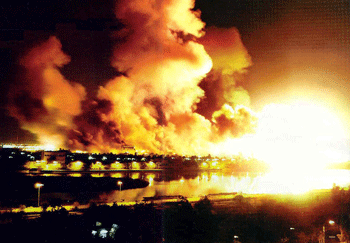
At the start of the U.S. invasion of Iraq in 2003, President George W. Bush ordered the U.S. military to conduct a devastating aerial assault on Baghdad, known as "shock and awe."

At the start of the U.S. invasion of Iraq in 2003, President George W. Bush ordered the U.S. military to conduct a devastating aerial assault on Baghdad, known as “shock and awe.”

At the start of the U.S. invasion of Iraq in 2003, President George W. Bush ordered the U.S. military to conduct a devastating aerial assault on Baghdad, known as “shock and awe.”

But a nascent anti-war movement among rank-and-file Democrats did emerge, propelling Barack Obama, an anti-Iraq War Democrat, to the 2008 presidential nomination over Iraq War supporter Hillary Clinton. But those peaceful sentiments among the Democratic “base” did not reach very deeply into the ranks of Democratic foreign policy mavens.

So, when Obama entered the White House, he faced a difficult challenge. The State Department needed a thorough purging of the neocons and the liberal hawks, but there were few Democratic foreign policy experts who hadn’t sold out to the neocons. An entire generation of Democratic policy-makers had been raised in the world of neocon-dominated conferences, meetings, op-eds and think tanks, where tough talk made you sound good while talk of traditional diplomacy made you sound soft.

By contrast, more of the U.S. military and even the CIA favored less belligerent approaches to the world, in part, because they had actually fought Bush’s hopeless “global war on terror.” But Bush’s hand-picked, neocon-oriented high command – the likes of General David Petraeus – remained in place and favored expanded wars in both Iraq and Afghanistan.

Obama then made one of the most fateful decisions of his presidency. Instead of cleaning house at State and at the Pentagon, he listened to some advisers who came up with the clever P.R. theme “Team of Rivals” – a reference to Abraham Lincoln’s first Civil War cabinet – and Obama kept in place Bush’s military leadership, including Robert Gates as Secretary of Defense, and reached out to hawkish Sen. Hillary Clinton to be his Secretary of State.

In other words, Obama not only didn’t take control of the foreign-policy apparatus, he strengthened the power of the neocons and liberal hawks. He then let this powerful bloc of Clinton-Gates-Petraeus steer him into a foolhardy counterinsurgency “surge” in Afghanistan that did little more than get 1,000 more U.S. soldiers killed along with many more Afghans.

Obama also let Clinton sabotage his attempted outreach to Iran in 2010 seeking constraints on its nuclear program and he succumbed to her pressure in 2011 to invade Libya under the false pretense of establishing a “no-fly zone” to protect civilians, what became a “regime change” disaster that Obama has ranked as his biggest foreign policy mistake.

The Syrian Conflict

Obama did resist Secretary Clinton’s calls for another military intervention in Syria although he authorized some limited military support to the allegedly “moderate” rebels and allowed Saudi Arabia, Qatar and Turkey to do much more in supporting jihadists connected to Al Qaeda and even the Islamic State.

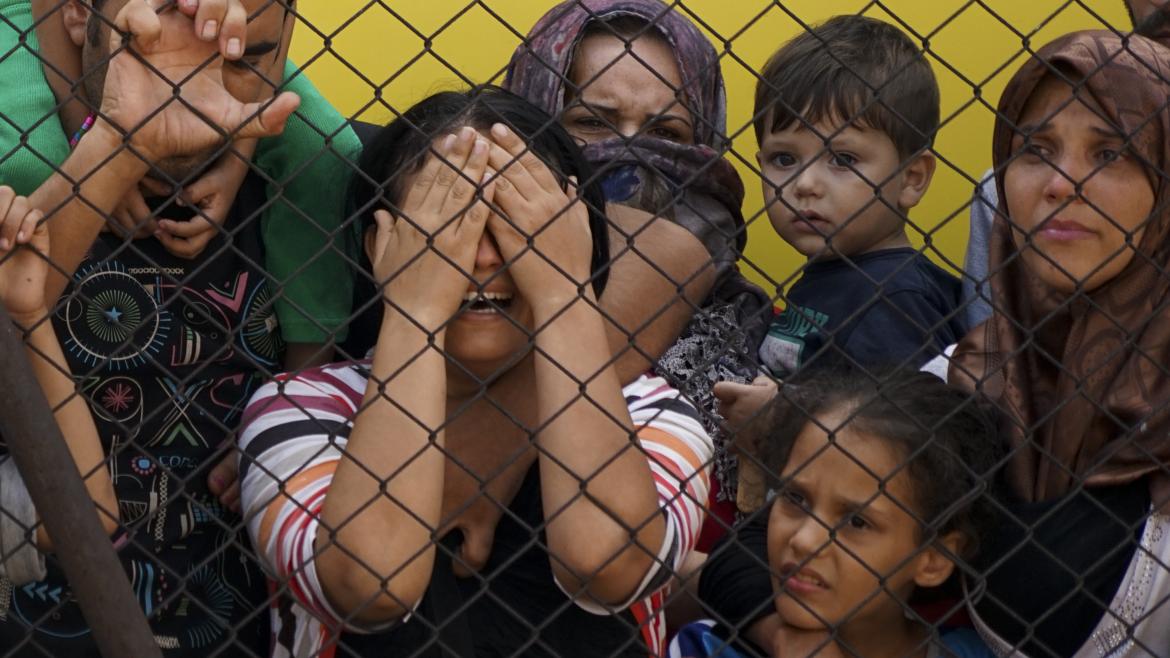
Syrian women and children refugees at Budapest railway station. (Photo from Wikipedia)

Syrian women and children refugees at Budapest railway station. (Photo from Wikipedia)

Under Secretary Clinton, the neocon/liberal-hawk bloc consolidated its control of the State Department diplomatic corps. Under neocon domination, the State Department moved from one “group think” to the next. Having learned nothing from the Iraq War, the conformity continued to apply toward Libya, Syria, Afghanistan, Ukraine, Russia, China, Venezuela, etc.

Everywhere the goal was same: to impose U.S. hegemony, to force the locals to bow to American dictates, to steer them into neo-liberal “free market” solutions which were often equated with “democracy” even if most of the people of the affected countries disagreed.

Double-talk and double-think replaced reality-driven policies. “Strategic communications,” i.e., the aggressive use of propaganda to advance U.S. interests, was one watchword. “Smart power,” i.e., the application of financial sanctions, threats of arrests, limited military strikes and other forms of intimidation, was another.

Every propaganda opportunity, such as the Syrian sarin attack in 2013 or the Malaysia Airlines Flight 17 shoot-down over eastern Ukraine, was exploited to the hilt to throw adversaries on the defensive even if U.S. intelligence analysts doubted that evidence supported the accusations.

Lying at the highest levels of the U.S. government – but especially among the State Department’s senior officials – became epidemic. Perhaps even worse, U.S. “diplomats” seemed to believe their own propaganda.

Meanwhile, the mainstream U.S. news media experienced a similar drift into the gravity pull of neocon dominance and professional careerism, eliminating major news outlets as any kind of check on official falsehoods.

The Up-and-Comers

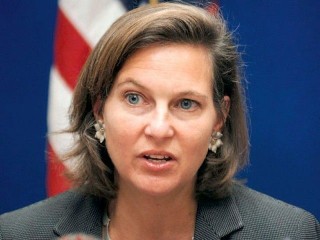
The new State Department star – expected to receive a high-level appointment from President Clinton-45 – is neocon Assistant Secretary of State for European Affairs Victoria Nuland, who orchestrated the 2014 putsch in Ukraine, toppling an elected, Russia-friendly president and replacing him with a hard-line Ukrainian nationalist regime that then launched violent military attacks against ethnic Russians in the east who resisted the coup leadership.

Assistant Secretary of State for European Affairs Victoria Nuland, who pushed for the Ukraine coup and helped pick the post-coup leaders.

Assistant Secretary of State for European Affairs Victoria Nuland, who pushed for the Ukraine coup and helped pick the post-coup leaders.

When Russia came to the assistance of these embattled Ukrainian citizens, including agreeing to Crimea’s request to rejoin Russia, the State Department and U.S. mass media spoke as one in decrying a “Russian invasion” and supporting NATO military maneuvers on Russia’s borders to deter “Russian aggression.”

Anyone who dares question this latest “group think” – as it plunges the world into a dangerous new Cold War – is dismissed as a “Kremlin apologist” or “Moscow stooge” just as skeptics about the Iraq War were derided as “Saddam apologists.” Virtually everyone important in Official Washington marches in lock step toward war and more war. (Victoria Nuland is married to Robert Kagan, making them one of Washington’s supreme power couples.)

So, that is the context of the latest State Department rebellion against Obama’s more tempered policies on Syria. Looking forward to a likely Hillary Clinton administration, these 51 “diplomats” have signed their name to a “dissent” that advocates bombing the Syrian military to protect Syria’s “moderate” rebels who – to the degree they even exist – fight mostly under the umbrella of Al Qaeda’s Nusra Front and its close ally, Ahrar al Sham.

The muddled thinking in this “dissent” is that by bombing the Syrian military, the U.S. government can enhance the power of the rebels and supposedly force Assad to negotiate his own removal. But there is no reason to think that this plan would work.

In early 2014, when the rebels held a relatively strong position, U.S.-arranged peace talks amounted to a rebel-dominated conference that made Assad’s departure a pre-condition and excluded Syria’s Iranian allies from attending. Not surprisingly, Assad’s representative went home and the talks collapsed.

Now, with Assad holding a relatively strong hand, backed by Russian air power and Iranian ground forces, the “dissenting” U.S. diplomats say peace is impossible because the rebels are in no position to compel Assad’s departure. Thus, the “dissenters” recommend that the U.S. expand its role in the war to again lift the rebels, but that would only mean more maximalist demands from the rebels.

Serious Risks

This proposed wider war, however, would carry some very serious risks, including the possibility that the Syrian army could collapse, opening the gates of Damascus to Al Qaeda’s Nusra Front (and its allies) or the Islamic State – a scenario that, as The New York Times noted, the “memo doesn’t address.”

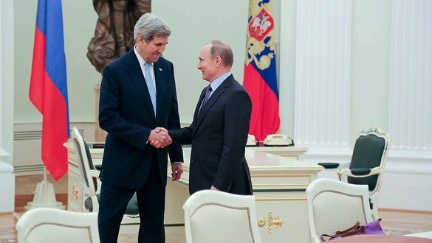
Russian President Vladimir Putin greets Secretary of State John Kerry before meetings at the Kremlin on Dec. 15, 2015. (State Department photo)

Russian President Vladimir Putin greets Secretary of State John Kerry before meetings at the Kremlin on Dec. 15, 2015. (State Department photo)

Currently, the Islamic State and – to a lesser degree – the Nusra Front are in retreat, chased by the Syrian army with Russian air support and by some Kurdish forces with U.S. backing. But those gains could easily be reversed. There is also the risk of sparking a wider war with Iran and/or Russia.

But such cavalier waving aside of grave dangers is nothing new for the neocons and liberal hawks. They have consistently dreamt up schemes that may sound good at a think-tank conference or read well in an op-ed article, but fail in the face of ground truth where usually U.S. soldiers are expected to fix the mess.

We have seen this wishful thinking go awry in Iraq, Afghanistan, Libya, Ukraine and even Syria, where Obama’s acquiescence to provide arms and training for the so-called “unicorns” – the hard-to-detect “moderate” rebels – saw those combatants and their weapons absorbed into Al Qaeda’s or Islamic State’s ranks.

Yet, the neocons and liberal hawks who control the State Department – and are eagerly looking forward to a Hillary Clinton presidency – will never stop coming up with these crazy notions until a concerted effort is made to assess accountability for all the failures that that they have inflicted on U.S. foreign policy.

As long as there is no accountability – as long as the U.S. president won’t rein in these warmongers – the madness will continue and only grow more dangerous.

[For more on this topic, see Consortiumnews.com’s “Democrats Are Now the Aggressive War Party” and “Would a Clinton Win Mean More Wars?’]

Investigative reporter Robert Parry broke many of the Iran-Contra stories for The Associated Press and Newsweek in the 1980s. You can buy his latest book, America’s Stolen Narrative, either in print here or as an e-book (from Amazon andbarnesandnoble.com).

Kerry threatens war-without-end on Syria

From Sputnik

21.05.2016
Finian Cunningham
Alleged peace-maker John Kerry threatened to wage war-without-end on Syria – if the Middle East country does accept the US demand for regime change.

That’s hardly the language of a supposed bona fide diplomat who presents an image to the world as a politician concerned to bring about an end to the five-year Syrian conflict.

The US Secretary of State repeatedly sounds anxious to alleviate the appalling suffering of the Syrian nation, where over the past five years some 400,000 people have been killed and millions displaced as refugees.

Anyone who has not been brainwashed by Western media propaganda knows full well that the suffering of Syria has been caused by Washington and its allies sponsoring a covert war for regime change in that country.

Kerry was speaking during another round of failed negotiations — this time in Vienna — along with other leaders from the 17-nation International Syria Support Group that includes Russia, as well as the United Nations.

The “support group” is a disgustingly erroneous name, given that certain members of this entity — primarily the US, Saudi Arabia and Turkey — have done everything in their power to sponsor a proxy terrorist war on Syria. If the truth were not so abject, it would be laughable.

In a Voice of America report headlined “US still has leverage in Syria,” Kerry is quoted thus: “He said the greatest leverage [on Syria] was the fact that [President] Assad and his backers would never be able to end the war in Syria if they declined to negotiate a political settlement.”

Consider the pernicious import of that for a moment. In other words, America’s top “diplomat” is laying down a criminal ultimatum to the sovereign state of Syria and its elected government of President Bashar al-Assad. Kerry is saying in no uncertain terms that unless the Syrian authorities do not accept Washington’s demand for regime change, then the country is facing never-ending war.

Of course, being a weasel-worded diplomat, Kerry does not use the illegal term “regime change”. He instead talks about “political transition”. And he has set a date in August for this “transition” to take place. But what Kerry’s euphemistic jargon boils down to is this: the Syrian president and his administration must vacate government — or else face more violence and destruction.

This is the political objective that Washington and its allies in NATO, Saudi Arabia and Turkey have wanted all along. They want what is an independent, anti-imperialist Syrian government to give way to some composite regime that would be a puppet for Washington’s geopolitical interests in the oil-rich, strategically vital Middle East region.

Any replacement regime would spurn its erstwhile allies of Russia, Iran and Lebanon’s Hezbollah resistance movement to become an American vassal.

In reality, the supposed pro-democracy change that Washington allegedly wants to install in Syria would be dominated by a repressive, fundamentalist regime that would betray the interests of the Syrian people. We can count on this outcome because the proxies who are waging Washington’s covert war are dominated by extremists fully aligned with their despotic sponsors in Saudi Arabia and Turkey.

Kerry’s apparent confidence in predicting that Syria faces a war of attrition if it does capitulate is a tacit admission by Washington that it controls the illegally armed factions in Syria.

The United States may officially proscribe terror groups like al Qaeda-linked Jabhat al Nusra and the so-called Islamic State (also known as Daesh). The US pays lip service to “defeating terrorism”.

But anyone with an informed understanding of what is really happening in Syria and other countries subjected to US-led regime change knows that Washington has orchestrated these same terror groups for its criminal political objectives.

This is corroborated by the fact that Washington refuses to coordinate its (ineffectual) bombing campaign with Russia to eliminate the terror groups. It is corroborated by the fact that Washington and its allies point-blank refuse Russia’s proposals at the UN Security Council to designate other known terror outfits — Jaysh al-Islam and Ahrar al-Shams — as terrorist.

Jaysh al-Islam and Ahrar al-Shams are every bit as vile and barbaric as the other al Qaeda-affiliated franchises. They all espouse the same twisted death-cult ideology; fight alongside each others (when they are not feuding, that is, over war spoils); and ultimately they all share the same sponsors and American-supplied weaponry.

It is openly admitted that America’s allies Saudi Arabia and Turkey, as well as Qatar, bankroll Jaysh al-Islam and Ahrar al-Shams and that this nexus serves as a conduit for American weapons from the Central Intelligence Agency.

Why else would John Kerry begin his week of “diplomacy” in Vienna by first making an urgent visit to Saudi King Salman last weekend. Kerry was reportedly appealing to the 9/11-sponsoring Saudi regime to support his diplomatic push in Vienna. The Western media “reported” Kerry’s Saudi visit as if it were a benign mission, as they usually do. Whenever it should be obvious that what he was really doing was trying to get the Saudis to ease off on the terror war in Syria.

Washington is currently trying to wrangle regime change in Syria through a political track. That is a world of difference from gullible Western media projections of Kerry’s pretensions of “negotiating peace”.

Yet all the while the US and the Saudis are reserving the right to use “Plan B” if the political track should not materialize in regime change.

That is what Kerry really means when he said in Vienna that “Assad and his backers would never be able to end the war in Syria if they declined to negotiate a political settlement.”

Washington’s “leverage” in Syria is due to the simple, diabolical fact that it and its despotic allies ultimately can turn on and off the violence when it is expedient for their interests. And that violence relies on the deployment of known terrorist organizations, including the ones that Washington’s double-think refuses to recognize as “terrorist”.

So let’s put this into stark perspective. Despite his Orwellian title of diplomat and peace-maker, US Secretary of State John Kerry is the public face of a terrorist enterprise.

What other world power gives itself the right to threaten nations with “regime change or war”? And yet this same nation considers itself a paragon of democracy, human rights and law-abiding probity.

The United States of America is a rogue regime on a criminal scale that exceeds the very worst in history.

As a parting footnote, John Kerry is a decorated American “war hero”. He served four months as a navy officer during the US genocidal war on Vietnam during the late 1960s. Kerry received a bunch of medals for his “actions”, which according to reliable accounts from veterans on his river-boat patrols, involved shooting fleeing Vietnamese peasants in the back.

This is the same Kerry who is now purporting to bring peace to Syria.

Like everything that Washington says, it is full of lies and deception. The abiding lesson: don’t turn your back on Washington and its terrorist-sponsoring, war-mongering “diplomats”.

The views expressed in this article are solely those of the author and do not necessarily reflect the official position of Sputnik.

http://sputniknews.com/columnists/20160521/1040021784/kerry-threatens-war-syria.html

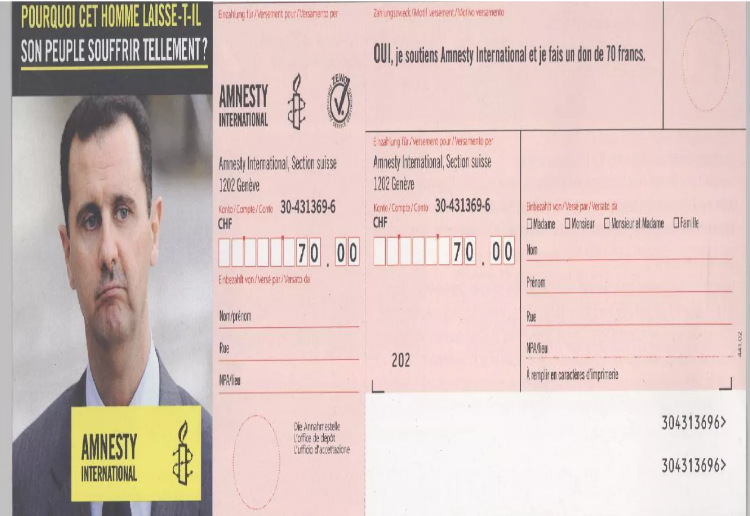
Amnesty International, Swiss section, takes off its mask in a fund-raiser

From Fort Russ

“Why does this man let his people suffer so much? YES I support Amnesty International and I am making a 70 Franc donation. Amnesty International, Swiss section”

Original headline: Syria: NO, I will not support this revolting Amnesty International campaign!

Silvia Cattori, in Arret sur Info, May 23, 2016
Translated from French by Tom Winter

Sent in May 2016 to every household: We have just received from a Arret sur info reader this flyer calling for donations, distributed in letter boxes by Amnesty International. The flyer leaves no doubt about the outrageous political bias adopted by the NGO from the beginning of the war in Syria.

We denounce this misleading campaign that comes at the detriment of the Syrian people. The Syrian state is the only secular state in the region, and Amnesty is combatting it, seeking the overthrow of the Assad government. This means imposing on Syrians the destruction of their state, and bringing armed groups, who want to establish an Islamic state, to power, the groups supported by obscurantist regimes like Saudi Arabia, Qatar, and Kuwait.

http://www.fort-russ.com/2016/05/amnesty-internationalswiss-section.html

America’s outrageous ultimatum to Syria and Assad, and de facto demand for Syria to surrender to al Qaeda

Global Research, May 07, 2016
Syria as the Libya of the Levant

How the United States presumes to possess the authority to determine the fate of a sovereign nation thousands of miles from its own shores in the Middle East is never explained by US Secretary of State John Kerry when he recently announced a new ultimatum leveled at Damascus. Nor is it explained why Syria should capitulate to US demands to begin a political transition that has demonstrably left other nations across the Middle East and North Africa (MENA) divided, destroyed, and safe-havens for state-sponsored terrorism years after “successful” US-backed regime change has been achieved – Libya most notably.

Yet despite all of this, according to the Associate Press (AP) in their article, “Kerry warns Assad to start transition by Aug. 1  or else,” the United States fully expects Damascus to concede to a “political transition” engineered by Washington, leaving the nation in the hands of verified terrorists linked directly to the political and militant forces currently laying waste to Libya and those nations that put them into power.

The article reports:

Secretary of State John Kerry warned Syria’s government and its backers in Moscow and Tehran on Tuesday that they face an August deadline for starting a political transition to move President Bashar Assad out, or they risk the consequences of a new U.S. approach toward ending the 5-year-old civil war.   

AP would also claim:

…it’s unlikely that the Obama administration, so long opposed to an active American combat role in Syria, would significantly boost its presence beyond the 300 special forces it has authorized thus far in the heart of a U.S. presidential election season. More feasible might be U.S. allies like Saudi Arabia giving the rebels new weapons to fight Assad, such as portable surface-to-air missiles.

Again, the US is making demands of “Syria’s government and its backers in Moscow” while it is openly allied with Saudi Arabia who is admittedly backing US State Department-listed foreign terrorist organizations including the Al Nusra Front – quite literally Al Qaeda in Syria and Iraq.

45345444

This point has inconveniently surfaced even across the West’s own media, including the Independent in an article titled, “Turkey and Saudi Arabia alarm the West by backing Islamist extremists the Americans had bombed in Syria.” In it states that:

Turkey and Saudi Arabia are actively supporting a hardline coalition of Islamist rebels against Bashar al-Assad’s regime that includes al-Qaeda’s affiliate in Syria, in a move that has alarmed Western governments. 

The two countries are focusing their backing for the Syrian rebels on the combined Jaish al-Fatah, or the Army of Conquest, a command structure for jihadist groups in Syria that includes Jabhat al-Nusra, an extremist rival to Isis which shares many of its aspirations for a fundamentalist caliphate.

Despite superficial attempts to portray Al Nusra at “arms length” from Saudi Arabia, and thus from Saudi Arabia’s closest and most valuable ally, Washington, the inseparable nature of those the US and Saudi Arabia are supporting and those they claim not to support is documented fact.

America Essentially Demands Syria’s Surrender to Al Qaeda

Considering the verified nature of the so-called “opposition” in Syria and the verifiable nature of what US foreign policy has done to Libya – leaving it to this day in the hands of state-sponsored terrorist organizations including the notorious “Islamic State” or ISIS – what the US is essentially demanding of Syria and its allies is capitulation to Al Qaeda.

It is a surreal full-circle US foreign policy has made, from first creating Al Qaeda in the late 1980’s jointly with Saudi Arabia and elements within the Pakistani government, then claiming to have been struck egregiously by the terrorist organization on September 11, 2001 triggering over a decade of very profitable war, before finally arriving in Libya and Syria beginning in 2011 where once again US politicians found themselves standing shoulder-to-shoulder with literal commanders of Al Qaeda and its affiliates, waging proxies wars against their collective enemies.

Indeed, US Senator John McCain would find himself in a Libya utterly devastated by NATO at the end of 2011, shaking hands with the commander of US State Department-listed foreign terrorist organization, the Libyan Islamic Fighting Group (LIFG) – literally Al Qaeda in Libya. The LIFG commander, Abdelhakim Belhadj, had at one point been arrested by the US before being handed over to the Libyan government and imprisoned for his terrorism.

Syria’s Clear Course of Action

Syria is undoubtedly being overrun by heavily armed and extremely dangerous terrorists backed by foreign powers. These are terrorists that have proven already in Libya, that upon coming to power, they will first carry out genocide against their ethnic and political enemies, then transform Syria into a devastated wasteland and springboard for terrorism and proxy war elsewhere in the region – likely Iran and then southern Russia.Syria’s only clear course of action is to resist and defeat these terrorist factions and restore order within the nation’s boundaries. It must do this by interdicting terrorists and their supplies along the Turkish-Syrian border in the north, and the Jordanian-Syrian border in the south. It is abundantly clear that the terrorists operating within Syria cannot sustain their fighting capacity without significant and constant logistical support from their foreign sponsors beyond Syria’s borders. This fact alone, undermines the legitimacy of the so-called “uprising” and “civil war” in Syria that upon closer examination is clearly a proxy invasion.

The US’s Clear Course of Action

The US itself, in its own military manuals (MCWP 3-35.3) regarding combat operations, states in reference to defeating terrorism that:

In countering this threat, [it should be determined] whether it is internally or externally directed terrorism. Terrorism rooted externally must be severed from its roots. Against internal terrorism, [attempts should be made] to penetrate the infrastructure and destroy the leadership of the terrorist groups.

The US has already boasted of having struck hard at the leadership of various terrorist groups in Syria it claims to be at war with, yet these groups appear unfazed. This is precisely because the terrorism is being direct externally, from Turkey and Jordan where the US itself has based its forces for its ongoing Syrian operations. The clear and obvious course of action for the US is to identify the “roots” of this externally directed terrorism and “sever” them.

However, the US refuses to do this. Instead, even as it continues its feigned war against terrorism in Syria, it is doubling down on support for its proxies, including Turkey, Jordan, and Saudi Arabia, who in turn, are harboring, arming, funding, training, and directly supporting the very terrorist groups the US claims to be fighting.

US Secretary of State John Kerry threatens a “new approach” by the US in Syria, if Syria does not capitulate to what is essentially the end of its existence as a functioning nation-state. The “new approach” is likely simply the continuation of existing plans to incrementally invade and occupy Syrian territory, particularly in the east through the infiltration of Iraq-based Kurds operating under US proxy Masoud Barzani, as well as to trigger a cross-border incident north of Aleppo by using their ISIS proxies to attack Turkish targets – reminisced of staged attacks Ankara had planned earlier during the war to justify the invasion and occupation of northern Syria.

Warning the world of the “success” America’s previous “political transitions” have wrought in Libya or Iraq, and raising awareness of the current nature of US-Saudi support for Al Qaeda and other terrorist groups in Syria today, is essential in undermining the legitimacy and authority upon which the US is attempting to base its demands directed at Damascus. The demands are illegitimate and the authority they are made with constitutes not principles nor rule of law, but naked and unjust aggression that must be resisted today lest it succeed and set a precedent for further acts of injustice against other nations tomorrow.

Tony Cartalucci, Bangkok-based geopolitical researcher and writer, especially for the online magazine New Eastern Outlook”.


Hillary Clinton approved delivering Libya’s sarin gas to Syrian rebels: Seymour Hersh

Global Research, May 01, 2016

he great investigative journalist Seymour Hersh, in two previous articles in the London Review of Books («Whose Sarin?» and «The Red Line and the Rat Line») has reported that the Obama Administration falsely blamed the government of Syria’s Bashar al-Assad for the sarin gas attack that Obama was trying to use as an excuse to invade Syria; and Hersh pointed to a report from British intelligence saying that the sarin that was used didn’t come from Assad’s stockpiles.

Hersh also said that a secret agreement in 2012 was reached between the Obama Administration and the leaders of Turkey, Saudi Arabia, and Qatar, to set up a sarin gas attack and blame it on Assad so that the US could invade and overthrow Assad. «By the terms of the agreement, funding came from Turkey, as well as Saudi Arabia and Qatar; the CIA, with the support of MI6, was responsible for getting arms from Gaddafi’s arsenals into Syria». 

Hersh didn’t say whether these «arms» included the precursor chemicals for making sarin which were stockpiled in Libya, but there have been multiple independent reports that Libya’s Gaddafi possessed such stockpiles, and also that the US Consulate in Benghazi Libya was operating a «rat line» for Gaddafi’s captured weapons into Syria through Turkey. So, Hersh isn’t the only reporter who has been covering this. Indeed, the investigative journalist Christoph Lehmann headlined on 7 October 2013, «Top US and Saudi Officials responsible for Chemical Weapons in Syria» and reported, on the basis of very different sources than Hersh used, that «Evidence leads directly to the White House, the Chairman of the Joint Chiefs of Staff Martin Dempsey, CIA Director John Brennan, Saudi Intelligence Chief Prince Bandar, and Saudi Arabia´s Interior Ministry». 

And, as if that weren’t enough, even the definitive analysis of the evidence that was performed by two leading US analysts, the Lloyd-Postal report, concluded that, «The US Government’s Interpretation of the Technical Intelligence It Gathered Prior to and After the August 21 Attack CANNOT POSSIBLY BE CORRECT». Obama has clearly been lying.

However, now, for the first time, Hersh has implicated Hillary Clinton directly in this «rat line». In an interview with Alternet.org, Hersh was asked about the then-US-Secretary-of-State’s role in the Benghazi Libya US consulate’s operation to collect weapons from Libyan stockpiles and send them through Turkey into Syria for a set-up sarin-gas attack, to be blamed on Assad in order to ‘justify’ the US invading Syria, as the US had invaded Libya to eliminate Gaddafi. Hersh said: «That ambassador who was killed, he was known as a guy, from what I understand, as somebody, who would not get in the way of the CIA. As I wrote, on the day of the mission he was meeting with the CIA base chief and the shipping company. He was certainly involved, aware and witting of everything that was going on. And there’s no way somebody in that sensitive of a position is not talking to the boss, by some channel».

Seymour Hersh Says Hillary Approved Sending Libya’s Sarin to Syrian Rebels

This was, in fact, the Syrian part of the State Department’s Libyan operation, Obama’s operation to set up an excuse for the US doing in Syria what they had already done in Libya.

The interviewer then asked:

«In the book [Hersh’s The Killing of Osama bin Laden, just out] you quote a former intelligence official as saying that the White House rejected 35 target sets [for the planned US invasion of Syria] provided by the Joint Chiefs as being insufficiently painful to the Assad regime. (You note that the original targets included military sites only – nothing by way of civilian infrastructure.) Later the White House proposed a target list that included civilian infrastructure. What would the toll to civilians have been if the White House’s proposed strike had been carried out?»

Hersh responded by saying that the US tradition in that regard has long been to ignore civilian casualties; i.e., collateral damage of US attacks is okay or even desired (so as to terrorize the population into surrender) – not an ‘issue’, except, perhaps, for the PR people.

The interviewer asked why Obama is so obsessed to replace Assad in Syria, since «The power vacuum that would ensue would open Syria up to all kinds of jihadi groups»; and Hersh replied that not only he, but the Joint Chiefs of Staff, «nobody could figure out why». He said, «Our policy has always been against him [Assad]. Period». This has actually been the case not only since the Party that Assad leads, the Ba’ath Party, was the subject of a shelved CIA coup-plot in 1957 to overthrow and replace it; but, actually, the CIA’s first coup had been not just planned but was carried out in 1949 in Syria, overthrowing there a democratically elected leader, in order to enable a pipeline for the Sauds’ oil to become built through Syria into the largest oil market, Europe; and, construction of the pipeline started the following year.

But, there were then a succession of Syrian coups (domestic instead of by foreign powers – 195419631966, and, finally, in 1970), concluding in the accession to power of Hafez al-Assad during the 1970 coup. And, the Sauds’ long-planned Trans-Arabia Pipeline has still not been built. The Saudi royal family, who own the world’s largest oil company, Aramco, don’t want to wait any longer. Obama is the first US President to have seriously tried to carry out their long-desired «regime change» in Syria, so as to enable not only the Sauds’ Trans-Arabian Pipeline to be built, but also to build through Syria the Qatar-Turkey Gas Pipeline that the Thani royal family (friends of the Sauds) who own Qatar want also to be built there. The US is allied with the Saud family (and with their friends, the royal families of Qatar, Kuwait, UAE, Bahrain, and Oman). Russia is allied with the leaders of Syria – as Russia had earlier been allied with Mossadegh in Iran, Arbenz in Guatemala, Allende in Chile, Hussein in Iraq, Gaddafi in Libya, and Yanukovych in Ukraine (all of whom except Syria’s Ba’ath Party, the US has successfully overthrown).

Hersh was wrong to say that «nobody could figure out why» Obama is obsessed with overthrowing Assad and his Ba’ath Party, even if nobody that he spoke with was willing to say why. They have all been hired to do a job, which didn’t change even when the Soviet Union ended and the Warsaw Pact was disbanded; and, anyone who has been at this job for as long as those people have, can pretty well figure out what the job actually is – even if Hersh can’t.

Hersh then said that Obama wanted to fill Syria with foreign jihadists to serve as the necessary ground forces for his planned aerial bombardment there, and, «if you wanted to go there and fight there in 2011-2013, ‘Go, go, go… overthrow Bashar!’ So, they actually pushed a lot of people [jihadists] to go. I don’t think they were paying for them but they certainly gave visas».

However, it’s not actually part of America’s deal with its allies the fundamentalist-Sunni Arabic royal families and the fundamentalist Sunni Erdogan of Turkey, for the US to supply the salaries (to be «paying for them», as Hersh put it there) to those fundamentalist Sunni jihadists – that’s instead the function of the Sauds and of their friends, the other Arab royals, and their friends, to do. (Those are the people who finance the terrorists to perpetrate attacks in the US, Europe, Russia, Afghanistan, Pakistan, India, India, Nigeria, etc. – i.e., anywhere except in their own countries.) And, Erdogan in Turkey mainly gives their jihadists just safe passage into Syria, and he takes part of the proceeds from the jihadists’ sales of stolen Syrian and Iraqi oil. But, they all work together as a team (with the jihadists sometimes killing each other in the process – that’s even part of the plan) – though each national leader has PR problems at home in order to fool his respective public into thinking that they’re against terrorists, and that only the ‘enemy’ is to blame. (Meanwhile, the aristocrats who supply the «salaries» of the jihadists, walk off with all the money.)

This way, US oil and gas companies will refine, and pipeline into Europe, the Sauds’ oil and the Thanis’ gas, and not only will Russia’s major oil-and-gas market become squeezed away by that, but Obama’s economic sanctions against Russia, plus the yet-further isolation of Russia (as well as of China and the rest of the BRICS countries) by excluding them from Obama’s three mega-trade-deals (TTIP, TPP & TISA), will place the US aristocracy firmly in control of the world, to dominate the 21st Century, as it has dominated ever since the end of WW II.

Then, came this question from Hersh: «Why does America do what it does? Why do we not say to the Russians, Let’s work together?» His interviewer immediately seconded that by repeating it, «So why don’t we work closer with Russia? It seems so rational». Hersh replied simply: «I don’t know». He didn’t venture so much as a guess – not even an educated one. But, when journalists who are as knowledgeable as he, don’t present some credible explanation, to challenge the obvious lies (which make no sense that accords with the blatantly contrary evidence those journalists know of against those lies) that come from people such as Barack Obama, aren’t they thereby – though passively – participating in the fraud, instead of contradicting and challenging it? Or, is the underlying assumption, there: The general public is going to be as deeply immersed in the background information here as I am, so that they don’t need me to bring it all together for them into a coherent (and fully documented) whole, which does make sense? Is that the underlying assumption? Because: if it is, it’s false.

Hersh’s journalism is among the best (after all: he went so far as to say, of Christopher Stephens, regarding Hillary Clinton, «there’s no way somebody in that sensitive of a position is not talking to the boss, by some channel»), but it’s certainly not good enough. However, it’s too good to be published any longer in places like the New Yorker. And the reporting by Christof Lehmann was better, and it was issued even earlier than Hersh’s; and it is good enough, because it named names, and it explained motivations, in an honest and forthright way, which is why Lehmann’s piece was published only on a Montenegrin site, and only online, not in a Western print medium, such as the New Yorker. The sites that are owned by members of the Western aristocracy don’t issue reports like that – journalism that’s good enough. They won’t inform the public when a US Secretary of State, and her boss the US President, are the persons actually behind a sarin gas attack they’re blaming on a foreign leader the US aristocrats and their allied foreign aristocrats are determined to topple and replace.

Is this really democracy?

Putin’s progress in Syria sends Kerry scampering to the UN… Washington’s unspoken agenda is to protect ISIS

From Global Research

Global Research, December 24, 2015
Counterpunch 23 December 2015
kerryputin-510x286“It is remarkable that western leaders only remember the term ceasefire when their rebels on the ground are losing. Why didn’t they see the need for peace in Syria before the Russian operation started?” — Iyad Khuder, Damascus-based political analyst

Imagine if the American people elected a president who was much worse than George W. Bush or Barack Obama. A real tyrant. Would that be sufficient justification for someone like Vladimir Putin to arm and train Mexican and Canadian mercenaries to invade America, kill US civilians, destroy cities and critical infrastructure, seize vital oil refineries and pipeline corridors, behead government officials and prisoners they’d captured, declare their own independent state, and do everything in their power to overthrow the elected-government in Washington?

Of course not. The question is ridiculous. It wouldn’t matter if the US president was a tyrant or not, that doesn’t justify an invasion by armed proxies from another country.  And yet, this is precisely the policy that US Secretary of State John Kerry defended at the United Nations on Friday.  Behind all the political blabber about a “roadmap to peace”, Kerry was tacitly defending a policy which has led to the deaths of 250,000 Syrians and the destruction of the country.

And, keep in mind, Kerry didn’t drag his case before the UN Security Council because he’s serious about a negotiated settlement or peace. That’s baloney. What Kerry wants is a resolution that will protect the groups of US-backed jihadis on the ground from the Russian-led offensive. That’s what’s really going on. The Obama administration sees the handwriting on the wall. They know that Russia is going to win the war, so they’ve settled on a plan for protecting their agents in the field. That’s why the emphasis is on a ceasefire; it’s because Kerry wants a  “Timeout” so his Sunni militants can either regroup or retreat.  Just take a look at this short excerpt from the UN’s summary of last Friday’s confab and you’ll see Kerry’s really up-to:

“In its first resolution to focus on the politics of ending Syria’s five-year-long war, the Security Council today gave the United Nations an enhanced role in shepherding the opposing sides to talks for a political transition, with a timetable for a ceasefire, a new constitution and elections, all under UN auspices….

(The Security Council) acknowledged the close linkage between a ceasefire and a parallel political process, with the former to come into effect as soon as the sides have begun initial steps towards a political transition under UN auspices….

The resolution asked Mr. Ban through the offices of his Special Envoy Staffan de Mistura to determine the modalities of a ceasefire and plan to support its implementation, while urging Member States, in particular members of the ISSG, to accelerate all efforts to achieve a ceasefire, including through pressing all relevant parties to adhere to one.

Emphasizing the need for a ceasefire monitoring and verification mechanism, the Council asked Mr. Ban to report back to it on options with a month, and called on Member States to provide “expertise and in-kind contributions” to support such a mechanism…”

(“In first political resolution on war-torn Syria, Security Council gives UN major role in seeking peace”, UN News Centre)

See what I mean: Ceasefire, ceasefire, ceasefire. It’s all about a ceasefire. Kerry wants a ceasefire. Obama wants a ceasefire. A big part of the ruling US establishment want a ceasefire. No, not the neocons, not the liberal interventionists, and not the diehard hawks like Ash Carter at the Pentagon, but a good portion of the ruling elites who’ve been following events on the ground and who know how this thing is going to end. The smart money has already moved on to Plan B, which is why they’re now focused on cutting their losses and saving as many of “their guys” as possible.  Naturally, the people who funded, armed, trained and deployed these various Sunni fighters feel responsible for their safety, so they’re going to do whatever they can to get them out. That’s where Kerry comes in. Kerry’s job was to fly to Moscow, tell Putin that Obama had changed his mind about regime change, and get the Kremlin to back Kerry’s UN resolution. The primary objective of this farce is to garner international support for designating terrorist groups as “moderates” and to move in the direction of UN-mandated ceasefire that will stop the Russian-led offensive in its tracks.

But isn’t that what everyone wants, an end to the hostilities?

Not exactly. A war against terrorists is different than a war between nation-states or a civil war. A group like Jabhat al-Nusra, for example, can’t be treated the same way as armed members of the political opposition. These are religious fanatics determined to use any means possible to achieve their goal of a fascist Islamic Caliphate. Reasoned discourse doesn’t work with people like this,  they have to be killed or captured. And this is exactly what the Russian-led coalition is doing, they’re progressively mopping up the terrorist threat in Syria at great risk to themselves and their fellow-collation members Iran, Hezbollah, and the Syrian Arab Army.  Kerry’s job is to throw a wrench in the anti-terror campaign to impede the coalition’s progress. And he’s willing to lie to do it.  Case in point: Here’s a quote from Kerry in Moscow just last Tuesday:

“As I emphasized today, the United States and our partners are not seeking so-called “regime change,” as it is known in Syria.

Later in the day, Kerry underscored the administration’s dramatic about-face saying: “We are not trying to do a regime change. We are not engaged in a color revolution.  We’re not engaged in trying to interfere in another country … We’re trying to make peace.”

Okay, so the US has given up on regime change?

Not at all. Kerry was just lying through his teeth as usual.  Here’s what he said less than 24 hours later:

“Russia can’t stop the war with Assad there because Assad attracts the foreign fighters. Assad is a magnet for terrorists, because they’re coming to fight Assad.  So if you want to stop the war in Syria, and we do, if you want to fight Daesh and stop the growth of terrorism, you have to deal with the problem of Assad. Now, that doesn’t mean we want to change every aspect of the government; we don’t.”

(‘US not after regime change in Syria, but Assad must go’ – Kerry to Russian TV”, RT)

Got that? So the US doesn’t support regime change, but Assad’s still got to go.

How’s that for hypocrisy? The truth is the Obama administration is just as committed to toppling Assad as ever. Kerry was just misleading Putin to get his approval for his ridiculous resolution at the UN.  As a result, Assad’s name was never mentioned in the resolution which,  Kerry seems to think, is a big victory for the US. But it’s not a victory, in fact, all of Russia’s demands were met in full through the passing of UN Resolution  2254 (three resolutions were passed on Friday) which reiterates all Putin’s demands dating back to the Geneva Communique’ of 2012.  Assad was never mentioned in 2254 either, because naming the president wasn’t necessary to establish the conditions for 1–a transitional government, 2–outlining the terms for a new constitution and  a non-Islamist Syrian state, and 3—free and fair elections to ensure the Syrian people control their own future. In 2012, the US rejected these three provisions saying that the would not agree unless Assad was excluded from participating in the transitional government. Now the US has reversed its position on Assad which means that 100 percent of Moscow’s demands have been met.  UN Resolution  2254 is complete capitulation on the part of the US. It is a humiliating diplomatic defeat which no one in the media is even willing to acknowledge.

So what did Kerry gain by all his globe-trekking and backroom maneuvering?

Nothing. In fact, he gave away the farm by making a number of concessions to gain Russia’s support.

What “concessions” are we talking about?

Here’s a short list:  Kerry met with Putin in Moscow on December 15. On December 16, the IMF ruled in favor of Russia in its $3 billion claim against Ukraine. Here’s the story:

“The executive board of the International Monetary Fund has recognized Ukraine’s $3 billion debt to Russia as official and sovereign – a status Kiev has been attempting to contest.

“In the case of the Eurobond, the Russian authorities have represented that this claim is official. The information available regarding the history of the claim supports this representation,” the IMF said in a statement.” (“IMF recognizes Ukraine’s contested $3bn debt to Russia as sovereign “, RT)

How many strings do you think Washington had to pull to seal that deal?

Also on December 16,  the US announced that it would remove its F-15 fighters stationed in Turkey immediately. Here’s the story:

Twelve U.S. Air Force F-15 fighters sent to Incirlik airbase only last month to guard Turkish airspace and hit ISIS targets in Syria were suddenly flown back Wednesday to their home base in Britain, U.S. European Command announced….

The redeployment of the fighters came amid a flurry of diplomatic and military-to-military activity in the region and with Russia …

A day before the planes left, Secretary of State John Kerry was in Moscow for talks with Russian President Vladimir Putin ahead of United Nations Security Council meetings in New York Friday on Syria and U.S. efforts to ease out President Bashar al-Assad.

(“US Air Force Begins Withdrawing F-15 Fighter Jets From Turkey“, Military.com)

Another coincidence?

Not likely.

Then there’s this:  On December 17, Obama allowed a Russian-backed resolution to pass the UNSC unanimously that that will help uncover secret  financing for ISIS and “strengthen legal measures against those doing business with terrorist groups.” According to RT:

“The resolution is the result of a joint effort by Russia and the US, which are both leading anti-IS campaigns in Syria….The key objective of the new resolution is the “enforcement of a framework to reveal and disrupt illegal financing of IS and groups related to it by means of trade in oil, artifacts, and other illegal sources.”…

The document, which is based on UN Charter Article VII and takes effect immediately, calls for members to “move vigorously and decisively to cut the flow of funds” to IS.”

UN Security Council unanimously adopts resolution targeting ISIS finances

Is that what Obama really wants, to expose the revenue streams for these extremist organizations that are clearly getting support from Washington’s main allies in the Gulf?

Probably not, but Kerry caved-in anyway hoping that his support would help him to nab the elusive ceasefire.

Finally,  on December 18, Obama told Turkish President Erdogan that he wanted him to  remove his troops and tanks from Iraq. Here’s the story:

“US President Barack Obama has called on his Turkish counterpart Recep Tayyip Erdogan to withdraw his country’s troops out of Iraq and respect its integrity. In a telephone call on Friday, Obama “urged President Erdogan to take additional steps to deescalate tensions with Iraq, including by continuing to withdraw Turkish military forces.”

He also “reinforced the need for Turkey to respect the sovereignty and territorial integrity of Iraq,” the White House said.

A 300-strong contingent of Turkish forces backed by 20 to 25 tanks was stationed on the outskirts of the city of Mosul, the capital of Iraq’s Nineveh Province, on December 4.” (“Obama to Erdogan: Withdraw Turkish troops from Iraq“, Press TV)

(Turkey has since promised to remove more troops following Obama’s call.)

In other words, the Turkish occupation began on December 4, but Obama never responded until two days after Kerry talked with Putin in Moscow. Another coincidence?

Maybe or maybe not. In any event the US had to do some serious horse-trading to persuade Putin to take Kerry’s issue to the Security Council. (By the way, Obama knew beforehand that Turkey planned to invade Iraq, in fact, “an important Turkish official  confirmed this claim by saying “all relevant countries” were informed about the deployment of the troops. See here for details.

Like we said earlier: Kerry gave away the farm to slam a deal that isn’t going to have the slightest impact on the outcome of the war.  And that’s what’s so tragic about all this diplomatic tap-dancing, is that it doesn’t really change anything. Syria’s future is going to be decided on the battlefield not at the United Nations and not at the bargaining table. Washington decided that long ago when it elected to use force of arms to try to achieve its geopolitical ambitions.  Now an organized opposition has emerged that is openly challenging US-backed proxies leaving Washington with just two options, fight or retreat.

It had to come to this, didn’t it?   After all, if you push people hard enough, eventually they push back.

Mike Whitney lives in Washington state. He is a contributor to Hopeless: Barack Obama and the Politics of Illusion (AK Press). Hopeless is also available in a Kindle edition. He can be reached at fergiewhitney@msn.com.

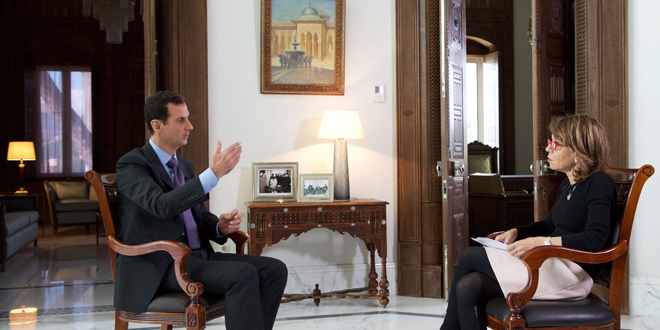
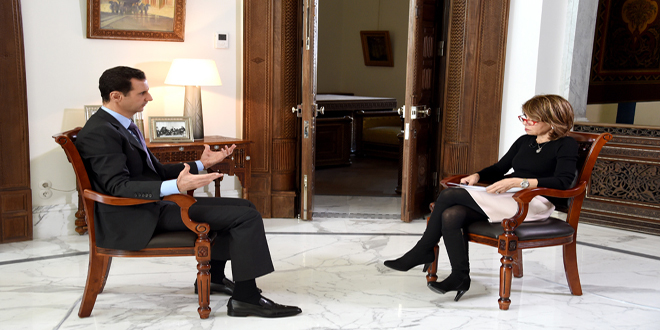
Interview with Syrian President Bashar al-Assad; “Britain and France were the spearheads in supporting the terrorists in Syria”

Global Research, December 06, 2015
SANA News 6 December 2015

Damascus – President Bashar al-Assad gave an interview to The Sunday Times in which he said Britain and France have neither the will nor the vision on how to defeat terrorism and their airstrikes against ISIS will yield no results, but will rather be illegal and harmful in that they will help in spreading terrorism.

The following is the full text of the interview:

 Question 1:  Thank you for seeing us Mr President.  As you know, the British government today will be voting on whether it will join the coalition airstrikes against ISIS. Is Britain right to join airstrikes against ISIS in Syria? And do you welcome its involvement; and will it make things worse or not make a change?

President Assad:  If I want to let’s say, evaluate a book, I cannot take or single out a phrase from that book to evaluate the whole book.  I have to look at the headlines, then the titles of the chapters and then we can discuss the rest of the book.  So, what we are talking about is only an isolated phrase.  If we want to go back to the headline, it is “the will to fight terrorism.”  We know from the very beginning that Britain and France were the spearheads in supporting the terrorists in Syria, from the very beginning of the conflict.  We know that they don’t have that will, even if we want to go back to the chapter on military participation with the coalition, it has to be comprehensive, it has to be from the air, from the ground, to have cooperation with the troops on the ground, the national troops for the interference or participation to be legal.  It is legal only when the participation is in cooperation with the legitimate government in Syria.  So, I would say they don’t have the will and they don’t have the vision on how to defeat terrorism.

And if you want to evaluate, let’s evaluate from the facts.  Let’s go back to the reality on the ground.  Since that coalition started its operation a year or so, what was the result? ISIS and al-Nusra and other like-minded organizations or groups, were expanding, expanding freely.  What was the situation after the Russians participated in fighting terrorism directly?  ISIS and al-Nusra started shrinking.  So I would say, first they will not give any results.  Second, it will be harmful and illegal, and it will support terrorism as what happened after the coalition started its operation a year or so, because this is like a cancer.  You cannot cut the cancer.  You have to extract it.  This kind of operation is like cutting the cancer that will make it spread in the body faster.

Question 2:  Are you saying, just to clarify two things, are you saying that the British, if the British join the intervention, that includes also the other coalition, with that intervention you see that is illegitimate from an international-law perspective?

President Assad:  Definitely, definitely, we are a sovereign country.  Look at the Russians, when they wanted to make this alliance against terrorism, the first thing they did was they started discussions with the Syrian government before anyone else.  Then they started discussing the same issue with other governments.  Then they came.  So, this is the legal way to combat any terrorist around the world.

Britain and France helped in the rise of ISIS and al-Nusra in this region

Question 3:  You say that France and Britain are responsible for the rise of terrorism here. But they were not responsible for the rise of ISIS, for example, is not that a little bit a harsh accusation?

President Assad: Let’s start from what Blair said.  He said that invading Iraq led to the rise of ISIS.  And we know that ISIS started publically, announcing itself as a state in Iraq in 2006, and the leader was Abu Mosaab al-Zerqawi.  He was killed by American strikes; and they announced that they killed him.  So, they know he existed and they know that IS in Iraq at that time had existed; and that it moved to Syria after the beginning of conflict in Syria because of the chaos that happened.  So, they confess.  British officials confessed, mainly Blair; and the reality is telling, that they helped in the rise of ISIS and al-Nusra in this region.

President al-Assad-Sunday Times-interview 3

Question 4:  In your view, does al-Qaida’s branch in Syria, Jabhat al-Nusra, pose an equal or a greater long-term threat to the West than ISIS? And as such, is Britain’s Prime Minister, Cameron, going after the wrong enemy? I.e. he is going after ISIS instead of going after al-Nusra.

President Assad: The whole question is about the structure, and the problem is not about the structure of the organization.  It is about their ideology.  They do not base their actions on the structure, they base them on their dark, Wahhabi deviated ideology.  So, if we want to evaluate these two, the difference between the two, there is no difference because they have the same ideology.  This is one aspect.  The other aspect, if we want to talk about their grassroots, their followers, their members, you cannot have this distinction, because they move from one organization or one group to another.  And that is why sometimes they fight with each other, for their vested interests, on a local and small scale.  But in reality they are cooperating with each other on every level.  So, you cannot tell which is more dangerous because this is one mentality.  It is like if you say the first one is al-Qaida and the second one is al-Qaida.  The difference is the label, and maybe some other trivial things.

Question 5:  Last week, a key part of Cameron’s argument for extending UK airstrikes to Syria was a number that he used – 70 thousand moderate rebels – that he mentioned “don’t belong to extremist groups”, but are already on the ground, who the west can use to help them in the fight of ISIS. As far as you know, which groups are included in the 70 thousand? Are you aware of 70 thousand moderate rebels in Syria?

President Assad: Let me be frank and blunt about this.  This is a new episode in a long series of David Cameron’s classical farce, to be very frank.  This is not acceptable.  Where are they?  Where are the 70 thousand moderates that he is talking about?  That is what they always talk about: moderate groups in Syria.  This is a farce based on offering the public factoids instead of facts.

The Russians have been asking, since the beginning of their participation two months ago.  They have said: where are those moderates?  No one gave them an answer.  Actually, since the beginning of the conflict in Syria, there were no moderate militants in Syria.  All of them were extremists.  And in order not to say I am just giving excuses and so on, go back to the internet, go back to the social networking sites.  They uploaded their atrocities’ videos and pictures, with their faces and their rhetoric.  They use swords, they do beheadings; they ate the heart of a dismembered innocent person and so on.

And you know, the confession of a criminal is the incontrovertible fact.  So, those are the 70 thousand moderates he is taking about.  It is like if we describe the terrorists who committed the attack in Paris recently, and before that in Charlie Hebdo, and before that in the UK nearly ten years ago, and in Spain before that, and the 11th of September in New York, to describe them as moderate opposition.  That is not accepted anywhere in this world; and there is no 70 thousand, there is no 7 thousand, he does not have, maybe now ten of those.

Question 6:  Not even the Kurds and the FSA for example, the free Syrian army?

President Assad: The Kurds are fighting the terrorists with the Syrian army, in the same areas.

Question 7:  But they are also being supported and armed and trained and backed by the Americans to also launch, to fight …

President Assad:  Mainly by the Syrian army, and we have the documents.  We sent them armaments, because they are Syrian citizens, and they want to fight terrorism.  We do the same with many other groups in Syria, because you cannot send the army to every part of Syria.  So, it is not only the Kurds.  Many other Syrians are doing the same.

Question 8: U.S. Secretary of state John Kerry said last Friday that the Syrian government could cooperate with the opposition forces against the ISIS even if president Assad is still in office, but he said that this would be so difficult if the opposition fighters, who have been fighting the Syrian president, don’t have a faith that the Syrian president will eventually leave power.

Kerry also said that concerning the timing of leaving office, the answer is it is not obvious whether he will have to leave.

Meanwhile, the French Foreign Minister Laurent Fabius told Le Progres Newspaper on Saturday that he no longer believes that President Assad’s departure is essential to any political transition in Syria, adding that the political transition does not mean that President Assad should step down before it but there should be future insurances.

My question: Do you intend to complete your presidential term until 2021 or do you expect a referendum or presidential elections prior to that date? And if so, when can these elections be held? And what can make you decide to hold them? And if they are held, is it certain that you will be running for election? What can influence your decision?

President Assad: The answer depends on the context of the question. If it is related to a settlement in Syria, then early elections have nothing to do with ending the conflict. This can only happen by fighting terrorists and ceasing Western and regional support for terrorists…Early elections will only be held as part of a comprehensive dialogue about future by the political powers and the civil society groups in Syria.

Thus, it is not about the will of the President, but rather the will of the Syrian people…It is about a political process. If this process is agreed on, then I have the right to run for elections like any other Syrian citizen…My decision in this case will be based on my ability to deliver on my commitments…and on whether I have the support of the Syrian people or not….Anyway, It is early to talk about this, because as you know, this process was not agreed upon yet.

President al-Assad-Sunday Times-interview 2

Question 9:   Do you think ISIS can be defeated by airstrikes alone?

You cannot defeat ISIS through airstrikes alone without cooperation with forces on the ground

President Assad:  Did the coalition defeat them by airstrikes during the last year or so?  It didn’t.  Did the Americans achieve anything from the airstrikes in Afghanistan?  They achieved nothing.  Did they achieve anything in Iraq since the invasion in 2003?  Nothing.  You cannot defeat ISIS through airstrikes alone, without cooperation with forces on the ground.  You cannot defeat them if you do not have buy-in from the general public and the government.  They cannot defeat ISIS by airstrikes; they are going to fail again.  The reality is telling.

Question 10:     If the international coalition refuses, as it has so far, to coordinate with the Syrian Army, or with the local troops on the ground, what is your next plan?  I mean do you have a plan B beyond what is going on?  How do you plan to end this war?

President Assad:  This coalition is illusive, it’s virtual, because it has not made any achievements in fighting terrorism on the ground in Syria.  Since an illusion doesn’t exist, let’s not waste time with the ‘before and after.’  From the very beginning we started fighting terrorism irrespective of any global or world powers.  Whoever wants to join us is welcome, and whether they join us or not, we are going to continue.  This is our plan. It is the only plan we have and we will not change it.

Question 11:  Are you calling on them to ask the Syrian government to coordinate and cooperate with the Syrian army and the Syrian air force in the fight against terrorists?

President Assad:  We are very realistic.  We know that they are not going to do so and that they don’t have the will.  This is more about international law than anything else.  Is it possible that western governments, or regimes, don’t know the basics of international law, that they don’t understand the meaning of a sovereign state or that they haven’t read the UN Charter?  They have no respect for international law and we didn’t ask for their cooperation.

Question 12:  But would you like them to?

President Assad:  If they are ready – serious and genuine – to fight terrorism, we welcome any country or government, any political effort.  In that regard we are not radical, we are pragmatic.  Ultimately, we want to resolve the situation in Syria and prevent further bloodshed.  That is our mission.  So, it’s not about love or hate, accepting or not, it is about reality.  Are they truly ready to help us fight terrorism, to stop terrorists coming into Syria through their surrogate governments in our region, or not?  That is the real question.  If they are ready, we will welcome them.  This is not personal.

Question 13:  Do you think it is possible for you, in Syria, and for your allies – Russia, Iran, Hezbollah and other allies – to defeat ISIS militarily; and if so, how long do you think it might take?

President Assad:  The answer is based on two factors: our capabilities on the one hand, and the support the terrorists receive on the other.  From our perspective, if you were to remove the support these groups get from various countries in our region and the West in general, it will take a matter of months to achieve our mission.  It is not very complicated, the solution is very clear to usHowever, these groups have unlimited support from these countries, which makes the situation drag on, makes it more complicated and harder to resolve.  This means our mission will be achieved at a much higher price, which will ultimately be paid by Syrians.

Question 14:  But there has already been a high price: over 200,000 people have been killed.

President Assad:  You are right, and that is a consequence of the support I referred to.

Question 15:  But a lot of it is also blamed on the Syrian government and the Syrian use of force, sometimes indiscriminate or unnecessary force in certain areas that has brought about a large number of people killed.  How do you respond to that?

President Assad:  First, all wars are bad.  There is no such thing as a good war.  In every war there are always too many innocent casualties.  These are only avoidable by bringing that war to an end.  So it is self-evident that wars anywhere in the world will result in loss of life.  But the rhetoric that has been repeated in the West for a long time ignores the fact that from day one terrorists were killing innocent people, it also ignores that fact that many of the people killed were supporters of the government and not vice versa.  As a government, our only countermeasure against terrorists is to fight them.  There is no other choice.  We cannot stop fighting the terrorists who kill civilians for fear of being accused by the West of using force.

Question 16: Let us talk about the role of Russia.  How important has the role of Russia been?  Was Syria about to fall had Russia not intervened when it did at the time?

Russia and Iran’s support played important part in Syria’s steadfastness against terrorism

President Assad: The Russian role is very important.  It has had a significant impact on both the military and political arena in Syria.  But to say that without this role, the government or the state would have collapsed, is hypothetical.  Since the very beginning of the conflict in Syria, there were bets on the collapse of the government.  First it was a few weeks, then it was a few months and then a few years.  Every time it was the same wishful thinking.  What is definite is that the Russian support to the Syrian people and government from the very beginning, along with the strong and staunch support of Iran, has played a very important part in the steadfastness of the Syrian state in the fight against terrorism.

Question 17: You mean the previous one, or the recent military intervention?

President Assad:  No, the whole support; it is not only about their participation.  Their support from the very beginning in all aspects: political, military and economic.

Question 18: How and why did Russian involvement come about now?  And can you give us some details of the discussions between you and President Putin that brought it about?  Who took the first step?  Did you ask, or did they offer?

The Russians want to protect Syria, Iraq, the region, themselves and even Europe

President Assad:  You will have to ask the Russians why they got involved.  But from our perspective, since the Western coalition started in Syria, ISIS has expanded, al-Nusra has expanded and every other extremist and terrorist group has expanded and captured new territory in Syria and Iraq.  The Russians clearly saw how this posed a threat to Syria, Iraq and the region in general, as well as to Russia and the rest of the world.  We can see this as a reality in Europe today.  If you read and analyse what happened in Paris recently and at Charlie Hebdo, rather than view them as separate incidences, you will realize something very important.  How many extremists cells now exist in Europe?  How many extremists did you export from Europe to Syria?  This is where the danger lies.  The danger is in the incubator.  The Russians can see this very clearly.  They want to protect Syria, Iraq, the region, themselves and even Europe.  I am not exaggerating by saying they are protecting Europe today.

Question 19: So, did they come to you and say we would like to be involved? Or did you ask them: could you help us?

President Assad:  It was an accumulative decision; it didn’t happen by me having this idea or them having another.  As you know, our relationship with the Russians goes back more than five decades, and they have always had military staff in Syria: call them experts or by any other name.  This cooperation accelerated and increased during the crisis.  Their teams are here and can see the situation real-time with us.  This kind of decision doesn’t start from the top down, but rather from the bottom up.  There is a daily political and military discussion between our two countries.  When it reached a presidential level, it was mature enough and ready for the decision to be made quickly.

Question 20: But there must have been a point when they said: we think, or with your agreement, we think that we should actually now physically get involved.

President Assad: Again, this was started at the lower levels.  These officials jointly agreed that it was necessary to get involved and each party discussed it with their leaders.  When it reached the stage of discussion between us, I mean between President Putin and I, we focused our discussions on the how.  Of course this did not happen directly as we had not yet met and it’s impossible to discuss these issues on the phone.   It was mediated through senior officials from both sides.  That is what happened.  In terms of procedure, I sent a letter to President Putin which included an invitation for their forces to participate.

Question 21:  So you asked president Putin having been advised by your officials.

President Assad:  Exactly, after we reached that point I sent President Putin a formal letter and we released a statement announcing that we had invited them to join our efforts.  Let’s not forget that President Putin had already taken the step when he said he was willing to create a coalition.  My response to this was that we are ready if you want to bring your forces to participate.

Question 22:  So, what forces have been deployed? I am talking about Russian forces. There have been reports, for example, of a thousand ground troops plus Special Forces, is this correct? Is there anytime when you think that the Russians will be involved in Syria, not just by air but with ground troops as well?

President Assad:  No, so far there is no such thing.  There are no ground troops except for the personnel that they send with their military staff and airplanes to guard the airbase, and that is natural.  They don’t have any ground troops fighting with Syrian forces at all.

Question 23:  And there is no plan for that?

President Assad:  We have not discussed that yet, and I don’t think we need it now, because things are moving in the right direction.  The Russians may consider it with time or under different circumstances, but for the moment, this has not been discussed.

Question 24: There was a report, or a hint, that Syria might be receiving S-300 from the Russians, and the S-300 will allow Syria to protect its airspace. Is this something, for example, that Syria will use against the US-led coalition’s air force, even if Britain was involved, since their warplanes are in Syrian skies, as you said earlier, without official or sovereign permission. As Syria will receive S-300, then will it use this to impose, if you want, protection of its skies and impose a way to tell the coalition that you have to actually directly deal with us, or coordinate with us on the ground?

We will use any means available to us to protect our airspace

President Assad:  That is our right and it is only to be expected that we prevent any airplane from violating our airspace.  That is completely legal.  We are going to use any means available to us to protect our airspace.  It is not about that armament in particular.  Any air defense we have is for that reason.

Question 25:  Do you have that defense at the moment?

President Assad:  No. So far we don’t have it.

Question 26:  If you get that defense?

President Assad:  Any defense systems we are going to have are for that purpose.  If we are not going to protect our airspace, then why buy such armaments in the first place?  That is self-evident.

Question 27:  And if you get it …

President Assad: Not at the moment; it is not our priority now.  Our priority is fighting the terrorists on the ground.  This is the most important danger now.  Of course we are keen to protect our airspace and prevent foreign interference in our internal affairs, militarily or other.  But the priority now is to defeat the terrorists.  By defeating the terrorists, some of whom are Syrians, we can move further in protecting the whole country from foreigners.  It is a matter of priorities.

Question 28:  But I meant about the actual coalition airplanes that are actually flying over Syria. So, that is not a priority either at the moment?

President Assad:  No, not at the moment.  At the moment the priority is fighting terrorism.

Question 29:  If Saudi Arabia were to invite you for serious discussions on the future of Syria, would you accept such an invitation? Or have relations between Syria and Saudi Arabia been severely severed that you would never consider that?

President Assad:  No, there is nothing impossible in politics.  It is not about whether I accept or not, but rather about the policies of each government.  What are their policies towards Syria? Are they going to keep supporting the terrorists or not? Are they going to continue playing their dangerous games in Syria, Yemen and other places?  If they are ready and willing to change their policies, especially with regard to Syria, we don’t have a problem meeting with them.  So it is not about the meeting or whether we go or not, the issue is their approach to what is happening in Syria.

Question 30:  Do you expect any results from the talks in Vienna?  And what would be the shape of any possible deal that you see coming out of Vienna?

President Assad:  The most important clause in the Vienna communique is that the Syrians should come together to discuss the future of Syria.  Everything else is an accessory.  If you don’t have that main part, the accessories are of no use.  So, the only solution is for us to come together as Syrians.  Vienna itself is a meeting to announce intentions; it is not the actual process of siting down and discussing the future.  So, the question is not what results from Vienna, but rather what we Syrians are able to achieve when we sit down together.

Question 31:  But do you realize that some of the opposition’s leaders, and I’m talking about opposition figures who have been against taking up arms and what have you, but are also afraid of coming to Syria, because the moment they land in Syria, they will be arrested by the security officers and put in prison. And it has happened to others.

President Assad:  No, it has never happened.  There is an opposition in Syria, and they are free to do whatever they want.

Question 32:  No, I mean the external opposition. For example, somebody like Haitham Mannaa, cannot come back.

President Assad:  We have clearly stated that when there is a gathering in Syria, which they want to attend, we guarantee that they will not be arrested or held.  We have said this many times.  We don’t have any problems in this regard.

President al-Assad-Sunday Times-interview 1

Question 33:  Now, Saudi Arabia invited 65 figures, including opposition leaders, even rebel commanders, businessmen, religious figures for a meeting in Saudi Arabia to present a united front in preparation for the January Vienna talks. Yet, the Syrian government, which is the other major element in this whole thing for the future of Syria, has not been seen to be involved with the opposition. Are you conducting any talks with the opposition? Have you reached any consensus with them?

President Assad:  We have direct channels with some opposition groups; but others cannot communicate with us because they are not allowed to do so by the governments that control them.  From our perspective, we are open for discussions with every peaceful opposition party.  We don’t have any problems.  With regards to the meeting in Saudi Arabia, the Saudi’s have been supporting terrorism directly, publically and explicitly.  That meeting will not change anything on the ground.  Before the meeting and after the meeting Saudi Arabia has been supporting terrorists and will continue to do so.  It is not a benchmark or a critical juncture to discuss.  It will not change anything.

Question 34:  Do you see that anytime, in the future, that in order to protect Syria, or in order to save Syria, or to get the Syria process moving, that you might see yourself sitting with certain groups, one group, or certain groups, that perhaps now you deem terrorist, but in the future, it might be feasible that you would agree to negotiate with them because it would do well for the future?

President Assad:  We already have; since the very beginning one of the pillars of our policy, was to start a dialogue with all parties involved in the conflict, whether they were in Syria or not.  We negotiated with many terrorist groups, not organizations – to be very precise, who wanted to give up their armaments, and return to normal life.  These negotiations led to many amnesties being issued and has proven to be very successful in several areas.  Furthermore, some of these fighters have joined the Syrian Army and are now fighting with our forces.  So yes, we are sitting down with those who committed illegal acts in Syria, whether political or military, to negotiate settlements on the condition that they give up their arms and return to normal life.  This doesn’t mean that we negotiate with terrorist organizations like ISIS, al-Nusra and others. This is what I meant by groups, those who want out of the fight, regret their choices and want to have their lives back.

Question 35:  The rebels call them barrel bombs. You refuse to refer to them as barrel bombs. Irrespective of the name, these were indiscriminate. Do you accept that Syria used indiscriminate bombs in some areas, which resulted in the death of many civilians?

President Assad:  Let us suppose that this part of the propaganda is true, which it isn’t.  But for the sake of argument, let us ask the same question regarding the different attacks committed by the Americans and the British with their state-of-the-art airplanes and missiles in Afghanistan and in Iraq, not only after the invasion of Iraq in 2003, but also during the first Gulf war in 1990.  How many civilians and innocent people were killed by those airstrikes with these very high precision missiles?  They killed more civilians than terrorists.  So, the issue is not these so-called barrel bombs and this evil president killing the good people who are fighting for freedom.  This romantic image is not the case.  It is about how you use your armaments, rather than the difference between so called barrel bombs and high precision missiles.  It is about how you use these weapons, what kind of information you have and your intention.  Do we have the will to kill innocent people?  How is that possible when the state is defending them?  By doing so, we are pushing them towards the terrorists.  If we want to kill people, for any reason, innocent people or civilians, that will play directly into the hands of the terrorists.  And this is against our interests.  Are we going to shoot ourselves in the foot? That is not realistic and not logical.  This propaganda cannot be sold anymore.

Question 36: Mr President, the final question. As president of the country, and you always lead the military and everything. Do you, even if by default, not bear responsibility for some of the things that happened in Syria?

President Assad: I’ve been asked this question many times especially by western media and journalists.  The aim of the question is to corner me between two answers: if I were to say I was responsible, they would say look the President bears responsibility for everything that happened, if I were to say I am not responsible, they would say this is not true, you are the president, how can you not be responsible.

Question 37:  Because you are the head, like in a family …

President Assad:  Let me continue, that was only an introduction to my answer.  It is very simple.  Since the very beginning, we built our policy around two pillars, engaging in dialogue with everyone, and fighting terrorism everywhere in Syria.  Now, if you want to talk about the responsibility, you have to discuss many aspects of the conflict, and the reason why we are here today in this difficult and dire situation in Syria.  If I am to claim responsibility, do I also claim responsibility for asking the Qataris to pay the terrorists money?  Or for the Saudis to fund their activities?  Or for western governments allowing their terrorists to come to Syria?  Do I claim responsibility for asking western governments to offer a political umbrella to those terrorists and label them as moderates?  Or for the western embargos on the Syrian people?  This is how we have to discuss it.  We cannot simply say, that he takes responsibility or not.  We have to talk about every part; we have to differentiate between the policy decisions and the practices, between the strategy and the tactics.  So, it is very complicated to evaluate it.  Additionally, if you want to evaluate who bears responsibility in Syria, it could happen at the end of the war, when you can investigate the whole story before, during and after.

Interviewer:  Mr President, thank you very much.

The U.S. conspiracy against Syria

Syria and “Conspiracy Theories”: It is a Conspiracy

Essential reading.

By Felicity Arbuthnot
Global Research, September 04, 2013
Global Research [originally published 3 March 2012]

We have met the enemy and he is us.” (Walt Kelly, 1913-1973.)

It was political analyst Mahdi Darius Nazemroaya, in November 2006, who wrote in detail(1) of US plans for the Middle East:

“The term ‘New Middle East’, was introduced to the world in June 2006, in Tel Aviv, by U.S. Secretary of State Condoleezza Rice (who was credited by the Western media for coining the term) in replacement of the older and more imposing term, the “Greater Middle East’ “, he wrote.

Sanity dictated that this would be a U.S. fantasy rampage too far and vast – until realization hit that the author of the map of this New World, planned in the New World’s “New World Order”, was Lt. Colonel Ralph Peters, who, in one of the most terrifying articles ever published, wrote in 1997:

“There will be no peace. At any given moment for the rest of our lifetimes, there will be multiple conflicts in mutating forms around the globe. Violent conflict will dominate the headlines …The de facto role of the US armed forces will be to keep the world safe for our economy and open to our cultural assault. To those ends, we will do a fair amount of killing.”(2) (My emphasis.)

At the time, Peters was assigned to the Office of the Deputy Chief of Staff for Intelligence, where he was responsible: “for future warfare.” His plans for Iraq worked out just fine – unless you are an Iraqi.

A month after Nazemroaya’s article was published, William Roebuck, Director for the Office of the State Department’s Bureau of Near Eastern Affairs, was composing an end of year strategy for Syria(3) from his study in the U.S. Embassy in Damascus, where he had been based between 2004-2007, rising to Deputy Chief of Mission.

The subject title was: “Influencing the SARG (Syrian Arab Regime Government) in the end of 2006.”

“The SARG ends 2006 in a much stronger position domestically and internationally (than in) 2005.” Talking of President Assad’s: “growing self-confidence”, he felt that this might lead to: “mistakes and ill-judged  … decisions … providing us with new opportunities.” Whilst: “additional bilateral or multilateral pressure can impact on Syria”, clearly he had even more ambitious plans:

“This cable summarizes our assessment of … vulnerabilities, and suggests that there may be actions, statements and signals, that the USG (US Government) can send that will improve the likelihood of such opportunities arising .”

The proposals would need to be: “fleshed out and converted into real actions and we need to be ready to move quickly to take advantage of such opportunities.” (no, not a Le Carré, Forsyth, or Fleming, “diplomat” in Damascus.)

“As the end of 2006 approaches” wrote Roebuck, “Bashar appears … stronger than he has done in two years. The country is economically stable …regional issues seem to be going Syria’s way.”

However: “vulnerabilities and looming issues may provide opportunities to up the pressure on Bashar … some of these vulnerabilities “(including the complexities with Lebanon)”… “can be exploited to put pressure on the regime. Actions that cause Bashar to lose balance, and increase his insecurity, are in our interest.”

The President’s: “ mistakes are hard to predict and benefits may vary, if we are prepared to move quickly and take advantage of opportunities …”

A “vulnerability”, wrote Roebuck, was Bashar al Assad’s protection of: “Syria’s dignity and international reputation.” Pride and “protection”, clearly a shocking concept.

In the light of the proposed Tribunal in to the assassination of Lebanon’s former Prime Minister, Rafick Hariri (14th February 2005) killed with his friend, former Minister of Economy Bassel Fleihan and twenty colleagues and bodyguards, in a huge bomb, detonated under his motorcade, this “vulnerability” could be exploited.

Unproven allegations have pointed the finger at Israel, Syria, Hezbollah and myriad others, as behind another Middle East tragedy, but Roebuck regarded it as an: “opportunity to exploit this raw nerve, without waiting for the formation of the Tribunal.”

Another idea outlined under a further “vulnerability” heading, was the growing  alliance between Syria and Iran. “Possible action”, was to: “play on Sunni fears of Iranian influence.” Although these were: “often exaggerated”, they were there to be exploited:

“Both the local Egyptian and Saudi missions here … are giving increasing attention to the matter and we should co-ordinate more closely with their governments on ways to better publicize and focus regional attention to the issue.” Concerned Sunni religious leaders should also be worked on. Iraq-style divide and rule model, writ large.

The “divide” strategy, of course, should also focus on the first family and legislating circle, with: “ targeted sanctions (which) must exploit fissures and render the inner circle weaker, rather the drive its members closer together.”

The public should also be subject to: “continual reminders of corruption … we should look for ways to remind …”

Another aspect to be exploited was: “The Khaddam factor.”

Abdul Halim Khaddam, was Vice President,1984-2005, and acting President in 2000, during the months beween Bashir al Assad’s accession and his father’s death.

Thought to have Presidential ambitions himself, there was a bitter split between Khaddam and al Assad after Hariri’s death. Allegations of treasonous betrayal by Khaddam have validity.

The ruling party, writes Roebuck: “…follow every news item involving Khaddam, with tremendous emotional interest. We should continue to encourage the Saudis and others to allow  Khaddam access to their media … providing him with venues for airing the SARG’s dirty laundry.”

Morever, it was anticipated that:  “an over reaction by the regime [would] add to its isolation and alienation from its Arab neighbours.”

On January 14th 2006, Khaddam had formed a government in exile, and had predicted the end of the al-Assad government by the year’s end.

He is currently regarded as an opposition leader, and has claimed, on Israel’s Channel 2 TV.(4) receiving money from the US and the EU to help overthrow  the Syrian government.

The ever creative Mr Roebuck’s further plans included: “Encouraging rumours and signals of external plotting.” To this end: “Regional allies like  Egypt and Saudi Arabia should be encouraged to meet with figures like Kaddam  and Rifat (sic) al Assad, with appropriate leaking of the meetings afterwards. This … increases the possibility of a self-defeating over-reaction.”

Rifaat al Assad, Bashar’s uncle, was in charge of the Defence Brigade, who killed up to thirty thousand people in, and flattened much of, the city of Hama, in February 1982. So much for endlessly trumpeted concerns for: “human rights violations.” Rifaat al Assad lives in exile and safety, in London. Khaddam lives in Paris.(5)

Here is a serious cause for concern for the overthrow-bent: “Bashar keeps unveiling a steady stream of initiatives on reform and it is certainly possible he believes this is his legacy to Syria …. These steps have brought back Syrian expats to invest …  (and) increasing openness.”

Solution? “Finding ways to publicly call into question Bashar’s reform efforts.” Indeed, moving heaven and earth to undercut them, is made clear.

Further: “Syria has enjoyed a considerable up-tick in foreign direct investment”; it follows: foreign investment is to be: “discouraged.”

In May of 2006, complains Roebuck, Syrian Military Intelligence protested: “what they believed were U.S. efforts to provide military training and equipment to Syria’s Kurds.” The Iraq model, yet again.

The answer was to: “Highlight Kurdish complaints.”  This, however: “would need to be handled carefully, since giving the wrong kind of prominence to Kurdish issues in Syria, could be a liability for our efforts … given Syrian … civil society’s skepticism of Kurdish objectives.”

In “Conclusion”, this shaming, shoddy document states: “The bottom line is that Bashar is entering the New Year in a stronger position than he has been, in several years”, meaning “vulnerabilities” must be sought out. “If we are ready to capitalize, they will offer us opportunities to disrupt his decision-making, keep him off balance – and make him pay a premium for his mistakes.”

The cable is copied to: The White House, U.S. Secretary of State, U.S. Treasury, U.S. Mission at the UN, U.S. National Security Council, CENTCOM, all Arab League and EU countries.

The only U.S. Embassy which received a copy is that in Tel Aviv. William Roebuck worked at the Embassy in Tel Aviv (2000-2003) embracing the invasion of Iraq year.
In 2009, he was Deputy Political Consul In Baghdad: “leading efforts to support the critical 2009 Iraqi elections.” The “free and fair, democratic” ones, where people were threatened with the deaths of their children even, if they did not vote the “right” way.

The result was Nuri al Maliki’s premiership, complete with his murderous militias. The man under whose Ministry of the Interior, U.S. soldiers discovered tortured, starving prisoners.

The Damascus cable comes courtesy Wikileaks. Lt. Colonel Peters called, on Fox News, for founder, Julian Assange, to be assassinated. The forty second clip(6) is worth the listen.

The Colonel also writes fiction and thrillers under the name Owen Patterson. Perhaps he is living the dream.

Felicity Arbutnot is Global Research’s Human Rights Correspondent based in London
Notes

1. http://www.globalresearch.ca/index.php?context=va&aid=3882

2. http://www.informationclearinghouse.info/article3011.htm

3. http://wikileaks.cabledrum.net/cable/2006/12/06DAMASCUS5399.html

4. http://www.youtube.com/watch?v=COqBQYcrd9Q

5. http://www.globalresearch.ca/index.php?context=va&aid=29501

6. http://www.youtube.com/watch?v=rS5h59iZg3o

U.S. Reps. Tulsi Gabbard, Austin Scott introduce legislation to end illegal U.S. war to overthrow Syrian government of Assad

Update: The bill is HR 4108.

From the website of Congresswoman Tulsi Gabbard

Press release, November 19, 2015

Washington, DC—Rep. Tulsi Gabbard (D-HI) and Rep. Austin Scott (R-GA), both members of the House Armed Services Committee, introduced a bipartisan bill today to end U.S. efforts to overthrow the Syrian Arab Republic led by President Bashar al-Assad.

Congresswoman Tulsi Gabbard, a twice-deployed combat veteran, said the intent of the bill is to “Bring an immediate end to the illegal, counter-productive war to overthrow the Syrian government of Assad.”

Rep. Tulsi Gabbard explained,“The U.S. is waging two wars in Syria. The first is the war against ISIS and other Islamic extremists, which Congress authorized after the terrorist attack on 9/11.  The second war is the illegal war to overthrow the Syrian government of Assad.

“The war to overthrow Assad is counter-productive because it actually helps ISIS and other Islamic extremists achieve their goal of overthrowing the Syrian government of Assad and taking control of all of Syria—which will simply increase human suffering in the region, exacerbate the refugee crisis, and pose a greater threat to the world.  Also, the war to overthrow Assad is illegal because Congress never authorized it.”

Congressman Austin Scott said, “Our primary mission should be the war against ISIS, al Qaeda, and radical Islamic extremists that have operations both inside and outside of Syria and Iraq.  Those groups have carried out attacks on American allies, and are currently threatening attacks on our homeland.  This represents a clear and present danger to our citizens, and I support eliminating these radical Islamic terrorists through any means necessary.  Working to remove Assad at this stage is counter-productive to what I believe our primary mission should be.”

Congresswoman Tulsi Gabbard said, “Here are 10 reasons the U.S. must end its war to overthrow the Syrian government of Assad:

1.     Because if we succeed in overthrowing the Syrian government of Assad, it will open the door for ISIS, al-Qaeda, and other Islamic extremists to take over all of Syria.  There will be genocide and suffering on a scale beyond our imagination.  These Islamic extremists will take over all the weaponry, infrastructure, and military hardware of the Syrian army and be more dangerous than ever before.

2.     Because overthrowing the Syrian government of Assad is the goal of ISIS, al-Qaeda, and other Islamic extremist groups. We should not be allying ourselves with these Islamic extremists by helping them achieve their goal because it is against the security interests of the United States and all of civilization.

3.     Because the money and weapons the CIA is providing to overthrow the Syrian government of Assad are going directly or indirectly into the hands of the Islamic extremist groups, including al-Qaeda affiliates, al-Nusra, Ahrar al-Sham, and others who are the actual enemies of the United States.  These groups make up close to 90 percent of the so-called opposition forces, and are the most dominant fighters on the ground.

4.     Because our efforts to overthrow Assad has increased and will continue to increase the strength of ISIS and other Islamic extremists, thus making them a bigger regional and global threat.

5.     Because this war has exacerbated the chaos and carnage in Syria and, along with the terror inflicted by ISIS and other Islamic extremist groups fighting to take over Syria, continues to increase the number of Syrians forced to flee their country.

6.     Because we should learn from our past mistakes in Iraq and Libya that U.S. wars to overthrow secular dictators (Saddam Hussein and Muammar Gaddafi) cause even more chaos and human suffering and open the door for Islamic extremists to take over in those countries.

7.     Because the U.S. has no credible government or government leader ready to bring order, security, and freedom to the people of Syria.

8.     Because even the ‘best case’ scenario—that the U.S. successfully overthrows the Syrian government of Assad—would obligate the United States to spend trillions of dollars and the lives of American service members in the futile effort to create a new Syria.  This is what we have been trying to do in Iraq for twelve years, and we still have not succeeded.  The situation in Syria will be much more difficult than in Iraq.

9.     Because our war against the Syrian government of Assad is interfering with our being one-pointedly focused on the war to defeat ISIS, Al-Qaeda, and the other Islamic extremists who are our actual enemy.

10.  Because our war to overthrow the Assad government puts us in direct conflict with Russia and increases the likelihood of war between the United States and Russia and the possibility of another world war.”

Congresswoman Tulsi Gabbard said, “To destroy ISIS will take international alliances.  If we are serious about defeating ISIS and solving the refugee problem, we’ll work in partnership with Russia, France, and anyone else who is serious about destroying ISIS and affiliated Islamic extremist organizations worldwide.

“The problem is, because the U.S. is trying to overthrow the Syrian government of Assad and Russia is supporting the government of Assad, it is impossible for us to have an effective, cooperative relationship with Russia in our mutual fight against ISIS.  Our focus on overthrowing Assad is interfering with our ability to destroy ISIS.”

“We must immediately end the illegal, counter-productive war to overthrow the Syrian government of Assad and ally ourselves with any countries willing to focus on destroying the Islamic extremists who pose a genuine threat to civilization,” Congresswoman Tulsi Gabbard concluded.

###

http://gabbard.house.gov/index.php/press-releases/520-reps-tulsi-gabbard-austin-scott-introduce-legislation-to-end-illegal-u-s-war-to-overthrow-syrian-government-of-assad