Michael Parenti, who died on Saturday at 92, wrote for Consortium News what appears to be his last article on the occasion of the 100th anniversary of the end of WWI.
Michael Parenti, a giant on the American left, who influenced generations of activists, scholars and ordinary Americans, died on Saturday in Berkeley, California. He was 92. Parenti wrote for Consortium News what is believed to be his last article, about the horrors of World War I. It appeared on U.S. Memorial Day, May 28, 2018, and we republish it here ahead of a tribute Consortium News is preparing.
On Memorial Day 2018, in the year marking the 100th anniversary of the end of World War I, Michael Parenti contemplates the trenches and the oligarchs who caused so much unnecessary misery.
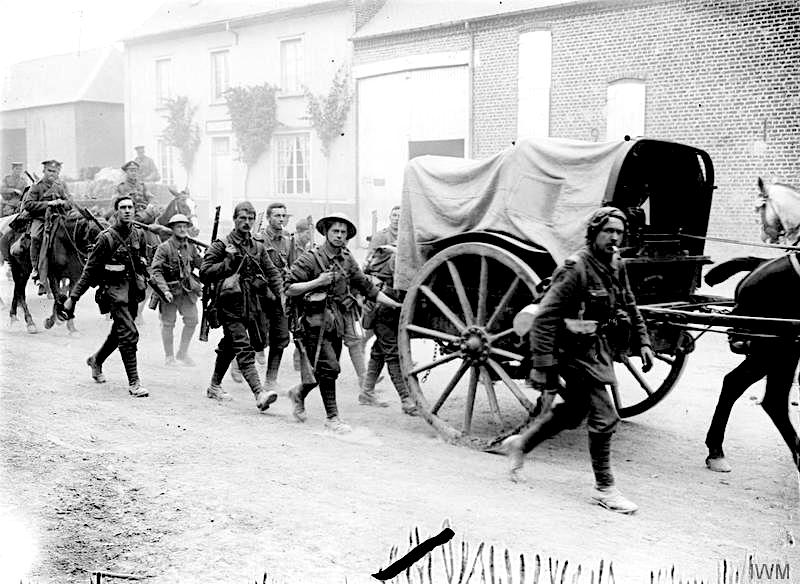
During World War I Battle of the Somme, East Yorkshire regimentmarching to the front line, June 28 , 1916. ( Ernest Brooks, Imperial War Museums, Public domain, Wikimedia Commons)
Now comes a different conflict. We have enemies at home: the schemers who trade our blood for sacks of gold, who make the world safe for hypocrisy, safe for themselves, readying themselves for the next “humanitarian war.” See how sleek and self-satisfied they look, riding our backs, distracting our minds, filling us with fright about wicked foes…
May 28, 2018 Special to Consortium News
Looking back at the years of fury and carnage, Colonel Angelo Gatti, staff officer of the Italian Army (Austrian front), wrote in his diary: “This whole war has been a pile of lies. We came into war because a few men in authority, the dreamers, flung us into it.”
No, Gatti, caro mio, those few men are not dreamers; they are schemers. They perch above us. See how their armament contracts are turned into private fortunes—while the young men are turned into dust: more blood, more money; good for business this war.
It is the rich old men, i pauci, “the few,” as Cicero called the Senate oligarchs whom he faithfully served in ancient Rome. It is the few, who together constitute a bloc of industrialists and landlords, who think war will bring bigger markets abroad and civic discipline at home. One of i pauci in 1914 saw war as a way of promoting compliance and obedience on the labor front and—as he himself said—war, “would permit the hierarchal reorganization of class relations.”
Just awhile before the heresies of Karl Marx were spreading among Europe’s lower ranks. The proletariats of each country, growing in numbers and strength, were made to wage war against each other. What better way to confine and misdirect them than with the swirl of mutual destruction.
Then there were the generals and other militarists who started plotting this war as early as 1906, eight years before the first shots were fired. War for them means glory, medals, promotions, financial rewards, inside favors, and dining with ministers, bankers, and diplomats: the whole prosperity of death. When the war finally comes, it is greeted with quiet satisfaction by the generals.
Moguls and Monarchs Prevail
But the young men are ripped by waves of machine-gun fire or blown apart by exploding shells. War comes with gas attacks and sniper shots: grenades, mortars, and artillery barrages; the roar of a great inferno and the sickening smell of rotting corpses. Torn bodies hang sadly on the barbed wire, and trench rats try to eat away at us, even while we are still alive.
Farewell, my loving hearts at home, those who send us their precious tears wrapped in crumpled letters. And farewell my comrades. When the people’s wisdom fails, moguls and monarchs prevail and there seems to be no way out.
Fools dance and the pit sinks deeper as if bottomless. No one can see the sky, or hear the music, or deflect the swarms of lies that cloud our minds like the countless lice that torture our flesh. Crusted with blood and filth, regiments of lost souls drag themselves to the devil’s pit. “Lasciate ogni speranza, voi ch’entrate.” (“Abandon all hope, ye who enter” as our Dante delivered his painful message).
Meanwhile from above the Vatican wall, the pope himself begs the world leaders to put an end to hostilities, “lest there be no young men left alive in Europe.” But the war industry pays him no heed.
Finally the casualties are more than we can bear. There are mutinies in the French trenches! Agitators in the Czar’s army cry out for “Peace, Land, and Bread!” At home, our families grow bitter. There comes a breaking point as the oligarchs seem to be losing their grip.
At last the guns are mute in the morning air. A strange almost pious silence takes over. The fog and rain seem to wash our wounds and cool our fever. “Still alive,” the sergeant grins, “still alive.” He cups a cigarette in his hand. “Stack those rifles, you lazy bastards.” He grins again, two teeth missing. Never did his ugly face look so good as on this day in November 1918. Armistice embraces us like a quiet rapture.
Not really a quiet rapture with smiling sergeants. Many troops on both sides continued killing to the bitter end, with a fury that had no mercy. In one day, November 11, the last day of war, some 10,900 men were wounded or killed from both sides, a furious rage in the face of peace, years of slaughter; now moments of vengeance.
The Fall of Eagles
A big piece of the encrusted aristocratic world breaks off. The Romanovs, Czar and family, are all executed in 1918 in Revolutionary Russia. That same year, the House of Hohenzollern collapses as Kaiser Wilhelm II flees Germany. Also in 1918, the Ottoman empire is shattered. And on Armistice Day, November 11th, 1918, at 11:00 a.m.—the eleventh hour of the eleventh day of the eleventh month—we mark the end of the war and with it the dissolution of the Habsburg dynasty.
Four indestructible monarchies: Russian, German, Turkish, and Austro-Hungarian, four great empires, each with millions of bayonets and cannon at the ready, now twisting in the dim shadows of history.
Will our children ever forgive us for our dismal confusion? Will they ever understand what we went through? Will we? By 1918, four aristocratic autocracies fade away, leaving so many victims mangled in their wake, and so many bereaved crying through the night.
Back in the trenches, the agitators among us prove right. The mutinous Reds standing before the firing squad last year were right. Their truths must not be buried with them. Why are impoverished workers and peasants killing other impoverished workers and peasants? Now we know that our real foe is not in the weave of trenches; not at Ypres, nor at the Somme, or Verdun or Caporetto. Closer to home, closer to the deceptive peace that follows a deceptive war.
Now comes a different conflict. We have enemies at home: the schemers who trade our blood for sacks of gold, who make the world safe for hypocrisy, safe for themselves, readying themselves for the next “humanitarian war.” See how sleek and self-satisfied they look, riding our backs, distracting our minds, filling us with fright about wicked foes. Important things keep happening, but not enough to finish them off. Not yet enough.
Obama fears a conflict with Russia or China. Surprised? Of course not! But with Europe? This friendship, “value-based” as we are told, is forever, right? The writer Michel Collon answers.
Obama warns the neocons who oppose the nuclear deal with Iran: “Our closest allies in Europe aren’t accepting more sanctions. A war would strengthen Iran and isolate the United States.” A senior diplomat in Washington confirmed “If the US Congress rejects the agreement, it would be a nightmare and disaster.”
Of course! And immediately after the agreement German firms were rushing to Tehran to sign the contracts that had been blocked by Washington for years! In fact, the principle “The great powers have no principles, only interests” applies equally to alliances: an eternal “friendship” can quickly transform itself into an acute conflict.
To control Eurasia, Brzezinzki proposed controlling Europe, back in 1997: “The central problem for America is to build a Europe based on Franco-German relations, viable, linked to the United States, and that expands the system of international democratic cooperation that America’s exercise of global hegemony depends on. “
“Democratic” meaning “subject to the USA” — Brzezinski employs the EU to prevent a Berlin-Moscow alliance. Russia being geographically the “natural” partner for German companies, the US policy is thus to sow discord. Ukraine is getting used for that. When the EU in Kiev won an agreement between all parties for early elections, Washington organized a coup the day after by relying on neo-Nazi groups! The US special envoy Nuland summarizing it all with class: “Fuck the EU.”
New? No. Already in 1997, Brzezinski announced: “Europe must be a springboard for the further breakthrough of democracy in Eurasia. Between 2005 and 2010, Ukraine should be ready for serious discussions with NATO.” Brzezinski wanted to center Europe an a Paris. – Berlin – Warsaw – Kiev axis. Against Moscow. He feared that European unification would collapse (Is the collapse coming?) and that Berlin would turn to the East. “The three major geostrategic imperatives can be summed up as follows:
“avoid collusion between the vassals (sic!) and
keep them in the state of dependence (…),
cultivate docility (sic) of the protected subjects;
prevent the barbarians (sic) forming offensive coalitions.
Is this strategy passé? No. Recently, the influential US analyst George Friedman, when asked “Is Daesh a threat to the United States,” responded with these surprising words: “This is not an existential threat. We must take care of it suitably, but we have other interests in international politics. The main interest (…) is the relationship between Germany and Russia, because united, they could threaten us. Our main goal is to ensure that this will never happen.” To prevent European multinationals turning to the New Silk Road proposed by Beijing, the key is to prevent any agreement between Berlin and Moscow. And divert the EU from Russian energy. In short, behind the official smiles on TV, the “friends” in the west don’t love anyone at all. NSA Spying has confirmed it: there are no friends in the business.
The US relationship with the EU has two aspects: unity and rivalry. The European multinationals need US police to intimidate the third world and keep China at bay. But the US multinationals are taking advantage of every war to steal market share from their European rivals. And Washington is very strong about getting paid by its “friends” for the wars that serve its interests at the expense of the “friends.”
All of these US wars create chaos that spill over “friend” Europe.
In fact, behind the direct and declared foe, every war has a second level of conflict:
In ’91, Bush attacked Iraq in order also to undermine French and Russian contracts.
In Yugoslavia, Clinton wanted to neutralize France and especially prevent the formation of a Euro-army.
In Libya, Obama (with Sarkozy) undermined the German and Italian contracts with Gaddafi.
In Syria, Obama (with Holland) is still working against Germany.
In Ukraine, ditto.
And all these US wars create chaos that spills over “good friend” Europe (migration crisis, terrorist attacks, loss of business partners…).
Ultimately, NATO is for Europe a suicide. Will Europe follow the US all the way to the Inferno? The world’s future is in the balance.
A couple of weeks ago a group of influencial German figures, the members of Willy Brandt Circle, have signed an Open Letter to SPD (German Social-Democrats) Bundestag delegates and cabinet ministers urging them to abandon the confrontational course in relations with Russia. The authors reviewed the degrading EU-Russia ties in the context of Ukraine’s crisis which was the direct result of mutual misunderstandings and controversies. Hereby ORIENTAL REVIEW publishes an exclusive English translation of the Letter in full:
***
Europe is experiencing the worst crisis since the end of the East-West conflict. Not only dealing with Greece and the thousands of refugees heighten tenses across the continent, but also the ceasefire negotiation process in Ukraine remains fragile. As long as the conflict over the future of Ukraine is unsolved, the real danger of escalation is on the table.
A comprehensive peace treaty for Europe, envisioned by the Charter of Paris 1990, is still needed. Europe has no interest in aggravating old controversy between the United States and the USSR, bringing Russia to its knees. There is a difference between the European and the American interests: pan-European problems cannot be solved without Russia or even against Russia. Recent history shows: Russia and the peoples of the Soviet Union contributed more than anyone to the liberation of Europe from fascism and later to the unification of Germany. Therefore, Germany has a special responsibility to win Russia as a negotiating partner in the European peace order.
In 1990 it seemed that the answer to these questions is found once and for all: Russia became a co-architect of the European integration. Russia, alongside with the USA, would naturally become an anchor and an equal partner. Since then Russia’s expectations have been deeply disappointed: EU and, what’s more important, NATO enlargement policy totally excluded the possibility of Russia’s membership. It was too difficult, as the country was too big. Moreover, some Eastern European states claimed that their quick accession to NATO membership was a military precaution against Russia. Having no perspective to join NATO itself, more and more patriotic Russia sees the expansion of the structures of the Western alliance as a threat. NATO expansion nourished Russia’s old fear of being surrounded and it was gradually forced to thinking in geopolitical categories and zones of influence.
The Ukrainian crisis is a reflection of a major conflict between Russia and the Euro-Atlantic structures. It may lead to a catastrophe if the ongoing arms race, military provocations and confrontational rhetoric is not stopped. We strongly appeal to all responsible politicians and peace-loving citizens but first and foremost directly to the SPD:
In this situation bold political initiative is needed comparable to the initiatives that helped to stop the conflict spiral during Berlin Wall and Cuban Missile Crisis. It was German social democracy that paved the way to the new Willy Brandt’s Ostpolitik and the détente. In 2015 we require such courage and political wisdom to counter the threat of renewed confrontation and division of Europe. We call to stop the confrontation and restart our relations with Russia before it is too late for all of us.
The Ukraine crisis cannot be solved by political sanctions against Russia. The underlying causes of the Russian-European alienation should be discussed at EU-Russia summit talks. Lasting reconciliation of interests can only be achieved through dialogue and negotiation. The economic sanctions undermine the development of Europe as a common economic area. Cooperation is an engine of confidence building. Energy infrastructure that has already been affected by the current sharpening of contradictions is a vital part of our mutual interests and bilateral trade.
The European Union that is partially responsible for the roots of the crisis must contribute to its solution on the basis of consensus. The interaction of Germany, France and Poland with Ukraine and Russia in Minsk II Agreement is an innovative approach. Implementation of Minsk II may bridge the credibility gap. A wider European integration is needed. Germany must throw into the say its position as a future OSCE president and act in the spirit of dialogue.
The United States as the most important partner of the new Ukrainian government has also high responsibility to find a solution to the crisis. All available international fora should be used to bring Russia and the US together. In times of crisis we need to maintain close ties in order to communicate effectively. Therefore, G7 should involve Russia and the work of the NATO-Russia Council should continue as soon as possible. Essential ways to negotiate in crisis should not be limited but broadened.
The incorporation of the Crimea into Russia is a violation of international agreements. At the same time it is a political reality that cannot be undone against the will of the majority of Crimea’s voters. The status quo must not undermine the constructive cooperation with stakeholders of the common European interest.
Ukrainian crisis is also the result of a weak federal structure in a relatively new state. Only through a strong federal system the country can protect itself from ethnic strife and the threat of secession. The experience of other European countries with federal structure should be offered to Ukraine if needed.
NATO membership for Ukraine will not enhance Alliance’s security. It will fuel the flame of Russia’s fears about NATO objectives and increase the risks of unwanted military confrontation. The framework of the OSCE and the “Vienna Document” 2011 is vital in times of crisis and should be implemented to bring together political and military bodies of all European states.
The Ukraine crisis threatens the European arms control. Arms race, transfer of lethal military equipment and new troop deployments on both sides of the Russian border undermine the existing system of arms control treaties. The participation of German troops in the military training of the “intervention force” can trigger on the Russian side memories of the German invasion and aggravate tension, which is unnecessary. Disengagement of troops, non-proliferation and arms curbs are goals to be achieved as soon as possible.
During the Ukraine crisis we saw alarming rise of nuclear intent once again. There is a risk of rearming with medium range nuclear missiles in Europe as it happened in the 1980-es. Nuclear weapons must be finally outlawed. A matter of principle weapons of total annihilation should not be part of employable forces.
European peace order is not only an order of states. It is based on strong civil societies and, among other, international cooperation in the field of culture, media, sports and science. Restart of European youth exchange programs with Russia and Ukraine may help to overcome stereotyping and encourage better understanding of each other and, consequently, build better relations.
Europe needs Russia and Russia needs Europe. We stand at a tipping point. Either we enter a more or less Cold war with dim future or pave the way together the new common European peace order.
Now is the time to act!
Berlin, July, 21, 2015
Signers:
Prof. Egon Bahr was the creator of the “Ostpolitik” promoted by West German Chancellor Willy Brandt, for whom he served as Secretary of the Prime Minister’s Office from 1969 until 1972. Between 1972 and 1990 he was an MP in the Bundestag.
Prof. Dr. Walther Stützle was the Deputy Minister of Defense in 1998-2002.
Dr. Christoph Zöpel is the SPD politician, Foreign Minister in 1999-2002.
Prof. Dr. Ingomar Hauchler, Bundestag MP (SPD) from 1983 to 1998.
Antje Vollmer, is a member of the German Green Party. From 1994 to 2005, she was one of the vice presidents of the Bundestag.
Prof. Dr. Dieter Klein is the Head of the Commission on the Future of the Rosa Luxembourg Foundation and a member of its Board.
Prof. Dr. Gustav Horn is the Professor of Economics at the University of Flensburg, Scientific Director of the Institute of Macroeconomic Research in the Hans Böckler Foundation.
Dr. Rainer Land is the German social scientist and economist.
Prof. Dr. Götz Neuneck is the Deputy Director of the Institute for Peace Research and Security Policy at the University of Hamburg (IFSH) and Director of the Interdisciplinary Research Group Arms Control and Disarmament (IFAR).
Prof. Dr. Rolf Reissig is a member of the Scientific Advisory Board of the Rosa Luxembourg Foundation.
Prof. Dr. Elmar Brähler, was the Professor of Medical Psychology and Medical Sociology at the University of Leipzig.
Prof. Dr. Peter Brandt is the German historian and retired Professor for Modern and Contemporary History at the University of Hagen.
Prof. Dr. Michael Schneider is the German political journalist and literary critic.
Prof. Klaus Staeck is a German lawyer and publisher.
Dr. Friedrich Dieckmann is the author of essays, reviews, stories and radio features.
Prof. Dr. Hans-Joachim Gießmann is the Executive Director of Berghof Foundation.
Prof. Dr. Lutz Götze, Professor Emeritus of the University of Saarland.
Dr. Enrico Heitzer, Researcher of the Brandenburg Memorials Foundation.
Gunter Hofmann is the German journalist working for Die Zeit.
Dr. Hans Misselwitz is a functionary of the SPD and a founding member of the Institute Solidarity modernity.
Dr. Irina Mohr is the leader of Forum Berlin of the Friedrich Ebert Foundation.
Dr. Edelbert Richter is a Member of the European Parliament in 1991-1994, German Bundestag MP in 1994-2002, member of the Federation of German Scientists.
Dr. Friedrich Schorlemmer, is a German Protestant theologian, civil rights activist and member of the SPD.
Wolfgang Schmidt is the Hamburg Commissioner to the Federal Government, the European Union and of Foreign Affairs; Member of the Committee of the Regions.
Axel Schmidt-Gödelitz is the Chairman of the East-West Forum.
Volker Braun is the prominent German writer living in Berlin.
Daniela Dahn is the writer, journalist and essayist.
“Donbass is a place where people were not divided along ethnic lines. Where Russian, Ukrainian, Tatar, Armenian, Jewish and Uzbek drank cognac at one table.We ate and conversed about religion. Amazing scene.”
Mikhail Kovalenko, Slavyansk surgeon http://fortruss.blogspot.com/2015/02/slavyansk-surgeon-talks-about-another.html
This is not President Poroshenko’s vision.
From Fort Russ
February 11, 2015 Da Dzi Translated from Russian by Kristina Rus
Petro Poroshenko candidly explained, who is the title nation of Ukraine, first grade [highest grade of] citizens.
Petro Poroshenko during an expanded meeting of the Cabinet of Ministers called the inhabitants of the Western regions of Ukraine “the foundation of statehood of the country.”
“There is no doubt. I, on the contrary, believe that Galicians are the foundation of the statehood of Ukraine”, – said Poroshenko.
Thus, he clearly defined the nation, which his regime is standing on. Blue blood. The first grade. Poroshenko defined the nation, which Kiev will be feeding until the end, when the East will starve and slide into poverty. It is the Western Nazis who ensured the coup and brought to power Poroshenko, Yatsenyuk, Turchinov. It is zapadentsi [Western Ukrainians] who had always been the loyal guard of Europe. They served faithfully to Poland, Austria, and Hitler’s Germany. Zapadentsi were always ready to kill the people of the East.
Therefore it is not surprising that Poroshenko regards them as Ukrainians of first grade, the titular nation, the elite of Ukraine.
Because initially it was planned that Donbass after Euromaidan will faithfully serve Zapadenshina [Western Ukraine], giving their last. No wonder that since the 90’s Galicians called Donbass residents as “slaves”, “alcoholics”, “katsapi”. Told “funny” jokes about how banderites will deal with the wrong Ukrainians. And this is why with such inhuman wickedness the inhabitants of Galicia rejoice in the deaths of women and children of Donbass. Donbass residents did not want to be the slaves of Galicians, the first grade Ukrainians, the elite nation of “United Ukraine”.
Fascism is characterized by justification of superiority and exclusivity of one proclaimed dominant nation.

 Free Ukraine Now