Michael Parenti, who died on Saturday at 92, wrote for Consortium News what appears to be his last article on the occasion of the 100th anniversary of the end of WWI.
Michael Parenti, a giant on the American left, who influenced generations of activists, scholars and ordinary Americans, died on Saturday in Berkeley, California. He was 92. Parenti wrote for Consortium News what is believed to be his last article, about the horrors of World War I. It appeared on U.S. Memorial Day, May 28, 2018, and we republish it here ahead of a tribute Consortium News is preparing.
On Memorial Day 2018, in the year marking the 100th anniversary of the end of World War I, Michael Parenti contemplates the trenches and the oligarchs who caused so much unnecessary misery.
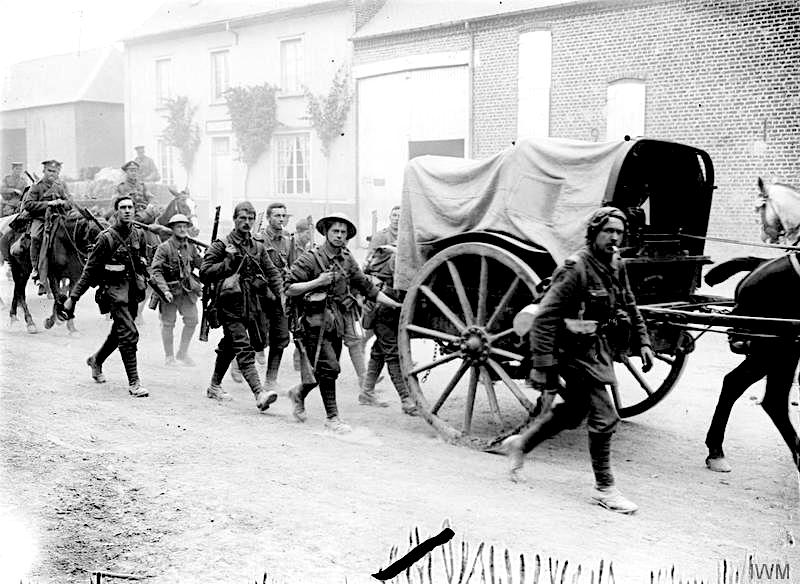
During World War I Battle of the Somme, East Yorkshire regimentmarching to the front line, June 28 , 1916. ( Ernest Brooks, Imperial War Museums, Public domain, Wikimedia Commons)
Now comes a different conflict. We have enemies at home: the schemers who trade our blood for sacks of gold, who make the world safe for hypocrisy, safe for themselves, readying themselves for the next “humanitarian war.” See how sleek and self-satisfied they look, riding our backs, distracting our minds, filling us with fright about wicked foes…
May 28, 2018 Special to Consortium News
Looking back at the years of fury and carnage, Colonel Angelo Gatti, staff officer of the Italian Army (Austrian front), wrote in his diary: “This whole war has been a pile of lies. We came into war because a few men in authority, the dreamers, flung us into it.”
No, Gatti, caro mio, those few men are not dreamers; they are schemers. They perch above us. See how their armament contracts are turned into private fortunes—while the young men are turned into dust: more blood, more money; good for business this war.
It is the rich old men, i pauci, “the few,” as Cicero called the Senate oligarchs whom he faithfully served in ancient Rome. It is the few, who together constitute a bloc of industrialists and landlords, who think war will bring bigger markets abroad and civic discipline at home. One of i pauci in 1914 saw war as a way of promoting compliance and obedience on the labor front and—as he himself said—war, “would permit the hierarchal reorganization of class relations.”
Just awhile before the heresies of Karl Marx were spreading among Europe’s lower ranks. The proletariats of each country, growing in numbers and strength, were made to wage war against each other. What better way to confine and misdirect them than with the swirl of mutual destruction.
Then there were the generals and other militarists who started plotting this war as early as 1906, eight years before the first shots were fired. War for them means glory, medals, promotions, financial rewards, inside favors, and dining with ministers, bankers, and diplomats: the whole prosperity of death. When the war finally comes, it is greeted with quiet satisfaction by the generals.
Moguls and Monarchs Prevail
But the young men are ripped by waves of machine-gun fire or blown apart by exploding shells. War comes with gas attacks and sniper shots: grenades, mortars, and artillery barrages; the roar of a great inferno and the sickening smell of rotting corpses. Torn bodies hang sadly on the barbed wire, and trench rats try to eat away at us, even while we are still alive.
Farewell, my loving hearts at home, those who send us their precious tears wrapped in crumpled letters. And farewell my comrades. When the people’s wisdom fails, moguls and monarchs prevail and there seems to be no way out.
Fools dance and the pit sinks deeper as if bottomless. No one can see the sky, or hear the music, or deflect the swarms of lies that cloud our minds like the countless lice that torture our flesh. Crusted with blood and filth, regiments of lost souls drag themselves to the devil’s pit. “Lasciate ogni speranza, voi ch’entrate.” (“Abandon all hope, ye who enter” as our Dante delivered his painful message).
Meanwhile from above the Vatican wall, the pope himself begs the world leaders to put an end to hostilities, “lest there be no young men left alive in Europe.” But the war industry pays him no heed.
Finally the casualties are more than we can bear. There are mutinies in the French trenches! Agitators in the Czar’s army cry out for “Peace, Land, and Bread!” At home, our families grow bitter. There comes a breaking point as the oligarchs seem to be losing their grip.
At last the guns are mute in the morning air. A strange almost pious silence takes over. The fog and rain seem to wash our wounds and cool our fever. “Still alive,” the sergeant grins, “still alive.” He cups a cigarette in his hand. “Stack those rifles, you lazy bastards.” He grins again, two teeth missing. Never did his ugly face look so good as on this day in November 1918. Armistice embraces us like a quiet rapture.
Not really a quiet rapture with smiling sergeants. Many troops on both sides continued killing to the bitter end, with a fury that had no mercy. In one day, November 11, the last day of war, some 10,900 men were wounded or killed from both sides, a furious rage in the face of peace, years of slaughter; now moments of vengeance.
The Fall of Eagles
A big piece of the encrusted aristocratic world breaks off. The Romanovs, Czar and family, are all executed in 1918 in Revolutionary Russia. That same year, the House of Hohenzollern collapses as Kaiser Wilhelm II flees Germany. Also in 1918, the Ottoman empire is shattered. And on Armistice Day, November 11th, 1918, at 11:00 a.m.—the eleventh hour of the eleventh day of the eleventh month—we mark the end of the war and with it the dissolution of the Habsburg dynasty.
Four indestructible monarchies: Russian, German, Turkish, and Austro-Hungarian, four great empires, each with millions of bayonets and cannon at the ready, now twisting in the dim shadows of history.
Will our children ever forgive us for our dismal confusion? Will they ever understand what we went through? Will we? By 1918, four aristocratic autocracies fade away, leaving so many victims mangled in their wake, and so many bereaved crying through the night.
Back in the trenches, the agitators among us prove right. The mutinous Reds standing before the firing squad last year were right. Their truths must not be buried with them. Why are impoverished workers and peasants killing other impoverished workers and peasants? Now we know that our real foe is not in the weave of trenches; not at Ypres, nor at the Somme, or Verdun or Caporetto. Closer to home, closer to the deceptive peace that follows a deceptive war.
Now comes a different conflict. We have enemies at home: the schemers who trade our blood for sacks of gold, who make the world safe for hypocrisy, safe for themselves, readying themselves for the next “humanitarian war.” See how sleek and self-satisfied they look, riding our backs, distracting our minds, filling us with fright about wicked foes. Important things keep happening, but not enough to finish them off. Not yet enough.
Translator’s note: News of this warning from the generals of the former DDR has been all over the European press. Here is the actual document.
Documented: The leadership of the former East German Forces warns of war and calls for cooperation rather than confrontation with Russia
As military personnel who held responsible positions in the DDR armed forces, we have turned to the German public in great concern over the maintenance of peace and the survival of civilization in Europe.
In the years of the Cold War, in which we lived through long stretches of confrontation and militarization right up to the edge of open conflict, we employed our military expertise for the maintenance of peace and the protection of our socialist German Democratic Republic. The National People’s Army was not involved for a single day in armed conflict, and in the events of 1989-90 it played a leading role in seeing to it that no arms came into use. Peace was always the number one maxim of our dealings. And that is why we firmly oppose using the military factor as an instrument of policy. Experience makes clear that the burning questions of our time are not to be solved by military means.
It is worth remembering that the Soviet Army bore the brunt of the demolition of fascism in the Second World War. Alone 27 million Soviet citizens gave their lives for this historic victory. We owe them, and the allies, our gratitude here on this 70th anniversary of the liberation.
Now we note that war has again become mankind’s constant companion. The new world order run by the US and her allies has in recent times led to wars in Yugoslavia, Afghanistan, Iraq, Yemen and Sudan, in Libya and Somalia. About two million people are victims of these wars, and millions have become refugees.
Now the vents of war have reached Europe. It is plain to see that the US strategy is to eliminate Russia as a competitor and to weaken the EU. In recent years NATO has crept ever closer to Russia’s borders. With the attempt to put Ukraine into NATO, the cordon sanitaire would be locked in from the Baltic States to the Black Sea, in order to isolate Russia from the rest of Europe. By the American planning, any German-Russian alliance would be difficult or impossible.
In order to influence the public in this direction, an unprecedented media campaign is in full swing, where the incorrigible pols and the corrupt journalists are beating the drums of war. The Federal Republic of Germany, in this heated-up atmosphere ought to be playing a role for the advancement of peace. Germany’s geopolitical placement and its historical experience and the objective interests of her people all demand this, just the contrary to the bundespresident’s calls towards greater military responsibility, and the war hysteria and russophobia stirred up by the media.
Putting the spurs to the militarization of eastern Europe is not playing with fire, it is playing with war!
With awareness of the destructive nature of modern war and in fulfillment of our responsibilities as citizens, we say in plain clarity: here, already, there begins a crime against humanity.
Are the many dead of the Second World War, the huge destruction throughout all Europe, the refugee streams and the endless sorrow of humanity forgotten already? Haven’t the newest wars of the US and NATO brought enough grief ? Haven’t they already demanded enough human life?
Don’t we understand what a military conflict in the densely populated continent of Europe would mean? Here would come warplanes in their hundreds, armed drones laden with bombs and rockets, thousands of tanks and armored vehicles, artillery systems. In the North Sea, the Baltic Sea, the Black Sea the most modern warships would fight, and, waiting in the wings, atomic bombs.
There would be no distinction of front and not-front. Mothers, by the million would mourn their children and their husbands, their fathers, their brothers. The landscape of Europe would be that of a wasteland.
Should it come to this? No, a thousand times, NO!
Therefore we turn to the German public:
Any such scenario must get stopped.
We don’t need any rhetoric of war, we need instead polemics of peace.
We don’t need any missions abroad for the Bundeswehr, and we don’t need any EU Army.
We don’t need more funding for military goals; we need funding for social needs and humanitarian needs.
We don’t need any war fever against Russia; we need more mutual understanding, coexistence and neighborliness.
We don’t need any military dependence on the US; we need our own answerability for peace.
Instead of a “NATO Rapid Reaction Force” on the eastern borders, we need more tourism, youth exchanges, and steps toward peace with our neighbors to the east.
We need a peaceful Germany in a peaceful Europe.
May our children, our grandchildren, our great grandchildren, remember us this way.
Because we know all too well what war means, we raise our voice against the war; we raise our voice for peace.
Signed:
Armeegeneral a.D. Heinz Keßler
Admiral a.D. Theodor Hoffmann
Die Generaloberste a.D. Horst Stechbarth; Fritz Streletz; Fritz Peter
Die Generalleutnante a.D. Klaus Baarß; Ulrich Bethmann; Max Butzlaff; Manfred Gehmert; Manfred Grätz; Wolfgang Kaiser; Gerhard Kunze; Gerhard Link; Wolfgang Neidhardt; Walter Paduch; Werner Rothe; Artur Seefeldt; Horst Skerra; Wolfgang Steger; Horst Sylla; Ehrenfried Ullmann; Alfred Vogel; Manfred Volland; Horst Zander

 Free Ukraine Now