How to fight Western propaganda

Posted on Dissident Voice
by Andre Vltchek / May 15th, 2015

First they manufacture monstrous lies, and then they tell us that we should be objective!

Is love objective; is passion?

Are dreams defendable, logically and philosophically?

When a house is attacked by brigands, when a village is overran by gangsters, when smoke, fire and cries for help are coming from every corner, should we award ourselves with the luxury of time to calculate, analyze and aim at complete logical, ethical, holistic and objective solutions?

I strongly believe no! We are obliged to fight those who are burning our dwellings, to hit with full force those who are attempting to rape our women, and to confront fire with fire when innocent beings are slaughtered.

When the most powerful and the most destructive force on earth employs all its persuasive might, utilizing everything from the mainstream media to educational facilities, in order to justify its crimes, when it spreads its poisonous propaganda and lies in order to oppress the world and suppress hope, do we step back and begin endless and detailed work on precise and objective narratives? Or do we confront lies and propaganda with our own narrative, supported by our intuition, passion and dreams for a better world?

*****

The Empire lies continuously. It lies in the morning, during the day, in the evening, even at night, when most of the people are sound asleep. It has been doing it for decades and centuries. For grand deceits it relies on countless numbers of propagandists who pose as academics, teaches, journalists and “public intellectuals”. Perfection in the art of disinformation has been reached. Western advertising (so much admired and used by the German Nazis) has some common roots with propaganda, although propaganda is much older and “complete”.

It appears that even some leaders of the Empire now believe in most of their fabrications, and most of the citizens certainly do. Otherwise, how could they sleep at night?

The western propaganda apparatus is enormously efficient and effective. It is also brilliant in how it ensures that its inventions get channeled, distributed, and accepted in all corners of the world. The system through which disinformation spreads, is incredibly complex. Servile local media and academia on all continents work hard to guarantee that only one narrative is allowed to penetrate the brains of billions.

The results are: intellectual cowardice and ignorance, all over the world, but especially in the West and in its client states.

*****

What are we, who oppose the regime, supposed to do?

First of all, things are not as hopeless as they used to be.

This is not the morbid unipolar world that we experienced in the early 90’s. Now Venezuela, Russia, China, and Iran support large media outlets that are opposed to the Empire. Powerful television stations emerged: RT, Press TV, TeleSUR, and CCTV. Huge English language Internet-based magazines and sites in the United States, Canada and Russia are also exposing the lies of the official Western propagandists: Dissident Voice, Information Clearing House, Global Research, Veterans News, Strategic Culture, New Eastern Outlook quickly come to mind. And there are hundreds of important sites doing the same in Spanish, Chinese, Russian, Portuguese and French languages.

The fight is on: the fight for an intellectually multi-polar world. It is a tough, mortal fight! It is a crucial battle, simply because the metastases of the Western propaganda cancer have spread everywhere, contaminated all continents, and even some of the most courageous countries and brains that are earnestly fighting against the Western imperialism and fascism! No one is immune. To be frank, all of us are contaminated.

Unless we win this battle, by first clearly identifying and proving “their narrative” as fraudulent, and later by offering humanist and compassionate perceptions, we cannot even dream about the revolution, or about any significant changes in arrangement of the world.

*****

How do we achieve victory? How do we convince the masses, those billions of people? How do we open their eyes and make them see that the Western regime is dishonest, toxic, poisonous and destructive? Most of humanity is hooked on the Empire’s propaganda; that propaganda which is not only spread by mainstream media outlets, but also by pop music, soap operas, social media, advertisement, consumerism, ‘fashion trends’ and by many other covert means; cultural, religious and media junk that leads to total emotional and intellectual stupor and is administered like some highly addictive narcotic, regularly and persistently.

Do we counter the tactics and strategy of the destructive and ruthless Empire with our honesty, with research, with telling and writing meticulously investigated facts?

The Empire perverts facts. It repeats lies through its loudspeakers and tubes. It shouts them thousands and thousands of times, until they sink into the sub conscious of people, penetrate the skin, spread all through their brains.

Good will, naive honesty, “speaking truth to power”, could this change the world and the power itself? I highly doubt it.

The Empire and its power are illegitimate, and they are criminal. Is there any point of speaking truth to a gangster? Hardly! Truth should be spoken to people, to masses, not to those who are terrorizing the world.

By talking to villains, by begging them to stop torturing others, we are legitimizing their crimes, and we are acknowledging their power. By trying to appease gangsters, people are putting themselves at their mercy.

I absolutely refuse to be in such position!

*****

To win over billions of people, we have to inspire them, to fire them up. We have to outrage them, embrace them, shame them, make them laugh and make them cry. We have to make sure that they get goose bumps when they see our films, read our books and essays, listen to our speeches.

We have to detox them, make them feel again, wake up natural instincts in them.

Simple truth as a detox agent will not work. The poison of our adversaries has sunk too deeply. Most of the people are too lethargic and too immune to simple, quietly stated truths!

We have tried, and others have tried as well. My acquaintance (but definitely not my comrade) John Perkins, former US apparatchik educated by the State Department, wrote a detailed account of his horrid deeds in Ecuador, Indonesia and elsewhere – Confession of An Economic Hitman. It is a meticulous, detailed account of how the West destabilizes poor countries, using corruption, money, alcohol, and sex. The book sold millions of copies, worldwide. And yet, nothing changed! It did not trigger a popular revolution in the United States. There were no protests, no demands for regime change in Washington.

In the recent past, I wrote and published two academic, or at least semi-academic books, packed with great details, quotes and tons of footnotes: one on Indonesia, a country used by the West as a model horror scenario for the rest of the world, after the 1965-US-sponsored military coup. The coup killed 2-3 million people, murdered all intellectualism, and lobotomized the 4th most populous country on earth. The book is called Indonesia – Archipelago of Fear. The second book, unique because it covers an enormous part of the world – Polynesia, Melanesia and Micronesia (Oceania – Neocolonialism, Nukes and Bones), showed how the US, UK, Australia, New Zealand and France, literally divided and destroyed the great South Pacific island cultures and the people. Now classes are being taught using my books, but only a very limited number of people are influenced by the facts exposed in them. The elites in both Indonesia and Oceania made sure that the books are not widely read by the people.

I have spent years and years compiling facts, researching, investigating. The revolutionary effectiveness of my academic work is – I have to admit – nearly zero.

It is easy to see the contrast: when I write an essay, a powerfully crafted, emotional essay, demanding justice, accusing the Empire of murder and theft, I get millions of readers on all continents, as well as translations to dozens of languages!

Why do I write this; why do I share this with my readers? Because we should all be realistic. We have to see, to understand, what people want – what they demand. The people are unhappy and scared. Most of them don’t know why. They hate the system, they are lonely, frustrated, they know that they are lied to and exploited. But they cannot define those lies. Academic books exposing the lies are too complex for them to read since the masses have no time to read thousands of indigestible pages or the necessary education to allow them to understand what they are reading.

It is our duty to address those people, the majority, otherwise what kind of revolutionaries are we? After all, we are supposed to create for our brothers and sisters, not for a few researchers at the universities, especially when we realize that most of the universities are serving the Empire by regurgitating official nomenclature and supporting demagogues.

*****

The Empire speaks, writes and then repeats some outrageous lies, about its benevolence, and exceptionality of its rule, or about the “evils” of the Soviet Union, China, Iran, Venezuela, North Korea or Cuba. This is done daily. In fact it is designed so that almost every human being gets his or her dose of the toxin at least several times a day.

We feel we have to react – we begin spending years of our lives, meticulously proving, step by step, that the Empire’s propaganda is either one big fat lie, or exaggeration, or both. After we compile our arguments, we publish the results in some small publishing house, most likely in the form of a slender book, but almost nobody reads it because of its tiny circulation, and because the findings are usually too complex, too hard to digest, and simply because the facts do not shock anybody, anymore. One million more innocent people were murdered somewhere in Africa, in the Middle East, in Asia; what else is new?

Researching and trying to tell the truth, fully and honestly, we feel that we are doing great, professional, scientific work. All the while the propagandists of the Empire are dying of laughter watching us! We are representing little danger to them. They are winning effortlessly!

Why is that? Doesn’t the detailed truth matter?

It does – from the point of higher principles it matters. Ethically it matters. Morally it matters. Philosophically it matters.

But strategically, when one is engaged in an ideological war, it does not matter that much! The truth yes, always; the truth matters! But simplified, digestible truth, presented powerfully and emotionally!

When immorality is ravishing the world, when it is charging mercilessly, when innocent millions are dying, what matters is to stop the slaughter, first by identifying the murderous force, then by containing it.

Language has to be strong, emotions raw.

When facing murderous hordes, poetry, emotionally charged songs, and patriotic odes have always been more effective than deep academic studies. And so were political novels and films, passionate documentaries, even explicit cartoons and posters.

Some would ask: “Just because they are lying, should we lie as well?” No! We should try to be as truthful as we can. But our message should be often “abridged”, so the billions, not just those selected few, could understand it.

It does not mean that the quality of our work should suffer. Simplicity is often more difficult to achieve than encyclopedic works with thousands of footnotes.

Sun Tzu’s Art of War is short, just a pamphlet, straight to the point. And so is the Communist Manifesto, and J’accuse!

Our revolutionary work does not have to be necessarily brief, but it has to be presented in a way that could be understood by many. I am constantly experimenting with the form, while never compromising on substance. My recent book, Exposing Lies of the Empire has more than 800 pages, but I made sure that it is packed with fascinating stories, with testimonies of people from all corners of the globe, with colorful description of both victims and tyrants. I don’t want my books to collect dust in university libraries. I want them to mobilize people.

*****

I truly believe that there is not much time for “objectivity” in any battle, including those ideological ones, especially when these are battles for the survival of humanity!

The lies of the enemy have to be confronted. They are toxic, monstrous lies!

Once the destruction stops, millions of innocent men, women and children will cease being sacrificed, and we can return to our complex philosophical concepts, to details and to nuances.

But before we win our final battles against imperialism, nihilism, fascism, exceptionalism, selfishness and greed, we have to fully and effectively utilize our most powerful weapons: our visions of a better world, our love for humanity, our passion for justice. Our determination and our beliefs have to be presented in a loud, potent, even “dogmatic” manner, our voice should be creative, artistic, powerful!

The house is on fire, comrades! The entire town is turning to ashes. The entire planet is plundered, devastated, lobotomized.

We cannot confront bigots with nukes and battleships. But our talents, our muses, and our hearts are here, with us, ready to join the battle.

Let us outsmart our enemies; let us make sure that the world begins laughing at them! Have you seen them, those pathetic losers, the buffoons – the CEO’s? Have you listened to those Prime Ministers and Presidents, those servants of the “market”? Let us convince the masses that their tyrants –the imperialists, the neo-colonialists and all their dogmatic preachers – are nothing more than pitiful, greedy, poisonous fools! Let us discredit them! Let us ridicule them.

They are robbing and murdering millions. Let us begin by at least pissing on them!

Let us fight Western propaganda by first exposing those who are really behind it. Let’s get personal.

Let’s turn this revolution into something creative, hilarious, truly fun!

André Vltchek is a novelist, filmmaker, and investigative journalist. He has covered wars and conflicts in dozens of countries. His latest book is Exposing Lies of the Empire. He also wrote, with Noam Chomsky, On Western Terrorism: From Hiroshima to Drone Warfare. His critically acclaimed political revolutionary novel Point of No Return is re-edited and available. Oceania is his book on Western imperialism in South Pacific. His provocative book about post-Suharto Indonesia and market-fundamentalism is called Indonesia: The Archipelago of Fear. He completed a feature documentary Rwanda Gambit (2013) about Rwandan history and the plunder of DR Congo. After living for many years in Latin America and Oceania, Vltchek presently resides and works in East Asia and Africa. He can be reached through his website. Read other articles by Andre.

How to Fight Western Propaganda

Will Washington kill us all?

By Paul Craig Roberts
Global Research, April 16, 2015

Did you know that Washington keeps 450 nuclear ICBMs on “hair-trigger alert”?  Washington thinks that this makes us “safe.”  The reasoning, if it can be called reason, is that by being able to launch in a few minutes, no one will try to attack the US with nuclear weapons.  US missiles are able to get on their way before the enemy’s missiles can reach the US to destroy ours.

If this makes you feel safe, you need to read Eric Schlosser’s book, Command and Control.

The trouble with hair-triggers is that they make mistaken, accidental, and unauthorized launch more likely. Schlosser provides a history of almost launches that would have brought armageddon to the world.

In Catalyst, a publication of the Union of Concerned Scientists, Elliott Negin tells the story of Soviet Lt. Col. Stanislav Petrov.  Just after midnight in 1983 the Soviet Union’s early warning satellite system set off the alarm that 5 US ICBMs were headed for the Soviet Union.

Col. Petrov was supposed to inform the Soviet leader, who would have 8 to 10 minutes to decide whether to launch in retaliation. Who knows what he would have decided. Instead Col. Petrov used his judgment.  There was no reason for the US to be attacking the Soviet Union.  Moreover, Petrov reasoned that an American attack would involve hundreds of ICBMs, possibly thousands.  He checked whether Soviet ground-based radar had detected incoming ICBMs, and it had not.  Petrov decided it was a false alarm, and sat on it.

It turned out that the early warning system had mistaken a pattern of sunlight reflection on clouds as missiles. This was a close call, but Negin reports that “a failed computer chip, and an improperly installed circuit card are some of the culprits” that could initiate nuclear war. In other words, the sources of false alarms are numerous.

Fast forward to today.  Imagine an American officer monitoring the US early warning system.  This officer has been listening to 15 years of war propaganda accompanied by US invasions and bombings of 8 countries.  Terrorist warnings and security alerts abound, as do calls from American and Israeli politicians for nuking Iran.  The media has convinced him that Russia has invaded Ukraine and is on the verge of invading the Baltics and Poland. American troops and tanks have been rushed to the Russian border. There is talk of arming Ukraine.  Putin is dangerous and is threatening nuclear war, running his strategic bombers close to our borders and holding nuclear drills.  The American officer has just heard a Fox News general again call for “killing Russians.”  The Republicans have convinced him that Obama is selling out America to Iran, with Senator Tom Cotton warning of nuclear war as a consequence. We will all be killed because there is a Muslim in the White House.

Why isn’t anyone standing up for America, the patriotic American officer wonders, just as the alarm goes off:  Incoming ICBMs. Are they Russian or Iranian?  Was Israel right after all?  A hidden Iranian nuclear weapons program?  Or has Putin decided that the US is in the way of his reconstruction of the Soviet Empire, which the American media affirms is Putin’s goal?  There is no room for judgment in the American officer’s mind.  It has been set on hair-trigger by the incessant propaganda that Americans call news.  He passes on the warning.

Obama’s Russophobic neocon National Security Advisor is screaming:  “You can’t let Putin get away with this!”  “It might be a false alarm,” replies the nervous and agitated president.  “You liberal pussy!  Don’t you know that Putin is dangerous!?  Push the button!”

And there goes the world.

Considering the extreme Russophobia being created among Americans by the Ministry of Propaganda, the demonization of Vladimir Putin–the “new Hitler,” Vlad the Impaler– the propagandistic creation of “the Russian threat,” the crazed neocon desire for US world hegemony, the hatred of Russia and China as rising rivals capable of exercising independent power, the loss of American Uni-power status and unconstrained unilateral action.  In the midst of these emotions and minds swayed not by facts but by propaganda, hubris, and ideology, there is a great chance that Washington’s response to a false alarm will bring the end of life on earth.

How much confidence do you have in Washington?  How many times has Washington–especially the crazed neocons–been wrong?

Remember the 3-week “cakewalk” Iraq war that would cost $70 billion and be paid out of Iraqi oil revenues?  Now the cost is $3,000 billion and rising, and after 12 years the radical Islamic State controls half of the country.  To pay for the wars the Republicans want to “privatize,” that is, take away, Social Security and Medicare.

Remember “Mission Accomplished” in Afghanistan? Twelve years later the Taliban again control the country and Washington, after murdering women, children, funerals, weddings, village elders, and kids’ soccer games,  has been driven out by a few thousand lightly armed Taliban.

The frustrations of these defeats have mounted in Washington and in the military.  The myth is that we lost because we didn’t use our full force.  We were intimidated by world opinion or by those damn student protesters, or blocked from victory by some gutless president, a liberal pussy who wouldn’t use all of our power.  For the right-wing, rage is a way of life.

The neocons believe fervently that History has chosen America to rule the world, and here we are defeated by Vietnamese guerrillas, by Afghan tribesmen, by Islamist fundamentalists, and now Putin has sent his missiles to finish the job.

Whoever the White House fool is, he will push the button.

The situation is deteriorating, not improving.  The Russians, hoping for some sign of intelligence in Europe, contradict Washington’s anti-Russian lies.  Washington calls truthful contradiction of its own propaganda to be Russian propaganda.  Washington has ordered the Broadcasting Board of Governors, a US government agency, headed by Andrew Lack, a former chairman of NBC news, to counteract an alleged, but non-existent, “Kremlin Troll Army” that is outshouting the Western prostitutes and “perpetuating a pro-Russian dialogue” on the Internet.  In case you don’t remember, Lack is the idiot who declared RT to be a “terrorist organization.”  In other words, in Lack’s opinion, one that he can enforce, a truth-teller is a terrorist.

Lack epitomizes well Washington’s view of truthful reporting: If it doesn’t serve Washington’s propaganda, it is not true. It is terrorism.

Lack hopes to control RT with intimidation:  In effect, he has told RT to shut up and say what we want or we will close you down as a terrorist organization.  We might even arrest your American employees as aiders and abettors of terrorism.

To counteract a Revanchist Russia and its Internet Troll Army, the Obama regime is handing $15,400,000 to the insane Lack to use to discredit every truthful statement that emerges from the English language versions of Russian media.  This amount, of course, will rise dramatically. Soon it will be in the billions of dollars, while Americans are evicted from their homes and sent to prison for their debts.

In his budget request, Lack, who seems to lack every aspect of humanity, including intelligence, integrity, and morality, justified his request, which will be granted, for the hard-earned money of Americans, whose standard of living is falling, with the wild assertion that Russia “threatens Russia’s neighbors and, by extension, the United States and its Western allies.”

Lack promises to do even more: “The US international media is now set forth to refute Russian propaganda and influence the minds of Russians and Russian-speakers in the former Soviet Union,  Europe and around the world.”  Lack is going to propagandize against Russia inside Russia.

Of course, the CIA organizations–the National Endowment for Democracy and Radio Free Europe/Radio Liberty–will be enriched by this anti-Russian propaganda campaign and will support it wholeheartedly.

Therefore, the Union of Concerned Scientists’ call for cooperation with Russia to take ICBMs off hair-trigger status is unlikely to occur. How can nuclear tensions be reduced when Washington is building tensions as fast as it possibly can?  Washington’s Ministry of Propaganda has reconstructed Putin as Osama bin Laden, as Saddam Hussein, demonized figures, bogymen who evoke fear from the brainwashed American sheeple.  Russia is transformed into al Qaeda lusting for another attack on the World Trade Center and for the Red Army (many Americans think Russia is still communist) to roll across Europe.

Gorbachev was a trick.  He deceived the old movie actor.  The deceived Americans are sitting ducks, and here come the ICBMs.  The crazed views of the American politicians, military, and people are unable to comprehend truth or to recognize reality.

The propagandistic American “media” and the crazed neoconservatives have set humanity on the path to destruction.

The Union of Concerned Scientists, of which I am a member, need to come to their senses. It is impossible to work out a reduction in nuclear threat as long as one side is going all out to demonize the other.  The demonization of Russia and its leader by the New York Times, Washington Post, CNN, Fox News, and the rest of the American Propaganda Ministry, by almost the entirety of the House and Senate, and by the White House makes reducing the threat of nuclear war impossible.

The American people and the entire world need to understand that the threat to life on earth resides in Washington and that until Washington is fundamentally and totally changed, this threat will remain as the worse threat to life on earth.  Global Warming can disappear instantly in Nuclear Winter.

http://www.globalresearch.ca/will-washington-kill-us-all/5443204

Former CIA official on the secret wars of the CIA — Part 2

From The Other Americas Radio
http://www.informationclearinghouse.info//article4069.htm

Transcript: THE SECRET WARS OF THE CIA

by John Stockwell

A lecture given in October, 1987

Part II – Part I Here

I just got my latest book back from the CIA censors. If I had not submitted it to them, I would have gone to jail, without trial – blow off juries and all that sort of thing – for having violated our censorship laws….

In that job [Angola] I sat on a sub-committee of the NSC, so I was like a chief of staff, with the GS-18s (like 3-star generals) Henry Kissinger, Bill Colby (the CIA director), the GS-18s and the CIA, making important decisions and my job was to put it all together and make it happen and run it, an interesting place from which to watch a covert action being done….

When the world’s gotten blocked up before, like a monopoly game where everything’s owned and nobody can make any progress, the way they erased the board and started over has been to have big world wars, and erase countries and bomb cities and bomb banks and then start from scratch again. This is not an option to us now because of all these 52,000 nuclear weapons….

The United States CIA is running 50 covert actions, destabilizing further almost one third of the countries in the world today….

By the way, everything I’m sharing with you tonight is in the public record. The 50 covert actions – these are secret, but that has been leaked to us by members of the oversight committee of the Congress. I urge you not to take my word for anything. I’m going to stand here and tell you and give you examples of how our leaders lie. Obviously I could be lying. The only way you can figure it out for yourself is to educate yourselves. The French have a saying, `them that don’t do politics will be done’. If you don’t fill your mind eagerly with the truth, dig it out from the records, go and see for yourself, then your mind remains blank and your adrenaline pumps, and you can be mobilized and excited to do things that are not in your interest to do….

Nicaragua is not the biggest covert action, it is the most famous one. Afghanistan is, we spent several hundred million dollars in Afghanistan. We’ve spent somewhat less than that, but close, in Nicaragua….

[When the U.S. doesn’t like a government], they send the CIA in, with its resources and activists, hiring people, hiring agents, to tear apart the social and economic fabric of the country, as a technique for putting pressure on the government, hoping that they can make the government come to the U.S.’s terms, or the government will collapse altogether and they can engineer a coup d’etat, and have the thing wind up with their own choice of people in power.

Now ripping apart the economic and social fabric of course is fairly textbook-ish. What we’re talking about is going in and deliberately creating conditions where the farmer can’t get his produce to market, where children can’t go to school, where women are terrified inside their homes as well as outside their homes, where government administration and programs grind to a complete halt, where the hospitals are treating wounded people instead of sick people, where international capital is scared away and the country goes bankrupt. If you ask the state department today what is their official explanation of the purpose of the Contras, they say it’s to attack economic targets, meaning, break up the economy of the country. Of course, they’re attacking a lot more.

To destabilize Nicaragua beginning in 1981, we began funding this force of Somoza’s ex-national guardsmen, calling them the contras (the counter-revolutionaries). We created this force, it did not exist until we allocated money. We’ve armed them, put uniforms on their backs, boots on their feet, given them camps in Honduras to live in, medical supplies, doctors, training, leadership, direction, as we’ve sent them in to de-stabilize Nicaragua. Under our direction they have systematically been blowing up graineries, saw mills, bridges, government offices, schools, health centers. They ambush trucks so the produce can’t get to market. They raid farms and villages. The farmer has to carry a gun while he tries to plow, if he can plow at all.

If you want one example of hard proof of the CIA’s involvement in this, and their approach to it, dig up `The Sabotage Manual’, that they were circulating throughout Nicaragua, a comic-book type of a paper, with visual explanations of what you can do to bring a society to a halt, how you can gum up typewriters, what you can pour in a gas tank to burn up engines, what you can stuff in a sewage to stop up the sewage so it won’t work, things you can do to make a society simply cease to function.

Systematically, the contras have been assassinating religious workers, teachers, health workers, elected officials, government administrators. You remember the assassination manual? that surfaced in 1984. It caused such a stir that President Reagan had to address it himself in the presidential debates with Walter Mondale. They use terror. This is a technique that they’re using to traumatize the society so that it can’t function.  Continue reading

April 7: Russian military intercepted U.S. spy plane, transponder off, headed for Russian border

From Sputnik News, April 11, 2015

The US RC-135U reconnaissance plane was flying towards the Russian border with its transponder switched off, a Defense Ministry spokesman said in Moscow Saturday.

Maj.-General Igor Konashenkov said that an unidentified airborne target was spotted over the Baltic Sea by Russian air defenders on April 7 flying directly towards the Russian border.

A Su-27 fighter jet was scrambled to inspect the target. Moving up to the unidentified aircraft the Russian pilot flew around it several times, made sure it was a US RC-135U reconnaissance plane and reported its tail number to ground control.

I want to emphasize that the RC-135U was moving towards the Russian border with its transponder switched off… As to the professional qualities of our pilots, this is something for the Russian military command to assess. Moreover, US reconnaissance planes  are supposed to fly along US borders only and nowhere else,” Konashenkov said, adding that no “emergency situations” were registered during Tuesday’s mid-air encounter.

A Pentagon spokesman said on Saturday that a Russian Su-27 jet fighter on Tuesday flew dangerously close to and nearly collided with a US reconnaissance plane over the Baltic Sea.

http://sputniknews.com/military/20150411/1020753530.html

…”On the morning of April 7th, a US RC-135U flying a routine route in international airspace was intercepted by a Russian Su-27 Flanker in an unsafe and unprofessional manner. The United States is raising this incident with Russia through the appropriate diplomatic and official channels,” Pentagon spokeswoman Eileen Lainez said in Washington.

The Su-27 conducted the close-in intercept in international waters over the Baltic Sea of an RC-135 reconnaissance aircraft, which was monitoring Russian military activities in western Russia and Kaliningrad.

US media try to persuade that the Russian fighter jet flew within just six meters of the reconnaissance plane in what is described as a “reckless” encounter that endangered the lives of the RC-135 crew.

The Russian  Defense Ministry earlier said that all flights by Russian military aircraft are conducted in strict conformity with internationally-recognized rules of flights in international airspace and over neutral waters without violating other countries’ borders.

NATO officials have in recent months complained about an increased presence of Russian military aircraft in European airspace, including over the Baltic Sea.

Russia’s Air Force Commander, Col.-General Viktor Bondarev, dismissed the reports as a propaganda ploy, meant to divert public attention from NATO’s ongoing military buildup in close vicinity of the Russian borders.

http://sputniknews.com/russia/20150411/1020747388.html

Posted on Fort Russ

April 11, 2015
Rossiyskaya Gazeta (rg.ru)
Translated by Kristina Rus

The official representative of the Russian Defense Ministry, Major General Igor Konashenkov stated that American reconnaissance aircraft RC-135U was heading for the border of the Russian Federation. This is why a Russian fighter jet Su-27 approached it over the Baltic sea. This was reported by TASS.

According to Konashenkov, on April 7 at 13:18 Moscow time on-duty air defense forces over the Baltic discovered an unidentified aerial target, which was heading towards the Russian state border.

As a result a Su-27 fighter was raised, which approached the unidentified aircraft, flew around it several times, identified it as a spy plane RC-135U of the United States Air Force and its fleet number, which was reported to the command.

After the American spy plane was circled around by a Russian fighter jet plane, the U.S. air plane changed course and retreated from the Russian border.

It was also noted that the spy plane shut off its transponder. Meanwhile, according to Konashenkov, during the flight there were no emergency situations.

Earlier today the representative of the US Ministry of Defense, Mark Wright stated that the Russian Su-27 fighter flew dangerously close to the American reconnaissance aircraft in the skies over the Baltic sea.

It was reported that “the US is preparing to raise the issue through appropriate official diplomatic channels”.

The head of the Federation Council Committee on International Affairs, Konstantin Kosachev has urged the US to stop escalating the atmosphere around the flights of Russian military aircraft in the Baltic region.

“In connection with the incident over the Baltic sea it is necessary to remember about one thing: Russia is a Baltic country, and the United States is not,” – added the Senator.

Robert Parry: The victory of ‘perception management’

An exceptional and critically important article.

From Consortium News, December 28, 2014
By Robert Parry

Special Report: In the 1980s, the Reagan administration pioneered “perception management” to get the American people to “kick the Vietnam Syndrome” and accept more U.S. interventionism, but that propaganda structure continues to this day getting the public to buy into endless war, writes Robert Parry.

To understand how the American people find themselves trapped in today’s Orwellian dystopia of endless warfare against an ever-shifting collection of “evil” enemies, you have to think back to the Vietnam War and the shock to the ruling elite caused by an unprecedented popular uprising against that war.

While on the surface Official Washington pretended that the mass protests didn’t change policy, a panicky reality existed behind the scenes, a recognition that a major investment in domestic propaganda would be needed to ensure that future imperial adventures would have the public’s eager support or at least its confused acquiescence.
President Ronald Reagan meeting with media magnate Rupert Murdoch in the Oval Office on Jan. 18, 1983, with Charles Wick, director of the U.S. Information Agency, the the background. (Credit: Reagan presidential library)

President Ronald Reagan meeting with media magnate Rupert Murdoch in the Oval Office on Jan. 18, 1983, with Charles Wick, director of the U.S. Information Agency, in the background. (Photo credit: Reagan presidential library)

This commitment to what the insiders called “perception management” began in earnest with the Reagan administration in the 1980s but it would come to be the accepted practice of all subsequent administrations, including the present one of President Barack Obama.

In that sense, propaganda in pursuit of foreign policy goals would trump the democratic ideal of an informed electorate. The point would be not to honestly inform the American people about events around the world but to manage their perceptions by ramping up fear in some cases and defusing outrage in others – depending on the U.S. government’s needs.

Thus, you have the current hysteria over Russia’s supposed “aggression” in Ukraine when the crisis was actually provoked by the West, including by U.S. neocons who helped create today’s humanitarian crisis in eastern Ukraine that they now cynically blame on Russian President Vladimir Putin.

Yet, many of these same U.S. foreign policy operatives – outraged over Russia’s limited intervention to protect ethnic Russians in eastern Ukraine – are demanding that President Obama launch an air war against the Syrian military as a “humanitarian” intervention there.

In other words, if the Russians act to shield ethnic Russians on their border who are being bombarded by a coup regime in Kiev that was installed with U.S. support, the Russians are the villains blamed for the thousands of civilian deaths, even though the vast majority of the casualties have been inflicted by the Kiev regime from indiscriminate bombing and from dispatching neo-Nazi militias to do the street fighting.

In Ukraine, the exigent circumstances don’t matter, including the violent overthrow of the constitutionally elected president last February. It’s all about white hats for the current Kiev regime and black hats for the ethnic Russians and especially for Putin.

But an entirely different set of standards has applied to Syria where a U.S.-backed rebellion, which included violent Sunni jihadists from the start, wore the white hats and the relatively secular Syrian government, which has responded with excessive violence of its own, wears the black hats. But a problem to that neat dichotomy arose when one of the major Sunni rebel forces, the Islamic State, started seizing Iraqi territory and beheading Westerners.

Faced with those grisly scenes, President Obama authorized bombing the Islamic State forces in both Iraq and Syria, but neocons and other U.S. hardliners have been hectoring Obama to go after their preferred target, Syria’s President Bashar al-Assad, despite the risk that destroying the Syrian military could open the gates of Damascus to the Islamic State or al-Qaeda’s Nusra Front.

Lost on the Dark Side

You might think that the American public would begin to rebel against these messy entangling alliances with the 1984-like demonizing of one new “enemy” after another. Not only have these endless wars drained trillions of dollars from the U.S. taxpayers, they have led to the deaths of thousands of U.S. troops and to the tarnishing of America’s image from the attendant evils of war, including a lengthy detour into the “dark side” of torture, assassinations and “collateral” killings of children and other innocents.

But that is where the history of “perception management” comes in, the need to keep the American people compliant and confused. In the 1980s, the Reagan administration was determined to “kick the Vietnam Syndrome,” the revulsion that many Americans felt for warfare after all those years in the blood-soaked jungles of Vietnam and all the lies that clumsily justified the war.

So, the challenge for the U.S. government became: how to present the actions of “enemies” always in the darkest light while bathing the behavior of the U.S. “side” in a rosy glow. You also had to stage this propaganda theater in an ostensibly “free country” with a supposedly “independent press.”

From documents declassified or leaked over the past several decades, including an unpublished draft chapter of the congressional Iran-Contra investigation, we now know a great deal about how this remarkable project was undertaken and who the key players were.

Perhaps not surprisingly much of the initiative came from the Central Intelligence Agency, which housed the expertise for manipulating target populations through propaganda and disinformation. The only difference this time would be that the American people would be the target population.

For this project, Ronald Reagan’s CIA Director William J. Casey sent his top propaganda specialist Walter Raymond Jr. to the National Security Council staff to manage the inter-agency task forces that would brainstorm and coordinate this “public diplomacy” strategy.

Many of the old intelligence operatives, including Casey and Raymond, are now dead, but other influential Washington figures who were deeply involved by these strategies remain, such as neocon stalwart Robert Kagan, whose first major job in Washington was as chief of Reagan’s State Department Office of Public Diplomacy for Latin America.

Now a fellow at the Brookings Institution and a columnist at the Washington Post, Kagan remains an expert in presenting foreign policy initiatives within the “good guy/bad guy” frames that he learned in the 1980s. He is also the husband of Assistant Secretary of State for European Affairs Victoria Nuland, who oversaw the overthrow of Ukraine’s elected President Viktor Yanukovych last February amid a very effective U.S. propaganda strategy.

During the Reagan years, Kagan worked closely on propaganda schemes with Elliott Abrams, then the Assistant Secretary of State for Latin America. After getting convicted and then pardoned in the Iran-Contra scandal, Abrams reemerged on President George W. Bush’s National Security Council handling Middle East issues, including the Iraq War, and later “global democracy strategy.” Abrams is now a senior fellow at the Council on Foreign Relations.

These and other neocons were among the most diligent students learning the art of “perception management” from the likes of Raymond and Casey, but those propaganda skills have spread much more widely as “public diplomacy” and “information warfare” have now become an integral part of every U.S. foreign policy initiative.

A Propaganda Bureaucracy

Declassified documents now reveal how extensive Reagan’s propaganda project became with inter-agency task forces assigned to develop “themes” that would push American “hot buttons.” Scores of documents came out during the Iran-Contra scandal in 1987 and hundreds more are now available at the Reagan presidential library in Simi Valley, California.

What the documents reveal is that at the start of the Reagan administration, CIA Director Casey faced a daunting challenge in trying to rally public opinion behind aggressive U.S. interventions, especially in Central America. Bitter memories of the Vietnam War were still fresh and many Americans were horrified at the brutality of right-wing regimes in Guatemala and El Salvador, where Salvadoran soldiers raped and murdered four American churchwomen in December 1980.

The new leftist Sandinista government in Nicaragua also was not viewed with much alarm. After all, Nicaragua was an impoverished country of only about three million people who had just cast off the brutal dictatorship of Anastasio Somoza.

So, Reagan’s initial strategy of bolstering the Salvadoran and Guatemalan armies required defusing the negative publicity about them and somehow rallying the American people into supporting a covert CIA intervention inside Nicaragua via a counterrevolutionary force known as the Contras led by Somoza’s ex-National Guard officers.

Reagan’s task was made tougher by the fact that the Cold War’s anti-communist arguments had so recently been discredited in Vietnam. As deputy assistant secretary to the Air Force, J. Michael Kelly, put it, “the most critical special operations mission we have … is to persuade the American people that the communists are out to get us.”

At the same time, the White House worked to weed out American reporters who uncovered facts that undercut the desired public images. As part of that effort, the administration attacked New York Times correspondent Raymond Bonner for disclosing the Salvadoran regime’s massacre of about 800 men, women and children in the village of El Mozote in northeast El Salvador in December 1981. Accuracy in Media and conservative news organizations, such as The Wall Street Journal’s editorial page, joined in pummeling Bonner, who was soon ousted from his job.

But these were largely ad hoc efforts. A more comprehensive “public diplomacy” operation took shape beginning in 1982 when Raymond, a 30-year veteran of CIA clandestine services, was transferred to the NSC.

A slight, soft-spoken New Yorker who reminded some of a character from a John le Carré spy novel, Raymond was an intelligence officer who “easily fades into the woodwork,” according to one acquaintance. But Raymond would become the sparkplug for this high-powered propaganda network, according to a draft chapter of the Iran-Contra report.

Though the draft chapter didn’t use Raymond’s name in its opening pages, apparently because some of the information came from classified depositions, Raymond’s name was used later in the chapter and the earlier citations matched Raymond’s known role. According to the draft report, the CIA officer who was recruited for the NSC job had served as Director of the Covert Action Staff at the CIA from 1978 to 1982 and was a “specialist in propaganda and disinformation.”

“The CIA official [Raymond] discussed the transfer with [CIA Director] Casey and NSC Advisor William Clark that he be assigned to the NSC as [Donald] Gregg’s successor [as coordinator of intelligence operations in June 1982] and received approval for his involvement in setting up the public diplomacy program along with his intelligence responsibilities,” the chapter said.

“In the early part of 1983, documents obtained by the Select [Iran-Contra] Committees indicate that the Director of the Intelligence Staff of the NSC [Raymond] successfully recommended the establishment of an inter-governmental network to promote and manage a public diplomacy plan designed to create support for Reagan Administration policies at home and abroad.”

During his Iran-Contra deposition, Raymond explained the need for this propaganda structure, saying: “We were not configured effectively to deal with the war of ideas.”

One reason for this shortcoming was that federal law forbade taxpayers’ money from being spent on domestic propaganda or grassroots lobbying to pressure congressional representatives. Of course, every president and his team had vast resources to make their case in public, but by tradition and law, they were restricted to speeches, testimony and one-on-one persuasion of lawmakers.

But things were about to change. In a Jan. 13, 1983, memo, NSC Advisor Clark foresaw the need for non-governmental money to advance this cause. “We will develop a scenario for obtaining private funding,” Clark wrote. (Just five days later, President Reagan personally welcomed media magnate Rupert Murdoch into the Oval Office for a private meeting, according to records on file at the Reagan library.)

As administration officials reached out to wealthy supporters, lines against domestic propaganda soon were crossed as the operation took aim not only at foreign audiences but at U.S. public opinion, the press and congressional Democrats who opposed funding the Nicaraguan Contras.

At the time, the Contras were earning a gruesome reputation as human rights violators and terrorists. To change this negative perception of the Contras as well as of the U.S.-backed regimes in El Salvador and Guatemala, the Reagan administration created a full-blown, clandestine propaganda network.

In January 1983, President Reagan took the first formal step to create this unprecedented peacetime propaganda bureaucracy by signing National Security Decision Directive 77, entitled “Management of Public Diplomacy Relative to National Security.” Reagan deemed it “necessary to strengthen the organization, planning and coordination of the various aspects of public diplomacy of the United States Government.”

Reagan ordered the creation of a special planning group within the National Security Council to direct these “public diplomacy” campaigns. The planning group would be headed by the CIA’s Walter Raymond Jr. and one of its principal arms would be a new Office of Public Diplomacy for Latin America, housed at the State Department but under the control of the NSC.

CIA Taint

Worried about the legal prohibition barring the CIA from engaging in domestic propaganda, Raymond formally resigned from the CIA in April 1983, so, he said, “there would be no question whatsoever of any contamination of this.” But Raymond continued to act toward the U.S. public much like a CIA officer would in directing a propaganda operation in a hostile foreign country.

Raymond fretted, too, about the legality of Casey’s ongoing involvement. Raymond confided in one memo that it was important “to get [Casey] out of the loop,” but Casey never backed off and Raymond continued to send progress reports to his old boss well into 1986. It was “the kind of thing which [Casey] had a broad catholic interest in,” Raymond shrugged during his Iran-Contra deposition. He then offered the excuse that Casey undertook this apparently illegal interference in domestic politics “not so much in his CIA hat, but in his adviser to the president hat.”

As a result of Reagan’s decision directive, “an elaborate system of inter-agency committees was eventually formed and charged with the task of working closely with private groups and individuals involved in fundraising, lobbying campaigns and propagandistic activities aimed at influencing public opinion and governmental action,” the draft Iran-Contra chapter said. “This effort resulted in the creation of the Office of Public Diplomacy for Latin America and the Caribbean in the Department of State (S/LPD), headed by Otto Reich,” a right-wing Cuban exile from Miami.

Though Secretary of State George Shultz wanted the office under his control, President Reagan insisted that Reich “report directly to the NSC,” where Raymond oversaw the operations as a special assistant to the President and the NSC’s director of international communications, the chapter said.

“Reich relied heavily on Raymond to secure personnel transfers from other government agencies to beef up the limited resources made available to S/LPD by the Department of State,” the chapter said. “Personnel made available to the new office included intelligence specialists from the U.S. Air Force and the U.S. Army. On one occasion, five intelligence experts from the Army’s 4th Psychological Operations Group at Fort Bragg, North Carolina, were assigned to work with Reich’s fast-growing operation.”

A “public diplomacy strategy paper,” dated May 5, 1983, summed up the administration’s problem. “As far as our Central American policy is concerned, the press perceives that: the USG [U.S. government] is placing too much emphasis on a military solution, as well as being allied with inept, right-wing governments and groups. …The focus on Nicaragua [is] on the alleged U.S.-backed ‘covert’ war against the Sandinistas. Moreover, the opposition … is widely perceived as being led by former Somozistas.”

The administration’s difficulty with most of these press perceptions was that they were correct. But the strategy paper recommended ways to influence various groups of Americans to “correct” the impressions anyway, removing what another planning document called “perceptional obstacles.”

“Themes will obviously have to be tailored to the target audience,” the strategy paper said.

Casey’s Hand

As the Reagan administration struggled to manage public perceptions, CIA Director Casey kept his personal hand in the effort. On one muggy day in August 1983, Casey convened a meeting of Reagan administration officials and five leading ad executives at the Old Executive Office Building next to the White House to come up with ideas for selling Reagan’s Central American policies to the American people.

Earlier that day, a national security aide had warmed the P.R. men to their task with dire predictions that leftist governments would send waves of refugees into the United States and cynically flood America with drugs. The P.R. executives jotted down some thoughts over lunch and then pitched their ideas to the CIA director in the afternoon as he sat hunched behind a desk taking notes.

“Casey was kind of spearheading a recommendation” for better public relations for Reagan’s Central America policies, recalled William I. Greener Jr., one of the ad men. Two top proposals arising from the meeting were for a high-powered communications operation inside the White House and private money for an outreach program to build support for U.S. intervention.

The results from the discussions were summed up in an Aug. 9, 1983, memo written by Raymond who described Casey’s participation in the meeting to brainstorm how “to sell a ‘new product’ – Central America – by generating interest across-the-spectrum.”

In the memo to then-U.S. Information Agency director Charles Wick, Raymond also noted that “via Murdock [sic] may be able to draw down added funds” to support pro-Reagan initiatives. Raymond’s reference to Rupert Murdoch possibly drawing down “added funds” suggests that the right-wing media mogul had been recruited to be part of the covert propaganda operation. During this period, Wick arranged at least two face-to-face meetings between Murdoch and Reagan.

In line with the clandestine nature of the operation, Raymond also suggested routing the “funding via Freedom House or some other structure that has credibility in the political center.” (Freedom House would later emerge as a principal beneficiary of funding from the National Endowment for Democracy, which was also created under the umbrella of Raymond’s operation.)

As the Reagan administration pushed the envelope on domestic propaganda, Raymond continued to worry about Casey’s involvement. In an Aug. 29, 1983, memo, Raymond recounted a call from Casey pushing his P.R. ideas. Alarmed at a CIA director participating so brazenly in domestic propaganda, Raymond wrote that “I philosophized a bit with Bill Casey (in an effort to get him out of the loop)” but with little success.

Meanwhile, Reich’s Office of Public Diplomacy for Latin America (S/LPD) proved extremely effective in selecting “hot buttons” that would anger Americans about the Sandinistas. He also browbeat news correspondents who produced stories that conflicted with the administration’s “themes.” Reich’s basic M.O. was to dispatch his propaganda teams to lobby news executives to remove or punish out-of-step reporters – with a disturbing degree of success. Reich once bragged that his office “did not give the critics of the policy any quarter in the debate.”

Another part of the office’s job was to plant “white propaganda” in the news media through op-eds secretly financed by the government. In one memo, Jonathan Miller, a senior public diplomacy official, informed White House aide Patrick Buchanan about success placing an anti-Sandinista piece in The Wall Street Journal’s friendly pages. “Officially, this office had no role in its preparation,” Miller wrote.

Other times, the administration put out “black propaganda,” outright falsehoods. In 1983, one such theme was designed to anger American Jews by portraying the Sandinistas as anti-Semitic because much of Nicaragua’s small Jewish community fled after the revolution in 1979.

However, the U.S. embassy in Managua investigated the charges and “found no verifiable ground on which to accuse the GRN [the Sandinista government] of anti-Semitism,” according to a July 28, 1983, cable. But the administration kept the cable secret and pushed the “hot button” anyway.

Black Hats/White Hats

Repeatedly, Raymond lectured his subordinates on the chief goal of the operation: “in the specific case of Nica[ragua], concentrate on gluing black hats on the Sandinistas and white hats on UNO [the Contras’ United Nicaraguan Opposition].” So Reagan’s speechwriters dutifully penned descriptions of Sandinista-ruled Nicaragua as a “totalitarian dungeon” and the Contras as the “moral equivalent of the Founding Fathers.”

As one NSC official told me, the campaign was modeled after CIA covert operations abroad where a political goal is more important than the truth. “They were trying to manipulate [U.S.] public opinion … using the tools of Walt Raymond’s trade craft which he learned from his career in the CIA covert operation shop,” the official admitted.

Another administration official gave a similar description to The Miami Herald’s Alfonso Chardy. “If you look at it as a whole, the Office of Public Diplomacy was carrying out a huge psychological operation, the kind the military conduct to influence the population in denied or enemy territory,” that official explained. [For more details, see Parry’s Lost History.]

Another important figure in the pro-Contra propaganda was NSC staffer Oliver North, who spent a great deal of his time on the Nicaraguan public diplomacy operation even though he is better known for arranging secret arms shipments to the Contras and to Iran’s radical Islamic government, leading to the Iran-Contra scandal.

The draft Iran-Contra chapter depicted a Byzantine network of contract and private operatives who handled details of the domestic propaganda while concealing the hand of the White House and the CIA. “Richard R. Miller, former head of public affairs at AID, and Francis D. Gomez, former public affairs specialist at the State Department and USIA, were hired by S/LPD through sole-source, no-bid contracts to carry out a variety of activities on behalf of the Reagan administration policies in Central America,” the chapter said.

“Supported by the State Department and White House, Miller and Gomez became the outside managers of [North operative] Spitz Channel’s fundraising and lobbying activities. They also served as the managers of Central American political figures, defectors, Nicaraguan opposition leaders and Sandinista atrocity victims who were made available to the press, the Congress and private groups, to tell the story of the Contra cause.”

Miller and Gomez facilitated transfers of money to Swiss and offshore banks at North’s direction, as they “became the key link between the State Department and the Reagan White House with the private groups and individuals engaged in a myriad of endeavors aimed at influencing the Congress, the media and public opinion,” the chapter said.

The Iran-Contra draft chapter also cited a March 10, 1985, memo from North describing his assistance to CIA Director Casey in timing disclosures of pro-Contra news “aimed at securing Congressional approval for renewed support to the Nicaraguan Resistance Forces.”

The chapter added: “Casey’s involvement in the public diplomacy effort apparently continued throughout the period under investigation by the Committees,” including a 1985 role in pressuring Congress to renew Contra aid and a 1986 hand in further shielding the Office of Public Diplomacy for Latin America from the oversight of Secretary Shultz.

A Raymond-authored memo to Casey in August 1986 described the shift of the S/LPD office – where Robert Kagan had replaced Reich – to the control of the Bureau of Inter-American Affairs, which was headed by Assistant Secretary of State Elliott Abrams, who had tapped Kagan for the public diplomacy job.

Even after the Iran-Contra scandal unraveled in 1986-87 and Casey died of brain cancer on May 6, 1987, the Republicans fought to keep secret the remarkable story of the public diplomacy apparatus. As part of a deal to get three moderate Republican senators to join Democrats in signing the Iran-Contra majority report, Democratic leaders agreed to drop the draft chapter detailing the CIA’s domestic propaganda role (although a few references were included in the executive summary). But other Republicans, including Rep. Dick Cheney, still issued a minority report defending broad presidential powers in foreign affairs.

Thus, the American people were spared the chapter’s troubling conclusion: that a secret propaganda apparatus had existed, run by “one of the CIA’s most senior specialists, sent to the NSC by Bill Casey, to create and coordinate an inter-agency public-diplomacy mechanism [which] did what a covert CIA operation in a foreign country might do. [It] attempted to manipulate the media, the Congress and public opinion to support the Reagan administration’s policies.”

Kicking the Vietnam Syndrome

The ultimate success of Reagan’s propaganda strategy was affirmed during the tenure of his successor, George H.W. Bush, when Bush ordered a 100-hour ground war on Feb. 23, 1991, to oust Iraqi troops from Kuwait, which had been invaded the previous August.

Though Iraqi dictator Saddam Hussein had long been signaling a readiness to withdraw – and Soviet President Mikhail Gorbachev had negotiated a withdrawal arrangement that even had the blessings of top U.S. commanders in the field – President Bush insisted on pressing ahead with the ground attack.

Bush’s chief reason was that he – and his Defense Secretary Dick Cheney – saw the assault against Iraq’s already decimated forces as an easy victory, one that would demonstrate America’s new military capacity for high-tech warfare and would cap the process begun a decade earlier to erase the Vietnam Syndrome from the minds of average Americans.

Those strategic aspects of Bush’s grand plan for a “new world order” began to emerge after the U.S.-led coalition started pummeling Iraq with air strikes in mid-January 1991. The bombings inflicted severe damage on Iraq’s military and civilian infrastructure and slaughtered a large number of non-combatants, including the incineration of some 400 women and children in a Baghdad bomb shelter on Feb. 13. [For details, see Consortiumnews.com’s “Recalling the Slaughter of Innocents.”]

The air war’s damage was so severe that some world leaders looked for a way to end the carnage and arrange Iraq’s departure from Kuwait. Even senior U.S. military field commanders, such as Gen. Norman Schwarzkopf, looked favorably on proposals for sparing lives.

But Bush was fixated on a ground war. Though secret from the American people at that time, Bush had long determined that a peaceful Iraqi withdrawal from Kuwait would not be allowed. Indeed, Bush was privately fearful that the Iraqis might capitulate before the United States could attack.

At the time, conservative columnists Rowland Evans and Robert Novak were among the few outsiders who described Bush’s obsession with exorcising the Vietnam Syndrome. On Feb. 25, 1991, they wrote that the Gorbachev initiative brokering Iraq’s surrender of Kuwait “stirred fears” among Bush’s advisers that the Vietnam Syndrome might survive the Gulf War.

“There was considerable relief, therefore, when the President … made clear he was having nothing to do with the deal that would enable Saddam Hussein to bring his troops out of Kuwait with flags flying,” Evans and Novak wrote. “Fear of a peace deal at the Bush White House had less to do with oil, Israel or Iraqi expansionism than with the bitter legacy of a lost war. ‘This is the chance to get rid of the Vietnam Syndrome,’ one senior aide told us.”

In the 1999 book, Shadow, author Bob Woodward confirmed that Bush was adamant about fighting a war, even as the White House pretended it would be satisfied with an unconditional Iraqi withdrawal. “We have to have a war,” Bush told his inner circle of Secretary of State James Baker, national security adviser Brent Scowcroft and Gen. Colin Powell, according to Woodward.

“Scowcroft was aware that this understanding could never be stated publicly or be permitted to leak out. An American president who declared the necessity of war would probably be thrown out of office. Americans were peacemakers, not warmongers,” Woodward wrote.

The Ground War

However, the “fear of a peace deal” resurfaced in the wake of the U.S.-led bombing campaign. Soviet diplomats met with Iraqi leaders who let it be known that they were prepared to withdraw their troops from Kuwait unconditionally.

Learning of Gorbachev’s proposed settlement, Schwarzkopf also saw little reason for U.S. soldiers to die if the Iraqis were prepared to withdraw and leave their heavy weapons behind. There was also the prospect of chemical warfare that the Iraqis might use against advancing American troops. Schwarzkopf saw the possibility of heavy U.S. casualties.

But Gorbachev’s plan was running into trouble with President Bush and his political subordinates who wanted a ground war to crown the U.S. victory. Schwarzkopf reached out to Gen. [Colin] Powell, chairman of the Joint Chiefs of Staff, to make the case for peace with the President.

On Feb. 21, 1991, the two generals hammered out a cease-fire proposal for presentation to the NSC. The peace deal would give Iraqi forces one week to march out of Kuwait while leaving their armor and heavy equipment behind. Schwarzkopf thought he had Powell’s commitment to pitch the plan at the White House.

But Powell found himself caught in the middle. He wanted to please Bush while still representing the concerns of the field commanders. When Powell arrived at the White House late on the evening of Feb. 21, he found Bush angry about the Soviet peace initiative. Still, according to Woodward’s Shadow, Powell reiterated that he and Schwarzkopf “would rather see the Iraqis walk out than be driven out.”

In My American Journey, Powell expressed sympathy for Bush’s predicament. “The President’s problem was how to say no to Gorbachev without appearing to throw away a chance for peace,” Powell wrote. “I could hear the President’s growing distress in his voice. ‘I don’t want to take this deal,’ he said. ‘But I don’t want to stiff Gorbachev, not after he’s come this far with us. We’ve got to find a way out’.”

Powell sought Bush’s attention. “I raised a finger,” Powell wrote. “The President turned to me. ‘Got something, Colin?’,” Bush asked. But Powell did not outline Schwarzkopf’s one-week cease-fire plan. Instead, Powell offered a different idea intended to make the ground offensive inevitable.

“We don’t stiff Gorbachev,” Powell explained. “Let’s put a deadline on Gorby’s proposal. We say, great idea, as long as they’re completely on their way out by, say, noon Saturday,” Feb. 23, less than two days away.

Powell understood that the two-day deadline would not give the Iraqis enough time to act, especially with their command-and-control systems severely damaged by the air war. The plan was a public-relations strategy to guarantee that the White House got its ground war. “If, as I suspect, they don’t move, then the flogging begins,” Powell told a gratified president.

The next day, at 10:30 a.m., a Friday, Bush announced his ultimatum. There would be a Saturday noon deadline for the Iraqi withdrawal, as Powell had recommended. Schwarzkopf and his field commanders in Saudi Arabia watched Bush on television and immediately grasped its meaning.

“We all knew by then which it would be,” Schwarzkopf wrote. “We were marching toward a Sunday morning attack.”

When the Iraqis predictably missed the deadline, American and allied forces launched the ground offensive at 0400 on Feb. 24, Persian Gulf time.

Though Iraqi forces were soon in full retreat, the allies pursued and slaughtered tens of thousands of Iraqi soldiers in the 100-hour war. U.S. casualties were light, 147 killed in combat and another 236 killed in accidents or from other causes. “Small losses as military statistics go,” wrote Powell, “but a tragedy for each family.”

[Editor: This was only the beginning of casualties as Gulf War Illness surfaced. Destroying the lives of veterans, their family members, and non-Iraq soldiers, this ground war ended up being very costly for American soldiers, affecting even those who had never left the States, but unpacked  contaminated gear shipped home from Iraq. The Veterans Administration and the military establishment have denied their crippling and often fatal illnesses. A bioweapon organism, mycoplasma fermentans incognitus, with a United States patent, was discovered in many of these ill veterans. It is contageous.

 A simple treatment with the antibiotic doxycycline over a series of months often can eradicate the organism. However, if not eradicated, it can cause organ failure and death. Though the VA discovered the presence of this organism in a high percentage of ill veterans it tested, it has buried the information and refused to treat veterans and their families. It has often prescribed psychiatric drugs instead.

The excellent HBO film “Thanks of a Grateful Nation” covers some of this story.

Veterans have had no information, no diagnostic help, and no relief except from independent sources. Drs. Garth and Nancy Nicholson have been lead researchers and advocates for veterans and members of the public who have contracted this very serious disease — http://www.immed.org/index.htm. They have saved many people’s lives.]

On Feb. 28, the day the war ended, Bush celebrated the victory. “By God, we’ve kicked the Vietnam Syndrome once and for all,” the President exulted, speaking to a group at the White House. [For more details, see Robert Parry’s Secrecy & Privilege.]

So as not to put a damper on the post-war happy feelings, the U.S. news media decided not to show many of the grisliest photos, such as charred Iraqi soldiers ghoulishly still seated in their burned-out trucks where they had been incinerated while trying to flee. By that point, U.S. journalists knew it wasn’t smart for their careers to present a reality that didn’t make the war look good.

Enduring Legacy

Though Reagan’s creation of a domestic propaganda bureaucracy began more than three decades ago – and Bush’s vanquishing of the Vietnam Syndrome was more than two decades ago – the legacy of those actions continue to reverberate today in how the perceptions of the American people are now routinely managed. That was true during last decade’s Iraq War and this decade’s conflicts in Libya, Syria and Ukraine as well as the economic sanctions against Iran and Russia.

Indeed, while the older generation that pioneered these domestic propaganda techniques has passed from the scene, many of their protégés are still around along with some of the same organizations. The National Endowment for Democracy, which was formed in 1983 at the urging of CIA Director Casey and under the supervision of Walter Raymond’s NSC operation, is still run by the same neocon, Carl Gershman, and has an even bigger budget, now exceeding $100 million a year.

Gershman and his NED played important behind-the-scenes roles in instigating the Ukraine crisis by financing activists, journalists and other operatives who supported the coup against elected President Yanukovych. The NED-backed Freedom House also beat the propaganda drums. [See Consortiumnews.com’s “A Shadow Foreign Policy.”]

Two other Reagan-era veterans, Elliott Abrams and Robert Kagan, have both provided important intellectual support for continuing U.S. interventionism around the world. Earlier this year, Kagan’s article for The New Republic, entitled “Superpowers Don’t Get to Retire,” touched such a raw nerve with President Obama that he hosted Kagan at a White House lunch and crafted the presidential commencement speech at West Point to deflect some of Kagan’s criticism of Obama’s hesitancy to use military force.

A New York Times article about Kagan’s influence over Obama reported that Kagan’s wife, Assistant Secretary of State Victoria Nuland, apparently had a hand in crafting the attack on her ostensible boss, President Obama.

According to the Times article, the husband-and-wife team share both a common world view and professional ambitions, Nuland editing Kagan’s articles and Kagan “not permitted to use any official information he overhears or picks up around the house” – a suggestion that Kagan’s thinking at least may be informed by foreign policy secrets passed on by his wife.

Though Nuland wouldn’t comment specifically on Kagan’s attack on President Obama, she indicated that she holds similar views. “But suffice to say,” Nuland said, “that nothing goes out of the house that I don’t think is worthy of his talents. Let’s put it that way.”

Misguided Media

In the three decades since Reagan’s propaganda machine was launched, the American press corps also has fallen more and more into line with an aggressive U.S. government’s foreign policy strategies. Those of us in the mainstream media who resisted the propaganda pressures mostly saw our careers suffer while those who played along moved steadily up the ranks into positions of more money and more status.

Even after the Iraq War debacle when nearly the entire mainstream media went with the pro-invasion flow, there was almost no accountability for that historic journalistic failure. Indeed, the neocon influence at major newspapers, such as the Washington Post and the New York Times, only has solidified since.

Today’s coverage of the Syrian civil war or the Ukraine crisis is so firmly in line with the State Department’s propaganda “themes” that it would put smiles on the faces of William Casey and Walter Raymond if they were around today to see how seamlessly the “perception management” now works. There’s no need any more to send out “public diplomacy” teams to bully editors and news executives. Everyone is already onboard.

Rupert Murdoch’s media empire is bigger than ever, but his neocon messaging barely stands out as distinctive, given how the neocons also have gained control of the editorial and foreign-reporting sections of the Washington Post, the New York Times and virtually every other major news outlet. For instance, the demonizing of Russian President Putin is now so total that no honest person could look at those articles and see anything approaching objective or evenhanded journalism. Yet, no one loses a job over this lack of professionalism.

The Reagan administration’s dreams of harnessing private foundations and non-governmental organizations have also come true. The Orwellian circle has been completed with many American “anti-war” groups advocating for “humanitarian” wars in Syria and other countries targeted by U.S. propaganda. [See Consortiumnews.com’s “Selling ‘Peace Groups’ on US-Led Wars.”]

Much as Reagan’s “public diplomacy” apparatus once sent around “defectors” to lambaste Nicaragua’s Sandinistas by citing hyped-up human rights violations now the work is done by NGOs with barely perceptible threads back to the U.S. government. Just as Freedom House had “credibility” in the 1980s because of its earlier reputation as a human rights group, now other groups carrying the “human rights” tag, such as Human Rights Watch, are in the forefront of urging U.S. military interventions based on murky or propagandistic claims. [See Consortiumnews.com’s “The Collapsing Syria-Sarin Case.”]

At this advanced stage of America’s quiet surrender to “perception management,” it is even hard to envision how one could retrace the many steps that would lead back to the concept of a democratic Republic based on an informed electorate. Many on the American Right remain entranced by the old propaganda theme about the “liberal media” and still embrace Reagan as their beloved icon. Meanwhile, many liberals can’t break away from their own wistful trust in the New York Times and their empty hope that the media really is “liberal.”

To confront the hard truth is not easy. Indeed, in this case, it can cause despair because there are so few voices to trust and they are easily drowned out by floods of disinformation that can come from any angle – right, left or center. Yet, for the American democratic Republic to reset its goal toward an informed electorate, there is no option other than to build institutions that are determinedly committed to the truth.

Investigative reporter Robert Parry broke many of the Iran-Contra stories for The Associated Press and Newsweek in the 1980s. You can buy his latest book, America’s Stolen Narrative, either in print here or as an e-book (from Amazon and barnesandnoble.com). You also can order Robert Parry’s trilogy on the Bush Family and its connections to various right-wing operatives for only $34. The trilogy includes America’s Stolen Narrative. For details on this offer, click here.

A few of the informative comments under the original article:

MarkinPNW

This “Perception Management” is nothing knew. The argument has been made persuasively that the attack on Pearl Harbor actually resulted from a deliberate and successful campaign by FDR to change or “manage” the mass opinions or “Perceptions” of the US electorate from strongly pro-peace and anti-war (what could be called a “Great War syndrome” from the stupid and useless devastation of WW1) to all out pro-war for US involvement in WW2, by provoking the Japanese and refusing all peace negotiations with the Japanese who desperately were trying to avoid war.

In reference to “Orwellian Dystopia”, Orwell’s novels “Animal Farm” and “1984” were based in large part on Orwell’s experience in the Spanish Civil War and WW2, respectively.

hp

The ripened fruit of the pervert Freud’s pervert nephew Edward Bernays.

Jacob

“In the 1980s, the Reagan administration pioneered ‘perception management’ to get the American people to ‘kick the Vietnam Syndrome’ and accept more U.S. interventionism, . . .” 

The management of public perception within the U.S. regarding its imperialistic/colonial ambitions goes back much further than the 1980s. The Committee on Public Information, also known as “the Creel Commission,” was the likely model Reagan wanted to imitate. The purpose of the CPI was to convince the American public, which was mostly anti-war, to support America’s entry into the European war, also known as WWI. The CPI was in official operation from 1917 to 1919 during the Woodrow Wilson administration. But the paradigm for the use of mass propaganda to alter public perceptions is the Congregatio de propaganda fide (The Office for the Propagation of the Faith), a 1622 Vatican invention to undermine the spread of Protestantism by managing public perceptions on religious and spiritual matters.


The Victory of ‘Perception Management’
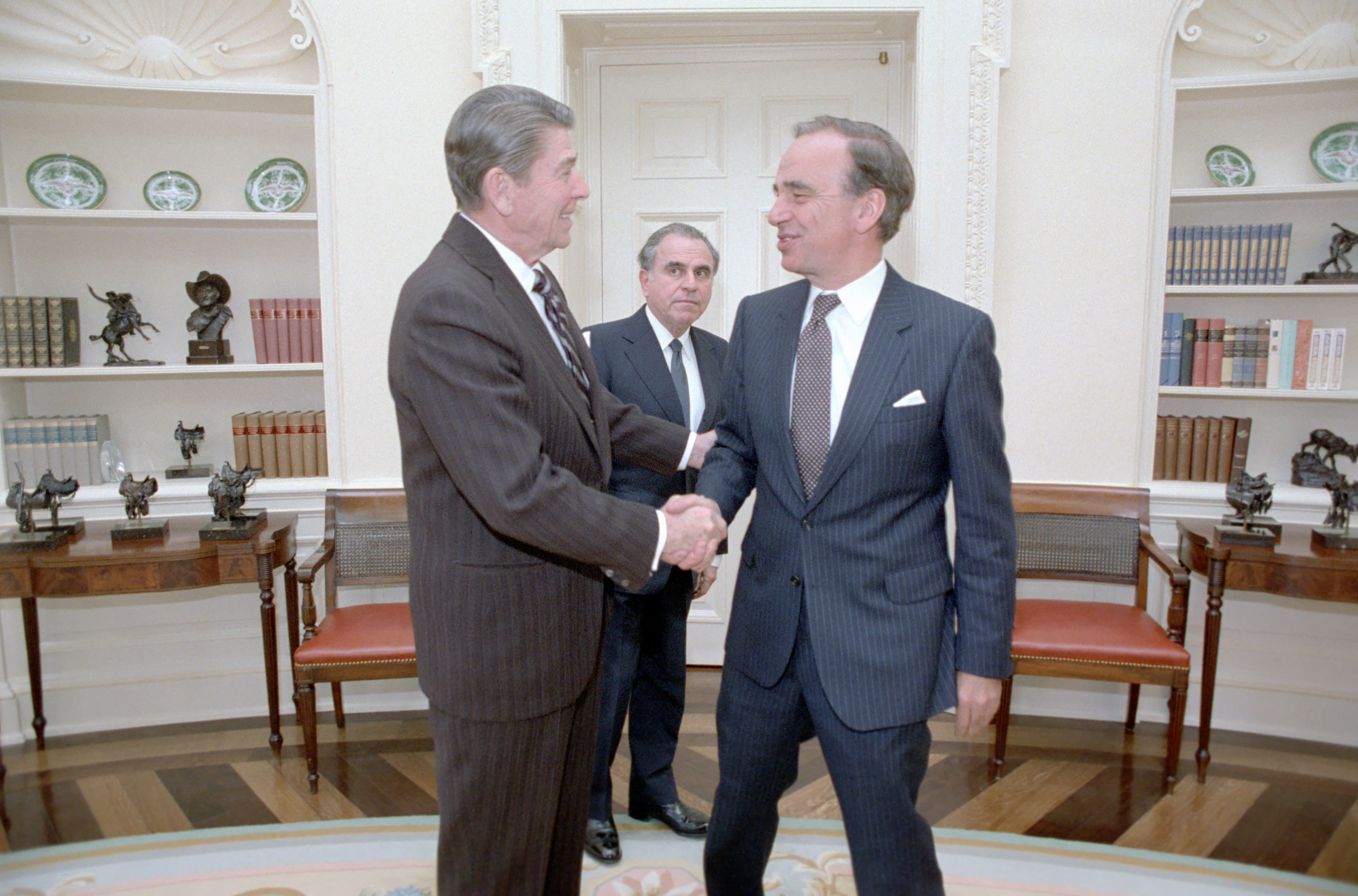


NATO’s Vershbow says EU-NATO “deeper cooperation” needed to fight Russia — a merger perhaps?

The Deputy Secretary General noted that while NATO-EU cooperation has intensified in recent years, “the logic of closer cooperation between NATO and the EU is more compelling than ever before.” He added that the two organisations should “further coordinate our approaches to counter hybrid warfare, dispel propaganda and misinformation, and defend our shared democratic values.”

North Atlantic Treaty Organization
March 5, 2015
Deputy Secretary General: NATO-EU cooperation is more important than ever

1119-eu-nato

NATO Deputy Secretary General Ambassador Alexander Vershbow has called for deeper cooperation between NATO and the European Union in the fight against new security threats. “We need to work together to manage crises, bring relief, and project stability beyond our borders,” he said. Ambassador Vershbow made his remarks in Riga, Latvia on Thursday (5 March 2015) in a speech to the Interparliamentary Conference for the Common Foreign and Security Policy and the Common Security and Defence Policy. “This is a critical time for the security of all our nations,” Ambassador Vershbow said.

The Deputy Secretary General warned that the Euro-Atlantic community faces “new threats and challenges both on our eastern and our southern borders”. To the east, we see “an angry, revisionist Russia that breaks international rules” and continues to destabilise Ukraine and intimidate its neighbours, he said. Meanwhile, to the south, across the Middle East and North Africa, “ISIL’s violent ideology has poured oil on the fire of extremism and sectarianism”. Ambassador Vershbow noted that migrants fleeing turmoil have placed strain on countries like Italy and Turkey, and that violent ideologies have inspired terrorism on the streets of Europe.

The Deputy Secretary General stressed that NATO and its partners must also be ready to counter hybrid warfare, which combines military intimidation, economic and diplomatic duplicity, and media manipulation. Ambassador Vershbow noted that hybrid warfare has been “central to the Russian strategy” in Crimea and eastern Ukraine. He underlined that any response to hybrid threats should be “multi-faceted”, leveraging the complementary hard and soft power tools of NATO and the European Union.

Ambassador Vershbow also pointed to other areas ripe for deepened cooperation between NATO and the European Union, including support for partners like Ukraine, Georgia, and Moldova; as well as for nations to the south. “There is a key role for the European Union to help these countries with political and economic reforms, to build strong institutions, and to fight corruption,” he said.

The Deputy Secretary General noted that while NATO-EU cooperation has intensified in recent years, “the logic of closer cooperation between NATO and the EU is more compelling than ever before.” He added that the two organisations should “further coordinate our approaches to counter hybrid warfare, dispel propaganda and misinformation, and defend our shared democratic values.”

https://rickrozoff.wordpress.com/2015/03/06/real-nato-boss-nato-eu-merger-needed-for-war-with-Russia/
Real NATO Boss: NATO-EU Merger Needed For War With Russia

“The US should keep out of the Ukraine conflict”– EU Parliament President Martin Schulz in heated talk show roundtable

Participants on Günther Jauch talk show, February 8, 2015:

Martin Schulz — EU Parliament President
Gabriele Krone-Schmaltz — ARD (Ukrainian TV) Moscow correspondent
John Kornblum — former U.S. ambassador to Germany
Harald Kujat — formerly NATO/Bundeswehr General

Posted on Fort Russ
 2/11/2015

Germans are fed up with the US ‘”over-protectiveness” and are not willing to fight for Poroshenko

Translated from Russian by J.Hawk

Ukrainian special services ought to immediately put out an arrest warrant on the European Parliament deputy Martin Schulz. This “Colorado beetle” and “quilted jacket” [both are derogatory terms used to describe the Ukrainian proponents of good relations with Russia] dared, on the state ARD TV channel, to call what’s happening in Ukraine a civil war, while the current Kiev government really hates that term. You are liable to get arrested for that, like the journalist Kotsaba.

Schultz made that statement on Gunther Jauch’s talk show, which is the equivalent of Savik Schuster’s show in Ukraine.

The next show aired on February 8. The topic: “Fateful Days for Europe—Whom is Putin Listening to?” Needless to say, the topic was Ukraine.

The discussion as to whom Putin listens to included the European Parliament President Martin Schulz, the ARD Moscow correspondent Gabriele Krone-Schmaltz, the former US ambassador to Germany John Kornblum, and the former NATO [actually, Bundeswehr] general Harald Kujat.

The discussion was heated and shows that being under the “over-protectiveness” of the US Big Brother has long gotten under the Germans’ skin, and any reference to that fact caused applause among the studio audience.

It would be difficult to call Schultz a Russophile and a Ukrainophobe. Nevertheless even he could not force himself to lie in front of the cameras and call the conflict on the Donbass one between the Forces of Light against Colorado beetle terrorists.

The Donbass conflict is a civil war. It must be resolved by diplomatic means, and not through the use of the Ukrainian army. “If Minsk-1 had failed, maybe Minsk-2 will fail too, but even then we need to continue the negotiations even if it means Minsk-70,” is how Schultz sees the problem’s resolution.

One left with an impression of tension in the German-US relations. Judging by how Angela Merkel spent the entire 2014 agreeing with Obama, the anti-US sentiment in Germany had grown, to the point that Kornblum was reduced to complaining to his German audience that “these days I’m seeing a tendency to blame everything on the US.”

His statement that “it’s Russia that’s waging war”, Krone-Schmaltz met with a rather sharp reply. “I want to emphasize, I am underscoring that if Russia were included during the preparations for the association agreement with Ukraine (and this is normal diplomatic work), none of this would be happening. I also believe that if the Eastern regions of Ukraine, where there is fighting right now, were given some autonomy, none of this would be happening. One can’t judge everything by today’s events and blame Moscow as soon as something goes wrong. One needs to engage in a little self-criticism.” Judging by the studio applause, she hit the nail on the head.

“Mr. Kornblum, what do you think about what McCain said to Merkel, namely that she ‘doesn’t care that people in eastern Ukraine are being killed like cattle’? Such rhetoric in Germany, to put it mildly, is considered unfriendly,” said Jauch to Kornblum. “Well, McCain is known for his sharp tongue. There are heated discussions, people are getting hot-headed. If you knew how many times I was told that America is responsible for that war. But we are not dealing with a ‘civil war’ but with a Russian aggression,” continued Kornblum.

General Kujat could not remain indifferent to that statement. “There is no military solution. Let me clarify: the West does not have a military solution. If we do something idiotic and intervene, we will not win but lose, and there will be a huge catastrophe. The situation looks different for Russia. Russia could adopt a military solution and we need to keep that in mind. But if Russia had really wanted it, that war, that conflict in Eastern Ukraine, would have been over in 48 hours. We keep hearing from various sources that regular Russian forces are participating in the fighting. Ukraine’s president also repeated that claim. However, I have no trustworthy information that would confirm that. Even the Ukrainian GenStaff Chief recently said: we are not fighting against regular Russian forces. If there were regular Russian forces there, the conflict would be over in 48 hours. What we are hearing is propaganda.”

To Schulz’s words that “Putin obviously has influence over the separatists,” Krone-Schmaltz reacted as follows: “it would be an oversimplification that Moscow controls the separatists, and Kiev controls its forces. It’s obvious there are forces that nobody controls. Kiev likewise does not control several of its military formations. For example, there was an ceasefire agreement after the Boeing MH17 catastrophe, in order to collect the victims. And who violated that ceasefire? Not the separatists but the Ukrainian army, whoever might be representing it! It’s been like this until today. I remind you that the Right Sector still insists it has a right to carry weapons. Therefore the EU ought to exert pressure also on Kiev so that the situation does not spin out of control.”

Schulz also pointed out that there are too many Americans involved. “This conflict is occurring on the border with the EU, therefore the US ought to pull back. I think it would be best if the Europeans were to solve this problem themselves,” he said to thunderous applause. Continue reading

Robert Parry: How the New York Times falsifies the Ukraine narrative

In late February, a conference is scheduled in New York City to discuss the risk of nuclear war if computers reach the level of artificial intelligence and take decisions out of human hands. But there is already the old-fashioned danger of nuclear war, started by human miscalculation, fed by hubris and propaganda.

That possible scenario is playing out in Ukraine, where the European Union and the United States provoked a political crisis on Russia’s border in November 2013, then backed a coup d’etat in February 2014 and have presented a one-sided account of the ensuing civil war, blaming everything on Russia.

Possibly the worst purveyor of this Cold War-style propaganda has been the New York Times, which has given its readers a steady diet of biased reporting and analysis, including now accusing the Russians for a resurgence in the fighting.

One way the Times has falsified the Ukraine narrative is by dating the origins of the crisis to several months after the crisis actually began. So, the lead story in Saturday’s editions ignored the actual chronology of events and started the clock with the appearance of Russian troops in Crimea in spring 2014.

The Times article by Rick Lyman and Andrew E. Kramer said: “A shaky cease-fire has all but vanished, with rebel leaders vowing fresh attacks. Civilians are being hit by deadly mortars at bus stops. Tanks are rumbling down snowy roads in rebel-held areas with soldiers in unmarked green uniforms sitting on their turrets, waving at bystanders — a disquieting echo of the ‘little green men’ whose appearance in Crimea opened this stubborn conflict in the spring.”

In other words, the story doesn’t start in fall 2013 with the extraordinary U.S. intervention in Ukrainian political affairs – spearheaded by American neocons, such as National Endowment for Democracy president Carl Gershman, Assistant Secretary of State for European Affairs Victoria Nuland and Sen. John McCain – nor with the U.S.-backed coup on Feb. 22, 2014, which ousted elected President Viktor Yanukovych and put one of Nuland’s chosen leaders, Arseniy Yatsenyuk, in as Prime Minister.

No, because if that history were included, Times readers might actually have a chance for a balanced understanding of this unnecessary tragedy. For propaganda purposes, it is better to start the cameras rolling only after the people of Crimea voted overwhelmingly to secede from the failed state of Ukraine and rejoin Russia.

Except the Times won’t reference the lopsided referendum or the popular will of the Crimean people. It’s better to pretend that Russian troops – the “little green men” – just invaded Crimea and conquered the place against the people’s will. The Russian troops were already in Crimea as part of an agreement with Ukraine for maintaining the Russian naval base at Sevastopol.

Which leads you to the next paragraph of the Times story: “The renewed fighting has dashed any hopes of reinvigorating a cease-fire signed in September [2014] and honored more in name than in fact since then. It has also put to rest the notion that Russia’s president, Vladimir V. Putin, would be so staggered by the twin blows of Western sanctions and a collapse in oil prices that he would forsake the separatists in order to foster better relations with the West.”

That last point gets us to the danger of human miscalculation driven by hubris. The key error committed by the EU and compounded by the U.S. was to assume that a brazen bid to get Ukraine to repudiate its longtime relationship with Russia and to bring Ukraine into the NATO alliance would not prompt a determined Russian reaction.

Russia sees the prospect of NATO military forces and their nuclear weapons on its borders as a grave strategic threat, especially with Kiev in the hands of rabid right-wing politicians, including neo-Nazis, who regard Russia as a historic enemy. Confronted with such a danger – especially with thousands of ethnic Russians inside Ukraine being slaughtered – it was a near certainty that Russia’s leaders would not succumb meekly to Western sanctions and demands.

Yet, as long as the United States remains in thrall to the propagandistic narrative that the New York Times and other U.S. mainstream media outlets have spun, President Barack Obama will almost surely continue to ratchet up the tensions. To do otherwise would open Obama to accusations of “weakness.”

During his State of the Union address, Obama mostly presented himself as a peacemaker, but his one major deviation was when he crowed about the suffering that U.S.-organized sanctions had inflicted on Russia, whose economy, he boasted, was “in tatters.”

So, with the West swaggering and Russia facing what it considers a grave strategic threat, it’s not hard to imagine how the crisis in Ukraine could escalate into a violent clash between NATO and Russian forces with the possibility of further miscalculation bringing nuclear weapons into play.

The Actual Narrative

There’s no sign that the New York Times has any regrets about becoming a crude propaganda organ, but just in case someone is listening inside “the newspaper of record,” let’s reprise the actual narrative of the Ukraine crisis. It began not last spring, as the Times would have you believe, but rather in fall 2013 when President Yanukovych was evaluating the cost of an EU association agreement if it required an economic break with Russia.

This part of the narrative was well explained by Der Spiegel, the German newsmagazine, even though it has generally taken a harshly anti-Russian line. But, in a retrospective piece published a year after the crisis began, Der Spiegel acknowledged that EU and German leaders were guilty of miscalculations that contributed to the civil war in Ukraine, particularly by under-appreciating the enormous financial costs to Ukraine if it broke its historic ties to Russia.

In November 2013, Yanukovych learned from experts at the National Academy of Sciences of Ukraine that the total cost to the country’s economy from severing its business connections to Russia would be around $160 billion, 50 times the $3 billion figure that the EU had estimated, Der Spiegel reported.

The figure stunned Yanukovych, who pleaded for financial help that the EU couldn’t provide, the magazine said. Western loans would have to come from the International Monetary Fund, which was demanding painful “reforms” of Ukraine’s economy, structural changes that would make the hard lives of average Ukrainians even harder, including raising the price of natural gas by 40 percent and devaluing Ukraine’s currency, the hryvnia, by 25 percent.

With Putin offering a more generous aid package of $15 billion, Yanukovych backed out of the EU agreement but told the EU’s Eastern Partnership Summit in Vilnius, Lithuania, on Nov. 28, 2013, that he was willing to continue negotiating. German Chancellor Angela Merkel responded with “a sentence dripping with disapproval and cool sarcasm aimed directly at the Ukrainian president. ‘I feel like I’m at a wedding where the groom has suddenly issued new, last minute stipulations,” according to Der Spiegel’s chronology of the crisis.

After the collapse of the EU deal, U.S. neocons went to work on one more “regime change” – this time in Ukraine – using the popular disappointment in western Ukraine over the failed EU agreement as a way to topple Yanukovych, the constitutionally elected president whose political base was in eastern Ukraine.

Assistant Secretary of State Nuland, a prominent neocon holdover who advised Vice President Dick Cheney, passed out cookies to anti-Yanukovych demonstrators at the Maidan Square in Kiev and reminded Ukrainian business leaders that the United States had invested $5 billion in their “European aspirations.”

Sen. McCain, who seems to want war pretty much everywhere, joined Ukrainian rightists onstage at the Maidan urging on the protests, and Gershman’s U.S.-funded National Endowment for Democracy deployed its Ukrainian political/media operatives in support of the disruptions. As early as September 2013, the NED president had identified Ukraine as “the biggest prize” and an important step toward toppling Putin in Russia. [See Consortiumnews.com’s “Neocons’ Ukraine-Syria-Iran Gambit.”]

By early February 2014, Nuland was telling U.S. Ambassador to Ukraine Geoffrey Pyatt “fuck the EU” and discussing how to “glue this thing” as she handpicked who the new leaders of Ukraine would be; “Yats is the guy,” she said about Arseniy Yatsenyuk.

As violent disorders at the Maidan grew worse – with well-organized neo-Nazi militias hurling firebombs at police – the State Department and U.S. news media blamed Yanukovych. On Feb. 20, when mysterious snipers – apparently firing from positions controlled by the neo-Nazi Right Sektor – shot to death police officers and protesters, the situation spun out of control – and the American press again blamed Yanukovych.

Though Yanukovych signed a Feb. 21 agreement with three European countries accepting reduced powers and early elections, that was not enough for the coup-makers. On Feb. 22, a putsch, spearheaded by neo-Nazi militias, forced Yanukovych and his officials to flee for their lives.

Remarkably, however, when the Times pretended to review this history in a January 2015 article, the Times ignored the extraordinary evidence of a U.S.-backed coup – including the scores of NED political projects, McCain’s cheerleading and Nuland’s plotting. The Times simply informed its readers that there was no coup. [See Consortiumnews.com’s “NYT Still Pretends No Coup in Ukraine.”]

But the Times’ propaganda on Ukraine is not just wretched journalism, it is also a dangerous ingredient in what could become a nuclear confrontation, if Americans come to believe a false narrative and thus go along with more provocative actions by their political leaders who, in turn, might feel compelled to act tough because otherwise they’d be attacked as “soft.”

In other words, even without computers seizing control of man’s nuclear weapons, man himself might blunder into a nuclear Armageddon, driven not by artificial intelligence but a lack of the human kind.

http://www.helencaldicott.com/nyt-lost-ukraine-propaganda/