Michael Parenti, who died on Saturday at 92, wrote for Consortium News what appears to be his last article on the occasion of the 100th anniversary of the end of WWI.
Michael Parenti, a giant on the American left, who influenced generations of activists, scholars and ordinary Americans, died on Saturday in Berkeley, California. He was 92. Parenti wrote for Consortium News what is believed to be his last article, about the horrors of World War I. It appeared on U.S. Memorial Day, May 28, 2018, and we republish it here ahead of a tribute Consortium News is preparing.
On Memorial Day 2018, in the year marking the 100th anniversary of the end of World War I, Michael Parenti contemplates the trenches and the oligarchs who caused so much unnecessary misery.
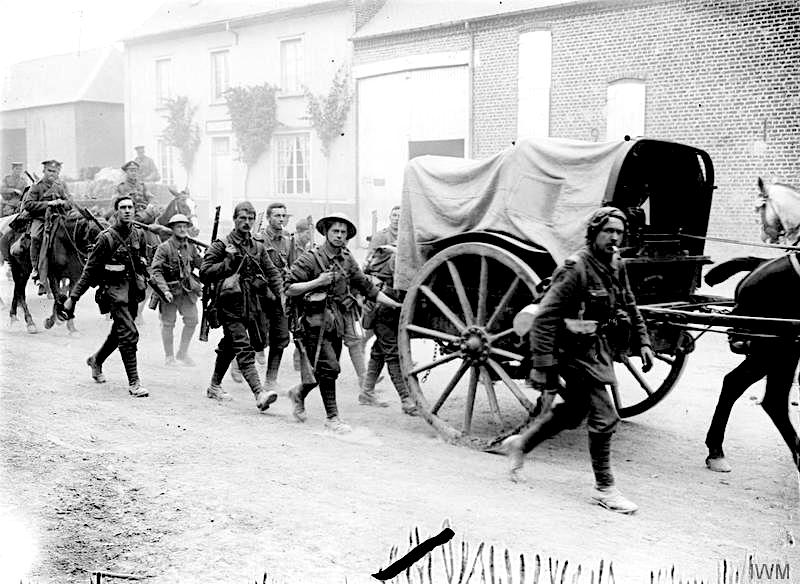
During World War I Battle of the Somme, East Yorkshire regimentmarching to the front line, June 28 , 1916. ( Ernest Brooks, Imperial War Museums, Public domain, Wikimedia Commons)
Now comes a different conflict. We have enemies at home: the schemers who trade our blood for sacks of gold, who make the world safe for hypocrisy, safe for themselves, readying themselves for the next “humanitarian war.” See how sleek and self-satisfied they look, riding our backs, distracting our minds, filling us with fright about wicked foes…
May 28, 2018 Special to Consortium News
Looking back at the years of fury and carnage, Colonel Angelo Gatti, staff officer of the Italian Army (Austrian front), wrote in his diary: “This whole war has been a pile of lies. We came into war because a few men in authority, the dreamers, flung us into it.”
No, Gatti, caro mio, those few men are not dreamers; they are schemers. They perch above us. See how their armament contracts are turned into private fortunes—while the young men are turned into dust: more blood, more money; good for business this war.
It is the rich old men, i pauci, “the few,” as Cicero called the Senate oligarchs whom he faithfully served in ancient Rome. It is the few, who together constitute a bloc of industrialists and landlords, who think war will bring bigger markets abroad and civic discipline at home. One of i pauci in 1914 saw war as a way of promoting compliance and obedience on the labor front and—as he himself said—war, “would permit the hierarchal reorganization of class relations.”
Just awhile before the heresies of Karl Marx were spreading among Europe’s lower ranks. The proletariats of each country, growing in numbers and strength, were made to wage war against each other. What better way to confine and misdirect them than with the swirl of mutual destruction.
Then there were the generals and other militarists who started plotting this war as early as 1906, eight years before the first shots were fired. War for them means glory, medals, promotions, financial rewards, inside favors, and dining with ministers, bankers, and diplomats: the whole prosperity of death. When the war finally comes, it is greeted with quiet satisfaction by the generals.
Moguls and Monarchs Prevail
But the young men are ripped by waves of machine-gun fire or blown apart by exploding shells. War comes with gas attacks and sniper shots: grenades, mortars, and artillery barrages; the roar of a great inferno and the sickening smell of rotting corpses. Torn bodies hang sadly on the barbed wire, and trench rats try to eat away at us, even while we are still alive.
Farewell, my loving hearts at home, those who send us their precious tears wrapped in crumpled letters. And farewell my comrades. When the people’s wisdom fails, moguls and monarchs prevail and there seems to be no way out.
Fools dance and the pit sinks deeper as if bottomless. No one can see the sky, or hear the music, or deflect the swarms of lies that cloud our minds like the countless lice that torture our flesh. Crusted with blood and filth, regiments of lost souls drag themselves to the devil’s pit. “Lasciate ogni speranza, voi ch’entrate.” (“Abandon all hope, ye who enter” as our Dante delivered his painful message).
Meanwhile from above the Vatican wall, the pope himself begs the world leaders to put an end to hostilities, “lest there be no young men left alive in Europe.” But the war industry pays him no heed.
Finally the casualties are more than we can bear. There are mutinies in the French trenches! Agitators in the Czar’s army cry out for “Peace, Land, and Bread!” At home, our families grow bitter. There comes a breaking point as the oligarchs seem to be losing their grip.
At last the guns are mute in the morning air. A strange almost pious silence takes over. The fog and rain seem to wash our wounds and cool our fever. “Still alive,” the sergeant grins, “still alive.” He cups a cigarette in his hand. “Stack those rifles, you lazy bastards.” He grins again, two teeth missing. Never did his ugly face look so good as on this day in November 1918. Armistice embraces us like a quiet rapture.
Not really a quiet rapture with smiling sergeants. Many troops on both sides continued killing to the bitter end, with a fury that had no mercy. In one day, November 11, the last day of war, some 10,900 men were wounded or killed from both sides, a furious rage in the face of peace, years of slaughter; now moments of vengeance.
The Fall of Eagles
A big piece of the encrusted aristocratic world breaks off. The Romanovs, Czar and family, are all executed in 1918 in Revolutionary Russia. That same year, the House of Hohenzollern collapses as Kaiser Wilhelm II flees Germany. Also in 1918, the Ottoman empire is shattered. And on Armistice Day, November 11th, 1918, at 11:00 a.m.—the eleventh hour of the eleventh day of the eleventh month—we mark the end of the war and with it the dissolution of the Habsburg dynasty.
Four indestructible monarchies: Russian, German, Turkish, and Austro-Hungarian, four great empires, each with millions of bayonets and cannon at the ready, now twisting in the dim shadows of history.
Will our children ever forgive us for our dismal confusion? Will they ever understand what we went through? Will we? By 1918, four aristocratic autocracies fade away, leaving so many victims mangled in their wake, and so many bereaved crying through the night.
Back in the trenches, the agitators among us prove right. The mutinous Reds standing before the firing squad last year were right. Their truths must not be buried with them. Why are impoverished workers and peasants killing other impoverished workers and peasants? Now we know that our real foe is not in the weave of trenches; not at Ypres, nor at the Somme, or Verdun or Caporetto. Closer to home, closer to the deceptive peace that follows a deceptive war.
Now comes a different conflict. We have enemies at home: the schemers who trade our blood for sacks of gold, who make the world safe for hypocrisy, safe for themselves, readying themselves for the next “humanitarian war.” See how sleek and self-satisfied they look, riding our backs, distracting our minds, filling us with fright about wicked foes. Important things keep happening, but not enough to finish them off. Not yet enough.
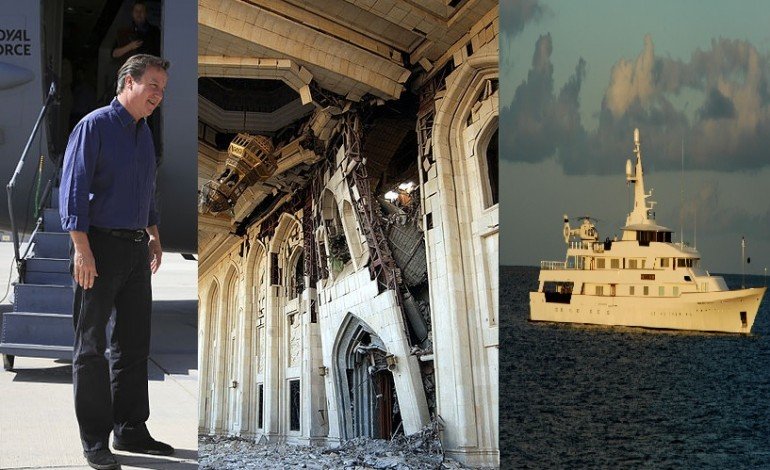
David Cameron has announced that at least one billion pounds from UK taxpayers will go to fund the ‘reconstruction’ of Syria after it has been pummeled by British bombs. The lunacy of pledging to rob the public purse to repair the damage Cameron is so hell-bent on creating is breathtaking. That is until you examine who the plan makes sense for: Cameron’s much loved British companies.
On 26 November, Cameron made a statement on his proposals for bombing Syria to the House of Commons. In his statement he addressed the following:
The House is rightly also asking more questions about whether there will be a proper post conflict reconstruction effort to support a new Syrian government when it emerges, and Britain’s answer to that qusetion is absolutely yes. I can tell the House that Britain will be prepared to contribute at least another billion pounds for this task.
This is, of course, a direct insult to the British population, who have been forced to endure a crippling amount of cuts to public services in the name of ‘essential’ austerity. However, it is glaringly obvious by now that the Tory party’s austerity program is nothing more than an ideological instrument to re-order society.
Part of this ideology resides in bringing about a British business boom, and Cameron is willing to do whatever it takes to ensure that happens. It is why corporation tax has been consistently lowered by his government – leading to companies loving these little isles as they pay next to nothing to trade here.
It’s also why Cameron sees opportunity in the tragedy of Syria. For all his fire and brimstone talk of destroying jihadi “monsters”, he is counting on benefits for the British contractors carrying out the extensive work necessary to rebuild Syria after RAF bombers, and those of numerous other countries, have decimated it.
There is a precedent for this: the Iraq war. Multiple companies profited from the illegal invasion of Iraq, many of them British. An article in Business Pundit details the most vicious of these profiteers, here’s a selection of the UK’s beneficiaries:
Aegis
A security and risk management company who landed a £250 million contract to coordinate all of Iraq’s private security operations, which led to them being rejected for membership of trade organisation International Peace Operations Association.
The bank bought a 70% controlling stake in Dar es Salaam Investment Bank, which had gathered $91 million worth of assets by 2008. Daesh (ISIS) is already known to have seized control of banks in the areas they maintain, which would open up a lucrative opportunity for western banks should they be defeated.
Erinys
A London-based private security company who landed a $90 million contract to secure Iraq’s oil fields. Daesh has huge reserves of oil that power it financially, and which would need protecting once wrestled from its control.
Armor Holdings
Not a UK-based company, but it was acquired by BAE Systems in 2007 – a subsidiary of BAE Systems plc, based in the UK. Armor Holdings provided military and personnel safety equipment for the Iraq war, and saw its profits increase by over 2,000% between 2001 and 2008.
Aside from the businesses set to reap the benefits of a Syria in ashes, there are those who will benefit from creating those ashes – namely defence companies. BAE Systems is one of the military manufacturers that will see a rise in profits from any decision to continue along the western warpath. In fact, BAE announced this year that its profits were up £500 million in 2013, having gained contracts worth over £10bn from the US and UK governments for three consecutive years, according to the BBC.
That corporate behemoths like BAE Systems benefit from the ‘war on terror’ is no accident, and it’s a result Cameron is banking on. As investigative reporter James Risen lays out so well in his book Pay Any Price, many have recognised the opportunities this never-ending war has created, both in the battles abroad, and the enhanced security measures we find on our own doorsteps:
As trillions of dollars have poured into the nation’s new homeland security-industrial complex, the corporate leaders at its vanguard can rightly be considered the true winners of the war on terror.
The first step in tackling this, is to recognise it. If we face the true motivation of our government’s actions, we are able to challenge it.
Cameron’s claims about why he wants to bomb Syria have already been widely debunked, even by members of his own party. His position on who he is doing it for should also be challenged. It is not the Syrian people. They will undoubtedly suffer from further bombing. It is not UK citizens, who will see the threat of terrorism at home further increase. Is it these giant industries, with their lobbyists and political donations, that Cameron actually holds closest to his heart?

 Free Ukraine Now