Not long after the war, I was a member of a delegation that interviewed people who had been forced from their homes in Kosovo. We heard how attacks on people often took place in the presence of KFOR soldiers, who invariably did nothing. Indeed, by all accounts, the relationship between KFOR and the xenophobic KLA was mutually warm and supportive.
Albanians who wanted to live together in a multiethnic society, or even those who held ordinary government jobs such as mailman, were not immune from attack either. We talked with an Albanian man who had been a member of the Yugoslav government in Kosovo up until the arrival of KFOR. He told us that the KLA had driven out of Kosovo 150,000 Albanians did not share its extremist views. Another Albanian we talked with in Belgrade wanted to return to Kosovo but was concerned about his safety if he did so. In time, his feelings of homesickness overcame his fear. He returned home, only to be killed in a rain of automatic rifle bullets fired by KLA soldiers who broke into his home.
Typically, refugees of the “wrong” ethnicity went largely unnoticed in the West. To learn more about the forgotten ones, we joined Jovan Damjanovich, president of the Association of Romani Organizations of the Republic of Serbia, in his office in the slightly rundown Belgrade suburb of Zemun. A passionate man, Damjanovich briefed us on how his community had fared at the hands of the Kosovo Liberation Army.
The situation of the Roma was dire. The Yugoslav government, financially strapped by harsh Western sanctions and struggling to care for several hundred thousand refugees from earlier wars in Croatia and Bosnia, was now confronted with the sudden influx of hundreds of thousands more.
We were driven to a Roma settlement in Zemun Polje, located on the outskirts of the town. Romani residents here had taken more than five thousand refugees into their homes, placing an enormous strain on the local population’s personal finances. Those who had little opened their homes to help their fellow human beings. It said much for the people here.
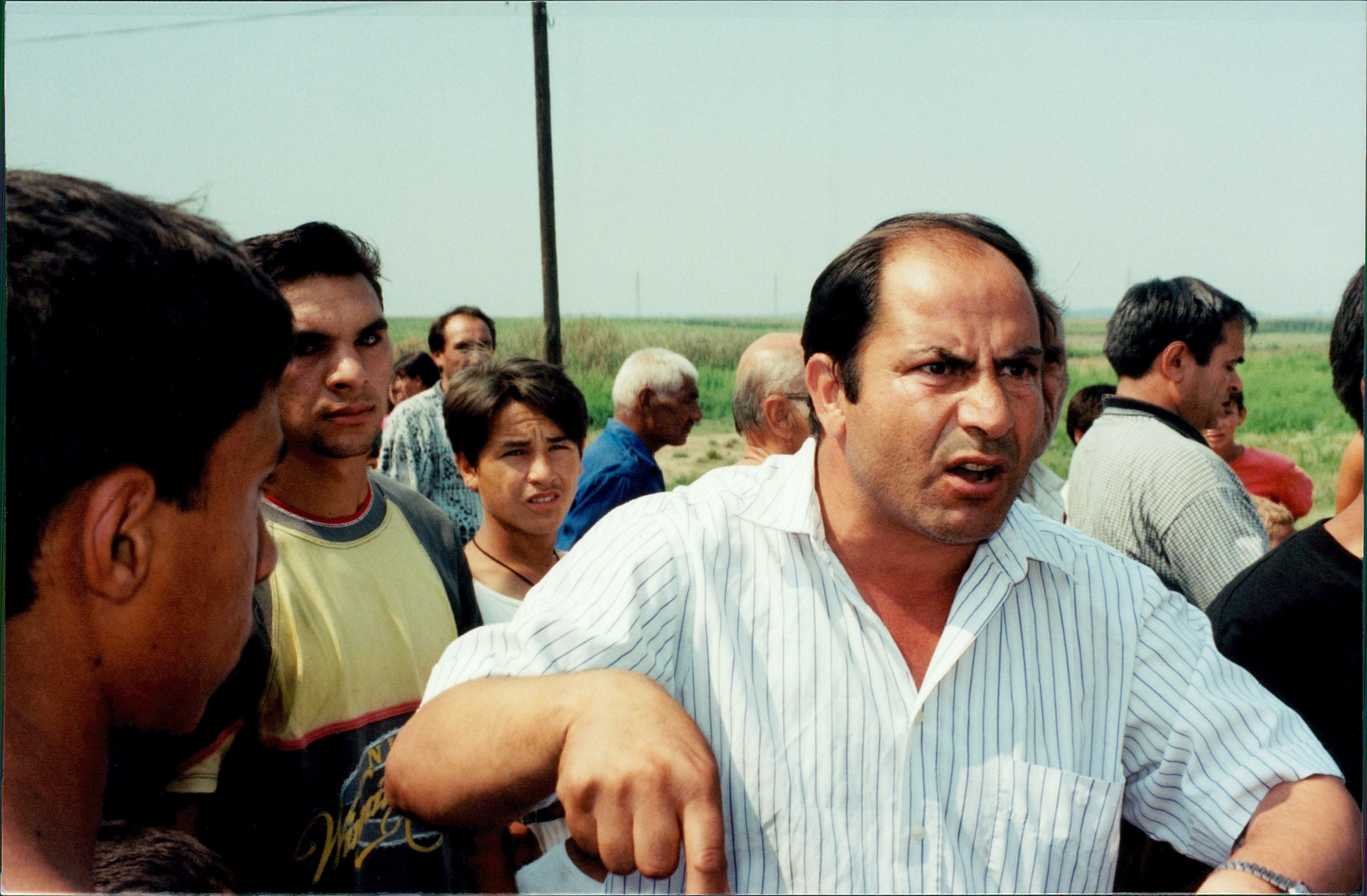
Caption: Roma refugees at Zemun Polje. Photo: Gregory Elich
The moment our cars pulled to a stop at the end of the settlement, a crowd formed around us. We interviewed a number of Roma and Egyptian refugees from Kosovo. Tefiq Krashich brought his family here from Obilich after KLA soldiers came to his house and threatened to kill his family. For two months, his family had nowhere to sleep until being taken in by a local family. They now had shelter but life remained difficult. “We have no food,” Krashich said. “We are starving. We are begging in the streets for food.”
Threats drove Pucho Rezhezha and his family from their home. After murdering Pucho’s brother, the KLA warned that they would kill everyone in the family if they did not leave Kosovo.
We interviewed a few more people, all with similar tales to tell, but emotions soon started to flare out of control, prompting Damjanovich to cut short the interviews. As our cars drove down the dirt road that ran alongside the settlement, children ran excitedly behind us, enveloped in the dust kicked up by the cars. We sped past two boys standing by the side of the road, pumping their fists in the air while chanting, “Yugoslavia! Yugoslavia!”
The next day, Damjanovich arranged for us to resume our interviews, this time in the center of Zemun. Even before we managed to set up our video cameras, we were surrounded by refugees, anxious to tell us their stories and to hear what others had to say. The weather was sweltering, and sweat poured down my back as the crowd closed around us. Estref Ramdanovich, vice president of the Roma association, informed us that out of a total population of 150,000 Roma in Kosovo, the KLA had by that point expelled 120,000. “The KLA soldiers don’t want any other ethnic group to be in Kosovo,” he explained. “Only Albanians.” Ramdanovich was one of those who had sacrificed much to help others, having taken an astonishing twenty refugees into his home.
With rising emotion, Jovan Damjanovich described the situation. “How many refugees are in the streets, in the bus stations, in the railroad stations, in the parks!” He planned to issue appeals for aid.
“Soon winter will arrive. The international organizations cannot remain blind and deaf when people are dying at their feet. It is a humanitarian catastrophe. Not only is the KLA burning houses. Not only are they expelling people. Not only are they killing many people. They want to create an ethnically clean Kosovo. We think the international community, on the basis of the United Nations Charter, has to do something. Because if there exists humanity, if there exists civilization, we cannot watch the death of a nation.”
It was no surprise to me when the so-called “international community” – a term that somehow always means only powerful interests in the United States and Western Europe and excludes the vast majority of the world’s population – continued to ignore the plight of these politically inconvenient refugees. Little more than a week after our visit to Zemun, Nusret Saiti, leader of the largest remaining Roma community in Kosovo, reported that the KLA had torched over 99 percent of the town’s Romani homes, leaving only three standing. The KLA was stripping the demolished homes for building materials, Saiti said, but NATO’s KFOR mission made no effort to stop them. In just the first year and a half alone of NATO occupation, more than 800 Roma were either killed or had gone missing, a situation which Western officials willfully ignored. Only much later, after most of the Roma had been expelled from the province, were primitive and inadequate refugee camps set up under guard within Kosovo.
We began to talk with the refugees. A soon as Yugoslav forces departed from Kosovo, the KLA showed up, they all told us. Bajrosha Ahmeti burned with anger.
“My daughter, Enisa Ahmeti, was raped by KLA soldiers. At night, we were sleeping in our house, and KLA soldiers broke in and dragged my daughter out and raped her.”
The KLA gang then forced the family from their home, without allowing them to pack. “These are the only clothes I have. I have no food, nowhere to sleep,” she told us. “Should I sleep on the street? The children awake at night, calling ‘Mama, Mama,’ and I have nothing to give them. They can’t sleep well. They can’t eat.”
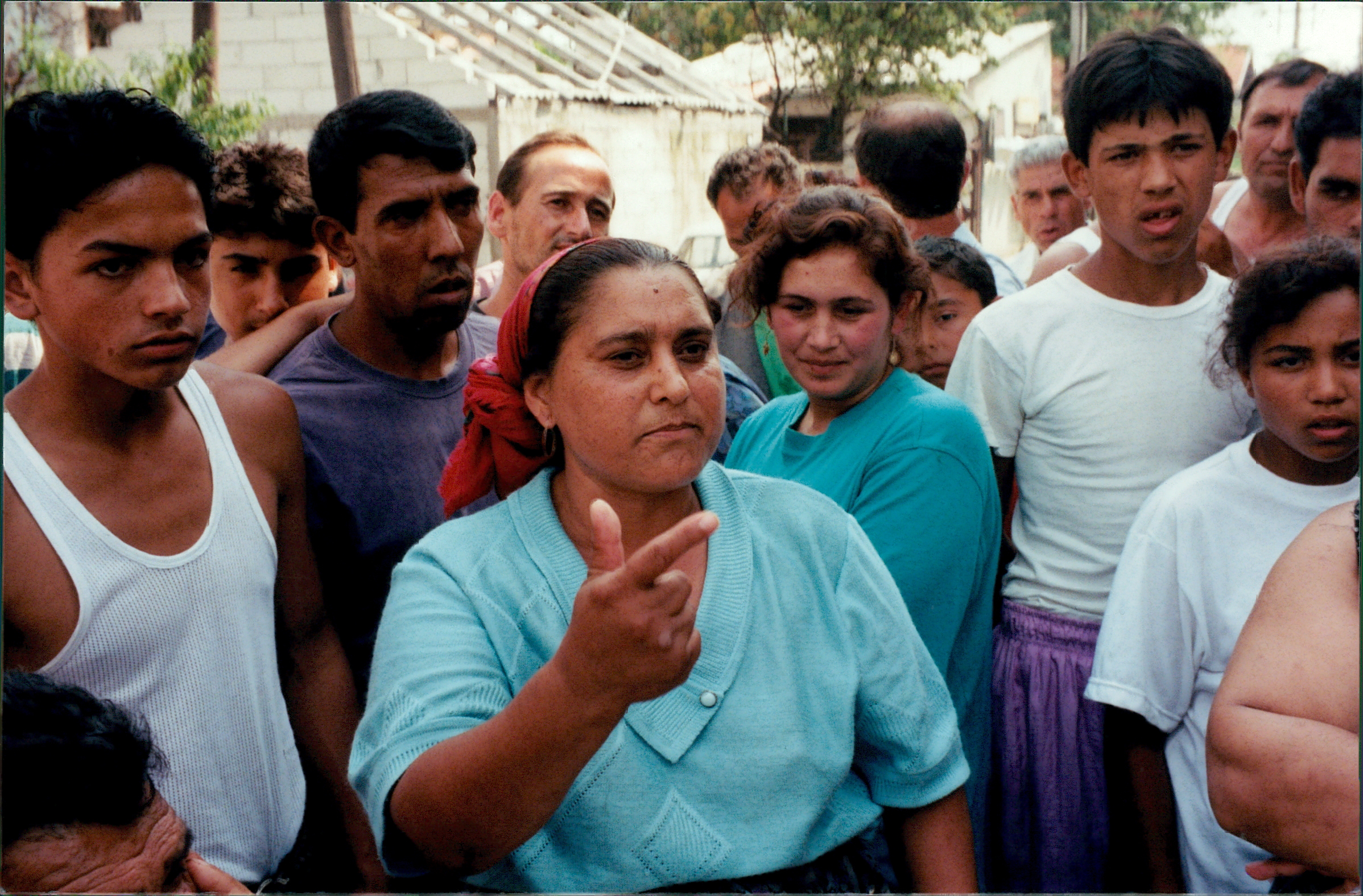
Caption: Bayrosha Ahmeti (center). Photo: Gregory Elich
Adan Berisha told us that he and his wife were tortured by KLA soldiers. He pointed to his wife, whose face and arm were disfigured. It appeared that acid had been poured on her. But that was not the end of the family’s woes, for the KLA also murdered Berisha’s 12-year-old son. After killing the boy, the KLA soldiers threw Adnan, his wife, and grandson out of their home and began to haul away their possessions.
“A KLA soldier gave us only three hours to leave our home. He told us he would kill us if we stayed even half an hour longer than that. Three hours to leave Kosovo. I can’t go back to Kosovo because the militias will kill me.”
Lacking money or assets of any kind, the family’s trek from the province was difficult. Drawing attention to his grandson, Adnan said,
“This little baby, who is only three months old, went four days without eating. After we escaped from the Albanians, we went to Nish, where we didn’t have any food or water to give to this little baby.”
Adnan reached into his pocket for his wallet and produced a photograph of his son. There was a painful moment of silence as we gazed at the picture of the murdered boy. Then Adnan remarked in a quiet voice filled with anguish, “Sorrow. A world of sorrow.”
Four KLA soldiers broke into the home of Elas Raqmani one morning at about 6:00 AM. Two were armed with rifles and the others with knives. “KLA soldiers took everything – all of the furniture from my home,” he recounted.
“My stove was taken out. The washing machine, refrigerator, and freezer were taken out. We were watching, but I was so sick of the sight, I couldn’t bear to watch the Albanians taking my things right out front.”
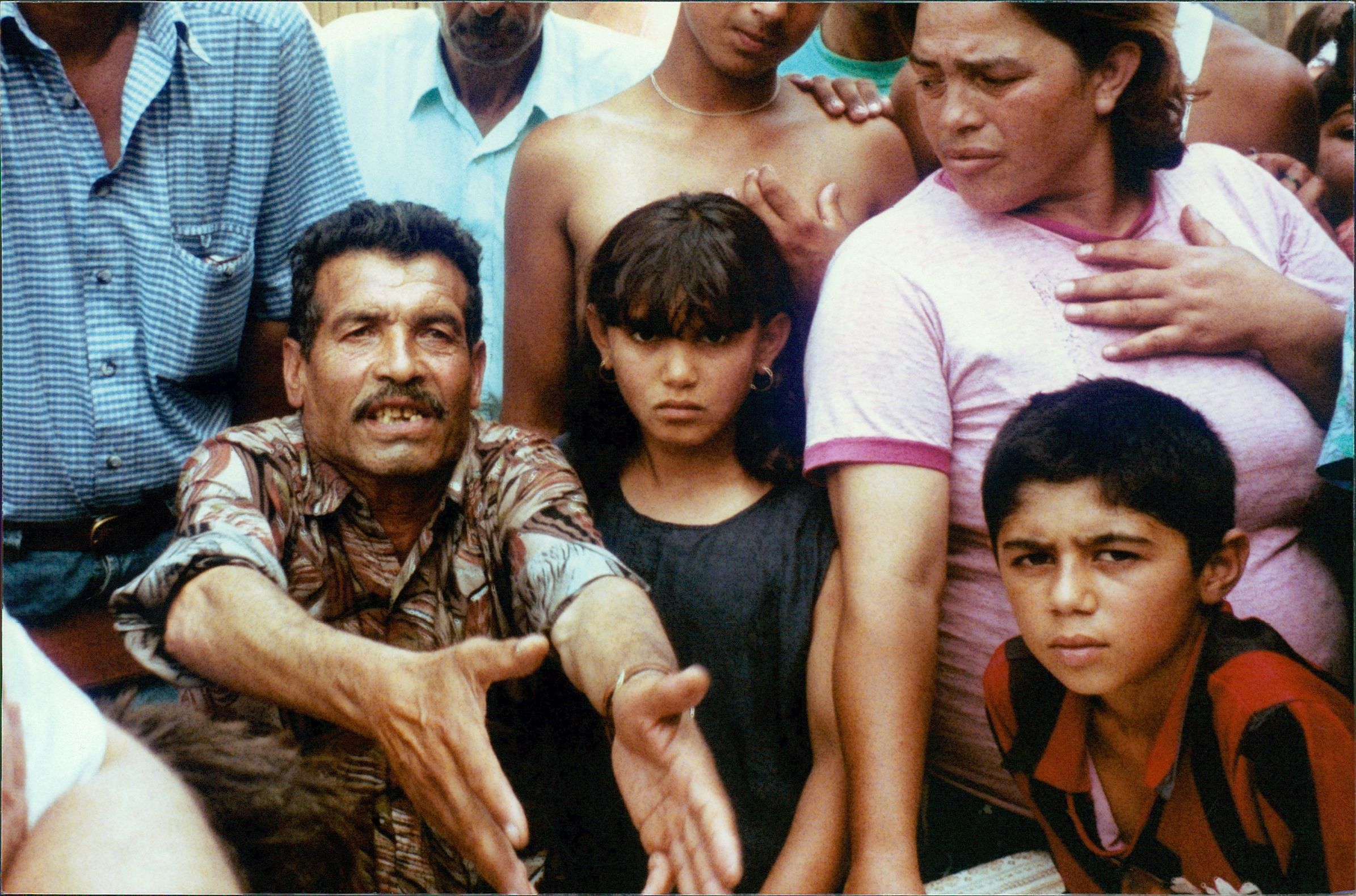
Caption: Elas Raqmani (seated). Photo: Gregory Elich
The intruders then ordered the family to leave. Only later did Raqmani learn that many of his neighbors were killed that day. Raqmani told us that he had worked for fifty years, and his family lived very well until the day he lost his home. His wife was now reduced to visiting the markets each day and asking for leftover vegetables.
Raqmani expressed himself with a passion that swept all before it, and strong emotions spread throughout the crowd as he spoke. “Kosovo was taken away from us. I’m not against the American people, but this decision they made strikes me as loony. The rights of every people – the Serb, the Montenegrin, and the Gypsy – have been annulled.” Angrily slapping the table before him, Raqmani exclaimed,
“People are going out to kill, but you, as an army, just sit there. Did you come here to help or to watch this circus going on? Events now are making history. It is not acceptable what the American people are doing to us. If they came to help, let me see them help. But if they did not come to help, then everyone – Serbs and Gypsies – will be stamped out! They are allowing that to be done!”
Surrounded by her young children, Ajsha Shatili told us she was forced to leave her home on June 19, only a few days after the withdrawal of Yugoslav forces.
“KLA soldiers dragged my children and me from our home and started removing all of my furniture. I called three British KFOR soldiers for help. They came but did nothing. They only told me, “Good, good. Don’t cry. It will be good.” Wiping away her tears, she told us that a KLA soldier wounded her son by plunging a knife into his back when he attempted to stop the looting. Once the KLA soldiers had taken everything they wanted, they proceeded to burn down both of her homes under the indifferent gaze of the British soldiers. Like so many others, she now owned only the clothes she was wearing when she was driven out of Kosovo. Fortunately, all of her friends and relatives managed to escape from Kosovo before being killed. “They were all afraid for their lives,” she explained. When asked what would have happened had she and her family stayed in Kosovo, Shatili answered in a voice so filled with torment that it was almost a howl of pain. “Everyone would be killed! Everyone!”

Caption: Ajsha Shatili (center). Photo: Gregory Elich
Five KLA soldiers came to the home of Hashim Berisha in search of his brother, who was a soldier in the Yugoslav army. Hashim was ordered to produce his brother, or they would kill his entire family. He went to his sister’s house and told her what had happened. His sister then ran to report the incident at the local British KFOR headquarters, where the matter failed to interest them. They merely pointed out that she could go wherever she would like to go just so she would not be killed. The next day, Hashim surreptitiously checked on his house and saw that it had been burned down. The KLA eventually caught up with his brother and subjected him to a severe beating. He was fortunate to have survived. Afterwards, Hashim’s brother went to KFOR headquarters in Prishtina, and told them his story. But KFOR’s translator was a KLA sympathizer, and it soon became apparent that what the translator was telling KFOR bore no resemblance to his story. Having no desire to wait around to be killed, he gathered his family and left Kosovo.
When KLA soldiers looted all of the furniture from his home in Uroshevac, Abdullah Shefik knew it was time to go. Shefik collected his family and friends, eleven people in all, and squeezed them all into his van, with the few possessions they managed to fit in. They headed north to escape Kosovo, but along the route they encountered a KLA roadblock. “They were waiting for us. KLA soldiers stopped me and ordered me to leave my van with them. KFOR soldiers stood nearby when my van was hijacked, but they did nothing.” The KFOR unit was American, Shefik added, but “viewed the whole thing and said nothing.”
Bechet Koteshi told us that as soon as British and French KFOR troops entered Gnjilane, KLA soldiers rampaged through the town, attacking Serbs and Roma. “KFOR did nothing because they were on the other side of the town, but the town is not very big, so they had to know what was happening.” Koteshi was in a pharmacy when the shooting began. He departed immediately, riding his bicycle home as fast as possible. “Three hundred meters behind me was another man riding a bicycle, and KLA soldiers threw a grenade at him and killed him.” Some weeks later, Koteshi snuck back into Kosovo to check briefly on his father, who was living in a tent after his home had been torched by the KLA. “It was so hard for him because he lived in a tent with no electricity and no water. Two days ago, KLA terrorists entered the camp and shouted at them, so they fled their tents in fear.”
NATO was complicit in these acts of terror, as borne out by our interviews and those conducted by others. The role of NATO was summed up by a refugee interviewed by Roma activist Sani Rifati:
“When NATO bombs stopped falling in Yugoslavia, my family returned to Kosovo. We were watching the KLA and KFOR soldiers hugging each other and celebrating their arrival in Kosovo. At that moment I thought, this can’t be happening! Why is that KLA terrorist soldier going to hug a KFOR soldier? I realized it is going to be like hell here. Within three days, all non-ethnic Albanians had to leave Kosovo. My house was burned by ethnic Albanians in front of KFOR forces. I went to report to the so-called foreign peacekeepers that my house was burning — and one of the soldiers was telling me it’s okay. My friend’s sister was raped by ethnic Albanians, and she went to report to the KFOR officer; he was telling her it’s okay. My neighbor was kidnapped by KLA and his wife went to report that he’s gone and the officer was telling her it’s okay. KLA was taking our brothers, relatives, friends and taking them to the KLA torture rooms, and wives went to report to the KFOR officers; they were telling them it’s okay. KLA and ethnic Albanians were killing Romani people and they were telling us it’s okay. Is that really okay? We were kicked out from my home in five minutes. KLA terrorists came to my house and told me that in five minutes we must leave our home and then they’re going to burn it.”
Roma leader Jovan Damjanovich issued a statement condemning the KLA’s campaign of terror. “This state of affairs calls into question the justification for the foreign presence. The exodus of Serbs, Montenegrins, and Romanies continues on the lines of the Nazi scenario of fifty years ago, while the world looks on.” Damjanovich’s plea did not go unnoticed in the West, and he was added to the European Union and U.S. sanctions list, whose members were banned from travel and their funds held in foreign accounts seized.
We met Bajram Haliti, who had been an official in the Yugoslav government in Kosovo. In addition to his role in the Kosovo government prior to NATO occupation, he also served in the national government as Secretary for Development of Information on the Languages of National Minorities. Haliti was gentle and soft-spoken, and I took an immediate liking to this scholarly man who described himself as a humanist. Haliti was a poet, and had also published a study entitled The Roma: a People’s Terrible Destiny, on the subject of the Nazi genocide against the Roma people in the Second World War. At his home in Kosovo, his personal library contained over 500 books on the subject, from all over the world. But KLA soldiers burned down both of Haliti’s homes, and the library he had spent a lifetime collecting went up in flames. “I can’t set a price on that library,” he sadly told us.
“The Roma people are in a very hard situation,” Haliti told us.
“It is the same situation Jewish people faced in 1939. At that time, Hitler persecuted every Jew in his territory. And now we have [KLA leader and present-day Kosovo foreign minister] Hashim Thaci. Now Romani houses are burned down, and Roma are expelled by the KLA.”
At the beginning of May 1999, Haliti sent an open letter to U.S. President Clinton, calling for an end to the war. “Only peaceful means can lead to a just settlement for all national communities which live in Kosovo and Metohija.” The letter made an impression in Washington: Haliti was placed on the first sanctions list. The swiftness in which sanctions were imposed on Jovanovich and Haliti demonstrated the West’s responsiveness to the Roma people’s situation.
Gregory Elich is on the Board of Directors of the Jasenovac Research Institute and the Advisory Board of the Korea Policy Institute. He is a columnist for Voice of the People, and one of the co-authors of Killing Democracy: CIA and Pentagon Operations in the Post-Soviet Period, published in the Russian language.
 Free Ukraine Now