Foreign Minister Sergey Lavrov’s interview with the RBC television channel, Moscow, August 28, 2026

From the Ministry of Foreign Affairs of the Russian Federation

Question: Mr Lavrov, thank you very much for agreeing to speak with us. The first question is, one might say, conceptual – concerning the world order. Previously, we discussed the existence of a bipolar world. Subsequently, following the collapse of the USSR, we spoke of a unipolar world. How would you characterise the present state of the world? What is its nature?

Sergey Lavrov: The world currently stands at a stage of transformation and profound change. These changes will, in all likelihood, span an entire era, such that the generation currently residing on Earth may not witness the final configuration – if, of course, it does ultimately materialise, and if it proves possible to bring it about.

It is true that, after the dissolution of the Soviet Union, unipolarity was proclaimed almost openly. Francis Fukuyama captured the aspirations, dreams, and prevailing sentiment of Western society and its elites when he declared that the “end of history” had arrived and that henceforth only the Western liberal model, in economics, politics, and human rights, would constitute the sole, dominant paradigm on the planet. At the time, this was received in various ways, but I do not recall our Chinese counterparts commenting on it with any great frequency.

Domestically, it was remarked upon with a certain enthusiasm, with many claiming that finally, we had cast off the “shackles” of the communist system. “God bless America!” – as the then President of the Russian Federation, Boris Yeltsin, exclaimed in the US Congress. Western experts flooded into all our governmental institutions, took part in reforms, contributed to the preparation of privatisation – and a great deal else was occurring at that time.

Many raised the alarm regarding the dangers inherent in this course. In my view, the events of the 2000 election reflected the desire of the nation and its people to reclaim its historical essence, its destiny, and its national pride. At the end of December 1999, when Boris Yeltsin publicly transferred power to Vladimir Putin, followed by elections being called, a new epoch dawned. I do not believe that the proponents of the unipolar theory anticipated that Russia would be as compliant as it had been under Boris Yeltsin’s administration. One must give the West its due – it began not only by “patting us on the shoulder,” but also by creating a certain atmosphere.

In 2001, President Vladimir Putin paid his first visit to the United States. A year later, US President George W. Bush visited our country. A declaration was signed – you may not believe this (and indeed, few now recall it) – concerning new strategic relations between the Russian Federation and the United States.

The Russian President responded in kind. Even before George W. Bush assumed office, he had interacted with Bill Clinton. Not long ago, Vladimir Putin recalled how, at their first meeting, he proposed to Bill Clinton that if they were no longer adversaries, if the Soviet Union had ceased to exist, if the Warsaw Pact was no more, if ideological differences were a thing of the past, and if they did not wish to dissolve NATO – then they might admit Russia to the alliance and collaborate. Bill Clinton hemmed and hawed, to put it in colloquial terms. This occurred at a G20 summit. In the evening, at a reception, Bill Clinton responded that his advisers had told him it “would not work.”

The intention was always to keep us close, but not as an equal partner. Even when we triumphantly joined the G8, which later became the G7, it was not full-fledged membership.

Question: Seven plus one, was it not?

Sergey Lavrov: No, it was the Group of Eight whenever political issues were on the agenda, whenever the West sought to impose certain political assessments – for example, with regard to Iran or the DPRK. Moreover, they imposed assessments that exceeded the parameters of existing UN Security Council resolutions.

We participated in meetings of finance ministers, but the most sensitive matters concerning the governance of the international monetary, financial, and trade system were discussed by the G7. Only afterwards was the head of our Ministry of Finance invited and, by and large, simply informed of what had already been agreed upon in those areas.

The watershed moment in the evolution of our position, in our final understanding and the crystallisation of the conviction that the West would not engage with us on equal terms, was President Vladimir Putin’s Munich speech in 2007. Everyone is familiar with it. Everything said on that occasion was grounded in facts. And beyond the facts – dry, compelling, irrefutable – there was also an emotional dimension. If one watches the recording of that address, one can see how, in citing examples of the West deceiving us at every turn, whether regarding NATO or numerous other specific crises, Vladimir Putin quite literally asked, as they say, with palpable emotion: “Why are you doing this? Why not conduct our affairs as was promised, as is set out in so many documents?”

At present, the emergence of a multipolar world is an established reality. China is the world’s largest economy by purchasing power parity, a fact recognised by virtually all, and the pace of its economic development is highly impressive. At the same time, there is now talk of a possible crisis of overproduction: owing to what the West has done to its own economies, there may be nowhere to sell everything China produces. But that is a practical matter, and it will be resolved.

In geopolitical and geoeconomic terms, giants such as China, India, and Brazil are asserting themselves and rapidly strengthening their economic positions, claiming their rightful place in world economic affairs.

Fundamental transformations are underway in Africa, as the continent begins to distance itself from the neo-colonial model whereby raw materials were extracted there and value was added in Europe.

Question: Did Africans also realise they had been deceived?

Sergey Lavrov: Of course. They were happy, enjoying political freedom and political decolonisation. But economic deprivation remains.

Question: A follow-up question that concerns many segments of our population. You mentioned how, in 2007, President Vladimir Putin said the West always deceives. But we still hear reactions from our country like, “Look, they’ve deceived us again.” And everyone asks: why do we still expect fair play? How much longer are we going to fall for this?

Sergey Lavrov: After all, we are a God-fearing nation. Our multi-ethnic people have many proverbs about their great patience: “God endured, and so must we,” “Measure twice, cut once,” “Don’t hold your breath for promises.” This reveals something about our psychology – not naivety ingrained by centuries of historical experience, but rather the enduring hope that a scoundrel cannot be a complete scoundrel, to put it simply. [Our epic hero] Ilya Muromets lay idle on the stove for 33 years, waiting for the moment his services would be called upon for his homeland.

Deception lies in the foundation of Western diplomacy. And it still does. We can recall 1999, when the OSCE summit in Istanbul stated that NATO would not expand. Its declaration said so, in different words: no one shall strengthen their security at the expense of others, and no country or organisation in the Euro-Atlantic space shall claim dominance. The North Atlantic Alliance did exactly the opposite.

There are memoirs by Yevgeny Primakov, who headed the Russian Ministry of Foreign Affairs in the mid-1990s. Incidentally, Jack Matlock, the former US ambassador to our country, has published a memoir in which he clearly and unconditionally confirmed what was firmly promised: NATO would not expand if Germany reunified. But the alliance did expand, not just to eastern Germany but to other countries as well.

When we asked how this was possible if we had been promised and given a firm assurance, we were told: “But it was verbal.” Then, in Istanbul in 1999, it was formalised in writing. But the expansion continued. We asked again: “This time it wasn’t verbal, but written, at the highest level.” They answered us without batting an eyelid: “But that’s a political declaration; it’s not legally binding.” Our penultimate attempt was in 2008, when we said: “Okay, since you’re citing the declaration’s non-binding political nature, here’s a legally binding agreement that translates into legal language the same principles enshrined in the OSCE and signed by your leaders.” They “went under the rug,” not even discussing it. The same was true of our last effort to prevent the Ukrainian crisis. In December 2021, we proposed to NATO and the United States that we conclude treaties on European security in this part of our Eurasian continent. Sadly, such examples abound.

Let’s turn to Ukrainian affairs, since we’ve mentioned them. On February 21, 2014, Germany, France and Poland guaranteed, with their ministerial signatures, an agreement between Viktor Yanukovych and the opposition on early elections and the formation of a government of national unity before the elections. The next morning, February 22, the opposition seized government buildings, took to the Maidan and declared: “Congratulations – we’ve created a ‘government of victors!’” And on those same dates, February 22–24, 2014 (read it up, it’s all online) François Hollande, then President of France, Frank-Walter Steinmeier, then German Foreign Minister, Angela Merkel, then Chancellor of Germany, and, of course, William Hague, then British Foreign Secretary, all declared that the people had finally taken power into their own hands. They claimed Viktor Yanukovych had left, and no one knew where he was. But Viktor Yanukovych was at his party congress in Kharkov. That he wasn’t exactly welcomed there is another matter. But he hadn’t fled; he was still in the country.

Question: And after everything that has happened, do we still believe them?

Sergey Lavrov: I would point to our national character and to the proverbs that reflect our faith in people right to the very end. But the end has already come.

After the special military operation began, the West, having overcome its initial confusion, firmly set out on a course of supplying the Nazi Kiev regime with ever more advanced and increasingly deadly offensive weapons. In one of his speeches in the year the special military operation began, President Vladimir Putin, answering questions about the West’s position, its treachery and duplicity, said that we would always be ready to talk, but that we had learned our lessons and that our relations with the West would never again be what they had been before February 2022.

Question: Since we’re on the subject, the head of Vatican diplomacy, Archbishop Paul Richard Gallagher, and CIA Director John Ratcliffe are both in Moscow this week, on the same day. What is going on?

Sergey Lavrov: The head of Vatican diplomacy and the CIA Director are visiting.

Question: What is behind these visits? What did you discuss?

Sergey Lavrov: In both cases, the visitors came because they wanted to talk.

I spoke with the head of Vatican diplomacy, the Secretary for Relations with States and International Organisations of the Holy See, Archbishop Paul Richard Gallagher. There were no secrets between us. We covered virtually everything later at the news conference.

Of course, they expressed an interest in bringing the Ukrainian conflict to an end as quickly as possible. In particular, they once again confirmed their readiness to assist in resolving humanitarian matters.

Cardinal Matteo Zuppi, whom Pope Leo XIV tasked with facilitating contacts on humanitarian issues, prisoner exchanges and the exchange of bodies between Russia and Ukraine, has visited us several times.

As you know, our Human Rights Commissioner Yana Lantratova is in contact with her Ukrainian counterpart. They use practical, depoliticised language. This approach helps resolve issues, and we support it.

The Vatican has expressed its readiness to assist with these efforts, just as Melania Trump has helped resolve a number of issues brought to her through public organisations.

Naturally, given Mr Gallagher’s interest in achieving a swift settlement – something he has emphasised repeatedly – I provided him with all the examples that we are discussing with you now.

Question: What was his response?

Sergey Lavrov: I pointed out that we had never been short of goodwill, and that back in 2014 we had supported the agreement that had been reached, only to see it trampled upon the very next morning, to the applause of those who had guaranteed its inviolability. A year later, there were the Minsk agreements, in which Russia acted as a guarantor alongside Europeans – Angela Merkel and François Hollande. They were sabotaged in their entirety, despite the fact that in 2019 Emmanuel Macron, who had by then become President of France, gathered the so-called Normandy Four, together with Vladimir Putin, Angela Merkel and Vladimir Zelensky, and we adopted yet another document. It reaffirmed the need to honour the Minsk agreements, especially since they had been endorsed by the UN Security Council.

More recently, Angela Merkel, François Hollande and Pyotr Poroshenko all said that they had never intended to implement any of this. They needed to buy time to arm themselves. And then, of course, there were the manoeuvres of the then British Prime Minister Boris Johnson in April 2022, when he did not let the Ukrainians sign the document which they themselves had drafted and initialled during the Istanbul talks.  This was especially pertinent as my interlocutor, Paul Richard Gallagher, is also from the British Isles.

Question: And what did the Vatican’s envoy say?

Sergey Lavrov: I think he understood everything. I can say that he did not bring forward any counterarguments, apart from the general refrain that “we need to bring this to an end as soon as possible.”

Here is what I told him. What the West is currently pushing for is stopping along the line of contact, with a ceasefire but no lasting peace. At the same time, it has been declared for everyone to hear that, once hostilities have been suspended or stopped in this way, neither Ukraine nor the West, at least as far as Europe is concerned, will recognise the territories under Russia’s control as part of the Russian Federation, including under the Russian Constitution. They even proudly say that there must first be a ceasefire, followed by efforts to restore the 1991 borders by peaceful means. Then “stabilisation forces” would be deployed in the territory remaining under Vladimir Zelensky’s control, with the UK and France at the forefront of this, should we say, unhinged initiative.

And these “stabilisation forces” would, in effect, preserve, entrench and protect the neo-Nazi regime – the only regime in the world to have banned an entire language and an entire canonical denomination at the legislative level. Moreover, these bans were introduced long before the special military operation began.

Question: What was the Vatican’s reaction to this?

Sergey Lavrov: I asked the Vatican’s representative to what extent they take these human rights, including religious rights, seriously. He said that this was not right. Let me be frank – and I hope I am not giving away any secrets – in response to my request, he promised to send an appropriate signal in his subsequent contacts with the Ukrainians.

He had visited Kiev one month before coming to Moscow, so I asked him whether they had raised these issues, because the Vatican follows all the developments in the global religious sphere, across all the world’s religions. They could not have been unaware of what was going on. He admitted that he had not had enough time.

However, I have been saying that this state of affairs is unacceptable for several years now. I have been referring to the UN Charter, which states that everyone must respect and ensure human rights irrespective of race, sex, language or religion. In other words, this applies directly to the Kiev regime. And no one, anywhere, in any of the proposals put forward by those seeking to bring the conflict to an end through such a “just settlement” – whether those voices are coming from Europe or from other regions of the world – mentions language, religion or human rights.

At one event, after I had spoken and raised this issue once again, one of my Western colleagues – I will not name him or his country – came up to me over a cup of coffee and said that, if negotiations began, this would be part of them. I replied that this cannot be part of a negotiating package. It is an obligation that Ukraine must fulfil unconditionally. And those who lead and run Ukraine bear direct responsibility for this.

Question: Today, The Wall Street Journal published an article about CIA Director John Ratcliffe’s visit to Moscow. According to the article, he came to warn against a potential Russian attack on a NATO country, most likely one of the Baltic states. US President Donald Trump said it was a “routine” visit. There is another version, namely that on August 14 we asked the Americans to explain how they were helping the Ukrainians carry out strikes against our economic infrastructure. In your view, which of these versions is closer to the truth? What actually happened?

Sergey Lavrov: I wasn’t there. Like the rest of the world, we have procedures governing contacts between intelligence agencies. There is nothing unusual about that. Nor is there anything unusual about them conducting their work quietly.

We also conduct much of our diplomatic work quietly, but diplomats are traditionally expected, by the very nature of their profession, to say something publicly. Of course, we do not disclose details that are particularly sensitive or are still being worked on, when it is important not to jeopardise potential compromises or a possible consensus.

As for August 14, yes, we published something…

Question: It was reported that on August 14 we asked the Americans how they were helping the Ukrainians carry out strikes against our territory, and that we practically issued an ultimatum.

Sergey Lavrov: No, there was no ultimatum on our part.

We did raise the question because reports periodically appear in the Western media about how, specifically, the administration of Donald Trump, which has described the Ukrainian crisis as “Joe Biden’s war,” is helping Ukraine with new financial allocations, weapons, intelligence information and so on. There have been three or four such instances over the past couple of months. When such information appears, we calmly send it to the US State Department through diplomatic channels and ask them to confirm whether it is true.

Question: What was the response?

Sergey Lavrov: We have not received a response even once.

In principle, when it comes to the Americans, Russia appreciates the fact that US President Donald Trump has pursued a policy from the outset that differs from that of the Europeans and former US President Joe Biden. Whatever reservations we may have in making this assessment, he has nevertheless focused on the root causes. Long before his current initiatives, when he was on the campaign trail, he repeatedly said, in effect, forget about NATO [membership for Ukraine]: the Russians had made their position on the alliance clear to us long before President Vladimir Putin. It was unrealistic, he said, and should not even be discussed. Donald Trump said this repeatedly, both before and after Anchorage.

In Anchorage, we discussed a proposal that, as President Vladimir Putin has explained, US Special Envoy to the Middle East Steve Witkoff had brought to us a week before the meeting. It contained certain elements of compromise, but was based on the realities that had emerged on the ground. And when I say “on the ground,” I also include the referendums that had been held there. The proposal was based on these realities, with some limited compromises.

After the NATO summit in June this year, my colleague, US Secretary of State Marco Rubio – I subsequently spoke with him and asked him about this – said that the United States could not be a mediator because it was unequivocally on Ukraine’s side. Apparently, according to him, nothing had happened in Anchorage. What was discussed there was their proposal, which the Ukrainians subsequently rejected.

But this brings us to the question of how Russians negotiate and how negotiations are conducted in the West.

Question: I just wanted to ask: does it often happen that presidents meet simply to talk, without any prior agreements?

Sergey Lavrov: You can certainly meet just to talk, and it is still useful to exchange views even when there is no document. But there is a tradition that goes back centuries: merchants would “shake hands” on a deal – they reached an understanding. That was it. No one signed any papers. It was a matter of honour. It was the same with NATO: they gave us their word, and then later started saying, “Well, those were just words.”

In Anchorage, the United States put forward a proposal. President Vladimir Putin began by reading it out point by point and asking Steve Witkoff, who was present, whether he had set it out correctly. Witkoff nodded and confirmed everything. Once Steve Witkoff had confirmed that everything President Putin had read out accurately reflected the position of US President Donald Trump, President Putin said that there were some nuances, but that he accepted the proposal in full. We were ready to proceed. If that is not agreement, if that is not an understanding, then I don’t know what is.

Immediately following the Anchorage summit, the Europeans, together with Vladimir Zelensky, rushed to court Donald Trump. As a result of their lobbying, which continued for almost the entire year, President of France Emmanuel Macron proudly announced at the G7 summit in Evian in June this year that they had “buried” Anchorage and that Donald Trump was now on their side. I don’t know how that was viewed in the White House, but there was no response to those remarks.

Question: Does that mean that we failed to follow through, that we didn’t court Donald Trump and failed to explain our position to him?

Sergey Lavrov: That’s not our style. We are used to doing things, you might say, “like gentlemen,” or you could put it more colloquially, “like real men.” Essentially, it’s the same thing. We shook hands on the deal.

Question: We stand by our word.

Sergey Lavrov: Exactly. Here is the proposal. We say that we accept it without changes. Just as we essentially accepted the Ukrainian proposal without changes in April 2022 in Istanbul.

Admittedly, after Secretary of State Marco Rubio said that the United States could not act as a mediator, we met with him in Manila on the sidelines of the ASEAN events. Then, about a month ago, he said that they were interested in resolving the Ukrainian crisis, but that new approaches needed to be explored. Russia is ready to hear out any new approaches. In the meantime, we continue our efforts on the ground.

President Vladimir Putin has repeatedly recalled what happened in early April 2022, when we had practically reached an agreement in Istanbul and had initialled the documents, only for the then British Prime Minister Boris Johnson to tell them they could not go ahead. At that time, President of France Emmanuel Macron called Vladimir Putin and asked him, in order to create the best possible atmosphere for signing the document, to make a “gesture of goodwill” and withdraw from Kiev. We withdrew from Kiev. Then, just two days later, when we were no longer there, the BBC arrived and began filming bodies neatly laid out along the roadside in the residential community of Bucha. Even then, President Vladimir Putin said that from that point on we would always remain ready for negotiations, but that we would not declare any ceasefires for the duration of the talks. The fighting will stop only when a comprehensive, long-term settlement has been reached.

And finally, regarding the Americans. At Anchorage itself, during the press conference with President Vladimir Putin, US President Donald Trump spoke in highly positive terms about the results. He said that, essentially, only one difficult issue remained. I am referring to what everyone knows by now – the part of the Donetsk People’s Republic that is still under the control of the Ukrainian armed forces. In his statements in August 2025, Donald Trump stressed in particular that we were not pursuing some kind of ceasefire that would inevitably collapse a year or two later, but were instead working towards establishing lasting and sustainable foundations for a stable settlement. All our main points were fully confirmed.

Question: But if Donald Trump was fully in favour of signing these agreements, and yet nothing came of it, the question arises: is Donald Trump really in charge, and is he as powerful as he wishes to appear?

Sergey Lavrov: I have spoken with US President Donald Trump several times, both during his first term and now. But I have never played golf with him, so I cannot judge the power of his swing. Those who know the sport have told me, however, that he is a very good player.

I will not speculate on how well-coordinated relations within the Western camp are today, or whether they are structured in such a way that it is possible to understand who is doing what and who depends on whom. But the United States is clearly concerned that its once seemingly unlimited power is becoming a thing of the past. You can see this even from the statistics on its share of the global economy. They lead only in terms of military spending. Even there, however, they have now forced Europe to catch up, bringing its combined military spending to almost 1.5 trillion euros. That is the kind of military budget the United States would like to have for itself.

We were absolutely sincere when disaster struck the Americans. On September 11, 2001, President Vladimir Putin was the first to call then US President George W. Bush, the first to offer assistance and the first to express solidarity. Just a few days later, the UN Security Council adopted a resolution that became the basis for the operation launched by the Americans in Afghanistan, with the stated aim, proclaimed to the whole world and enshrined in the Security Council resolution, of eliminating terrorism and helping the Afghan people return to normal life.

As a result, an international coalition was formed under that resolution. We were sincerely prepared to cooperate in various forms. But in the end, instead of eliminating terrorism, the Americans simply decided to stay in Afghanistan. And they remained there until the latest events.

Russia expressed its solidarity primarily because, at that time, we knew and understood better than most what international terrorism was, having seen it actively sponsored in the Caucasus by the British and some other Western countries.

Question: It is good that you mentioned the British. My next question was about them.

In 2022, then British Prime Minister Boris Johnson flew to Kiev, and the signing of the Istanbul agreements was derailed. This week, the new Prime Minister, Andy Burnham, visited Ukraine – the British travel to Ukraine quite frequently. What is Britain’s role in this entire conflict? In your view, are the British currently managing to outmanoeuvre the Americans?

Sergey Lavrov: Britain’s role is highly negative, as it has been for centuries. As far as Russia is concerned, certainly. But the same applies to most others as well – I would not call them partners, but Britain’s “fellow travellers,” because Britain has never had permanent allies. The United States is no exception. They have always looked somewhat down their noses at those Anglo-Saxons who established their own state across the Atlantic.

Since the time of Ivan the Terrible – and there is ample contemporary evidence of this – the British have constantly sought to cause trouble for our country. One need only recall the Crimean War in the late 19th century. During the Revolution, British diplomats actively incited the State Duma and betrayed their own monarchs’ relatives, as Nicholas II and his family were. King George V refused to grant Nicholas II’s direct request for asylum. That was in the spring of 1917. We all know what happened next.

Yes, there was the period of the Second World War. Indeed, they were our allies – both the United States and Britain. Lend-Lease and the Arctic convoys were of great assistance. Many historians write that they played an almost decisive role in enabling us to hold out during the first year, up to the Battle of Moscow.

Then a kind of diplomatic manoeuvring began: the second front, and so on. It gave the impression that they were watching the situation at the front and waiting to see which way it would go. They were thinking about which side to choose.

Question: Then there was the Fulton speech by the then British Prime Minister Winston Churchill. That much is clear.

Sergey Lavrov: Before the Fulton speech, there was also something that our intelligence services did not disclose until recently, because they wanted, after all, to preserve the memory of our alliance. There was Operation Unthinkable, which the British began planning together with the Americans before the end of the Second World War. It envisaged a massive attack on the Soviet Union.

Even so, we do not forget the period of our alliance. But if this was a situational alliance on the part of our partners, our brothers-in-arms during the Second World War, it disappeared very quickly.

Question: I was asking about something else. Their attitude towards us is clear. Do you not think that the British are now outmanoeuvring the Americans on the Ukrainian front?

Sergey Lavrov: Vladimir Zelensky is outmanoeuvring everyone there as well. You do not even need politicians as sophisticated as the British for that. Look at it: Vladimir Zelensky is calling the shots for everyone. That is simply his style.

Apart from the fact that huge amounts of money are disappearing in Ukraine, much of it being stolen, and corruption is flourishing, he is not carrying out the “instructions” of those same Americans regarding cooperation with the National Agency on Corruption Prevention. They also have some kind of special administrative chamber there. They simply ignore these instructions and try to keep these agencies under their control.

But beyond all that, beyond this growing irritation, there is also “irritation with Ukrainians” who have gone to Europe and behave as though they own the place, creating problems for the employment of local citizens in Poland, for example.

There are also problems with grain exports. They have now started transporting grain overland to Poland. The conditions created there for Ukrainian grain are such that Polish farmers are already on the verge of going on strike.

Apart from all these objective facts, Vladimir Zelensky’s behaviour when he travels around the world is such that everyone is expected to listen to him and carry out his orders.

Question: But everyone does listen.

Sergey Lavrov: The irritation is building. But I would not rely on the idea that this irritation will keep growing and that, at some point, they will simply tell him, as it were, “Enough. Surrender.”

No, we must not give in to such sentiments and, of course, we must not give in to the attempts by Vladimir Zelensky, actively provoked with the support of the Europeans, to destabilise our society through terrorist attacks on oil refineries, online marketplaces and civilian infrastructure, designed to sow fear.

Schools, children’s centres, beaches, passenger buses – a huge number of targets that have nothing whatsoever to do with military potential. And the West shamefully remains silent. Sadly, UN Secretary-General António Guterres and High Commissioner for Human Rights Volker Türk are also shamefully silent. They have unequivocally and firmly taken the side of the Ukrainian regime.

Since we have touched upon these terrorist methods, which have been intensifying, and what they have started doing in the Black Sea, for which they have received a much stronger response from us: I know that there are people among us who say, “How could everything have been fine, and then suddenly this…” People comment on it in different ways. Few say that we started it. Almost everyone who grumbles about what is happening in everyday life understands that it was the West that started it. But they keep asking, increasingly often, when we are going to end this and why we cannot do it sooner. After all, they say, we are more powerful.

We have never experienced anything like this in our history. During the Second World War, we did have the United States and Britain on our side. Then, as we advanced victoriously, particularly across Europe, other countries joined our ranks – countries that were already pulling their troops out from under Hitler’s command and sending them over to our side.

This time, many people call it a world war. But the only people in the trenches alongside us were North Korean servicemen. Everyone else is on the other side. As US Secretary of State Marco Rubio said – perhaps it simply slipped out – the United States is not a mediator; it is on Ukraine’s side. That makes the collective West’s front against us a universal one.

Question: You mentioned North Korea. Essentially, we now have two allies – North Korea and Iran. Everyone is asking how we got to this point, how we ended up in such company.

Sergey Lavrov: What’s wrong with such company?

Question: Countries that were once regarded around the world as pariah states have become Russia’s main allies. Many people are asking how this came about.

Sergey Lavrov: They were regarded as pariahs by those who imagined themselves the victors of the Cold War and proclaimed the “end of history” for all time – which is where we began our conversation.

I worked in New York from 1994. At the time, Boris Yeltsin was President of the Russian Federation and Andrey Kozyrev was Foreign Minister. I attended a G8 meeting after the Russian Federation had become part of the group.

I remember feeling uncomfortable because I categorically refused to sign off on unacceptable wording, but they looked at me as though I were a pariah. I said, “Listen, why are you bringing G8 issues here that are on the agenda of the UN Security Council? That’s simply unethical.” I even told them point-blank that I understood what they were trying to do: to extract some kind of agreement from the Russian representative on some wording that they could then promote in the UN Security Council and point the finger at us.

The West has boorish manners. That’s just the way they are. Although, at the time, they were still polishing them a little, given that, as I said, documents proclaiming a strategic partnership with the United States had been adopted.

North Korea. What did it do? It was declared an enemy from the very beginning, the main problem. They drew the conclusion – and it proved to be the right one – that in today’s world, the only guarantee is nuclear weapons. Especially when you have South Korea, US military bases and Japan right next door. No one is threatening them now.

US President Donald Trump recently spoke of North Korea not as a pariah, but of its leader, Kim Jong-un, as a good friend of his, saying that the two of them get along well.

In Iran, completely out of the blue, in June 2025, the United States and Israel bombed the country in the midst of negotiations. The talks were under way; they finished in the evening and agreed to meet again in the morning – and in between, they bombed them. The war lasted 12 days. Then there were the strikes on February 28 this year. Now the Americans say they are demanding that Iran open the Strait of Hormuz. The Islamic Republic of Iran says that, in return, the sanctions must be eased or lifted. And they will keep pressing for that.

But the most interesting thing is that the Strait of Hormuz was completely open until February 28. Following this aggression, Iran demonstrated that it, too, has its own national interests, national pride and traditions. The history of Persia goes back more than a thousand years.

Now, if the Strait of Hormuz is to be reopened, they are discussing a fee for passage. There was no such fee until the United States and Israel launched this reckless attack. Incidentally, we do not want a fee to be introduced either, but that is a matter for further discussions.

One of the consequences of the aggression against Iran is that the position of those in the Iranian leadership who had warned that, without nuclear weapons, Iran would be constantly pressured has been greatly strengthened. These views were marginal under Ayatollah Ali Khamenei and Ali Larijani, Secretary of Iran’s Supreme National Security Council, both of whom were killed.

Now US President Donald Trump says they want to talk to the Iranians, but there is no one there to talk to; he doesn’t know anyone. They killed everyone there. What is that supposed to mean?

Question: Let me ask you an unusual question. Perhaps no one has ever asked you this before. As a diplomat, do you see artificial intelligence as a threat to diplomacy? Two blocs have already emerged. One American bloc is called Pax Silica, and the second, Chinese one is called WAICO.

Sergey Lavrov: “Silica” comes from silicone, as I understand it.

Question: Indeed, countries have started forming separate groups depending on what type of artificial intelligence they use.

Sergey Lavrov: I would say that the idea of creating this kind of division did not come from the countries themselves. They were subjected to these divisive practices. The United States views China as its main competitor. There are trustworthy professional assessments claiming that China is advancing more rapidly and effectively in this domain, given certain national characteristics, including discipline, the readiness to sacrifice free time and to fully invest in one’s work.

It is true that the Americans were the ones who created Pax Silica. They do not want China to be part of it. This coalition was established and presented as an initiative to promote cooperation and control the circulation of semiconductors and other components which are involved in developing and using artificial intelligence in one way or another. Specifically, its purpose is to gather as many countries as possible under this umbrella and set forth rules governing the use of AI, including in terms of its commercial use and possible dual-use, including for military purposes, but in a way that suits the United States, while preventing those who are part of Pax Silica from switching over to China. This is just to give you a rough idea without going into too much detail.

In July 2026, China held the first World Artificial Intelligence Conference, during which it announced the establishment of the World Artificial Intelligence Cooperation Organisation. Russia took part in this conference as a full-fledged founding member – or should I say mother? We are now at a crucial stage of fine-tuning this concept and addressing organisational matters, including the governing bodies, subsidiary institutions, the research council, who would head the organisation and how many vice presidents it will have, etc. There were 29 countries, including Russia, which signed the agreement to establish the World Artificial Intelligence Cooperation Organisation, while the United States has a comparable number of participants. This is a serious matter. In principle, we would like to have a global conversation on this issue without splitting everyone apart in terms of national, ideological, or class-driven affiliations.

China offers an inclusive project which is open to everyone, while Pax Silica is more of a closed cooperation framework.

Question: Is this about selling technology?

Sergey Lavrov: Yes, imposing technology in the long run, as they say. This will not be an easy matter.

By the way, Paul Richard Gallagher, who heads the Vatican’s diplomacy, has recently visited Russia. They share our concern about the fact that there has been a growing number of researchers voicing their misgivings regarding the possibility of controlling AI’s military applications.

Question: We learned that former President of Armenia Robert Kocharyan and his son were both arrested for two months. We saw Armenian law enforcement officers at all the family’s businesses. What is the Foreign Ministry’s position?

Sergey Lavrov: There is another former President of Armenia, Armen Sarkissian, who served as Defence Minister when Robert Kocharyan was President, and went on to become President himself. He is also facing an investigation.

As far as the Foreign Ministry is concerned, we focus on the interests of the people of Armenia. We can see that for many centuries their interests were intertwined with the interests of our nation. We have always been together and demonstrated solidarity towards one another during long stretches of history. Russia was there to help out the Armenian nation and its leaders many times when they found themselves in dire straits. Of course, these interests must dominate the agenda. This is not what today’s leaders in Yerevan are after. They declared the goal to focus on the European Union and adopted a law launching the EU accession process. But when countries of the Eurasian Economic Union issued a statement following their meeting in May 2026 at a summit calling on the Armenian leadership to hold a referendum in order to decide whether they want to be in the EU or stay within the EAEU – I think that this request was completely justified. The norms of one organisation are incompatible with the norms of the other organisation, as has been said many times already. But Prime Minister of Armenia Nikol Pashinyan said that he would make up his mind when the time comes. What does this mean if you have already adopted a law launching Armenia’s accession to the European Union?

Just the other day, I read a news article about Nikol Pashinyan’s statement that they could talk about a referendum once they apply for EU membership, receive a response and once there is a roadmap for this accession. This is when the referendum can happen, he said.

I think that this demonstrates that he does not trust the Armenian voters and the people of Armenia all that much. He should have offered them an honest choice by explaining what they are choosing and what fuels the Armenian economy today. Annual trade exceeded $6 billion over the past three years, and reached $12 billion in one of these years. This is to say that the EAEU fuelled much of Armenia’s development.

Question: Do the processes which are currently unfolding in Armenia remind you in any way of what happened in Ukraine in 2013 when affiliation with two incompatible unions was also on the agenda?

Sergey Lavrov: Viktor Yanukovych’s request to postpone the association agreement rather than cancel it served as a formal pretext for launching the bloody Maidan. It was quite obvious at that time that by becoming an associated member of the European Union, Ukraine would benefit from close to zero tariffs across the board. But they also had zero tariffs within the CIS free trade area. There were no customs borders between us. All we did was tell them that if they opened their border with Europe, we would have to close our border. After all, Russia spent 18 years insisting on having protective tariffs regarding Europe as part of the process to join the WTO. And we got these protections. If you open up your markets, everything will flow there.

Question: Russia has navigated this path in its relations with Ukraine. How can we now avoid repeating the same mistakes with Armenia and refrain from severing relations or breaking ties?

Sergey Lavrov: From our side, everything has been done. All our positions, as well as the advantages that Armenia derives from its participation in the Eurasian Economic Union – including the receipt of energy resources from us at prices three to four times lower than those prevailing in the European Union – remain in place.

I proceed from the assumption that there are good economists in Armenia. Regular contacts are maintained between our respective deputy prime ministers. Any issue of interest to our Armenian counterparts may be raised for discussion, including the situation regarding the South Caucasus Railway, which is operated by Russian Railways under a concession agreement. We are surprised to hear such questions… If they have indeed arisen, one should explain to one’s partner how one sees the matter. Instead, public pronouncements are issued, asserting that the railway is entirely “theirs” and that we, purportedly, owe them two billion dollars. I understand that such statements provoke, in addition to assessments based on economic analysis, an emotional response among our citizens. I am no exception.

One might also recall the situation in Moldova, where the elections were conducted with such intense involvement on the part of the European Union. Even this was insufficient to secure a majority of votes from Moldovans residing in Moldova itself. Only 48 percent supported moving towards the European Union and the election of Maia Sandu as president. The result was determined by the polling stations established across Europe – more than two hundred in total – whereas in Russia, where the largest Moldovan diaspora resides, a mere two polling stations were opened. In effect, 100,000 votes were simply crossed out; people were denied the opportunity to vote.

Incidentally, the European Union presently has a mission there. A similar mission was engaged in “combating hybrid threats” during the parliamentary elections held in Armenia on June 7 this year. That is regrettable.

This is all the more deplorable given that – once again, both in the case of Moldova and in the case of Armenia – the European Union is directly interfering in electoral processes and seeking to exert influence. Admittedly, not as brazenly as was the case in Romania in 2024, when no amount of campaigning proved effective, and the frontrunner was removed from the race after the first round without any explanation.

There are, perhaps, analysts in Armenia and other countries that are courting the European Union. I have not the slightest doubt on that score. Intelligent, perceptive individuals – they must, at long last, understand what the European Union truly represents and what benefit they hope to derive.

Question: After the collapse of the Soviet Union, the concept of the “post-Soviet space” appeared. In 2026, in your opinion, has this concept not yet passed into history? Is it still relevant?

Sergey Lavrov: I believe that it entered the annals of history long ago, as did many other groupings that were formerly empires.

The Soviet Union was, in all probability, an empire, as was the Russian Empire. In some respects, our territorial boundaries were even more extensive. Yet “post” always denotes something that is past. History must be remembered. However, when it comes to contemporary political science, to use the notion that “there was a time, and we must somehow not forget about it”… That is properly the domain of historians and the task of educating young people in schools and universities, in order to preserve our traditions and spiritual values, which have been nurtured across the centuries from one generation to the next. As far as modern politics is concerned, the appropriate term is the one we used in the latest version of the Foreign Policy Concept dated March 31, 2023 – the “Near Abroad.”

The Near Abroad is a neutral designation: neither Soviet, nor imperial, nor democratic. And then there is the “far abroad.” Here live people who – each nation – have the right to choose how to organise their lives and their state, and to determine their own destiny. We have never imposed anything upon anyone.

If one examines the root causes of every crisis, it becomes evident that all the problems arising around us were imported from outside. This includes Britain and the Europeans. Constantly – Europe.

As early as 2004, we witnessed the first Maidan in Ukraine. At that time, Ukraine’s Constitutional Court was compelled to hand down an unconstitutional ruling and conduct a third round of elections, because Viktor Yanukovych, not Viktor Yushchenko, had prevailed in the second round. By decision of Ukraine’s Constitutional Court, a third round was held, even though there was no provision for it in the Constitution. At that time, we worked with both Viktor Yushchenko and Yulia Timoshenko. We respected the will of the Ukrainian people – even that choice, which was arrived at through the fraudulent methods employed by the Europeans. We have nothing for which to reproach ourselves. Perhaps we are criticised for the fact that our “soft power” is too soft, and that it ought to be more assertive.

Question: Yes, I heard in Armenia in May this year that Russia does not know how to wield soft power and that it does not succeed in this regard.

Sergey Lavrov: Yes, perhaps. After all, soft power has now unequivocally degenerated into direct methods of interference in internal affairs. Of course, during both the pre-war period and the war itself, we had – and continue to have – experience in sabotage operations. Our intelligence officers have operated in various countries and have heroically defended our interests. But that, first and foremost, concerns the collection of information. As for orchestrating coups, we never learned how to do that.

https://mid.ru/en/foreign_policy/news/2136580
International Cooperation in the Arctic: Challenges and Opportunities, by Sergey Lavrov (published on arctic.ru)

From the Ministry of Foreign Affairs of the Russian Federation
August 31, 2026

On 19 August, a landmark event took place in Arctic shipping. For the first time, a container ship from China arrived at the port of Murmansk via the Northern Sea Route, a vital part of the Trans-Arctic Transport Corridor. In collaboration with our international partners this represents the start of a new phase in the development of Russia’s Arctic region, which accounts for at least 10 percent of the country’s GDP and is home to more than 2.5 million of our citizens. In this regard, I would like to share a number of considerations on how we assess the current state of affairs in the Arctic and how we plan to develop international cooperation there.

Russia and international partners in the Arctic

The Foundations of the Russian State Policy in the Arctic for the Period up to 2035, approved by President Vladimir Putin, focus the efforts of all government bodies on improving the quality of life for the population of the Arctic zone of the Russian Federation, promoting economic growth in its territories, protecting the environment and fostering mutually beneficial international cooperation. The latter is of particular importance to the Foreign Ministry, which is entrusted with coordinating functions in relations with foreign countries and intergovernmental organisations. And, I would like to emphasise, the whole range of issues relating to the development of the Arctic zone, maritime logistics and the Northern Sea Route plays an important role in the activities of the Maritime Board of the Russian Federation.

Foreign policy priorities in high latitudes have been enshrined in the currently effective Concept of the Foreign Policy of the Russian Federation of March 31, 2023. In the Arctic, Russia is seeking to preserve peace and stability, reduce the level of threats to national security, and create favourable external conditions for the country’s socio-economic development. We are open to interaction with all constructively minded foreign countries displaying reciprocal readiness to put these ideas into practice. There are quite a few such countries. The vast resource, transport, and logistics potential of the Far North, its unique natural and climatic features, long-standing traditions of regional cooperation, and the rich cultural heritage of its indigenous peoples offer broad opportunities for advantageous partnership.

The countries that cooperate closely with us in the Arctic include, first and foremost, China and India. Substantive discussions on Arctic issues take place with Beijing during regular meetings between the heads of government. The specialised bilateral subcommission on the Northern Sea Route is operational, as are mechanisms for interministerial consultations and scientific exchanges. The results speak for themselves: they include the launch of regular container shipments across Russia’s northern seas, with plans to increase their frequency, and other achievements, including in polar research.

We are engaged in an active dialogue with New Delhi on the high latitudes issues. In late August, it was discussed at a meeting of the Russian-Indian Intergovernmental Commission on Trade, Economic, Scientific, Technical, and Cultural Cooperation. Indian corporations are involved in developing the resource potential of our Arctic region. Indian corporations are involved in developing the resource potential of Russia’s Arctic region. According to some experts, the Arctic could become a major area of cooperation between Russia and India over the next 20 years.

There are prospects for interaction in the Far North with Brazil, Indonesia, Iran and other BRICS countries. We are also ready to develop cooperation with Belarus and other partners and allies in the CIS. South Korea and Singapore should also be mentioned as displaying interest in joint work with Russia in some Arctic projects, notwithstanding their participation in the unfriendly sanction campaign launched by the collective West against our country.

The interest of non-Arctic countries in establishing cooperation with Russia in the High North is reflected in the active participation of foreign guests in symposia and conferences devoted to Arctic issues. Numerous foreign delegations will take part in discussions during special sessions at the 11th Eastern Economic Forum, which opens on September 1 in Vladivostok. Next March, we look forward to welcoming distinguished guests from abroad to the next major international forum of the Russian Arctic, The Arctic – Territory of Dialogue, which will take place in Murmansk.

Challenges for international cooperation in the Arctic

Preserving the Arctic as an area of peace and cooperation meets the interests of the entire international community, and Russia is undoubtedly interested in this as well. Meanwhile, there are those who do not share this point of view. How else can one explain the fact that NATO countries, as well as the Alliance as a whole, are driving the region towards militarisation and creating hotbeds of international tension there?

In February 2026, NATO launched its Arctic Sentry operation, designed to expand its military presence in the High North. Intensive military preparations are underway in close proximity to our northern borders. NATO is conducting large-scale military exercises involving non-regional countries and introducing new components of its command-and-control system.

Such military activity in the Far North poses a direct threat to Russia’s security. It also increases the risk of incidents that could trigger an armed confrontation with potentially disastrous consequences.

This deliberate and systematic effort to foster an atmosphere of mistrust in the military sphere is taking place alongside Western attempts to undermine Russia’s legitimate rights in international cooperation through illegitimate financial and economic sanctions targeting legal entities and individuals from countries of the Global Majority involved in joint projects in the Arctic region.

NATO and other Western countries make no secret of their true motives, openly declaring their intention to turn the Arctic into a new front for opposing the development of Russia and its like-minded partners.

One manifestation of the West’s anti-Russian policy has been the disruption of previously effective mechanisms of multilateral cooperation in the Far North. Some have ceased to exist altogether, while others have largely lost their relevance without Russia’s participation, after Moscow was forced to suspend its engagement with them in response to hostile actions. The Arctic Council, established almost 30 years ago, on September 19, 1996, remains the only functioning intergovernmental format.

The Council is approaching its anniversary in a shape that is far from ideal. Since March 2022, as a result of actions by its Western member states, its work has effectively been frozen, leaving the organisation in a severe crisis. Ministerial meetings and sessions of its key coordinating body, the Senior Arctic Officials, have been suspended, while its capacity to implement projects has been significantly curtailed. The Council’s activities are now largely confined to expert-level contacts and remote meetings of its working bodies.

Russia is ready to resume the full-fledged work of the Arctic Council, provided that all parties engage in good faith and take into account the legitimate interests of every participant. At the same time, we are prepared for the scenario currently being pursued by NATO countries within the organisation as they attempt to discuss Arctic issues among themselves, without Russia, thereby effectively discrediting and marginalising the Arctic Council. Should this scenario materialise, Russia has the territory, logistics, technology, and reliable partners needed to carry out mutually beneficial projects and confidently implement its plans in the Arctic.

The future of international cooperation in the Arctic

A glance at the world map makes it clear that Russia has been, is, and will remain a leading Arctic state. As climate change continues and the polar ice cover recedes, experts predict that the Arctic will become increasingly accessible for transportation and resource development. The region is already playing an increasingly important role in maintaining stable trade links amid more frequent disruptions to global supply chains, particularly in the straits of the world’s oceans that are of systemic importance to the global economy.

The strategic importance of the Arctic to our country’s national interests and security will also continue to grow. We will pursue the comprehensive development of the High North and further expand the infrastructure of Russia’s Arctic zone in accordance with Russian law and the country’s development priorities.

In our economic activities, we will continue to proceed from the understanding that the Arctic maritime areas form an integral part of the World Ocean. The provisions of the 1982 UN Convention on the Law of the Sea, which establish special rights and responsibilities for coastal states in the Arctic, apply there in full. Commitment to these rights and responsibilities was reaffirmed in the Ilulissat Declaration, adopted in 2008 by the five Arctic coastal states – Russia, Denmark, Canada, Norway, and the United States. At this stage, we see no need to develop new international legal instruments governing economic and other activities in the High North.

Russia’s foreign policy in the Arctic will remain comprehensive and pragmatic. We support the Arctic’s development as an integral part of the broader Eurasian space of security and cooperation.

Our current opponents should have learned the many lessons of history by now and understood that attempts to speak to Russia in the language of sanctions and threats are futile. Unfriendly and hostile actions have been and will continue to be met with an appropriate response, including asymmetric measures. Russia favours constructive dialogue in all regions of the world, but, when necessary, we will defend our national interests by all available means.

As President of Russia Vladimir Putin has repeatedly emphasised, extensive work is underway in the Arctic, and we are open to cooperation with all partners willing to engage on the basis of equality and mutual benefit. Such partners, beyond the circle of NATO countries pursuing Russophobic policies, constitute the overwhelming majority. Promising areas of cooperation include the development of natural resources and the Trans-Arctic Transport Corridor, including its key component, the Northern Sea Route. Priorities also include the development of industrial, transport, and tourism infrastructure. Improving the well-being of people living in the Far North, preserving the Arctic environment, and advancing scientific research will also remain key priorities. In all these areas, we see international cooperation as playing a major role.

https://mid.ru/en/foreign_policy/news/2136949

Video: Escalation or Peaceful Coexistence between the West and Russia

From Global Research

August 31, 2026
By Drago Bosnic and Michel Chossudovsky

The world is at a dangerous crossroads. In the post Cold War Era, East-West Dialogue has been scrapped.

At the juncture of the most serious crisis in modern history: Is “Peaceful Coexistence” and Diplomacy between Russia and the West  an Option? 

In late August, CIA Director John Ratcliffe flew to Russia on an  Air Force C-17 “Globemaster III” heavy-lift transport plane. He reportedly met his Russian intelligence counterparts, without immediately disclosing the nature of the visit. 

His concern was not the danger of escalation. His intent “consisted in blackmailing the Kremlin while offering nothing but hot air in return”.  

We are at a dangerous crossroads. Russia is expected “to hold back”, despite routine NATO attacks directed against civilian targets inside Russia, in the course of the last five years.

Constructive Debate and Dialogue is crucial.

Can East-West Dialogue be Restored as a Means to Avoiding a Third World War?

There is a sense of urgency. Military escalation could potentially lead humanity into nuclear war.

The first priority is to restore dialogue and diplomatic channels. 

A Peace Initiative is required. 

Escalation or Peaceful Coexistence. Is Russia The Enemy?

Original in English, subtitles in 17 languages (scroll down).

Original in English. Click below: subtitles in 17 languages with hyperlinks:

EnglishFrançaisعربيहिंदीРусскийEspañol中文DeutschفارسیPortuguêsItaliano日本語한국어TürkçeСрпскиBahasa Malayภาษาไทย.

Our thanks to Lux Media for their support in the production of the Video with subtitles in 17 languages

We are committed to the Truth:

To contribute to the GRTV-Lux Media Video Project Click Global Research Donor Box

Our objective is to reach out to people Worldwide:

China, East and South East Asia, The Pacific, the U.S., Latin America, Western Europe, Africa, The Middle East, Russia, Ukraine, 

Our longstanding commitment is World Peace and “True Democracy”.

Original in English, subtitles in 17 languages (scroll down).

Genocide is Embedded in America’s “Humanitarian Wars”.

War on Iraq : Five US Presidents, Five British Prime Ministers, More than Thirty Years of Duplicity, and Counting….

From Global Research

By Felicity Arbuthnot and Prof Michel Chossudovsky
Global Research 6 August 2010
Global Research, May 02, 2026 republished

Introduction by Michel Chossudovsky on America’s “Humanitarian Wars”, followed by an incisive and carefully documented article by Veteran War Correspodent Felicity Arbuthnot on The War on Iraq.

***

Introduction  

“Is it a mere coincidence? In recent history, from the Vietnam war to the present, the month of March has been chosen by the Pentagon and NATO military planners as the “best month” to go to war.

With the exception of the War on Afghanistan (October 2001) and the 1990-91 Gulf War, all major US-NATO and allied led military operations over a period of more than half a century –since the invasion of Vietnam by U.S. ground forces on March 8, 1965– have been initiated in the month of March.

The Ides of March (Idus Martiae) is a day in the Roman calendar which broadly corresponds to March 15. The Ides of March is also known as the date on which Julius Caesar was assassinated in 44 BC.

Lest we forget, the month of March (in the Roman Calendar) is dedicated to Mars (Martius), the Roman God of War.

March 2024 marks the 21st anniversary of the onslaught of the war on Iraq.

The US-NATO led invasion of Iraq started on 20 March 2003 on the pretext that Iraq possessed Weapons of Mass Destruction (WMD).

In March, we will also be commemorating the Vietnam War launched on March 8, 1965 following the adoption by the US Congress of the Gulf of Tonkin Resolution, which authorized President Lyndon Johnson to dispatch ground forces to Vietnam.

We will also be remembering NATO’s War on Yugoslavia which was launched on March 24, 1999 under Operation “Noble Anvil”.

All these wars, according to the media, are peace-making undertakings. They are tagged as “Humanitarian Wars” under the banner of “Responsibility to Protect (R2P). 

January-February 2024, we commemorated the thirty-third anniversary of so-called Gulf War, namely the first genocidal attack against  Iraq. 

“In Geneva, on 9th January 1991, then Secretary of State James Baker –a “diplomat” who stated: “We will reduce Iraq to a pre-industrial age”– met Iraq’s Foreign Minister, Tareq Aziz, with a letter from Bush Snr., promising the destruction of Iraq, if Kuwait was not withdrawn from by 15th January. Tareq Aziz stated he would not deliver the letter.” (Felicity Arbuthnot)

Sending Countries “Back to the Stone-Age” 

Iraq

Secretary of State James Baker stated: 
“We will reduce Iraq to a pre-industrial age”

During that first war [Gulf War], Secretary of State James Baker told the Iraqi foreign minister that “we will return you to the pre-industrial age.”

Baker’s words were prophetic. The American-led coalition delivered 88,000 tons of bombs, equivalent … to seven Hiroshima-sized atomic bombs.

The bombing unquestionably set out to destroy the civilian infrastructure, leveling oil refineries, electrical plants and transportation networks. (The Nation, May 28, 2007)

Vietnam

General Curtis LeMay is quoted as saying in relation to North Vietnam:
“they’ve got to draw in their horns and stop their aggression, or we’re going to bomb them back into the Stone Age.
( Curtis Lemay, 1965 autobiography (co-author with MacKinlay Kantor)

Pakistan 

“The Bush administration threatened to bomb Pakistan “back to the stone age” after the September 11 attacks if the country did not cooperate with America’s war on Afghanistan

… General Pervez Musharraf, said the threat was delivered by the assistant secretary of state, Richard Armitage, in conversations with Pakistan’s intelligence director … ‘Be prepared to be bombed. Be prepared to go back to the stone age’,”. … (The Guardian, September 22, 2006, emphasis added)

Israel

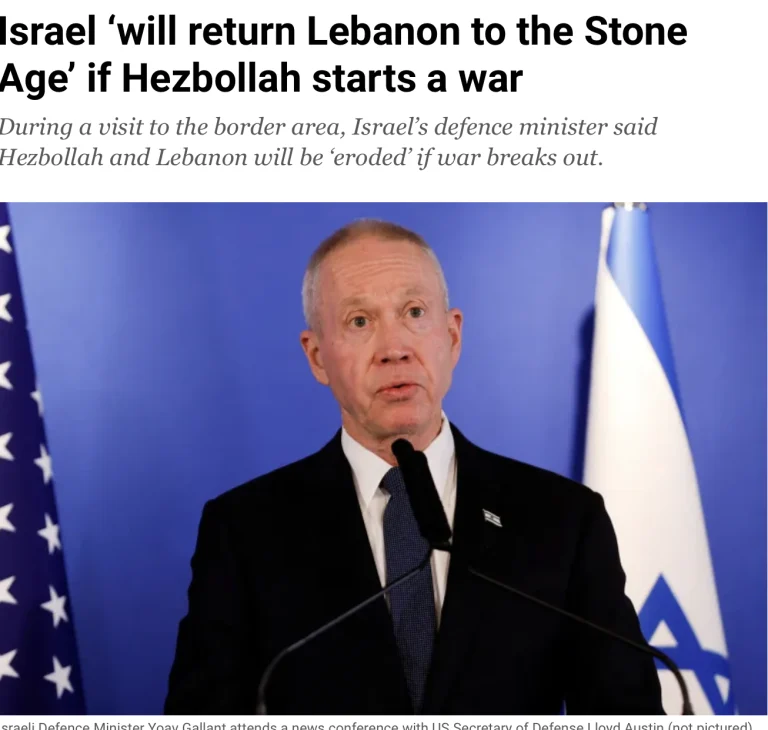
 “We are fighting against animals”, Israel’s Defense Minister Yoav Gallant 

Genocide is Embedded in America’s ‘Humanitarian Wars”

Is this not what Israel –with the firm support of the Biden Administration– is  carrying out in Palestine?

All U.S. led wars have targeted hospitals and schools.

I recall Twenty-five years ago in the early hours of March 24, 1999, when NATO began the bombing of Belgrade under Operation “Allied Force ”,

“the children’s hospital was the object of air attacks. It had been singled out by military planners as a strategic target”. 

The conduct of war crimes and genocide is integral part of what is euphemistically call “US Foreign Policy”. 

The history of US-led wars confirms that murdering millions of civilians is an integral part of America’s global war agenda.

From Dresden to Gaza (1945-2024): The Death of 40+ Million People

During and since World War II , the United States has killed more than 40 million people in a number of countries, “most of them civilians, either directly or through proxy by its puppet regimes”:

Continue reading

Russian Foreign Minister Lavrov’s remarks to UN General Assembly – September 29, 2025

We support the unwavering adherence to the principle of equality as it guarantees that all countries can take their rightful place in the world system regardless of their military power, population, territory, or economic capabilities.

From the Foreign Ministry of the Russian Federation

27 September 2025 20:57

Remarks by Foreign Minister Sergey Lavrov at the General Debate of the 80th Session of the United Nations General Assembly, New York, September 27, 2025

1611-27-09-2025

Madam President,

Ladies and gentlemen,

Eighty years ago, the most devastating war in human history came to an end, with more than 70 million lives lost to military operations, starvation, and disease. The year 1945 changed the course of world history forever. The triumph over German Nazism, under whose banners a great part of Europe had rallied, and Japanese militarism, paved the way for peace, recovery, and prosperity.

This year, Moscow and Beijing held celebrations to mark the festive days of May 9 and September 3 in honour of Victory in the Great Patriotic War and World War II. The world witnessed grand military parades in recognition of the Soviet people’s decisive contribution to the defeat of Nazi Germany and the distinct role of the Chinese people in the defeat of militarist Japan. We hold sacred the memory of our combat fellowship with all the allies who stood on the side of truth in the fight against evil forces.

One of the enduring outcomes of that war was the establishment of the United Nations. The principles of this Organisation’s Charter agreed upon by its founding fathers continue to serve as a beacon of international cooperation. They embody the centuries-old experience of co-existence among the states and retain their full relevance in the era of multipolarity. The only remaining task is for all member states without exception to adhere to these principles in their entirety, totality and interconnectedness.

However, the reality is quite different. Systemic and callous violations of the principle of the sovereign equality of states undermine the very faith in justice and lead to crises and conflicts. The root cause of these problems lies in the incessant attempts to divide the world into “friends” and “foes,” into “democracies” and “autocracies,” into a “blooming garden” and a “jungle,” into those who are “at the table” and those who are “on the menu,” into a select few who are above the rules, and the rest, who are somehow obliged to serve the interests of the “golden billion.” We support the unwavering adherence to the principle of equality as it guarantees that all countries can take their rightful place in the world system regardless of their military power, population, territory, or economic capabilities.

Furthermore, the West has repeatedly violated the principle of the non-use of force or threat of force. NATO’s bombing of Yugoslavia, the invasion of Iraq by a US-led coalition and NATO’s regime-change operation in Libya have all brought about tragedies. Today, Israel’s unlawful use of force against the Palestinians, along with aggressive actions targeting Iran, Qatar, Yemen, Lebanon, Syria and Iraq, threaten to trigger explosive developments across the entire Middle East.

Continue reading

Scott Ritter: Ukraine’s Operation Spiderweb and nuclear war

Playing with Fire
By Scott Ritter
June 1, 2025


Ukraine’s Operation Spiderweb has crossed the threshold when it comes to triggering a Russian nuclear response. How Russia and the United States respond could determine the fate of the world.

In 2012, Russian President Vladimir Putin declared that “The nuclear weapons remain the most important guarantee of Russia’s sovereignty and territorial integrity and play a key role in maintaining the regional balance and stability.”

In the intervening years, western analysts and observers have accused Russia and its leadership of irresponsibly invoking the threat of nuclear weapons as a means of “saber rattling”—a strategic bluff to hide operational and tactical shortfalls in Russian military capabilities.

In 2020 Russia published, for the first time, an unclassified version of its nuclear doctrine. The document, called “Basic Principles of State Policy of the Russian Federation on Nuclear Deterrence,” noted that Russia “reserves the right to use nuclear weapons” when Moscow is acting “in response to the use of nuclear and other types of weapons of mass destruction against it and/or its allies, as well as in the event of aggression against the Russian Federation with the use of conventional weapons when the very existence of the state is in jeopardy.” The document also stated that Russia reserved the right to use nuclear weapons in case of an “attack by [an] adversary against critical governmental or military sites of the Russian Federation, disruption of which would undermine nuclear forces response actions.”

In 2024 Vladimir Putin ordered Russia’s nuclear doctrine to be updated to consider the complicated geopolitical realities that had emerged from the ongoing Special Military Operation (SMO) in Ukraine, where the conflict had morphed into a proxy war between the collective west (NATO and the US) and Russia.

The new doctrine declared that nuclear weapons would be authorized for use in case of an “aggression against the Russian Federation and (or) its allies by any non-nuclear state with the participation or support of a nuclear state is considered as their joint attack.”

Russia’s nuclear arsenal would also come into play in the event of “actions by an adversary affecting elements of critically important state or military infrastructure of the Russian Federation, the disablement of which would disrupt response actions by nuclear forces.”

The threats did not have to come in the form of nuclear weapons. Indeed, the new 2024 doctrine specifically stated that Russia could respond with nuclear weapons to any aggression against Russia involving “the employment of conventional weapons, which creates a critical threat to their sovereignty and (or) territorial integrity.”

Operation Spiderweb, the largescale assault on critical Russian military infrastructure directly related to Russia’s strategic nuclear deterrence by unmanned drones, has demonstrably crossed Russia’s red lines when it comes to triggering a nuclear retaliation and/or pre-emptive nuclear strike to preclude follow-on attacks. The Ukrainian SBU, under the personal direction of its chief, Vasyl Malyuk, has taken responsibility for the attack.

Operation Spiderweb is a covert direct-action assault on critical Russian military infrastructure and capabilities directly related to Russia’s strategic nuclear deterrent capabilities. At least three airfields were attacked using FPV drones operating out of the backs of civilian Kamaz trucks repurposed as drone launch pads. Dyagilevo airfield in Ryazan, Belaya airfield in Irkutsk, and Olenya airfield in Murmansk, home to Tu-95 and Tu-22 strategic bombers and A-50 early warning aircraft, were struck, resulting in numerous aircraft being destroyed and/or heavily damaged.

This would be the equivalent of a hostile actor launching drone strikes against US Air Force B-52H bombers stationed at Minot Air Force Base in North Dakota and at Barksdale Air Force Base in Louisiana, and B-2 bombers stationed at Whiteman Air Force Base in Missouri.

The timing of Operation Spiderweb is clearly designed to disrupt peace talks scheduled to take place in Istanbul on June 2.

First and foremost, one must understand that it is impossible for Ukraine to seriously prepare for substantive peace talks while planning and executing an operation such as Operation Spiderweb; while the SBU may have executed this attack, it could not have happened without the knowledge and consent of the Ukrainian President or the Minister of Defense.

Moreover, this attack could not have occurred without the consent of Ukraine’s European partners, in particular Great Britain, France and Germany, all of whom were engaged in direct consultations with Ukrainian President Volodymyr Zelensky in the days and weeks leading up to the execution of Operation Spiderweb.

The Ukrainians have been encouraged by Europe to be seen as actively supporting the Istanbul peace process, with an eye to the notion that if the talks failed, the blame would be placed on Russia, not Ukraine, thereby making it easier for Europe to continue providing military and financial support to Ukraine.

There appears to be a major role being played by US actors as well—Senator’s Lyndsay Graham, a Republican from South Carolina, and Sydney Blumenthal, a Democrat from Connecticut, made a joint visit to Ukraine in the past week where they coordinated closely with the Ukrainian government about a new package of economic sanctions linked to Russia’s willingness to accept peace terms predicated on a 30-day ceasefire—one of Ukraine’s core demands.

Operation Spiderweb appears to be a concerted effort to drive Russia away from the Istanbul talks, either by provoking a Russian retaliation which would provide cover for Ukraine to stay home (and an excuse for Graham and Blumenthal to go forward with their sanctions legislation), or provoking Russia to pull out of the talks as it considers its options going forward, an act that would likewise trigger the Graham-Blumenthal sanctions action.

Unknown is the extent to which President Trump, who has been pushing for successful peace talks between Russia and Ukraine, was knowledgeable of the Ukrainian actions, including whether he approved of the action in advance (Trump appeared to be ignorant of the fact that Ukraine had targeted Russian President Putin using drones during a recent trip to Kursk.)

How Russia responds to this latest Ukrainian action is yet unknown; the drone attacks on Russian military bases came on the heels of at least two Ukrainian attacks on Russian rail lines that resulted in significant damage done to locomotives and passenger cars and killed and wounded scores of civilians.

But this much is clear: Ukraine could not have carried out Operation Spiderweb without the political approval and operational assistance of its western allies. The American and British intelligence services have both trained Ukrainian special operation forces in guerilla and unconventional warfare actions, and it is believed that previous Ukrainian attacks against critical Russian infrastructure (the Crimea bridge and Engels Air Base) were done with the assistance of US and British intelligence in the planning and execution phases. Indeed, both the Crimea bridge and Engels airbase attacks were seen as triggers for the issuing of Russia’s 2024 nuclear doctrine modifications.

Russia has in the past responded to provocations by Ukraine and its western allies with a mixture of patience and resolve.

Many have interpreted this stance as a sign of weakness, something which may have factored in the decision by Ukraine and its western facilitators to carry out such a provocative operation on the eve of critical peace discussions.

The extent to which Russia can continue to show the same level of restraint as in the past is tested by the very nature of the attack—a massive use of conventional weapons which struck Russia’s strategic nuclear deterrence force, causing damage.

It is not a stretch of the imagination to see this tactic being used in the future as a means of decapitating Russian strategic nuclear assets (aircraft and missiles) and leadership (the attack against Putin in Kursk underscores this threat.)

If Ukraine can position Kamaz trucks near Russian strategic air bases, it could do so against Russian bases housing Russia’s mobile missile forces.

That Ukraine would carry out such attack likewise shows the extent to which western intelligence services are testing the waters for any future conflict with Russia—one that NATO and EU members say they are actively preparing for.

We have reached an existential crossroads in the SMO.

For Russia, the very red lines it deemed necessary to define regarding the possible use of nuclear weapons have been blatantly violated by not only Ukraine, but its western allies.

President Trump, who has been claiming to support a peace process between Russia and Ukraine, must now decide as to where the United States stands considering these developments.

His Secretary of State, Marco Rubio, has acknowledged that under the previous administration of Joe Biden the United States was engaged in a proxy war with Russia. Trump’s Special Envoy to Ukraine, Keith Kellogg, recently acknowledged the same about NATO.

In short, by continuing to support Ukraine, both the US and NATO have become active participants in a conflict which has now crossed the threshold regarding the employment of nuclear weapons.

The United States and the world stand on the precipice of a nuclear Armageddon of our own making.

Either we separate ourselves from the policies that have brought us to this point, or we accept the consequences of our actions, and pay the price.

We cannot live in a world where are future is dictated by the patience and restraint of a Russian leader in the face of provocations we are ourselves responsible for.

Ukraine, not Russia, represents an existential threat to humanity.

NATO, not Russia, is responsible for encouraging Ukraine to behave in such a reckless manner.

So, too, is the United States. The contradictory statements made by US policy makers regarding Russia provide political cover for Ukraine and its NATO enablers to plan and execute operations like Operation Spiderweb.

Senators Graham and Blumenthal should be called out for sedition if their intervention in Ukraine was done to deliberately sabotage a peace process President Trump has said is central to his vision of American national security going forward.

But it is Trump himself who must decide the fate of the world.

In the coming hours we will undoubtedly hear from the Russian President about how Russia will respond to this existential provocation.

Trump, too, must respond.

By telling Graham and Blumenthal and their supporters to stand down regarding Russian sanctions.

By ordering NATO and the EU to cease and desist from continuing to provide military and financial support to Ukraine.

And by taking sides in the SMO.

Choose Ukraine and trigger a nuclear war.

Choose Russia and save the world.

Scott Ritter is a former Marine intelligence officer with extensive experience in arms control and disarmament, and an expert on US-Russian relations. His work can be found at ScottRitter.com. He is the author of several books, including his latest, Highway to Hell: The Armageddon Chronicles, 2014-2025, published by Clarity Press.

https://scottritter.substack.com/p/playing-with-fire

John Pilger’s 2014 Warning About Ukraine

Originally published by The Guardian, May 13, 2014
In Ukraine, the US is dragging us towards war with Russia
Washington’s role in Ukraine, and its backing for the regime’s neo-Nazis, has huge implications for the rest of the world
By John Pilger

Republished by Consortium News, September 24, 2022

In an article on May 13, 2014 in The Guardian, republished here, John Pilger warned the “U.S. is threatening to take the world to war” over Ukraine, words that have taken on new meaning.

Why do we tolerate the threat of another world war in our name? Why do we allow lies that justify this risk? The scale of our indoctrination, wrote Harold Pinter, is a “brilliant, even witty, highly successful act of hypnosis”, as if the truth “never happened even while it was happening”.

Every year the American historian William Blum publishes his “updated summary of the record of U.S. foreign policy” which shows that, since 1945, the U.S. has tried to overthrow more than 50 governments, many of them democratically elected; grossly interfered in elections in 30 countries; bombed the civilian populations of 30 countries; used chemical and biological weapons; and attempted to assassinate foreign leaders.

In many cases Britain has been a collaborator. The degree of human suffering, let alone criminality, is little acknowledged in the west, despite the presence of the world’s most advanced communications and nominally most free journalism. That the most numerous victims of terrorism – “our” terrorism – are Muslims, is unsayable. That extreme jihadism, which led to 9/11, was nurtured as a weapon of Anglo-American policy (Operation Cyclone in Afghanistan) is suppressed. In April the U.S. state department noted that, following Nato’s campaign in 2011, “Libya has become a terrorist safe haven“.

The name of “our” enemy has changed over the years, from communism to Islamism, but generally it is any society independent of western power and occupying strategically useful or resource-rich territory, or merely offering an alternative to U.S. domination.

The leaders of these obstructive nations are usually violently shoved aside, such as the democrats Muhammad Mossedeq in Iran, Jacobo Arbenz in Guatemala and Salvador Allende in Chile, or they are murdered like Patrice Lumumba in the Democratic Republic of Congo. All are subjected to a western media campaign of vilification – think Fidel Castro, Hugo Chávez, now Vladimir Putin.

“If Putin can be provoked into coming to their aid, his pre-ordained ‘pariah’ role will justify a Nato-run guerrilla war that is likely to spill into Russia itself.”

Washington’s role in Ukraine is different only in its implications for the rest of us. For the first time since the Reagan years, the U.S. is threatening to take the world to war. With eastern Europe and the Balkans now military outposts of Nato, the last “buffer state” bordering Russia – Ukraine – is being torn apart by fascist forces unleashed by the U.S. and the EU. We in the west are now backing neo-Nazis in a country where Ukrainian Nazis backed Hitler.

Having masterminded the coup in February against the democratically elected government in Kiev, Washington’s planned seizure of Russia’s historic, legitimate warm-water naval base in Crimea failed. The Russians defended themselves, as they have done against every threat and invasion from the west for almost a century.

But Nato’s military encirclement has accelerated, along with U.S.-orchestrated attacks on ethnic Russians in Ukraine. If Putin can be provoked into coming to their aid, his pre-ordained “pariah” role will justify a Nato-run guerrilla war that is likely to spill into Russia itself.

Instead, Putin has confounded the war party by seeking an accommodation with Washington and the EU, by withdrawing Russian troops from the Ukrainian border and urging ethnic Russians in eastern Ukraine to abandon the weekend’s provocative referendum.

These Russian-speaking and bilingual people – a third of Ukraine’s population – have long sought a democratic federation that reflects the country’s ethnic diversity and is both autonomous of Kiev and independent of Moscow. Most are neither “separatists” nor “rebels”, as the western media calls them, but citizens who want to live securely in their homeland.

Like the ruins of Iraq and Afghanistan, Ukraine has been turned into a C.I.A. theme park – run personally by C.I.A. director John Brennan in Kiev, with dozens of “special units” from the C.I.A. and F.B.I. setting up a “security structure” that oversees savage attacks on those who opposed the February coup. Watch the videos, read the eye-witness reports from the massacre in Odessa this month. Bussed fascist thugs burned the trade union headquarters, killing 41 people trapped inside. Watch the police standing by.

A doctor described trying to rescue people, “but I was stopped by pro-Ukrainian Nazi radicals. One of them pushed me away rudely, promising that soon me and other Jews of Odessa are going to meet the same fate. What occurred yesterday didn’t even take place during the fascist occupation in my town in world war two. I wonder, why the whole world is keeping silent.” [see footnote]

Russian-speaking Ukrainians are fighting for survival. When Putin announced the withdrawal of Russian troops from the border, the Kiev junta’s defence secretary, Andriy Parubiy – a founding member of the fascist Svoboda party – boasted that attacks on “insurgents” would continue. In Orwellian style, propaganda in the west has inverted this to Moscow “trying to orchestrate conflict and provocation“, according to William Hague. His cynicism is matched by Obama’s grotesque congratulations to the coup junta on its “remarkable restraint” after the Odessa massacre. The junta, says Obama, is “duly elected”. As Henry Kissinger once said: “It is not a matter of what is true that counts, but what is perceived to be true.”

In the U.S. media the Odessa atrocity has been played down as “murky” and a “tragedy” in which “nationalists” (neo-Nazis) attacked “separatists” (people collecting signatures for a referendum on a federal Ukraine). Rupert Murdoch’s Wall Street Journal damned the victims – “Deadly Ukraine Fire Likely Sparked by Rebels, Government Says“. Propaganda in Germany has been pure cold war, with the Frankfurter Allgemeine Zeitung warning its readers of Russia’s “undeclared war”. For the Germans, it is a poignant irony that Putin is the only leader to condemn the rise of fascism in 21st-century Europe.

A popular truism is that “the world changed” following 9/11. But what has changed? According to the great whistleblower Daniel Ellsberg, a silent coup has taken place in Washington and rampant militarism now rules. The Pentagon currently runs “special operations” – secret wars – in 124 countries. At home, rising poverty and a loss of liberty are the historic corollary of a perpetual war state. Add the risk of nuclear war, and the question is: why do we tolerate this?_______________

FOOTNOTE: The Guardian attached the following footnote to Pilger’s story, which Pilger says suggests “that a quote of a witness to the Odessa atrocity is unverified. This appeared only in the last edition. In fact, the quote didn’t come from a Facebook entry, but from a Voice of America broadcast and was verified.” This is The Guardian‘s footnote: ” The following footnote was appended on 16 May 2014: The quotation from a doctor who says he was ‘stopped by pro-Ukrainian Nazi radicals’ was from an account on a Facebook page that has subsequently been removed.”

John Pilger has twice won Britain’s highest award for journalism and has been International Reporter of the Year, News Reporter of the Year and Descriptive Writer of the Year. He has made 61 documentary films and has won an Emmy, a BAFTA and the Royal Television Society prize. His ‘Cambodia Year Zero’ is named as one of the ten most important films of the 20th century. He can be contacted at www.johnpilger.com

[John Pilger died December 30, 2023]

The views expressed are solely those of the author and may or may not reflect those of Consortium News.

https://consortiumnews.com/2022/09/24/john-pilgers-2014-warning-about-ukraine/

https://www.theguardian.com/commentisfree/2014/may/13/ukraine-us-war-russia-john-pilger

Russian Foreign Minister Lavrov speaks to UN Security Council, July 16, 2024

https://www.youtube.com/watch?v=TG7b0Kq85Zw — with UN-dubbed English and English subtitles

From the Ministry of Foreign MInistry of the Russian Federation

Statement by Foreign Minister Sergey Lavrov during the UN Security Council meeting on multilateral cooperation in the interest of a more just, democratic and sustainable world order, New York, July 16, 2024

16 July 2024

I would like to extend a warm welcome to distinguished dignitaries present in the Security Council Chamber. Their participation in today’s meeting confirms the importance of the subject under review. In accordance with Rule 37 of the Council’s provisional rules of procedure, I invite the representatives of Australia, Bangladesh, Belarus, the Plurinational State of Bolivia, Brazil, Cambodia, Chile, Cuba, the Dominican Republic, Egypt, Ethiopia, Ghana, Guatemala, Hungary, India, Indonesia, Islamic Republic of Iran, Iraq, Kazakhstan, Kuwait, Maldives, Morocco, Nepal, Nicaragua, Pakistan, the Philippines, Saudi Arabia, Serbia, South Africa, Syrian Arab Republic, Thailand, Timor-Leste, Türkiye, the UAE, Uganda, Vietnam, and the Bolivarian Republic of Venezuela to take part in the session.

In accordance with Rule 39 of the Council’s provisional rules of procedure, I invite His Excellency Stavros Lambrinidis, Head of the European Union Delegation to the United Nations, to participate in this meeting.

The Security Council will now begin its consideration of agenda item 2. I would like to draw the attention of the Council members to document S/2024/537, a cover letter dated July 9, 2024 from the Permanent Representative of the Russian Federation to the United Nations addressed to Secretary-General of the United Nations Antonio Guterres for a policy brief on the item under review.

Distinguished Ladies and Gentlemen,

Your Excellency,

Today, the very foundations of the international legal order – strategic stability and the UN-centric system of international politics – are put to the test. We won’t be able to resolve the mounting conflicts unless we understand their root causes and restore faith in our ability to join forces for the common good and justice for all.

Let’s face it: not all countries represented in this chamber recognise the key principle of the UN Charter which is the sovereign equality of all states. Speaking through its presidents, the United States has long declared its exceptionalism. This applies to Washington’s attitude towards its allies, whom it demands to be unquestioningly obedient even to the detriment of their national interests.

Rule, America! This is the thrust of the notorious “rules-based order” which presents a direct threat to multilateralism and international peace.

The most important components of international law – the UN Charter and the resolutions of our Council – are interpreted by the collective West in a perverse and selective manner, depending on the instructions coming from the White House. Numerous Security Council resolutions have been ignored altogether, among them Resolution 2202, which approved the Minsk agreements on Ukraine, and Resolution 1031, which approved the Dayton Agreement on peace in BiH on the basis of the principle of equal rights of the three constituent peoples and two entities. We can discuss endlessly the sabotage of the resolutions on the Middle East. Just think back to what Antony Blinken had to say in an interview with CNN in February 2021 taking a question about what he thinks about the decision of the previous US administration to recognise the Syrian Golan Heights as part of Israel. In case someone is not sure what his answer was, I will refresh your memory. The Secretary of State said, “Leaving aside the legalities of that question, as a practical matter, the Golan is very important to Israel’s security.” This is despite the fact that UN Security Council Resolution 497 of 1981, which you and I are well aware of and which no one has cancelled, qualifies annexation of the Golan Heights by Israel as illegal. However, according to those very “rules,” to quote Mr Blinken, “legal questions are something else.” And, of course, everyone remembers the statement by the US Ambassador to the UN that Resolution 2728 adopted on March 25 demanding an immediate ceasefire in the Gaza Strip “is not legally binding,” meaning that the American “rules” supersede Article 25 of the UN Charter.

Continue reading

Finland gives U.S. control over 15 military bases, on Russia’s doorstep

From Global Research
July 4, 2024
by Drago Bosnic

For nearly half a century, Scandinavia’s neutrality (with the obvious exception of Norway) was an important segment of keeping various buffer zones between the Soviet Union and NATO. And interestingly, despite the fact that the USSR was much more powerful than Russia nowadays, while also being virtually unopposed in the Baltic Sea, for some reason, neither Sweden nor Finland felt the need to become part of NATO.

What’s more, if there ever was a danger of a mythical Soviet invasion of either country, it was gone in 1991. Up to that point, Moscow’s access to the Baltic Sea stretched from Finland to Denmark (nearly, that is). Nowadays, Saint Petersburg and Kaliningrad are Russia’s only access points.

Thus, if the Kremlin hadn’t invaded Sweden and Finland during the (First) Cold War, it surely wouldn’t be doing it now. However, as rabid Russophobia is an extremely damaging degenerative disease, it clouds people’s judgment, leading them to make all sorts of rash and inexplicable decisions. On the other hand, it’s impossible to explain NATO expansionism in Scandinavia without seeing it as part of a wider offensive build-up that aims to surround Russia with hostile states and other entities (including terrorist ones). In one of the latest such moves, Helsinki just gave the United States the legal permission to station troops in the country. The vote in the Finnish Parliament was unanimous.

Thus, starting from July 1, Washington DC has access to at least 15 Finnish military bases, with the possibility of deploying heavy weapons. It wasn’t specified what sort of arms and equipment that refers to, but it’s not that difficult to imagine.

The US is already trying to surround both Russia and China with the previously banned medium and intermediate-range missiles, which is precisely why it’s setting up new military bases all across Europe and the Asia-Pacific region. The latest agreement with Finland, aptly termed the “Defense” Cooperation Agreement (DCA), “will allow the United States to bring defense equipment, supplies, materials, and soldiers to Finland”, according to local sources (https://yle%5Bdot%5Dfi/a/74-20097310.)

Worse yet, the DCA gives America legal grounds to create military exclusion zones, areas that will be accessible to US personnel only. What this really means is that Finland effectively relinquished its sovereignty so it could become a legitimate target for Russian missiles.

Congratulations, Helsinki! You just exposed 5.5 million Finns to virtually immediate thermonuclear annihilation in case of (an increasingly possible) military conflict between NATO and Russia. Considering the fact that the US has similar “exclusive access” facilities all over the world and that the Pentagon usually uses them for illegal programs and experiments, including with deadly biological materials, Russia will respond.

In fact, the Kremlin certainly anticipated such moves, which is why it started deploying new missile brigades in northwestern Russia, including those armed with ballistic and hypersonic weapons. Moscow’s second-to-none missiles such as those used by the “Iskander-M” platform or the MiG-31K strike fighters with 9-A-7660 “Kinzhal” systems (carrying the 9-S-7760 air-launched hypersonic missiles) put the entire Scandinavia in range. In addition, the sheer speed of these unrivaled weapons gives the Kremlin the ability of a virtually instantaneous retaliation in case anyone gets any ideas. Unfortunately, none of this seems to have deterred the (obviously suicidal) ruling elite in Helsinki.

The Finnish Parliament’s rather senseless decision to antagonize its much larger nuclear-armed neighbor cannot possibly be justified by any excuses of “defense” or any similar reasoning. The simple fact that Finland is allowing the presence of American offensive capabilities on the border with Russia will be enough for the latter to deploy weapons that the former simply has no means of defending against. As the DCA creates a legal framework for a permanent American military presence in Finland, this also means that the Kremlin will surely respond in kind, making Helsinki far less safe than was the case before it joined NATO, thus defeating the very purpose of its membership in this racketeering cartel.

However, according to Finnish sources, there might even be some opposition to this in the country, as MP Anna Kontula submitted a proposal calling on other MPs to reject the DCA, although her motion received no backing. Therefore, the Finnish Parliament “did not vote on the agreement, but approved it unanimously”, local sources report (https://yle%5Bdot%5Dfi/a/74-20097360). This alone puts the legality of the agreement in serious question, although we’re extremely unlikely to see any major opposition to it. Last month, Helsinki’s Constitutional Law Committee concluded that the “[DCA] would have to be approved by a two-thirds majority in Parliament, as it affects several aspects of the Finnish constitution” (i.e. it’s unconstitutional).

In other words, Finland is going out of its way to please the US and NATO, just like it did with Nazi Germany (their geopolitical predecessor) over 80 years ago. This was in the making for quite some time, even predating the special military operation (SMO), as Helsinki wanted to acquire the troubled F-35 fighter jets back in 2021 (https://www.treasuryfinland%5Bdot%5Dfi/news/state-treasury-has-completed-currency-hedging-in-the-purchase-of-finlands-f-35-fighter-jets/#:~:text=In its plenary session in,%2C software%2C supplies and services.). Having such aircraft in one’s arsenal also means that a country is relinquishing its sovereignty. Namely, the US has control over the F-35’s systems, as the jet keeps sending data back to Lockheed Martin and the US military, meaning that even if the then “neutral” Finland didn’t join NATO, the Pentagon would effectively control a crucial branch of the country’s armed forces, forcing Russia to respond either way.

This article was originally published on InfoBrics.

Drago Bosnic is an independent geopolitical and military analyst. He is a regular contributor to Global Research.

The original source of this article is Global Research

Copyright © Drago Bosnic, Global Research, 2024

Anti-NATO events in Washington DC

From Global Network Against Weapons and Nuclear Power in Space
by Bruce Gagnon
July 9, 2024

Bruce Gagnon and Rick Staggenborg in the march on Sunday

Four of us from Maine (MB Sullivan, Lisa Savage, Mark Roman and I) made the 10-hour drive to Washington DC last Friday to join the anti-NATO events planned to protest NATO’s ’75th anniversary celebration’ which begins on July 10. We were joined by former Mainers Melody Shank and Ken Jones  now living in North Carolina. 

Things began with a conference on Saturday morning at a local church attended by about 150 people and organized by a coalition led by World Beyond War. Disappointingly (but not surprising) several of the speakers once again blamed Russia for the war in Ukraine with words like ‘illegal, immoral, provocative’ Russian invasion. Sadly there are still some in the ‘peace movement’ who continue to be reluctant to pin the blame for the proxy war on US-NATO which was particularly uncalled for at an anti-NATO summit. Those that do at some point admit that US-NATO did in fact instigate the ‘tensions’ always seem to say that Russia should not have responded to protect the Donbass. That option was of course unacceptable to Moscow which I fully agree with.

This of course has been going on ever since the 2014 US-NATO orchestrated coup d’etat in Kiev which was led by the Obama-Biden administration under the direction of Victoria Nuland, Hillary Clinton and Joe Biden [and John Kerry]. Soon thereafter the US-NATO regime in Kiev (infused with Nazis from Western Ukraine) began attacking the Donbass region of Ukraine where Russian-ethnics predominate and killed more than 15,000 and wounded around 35,000. 

Moscow made repeated attempts to create mechanisms to end the siege on the Donbass including the Minsk 1 & 2 agreements that leaders of Ukraine, France and Germany later admitted they never intended to honor – they just used the agreements to buy time to build up Ukraine’s US-NATO funded, trained, armed and directed army for a final charge against their own citizens whose only crime was they spoke Russian.

By early 2022 Russia knew that the western controlled Ukrainian military would soon launch a full scale attack on the Donbass so Moscow decided to preempt that move and began the slow and deliberate effort to push the Nazi-led forces away from the Donbass which sits on Russia’s border.

Later Saturday around 5:00 pm a larger conference began at another church in Washington. Oh, what a difference it was. This event was led by anti-imperialist organizations that have no doubt the US-NATO were in fact responsible for the war in Ukraine – to be used in a now failed strategy to force ‘regime change’ in Moscow in order for western resource extraction corporations to grab Russia’s vast resource base (among other reasons).

More than 300 (mostly young activists) gathered at this event with powerful speakers talking about a myriad of regions of the world where the US-NATO war machine is trying to regain their settler colonial domination. Good luck with that one.

This multi-ethnic coalition was a stark difference from the smaller event we had attended earlier that day. 

I learned years ago about the US anti-imperialist movement led by Mark Twain during Washington’s war on the Philippines.  At this event an impressive video was shown about the long US occupation of the Philippines that continues today as the Biden administration now floods that island nation with new missiles, warships, war planes and troops aimed at China. All part of NATO’s ‘pivot’ into the Asia-Pacific.

We also heard from young activists speaking about Palestine, Puerto Rico, black liberation movements across the US and much more. The Nicaraguan ambassador to the US also spoke and was roundly received. 

Fascism is growing worldwide in order to protect corporate interests and to suppress the resulting people’s movements for liberation. US-NATO wars in the Middle East have cost 4.5 million lives in the last 25 years. Israel is a ‘partner’ of NATO and takes part in its war games. NATO also trains Middle Eastern reactionary regimes that have served as western puppets for many years – Saudi Arabia, Bahrain, UAE, Jordan and more.

On Sunday we joined a march led by the anti-imperialist/anti-capitalist coalition to the White House. A rally was set up in Lafayette Park next to the White House led by the World Beyond War coalition. When we arrived very few people were at the rally site. Thanks to the 400 in the anti-imperialist march the rally began to look more respectable though I didn’t see any of the anti-imperialist leaders invited to the stage to speak to the largely younger crowd.

Despite the long drive from Maine to DC we all agreed that it was well worth the trip – especially to be with emerging activists. We often hear elder ‘peace movement’ folks wonder where are the ‘young people’? Actually they are out there leading the protests against zionist genocide in Palestine and doing great anti-NATO work against the empire’s ever expanding war machine. Some might call them radicals – but I stand by the definition of radical as those getting to the root of the problems that we face.

The half-stepping reformist peace groups (sometimes linked to the Democratic party and their foundation funders) have a long way to go if they hope to more fully integrate with the next generation of activism.

https://space4peace.blogspot.com/2024/07/anti-nato-events-in-washington-dc.html