The Russian-Chinese Communiqué

From Consortium News
May 23, 2026

After their summit in Beijing on Wednesday, the Russian and Chinese presidents issued the following communiqué, declaring the failure of neocolonial hegemony and the emergence of a new era of international relations.
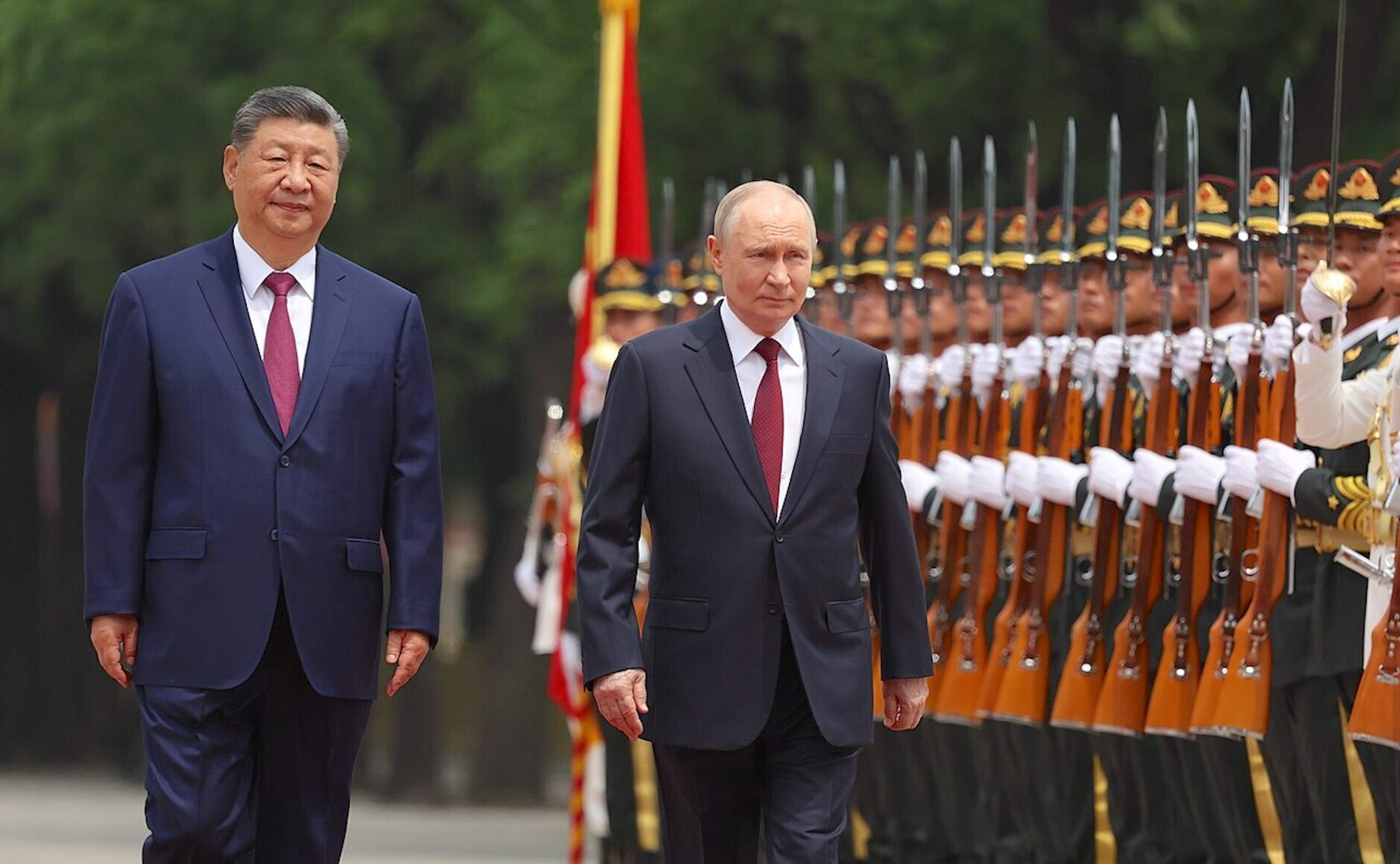
Chinese President Xi Jinping and Russian President Vladimir Putin in Beijing on Wednesday. (Russian President)

The Russian Federation and the People’s Republic of China (hereinafter referred to as the Parties), being civilizations with an ancient history, founding countries of the United Nations (U.N.) and permanent members of its Security Council, important centers of power in a multipolar world, playing a constructive role in maintaining the global balance of power and improving the system of international relations,

Guided by the ideas of the Russian-Chinese Joint Declaration on a Multipolar World and the Formation of a New International Order of April 23, 1997, the Joint Declaration between the Russian Federation and the People’s Republic of China on the International Order in the 21st Century of July 1, 2005, the Joint Statement of the Russian Federation and the People’s Republic of China on the Current Situation in the World and Major International Issues of July 4, 2017, the Joint Statement of the Russian Federation and the People’s Republic of China on International Relations Entering a New Era and Global Sustainable Development of February 4, 2022, state the following:

1. Since the end of World War II, changes in the international landscape and the balance of power in the world have accelerated.

On the one hand, the wave of decolonization and the end of the Cold War led to a significant increase in the number of sovereign states in the world. Global society has become more diverse and complex. The development and international influence of states in Asia, Africa, the Middle East, Latin America, and the Caribbean have risen. The number of regional and interregional associations, spanning all areas of international relations, from politics and security to economics and humanitarian affairs, has increased, and their role in global affairs is steadily growing. Global interconnectedness and interdependence have reached levels unprecedented in human history.

Attempts by a number of states to unilaterally manage global affairs, impose their interests on the entire world, and limit the sovereign development of other countries, in the spirit of the colonial era, have failed. The system of international relations in the 21st century is undergoing a profound transformation, evolving toward a long-term state of polycentricity and the emergence of a new type of international relations.

Most states, drawing on their historical experience, have deeply recognized the dawn of a new era and the need to pursue the path of forming a more cohesive international community, as well as mutual respect for fundamental interests, equality, justice, and mutually beneficial cooperation without dividing the world into opposing regions and blocs.

On the other hand, the global situation is becoming more complex. Negative neocolonial tendencies such as unilateral forceful approaches, hegemonism, and bloc confrontation are on the rise. Fundamental, universally recognized norms of international law and international relations are regularly violated, and it is becoming more difficult for states to coordinate their actions and resolve conflicts within global governance institutions, many of which are losing their effectiveness. The global peace and development agenda is facing new risks and challenges, and there is a danger of fragmentation of the international community and a return to the “law of the jungle.”

2. Advocating for a harmonious process of establishing an equal and orderly multipolar world and a new type of international relations, including a more just and rational system of global governance, the Parties undertake and call upon the international community to adhere to the following basic principles in their relations with each other:

1) the principle of openness of the world for inclusive and mutually beneficial cooperation.

It is important to overcome the divisions of the world and promote the elimination of cross-border barriers in various spheres, while respecting the sovereignty, territorial integrity, and identity of all sovereign states. There is no universal development path in the world, and no “first-class” countries or peoples exist. The natural differences between states in such a diverse and complex world should not be an obstacle to the development of equal, respectful, and mutually beneficial relations between them. It is essential to respect the choice of each sovereign state’s path and development model. Democratizing international political relations and building a more open global economy are in the fundamental interests of all countries. Unilateral approaches to resolving common problems, hegemony, and coercive policies in any form are unacceptable.

2) the principle of indivisible and equal security.

The emergence of a more cohesive international community amid growing common risks and challenges for humanity means that the security of one state cannot be achieved at the expense of another. All sovereign states have an equal right to security. It is necessary to pay due attention to the rational security concerns of all countries, focus on cooperation on security issues, reject bloc confrontation and zero-sum game strategies, oppose the expansion of military alliances, hybrid wars, and proxy wars, and promote the creation of a renewed, balanced, effective, and sustainable global and regional security architecture. Disagreements and disputes should be resolved peacefully, addressing the root causes of conflicts. It is unacceptable to coerce sovereign states into abandoning their neutrality.

3) the principle of democratization of international relations and improvement of the global governance system.

All states and their associations are free to choose their international partners and models of international interaction. Global hegemony is unacceptable and must be prohibited. No state or group of states should control international affairs, dictate the fate of others, or monopolize development opportunities. The system of global governance and regulation must ensure conditions for the equal participation of all states in political decision-making processes and their benefits, and it must be continuously improved. Global governance, an important instrument for regulating the system of international relations, must adhere to sovereign equality, the rule of international law, multilateralism, human-centeredness, and results-oriented approaches.

To this end, it is necessary to strengthen the role of multilateralism as the primary tool for resolving multifaceted and complex global problems and prevent the weakening of the U.N. Reform of the U.N. and other multilateral institutions must serve the interests of all humanity and consistently enhance the representativeness and voice of developing states in the international system. The U.N. Charter is the fundamental norm of international relations, and its principles must be observed in their entirety and interrelationship. Rules developed by a small group of states should not replace generally recognized international law. Large states must assume special responsibilities and missions, impose additional demands on themselves, and not abuse their advantages;

4) world civilizational and value diversity.

All human civilizations are valuable and equal in themselves; civilizations are not divided into highly developed and underdeveloped, strong and weak. The spiritual and moral system of no civilization can be considered exclusive or superior to others. All countries must advocate for a view of civilization based on equality, the mutual exchange of experiences, and dialogue. They must strengthen mutual respect, understanding, trust, and exchanges between different nationalities and civilizations, promote mutual understanding and friendship among the peoples of all countries, and protect the diversity of cultures and civilizations.

It is necessary to resolutely oppose the use of human rights as a pretext for interference in the internal affairs of other states, as well as the politicization and instrumentalization of human rights issues. Religion is an important conduit for human culture, playing a special role in building ties between peoples, and all states must create favorable conditions for interreligious dialogue and exchanges.

3. The parties will continue to develop a joint vision for the formation of a multipolar world and a new type of more equitable international relations.

https://consortiumnews.com/2026/05/23/the-russian-chinese-communique/

Cuba Is Not a Failed State – It Is a Besieged State

From UNAC / Stop the Wars at Home and Abroad
May 22, 2026

We Need to Build a Unified Resistance to Sanctions and War

The statement below is a response to the ongoing blockade against Cuba and the propaganda derived from it.   We hope you will endorse this statement, but we also hope you will commit to emergency actions if the Trump Administration follows through with their threats to invade Cuba.

At this critical junction in world history when the Cuban Revolution is being threatened by US hegemon, it is essential to come to its defense. Cuba is the hope of humanity.

  • Sign On to  “Cuba is Not a Failed State – It Is a Besieged State”
  • Register your Emergency Action

We defend Cuba by combating the intentionally negative stereotyping of a failed state. The problems Cuba faces under blockade conditions should not be portrayed in such alarmist ways that it reinforces Washington’s propaganda. We need to combat this defeatist approach.

Cuba is being sanctioned for the crime of being a good example

That Washington continues to intensify its six-decade campaign against the Cuban Revolution testifies to the island’s resilience and strength.

Washington’s regime-change campaign has taken a heavy toll. Responsible Statecraft describes US policy as “bent on breaking the island.” The Guardian reports “an epidemic of flies, rats, waste and foul odors.”

These accounts portray Cuban hardship but intentionally overlook Cuban social achievements. Even statements from Congressional leaders advocating for an end to the blockade by focusing on the crisis it has created, can feed into Washington’s self-serving narrative that Cuba is a “failed nation.”

When descriptions of the humanitarian crisis caused by the escalated blockade do not question the ideological assumption that accepts capitalism as the natural state of humanity, they can be used to depict socialism as an abortive failed experiment.

This is why solidarity activists must take special care to highlight the incredible achievements of Cuba, even under blockade conditions, all while waging an active campaign against the sanctions and gathering supplies to take to the island in solidarity.

Doing so much with so little

The Center for Economic and Policy Research documents a dramatic increase in infant mortality from 4.9, now rising to 9.9 per 1,000 live births, attributable to deteriorating living conditions caused by the US economic war.

Yet, even under this intentional strangulation, Cuba’s infant mortality rate remains among the lowest in the region. Cuba has free public, personalized healthcare for every Cuban from birth and throughout life.

Surrounding countries that are not facing any U.S. sanctions but are forced to survive under capitalist relations have consistently higher infant mortality rates. Panama (11), Dominican Republic (16), El Salvador (12), Honduras (15), Guatemala (20), Jamaica (12), Haiti (45-50).

Most stunning is that Cuba’s infant mortality figures under a ruthless blockade are still lower than for African Americans in the U.S. (10.9).

This reflects the demonstrated success of Cuba’s social medicine model, even under the most challenging of circumstances.

Using Cuba’s example of people-centered healthcare, Nicaragua dramatically reduced their infant mortality from 29 deaths per thousand in 2005 under a right-wing, pro U.S. government  to 9 under the Sandinistas and with the assistance of Cuban doctors.

This is why the Trump administration is determined to block Cuban medical staff from providing medical care in the Caribbean. A dozen countries have acquiesced to demands from the U.S. to end medical agreements with Cuba.

  • Sign On to  “Cuba is Not a Failed State – It Is a Besieged State”
  • Register your Emergency Action

Cuba’s medical staff focuses heavily on underserved areas in Latin America, the Caribbean, and Africa. They provide more doctors and medical staff than the World Health Organization and most western nations combined. The United States calls Cuba’s medical internationalism “human trafficking” – but it’s really an internationalist lifeline for the Global South.

Cuba is not alone, as it receives significant solidarity aid from allied states.  China, for example, is helping  address Cuba’s fossil fuel dependency by supplying 49 solar farms (20% of all its energy needs) and fleets of electric buses, cars, and scooters. Our solidarity movement should highlight and encourage such international cooperation.

Among Cuba’s public health achievements are its international medical brigades, excellence in advanced research, response to the pandemic, service to underserved populations, south-south cooperation initiatives, and the world’s highest doctor-to-patient ratios.

The Cuban socialist model has also produced notable successes in sports and public education.

Writing from Cuba, Carlos Fernandez de Cossio defended the country’s accomplishments over the past decade despite the “intense economic war,” including:

  • sustaining the national electrical system while expanding renewable energy
  • strengthening telecommunications and expanding internet access
  • supporting vulnerable populations through food cultivation
  • improving water infrastructure in underserved communities
  • developing COVID vaccines and other medicines
  • expanding domestic industry including the assembly of electric vehicles

For a small, natural resource-poor island, Cuba has achieved so much with so little and under such extraordinarily adverse conditions. The nation asks only that the jackboot of imperialism be lifted so that it may truly flourish.

International people’s solidarity must not allow these incredible achievements to be overlooked as we advocate for relief from the cruel blockade. We should describe this crisis  the same way that the Cuban leadership describes it – acknowledging the harms of US imperialism, but always stressing the achievements of the Cuban revolution and the power of solidarity and cooperation.

¡Venceremos!

Leading Organizers from the Following Organizations support this Cuba statement and the Call to Action.  

United National Antiwar Coalition, Cuba Si NY/NJ, International US-Cuba Normalization Conference, Venezuela Solidarity Network, US Peace Council, Alliance for Global Justice, SanctionsKill! Campaign, Resist U.S. Led War Movement, Black Alliance for Peace, International League of Peoples Struggles, Americas Without Sanctions, Chicago ALBA Solidarity, Nicaragua Solidarity Coalition, Task Force on the Americas, International Action Center, Veterans For Peace, Code Pink NY, National Lawyers Guild, Anti War Action Network, Freedom Road Socialist Organization, Bronx Antiwar, Compas de la Diaspora, Struggle for Socialism Party, Alberto Lovera Bolivarian Circle, Diaspora Pa’lante Collective, Workers World Party,
(This statement was initiated by the SanctionsKill Campaign.)

Add your support and help to circulate this statement.

Sign here: https://unac.notowar.net/cuba-is-not-a-failed-state-it-is-a-besieged-state/#Endorse

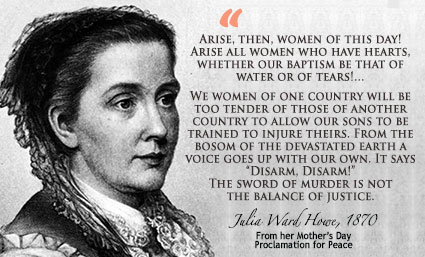
US Mother’s Day original goal was an international women’s peace congress to end war so “the great human family can live in peace”

From The Peace Alliance

MOTHER’S DAY PROCLAMATION
Boston, 1870

Arise, then… women of this day!
Arise, all women who have hearts,
whether our baptism be that of water or of tears!
Say firmly:
We will not have great questions decided by irrelevant agencies.
Our husbands shall not come to us, reeking with carnage,
for caresses and applause.
Our sons shall not be taken from us to unlearn
all that we have been able to teach them of charity, mercy and patience.
We, women of one country, will be too tender of those of another country
to allow our sons to be trained to injure theirs.

From the bosom of the devastated earth a voice goes up with our own.
It says:  Disarm, Disarm!
The sword of murder is not the balance of justice.
Blood does not wipe out dishonor,
nor violence vindicate possession.
As men have often forsaken the plough and the anvil
at the summons of war,
let women now leave all that may be left of home
for a great and earnest day of council.

Let them meet first, as women, to bewail and commemorate the dead.
Let them then solemnly take council with each other as to the means
whereby the great human family can live in peace,
each bearing after his own kind the sacred impress, not of Caesar,
but of God.

In the name of womanhood and of humanity, I earnestly ask
that a general congress of women, without limit of nationality,
may be appointed and held at some place deemed most convenient,
and at the earliest period consistent with its objects,
to promote the alliance of the different nationalities,
the amicable settlement of international questions,
the great and general interests of peace.

~ Julia Ward Howe

https://peacealliance.org/history-of-mothers-day-as-a-day-of-peace-julia-ward-howe/

The US kills babies in Cuba; CBS hides the truth

From Global Research

May 4, 2026
Michelle Ellner
CODEPINK

When the lights go out in Havana, the foreign cameras arrive to film the darkness.

They come for the blackout glow: candles in apartment windows, families sleeping on balconies, mothers fanning infants through another airless night. They come for the line outside the pharmacy, the bus that never comes, the refrigerator gone warm.

They come for the darkness.

A recent CBS segment on Cuba offered viewers a familiar script: a “failed” island, an aging revolution, refugees in Florida, and Washington once again contemplating what to do with the place 90 miles away. But the segment was also built on an omission so large it swallowed the truth: that while these cameras speak of shortages and collapse, babies are dying under a policy designed to create both.

A new report from the Center for Economic and Policy Research has found that the expansion of U.S. sanctions beginning in 2017 was likely the primary cause of a dramatic rise in infant mortality in Cuba. According to the report, Cuba’s infant mortality rate surged by 148 percent from 2018 to 2025. Had the rate remained stable, approximately 1,800 babies who died during those years would likely still be alive. 

Read that again. Babies. 

The report links the rise to the tightening of unilateral U.S. coercive measures under the first Donald Trump administration, the continuation of most of those measures under Joe Biden, and further escalation under the second Trump administration. Instead of telling that story, prime-time segments like CBS recycle Cold War clichés.

In this segment, people are invited to remember pre-revolutionary Cuba as a lost paradise. But beyond the casino lights were cane cutters, domestic workers, rural families without doctors, children without schools, Black Cubans denied the full rights, dignity, and opportunities the government claimed to promise, workers, surviving in an economy where much of the wealth flowed upward. For many Cubans, the revolution was a rupture with dependency.

It is common in U.S. media to shrink the Cuban Revolution into one beard, one speech, one man. As if millions of lives, shaped by inequality, dictatorship, and foreign domination, could be reduced to nothing more than a personality cult. Fidel Castro was central to Cuba’s history, but so were peasants who wanted land, teachers who crossed mountains to teach literacy, doctors who stayed in poor neighborhoods, workers who believed sovereignty meant something more than a flag. 

Like any other country, Cuba has real internal problems. Bureaucracy exists. Economic errors exist. Frustration is real. Emigration is real. And yet, these realities are routinely seized upon by Washington as the ready-made justification for intervention, pressure, and policies that deepen the very conditions they claim to condemn.

For decades, the United States has built an external wall around the island brick by brick. Sanctions. Financial penalties. Shipping restrictions. Fuel pressure. Banking obstacles. Threats against companies that trade. Punishments for third countries. Obstacles to medicine, parts, credit, investment, and entrepreneurs. Policy papers described the logic openly generations ago: create hardship, provoke desperation, generate political unrest.

This is where media like CBS plays a critical role by showing the suffering while obscuring the system that produces it. By rendering U.S. policy as background noise rather than as an active force shaping the very reality being filmed. And this is not an isolated editorial choice. It is a pattern.

But when infant deaths rise sharply during a period of intensified external strangulation, honesty demands more than repeating those talking points. It requires naming cause and responsibility. And it requires asking a more uncomfortable question: If the Cuban system is truly destined to fail on its own, why has so much power been invested in making sure it does?

You don’t spend decades trying to suffocate something that poses no alternative. Why isolate, sanction, and punish a model you believe is irrelevant? Unless the fear is not that it will fail. Unless the fear is that it might, even with all its contradictions, suggest a different way of organizing society. One where people are not reduced to clients, markets, or consumers to be captured, but honored as human beings to be nourished, protected, and allowed to flourish.

When I walked through Havana during a blackout, I saw neighbors calling across courtyards, playing dominoes by candlelight. Someone on the corner had a speaker with half a battery and enough music for three buildings. Two young people kissed along the Malecón. Someone cursed the government. Someone cursed the blockade. Someone cursed both. Someone laughed. I saw human beings remain stubbornly human. 

Why does CBS not cover that? Because they film the darkness. But the real story is not the candle in the window. It is the hand that cut the fuel, the policy that constricted the hospital, the silence that normalized preventable deaths, and the infants whose names will never appear in the broadcast.

Michelle Ellner is a Latin America campaign coordinator of CODEPINK. She was born in Venezuela and holds a bachelor’s degree in languages and international affairs from the University La Sorbonne Paris IV, in Paris. After graduating, she worked for an international scholarship program out of offices in Caracas and Paris and was sent to Haiti, Cuba, The Gambia, and other countries for the purpose of evaluating and selecting applicants.

https://www.globalresearch.ca/cuba-they-film-darkness/5924811

The National Lawyers Guild joins the International Association of Democratic Lawyers in condemning the joint U.S.-Israeli illegal aggression on Iran

National Lawyers Guild
March 13, 2026

The National Lawyers Guild joins the International Association of Democratic Lawyers (IADL) in condemning in the strongest terms the joint attack by the United States and Israel on the Islamic Republic of Iran, launched on the morning of Saturday, February 28, 2026, amid the holy month of Ramadan. 

These attacks constitute another example of the crime of aggression, in blatant violation of article 2(4) of the United Nations Charter and the principles of sovereignty, territorial integrity of states, good neighborliness and the peaceful settlement of disputes. International law clearly prohibits both the use of force and the threat to use force against the territorial integrity of any state, and it is also clear that the United States and Israel have deep disregard and contempt for these principles. These attacks further violate the U.S. Constitution. The U.S. president acted unilaterally and lawlessly — without congressional authorization and absent any imminent threat to the U.S. However, it is important to point out the failure and unwillingness of the U.S. Congress to act to respond to Trump’s other unauthorized hostilities in Iran or anywhere. As many have also pointed out there are over 50 members of Congress who have investments in defense companies and directly profit from these illegal wars. 

Neither the U.S. nor Israel has attempted to hide the fact that this aggression is being carried out to facilitate a regime change that they would find amenable to their goals of total domination of the entire region of West Asia militarily, economically and politically, and to deprive the Palestinian people under occupation and facing an ongoing genocide of support for their capacity to resist and free themselves of this unlawful occupation. We are reminded of the 12-day war of June 2025, another illegal aggression perpetrated by the same parties against Iran, which the NLG and IADL also strongly condemned. The persistent lack of accountability or any meaningful consequences for those responsible has not merely enabled further warmongering and destruction; it has entrenched a culture of impunity that effectively amounts to complicity.

Once again, we note that purported negotiations that claimed to seek a peaceful resolution or to address nuclear development were used as a sham in an attempt to lower Iranian defenses, as we have seen before in the context of the invasion of Iraq. Israeli officials have openly stated that they have planned this attack over months and weeks, spanning a larger period of time than any of the negotiation rounds. Such aggression not only underlines the bad faith of the United States and Israel but also discourages nations from participating in peace talks or negotiations, when it has been made clear that these states view such negotiations only as a way to pass time until a new aggression is launched. 

This aggression follows by less than two months the U.S. attack on Venezuela and the unlawful abduction of its president and first lady, and comes amid the ongoing war threats and oil blockade imposed on Cuba. This complete disregard for the process of negotiations only encourages nuclear proliferation around the world; we further note that the United States holds the world’s largest supply of nuclear weapons and is the only state to have used them. Further, Israel is an undeclared nuclear power that routinely makes threats based on its nuclear weapons capacity. 

We note that Benjamin Netanyahu, the Prime Minister of Israel, is still the subject of an arrest warrant issued by the International Criminal Court for war crimes and crimes against humanity, while pursuing constant war and aggression against the Palestinian people targeted for genocide, Lebanon, Syria, and now, once again, Iran. The aggression is the continuation of the illegal aggression launched last year as well as a continuation of a sustained and deliberate campaign of hostile acts spanning more than 46 years – including sanctions designed to destroy the Iranian economy, coordinated cyber-warfare operations, targeted assassinations and systematic acts of sabotage. 

We urge all states to provide all necessary assistance, consistent with their obligations under international law, to the Islamic Republic of Iran, Palestine, and other nations subjected to unlawful aggression by the United States and Israel,  and to condemn their  serious violations of international law, including genocide. We underline that this aggression is a threat not only to all of the peoples and nations of the West Asian region but to the future of multilateralism, international law, and the territorial integrity of states. Iran, a sovereign nation, has the clear and legitimate right to defend itself against this unlawful aggression. We urge all states to immediately implement an arms embargo on Israel and the U.S., withdraw their ambassadors, and pursue legal actions to hold their military and political officials accountable. 

We cannot rely solely on states or international institutions to end this aggression. We urge all supporters of justice, sovereignty, peace, and international law to participate in mass demonstrations and actions against the aggression on Iran, and to mobilize popular pressure to bring the aggression to an end. We urge all legal organizations, lawyers and human rights organizations to utilize domestic and international systems to hold Israeli and U.S. officials and soldiers accountable for their unlawful aggression against Iran and their acts of genocide in Palestine, as well as to support and defend organizers and social movements against state repression for their work to end war and genocide. 

The Military Law Taskforce (MLT) of the National Lawyers Guild reminds U.S. armed service members that they have the right and the duty to resist and refuse illegal orders. The MLTF pledges to support those who do so, and support service members who protest or stand against this disastrous war.

https://www.nlg.org/nlg-iran-march-2026/

Genocide is Embedded in America’s “Humanitarian Wars”.

War on Iraq : Five US Presidents, Five British Prime Ministers, More than Thirty Years of Duplicity, and Counting….

From Global Research

By Felicity Arbuthnot and Prof Michel Chossudovsky
Global Research 6 August 2010
Global Research, May 02, 2026 republished

Introduction by Michel Chossudovsky on America’s “Humanitarian Wars”, followed by an incisive and carefully documented article by Veteran War Correspodent Felicity Arbuthnot on The War on Iraq.

***

Introduction  

“Is it a mere coincidence? In recent history, from the Vietnam war to the present, the month of March has been chosen by the Pentagon and NATO military planners as the “best month” to go to war.

With the exception of the War on Afghanistan (October 2001) and the 1990-91 Gulf War, all major US-NATO and allied led military operations over a period of more than half a century –since the invasion of Vietnam by U.S. ground forces on March 8, 1965– have been initiated in the month of March.

The Ides of March (Idus Martiae) is a day in the Roman calendar which broadly corresponds to March 15. The Ides of March is also known as the date on which Julius Caesar was assassinated in 44 BC.

Lest we forget, the month of March (in the Roman Calendar) is dedicated to Mars (Martius), the Roman God of War.

March 2024 marks the 21st anniversary of the onslaught of the war on Iraq.

The US-NATO led invasion of Iraq started on 20 March 2003 on the pretext that Iraq possessed Weapons of Mass Destruction (WMD).

In March, we will also be commemorating the Vietnam War launched on March 8, 1965 following the adoption by the US Congress of the Gulf of Tonkin Resolution, which authorized President Lyndon Johnson to dispatch ground forces to Vietnam.

We will also be remembering NATO’s War on Yugoslavia which was launched on March 24, 1999 under Operation “Noble Anvil”.

All these wars, according to the media, are peace-making undertakings. They are tagged as “Humanitarian Wars” under the banner of “Responsibility to Protect (R2P). 

January-February 2024, we commemorated the thirty-third anniversary of so-called Gulf War, namely the first genocidal attack against  Iraq. 

“In Geneva, on 9th January 1991, then Secretary of State James Baker –a “diplomat” who stated: “We will reduce Iraq to a pre-industrial age”– met Iraq’s Foreign Minister, Tareq Aziz, with a letter from Bush Snr., promising the destruction of Iraq, if Kuwait was not withdrawn from by 15th January. Tareq Aziz stated he would not deliver the letter.” (Felicity Arbuthnot)

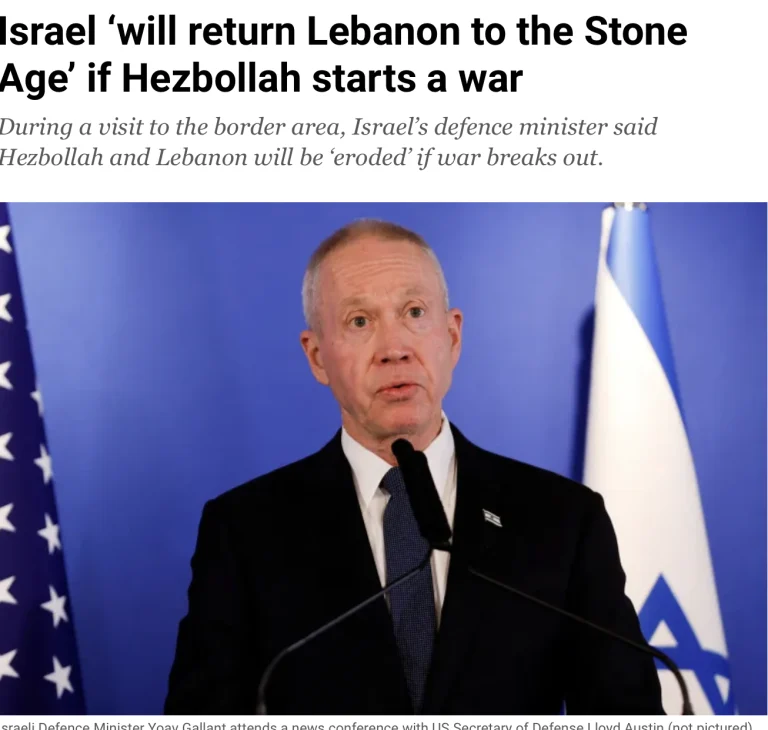
Sending Countries “Back to the Stone-Age” 

Iraq

Secretary of State James Baker stated: 
“We will reduce Iraq to a pre-industrial age”

During that first war [Gulf War], Secretary of State James Baker told the Iraqi foreign minister that “we will return you to the pre-industrial age.”

Baker’s words were prophetic. The American-led coalition delivered 88,000 tons of bombs, equivalent … to seven Hiroshima-sized atomic bombs.

The bombing unquestionably set out to destroy the civilian infrastructure, leveling oil refineries, electrical plants and transportation networks. (The Nation, May 28, 2007)

Vietnam

General Curtis LeMay is quoted as saying in relation to North Vietnam:
“they’ve got to draw in their horns and stop their aggression, or we’re going to bomb them back into the Stone Age.
( Curtis Lemay, 1965 autobiography (co-author with MacKinlay Kantor)

Pakistan 

“The Bush administration threatened to bomb Pakistan “back to the stone age” after the September 11 attacks if the country did not cooperate with America’s war on Afghanistan

… General Pervez Musharraf, said the threat was delivered by the assistant secretary of state, Richard Armitage, in conversations with Pakistan’s intelligence director … ‘Be prepared to be bombed. Be prepared to go back to the stone age’,”. … (The Guardian, September 22, 2006, emphasis added)

Israel

 “We are fighting against animals”, Israel’s Defense Minister Yoav Gallant 

Genocide is Embedded in America’s ‘Humanitarian Wars”

Is this not what Israel –with the firm support of the Biden Administration– is  carrying out in Palestine?

All U.S. led wars have targeted hospitals and schools.

I recall Twenty-five years ago in the early hours of March 24, 1999, when NATO began the bombing of Belgrade under Operation “Allied Force ”,

“the children’s hospital was the object of air attacks. It had been singled out by military planners as a strategic target”. 

The conduct of war crimes and genocide is integral part of what is euphemistically call “US Foreign Policy”. 

The history of US-led wars confirms that murdering millions of civilians is an integral part of America’s global war agenda.

From Dresden to Gaza (1945-2024): The Death of 40+ Million People

During and since World War II , the United States has killed more than 40 million people in a number of countries, “most of them civilians, either directly or through proxy by its puppet regimes”:

Continue reading