Cuban Minister of Foreign Affairs speaks to the UN Security Council – US violates international law and sovereign rights


From the Cuban Ministry of Foreign Affairs – Ministerio de Relaciones Exteriores

Statement by H.E. Mr. Bruno Rodríguez Parrilla, Minister of Foreign Affairs of the Republic of Cuba, at the General Debate of the Eighty First Session of the General Assembly of the United Nations. New York, September 26, 2026.
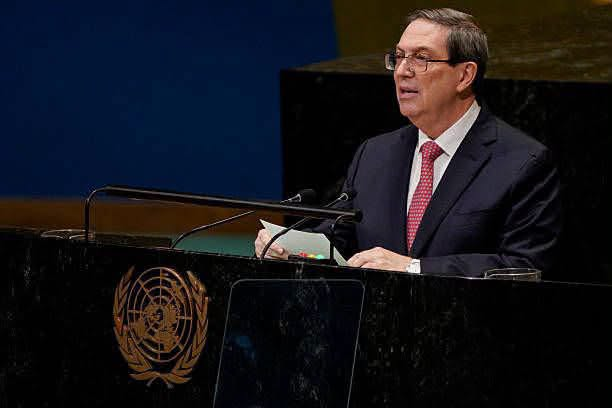
Mr. President of the General Assembly;

Madam Deputy Secretary-General:

In approximately three hours, exactly 66 years will have elapsed since Commander in Chief Fidel Castro Ruz, in a memorable speech from this rostrum, said, and I quote: “Let the philosophy of plunder disappear, and the philosophy of war will have disappeared! Let the colonies disappear; let the exploitation of countries by monopolies disappear; and then humanity will have reached a true stage of progress!”.

However, the advance of expansionism, usurpation, conquest as well as military and economic aggressions are alarming. The US government aspiration to impose peace through force is absurd and unrealizable. The fundamental pillars of International Law and the United Nations Organization, such as the sovereign equality among States, are under permanent attack.

The genocidal crime of Zionism against the Palestinian people; the pirate attacks against vessels and the extrajudicial executions in the Caribbean Sea and some areas in the Pacific; the military aggression against the Bolivarian Republic of Venezuela and the war against the Islamic Republic of Iran are new expressions of this atrocity.

They are also a reflection of the crisis of identity and relevance imposed on this United Nations Organization, and even on the General Assembly, the most universal, democratic and representative body of the international community.

We are convinced of the indispensable need to preserve and strengthen the United Nations, as we make it more democratic and effective; and of placing it closer to the peoples.

As is well known, in Cuba we are facing a multidimensional aggression from the United States government; a permanent, abusive and ruthless hostility that has lasted for almost seven decades already. Since January, 2026, this aggression has strengthened and become crueler and more dangerous, with the imposition of an energy blockade that, by resorting to intimidation and coercion, prevents any country from exporting fuel to Cuba -an equivalent to a naval blockade-, which is classified by International Law as an act of war.

Through the adoption of successive measures, the government of the United States has been applying new prohibitions on all countries with regard to products and services that cannot be exported or transported to Cuba. More than 7 thousand containers remain stranded in different ports; many of them are loaded with foodstuffs, medicines and medical devices or have even been paid for by Cuban private companies.

It is an unusual and unprecedented action. A superpower unilaterally deprives all States of their right to export the commodities that they wish to the country that they wish and continuously and comprehensively violates freedom of trade and navigation.

Added to this is the intimidation of entrepreneurs of different countries so that they abandon, against their will, their investments and businesses in Cuba; the obstacles and tricks to prevent the arrival of absolutely legitimate commercial shipments; the pressures to prevent the entry of visitors and tourists; and the efforts aimed at restricting as much as possible Cuba’s legitimate access to financing, technology and markets.

The United States has gone as far as to exert unsuspected pressures on sovereign governments so that they renounce the medical services they requested from us for the benefit of their respective populations and which are offered altruistically by Cuban professionals, because the US government is opposed to such cooperation, regardless of the impact and harm this may cause to those populations if they are deprived of free, quality medical care; that is to say, deprived of an elemental human right. On Thursday last, while this General Assembly was in session, the State Department convened a humiliating meeting, specifically with the States that are the recipients of this cooperation, in order to exert pressure and make threats.

According to the Secretary of State, the US official policy is to shut down every relief valve, block every possible way out and eliminate any form of survival for Cuba.

The impact of such an iron-clad and ruthless siege has a human face. The economic warfare is aimed against the people. It harms the Cuban people as a whole. It takes a toll on human lives. It causes individual and collective pain; it causes anguish. It is not “collateral damage”. It is a policy deliberately designed to wound the deepest sensibilities of Cuban families; disturb their wellbeing and hurt the dignity of the people.

It is an act of collective punishment; a crime proscribed by International Humanitarian Law. The obvious short-term goal pursued by such policy is to induce a humanitarian crisis in Cuba, which is also a crime.

The government of the United States and the US State Department have been forced to recognize the suffering inflicted on the Cuban people, but they have the impudence and cynicism to insist in putting the blame on the government of Cuba. The executioner blames the victim.

They are following the formula recommended by the State Department since 1960 in the infamous Mallory Memorandum, which established as an official policy, [in] force up until today, the overthrowing of the Cuban government through the economic suffocation and the extreme suffering of the Cuban people out of material shortages, hunger and desperation.

A few days ago, the President of the United States declared in this podium that Cuba was ‘a failed State’. If that were the case, why did they have to impose a fuel blockade? Why did they impose secondary sanctions? Why do they have to threaten, persecute and exert pressures on every State on the planet? He also recognized that his government is putting on Cuba the biggest pressure ever applied against any other State. A few months before, he had said that “all that is left is to go in and destroy everything.”

The threat of the use of military force against Cuba persists. This behavior is a violation of International Law and an infringement of the San Francisco Charter.

Should it materialize, it would be a major crime. It would cause the death of Cuban and American youths as well as huge destruction. We expect it never happens. Cuba will exercise, with utmost resolve and energy, its legitimate right to defend itself. This aggression is being accompanied by a brutal media and cognitive warfare aimed, not only against the Cuban people, but also against the US citizens and the international public opinion. It is characterized by its gross and brazen attempts to interfere in the internal affairs of Cuba, which likewise is another international crime.

We are often asked what is the US pursuing with such an aggressive behavior, and the question usually surprises us, because the representatives of that government have outrightly declared their purpose to take Cuba, control the country and dominate the economy. In other words, nullify, through an aggression or economic suffocation, the national sovereignty which several generations of Cubans have struggled for since the nineteenth century -first to achieve it, and later on, after conquering the full freedom in 1959, to tenaciously defend it against the biggest risks, including that of a holocaust.

The US behavior relies on the fallacy, proclaimed early on this year, that Cuba is an unusual and extraordinary threat to the national security and the foreign policy of the United States -a nonsense shamelessly repeated by that government. In a futile attempt to substantiate such an assertion, the US government inundates its huge communication platforms with false claims using the spokespersons and publications it hires and pays, taking advantage of the increasing control exercised by its government over them. The US President himself repeated it a few days ago in this room.

Any minimally informed observer would understand the unrealistic and evil intention to portray a relatively small and developing nation like Cuba, with a modest economic performance, as a threat to the biggest nuclear, military, technological and economic power in the planet.

This Organization and its member States have abundant evidence of the fact that we are a peace-loving country; of the efforts of Cuba in favor of international cooperation, understanding and the peaceful settlement of disputes as well as of the active role that we have played in support of the United Nations.

Cuba is not a threat, the blockade is!

Cuba is not a threat; the blockade certainly is!

We have always been and we will continue to be ready to engage in a dialogue with the government of the United States to try to find a solution to bilateral differences, on the basis of responsibility, respect, sovereign equality, the observance of International Law, without any interference in the internal affairs of States and without preconditions.

We are open to trade and business relations with United States companies, just as we are with those of any other country.

We are aware of the immense challenge our country faces in terms of its security, survival, the wellbeing of the people and the destiny of the homeland. We are not facing this challenge passively. We are doing it firmly and with dignity. Based on that, we are moving on in a process of changes that would lead to profound transformations of the economic and social model of the country, based on our historical experience.

On July 30 last, during the Seventh Session of the National People’s Power Assembly, President Miguel Díaz-Canel said: “In view of the complex situation I have described, how can we prevail in the construction of socialism? How could we find the material and financial resources needed to preserve the social achievements attained by the Revolution? As it already happened on former occasions, when we were faced with particularly complex situations -such as the Special Period-; when, under the guidance, first of Commander in Chief, and later of Army General Raúl Castro, the economic model was transformed to adapt it to the challenging foreign circumstances demanded by the times, under the leadership of the Party, in a collective and democratic way, in consultation with the people, without compromising the independence, the national sovereignty or the social achievements of the Revolution”, end of quote.

At that session, the National People’s Power Assembly adopted a new program, with new practices, actors and economic concepts. All of that is being done in accordance with the Constitution in force -. which was adopted through a free and universal referendum- and the conception of our socialist State of law and social justice.

As was pointed out by the leader of the Cuban Revolution, Army General Raúl Castro Ruz, the most important thing will be, and I quote: “the appropriate and timely implementation process, with well-defined priorities and the conscious participation of the people.”

This process relies on the strengths that we have built; the potential of our human resources and the determination to respond to the needs of the people with the greatest possible social justice, without ceasing in our efforts to defend, with utmost vigor and resolve, the sovereignty and the right to self-determination.

We know that we count on the support of the international community and the solidarity of millions, among them, an increasing number of US citizens.

That is reflected in the numerous gestures and statements in support of Cuba and against the abusive aggression. It is reflected in the fraternal material assistance received by our people, seeking to mitigate the huge damage caused to the Cuban economy and society.

That spirit of solidarity and empathy is also expressed with particular special emphasis among Cubans who reside permanently or temporarily outside the national territory and among their descendants, particularly here in the United States.

Mr. President;

We reject the Monroe Doctrine and its Corollaries as much as we refuse every attempt of imperialist militarization, intervention or domination in Latin America and the Caribbean, a region that was proclaimed as a Zone of Peace in 2014, precisely in Havana.

As a Small Island Developing State, we stand in solidarity with our brothers and sisters who share a similar condition and with their warning about the worrying and inexorable advance of climate change.

It is necessary to promote a governance that makes a more intensive use of the new ICTs, particularly the disruptive technologies, such as artificial intelligence.

We reject the implementation of unilateral coercive measures. We express our support to and solidarity with each and every nation which are victim of them.

We ratify our solidarity with the Government of National Reconciliation and Unity of Nicaragua.

We reiterate our support to the inalienable right of the people of Puerto Rico to self-determination and independence.

The sister nations of Africa and the Caribbean deserve a fair and differentiated treatment, as well as the reparations for the horrors of colonialism and the transatlantic slave trade.

We reaffirm our solidarity with the Saharan people and their right to self-determination.

We ratify our support to the “One China” principle.

We strongly believe that the current trend of international relations of disrespect for International Law and the United Nations, the imposition of the unilateral will of the mightiest over other countries by means of intimidation and coercion, is dangerous and unsustainable. The law of the jungle cannot be the future of humanity.

To prevent those practices, in addition of promoting peace and justice, the preceding generations founded the United Nations and for decades developed and tried to enrich its activity. Let us recover its role today, when we are perhaps in time to do so, before the Organization goes down in history as an unrealized dream of great promises.

In the year of the centennial birthday of Fidel Castro Ruz, the historical leader of the Cuban Revolution, let us be confident, as he was, that if we struggle with resolve, a better world will be possible.

Homeland or Death!

We Shall Overcome!

https://news.un%5Bdot%5Dorg/en/story/2026/09/1168458 — video

https://www.facebook%5Bdot%5Dcom/CubaMINREX/posts/-statement-by-he-mr-bruno-rodr%C3%ADguez-parrilla-minister-of-foreign-affairs-of-the-/1538902638275672/

Also
https://www.c-span%5Bdot%5Dorg/program/washington-journal/cuban-deputy-foreign-minister-carlos-fernndez-de-cosso-on-us-cuba-relations/685796
Cuban Deputy Foreign Minister Carlos Fernández de Cossío talked about the Trump administration’s approach to U.S.-Cuba relations, September 27, 2026
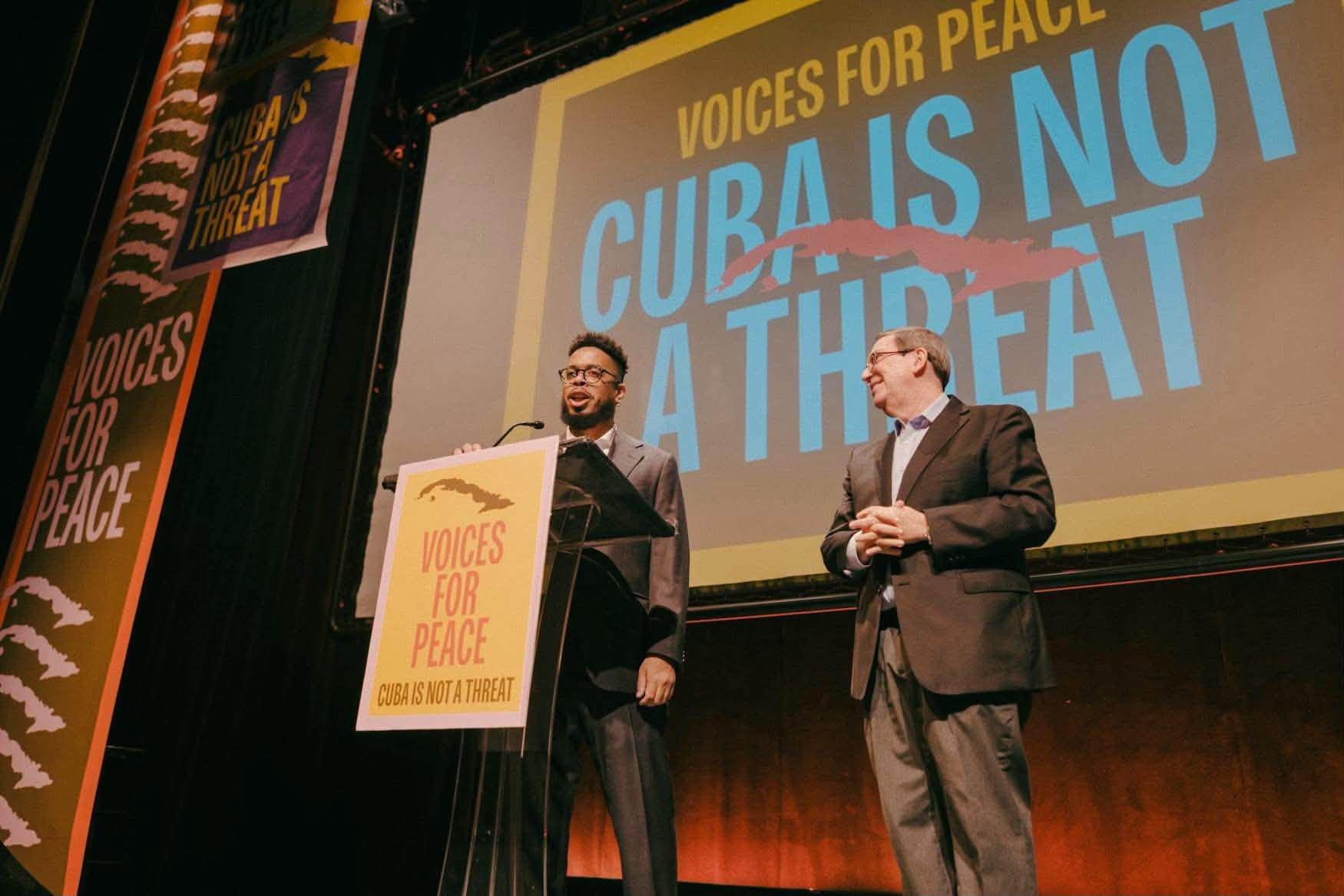
Cuba Is Not a Failed State – It Is a Besieged State

From UNAC / Stop the Wars at Home and Abroad
May 22, 2026

We Need to Build a Unified Resistance to Sanctions and War

The statement below is a response to the ongoing blockade against Cuba and the propaganda derived from it.   We hope you will endorse this statement, but we also hope you will commit to emergency actions if the Trump Administration follows through with their threats to invade Cuba.

At this critical junction in world history when the Cuban Revolution is being threatened by US hegemon, it is essential to come to its defense. Cuba is the hope of humanity.

  • Sign On to  “Cuba is Not a Failed State – It Is a Besieged State”
  • Register your Emergency Action

We defend Cuba by combating the intentionally negative stereotyping of a failed state. The problems Cuba faces under blockade conditions should not be portrayed in such alarmist ways that it reinforces Washington’s propaganda. We need to combat this defeatist approach.

Cuba is being sanctioned for the crime of being a good example

That Washington continues to intensify its six-decade campaign against the Cuban Revolution testifies to the island’s resilience and strength.

Washington’s regime-change campaign has taken a heavy toll. Responsible Statecraft describes US policy as “bent on breaking the island.” The Guardian reports “an epidemic of flies, rats, waste and foul odors.”

These accounts portray Cuban hardship but intentionally overlook Cuban social achievements. Even statements from Congressional leaders advocating for an end to the blockade by focusing on the crisis it has created, can feed into Washington’s self-serving narrative that Cuba is a “failed nation.”

When descriptions of the humanitarian crisis caused by the escalated blockade do not question the ideological assumption that accepts capitalism as the natural state of humanity, they can be used to depict socialism as an abortive failed experiment.

This is why solidarity activists must take special care to highlight the incredible achievements of Cuba, even under blockade conditions, all while waging an active campaign against the sanctions and gathering supplies to take to the island in solidarity.

Doing so much with so little

The Center for Economic and Policy Research documents a dramatic increase in infant mortality from 4.9, now rising to 9.9 per 1,000 live births, attributable to deteriorating living conditions caused by the US economic war.

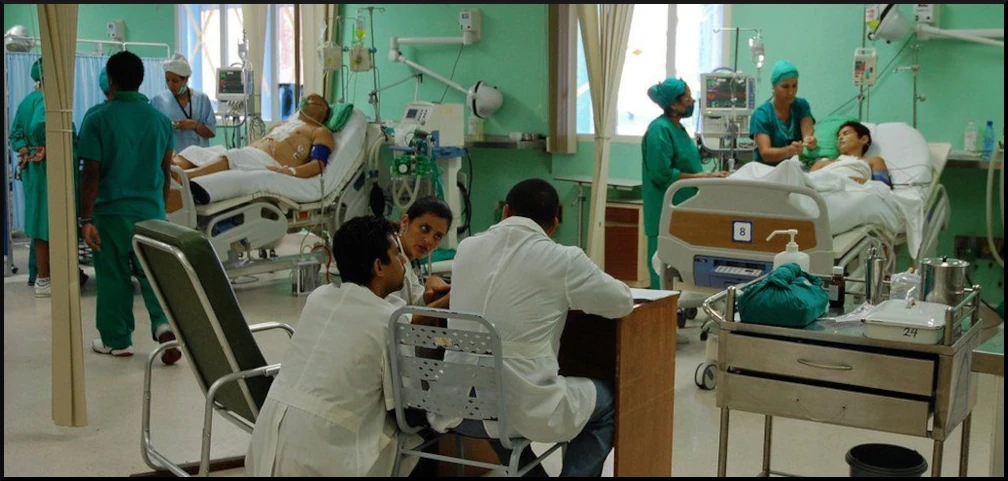
Yet, even under this intentional strangulation, Cuba’s infant mortality rate remains among the lowest in the region. Cuba has free public, personalized healthcare for every Cuban from birth and throughout life.

Surrounding countries that are not facing any U.S. sanctions but are forced to survive under capitalist relations have consistently higher infant mortality rates. Panama (11), Dominican Republic (16), El Salvador (12), Honduras (15), Guatemala (20), Jamaica (12), Haiti (45-50).

Most stunning is that Cuba’s infant mortality figures under a ruthless blockade are still lower than for African Americans in the U.S. (10.9).

This reflects the demonstrated success of Cuba’s social medicine model, even under the most challenging of circumstances.

Using Cuba’s example of people-centered healthcare, Nicaragua dramatically reduced their infant mortality from 29 deaths per thousand in 2005 under a right-wing, pro U.S. government  to 9 under the Sandinistas and with the assistance of Cuban doctors.

This is why the Trump administration is determined to block Cuban medical staff from providing medical care in the Caribbean. A dozen countries have acquiesced to demands from the U.S. to end medical agreements with Cuba.

  • Sign On to  “Cuba is Not a Failed State – It Is a Besieged State”
  • Register your Emergency Action

Cuba’s medical staff focuses heavily on underserved areas in Latin America, the Caribbean, and Africa. They provide more doctors and medical staff than the World Health Organization and most western nations combined. The United States calls Cuba’s medical internationalism “human trafficking” – but it’s really an internationalist lifeline for the Global South.

Cuba is not alone, as it receives significant solidarity aid from allied states.  China, for example, is helping  address Cuba’s fossil fuel dependency by supplying 49 solar farms (20% of all its energy needs) and fleets of electric buses, cars, and scooters. Our solidarity movement should highlight and encourage such international cooperation.

Among Cuba’s public health achievements are its international medical brigades, excellence in advanced research, response to the pandemic, service to underserved populations, south-south cooperation initiatives, and the world’s highest doctor-to-patient ratios.

The Cuban socialist model has also produced notable successes in sports and public education.

Writing from Cuba, Carlos Fernandez de Cossio defended the country’s accomplishments over the past decade despite the “intense economic war,” including:

  • sustaining the national electrical system while expanding renewable energy
  • strengthening telecommunications and expanding internet access
  • supporting vulnerable populations through food cultivation
  • improving water infrastructure in underserved communities
  • developing COVID vaccines and other medicines
  • expanding domestic industry including the assembly of electric vehicles

For a small, natural resource-poor island, Cuba has achieved so much with so little and under such extraordinarily adverse conditions. The nation asks only that the jackboot of imperialism be lifted so that it may truly flourish.

International people’s solidarity must not allow these incredible achievements to be overlooked as we advocate for relief from the cruel blockade. We should describe this crisis  the same way that the Cuban leadership describes it – acknowledging the harms of US imperialism, but always stressing the achievements of the Cuban revolution and the power of solidarity and cooperation.

¡Venceremos!

Leading Organizers from the Following Organizations support this Cuba statement and the Call to Action.  

United National Antiwar Coalition, Cuba Si NY/NJ, International US-Cuba Normalization Conference, Venezuela Solidarity Network, US Peace Council, Alliance for Global Justice, SanctionsKill! Campaign, Resist U.S. Led War Movement, Black Alliance for Peace, International League of Peoples Struggles, Americas Without Sanctions, Chicago ALBA Solidarity, Nicaragua Solidarity Coalition, Task Force on the Americas, International Action Center, Veterans For Peace, Code Pink NY, National Lawyers Guild, Anti War Action Network, Freedom Road Socialist Organization, Bronx Antiwar, Compas de la Diaspora, Struggle for Socialism Party, Alberto Lovera Bolivarian Circle, Diaspora Pa’lante Collective, Workers World Party,
(This statement was initiated by the SanctionsKill Campaign.)

Add your support and help to circulate this statement.

Sign here: https://unac.notowar.net/cuba-is-not-a-failed-state-it-is-a-besieged-state/#Endorse

The US kills babies in Cuba; CBS hides the truth

From Global Research

May 4, 2026
Michelle Ellner
CODEPINK

When the lights go out in Havana, the foreign cameras arrive to film the darkness.

They come for the blackout glow: candles in apartment windows, families sleeping on balconies, mothers fanning infants through another airless night. They come for the line outside the pharmacy, the bus that never comes, the refrigerator gone warm.

They come for the darkness.

A recent CBS segment on Cuba offered viewers a familiar script: a “failed” island, an aging revolution, refugees in Florida, and Washington once again contemplating what to do with the place 90 miles away. But the segment was also built on an omission so large it swallowed the truth: that while these cameras speak of shortages and collapse, babies are dying under a policy designed to create both.

A new report from the Center for Economic and Policy Research has found that the expansion of U.S. sanctions beginning in 2017 was likely the primary cause of a dramatic rise in infant mortality in Cuba. According to the report, Cuba’s infant mortality rate surged by 148 percent from 2018 to 2025. Had the rate remained stable, approximately 1,800 babies who died during those years would likely still be alive. 

Read that again. Babies. 

The report links the rise to the tightening of unilateral U.S. coercive measures under the first Donald Trump administration, the continuation of most of those measures under Joe Biden, and further escalation under the second Trump administration. Instead of telling that story, prime-time segments like CBS recycle Cold War clichés.

In this segment, people are invited to remember pre-revolutionary Cuba as a lost paradise. But beyond the casino lights were cane cutters, domestic workers, rural families without doctors, children without schools, Black Cubans denied the full rights, dignity, and opportunities the government claimed to promise, workers, surviving in an economy where much of the wealth flowed upward. For many Cubans, the revolution was a rupture with dependency.

It is common in U.S. media to shrink the Cuban Revolution into one beard, one speech, one man. As if millions of lives, shaped by inequality, dictatorship, and foreign domination, could be reduced to nothing more than a personality cult. Fidel Castro was central to Cuba’s history, but so were peasants who wanted land, teachers who crossed mountains to teach literacy, doctors who stayed in poor neighborhoods, workers who believed sovereignty meant something more than a flag. 

Like any other country, Cuba has real internal problems. Bureaucracy exists. Economic errors exist. Frustration is real. Emigration is real. And yet, these realities are routinely seized upon by Washington as the ready-made justification for intervention, pressure, and policies that deepen the very conditions they claim to condemn.

For decades, the United States has built an external wall around the island brick by brick. Sanctions. Financial penalties. Shipping restrictions. Fuel pressure. Banking obstacles. Threats against companies that trade. Punishments for third countries. Obstacles to medicine, parts, credit, investment, and entrepreneurs. Policy papers described the logic openly generations ago: create hardship, provoke desperation, generate political unrest.

This is where media like CBS plays a critical role by showing the suffering while obscuring the system that produces it. By rendering U.S. policy as background noise rather than as an active force shaping the very reality being filmed. And this is not an isolated editorial choice. It is a pattern.

But when infant deaths rise sharply during a period of intensified external strangulation, honesty demands more than repeating those talking points. It requires naming cause and responsibility. And it requires asking a more uncomfortable question: If the Cuban system is truly destined to fail on its own, why has so much power been invested in making sure it does?

You don’t spend decades trying to suffocate something that poses no alternative. Why isolate, sanction, and punish a model you believe is irrelevant? Unless the fear is not that it will fail. Unless the fear is that it might, even with all its contradictions, suggest a different way of organizing society. One where people are not reduced to clients, markets, or consumers to be captured, but honored as human beings to be nourished, protected, and allowed to flourish.

When I walked through Havana during a blackout, I saw neighbors calling across courtyards, playing dominoes by candlelight. Someone on the corner had a speaker with half a battery and enough music for three buildings. Two young people kissed along the Malecón. Someone cursed the government. Someone cursed the blockade. Someone cursed both. Someone laughed. I saw human beings remain stubbornly human. 

Why does CBS not cover that? Because they film the darkness. But the real story is not the candle in the window. It is the hand that cut the fuel, the policy that constricted the hospital, the silence that normalized preventable deaths, and the infants whose names will never appear in the broadcast.

Michelle Ellner is a Latin America campaign coordinator of CODEPINK. She was born in Venezuela and holds a bachelor’s degree in languages and international affairs from the University La Sorbonne Paris IV, in Paris. After graduating, she worked for an international scholarship program out of offices in Caracas and Paris and was sent to Haiti, Cuba, The Gambia, and other countries for the purpose of evaluating and selecting applicants.

https://www.globalresearch.ca/cuba-they-film-darkness/5924811

Dennis Kucinich — Biden’s missile crisis; Congress must act now.

From Dennis Kucinich
November 19, 2024

The American people voted for Trump to end the wars. Biden apparently wants to end the world.

When President Biden approved the use of supersonic Army Tactical Missile Systems (ATACMS) to strike Russia, he placed in jeopardy the national security of the United States, the safety of our troops abroad and violated the U.S. Constitution, Article I, Section 8, which provides that only Congress can declare war.

Biden has made a decision to insert the U.S. into an unambiguous, escalatory phase, using the territory of Ukraine to attack Russia directly with missiles which can reach 190 miles deep.  This is an illegal act by the President which puts our nation on a path to war with Russia.  

The American people voted for Trump to end the wars. Biden apparently wants to end the world. Trump is listening to the American people. Biden is listening to NATO’s malignant agenda. 

Trump has put America’s interests for peace and prosperity first. 

No President has the right to use unilateral executive authority to permit a U.S. missile strike against another nation. It invites a retaliatory attack.  It is an impeachable offense.

Congress, as a co-equal branch of government, must act now: 

Any Member of Congress can, under privileges of the House, ask for immediate consideration of a joint resolution which invokes Article I, Section 8, and then cuts off all funding for personnel, coordination, technical advisers, materiel, equipment and deployment of ATACMS and emplacement of any other offensive missile systems in Ukraine.

The specter of WWIII has  loomed before,  in October of 1962, when the Soviet Union used the territory of Cuba to place offensive missiles just 90 miles away from the American mainland.

Absent the wisdom of President Kennedy and the forbearance of Nikita Krushchev, the world was on a path to nuclear annihilation. 

If Krushchev had “permitted” Russian missiles to be launched at the U.S.  from Cuba, you would not be reading this.

It is magical thinking that U.S. missiles can be used to attack Russia without consequences.  Now it is Putin who must exercise forbearance.

North Korea has reportedly sent a detachment to assist Russia.  Once the North Koreans learn the Russian language and vice versa, military cooperation will be instructive.  That some in the Biden Administration use this occurrence as a bogus excuse to aim U.S. missiles at Russia, shows the neocon/neolieral addiction to war has become a tragicomic death wish. 

Western vainglorious cynicism, together with hundreds of billions of dollars for weapons, shoved Ukraine into an unwinnable conflict. Russia is not NATO’s footstool, but its undoing.

The Putin-as-Hitler narrative projected in the media accelerated fear, induced acquiescence and rallied Western support for what was essentially a long-standing war scam by the military-industrial-intelligence complex. The alchemy which turned man into monster turned blood into cash.     

Kiev has already paid a horrible price for being a US/NATO proxy: the loss of the flower of its youth, the destruction of its beautiful cities, the spoilation of its fertile farmland, and the sacrifice of its sovereignty.  

Now, as U.S. missiles rain down on Russia, a counterstrike will occur, spreading ever wider the misery which has enveloped Ukraine.  

The Biden Administration, in the face of the Afghanistan withdrawal debacle, rejected a Ukrainian-Russian diplomatic settlement more than two years ago, and continued financing the war for domestic political reasons, giving Americans a false hope for victory over Russia. 

Two weeks ago, the people of the United States voted to stop the endless wars and elected Donald Trump.   

Two months to go before the January 20, 2025 Inauguration and Joe Biden has handed Donald Trump a poisoned presidential chalice.  Trump knows better than to drink from it.

###

Dennis Kucinich, a sixteen year Member of Congress (1997-2013) and twice a candidate for the Democratic nomination for President. Kucinich exposed NATO’S intent to exploit Ukraine eleven years ago: https://www.huffpost.com/entry/ukraine-nato_b_4435637, and subsequently called for the disbanding of NATO, https://denniskucinich.substack.com/p/the-dissolution-of-nato-may-be-the. He has written extensively on the danger of a nuclear war with Russia https://denniskucinich.substack.com/p/we-need-another-president-kennedy.

The Kucinich Report is a reader-supported publication. To receive new posts and support my work, please sign up to be a free or paid subscriber.

https://denniskucinich.substack.com/p/bidens-missile-crisis

Russian Federation remarks on 60th anniversary of US embargo against Cuba

Briefing by Foreign Ministry Spokeswoman Maria Zakharova, Moscow, February 9, 2022

The 60th anniversary of the US economic, commercial and financial embargo against Cuba

February 3 marks the 60th anniversary of the odious phenomenon in modern history, which, unfortunately, has only worsened in recent years, namely, the US economic, commercial and financial blockade of Cuba. If previously it was only against Cuba, today sanctions, restrictions and unilateral measures are being imposed by the United States and its “partners and satellites” across the board on multiple countries. Today, I would like to discuss Cuba, which has been living under embargo for 60 years now. A great global power, one of the pillars of the world order, has thus settled accounts with a small country for it wanting to free itself from the colonial grip of its northern neighbour and embark on a path of independent development. Revenge. Exactly the same thing that we are now seeing with regard to Crimea residents who have made their choice. Our country did not turn them away and respectfully accepted their choice. And now they are retaliating with sanctions. There’s nothing new about it.

The entire international community believes that Washington’s anti-Cuban policy is inhumane and illegal. Just think of it: 60 years of sanctions. Then look at the map and compare the size of the United States and that of the island of Cuba. There were the UN General Assembly resolutions, the calls by international public organisations, business circles, and just people with common sense. There were numerous business calculations about self-inflicted damage. At some point there were even hints at common sense prevailing and, on the face of it, nothing seemed to stand in the way of finally embarking on the path of realism. But no such thing. With enviable tenacity worthy of a better cause (not in the sense that sanctions should be imposed on other geographical locations, but in the sense that developing and implementing them in circumvention of the UN Security Council is illegal), throughout decades, almost all US administrations, with an exception only during the “Obama thaw,” stick to the same discriminatory policy with the ever-exacerbating consequences. They are doing so contrary to common sense, in an unscrupulous and hypocritical manner, under the banner of protecting democracy and human rights, and subjugating their every move to domestic political bias and the fleeting and self-serving interests of their “political hawks.”

At the same time, no one in the United States seems to care about the fact that this policy impacts not the Cuban leadership, but ordinary Cubans. It strangles the life-supporting sectors of the economy, creates social problems and deprives these people of those very human rights that the American guardians of global democracy are so worried about in words only. Most interestingly, the economic performance is cited as proof of the inefficiency of the Cuban system. Listen, for 60 years now Cuba has not only survived, but lived and moved forward amid your sanctions. I often wonder what would become of the United States if similar sanctions were imposed on it for at least a year, or even a couple of months. That would be fun to watch. They would not just forget about democracy, there would simply be nothing left of the United States if at least a tenth of these restrictions had been imposed. Then, we would observe the competition of the systems. Washington is unlikely to run the risk of holding this experiment, isn’t it? You know, things like hidden resentment, revenge, delayed decision-making or retribution happen in history. Still, common sense must prevail in humanitarian situations, such as the pandemic. That is exactly what the world has been living through for the third year now.

Notably, many Cubans who live in the United States and other countries of that region have relatives in Cuba who are impacted by the embargo imposed amid the pandemic rather than the theoretical sanctions. However, no one in the United States seems to be worried about that. They are a different kind of “human rights” and do not need to be taken care of. So, instead of uniting efforts in the face of a common challenge and creating some kind of synergy and green corridors, the US authorities did everything the other way round: they tightened the screws by imposing more sanctions on the pharmaceutical industry in Cuba, that very Cuba that helps everyone in the region deal with the impact of the pandemic, and is the first to respond not even to requests, but to developments in neighbouring and outlying countries in connection with emergencies, man-made disasters, etc. Cuban doctors are always among the first responders. Sanctions were imposed on them, and an absurd campaign was unleashed to discredit the assistance that the Cuban health workers are providing to other countries. They even went as far as to call it “human trafficking.” However, in case the United States is unaware of what human trafficking is, we can tell them. It has nothing to do with Cuba whatsoever, and it’s just a flat-out offence.

Cuba is showing amazing fortitude and courage. It is decisively moving forward along a path of independence as it overcomes hardships and difficulties. It is reforming the economy, optimising production and management systems, and improving the efficiency of state regulation. It is promoting fundamental and applied research and development and attaining world-class achievements in medicine and pharmacology. At the same time, it remains politically active in the international arena, upholding its interests and finding ways to help others, as I have already mentioned, remaining a symbol of the struggle against the remnants of the post-colonial world order, and Cuba simply stands for freedom and independence with all its heart and soul.

This 60 year-old history of the anti-Cuban embargo is the history of the Cuban people’s selfless feat, a vibrant expression of national identity, pride and dignity, which have been honourably carried through generations. We pay tribute to the great fortitude of our Cuban friends. We wish them strength, patience, success, good health and we hope that they find a way to overcome the challenges that life has posed to all of us.

Your cause is just, hence the conclusion: you will come out a winner. In this regard, I would like to remind the audience about what Fidel Castro once said, “We must firmly fight against the blockade, since the blockade is the main obstacle to our progress and is more than a ban on trade with Cuba, but also a symbol of pressure that the United States is exerting on the world at large.”

https://www.mid.ru/en/press_service/spokesman/briefings/1797611/

US – Hands Off Cuba : Statement by the United National Antiwar Coalition

November 18, 2021

Cuba, a small island with a population of only 11 million people and few resources has been the target of US imperialism since its revolution in 1959.  It has been subject to invasions such as that at the Bay of Pigs, many assassination attempts of Fidel Castro, and the US has imposed a crippling blockade for years.  However, under the Trump and Biden administrations these attacks have been stepped up.  Trump greatly increased the sanctions against Cuba and labeled it as a terrorist country.  This further hindered its ability to trade with other countries as banks and markets were closed to Cuba causing severe shortages and hardships for the Cuban people.  The Biden administration maintained these increased sanctions and the terrorist label and is trying to organize demonstrations against the Cuban government based on dissatisfaction with the shortages.  This is especially criminal during the COVID-19 crisis, during which the US sanctions have not allow medicine or medical equipment into the country.

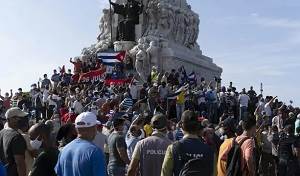
A crowd of people in front of a statue

Description automatically generated with medium confidence
Pro-government protest in Cuba that the corporate media said was anti-government

The US does not fear Cuba militarily or as economic competition.  It fears Cuba because of its example to the rest of the world, especially to Latin American countries, as they move forward in breaking away from US imperialism and its neo-liberal economic policies.  While the US will not provide healthcare for all, even during this pandemic, Cuba provides free healthcare and education for all.  Even with the sanctions-imposed limitations on medicine and medical equipment, Cuba has done remarkable well in containing the virus and even sent doctors to help out in other countries.  It prioritizes the needs of the Cuban people not the corporations, banks, and billionaire class.  The example of people over profit is one that the US cannot tolerate, and so they attack Cuba.

On November 15, Cuba started opening up after restrictions due to the COVID pandemic. Biden used this day to call for demonstrations in Cuba against the government. This call has proven to be a failure as demonstration did not materialize anywhere on the island. While the Cuban people and Cuban government will have to deal with this intervention and the discontent due to shortages and the pandemic, we in the US must show our solidarity with Cuba and oppose our government’s interference in the internal affairs of Cuba and other countries throughout the world.

Demonstration were called in a number of US cities on November 15 to express solidarity and help inform the people of the US of the criminal role the US government plays in Cuba.  This crisis will not end on November 15.  We must step-up our efforts to show solidarity and stay the hand of US imperialism.

Hands off Cuba!

End the Blockade!

End all Sanctions!

End US meddling in the affairs of other countries!

https://nepajac.org/handoffcuba.htm

China and Russia have long endured massive threats. War hawk JFK against China, Russia, and Cuba

So many myths have been fed to the American people. Here’s more information about the real John F. Kennedy. [1] 
–
From Global Research
–
By Shane Quinn
February 15, 2018
–

In April 1962, the Kennedy administration ordered nuclear missiles to be sent to Japan’s Okinawa Island. The weapons were directed at the People’s Republic of China, a nation the Americans had “lost” to Communism 13 years before.

President John F. Kennedy‘s decision to aim missiles at China occurred six months before the Cuban Missile Crisis, known as the October Crisis in Cuba. The missiles Kennedy directed at Mao Zedong’s China were “near identical” to those aimed at the US, after the Soviet Union sent nuclear-armed weapons to Cuba in October 1962.

The American missiles on occupied Okinawa – an island just over 500 miles from China’s coast – were “over 75 times the power of the bomb dropped on Hiroshima” in August 1945. The nuclear weapon that leveled Hiroshima killed about 80,000 people initially, mostly civilians. However, further tens of thousands later died after succumbing to severe radiation poisoning.

In the early 1960s, China possessed by far the world’s largest population, at almost 700 million. Any order obeyed to fire such destructive weapons at China would have killed unprecedented numbers. Yet the American missiles on Okinawa remained hidden from public knowledge, and has only come to light in recent times. The reason for Kennedy’s order for missiles to be readied on Okinawa, can be traced to intense friction between two of Asia’s largest countries.

A 1962 aerial photograph shows Okinawa’s first Mace missile site at Bolo Point, Yomitan. (Source: Larry Johnston via APJJF)

During 1962, antagonism soared between China and American-backed India – primarily over border disputes along the Himalayas. It culminated in the Sino-Indian conflict, starting on 20 October, with much of the fighting occurring at over 4,000 meters. This forgotten conflict also began in the middle of the Cuban Missile Crisis, as the Americans were entirely distracted with Cuba. After a month of bloody fighting, China emerged victorious having secured territorial gains.

History, up to the current day, suggests the US holds the right to erect weapons wherever it chooses, ignoring the potential consequences. For example, in 1961, president Kennedy positioned intermediate-range “Jupiter” nuclear missiles in Italy and Turkey – this time aimed at Russia. The Turkish border is little more than 300 miles from Russia, separated alone by diminutive Georgia.

None of this was lost on the Russians. In May the following year (1962), the Soviet president Nikita Khrushchev complained to a confidant that the Americans “have surrounded us”. Kennedy’s reckless deployment of missiles was also a crucial factor leading up to the Cuban Missile Crisis.

Behind the thinking of his Cuban missile decision, Khrushchev explained following his retirement that the Americans

“would learn just what it feels like to have enemy missiles pointing at you; we’d be doing nothing more than giving them a little of their own medicine”.

The enormous threats against Russia also had a deeper psychological impact. Over the past century and more, Russia was repeatedly invaded and almost destroyed by invading armies. From Napoleon Bonaparte’s 1812 offensive, through to Operation Barbarossa overseen by Adolf Hitler in 1941.

The intimidation of Russia, a long-time nuclear power, has continued apace to the present day. One significant menace is the continued existence of NATO as an organization – and the presence of its troops and weapons along Russia’s frontiers. NATO receives much of its funding from America, so is in reality a tool of imperialism, posing a significant global security threat.

In more rational times Dwight D. Eisenhower, NATO’s first supreme commander, wrote in 1951 that NATO

“will have failed” if “in 10 years all American troops stationed in Europe… have not been returned to the United States”.

Eisenhower would become a re-elected US president (1953-61), so his was not a voice without weight. It would be interesting to gauge his reaction if he knew that, by 2018, American troops were still present on European soil. This reality may have disturbed George Kennan too, the farsighted former US ambassador to the Soviet Union and Yugoslavia, himself no dove. In 1996 Kennan described NATO expansion eastwards, in continued violation of agreements, as “a strategic blunder of potentially epic proportions”.

Meanwhile, a further critical element in the placing of Soviet missiles in Cuba, was the Kennedy administration’s assaults on the island nation. There was the failed Bay of Pigs invasion in April 1961, which ended in a Cuban rout of US-backed forces. Stung by this embarrassment, in January 1962 Kennedy outlined that “the Cuban problem” is “the top priority in the United States government”.

The ensuing Operation Mongoose brought the “terrors of the earth” to Cuba – a quote attributed to Arthur Schlesinger Jr., Kennedy’s top Latin American advisor. In the months before the missile crisis, Cuba was subjected to widescale terrorist attacks directed from America. This included the bombing of Cuban hotels and petrochemical plants, poisoning of crops and livestock, attacks on fishing boats, the tainting of sugar exports, etc.

In March 1962, it was made clear that the assaults were to lead to “final success” which would “require decisive US intervention”. The renewed invasion of Cuba was dated for October 1962 – it is no coincidence that Khrushchev sent his missiles to Cuba during the same month.

As the missile crisis peaked, the world came perilously close to a nuclear war, largely due to Kennedy’s hegemonic policies. This was all concealed from the American public, who were repeatedly informed the blame lay squarely with the USSR and its Cuban ally.

Image result for posada and bosch

Bosch and Posada (Source: Cuba Headlines)

Following the de-escalation in late October, the US immediately recommenced terrorist operations against Cuba. These murderous acts continued for decades in various forms. This included American support for the Cuban exiles, Luis Posada Carriles and Orlando Bosch, two of the worst international terrorists of the post-World War II period.

Posada Carriles and Bosch are most infamously remembered for masterminding the 1976 destruction of a Cuban airliner, killing all 73 people aboard. However, the duo were also responsible for countless other terrorist attacks on embassies, consuls, tourist industries, ambassadors, civilians, etc. – not just in Cuba – but across Latin America.

Furthermore, the US continues its blockade of Cuba, which has lasted for more than five decades – despite opposition from virtually the entire world. The embargo was first introduced by Kennedy himself in October 1962.

After visiting Cuba two years ago, then president Barack Obama said he and Raul Castro “continue to have serious differences, including on democracy and human rights”. One could forgive the Cuban leader for being somewhat perplexed by this statement. Not mentioned by Obama was America’s efforts to bring “democracy and human rights” to Cuba, in the form of vicious terrorist assaults and economic strangulation.

Nor did Obama highlight Cuba’s central role in liberating southern Africa from apartheid. South Africa’s racist regime was heavily supported by the US, yet it appears trivial facts such as these are not worthy of mention by Obama, or indeed, the mainstream press.

Since the 1950s, the American record in introducing “human rights” and “freedom” to the world makes something of a mockery of its projected image. Instead, it is Cuba that has long been vilified by Western elites for supposed human rights abuses.

*

Shane Quinn obtained an honors journalism degree. He is interested in writing primarily on foreign affairs, having been inspired by authors like Noam Chomsky. 

–
[1] Also, for those with the stomach, there is  The Dark Side of Camelot by Seymour Hersh about the Kennedy presidency.

Operation Northwoods — Pentagon planned to carry out terrorism and blame Cuba

False-flag terrorism — repeatedly done by the United States. This is the pattern John McCain and the CIA are following in plotting against Russia, Syria, Ukraine, and other countries. Here it was done against Cuba.

This article came out four months before September 11, 2001.

————————————————————-

From ABC News

U.S. Military Wanted to Provoke War With Cuba

By DAVID RUPPE
New York, May 1, 2001

In the early 1960s, America’s top military leaders reportedly drafted plans to kill innocent people and commit acts of terrorism in U.S. cities to create public support for a war against Cuba.

Code named Operation Northwoods, the plans reportedly included the possible assassination of Cuban émigrés, sinking boats of Cuban refugees on the high seas, hijacking planes, blowing up a U.S. ship, and even orchestrating violent terrorism in U.S. cities.

The plans were developed as ways to trick the American public and the international community into supporting a war to oust Cuba’s then new leader, communist Fidel Castro.

America’s top military brass even contemplated causing U.S. military casualties, writing: “We could blow up a U.S. ship in Guantanamo Bay and blame Cuba,” and, “casualty lists in U.S. newspapers would cause a helpful wave of national indignation.”

Details of the plans are described in Body of Secrets (Doubleday), a new book by investigative reporter James Bamford about the history of America’s largest spy agency, the National Security Agency. However, the plans were not connected to the agency, he notes.

The plans had the written approval of all of the Joint Chiefs of Staff and were presented to President Kennedy’s defense secretary, Robert McNamara, in March 1962. But they apparently were rejected by the civilian leadership and have gone undisclosed for nearly 40 years.

“These were Joint Chiefs of Staff documents. The reason these were held secret for so long is the Joint Chiefs never wanted to give these up because they were so embarrassing,” Bamford told ABCNEWS.com.

“The whole point of a democracy is to have leaders responding to the public will, and here this is the complete reverse, the military trying to trick the American people into a war that they want but that nobody else wants.”

Gunning for War

The documents show “the Joint Chiefs of Staff drew up and approved plans for what may be the most corrupt plan ever created by the U.S. government,” writes Bamford.

The Joint Chiefs even proposed using the potential death of astronaut John Glenn during the first attempt to put an American into orbit as a false pretext for war with Cuba, the documents show.

Should the rocket explode and kill Glenn, they wrote, “the objective is to provide irrevocable proof … that the fault lies with the Communists et all Cuba [sic].”

The plans were motivated by an intense desire among senior military leaders to depose Castro, who seized power in 1959 to become the first communist leader in the Western Hemisphere — only 90 miles from U.S. shores.

The earlier CIA-backed Bay of Pigs invasion of Cuba by Cuban exiles had been a disastrous failure, in which the military was not allowed to provide firepower. The military leaders now wanted a shot at it.

“The whole thing was so bizarre,” says Bamford, noting public and international support would be needed for an invasion, but apparently neither the American public, nor the Cuban public, wanted to see U.S. troops deployed to drive out Castro.

Reflecting this, the U.S. plan called for establishing prolonged military — not democratic — control over the island nation after the invasion.

“That’s what we’re supposed to be freeing them from,” Bamford says. “The only way we would have succeeded is by doing exactly what the Russians were doing all over the world, by imposing a government by tyranny [??? — exactly where was Russia doing this all over the world?], basically what we were accusing Castro himself of doing.”

‘Over the Edge’

The Joint Chiefs at the time were headed by Eisenhower appointee Army Gen. Lyman L. Lemnitzer, who, with the signed plans in hand made a pitch to McNamara on March 13, 1962, recommending Operation Northwoods be run by the military.

Whether the Joint Chiefs’ plans were rejected by McNamara in the meeting is not clear. But three days later, President Kennedy told Lemnitzer directly there was virtually no possibility of ever using overt force to take Cuba, Bamford reports. Within months, Lemnitzer would be denied another term as chairman and transferred to another job.

The secret plans came at a time when there was distrust in the military leadership about their civilian leadership, with leaders in the Kennedy administration viewed as too liberal, insufficiently experienced and soft on communism. At the same time, however, there were real concerns in American society about their military overstepping its bounds.

There were reports U.S. military leaders had encouraged their subordinates to vote conservative during the election.

And at least two popular books were published focusing on a right-wing military leadership pushing the limits against government policy of the day.

The Senate Foreign Relations Committee published its own report on right-wing extremism in the military, warning a “considerable danger” in the “education and propaganda activities of military personnel” had been uncovered. The committee even called for an examination of any ties between Lemnitzer and right-wing groups. But Congress didn’t get wind of Northwoods, says Bamford.

“Although no one in Congress could have known at the time,” he writes, “Lemnitzer and the Joint Chiefs had quietly slipped over the edge.”

Even after Lemnitzer was gone, he writes, the Joint Chiefs continued to plan “pretext” operations at least through 1963.

One idea was to create a war between Cuba and another Latin American country so that the United States could intervene. Another was to pay someone in the Castro government to attack U.S. forces at the Guantanamo naval base — an act, which Bamford notes, would have amounted to treason. And another was to fly low level U-2 flights over Cuba, with the intention of having one shot down as a pretext for a war.

“There really was a worry at the time about the military going off crazy and they did, but they never succeeded, but it wasn’t for lack of trying,” he says.

After 40 Years

Ironically, the documents came to light, says Bamford, in part because of the 1992 Oliver Stone film JFK, which examined the possibility of a conspiracy behind the assassination of President Kennedy.

As public interest in the assassination swelled after JFK’s release, Congress passed a law designed to increase the public’s access to government records related to the assassination.

The author says a friend on the board tipped him off to the documents.

Afraid of a congressional investigation, Lemnitzer had ordered all Joint Chiefs documents related to the Bay of Pigs destroyed, says Bamford. But somehow, these remained.

“The scary thing is none of this stuff comes out until 40 years after,” says Bamford.

http://abcnews.go.com/US/story?id=92662

James Bamford is a former investigative reporter for ABC News.

Posted under Fair Use Rules.

Washington’s “Two Track policy” to Latin America: Marines to Central America and diplomats to Cuba

By Prof. James Petras
Global Research, May 20, 2015

Everyone, from political pundits in Washington to the Pope in Rome, including most journalists in the mass media and in the alternative press, have focused on the US moves toward ending the economic blockade of Cuba and gradually opening diplomatic relations.  Talk is rife of a ‘major shift’ in US policy toward Latin America with the emphasis on diplomacy and reconciliation.  Even most progressive writers and journals have ceased writing about US imperialism.

However, there is mounting evidence that Washington’s negotiations with Cuba are merely one part of a two-track policy.  There is clearly a major US build-up in Latin America, with increasing reliance on ‘military platforms’, designed to launch direct military interventions in strategic countries.  

Moreover, US policymakers are actively involved in promoting ‘client’ opposition parties, movements and personalities to destabilize independent governments and are intent on re-imposing US domination.

In this essay we will start our discussion with the origins and unfolding of this ‘two track’ policy, its current manifestations, and projections into the future.  We will conclude by evaluating the possibilities of re-establishing US imperial domination in the region.

Origins of the Two Track Policy

Washington’s pursuit of a ‘two-track policy’, based on combining ‘reformist policies’ toward some political formations, while working to overthrow other regimes and movements by force and military intervention, was practiced by the early Kennedy Administration following the Cuban revolution.  Kennedy announced a vast new economic program of aid, loans and investments – dubbed the ‘Alliance for Progress’ – to promote development and social reform in Latin American countries willing to align with the US.  At the same time the Kennedy regime escalated US military aid and joint exercises in the region. Kennedy sponsored a large contingent of Special Forces – ‘Green Berets’ – to engage in counter-insurgency warfare.  The ‘Alliance for Progress’ was designed to counter the mass appeal of the social-revolutionary changes underway in Cuba with its own program of ‘social reform’.  While Kennedy promoted watered-down reforms in Latin America, he launched the ‘secret’ CIA (‘Bay of Pigs’) invasion of Cuba in 1961and naval blockade in 1962 (the so-called ‘missile crises’).  The two-track policy ended up sacrificing social reforms and strengthening military repression.  By the mid-1970’s the ‘two-tracks’ became one – force.  The US invaded the Dominican Republic in 1965. It backed a series of military coups throughout the region, effectively isolating Cuba.  As a result, Latin America’s labor force experienced nearly a quarter century of declining living standards.

By the 1980’s US client-dictators had lost their usefulness and Washington once again took up a dual strategy: On one track, the White House wholeheartedly backed their military-client rulers’ neo-liberal agenda and sponsored them as junior partners in Washington’s regional hegemony.  On the other track, they promoted a shift to highly controlled electoral politics, which they described as a ‘democratic transition’, in order to ‘decompress’ mass social pressures against its military clients.  Washington secured the introduction of elections and promoted client politicians willing to continue the neo-liberal socio-economic framework established by the military regimes.

By the turn of the new century, the cumulative grievances of thirty years of repressive rule, regressive neo-liberal socio-economic policies and the denationalization and privatization of the national patrimony had caused an explosion of mass social discontent.  This led to the overthrow and electoral defeat of Washington’s neo-liberal client regimes.

Throughout most of Latin America, mass movements were demanding a break with US-centered ‘integration’ programs.  Overt anti-imperialism grew and intensified.  The period saw the emergence of numerous center-left governments in Venezuela, Argentina, Ecuador, Bolivia, Brazil, Uruguay, Paraguay, Honduras and Nicaragua.  Beyond the regime changes , world economic forces had altered: growing Asian markets, their demand for Latin American raw materials and the global rise of commodity prices helped to stimulate the development of Latin American-centered regional organizations – outside of Washington’s control.

Washington was still embedded in  its 25 year ‘single-track’ policy of backing civil-military authoritarian and imposing neo-liberal policies and was unable to respond and present a reform alternative to the anti-imperialist, center-left challenge to its dominance.  Instead, Washington worked to reverse the new party- power configuration.  Its overseas agencies, the Agency for International Development (AID), the Drug Enforcement Agency (DEA) and embassies worked to destabilize the new governments in Bolivia, Ecuador, Venezuela, Paraguay and Honduras.  The US ‘single-track’ of intervention and destabilization failed throughout the first decade of the new century (with the exception of Honduras and Paraguay.

In the end Washington remained politically isolated.  Its integration schemes were rejected.  Its market shares in Latin America declined. Washington not only lost its automatic majority in the Organization of American States (OAS), but it became a distinct minority.

Continue reading →

Media disinformation: Russia invades Ukraine. Again. And again. And yet again … using Saddam’s WMD

The Anti-Empire Report #134

By William Blum — Published November 19, 2014

“Russia reinforced what Western and Ukrainian officials described as a stealth invasion on Wednesday [August 27], sending armored troops across the border as it expanded the conflict to a new section of Ukrainian territory. The latest incursion, which Ukraine’s military said included five armored personnel carriers, was at least the third movement of troops and weapons from Russia across the southeast part of the border this week.”

None of the photos accompanying this New York Times story online showed any of these Russian troops or armored vehicles.

“The Obama administration,” the story continued, “has asserted over the past week that the Russians had moved artillery, air-defense systems and armor to help the separatists in Donetsk and Luhansk. ‘These incursions indicate a Russian-directed counteroffensive is likely underway’, Jen Psaki, the State Department spokeswoman, said. At the department’s daily briefing in Washington, Ms. Psaki also criticized what she called the Russian government’s ‘unwillingness to tell the truth’ that its military had sent soldiers as deep as 30 miles inside Ukraine territory.”

Thirty miles inside Ukraine territory and not a single satellite photo, not a camera anywhere around, not even a one-minute video to show for it. “Ms. Psaki apparently [sic] was referring to videos of captured Russian soldiers, distributed by the Ukrainian government.” The Times apparently forgot to inform its readers where they could see these videos.

“The Russian aim, one Western official said, may possibly be to seize an outlet to the sea in the event that Russia tries to establish a separatist enclave in eastern Ukraine.”

This of course hasn’t taken place. So what happened to all these Russian soldiers 30 miles inside Ukraine? What happened to all the armored vehicles, weapons, and equipment?

“The United States has photographs that show the Russian artillery moved into Ukraine, American officials say. One photo dated last Thursday, shown to a New York Times reporter, shows Russian military units moving self-propelled artillery into Ukraine. Another photo, dated Saturday, shows the artillery in firing positions in Ukraine.”

Where are these photographs? And how will we know that these are Russian soldiers? And how will we know that the photos were taken in Ukraine? But most importantly, where are the fucking photographs?

Why am I so cynical? Because the Ukrainian and US governments have been feeding us these scare stories for eight months now, without clear visual or other evidence, often without even common sense. Here are a few of the many other examples, before and after the one above:

  • The Wall Street Journal (March 28) reported: “Russian troops massing near Ukraine are actively concealing their positions and establishing supply lines that could be used in a prolonged deployment, ratcheting up concerns that Moscow is preparing for another [sic] major incursion and not conducting exercises as it claims, US officials said.”
  • “The Ukrainian government charged that the Russian military was not only approaching but had actually crossed the border into rebel-held regions.” (Washington Post, November 7)
  • “U.S. Air Force Gen. Philip M. Breedlove told reporters in Bulgaria that NATO had observed Russian tanks, Russian artillery, Russian air defense systems and Russian combat troops enter Ukraine across a completely wide-open border with Russia in the previous two days.” (Washington Post, November 13)
  • “Ukraine accuses Russia of sending more soldiers and weapons to help rebels prepare for a new offensive. The Kremlin has repeatedly denied aiding the separatists.” (Reuters, November 16)

Since the February US-backed coup in Ukraine, the State Department has made one accusation after another about Russian military actions in Eastern Ukraine without presenting any kind of satellite imagery or other visual or documentary evidence; or they present something that’s very unclear and wholly inconclusive, such as unmarked vehicles, or unsourced reports, or citing “social media”; what we’re left with is often no more than just an accusation. The Ukrainian government has matched them.

On top of all this we should keep in mind that if Moscow decided to invade Ukraine they’d certainly provide air cover for their ground forces. There has been no mention of air cover.

This is all reminiscent of the numerous stories in the past three years of “Syrian planes bombing defenseless citizens”. Have you ever seen a photo or video of a Syrian government plane dropping bombs? Or of the bombs exploding? When the source of the story is mentioned, it’s almost invariably the rebels who are fighting against the Syrian government. Then there’s the “chemical weapon” attacks by the same evil Assad government. When a photo or video has accompanied the story I’ve never once seen grieving loved ones or media present; not one person can be seen wearing a gas mask. Is it only children killed or suffering? No rebels? Continue reading →