On Earth Day, U.S./NASA contaminated Saturn with plutonium-238 — the Cassini probe’s deadly crash

“When I heard that NASA would be dive-bombing Cassini into Saturn with 72 pounds of deadly plutonium-238 on-board, I thought of the Army handing out smallpox laden blankets to Indians on the reservations,” comments Bruce Gagnon, coordinator of the Global Network against Weapons & Nuclear Power in Space, which has been in the lead in protesting NASA nuclear space missions. “NASA readily admits that ‘biotic or prebiotic’ life very possibly exists on Saturn—are they trying to kill it?”

“It’s time to put a stop to their freedom to threaten the lives of people here on Earth.” — Allan Kohn, NASA official from 1964 to 1994

The Nuclearization of Space. The Crash of Cassini

Global Research, April 29, 2017
CounterPunch 27 April 2017


Despite protests around the world, the Cassini space probe—containing more deadly plutonium than had ever been used on a space device—was launched 20 years ago
. And this past weekend—on Earth Day—the probe and its plutonium were sent crashing into Saturn.

The $3.27 billion mission constituted a huge risk. Cassini with its 72.3 pounds of Plutonium-238 fuel was launched on a Titan IV rocket on October 17, 1997 despite several Titan IV rockets having earlier blown up on launch.

At a demonstration two weeks before in front of the fence surrounding the pad at Cape Canaveral from which Cassini was to be launched, Dr. Michio Kaku, professor of theoretical physics at the City University of New York, warned of widespread regional damage if this Titan IV lofting Cassini exploded on launch. Winds could carry the plutonium

“into Disney World, University City, into the citrus industry and destroy the economy of central Florida,” he declared.

Four months before, at an earlier demonstration at the same site, Allan Kohn, a NASA career official from 1964 to 1994 who had been the emergency preparedness officer at the Kennedy Space Center, noted that

we were told by NASA that the odds against the Cassini blowing up and releasing radiation [are] 1,500 to one. These are pretty poor odds. You bet the lottery and the odds against you are one in 14 million.”

As to NASA’s claim that the plutonium system was “indestructible,” he said it is

“indestructible just like the Titanic was unsinkable….It’s time to put a stop to their freedom to threaten the lives of people here on Earth.”

And, indeed, on an Earth “flyby” by Cassini , done on August 18, 1999, it wouldn’t have been a regional disaster but a global catastrophe if an accident happened.

Cassini didn’t have the propulsion power to get directly from Earth to its final destination of Saturn, so NASA figuredImage result for cassini saturn on having it hurtle back to Earth in a “sling shot maneuver” or “flyby”—to use Earth’s gravity to increase its velocity so it could reach Saturn. The plutonium was only used to generate electricity—745 watts—to run the probe’s instruments. It had nothing to do with propulsion.

So NASA had Cassini come hurtling back at Earth at 42,300 miles per hour and skim over the Earth’s atmosphere at 727 miles high. If there were a rocket misfire or miscalculation and the probe made what NASA in its “Final Environmental Impact Statement for the Cassini Mission” called an “inadvertent reentry,” it could have fallen into Earth’s atmosphere, disintegrating, and releasing plutonium. Then, said NASA in its statement, “Approximately 7 to 8 billion world population at a time … could receive 99 percent or more of the radiation exposure.”

The worst accident involving space nuclear power occurred in 1964 when a satellite powered by a SNAP-9A plutonium system failed to achieve orbit and fell to Earth, breaking apart and releasing its 2.1 pounds of Plutonium-238 fuel, which dispersed all over the planet. According to the late Dr. John Gofman, professor of medical physics at the University of California at Berkeley, that accident contributed substantially to global lung cancer rates.

In her book, Nuclear Madness, Dr. Helen Caldicott, president emeritus of Physicians for Social Responsibility, writes about plutonium:

“Named after the god of the underworld, it is so toxic that less than one-millionth of a gram, an invisible particle, is a carcinogenic dose. One pound, if uniformly distributed, could hypothetically induce lung cancer in every person on Earth.”

Further, the Plutonium-238 used in space devices is 280 times more radioactive than the Plutonium-239 used in nuclear weapons.

Cassini finally reached Saturn and took excellent pictures and provided scientific information about Saturn, its rings, and moons including Enceladus and Titan.

NASA sent it crashing into Saturn on April 22, 2017

“to make sure Cassini is incinerated at the end of its journey to ensure that any of its earthborn microbes do not contaminate the biotic or prebiotic worlds out there,” wrote Dennis Overbye in his front-page story in The New York Times on April 22. (The article didn’t mention plutonium at all.)

“When I heard that NASA would be dive-bombing Cassini into Saturn with 72 pounds of deadly plutonium-238 on-board, I thought of the Army handing out smallpox laden blankets to Indians on the reservations,” comments Bruce Gagnon, coordinator of the Global Network against Weapons & Nuclear Power in Space, which has been in the lead in protesting NASA nuclear space missions. “NASA readily admits that ‘biotic or prebiotic’ life very possibly exists on Saturn—are they trying to kill it?”

Said Gagnon:

“We are told that NASA is out searching for the origins of life in the universe but they seem to have forgotten the prime directive from Captain Kirk on Star Trek to ‘do no harm.’”

Felton Davis, an activist with the Catholic Worker movement in New York City, who participated in anti-Cassini protests through the years, said NASA

“should face the environmental reality that other celestial bodies are not garbage dumps.”

After the 1964 accident involving the SNAP-9A plutonium system, NASA moved to develop solar photovoltaic panels to energize satellites, and now all are powered by solar panels—as is the International Space Station.

But NASA has insisted that it needs nuclear power for missions into space—claiming for years that it could not use anything but atomic energy beyond the orbit of Mars. However, that has been proven incorrect by NASA itself. On July 4th, Independence Day, 2016, NASA’s solar-energized space probe Juno arrived at Jupiter. Launched from Cape Canaveral on August 5, 2011, it flew nearly two billion miles to reach Jupiter, and although sunlight at Jupiter is just four percent of what it is on Earth, Juno’s solar panels were able to harvest energy.

Related image

Juno spacecraft above the north pole of Jupiter
Photo from NASA

Nevertheless, the U.S. Department of Energy working with NASA has started up a new production facility at its Oak Ridge National Laboratory in Tennessee to produce Plutonium-238 for space use. Other DOE labs are also to participate.

Says Gagnon of the Maine-based Global Network (www.space4peace.org):

“Various DOE labs are rushing back into the plutonium processing business likely to make it possible for the nuclear industry to move their deadly product off-planet in order to ensure that the mining operations envisioned on asteroids, Mars, and the Moon will be fully nuclear-powered. Not only do the DOE labs have a long history of contaminating us on Earth but imagine a series of rocket launches with toxic plutonium on board that blow up from time to time at the Kennedy Space Center. They are playing with fire and the lives of us Earthlings. The space and the nuke guys are in bed together and that is a bad combination—surely terrible news for all of us.”

“The Global Network,” said Gagnon, “remains adamantly opposed to the use of nuclear power in space.”

Karl Grossman, professor of journalism at the State University of New York/College of New York, is the author of the book, The Wrong Stuff: The Space’s Program’s Nuclear Threat to Our Planet. Grossman is an associate of the media watch group Fairness and Accuracy in Reporting (FAIR). He is a contributor to Hopeless: Barack Obama and the Politics of Illusion.
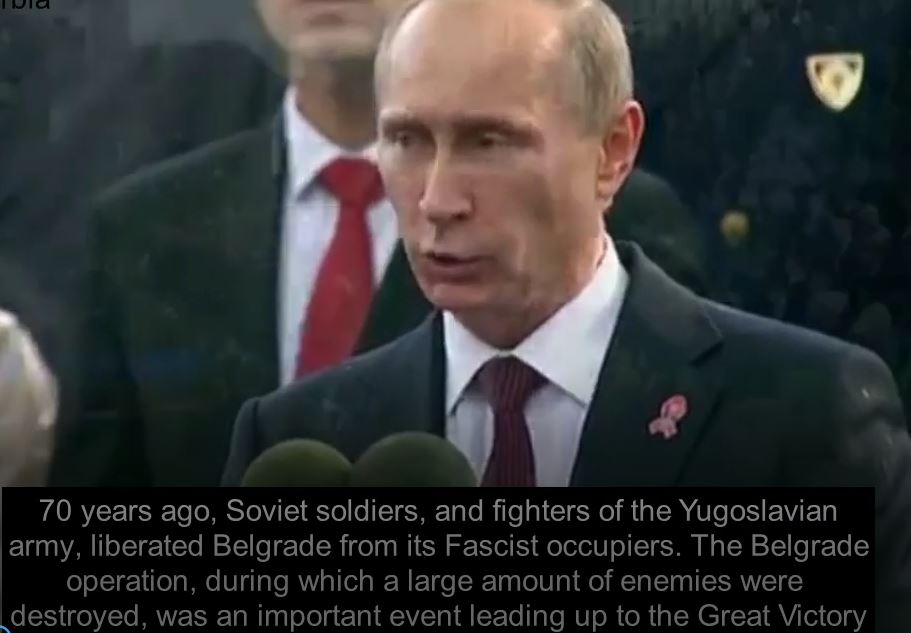
Putin in Serbia: the USSR won WWII [Video]

April 27th, 2017 – Fort Russ News –
by Inessa Sinchougova

In anticipation of Victory Day, May 9th 2017, it is topical to revisit the subject of WWII. It is trendy nowadays in Western states to belittle the role of the Soviet Union in the Great Patriotic War, as it is known in Russia, in which an estimated 27 million Soviet soldiers and civilians died. On a personal level, it is 3 of my great-grandfathers killed in battle, and 1 who made it from Siberia to Berlin, and home to tell the story. One out of four family members – and this is standard for each Russian/Soviet family.

In this clip, Vladimir Putin addresses an assembly in Belgrade in 2014, an anniversary date for the liberation of Belgrade. He states that it is the USSR and the Yugoslavian forces that offered the most resistance to Hitler’s Germany; no historical manipulation can be entered into.

It is also trendy nowadays to dismiss the destructive role Nazism had on the European continent, linking Hitler to fighting against ‘international Jewish banksters’,  ‘subspecies’ and ‘the cabal.’ In reality, nobody in history of humanity destroyed more ‘white’ Europeans than Hitler’s Germany. At that point in time, world casualties amounted to almost ¼ of the world’s population as a whole. Every Russian city today has a monument or an eternal fire to the Great Patriotic War, with the names of the deceased printed for eternity.

Today, in April 2017, preparations for the 2017 Parade are taking place in Moscow. Are you coming?

Busted: Bulgaria routinely ships weapons to Syrian militants – investigation

April 26th, 2017 – Fort Russ News –

North Atlantic Treaty Organization countries have repeatedly been accused of supplying weapons to terrorists. Bulgaria – is no exception. 
According to the news agency “Tass”, another batch of Bulgarian arms to Syria was delivered April 4, 2017 from the port of Burgas (Bulgaria) to the port of “Jeddah” (Saudi Arabia) on the vessel “Marianne Danica”, en route under the flag of Denmark.
It is known that over the last month, the Bulgarian ship has made two trips to Saudi Arabia and returned to Bulgaria for the next “batch”. Saudi Arabia can not realistically be the recipient of the weapons, as the country’s army is equipped with exclusively Western weapons already.
Reporters of the newspaper “Trud”, who published the  original  result of the investigation, also found that the Bulgarian weapons manufacturer “VMZ-Sopot” signed contracts on arms supplies with the US; two companies “Chemring”, in the amount of $47m, (Dec 2016) and Orbital ATK, to the amount of $50m  in January of this year.
VMZ-Sopot, Bulgaria
Payment for orders is made through ‘front companies’ representatives of European command and of the US armed forces.
As a reminder, the previous (and first) noisy case of transportation of Bulgarian arms to Syrian Islamists occurred in December 2016.
Then, journalists visited the city of Aleppo and found 9 Al-Nusra warehouses for heavy machine guns and ammunition, missiles for multiple rocket launchers, all produced in Bulgaria. It turned out that the supplier of ammunition is a Bulgarian privately owned weapons company Arcus from Lyaskovets, and military factory VMZ-Sopot.
The fact that the leadership of the Republic of Bulgaria has repeatedly and convincingly been accused of supplying weapons to Syria, no one, apparently, cares. As a result, Bulgaria, as a member of NATO and the European Union, under the auspices of the United States and through “gray schemes” continues to regularly and illegally redirect weapons to terrorist groups in Syria.

Kiev to begin army exercises on border with Crimea

April 27th, 2017 – Fort Russ News –
Politnavigator – by Inessa Sinchougova

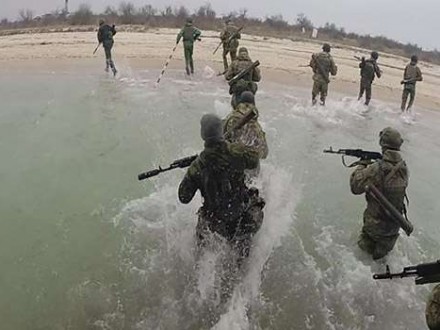
Tomorrow, 28 April, in the Kherson region that borders the Crimea, Ukrainian military exercises will begin.
This was reported by the press officer of the Operational Command “South” of the Armed Forces of Ukraine, Igor Biryukov.
 
“There is a water barrier to overcome in Nikolaev – the Southern Bug River. Overall, during training, water obstacles in four places will be overcome.”
The main objective of the exercise is the ability of the regiment to overcome water obstacles.

Radioactive goods are being looted, stripped, and exported from Chernobyl – video and transcript

Fort Russ
April 28th, 2017
Translation by Tatzhit Mihailovich

Source Video:
https://www.youtube.com/watch?v=6lWp6enOwTQ

FROM THE TRANSLATOR

The 31st anniversary of Chernobyl nuclear disaster this Wednesday has attracted considerable media attention in the West. Most of the publications focused on the event itself. Some talked about the recent “accomplishments” of the Poroshenko regime – erecting a steel containment structure over the old concrete one [1], plans to build a solar power plant at the site, and so on [2].

A few articles, like the Associated Press piece (reprinted by most Western outlets – Washington Post, ABC News, Fox, Daily Mail, etc etc)  used to occasion to highlight “anti-nuclear protest in Belarus” [3].

Finally, one or two articles talked about cool projects in the exclusion zone – such as a few Polish “adventurers” moving a generator into Pripyat and turning lights on (source) – but without discussing e.g. the potential for electrical fires, which would spread radioactive smoke, or the fact that random people can freely roam Pripyat.

No one talked about the real problem – the fact that the “closed zone” around Chernobyl is no longer really “closed”, and that everything of value is being looted and sold to unsuspecting buyers [4]. The interview below discusses this problem.

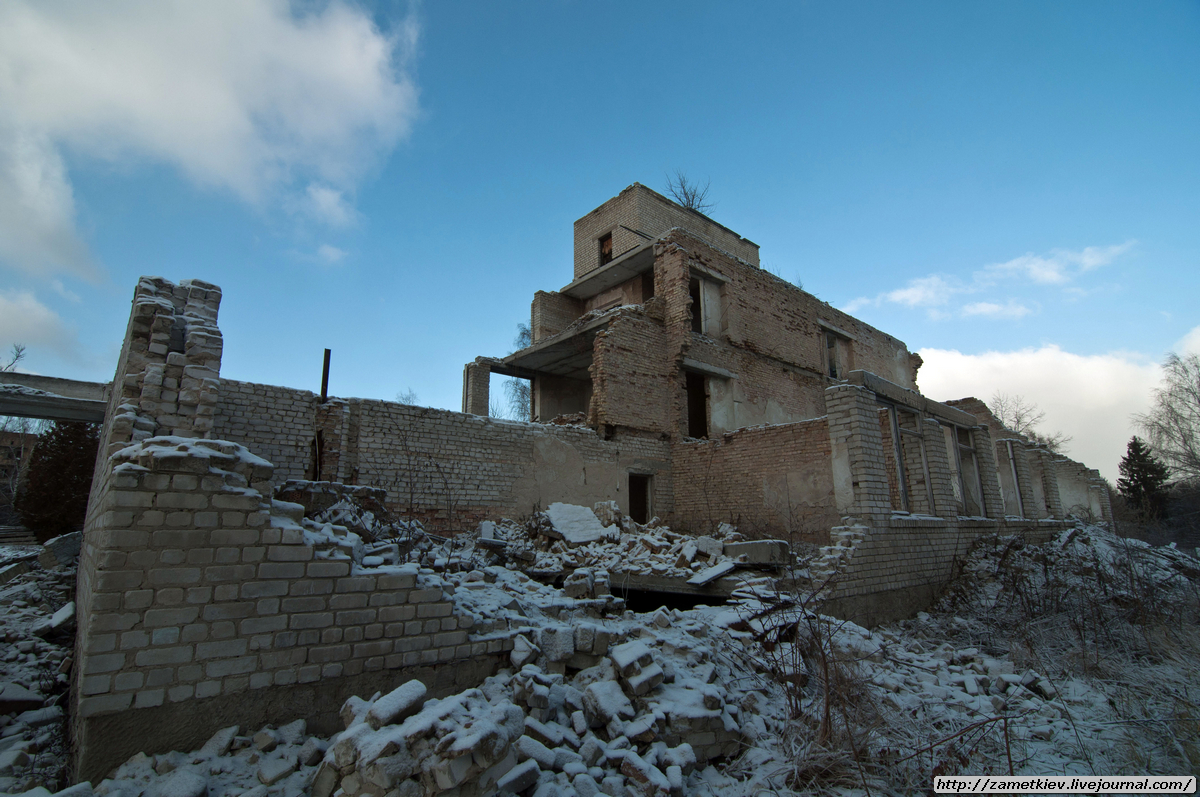
[pictured: school in the radioactive town of Polesskoe, mentioned in interview below, midway through being disassembled for construction materials. Photo credit to zametkiev LJ.]

Interestingly, the man presenting the evidence (Alexander Medinskiy) is actually a Ukrainian nationalist – or used to be, anyway. He even fought in Donbass, but since coming back from the war, he has seen the effects of “Western democracy” on Ukraine and has become a vocal critic of the new regime, calling it corrupt, dictatorial, and criminal (and was branded a “terrorist sympathizer” in return). So, we can hear a report for an “insider”, as it were.

VIDEO

INTERVIEW TRANSCRIPT
(A) = Aleksandr Medinskiy
(K) = Konstantin Zazvonov

[greetings skipped]

(A) Kostya, everyone in Ukraine understands that the industry is mostly dead, so all that’s left is scrapping the leftovers. Now they are getting into Chernobyl.

(K) Isn’t it supposed to be closed off?

(A) It used to be “restricted” before. And even then, not guarded well. And now, it’s not just lone looters. It goes all the way to the top, so restrictions no longer apply.
Moreover, most of the policemen that were guarding Chernobyl have been laid off now, so it’s standing wide open.

(K) Got it. What exactly is being looted? [Irradiated] vehicles from storage areas, or building materials and infrastructure?

(A) Anything and everything of value, Kostya.
First of all… Let’s show a photo here… On Google photos we can see that in 2002, this “vehicle cemetery” was completely full and by 2013, it was all taken. So first they looted the vehicles – those are the most valuable. Not every last one, but most.

Now they’ve moved on to houses – taking them apart for pipes, rebar, and so on.

Here we can see how the school in Polesskoe [ghost town about 20 mi downwind from the reactor – ed.] is being disassembled into concrete slabs.

No idea where those slabs will turn up, because it is very tricky to figure out the schemes being used there.

But… I can say that, some time ago, businessmen I know personally have bought a load of used metal pipes, supposedly originating from Dnepropetrovsk.

And when the load was delivered, they were smart enough to check it with a radiation counter – the levels were off the charts, pretty much lethal.

They weren’t able to find out where the pipes originated from, but it certainly wasn’t Dnepropetrovsk. Somewhere within the exclusion zone, apparently.

(K) So is it sold within Ukraine, or exported? Or you don’t have that sort of information?

(A) I’ll put it this way. If you really look into what’s happening into exclusion zone, this is a large-scale, industrial effort. They are disassembling buildings using cranes. This isn’t merely a couple hobos trying to scavenge.

We can see heavy construction vehicles being moved in. We can see buildings being disassembled in a professional manner, with cranes.

We can see heavy vehicles being used to drag radioactive barges onto the shore, where they are cut for scrap. There are videos of that as well.
Where does all of this go is anybody’s guess. Some of it is bought by unwary people within Ukraine. Some of the metal is probably molten down, re-cast, and then exported.

Everybody knows that, [unfortunately], our government is among the world’s most corrupt ones. Thus, it is no problem to make real and proper documents verifying that these goods have “successfully passed” radiological inspection.

The real horror of the situation is that these materials can be anywhere in Ukraine now. Those radioactive pipes I told you about – they were brought to the capital!

And after those businessmen refused – where did they take those pipes? Maybe sold them to somebody else?

(K) I’d bet they didn’t take them back to Chernobyl! Yeah, probably resold.

You know, in one of my future videos, I plan to talk about contraband to Poland – how cigarettes and [medical] drugs are being smuggled across the border via drones.

And about Chernobyl – how is it all transported, do you think? How do they smuggle all those vehicles and building materials? Do they do it at night, do they camouflage it, or what?

(A) Let me explain how things work here. “Illegal” smuggling isn’t the main problem here, not really.

The problem is that the government officials are so corrupt, this wave of contraband is going “semi-legally” – through the checkpoints, with all the proper documentation, with knowledge of those in charge.

We’ll talk about that in more detail later. As for items from the exclusion zone, they can be split into several segments.

The most basic category are the hunters, poachers, the people who hunt for meat here. As you can guess, no one checks the meat with any sort of radiation counters.

And the exclusion zone is kind of interesting. There are some patches that are relatively clean, and there are patches that are extremely radioactive.

For example, aforementioned Polesie, [where the school was being taken apart for slabs] – that area is extremely “hot”.

There are people who gather mushrooms, berries, and so on – [Chernobyl] exclusion zone obviously has all of that. And then this food can go to the markets in Kiev, maybe even exported abroad, zero control for that.

Then there are the midlevel “harvesters”, who cut up pipes, rebar, the aforementioned barges, and so on. They pay off the officials and transport the loot semi-legally.

And there is an even higher level. [Irradiated] vehicles aren’t usually cut for scrap, unless they’re completely unserviceable. And if they can still work…

There was discussion of using the remaining helicopters [from the “radiation graveyard”], some tracked vehicles – to use them in the warzone. Can you imagine that?

(K) I thought it was actually done in the end?

(A) I can not claim that it was done. I know it was discussed, that’s all.
So, we can see that the “graveyards” are now empty. Where did the vehicles go…

Maybe they sold the armor to some warring African state. Or to South-East Asia somewhere – not everyone is smart enough to do their own radiological inspection of our country’s exports.

(K) So you suspect UkrSpetsExport (Ukraine’s arms export monopoly – ed.) could have made some money there?

(A) I don’t want to make any such statements. Because we want to be… [Ukrainian word] how do you say this in Russian… We want to be objective, evidence-based.
What I wanted to tell here is that the problem exists, and that its rapidly getting worse.
Right now they’re taking apart Polesskoe, then they’ll move on to Pripyat – the probably already started, then they’ll start taking apart the reactor building itself…

You see, that place can be looted for decades. There are construction materials, scrap metal,  venison, mushrooms, and so on. It can be a serious source of income.

The problem is that the whole government system is corrupt. UkrSpetsExport is part of it, so we can not honestly conclude that it is not involved, either. Any part of the system could be.

(K) Thank you very much for your insights on [what’s currently going in] Chernobyl

(A) Yes, thank you too, for raising awareness about this problem. Its being swept under the rug, not talked about, but it’s actually huge. Radiation is an invisible killer.

There are many survivors of Chernobyl among the Ukrainian people, and they should know about this. Also, this problem needs to be discussed internationally. We will continue investigating this matter over here.

(K) Thank you Alex. Use your radiation counter, be safe. All the best!

NOTES:

[1] The project was funded by foreign countries, started in 2007 and slated for completion in 2014.
Of course, the Maidan “revolution” set the project back a few years and incurred mysterious additional costs that required further foreign funding. In the end, the new regime was able to claim credit for finishing a project they didn’t start, didn’t pay for, and actually delayed.
[2] An interesting contrast can be seen here: VOA propagandists claim that the Chernobyl solar plant will generate 2.5 Gw and the project will be complete by May (link), while the somewhat more reasonable BBC propagandists talk about 1 Gw, built by 2019 or so (link).
In reality, most likely, none of these output figures and deadlines will be met – no work has been done so far, and no contracts have been signed.
[3] There is almost no information on this anti-nuclear protest in Belorussian or Russian-language sources; even the Youtube videos put out by the organizers have a couple thousand views at most.
The number of Western journalists and bloggers discussing this tiny gathering of professional “opposition activists” might very well be greater than the number of actual Belorussians who support the protesters.

[4] The lack of attention to what’s going on in the exclusion zone is especially puzzling considering how much the Western mass media love scaring their audiences – fear is the most powerful of human emotions, after all, and scare stories bring the most ad profits.
I suppose that in this case, profits had to take a back seat to the political goal of supporting the Poroshenko regime.

http://www.fort-russ.com/2017/04/open-ukraine-radioactive-goods-are.html

North Korea in the crosshairs: lively input from James Bradley, Ken O’Keefe, Mohammad Marandi (VIDEO)

From CrossTalk, RT

https://www.rt.com/shows/crosstalk/386416-north-korea-absent-diplomacy/video/

North Korea’s leader Kim Jong Un © KCNA / Reuters

We have heard it all before – all options are on the table – and of course, that means using force. This time, North Korea is in the crosshairs, with the usual bellicose language and threats being meted out. What is completely absent, however, is diplomacy.

CrossTalking with James Bradley, Ken O’Keefe, and Mohammad Marandi.

https://www.rt.com/shows/crosstalk/386416-north-korea-absent-diplomacy/

“The Doomsday Forum” of senior military, nuclear weapons officials… America’s “$1 trillion nuclear weapons plan”. Take out Russia, Iran and North Korea?

Global Research, April 28, 2017

Author’s Note

This article was first published on July 8, 2016

America’s pre-emptive nuclear doctrine was firmly entrenched prior to Donald Trump’s accession to the White House. The use of nukes against North Korea has been on the drawing-board of the Pentagon for more than half a century. 

In June 2016 under the Obama administration, top military brass together with the CEOs of the weapons industry debated the deployment of nuclear weapons against Russia, China, Iran and North Korea.

The event was intended to sensitize senior decision makers. The focus was on building a consensus (within the Armed Forces, the science labs, the nuclear industry, etc) in favor of pre-emptive nuclear war 

It was a form of “internal propaganda” intended for senior decision makers (Top Officials) within the military as well as the weapons industry. The emphasis was on “building peace” and “global security” through the “pre-emptive” deployment of nukes (Air, Land and Sea) against four designated “rogue” countries, which allegedly are threatening the Western World. 

One of keynote speakers at the Doomsday Forum, USAF Chief of Staff for Nuclear Integration, Gen. Robin Rand, is presently involved under the helm of Secretary of Defense General Mattis in coordinating the deployment of strike capabilities to East Asia. Gen. Robin Rand heads the Air Force’s nuclear forces and bombers. His responsibility consists in “moving ahead with plans to deploy its most advanced weapons to the [East Asian] region…” Recent reports confirm an unfolding consensus within the military establishment:

“Military leaders regularly, and since the change of administration, have listed China, Russia, North Korea, Iran, and ISIS as the major areas of concern for the future. From a security standpoint, tensions with North Korea continue to escalate, with reverberations throughout the region. In response to Pyongyang’s nuclear missile program, … the U.S. sped up the deployment of THAAD anti-missile interceptors to South Korea. This may reassure Seoul, and to a lesser extent Tokyo, but it has incensed Beijing.” Defense One, March 17, 2017

The unspoken truth is that the THAAD missiles to be stationed in South Korea are not intended for the DPRK, they are slated to be used against China and Russia.

Michel Chossudovsky, April 28, 2017

*     *     *

On June 21, 2017,  250 top military brass, military planners, corporate military-industrial  “defense” contractors, top officials and scientists from the nuclear weapons laboratories as well as prominent  academics gathered at the Crowne Plaza Hotel in Albuquerque, New Mexico to discuss, debate and promote the Pentagon’s One Trillion Dollar Nuclear Weapons program.

Continue reading

The victory over Nazism: historical accuracy and international cooperation vs historical revisionism promoting xenophobia – President Putin and Russian committee discuss initiatives

From Kremlin.ru

April 20, 2017

Meeting of the Pobeda (Victory) Organising Committee

Vladimir Putin chaired the 39th meeting of the Russian Pobeda (Victory) Organising Committee in the Grand Kremlin Palace.

The main item on the meeting’s agenda was developing humanitarian cooperation with other countries at government and public level in the aim of promoting objective information about Russia’s history and present, including its role in the victory over Nazism.

* * *

President of Russia Vladimir Putin: Good afternoon, colleagues,

Today, we are holding this meeting of the Russian Pobeda (Victory) Organising Committee to discuss ways to develop our international cooperation and make fuller use of our humanitarian ties’ tremendous potential in our work together with others who are on the same page with us and think along the same lines as we do.

Work to preserve and defend the historical truth about World War II and the traditions and spirit of alliance in the fight against Nazism plays a great role here. In our view, this is above all a moral and human concept, a moral and human duty to the generation of victors, to those who fell for their motherland, and to those who revived and developed the country after the Great Patriotic War. This historical truth cements society and provides a spiritual foundation and basic values for development and for giving people of various generations the sense of being part of a truly united nation.

At the same time, we pursue open discussion of even the most controversial aspects of history, not only from the World War II period, but from other eras too. We take the view that no matter how difficult and contradictory history may be, it is there not to make us quarrel, but to warn us against mistakes and help us to strengthen our good neighbourly ties.

Sadly, there are other approaches to history too, of course, which attempt to turn it into a political and ideological weapon. We see the risks that arise from a cynical approach to the past. We see how falsification and manipulation of historical facts create division between countries and peoples, draw new dividing lines and create supposed enemies.

The line that same countries now follow, and which elevates Nazism to heroic status and justifies the Nazis’ accomplices, is particularly dangerous. Not only does it insult the memory of the victims of Nazi crimes, but it feeds nationalist, xenophobic and radical forces.

I want to emphasise too that historical revision opens the road to a revision of the very foundations of the modern world order and the erosion of the key principles of international law and security that took shape following World War II. We have said before what great risks this could have for everyone today.

Colleagues, we must stand up for an objective approach to history and pursue consistent and steady work on patriotic education, support public initiatives such as search movements or historical reconstructions, develop ties with compatriots abroad, look after the memorials here at home and abroad, and respond firmly to all acts of vandalism.

I think it particularly important to ensure broad access to archival materials, facilitate their publication and give people the possibility of turning to the original sources. This is an effective means of combating all kinds of inventions and myths.

We need to publish and store these archival and other materials on modern and good quality internet resources with interactive capability and enable convenient search for needed information. We need to focus on young people above all in this work and offer and promote these resources with the help of social networks.

Let me add that we are always open to honest and professional discussions on historical themes and joint research on even the most sensitive issues, at all levels what’s more, from large-scale intergovernmental programmes to bilateral contacts between regions, twin cities, universities, museums, scholars and researchers.

Common historical dates, including those that recall our brotherhood in battle and our cooperation during World War II are a good occasion for organising international conferences, round tables and exhibitions. This year marks the 75th anniversary of the legendary Normandie-Nieman regiment.

We have less than three weeks to go before May 9. I am sure that streets in Russia and abroad will once again fill with crowds of people willing to join the ranks of the Immortal Regiment. This deeply symbolic and touching event took place in 50 countries last year. This is the best proof of international cooperation’s colossal potential and of how a commitment to historical truth and our common memory brings people closer and unites them, and strengthens the mutual trust so greatly needed in Europe and around the world today.

The Foreign Ministry has overseen the drafting of a report and plan for comprehensive measures in the areas I have mentioned in humanitarian and international cooperation. We will discuss this document today.

Please, you have the floor, Mr Karasin.

Deputy Foreign Minister Grigory Karasin: Mr President, colleagues,

At this time of new challenges in global affairs, promoting objective information about our country and its past and present and responding to attempts to falsify history are undoubted priorities for the Foreign Ministry and the other agencies engaged in international activity. We are pursuing this work in accordance with the new draft of Russia’s Foreign Policy Concept that you approved in November 2016. Today, these efforts are particularly important.

Over recent years, history has become a target for the large-scale information campaign unleashed against our country and aiming to contain it and weaken its authority on the international stage.

Constant attempts to revise the results of World War II as enshrined in the UN Charter and other international legal documents are of particular concern, as are attempts to paint with the same brush Nazi Germany, the aggressor country, and the Soviet Union, whose people bore the brunt of the war and who freed Europe from the fascist plague, thereby ensuring the continent’s peaceful development for decades to come. We continue to give utmost attention to responding to this hostile line. We consistently advance the argument, including in key international forums, that it was the united anti-Nazi coalition’s efforts that not only vanquished Nazism but also created the post-war world order and its institutions, including the United Nations Organisation, and gave the human rights protection system its current shape.

We constantly remind our partners of the enduring significance of the Nuremburg tribunal’s decisions that stated in clear and unambiguous terms who was on the side of good and who was on the side of evil.

It was at our proposal that the UN General Assembly passes every year a resolution on combating glorification of Nazism, neo-Nazism and other practices that cause escalation of modern forms of racism, racial discrimination, xenophobia and related intolerance.

To expand and support this base, the Foreign Ministry works in concerted fashion in multilateral formats and during bilateral contacts with our partners abroad.

A new resolution was adopted at the plenary session of the 71st session of the UN General Assembly in New York last December. 136 countries voted for this document. Only two delegations voted against it: the USA and Ukraine. 49 countries abstained. It is particularly important and valuable that the number of UN member states acting as co-authors of the document, increased to 55.

Continue reading

Poll: Americans support the military-industrial complex above all else

Global Research, April 27, 2017

A new Morning Consult/POLITICO survey, published on 26 April, indicates that most American voters support the military-industrial complex more than they support any other recipient of U.S. federal government spending.

The military-industrial complex includes almost all federal contractors, the top ten of which, in the ranking of the “Top 100 Contractors of the U.S. federal government”, are all military suppliers:

.

1: Lockheed Martin.
2: Boeing.
3: General Dynamics.
4: Raytheon.
5: Northrop Grumman.
6: McKesson.
7: United Technologies.
8: L-3.
9: Bechtel.
10: BAE.

Those ten firms would be the likeliest main beneficiaries from today’s America’s extremely pro-military-industrial-complex public, which is clearly revealed in this poll.

2,032 American voters were asked in the poll a list of objectives that might be so important as to justify “the government must shut down.” Only one single objective was close to being supported by an absolute majority of the respondents, so that the government’s going to shut-down would, in those respondents’ view, be justified for Congress to do in order to achieve that given objective, which was stated as: 

“Increase funding for defense and homeland security.” 47% of respondents (just shy of an absolute majority, which is 50+%) chose that goal as being so drastically important; 39% chose instead the answer, “NOT important enough to prompt a shutdown.” 14% chose “Don’t Know / No Opinion.” In other words: 47% were in support of any member of Congress who refused to vote to fund the government unless the proposed legislation to keep the government going would “Increase funding for defense and homeland security” (increase funding that’s going mainly to those ten firms).

Increased spending on the military-industrial complex (which is incontestably the most corrupt portion of the U.S. federal government) is so extremely important to 47% of America’s voters, according to this poll. Those 47% are like a huge cheering section for those ten corporate stocks: they’re willing to shut down the federal government if the taxpayer-money going to those ten firms isn’t increased.

The second-highest-supported listed objective, “Continue to make cost-sharing payments to health insurance companies,” was supported by only 42% of respondents. Exactly the same percentage, 42%, chose “NOT important enough to prompt a shutdown.” So: only “Increase funding for defense and homeland security” was supported, in this poll, by more people than opposed it — and it was supported by 47% and opposed by only 39%; so, it was supported by 47/39, or 1.21 times as many respondents, as the number of respondents who opposed it. The proponents of increasing the military-industrial-complex don’t merely dominate; they clearly dominate.

The third-highest-supported objective, at 35%, was “Provide health care benefits to retired coal miners.” 44% said that that goal isn’t worth shutting down the government in order for it to be attained. I.e.: more think that those miners should be left to die than think that continuing to provide for their black-lung treatments (etc.) is essential.

The lowest support of all, at only 27%, was “Fund a wall along the Mexican border.” Donald Trump’s alleged support for that is shared by far fewer Americans than oppose it. 61% of respondents on that say it’s “NOT important enough to prompt a shutdown.”

In between was the 32% who wanted to shut down the government unless it would “Decrease funding for domestic programs.” By contrast, 48% said that that goal was “NOT important enough to prompt a shutdown.” In other words: congressmen who would vote to shut down the federal government unless the proposed budget reduces “funding for domestic programs” would be opposed by a very large majority (48% to 32%) of America’s voters: 50% more Americans oppose than support it.

Americans, according to this poll, very strongly, by a 47% to 39% margin, absolutely demand “Increase funding for defense and homeland security,” but by an even stronger 48% to 32% margin, they do NOT absolutely demand “Decrease funding for domestic programs.” (This poll did not inquire regarding whether there is more support for increasing domestic programs than for decreasing those programs.)

Retired U.S. Army Colonel Lawrence Wilkerson, who, as the Chief of Staff to U.S. Secretary of State Colin Powell had been deceived into believing the military-industrial-complex’s hired allegations in 2002 about Saddam Hussein and “WMD,” became afterward an opponent of that very same operation which had deceived him, has since said (at 11:06- on the video here) about that operation which had deceived him:

It is a corporate complex that is growing and it surrounds everything else, including what I call fateful decision-making. … You are serving the ulterior purposes of the leadership of the country. … You are serving corporate and commercial interests, you are serving the interests of people who bureaucratically are seeking power within the structure, and you are serving the interests of what is basically an incompetent governing process. 

This latest poll makes very clear that the majority of the U.S. public are satisfied with that situation, or else don’t know that it’s even the case. Of course, if they don’t know the reality about this matter, then they’ve been deceived by the news media they’re being exposed to, and/or by whatever other sources have influenced them regarding it; but, otherwise, they really do love the military-industrial-complex, and they authentically demand that more and more of their tax-dollars go toward paying for it.

Investigative historian Eric Zuesse is the author, most recently, of  They’re Not Even Close: The Democratic vs. Republican Economic Records, 1910-2010, and of  CHRIST’S VENTRILOQUISTS: The Event that Created Christianity.

Indigenous peoples of the Amazon share message with the world

Global Research, April 26, 2017

We, the traditional authorities and elected leaders of the Uitoto, Muinane, Andoque and Nonuya peoples of the Middle Rio Caquetá region of the Colombian Amazon are in Bogotá between the 25th and 28th of April to represent our peoples and our Traditional Association of Indigenous Authorities – the Regional Indigenous Council of Middle Amazonas (CRIMA) in meetings with different State institutions and international agencies. We self-identify ourselves as the “People of the Centre” and heirs of the Green Territory of Life in the Amazon rainforest.

We are here to demand guarantees for our rights and to share concerns regarding forest, climate change and biodiversity projects that affect our territory, including the National Parks Department’s Heart of the Amazon Project supported by the World Bank and Global Environment Facility, and the Vision Amazonia Programme funded by the UK, Germany and Norway. We wish to express concerns that these programmes are undermining our principles of consent and participation and are applying processes that are not appropriate for our way of thinking and decision making.

Asserting our rights: Under our Law of Origin, and in accordance with our uses and customs, we have maintained a respectful relationship with our territory and the natural world. Before colonisation, our ancestors lived well. More than a century ago the cauchería came to exploit, enslave and displace our peoples, and almost exterminated us. We are the survivors of that genocide. We have since been reconstructing our society by building our malocas (ceremonial houses) and practising our ritual dances using the Word of Life and the wisdom of our elders. Since the 1970’s, our Cabildos (Councils) and Traditional Association of Indigenous Authorities have undertaken collective actions to legally securing our territory and to claim our rights.

Messages of the People of the Centre

To the Colombian government: We are not here to ask for projects. We want the national government to fully recognise our autonomy and our rights to govern our territory. We wish to see our applications for the extension of Reserves of Monochoa, Puerto Sábalo-Los Monos and Aduche properly processed and titled in favour of our communities to consolidate the Territory of Life belonging to the People of the Centre. In addition, we seek the formation and legal registration of an Indigenous Territorial Entity under our full jurisdiction in order to manage, administer and preserve our traditional territory and forests and maintain our way of life.

To international institutions: We inform the World Bank, the Global Environment Facility, donor governments and cooperation agencies of Germany, the United Kingdom and Norway, that they must reach agreements directly with us, as our ancestors did. They did not talk to outsiders by means of third parties. We don’t want to have the interference of intermediaries such as NGOs and environmental funds: we seek a direct relationship between programmes, international donors and our traditional authorities. We demand that we are recognised and respected as environmental authorities in our own territory, with our own indigenous system of territorial ordering. We demand that the agencies respect our rights to own, manage and control our territory. To this end, we seek formal steps to develop and implement a Safeguard Plan for our peoples.

To the world: These demands are not just our concerns. Many other peoples in the Amazon and the world have similar claims and proposals for protecting peoples’ rights and sustaining the forests. When we say that we manage our territory and have our own government we are not talking about nature as an object or natural resource, but rather as a space with natural beings with whom we relate guided by our Word of Life and mutual respect. We want to let the world know what “territory” means to us. This week we will share the teachings of the Muinane people about our care of territory. The Uitoto, Andoque and Nonuya peoples have been working in the same direction in documenting our ways of managing and preserving the rainforests. We want to invite all the Peoples of the Centre, America and other parts of the world to join us in this effort to defend life and territory.

Contacts:
Hernando Castro, Regional Indigenous Council of Middle Amazonas: hecasu68@yahoo.es
Tom Griffiths, FPP: tom@forestpeoples.org
Camilla Capasso, FPP: camilla@forestpeoples.org