NEW STUDY: GAZA’S CHILDREN FACE SEVERE PSYCHOLOGICAL TOLL AMID CATASTROPHIC WAR December 11, 2024
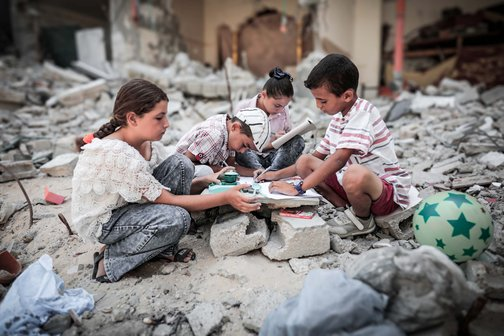
A new report out of Gaza lays bare the profound psychological impact of the ongoing war, particularly on children who are injured, disabled, separated from their families, or unaccompanied.
The study, Needs Assessment Study of Children with Disabilities, Injured and Separated or Unaccompanied, was conducted by the Community Training Centre for Crisis Management (CTCCM) with support from the War Child Alliance. It paints a harrowing picture of children’s mental health under Israeli bombardment and blockade.
“We met with injured, separated, and disabled children and their caregivers to hear from them about the toll of war on their lives. What they shared was devastating – but sadly, not surprising. This study reinforces what we have seen, heard and witnessed over more than a year. Children are traumatised by this war, and we must respond,” says a spokesperson and Project Technical Coordinator from CTCCM in Gaza.
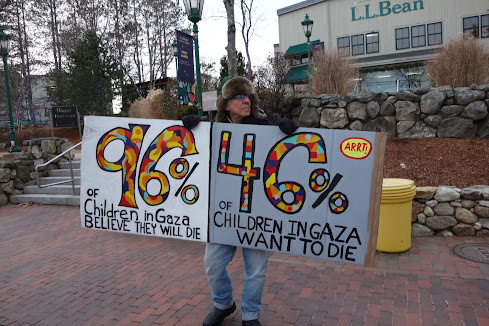
The findings in this study are stark. Caregivers report that 96% of children feel death is imminent, and nearly half believe they will die because of the war. Many children exhibit symptoms of aggression, fear, withdrawal, and severe anxiety, alongside a pervasive sense of hopelessness. Years of displacement, loss, and relentless bombing have left children psychologically scarred and their families in dire circumstances.
The survey of 504 households reveals that 88% of families have been displaced multiple times, with 21% forced to move six or more times. Most families live on less than €122 a month, grappling with soaring prices for food and essentials due to the ongoing blockade and restrictions on humanitarian aid. Meanwhile, 80% of breadwinners are unemployed, reflecting the devastating economic consequences of the war.
“For children in Gaza, nowhere is safe. They have seen homes destroyed, loved ones killed, and schools turned to rubble. Even so-called evacuation zones are not spared from bombing. The mental health of Gaza’s children is under constant attack,” says Rob Williams, War Child Alliance CEO.
from Global Network Against Nuclear Power and Weapons in Space Organizing Notes, December 21, 2024 By Bruce Gagnon
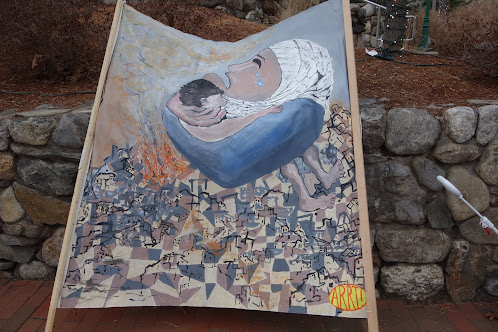
Forty of us gathered in Freeport, Maine today (a holiday shopping mecca in our state) right in front of the famous L.L. Bean store. This was our monthly protest that we’ve been doing for a couple of years in different busy traffic areas across the state.
It was 28 degrees out and a bit windy but we braved the cold for 90 minutes due to the huge crowds on the main road thru town and the busy foot traffic on the sidewalks.
We lined up along both sides of the street in the center of the shopping district for about forty minutes and then walked slowly, single-file, down both sides of the street for several blocks and then each side of us crossed to the opposite sidewalk and walked back to the starting point.
Along the way we handed out hundreds of BDS flyers asking the public to boycott major corporations in the US that have shown big support for the zionist wars in the Middle East aimed at Palestine, Lebanon, Yemen and more recently Syria.
Is Iran the next Israel-US target for ‘regime change’? The zionists must be careful because Iran can actually fight back.
When we passed by the Starbucks coffee shop we chanted ‘Boycott Starbucks’ repeatedly as people paused at the door and didn’t enter until we passed by. I wonder how their drink tasted after that?
We closed the protest with strong words from Palestinian human rights activist Faisal Khan. (See some of his recent writings that I will put on this blog the day after Christmas.)
Our next monthly statewide protest will be in Camden, Maine (along the coast on Hwy 1) sometime in January. We don’t have a date yet but will send out info soon.
Thanks to all for helping to make this a great action. We must keep coming together to call for an end to these insane genocidal zionist war$.
“As far as the locals were concerned, there is no doubt that the Ukrainians were trying to kill as many civilians as possible. My guide explained that they always fired HIMARS rockets in groups of three—the first rocket to pierce the roof and structures, the second to kill the occupants, and, 20 to 25 minutes later, a third strike to kill as many firefighters, rescue workers, relatives, policemen, friends, and neighbours who had come to help the victims as possible.”
—
When I first read Guy Mettan’s report from Donbas I felt as if he had transported me to an antipodean universe of some kind. You can take this, as I do, as a measure of how prevalently, as in wall-to-wall, Western media have systematically misrepresented the Donbas region—when they represent it at all, this is to say. I was at once astonished and voraciously curious to read Mettan’s account of his travels to the two republics of the formerly Ukrainian region, which voted in referenda in September 2022 to join the Russian Federation.
Mettan is based in Geneva and travels often, a little in the way of what the French call le grand rapporteur—the accomplished correspondent who has established his authority in the course of a long career. When I met Mettan at a Geneva café the other day to discuss publication of his Donbas report I asked, “What did you expect to find?” It seemed an important question. Mettan immediately smiled. “Nothing,” he said. “I had no expectations whatsoever.”
Good, I recall thinking. A blank slate. A project so counter to the orthodoxy as this would not otherwise work.
This is a very rare account, rare for its objectivity, a look at a place and a people we are not supposed to see from a journalist of long experience. We at The Floutist are pleased to welcome Guy Mettan into our pages.
This is the first of a two-part series. The second part of Mettan’s report will appear shortly.
—P. L., 11 May.
Guy Mettan
DONESTK—How could they do this to us? Why does Kiev want to destroy us?
These are the questions that the people of Donbas have been asking themselves for the past 10 years. Considered from Switzerland or France, they may seem incongruous, as we are so used to believing that only Ukrainians are suffering from the war with Russia. We don’t want to know that the battle has been going on for a decade and has primarily affected the civilian population of Donbas.
For a week in April, I was able to criss-cross the two provinces of Donetsk and Lugansk, visiting towns that had been destroyed and those that were being rebuilt, meeting refugees, and talking to people. This is my report.
I have no doubt that this piece will offend many people who are used to seeing the world in black and white. To them I would say what John Steinbeck and Robert Capa said to their detractors when they visited Stalin’s Russia in 1947, at the beginning of the Cold War: I am simply bearing witness, reporting what I saw and heard on the other side of the front. Then it’s up to everyone to form an opinion.
Watch panel discussions moderated by Scott Ritter and Medea Benjamin December 7 on the threat and danger of nuclear war today, how to persuade the Biden administration to act responsibly, and how to mobilize the population to become involved in opposing nuclear war.
Participants:Max Blumenthal, Margaret Kimberley, Dan Kovalik, Wilmer Leon, Garland Nixon, Anya Parampil, Theodore Postol, Jose Vega, Mel Goodman and Larry Wilkerson.
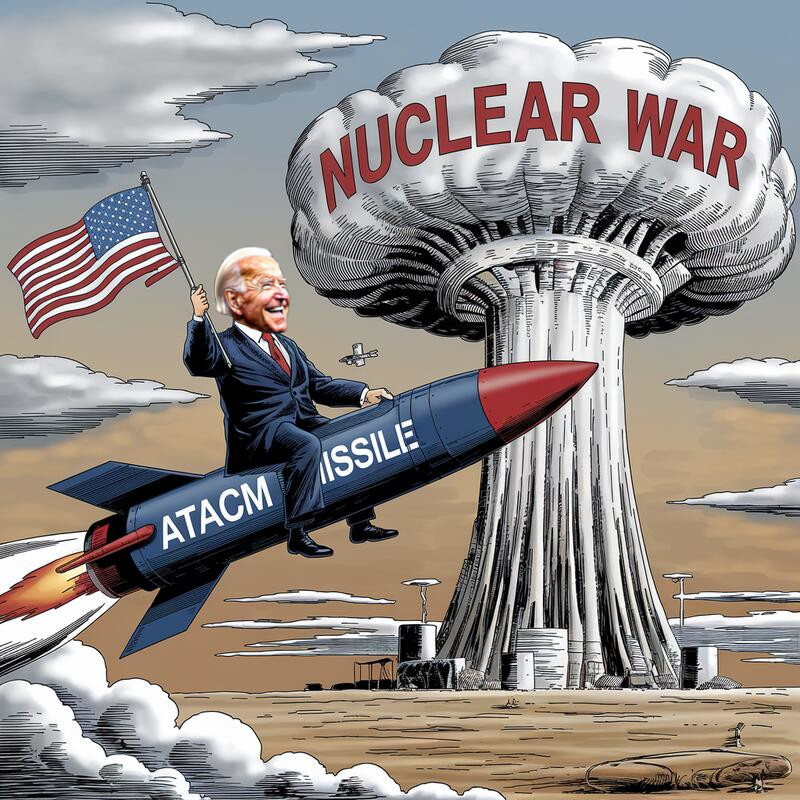
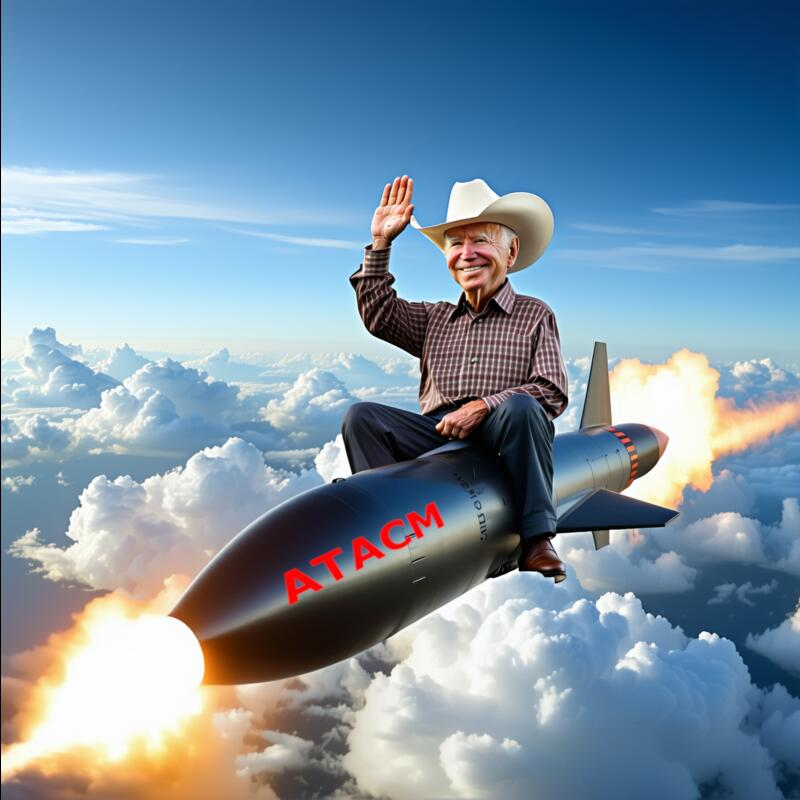
“The United States has to stop attacking Russian soil with American-made ATACMS missiles. Even though we use a Ukrainian cutout, it’s American provided, American targets and American intelligence. It’s the Americans attacking Russia. From the Russian perspective, the United States is at war with Russia … which has triggered their nuclear doctrine.” — Scott Ritter
This bill is co-sponsored by Congresswoman Anna Paulina Luna.
H.R. 10218 – To prohibit the transfer of Army Tactical Missile Systems to Ukraine, and for other purposes.
Introduced in House (11/21/2024)
118th CONGRESS 2d Session
H. R. 10218
To prohibit the transfer of Army Tactical Missile Systems to Ukraine, and for other purposes.
IN THE HOUSE OF REPRESENTATIVES
November 21, 2024
Mr. Higgins of Louisiana introduced the following bill; which was referred to the Committee on Foreign Affairs
A BILL
To prohibit the transfer of Army Tactical Missile Systems to Ukraine, and for other purposes.
Be it enacted by the Senate and House of Representatives of the United States of America in Congress assembled,
SECTION 1. PROHIBITION ON TRANSFER OF ARMY TACTICAL MISSILE SYSTEMS TO UKRAINE.
(a) Prohibition.—For the period beginning on the date of the enactment of this Act and ending at the close of January 20, 2025, notwithstanding any other provision of law, during any period for which a state of conflict exists between Ukraine and the Russian Federation—
(1) no Army Tactical Missile Systems (ATACMS) may be transferred to Ukraine; and
(2) U.S. Military Services or intelligence agencies may not provide support to Ukrainian units operating High Mobility Artillery Rocket Systems (HMARS) platforms utilizing ATACMS munitions to strike outside of internationally recognized Ukrainian territorial borders—
A bill introduced into the U.S. House of Representatives by Rep. Clay Higgins (R-LA) would prohibit the U.S. from sending long-range ATACMS missiles to Ukraine to be fired into Russia.
As U.S. personnel and satellites are required to fire the missiles from Ukrainian territory, Moscow considers it a direct U.S. attack on Russia putting it in a state of war with the U.S. which could lead to nuclear conflict.
…Several members of Congress and their staff said they were taken off guard by President Joe Biden’s reversal of his previous decision not to allow the use of ATACMS to be fired into Russia from Ukraine.
The members and their staff made these remarks during meetings on Thursday on Capitol Hill with former U.N. weapons inspector Scott Ritter and activists of Code Pink, led by Medea Benjamin.
Biden Breaks With Realists
Biden had twice before sided with the Pentagon to avoid direct war with Russia. In March 2022 he overruled his Secretary of State Antony Blinken to scotch plans for a NATO no-fly zone over Ukraine, which could have lead to direct conflict with Russia.
Biden opposed the no-fly zone, he said at the time, because “that’s called World War III, okay? Let’s get it straight here, guys. We will not fight the third world war in Ukraine.”
Then in September Biden deferred to the realists in the Pentagon to oppose long-range British Storm Shadow missiles from being fired by Ukraine deep into Russia out of fear it would also lead to a direct NATO-Russia military confrontation with all that that entails.
Putin warned at the time that because British soldiers on the ground in Ukraine would actually launch the British missiles into Russia with U.S. geostrategic support, it “will mean that NATO countries — the United States and European countries — are at war with Russia. And if this is the case, then, bearing in mind the change in the essence of the conflict, we will make appropriate decisions in response to the threats that will be posed to us.”
That was a clear warning that British and U.S. targets could be hit. Biden thus wisely backed off.
But after he was driven from the race and his party lost the White House last month, Biden suddenly switched gears allowing not only British, but also U.S. long-range ATACMS missiles to be fired into Russia. It’s not clear that the White House ever informed the Pentagon in advance.
Higgin’s bill was introduced as H.R. 10218 on Nov. 21, but none of the other House members that Ritter and Benjamin met with on Capitol Hill had heard of it. Nor was it reported in the mainstream media.
“We found that commonsense is actually alive and living here in the halls of Congress,” Ritter told Consortium News. “Members of Congress and their staffs understand the danger of nuclear war. We found that there was a bill already written … that sought to achieve what we were trying to get them to do.”
Benjamin said: “We are excited to push this bill, which we just found out about. … It will not pass, but the idea is to get momentum for it so that message is coming out there that there are members of Congress who want to see this reversed and that in the next Congress, they will introduce it again with a lot more momentum.”
“To stop a nuclear war comes down to one issue,” Ritter said:
“The United States has to stop attacking Russian soil with American-made ATACMS missiles. Even though we use a Ukrainian cutout, it’s American provided, American targets and American intelligence. It’s the Americans attacking Russia. From the Russian perspective, the United States is at war with Russia … which has triggered their nuclear doctrine.”
Transcript from Russia Ministry of Foreign Affairs
Foreign Minister Sergey Lavrov’s interview to Tucker Carlson, Moscow, December 6, 2024
Question: Minister Lavrov, thank you for doing this. Do you believe the United States and Russia are at war with each other right now?
Sergey Lavrov: I wouldn’t say so. And in any case, this is not what we want. We would like to have normal relations with all our neighbors, of course, but generally with all countries especially with the great country like the United States. And President Vladimir Putin repeatedly expressed his respect for the American people, for the American history, for the American achievements in the world, and we don’t see any reason why Russia and the United States cannot cooperate for the sake of the universe.
Question: But the United States is funding a conflict that you’re involved in, of course, and now is allowing attacks on Russia itself. So that doesn’t constitute war?
Sergey Lavrov: Well, we officially are not at war. But what is going on in Ukraine is that some people call it hybrid war. I would call it hybrid war as well, but it is obvious that the Ukrainians would not be able to do what they’re doing with long-range modern weapons without direct participation of the American servicemen. And this is dangerous, no doubt about this.
We don’t want to aggravate the situation, but since ATACMS and other long-range weapons are being used against mainland Russia as it were, we are sending signals. We hope that the last one, a couple of weeks ago, the signal with the new weapon system called Oreshnik was taken seriously.
However, we also know that some officials in the Pentagon and in other places, including NATO, started saying in the last few days something like that NATO is a defensive alliance, but sometimes you can strike first because the attack is the best defense. Some others in STRATCOM, Thomas Buchanan is his name, representative of STRATCOM, said something which allows for an eventuality of exchange of limited nuclear strikes.
And this kind of threats are really worrying. Because if they are following the logic which some Westerners have been pronouncing lately, that don’t believe that Russia has red lines, they announced their red lines, these red lines are being moved again and again. This is a very serious mistake. That’s what I would like to say in response to this question.
It is not us who started the war. Putin repeatedly said that we started the special military operation in order to end the war which Kiev regime was conducting against its own people in the parts of Donbass. And just in his latest statement, the President Putin clearly indicated that we are ready for any eventuality. But we strongly prefer peaceful solution through negotiations on the basis of respecting legitimate security interest of Russia, and on the basis of respecting the people who live in Ukraine, who still live in Ukraine being Russians, and their basic human rights, language rights, religious rights, have been exterminated by a series of legislation passed by the Ukrainian parliament. They started long before the special military operation. Since 2017, legislation was passed prohibiting Russian education in Russian, prohibiting Russian media operating in Ukraine, then prohibiting Ukrainian media working in Russian language, and the latest, of course there were also steps to cancel any cultural events in Russian, Russian books were thrown out of libraries and exterminated. The latest was the law prohibiting canonic Orthodox Church, Ukrainian Orthodox Church.
You know it’s very interesting when people in the West say we want this conflict to be resolved on the basis of the UN Charter and respect for territorial integrity of Ukraine, and Russia must withdraw. The Secretary General of the United Nations says similar things. Recently his representative repeated that the conflict must be resolved on the basis of international law, UN Charter, General Assembly resolutions, while respecting territorial integrity of Ukraine. It’s a misnomer, because if you want to respect the United Nations Charter, you have to respect it in its entirety. The United Nations Charter, among other things, says that all countries must respect equality of states and right of people for self-determination. And they also mentioned the United Nations General Assembly resolutions, and this is clear that what they mean is the series of resolutions which they passed after the beginning of this special military operation and which demand condemnation of Russia, Russia to get out of Ukraine territory in 1991 borders. But there are other United Nations General Assembly resolutions which were not voted, but which were consensual, and among them is a Declaration on principles of relations between states on the basis of the Charter. And it clearly says, by consensus, everybody must respect territorial integrity of states whose governments respect the right of people for self-determination, and because of that represent the entire population living on a given territory.
To argue that the people who came to power through military coup d’état in February 2014 represented Crimeans or the citizens of eastern and southern Ukraine is absolutely useless. It is obvious that Crimeans rejected the coup. They said, leave us alone, we don’t want to have anything with you. So we did: Donbass, Crimeans held referendum, and they rejoined Russia. Donbass was declared by the putschists who came to power terrorist group. They were shelled, attacked by artillery. The war started, which was stopped in February 2015.
The Minsk agreements were signed. We were very sincerely interested in closing this drama by seeing Minsk agreements implemented fully. It was sabotaged by the government, which was established after the coup d’état in Ukraine. There was a demand that they enter into a direct dialogue with the people who did not accept the coup. There was a demand that they promote economic relations with that part of Ukraine. And so on and so forth. None of this was done.
The people in Kiev were saying we would never talk to them directly. And this is in spite of the fact that the demand to talk to them directly was endorsed by the Security Council. And putschists said they are terrorists, we would be fighting them, and they would be dying in cellars because we are stronger.
Had the coup in February 2014 had it not happened and the deal which was reached the day before between the then president and the opposition implemented, Ukraine would have stayed one piece by now with Crimea in it. It’s absolutely clear. They did not deliver on the deal. Instead they staged the coup. The deal, by the way, provided for creation of a government of national unity in February 2014, and holding early elections, which the then president would have lost. Everybody knew that. But they were impatient and took the government buildings next morning. They went to this Maidan Square and announced that they created the government of the winners. Compare the government of national unity to prepare for elections and the government of the winners.
How can the people whom they, in their view, defeated, how can they pretend that they respect the authorities in Kiev? You know, the right for self-determination is the international legal basis for decolonization process, which took place in Africa on the basis of this charter principle, the right for self-determination. The people in the colonies, they never treated the colonial powers, colonial masters, as somebody who represent them, as somebody whom they want to see in the structures which govern those lands. By the same token, the people in east and south of Ukraine, people in Donbass and Novorossiya, they don’t consider the Zelensky regime as something which represents their interests. How can they do that when their culture, their language, their traditions, their religion, all this was prohibited?
And the last point is that if we speak about the UN Charter, resolutions, international law, the very first article of the UN Charter, which the West never, never recalls in the Ukrainian context, says, “Respect human rights of everybody, irrespective of race, gender, language, or religion.”
Take any conflict. The United States, UK, Brussels, they would interfere, saying, “Oh, human rights have been grossly violated. We must restore the human rights in such and such territory.” On Ukraine, never, ever they mumbled the words “human rights,” seeing these human rights for the Russian and Russian-speaking population being totally exterminated by law. So when people say, “Let’s resolve the conflict on the basis of the Charter,” – yes. But don’t forget that the Charter is not only about territorial integrity. And territorial integrity must be respected only if the governments are legitimate and if they respect the rights of their own people.
Question: I want to go back to what you said a moment ago about the introduction or the unveiling of the hypersonic weapons system that you said was a signal to the West. What signal exactly? I think many Americans are not even aware that this happened. What message were you sending by showing it to the world?
Sergey Lavrov: Well, the message is that you, I mean the United States, and the allies of the United States who also provide this long-range weapons to the Kiev regime, they must understand that we would be ready to use any means not to allow them to succeed in what they call strategic defeat of Russia.
They fight for keeping the hegemony over the world on any country, any region, any continent. We fight for our legitimate security interests. They say, for example, 1991 borders. Lindsey Graham, who visited some time ago Vladimir Zelensky for another talk, he bluntly, in his presence said that Ukraine is very rich with rare earth metals and they cannot leave this richness to the Russians. We must take it. We fight.
So they fight for the regime which is ready to sell or to give to the West all the natural and human resources. We fight for the people who have been living on these lands, whose ancestors were actually developing those lands, building cities, building factories for centuries and centuries. We care about people, not about natural resources which somebody in the United States would like to keep and to have Ukrainians just as servants sitting on these natural resources.
So the message which we wanted to send by testing in real action this hypersonic system is that we will be ready to do anything to defend our legitimate interests.
We hate even to think about war with the United States, which will take nuclear character. Our military doctrine says that the most important thing is to avoid a nuclear war. And it was us, by the way, who initiated in January 2022 the message, the joint statement by the leaders of the five permanent members of the Security Council saying that we will do anything to avoid confrontation between us, acknowledging and respecting each other’s security interests and concerns. This was our initiative.
And the security interests of Russia were totally ignored when they rejected about the same time the proposal to conclude a treaty on security guarantees for Russia, for Ukraine in the context of coexistence and in the context where Ukraine would not be ever member of NATO or any other military bloc. These security interests of Russia were presented to the West, to NATO and to the United States in December 2021. We discussed them several times, including during my meeting with Antony Blinken in Geneva in January 2022. And this was rejected.
So we would certainly like to avoid any misunderstanding. And since the people, some people in Washington and some people in London, in Brussels, seemed to be not very capable to understand, we will send additional messages if they don’t draw necessary conclusions.
Question: The fact that we’re having a conversation about a potential nuclear exchange and it’s real thought I’d ever see.
And it raises the question, how much back-channel dialogue is there between Russia and the United States? Has there been for the last two and a half years? Is there any conversation ongoing?
Sergey Lavrov: There are several channels, but mostly on exchange of people who serve terms in Russia and in the United States. There were several swaps.
There are also channels which are not advertised or publicized, but basically the Americans send through these channels the same message which they send publicly. You have to stop, you have to accept the way which will be based on the Ukrainian needs and position. They support this absolutely pointless ‘peace formula’ by Vladimir Zelensky, which was additioned recently by ‘victory plan’. They held several series of meetings, Copenhagen format, Burgenstock. And they brag that first half of next year they will convene another conference and they will graciously invite Russia that time. And then Russia would be presented an ultimatum.
All this is seriously repeated through various confidential channels. Now we hear something different, including Vladimir Zelensky’s statements that we can stop now at the line of engagement, line of contact. The Ukrainian government will be admitted to NATO, but NATO guarantees at this stage would cover only the territory controlled by the government, and the rest would be subject to negotiations. But the end result of these negotiations must be total withdrawal of Russia from Russian soil, basically. Leaving Russian people to the Nazi regime, which exterminated all the rights of the Russian and Russian-speaking citizens of their own country.
Question: If I could just go back to the question of nuclear exchange. So there is no mechanism by which the leaders of Russia and the United States can speak to each other to avoid the kind of misunderstanding that could kill hundreds of millions of people.
Sergey Lavrov: No. We have this channel which is automatically engaged when ballistic missile launch is taking place.
As regards this Oreshnik hypersonic mid-range ballistic missile. 30 minutes in advance the system sent the message to the United States. They knew that this was the case and that they don’t mistake it for anything bigger and real dangerous.
Question: I think the system sounds very dangerous.
Sergey Lavrov: Well, it was a test launch, you know.
Question: Yes. Oh, you’re speaking of the test, okay. But I just wonder how worried you are that, considering there doesn’t seem to be a lot of conversation between the two countries. Both sides are speaking about exterminating the other’s populations. That this could somehow get out of control in a very short period and no one could stop it. It seems incredibly reckless.
Sergey Lavrov: No, we are not talking about exterminating anybody’s population. We did not start this war. We have been, for years and years and years, sending warnings that pushing NATO closer and closer to our borders is going to create a problem.
In 2007, Putin started to explain to the people who seemed to be overtaken by the ‘end of history’ and being dominant, no challenge, and so on and so forth.
And of course, when the coup took place, the Americans did not hide that they were behind it. There is a conversation between Victoria Nuland and the then American ambassador in Kiev when they discuss personalities to be included in the new government after the coup. The figure of $5 billion spent on Ukraine after independence was mentioned as the guarantee that everything would be like the Americans want.
So we don’t have any intention to exterminate Ukrainian people. They are brothers and sisters to the Russian people.
Question: How many have died so far, do you think, on both sides?
Sergey Lavrov: It is not disclosed by Ukrainians. Vladimir Zelensky was saying that it is much less than 80,000 persons on Ukrainian side.
But there is one very reliable figure. In Palestine during one year after the Israelis started their operation in response to this terrorist attack, which we condemned. And this operation, of course, acquired the proportion of collective punishment, which is against international humanitarian law as well. So during one year after the operation started in Palestine, the number of Palestinian civilians killed is estimated at 45,000. This is almost twice as many as the number of civilians on both sides of Ukrainian conflict who died during ten years after the coup. One year and ten years. So it is a tragedy in Ukraine. It’s a disaster in Palestine, but we never, ever had as our goal killing people.
And the Ukrainian regime did. The head of the office of Vladimir Zelensky once said that we will make sure that cities like Kharkov, Nikolaev will forget what Russian means at all. Another guy in his office stated that Ukrainians must exterminate Russians through law or, if necessary, physically. Ukrainian former ambassador to Kazakhstan Pyotr Vrublevsky became famous when giving an interview and looking into the camera (being recorded and broadcast) he said: ”Our main task is to kill as many Russians as we can so that our children have less things to do”. And statements like this are all over the vocabulary of the regime.
Question: How many Russians in Russia have been killed since February of 2022?
Sergey Lavrov: It’s not for me to disclose this information. In the time of military operations special rules exist. Our ministry of defense follows these rules.
But there is a very interesting fact that when Vladimir Zelensky was playing not in international arena, but at his comedy club or whatever it is called, he was (there are videos from that period) bluntly defending the Russian language. He was saying: “What is wrong with Russian language? I speak Russian. Russians are our neighbors. Russian is one of our languages”. And get lost, he said, to those who wanted to attack the Russian language and Russian culture. When Vladimir Zelensky became president, he changed very fast.
Before the military operation, in September 2021, he was interviewed, and at that time he was conducting war against Donbass in violation of the Minsk agreements. And the interviewer asked him what he thought about the people on the other side of the line of contact. He answered very thoughtfully there are people and there are species. And if you, living in Ukraine, feel associated with the Russian culture, my advice to you, for the sake of your kids, for the sake of your grandkids, get out to Russia.
And if this guy wants to bring Russians and people of Russian culture back under his territorial integrity, I mean, it shows that he’s not adequate.
Question: So, what are the terms under which Russia would cease hostilities? What are you asking for?
Sergey Lavrov: Ten years ago, in February 2014, we were asking only for the deal between the president and the opposition to have government of national unity, to hold early elections, to be implemented. The deal was signed. And we were asking for the implementation of this deal. They were absolutely impatient and aggressive. And they were, of course, pushed, I have no slightest doubt, by the Americans, because if Victoria Nuland and the U.S. ambassador agreed the composition of the government, why wait for five months to hold early elections?
The next time we were in favor of something was when the Minsk Agreements were signed. I was there. The negotiations lasted for 17 hours (well, Crimea was lost by that time because of referendum). And nobody, including my colleague John Kerry, meeting with us, nobody in the West was worry about the issue of Crimea. Everybody was concentrated on Donbass. And the Minsk Agreements provided for territorial integrity of Ukraine, minus Crimea (this was not even raised) and a special status for a very tiny part of Donbass, not for the entire Donbass, not for Novorossiya at all. Part of Donbass, under these Minsk Agreements, endorsed by the Security Council, should have the right to speak Russian language, to teach Russian language, to study in Russian, to have local law enforcement (like in the states of U.S.), to be consulted when judges and prosecutors are appointed by the central authority, and to have some facilitated economic connections with neighboring regions of Russia. That’s it. Something which President Macron promised to give to Corsica and still is considering how to do this.
And when these agreements were sabotaged all along by Piotr Poroshenko and then by Vladimir Zelensky. Both of them, by the way, came to presidency, running on the promise of peace. And both of them lied. So when these Minsk Agreements were sabotaged to the extent that we saw the attempts to take this tiny part of Donbass by force, and we, as President Putin explained, at that time, we suggested these security arrangements to NATO and the United States, which was rejected. And when the Plan B was launched by Ukraine and its sponsors, trying to take this part of Donbass by force, it was then that we launched the special military operation.
Had they implemented the Minsk Agreements Ukraine would be one piece, minus Crimea. But even then, when Ukrainians, after we started the operation, suggested to negotiate, we agreed, there were several rounds in Belarus, and one later they moved to Istanbul. And in Istanbul, Ukrainian delegation put a paper on the table saying: “Those are the principles on which we are ready to agree.” And we accepted those principles.
Question: The Minsk Principles?
Sergey Lavrov: No. The Istanbul Principles. It was April 2022.
Question: Right.
Sergey Lavrov: Which was: no NATO, but security guarantees to Ukraine, collectively provided with the participation of Russia. And these security guarantees would not cover Crimea or the east of Ukraine. It was their proposal. And it was initialed. And the head of the Ukrainian delegation in Istanbul, who is now the chair of the Vladimir Zelensky faction in the parliament, he recently (a few months ago) in an interview, confirmed that this was the case. And on the basis of these principles, we were ready to draft a treaty.
But then this gentleman who headed the Ukrainian delegation in Istanbul said that Boris Johnson visited and told them to continue to fight. Then there was…
Question: But Boris Johnson, on behalf of…
Sergey Lavrov: He said no. But the guy who initialed the paper, he said it was Boris Johnson. Other people say it was President Putin who ruined the deal because of the massacre in Bucha. But they never mentioned any more massacre in Bucha. I do. And we do.
In a sense, they are on the defensive. Several times in the United Nations Security Council, sitting at the table with Antonio Guterres, I (last year and this year) at the General Assembly, I raised the issue of Bucha and said, guys, it is strange that you are silent about Bucha because you were very vocal when BBC team found itself on the street where the bodies were located. I inquired, can we get the names of the persons whose bodies were broadcast by BBC? Total silence. I addressed Antonio Guterres personally in the presence of the Security Council members. He did not respond. Then at my press conference in New York after the end of the General Assembly last September, I asked all the correspondents: guys, you are journalists. Maybe you’re not an investigative journalists but journalists normally are interested to get the truth. And Bucha thing, which was played all over the media outlets condemning Russia, is not of any interest to anyone – politicians, UN officials. And now even journalists. I asked when I talked to them in September, please, as professional people, try to get the names of those whose bodies were shown in Bucha. No answer.
Just like we don’t have any answer to the question, where is the results of medical analysis of Alexey Navalny, who died recently, but who was treated in Germany in the fall of 2020. When he fell bad on a plane over Russia, the plane landed. He was treated by the Russian doctors in Siberia. Then the Germans wanted to take him. We immediately allowed the plane to come. They took him. In less than 24 hours, he was in Germany. And then the Germans continued to say that we poisoned him. And now the analysis confirmed that he was poisoned. We asked for the test results to be given to us. They said, no, we give it to the organization on chemical weapons. We went to this organization, we are members, and we said, can you show to us, because this is our citizen, we are accused of having poisoned him. They said that the Germans told us not to give it to you. They found nothing in the civilian hospital, and the announcement that he was poisoned was made after he was treated in the military Bundeswehr hospital. So it seems that this secret is not going…
Question: So how did Navalny die?
Sergey Lavrov: Well, he died serving the term in Russia. As far as it was reported, every now and then he felt not well. Which was another reason why we continued to ask the Germans: can you show us the results which you found? Because we did not find what they found. And what they did to him, I don’t know.
Question: What the Germans did to him?
Sergey Lavrov: Yeah, because they don’t explain to anybody, including us. Or maybe they explain to the Americans. Maybe this is credible.
But they never told us how they treated him, what they found, and what methods they were using.
Question: How do you think he died?
Sergey Lavrov: I am not a doctor. But for anybody to guess, even for the doctors to try to guess, they need to have information. And if the person was taken to Germany to be treated after he had been poisoned, the results of the tests cannot be secret.
We still cannot get anything credible on the fate of Skripals – Sergei Skripal and his daughter. The information is not provided to us. He is our citizen, she is our citizen. We have all the rights and the conventions which the UK is party to, to get information.
Question: Why do you think that Boris Johnson, former Prime Minister of the UK, would have stopped the peace process in Istanbul? On whose behalf was he doing that?
Sergey Lavrov: Well, I met with him a couple of times, and I wouldn’t be surprised if he was motivated by some immediate desire or by some long-term strategy. He is not very predictable.
Question: But do you think he was acting on behalf of the U.S. government, on behalf of the Biden administration, or he was doing this independently.
Sergey Lavrov: I don’t know. And I wouldn’t guess. The fact that the Americans and the Brits are leading in this “situation” is obvious.
Now it is becoming also clear that there is a fatigue in some capitals, and there are talks every now and then that the Americans would like to leave it with the Europeans and to concentrate on something more important. I wouldn’t guess.
We would be judging by specific steps. It’s obvious, though, that the Biden administration would like to leave a legacy to the Trump administration as bad as they can.
And similar to what Barack Obama did to Donald Trump during his first term. Then late December 2016, President Obama expelled Russian diplomats. Just very late December. 120 persons with family members. Did it on purpose. Demanded them leave on the day when there was no direct flight from Washington to Moscow. So they had to move to New York by buses with all their luggage, with children, and so on and so forth.
And at the same time, President Obama announced the arrest of pieces of diplomatic property of Russia. And we still never were able to come and see what is the state of this Russian property.
Question: What was the property?
Sergey Lavrov: Diplomatic. They never allowed us to come and see it though under all conventions. They just say that these pieces we don’t consider as being covered by diplomatic immunity, which is a unilateral decision, never substantiated by any international court.
Question: So you believe the Biden administration is doing something similar again to the incoming Trump administration.
Sergey Lavrov: Because that episode with the expulsion and the seizure of property certainly did not create the promising ground for beginning of our relations with the Trump administration. So I think they’re doing the same.
Question: But this time President Trump was elected on the explicit promise to bring an end to the war in Ukraine. So I mean, he said that in appearance after appearance. So given that, there is hope for a resolution, it sounds like. What are the terms to which you’d agree?
Sergey Lavrov: Well, the terms, I basically alluded to them. When President Putin spoke in this Ministry of Foreign Affaires on the 14th of June he once again reiterated that we were ready to negotiate on the basis of the principles which were agreed in Istanbul and rejected by Boris Johnson, according to the statement of the head of the Ukrainian delegation.
The key principle is non-block status of Ukraine. And we would be ready to be part of the group of countries who would provide collective security guarantees to Ukraine.
Question: But no NATO?
Sergey Lavrov: No NATO. Absolutely. No military bases, no military exercises on the Ukrainian soil with participation of foreign troops. And this is something which he reiterated. But of course, he said, it was April 2022, now some time has passed, and the realities on the ground would have to be taken into account and accepted.
The realities on the ground are not only the line of contact, but also the changes in the Russian Constitution after referendum was held in Donetsk, Lugansk republics and Kherson and Zaporozhye regions. And they are now part of the Russian Federation, according to the Constitution. And this is a reality.
And of course, we cannot tolerate a deal which would keep the legislation which are prohibiting Russian language, Russian media, Russian culture, Ukrainian Orthodox Church, because it is a violation of the obligations of Ukraine under the UN Charter, and something must be done about it. And the fact that the West (since this russophobic legislative offensive started in 2017) was totally silent and it is silent until now, of course we would have to pay attention to this in a very special way.
Question: Would sanctions against Russia be a condition?
Sergey Lavrov: You know, I would say probably many people in Russia would like to make it a condition. But the more we live under sanctions, the more we understand that it is better to rely on yourself, and to develop mechanisms, platforms for cooperation with ‘normal’ countries who are not unfriendly to you, and don’t mix economic interests and policies and especially politics. And we learned a lot after the sanctions started.
The sanctions started under President Obama. They continued in a very big way under the first term of Donald Trump. And these sanctions under the Biden administration are absolutely unprecedented.
But what doesn’t kill you makes you stronger, you know. They would never kill us, so they are making us stronger.
Question: And driving Russia east. And so the vision that I think same policymakers in Washington had 20 years ago is why not to bring Russia into a Western bloc, sort of as a balance against the rising east. But it doesn’t seem like that. Do you think that’s still possible?
Sergey Lavrov: I don’t think so. When recently President Putin was speaking at Valdai Club to politologists and experts, he said we would never be back at the situation of early 2022. That’s when he realized (for himself, apparently, not only he, but he spoke publicly about this) that all attempts to be on equal terms with the West have failed.
It started after the demise of the Soviet Union. There was euphoria, we are now part of the ‘liberal world’, democratic world, ‘end of history’. But very soon it became clear to most of the Russians that in the 1990s we were treated as – at best as junior partner, maybe not even as a partner, – but as a place where the West can organize things like it wants, striking deals with oligarchs, buying resources and assets. And then probably the Americans decided that Russia is in their pocket. Boris Yeltsin, Bill Clinton, buddies, laughing, joking.
But even at the end of Boris Yeltsin’s term, he started to contemplate that this was not something he wanted for Russia. And I think this was very obvious when he appointed Vladimir Putin prime minister, and then left earlier, and blessed Vladimir Putin as his successor for the elections which were coming and which Putin won.
But when Vladimir Putin became president, he was very much open to cooperation with the West. And he mentions about this quite regularly when he speaks with interviewers or at some international events.
I was present when he met with George Bush Jr., with Barack Obama. Well, after the meeting of NATO in Bucharest, which was followed by NATO-Russia summit meeting in 2008, when they announced that Georgia and Ukraine will be in NATO. And then they tried to sell it to us. We asked: why? There was lunch and President Putin asked what was the reason for this? Good question. And they said this is something which is not obligatory. How come?
Well to start the process of joining NATO, you need a formal invitation. And this is a slogan – Ukraine and Georgia will be in NATO. But this slogan became obsession for some people in Tbilisi first, when Mikhail Saakashvili lost his senses and started the war against his own people under the protection of OSCE mission with the Russian peacekeepers on the ground. And the fact that he launched this was confirmed by the European Union investigation, which they launched and which concluded that he gave the order to start.
And for Ukrainians, it took a bit longer. They were cultivating this pro-Western mood. Well, pro-Western is not bad, basically. Pro-Eastern is also not bad. What is bad is that you tell people, either/or, either you go with me or you’re my enemy.
What happened before the coup in Ukraine? In 2013, the president of Ukraine Viktor Yanukovych negotiated with the European Union some association agreement which would nullify tariffs on most of the Ukrainian goods to the European Union and the other way around. And at some point, when he was meeting with Russian counterparts, we told him, Ukraine was part of the free trade area of the Commonwealth of Independent States. No tariffs for everybody. And we, Russia, negotiated agreement with World Trade Organization for some 17 years, mostly because we bargained with European Union. And we achieved some protection for many of our sectors, agriculture and some others. We explained to the Ukrainians that if you go zero in your trade with European Union, we would have to protect our customs border with Ukraine. Otherwise the zero tariff European goods would flood and would be hurting our industries, which we tried to protect and agreed for some protection. And we suggested to the European Union: guys, Ukraine is our common neighbor. You want to have better trade with Ukraine. We want the same. Ukraine want to have markets both in Europe and in Russia. Why don’t we sit three of us and discuss it like grownups? The head of the European Commission was the Portuguese José Manuel Barroso. He responded it’s none of your business what we do with Ukraine. We, for example, the European Union, we don’t ask you to discuss with us your trade with Canada. Absolutely arrogant answer.
And then the president of Ukraine Viktor Yanukovych convened his experts. And they said, yes, it would be not very good if we have opened the border with European Union, but the customs border with Russia would be closed. And they would be checking, you know, what is coming. So that the Russian market is not affected.
So he announced in November 2013 that he cannot sign the deal immediately, and he asked the European Union to postpone it for until next year. That was the trigger for Maidan, which was immediately thrown up and ended by the coup.
So my point is that this either/or. Actually, the first coup took place in 2004, when after second round of elections, the same Viktor Yanukovych won presidency. The West raised hell and put pressure on the Constitutional Court of Ukraine to rule that there must be a third round. The Constitution of Ukraine says there may be only two rounds. But the Constitutional Court, under the pressure of the West, violated the Constitution for the first time then. And pro-Western candidate was chosen. At that time, when all this was taking place and boiling, the European leaders were publicly saying Ukrainian people must decide: are they with us or with Russia?
Question: But it is the way that big countries behave. I mean, there are certain orbits, and now it’s BRICS versus NATO, U.S. versus China. And it sounds like you’re saying the Russian-Chinese alliance is permanent.
Sergey Lavrov: Well, we are neighbors. And of course geography is very important.
Question: But you’re also neighbors with Western Europe. And you’re part of it, in effect.
Sergey Lavrov: Through Ukraine the Western Europe wants to come to our borders.
And there were plans that were discussed almost openly to put British naval bases on the Sea of Azov. Crimea was eyed. Dreaming about creating NATO base in Crimea and so on and so forth.
Look, we have been very friendly with Finland, for example. Overnight, the Finns came back to the early years of preparation for World War II when they were best allies of Hitler. And all this neutrality, all this friendship, going to sauna together, playing hockey together, all this disappeared overnight. So maybe this was deep in their hearts, and the neutrality was burdening them, and niceties were burdening for them. I don’t know.
Question: They’re mad about the ‘winter war’. That’s totally possible.
Can you negotiate with Zelensky? You’ve pointed out that he has exceeded his term. He’s not democratically elected president of Ukraine anymore. So do you consider him a suitable partner for negotiations?
Sergey Lavrov: President Putin addressed many times this issue as well. In September 2022, during the first year of the special military operation, Vladimir Zelensky, in his conviction that he would be dictating the terms of the situation also to the West, he signed a decree prohibiting any negotiations with Putin’s government.
During public events after that episode, President Vladimir Putin is asked why Russia is not ready for negotiations. He said, don’t turn it upside down. We are ready for negotiations, provided it will be based on the balance of interest, -tomorrow. But Vladimir Zelensky signed this decree prohibiting negotiations. For starters, why don’t you tell him to cancel it publicly? This will be a signal that he wants negotiations. Instead, Vladimir Zelensky invented his ‘peace formula’. Lately, it was complemented by a ‘victory plan’. They keep saying, we know what they say when they meet with European Union ambassadors and in other formats, they say no deal unless the deal is on our terms.
I mentioned to you that they are planning now the second summit on the basis of this peace formula, and they don’t shy away from saying, we will invite Russia to put in front of it the deal which we agreed already with the West.
When our Western colleagues sometimes say nothing about Ukraine without Ukraine in effect, this implies that anything about Russia without Russia. Because they discuss what kind of conditions we must accept.
By the way, recently they already violated, tacitly, the concept nothing about Ukraine without Ukraine. There are passes, there are messages. They know our position. We are not playing double game. What President Putin announced is the goal of our operation. It’s fair. It’s fully in line with the United Nations Charter. First of all, the rights: language rights, minority rights, national minority rights, religious rights, and it’s fully in line with OSCE principles.
There is an Organization for Security and Cooperation in Europe which is still alive. And well, several summits of this organization clearly stated that security must be indivisible, that nobody should expand his security at the expense of security of others, and that, most important, no organization in Euro-Atlantic space shall claim dominance. This was last time it was confirmed by OSCE in 2010.
NATO was doing exactly the opposite. So we have legitimacy in our position. No NATO on our doorsteps because OSCE agreed that this should not be the case if it hurts us. And please restore the rights of Russians.
Question: Who do you think has been making foreign policy decisions in the United States? This is a question in the United States. Who is making these decisions?
Sergey Lavrov: I wouldn’t guess. I haven’t seen Antony Blinken for years. When it was the last time? Two years ago, I think, at the G20 summit. Was it in Rome or somewhere? In the margins. I was representing President Putin there. His assistant came up to me during a meeting and said that Antony wants to talk just for 10 minutes. I left the room. We shook hands, and he said something about the need to de-escalate and so on and so forth. I hope he’s not going to be angry with me since I am disclosing this. But we were meeting in front of many people present in the room, and I said, “We don’t want to escalate. You want to inflict strategic defeat upon Russia.” He said, “No. It is not strategic defeat globally. It is only in Ukraine.”
Question: You’ve not spoken to him since?
Sergey Lavrov: No.
Question: Have you spoken to any officials in the Biden administration since then?
Sergey Lavrov: I don’t want to ruin their career.
Question: But have you had meaningful conversations?
Sergey Lavrov: No. Not at all.
When I met in international events one or another person whom I know, an American, some of them say hello, some of them exchange a few words, but I never impose myself.
It’s becoming contagious when somebody sees an American talking to me or a European talking to me. Europeans are running away when they see me. During the last G20 meeting, it was ridiculous. Grown-up people, mature people. They behave like kids. So childish. Unbelievable.
Question: So you said that when in 2016, in December, the final moments of the Biden administration, Biden made the relationship between the United States and Russia more difficult.
Sergey Lavrov: Obama. Biden was vice-president.
Question: Exactly. I’m so sorry.
The Obama administration left a bunch of bombs, basically, for the incoming Trump administration.
In the last month since the election, you have all sorts of things going on politically in bordering states in this region. In Georgia, in Belarus, in Romania, and then, of course, most dramatically in Syria, you have turmoil.
Does this seem like part of an effort by the United States to make the resolution more difficult?
Sergey Lavrov: There is nothing new, frankly. Because the U.S., historically, in foreign policy, was motivated by making some trouble and then to see if they can fish in the muddy water.
Iraqi aggression, Libyan adventure – ruining the state, basically. Fleeing from Afghanistan. Now trying to get back through the back door, using the United Nations to organize some ‘event’ where the U.S. can be present, in spite of the fact that they left Afghanistan in very bad shape and arrested money and don’t want to give it back.
I think this is, if you analyze the American foreign policy steps, adventures, most of them are the right word – the pattern. They create some trouble, and then they see how to use it.
When the OSCE monitors elections, when it used to monitor elections in Russia, they would always be very negative, and in other countries as well, Belarus, Kazakhstan. This time, in Georgia, the monitoring mission of OSCE presented a positive report. And it is being ignored.
So when you need endorsement of the procedures, you do it when you like the results of the election. If you don’t like the results of elections, you ignore it.
It’s like when the United States and other Western countries recognized unilateral declaration of independence of Kosovo, they said this is the self-determination being implemented. There was no referendum in Kosovo – unilateral declaration of independence. By the way, after that the Serbs approached International Court of Justice, which ruled that (well, normally they are not very specific in their judgment, but they ruled) that when part of a territory declares independence, it is not necessarily to be agreed with the central authorities.
And when a few years later, Crimeans were holding referendum with invitation of many international observers, not from international organizations, but from parliamentarians in Europe, in Asia, in post-Soviet space, they said, no, we cannot accept this because this is violation of territorial integrity.
You know, you pick and choose. The UN Charter is not a menu. You have to respect it in all its entirety.
Question: So who’s paying the rebels who’ve taken parts of Aleppo? Is the Assad government in danger of falling? What is happening exactly, in your view, in Syria?
Sergey Lavrov: Well, we had a deal when this crisis started. We organized the Astana process (Russia, Turkey and Iran). We meet regularly. Another meeting is being planned before the end of the year or early next year, to discuss the situation on the ground.
The rules of the game are to help Syrians to come to terms with each other and to prevent separatist threats from getting strong. That’s what the Americans are doing in the east of Syria when they groom some Kurdish separatists using the profits from oil and grain sold, the resources which they occupy.
This Astana format is a useful combination of players, if you wish. We are very much concerned. And when this happened, with Aleppo and surroundings, I had a conversation with the Turkish minister of foreign affairs and with Iranian colleague. We agreed to try to meet this week. Hopefully in Doha at the margins of this international conference. We would like to discuss the need to come back to strict implementation of the deals on Idlib area, because Idlib de-escalation zone was the place from where the terrorists moved to take Aleppo. The arrangements reached in 2019 and 2020 provided for our Turkish friends to control the situation in the Idlib de-escalation zone and to separate the Hayat Tahrir al-Sham (former Nusra) from the opposition, which is non-terrorist and which cooperates with Turkey.
And another deal was the opening of M5 route from Damascus to Aleppo, which is also now taken completely by the terrorists. So we, as ministers of foreign affairs, would discuss the situation, hopefully, this coming Friday. And the military of all three countries and the security people are in contact with each other.
Question: But the Islamist groups, the terrorists you just described, who is backing them?
Sergey Lavrov: Well, we have some information. We would like to discuss with all our partners in this process the way to cut the channels of financing and arming them.
The information which is being floated and it’s in the public domain mentions among others the Americans, the Brits. Some people say that Israel is interested in making this situation aggravate. So that Gaza is not under very close scrutiny. It’s a complicated game. Many actors are involved. I hope that the context which we are planning for this week will help stabilize the situation.
Question: What do you think of Donald Trump?
Sergey Lavrov: I met him several times when he was having meetings with President Putin and when he received me twice in the Oval Office when I was visiting for bilateral talks.
Well, I think he’s a very strong person. A person who wants results. Who doesn’t like procrastination on anything. This is my impression. He’s very friendly in discussions. But this does not mean that he’s pro-Russian as some people try to present him. The amount of sanctions we received under the Trump administration was very big.
We respect any choice which is made by the people when they vote. We respect the choice of American people. As President Putin said, we are and we have been open all along to the contacts with the current administration. We hope that when Donald Trump is inaugurated, we will understand. The ball, as President Putin said, is on their side. We never severed our contacts, our ties in the economy, trade, security, anything.
Question: My final question is: how sincerely worried are you about an escalation in conflict between Russia and the United States, knowing what you do?
Sergey Lavrov: Well, we started with this question, more or less.
Question: It seems the central question.
Sergey Lavrov: Yes. The Europeans whisper to each other that it is not for Vladimir Zelensky to dictate the terms of the deal – it’s for the U.S. and Russia.
I don’t think we should be presenting our relations as two guys decide for everybody. Not at all. It is not our style.
We prefer the manners which dominate in BRICS, in Shanghai Cooperation Organization, where the UN Charter principle of sovereign equality of states is really embodied.
The U.S. is not used to respect sovereign equality of states. When the U.S. says we cannot allow Russia to win on Ukraine because this would undermine our rules-based world order. And rules-based world order is American domination.
Now, by the way, NATO, at least under Biden administration, is eyeing the entire Eurasian continent, Indo-Pacific strategies, South China Sea, East China Sea, is already on NATO agenda. NATO is moving infrastructure there. AUKUS, building ‘quartet’ Indo-Pacific Four as they call it (Japan, Australia, New Zealand, South Korea). U.S., South Korea, and Japan are building military alliance with some nuclear components. And Jens Stoltenberg, the former Secretary General of NATO, last year after the summit he said that the Euro-Atlantic security is indivisible from Indo-Pacific security. When he was asked does it mean that you go beyond territorial defense, he answered – no, it doesn’t go beyond territorial defense, but to defend our territory, we need to be present there. This element of preemption is more and more present.
We don’t want war with anybody. And as I said, five nuclear states declared at the top level in January 2022 that we don’t want confrontation with each other and that we shall respect each other’s security interests and concerns. And it also stated nuclear war can never be won, and therefore nuclear war is not possible.
And the same was reiterated bilaterally between Russia and the United States, Putin-Biden, when they met in 2021 in Geneva in June. Basically, they reproduced the statement by Reagan-Gorbachev of 1987 ‘no nuclear war’. And this is absolutely in our vital interest, and we hope that this is also in vital interest of the United States.
I say so because some time ago John Kirby, who is the White House communications coordinator, was answering questions about escalation and about possibility of nuclear weapons being employed. And he said, “Oh, no, we don’t want escalation because then if there is some nuclear element, then our European allies would suffer.” So even mentally, he excludes that the United States can suffer. And this is something which makes the situation a bit risky. It might – if this mentality prevails, then some reckless steps would be taken, and this is bad.
Question: What you’re saying is American policy makers imagine there could be a nuclear exchange that doesn’t directly affect the United States, and you’re saying that’s not true.
Sergey Lavrov: That’s what I said, yes. But professionals in deterrence, nuclear deterrence policy, they know very well that it’s a very dangerous game. And to speak about limited exchange of nuclear strikes is an invitation to disaster, which we don’t want to have.
Scott Ritter joined Medea Benjamin and Code Pink to urgently lobby members on Capitol Hill to do what they could to stop the U.S. from starting a nuclear war.
By Joe Lauria on Capitol Hill, Washington Special to Consortium News
Scott Ritter, the former U.S. Marine counterintelligence officer and chief U.N. weapons inspector joined forces with Medea Benjamin and Code Pink to lobby members of the U.S. House of Representatives to urgently act to head off what could be impending nuclear war with Russia.
Ritter laid out the immediate peril the world faces, which is being dangerously ignored by most of the U.S. government and establishment media. That’s because U.S. intelligence services have foolishly concluded that Russia is bluffing, Ritter argued.
He told Congress members and their staffs Thursday on a day-long venture in the labyrinth of House office buildings on Capitol Hill that based on his conversations with Russian officials the U.S. could take no chances.
Ritter had direct meetings with Rep. Jim McGovern (D-MA) and Rep. Marjorie Taylor Greene (R-GA) and with staff members of about a dozen other members, including House Speaker Mike Johnson (R-LA), and Reps. Daniel Webster (R-FL), Roger Williams (R-TX), Clay Higgins (R-LA) and Delia Ramirez (D-IL).
With Benjamin, Ritter urged House members to
sign a letter to the U.S. president urging he change course;
co-sponsor a resolution recently introduced that would prevent the firing of U.S. long-range ATACMS into Russia;
hold hearings of the House Intelligence Committee to challenge the intel that Russia is bluffing; and
appeal to members of President-Elect Donald Trump‘s transition team to get Trump to make an immediate statement that after he is sworn in he will order a cessation of ATACMS being fired into Russia.
Such a statement now from Trump, Ritter argued on Capitol Hill, would lessen tension with Moscow over the ATACMS and possibly avert catastrophe.
1hr, 3 min. Camera andInterviewer:Joe Lauria, (0:50 to 4:20 courtesy of Liz Holzman). Producer and Editor:Cathy Vogan.

 Free Ukraine Now