UN report on Israel’s deliberate targeting and killing of Palestinian children

From the United Nations

18 June 2026

“The essence of childhood has been destroyed”: Israel’s deliberate targeting of Palestinian children in the Occupied Palestinian Territory since 7 October 2023

Independent International Commission of Inquiry on the Occupied Palestinian Territory, including East Jerusalem, and Israel

https://undocs.org/en/A/HRC/62/CRP.2 — English
https://undocs.org/fr/A/HRC/62/CRP.2 — French
https://undocs.org/ar/A/HRC/62/CRP.2 — Arabic
https://undocs.org/zh/A/HRC/62/CRP.2 — Chinese
https://undocs.org/ru/A/HRC/62/CRP.2 — Russian
https://undocs.org/es/A/HRC/62/CRP.2 — Spanish

[emphasis added]

Summary:

The Independent International Commission of Inquiry on the Occupied Palestinian Territory, including East Jerusalem, and Israel examines violations and crimes against and affecting Palestinian children, including serious physical and psychological harm by the Israeli security forces since 7 October 2023 resulting in the death of at least 20,179 and injury of 44,143 children.

The paper describes the deliberate targeting and killing of Palestinian children, including post-ceasefire since the October 2025 Gaza peace plan. The Commission also examines a sharp increase in violence perpetrated by members of Israeli settlers against Palestinian children in the West Bank, including East Jerusalem.

The Commission examines the use of torture, inhumane and degrading treatment, including sexual and gender-based violence, against Palestinian children, particularly during mass arrests and in detention. It analyses pattern of Israel’s targeting of critical infrastructure essential to children, such as healthcare facilities and its short- to long-term consequences, as well as the impact of reproductive violence on newborns, resulting in poor neonatal health and birthing outcomes; attacks on orphanages and schools, impacting the loss of care for orphans and unaccompanied children, and inducing academic harm and learning disruptions for children, respectively.

The Commission examines the impact of the conditions of life imposed by Israel in Gaza resulting in preventable mortality of children, exacerbating morbidity, and serious mental trauma from the relentless and widespread attacks by Israel over two years – collectively revealing severe, multi-layered harm to Palestinian children’s survival, health, and development. Further, the Commission examines how Israeli soldiers mock and weaponize symbols of childhood in Gaza, raising ethical, disciplinary and legal questions about the conduct of the Israeli security forces during the ground invasion of Gaza.

Lastly, the Commission provides recommendations to diverse stakeholders for the cessation of attacks, reparations, accountability and international enforcement of sanctions – aimed at advancing child-responsive justice.

I. Introduction

1. This Conference Room Paper (CRP) of the Independent International Commission of Inquiry on the Occupied Palestinian Territory, including East Jerusalem, and Israel (the Commission) examines Israeli violations and crimes against Palestinian children in the Occupied Palestinian Territory, as well as their short- to long-term impact on children, between 7 October 2023 and 31 March 2026. The Commission has published four mandated reports and four conference room papers since 7 October 2023.

2. This report presents the Commission’s new and expanded findings on the intentional targeting, arrests and ill-treatment, sexual and gender-based violence, attacks on educational facilities and healthcare, and the conditions imposed in the Occupied Palestinian Territory which directly affect children. For the purpose of this report, a ‘child’ means “every human being below the age of 18 years”, consistent with article 1 of the Convention on the Rights of the Child (CRC).

3. Since 7 October 2023, the Commission has sent 13 requests for information and/or access to the Government of Israel, four requests for information to the State of Palestine and one request for information to the Ministry of Health in the Gaza Strip. The State of Palestine and the Ministry of Health in the Gaza Strip provided information to the Commission. No responses were received from the Government of Israel.

4. The Commission’s comprehensive findings on violations and abuses against Israeli children committed by the military wing of Hamas and other Palestinian armed groups on and since 7 October 2023 were presented in its reports to the Human Rights Council in June 2024 and to the General Assembly in October 2024, as well as in a separate conference room paper published in June 2024.

5. In these reports, the Commission found that Israeli children were subjected to physical and emotional mistreatment on 7 October 2023. In addition to the 40 children who were killed and hundreds injured, many children lost one or both parents. Many children witnessed the killings of their parents and siblings and were also filmed for propaganda purposes by Palestinian armed groups who published videos depicting Israeli children in vulnerable positions while they were under the control of the armed elements. The Commission finds it particularly egregious that children were targeted for abduction, several of them taken alone. The Commission concluded that Hamas and other Palestinian armed groups committed war crimes and crimes against humanity, including against Israeli children and child hostages.

Continue reading
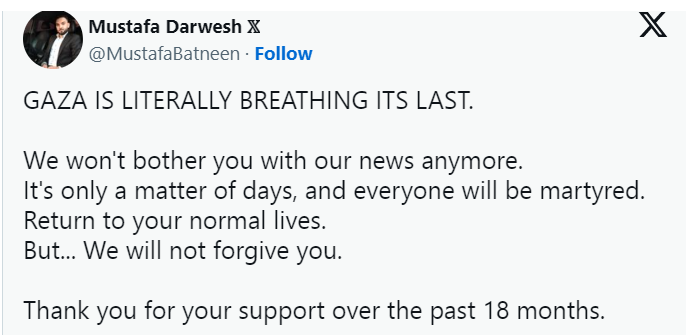
‘It’s only a matter of days’: Palestinians bid farewell as Israel rains bombs on Gaza; ‘It seems we won’t survive this time.’

From Middle East Eye
April 4, 2025
By Pauline Ertel

Palestinians posting on social media say they don’t think they will survive Israel’s bloody bombardment across the strip

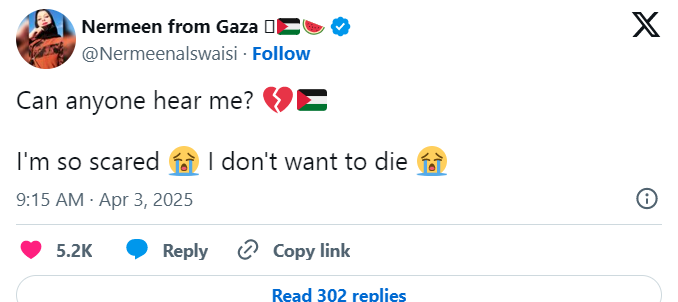
Palestinians are posting final messages and letters of farewell on social media, expressing their fear they will not survive amid the intensity of Israel‘s carpet bombing of the Gaza Strip.

Many Palestinians in Gaza have turned to social media since the start of Israel’s onslaught in October 2023 to communicate with one another, document Israeli attacks and their daily experiences, and share their thoughts, hopes and lives with international audiences in a period when media outletssocial media platforms and arts and education institutions stand accused of censoring information and muzzling freedom of expression related to the war.

Over the past 24 hours however, posts expressing hopelessness amid the severity and destructiveness of the attacks and fear that people in Gaza might not survive this time, have soared. 

On Thursday, Israel killed at least 112 Palestinians, in what has become the deadliest day since Israel resumed its war on the besieged enclave on 18 March.

video posted by Nour, a woman from Gaza, shows an Israeli strike on a building nearby amidst an entirely destroyed neighbourhood as a woman sobs in the background.

“It seems we won’t survive this time ..” the caption reads.

Journalist Abdallah Alattar from Rafah in the southern Gaza Strip, shared: “it seems that we won’t make it this time” on Friday morning, which has been widely circulated and reshared.

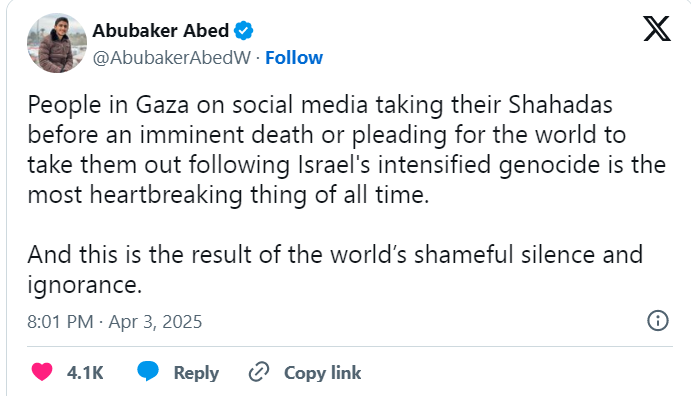
Abubaker Amed, a football journalist from Deir al-Balah, expressed in a post that the people of Gaza “know the world has let them down and thus feel their killing is a matter of time”.

Several users have also called on the people and global powers to pay attention and speak up for the people in Gaza, facing not only bombing, but also starvation due to Israel’s blockade on food and essentials.

“Bombs above, hunger below—Gaza is suffering. How much longer can we endure this?” wrote one Palestinian. “The world must act NOW!”

Israel’s war on Gaza continues to be supported and funded by its allies, most notably the US.  

In March, the Donald Trump administration bypassed a normal congressional review to approve a nearly $3bn arms sale to Israel.

On Thursday, independent US Senator Bernie Sanders attempted to bring forward two joint resolutions of disapproval to block $8.8bn worth of offensive weapons sales to Israel that were already approved by the Trump administration.

Only 15 senators, including Tim Kaine and former presidential hopeful Elizabeth Warren, voted to move forward and the vote to block the weapons transfers failed.

Prayers and self-eulogies

Several users have also used their social media accounts to post a farewell messages and prayers in case they should die.  

Writer and pharmacist from Gaza Omar Hamad, on Thursday night posted a farewell message on X, saying that he felt his posts did not make a difference.

“At first, I was eager, sharing everything my hands could write,” he said. “But I do not know what you need to see or read to finally rise against all that is happening – not for our sake, but for your conscience, for your faith, so that you do not struggle with your conscience when you go to sleep.”

I have never felt death drawing this close to me throughout the entire genocide as I do these days,” Hamad wrote in a separate post on 3 April.

Hamza Alsharif, a medical doctor at the European Hospital and the Al-Aqsa Hospital posted on X that bombings “are intensifying across all areas of the Strip”, and that “blood is everywhere”.

“If I die, I am not a number, I am a planet in itself, I have dreams and ambitions that I wanted to achieve. Don’t forget me in your prayers and keep talking about me,” Dr Alsharif wrote in a post pinned to his profile since 18 March.

Last month, an Israeli missile targeted and killed 23-year-old Al Jazeera journalist Hossam Shabat in Beit Lahiya just hours after Mohammad Mansour, a correspondent for Palestine Today, was killed in an Israeli air strike which targeted his home. His wife and son were killed alongside him.

Hours after Hossam’s death, his colleagues posted a message written by Hossam himself, indicating that he had a sense that he would be likely targeted.

“If you’re reading this, it means I have been killed – most likely targeted – by the Israeli occupation forces,” said the 23-year-old.

Hossam’s self-written eulogy was reminiscent of renowned Palestinian poet and academic Refaat Alareer, who was killed in an Israeli air strike in December last year and whose widely circulated poem ‘If I must die‘ became a symbol of hope and resistance amid Israel’s war.

https://www.middleeasteye.net/trending/we-wont-make-it-time-people-gaza-post-farewell-messages-online

Study on children in Gaza: 96% feel death is imminent; 49% want to die

For children in Gaza, nowhere is safe.

From the War Child Alliance

NEW STUDY:
GAZA’S CHILDREN FACE SEVERE PSYCHOLOGICAL TOLL AMID CATASTROPHIC WAR
December 11, 2024

A new report out of Gaza lays bare the profound psychological impact of the ongoing war, particularly on children who are injured, disabled, separated from their families, or unaccompanied.

Summary https://www.warchild.net/documents/339/20241205_WCA_OPT_Gaza_NAS_FINAL.pdf

The study, Needs Assessment Study of Children with Disabilities, Injured and Separated or Unaccompanied, was conducted by the Community Training Centre for Crisis Management (CTCCM) with support from the War Child Alliance. It paints a harrowing picture of children’s mental health under Israeli bombardment and blockade.

“We met with injured, separated, and disabled children and their caregivers to hear from them about the toll of war on their lives. What they shared was devastating – but sadly, not surprising. This study reinforces what we have seen, heard and witnessed over more than a year. Children are traumatised by this war, and we must respond,” says a spokesperson and Project Technical Coordinator from CTCCM in Gaza.

The findings in this study are stark. Caregivers report that 96% of children feel death is imminent, and nearly half believe they will die because of the war. Many children exhibit symptoms of aggression, fear, withdrawal, and severe anxiety, alongside a pervasive sense of hopelessness. Years of displacement, loss, and relentless bombing have left children psychologically scarred and their families in dire circumstances.

The survey of 504 households reveals that 88% of families have been displaced multiple times, with 21% forced to move six or more times. Most families live on less than €122 a month, grappling with soaring prices for food and essentials due to the ongoing blockade and restrictions on humanitarian aid. Meanwhile, 80% of breadwinners are unemployed, reflecting the devastating economic consequences of the war.

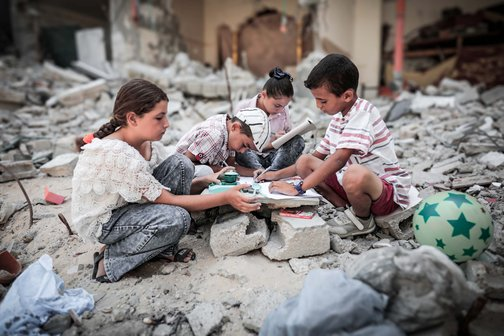
For children in Gaza, nowhere is safe. They have seen homes destroyed, loved ones killed, and schools turned to rubble. Even so-called evacuation zones are not spared from bombing. The mental health of Gaza’s children is under constant attack,” says Rob Williams, War Child Alliance CEO.

Continue reading