UK and US depleted-uranium weapons for Ukraine

From Beyond Nuclear
3-21-23

From Campaign for Nuclear Disarmament: 
The UK government is sending depleted uranium shells for use in the Challenger 2 tanks gifted to Ukraine, a move the longtime British peace and disarmament organization, Campaign for Nuclear Disarmament (CND) has condemned as an additional environmental and health disaster for those living through the conflict.

Defence Minister Baroness Goldie admitted in the answer to a written question that armour piercing rounds containing depleted uranium (DU) were included in its tank package for Kiev. She added that the rounds “are highly effective in defeating modern tanks and armoured vehicles.”

A byproduct of the nuclear enriching process used to make nuclear fuel or nuclear weapons, DU emits three quarters of the radioactivity of natural uranium and shares many of its risks and dangers. It is used in armour piercing rounds as it is heavy and can easily penetrate steel. However on impact, toxic or radioactive dust can be released and subsequently inhaled.

DU shells were used extensively by the US and British in Iraq in 1991 and 2003, as well as in the Balkans during the 1990s…

CND General Secretary Kate Hudson said:

“Like in Iraq, the addition of depleted uranium ammunition into this conflict will only increase the long-term suffering of the civilians caught up in this conflict. DU shells have already been implicated in thousands of unnecessary deaths from cancer and other serious illnesses. CND has repeatedly called for the UK government to place an immediate moratorium on the use of depleted uranium weapons and to fund long-term studies into their health and environmental impacts. Sending them into yet another war zone will not help the people of Ukraine.” 

from Military Watch Magazine

American Depleted Uranium Weapons For the Ukrainian Army: Why is Russia So Worried?

1-30-23

Russia has issued a strong warning against the supply of depleted uranium weapons to the Ukrainian Military, amid concerns that a wide range of Western tanks and armoured vehicles set to be delivered to the country are designed specifically to use such munitions. Head of the Russian delegation to the Vienna Negotiations on Military Security and Arms Control Konstantin Gavrilov cautioned to this effect on January 25: “We know that Leopard 2 tanks, as well as Bradley and Marauder armoured fighting vehicles, can use depleted uranium shells, which can contaminate terrain, just like it happened in Yugoslavia and Iraq. If Kiev were to be supplied with such munitions for the use in western heavy military hardware, we would regard it as the use of ‘dirty nuclear bombs’ against Russia, with all the consequences that entails.” Regarding the possible responses Russia could take, Gavrilov elaborated: “If Washington and NATO countries provide Kiev with weapons for striking against the cities deep inside the Russian territory and for attempting to seize our constitutionally affirmed territories, it would force Moscow to undertake harsh retaliatory actions. Do not say that we did not warn you.” A number of analysts took this to be an implied threat of a Russian nuclear response.

Depleted uranium is prized as one of the heaviest elements on the planet, and is made from low-level radioactive waste left over from the manufacture of nuclear fuel or nuclear warheads which makes it affordable to produce in large quantities. Although it has been used in the armour of American M1 Abrams tanks, those intended for the Ukrainian Army will not have this armour the composition of which is a sensitive Pentagon secret. Aside from armour, however, depleted uranium is more widely used in anti armour weapons including the rounds fired by tanks and other combat vehicles to provide a greater penetrative capability. A notable example is the M829 armour fin-stabilised discarding sabot round which is compatible with M1 Abrams and Leopard 2 tanks, older versions of which were employed extensively by the Abrams during the Gulf War. Such munitions could be particularly useful in the Ukrainian theatre as Russia has continued to improve the capabilities of its frontline armour. The potential environmental impacts of their use, however, can be calamitous, with the radioactive particles emitted into the air when depleted uranium rounds are used having half-lives of over four billion years. The easily inhalable dust can travel for well over 40km from the site of each impact, creating a mass area effect. 

The effects of depleted uranium shelling were seen in the Gulf War, with British Royal Navy Commander Robert Green reporting: “a surge of unexplained illnesses, cancers and children born with genetic deformities among the Iraqi people, especially in the south near the battlefields.” A confidential UN report leaked in May 1999 similarly concluded regarding depleted uranium weapons: “this type of ammunition is nuclear waste, and its use is very dangerous and harmful.” In the subsequent Iraq War the following decade the city of Fallujah was particularly heavily bombarded by depleted uranium weapons by U.S. forces, with Professor Chris Busby. One of the authors of a survey of 4,800 Fallujah residents wrote regarding the connection between these attacks and the rapid increase in cancers and birth defects that followed: “to produce an effect like this, some very major mutagenic exposure must have occurred in 2004 when the attacks happened.” He concluded that some kind of uranium weapon had to have been the cause.

The Fallujah survey by 11 experts, which covered over 700 households, concluded that the effects on the population were “similar to that in the Hiroshima survivors who were exposed to ionising radiation from the bomb and uranium in the fallout.” Depleted uranium weapons were found to have had highly similar effects in Yugoslavia, and were also used for limited strikes by U.S. forces in Syria. Although Operation Desert Storm was authorised by the United Nations Security Council, the 2003 invasion of Iraq and bombings of Syria and Yugoslavia were widely considered by legal experts to be acts of aggression in violation of international law. This only increased the controversy surrounding depleted uranium attacks in these conflicts and the contamination that resulted. Legal arguments against supplying depleted uranium weapons to Ukraine, by contrast, are limited, and while Russia considers Ukraine’s ethnically Russian Donbas regions to be part of its territory, this is not internationally recognised meaning use of depleted uranium rounds there would constitute an internal Ukrainian affair. How Russia may respond to such weapons being used against the Russian population however, or against its own forces, remains to be seen. 

Note: Many of the details on previous depleted uranium attacks, and the causes of the U.S.-led military campaigns in which such weapons were widely used, were taken from the upcoming book by international security scholar A. B. Abrams: ‘Atrocity Fabrication and Its Consequences: How Fake News Shapes World Order.’

https://beyondnuclear.org/depleted-uranium-weapons-to-ukraine/

militarywatchmagazine(dot)com/article/hiroshima-uranium-ukraine-russia-worried
militarywatchmagazine(dot)com/

Iraqi Holocaust; 20th Anniversary of Iraq invasion, five million people dead since 1990

From Global Research

Iraq Invasion 20th Anniversary: Five Million Dead in Iraqi Holocaust 1990 Onwards

by Gideon Polya
March 20, 2023

The 20th anniversary of the war criminal US, UK and Australian invasion of Iraq in 2003 will fall on about 20 March 2023. On this occasion mendacious and racist Western media will at best remember the Iraq War as a US policy mistake. However decent people will remember the carnage. From 1990 onwards Iraqi deaths from US-imposed violence and deprivation have totalled about 5.0-5.5 million, similar to deaths in the WW2 Jewish Holocaust (5-6 million).

(A) Some important prefatory comments on violent deaths, avoidable deaths from imposed deprivation, and culpability.

One notes that “holocaust” implies a large number of deaths whereas  “genocide” is precisely defined by Article 2 of the UN Convention on the Prevention and Punishment of the Crime of Genocide (the UN Genocide Convention) thus:

“In the present Convention, genocide means any of the following acts committed with intent to destroy, in whole or in part, a national, ethnic, racial or religious group, as such: a) Killing members of the group; b) Causing serious bodily or mental harm to members of the group; c) Deliberately inflicting on the group conditions of life calculated to bring about its physical destruction in whole or in part; d) Imposing measures intended to prevent births within the group; e) Forcibly transferring children of the group to another group” [1].

Further, deaths in war and occupation come from violence and from imposed deprivation. Whether a child dies from violence (bombs, bullets or bashing) or from being deprived of life-sustaining requisites (food, potable water and medicine), the death is just as final, and the culpability of the perpetrator just as real. However while deaths in war from violence are often hard to assess, avoidable deaths from imposed deprivation can be estimated from comparative demographic data (that have been provided for the years from 1950 onwards by the UN Population Division). The methodology used to estimate avoidable deaths from deprivation is described in detail  in my book “Body Count. Global avoidable mortality since 1950” [2].

Culpability for avoidable deaths from imposed deprivation is set out by Articles 55 and 56 of the Fourth Geneva Convention ( the Geneva Convention relative to the Protection of Civilian Persons In Time of War) that state that the  Occupying Power  is obliged to supply the conquered Subjects with life-sustaining food and medical requisites “to the fullest extent of the means available to it”.These key injunctions of International Law have been grossly violated by the US and its degenerate and serial war criminal allies (notably the UK, Apartheid Israel, France and US lackey Australia) in the post-9/11 US War on Muslims [3, 4].

Scrupulously ignored by mendacious Mainstream media (M3) journalist, editor, politician, academic and commentariat presstitutes is the horrible reality that the ongoing Iraqi Genocide and Iraq Holocaust actually commenced 109 years ago with the British invasion of Iraq in 1914 for oil and imperial hegemony [2, 5]. The deaths in the various stages of the 109-year and ongoing Iraq Holocaust are succinctly set out below.

(B) Deaths from violence and deprivation in the ongoing, 109-year Iraqi Holocaust.

(1) British rule or hegemony (1914-1950): 4 million.

British interest in invading and conquering Iraq came from discovery of oil in adjacent Iran in 1908. Western violation of Iraq commenced with the British invasion for oil and imperial hegemony a mere 6 years later, in 1914 during WW1.  Churchill had forced the Ottoman Empire (1517-1924 Ottoman Caliphate) into WW1  by seizing British-built battleships that the Turks had already paid for. Assuming excess mortality of Iraqis under British rule or hegemony (1914-1950) was the same as for Indians under the British – interpolation from available data indicate Indian avoidable death rates in “deaths per 1,000 of population per year” of 37 (1757-1920), 35 (1920-1930), 30 (1930-1940) and 24 (1940-1950) –  one can estimate from Iraqi population data that Iraqi avoidable deaths from deprivation under British occupation and hegemony from 1914-1950 totalled about 4 million [2, 4-7].

(2) Gulf War (1990-1991) and Sanctions period (1990-2003): 1.9 million.

Violent deaths and avoidable deaths from violently-imposed deprivation in the Gulf War (1990-1991) and the Sanctions period (1990-2003) totalled  0.2 million and 1.7 million, respectively. During the Sanctions period the US, UK an Israeli air forces relentlessly bombed Iraqi infrastructure with consequent huge avoidable deaths from deprivation. On May 12, 1996, Madeleine Albright (US UN Ambassador and later US Secretary of State) defended UN sanctions against Iraq on a “60 Minutes” segment in which Lesley Stahl asked her “We have heard that half a million children have died. I mean, that’s more children than died in Hiroshima. And, you know, is the price worth it?” Madeleine Albright replied “We think the price is worth it” [6]. This was a singular instance in which the US admitted to its genocidal carnage. Back in 1990 eminent Australian medical scientist  Professor Fred Mendelsohn (his industrial chemist father Oscar Mendelsohn befriended and employed my Jewish Hungarian refugee father,  Dr John Polya, in about 1940) argued for peace and warned in a letter published by The Age (Melbourne) that huge numbers of children would die in the looming Gulf War. This wonderful and inspiring pro-peace humanitarian  was right – Iraqi under-5 infant deaths under Sanctions totalled 1.7 million, a massive crime against Humanity.

Continue reading

Urgent: Imprisoned Diplomat Alex Saab’s Life Is in Danger

By Free Alex Saab and Popular Resistance

19 March 2023

Today the Free Alex Saab Movement makes an urgent call to the world to denounce the alarming health condition of Venezuelan diplomat Alex Saab, which endangers his life.

In July 2021, the Working Group against Torture and several UN rapporteurs expressed their concern about the irreparable deterioration of Alex Saab’s health condition.

Let us recall that in Cape Verde, on July 7, 2021, after many refusals, Alex Saab was visited by his family doctor, who in his report detected a worrying health condition of the Venezuelan official, especially because Saab is a stomach cancer survivor. The doctor diagnosed: anemia, anorexia, diabetes mellitus type 2, hypothyroidism, hypertension, high risk of thromboembolic disease including pulmonary embolism and deep vein thrombosis. In addition, he highlighted that a high infection by the bacterium Helicobacter pylori was found in his blood and an endoscopy identified bleeding from the digestive tract that could mean recurrence of the cancer; likewise, the lower left molar was found broken due to the beatings received during the torture and access to proper medical care was recommended, however, he was never allowed to receive treatment.

Subsequently, the treating physician issued, on September 9, 2021, a new report highlighting the need for patient Alex Saab to receive specialized medical care and asked the authorities of Cape Verde to take into consideration the need to preserve the health and life of Alex Saab. Cape Verde did nothing in this regard.

Alex Saab arrived in the territory of the United States, kidnapped for the second time, on October 16, 2021 and from that moment until today he has not received any medical attention according to the basic diseases that had been reported, ignoring the call of the UN rapporteurs.

Alex Saab is in the Federal Detention Center in Miami and his prison situation is even worse than in Cape Verde; he has not been allowed family visits and has not seen his wife and children for more than two years and eight months, who have also been victims of persecution by the U.S. authorities and their allies.

Alex Saab has also not been allowed consular visits, which is a human right of every prisoner deprived of liberty. The U.S. State Department has not responded to the Venezuelan State’s request to grant him a consular visit, as established in Article 36 of the Vienna Convention on Consular Relations.

In the medical reports made in July, Alex Saab’s doctor had already informed that they had identified bleeding from the digestive tract, which could mean a recurrence of the cancer. Now, it is extremely alarming to learn that Alex has been vomiting blood for weeks and despite having reported it to the U.S. authorities, there is still a lack of medical attention at the prison. Why has the U.S. not bothered to treat him?

Everything indicates that the lack of medical attention is part of a State policy, as was his illegal arrest. Could it be that they want to hand over Alex Saab dead to the Venezuelan authorities? Why then the insistence on not providing him with medical attention, and not allowing his doctor to visit him?

Everyone knows that the truth is on the side of the Venezuelan diplomat, and sooner or later the United States must release him, but they are taking more time than usual, could it be that they are waiting for his illnesses to develop further?

We, the #FreeAlexSaab Movement, holds the U.S. Government responsible for the life and for what may happen to the diplomat Alex Saab Moran.

We ask at the same time that the International Committee of the Red Cross to be present at the Federal Detention Center in Miami-USA.

Likewise, we urge the High Commissioner of the UN Human Rights to take action and denounce this violation of the human rights of the Venezuelan diplomat illegally detained in U.S. territory.

We request the Secretary General of the United Nations, Antonio Guterres, as the highest defender of International Law, to make an announcement on this case, which constitutes a flagrant violation of international law and human rights.

We demand immediate freedom for Alex Saab Moran, the Venezuelan diplomat kidnapped in the United States. We urgently require a humanitarian, political and diplomatic solution to this unjust situation.

It is time for a solution that will bring benefits for both nations, it is time to move forward, we urge the U.S. Government to sit down and reach an agreement, Venezuela has shown to be open to a solution.

Copyright © Free Alex Saab and Popular ResistancePopularResistance.Org, 2023

https://popularresistance.org/urgent-imprisoned-diplomat-alex-saabs-life-is-in-danger/

Urgent: Imprisoned Diplomat Alex Saab’s Life Is in Danger

Save Jeju! Report from Jeju Island on U.S.-NATO military expansion in South Korea — ongoing struggle to stop Navy base (VIDEO)

From Global Network Against Weapons and Nuclear Power in Space

March 22, 2023

Of the 365 days per year, “more than 200 days of war drills” in Korea.

Global Network Advisory Board member Sung-Hee Choi reports on the latest developments in South Korea as Washington expands military operations throughout the Asia-Pacific region.

 
‘We are a target’, she says.
 
This aggressive military expansion, labeled the ‘Asia Pivot’ by former Secretary of State Hillary Clinton, is creating major tensions in the region as the US prepares for war with China, North Korea and Russia.
 
During the interview Sung-Hee talks about the US Navy destroyer USS Rafael Peralta (DDG-115) that recently ported at the Navy base in Gangjeong village on Jeju. She shares a short video of a protest held at the base as the destroyer crew members were bussed to a hotel outside of the village.
 
The DDG 115 was built in Bath, Maine and during the ‘Christening’ of the warship in 2015 several members of the peace community from across the state were arrested for non-violently blocking the streets and entrances surrounding the shipyard as the public was invited to attend the ceremony. (Regular peace vigils are held at Bath Iron Works in Maine where these destroyers are built. Currently there are seven more under construction.)
 
There has long been a connection between Maine and the activists in Gangjeong village.  Over the years eight Maine-based activists (as well as hundreds of other international peaceniks) traveled to the village to join protests against the Navy base construction that was forced on South Korea by Washington.
 
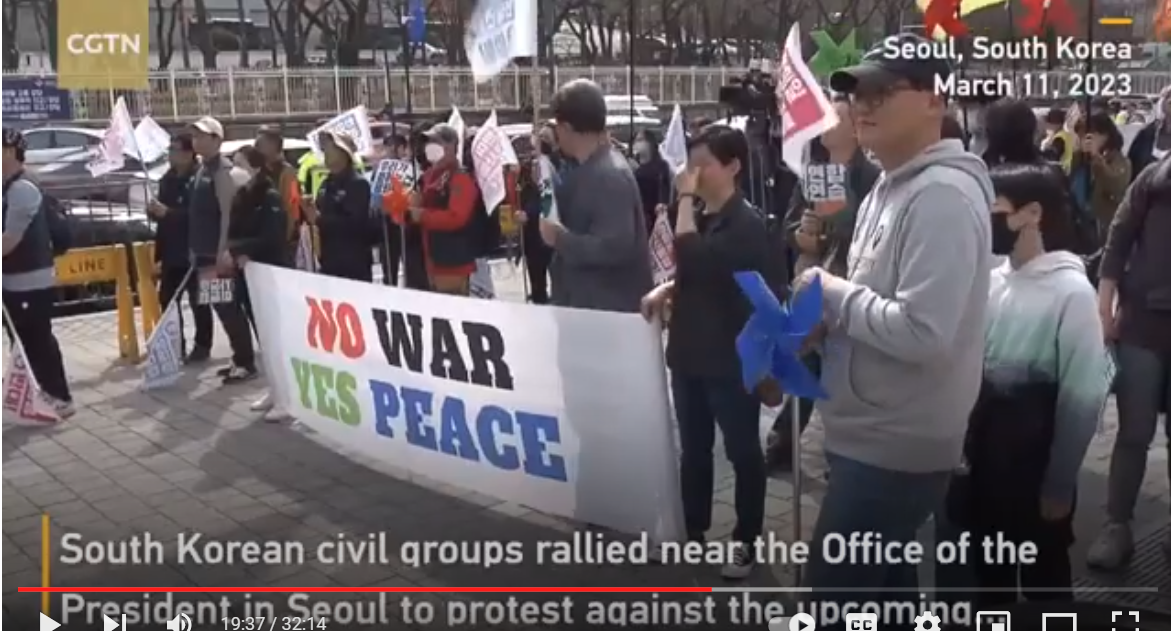
In another part of the interview Sung-Hee reports on recent (and on-going) US-NATO war games aimed at North Korea. She shares a second short video of protests in Seoul opposing these war games.
 
Near the end of the interview Sung-Hee talks about how the US Space Force has assigned personnel to South Korea and is drawing their nation into the larger US program of militarizing space.

Each time a US-NATO warship arrives at the Navy base on Jeju Island protests are held in the water and at the Navy base gates.

Daily protests have been held since 2007 when the base construction was announced.

Gangjeong village is a fishing and farming community with a 500 year history. Their sacred rocky coastline was blasted and covered with cement to build the docks for warships.

Throughout the long struggle to oppose the Navy base, which sits in a strategic spot just off the Korean peninsula, art has been used to illustrate the villagers love for nature and their commitment to resist US-forced militarization.

Toxic contamination from base construction and visiting warships has now begun to impact the once pristine environment of the village and the sea.

Please help us by liking and sharing this video. 

http://space4peace.blogspot.com/

http://savejejunow.org/

Save Jeju Now!

Help the people of Jeju Island!

Congressman Brad Sherman leads colleagues in re-introducing the Peace on the Korean Peninsula Act

From JNCTV

March 1, 2023. Arya Ansari, (202) 225-5911, (202) 740-0994

Washington, D.C. – Today, Congressman Brad Sherman (CA-32), senior member of the House Foreign Affairs Committee, led 19 members of Congress in re-introducing the Peace on the Korean Peninsula Act – bipartisan legislation that calls for serious, urgent diplomatic engagement in pursuit of a formal end to the Korean War. Congressman Sherman made the announcement in a press conference on Capitol Hill and was joined by his Congressional colleagues along with members of the Korean American Public Action Committee (KAPAC) and supporters of the Korea Peace movement.

“The continued state of war on the Korean Peninsula does not serve the interests of the United States nor our constituents with relatives in North and South Korea,” said Congressman Brad Sherman. “Serious, urgent diplomatic engagement is needed to achieve peace between North and South Korea. I’m pleased to stand here today, with my colleagues, the Korean American community, and supporters of the Korea peace movement, to reintroduce this crucial bill and continue to help grow the movement for Korea peace.”

In 1953, the parties to the Korean War signed an Armistice Agreement that pledged an end to “all acts of armed force in Korea until a final peaceful settlement is achieved.” Common sense tells us that this conflict ended in July 1953. But in fact, we only signed an armistice. Therefore, we have officially remained in a state of war with North Korea for 70 years. This situation does not serve anyone’s interest.

On April 27, 2018, in Panmunjom, the leaders of South Korea and North Korea declared that “a new era of peace has begun on the Korean peninsula,” and committed “to declare the end of war” on the Korean peninsula 65 years after the signing of the armistice agreement.

The Peace on the Korean Peninsula Act expresses support for the commitments made at Panmunjom and urges the Secretary of State to pursue meaningful diplomatic engagement with North Korea and South Korea in pursuit of a binding peace agreement constituting a formal and final end to the state of war between North Korea, South Korea, and the United States. The bill also requires a report from the Secretary of State that describes a clear roadmap for achieving a permanent peace agreement on the Korean peninsula.

One major consequence of the continuation of the Korean War is that the United States does not have formal relations with North Korea. The current restrictions barring United States nationals from traveling to North Korea have had profound effects on Americans with relatives living in North Korea, who long to see their relatives – in many cases, for one last time.

The Peace on the Korean Peninsula Act requires the Secretary of State to conduct a full review of the restrictions in place conditioning the travel of Americans to North Korea, and to submit a report to Congress detailing that review.

Congressman Sherman is pleased to be joined by his bipartisan colleagues Representatives Ro Khanna (D-CA), Andy Kim (D-NJ), Cori Bush, Luis Correa, Eleanor Holmes Norton, Paul Tonko, Chuy Garcia, Andy Biggs, Dina Titus, Rashida Tlaib, Marilyn Strickland, Sara Jacobs, Jan Schakowsky, James McGovern, Lisa Blunt Rochester, Adriano Espaillat, Pramila Jayapal, Judy Chu, and Ilhan Omar in introducing the Peace on the Korean Peninsula Act.

https://jnctv.org/2023/03/04/congressman-brad-sherman-leads-colleagues-in-re-introducing-the-peace-on-the-korean-peninsula-act/

US is maintaining tensions with North Korea to draw in allies against China

The greatest threat to peace and stability in northeast Asia is the U.S. Indo-Pacific military encirclement of China.

By Simone Chun

March 3, 2023
Published in TruthOut

The U.S. military encirclement of China threatens to escalate into an Asia-Pacific war, with the Korean Peninsula at the focal point of this dangerous path. Garrisoned with nearly 30,000 combat-ready U.S. forces manning the astonishing 73 U.S. military bases dotting its tiny landmass, South Korea is the most critical frontline component of U.S. military escalation in northeast Asia.

Three important implications of this grand strategy, which places the Korean Peninsula at the pernicious center of intensified China-U.S. competition, merit attention: 1) the accelerated remilitarization of Japan; 2) the revitalization of extremist hardline North Korea policies in both Washington and Seoul; and 3) the intensification and expansion of belligerent wargames targeted at China and North Korea.

Washington’s anti-China policy, which binds South Korea to the service of U.S. geopolitical strategic interests and keeps it in a subservient client-patron relationship with the U.S., also has the ancillary effect of empowering extremist far right factions in South Korea. These politicians exploit the North Korean threat as justification for domestic repression under South Korea’s National Security Laws — among the most draconian in the world — empowering them to leverage red-baiting and worse against any critics or perceived threats to their grip on power.

Case in point: South Korea’s far right president, Yoon Suk-yeol, who was elected by a razor-thin margin of 0.7 percent barely eight months ago, is already leaving his mark, having established a “republic of prosecution” that pursues the politics of fear and prosecution domestically on the one hand, and subordinates South Korea’s sovereignty to Washington’s interests on the other. 

The “most disliked leader in the world” garnered a disapproval rating of 70 percent in a recent Morning Consulting survey, and faces massive and sustained public demand for his immediate resignation. It is noteworthy that in spite of Washington’s stated foreign policy goal of promoting democracy, freedom and human rights, the U.S. remains silent on Yoon’s “atavistic reversion” of vitally democratic South Korea into a newly repressive national security state. According to K.J. Noh, “South Korea’s essential role as the closest and largest military force projection platform against China, its role in a ‘JAKUS’ (Japan-South Korea-U.S. military alliance), its cooperation with NATO, its stated plans to join a Quad-plus, and its assumption of a submissive position toward U.S. decoupling and economic enclosure against China make it far too valuable to criticize or undermine regardless of its excesses.”

First and foremost, in intensifying its offensive against Beijing, Washington has shifted both risk and burden to allies that form its “vanguard against China,” enabling the U.S. to dictate decisions and procure imperial benefits while distributing the costs to vassal states. In order to justify its burgeoning military regional presence and intensified control over South Korea, Japan and Taiwan to bolster its posture against China, the U.S. needs to keep regional tension high. Despite the U.S. position that it is “open to talks” with North Korea, continued sanctions (including those targeting the civilian and medical sector), expansion of the U.S. military presence in the region, intensification of multinational military drills, and continued political rhetoric from Washington ensure that tensions with the north remain elevated. This benefits both Washington and the extremist regime in Seoul, and ensures South Korea’s perpetual relegation to the status of a U.S. neocolonial state.

Hawkish U.S. policies have consistently failed to garner public support in South Korea. According to a series of polls conducted in 2021, 61 percent of South Koreans support relaxing sanctions against the north and 79 percent support peace with Pyongyang, with an additional 71 percent supporting a formal end-of-war declaration between the two Koreas. These sentiments persist even among Yoon supporters, a majority of whom support an inter-Korean peace treaty, breaking with his rhetoric of a tougher stance toward North Korea. The South Korean Democratic and Progressive Parties, as well as major civil and labor organizations, support military deescalation with the North and maintenance of neutrality in the Washington-Beijing competition. Democratic Party Chairman Lee Jae-myung has repeatedly warned against South Korea becoming a “pawn in the plans of other states,” pledging his party to the principles of independence and sovereignty.

A few years from now, after the Biden and Yoon administrations have ended, North Korea will likely not have been denuclearized and South Korea may emerge as the nuclear front line in the U.S. rivalry with China and Russia, setting the stage for the Korean Peninsula to serve as the main battleground in a new Cold War. If Biden has a genuine interest in achieving lasting regional security, he should pursue a broader vision in which nations can coexist. According to the latest poll, a significant majority of Americans support tension-reducing policies with North Korea and China, and 7 in 10 Americans are supportive of a summit between Biden and North Korean leader Kim Jong Un. Over half of those polled support a full-fledged peace agreement to finally end the 73-year-old Korean War — an unresolved conflict that has left nearly 5 million casualties and forcibly separated 10 million Korean families on either side of the 38th parallel, including more than 100,000 Korean Americans.

Instead of narrowly focusing on the threat of China and exploiting the North Korean threat as a cover for a militaristic and volatile anti-China policy, the Biden administration should recognize that peace in the Korean Peninsula is not only obtainable, but can lay the groundwork for a broader and more stable regional order based on coexistence.

Full article at:

https://truthout.org/articles/us-is-maintaining-tensions-with-north-korea-to-draw-in-allies-against-china/

United States is planning a chemical weapon attack in Ukraine; shipment of warfare agent BZ and toxic chemicals delivered by Kiev forces to Kramatorsk

From Strategic Stability

Powerpoint presentation

Report # 209. The USA is preparing false flag ‘chemical attacks’ in Ukraine

March 1, 2023

1. The USA has delivered three types of CW agents to Ukraine

On 22 February,2023, an influential U.S. non-governmental organisation held a conference on the events in Ukraine. Within the event, former U.S. Ambassador to Russia John Sullivan made the statement, ‘…Russian troops plan to use chemical weapons in the special military operation area…’.

Due to such false and provocative US statement Russian MoD made by Lieutenant General Igor Kirillov, the Chief of Nuclear, Biological, and Chemical Protection Troops of Russian Armed Forces, the following remarks:

Russia regards this information as the intention of the United States itself and its accomplices to carry out a provocation in Ukraine using toxic chemicals. They expect that amid hostilities, the international community will be unable to organise an effective investigation, with the result that the real organisers and executors may escape accountability and the blame is going to be placed on Russia.

Supply of safety equipment for Ukraine

The preparations are in full swing. In early 2023, the Euro-Atlantic Disaster Response Coordination Centre planned a large shipment of individual protection means to Ukraine. In order to substantiate the situation, ‘…Russian troops have already used phosphorus ammunition and could use the poisonous substances in a foreseeable escalation of the situation…”.

The list of supplied equipment includes more than 55,000 sets of personal protective gear, 55,000 gas masks, 13,000 individual gas casualty first-aid kits. Priority is given to antidotes for organophosphorus agents such as sarin and soman — 600,000 ampoules, anti-seizure medications — 3 mln tablets, detoxification preparations for mustard gas, lewisite and chloroacetophenone inhibitors of hydrocyanic acid — 750,000 vials.

Toxic chemicals delivered to Kramatorsk

In addition, the Ministry of Defence of the Russian Federation received information that on February, 10, 2023, a rail transport arrived in Ukraine (Kramatorsk) controlled by AFU with a cargo of chemicals in one of its cars, accompanied by a group of foreign nationals. The car was detached and towed to the territory of the Kuybyshev Iron and Steel Works in Kramatorsk, where it was unloaded under the control of the Security Service of Ukraine and the AFU command representatives.

The consignment consisted of 16 sealed metal boxes, eight of which were labelled with a chemical hazard symbol, BZ inscription and marked with two red bands, corresponding to the class of poisonous substances of temporary incapacitation action. Five of the boxes were labelled as ‘C-S-RIOT’ (chlorobenzylidenemalononitrile), three were labelled as ‘C-R-RIOT’ (dibenzoxazepine) with a single red band, which corresponds to substances with an irritant action. The cargo was placed on the U.S.-manufactured armoured vehicles, which moved to the combat line of contact as part of the convoy.

On 19 February, 2023, 11 cars of specially marked shrapnel ammunition have been unloaded in Kramatorsk. The unloading took place at night on a platform in the suburbs, with the car labelled as ‘Building materials’, ‘Cement’. According to the information of the Russian Ministry of Defence, the U.S. Army has previously upgraded its shrapnel rounds to be loaded with ready-to-use, liquid formulated irritant acids.

The facts of the simultaneous delivery of toxic chemicals and protection means indicate an attempted large-scale provocation using the BZ (3-Quinuclidinyl benzilate) psychotropic incapacitating warfare agent during the conflict.

Threats posed by using BZ

Under the international Chemical Weapons Convention, BZ agent is a controlled chemical and its use is prohibited under Article 1 of the CWC.

Chemical warfare is forbidden under the Chemical Weapons Convention (CWC) of 1997, to which the USA, Ukraine and Russia are all signatories.

This chemical causes acute phrenoplegia, disorientation, hallucinations, and memory impairment. BZ agent is a standard war gas for the U.S. Army. It was used extensively during the Vietnam War. The United States and its allies have repeatedly used chemical munitions in the military conflicts in Afghanistan, Iraq and Syria.

The U.S. declared a total destruction of stocks of BZ as early as 1990. Fifty tonnes of the substance have been disposed of, but samples were left behind. In addition, the possibility of synthesising BZ precursors from pharmaceutical production facilities in the volume of up to several dozen tonnes per year is now retained.

Examples of U.S. provocative actions

Russia has repeatedly noted that Western leadership regularly make provocative statements about the possibility of Russia using weapons of mass destruction.

However, these projects have been implemented not by Russia, but many times by the USA itself with the aim to achieve political goals.

For example, a vial of ‘washing powder’ in the hands of U.S. Secretary of State Colin Powell prompted the invasion of Iraq and the deaths of over half a million Iraqi citizens.In 2017, photos of the White Helmets replicated by news agencies, showing people wearing ordinary gauze bandages taking samples at the site of the alleged use of sarin, led to a U.S. missile strike on Shayrat airbase in Syria. In 2018, staged shootings of allegedly chlorine-poisoned children in Douma (Syrian) caused the destruction of a research centre in Barzah and Jamraya [see PPT slides].

Russian MoD reminded that no one has been held accountable for these crimes so far.

International legal assessment of the use of toxic chemicals during hostilities

U.S. compliance with its obligations under the CWC is distinctly selective. Any restrictions under this treaty that threat to U.S. national interests are ignored with the direct connivance of the Organisation for the Prohibition of Chemical Weapons.

For example, in violation of Article 1 of the Convention and the 1925 Geneva Protocol, the United States Department of Defense has legalised the use of a range of chemicals as weapons of war. Its use is envisaged with a wide range of standard ammunition.

Russian MoD warned warned hat the Russian stationary and mobile CBRN monitoring complexes deployed in the area of the special military operation make it possible to identify chemical threats in a timely manner and to respond to them promptly. It is therefore a mistake for the West to count on successful provocations with toxic chemicals in a warfare environment.

The analytical capabilities of the Russian Ministry of Defence chemical laboratories can reliably determine not only the type of chemicals used, but also the country of their manufacture.

For example, the information presented on the slide about the use of improvised munitions against Russian troops by unmanned aerial vehicles (UAVs) is widely known. Investigations proved that it was a thermal ammunition that contained flammable oxidisers and additives, some of which were produced in the Czech Republic.

Russia also warned that in the event of provocation using toxic chemicals, the true culprits will be identified and punished. Russia will continue to work to expose the Western criminal activities in violation of the Chemical Weapons Convention.

The spheres and perils of U.S. hegemony

Ministry of Foreign Affairs of the People’s Republic of China

US Hegemony and Its Perils

February 2023

Contents

Introduction

I. Political Hegemony—Throwing Its Weight Around

II. Military Hegemony—Wanton Use of Force 

III. Economic Hegemony—Looting and Exploitation

IV. Technological Hegemony—Monopoly and Suppression

V. Cultural Hegemony—Spreading False Narratives

Conclusion

Introduction

Since becoming the world’s most powerful country after the two world wars and the Cold War, the United States has acted more boldly to interfere in the internal affairs of other countries, pursue, maintain and abuse hegemony, advance subversion and infiltration, and willfully wage wars, bringing harm to the international community.

The United States has developed a hegemonic playbook to stage “color revolutions,” instigate regional disputes, and even directly launch wars under the guise of promoting democracy, freedom and human rights. Clinging to the Cold War mentality, the United States has ramped up bloc politics and stoked conflict and confrontation. It has overstretched the concept of national security, abused export controls and forced unilateral sanctions upon others. It has taken a selective approach to international law and rules, utilizing or discarding them as it sees fit, and has sought to impose rules that serve its own interests in the name of upholding a “rules-based international order.”

This report, by presenting the relevant facts, seeks to expose the U.S. abuse of hegemony in the political, military, economic, financial, technological and cultural fields, and to draw greater international attention to the perils of the U.S. practices to world peace and stability and the well-being of all peoples.

I. Political Hegemony — Throwing Its Weight Around

The United States has long been attempting to mold other countries and the world order with its own values and political system in the name of promoting democracy and human rights.

◆ Instances of U.S. interference in other countries’ internal affairs abound. In the name of “promoting democracy,” the United States practiced a “Neo-Monroe Doctrine” in Latin America, instigated “color revolutions” in Eurasia, and orchestrated the “Arab Spring” in West Asia and North Africa, bringing chaos and disaster to many countries.

In 1823, the United States announced the Monroe Doctrine. While touting an “America for the Americans,” what it truly wanted was an “America for the United States.”

Since then, the policies of successive U.S. governments toward Latin America and the Caribbean Region have been riddled with political interference, military intervention and regime subversion. From its 61-year hostility toward and blockade of Cuba to its overthrow of the Allende government of Chile, U.S. policy on this region has been built on one maxim-those who submit will prosper; those who resist shall perish.

The year 2003 marked the beginning of a succession of “color revolutions” — the “Rose Revolution” in Georgia, the “Orange Revolution” in Ukraine and the “Tulip Revolution” in Kyrgyzstan. The U.S. Department of State openly admitted playing a “central role” in these “regime changes.” The United States also interfered in the internal affairs of the Philippines, ousting President Ferdinand Marcos Sr. in 1986 and President Joseph Estrada in 2001 through the so-called “People Power Revolutions.”

In January 2023, former U.S. Secretary of State Mike Pompeo released his new book Never Give an Inch: Fighting for the America I Love. He revealed in it that the United States had plotted to intervene in Venezuela. The plan was to force the Maduro government to reach an agreement with the opposition, deprive Venezuela of its ability to sell oil and gold for foreign exchange, exert high pressure on its economy, and influence the 2018 presidential election.

◆ The U.S. exercises double standards on international rules. Placing its self-interest first, the United States has walked away from international treaties and organizations, and put its domestic law above international law. In April 2017, the Trump administration announced that it would cut off all U.S. funding to the United Nations Population Fund (UNFPA) with the excuse that the organization “supports, or participates in the management of a programme of coercive abortion or involuntary sterilization.” The United States quit UNESCO twice in 1984 and 2017. In 2017, it announced leaving the Paris Agreement on climate change. In 2018, it announced its exit from the UN Human Rights Council, citing the organization’s “bias” against Israel and failure to protect human rights effectively. In 2019, the United States announced its withdrawal from the Intermediate-Range Nuclear Forces Treaty to seek unfettered development of advanced weapons. In 2020, it announced pulling out of the Treaty on Open Skies.

The United States has also been a stumbling block to biological arms control by opposing negotiations on a verification protocol for the Biological Weapons Convention (BWC) and impeding international verification of countries’ activities relating to biological weapons. As the only country in possession of a chemical weapons stockpile, the United States has repeatedly delayed the destruction of chemical weapons and remained reluctant in fulfilling its obligations. It has become the biggest obstacle to realizing “a world free of chemical weapons.”

◆ The United States is piecing together small blocs through its alliance system. It has been forcing an “Indo-Pacific Strategy” onto the Asia-Pacific region, assembling exclusive clubs like the Five Eyes, the Quad and AUKUS, and forcing regional countries to take sides. Such practices are essentially meant to create division in the region, stoke confrontation and undermine peace.

◆ The U.S. arbitrarily passes judgment on democracy in other countries, and fabricates a false narrative of “democracy versus authoritarianism” to incite estrangement, division, rivalry and confrontation. In December 2021, the United States hosted the first “Summit for Democracy,” which drew criticism and opposition from many countries for making a mockery of the spirit of democracy and dividing the world. In March 2023, the United States will host another “Summit for Democracy,” which remains unwelcome and will again find no support.

II. Military Hegemony — Wanton Use of Force

The history of the United States is characterized by violence and expansion. Since it gained independence in 1776, the United States has constantly sought expansion by force: it slaughtered Indians, invaded Canada, waged a war against Mexico, instigated the American-Spanish War, and annexed Hawaii. After World War II, the wars either provoked or launched by the United States included the Korean War, the Vietnam War, the Gulf War, the Kosovo War, the War in Afghanistan, the Iraq War, the Libyan War and the Syrian War, abusing its military hegemony to pave the way for expansionist objectives. In recent years, the U.S. average annual military budget has exceeded 700 billion U.S. dollars, accounting for 40 percent of the world’s total, more than the 15 countries behind it combined. The United States has about 800 overseas military bases, with 173,000 troops deployed in 159 countries.

According to the book America Invades: How We’ve Invaded or been Militarily Involved with almost Every Country on Earth, the United States has fought or been militarily involved with almost all the 190-odd countries recognized by the United Nations with only three exceptions. The three countries were “spared” because the United States did not find them on the map.

◆ As former U.S. President Jimmy Carter put it, the United States is undoubtedly the most warlike nation in the history of the world. According to a Tufts University report, “Introducing the Military Intervention Project: A new Dataset on U.S. Military Interventions, 1776-2019,” the United States undertook nearly 400 military interventions globally between those years, 34 percent of which were in Latin America and the Caribbean, 23 percent in East Asia and the Pacific, 14 percent in the Middle East and North Africa, and 13 percent in Europe. Currently, its military intervention in the Middle East and North Africa and sub-Saharan Africa is on the rise.

Alex Lo, a South China Morning Post columnist, pointed out that the United States has rarely distinguished between diplomacy and war since its founding. It overthrew democratically elected governments in many developing countries in the 20th century and immediately replaced them with pro-American puppet regimes. Today, in Ukraine, Iraq, Afghanistan, Libya, Syria, Pakistan and Yemen, the United States is repeating its old tactics of waging proxy, low-intensity, and drone wars.

◆ U.S. military hegemony has caused humanitarian tragedies. Since 2001, the wars and military operations launched by the United States in the name of fighting terrorism have claimed over 900,000 lives with some 335,000 of them civilians, injured millions and displaced tens of millions. The 2003 Iraq War resulted in some 200,000 to 250,000 civilian deaths, including over 16,000 directly killed by the U.S. military, and left more than a million homeless.

The United States has created 37 million refugees around the world. Since 2012, the number of Syrian refugees alone has increased tenfold. Between 2016 and 2019, 33,584 civilian deaths were documented in the Syrian fightings, including 3,833 killed by U.S.-led coalition bombings, half of them women and children. The Public Broadcasting Service (PBS) reported on 9 November 2018 that the air strikes launched by U.S. forces on Raqqa alone killed 1,600 Syrian civilians.

The two-decades-long war in Afghanistan devastated the country. A total of 47,000 Afghan civilians and 66,000 to 69,000 Afghan soldiers and police officers unrelated to the September 11 attacks were killed in U.S. military operations, and more than 10 million people were displaced. The war in Afghanistan destroyed the foundation of economic development there and plunged the Afghan people into destitution. After the “Kabul debacle” in 2021, the United States announced that it would freeze some 9.5 billion dollars in assets belonging to the Afghan central bank, a move considered as “pure looting.”

In September 2022, Turkish Interior Minister Suleyman Soylu commented at a rally that the United States has waged a proxy war in Syria, turned Afghanistan into an opium field and heroin factory, thrown Pakistan into turmoil, and left Libya in incessant civil unrest. The United States does whatever it takes to rob and enslave the people of any country with underground resources.

The United States has also adopted appalling methods in war. During the Korean War, the Vietnam War, the Gulf War, the Kosovo War, the War in Afghanistan and the Iraq War, the United States used massive quantities of chemical and biological weapons as well as cluster bombs, fuel-air bombs, graphite bombs and depleted uranium bombs, causing enormous damage on civilian facilities, countless civilian casualties and lasting environmental pollution.

III. Economic Hegemony — Looting and Exploitation

After World War II, the United States led efforts to set up the Bretton Woods System, the International Monetary Fund and the World Bank, which, together with the Marshall Plan, formed the international monetary system centered around the U.S. dollar. In addition, the United States has also established institutional hegemony in the international economic and financial sector by manipulating the weighted voting systems, rules and arrangements of international organizations including “approval by 85 percent majority,” and its domestic trade laws and regulations. By taking advantage of the dollar’s status as the major international reserve currency, the United States is basically collecting “seigniorage” from around the world; and using its control over international organizations, it coerces other countries into serving America’s political and economic strategy.

◆ The United States exploits the world’s wealth with the help of “seigniorage.” It costs only about 17 cents to produce a 100 dollar bill, but other countries had to pony up 100 dollar of actual goods in order to obtain one. It was pointed out more than half a century ago, that the United States enjoyed exorbitant privilege and deficit without tears created by its dollar, and used the worthless paper note to plunder the resources and factories of other nations.

◆ The hegemony of U.S. dollar is the main source of instability and uncertainty in the world economy. During the COVID-19 pandemic, the United States abused its global financial hegemony and injected trillions of dollars into the global market, leaving other countries, especially emerging economies, to pay the price. In 2022, the Fed ended its ultra-easy monetary policy and turned to aggressive interest rate hike, causing turmoil in the international financial market and substantial depreciation of other currencies such as the Euro, many of which dropped to a 20-year low. As a result, a large number of developing countries were challenged by high inflation, currency depreciation and capital outflows. This was exactly what Nixon’s secretary of the treasury John Connally once remarked, with self-satisfaction yet sharp precision, that “the dollar is our currency, but it is your problem.”

◆ With its control over international economic and financial organizations, the United States imposes additional conditions to their assistance to other countries. In order to reduce obstacles to U.S. capital inflow and speculation, the recipient countries are required to advance financial liberalization and open up financial markets so that their economic policies would fall in line with America’s strategy. According to the Review of International Political Economy, along with the 1,550 debt relief programs extended by the IMF to its 131 member countries from 1985 to 2014, as many as 55,465 additional political conditions had been attached.

◆ The United States willfully suppresses its opponents with economic coercion. In the 1980s, to eliminate the economic threat posed by Japan, and to control and use the latter in service of America’s strategic goal of confronting the Soviet Union and dominating the world, the United States leveraged its hegemonic financial power against Japan, and concluded the Plaza Accord. As a result, Yen was pushed up, and Japan was pressed to open up its financial market and reform its financial system. The Plaza Accord dealt a heavy blow to the growth momentum of the Japanese economy, leaving Japan to what was later called “three lost decades.”

◆ America’s economic and financial hegemony has become a geopolitical weapon. Doubling down on unilateral sanctions and “long-arm jurisdiction,” the United States has enacted such domestic laws as the International Emergency Economic Powers Act, the Global Magnitsky Human Rights Accountability Act, and the Countering America’s Adversaries Through Sanctions Act, and introduced a series of executive orders to sanction specific countries, organizations or individuals. Statistics show that U.S. sanctions against foreign entities increased by 933 percent from 2000 to 2021. The Trump administration alone has imposed more than 3,900 sanctions, which means three sanctions per day. So far, the United States had or has imposed economic sanctions on nearly 40 countries across the world, including Cuba, China, Russia, the DPRK, Iran and Venezuela, affecting nearly half of the world’s population. “The United States of America” has turned itself into “the United States of Sanctions.” And “long-arm jurisdiction” has been reduced to nothing but a tool for the United States to use its means of state power to suppress economic competitors and interfere in normal international business. This is a serious departure from the principles of liberal market economy that the United States has long boasted.

IV. Technological Hegemony — Monopoly and Suppression

The United States seeks to deter other countries’ scientific, technological and economic development by wielding monopoly power, suppression measures and technology restrictions in high-tech fields.

◆ The United States monopolizes intellectual property in the name of protection. Taking advantage of the weak position of other countries, especially developing ones, on intellectual property rights and the institutional vacancy in relevant fields, the United States reaps excessive profits through monopoly. In 1994, the United States pushed forward the Agreement on Trade-Related Aspects of Intellectual Property Rights (TRIPS), forcing the Americanized process and standards in intellectual property protection in an attempt to solidify its monopoly on technology.

In the 1980s, to contain the development of Japan’s semiconductor industry, the United States launched the “301” investigation, built bargaining power in bilateral negotiations through multilateral agreements, threatened to label Japan as conducting unfair trade, and imposed retaliatory tariffs, forcing Japan to sign the U.S.-Japan Semiconductor Agreement. As a result, Japanese semiconductor enterprises were almost completely driven out of global competition, and their market share dropped from 50 percent to 10 percent. Meanwhile, with the support of the U.S. government, a large number of U.S. semiconductor enterprises took the opportunity and grabbed larger market share.

◆ The United States politicizes, weaponizes technological issues and uses them as ideological tools. Overstretching the concept of national security, the United States mobilized state power to suppress and sanction Chinese company Huawei, restricted the entry of Huawei products into the U.S. market, cut off its supply of chips and operating systems, and coerced other countries to ban Huawei from undertaking local 5G network construction. It even talked Canada into unwarrantedly detaining Huawei’s CFO Meng Wanzhou for nearly three years.

The United States has fabricated a slew of excuses to clamp down on China’s high-tech enterprises with global competitiveness, and has put more than 1,000 Chinese enterprises on sanction lists. In addition, the United States has also imposed controls on biotechnology, artificial intelligence and other high-end technologies, reinforced export restrictions, tightened investment screening, suppressed Chinese social media apps such as TikTok and WeChat, and lobbied the Netherlands and Japan to restrict exports of chips and related equipment or technology to China.

The United States has also practiced double standards in its policy on China-related technological professionals. To sideline and suppress Chinese researchers, since June 2018, visa validity has been shortened for Chinese students majoring in certain high-tech-related disciplines, repeated cases have occurred where Chinese scholars and students going to the United States for exchange programs and study were unjustifiably denied and harassed, and large-scale investigation on Chinese scholars working in the United States was carried out.

◆ The United States solidifies its technological monopoly in the name of protecting democracy. By building small blocs on technology such as the “chips alliance” and “clean network,” the United States has put “democracy” and “human rights” labels on high-technology, and turned technological issues into political and ideological issues, so as to fabricate excuses for its technological blockade against other countries. In May 2019, the United States enlisted 32 countries to the Prague 5G Security Conference in the Czech Republic and issued the Prague Proposal in an attempt to exclude China’s 5G products. In April 2020, then U.S. Secretary of State Mike Pompeo announced the “5G clean path,” a plan designed to build technological alliance in the 5G field with partners bonded by their shared ideology on democracy and the need to protect “cyber security.” The measures, in essence, are the U.S. attempts to maintain its technological hegemony through technological alliances.

◆ The United States abuses its technological hegemony by carrying out cyber attacks and eavesdropping. The United States has long been notorious as an “empire of hackers,” blamed for its rampant acts of cyber theft around the world. It has all kinds of means to enforce pervasive cyber attacks and surveillance, including using analog base station signals to access mobile phones for data theft, manipulating mobile apps, infiltrating cloud servers, and stealing through undersea cables. The list goes on.

U.S. surveillance is indiscriminate. All can be targets of its surveillance, be they rivals or allies, even leaders of allied countries such as former German Chancellor Angela Merkel and several French Presidents. Cyber surveillance and attacks launched by the United States such as “Prism,” “Dirtbox,” “Irritant Horn” and “Telescreen Operation” are all proof that the United States is closely monitoring its allies and partners. Such eavesdropping on allies and partners has already caused worldwide outrage. Julian Assange, the founder of Wikileaks, a website that has exposed U.S. surveillance programs, said that “do not expect a global surveillance superpower to act with honor or respect. There is only one rule: there are no rules.

V. Cultural Hegemony — Spreading False Narratives

The global expansion of American culture is an important part of its external strategy. The United States has often used cultural tools to strengthen and maintain its hegemony in the world.

◆ The United States embeds American values in its products such as movies. American values and lifestyle are a tied product to its movies and TV shows, publications, media content, and programs by the government-funded non-profit cultural institutions. It thus shapes a cultural and public opinion space in which American culture reigns and maintains cultural hegemony. In his article The Americanization of the World, John Yemma, an American scholar, exposed the real weapons in U.S. cultural expansion: the Hollywood, the image design factories on Madison Avenue and the production lines of Mattel Company and Coca-Cola.

There are various vehicles the United States uses to keep its cultural hegemony. American movies are the most used; they now occupy more than 70 percent of the world’s market share. The United States skilfully exploits its cultural diversity to appeal to various ethnicities. When Hollywood movies descend on the world, they scream the American values tied to them.

◆ American cultural hegemony not only shows itself in “direct intervention,” but also in “media infiltration” and as “a trumpet for the world.” U.S.-dominated Western media has a particularly important role in shaping global public opinion in favor of U.S. meddling in the internal affairs of other countries.

The U.S. government strictly censors all social media companies and demands their obedience. Twitter CEO Elon Musk admitted on 27 December 2022 that all social media platforms work with the U.S. government to censor content, reported Fox Business Network. Public opinion in the United States is subject to government intervention to restrict all unfavorable remarks. Google often makes pages disappear.

U.S. Department of Defense manipulates social media. In December 2022, The Intercept, an independent U.S. investigative website, revealed that in July 2017, U.S. Central Command official Nathaniel Kahler instructed Twitter’s public policy team to augment the presence of 52 Arabic-language accounts on a list he sent, six of which were to be given priority. One of the six was dedicated to justifying U.S. drone attacks in Yemen, such as by claiming that the attacks were precise and killed only terrorists, not civilians. Following Kahler’s directive, Twitter put those Arabic-language accounts on a “white list” to amplify certain messages.

◆The United States practices double standards on the freedom of the press. It brutally suppresses and silences media of other countries by various means. The United States and Europe bar mainstream Russian media such as Russia Today and the Sputnik from their countries. Platforms such as Twitter, Facebook and YouTube openly restrict official accounts of Russia. Netflix, Apple and Google have removed Russian channels and applications from their services and app stores. Unprecedented draconian censorship is imposed on Russia-related contents.

◆The United States abuses its cultural hegemony to instigate “peaceful evolution” in socialist countries. It sets up news media and cultural outfits targeting socialist countries. It pours staggering amounts of public funds into radio and TV networks to support their ideological infiltration, and these mouthpieces bombard socialist countries in dozens of languages with inflammatory propaganda day and night.

The United States uses misinformation as a spear to attack other countries, and has built an industrial chain around it: there are groups and individuals making up stories, and peddling them worldwide to mislead public opinion with the support of nearly limitless financial resources.

Conclusion

While a just cause wins its champion wide support, an unjust one condemns its pursuer to be an outcast. The hegemonic, domineering, and bullying practices of using strength to intimidate the weak, taking from others by force and subterfuge, and playing zero-sum games are exerting grave harm. The historical trends of peace, development, cooperation, and mutual benefit are unstoppable. The United States has been overriding truth with its power and trampling justice to serve self-interest. These unilateral, egoistic and regressive hegemonic practices have drawn growing, intense criticism and opposition from the international community.

Countries need to respect each other and treat each other as equals. Big countries should behave in a manner befitting their status and take the lead in pursuing a new model of state-to-state relations featuring dialogue and partnership, not confrontation or alliance. China opposes all forms of hegemonism and power politics, and rejects interference in other countries’ internal affairs. The United States must conduct serious soul-searching. It must critically examine what it has done, let go of its arrogance and prejudice, and quit its hegemonic, domineering and bullying practices.

https://www.fmprc.gov.cn/mfa_eng/wjbxw/202302/t20230220_11027664.html

Ukraine: One Year On — interview with Margaret Kimberley and Scott Ritter

United National Anti-War Coalition

February 21, 2023

February 21 United National Anti-War Coalition webinar

The war in Ukraine is reaching the first anniversary of Russia’s Special Military Operation. What is the status of the war now, what will happen in the future and how can we help end the war?

Moderated by Joe Lombardo, with Scott Ritter (former UN weapons inspector in Iraq), and Margaret Kimberley (Black Alliance for Peace, Black Agenda Report, U.N.A.C.),

https://www.unacpeace.org/

Why is Germany pushing WW3 with Russia? Interview with Heinrich Bücker

Global Network Against Weapons and Nuclear Power in Space
http://www.space4peace.org
February 22, 2023

Space Alert interview with German activist Heinrich Buecker

Heinrich Bücker is the founder and operator of Berlin’s Coop Antiwar Cafe, a popular gathering place for leftist activists in the city. He has come under attack by the German government for his criticism of Germany’s role in the war in Ukraine.

In this interview Global Network coordinator Bruce Gagnon speaks with Heinrich Buecker from Berlin. They discuss the following:

  • Germany has been in the news a lot lately for giving tanks to Ukraine and also due to comments by Green Party foreign minister Annalena Baerbock who declared that Europe was ‘at war with Russia’. She has since withdrawn the words but the damage from them still remains.
  • Pulitzer prize journalist Seymour Hersh recently released a blockbuster article about how the Biden administration was responsible for the terrorist attack blowing up the Nord Stream pipeline. How are the German people reacting to that story?
  • How has the shortage of oil and natural gas and inflation impacted life across your country?
  • How many American troops are currently deployed in Germany? How would you respond to claims by many people that the US is responsible for forcing Germans into the current anti-Russian hatred?
  • Why is it so important for Germans to resist this new wave of anticommunism and Russophobia?
  • Were there similar waves of Russophobia in Germany before WW2? 

On June 22, 2022 Heinrich Buecker gave a speech at an event hosted by Berlin’s Friedenskoordination (Peace Coordination) at the Soviet War Memorial in Berlin’s Treptower Park, in which, according to a statement on the antiwar cafe’s website, he said that “… it seems incomprehensible to me that German politics should again support the same chauvinistic and especially Russophobic ideologies on the basis of which the German Reich found willing helpers in 1941. The SS and Wehrmacht used Ukrainian national-fascist organizations as repressive and murderous squads against their own countrymen, including millions of Jewish men, women and children.”

As a result, he is now facing the possibility of up to three years in prison.

Arguing in favor of sending tanks to Kiev, German Foreign Minister Annalena Baerbock (Green Party) said EU countries were fighting a war against Russia. US and EU officials have previously gone out of their way to claim they were not a party to the conflict in Ukraine.

“And therefore I’ve said already in the last days – yes, we have to do more to defend Ukraine. Yes, we have to do more also on tanks,” Baerbock said during a debate at the Parliamentary Assembly of the Council of Europe (PACE). “But the most important and the crucial part is that we do it together and that we do not do the blame game in Europe, because we are fighting a war against Russia and not against each other.”

Additional Resources:
US-petition by UNAC: https://unac.notowar.net/drop-the-cha…

Heinrich speech in Berlin GERMAN: https://www.youtube.com/watch?v=Bshdb…
Statement on the investigation – by Heinrich Buecker / ENGLISH https://bit.ly/3R6jthu
Info and press (German and English) https://kurzelinks.de/strafverfahren
Global Network links: https://linktr.ee/space4peace