Robert Parry: The victory of ‘perception management’

An exceptional and critically important article.

From Consortium News, December 28, 2014
By Robert Parry

Special Report: In the 1980s, the Reagan administration pioneered “perception management” to get the American people to “kick the Vietnam Syndrome” and accept more U.S. interventionism, but that propaganda structure continues to this day getting the public to buy into endless war, writes Robert Parry.

To understand how the American people find themselves trapped in today’s Orwellian dystopia of endless warfare against an ever-shifting collection of “evil” enemies, you have to think back to the Vietnam War and the shock to the ruling elite caused by an unprecedented popular uprising against that war.

While on the surface Official Washington pretended that the mass protests didn’t change policy, a panicky reality existed behind the scenes, a recognition that a major investment in domestic propaganda would be needed to ensure that future imperial adventures would have the public’s eager support or at least its confused acquiescence.
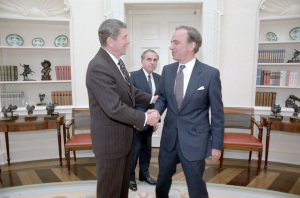
President Ronald Reagan meeting with media magnate Rupert Murdoch in the Oval Office on Jan. 18, 1983, with Charles Wick, director of the U.S. Information Agency, the the background. (Credit: Reagan presidential library)

President Ronald Reagan meeting with media magnate Rupert Murdoch in the Oval Office on Jan. 18, 1983, with Charles Wick, director of the U.S. Information Agency, in the background. (Photo credit: Reagan presidential library)

This commitment to what the insiders called “perception management” began in earnest with the Reagan administration in the 1980s but it would come to be the accepted practice of all subsequent administrations, including the present one of President Barack Obama.

In that sense, propaganda in pursuit of foreign policy goals would trump the democratic ideal of an informed electorate. The point would be not to honestly inform the American people about events around the world but to manage their perceptions by ramping up fear in some cases and defusing outrage in others – depending on the U.S. government’s needs.

Thus, you have the current hysteria over Russia’s supposed “aggression” in Ukraine when the crisis was actually provoked by the West, including by U.S. neocons who helped create today’s humanitarian crisis in eastern Ukraine that they now cynically blame on Russian President Vladimir Putin.

Yet, many of these same U.S. foreign policy operatives – outraged over Russia’s limited intervention to protect ethnic Russians in eastern Ukraine – are demanding that President Obama launch an air war against the Syrian military as a “humanitarian” intervention there.

In other words, if the Russians act to shield ethnic Russians on their border who are being bombarded by a coup regime in Kiev that was installed with U.S. support, the Russians are the villains blamed for the thousands of civilian deaths, even though the vast majority of the casualties have been inflicted by the Kiev regime from indiscriminate bombing and from dispatching neo-Nazi militias to do the street fighting.

In Ukraine, the exigent circumstances don’t matter, including the violent overthrow of the constitutionally elected president last February. It’s all about white hats for the current Kiev regime and black hats for the ethnic Russians and especially for Putin.

But an entirely different set of standards has applied to Syria where a U.S.-backed rebellion, which included violent Sunni jihadists from the start, wore the white hats and the relatively secular Syrian government, which has responded with excessive violence of its own, wears the black hats. But a problem to that neat dichotomy arose when one of the major Sunni rebel forces, the Islamic State, started seizing Iraqi territory and beheading Westerners.

Faced with those grisly scenes, President Obama authorized bombing the Islamic State forces in both Iraq and Syria, but neocons and other U.S. hardliners have been hectoring Obama to go after their preferred target, Syria’s President Bashar al-Assad, despite the risk that destroying the Syrian military could open the gates of Damascus to the Islamic State or al-Qaeda’s Nusra Front.

Lost on the Dark Side

You might think that the American public would begin to rebel against these messy entangling alliances with the 1984-like demonizing of one new “enemy” after another. Not only have these endless wars drained trillions of dollars from the U.S. taxpayers, they have led to the deaths of thousands of U.S. troops and to the tarnishing of America’s image from the attendant evils of war, including a lengthy detour into the “dark side” of torture, assassinations and “collateral” killings of children and other innocents.

But that is where the history of “perception management” comes in, the need to keep the American people compliant and confused. In the 1980s, the Reagan administration was determined to “kick the Vietnam Syndrome,” the revulsion that many Americans felt for warfare after all those years in the blood-soaked jungles of Vietnam and all the lies that clumsily justified the war.

So, the challenge for the U.S. government became: how to present the actions of “enemies” always in the darkest light while bathing the behavior of the U.S. “side” in a rosy glow. You also had to stage this propaganda theater in an ostensibly “free country” with a supposedly “independent press.”

From documents declassified or leaked over the past several decades, including an unpublished draft chapter of the congressional Iran-Contra investigation, we now know a great deal about how this remarkable project was undertaken and who the key players were.

Perhaps not surprisingly much of the initiative came from the Central Intelligence Agency, which housed the expertise for manipulating target populations through propaganda and disinformation. The only difference this time would be that the American people would be the target population.

For this project, Ronald Reagan’s CIA Director William J. Casey sent his top propaganda specialist Walter Raymond Jr. to the National Security Council staff to manage the inter-agency task forces that would brainstorm and coordinate this “public diplomacy” strategy.

Many of the old intelligence operatives, including Casey and Raymond, are now dead, but other influential Washington figures who were deeply involved by these strategies remain, such as neocon stalwart Robert Kagan, whose first major job in Washington was as chief of Reagan’s State Department Office of Public Diplomacy for Latin America.

Now a fellow at the Brookings Institution and a columnist at the Washington Post, Kagan remains an expert in presenting foreign policy initiatives within the “good guy/bad guy” frames that he learned in the 1980s. He is also the husband of Assistant Secretary of State for European Affairs Victoria Nuland, who oversaw the overthrow of Ukraine’s elected President Viktor Yanukovych last February amid a very effective U.S. propaganda strategy.

During the Reagan years, Kagan worked closely on propaganda schemes with Elliott Abrams, then the Assistant Secretary of State for Latin America. After getting convicted and then pardoned in the Iran-Contra scandal, Abrams reemerged on President George W. Bush’s National Security Council handling Middle East issues, including the Iraq War, and later “global democracy strategy.” Abrams is now a senior fellow at the Council on Foreign Relations.

These and other neocons were among the most diligent students learning the art of “perception management” from the likes of Raymond and Casey, but those propaganda skills have spread much more widely as “public diplomacy” and “information warfare” have now become an integral part of every U.S. foreign policy initiative.

A Propaganda Bureaucracy

Declassified documents now reveal how extensive Reagan’s propaganda project became with inter-agency task forces assigned to develop “themes” that would push American “hot buttons.” Scores of documents came out during the Iran-Contra scandal in 1987 and hundreds more are now available at the Reagan presidential library in Simi Valley, California.

What the documents reveal is that at the start of the Reagan administration, CIA Director Casey faced a daunting challenge in trying to rally public opinion behind aggressive U.S. interventions, especially in Central America. Bitter memories of the Vietnam War were still fresh and many Americans were horrified at the brutality of right-wing regimes in Guatemala and El Salvador, where Salvadoran soldiers raped and murdered four American churchwomen in December 1980.

The new leftist Sandinista government in Nicaragua also was not viewed with much alarm. After all, Nicaragua was an impoverished country of only about three million people who had just cast off the brutal dictatorship of Anastasio Somoza.

So, Reagan’s initial strategy of bolstering the Salvadoran and Guatemalan armies required defusing the negative publicity about them and somehow rallying the American people into supporting a covert CIA intervention inside Nicaragua via a counterrevolutionary force known as the Contras led by Somoza’s ex-National Guard officers.

Reagan’s task was made tougher by the fact that the Cold War’s anti-communist arguments had so recently been discredited in Vietnam. As deputy assistant secretary to the Air Force, J. Michael Kelly, put it, “the most critical special operations mission we have … is to persuade the American people that the communists are out to get us.”

At the same time, the White House worked to weed out American reporters who uncovered facts that undercut the desired public images. As part of that effort, the administration attacked New York Times correspondent Raymond Bonner for disclosing the Salvadoran regime’s massacre of about 800 men, women and children in the village of El Mozote in northeast El Salvador in December 1981. Accuracy in Media and conservative news organizations, such as The Wall Street Journal’s editorial page, joined in pummeling Bonner, who was soon ousted from his job.

But these were largely ad hoc efforts. A more comprehensive “public diplomacy” operation took shape beginning in 1982 when Raymond, a 30-year veteran of CIA clandestine services, was transferred to the NSC.

A slight, soft-spoken New Yorker who reminded some of a character from a John le Carré spy novel, Raymond was an intelligence officer who “easily fades into the woodwork,” according to one acquaintance. But Raymond would become the sparkplug for this high-powered propaganda network, according to a draft chapter of the Iran-Contra report.

Though the draft chapter didn’t use Raymond’s name in its opening pages, apparently because some of the information came from classified depositions, Raymond’s name was used later in the chapter and the earlier citations matched Raymond’s known role. According to the draft report, the CIA officer who was recruited for the NSC job had served as Director of the Covert Action Staff at the CIA from 1978 to 1982 and was a “specialist in propaganda and disinformation.”

“The CIA official [Raymond] discussed the transfer with [CIA Director] Casey and NSC Advisor William Clark that he be assigned to the NSC as [Donald] Gregg’s successor [as coordinator of intelligence operations in June 1982] and received approval for his involvement in setting up the public diplomacy program along with his intelligence responsibilities,” the chapter said.

“In the early part of 1983, documents obtained by the Select [Iran-Contra] Committees indicate that the Director of the Intelligence Staff of the NSC [Raymond] successfully recommended the establishment of an inter-governmental network to promote and manage a public diplomacy plan designed to create support for Reagan Administration policies at home and abroad.”

During his Iran-Contra deposition, Raymond explained the need for this propaganda structure, saying: “We were not configured effectively to deal with the war of ideas.”

One reason for this shortcoming was that federal law forbade taxpayers’ money from being spent on domestic propaganda or grassroots lobbying to pressure congressional representatives. Of course, every president and his team had vast resources to make their case in public, but by tradition and law, they were restricted to speeches, testimony and one-on-one persuasion of lawmakers.

But things were about to change. In a Jan. 13, 1983, memo, NSC Advisor Clark foresaw the need for non-governmental money to advance this cause. “We will develop a scenario for obtaining private funding,” Clark wrote. (Just five days later, President Reagan personally welcomed media magnate Rupert Murdoch into the Oval Office for a private meeting, according to records on file at the Reagan library.)

As administration officials reached out to wealthy supporters, lines against domestic propaganda soon were crossed as the operation took aim not only at foreign audiences but at U.S. public opinion, the press and congressional Democrats who opposed funding the Nicaraguan Contras.

At the time, the Contras were earning a gruesome reputation as human rights violators and terrorists. To change this negative perception of the Contras as well as of the U.S.-backed regimes in El Salvador and Guatemala, the Reagan administration created a full-blown, clandestine propaganda network.

In January 1983, President Reagan took the first formal step to create this unprecedented peacetime propaganda bureaucracy by signing National Security Decision Directive 77, entitled “Management of Public Diplomacy Relative to National Security.” Reagan deemed it “necessary to strengthen the organization, planning and coordination of the various aspects of public diplomacy of the United States Government.”

Reagan ordered the creation of a special planning group within the National Security Council to direct these “public diplomacy” campaigns. The planning group would be headed by the CIA’s Walter Raymond Jr. and one of its principal arms would be a new Office of Public Diplomacy for Latin America, housed at the State Department but under the control of the NSC.

CIA Taint

Worried about the legal prohibition barring the CIA from engaging in domestic propaganda, Raymond formally resigned from the CIA in April 1983, so, he said, “there would be no question whatsoever of any contamination of this.” But Raymond continued to act toward the U.S. public much like a CIA officer would in directing a propaganda operation in a hostile foreign country.

Raymond fretted, too, about the legality of Casey’s ongoing involvement. Raymond confided in one memo that it was important “to get [Casey] out of the loop,” but Casey never backed off and Raymond continued to send progress reports to his old boss well into 1986. It was “the kind of thing which [Casey] had a broad catholic interest in,” Raymond shrugged during his Iran-Contra deposition. He then offered the excuse that Casey undertook this apparently illegal interference in domestic politics “not so much in his CIA hat, but in his adviser to the president hat.”

As a result of Reagan’s decision directive, “an elaborate system of inter-agency committees was eventually formed and charged with the task of working closely with private groups and individuals involved in fundraising, lobbying campaigns and propagandistic activities aimed at influencing public opinion and governmental action,” the draft Iran-Contra chapter said. “This effort resulted in the creation of the Office of Public Diplomacy for Latin America and the Caribbean in the Department of State (S/LPD), headed by Otto Reich,” a right-wing Cuban exile from Miami.

Though Secretary of State George Shultz wanted the office under his control, President Reagan insisted that Reich “report directly to the NSC,” where Raymond oversaw the operations as a special assistant to the President and the NSC’s director of international communications, the chapter said.

“Reich relied heavily on Raymond to secure personnel transfers from other government agencies to beef up the limited resources made available to S/LPD by the Department of State,” the chapter said. “Personnel made available to the new office included intelligence specialists from the U.S. Air Force and the U.S. Army. On one occasion, five intelligence experts from the Army’s 4th Psychological Operations Group at Fort Bragg, North Carolina, were assigned to work with Reich’s fast-growing operation.”

A “public diplomacy strategy paper,” dated May 5, 1983, summed up the administration’s problem. “As far as our Central American policy is concerned, the press perceives that: the USG [U.S. government] is placing too much emphasis on a military solution, as well as being allied with inept, right-wing governments and groups. …The focus on Nicaragua [is] on the alleged U.S.-backed ‘covert’ war against the Sandinistas. Moreover, the opposition … is widely perceived as being led by former Somozistas.”

The administration’s difficulty with most of these press perceptions was that they were correct. But the strategy paper recommended ways to influence various groups of Americans to “correct” the impressions anyway, removing what another planning document called “perceptional obstacles.”

“Themes will obviously have to be tailored to the target audience,” the strategy paper said.

Casey’s Hand

As the Reagan administration struggled to manage public perceptions, CIA Director Casey kept his personal hand in the effort. On one muggy day in August 1983, Casey convened a meeting of Reagan administration officials and five leading ad executives at the Old Executive Office Building next to the White House to come up with ideas for selling Reagan’s Central American policies to the American people.

Earlier that day, a national security aide had warmed the P.R. men to their task with dire predictions that leftist governments would send waves of refugees into the United States and cynically flood America with drugs. The P.R. executives jotted down some thoughts over lunch and then pitched their ideas to the CIA director in the afternoon as he sat hunched behind a desk taking notes.

“Casey was kind of spearheading a recommendation” for better public relations for Reagan’s Central America policies, recalled William I. Greener Jr., one of the ad men. Two top proposals arising from the meeting were for a high-powered communications operation inside the White House and private money for an outreach program to build support for U.S. intervention.

The results from the discussions were summed up in an Aug. 9, 1983, memo written by Raymond who described Casey’s participation in the meeting to brainstorm how “to sell a ‘new product’ – Central America – by generating interest across-the-spectrum.”

In the memo to then-U.S. Information Agency director Charles Wick, Raymond also noted that “via Murdock [sic] may be able to draw down added funds” to support pro-Reagan initiatives. Raymond’s reference to Rupert Murdoch possibly drawing down “added funds” suggests that the right-wing media mogul had been recruited to be part of the covert propaganda operation. During this period, Wick arranged at least two face-to-face meetings between Murdoch and Reagan.

In line with the clandestine nature of the operation, Raymond also suggested routing the “funding via Freedom House or some other structure that has credibility in the political center.” (Freedom House would later emerge as a principal beneficiary of funding from the National Endowment for Democracy, which was also created under the umbrella of Raymond’s operation.)

As the Reagan administration pushed the envelope on domestic propaganda, Raymond continued to worry about Casey’s involvement. In an Aug. 29, 1983, memo, Raymond recounted a call from Casey pushing his P.R. ideas. Alarmed at a CIA director participating so brazenly in domestic propaganda, Raymond wrote that “I philosophized a bit with Bill Casey (in an effort to get him out of the loop)” but with little success.

Meanwhile, Reich’s Office of Public Diplomacy for Latin America (S/LPD) proved extremely effective in selecting “hot buttons” that would anger Americans about the Sandinistas. He also browbeat news correspondents who produced stories that conflicted with the administration’s “themes.” Reich’s basic M.O. was to dispatch his propaganda teams to lobby news executives to remove or punish out-of-step reporters – with a disturbing degree of success. Reich once bragged that his office “did not give the critics of the policy any quarter in the debate.”

Another part of the office’s job was to plant “white propaganda” in the news media through op-eds secretly financed by the government. In one memo, Jonathan Miller, a senior public diplomacy official, informed White House aide Patrick Buchanan about success placing an anti-Sandinista piece in The Wall Street Journal’s friendly pages. “Officially, this office had no role in its preparation,” Miller wrote.

Other times, the administration put out “black propaganda,” outright falsehoods. In 1983, one such theme was designed to anger American Jews by portraying the Sandinistas as anti-Semitic because much of Nicaragua’s small Jewish community fled after the revolution in 1979.

However, the U.S. embassy in Managua investigated the charges and “found no verifiable ground on which to accuse the GRN [the Sandinista government] of anti-Semitism,” according to a July 28, 1983, cable. But the administration kept the cable secret and pushed the “hot button” anyway.

Black Hats/White Hats

Repeatedly, Raymond lectured his subordinates on the chief goal of the operation: “in the specific case of Nica[ragua], concentrate on gluing black hats on the Sandinistas and white hats on UNO [the Contras’ United Nicaraguan Opposition].” So Reagan’s speechwriters dutifully penned descriptions of Sandinista-ruled Nicaragua as a “totalitarian dungeon” and the Contras as the “moral equivalent of the Founding Fathers.”

As one NSC official told me, the campaign was modeled after CIA covert operations abroad where a political goal is more important than the truth. “They were trying to manipulate [U.S.] public opinion … using the tools of Walt Raymond’s trade craft which he learned from his career in the CIA covert operation shop,” the official admitted.

Another administration official gave a similar description to The Miami Herald’s Alfonso Chardy. “If you look at it as a whole, the Office of Public Diplomacy was carrying out a huge psychological operation, the kind the military conduct to influence the population in denied or enemy territory,” that official explained. [For more details, see Parry’s Lost History.]

Another important figure in the pro-Contra propaganda was NSC staffer Oliver North, who spent a great deal of his time on the Nicaraguan public diplomacy operation even though he is better known for arranging secret arms shipments to the Contras and to Iran’s radical Islamic government, leading to the Iran-Contra scandal.

The draft Iran-Contra chapter depicted a Byzantine network of contract and private operatives who handled details of the domestic propaganda while concealing the hand of the White House and the CIA. “Richard R. Miller, former head of public affairs at AID, and Francis D. Gomez, former public affairs specialist at the State Department and USIA, were hired by S/LPD through sole-source, no-bid contracts to carry out a variety of activities on behalf of the Reagan administration policies in Central America,” the chapter said.

“Supported by the State Department and White House, Miller and Gomez became the outside managers of [North operative] Spitz Channel’s fundraising and lobbying activities. They also served as the managers of Central American political figures, defectors, Nicaraguan opposition leaders and Sandinista atrocity victims who were made available to the press, the Congress and private groups, to tell the story of the Contra cause.”

Miller and Gomez facilitated transfers of money to Swiss and offshore banks at North’s direction, as they “became the key link between the State Department and the Reagan White House with the private groups and individuals engaged in a myriad of endeavors aimed at influencing the Congress, the media and public opinion,” the chapter said.

The Iran-Contra draft chapter also cited a March 10, 1985, memo from North describing his assistance to CIA Director Casey in timing disclosures of pro-Contra news “aimed at securing Congressional approval for renewed support to the Nicaraguan Resistance Forces.”

The chapter added: “Casey’s involvement in the public diplomacy effort apparently continued throughout the period under investigation by the Committees,” including a 1985 role in pressuring Congress to renew Contra aid and a 1986 hand in further shielding the Office of Public Diplomacy for Latin America from the oversight of Secretary Shultz.

A Raymond-authored memo to Casey in August 1986 described the shift of the S/LPD office – where Robert Kagan had replaced Reich – to the control of the Bureau of Inter-American Affairs, which was headed by Assistant Secretary of State Elliott Abrams, who had tapped Kagan for the public diplomacy job.

Even after the Iran-Contra scandal unraveled in 1986-87 and Casey died of brain cancer on May 6, 1987, the Republicans fought to keep secret the remarkable story of the public diplomacy apparatus. As part of a deal to get three moderate Republican senators to join Democrats in signing the Iran-Contra majority report, Democratic leaders agreed to drop the draft chapter detailing the CIA’s domestic propaganda role (although a few references were included in the executive summary). But other Republicans, including Rep. Dick Cheney, still issued a minority report defending broad presidential powers in foreign affairs.

Thus, the American people were spared the chapter’s troubling conclusion: that a secret propaganda apparatus had existed, run by “one of the CIA’s most senior specialists, sent to the NSC by Bill Casey, to create and coordinate an inter-agency public-diplomacy mechanism [which] did what a covert CIA operation in a foreign country might do. [It] attempted to manipulate the media, the Congress and public opinion to support the Reagan administration’s policies.”

Kicking the Vietnam Syndrome

The ultimate success of Reagan’s propaganda strategy was affirmed during the tenure of his successor, George H.W. Bush, when Bush ordered a 100-hour ground war on Feb. 23, 1991, to oust Iraqi troops from Kuwait, which had been invaded the previous August.

Though Iraqi dictator Saddam Hussein had long been signaling a readiness to withdraw – and Soviet President Mikhail Gorbachev had negotiated a withdrawal arrangement that even had the blessings of top U.S. commanders in the field – President Bush insisted on pressing ahead with the ground attack.

Bush’s chief reason was that he – and his Defense Secretary Dick Cheney – saw the assault against Iraq’s already decimated forces as an easy victory, one that would demonstrate America’s new military capacity for high-tech warfare and would cap the process begun a decade earlier to erase the Vietnam Syndrome from the minds of average Americans.

Those strategic aspects of Bush’s grand plan for a “new world order” began to emerge after the U.S.-led coalition started pummeling Iraq with air strikes in mid-January 1991. The bombings inflicted severe damage on Iraq’s military and civilian infrastructure and slaughtered a large number of non-combatants, including the incineration of some 400 women and children in a Baghdad bomb shelter on Feb. 13. [For details, see Consortiumnews.com’s “Recalling the Slaughter of Innocents.”]

The air war’s damage was so severe that some world leaders looked for a way to end the carnage and arrange Iraq’s departure from Kuwait. Even senior U.S. military field commanders, such as Gen. Norman Schwarzkopf, looked favorably on proposals for sparing lives.

But Bush was fixated on a ground war. Though secret from the American people at that time, Bush had long determined that a peaceful Iraqi withdrawal from Kuwait would not be allowed. Indeed, Bush was privately fearful that the Iraqis might capitulate before the United States could attack.

At the time, conservative columnists Rowland Evans and Robert Novak were among the few outsiders who described Bush’s obsession with exorcising the Vietnam Syndrome. On Feb. 25, 1991, they wrote that the Gorbachev initiative brokering Iraq’s surrender of Kuwait “stirred fears” among Bush’s advisers that the Vietnam Syndrome might survive the Gulf War.

“There was considerable relief, therefore, when the President … made clear he was having nothing to do with the deal that would enable Saddam Hussein to bring his troops out of Kuwait with flags flying,” Evans and Novak wrote. “Fear of a peace deal at the Bush White House had less to do with oil, Israel or Iraqi expansionism than with the bitter legacy of a lost war. ‘This is the chance to get rid of the Vietnam Syndrome,’ one senior aide told us.”

In the 1999 book, Shadow, author Bob Woodward confirmed that Bush was adamant about fighting a war, even as the White House pretended it would be satisfied with an unconditional Iraqi withdrawal. “We have to have a war,” Bush told his inner circle of Secretary of State James Baker, national security adviser Brent Scowcroft and Gen. Colin Powell, according to Woodward.

“Scowcroft was aware that this understanding could never be stated publicly or be permitted to leak out. An American president who declared the necessity of war would probably be thrown out of office. Americans were peacemakers, not warmongers,” Woodward wrote.

The Ground War

However, the “fear of a peace deal” resurfaced in the wake of the U.S.-led bombing campaign. Soviet diplomats met with Iraqi leaders who let it be known that they were prepared to withdraw their troops from Kuwait unconditionally.

Learning of Gorbachev’s proposed settlement, Schwarzkopf also saw little reason for U.S. soldiers to die if the Iraqis were prepared to withdraw and leave their heavy weapons behind. There was also the prospect of chemical warfare that the Iraqis might use against advancing American troops. Schwarzkopf saw the possibility of heavy U.S. casualties.

But Gorbachev’s plan was running into trouble with President Bush and his political subordinates who wanted a ground war to crown the U.S. victory. Schwarzkopf reached out to Gen. [Colin] Powell, chairman of the Joint Chiefs of Staff, to make the case for peace with the President.

On Feb. 21, 1991, the two generals hammered out a cease-fire proposal for presentation to the NSC. The peace deal would give Iraqi forces one week to march out of Kuwait while leaving their armor and heavy equipment behind. Schwarzkopf thought he had Powell’s commitment to pitch the plan at the White House.

But Powell found himself caught in the middle. He wanted to please Bush while still representing the concerns of the field commanders. When Powell arrived at the White House late on the evening of Feb. 21, he found Bush angry about the Soviet peace initiative. Still, according to Woodward’s Shadow, Powell reiterated that he and Schwarzkopf “would rather see the Iraqis walk out than be driven out.”

In My American Journey, Powell expressed sympathy for Bush’s predicament. “The President’s problem was how to say no to Gorbachev without appearing to throw away a chance for peace,” Powell wrote. “I could hear the President’s growing distress in his voice. ‘I don’t want to take this deal,’ he said. ‘But I don’t want to stiff Gorbachev, not after he’s come this far with us. We’ve got to find a way out’.”

Powell sought Bush’s attention. “I raised a finger,” Powell wrote. “The President turned to me. ‘Got something, Colin?’,” Bush asked. But Powell did not outline Schwarzkopf’s one-week cease-fire plan. Instead, Powell offered a different idea intended to make the ground offensive inevitable.

“We don’t stiff Gorbachev,” Powell explained. “Let’s put a deadline on Gorby’s proposal. We say, great idea, as long as they’re completely on their way out by, say, noon Saturday,” Feb. 23, less than two days away.

Powell understood that the two-day deadline would not give the Iraqis enough time to act, especially with their command-and-control systems severely damaged by the air war. The plan was a public-relations strategy to guarantee that the White House got its ground war. “If, as I suspect, they don’t move, then the flogging begins,” Powell told a gratified president.

The next day, at 10:30 a.m., a Friday, Bush announced his ultimatum. There would be a Saturday noon deadline for the Iraqi withdrawal, as Powell had recommended. Schwarzkopf and his field commanders in Saudi Arabia watched Bush on television and immediately grasped its meaning.

“We all knew by then which it would be,” Schwarzkopf wrote. “We were marching toward a Sunday morning attack.”

When the Iraqis predictably missed the deadline, American and allied forces launched the ground offensive at 0400 on Feb. 24, Persian Gulf time.

Though Iraqi forces were soon in full retreat, the allies pursued and slaughtered tens of thousands of Iraqi soldiers in the 100-hour war. U.S. casualties were light, 147 killed in combat and another 236 killed in accidents or from other causes. “Small losses as military statistics go,” wrote Powell, “but a tragedy for each family.”

[Editor: This was only the beginning of casualties as Gulf War Illness surfaced. Destroying the lives of veterans, their family members, and non-Iraq soldiers, this ground war ended up being very costly for American soldiers, affecting even those who had never left the States, but unpacked  contaminated gear shipped home from Iraq. The Veterans Administration and the military establishment have denied their crippling and often fatal illnesses. A bioweapon organism, mycoplasma fermentans incognitus, with a United States patent, was discovered in many of these ill veterans. It is contageous.

 A simple treatment with the antibiotic doxycycline over a series of months often can eradicate the organism. However, if not eradicated, it can cause organ failure and death. Though the VA discovered the presence of this organism in a high percentage of ill veterans it tested, it has buried the information and refused to treat veterans and their families. It has often prescribed psychiatric drugs instead.

The excellent HBO film “Thanks of a Grateful Nation” covers some of this story.

Veterans have had no information, no diagnostic help, and no relief except from independent sources. Drs. Garth and Nancy Nicholson have been lead researchers and advocates for veterans and members of the public who have contracted this very serious disease — http://www.immed.org/index.htm. They have saved many people’s lives.]

On Feb. 28, the day the war ended, Bush celebrated the victory. “By God, we’ve kicked the Vietnam Syndrome once and for all,” the President exulted, speaking to a group at the White House. [For more details, see Robert Parry’s Secrecy & Privilege.]

So as not to put a damper on the post-war happy feelings, the U.S. news media decided not to show many of the grisliest photos, such as charred Iraqi soldiers ghoulishly still seated in their burned-out trucks where they had been incinerated while trying to flee. By that point, U.S. journalists knew it wasn’t smart for their careers to present a reality that didn’t make the war look good.

Enduring Legacy

Though Reagan’s creation of a domestic propaganda bureaucracy began more than three decades ago – and Bush’s vanquishing of the Vietnam Syndrome was more than two decades ago – the legacy of those actions continue to reverberate today in how the perceptions of the American people are now routinely managed. That was true during last decade’s Iraq War and this decade’s conflicts in Libya, Syria and Ukraine as well as the economic sanctions against Iran and Russia.

Indeed, while the older generation that pioneered these domestic propaganda techniques has passed from the scene, many of their protégés are still around along with some of the same organizations. The National Endowment for Democracy, which was formed in 1983 at the urging of CIA Director Casey and under the supervision of Walter Raymond’s NSC operation, is still run by the same neocon, Carl Gershman, and has an even bigger budget, now exceeding $100 million a year.

Gershman and his NED played important behind-the-scenes roles in instigating the Ukraine crisis by financing activists, journalists and other operatives who supported the coup against elected President Yanukovych. The NED-backed Freedom House also beat the propaganda drums. [See Consortiumnews.com’s “A Shadow Foreign Policy.”]

Two other Reagan-era veterans, Elliott Abrams and Robert Kagan, have both provided important intellectual support for continuing U.S. interventionism around the world. Earlier this year, Kagan’s article for The New Republic, entitled “Superpowers Don’t Get to Retire,” touched such a raw nerve with President Obama that he hosted Kagan at a White House lunch and crafted the presidential commencement speech at West Point to deflect some of Kagan’s criticism of Obama’s hesitancy to use military force.

A New York Times article about Kagan’s influence over Obama reported that Kagan’s wife, Assistant Secretary of State Victoria Nuland, apparently had a hand in crafting the attack on her ostensible boss, President Obama.

According to the Times article, the husband-and-wife team share both a common world view and professional ambitions, Nuland editing Kagan’s articles and Kagan “not permitted to use any official information he overhears or picks up around the house” – a suggestion that Kagan’s thinking at least may be informed by foreign policy secrets passed on by his wife.

Though Nuland wouldn’t comment specifically on Kagan’s attack on President Obama, she indicated that she holds similar views. “But suffice to say,” Nuland said, “that nothing goes out of the house that I don’t think is worthy of his talents. Let’s put it that way.”

Misguided Media

In the three decades since Reagan’s propaganda machine was launched, the American press corps also has fallen more and more into line with an aggressive U.S. government’s foreign policy strategies. Those of us in the mainstream media who resisted the propaganda pressures mostly saw our careers suffer while those who played along moved steadily up the ranks into positions of more money and more status.

Even after the Iraq War debacle when nearly the entire mainstream media went with the pro-invasion flow, there was almost no accountability for that historic journalistic failure. Indeed, the neocon influence at major newspapers, such as the Washington Post and the New York Times, only has solidified since.

Today’s coverage of the Syrian civil war or the Ukraine crisis is so firmly in line with the State Department’s propaganda “themes” that it would put smiles on the faces of William Casey and Walter Raymond if they were around today to see how seamlessly the “perception management” now works. There’s no need any more to send out “public diplomacy” teams to bully editors and news executives. Everyone is already onboard.

Rupert Murdoch’s media empire is bigger than ever, but his neocon messaging barely stands out as distinctive, given how the neocons also have gained control of the editorial and foreign-reporting sections of the Washington Post, the New York Times and virtually every other major news outlet. For instance, the demonizing of Russian President Putin is now so total that no honest person could look at those articles and see anything approaching objective or evenhanded journalism. Yet, no one loses a job over this lack of professionalism.

The Reagan administration’s dreams of harnessing private foundations and non-governmental organizations have also come true. The Orwellian circle has been completed with many American “anti-war” groups advocating for “humanitarian” wars in Syria and other countries targeted by U.S. propaganda. [See Consortiumnews.com’s “Selling ‘Peace Groups’ on US-Led Wars.”]

Much as Reagan’s “public diplomacy” apparatus once sent around “defectors” to lambaste Nicaragua’s Sandinistas by citing hyped-up human rights violations now the work is done by NGOs with barely perceptible threads back to the U.S. government. Just as Freedom House had “credibility” in the 1980s because of its earlier reputation as a human rights group, now other groups carrying the “human rights” tag, such as Human Rights Watch, are in the forefront of urging U.S. military interventions based on murky or propagandistic claims. [See Consortiumnews.com’s “The Collapsing Syria-Sarin Case.”]

At this advanced stage of America’s quiet surrender to “perception management,” it is even hard to envision how one could retrace the many steps that would lead back to the concept of a democratic Republic based on an informed electorate. Many on the American Right remain entranced by the old propaganda theme about the “liberal media” and still embrace Reagan as their beloved icon. Meanwhile, many liberals can’t break away from their own wistful trust in the New York Times and their empty hope that the media really is “liberal.”

To confront the hard truth is not easy. Indeed, in this case, it can cause despair because there are so few voices to trust and they are easily drowned out by floods of disinformation that can come from any angle – right, left or center. Yet, for the American democratic Republic to reset its goal toward an informed electorate, there is no option other than to build institutions that are determinedly committed to the truth.

Investigative reporter Robert Parry broke many of the Iran-Contra stories for The Associated Press and Newsweek in the 1980s. You can buy his latest book, America’s Stolen Narrative, either in print here or as an e-book (from Amazon and barnesandnoble.com). You also can order Robert Parry’s trilogy on the Bush Family and its connections to various right-wing operatives for only $34. The trilogy includes America’s Stolen Narrative. For details on this offer, click here.

A few of the informative comments under the original article:

MarkinPNW

This “Perception Management” is nothing knew. The argument has been made persuasively that the attack on Pearl Harbor actually resulted from a deliberate and successful campaign by FDR to change or “manage” the mass opinions or “Perceptions” of the US electorate from strongly pro-peace and anti-war (what could be called a “Great War syndrome” from the stupid and useless devastation of WW1) to all out pro-war for US involvement in WW2, by provoking the Japanese and refusing all peace negotiations with the Japanese who desperately were trying to avoid war.

In reference to “Orwellian Dystopia”, Orwell’s novels “Animal Farm” and “1984” were based in large part on Orwell’s experience in the Spanish Civil War and WW2, respectively.

hp

The ripened fruit of the pervert Freud’s pervert nephew Edward Bernays.

Jacob

“In the 1980s, the Reagan administration pioneered ‘perception management’ to get the American people to ‘kick the Vietnam Syndrome’ and accept more U.S. interventionism, . . .” 

The management of public perception within the U.S. regarding its imperialistic/colonial ambitions goes back much further than the 1980s. The Committee on Public Information, also known as “the Creel Commission,” was the likely model Reagan wanted to imitate. The purpose of the CPI was to convince the American public, which was mostly anti-war, to support America’s entry into the European war, also known as WWI. The CPI was in official operation from 1917 to 1919 during the Woodrow Wilson administration. But the paradigm for the use of mass propaganda to alter public perceptions is the Congregatio de propaganda fide (The Office for the Propagation of the Faith), a 1622 Vatican invention to undermine the spread of Protestantism by managing public perceptions on religious and spiritual matters.


The Victory of ‘Perception Management’


CIA restructures to “cover entire universe”: Director John Brennan

Posted on Stop NATO

Xinhua News Agency
March 7, 2015

CIA to be restructured to “cover entire universe”: Director

c-i-a--847380-480x320

WASHINGTON: The U.S. Central Intelligence Agency (CIA) is planning to create new units in a series of reorganizations, aiming to “cover the entire universe” amid modern threats and crises, CIA Director John Brennan said Friday.

Announcing the restructuring to the 67-years-old agency Friday, Brennan said the move comes after nine outside experts spent three months analyzing the agency’s management structure, including what CIA deputy director David Cohen called “pain points”, organizational areas where the CIA’s bureaucracy does not work efficiently.

Briefing reporters at CIA headquarters earlier this week, Brennan said officers will be reassigned to 10 newly created ” mission centers,” a move to concentrate the agency’s focus on specific challenges or geographic areas, such as weapons proliferation or Africa.

“I know there are seams right now, but what we’ve tried to do with these mission centers is cover the entire universe, regionally and functionally, and so something that’s going on in the world falls into one of those buckets,” he told reporters.

“I’ve never seen a time when we have been confronted with such an array of very challenging, complex and serious threats to our national security, and issues that we have to grapple with,” he said.

The CIA chief also noted that he is establishing a new ” Directorate of Digital Innovation” to lead the agency’s efforts to track and take advantage of advances in cyber technology.

Brennan said the new digital directorate will have equal status within the agency with four other directorates which have existed for years.

“Our ability to carry out our responsibilities for human intelligence and national security responsibilities has become more challenging” in today’s digital world, Brennan said. “And so what we need to do as an agency is make sure we’re able to understand all of the aspects of that digital environment.”

Founded in 1947, the CIA consists of four major directorates. Two – the Directorate of Science and Technology, which among other activities invents spy gadgets, and the Directorate of Support, which handles administrative and logistical tasks – will retain their names.

The Directorate of Intelligence will be renamed “Directorate of Analysis” to reflect its function as the home of agency experts who collate and analyze information from secret and open sources, Brennan said.

The National Clandestine Service, home of front-line agency undercover “case officers”, who recruit spies and conduct covert actions, will be renamed Directorate of Operations, which it used to be called in the agency’s history.

The 10 new “mission centers” will bring together CIA officers with expertise from across the agency’s range of disciplines to concentrate on specific intelligence target areas or subject matter, said the CIA chief.


https://rickrozoff.wordpress.com/2015/03/07/cia-to-restructure-to-cover-entire-universe-director/

Interview: Former Ukr. Security Chief Yakimenko on the U.S./CIA involvement in coup d’etat and the Maidan snipers

This important interview was conducted shortly after the coup d’état in Ukraine.

From RT, March 13, 2014

There is no doubt there were mercenaries at Maidan, the former head of Ukraine’s security service, Aleksandr Yakimenko, says.

The violence on Maidan which caused almost 100 deaths was organized by some opposition leaders who poured Western money and resources into the coup, Yakimenko told the Russia-1 TV channel. Now Major General Alexander Yakimenko is in the top five of Maidan’s hit list. He made it to that list while he was still in his office in Kiev.

Q: How did you manage to escape?

Aleksandr Yakimenko: I am a Security Service officer.

Q: Where did those snipers come from?

AY: First shots were fired from the Philharmonic building. Maidan Commandant Parubiy was in charge of the building. On February 20, this building was used as a base by the snipers and people with automatic weapons. They basically covered those who were attacking the demoralized policemen running in panic, hunted down like animals. They were followed by armed people with different kinds of weapons. At that point, somebody opened fire at those who attacked the police, and some of them were killed. All this fire was coming from the Philharmonic building. After this first round of fire, about 20 people came out of this building – this was witnessed by many. These people wore special combat clothes and carried sniper rifle cases, as well as AKMs with scopes. There were witnesses, and not just our operatives, but also Maidan activists from Svoboda, Right Sector, Batkivshchyna, and UDAR.

The snipers split into two groups – 10 men each. The Security Service lost track of one of the groups. The other group took a position at the Ukraine hotel. Killings continued. In the beginning, when the shots were scattered, I was asked by Right Sector and Svoboda to mobilize a Special Forces unit and remove the snipers from the buildings.

AFP Photo / Sergei Supinsky

AFP Photo / Sergei Supinsky

Q: They asked you?

AY: Yes, Right Sector and Svoboda. I was ready to do that, but I needed Parubiy’s [he is now the Secretary of the National Security and Defence Council of Ukraine in the Turchinov-Yatsenyuk government] permission to enter Maidan. Otherwise our officers would’ve been attacked by the self-defense forces in the back. Parubiy didn’t give such permission. No weapons could be brought to Maidan without Parubiy’s permission. Hand guns, rifles, scopes – he had to agree to all of that. We had some intel about discharged Ukrainian army special forces participating in those activities. Some reports claimed that these were fighters from former Yugoslavia, as well as mercenaries from other countries.

Q: So you think they were mercenaries?

AY: No doubt. Parubiy removed himself from the picture. This affected the events of the last week. He joined Poroshenko. Gvozd, Malamuzh, and Gritsenko. These forces did what they were told by their bosses – the US. They basically lived in the embassy. They were there every day.

Q: Is it true that Nalivaichenko allowed the CIA agents to work in the Security Service building?

AY: Yes, that’s true. He also handed personal files of his own employees over to the CIA agents to study. But their mission was interrupted by an armed coup. The Maidan do not appoint these people; rather, it’s the US that does it. It’s enough to look at the newly appointed officials: Parubiy, Gvozd, Nalyvaichenko are all people who followed somebody else’s orders, the orders of the US, not even Europe. They are directly linked to the American intelligence. They sought to delay the negotiations and prevent the incumbent president from striking a deal with Russia and Russia from helping to prop up the social and economic order in Ukraine. After that they were planning to depose the president and integrate Ukraine into Europe, using Russian money. Who was troubled by the victory of the EU and the pro-integration forces? Only the US. It was the only country concerned over a possible alliance of Europe, Russia and Ukraine. The Customs Union and the connection between Russia and Ukraine did not sit well with their plans, either.

AFP Photo / Sergei Supinsky

AFP Photo / Sergei Supinsky

They’d been doing it ever since Yushchenko was president, and we couldn’t get rid of them. Once we started to put pressure, they relocated to Poland, Latvia and Lithuania. The most interesting part is that many regional governments spent budget money to pay for the so-called vyshkoli, i.e. training camps for militants to fight with various types of weapons.

All the orders were given either by the US embassy or by Jan Tombinski, a Polish representative who worked in the EU mission in Kiev. Poland played an invaluable role in the coup. It has always dreamt of restoring its former power and the Polish-Lithuanian Commonwealth.

Ever since the Maidan kicked off, our security service registered a dramatic increase in diplomatic correspondence coming in to various Western embassies in Kiev. There is one more mystery. Straight after this influx of correspondence we saw some foreign money at the Maidan and in Kiev exchange bureaus: the new, re-designed US dollar bank notes.

Q: So they were bringing in cash?

AY: Yes. Poroshenko, Firtash, Pinchuk – they all poured money into the Maidan. With all their assets in foreign banks, they found themselves trapped. So they had to follow orders from the West. All they were supposed to do was back the Maidan; otherwise they would have lost all their assets. They were thinking about their money rather than their own country. Unfortunately we couldn’t prevent the casualties, the people, mainly those who had come from the Western regions, were sent into the line of fire. The Maidan militants had left the barricades after the sniper fire started. But time will set the record straight.

The whole story has affected the Berkut guys, the Internal Troops, the Security Service, too. But ordinary Ukrainians have suffered as well. And I don’t think they should have sacrificed their lives for Yatsenyuk, Klitschko, Poroshenko and others to take their posts. Ukrainians have lots of patience. But one day they will run out of it and remove them from power. I hope that happens soon enough.

http://rt.com/op-edge/mercenaries-at-maidan-ukraine-558/

Breaking news: possible false flag in Moscow; opposition leader murdered

Reports are just beginning to come in on this story. Below is an article from the Saker. With the visit by Andriy Parubiy to Washington DC requesting arms, and media messages like this editorial in the Washington Post, the murder of Boris Nemtsov will be used as further “proof” against Russia in the fiction created by U.S. and NATO leadership.

From Vineyard of the Saker
February 27, 2015

Boris Nemtsov has been shot dead in Moscow.  He was one of the most charismatic leaders of the “liberal” or “democratic” “non-system” opposition in Russia (please understand that in the Russian context “liberal” and “democratic” means pro-US or even CIA-run, while “non-system” means too small to even get a single deputy in the Duma).  He was shot just a few days before the announced demonstration of the very same “liberal” or “democratic” “non-system” opposition scheduled for March 1st.

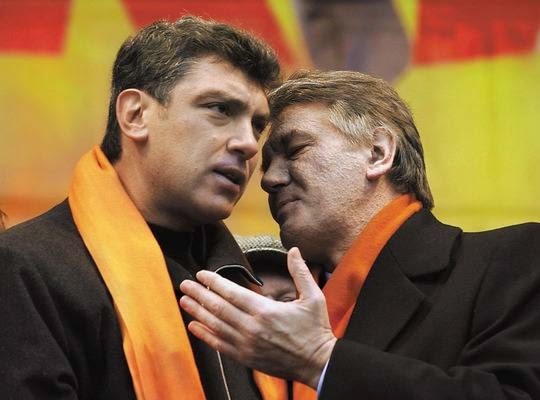
Nemtsov with Yushchenko

As I have already explained many times on this blog, the “liberal” or “democratic” “non-system” opposition in Russia has a popular support somewhere in the range of 5% (max). In other words, it is politically *dead* (for a detailed explanation, please read “From Napoleon to Adolf Hitler to Conchita Wurst“).  In the hopes of getting a higher number of people to the streets the “liberal” or “democratic” “non-system”opposition allied itself with the ultra-nationalists (usually useful idiots for the CIA) and the homosexual activists (also useful idiots for the CIA).  Apparently, this was not enough.

And now, in *perfect* timing, Nemtsov is murdered.

We all know the reaction of the AngloZionists and their propaganda machine.  It will be exactly the same as for MH-17: Putin the Murderer!!! Democracy Shot!! Freedom Killed!! etc. etc. etc. etc.

There is no doubt in my mind at all that either this is a fantastically unlikely but always possible case of really bad luck for Putin and Nemtsov was shot by some nutcase or mugged, or this was a absolutely prototypical western false flag: you take a spent politician who has no credibility left with anyone with an IQ over 70, and you turn him into an instant “martyr for freedom, democracy, human right and civilization”.

By the way if, as I believe, this is a false flag, I expect it to be a stunning success in the West and a total flop in Russia: by now, Russians already can smell that kind of setup a mile away and after MH-17 everybody was expecting a false flag.  So, if anything, it will only increase the hostility of Russians towards the West and rally them around Putin.  In the Empire, however, this will be huge, better than Politkovskaya or Litvinenko combined.  A “Nemtsov” prize will be created, a Nemtov statue will be place somewhere (in Warsaw?), the US Congress will pass a “Nemtsov law” and the usual combo package of “democratic hagiography” will be whipped-up.

What worries me most is that the Russian security services did not see this one coming and let it happen.  This is a major failure for the FSB which will now have a lot at stake to find out who did it.  I expect them to find a fall-guy, a patsy, who will have no provable contacts with any western services and who, ideally, might even have some contacts with the Russian services (like Andrei Lugovoi).

As for the “liberal” or “democratic” “non-system” – it will probably re-brand the upcoming protests as a “tribute to Nemtsov” thereby getting more people into the streets.

There are folks in Langley [CIA headquarters] tonight who got a promotion.

The Saker

http://vineyardsaker.blogspot.com/2015/02/breaking-news-false-flag-in-moscow.html

Victoria Nuland attempts another coup — Kiev Version 2.0 — in Macedonia

Posted on Strategic Culture Foundation, February 16, 2015
By Wayne Madsen

After having initiated her well-planned Maidan Square uprising in Kiev in early 2014, triggering Europe’s worst conflict in Ukraine since the Balkan Wars of the 1990s, Victoria Nuland, the Assistant Secretary of State for European and Eurasian Affairs, recently attempted a Kiev-style putsch in Macedonia aimed at overthrowing that nation’s democratically-elected government of Prime Minister Nikola Gruevski. It is a hallmark of neoconservatives like Nuland and her arch-neoconservative husband, the Brookings Institution’s Robert Kagan, to disregard democratic elections if their candidates fail to win election. Although Ukrainian President Viktor Yanukovych and Macedonian Prime Minister Gruevski were elected in free and fair elections, by all international metrics and norms, their governments were not as pro-NATO and pro-U.S. enough for the liking of Nuland and the Project for the New American Century (PNAC) cabalists that surround her husband.

Nuland’s tactics differed somewhat in her Ukrainian and Macedonian campaigns. Her signature challah bread offerings to protesters at Kiev’s Maidan Square took the form of unsolicited offerings to the Macedonian press suggesting that Gruevksi was wiretapping as many as 20,000 Macedonians and that a videotape proving it was secretly made by Macedonia’s George Soros-financed leader of the opposition, Zoran Zaev, in a meeting he had with Gruevski.

Nuland has been charged by Macedonian intelligence with conspiring with Zaev of the Macedonian Social Democratic Union of Macedonia (SDSM), the former Communist Party that has been thoroughly co-opted by the U.S. Central Intelligence Agency (CIA) and Soros operative. Also charged in the attempted putsch against Gruevski is Radmila Sekerinska. Zaev and Sekerinska are said by Macedonian insiders to be nothing more than fronts for former Prime Minister and President Branko Crvenkovski who continues to head up the SDSM and accept large amounts of largesse from such CIA NGO laundry operations as the National Democratic Institute (NDI), National Endowment for Democracy (NED), Freedom House, and Soros’s Open Society Institute (OSI) to foment a themed revolution against Gruevksi’s right-of-center VMRO-DPMNE government.

Gruevksi, unlike many U.S.-installed and -influenced governments of the region has been reluctant to apply sanctions against Russia over Ukraine. That stance has earned the government in Skopje the enmity of the Obama administration and most notably, Nuland, whose rhetoric echoes leading neo-conservative war hawks such as Republican senators John McCain and Lindsey Graham. In fact, Nuland’s husband has the distinction of working as a foreign policy adviser for both McCain and presumptive 2016 Democratic presidential candidate Hillary Clinton.

In response to Zaev’s charge that Gruevski wiretapped 20,000 Macedonians, including taping phone calls between Zaev and his young daughter, the Macedonian government charged that it was Zaev and his associates, working with a foreign intelligence agency believed to be the CIA, to overthrow Gruevski’s government. An obvious flight risk, Zaev was ordered to turn in his passport to the authorities. Others, in addition to Zaev, accused of working with the CIA to oust Gruevski include Zaev’s associates Sonja Verusevska and Branko Palifrov, as well as the former director of the Office of Security and Counter-intelligence (DBK), Zoran Verusevski. Gruevski charged that Zaev threatened to disclose sensitive information about his government provided to the SDSM by the CIA, referred to as “the bomb” in the Macedonian media, unless Gruevski appointed a caretaker government that would lead to early parliamentary elections. Gruevski has called Zaev’s gambit nothing more than blackmail pressure in order that a snap election be called. As far as pressuring the Gruevski government to resign and call early elections, Nuland resorted to the same gambit that was used in Kiev to oust Yanukovych.

Frankfurter Allgemeine Zeitung reporter Michael Martens, who reported on the Macedonian coup plot, claimed in an interview with Macedonian television that his initial report on the wiretapping issue had been altered by certain parties inside Macedonia. Martens said that with a population of 2 million, to wiretap 20,000 people would have even far exceed the capabilities of the East German Stasi. In any event, Martens said the 20,000 figure was not true and that Macedonian media and politicians had misquoted him and his article. However, the truth has never been on the side of provocateurs like Nuland and her neoconservative cabal of plotters and disinformation specialists.

The unapologetic foul-mouthed Nuland met on the side of the 51st Munich Security Conference in Germany with Macedonian Foreign Minister Nikola Poposki and President Gjorge Ivanov to express her displeasure at Gruevski’s insurrection charges against her friend Zaev and his SDSM co-conspirators. Earlier, Nuland had offered to mediate a long-standing dispute between Greece and Macedonia over the latter’s use of the name Macedonia, which some Greeks consider to be a solely Greek name. Macedonian observers viewed Nuland’s interest in the name dispute to be a trap that would enable a pro-U.S. government, along with the Zionist and global banker baggage that comes with any such «themed» coup d’etat, to seize power in Skopje. Nuland and her co-conspirators were hoping for a replay of Kiev in what can be termed «Kiev Version 2.0.»

Nuland and her co-conspirators in Skopje are alarmed over the speed at which the Macedonian security services rounded up the coup plotters. Macedonian police, in raids conducted in Skopje and Veles, seized five laptop computers, three desktop computers, 19 mobile phones, 100 CDs and DVDs, 17 hard disks, and 9 savings deposit books used by the coup plotters, including a number linked to Soros-financed NGOs. The bank accounts of the plotters reportedly were flush with healthy cash deposits from the CIA as the date of the planned coup approached.

The use of social media by the Soros/CIA coup plotters should come as no surprise. Social media served at the very core of the themed revolutions sponsored by the CIA and Soros twice in Ukraine (Orange Revolution and Euro-Maidan uprising), Jasmine Revolution (Tunisia), Lotus Revolution (Egypt), Rose Reviolution (Georgia), Tulip Revolution (Kyrgyszstan), and Green Revolution (Iran). In the case of Macedonia, there are clear indications that the Deputy Assistant Secretary of State in the Bureau of Democracy, Human Rights and Labor (DRL) Thomas Melia, responsible for DRL’s work in Europe, including Russia, as well as the Middle East and North Africa, conspired directly with Zaev to mount a coup against the Gruevski government. Melia is the former deputy director of Freedom House, a Cold War-era neoconservative bevvy of U.S. war hawks based in New York. Although founded in 1941 by such progressives as Eleanor Roosevelt, Ralph Bunche, journalist Dorothy Thompson, novelist Rex Stout (creator of Nero Wolfe), and Republican presidential candidate Wendell Willkie (who would be considered by today’s Republicans in the U.S. as a stark-raving liberal), Freedom House has devolved into a neoconservative chatter source having employed as their board members in recent years such war hawk cretins as Paul Wolfowitz, Ken Adelman, Zbigniew Brzezinski, Donald Rumsfeld, and Otto Reich. Freedom House has been caught red-handed funneling CIA money to opposition groups in Iran, Sudan, Russia, and China. In essence, Freedom House, like Soros’s NGOs, serves as a conduit for CIA support for rebellious opposition forces in dozens of countries around the world, countries that now include Macedonia, as well as Hungary, Venezuela, Syria, Egypt, Serbia, Jordan, Mexico, and Cuba.

What occurred in Macedonia was a classic disinformation ploy to mire the democratically-elected government in a bogus political scandal. The ploy is directly from the CIA playbook and it is now being carried out against Presidents Cristina Fernandez de Kirchner of Argentina, Dilma Rousseff of Brazil, and Michelle Bachelet of Chile. All face financial scandals cooked up by the CIA and its owned and operated media in the three nations. In Macedonia, the Soros-influenced media and Radio Free Europe are part of the operation.

Nuland’s vulgar language is only matched by the vulgarity of her backroom operations to unseat democratically-elected governments. «Nuland» should become a noun meaning disgraceful diplomatic conduct, in the same manner as the terms «quisling,» meaning «traitor» and derived from the actions of Norwegian Nazi leader Vidkun Quisling, and «boycott,» meaning the cessation of all business with a targeted entity and made famous by Irish land agent Captain Charles Boycott, became part of the English language.


http://www.strategic-culture.org/news/2015/02/16/nuland-attempts-kiev-version-2-skopje.html

Support Venezuela — interview with John Pilger:

Posted on Information Clearing House
By John Pilger and Michael Albert
February 16, 2015 “ICH” – “ZNet” –

Albert: Why would the U.S. want Venezuela’s government overthrown?

Pilger: There are straightforward principles and dynamics at work here. Washington wants to get rid of the Venezuelan government because it is independent of US designs for the region and because Venezuela has the greatest proven oil reserves in the world and uses its oil revenue to improve the quality of ordinary lives. Venezuela remains a source of inspiration for social reform in a continent ravaged by an historically rapacious U.S. An Oxfam report once famously described the Sandinista revolution in Nicaragua as ‘the threat of a good example’. That has been true in Venezuela since Hugo Chavez won his first election. The ‘threat’ of Venezuela is greater, of course, because it is not tiny and weak; it is rich and influential and regarded as such by China. The remarkable change in fortunes for millions of people in Latin America is at the heart of U.S. hostility. The U.S. has been the undeclared enemy of social progress in Latin America for two centuries. It doesn’t matter who has been in the White House: Barack Obama or Teddy Roosevelt; the US will not tolerate countries with governments and cultures that put the needs of their own people first and refuse to promote or succumb to U.S. demands and pressures. A reformist social democracy with a capitalist base – such as Venezuela – is not excused by the rulers of the world. What is inexcusable is Venezuela’s political independence; only complete deference is acceptable. The ‘survival’ of Chavista Venezuela is a testament to the support of ordinary Venezuelans for their elected government – that was clear to me when I was last there. Venezuela’s weakness is that the political ‘opposition’ — those I would call the ‘East Caracas Mob’ – represent powerful interests who have been allowed to retain critical economic power. Only when that power is diminished will Venezuela shake off the constant menace of foreign-backed, often criminal subversion. No society should have to deal with that, year in, year out.

What methods has the U.S. already used and would you anticipate their using to unseat the Bolivarians? 

There are the usual crop of quislings and spies; they come and go with their media theatre of fake revelations, but the principal enemy is the media. You may recall the Venezuelan admiral who was one of the coup-plotters against Chavez in 2002, boasting during his brief tenure in power, ‘Our secret weapon was the media’. The Venezuelan media, especially television, were active participants in that coup, lying that supporters of the government were firing into a crowd of protestors from a bridge. False images and headlines went around the world. The New York Times joined in, welcoming the overthrow of a democratic ‘anti-American’ government; it usually does. Something similar happened in Caracas last year when vicious right-wing mobs were lauded as ‘peaceful protestors’ who were being ‘repressed’. This was undoubtedly the start of a Washington-backed ‘colour revolution’ openly backed by the likes of the National Endowment for Democracy – a user-friendly CIA clone. It was uncannily like the coup that Washington successfully staged in Ukraine last year. As in Kiev, in Venezuela the ‘peaceful protestors’ set fire to government buildings and deployed snipers and were lauded by western politicians and the western media. The strategy is almost certainly to push the Maduro government to the right and so alienate its popular base. Depicting the government as dictatorial and incompetent has long been an article of bad faith among journalists and broadcasters in Venezuela and in the US, the UK and Europe. One recent US ‘story’ was that of a ‘US scientist jailed for trying to help Venezuela build bombs’. The implication was that Venezuela was harbouring ‘nuclear terrorists’. In fact, the disgruntled nuclear physicist had no connection whatsoever with Venezuela.

All this is reminiscent of the unrelenting attacks on Chávez, each with that peculiar malice reserved for dissenters from the west’s ‘one true way’. In 2006, Britain’s Channel 4 News effectively accused the Venezuelan president of plotting to make nuclear weapons with Iran, an absurd fantasy. The Washington correspondent, Jonathan Rugman, sneered at policies to eradicate poverty and presented Chávez as a sinister buffoon, while allowing Donald Rumsfeld, a war criminal, to liken Chavez to Hitler, unchallenged. The BBC is no different. Researchers at the University of the West of England in the UK studied the BBC’s systematic bias in reporting Venezuela over a ten-year period. They looked at 304 BBC reports and found that only three of these referred to any of the positive policies of the government. For the BBC, Venezuela’s democratic initiatives, human rights legislation, food programmes, healthcare initiatives and poverty reduction programmes did not exist. Mission Robinson, the greatest literacy programme in human history, received barely a passing mention. This virulent censorship by omission complements outright fabrications such as accusations that the Venezuelan government are a bunch of drug-dealers. None of this is new; look at the way Cuba has been misrepresented – and assaulted – over the years. Reporters Without Borders has just issued its worldwide ranking of nations based on their claims to a free press. The U.S. is ranked 49th, behind Malta, Niger, Burkino Faso and El Salvador.

Why might now be a prime time, internationally, for pushing toward a coup? If the primary problem is Venezuela being an example that could spread, is the emergence of a receptive audience for that example in Europe adding to the U.S. response?

It’s important to understand that Washington is ruled by true extremists, once known inside the Beltway as ‘the crazies’. This has been true since before 9/11. A few are outright fascists. Asserting US dominance is their undisguised game and, as the events in Ukraine demonstrate, they are prepared to risk a nuclear war with Russia. These people should be the common enemy of all sane human beings. In Venezuela, they want a coup so that they can roll-back of some of the world’s most important social reforms – such as in Bolivia and Ecuador. They’ve already crushed the hopes of ordinary people in Honduras. The current conspiracy between the US and Saudi Arabia to lower the price of oil is meant to achieve something more spectacular in Venezuela, and Russia.

What do you think the best approach might be to warding off u.s. machinations, and those of domestic Venezuelan elites as well, for the Bolivarians?

The majority people of Venezuela, and their government, need to tell the world the truth about the attacks on their country. There is a stirring across the world, and many people are listening. They don’t want perpetual instability, perpetual poverty, perpetual war, perpetual rule by the few. And they identify the principal enemy; look at the international polling surveys that ask which country presents the greatest danger to humanity. The majority of people overwhelmingly point to the U.S., and to its numerous campaigns of terror and subversion.

What do you think is the immediate responsibility of leftists outside Venezuela, and particularly in the U.S.?

That begs a question: who are these ‘leftists’? Are they the millions of liberal North Americans seduced by the specious rise of Obama and silenced by his criminalising of freedom of information and dissent? Are they those who believe what they are told by the New York Times, the Washington Post, the Guardian, the BBC? It’s an important question. ‘Leftist’ has never been a more disputed and misappropriated term. My sense is that people who live on the edge and struggle against US-backed forces in Latin America understood the true meaning of the word, just as they identify a common enemy. If we share their principles, and a modicum of their courage, we should take direct action in our own countries, starting, I would suggest, with the propagandists in the media. Yes, it’s our responsibility, and it has never been more urgent.


Click for Spanish, German, Dutch, Danish, French, translation- Note- Translation may take a moment to load.

http://www.informationclearinghouse.info/article41011.htm

Leading Ukrainian Nazi will visit Washington next week seeking weapons

From Fort Russ
By Eric Zuesse, February 17, 2015

Andrey [Andriy] Parubiy, a co-founder of the Social Nationalist Party of Ukraine, which the CIA renamed the “Freedom” Party (“Svoboda”) in order to hide its origin as Ukraine’s nazi party, announced on Sunday February 15th, that he’ll be seeking weapons from the U.S. He had started (but the CIA named) Ukraine’s ‘Anti Terrorist Operation,’ which has been trying to exterminate the residents in Ukraine’s Donbass region, Ukraine’s separatist region. Parubiy’s announcement said, “Next week I’m off to the United States to speak about this very subject,” of getting Washington to supply the weapons necessary to finish that job. 
The reason for his visit is: Ukraine is running out of bullets, guns, and other necessary equipment to achieve his goal. It’s a goal he had only begun as the organizer of Ukraine’s ‘Anti Terrorist Operation.’ The ‘ATO’ had commenced soon after the February 2014 coup in Ukraine, and has not been proceeding nearly as quickly as had been planned; it’s way behind schedule. 
According to German intelligence sources, no more than 50,000 people have been killed so far in the operation, though more than a million have fled, which also counts as success because the goal is to clear the land there. As a retired Ukrainian general who supports the operation said, “The shelling there is done as intimidation, … not just object destruction, but [also as] intimidation [to get the population to flee to nearby Russia]. The civilian population is intimidated by a chaotic bombardment.” That constant bombardment requires lots of bombs and bullets, which is why Parubiy now needs a big resupply.
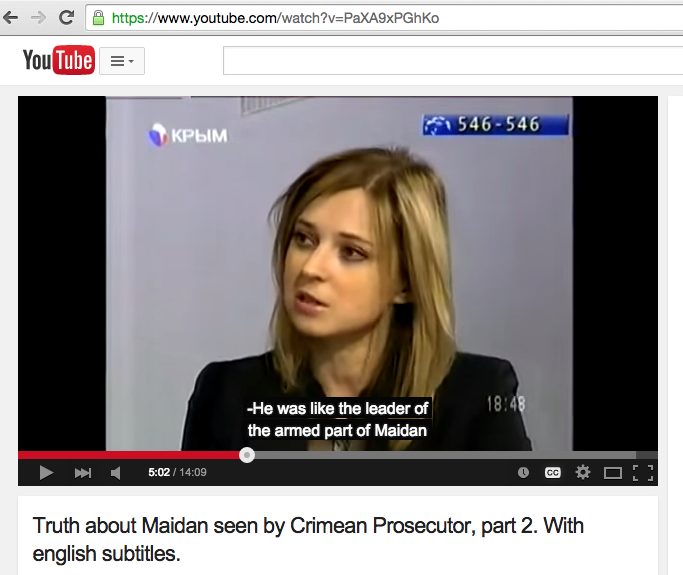
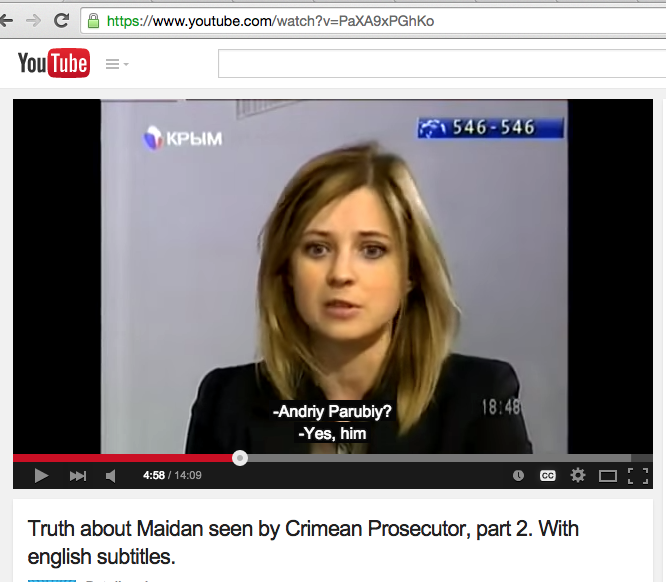
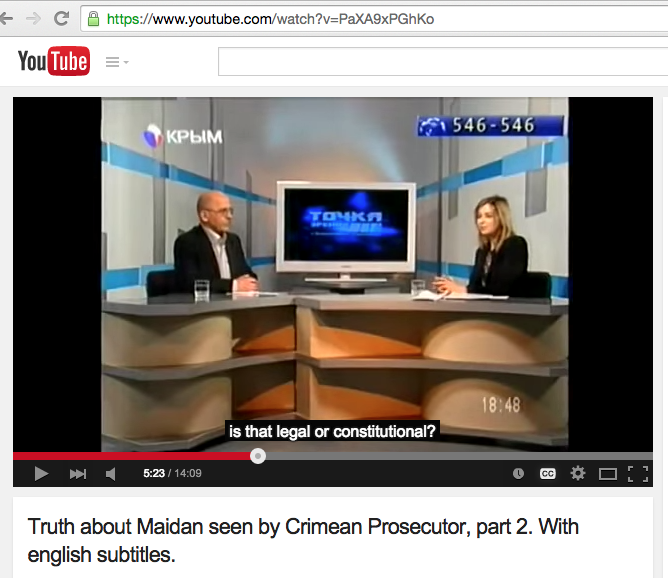
Crimea’s Chief Prosecutor, Natalya Poklonskaya, who lived in Kiev and was a criminal prosecutor in Ukraine’s national government until the coup, but who quit because she didn’t want to serve in what she called a “nazi” government which was being established from the coup, says that Parubiy “was the leader of the armed part of Maidan” —  he was the key organizer of the masked snipers who dressed as government forces and shot both the police and the Maidan demonstrators during the coup and so brought down the sitting President of Ukraine. If what she says about his role is correct, then Paribuy was crucial in the success of the 22 February 2014 overthrow of democratically elected Ukrainian President Viktor Yanukovych and was also crucial to the fulfillment of the appointment that occurred four days later of Yanukovych’s replacement as Ukraine’s leader, Arseniy Yatsenyuk, whom Victorial Nuland of the U.S. State Department had already selected, on 4 February 2014, to become Ukraine’s new leader
So, Parubiy was crucial in America’s successful take-over of Ukraine, and he will now be coming to Washington to request from Congress and the U.S. President the military support needed to finish the job that he and they had started, by completing the extermination of the residents in the Donbass region, which is the region whose residents had voted 90% for Yanukovych (it’s dark purple on that map) and have refused to accept the legitimacy of the Obama-coup Government. If those voters aren’t successfully eliminated, then any future Presidential election in Ukraine that would represent all of the land-area of the pre-coup Ukraine would need to include those anti-coup voters, and so would probably end U.S. control over Ukraine.
Parubiy in his announcement warned of the aggressive intentions of Russia’s President Vladimir Putin: “If he feels that he can go further, there is no doubt that there will be an attempt to break through and make a Crimea land corridor, he’ll attempt to get at least to the borders of Luhansk and Donetsk oblasts. And so, in order to have the guarantee that this will not happen, the most important thing is to strengthen our armed forces, and seek that the United States give us the modern weapons we need.”
—————

Evidence about the connection between the Ukrainian coup and Crimea’s breakaway

By Eric Zuesse
Posted on Fort Russ, February 16, 2015

Little attention is generally paid to the connection between the February 2014 coup in Ukraine, and Crimea’s breakaway from Ukraine. The testimony that will here be cited helps fill this in. An attorney in the federal prosecutor’s office at the time of the coup refers to the longtime national socialist, Andriy Paribiy, as having been the key person behind the coup. In the new regime, Paribiy became appointed to become the chief of national security, and the top person overseeing the war against “ATO” ‘Anti Terrorist Operation’ to exterminate the residents in the formerly Ukrainian area, Donbass, the area which had voted 90% for the overthrown President Viktor Yanukovych, and which consequently rejected this new regime, which Washington violently imposed to replace him.  

Below is a Crimean TV interview with Natalya Poklonskaya, who was a senior criminal prosecutor in Kiev at the time of the February 2014 Maidan demonstrations and overthrow of President Yanukovych, and who resigned her post during the coup and drove back to her childhood home in Crimea, because she objected to what she called “nazis” who, she said, had done the overthrow; she objected to the way that Yanukovych was replaced, and to the unconstitutional and violent nature of it, which she didn’t view as being a democratic action, at all, but instead a “nazi” one.
This interview was telecast shortly after the February 2014 overthrow, but before the March 16th referendum in Crimea on whether to reject the new Government and to rejoin Russia (of which Crimea had been a part during 1783-1954).
Poklonskaya was interviewed in this call-in live TV show so as to inform her fellow Crimeans what she had seen happen during the overthrow, and why she couldn’t, in good conscience, remain as a Ukrainian official in Kiev, and swear loyalty to the new Ukrainian Government there. She had heard the chants of the Maidan protesters and smelled their piles of burning tires, and seen their marches in Kiev with nazi symbols and salutes, and she didn’t want to become any part of that. So, she quit and was now unemployed back home in Crimea at the time of this interview.
The key moments in this interview are shown below, with English subscripts. (Here is the full interview, for anyone who wants to see that:
“He” refers to 

Andriy Paribiy was the co-founder (along with Oleh Tyahnybok) of the Social Nationalist Party of Ukraine, which the CIA had persuaded to change its name to “Freedom” or “Svoboda” in order not to offend Westerners with its origin as a native Ukrainian version of Hitler’s National Socialist Party of Germany. Polonskaya said:
“He was standing on Maidan and delivering orders.” The interviewer asked:
She then asked, rhetorically:
And she answered, also as a question (since she’s a good trial-lawyer):
She was asked her view of the new Ukrainian Government’s declaration that this referendum in Crimea would be illegal:
The referendum took place entirely peacefully, because Russian troops from Crimea’s naval base in Sevastopol Crimea prevented an invasion from Kiev. The results were 96% for reunion with Russia. A 2013 Gallup poll of Crimeans, and also a 2014 Gallup poll of Crimeans after the referndum, both showed overwhelming support for Russia and opposition to the United States; and the 2014 poll also showed that almost all Crimeans thought that the referendum-results had been free and fair and accurately reflected the views of Crimenans. However, the United States Government, and its allies, claim that the overthrow of Yanukovych was legal and that the reunification of Crimea with Russia was not, and also that the ethnic cleansing against the residents in the Donbass region of the former Ukraine is legal and that the military assistance that Russia is providing to enable those residents to defend themselves from being exterminated is not. The United States Government, and its Ukrainian Government, call that extermination-program Ukraine’s “Anti Terrorist Operation,” and the United States is sending Ukraine weapons to carry it out.
 
When the Crimean people voted to rejoin Russia when they did, they saved themselves from the fate that soon thereafter befell the residents in Donbass

—————

CIA carried out terrorist bombing in Syria’s capital; why are they claiming it now?

By Richard Becker
Liberation News, February 4, 2015

The news that the U.S. Central Intelligence Agency carried out a meticulously planned terrorist car bombing in Damascus, Syria, in February 2008 appeared on the front page of the Jan. 31, 2015, Washington Post. It was an outrageous action in the capital of a sovereign state. By all definitions, a state-sponsored car bombing in the capital city of another nation is defined as terrorism.

It doesn’t take much imagination to picture what the U.S. response would be if the scenario were reversed and such an attack took place in Washington, D.C. At the very least, bombs and missiles would fall like rain on Syria.

That the CIA would carry out such an act is hardly a surprise. In its near-seven decades’ existence, the CIA has been responsible for the murder of millions and the destruction of scores of progressive movements and governments in Asia, Africa, Latin America and Europe.

Virtually every progressive leader in the countries liberated from colonialism or neo-colonialism in the post-World War II era has been targeted for assassination by the CIA at one time or another. From Vietnam to Haiti to Afghanistan and beyond, U.S. clients who had outlived their usefulness in the eyes of Washington were set up for elimination.

CIA engineered or assisted coups in Iran, Guatemala, Congo, Iraq, Indonesia, Greece, Brazil, Bolivia, Chile, Argentina, Uruguay and more, and brought to power regimes that used extreme brutality in the interests of U.S. corporations and local elites.

Organized in 1947, the agency’s first coup was in newly independent Syria just two years later. Its bloody trail confirms that the CIA is the deadliest terrorist organization in the world, bar none.

What was unusual about the 2008 assassination of a top Hezbollah commander, Imad Mughniyah, was the public revelation that the CIA, in partnership with Israel’s Mossad secret service, had carried it out.

While the CIA formally declined comment on the story, the sources for the article were past and present CIA officials, something unthinkable unless approved from inside the agency.

Standard CIA practice has long been to refuse to comment on its coups and murders—and for good reason. Regardless of whether they are “signed off on” by the president or any other U.S. official, all are blatant violations of international and U.S. domestic laws. Agency officials seek to maintain a “window of deniability” to protect themselves from possible future legal consequences.

Why, then, did the agency break with its usual practice of treating such an operation as classified and instead boast through the mass media of the assassination?

Targeting Hezbollah to derail Iran negotiations

The Post report followed two weeks after an Israeli air attack that killed six members of Hezbollah, including Jihad Mughniyah, son of Imad Mughniyah, and a high-ranking Iranian officer inside Syria. Both Hezbollah and Iran have been supporting the government of Bashar al-Assad in Syria against the armed opposition, led by al-Qaeda and the Islamic State.

Hezbollah responded to the Jan. 18 air assault by destroying an Israeli tank in the Shebaa Farms region, the last part of Lebanon still under Israeli occupation. Hezbollah played a key role in the Lebanese resistance that drove Israel out of much of Lebanese territory it occupied in 1982-2000. In 2006, it fought the powerful, U.S.-backed Israeli army to a standstill in a month-long war.

Two Israeli soldiers were killed and seven wounded in Shebaa Farms. Israeli shelling killed a Spanish soldier who was part of the UN “peacekeeping” force in southern Lebanon. The Hezbollah leadership made it clear that their response was a limited one.

The Jan. 18 attack in Syria was a clear provocation, intended to draw a Hezbollah reaction. So, too, was the Post article. The aim of both was to push Hezbollah – as an ally of Iran — toward stronger retaliation.

The publication of the Post story should be understood as a form of taunting Hezbollah by elements in the U.S. establishment who are seeking a pretext for subverting the Iran nuclear negotiations.

Talal Atrissi, a Lebanese political commentator reportedly close to Hezbollah, said of the leaked CIA report on the 2008 assassination: “The leak is meant to undermine the talks, and that benefits Israel because it opposes these negotiations.”

A Lebanese professor at the American University in Beirut, Imad Salamey, pointed to the psychological warfare aspect of the Post report: “Your [Hezbollah’s] leadership has been targeted by the United States, so what do you do?”

The negotiations with Iran are at a critical stage, with late March set as the deadline to reach an agreement. There is a major division in U.S. ruling-class political circles over the negotiations.

While the Obama administration and its allies are seeking an agreement that they believe would weaken Iran, an opposing faction wants to scuttle the negotiations and impose even harsher sanctions.

Iran has stated that additional sanctions would mean an end to the negotiating process. Such an outcome could well lead to a new U.S. or U.S.-Israeli war against Iran, something that Israeli Prime Minister Netanyahu as well as many in Washington clearly desire.

On Jan. 21, in a highly unusual breach of bourgeois protocol, Speaker of the House of Representatives John Boehner invited the rabidly anti-Iranian Netanyahu to lecture a Joint Session of Congress on Mar. 3 on the so-called “danger” from Iran and in support of imposing even tighter sanctions on that country. Boehner’s invitation was made without consultation with the administration.

Protests calling for “No New War Against Iran,” “End the Colonial Occupation of Palestine, “ and “End All U.S. Aid to Israel” are being planned to coincide with Netanyahu’s appearance before Congress on Mar. 3.

Source:

CIA carried out terrorist bombing in Syria’s capital — Why are they claiming it now?

http://www.globalresearch.ca/cia-carried-out-terrorist-bombing-in-syrias-capital-why-are-they-claiming-it-now/5429775

Project Camelot and Chile

Originally found at
http://www.randomcollection.info/mcf/project-camelot-chile.htm

From The Rise and Fall of Project Camelot: Studies in the Relationship Between Social Science and Practical Politics, Irving Louis Horowitz, ed. (Cambridge MA: The M.I.T. Press, 1967), pp. 47-49 (document) and 232-36 (Jorge Montes):

Document Number 1

The following description of Project Camelot was released on December 4, 1964, through the Office of the Director of the Special Operations Research Office (SORO) of the American University in Washington, D.C. It was sent to scholars who were presumed interested in the study of internal war potentials and who might be willing to assemble at a four-week conference at the Airlie House in Virginia in August 1965. This release, dated December 4, 1964, is a summary version of a larger set of documents made available in August 1964 and in December 1964 [I.L.H.].

Project CAMELOT is a study whose objective is to determine the feasibility of developing a general social systems model which would make it possible to predict and influence politically significant aspects of social change in the developing nations of the world. Somewhat more specifically, its objectives are:

First, to devise procedures for assessing the potential for internal war within national societies;

Second, to identify with increased degrees of confidence those actions which a government might take to relieve conditions which are assessed as giving rise to a potential for internal war; and

Finally, to assess the feasibility of prescribing the characteristics of a system for obtaining and using the essential information needed for doing the above two things.

The project is conceived as a three to four-year effort to be funded at around one and one-half million dollars annually. It is supported by the Army and the Department of Defense, and will be conducted with the cooperation of other agencies of the government. A large amount of primary data collection in the field is planned as well as the extensive utilization of already available data on social, economic and political functions. At this writing, it seems probable that the geographic orientation of the research will be toward Latin American countries. Present plans call for a field office in that region.

By way of background: Project CAMELOT is an outgrowth of the interplay of many factors and forces. Among these is the assignment in recent years of much additional emphasis to the U.S. Army’s role in the over-all U.S. policy of encouraging steady growth and change in the less developed countries in the world. The many programs of the U.S. Government directed toward this objective are often grouped under the sometimes misleading label of counterinsurgency (some pronounceable term standing for insurgency prophylaxis would be better). This places great importance on positive actions designed to reduce the sources of disaffection which often give rise to more conspicuous and violent activities disruptive in nature. The U.S. Army has an important mission in the positive and constructive aspects of nation building as well as a responsibility to assist friendly governments in dealing with active insurgency problems.

Another major factor is the recognition at the highest levels of the defense establishment of the fact that relatively little is known, with a high degree of surety, about the social processes which must be understood in order to deal effectively with problems of insurgency. Within the Army there is especially ready acceptance of the need to improve the general understanding of the processes of social change if the Army is to discharge its responsibilities in the over-all counterinsurgency program of the U.S. Government. Of considerable relevance here is a series of recent reports dealing with the problems of national security and the potential contributions that social science might make to solving these problems. One such report was published by a committee of the Smithsonian Institution’s research group under the title, “Social Science Research and National Security,” edited by Ithiel de Sola Pool. Another is a volume of the proceedings of a symposium, “The U.S. Army’s Limited-War Mission and Social Science Research.” These proceedings were published in 1962 by the Special Operations Research Office of the American University.

Project CAMELOT will be a multidisciplinary effort. It will be conducted both within the SORO organization and in close collaboration with universities and other research institutions within the United States and overseas. The first several months of work will be devoted to the refinement of the research design and to the identification of problems of research methodology as well as of substance. This will contribute to the important articulation of all component studies of the project toward the stated objectives. Early participants in the project will thus have an unusual opportunity to contribute to the shaping of the research program and also to take part in a seminar planned for the summer of 1965. The seminar, to be attended by leading behavioral scientists of the country, will be concerned with reviewing plans for the immediate future and further analyzing the long-run goals and plans for the project.

A Communist Commentary on Camelot

by Jorge Montes Chilean Chamber of Deputies, 1965

A number of newspapers, and particularly El Siglo, have been referring to a so-called “Project Camelot.” What is this project? In order to define it, we shall textually quote from an official document. [See Document No.1 above, from which excerpts were cited.]

These quotes from the project reveal the determination on the part of U.S. foreign policy to intervene in any country of the world where popular movements might threaten its interests. To this end, they use a covert form of espionage, which they try to present in terms of scientific research, thus violating the most elementary norms of sovereignty.

Indeed, our own country, Uruguay, Colombia, and Venezuela in Latin America, Senegal and Nigeria in Africa, and India, Vietnam, and Laos in Asia are the countries in which organized espionage, under the appearance of sociological investigation and under the rubric of “Project Camelot,” is being carried out. Continue reading