The “beatification” of Barack Obama. The “good guy” storyline is set…

By Kit
Global Research, January 16, 2017
Off Guardian 15 January 2017
Obama's farewell speech tear, one more than he ever shed for Libya, Syria or Yemen.
Obama’s farewell speech tear, one more than he ever shed for Libya, Syria or Yemen.

As the eight-year term of America’s first black President draws to a close, the media are already in the process of myth-making. There’s room for an honest autopsy of a man who promised a new kind of world, and delivered merely warmed-over soundbites and a few fake tears.

“With Barack Obama’s exit the US is losing a saint.” writes Simon Jenkins in the Guardian, whilst Ann Perkins praises his “grace, decency and defence of democracy”. Lola Okolosie rhapsodises on his legacy of “warmth, love, resilience”.

Already the storyline is set – Obama was a good man, who tried to do great things, but was undone by a Republican senate, and his own “sharp intelligence”.

These people, as much as anybody, reflect the cognitive dissonance of the modern press. “Liberals”, to use their own tortured self-descriptor, now assign the roles of good guy and bad guy based purely on aesthetics, convenience and fuel for their vanity. Actions and consequences are immaterial.

For the sake of balance, here is a list of Saint Obama’s unique achievements:

  • Obama is the first President in American history to be at war for every single day of an 8 year presidency.
  • Obama has carried out 10x more drone strikes than Bush ever did. Every Tuesday a military aide presents Obama with a “kill list”, and the “decent, gracious” Obama picks a few names off a list…and kills them. And their families. And their neighbours. These illegal acts of state-sanctioned murder have killed hundreds of civilians in 5 different countries in 2016 alone. The only reason that number isn’t higher, is that the Obama administration re-classified all males over 18 as combatants, regardless of occupation.
  • After declaring he wanted to build a “nuclear free world”, Obama committed to spending $1 TRILLION dollars on rebuilding America’s nuclear weapons.
  • Under Obama, the NSA et al. were able to spy on, essentially, the whole world. When this was revealed, not a single intelligence officer or government official was prosecuted. Instead…
  • Obama’s administration declared a “war on whistleblowers”, enacting new laws and initiating what they call the “Insider Threat Program”. Manning was prosecuted, Snowden sent into exile and Assange was set-up, discredited and (they hoped) extradited. It has never been more dangerous to be a government whistle-blower, than under Barack Obama
  • In terms of foreign policy, despite his press-created and non-sensical reputation as a non-interventionist, American Special Forces are currently operating in over 70% of the world’s 195 countries. The great lie is that, where Bush was a warmonger, Obama has sought to avoid conflict. The truth is that Obama, in the grand tradition of the CIA and American Imperial power, has simply turned all America’s wars into covert wars.
  • Before Obama came into office, Libya was the richest and most developed nation in Africa. It is now a hell-hole. Destroyed by war, hollowed-out by corruption. The “liberal” press allow him to agonise over this as his “greatest mistake”, and then gently pardon him for his good intentions. The truth is that Libya was not a mistake, or a misjudgment, or an unforeseen consequence. Libya is exactly what America wanted it to become. A failed state where everything is for sale, a base to pour illegal CIA weapons south into Africa and east into the ME. When war is your economy, chaos is good for business. When secrecy is your weapon, anarchy is ammunition. Libya went according to plan. A brutal plan that killed 100,000s and destroyed the lives of millions more. Libya, like Iraq, is a neocon success story. Syria on the other hand…
  • Syria, probably the word that will follow Obama out of office as “Iraq” did his predecessor, is a total failure. Both of stated intent and covert goals. Where the press will mourn Obama’s “indecisive nature” and wish he’d “used his big stick”, the real story is one of evil incompetence, so great that it would be almost comical…if it hadn’t destroyed an ancient seat of civilisation and killed 100,000s of people. Syria (along with Libya, Iraq, Somalia, Iran and Sudan) was on the list of the 7 countries America intended to destroy, famously “leaked” by General Wesley Clark. After the fall of Libya, Syria was (essentially) surrounded by American military on all sides. Iraq, Israel, Turkey and America operating out of Libya could pour “freedom fighters” into Syria to bring down “the regime”. When that didn’t work they deployed the trusty “WMD” method, to demand “humanitarian intervention”…the Russians saw that off. Then “ISIS” was created by the CIA, as al-Qaida were before them, and their manufactured barbarism was used as a pretext for invasion. The Russians, again, saw to it that this would not happen.
  • Perhaps in the hope of distracting Russia from the ME, or perhaps merely as a short-sighted punitive measure, the Obama’s administration next foreign policy target was Ukraine. Victoria Nuland’s own voice proves how much that “color revolution” was an American creation. Ukraine is broke, even more broke than it was, its people starve and freeze through the winter. The new “democratic government” has shelled 10,000 people to death in the East of the country….using American weapons.
  • In Yemen, the poorest country in the ME is being bombed to shreds by the richest….again, using American (and British) weapons. Obama’s “defense of democracy” doesn’t extend to criticising, or even discussing, the abhorrent Human Rights record of America’s Saudi Arabian allies, and in an act of brazen hypocrisy, even supported their chairing of the Human Rights Council of the UN.

This is the world Saint Obama has created. Guantanamo is still open, and terrorist “suspects” are still held there without trial or charge (they are probably still tortured). Other “suspects” can be simply declared guilty, and unilaterally executed…anywhere in the world. The NSA and CIA are illegally monitoring the communications of half the world. If any other leader in the world claimed even 1% of this power, they would be decried as “autocratic”, and their country denounced as a “pariah state”.

The Middle-East is ablaze from Libya to Afghanistan, and from Yemen to Turkey. Relations with Russia are as precarious as at any time since WWII, thanks to America’s efforts to break Russia economically and shatter their global influence. There is no sign that America intends to back-down (see the recent red-scare style hysteria in the American press). Likewise America has positioned itself to have a massive conflict with China in the South China Sea. Obama is, in terms of influence, nothing more than a used-car salesman. His job is not to create policy, but to sell neocon ideas to the general public, but his lack of agency cannot excuse his lack of vision or morals. Under Obama’s notional leadership the world has moved to the very brink of self-immolation in the name of protecting American hegemony. Domestically America still crumbles.

He had a nice smile, and a good turn of phrase. He was witty, and cool, and looked good in a suit…but that doesn’t mean he wasn’t just more of the same. He could say the right things, and sound like he meant them, but he was still a monster. As he moves out to pasture, the press will try to spit-shine Obama’s tarnished halo, to try to convince us that he was a good man at heart and that, as politicians go, we can’t do any better.

But yes, we can.

http://www.globalresearch.ca/the-beatification-of-barack-obama-the-good-guy-storyline-is-set/5568823

How the US deliberately destroyed Iraq’s water supply, and now Syria…

Global Research, January 03, 2017
Global Research 29 August 2001

Global Research Editor’s Note

This incisive and carefully documented article by Prof. Thomas Nagy was first published by Global Research in September 2001.

It confirms the criminal nature of US intervention.

A similar and comparable operation in Syria has now been launched by using US supported Al Qaeda “opposition rebels”, with the help of the White Helmets to undermine and destroy the system of water supply in Damascus; this issue has been casually ignored by the Western media and the self proclaimed “international community”.

While, the modus operandi in the case of Syria differs from that described by Prof. Nagy, it nonetheless confirms a pattern.  In Syria, this diabolical operation carried out by US backed terrorists, constitutes the ultimate crime against humanity.  

In regards to Iraq, Professor Thomas Nagy of George Washington University, D.C., revealed the existence of Defense Intelligence Agency documents “proving beyond a doubt that, contrary to the Geneva Convention, the U.S. government intentionally used sanctions against Iraq to degrade the country’s water supply after the Gulf War.

“The United States knew the cost that civilian Iraqis, mostly children, would pay, and it went ahead anyway.” On May 12, 1996 some of the horrible consequences of this policy were revealed when the CBS news program 60 Minutes reported that roughly half million Iraqi children had died as a consequence of U.S. imposed sanctions.

This led to Secretary of State Madeleine Albright’s infamous answer to the question, “is the price worth it?” Her reply was yes “we think the price is worth it.” Albright later apologized, not for the murderous policy for which she was partially responsible, but rather for the fact that her answer to the above question had “aggravated our public relations problems” in the Middle East.

As to domestic reaction, her comment “went unremarked in the U.S.” Subsequently, in 2003, the U.S. invaded Iraq using the strategy of “rapid dominance” (more popularly known as “shock and awe”). The object of this strategy was to “paralyze” the enemy’s “will to carry on” through the disruption of “means of communication, transportation, food production, water supply, and other aspects of infrastructure.” One of the targets of the bombing campaign that led off the invasion was Iraq’s electrical grid. That directly impacted the country’s ability to process clean water.”

See also Lawrence Davidson, Loopholes in International Law

This important study by Professor Nagy was among the first articles published by Global Research. It was part of the launch of the site on September 9, 2001. The article was dated August, 29 2001.

The original URL of this article is: http://www.globalresearch.ca/articles/NAG108A.html

Michel Chossudovsky, Global Research Editor, January 3, 2017


*       *      *

Confirmed by documents of the US Defense Intelligence Agency (DIA), “the U.S. government intentionally used sanctions against Iraq to degrade the country’s water supply after the Gulf War. The United States knew the cost that civilian Iraqis, mostly children, would pay, and it went ahead anyway.”

Over the last two years, I’ve discovered documents of the Defense Intelligence Agency proving beyond a doubt that, contrary to the Geneva Convention, the U.S. government intentionally used sanctions against Iraq to degrade the country’s water supply after the Gulf War. The United States knew the cost that civilian Iraqis, mostly children, would pay, and it went ahead anyway.

The primary document, “Iraq Water Treatment Vulnerabilities,” is dated January 22, 1991. It spells out how sanctions will prevent Iraq from supplying clean water to its citizens.

Iraq depends on importing specialized equipment and some chemicals to purify its water supply, most of which is heavily mineralized and frequently brackish to saline,” the document states. “With no domestic sources of both water treatment replacement parts and some essential chemicals, Iraq will continue attempts to circumvent United Nations Sanctions to import these vital commodities. Failing to secure supplies will result in a shortage of pure drinking water for much of the population. This could lead to increased incidences, if not epidemics, of disease.

The document goes into great technical detail about the sources and quality of Iraq’s water supply. The quality of untreated water “generally is poor,” and drinking such water “could result in diarrhea,” the document says. It notes that Iraq’s rivers “contain biological materials, pollutants, and are laden with bacteria. Unless the water is purified with chlorine, epidemics of such diseases as cholera, hepatitis, and typhoid could occur.”

The document notes that the importation of chlorine “has been embargoed” by sanctions. “Recent reports indicate the chlorine supply is critically low.”

Food and medicine will also be affected, the document states. “Food processing, electronic, and, particularly, pharmaceutical plants require extremely pure water that is free from biological contaminants,” it says.

The document addresses possible Iraqi countermeasures to obtain drinkable water despite sanctions.

Iraq conceivably could truck water from the mountain reservoirs to urban areas. But the capability to gain significant quantities is extremely limited,” the document states. “The amount of pipe on hand and the lack of pumping stations would limit laying pipelines to these reservoirs. Moreover, without chlorine purification, the water still would contain biological pollutants. Some affluent Iraqis could obtain their own minimally adequate supply of good quality water from Northern Iraqi sources. If boiled, the water could be safely consumed. Poorer Iraqis and industries requiring large quantities of pure water would not be able to meet their needs.

Continue reading

Why the Brookings Institution and the Washington establishment love wars

Global Research, October 24, 2016

Washington’s public relations operations for the military contracting firms that surround the US Capitol aren’t by for-profit PR firms, so much as they’re by ‘non-profit’ foundations and think tanks, which present that ‘non-profit’ cover for their sales-promotion campaigns on behalf of the real beneficiaries: owners and top executives of these gigantic ‘defense’ contracting corporations, such as Lockheed Martin, and Booz Allen Hamilton.

Among the leading propagandists for invading Iraq back in 2002 were Kenn Pollack  and Michael O’Hanlon, both with the Brookings Institution; and both propagandists still are frequently interviewed by American ‘news’ media as being ‘experts’ on international relations, when all they ever really have been is salesmen for US invasions, such as that 2003 invasion, which destroyed Iraq and cost US taxpayers $3 trillion+ or $4.4 trillion – benefiting only the few beneficiaries and their agents, such as the top executives of these ‘non-profits,’ which receive a small portion of the take, as servants usually do.

More recently, Brookings’s Shadi Hamid headlined on 14 September 2013, «The US-Russian Deal on Syria: A Victory for Assad», and the PR-servant there, Dr Hamid, argued that

 «Syrian President Bashar al-Assad is effectively being rewarded for the use of chemical weapons, rather than ‘punished’ as originally planned… Assad and his Russian backers played on Obama’s most evident weakness, exploiting his desire to find a way – any way – out of military action… One might be forgiven for thinking that this was Assad’s plan all along, to use chemical weapons as bait, to agree to inspections after using them, and then to return to conventional killing».

Three weeks after that Brookings ‘expert’ had issued it, the great investigative journalist Christof Lehmann, on 7 October 2014, headlined and offered facts to the exact contrary at his nsnbc news site,

«Top US and Saudi Officials Responsible for Chemical Weapons in Syria», and he opened by summarizing his extensive case: «Evidence leads directly to the White House, the Chairman of the Joint Chiefs of Staff Martin Dempsey, CIA Director John Brennan, Saudi Intelligence Chief Prince Bandar, and Saudi Arabia´s Interior Ministry».

Then, on 14 January 2014, the MIT professor Theodore Postal and the former UN weapons-inspector Richard Lloyd performed a detailed analysis of the rocket that had delivered the sarin, and found that it had been fired from territory controlled by the anti-Assad rebels, not by Assad’s forces. Then, yet another great investigative journalist, Seymour Hersh, bannered in the London Review of Books, on 17 April 2014, «The Red Line and the Rat Line: Seymour M Hersh on Obama, Erdoğan and the Syrian rebels», and he reported that what had actually stopped Obama from invading Syria was Obama’s embarrassment at British intelligence having discovered that Obama’s case against Assad regarding the gas attack was fake.

Obama suddenly needed a face-saving way to cancel his pre-announced American bombing campaign to bring down the Assad government, since he wouldn’t have even the UK as an ally in it: 

«Obama’s change of mind [weakening his ardor against Assad] had its origins at Porton Down, the [British] defense laboratory in Wiltshire. British intelligence had obtained a sample of the sarin used in the 21 August attack and analysis demonstrated that the gas used didn’t match the batches known to exist in the Syrian army’s chemical weapons arsenal. The message that the case against Syria wouldn’t hold up was quickly relayed to the US joint chiefs of staff».

Did Dr Hamid or any other Brookings ‘expert’ ever issue a correction and make note of of their earlier falsehoods, or did they all instead hide this crucially important reality – that not only was the rocket fired from rebel territory but its sarin formula was different from that in Syria’s arsenals, and the actual suppliers were the US, Sauds, Qataris, and Turks – did they not correct their prior war-mongering misrepresentations, but instead hide the fact that the Obama allegations had been exposed to have been frauds and that Obama himself had been one of the planners behind the sarin gas attack? They hid the truth.

Back on 14 June 2013, a Brookings team of Dr Hamid, with Bruce Riedel, Daniel L Byman, Michael Doran, and Tamara Cofman Wittes, had headlined, «Syria, the US, and Arming the Rebels: Assad’s Use of Chemical Weapons and Obama’s Red Line», and they alleged that, although «President Obama has been extremely reluctant to get involved in Syria», «Regime change is the only way to end this conflict», and they applauded the «confirmation that the Assad regime used chemical weapons in Syria», but doubted that Obama would bomb Syria hard enough and often enough. None of them ever subsequently acknowledged that, in fact, they had misstated (been suckered by a US government fraud, if even they had believed it), and that Obama actually drove this hoax harder than his Joint Chiefs of Staff had advised him to.

Continue reading

Historic civil law suit against alleged war criminal George W. Bush in California: Chilcot Report submitted to the Ninth Circuit Court

Global Research, July 25, 2016
Witness Iraq 23 July 2016

We are pleased to announce that excerpts from the Chilcot Report by the British Iraq Inquiry Committee have been submitted to the Ninth Circuit in support of the plaintiff’s case in Saleh v. Bush, et al.

What is the current status of the case?

Currently, Saleh v. Bush is on appeal before the Ninth Circuit.  Ms. Saleh’s lawsuit in federal court against US government leaders named as Defendants — George W. Bush, Richard Cheney, Donald Rumsfeld, Colin Powell, Condoleezza Rice and Paul Wolfowitz — was dismissed in December 2014 after the district court immunized the Defendants, ruling they were acting within the lawful scope of their employment when they planned and executed the Iraq War.

Former British Prime Minister Tony Blair shaking hands with Defendant-Appellee George W. Bush.

Ms. Saleh is arguing on appeal that the Defendants should not be immunized. She alleges that the Defendants  were acting from personally held convictions that the US should invade Iraq, regardless of any legitimate policy reasons. Specifically, she is pointing to a record of statements made by some of the Defendants in leading neoconservative outlets in which they called for the military overthrow of the Hussein regime as early as 1997.

She is also arguing that Bush administration officials knowingly lied to the public by fraudulently tying Hussein to Al Qaida and the threat of weapons of mass destruction. Such misrepresentations would also make them personally liable for their conduct under relevant law.

The Ninth Circuit has not indicated when it will issue a ruling on the appeal.

What is the Chilcot Report?

The Chilcot Report is the final report issued by the Iraq Inquiry, a committee established by the British Government in 2009 to investigate what happened during the run up to the Iraq War. Composed of British “privy counsellors,” the report was released on July 6, 2016 after more than 6 years of investigation, research, and drafting.

Why is the Chilcot Report important to the Saleh v. Bush lawsuit?

The Chilcot Report contains (i) factual conclusions by the privy counsellors about what happened during the run up to the Iraq War, (ii) actual documentation (including written notes between Blair and Bush) that show a plan to go to war in Iraq as early as October 2001, and (iii) statements of international law by distinguished experts who have concluded that the Iraq War was illegal and constituted aggression against Iraq.

What are some of the pieces of evidence submitted to the Ninth Circuit?

These are some of the excerpts that we highlighted for the Ninth Circuit as evidence that the Iraq War was illegal, and that government leaders were not acting within the lawful scope of their employment authority when they planned and executed the Iraq War:

Conclusions of the Iraq Inquiry Committee:

  1. President Bush decided at the end of 2001 to pursue a policy of regime change in Iraq.
  1. On 26 February 2002, Sir Richard Dearlove, the Chief of the Secret Intelligence Service, advised that the US Administration had concluded that containment would not work, was drawing up plans for a military campaign later in the year, and was considering presenting Saddam Hussein with an ultimatum for the return of inspectors while setting the bar “so high that Saddam Hussein would be unable to comply.”
  1. Mr Straw’s advice of 25 March proposed that the US and UK should seek an ultimatum to Saddam Hussein to re-admit weapons inspectors. That would provide a route for the UK to align itself with the US without adopting the US objective of regime change. This reflected advice that regime change would be unlawful.
  1. Sir Richard Dearlove reported that he had been told that the US had already taken a decision on action – “the question was only how and when;” and that he had been told it intended to set the threshold on weapons inspections so high that Iraq would not be able to hold up US policy.

Conclusions of the Iraq Inquiry Committee related to the legal analysis of the British government leading up to the war:

  1. Despite being told that advice was not needed for Mr Blair’s meeting with President Bush on 31 January, Lord Goldsmith wrote on 30 January to emphasise that his view remained that resolution 1441 did not authorise the use of military force without a further determination by the Security Council.
  1. Mr Wood had warned Mr Straw on 24 January that “without a further decision by the Council, and absent extraordinary circumstances”, the UK would not be able lawfully to use force against Iraq.
  1. Mr Wood wrote that Kosovo was “no precedent”: the legal basis was the need to avert an overwhelming humanitarian catastrophe; no draft resolution had been put to the Security Council; and no draft had been vetoed. He hoped there was: “… no doubt in anyone’s mind that without a further decision of the Council, and absent extraordinary circumstances (of which at present there is no sign), the United Kingdom cannot lawfully use force against Iraq to ensure compliance with its SCR WMD obligations. To use force without Security Council authority would amount to the crime of aggression.”
  1. Lord Goldsmith recognised that there was a possibility of a legal challenge

Underlying statements and facts relied on by the Iraq Inquiry Committee

15 January 2010 Statement by Foreign & Commonwealth Office legal advisor Sir Michael Wood to the Iraq Inquiry Committee

I considered that the use of force against Iraq in March 2003 was contrary to international law. In my opinion, that use of force had not been authorized by the Security Council, and had no other legal basis in international law.

18 January 2010 Statement by Foreign & Commonwealth Office legal advisor Elizabeth Wilmshurst to the Iraq Inquiry Committee

I regarded the invasion of Iraq as illegal, and I therefore did not feel able to continue in my post. I would have been required to support and maintain the Government’s position in international fora. The rules of international law on the use of force by States are at the heart of international law. Collective security, as opposed to unilateral military action, is a central purpose of the Charter of the United Nations. Acting contrary to the Charter, as I perceived the Government to be doing, would have the consequence of damaging the United Kingdom’s reputation as a State committed to the rule of law in international relations and to the United Nations.

12 July 2010 Statement by Carne Ross, First Secretary of the U.K. Permanent Mission to the U.N. to the Iraq Inquiry Committee

This process of exaggeration was gradual, and proceeded by accretion and editing from document to document, in a way that allowed those participating to convince themselves that they were not engaged in blatant dishonesty. But this process led to highly misleading statements about the UK assessment of the Iraqi threat that were, in their totality, lies.

October 11, 2001 message from former British Prime Minister Tony Blair to George W. Bush

I have no doubt we need to deal with Saddam. But if we hit Iraq now, we would lose the Arab world, Russia, probably half of the EU …

However, I am sure we can devise a strategy for Saddam deliverable at a later date. My suggestion is, in order to give ourselves space that we say: phase 1 is the military action focused on Afghanistan because it’s there that perpetrators of 11 September hide. Phase 2 is the medium and longer term campaign against terrorism in all its forms. …

(Mr. Blair was apparently discussing with Defendant-Appellee Bush regime change in Iraq just one month after the attacks that took place on September 11, 2001. Mr. Blair’s suggestion for “phase 1” of the U.S.-U.K. strategy on the war on terrorism to first direct military action toward “Afghanistan because it’s there that perpetrators of 11 September hide,” further supports allegations that U.S. officials used an unrelated terrorist attack to execute a pre-existing plan of regime change in Iraq.  Mr. Blair then went on to discuss a “phase 2” that would include invading Iraq).

December 4, 2001 message from  former British Prime Minister Tony Blair to George W. Bush

Iraq is a threat because it has WMD capability … But any link to 11 September and AQ [Al Qaeda] is at best very tenuous; and at present international opinion would be reluctant, outside the US/UK, to support immediate military action … So we need a strategy for regime change that builds over time. …

(This note supports allegations that U.S. government leaders were aware that Iraq had no link to the 9/11 attacks or Al Qaeda and support allegations that U.S. government leaders made false statements to the public about the threat Iraq posed, or its connection to Al Qaeda, in order to support a war and satisfy personally-held objectives of regime change that had no legitimate policy underpinning)

July 28, 2002 message from former British Prime Minister Tony Blair to George W. Bush:

I will be with you, whatever …

The Evidence. Again, I have been told the US thinks this unnecessary. But we still need to make the case. If we recapitulate all the WMD evidence; add his attempts to secure nuclear capability; and, as seems possible, add on Al Qaida link, it will be hugely persuasive over here.

(This note confirms that U.S. government official’s intent to invade Iraq was well-formed by July 2002. Mr. Blair’s July 2002 note to George W. Bush observed that U.S. officials thought evidence supporting regime change was “unnecessary” and that an “Al Qaida link” could be simply be tacked onto government messaging in order to sell the war).

Statements by legal experts who have concluded that the Iraq War was illegal

10 September 2010 Submission by Philippe Sands QC to the Iraq Inquiry Committee

Distinguished members of the legal community in the United Kingdom have also concluded without ambiguity that the war was unlawful.

9 September 2010 Statement by Professor Nicholas Grief to the Iraq Inquiry Committee (emphasis added).

A second Security Council resolution specifically and unambiguously authorising military action was required. The vague warning of ‘serious consequences’ in resolution 1441 did not suffice, and to interpret resolution 678 as granting the necessary authority was not ‘good faith’ interpretation as required by international law. Without such a resolution, the invasion of Iraq constituted an act of aggression, contrary to Article 2(4) of the UN Charter.

What happens next?

The Department of Justice has indicated that it will oppose the filing of these portions from the Chilcot Report with the Ninth Circuit. We will circulate the DOJ opposition once it has been filed.

Chilcot Report ignores secret US/UK Operation Southern Force air war against Iraq

Global Research, July 26, 2016
Antiwar.com 26 July 2016

The Chilcot Inquiry, set up to look into the British role in the war in Iraq, reported on July 6, and although it was overshadowed by the political fallout from the Brexit vote to leave the European Union, received a largely favorable reception from the media and commentators. It is unclear why those commentators judged it to be “hard-hitting” because in terms of its conclusions all it did was tell us what we already knew.

Then British Prime Minister Tony Blair pursued a war that was arguably illegal has had disastrous consequences, not least for the 179 British servicemen and women killed and their loved ones, but also for Iraq, its people and the fight against terrorism.

I was staggered by the rush to say the report was hard hitting. It wasn’t. It simply laid out the facts in a narrative format and let the reader decide. Those facts were of course damning but I struggle to find anything in the report that a well informed reader of British newspapers wouldn’t already know.

It was a very workmanlike narrative of what happened taken from secret documents and witness testimony and therefore providing far more detail than had been previously available but it was not anything like a proper inquiry in the real sense. It was more like a neutral court report than the solid analysis which was required, and what we actually got from the curiously much derided Butler report.

As a result of the Chilcot’s failure to carry out any detailed analysis of the evidence presented to his inquiry, it completely missed the extensive and conclusive evidence of a ten-month illegal air war by Britain and the U.S. designed to provoke Saddam Hussein into giving the allies an excuse to go to war in Iraq.

All modern wars begin with an air war in which the enemy positions on the ground are “softened up” to make them easier to overcome. The Iraq War was no different in many ways. Except there was a difference. George W. Bush and Tony Blair didn’t tell us it was happening.

So why does this matter now?

It matters because the Iraq War didn’t begin on March 20, 2003 as everybody thought, it began ten months earlier on May 20, 2002 when the allies started the secret air war. It was definitely illegal because it started six months before the UN Security Council passed Resolution 1441 which Tony Blair’s government later used to claim the war was legal.

(U.S. readers might also care to note that it started five months before Congress passed the so-called Iraq Resolution which authorized military action against Iraq.)

The secret air war, codenamed Operation Southern Force, was carried out under cover of the UN-authorized operation under which U.S. and RAF aircraft patrolled a so-called no-fly zone over southern Iraq to protect the Shia majority from Saddam’s forces.

Lt.-Gen. Michael Moseley, the U.S. Air Force commander of allied air operations over Iraq, told a conference at Nellis Air Force Base in Nevada in July 2003 that during Operation Southern Force allied aircraft dropped more than 600 bombs on “391 carefully selected targets.”

British and U.S. officials claimed at the time that the reason behind the increased air strikes carried out in the southern no-fly zone, was an increase in Iraqi attacks on allied aircraft. But Lt.-Gen. Moseley said the bombing of Iraqi positions in southern Iraq paved the way for the invasion and was the reason the allies were able to begin the ground campaign without first waging an extensive air war as they had done during the 1991 Gulf War.

Planning for the illegal air war began shortly after Tony Blair attended a summit with George Bush at the U.S. President’s ranch in Crawford, Texas on April 6 and 7, 2002. Chilcot confirmed evidence from a Cabinet Office Briefing Paper leaked to me as part of the “Downing Street Memos” back in the spring of 2005 that Mr. Blair agreed at Crawford “to support military action to bring about regime change” in Iraq.

The British Prime Minister didn’t waste any time sorting out what would happen next. Chilcot records that the very next day, April 8, 2002, Geoff Hoon, the U.K. Defense Secretary, called in Chief of Defense Staff Admiral Sir Michael Boyce (now Lord Boyce) and the Permanent Undersecretary at the Ministry of Defense (MoD) Sir Kevin Tebbit to discuss “military options” in Iraq.

Ten days later, Air Marshal Brian Burridge, Deputy Commander of RAF Strike Command, was sent to the U.S. to act as liaison with General Tommy Franks, commander of the U.S. Central Command, who would lead the invasion force. Now Sir Brian, he told the Chilcot Inquiry that he had a meeting with Gen. Franks shortly after arriving at Central Command’s headquarters in Tampa, Florida, discussing the no-fly zones over Iraq “at some length.”

Nine days later, on April 26, Franks flew to London with Burridge for discussions with the U.K. defense chiefs. The Chilcot Report says they talked about the patrols of the no-fly zones with details of the discussions “circulated on very limited distribution.”

A week later, there was a top secret meeting in 10, Downing St. chaired by Blair and attended by Hoon, British Foreign Secretary Jack Straw and Adm. Boyce. The Chilcot Report notes briefly that “Mr. Blair had a meeting on Iraq with Mr. Straw, Mr. Hoon and Adm. Boyce on 2 May but there is no record of the discussion.”

It’s worth pointing out that the Downing Street note which describes that key meeting in such brazenly bare detail was initially provided to the Butler Inquiry which first looked at the intelligence provided to back the war in Iraq in 2004. So the cover-up goes back at least to then and in reality far beyond.

Three days later after that secretive Downing Street meeting, Donald Rumsfeld, U.S. Defense Secretary, flew to London for talks with Mr. Hoon, following which British officials announced changes to the rules of engagement in the no-fly zones making it easier for allied aircraft to attack Iraqi military positions.

Simon Webb, then Mod policy director, told the Chilcot inquiry that the Americans had proposed “changing the nature of the no-fly zone, quite a lot of which we were persuaded about but which a part of we weren’t persuaded about … and stood aside from.”

As one of the Mod’s most senior civil servants, Webb was spouting the sort of doublespeak of which the writers of BBC Television’s Yes, Minister would have been very proud. The key words there are not “stood aside from” but “quite a lot of which we were persuaded about.”

On 20 May 2002, allied aircraft began ramping up the number of attacks on Iraqi positions. Throughout the first few months of 2002, they had dropped barely any bombs on Iraq. But answers to parliamentary questions asked by Liberal Democrat MP Sir Menzies Campbell (now Lord Campbell), reveal that during those last ten days of May alone, U.S. and U.K. aircraft patrolling the southern no-fly zone dropped 7.3 tons of bombs on Iraqi positions.

Far from standing aside, as Webb claimed in his testimony to the Chilcot Inquiry, RAF aircraft dropped more than two thirds of those bombs, a total of 4.9 tons.

Throughout the summer of 2002, both British and U.S. aircraft continued to bomb southern Iraq under cover of the no-fly zone while Blair and Hoon insisted that nothing was happening. The Defense Secretary told a cabinet meeting on 20 June 2002 that “except for continuing patrols in the no-fly zones, no decisions have been taken in relation to military operations in Iraq.”

During defense questions in the House of Commons on Monday 15 July 2002, Hoon told Labour MP Alice Mahon that: “Absolutely no decisions have been taken by the British Government in relation to operations in Iraq or anywhere near Iraq … I can assure the House that any such decision would be properly reported to the House.”

The next day, Blair appeared before the Parliamentary Liaison Committee. Asked if the U.K. was “preparing for possible military action against Iraq,” Blair replied: “No, there are no decisions which have been taken about military action.”

Tony Blair and his Defense Secretary Geoff Hoon were able to claim throughout 2002 that no decision had been taken on military action because the truth of what was taking place in southern Iraq under cover of the UN-authorized no-fly zones was kept on an extremely tight “need to know” basis. Even fairly senior British officials believed the increased air strikes were simply the result of the relaxation of the rules of engagement.

A week later, on Tuesday 23 July 2002, Blair was due to have a meeting with his war cabinet. In preparation for that meeting, the Cabinet Office produced a briefing paper which was one of the Downing St. Memos leaked to me when I was on the Sunday Times. It warned the participants that: “When the Prime Minister discussed Iraq with President Bush at Crawford in April he said that the U.K. would support military action to bring about regime change.”

This represented a problem for British policy-makers, the Cabinet Office briefing paper said.

“We need now to … encourage the U.S. Government to place its military planning within a political framework, partly to forestall the risk that military action is precipitated in an unplanned way by, for example, an incident in the no fly zones,” the briefing paper said. “This is particularly important for the U.K. because it is necessary to create the conditions in which we could legally support military action.”

This is all the evidence we need to show that the air war was illegal. Those conditions in which Britain could legally support military action did not yet exist. They had to be created. So although it was clearly not known to the officials who drafted the briefing paper, RAF aircraft and for that matter RAF servicemen were already involved in military action against Iraq which was not legal under the U.K. interpretation of international law.

The minutes of that war cabinet meeting on July 23 became best known for comments by Sir Richard Dearlove, the then head of MI6, who had just returned from a trip to Washington DC to see his CIA counterpart George Tenet. He told the meeting that the intelligence was being “fixed around the policy” in America.

But Hoon said something even more interesting. U.S. aircraft overflying southern Iraq had begun “spikes of activity to put pressure on the regime.” He did not mention that RAF aircraft were also taking part in the attacks. Presumably some of his colleagues in the war cabinet were unaware of that fact and the lack of an official record for the May 2 meeting suggests that both Blair and Hoon thought it sensible not to have the British participation on record.

The attacks continued through June, July and August with both U.S. and British aircraft carrying out increased bombing but nevertheless failing to provoke the Iraqis into a reaction which might give the allies an excuse for war.

The attacks needed to be ramped up still further.

On September 5 2002, more than 100 allied aircraft, both U.S. and British, attacked an Iraqi air defense facility in western Iraq on September 5, 2002, in what was believed to be a prelude to the infiltration of special forces into Iraq from Jordan. The RAF saw it as such a success that it was reported on the front page of the official publication RAF News.

During September, allied aircraft dropped 54.6 tons of munitions on southern Iraq of which 21.1 tons were dropped by RAF aircraft. In October, they dropped 17.7 tons of which 11.4 tons, roughly two-thirds, were British.

The Iraq Resolution authorizing U.S. military action against Iraq was not passed by Congress until the early hours of October 11, 2002, five months after the start of Operation Southern Force, the secret air war preparing the way for the invasion.

UN Security Council Resolution 1441, which the U.K. Government would later claim made the war legal, was not passed until November 8, 2002, six months after the secret air war began.

It was not until March 17, 2003 that British Attorney-General Lord Goldsmith formally confirmed that military action was legal on the basis of UN Security Council Resolution 1441. A day later, the British parliament backed U.K. military action in Iraq.

Two days, later allied troops invaded Iraq. It was and remains widely regarded as the start of the Iraq War. Only a very few people knew that was not the truth. The war had begun ten months earlier on 20 May 2002 when British and American aircraft began bombing the 391 “carefully selected” targets assigned to Operation Southern Force, the illegal joint British and American bombing campaign that Chilcot completely missed.

Intelligence beast reporter Michael Smith broke the story of the secret “Downing Street Memos” in 2005. This article was originally published on Michael Smith’s blog.

On the 58th Anniversary of the Iraqi Revolution. The 1958 Revolution ended four decades of British domination

It became clear that regime change could only be achieved by a military invasion.

After a protracted public relations campaign—demonizing Saddam Hussein and other Iraqi leaders, attempting to link Iraq to the Sept. 11 attack, fabricating claims that Iraq had “weapons of mass destruction,” including nuclear weapons—U.S. and British forces invaded Iraq on March 19, 2003.

How many times will Americans allow this to go on?

Global Research, July 15, 2016
Liberation 13 July 2016
iraqi-forces

This article was originally published in 2011 by Liberation School website

You have given Iraq the opportunity to stand on its own,” President Barack Obama told hundreds of cheering U.S. troops in Baghdad on April 7, 2009, his first visit to the country after being elected. He added that now, “Iraqis need to take responsibility for their country.

For brazen hypocrisy and condescension, these words—repeated in essence by virtually all the top civilian and military officials of the Bush and Obama administrations over the past eight years—are hard to beat.

The implication is that before the U.S. invasion and occupation in 2003, Iraq was not able to “stand on its own,” and now the Iraqi people must be prodded to “take responsibility for their country.” This theme is really no different than the racist propaganda used by the colonial powers to justify their murderous exploitation in Africa, Asia, the Americas and the Middle East over hundreds of years.

The real history of Iraq is deliberately distorted or completely ignored by the corporate media and officials here for the simple reason that it utterly demolishes this colonialist narrative.

July 14, 2016, marks the 58rd anniversary of the Iraqi Revolution. The 1958 revolution ended four decades of British domination and marked the beginning of Iraqi independence. The fall of Baghdad on April 9, 2003, reduced Iraq once more to colonial status, now under U.S. rather than British rule.

Iraq before the 1958 revolution

Iraq is one of the oldest continually inhabited centers of human civilization, long known as Mesopotamia or the “land between the [Tigris and Euphrates] rivers.” Modern Iraq came into being in the aftermath of World War I (1914-18), a war of empires vs. empires. At the end of the war, the winners took over the colonies of the losers. Britain and France took over much of the Middle East from the defeated Turkey-based Ottoman Empire, and divided it up between them.

The former Ottoman provinces of Basra, Baghdad and Mosul became the new British “mandate” of Iraq. The British were also awarded Palestine by the just-established “League of Nations.” France was given “mandates” over present-day Lebanon and Syria. All were in reality colonies. The mandate system was justified on the supposed basis that the Arab people needed the tutelage of the British and French to prepare for “self-rule.”

The Arab people did not see it that way. In 1919 and 1920, revolts swept the region, from Egypt (also under British control) to Iraq, where the heaviest fighting took place, leaving thousands dead including the British commanding general. In 1925, another uprising, centered in the predominantly Kurdish region of northern Iraq, was answered by the British dropping poison gas from planes on the population.

Because of the fierce resistance to colonial domination by Arabs and Kurds alike, Britain granted Iraq its nominal independence in 1932. But it was independence in name only. The country was ruled by a British-installed monarchy, and continued to be occupied by British military bases.

Intifadas (uprisings) against the rule of British and their Iraqi collaborators, like Nuri as-Said, continued and intensified after the end of World War II.

To fortify their domination, the British promoted the development of a class of big landowners in Iraq, who exported grain, dates and other products. The peasants, who constituted the majority of the population, were treated as serfs–bound to the land and living in utter poverty.

In the 1950s, life expectancy in Iraq was 28-30 years. Infant mortality was estimated at 300-350 per 1,000 live births. By comparison, infant mortality in England at the time was around 25 per 1,000 births.

Illiteracy was more than 80 percent for men and 90 percent for women. Diseases related to malnutrition and unsanitary water were rampant.

A statistical survey at the time showed income of less than 13 Fils—4 cents—per day for individual peasants in Diwaniya, one of the more prosperous agricultural regions.

According to a 1952 World Bank report, the average yearly income for all Iraqis was $82. For peasants it was $21. (“Revolution in Iraq,” Society of Graduates of American Universities in Iraq, 1959)

Neocolonial and landlord rule was maintained by a ruthless secret police/military regime that tortured, murdered and imprisoned countless thousands of Iraqis. Still, the resistance was strong, as evidenced by the fact that Iraq was placed under martial law 11 times between 1935 and 1954, for a total of nine years and four months.

Underlying Iraq’s extreme poverty was this simple fact: oil-rich Iraq owned none of its own oil.

The United States and Iraq

U.S. involvement in Iraq began after World War I. U.S. corporations were granted 23.75 percent of Iraq’s oil as a reward for having entered World War I on the side of the victorious British and French empires. British, French and Dutch oil companies also each received 23.75 percent shares of Iraq’s petroleum resources. The broker of the deal, an Armenian oil baron named Calouste Gulbenkian, got the remaining five percent.

In the latter stages of World War II (1939-1945), the Roosevelt and Truman administrations, dominated by big banking, oil and other corporate interests, were determined to restructure the post-war world to ensure the dominant position of the United States.

The key elements in their strategy were: 1) U.S. military superiority in nuclear and conventional weaponry; 2) U.S. domination of newly created international institutions like the United Nations, International Monetary Fund and World Bank, and establishment of the dollar as the world currency; 3) control of global resources, particularly oil.

In pursuit of the latter, the U.S. government was intent on taking control of certain strategic assets of the British Empire, the war-time alliance between the two countries notwithstanding. Among those assets was Iraq.

Continue reading

Are US-backed Iraqi militias committing ethnic cleansing under the cover of fighting Daesh?

From Sputnik

25.05.2016) Get short URL
Iraqi forces and affiliated Shiite militias are accused of ethnic cleansing and mass atrocities in Iraq, under the cover of fighting to liberate territory from Daesh.

On Monday, the Iraqi Army announced plans to begin an offensive to retake the city of Fallujah from Daesh forces. The heavily-populated Iraqi city was the first to fall to the extremist group in 2014, but in recent months Iraqi forces have been able to sharply reduce the militants’ stronghold over the city.

The city also played site for one of the bloodiest battles following the US-led invasion of Iraq, leading to mass casualties of US service members and leaving a once-prominent city in ruins.

Following the ouster of Saddam Hussein, Fallujah, like many other multicultural cities in the country, descended into sectarian strife leading then-Senator Joe Biden to call for the partitioning of Iraq in 2006.

The Sunni-dominated city faced the worst of the systematic effort to expunge loyalists of Saddam Hussein’s secular Ba’ath Party, in a process now known as de-baathification, from positions within the Iraqi government, including ordinary social sector positions in education, medicine, and engineering.

The once prominent Sunni middle class found themselves the subject of persecution at the hands of the Shia-led government, and violent Shiite militias, notably Muqtada al-Sadr’s Mahdi Army.

The widespread alienation of Sunnis and the repeated violent tides of ethnic cleansing by Shiite militias forced many secular Sunnis into league with the violent Daesh extremist group, whose Iraqi branch is now dominated by a cadre of former Saddam Hussein loyalists.

With the government unravelling in Iraq, and the violent Mahdi army once again threatening to seize control of the country, the situation has been described as waves of ethnic cleansing by competing and increasingly extremist sectarian militias – the Mahdi Army, supported by Iraqi forces on the Shia side, and Daesh, along with al-Qaeda, on the Sunni side.

In this descent into social cataclysm, the Iraqi army, along with loosely-affiliated Shia militias, looks to ‘liberate’ Fallujah, using American weapons and support, but with many residents of the Daesh-occupied city fearing another violent round of ethnic cleansing. On Tuesday, Loud & Clear’s Brian Becker sat down with Iraqi-American and foreign policy analyst Raed Jarrar to discuss the latest offensive.

Has the offensive on Daesh-controlled Fallujah begun?

“The news coming from Iraq indicates that there are no signs that the offensive has begun yet, but the Iraqi government has announced its intentions to start an offensive,” explained Jarrar. “US sources have been denying that any operations have started taking place so there is some confusion about that.”

The foreign policy analyst observed that people remaining in Fallujah are frightened by the Iraqi forces and affiliated militias, who they believe will use the presence of Daesh as a cover for ethnic cleansing.

“Militias affiliated with the Iraqi forces have made shocking announcements of late, calling Fallujah a cancer that has to be cut out, and these proclamations are concerning because the militias have committed war crimes when they attacked towns controlled by ISIS in the past,” said Jarrar. “There is a real concern that the anticipated attacks on Fallujah will follow the pattern of abuses committed by Iraqi forces and affiliated militias in the past.”

What do they mean by ‘liberating’ Fallujah? Ramadi was ‘liberated’ but there was nothing left.

“There was a report by Human Rights Watch that came out last year that was titled ‘After Liberation Came Destruction.’ The word liberation is a very problematic word in this context,” said Jarrar. “Human Rights Watch reported the premeditated and systematic way that Iraqi forces and militias took towns back from ISIS and destroyed towns, committing ethnic cleansing. They targeted some ethnicities against other ethnicities, demolished homes of some sects and kept homes of other sects.”

“I expect that this is just another campaign of ethnic cleansing and they are using ISIS as a pretext to enter these towns and bombard them,” said Jarrar. “This is a premeditated policy of destruction and ethnic cleansing that the Iraqi government has been following since 2003.”

Where should forces attack to get a handle on the unravelling situation in Iraq?

“From my point of view, that is not the discussion that we should be having. It is not about which city to bombard first or what city to allow the US and its allies to bomb first,” said Jarrar. “That is why I wanted to comment on the word ‘liberate,’ because it implies that there is a legitimate force that will come in to kick out an illegitimate group. That is not the situation in Iraq. Iraq has many extremist and violent groups, including the government forces.”

“If the United States wants to give good advice to Iraq, then we need to start by stopping support to groups and the Iraqi government, that have been committing mass violations of human rights, funding these groups is illegal under US and international law,” said Jarrar. “We continue to give funds and weapons to groups committing atrocities in Iraq.”

Jaraa claimed that a more meaningful solution to the ongoing sectarian violence in Iraq and throughout the region, would be to focus on policies of division and persecution that pit groups against each other, likening the violence committed by Shia militias to that committed by Daesh, which he referred to as a similar force on the Sunni side.

“The idea of getting rid of all these things will not include dropping more bombs on Iraq, it will not make the country more peaceful and it will not make these groups more moderate. It will actually make more death and destruction and that is what the US has been doing in Iraq since 1991,” stated Jarrar.

Daesh is blocking Fallujah residents from leaving while the Iraqis demand that they leave – what will happen to the civilians?

“They are the ones that pay the hefty price and many of them have been paying a heavy price, not as a consequence of violence, but because that is the actual goal of violence – displacement,” explained Jarrar. “The Iraqi militias, especially those affiliated with the Iraqi government, have been implementing a plan of systematic displacement to gain more territory for their own group.”

“This is a different analysis than you receive in the mainstream media that the violence is part of the medicine, part of the solution, and the US has to support attacks on Fallujah and Mosul because this is the way to get rid of the bad guys and liberate these towns,” explained Farrar.

“That is not what is going on in the real world. In the real world this is more violence that has illegitimate agendas to displace more Iraqi and create more sectarian enclaves,” he said.

http://sputniknews.com/news/20160525/1040198115/iraq-shia-sunni-daesh-fallujah.html

Breaking: Baghdad State of Emergency, Green Zone stormed. Are Iraqis taking back their country?

Global Research, April 30, 2016

Supporters of Shia cleric Moqtada al-Sadr have stormed Baghdad’s highly fortified, US established Green Zone, also home to the US Embassy, uninvited, the biggest in the world.

All staff of the Japanese, French, British, Australian, Jordanian, Emirates and Saudi Arabia Embassies have moved in to into the American Embassy, it is being reported.

Entrances have been reported sealed and tight security imposed to protect the Iraq Central Bank and other government banks, says an unconfirmed report. However, the Guardian contradicts stating that: “A guard at a checkpoint said the protesters had not been searched before entering. About ten members of the armed group loyal to Sadr were checking protesters cursorily while government security forces who usually conduct careful searches with bomb-sniffing dogs stood by the side.” (1)

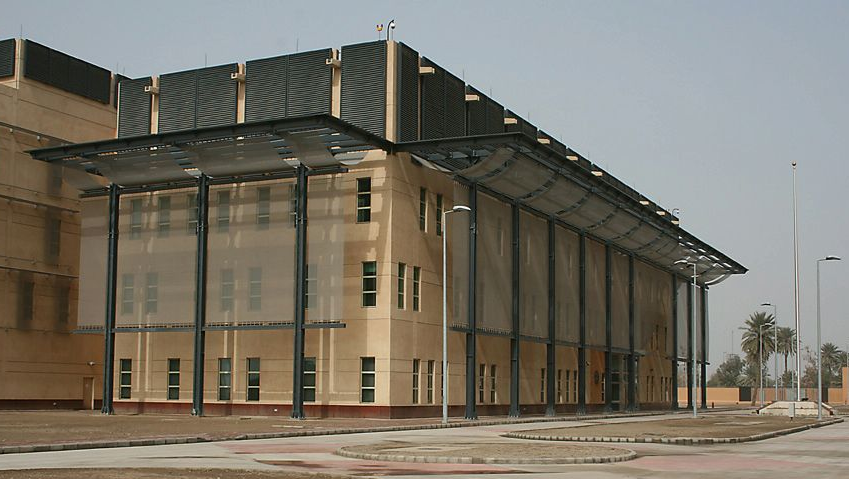
U.S. Embassy, Baghdad

Moreover: “Rudaw TV showed protesters chanting and taking selfies inside the parliament chamber where moments earlier MPs had been meeting.”

As Al Jazeera explains: “It is the climax of weeks of political turmoil in Iraq that has seen MPs hold a sit-in, brawl in the parliament chamber and seek to sack the speaker, stalling Prime Minister Haider al-Abadi’s efforts to replace party-affiliated ministers with technocrats.”

The further chaos comes just two days after US Vice President Joe Biden arrived in Baghdad in a situation so chaotic for the US’ puppet government that as the New York Times described it (28th April 2016) “ … the political situation in Iraq has become so fluid that Mr. Biden’s team has sometimes been unsure whether officials he planned to meet with would still be in office when he arrived.”

America’s fortress Green Zone has been breached with thousands of protestors breaking in, with one shouting: “You are not staying here! This is your last day in the Green Zone”, according to Al Jazeera (2) who reported that in Parliament: “ … some rioters rampaged through the building and broke into offices, while other protesters shouted: “peacefully, peacefully” and tried to contain the destruction …”

Barbed wire was pulled across the road leading to the Green Zone exits: “preventing some scared lawmakers from fleeing the chaos.”

The hated US imposed and fortified Zone – which was simply central Baghdad for all to wander under Saddam Hussein has finally been breached after thirteen years. Where another period of chaos will end, who knows, but meanwhile diplomats cower in the US Embassy, as factions Iraqis patience finally runs out over the tragedy and disaster that is the US and UK’s illegally imposed “New Iraq.”

“Iraq’s are very quick to revolt”, former Deputy Prime Minister and Foreign Minister, Tareq Aziz, told me in an interview before the invasion, listing the years and the fate of those the uprisings had been against. The decimation since has delayed a further one, but it seems it’s time has arrived.

As for the outcome, updates follow. As we have wondered before in these columns, Embassy roof time for the residents and guests of the US Ambassador – again? Vietnam’s spectre hovers?

Notes

1.    http://www.theguardian.com/world/2016/apr/30/moqtada-al-sadr-supporters-enter-baghdad-parliament-building-green-zone

2.    http://www.aljazeera.com/news/2016/04/protesters-storm-baghdad-green-zone-parliament-160430120004964.html

The crimes of NATO and the United States

From Fort Russ

Translated by Ollie Richardson for Fort Russ
30th January, 2016

Today, Ratko Mladić, Radovan Karadžić and Vojislav Šešelj are in the Hague prison. “The most fair court in the world” – the Hague – accused the former leader and former military leader of the army of Republika Srpska, for crimes against humanity and called them “the most bloody dictators of the late twentieth century”. However, the European Themis has obvious problems with memory, eyesight and hearing. Because, how does one explain that those responsible for the death of millions of people are not sat next to the “Serbian criminals”? Namely, the top leadership of NATO, who have unleashed over the last 20 years, several bloody conflicts, which they diplomatically called “peacekeeper wars”.
Afghanistan, 2011 – The victim of a mistaken NATO airstrike 
This section being dedicated not only to NATO crimes but also the United States of America is not accidental. Being one of the founding members of a military bloc and its main driving force, as well as having their representatives as the leaders of majority committees to the headquarters of NATO, the US often acts as a main initiator of the military operations.
STATISTICS FOR NATO’S “PEACEKEEPING OPERATIONS”
Yugoslavia
  • Dead – 5,700 people, including 400 children
  • Wounded – nearly 7,000 civilians, 30% of them children
  • Missing – 821 people
  • Excess mortality as a result of deterioration of conditions of existence not estimated
Afghanistan
  • Dead – 35,000 people
  • Refugees – 500,000 people
  • As well as the aggravation of inter-ethnic conflicts, terrorist attacks, increased drug trafficking
Iraq
  • During the war in Iraq over 1 million Iraqis were killed – this is a greatest loss in modern history. A quarter of them women and children.
  • During the operation, NATO forces used forbidden weapons, namely white phosphorus.
Libya
  • Killed more than 20,000 people (military and civilians)
  • Refugees – more than 350,000 people
In August 2011, NATO Secretary General Anders Fogh Rasmussen claimed that the actions of the aviation of NATO forces in Libya caused no civilian casualties.
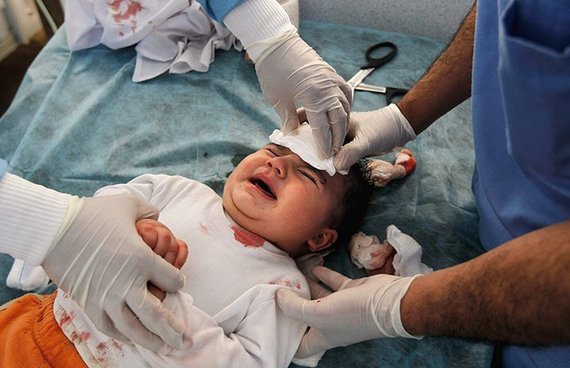
Libya, 2011 – Doctors help child who suffered from wounds in the besieged Libyan city of Misrata
LIST OF NATO’S CRIMES
1. DECEIVING THE WORLD COMMUNITY
Someone wise once said, “Anyone who has once proclaimed violence as his method must inexorably choose lying as his principle”. The US alone, or via the use of NATO forces, have started all military conflicts with deception, distorting the true reasons of the start of hostilities.
Vietnam
The incident in the Gulf of Tonkin in August 1964 may serve as the beginning of the great American fraud, which unleashed the bloody campaign of Vietnam, which began due to the fact that North Vietnamese speedboats, allegedly, attacked the United States fleet. After 40 years, the U.S. government declassified archival military documents from which it became clear that the cause of the beginning of the Vietnam campaign was shamelessly fabricated (mywebs.su/blog/1310.html). Following the Tonkin incident, the bombing of settlements in Vietnam resulted in thousands of victims among the civilian population.
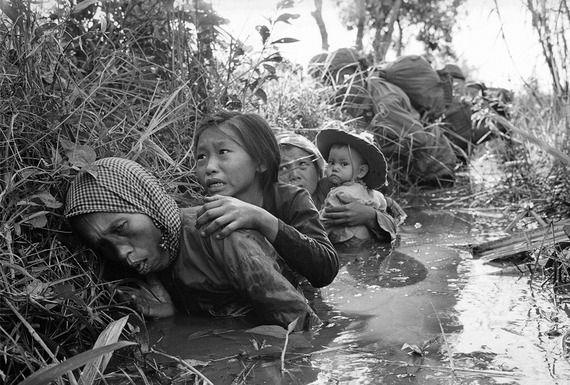
Vietnam, 1 January 1966 – Women and children hide in a ditch from the intense shelling 
The countries of former Yugoslavia
After the collapse of the Soviet Union and the dissolution of the Warsaw Pact, the Alliance began to feverishly look for a reason for their continued existence. The main one was the so-called “peacekeeping mission” when NATO entered in the resolution of ethnic conflicts, pursuing purely personal goals (especially the extension of their influence). As, for example, in the Balkans, when they invaded the region, and directly participated in the escalation of ethnic wars.
The military action of NATO against the former Republic of Yugoslavia, marking the beginning of the modern operations unit, is an example of flagrant violations of all norms and legislation, including the Organization of the North Atlantic Alliance (beta-press.ru/article/34). First of all, NATO violated its own Charter, the Washington Treaty, the 1st article of which stipulates that members of the Alliance must “settle all international disputes in which they may be involved in by peaceful means in such a way as not to endanger international peace, security and justice, and to refrain in their international relations from the threat or use of force in any manner inconsistent with the purposes of the United Nations”. The 6th article of the Treaty was also grossly violated, which states that the competence of NATO is limited to the territory of member countries of the Alliance, and Yugoslavia, Macedonia, Albania and Bosnia were not members of NATO. What can we say about the 7th article of the Washington Treaty, which clearly stipulates that the Alliance recognizes “the responsibility of the Security Council for the maintenance of international peace and security” (nato.int/cps/ru/natolive/official_texts_17120.htm).
American TIME magazine on September 11, 1995 was published under the title “Bringing the Serbs to heel. Massive bombing opens the door to peace”
NATO’s aggression against the former Yugoslavia almost negated all UN peacekeeping missions. The main reason for the invasion of the bloc in the Balkan country became its steadfast refusal to the ultimatum of NATO to concede its territory to the military forces of the Alliance. The condition of the Alliance meant nothing other than hard intervention in the internal affairs of a sovereign state and a threat to its territorial integrity. All of these actions violated the 1st article of the UN Resolution of 1974: “Aggression is the use of armed force by a state (group of States) against the sovereignty, territorial integrity or political independence of another state or in any other manner inconsistent with the Charter of the United Nations, as set out in this definition” (politics.ru/articles/database/global/pravoviie_dokumentii/rezoliutsiia_generalnoij_assamblei_oon_%C2%ABopredelen.shtml).
The best thing about the crimes of the U.S. and NATO in Yugoslavia was, the once the best friend of the West, dissident and human rights activist Alexander Solzhenitsyn, comparing the actions of the Alliance with Nazi crimes: “The worst thing that is happening today is not even the bombing of Serbia, while it is difficult to pronounce, – the most terrible thing is that NATO has transferred us into a new era. Just as Hitler once was, playing another adventures, withdrawing Germany from the League of Nations… USA and NATO removed the UN system of collective security, the recognition of the sovereignty of states. They started a new era: who ever is stronger, will crush. It’s scary…” (aif.ru/politics/article/comments/53043).
Iraq
The U.S invaded Iraq under the pretext of the presence of weapons of mass destruction, namely bacteriological (anthrax) (newsru.com/world/05feb2003/powellun.html). An additional reason was already familiar by that point – the fight for democracy. “Democratization” of Iraq has cost the lives of a million civilians (excluding losses for the military). “The dictator” Hussein was publicly executed, and weapons of mass destruction, which allegedly threatened the world, were never found. Later, in 2004, the U.S. Secretary of State Colin Powell admitted the published data, which marked the beginning of a bloody war, were, to put it mildly, “inaccurate” or simply falsified. “When I did a report in February 2003, it was based on the best information which was provided by the CIA. Unfortunately, over time, it became clear that the sources were inaccurate and wrong and in some cases, deliberately misleading. I’m deeply disappointed and I regret it” – Powell told the press (aif.ru/politics/article/comments/53043). He is sorry.
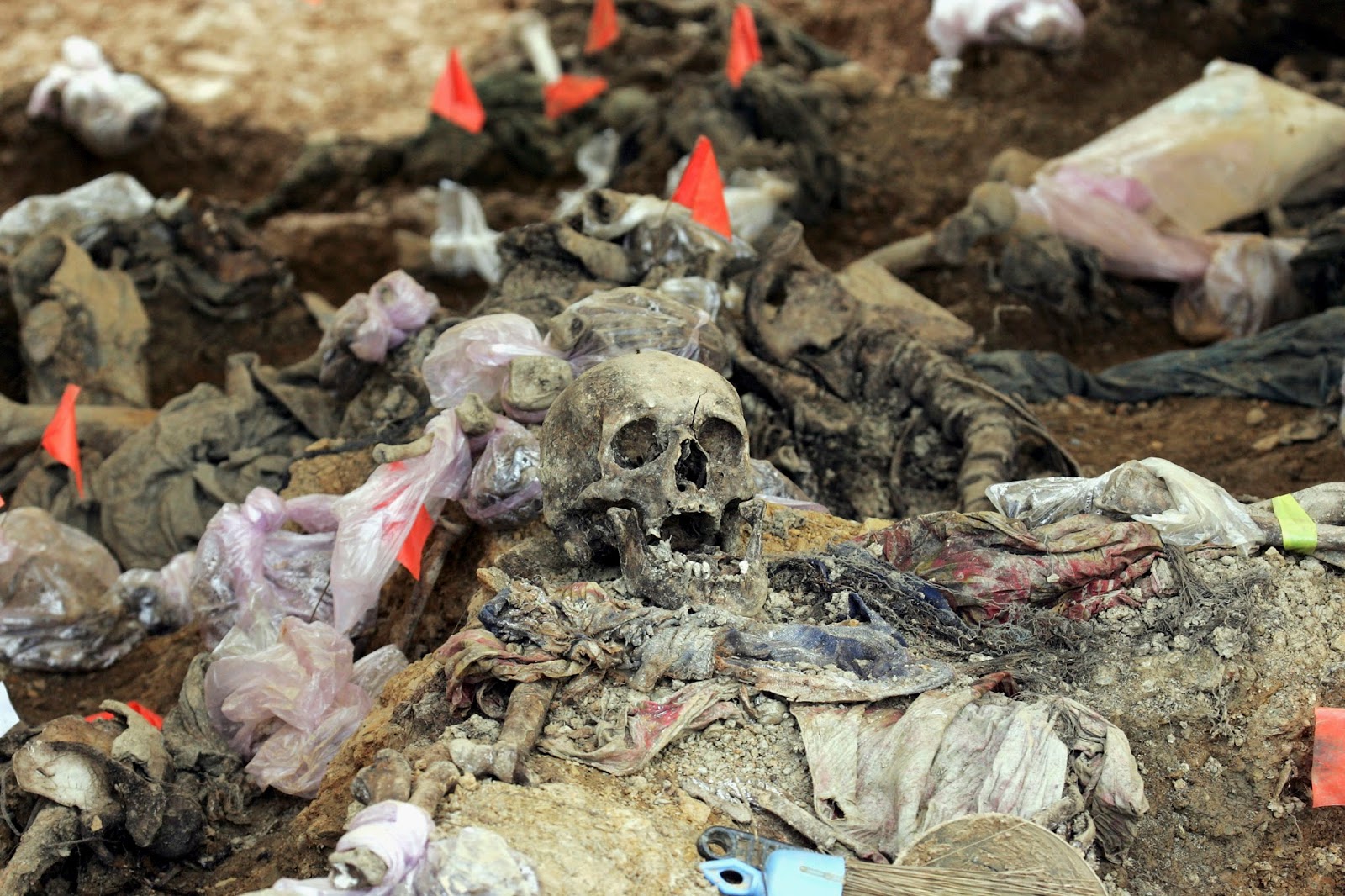
Iraq, 2003 – A father carries his mutilated, dead daughter after NATO’s bombing 
2. THE USE OF PROHIBITED WEAPONS
Vietnam
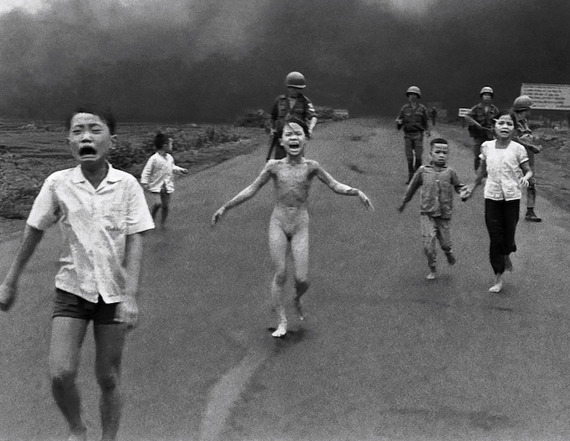
They used Napalm bombs – a weapon that is an incendiary, flamethrower mixture. As gelled gasoline, Napalm literally burnt them alive. Later, in 1980, the UN adopted the Convention on the prohibition of certain types of weapons, the 3rd Protocol would read that the use of incendiary weapons, including Napalm, against civilians is a crime. But during the Vietnam war these bombs had already killed and affected hundreds of thousands of Vietnamese.
8 June 1972 –  9 year-old Kim Phuc (center) flees from a Napalm bombing on the highway near Trang Bang. This photo went around the world and raised a storm of protest against the criminal policy of the USA in Vietnam
The countries of former Yugoslavia
In military operations against that country, NATO used weapons that were banned by the Nuremberg Charter and Geneva and Hague conventions. Firstly, in Yugoslavia, shells with a low concentration of uranium were used. This kind of weapon is not only highly accurate, but radioactive and highly toxic, and is dangerous to humans and the environment. Secondly, NATO used so-called cluster bombs – weapons of indirect fire, explosive projectiles, prohibited from the later “Ottawa process minefield” (icbl.org/intro.php). The peculiarity of this weapon is that the explosion occurs only in 50% of cases. Other bombs can lie for years in the ground, activating only in case of accidental contact.
Iraq
The Iraqi venture was marked by a number of high-profile crimes of the Alliance. Torture and abuse of Iraqi detainees at the Abu Ghraib prison stirred up the whole world…
Iraq, 2004 – Americans are photographed in the background of a dumped pile of naked prisoners in Abu Ghraib 
There was violence against civilians (murder, rape, robbery). And, of course, the use of one of the most dreaded types of incendiary chemical weapons, white phosphorus, (during the battle for Nasiriyah in April 2003, as well as the assaults on Fallujah in April and November 2004). This type of weapon, which burns the body and dissolves the flesh to the bone, was banned by the UN Convention on certain weapons in 1980, but the US never ratified it.
Photos of casualties from the use of white phosphorus we will not publish, because it is indeed a very scary sight.
Libya
There is information, which the leadership of NATO stubbornly refuses to acknowledge, that during the conflict in Libya, the military also used cluster bombs and white phosphorus, as was the case during the operations in Yugoslavia and Iraq (oko-planet.su/fail/failvideo/videoweapon/86827-nato-ispolzovalo-klasternye-bomby-v-livii-hotya-otricaet-eto-smotrite-sami.html). Also there is a possibility that NATO dumped uranium dust – a radioactive substance, banned by UN Convention, on Iraqi facilities (voltairenet.org/Voennye-prestupleniya-NATO-uchenye). Finally, many sources claim that in Libya, NATO used mustard gas in combat, a toxic substance “tested” during the years of World wars, and prohibited under various conventions as it is extremely dangerous (newsland.ru/news/detail/id/778279).
3. THE ARMS RACE
One of the main NATO crimes is pulling the world into a new arms race era. NATO is not only placing missile defense systems on the European continent, but also heavily increasing its nuclear capabilities. By the way, the official military doctrine of the Alliance recognizes the right to use nuclear weapons – the kind of weapons banned in 1996 by the world court (beta-press.ru/print.php?id=34), because it can lead to the destruction of humanity. Today, if we add up full military potential of the country-members of the bloc, NATO has 60% of the world’s nuclear arsenal.
The countries of the Alliance from year to year are increasing their military capabilities under the pretext: to “force protection, mobility, and high efficiency” (beta-press.ru/print.php?id=34). They spend huge money on it. For example, the military budget of the EU is about 11%. The spending for defense in the USA and Canada is growing. In the conditions of crisis, this money could go to peaceful humanitarian purposes, who preach to the West for medical services and education, on the development of social policies and environmental protection. But NATO needs a strong army to establish fully and definitively their hegemony in the world.
WHY DOES NATO START MILITARY CONFLICTS?
Americans themselves like to say that they are people of practical storage. They, like anyone else, know how to count money. And like all of history, humanity has fought over resources – be it gold, timber, or oil, and today, Americans aim to establish their influence in all strategically important regions of the planet. Petroleum countries have recently found problems with democracy and their mandatory dictator leader. It is in these countries that NATO tries to dominate, with the help of the world community, or by simply ignoring their opinion. As they say, morality in business is the concept of losing. So was Iraq and so was Libya. And in turn – Damascus.
The Expert Council for Foreign and Defense Policy, Sergey Karaganov, characterizes the current policy of the NATO countries – a priori cannot be a guarantor of stability and security in the world: “For example, Europe has officially announced that one of the main objectives of its policy – the access of European companies to the African market and resources. At any cost! It, above all, affects the interests of China, who, incidentally, are assessing the situation in the Middle East, having serious levers of pressure on Europe, and have not yet said their weighty word. This concerns Russia: in Guinea, the Europeans are already trying to remove RUSAL, “LUKOIL” from Côte d’Ivoire… And in the battle for Africa, the Europeans need to turn the Mediterranean sea into a “NATO Lake”. To solve this problem, Syria could become another Algeria (newsland.ru/news/detail/id/984811/).
So NATO, in this business scheme, is just a means to achieve the goal.

Declassified memo proves the Pentagon had ZERO evidence of WMDs in Iraq

From Activist Post
By Justin Gardner
January 26, 2016

Thirteen years after the invasion and occupation of Iraq, it is common knowledge that this war of choice was based on fabrications and slick propaganda. There were no weapons of mass destruction, the country posed no real threat to the U.S., and it was not a hotbed of terrorism until after Saddam was deposed.

Now, a bombshell has dropped in the form of a leaked classified report—a “smoking gun” if you will—that confirms the utter deception carried out on the American people to support the invasion. It demonstrates just how far the cabal under George W. Bush, making up a group known as the Project for the New American Century (PNAC), would go to prey upon fear in pursuit of global hegemony.

While Dick Cheney, Donald Rumsfeld and others were proclaiming their certainty about the imminent threats posed to the U.S. by Saddam’s Iraq, the leaked documents reveal that they knew almost nothing about any actual weapons or capabilities.

On August 16, 2002, Defense Secretary Donald Rumsfeld asked Air Force Maj. Gen. Glen Shaffer, head of the Joint Staff’s intelligence directorate, for a report on “what we don’t know (in a percentage) about the Iraqi WMD program.”

The findings, titled Iraq: Status of WMD Programs, were underscored by this statement:

Our assessments rely heavily on analytic assumptions and judgment rather than hard evidence. The evidentiary base is particularly sparse for Iraqi nuclear programs.

Regarding the actual programs, it says:

We’ve struggled to estimate the unknowns. … We range from 0% to about 75% knowledge on various aspects of their program…

Our knowledge of the Iraqi (nuclear) weapons program is based largely—perhaps 90%—on analysis of imprecise intelligence.

When forwarding the report, Air Force Maj. Gen. Glen Shaffer answered Rumsfeld’s original question by noting, “We don’t know with any precision how much we don’t know.

Rumsfeld apparently believed the report had some significance when he sent it to the chairman of the Joint Chiefs of Staff, saying, “Please take a look at this material as to what we don’t know about WMD. It is big.

Considering that this was a summary of all that the U.S. intelligence apparatus knew about Iraq’s WMD capabilities (or lack thereof), how could any responsible leader try and sell the invasion to the American people?

Yet that is what happened, perhaps no more fervently than Vice President Dick Cheney. There are countless examples of Cheney stating in no uncertain terms the nuclear, chemical, biological and ballistic missile threats that Saddam’s Iraq posed to the U.S.

Cheney asserted that Iraq was secretly reconstituting its biological and chemical weapons programs, but the report stated:

We cannot confirm the identity of any Iraqi facilities that produce, test, fill, or store biological weapons.

We do not know if all the processes required to produce a weapon are in place. [The Iraqis] lack the precursors for sustained nerve agent production…we cannot confirm the identity of any Iraqi sites that produce final chemical agent.

While Cheney and the gang issued repeated fear-mongering about “mushroom clouds,” the report stated:

We do not know the status of enrichment capabilities. We do not know with confidence the location of any nuclear-weapon-related facilities.

Days before Bush claimed that Iraq was developing ballistic missiles that could hit Israel with WMD, the report had found:

We doubt all processes are in place to produce longer range missiles.

The secret report was kept from the view of key players in the propaganda campaign, including Colin Powell who was made to look the fool [Ed: other evidence has shown that Colin Powell knowingly lied]. Just before the invasion, Powell said before the U.N. General Assembly:

My colleagues, every statement I make today is backed up by sources, solid sources. These are not assertions. What we’re giving you are facts and conclusions based on solid intelligence.

With this lack of factual evidence for their yearning to invade Iraq—a goal of PNAC since 1998—the war-mongering officials with deep ties to the defense industry proceeded to fabricate their own tales to justify the propaganda campaign.

They turned to a parallel intelligence apparatus that they created, which relied on a network of Iraqi defectors and exiles, most notably the late Ahmed Chalabi who admitted he provided wrong information.

Back home, Cheney and Rumsfeld had set up something called the Office of Special Plans, run by Paul Wolfowitz and Douglas Feith. This Pentagon office sent raw intelligence from Chalabi and other nefarious sources directly to the president, unvetted by intelligence analysts and uncorroborated.

If there was ever a smoking gun, this is it. If there was ever enough reason to bring charges of war crimes and other abuses of power against George W. Bush and Dick Cheney, this report provides it.

Justin Gardner writes for TheFreeThoughtProject.com

Copyright Justin Gardner 2016

http://www.activistpost.com/2016/01/declassified-memo-proves-the-pentagon-had-zero-evidence-of-wmds-in-iraq.html