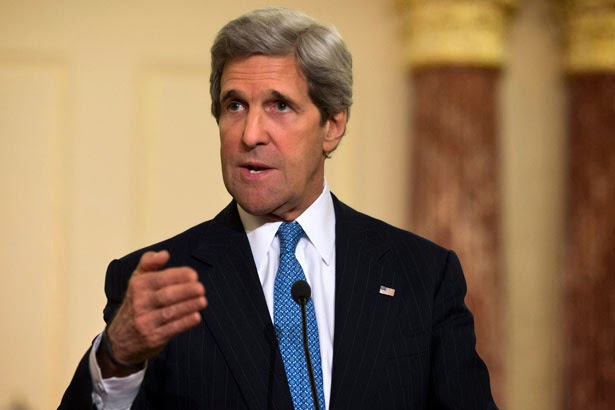
Key statements following meeting between Putin, Lavrov, and Kerry in Moscow

The Kremlin website may have more substantial information, at least on what the Russian delegation said.

Hopefully, the Kremlin counted the silver before the US delegation left. With Nuland, Tefft and company, no telling what they would lift as souvenirs.

From Fort Russ

Translated by Ollie Richardson for Fort Russ
15th December, 2015

U.S. Secretary of state John Kerry confirmed to the President of Russia Vladimir Putin that Washington is ready to work with Moscow to defeat the terrorist organization ISIS.
The President of Russia Vladimir Putin met with U.S. Secretary of State John Kerry after his talks in Moscow with Russian foreign Minister Sergei Lavrov.
In the meeting, which lasted more than three hours, the Russian side was also attended by the Russian presidential aide Yuri Ushakov, on the American side assistant Secretary of state Victoria Nuland, special assistant to the U.S. President for Russia Celeste Wallander and the US Ambassador to Russia John Tefft.
On the situation in Syria:
 
The parties agreed to continue work on compiling the list of terrorist organizations operating in Syria.
 

We agreed to continue to work in terms of compiling a unified list of terrorist organizations and to assist the UN in forming the delegations of the opposition – Sergei Lavrov

We found some areas of agreement in the classification of terrorist groups, but I can’t talk now about what we have agreed on a bilateral basis, because, as he said Sergei (Lavrov), the whole support Group Syria should participate in this discussion and it is important that all contributed to the decision – John Kerry

U.S. Secretary of state John Kerry confirmed to the President of Russia Vladimir Putin that the United States stands ready to work with Russia to defeat Russia banned terrorist organization “Islamic state” (is, formerly ISIS).
 

I confirmed to President Putin that U.S. ready to work with Russia to defeat the ISIL – John Kerry

Confirmed today the agreements that were reached between the military of the Russian Federation and the United States, and agreements that apply to the United States led a coalition to combat “Islamic state” (ISIS is a terrorist group banned in Russia). In practical terms agreed on some further steps that will help to make the fight against terrorism more effective – Sergei Lavrov

The parties agreed that the agreements reached in Vienna on Syria was approved by a UN resolution.

We agreed to continue work on the terrorist problem and on the organization of negotiations between the government and the opposition, we nevertheless deemed it appropriate at this stage to confirm the agreements that were reached in Vienna on October 30 and November 14 in the form of a resolution of the UN Security Council – Sergey Lavrov

During the negotiations was also affected by the military operation HQs of the Russian Federation in the SAR.

A recent report to the UN contained the assertion that the Russian operation in Syria has led to increased suffering of the civilian population. In these statements there were no references to facts. We requested the UN present such facts – Sergei Lavrov

 
Isolation of Russia is not included in the plans of the United States:
 
At the conclusion of the talks, Kerry said U.S. President Barack Obama about Russia’s isolation and explained that they were caused by the situation with the Crimea. Also the parties expressed unanimity in commitment to the Minsk agreements on settling the situation in Ukraine.
 

We exchanged assessments regarding the challenges to resolve the crisis in Ukraine. The Russian Federation and the USA are building on the agreements in principle reached between presidents Putin and Obama reaffirm their support of the Minsk agreements, we support “Normandy format” and will use their opportunities to achieve full implementation of the Minsk agreements – Sergei Lavrov

The USA does not have a specific policy on the isolation of the Russian Federation. We have a position related to the fact that we defend our principles and values. But, like I said, it is important for us to find areas of agreement and constructive behaviour – John Kerry

http://fortruss.blogspot.com/2015/12/key-statements-following-meeting.html

Turkey’s downing of Russian jet in Syrian airspace a breach of Syria’s sovereignty

From Syrian-Arab News Agency SANA

al-Moallem - Lavrov

Moscow, SANA –Deputy Prime Minister, Foreign and Expatriates Minister Walid al-Moallem affirmed that Turkey’s downing of the Russian warplane is an “act of aggression” that encroaches on the sovereignty of Syria as the plane was shot down in Syrian airspace, adding that Turkey has failed to provide any clear evidence regarding this incident.

In a joint press conference with his Russian counterpart Sergey Lavrov, al-Moallem stressed that Turkey is supporting terrorist organizations with weapons and facilitating their movements through the Turkish lands and securing their families.

Al-Moallem hailed the stances of the Russian leadership towards Syria, mainly the efforts exerted by minister Lavrov in promoting the political process in Vienna, noting that these stances reflect the depth of the strategic alliance between Syria and Russia, describing his talks with minister Lavrov as “frank and constructive”.

Addressing those who are demanding President Bashar al-Assad to step down, al-Moallem said “You are delusional and the reason is obvious because President al-Assad believes in the right of Syrian people to self-determination and will not allow anyone to take this right away,” said Al-Moallem.

The minister pointed out that the Russian Air Force in cooperation with Syrian Arab Army had put an end to the dreams of Erdogan which prompted Turkey to mount this aggression.

Al-Moallem said that Turkey continues to provide a cover for ISIS oil smuggling operations from Syria and Iraq into Turkey before heading to ports abroad.

Al-Moallem challenged the US Secretary of State John Kerry to offer a single piece of evidence that the Syrian side is striking oil deals with ISIS. “After all, it is not his first lie,” al-Moallem mocked.

Commenting on the statements of the French Foreign Minister Laurent Fabius, al-Moallem told journalists that Syria has always pointed to Europe’s wrong handling of the crisis in Syria, repeatedly warning that terrorism will backfire on those who support it and regretting that Britain and France are leading the European efforts against Syria’s legitimate government.

Fabius’ overtures and willingness to cooperate with the Syrian army, if proven genuine, is welcome, al-Moallem added, but said a drastic change is need in the approach to the Syrian crisis.

In turn, Lavrov confirmed that Russia will offer all it can to help Syria in combating terrorism, preserving its national unity, rebuilding it and providing Syria with the effective support on the international level.

Lavrov issued a blistering criticism against the statements of some Syria’s neighboring countries in which they fake commitment to UN counter-terrorism resolutions while “playing their own games” by forging alliances with terrorists, describing their conduct as “very impudent.”

He questioned Turkey’s interest in eliminating terrorism and restoring security and stability in Syria, voicing Russia’s full readiness to cooperate with all countries who want to fight terrorism which are part of the US-led anti-ISIS coalition that has so far “yielded no tangible results.”

Lavrov said it is important to prepare a list of terrorist organizations which ought to be kept away from any political process and excluded from any potential ceasefire agreement. If this does not happen, he added, Vienna meeting won’t bear fruit.

He pointed out the need to hold Syrian-Syrian dialogue which brings together the Syrian government and part of the opposition adding that all the parties concerned should contribute to supporting a peaceful political process and exert their efforts to launch dialogue.

The essence of the Vienna talks stipulates that the Syrians should determine the future of their country without outside interference, adding that Russia opposes Western attempts to come up with candidates for Syria’s leadership,” Lavrov added.

Commenting on the downing of a Russian Su-24 bomber by the Turkish Air Force, Lavrov wondered if Turkey is interested in combating terrorism in Syria and in the efforts to achieve stability and security.

Lavrov criticized Turkey’s contradicting statements concerning the downing of the Russian aircraft, particularly claiming that the Turkish air force did not recognize the jet to be Russian, only to contradict this later by stating that Turkey would have responded in the same way had any other jet violated its airspace.

Pointing to stepped up procedures against Turkey, Lavrov said Russia has decided to freeze the visa waiver system with Turkey in fear of “real, not hypothetical threats”.

Lavrov said eliminating ISIS is a necessity and Syria’s neighboring countries have a special responsibility in this confirming that combating terrorism in the Middle East requires abandoning double standard policies.

The minister said Russia strongly supports French President Francois Hollande’s statement about the necessity of closing the Turkish-Syrian borders, indicating that practical steps need to be taken in coordination with the Syrian government to defeat terrorism in Syria.

Al-Moallem: Syrian army making advances on all fronts backed by Russian air force

Earlier on Friday, the minister al-Moallem said the Syrian army is making progress on all fronts backed by the Russian air force.

During a meeting with his Russian counterpart Sergey Lavrov in Moscow on Friday, al-Moallem thanked the Russian leadership under President Vladimir Putin for its sincere efforts in supporting Syria against terrorism.

He affirmed that the Russian airstrikes in Syria have so far outdone by hundred times the Us-led coalition in the fight against ISIS, expressing sincere condolences over the death of the Russian pilot whose aircraft was downed by Turkey, describing it as a “stab in the back.”

“We have been at the receiving end of such stabs for over five years,” al-Moallem said.

Lavrov, for his part, said his country highly appreciates the Syrian government’s commitment to counterterrorism, vowing continued support for Syria to rout terrorists.

“We will continue providing all the necessary assistance to Syria in its war against terrorism in parallel with launching a political process,” added Lavrov, thanking the Syrian army for rescuing the Russian pilot whose aircraft was shot down by Turkey and for providing protection for the Russian embassy in Damascus.

“The Turkish leadership has crossed the line of what is acceptable and risks putting Turkey in a most severe situation,” he warned.

Manar al-Frieh/Manal

http://sana.sy/en/?p=62798

The reversal of Kerry’s warning to Poroshenko came from Obama, not Nuland

Here Eric Zuesse writes a correction to his article June 7 http://www.globalresearch.ca/obama-sidelines-kerry-on-ukraine-policy/5454038

War and Peace in Donbass: The Reversal of Kerry’s Ukraine Statement Came from Obama, Not Nuland
By Eric Zuesse, June 10, 2015
Posted on Global Research

When Assistant Secretary of State Victoria Nuland on May 15th contradicted her boss John Kerry’s statement of three days earlier, in which Kerry had warned Ukraine’s President Petro Petroshenko not to violate the Minsk II agreement, and not to invade Crimea, and not to re-invade Donbass, the source of this reversal was actually U.S. President Barack Obama, and not Victoria Nuland (as the State Department had reported).

When I first noticed the contradiction as I reported on May 21st, Nuland’s statement on May 15th was being quoted by Ukraine’s Interfax News Agency, without any link to its U.S. source. I looked but didn’t right away find its U.S. source, but the official Ukrainian news agency would not quote a U.S. Government official falsely, and so I went with the story on that basis.

Now that I have found the U.S. source in the full May 15th U.S. State Department press briefing in Washington, there can be little doubt that Nuland had actually been instructed by the White House to be quoted there as issuing this reversal of Kerry’s statement.

The press conference, by the Department’s press spokesperson Jeff Rathke, opened with an introductory statement in which he asserted:

Assistant Secretary Nuland’s ongoing visit to Kyiv and her discussions with Prime Minister Yatsenyuk and President Poroshenko reaffirm the United States’ full and unbreakable support for Ukraine’s government, sovereignty, and territorial integrity. We continue to stand shoulder to shoulder with the people of Ukraine and reiterate our deep commitment to a single Ukrainian nation, including Crimea, and all the other regions of Ukraine.

That’s all that was reported by Ukraine’s Interfax. Much later in the press conference, however, after reporters had asked him many questions about Iran, Burundi, Japan, Iraq, and other countries, but not Ukraine, one reporter finally asked a single (but unrelated) question about Ukraine, and, after answering it, Rathke interrupted the next reporter’s question, which was about Cuba, to ask all of the assembled press-stenographers, “I’m sorry, any other questions on Ukraine?” and, after not getting any such question, he simply went directly on to say:

I would – if I could take the opportunity, I would also just want to go back to what I said at the top, and just to review what has happened this week with regard to Ukraine. Secretary Kerry was in Sochi at the start of the week, where the Secretary was clear with Russia – President Putin, Foreign Minister Lavrov – about Ukraine and about the consequences for failing to uphold the Minsk commitments. Right after that discussion, he called President Poroshenko to update him and to reaffirm our support for Ukraine. He went from there immediately to the meeting of NATO foreign ministers in Antalya, where he briefed them and also underscored the United States’ commitment when he met with Foreign Minister Klimkin in Antalya. Assistant Secretary Nuland is in Kyiv right now, and the message of all of these engagements is that we stand for the implementation of Minsk. We stand in support of the Ukrainian Government, President Poroshenko, Prime Minister Yatsenyuk, and the Ukrainian people. And I wanted just to make sure that I took that opportunity.

In other words: Kerry, after his statement on May 12th to Putin in Sochi, saying, about Poroshenko’s repeated warnings that Ukraine will retake both Crimea and Donbass —

“we would strongly urge him to think twice not to engage in that kind of activity, that that would put Minsk in serious jeopardy. And we would be very, very concerned about what the consequences of that kind of action at this time may be.”

— was taken to the woodshed by his boss, Obama; and the best way that could be decided upon to issue the reversal was by this indirect one, which would be sourced to his subordinate Nuland, so that Kerry himself wouldn’t have to be the person contradicting himself, and so that the blame for the actually anti-Minsk-agreement position of the U.S. President himself would go instead to Nuland, whom everybody already knows to be a “neo-conservative,” and a hardliner against Russia — and would definitely not go to the Nobel Peace Prize winning U.S. President, Barack Obama.

In other words: the President, who had been behind the February 2014 coup that instigated Russia’s defensive measure of protecting its main naval base (ever since 1783) in Crimea and so Russia’s accepting the overwhelming desire of Crimea’s residents on 16 March 2014 to become again a part of Russia (of which Crimea had always been a part until 1954), wanted to move forward again with the war in Ukraine, and with the resulting sanctions against Russia, all of which were part of Obama’s plan ever since at least the summer of 2013, when the organizing of the overthrow of Yanukovych had started at the U.S. Embassy in Kiev.

The Minsk II agreement had been engineered by Merkel and Hollande of the EU, against the wishes and without the participation of Obama, and this is the sort of thing that Nuland had had in mind about the EU when she had told Geoffrey Pyatt, America’s Kiev Ambassador, on 4 February 2014, “F—k the EU!” and instructed him then whom to get appointed to run Ukraine after the coup (“Yats” Yatsenyuk), which coup then culminated 18 days later, onFebruary 22nd. (Yatsenyuk received the official appointment on February 26th.)

This likewise explains the reason why Ukraine’s President Poroshenko, as I reported on June 7th, said again, on June 5th, that Ukraine will retake both Crimea and Donbass. He has Obama’s wind to his sails on this (and not only Nuland’s).

So: the war will continue, as Obama wants, and probably the resistance to it on the part of the EU will continue to be ineffectual and half-hearted.

And the sanctions against Russia, for responding as it must to Obama’s actions, will also continue, which is also part of Obama’s original plan. (What was not part of Obama’s plan, however, was the continued survival of millions of the residents in Donbass, the former region of Ukraine that had voted 90%+ for the man, Viktor Yanukovych, whom Obama overthrew. But Obama evidently has not given up his goal of eliminating them.)

The people who say that Obama doesn’t have a plan are simply ignoring it. The evidence is very clear what the plan is. And it is succeeding: it’s a war-plan against Russia.

Investigative historian Eric Zuesse is the author, most recently, of They’re Not Even Close: The Democratic vs. Republican Economic Records, 1910-2010, and of CHRIST’S VENTRILOQUISTS: The Event that Created Christianity, and of Feudalism, Fascism, Libertarianism and

http://www.globalresearch.ca/war-and-peace-in-donbass-the-reversal-of-kerrys-ukraine-statement-came-from-obama-not-nuland/5454561

President Obama sides with Victoria Nuland on Ukraine. Will John Kerry resign?

By Eric Zuesse
Global Research, June 7, 2015

kerry_0

On May 21st, I headlined “Secretary of State John Kerry v. His Subordinate Victoria Nuland, Regarding Ukraine,” and quoted John Kerry’s May 12th warning to Ukrainian President Petro Poroshenko to cease his repeated threats to invade Crimea and re-invade Donbass, two former regions of Ukraine, which had refused to accept the legitimacy of the new regime that was imposed on Ukraine in violent clashes during February 2014. (These were regions that had voted overwhelmingly for the Ukrainian President who had just been overthrown.)

They didn’t like him being violently tossed out and replaced by his enemies.) Kerry said then that, regarding Poroshenko,

“we would strongly urge him to think twice not to engage in that kind of activity, that that would put Minsk in serious jeopardy. And we would be very, very concerned about what the consequences of that kind of action at this time may be.”

Also quoted there was Kerry’s subordinate, Victoria Nuland, three days later, saying the exact opposite, that we “reiterate our deep commitment to a single Ukrainian nation, including Crimea, and all the other regions of Ukraine.” I noted, then that, “The only person with the power to fire Nuland is actually U.S. President Barack Obama.” However, Obama instead has sided with Nuland on this.

Radio Free Europe, Radio Liberty, bannered, on June 5th, “Poroshenko: Ukraine Will ‘Do Everything’ To Retake Crimea’,” and reported that

President Petro Poroshenko has vowed to seek Crimea’s return to Ukrainian rule. … Speaking at a news conference on June 5, … Poroshenko said that ‘every day and every moment, we will do everything to return Crimea to Ukraine.’”

Poroshenko was also quoted there as saying, ”It is important not to give Russia a chance to break the world’s pro-Ukrainian coalition,” which indirectly insulted Kerry for his having criticized Poroshenko’s warnings that he intended to invade Crimea and Donbass.

Right now, the Minsk II ceasefire has broken down and there are accusations on both sides that the other is to blame. What cannot be denied is that at least three times, on April 30th, then on May 11th, and then on June 5th, Poroshenko has repeatedly promised to invade Crimea, which wasn’t even mentioned in the Minsk II agreement; and that he was also promising to re-invade Donbass, something that is explicitly prohibited in this agreement. Furthermore, America’s President, Barack Obama, did not fire Kerry’s subordinate, Nuland, for her contradicting her boss on this important matter.

How will that be taken in European capitals? Kerry was reaffirming the position of Merkel and Hollande, the key shapers of the Minsk II agreement; and Nuland was nullifying them. Obama now has sided with Nuland on this; it’s a slap in the face to the EU: Poroshenko can continue ignoring Kerry and can blatantly ignore the Minsk II agreement; and Obama tacitly sides with Poroshenko and Nuland, against Kerry.

The personalities here are important: On 4 February 2014, in the very same phone-conversation with Geoffrey Pyatt, America’s Ambassador in Ukraine, in which Nuland had instructed Pyatt to get “Yats” Yatsenyuk appointed to lead Ukraine after the coup (which then occurred 18 days later), she also famously said “F—k  the EU!” Obama is now seconding that statement of hers.

In effect, Obama is telling the EU that they can get anything they want signed, but that he would still move forward with his own policy, regardless of whether or not they like it.

Kerry, for his part, now faces the decision as to whether to quit — which would force the EU’s hand regarding whether to continue with U.S. policy there — or else for Kerry to stay in office and be disrespected in all capitals for his staying on after having been so blatantly contradicted by his subordinate on a key issue of U.S. foreign policy. If he stays on while Nuland also does, then, in effect, Kerry is being cut out of policymaking on Europe and Asia (Nuland’s territory), altogether, and the EU needs to communicate directly with Obama on everything, or else to communicate with Nuland as if she and not Kerry were the actual U.S. Secretary of State. But if Kerry instead quits, then the pressure would be placed on EU officials: whether to continue with the U.S., or to reject U.S. anti-Russia policy, and to move forward by leaving NATO, and all that that entails?

If they then decide to stay with the U.S., after that “F—k the EU!” and then this; then, the European countries are clearly just U.S. colonies. This would be far more embarrassing to those leaders than John Kerry would be embarrassed by his simply resigning from the U.S. State Department. It might even turn the tide and force the Ukrainian Government to follow through with all of its commitments under the Minsk II accords.

It would be the most effective thing for Kerry to do at this stage. But, it would lose him his position as a (now merely nominal) member of Obama’s Cabinet.

The way this turns out will show a lot, about John Kerry. The nations of Europe already know everything they need to know about Barack Obama. If Kerry quits, he’ll have respect around the world. If he stays, he’ll be just another Colin Powell.

The ball is in Kerry’s court, and everyone will see how he plays it — and what type of man he is (and isn’t).

Investigative historian Eric Zuesse is the author, most recently, of  They’re Not Even Close: The Democratic vs. Republican Economic Records, 1910-2010, and of CHRIST’S VENTRILOQUISTS: The Event that Created Christianity, and of  Feudalism, Fascism, Libertarianism and Economics

http://www.globalresearch.ca/obama-sidelines-kerry-on-ukraine-policy/5454038

Secretary of State John Kerry v. his subordinate Victoria Nuland, regarding Ukraine

by Eric Zuesse
Posted on Washington’s Blog, May 21, 2015

U.S. Secretary of State John Kerry, on May 12th, responding to Ukrainian President Petro Poroshenko’s assertions that Ukraine will retake Crimea and will conquer Donbass:

“I have not had a chance – I have not read the speech. I haven’t seen any context. I have simply heard about it in the course of today. But if indeed President Poroshenko is advocating an engagement in a forceful effort at this time, we would strongly urge him to think twice not to engage in that kind of activity, that that would put Minsk in serious jeopardy. And we would be very, very concerned about what the consequences of that kind of action at this time may be.”

U.S. Assistant Secretary of State for European & Eurasian Affairs, Victoria Nuland, as communicated by the U.S. State Department’s Press Office on May 15th, reiterating Poroshenko’s view:

“Assistant Secretary Nuland’s ongoing visit to Kyiv and her discussions with Prime Minister [Arseniy] Yatseniuk and President [Petro] Poroshenko reaffirm the United States’ full and unbreakable support for Ukraine’s government, sovereignty, and territorial integrity. We continue to stand shoulder to shoulder with the people of Ukraine and reiterate our deep commitment to a single Ukrainian nation, including Crimea, and all the other regions of Ukraine.”

Will John Kerry reprimand his subordinate for her contradicting what he, her boss, had said three days earlier? If not, then will President Barack Obama fire his Secretary of State John Kerry? If not, then will Victoria Nuland be fired? If not, then who is to trust anything that comes from the U.S. State Department, when the Secretary of State can be contradicted three days later by his subordinate, and both remain in their respective jobs?

Republicans are already preparing to weaken Kerry over this. The far-right news-site “Frontpage Mag” headlined on May 21st, “John Kerry’s Seven Hours of Weakness in Russia,” and condemned the “attempt by Kerry to re-set the ‘re-set’ button [on U.S. policy toward Russia] first pushed by his predecessor, Hillary Clinton.” The special subject of their ire: “The promise of ‘rolling back’ the mild sanctions regime the West imposed on Russia on account of Putin’s annexation of Crimea and support of separatist rebels was bandied about, if only Russia would behave in the future.” But winning changes in behavior is what international diplomacy is supposed to be all about — otherwise the State Department wouldn’t even be needed, and only the Pentagon would handle America’s foreign relations.

If Victoria Nuland stays in her job, then John Kerry will be neutered even if he’s not fired.

The only person with the power to fire Nuland is actually U.S. President Barack Obama. Perhaps the request for him to do that is already on his desk. If it’s not, then Kerry’s job is in jeopardy, because his diplomatic efforts can be obliterated by a subordinate and that subordinate will suffer no penalty for doing this. Nobody then would respect anything that the U.S. Secretary of State says, because it would necessarily represent the President’s policies. If the Secretary of State isn’t backed up by the President, then the Secretary of State has no real power at all.

———-

Investigative historian Eric Zuesse is the author, most recently, of  They’re Not Even Close: The Democratic vs. Republican Economic Records, 1910-2010, and of  CHRIST’S VENTRILOQUISTS: The Event that Created Christianity, and of  Feudalism, Fascism, Libertarianism and Economics

http://www.washingtonsblog.com/2015/05/secretary-of-state-john-kerry-v-his-subordinate-victoria-nuland-regarding-ukraine.html


State Dept. briefing May 15 via Nuland contradicts Kerry

From the US State Department
http://www.state.gov/r/pa/prs/dpb/2015/05/242432.htm

Daily Press Briefing – May 15, 2015 – US Department of State

TRANSCRIPT:

excerpt

…Second item, Ukraine. As the Secretary said at the NATO ministerial meeting in Antalya, Turkey, earlier this week, this is a critical moment for action by Russia and the separatists to live up to the Minsk agreements. Ukraine’s leaders continue to implement their Minsk commitments, just as they have answered the call of the Ukrainian people on the Maidan by delivering the largest reforms since Ukraine’s independence in less than a year, and they aren’t stopping. Assistant Secretary Nuland’s ongoing visit to Kyiv and her discussions with Prime Minister Yatsenyuk and President Poroshenko reaffirm the United States’ full and unbreakable support for Ukraine’s government, sovereignty, and territorial integrity. We continue to stand shoulder to shoulder with the people of Ukraine and reiterate our deep commitment to a single Ukrainian nation, including Crimea, and all the other regions of Ukraine.

QUESTION: In your opening statement you mentioned what you called a critical moment. Considering that there are ongoing concerns about Russia’s engagement in Ukraine, has there been any movement in the U.S. position to consider selling defensive lethal weapons to Ukraine? And if not, is there a point in which the U.S. would consider such sales?

MR RATHKE: Well, our focus from the outset of the crisis has been on supporting Ukraine and on pursuing a diplomatic solution that respects Ukraine’s sovereignty and territorial integrity. We constantly assess our policies on Ukraine to ensure that they are calibrated to achieve our objectives. I’m not going to go into the details of internal policy discussions, but we continue to assess how best to asses Ukraine. I don’t have an announcement to make now, but we continue to assess that.

QUESTION: So are you saying the door is possibly open or —

MR RATHKE: I’d just say we continue to assess that, that we are constantly looking at our policies on Ukraine. But I don’t have an announcement to make.

MR RATHKE: I’m sorry. Any other questions on Ukraine?

I would – if I could take the opportunity, I would also just want to go back to what I said at the top, and just to review what has happened this week with regard to Ukraine. Secretary Kerry was in Sochi at the start of the week, where the Secretary was clear with Russia – President Putin, Foreign Minister Lavrov – about Ukraine and about the consequences for failing to uphold the Minsk commitments. Right after that discussion, he called President Poroshenko to update him and to reaffirm our support for Ukraine. He went from there immediately to the meeting of NATO foreign ministers in Antalya, where he briefed them and also underscored the United States’ commitment when he met with Foreign Minister Klimkin in Antalya. Assistant Secretary Nuland is in Kyiv right now, and the message of all of these engagements is that we stand for the implementation of Minsk. We stand in support of the Ukrainian Government, President Poroshenko, Prime Minister Yatsenyuk, and the Ukrainian people. And I wanted just to make sure that I took that opportunity.

[on the topic of Okinawa’s opposition to continued US military presence there]

QUESTION: Okay. Today is the 43rd anniversary of the Okinawa’s reversion to Japan and sovereignty from the United States occupies, but still Okinawa have been hosting the large – the U.S. military facility since the World War II. And Okinawa governor Onaga and is strongly opposite to constructing the new U.S. military base in Henako. And also this Sunday, major rally against the base construction will be held in Okinawa, and they expected even to draw up at least 30,000 participants. So how do you think about that Okinawa situation?

MR RATHKE: Well, this is an issue on which we’re working with the Japanese Government. We are committed to the – to moving to the replacement facility. We’re working with the Japanese Government to that end. The Japanese Government as well is committed to it. They can speak to those details for themselves. So I don’t have an update to offer except to say that our commitment to Japan remains. It was underscored yet again during Prime Minister Abe’s visit and during the 2+2 meeting that happened during that same week. And so our commitment and our policy remains the same.

US State Dept. chief Kerry strongly warns Poroshenko about attempting to retake Donbass and Crimea: “Think twice”

By Eric Zuesse
Posted on Global Research, May 19, 2015

On Tuesday, May 12th, U.S. Secretary of State John Kerry was asked at a press conference in Sochi Russia, to respond to Ukrainian President Petro Poroshenko’s recent statements promising renewed war against Donbass, which were made first on April 30th, “The war will end when Ukraine regains Donbass and Crimea,” and which were repeated on May 11th, by his saying, “I have no doubt, we will free the [Donetsk] Airport, because it is our land.” In other words, Poroshenko had repeatedly made clear that he plans a third invasion of Donbass, and, ultimately, also to invade and retake Crimea. (The Western press, however, had not reported any of these threats that were being made by Poroshenko.)

Kerry responded:

 I have not had a chance – I have not read the speech. I haven’t seen any context. I have simply heard about it in the course of today [which would be shocking if true]. But if indeed President Poroshenko is advocating an engagement in a forceful effort at this time, we would strongly urge him to think twice not to engage in that kind of activity, that that would put Minsk in serious jeopardy. And we would be very, very concerned about what the consequences of that kind of action at this time may be.”

For the rest of the article:

http://www.globalresearch.ca/obama-gave-up-on-ukraine-towards-a-plan-b-for-ukraine/5450396
Obama Gave Up on Ukraine? Towards a Plan B for Ukraine?

Link to press conference:
http://www.state.gov/secretary/remarks/2015/05/242214.htm


The key man behind the Odessa Trade Unions Building massacre: his many connections to the White House

This was written just after the Odessa massacre last year.

By Eric Zuesse
Op Ed News, May 18, 2014

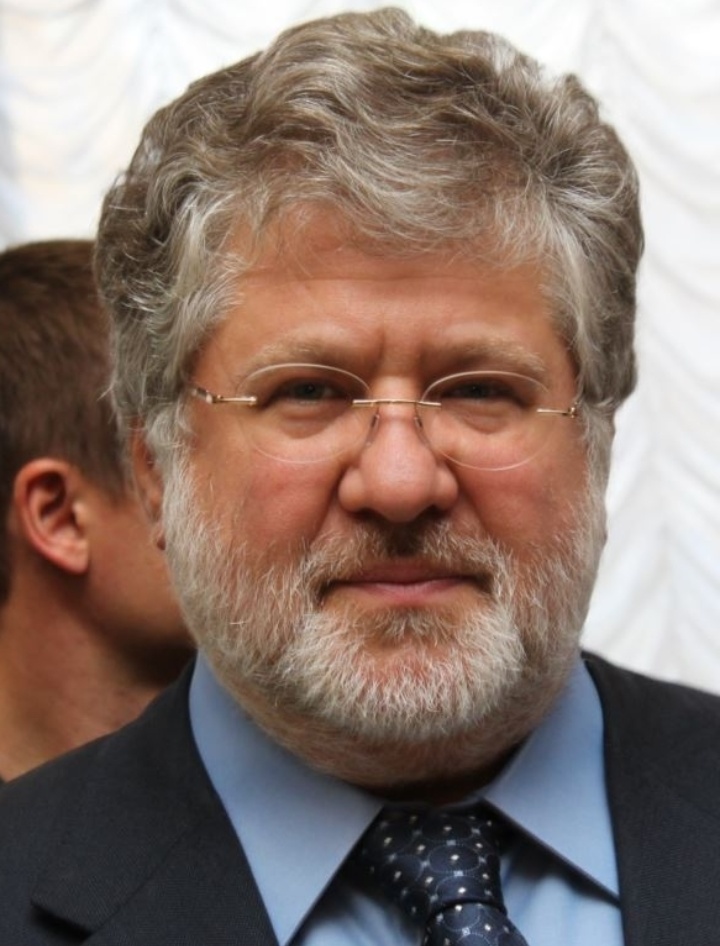
The key person behind the May 2nd massacre inside Odessa’s Trade Unions Building appears to have been Ihor Kolomoyskyi [pictured here: http://upload.wikimedia.org/wikipedia/commons/3/36/Ihor_Kolomoyskyi2.jpg ], who was appointed to be the regional governor in that area by Yulia Tymoshenko, the Ukrainian Presidential candidate that the Obama Administration has apparently been hoping will win the May 25th election to take over the Ukrainian Government, from the junta that the Obama Administration imposed in Ukraine on February 22nd. Just weeks before this coup, on February 4th, the U.S. Assistant Secretary of State for Europe and Asia, Victoria Nuland, chose Tymoshenko’s ally Arseni Yatsenyuk to head the post-coup interim government, which appointed Kolomoyskyi. Only a few months before this coup, Nuland had asserted that U.S. taxpayers had already invested more than $5 billion, in order to bring “democracy” to Ukraine, by which she was referring to the U.S. effort to oust the Russian-oriented, democratically elected, leader of Ukraine, President Viktor Yanukovych, who had prosecuted and imprisoned Tymoshenko for embezzlement and abuse of governmental office. Tymoshenko was then on 11 October 2011 sentenced to seven years in prison, and was ordered to pay the government restitution of $188 million. She was released from prison less than three years later, two days after the coup, on 24 February 2014. The Ukrainian criminal code was immediately changed, in order to legalize the actions for which Tymoshenko had been imprisoned. This allowed Tymoshenko to run for the Ukrainian Presidency. She had been Prime Minister 2007-2010. Both she and her husband, Oleksandr Tymoshenko, and his father, all three of whom were on the board of United Energy Systems of Ukraine (and thus Ms. Tymoshenko was called “the gas princess”) have been legally prosecuted as embezzling state funds, but so have most of Ukraine’s oligarchs and political leaders (and there’s a lot of crossover between those two categories).

Kolomoyskyi, who lives in Geneva Switzerland, is generally regarded as the second-richest man in Ukraine, with a fortune estimated at about $6 billion. Tymoshenko used to be called “the Eleven Billion Dollar Woman,” but, like all of Ukraine’s oligarchs (including Kolomoyskyi), nobody really knows precisely how wealthy she is, nor even whether she is more, or perhaps less, wealthy than Kolomoyskyi. Almost all of the oligarchs’ money is hidden offshore; so, is invisible.

Most of Ukraine’s oligarchs live in Geneva (like Kolomoyskyi), London (like the Tymoshenkos’ daughter, Yevhenia), NYC, Rome, and other Western cities, and they tend to stash their money in secret bank accounts in tax-haven countries, not only in order to avoid paying taxes, but also in order to make more difficult their being successfully sued by each other, for violating handshake business deals that had helped them to become so rich. After all, illegal contracts cannot be enforced by any legal government (since they’re illegal, and have secret illegal terms). Thus, other means than written contracts — handshake deals — are resorted to between these aristocrats.

For example, in one such case, a Ukrainian oligarch who lives in London, Victor Pinchuk (whose fortune is around $4 billion), is suing Kolomoyskyi by alleging him to have sold him a company, “KZhRK,” for $143 million, and then to have re-seized it from him by force of arms. As is usual (since virtually all of Ukraine’s oligarchs had become oligarchs from the privatizations, or sell-offs of government assets, which accompanied Ukraine’s abandonment of communism), this case hinges on verbal testimony, and the various parties to the case contradict each other. Kolomoyskyi is well known for taking over corporations through his team entering with guns drawn. Pinchuk claims that when Kolomoyskyi did that here, Pinchuk nonetheless, somehow, managed to get Kolomoyskyi to restore Pinchuk to control, but that Pinchuk later discovered “it appears that they may have sold approximately 50% of KZhRK to a third party in 2007”; so, Pinchuk filed suit against Kolomoyskyi, in London, on this murky case.

According to a summary by wikipedia of several news reports: “Kolomyski has used [his banking company] Privat’s ‘quasi-military forces’ to enforce hostile takeovers of companies, sending a team of ‘hired rowdies armed with baseball bats, iron bars, gas and rubber bullet pistols and chainsaws’ to forcibly take over a Kremenchuk steel plant in 2006,[17] and has used ‘a mix of phony court orders (often involving corrupt judges and/or registrars) and strong-arm tactics’ to replace directors on the boards of companies he purchases stakes in.[18] Kolomyski was criticized by Mr Justice Mann in a court case in London involving an attempted hostile takeover of an oil company, with the judge stating that Kolomyski had ‘a reputation of having sought to take control of a company at gunpoint in Ukraine’.”

Consequently, the reports of Kolomoyskyi’s tactics against the Ukrainians who refuse to be ruled by the Obama-installed government in Kiev seem to be consistent with this oligarch’s violent norm. Oriental Review headlined on 14 May 2014, “Bloodbath in Odessa guided by interim rulers of Ukraine,” and reported that, “The information provided below was obtained from an insider in one of Ukraine’s law-enforcement agencies, who wished to remain anonymous for obvious reasons.” The account there is a more detailed one than has ever before appeared, and it’s consistent with those others (such as this and this). It alleges that:

“Ten days before the tragedy a secret meeting was held in Kiev, chaired by the incumbent president Olexander Turchinov [a long-time political ally and business-partner of Tymoshenko; he had destroyed crucial documents in the government’s case against Tymoshenko], to prepare a special operation in Odessa. Present were minister of internal affairs Arsen Avakov [a gangster who was placed on Interpol’s ‘Wanted’ list on 21 March 2012], the head of the Ukrainian Security Service Valentin Nalivaychenko [a long-time NATO agent], and the secretary of the National Security and Defense Council Andriy Parubiy [co-founder of Ukraine’s National Socialist, or Nazi, Party]. Ukrainian oligarch Ihor Kolomoiskiy, the Kiev-appointed head of regional administration of the Dnepropetrovsk region, was consulted in regard to the operation [he being well-experienced in violent operations].

“During that meeting Arsen Avakov … reportedly came up with the idea of using football [soccer] hooligans, known as ‘ultras,’ in the operation. Ever since his time as the head of the Kharkov regional administration he [Avakov] has worked closely with the fans’ leaders, whom he continued to sponsor even from his new home in Italy.

Kolomoisky temporarily delivered his private ‘Dnieper-1’ Battalion under the command of law-enforcement officials in Odessa and also authorized a cash payment of $5,000 for ‘each pro-Russian separatist’ killed during the special operation. [That would be over $500,000, lent by his bank to the Ukrainian Government, to pay for the estimated 116 corpses thus produced.]

Continue reading

Washington wastes no time to sabotage Minsk

By Finian Cunningham
Posted on Strategic Culture Foundation, February 14, 2015

With their noses out of joint and egos bruised, the United States and its European lieutenants immediately got to work to undermine the Minsk ceasefire deal by twisting the terms of the accord and seeking to frame Russia for its imminent failure.

A Washington Post headline set the pace with this headline hours after the Minsk negotiations wrapped up in the Belarus capital. ‘Putin announces ceasefire with Ukraine,’ declared the Post, mendaciously implicating Russia as a protagonist in the year-old conflict, which, it is inferred, is now suing for a peace settlement.

US Secretary of State John Kerry, along with trusty British and Polish allies, warned Russia of more sanctions if the Minsk truce was not «fully implemented».

«The United States is prepared to consider rolling back sanctions on Russia when the Minsk agreements of September 2014, and now this agreement, are fully implemented,» Kerry said in a statement.

In other words, Washington is still peddling the hoary narrative that Moscow is an aggressor and is to blame for the conflict. Rolling back sanctions «when» Minsk is «fully implemented» is the US giving itself a licence to covertly sabotage the ceasefire at every turn and to maintain its unwarranted sanctions on Russia, as well as following up on promised supply of weapons to the Kiev regime.

There seems little doubt that the Americans are reeling from the diplomatic coup that Russian President Vladimir Putin pulled off in Minsk this week, along with German and French leaders, Angela Merkel and Francois Hollande.

Amid threats from the US last week that it was going to flood Ukraine with more heavy weapons, Putin and his European counterparts managed to broker a ceasefire to the conflict after marathon 17-hour negotiations. The truce is to be implemented this weekend and, it has to be said, constitutes only a slim prospect of bringing the civil war in Ukraine to a halt. It is fraught with many thorny issues, such as withdrawal of fighting units on both sides and the accepted definition of a demarcation line. The autonomous status of the separatist Donbas region is also far from clear, or whether Kiev is prepared to follow up with mutual negotiations with the breakaway ethnic Russian population.

Nevertheless, the mere agreement, in principle, by the Kiev regime and the pro-separatist rebels of the eastern Ukrainian region is a welcome chance for a cessation in violence that has cost nearly 5,500 lives and more than one million refugees. That Putin, along with Merkel and Hollande, managed to achieve this tentative breakthrough is something of a feat in diplomatic skills and commitment. The development also tends to negate the official Western narrative that purports to paint Russia as an aggressor and threat to European peace.

The Minsk deal properly frames the conflict as a civil war between the Kiev regime and the Donbas separatists, which Russia is trying to dampen by acting as a facilitator of negotiations between the warring sides.

Kremlin spokesman Dmitry Peskov was on the mark when he said after the Minsk talks that Russia is a guarantor of the peace deal, not a party obliged to fulfil its implementation. He reiterated that Moscow is not a participant in the conflict, as Western media have, and continue, to assert.

«Russia is the country that was called by the parties of the conflict,» said Peskov. «This is the country that called on the parties of the conflict to sign a complex of measures to fulfil the Minsk agreements. But Russia is not one of the parties to fulfil these measures. This is the country that is acting as the guarantor, that comes forward with a call, but, obviously, it’s not a party that needs to take any actions for [the fulfilment]. We simply can’t do this physically because Russia is not a participant in the conflict,» added the Kremlin spokesman.

It was left to the British premier David Cameron and the ex-Polish president Donald Tusk to undermine the latest Minsk chance for peace by casting aspersions on Russia and re-framing the conflict as one of external aggression on Ukraine.

Cameron talked, with typical British haughtiness, of Putin needing to change his behaviour, while Tusk added to the narrative of demonising the Russian leader by insinuating that he is not trustworthy.

Cameron, speaking at an EU summit in Brussels on Thursday, said: «If this is a genuine ceasefire, then of course that would be welcome. But what matters most of all is actually actions on the ground rather than just words on a piece of paper. I think we should be very clear that Putin needs to know that unless his behaviour changes, the sanctions we have in place won’t be altered.»

Tusk, who is now the European Council President, said: «If [the Minsk agreement] does not happen we will not hesitate to take the necessary steps. Our trust in the goodwill of President Putin is limited. This is why we have to maintain our decision on sanctions.»

Given that the Western-backed Kiev regime has serially violated past ceasefires, which led to the latest escalation of violence, it would be naive to expect that the latest peace bid will be honoured. The Kiev junta has been emboldened to prosecute its criminal war against the Donbas population because of the unswerving political, financial and military support that Washington has indulged. Massive, systematic war crimes by Kiev have been whitewashed and absolved by Washington with spurious, unfounded claims of «Russian aggression».

This is because the US-backed regime-change operation in Ukraine that brought the Kiev junta to power last February is fundamentally predicated on Washington’s long-term objective of destabilising Russia. That is why the prospects of a ceasefire being implemented are something of an oxymoron. A peace settlement in Ukraine would only be an impediment to Washington’s geopolitical objective of undermining Russia.

The criminal regime in Kiev has become something of a specialist in committing false flag terrorist atrocities, which it and its Western sponsors then duly attribute to «Russian-backed rebels». The massacre in Donetsk on January 21, in Mariupol on January 24, and this week in Kramatorsk, in which up to 17 people were killed from Smerch rockets, have all the hallmarks of false-flag operations perpetrated by the US-backed, trained and equipped Kiev regime forces.

In the Kramatorsk incident, on the eve of the Minsk summit, the Kiev regime claimed that the Smerch rockets were fired from separatist-held Gorlovka, which is 80 kilometres away, and the outer limit of the munition’s range. The separatists denied the attack, saying that they do not target civilian areas. Hours after the massacre, Kiev President Petro Poroshenko arrived in Kramatorsk for photo-opportunities with victims lying on hospital beds. That Poroshenko would hurry to a town that is under fire is doubtful if the rebel threat was real. Also speaking as if from a script, he said: «It is savages who use cluster bombs against civilians. It is a crime against humanity when civilians are killed by Russian weapons in their homes.»

The next day, the «outraged» Poroshenko was in Minsk warmly shaking hands with Putin. So much for Russia war crimes.

To say that the latest ceasefire will be easily sabotaged is an understatement, given the past conduct of the Kiev regime. All it has to do is to keep fighting and committing crimes and that will be «evidence» of Russia not implementing Minsk. That will then allow Washington and its dutiful British and Polish allies, along with the obliging Western news media propagandists, to blame Russia for the failure in «fully implementing» the ceasefire. More American weapons can then be funnelled into Ukraine and more sanctions ratcheted up.

Russian President Vladimir Putin deserves huge credit for showing statesmanlike leadership over the Ukraine crisis. The trouble is that the Americans are playing a very different and dirty game in which there are no rules to abide by.

http://www.strategic-culture.org/news/2015/02/14/washington-wastes-no-time-to-sabotage-minsk.html


John Kerry tells journalists to look in the social media for proof of Russian troops in Ukraine

Posted on Fort Russ

John Kerry

February 5, 2015
Russian RT 
Translated by Kristina Rus

West and Kiev continue to accuse Russia of having troops in the conflict zone in the East of Ukraine. However, so far no evidence has been provided. Today during the press conference, US Secretary of State John Kerry was also unable to answer the question about the evidence of participation of the Russian military in the conflict in Donbass, and suggested to look for it on social networks.

Today during a joint press conference with Ukrainian Prime Minister Arseniy Yatsenyuk in Kiev, the head of the U.S. Department of State, John Kerry, again failed to answer the question if there is strong evidence that Russian soldiers are involved in the conflict in the East of Ukraine. Instead, he invited the journalists to look for it online.

“Social networks are filled with reports and photos of Russian soldiers, who are brought back to Russia dead. And the parents of these soldiers in Russia are told that their sons were killed somewhere in an accident, ” – Kerry said. – There are also prisoners of war who have provided proof of their participation in the conflict (in the East of Ukraine. – RT). And that’s enough.”

Thus, at the moment, neither the West nor Kiev can provide convincing evidence of the presence of the Russian armed forces in the conflict zone. Moreover, not so long ago, the chief of the General Staff of Ukraine, Viktor Muzhenko, said during a briefing that Ukrainian army does not wage battles against the Russian military units and that Kiev knows only about some Russians fighting on the side of the militia.

“Currently, the Ukrainian army is not fighting with the regular army of Russia”, – said the general. However, Muzhenko stated that the General Staff of the UAF possessed information about the participation of individual citizens of the Russian Federation, including military, in the ranks of illegal armed formations”.

These words of the chief of the General Staff, who has access to the full volume of operational information from the front, clearly are contrary to the official position of Kiev, which from the beginning of the conflict repeatedly declared about an organized invasion of the regular units of the Russian army of the territory of Ukraine.

Recall that recently the President of Ukraine arrived at the economic forum in Davos with a fragment of the bus, exploded near Volnovakha. Petro Poroshenko made an emotional speech in which he accused the tragedy on Russia. In addition, during his speech, he stated that allegedly 9 thousand Russian soldiers are fighting on the territory of Ukraine . However, besides the loud proclamations, no evidence of Moscow’s involvement in the incident with the bus or participation in hostilities of regular units of the Russian army, was presented by the Ukrainian leader.

These words of the President were picked up by the permanent representative of Ukraine to the United Nations, Yuriy Sergeyev. During the last meeting of the Security Council on Ukraine, he not only repeated the words of Poroshenko about 9 thousand Russian soldiers, but added that the military contingent of the army of the Russian Federation in Ukraine continues to grow and has reached 12 thousand people.

Source: http://fortruss.blogspot.com/2015/02/john-kerry-tells-journalists-to-look-in.html