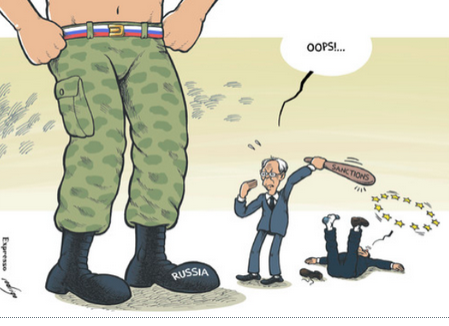
Historic interview with Tariq Aziz: “It’s not ‘regime change’ America wants, but ‘region change’…The Embargo also extends to dialogue.”

“Madam Felicity, when I was ten years old, I was handing out leaflets in the streets of Baghdad, putting them through people’s doors, to stop the British stealing our oil. I am not about to give up on Iraq now.”
Former Iraq Deputy Prime Minister and Foreign Minister Tariq Aziz died of a heart attack in prison June 5, 2015.
Global Research, June 27, 2015

First published by Middle East International, 21st May 1999.

Author’s note: In context, this interview took place during the most draconian US-UK led UN sanctions ever imposed on a country, denying all essential to modern life, which had been in place for nine years and nine months.

Tariq Aziz doesn’t hide his anger and frustration when speaking of his country’s plight:

“This is a region of conflicts, upheavals, revolutions, but this is the first time such rigid and comprehensive sanctions have been imposed anywhere.

“Prior to the embargo we had a high standard of free education from primary school to university and free health care. But one cannot live alone in the world. Nations need to trade, to buy and sell. There has been a sharp deterioration in health, social services, electricity, clean water.”

Seated in his Baghdad office, Iraq’s Deputy Prime Minister lists countless further examples of the misery inflicted by sanctions, from how the collapse of the Dinar has slashed the income of once well paid professionals to the equivalent of $3 a month, to the way the world’s former number one date producer is prohibited from selling its crop.

Aziz stresses that increasing the amount of oil that Iraq is allowed to sell under the oil-for-food arrangement to $5.2 billion every six months does nothing to alleviate the situation: “Our oil industry cannot do it”, he says.

“They need new equipment, parts, extensive refurbishment. Even before recent further damage by bombing, we could pump less than $2billion worth each six months. Forty percent of that goes to the UN. We are still paying for UNSCOM* which destroyed hundreds of factories and equipment, a number of whose Members are now exposed as spies. We also paying reparations to Kuwait and so on. We have nearly twenty three million inhabitants. We need  $16-18 billion a year plus export of commodities. Yet we are not allowed agricultural equipment to produce our own food, so we have to import.”

Ironically it was the UN Food and Agricultural Organization which advised Iraq that importing the bulk of its food needs made better economic sense than trying to become self-reliant. In 1993, just  three years in to the embargo, the (UN) World Food Programme warned that: “All the pre-famine indicators are now in place” in Iraq.

He recalls how James Baker ** told him during their famous pre-war meeting in Geneva that if Iraq did not comply with US demands: “We will reduce you to the pre-industrial age.” “That remains the objective today”, he asserts.

“In March ’91, we were left with no telephones or electricity, no clean water, with the refineries either crippled or damaged, almost all the bridges bombed, thus the country virtually divided. But we rebuilt and restored to a certain degree. The government remained. But now there are almost daily bombardments with the same objective.

“In the December (1998) aggression, the US ignored the (UN) Security Council. Fifteen Members were formally meeting (to discuss Iraq) and the bombs were already falling.”

Aziz contrasts Washingtons’s refusal to talk to Baghdad with the increasingly receptive ears grievance against sanctions have been falling on in other world capitals. “When we go to the US we are not allowed to leave New York. Congressmen, old friends, must come to New York to see us. Even a minor official at the UN is not allowed a cup of tea in the lobby with an Iraqi official. The Embargo also extends to dialogue. Dialogue is the golden rule to finding solutions. Yet the US accuses us of being ‘undemocratic’ “, he says.

“Recently, President Chirac was denied permission to discuss Iraq with (President) Clinton, yet Paris is deeply involved and I can talk at any level with them, the Russians, the Chinese. Big delegations visit here and I recently travelled to Spain, Italy, Belgium and France. But sanctions are genocide. If the US wants to impose military sanctions on Iraq, let them do it, but don’t deprive our children of milk, health, medicine.”

He has no doubt why the US attitude:

“ Iraq has the second largest oil reserves – actually the first. You can find oil wherever you drill in Iraq. The US wishes to dominate oil, Saudi Arabia and the Gulf. They want to keep us dormant, to bring in a pro-US government and present that as bringing about ‘democracy’ and ‘human rights.’ We are a ‘threat to peace and stability’ and a ‘threat to the region.’ ”

“Yet Saudi Arabia, run by just one man, is the darling of Washington. The irony is that the countries of the region are paying dearly, Saudi and Kuwait are paying – while we are the perceived ‘threat’ – for Americans to be on their soil.”

But doesn’t Iraq indeed pose a threat to its neighbours? What about human rights? Halabja? The Kurds? He replies that Iraq too feels threatened by US bases in the region, that the Kurds have a better deal than their Turkish counterparts, enjoying autonomy, official recognition and cultural rights. The truth about such matters, he intimates, is in the eye of the beholder.

“I have read stories in The Times that President Saddam shoots people in Cabinet meetings. How could he survive? Iraqis are quick to revolt as they did in 1921, 1931, 1947, 1957 and 1968.”

So how is this impasse to be resolved?

“Why don’t a cross-party group of US Congressmen come here, address our parliament, engage in dialogue, meet people? Misunderstandings arise from lack of dialogue. Even our Bishop” – Aziz is a Chaldean Christian – “cannot get in to the US to travel with a delegation. He has had to apply for a Vatican passport

“Last year, when I received an invitation from the Oxford Union, my visa was turned down by the UK. But shortly I am going to Ireland at the invitation of University College Dublin and they are connecting with the Oxford Union by TV, so we will belatedly have our debate – three ways.

As I rose to leave he said: “It is not ‘regime change’ America wants, but ‘region change.’ “

Then: “Madam Felicity, when I was ten years old, I was handing out leaflets in the streets of Baghdad, putting them through people’s doors, to stop the British stealing our oil. I am not about to give up on Iraq now.”

First published by Middle East International, 21st May 1999.

http://www.globalresearch.ca/its-not-regime-change-america-wants-but-region-change-historic-interview-with-tariq-aziz/5458748

Italian official says anti-Russian sanctions may be lifted

From Sputnik News, April 29, 2015

Ukraine’s Embassy in Rome has sent an official request to the Italian Foreign Ministry for comment on a recent statement by an official from the Italian Ministry of Economy and Finances about Italy possibly lifting anti-Russian sanctions in the near future, Ukrainian newspaper Evropeyskaya Pravda reported, citing a diplomatic source.

German Foreign Minister Frank-Walter Steinmeier, second left, welcomes his counterparts from France, Laurent Fabius, right, Russia, Sergey Lavrov, left, and Ukraine, Pavlo Klimkin, second right, for a meeting on the situation in Ukraine in Berlin, Germany, Monday, Jan. 12, 2015.
According to the newspaper, the diplomatic demarche, signed by Ukrainian Ambassador to Italy Heorhiy Chernyavskyi, was sent to the Italian Foreign Ministry on Tuesday. In the document, Chernyavskyi is said express doubts about the competence of Federico Eichberg, the Head of a Task Force on Foreign Investments at the Ministry of Economic Development. The Ambassador is also said to have proposed that the Foreign Ministry “respond to statements by Eichberg which directly contradict the government’s official position.”

Speaking at an Italian business conference in Milan earlier this week, Eichberg stated that Italy will not support the continuation of economic sanctions directed against Russia. “Italy has made it clear since February that the Council of Ministers will not vote for the extension of sanctions,” the official noted.

Russian analysts have commented that the Ukrainian Foreign Ministry’s protest seems to have come at rather an odd time, given that top Italian officials up to the ministerial level have been complaining about sanctions for several months now.

View image on Twitter

the Lemniscat @theLemniscat

Sanctions hurt Europe more than Russia Sanctions cost Italy over €5bn & 300,000 jobs http://www.eurasianbusinessbriefing.com/sanctions-cost-italy-over-e5bn-bank-chief-estimates/ 
3:18 AM – 17 Apr 2015
———————————————————————

On Monday, Italian Minister of Economy and Finance Pier Carlo Padoan told reporters at a press conference that he “sincerely hope[s] that we will come to canceling [the] sanctions as soon as possible, and that economic partnership between Europe and Russia, as well as Italy and Russia will continue to grow.”

Late last month, Italian Foreign Minister Paolo Gentiloni told German media that the EU is too fixated on the Ukrainian crisis, for which it has blamed Russia, while ignoring other, equally important problems, adding that he has recommended that Prime Minister Matteo Renzi restore relations with Moscow, including the “partial lifting of sanctions.”

Flags of Russia, EU, France and coat of arms of Nice on the city's promenade
Moreover, over the past year, Italian media have complained vigorously about the economic losses the country has suffered as a result of the sanctions policy. Italian businessmen last month stated that in 2014, trade turnover between the countries fell by 17 percent, with exports falling by 11.6 percent. The food and textile industries were most heavily hit, with supplies decreasing by 38 and 16 percent, respectively. In February, Banca Intesa estimated that the sanctions have caused 5.3 billion euros worth of losses for the Italian economy.

Already teetering on the brink of crisis, Europe’s economies have been dealt a heavy blow by sanctions and Russian countersanctions initiated last year over the Ukraine crisis.

http://sputniknews.com/europe/20150429/1021534129.html

Western sanctions and Russian perceptions

From The Vineyard of the Saker
February 19, 2015

I parse the Russian media (corporate and social) on a daily basis and I am always amazed at the completely different way the issue of western sanctions is discussed.  I think that it is important and useful for me to share this with those of you who do not speak Russian.

First, nobody in Russia believes that the sanctions will be lifted.  Nobody.  Of course, all the Russian politicians say that sanctions are wrong and not conducive to progress, but these are statements for external consumption.  In interviews for the Russian media or on talk shows, there is a consensus that sanctions will never be lifted no matter what Russia does.

Second, nobody in Russia believes that sanctions are a reaction to Crimea or to the Russian involvement in the Donbass.  Nobody.  There is a consensus that the Russian policy towards Crimea and the Donbass are not a cause, but a pretext for the sanctions.  The real cause of the sanctions is unanimously identified as what the Russians called the “process of sovereignization”, i.e. the fact that Russia is back, powerful and rich, and that she dares openly defy and disobey the “Axis of Kindness”.

Third, there is a consensus in Russia that the correct response to the sanctions is double: a) an external realignment of the Russian economy away from the West and b) internal reforms which will make Russia less dependent on oil exports and on the imports of various goods and technologies.

Fourth, nobody blames Putin for the sanctions or for the resulting hardships.  Everybody fully understands that Putin is hated by the West not for doing something wrong, but for doing something right.  In fact, Putin’s popularity is still at an all-time high.

Fifth, there is a wide agreement that the current Russian vulnerability is the result of past structural mistakes which now must be corrected, but nobody suggests that the return of Crimea to Russia or the Russian support for Novorussia were wrong or wrongly executed.

Finally, I would note that while Russia is ready for war, there is no bellicose mood at all.  Most Russians believe that the US/NATO/EU don’t have what it takes to directly attack Russia, they believe that the junta in Kiev is doomed and they believe that sending the Russian tanks to Kiev (or even Novorussia) would have been a mistake.

The above is very important because if you consider all these factors you can come to an absolutely unavoidable conclusion: western sanctions have exactly zero chance of achieving any change at all in Russian foreign policy and exactly zero chance of weakening the current regime.  In fact, if anything, these sanctions strengthen the Eurasian Sovereignists by allowing them to blame all the pain of economic reforms on the sanctions and they weaken the Atlantic Integrationists by making any overt support for, or association with, the West a huge political liability.

But the Eurocretins in Brussels don’t care I suppose, as long as they feel relevant or important, even if it is only in their heads.

The Saker


http://vineyardsaker.blogspot.ca/2015/02/western-sanctions-and-russian.html

Game with no rules: “Legal Imperialism” against Russia

By Valentin Katasonov
Posted on Strategic Culture Foundation

The term legal imperialism was coined in relation to the Argentina’s public debt. A New York court admitted a number of private claims to hand down a verdict. By a stroke of hand a judge increased the country’s debt up to $120 billion, according to experts’ estimates. The essence of legal imperialism is the support rendered by Anglo-Saxon legal system to financial vultures. 

Financial vultures vs. Argentina under the cover of American Themis

It all started in 2001. Argentina had to declare a sovereign default on around $130 billion. It was the biggest default on sovereign debt in history. The talks on restructuring started. As a result, the lenders agreed to write off the bulk of it (75%) and alter the conditions for paying off the rest. Some bondholders in possession of around $4 billion of Argentinian bonds refused to comply with the agreements’ terms. This included a small group of hedge funds holding over $1, 3 billion bonds headed by Elliott Management Corp. of billionaire Paul Singer. The hedge funds had already obtained the reputation of financial vultures. They acquired the bonds of the states that were on the verge of sovereign default or the ones already in default and then demanded 100% payments refusing to accept any compromises.

The audacity is supported by the fact that they normally win the trials demanding 100% payments on the bonds. The vultures went to the New York court to sue Argentina for the whole amount without restructuring. In October 2012 the United States Court of Appeals for the Second Circuit (New York) ruled on the pari passu clause that required they receive full payment. Moreover it forbade Argentina to pay off its restructured debts till it complies with the court’s decision. It was an uphill struggle for Argentina as it realized that other lenders would demand full payments too. The country was a hostage because its bonds were issued in compliance with the laws of the state of New York. According to the court’s decision, Argentina faced the June 31, 2014 deadline when it was supposed to pay the next installment of interest to all bondholders. No settlement had been reached so the leading rating agencies greatly lowered the country’s investment rating. The regular payments by Argentina to comply with the conditions of restructured debt were blocked by the court’s ruling. Argentina refuses to comply while the fines keep on growing each passing day…

Yukos case – first large-scale operation conducted by legal imperialism against Russia

The decision handed down by the Hague-based International Arbitration Court in the Russian oil giant Yukos case upon the claim of foreign shareholders is the example of how the legal imperialism works. Yukos ceased to exist as a legal entity in November 2007. For many years it avoided paying taxes. The taxes debts were to be paid in accordance with the court’s decision taken ten years ago. The company failed to comply. The bigger part of Yukos assets went to Russian oil producer Rosneft. Yukos foreign shareholders were disgruntled and went to courts abroad. Finally the claims were consolidated and sent to the Hague International Court. Initially the claimed sum was $114 billion (much more than the Yukos assets at the time of company’s liquidation). The Court let the claims be suspended, it was waiting for something. Finally it got what it was expecting. The West imposed sanctions against Russia in the spring of 2014. The court went back to the Yukos case and made public its verdict: Russia was to pay investors of the now non-existent company $50 billion – the largest compensation ever paid to shareholders upon an international arbitrary tribunal. According to the Court’s decision, Russia allegedly violated the Energy Charter Treaty and expropriated the company taking it from legal owners. A peculiar ruling in view that Russia never ratified the Charter. It is even more peculiar that the acquisition of the Yukos assets by another company is called «expropriation». In fact the verdict was an informal way of imposing sanctions by the West against Russia or the legal imperialism in force. As they say Russia was «put on the counter». After the ruling was announced Russia was given 180 days to comply. It did not. From January 15, the deadline set by the Court in the Hague for Russia to pay its fine, the fine will attract interest equal to the yield on a 10-year US Treasury bond. On January 15 the rate measured 1.91 percent. It means that the first year the sum of the debt will increase to $956, 6 million. That’s why over one billion dollars will surely be added to the $50 billion in 2015.

The Hague Court ruling: what does it mean for Russia?

The appeals made by Russian lawyers brought about no result. The Hague Court’s decision was not taken into account in the 2015 budget. The opposite side is very active. Right after the Court’s decision the former Yukos shareholders were involved in interesting activities – they started to look for Russian assets to be used to pay the debt. Russia’s state foreign assets could be confiscated. The Rosneft assets are to be arrested first, other companies with state participation (VTB, Gasprom, Aeroflot, VAB etc.) second and state agencies third. Embassies have immunity unlike ships visiting foreign ports.

Nobody cares about the fact that there are few companies with 100% state participation. There are non-state minority shareholders and the expropriation of companies’ assets would constitute a violation of their property rights. This is a classic game without rules. Actually there is one – punish Russia at any cost.

Legal imperialism as effective informal sanction against Russia

There have been three packages of sanctions introduced against Russia. Experts believe that the fourth will also come into effect. I don’t think so. The matter is – informal sanctions are more effective. There will be new claims to Russia, its companies and banks. Russian individuals and legal entities will be blacklisted; Western courts will hand down decisions on expropriating their foreign assets. The «case of Rotenberg» will be repeated. In the spring of 2014 Russian entrepreneur Arkady Rotenberg was blacklisted during the first wave of sanctions. In September Italian courts handed down a decision to arrest and confiscate his €30m assets. The March sanctions envisioned a ban on entering the territories of the countries that imposed sanctions and seizing the bank accounts of blacklisted persons. In the case of Rotenberg they took away his real estate that had no relation to business. I emphasize it to show that legal imperialism is a war without rules waged to satisfy the desire to plunder. In general, that’s how the algorithm of legal marauding works:

1) A Western vulture chooses an asset that belongs to a Russian legal entity of individual;

2) The vulture makes the Russian owner blacklisted;

3) A Western court hands down a decision to seize the asset;

4) The court’s decision is carried out; the asset becomes the property of the vulture.

Black lists as an instrument of legal imperialism

There are different grounds for being included into black lists: «suspicion of corruption involvement», «complicity in the annexation of Crimea and aggression against Ukraine», «the violation of human rights», «ties with terrorists» etc. The US has already introduced special laws, for instance, «the Magnitsky Act» allowing making lists of those who had connection to the death of lawyer Sergey Magnitsky. The lawyer represented the investment advisory firm Hermitage Capital Management. In 2008 he was arrested accused of few billion roubles tax evasion. He died in a prison cell. The West made him a martyr and responded with black lists.

Not the United States is mulling a possibility to turn the Magnitsky Act into a universal instrument of fighting Russia under the banner of defending human rights. It is planned to include into the list not only those who did anything wrong to Magnitsky, but also Alexey Navalny and his associates in «the struggle against totalitarianism». Washington wants to kill two birds with one stone: a) to exert political pressure on Russia; b) to reap benefit by seizing the assets of the persons included into the black lists (the Magnitsky Act envisions a ban on entry into the country and arrest of bank accounts). They want to get more out of it. It is considered to go beyond seizing the bank accounts but also spread the sanctions on bonds and equity.

(To be continued)

http://www.strategic-culture.org/news/2015/02/17/game-with-no-rules-legal-imperialism-against-russia-i.html

http://www.globalresearch.ca/game-with-no-rules-legal-imperialism-against-russia/5432153

German Foreign Minister says Germany reserves right to “act decisively against Ukrainian leadership, including sanctions”

From Fort Russ
2/9/2015

Ukrainian MFA summons Germany’s ambassador after Steinmeier mentions possible sanctions against Kiev

Translated from Russian by J.Hawk

Frank-Walter Steinmeier’s announcement that sanctions against Kiev are possible cause a furious reaction by the Ukrainian Ministry of Foreign Affairs.

The Foreign Minister Steinmeier made this statement in an interview with the ARD TV channel.

Steinmeier said that if no political decision is reached in Ukraine, the German government reserves the right to “act decisively against the Ukrainian leadership, up to and including sanctions”.

Germany’s ambassador to Ukraine Christoph Weil was forced to have a discussion with the Deputy Foreign Minister of Ukraine Andrey Olefirov due to Steinmeier’s statement.

Ukrainian diplomats are very sensitive to Western countries’ position on the ongoing crisis in the country. However, that sensitivity is very one-sided. In December Ukraine’s ambassador to the EU Andrey Eliseev similarly strongly reacted to Steinmeier’s statement that Ukraine is not wanted in NATO.

“Nobody can prevent Kiev from joining NATO!” was the Ukrainian diplomat’s reply. Germans, as usual, took no offense, and nobody summoned Ukraine’s ambassador to the German MFA.

J.Hawk’s Comment: Let’s not forget Steinmeier’s statement was made against the background of Angela Merkel’s visit to the US. It would seem that everyone knows what Poroshenko must do. It would seem that we now know what was agreed to between Putin, Merkel, and Hollande in Moscow, namely the federalization of Ukraine. It’s a solution that is consistent with the interests of both Russia and Germany, as the two countries in effect decide the zones of their respective zones of economic influence. It also has the benefit (from everyone’s perspective except the junta’s) of cutting the junta out of the equation to a significant degree. Poroshenko, for his part, is still insisting that the situation should revert to the original (and never implemented) Minsk agreement. “Finis Ucrainae” is still the most likely scenario, unless something snaps in Kiev. That Western leaders are, for the first time, suggesting the possibility of Kiev being sanctioned suggests Poroshenko is in process of graduating from “disappointment” to “liability.”

Source:
http://ruposters.ru/archives/11676

http://fortruss.blogspot.com/2015/02/germany-reserves-right-to-impose.html

Top Ukrainian general admits no Russian troops; no basis for sanctions against Russia or military aid to Ukraine

But of course, the U.S. and NATO, with their satellite photos and surveillance, knew this all along. That’s why the accusations never had proof attached. And it is also why the accusations about “rebels” shooting down MH-17 have gone so quiet.

Western leaders lie to provoke cataclysmic wars against innocent people. They support genocide. They create conditions for a nuclear war. What sort of people are they?
—————————————————————–

Eric Zuesse, January 31, 2014
Posted on Global Research

Ukraine’s top general is contradicting allegations by the Obama Administration and by his own Ukrainian Government, by saying that no Russian troops are fighting against the Ukrainian Government’s forces in the formerly Ukrainian, but now separatist, area, where the Ukrainian civil war is being waged.

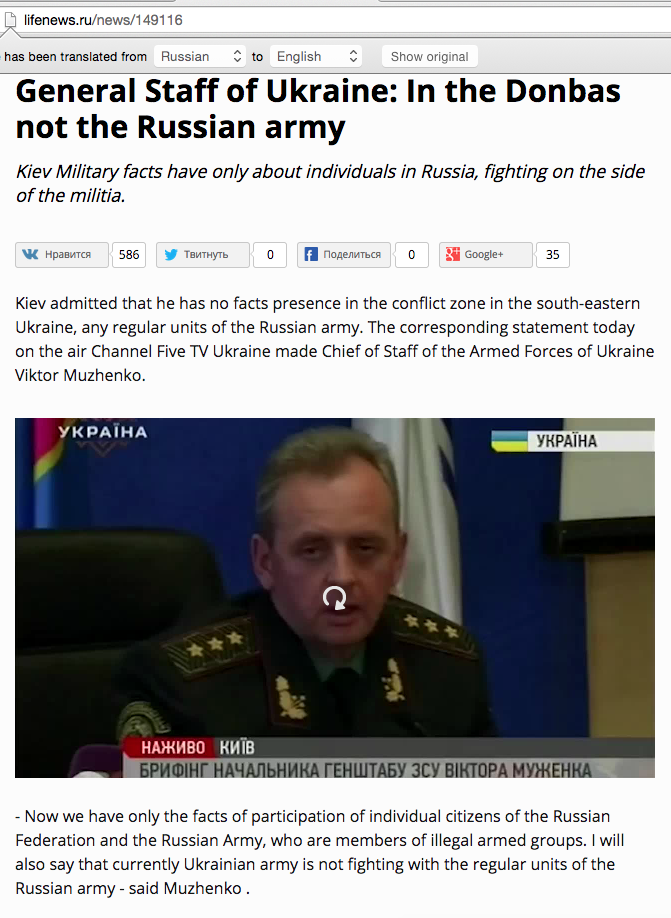
Here is a screen-print of a google-chrome auto-translation of that statement:

The Chief of Staff of Ukraine’s Armed Forces, General Viktor Muzhenko, is saying, in that news-report, which is dated on Thursday January 29th, that the only Russian citizens who are fighting in the contested region, are residents in that region, or of Ukraine, and also some Russian citizens (and this does not deny that perhaps some of other countries’ citizens are fighting there, inasmuch as American mercenaries have already been noted to have been participating on the Ukrainian Government’s side), who “are members of illegal armed groups,” meaning fighters who are not paid by any government, but instead are just “individual citizens” (as opposed to foreign-government-paid ones). General Muzhenko also says, emphatically, that the “Ukrainian army is not fighting with the regular units of the Russian army.”

In other words: He is explicitly and clearly denying the very basis for the EU’s sanctions against Russia, and for the U.S.’s sanctions against Russia: all of the sanctions against Russia are based on the falsehood that Ukraine is fighting against “the regular units of the Russian army” — i.e., against the Russian-Government-controlled-and-trained fighting forces.

The allegation to the effect that Ukraine is instead fighting against “regular units of the Russian army” is the allegation that Vladimir Putin’s Russia has invaded Ukraine, and it is the entire basis for the economic sanctions that are in force against Russia.

Those sanctions should therefore be immediately removed, with apology, and with compensation being paid to all individuals who have been suffering them; and it is therefore incumbent upon the Russian Government to pursue, through all legally available channels, restitution, plus damages, against the perpetrators of that dangerous fraud — and the news reports have already made clear precisely whom those persons are, who have asserted, as public officials, what can only be considered to be major libel.

Otherwise, Ukraine’s top general should be fired, for asserting what he has just asserted.

If what General Muzhenko says is true, then he is a hero for having risked his entire career by having gone public with this courageous statement. And, if what he says is false, then he has no place heading Ukraine’s military.

Investigative historian Eric Zuesse is the author, most recently, of They’re Not Even Close: The Democratic vs. Republican Economic Records, 1910-2010, and of  CHRIST’S VENTRILOQUISTS: The Event that Created Christianity.

Source:
http://www.globalresearch.ca/ukrainian-government-no-russian-troops-are-fighting-against-us-sanctions-against-russia-based-on-falshoods/5428523