Vladimir Putin’s “Seven Point Peace Plan” for East Ukraine

Posted on Global Research, September 3, 2014

By Prof Michel Chossudovsky

A  ceasefire agreement pertaining to East Ukraine was communicated to the media following a telephone conversation between Vladimir Putin and Ukrainian president Poroshenko.

Poroshenko is reported to have written on his Twitter account:

“As a result of my telephone conversation with the Russian president we reached an agreement on a permanent ceasefire on Donbass.”

The official communique on the president of Ukraine’s website states that:

“Mutual understanding was reached in regard to steps to be taken to provide peace,”

The Russian president cannot formally negotiate a cease fire with president Poroshenko because Russian forces are not involved in the conflict between Kiev forces and the Donbass militia.

What the Russian president undertook was to draft a seven point peace proposal calling for the withdrawal of Ukraine troops from southeastern regions of Ukraine and for Donbass militia to curtail their offensive.

This Seven point plan should be followed by concrete trilateral negotiations (Donbass, Ukraine, Russia). The Russian president is clear. These seven points could constitute the basis for negotiation between the parties in the conflict.

The Donbass governments of Donesk and Lugansk were not consulted regarding the substance of the seven point peace plan. They have no interest at this point in reaching a ceasefire agreement which provides Kiev forces with the opportunity to strike back at a later date.  The nature of these negotiations are of utmost importance.

This peace proposal which was communicated to journalists. Below is the full transcript.

At a press conference in Ulan Bator, Mongolia, Putin responded to journalists:

QUESTION: Mr President, you spoke with Mr Poroshenko today. The Ukrainian authorities initially announced that you had agreed on a complete ceasefire, but then explanations came that what is under discussion are concrete steps for settling the situation, which is understandable, given that Russia is not a party to this conflict. If there was discussion of concrete steps, what are they, and what will happen next?

VLADIMIR PUTIN: Yes, I did speak with President Poroshenko this morning, and it seemed to me at any rate that our views on how to settle the conflict are very close, as the diplomats say.

On the way here from Blagoveshchensk to Ulan Bator, I jotted down a few thoughts that could constitute an action plan of sorts. True, I have only these notes that I jotted down, but I can read them to you if you want.

In order to stop the bloodshed and stabilise the situation in southeast Ukraine, I believe that the parties to the conflict should immediately agree on and coordinate the following steps:

First, end active offensive operations by armed forces, armed units and militia groups in southeast Ukraine in the Donetsk and Lugansk areas.

Second, withdraw Ukrainian armed forces units to a distance that would make it impossible to fire on populated areas using artillery and all types of multiple launch rocket systems.

Third, allow for full and objective international monitoring of compliance with the ceasefire and monitoring of the situation in the safe zone created by the ceasefire.

Fourth, exclude all use of military aircraft against civilians and populated areas in the conflict zone.

Fifth, organise the exchange of individuals detained by force on an ‘all for all’ basis without any preconditions.

Sixth, open humanitarian corridors for refugees and for delivering humanitarian cargoes to towns and populated areas in Donbass – Donetsk and Lugansk Regions.

Seventh, make it possible for repair brigades to come to damaged settlements in the Donbass region in order to repair and rebuild social facilities and life-supporting infrastructure and help the region to prepare for the winter.

I think that the Kiev authorities and the representatives of southeast Ukraine could come to basic agreements and cement them at the contact group’s planned meeting on September 5.

I want to note that this statement and all I just said follow on from the telephone conversation with President Poroshenko that you asked about. I hope very much that Ukraine’s government will support the emerging progress in bilateral relations and make use of the positive opportunity the contact group’s work provides to bring about final and comprehensive settlement to the situation in southeast Ukraine, in full and unconditional respect for the lawful rights of those who live there of course.

That is all I have to say. I have nothing to add. Thank you. (Source office of the Russian presidency)

The first condition calls for a cease fire, the second and fourth conditions pertain to the relentless shelling and bombing of the civilian population by Ukraine forces.

There are, however, profound divisions within the Ukraine government, with attempts on the part of the West to stall the peace proposal.  Prime minister Arseny Yatsenyuk, who faithfully obeys orders emanating from the US State Department is reported to have dismissed the seven point peace plan, “calling it a trap.”

The contact group is meeting on September 5 in Minsk following its earlier meeting on September 1. At these earlier talks,  the Donetsk and Lugansk People’s Republics urged Kiev “to acknowledge their “special status.”

The initial statement said that if Kiev guarantees their “special status,” then the Donetsk and Lugansk republics will do everything possible “to preserve Ukraine’s common economic, cultural and political space and the space of the entire Ukraine-Russian civilization.”

This was interpreted as the two self-proclaimed republics seeking autonomy within Ukraine while wishing to remain part of it.

However, later Donetsk People’s Republic Deputy PM Andrey Purgin explained that it’s about “the common security space of Ukraine, Donetsk and Lugansk People’s Republics, about post-war reconstruction of the economic, cultural, and social connections with Ukraine, and also about the fact that the DNR and LNR wouldn’t lay claim to other Ukrainian territories.”

In their initial demands, LNR and DNR representatives called on the Ukrainian government to end their military operation in the country’s east so that parliamentary and local elections can take place freely.

“The president, government and [parliament] Verkhovna Rada should accept… decrees granting immediate recovery from the humanitarian catastrophe, acknowledging the special status of the territories under the control of the People’s Republics, creating conditions – first of all stopping the ‘anti-terror’ operations – for free elections of local authorities and MPs,” the document with the republics’ position reads.

The document also urged Kiev to guarantee “the right to use the Russian language at an official level on the territories of the People’s Republics.”

After the government of President Viktor Yanukovich was ousted in March, the new authorities immediately started to introduce the legislation curbing the Russian language. Though the law failed to materialize in the end, the initiative was one of the major factors that triggered the conflict in eastern Ukraine.

The self-proclaimed republics were represented by DNR Deputy PM Andrey Purgin and the chairman of the LNR’s Supreme Council, Aleksey Karyakin. RT emphasis added

The seven point peace plan is slated to be discussed at the contact group meeting under the auspices of the OSCE on September 5 with representatives of  Lugansk, Donetsk, Russia and Ukraine.

In all likelihood,  US-NATO will  attempt to stall the seven point peace proposal and will pressure the Ukrainian government.

The NATO Summit will be issuing its final communique on  September 5, which in large part has already been written and which proposes the militarization of Eastern Europe as well as NATO military involvement  in Ukraine.

Poroshenko will be leading the Ukrainian delegation to the Wales NATO summit on September 4-5. Putin was not invited to attend. The Ukrainian delegation will be releasing a joint declaration in consultation with NATO, which does not in any way envisage a cease fire.


http://www.globalresearch.ca/vladimir-putins-seven-point-peace-plan-for-east-ukraine/5399215

US opposes UN anti-Nazism Resolutions repeatedly

The article below was written in 2010. Since then, the US has continued opposing resolutions at the UN against the glorification  and free expression of Nazism and racism. The US has been joined by several other counties in opposing these resolutions. However, much-vilified Iran and Syria, as well as Israel have supported the resolutions and opposed Nazism.

Is “free speech” the real reason for US opposition, or just an excuse?

Slander and libel are not protected speech. Racist speech or hate speech is a form of libel and slander, and even assault. In addition, just as verbal sexual harassment creates a hostile work environment and is not protected, racist and hate speech create an unsafe and hostile living environment in an entire community. Furthermore, glorification of Nazism, which honors the people and the crimes, including murder, committed against millions of people, guarantees Nazism and racism will continue, making communities even less safe.

The US government won’t oppose racism or Nazism, because it supports them.

From Rock Creek Free Press

US Sole Opponent of UN Anti-Nazism Resolution
By Carla Stea / RCFP
January 25, 2010

On December 18, 2009, The United Nations General Assembly, by an overwhelming majority, adopted Resolution 64/147, A/C.3/64/L.53 put forth by the Third Committee, entitled: “Inadmissability of Certain Practices that Contribute to Fuelling Contemporary Forms of Racism, Racial Discrimination, Xenophobia and Related Intolerance.” Excerpts from this resolution stated:

  1. Reaffirms the provisions of the Durban Declaration and of the outcome document of the Durban Review Conference in which states condemned the persistence and resurgence of neo-Nazism, neo-Fascism and violent nationalist ideologies based on racial and national prejudice and stated that these phenomena could never be justified in any instance or in any circumstances…..Expresses deep concern about the glorification of the Nazi movement and former members of the Waffen SS organization, including by erecting monuments and memorials and holding public demonstrations in the name of the glorification of the Nazi past, the Nazi movement and neo-Nazism, as well as by declaring or attempting to declare such members, and those who fought against the anti-Hitler coalition and collaborated with the Nazi movements, as participants in national liberation movements……Expresses concern at recurring attempts to desecrate or demolish monuments erected in remembrance of those who fought against Nazism during the Second World War, as well as to unlawfully exhume or remove the remains of such persons, and urges states in this regard to fully comply with their relevant obligations, inter alia, under article 34 of Additional Protocol 1 to the Geneva Conventions of 1949….(Notes with concern the increase in the number of racist incidents in several countries and the rise of skinhead groups which have been responsible for many of these incidents, as well as the resurgence of racist and xenophobic violence targeting members of ethnic, religious or cultural communities and national minorities)….stresses that the practices described above do injustice to the memory of the countless victims of crimes against humanity committed in the Second World War, in particular those committed by the SS organization and those who fought against the anti-Hitler movement, and poison the minds of young people, and that those practices are incompatible with the obligations of the States members of the United Nations under its Charter, and are incompatible with the goals and principles of the Organization.”


On December 18th, 127 members of the United Nations, including India, Kazakhstan, China, Russia, Iran, Israel, Syria, Iraq, Libya, voted in favor of the resolution. Fifty-four members abstained, including France, Germany, Latvia, Georgia, Lithuania, Estonia and Ukraine, and only one nation opposed the resolution: the United States. Continue reading →

On Behalf of Monsanto: GMO Food Crops for Ukraine’s Bread Basket

U.S. Navy Commodore Matthew Perry sailed gunships into Tokyo Harbor in 1853 and demanded that Japan open its markets to American goods.

This is US foreign policy — the reality — not the public relations/Voice of America/spreading democracy fairy tale.

Exploring US and NATO dealings in the world shows a reality very similar to the Borg in the well-known American sci-fi series Star Trek.

For countries thinking of taking the hit, think again. Don’t believe anything you’re told by agents of the United States and NATO.

Remember; slavery didn’t end with the Abraham Lincoln’s Emancipation Proclamation; it spread to other countries.

On Behalf of Monsanto: GMO Food Crops for Ukraine’s Bread Basket

The Role of Public Relations Firm Hill and Knowlton

By Joyce Nelson
Global Research, August 24, 2014
Counterpunch 

Finally, a little-known aspect of the crisis in Ukraine is receiving some international attention.  On July 28, the California-based Oakland Institute released a report revealing that the World Bank and the International Monetary Fund (IMF), under terms of their $17 billion loan to Ukraine, would open that country to genetically-modified (GM) crops and genetically-modified organisms (GMOs) in agriculture.  The report is entitled “Walking on the West Side: the World Bank and the IMF in the Ukraine Conflict.” [1]

In late 2013, the then president of Ukraine, Viktor Yanukovych, rejected a European Union association agreement tied to the $17 billion IMF loan, whose terms are only now being revealed.  Instead, Yanukovych chose a Russian aid package worth $15 billion plus a discount on Russian natural gas.  His decision was a major factor in the ensuing deadly protests that led to his ouster from office in February 2014 and the ongoing crisis.

According to the Oakland Institute,

“Whereas Ukraine does not allow the use of genetically modified organisms (GMOs) in agriculture, Article 404 of the EU agreement, which relates to agriculture, includes a clause that has generally gone unnoticed:  it indicates, among other things, that both parties will cooperate to extend the use of biotechnologies.  There is no doubt that this provision meets the expectations of the agribusiness industry.  As observed by Michael Cox, research director at the investment bank Piper Jaffray, ‘Ukraine and, to a wider extent, Eastern Europe, are among the most promising growth markets for farm-equipment giant Deere, as well as seed producers Monsanto and DuPont’.” [2]

Ukrainian law bars farmers from growing GM crops.  Long considered “the bread basket of Europe,” Ukraine’s rich black soil is ideal for growing grains, and in 2012 Ukrainian farmers harvested more than 20 million tonnes of corn.

Monsanto’s Investment

In May 2013, Monsanto announced plans to invest $140 million in a non-GMO corn seed plant in Ukraine, with Monsanto Ukraine spokesman Vitally Fechuk confirming that ‘We will be working with conventional seeds only” because “in Ukraine only conventional seeds are allowed for production and importation.” [3]

But by November 2013, six large Ukrainian agriculture associations had prepared draft amendments to the law, pushing for “creating, testing, transportation and use of GMOs regarding the legalization of GM seeds.” [4] The president of the Ukrainian Grain Association, Volodymyr Klymenko, told a Nov. 5 press conference in Kiev that “We could mull over this issue for a long time, but we, jointly with the [agricultural] associations, have signed two letters to change the law on biosecurity, in which we proposed the legalization of the use of GM seeds, which had been tested in the United States for a long time, for our producers.” (Actually, GM seeds and GMOs have never undergone independent, long-term testing in the U.S.)

The agricultural associations’ draft amendments coincided with the terms of the EU association agreement and IMF/World Bank loan. Continue reading →

US Intelligence Veterans Write Open Letter To Merkel To Avoid All-Out Ukraine War

Via AntiWar and ConsortiumNews,

MEMORANDUM FOR: Angela Merkel, Chancellor of Germany

FROM: Veteran Intelligence Professionals for Sanity (VIPS)

SUBJECT: Ukraine and NATO

We the undersigned are longtime veterans of U.S. intelligence. We take the unusual step of writing this open letter to you to ensure that you have an opportunity to be briefed on our views prior to the NATO summit on September 4-5.

You need to know, for example, that accusations of a major Russian “invasion” of Ukraine appear not to be supported by reliable intelligence. Rather, the “intelligence” seems to be of the same dubious, politically “fixed” kind used 12 years ago to “justify” the U.S.-led attack on Iraq. We saw no credible evidence of weapons of mass destruction in Iraq then; we see no credible evidence of a Russian invasion now. Twelve years ago, former Chancellor Gerhard Schroeder, mindful of the flimsiness of the evidence on Iraqi WMD, refused to join in the attack on Iraq. In our view, you should be appropriately suspicions of charges made by the US State Department and NATO officials alleging a Russian invasion of Ukraine.

President Barack Obama tried yesterday to cool the rhetoric of his own senior diplomats and the corporate media, when he publicly described recent activity in the Ukraine, as “a continuation of what’s been taking place for months now … it’s not really a shift.”

Obama, however, has only tenuous control over the policymakers in his administration – who, sadly, lack much sense of history, know little of war, and substitute anti-Russian invective for a policy. One year ago, hawkish State Department officials and their friends in the media very nearly got Mr. Obama to launch a major attack on Syria based, once again, on “intelligence” that was dubious, at best.

Largely because of the growing prominence of, and apparent reliance on, intelligence we believe to be spurious, we think the possibility of hostilities escalating beyond the borders of Ukraine has increased significantly over the past several days. More important, we believe that this likelihood can be avoided, depending on the degree of judicious skepticism you and other European leaders bring to the NATO summit next week.

Experience With Untruth

Hopefully, your advisers have reminded you of NATO Secretary General Anders Fogh Rasmussen’s checkered record for credibility. It appears to us that Rasmussen’s speeches continue to be drafted by Washington. This was abundantly clear on the day before the U.S.-led invasion of Iraq when, as Danish Prime Minister, he told his Parliament: “Iraq has weapons of mass destruction. This is not something we just believe. We know.”

Photos can be worth a thousand words; they can also deceive. We have considerable experience collecting, analyzing, and reporting on all kinds of satellite and other imagery, as well as other kinds of intelligence. Suffice it to say that the images released by NATO on August 28 provide a very flimsy basis on which to charge Russia with invading Ukraine. Sadly, they bear a strong resemblance to the images shown by Colin Powell at the UN on February 5, 2003 that, likewise, proved nothing.

That same day, we warned President Bush that our former colleague analysts were “increasingly distressed at the politicization of intelligence” and told him flatly, “Powell’s presentation does not come close” to justifying war. We urged Mr. Bush to “widen the discussion … beyond the circle of those advisers clearly bent on a war for which we see no compelling reason and from which we believe the unintended consequences are likely to be catastrophic.”

Consider Iraq today. Worse than catastrophic. Although President Vladimir Putin has until now showed considerable reserve on the conflict in the Ukraine, it behooves us to remember that Russia, too, can “shock and awe.” In our view, if there is the slightest chance of that kind of thing eventually happening to Europe because of Ukraine, sober-minded leaders need to think this through very carefully.

If the photos that NATO and the US have released represent the best available “proof” of an invasion from Russia, our suspicions increase that a major effort is under way to fortify arguments for the NATO summit to approve actions that Russia is sure to regard as provocative. Caveat emptor is an expression with which you are no doubt familiar. Suffice it to add that one should be very cautious regarding what Mr. Rasmussen, or even Secretary of State John Kerry, are peddling.

We trust that your advisers have kept you informed regarding the crisis in Ukraine from the beginning of 2014, and how the possibility that Ukraine would become a member of NATO is anathema to the Kremlin. According to a February 1, 2008 cable (published by WikiLeaks) from the US embassy in Moscow to Secretary of State Condoleezza Rice, US Ambassador William Burns was called in by Foreign Minister Sergey Lavrov, who explained Russia’s strong opposition to NATO membership for Ukraine.

Lavrov warned pointedly of “fears that the issue could potentially split the country in two, leading to violence or even, some claim, civil war, which would force Russia to decide whether to intervene.” Burns gave his cable the unusual title, “NYET MEANS NYET: RUSSIA’S NATO ENLARGEMENT REDLINES,” and sent it off to Washington with IMMEDIATE precedence. Two months later, at their summit in Bucharest NATO leaders issued a formal declaration that “Georgia and Ukraine will be in NATO.”

Just yesterday, Ukrainian Prime Minister Arseny Yatsenyuk used his Facebook page to claim that, with the approval of Parliament that he has requested, the path to NATO membership is open. Yatsenyuk, of course, was Washington’s favorite pick to become prime minister after the February 22 coup d’etat in Kiev. “Yats is the guy,” said Assistant Secretary of State Victoria Nuland a few weeks before the coup, in an intercepted telephone conversation with US Ambassador to Ukraine Geoffrey Pyatt. You may recall that this is the same conversation in which Nuland said, “Fuck the EU.”

Timing of the Russian “Invasion”

The conventional wisdom promoted by Kiev just a few weeks ago was that Ukrainian forces had the upper hand in fighting the anti-coup federalists in southeastern Ukraine, in what was largely portrayed as a mop-up operation. But that picture of the offensive originated almost solely from official government sources in Kiev. There were very few reports coming from the ground in southeastern Ukraine. There was one, however, quoting Ukrainian President Petro Poroshenko, that raised doubt about the reliability of the government’s portrayal.

According to the “press service of the President of Ukraine” on August 18, Poroshenko called for a “regrouping of Ukrainian military units involved in the operation of power in the East of the country. … Today we need to do the rearrangement of forces that will defend our territory and continued army offensives,” said Poroshenko, adding, “we need to consider a new military operation in the new circumstances.”

If the “new circumstances” meant successful advances by Ukrainian government forces, why would it be necessary to “regroup,” to “rearrange” the forces? At about this time, sources on the ground began to report a string of successful attacks by the anti-coup federalists against government forces. According to these sources, it was the government army that was starting to take heavy casualties and lose ground, largely because of ineptitude and poor leadership.

Ten days later, as they became encircled and/or retreated, a ready-made excuse for this was to be found in the “Russian invasion.” That is precisely when the fuzzy photos were released by NATO and reporters like the New York Times’ Michael Gordon were set loose to spread the word that “the Russians are coming.” (Michael Gordon was one of the most egregious propagandists promoting the war on Iraq.)

No Invasion – But Plenty Other Russian Support

The anti-coup federalists in southeastern Ukraine enjoy considerable local support, partly as a result of government artillery strikes on major population centers. And we believe that Russian support probably has been pouring across the border and includes, significantly, excellent battlefield intelligence. But it is far from clear that this support includes tanks and artillery at this point – mostly because the federalists have been better led and surprisingly successful in pinning down government forces.

At the same time, we have little doubt that, if and when the federalists need them, the Russian tanks will come.

This is precisely why the situation demands a concerted effort for a ceasefire, which you know Kiev has so far been delaying. What is to be done at this point? In our view, Poroshenko and Yatsenyuk need to be told flat-out that membership in NATO is not in the cards – and that NATO has no intention of waging a proxy war with Russia – and especially not in support of the ragtag army of Ukraine. Other members of NATO need to be told the same thing.

For the Steering Group, Veteran Intelligence Professionals for Sanity

  •     William Binney, former Technical Director, World Geopolitical & Military Analysis, NSA; co-founder, SIGINT Automation Research Center (ret.)
  •     David MacMichael, National Intelligence Council (ret.)
  •     Ray McGovern, former US Army infantry/intelligence officer & CIA analyst (ret.)
  •     Elizabeth Murray, Deputy National Intelligence Officer for Middle East (ret.)
  •     Todd E. Pierce, MAJ, US Army Judge Advocate (Ret.)
  •     Coleen Rowley, Division Counsel & Special Agent, FBI (ret.)
  •     Ann Wright, Col., US Army (ret.); Foreign Service Officer (resigned)

Source:

http://www.zerohedge.com/news/2014-09-01/ex-nsa-director-us-intelligence-veterans-write-open-letter-merkel-avoid-all-out-ukra

America promised no NATO expansion to Russia in 1990; America lied

When the U.S. welched on Shevardnadze [Commentary]

The Ukraine crisis owes its roots to a deal America made and broke with the recently deceased Soviet foreign minister

By Ray McGovern, July 16, 2014

Ray McGovern was a CIA analyst for 27 years, serving as chief of the Soviet Foreign Policy Branch and then deputy national intelligence officer for Western Europe. Now retired, he co-founded Veteran Intelligence Professionals for Sanity (VIPS) in January, 2003.

Absent from U.S. media encomia for recently deceased former Soviet Foreign Minister Eduard Shevardnadze is any mention of the historic deal he reached with his U.S. counterpart James Baker in 1990 ensuring that the Soviet empire would collapse “with a whimper, not a bang” (Mr. Baker’s words).

Mr. Baker keeps repeating that the Cold War “could not have ended peacefully without Shevardnadze.” But he and others are silent on the quid pro quo. The quid was Moscow’s agreement to swallow the bitter pill of a reunited Germany in NATO; the quo was a U.S. promise not to “leapfrog” NATO over Germany farther East. Washington welched on the deal.

It began to unravel in October 1996 during the last weeks of President Bill Clinton’s campaign for re-election. Mr. Clinton bragged that he would welcome Poland, Hungary and the Czech Republic into NATO, explaining, “America truly is the world’s indispensable nation” (and, sotto voce, can do what it wants).

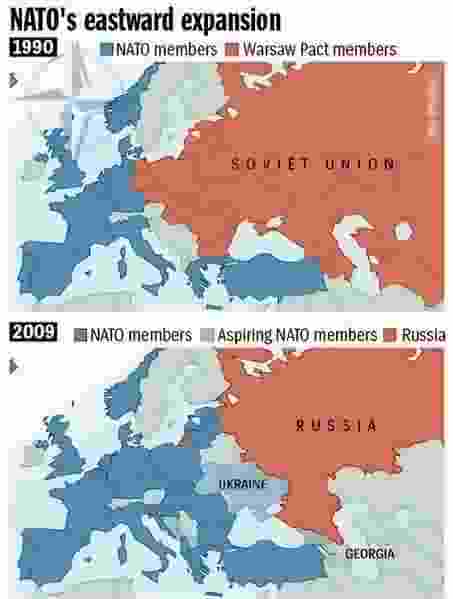
Those three countries joined NATO in 1999, and by April 2009, nine more became members, bringing the post-Cold War additions to 12 — equal to the number of the original 12 NATO states. The additional nine included the former Baltic Republics that had been part of the USSR, but not Ukraine. NATO intentions, however, were made clear at its summit in Bucharest in April 2008, which formally declared, “Georgia and Ukraine will be in NATO.”

Even hawkish former American national security adviser Zbigniew Brzezinski now concedes, “It is reasonable for Russia to feel uncomfortable about the prospect” of Ukraine in NATO. And that is the nub of today’s crisis there — not the “chauvinistic fanaticism” Mr. Brzezinski attributes to Russian President Vladimir Putin.

The foundering of the unique opportunity in 1990 to create a lasting peace in what President George H. W. Bush called a “Europe whole and free” was a tragedy. The expansion of NATO to the east — especially the decision to bring in Georgia and Ukraine — led, among other things, to Georgian-Russian hostilities in August 2008 and now to the current violence in Ukraine.

The fact that the Shevardnadze-Baker agreement was not recorded in an official document has helped revisionists to create alternative history, but there is compelling evidence testifying to Washington’s reneging on key oral commitments to Moscow.

Then-U.S. Ambassador to the USSR Jack Matlock, who took part in both the Bush-Gorbachev early-December 1989 summit in Malta and the Shevardnadze-Baker discussions in early February 1990, told me, “The language used was absolute, and the entire negotiation was in the framework of a general agreement that there would be no use of force by the Soviets and no ‘taking advantage’ by the U.S. … I don’t see how anybody could view the subsequent expansion of NATO as anything but ‘taking advantage,’ particularly since, by then, Russia was hardly a credible threat.”

On February 10, 1990, German Foreign Minister Hans-Dietrich Genscher told Shevardnadze, “For us, one thing is certain: NATO will not expand to the east.” Melvin Goodman, co-author of “The Wars of Eduard Shevardnadze,” has told me that, during an interview of Shevardnadze in March 1994, the former foreign minister said Mr. Baker had assured him that NATO “would not jump over” East Germany for new members.

Three months after the overthrow of Ukrainian President Viktor Yanukovych and installation of a pro-Western government in Kiev, Russian President Vladimir Putin complained: “But tomorrow Ukraine might become a NATO member, and the day after tomorrow missile defense units of NATO could be deployed in this country.”

Mr. Putin keeps coming back specifically to “missile defense” in NATO countries — or adjacent waters. On April 17, he said the issue is “probably even more important than NATO’s eastward expansion. Incidentally, our decision on Crimea was partially prompted by this logic: If we don’t do anything, Ukraine will be drawn into NATO … and NATO ships would dock in Sevastopol.”

President Putin added: “If these systems are deployed closer to our borders, our ground-based strategic missiles will be within their striking range.” Even Mr. Brzezinski might agree that “it is reasonable for Russia to feel uncomfortable” about NATO ships docking in Crimea. Among the chief reasons: The current version of the missile defense plan includes ship-borne systems.

In his book, “Duty,” former Defense Secretary Robert Gates notes that the Russians consider the latest plan even worse than earlier ones because it might eventually have capabilities against Russian ICBMs. He added dismissively, “Making the Russians happy wasn’t exactly on my to-do list.”


To respond to this commentary, send an email to talkback@baltimoresun.com. Please include your name and contact information. Copyright © 2014, The Baltimore Sun

http://warisacrime.org/content/some-facts-re-genesis-current-crisis-Ukraine

Published under Fair Use Rules.

Schedule — National Protests at NATO Summit in Wales

Information available at
http://stopwar.org.uk/events/national-protests-no-new-wars-no-to-nato-protests#.VAQKSdzn9Qw

No New Wars, No to NATO

PROTEST — 30 August – 5 September

DEMONSTRATE — Saturday, 30 August

COUNTER-CONFERENCE — Sunday, 31 August – Monday, 1 September, Cardiff & Newport

See Schedule below for other protests and direct action during the week

Stop the War Coalition 30 August 2014.

60 world leaders, including Barack Obama, meet in the UK for the NATO Summit on 4-5 September to plan their war on the world. From 30 August protesters will flock to South Wales for international actions including a national demonstration, counter summit, and week-long peace camp. Stop the War and CND have organised NO TO NATO – NO NEW WARS protests from 30 August to 5 September. See the timetable of action and events below.

LIVE BLOG for updates on NO TO NATO – NO MORE WARS week of protest in Wales…

Schedule

Continue reading →

Mykola Lebed — Nazi collaborator, US Ukrainian agent

Allen Dulles and the OUN-B; Did the CIA/MI6 use of Nazis in Ukraine During the Cold War Ever Stop?

February 15, 2014

According to Hitler’s Shadow: Nazi War Criminals, U.S. Intelligence and the Cold War by Richard Breitman and Norman Goda, U.S. intelligence documents released in 2010 reveal that on May 5, 1952, the Deputy Director of the CIA, Allen Dulles, well-known for running the Nazi Ratlines after World War II, which facilitated the escape of Nazi war criminals, wrote a letter to the U.S. Commissioner of Immigration and Naturalization on the subject of Mykola Lebed, the chief of the secret police organization of Stephen Bandera’s OUN-B (Organization of Ukrainian Nationalists).

In the letter Dulles wrote that Lebed was of “inestimable value to this Agency in its operations. In connection with future Agency operations of the first importance, it is urgently necessary that subject be able to travel in Western Europe, before subject undertakes such travel, however, this Agency must be in a position to assure his reentry into the United States without investigation or incident which would attact undue attention to his activities. Your Service has indicated that it cannot give such assurance because of the fact that subject was convicted in 1936 of complicity in the 1934 assassination of the Polish Minister of the Interior and sentenced to death, later commuted to life imprisonment…. Your Service has indicated that, if the subject reenters the United States on a reentry permit, an investigation must then be conducted…. In order to remove the obstacles to the fulfillment of this Agency’s projected operations and pursuant to the authority granted under Section 8 of the CIA Act of 1949, I approve and recommend for your approval, the entrance of this subject into the United States for permanent residence under the above Act because such entry is essential to the furtherance of the national intelligence mission and is in the interest of national security.”

Both Bandera, who was also convicted for assassinating the Polish Interior Minister, and Lebed escaped prison in Poland when the Nazis invaded Poland in 1939. Then, when the Nazis invaded the U.S.S.R. on June 22, 1941, Bandera and Lebed declared a sovereign and united Ukrainian state in East Galicia. Lebed, having trained at a Gestapo center in Zakopane, was to be the new minister for security.

A Banderist proclamation in April 1941 claimed that “Jews in the U.S.S.R. constitute the most faithful support of the ruling Bolshevik regime and the Muscovite imperialism in the Ukraine.” Pogroms in East Galicia in the war’s first days killed perhaps 12,000 Jews. In April 1943, Lebed proposed to “cleanse the entire revolutionary territory of the Polish population.” On a single day, July 11, 1943, the UPA (Ukrainian Insurgent Army) attacked some 80 localities, killing perhaps 10,000 Poles.

Allen Dulles’s letter makes no mention of Lebed’s training by the Gestapo, nor his and Bandera’s ethnic cleansing of Jews and Poles in Ukraine.

As documented by Breitman and Goda, the mission referred to Dulles was, like today’s, to wage war against Russia (then the Soviet Union) on Ukrainian soil, employing known Nazis. Their account raises serious questions as to whether this program was ever stopped as claimed.

Bandera himself was employed not by the CIA but by MI6, which worked with him until at least 1954. He was later picked up by the German BND headed by Gen. Reinhardt Gehlen, the head of German military intelligence on the Eastern Front during World War II, in 1959. Bandera’s personal contact in West German intelligence was Heinz Danko Herre, Gehlen’s old deputy. Herre admitted that West German use of Bandera was a “closely held” secret even within the BND and that the relationship was “not cleared with Bonn due to political overtones.”

Bandera had been trying to obtain a U.S. visa since 1955. Despite refusing to work with him, in October 1959 the CIA recommended that he obtain the visa. Ten days later he was assassinated, reportedly by the KGB.

While the MI6 and BND worked with Bandera, the CIA worked instead with Lebed from 1950, until the so-called end of the Cold War in 1990, despite the fact that a CIC (U.S. Army Counterintelligence Corps) report from July 1947 called Lebed a “well-known sadist and collaborator of the Germans.” Lebed was initially moved by the Army from Rome to Munich after the war. He later relocated to New York and acquired permanent resident status, then U.S. citizenship, thanks to Allen Dulles.

Once in the United States, he became the CIA’s chief contact for Operation Aerodynamics, which was the successor to the earlier Operation Cartel. These operations were for “the support, development and exploitation of the Ukrainian underground movement for resistance and intelligence purposes.”

Beginning in 1953, Aerodynamic began to operate though a Ukrainian study group under Lebed’s leadership in New York under CIA auspices. In 1956, this group was incorporated as the non-profit Prolog Research and Publishing Association. In 1956 alone, with CIA support, Prolog broadcast 1,200 radio programs totaling 70 hours per month, and distributed 200,000 newspapers and 5,000 pamphlets. Beginning in 1960, Prolog also employed a CIA-trained Ukrainian named Anatol Kaminsky. By 1966 Kaminsky was Prolog’s chief operations officer, while Lebed provided overall management.

Lebed retired in 1975, but remained an adviser and consultant to Prolog. In the 1980s Aerodynamic’s name was changed to Qrdynamic, Pddynamic, and then Qrplumb. In the 1980s, Prolog expanded its operations to reach other Soviet nationalities. Allegedly, Qrplumb was terminted in 1990. Prolog, however, was allowed to continue its activities, but it was allegedly on its own financially, which raises questions as to whether this entire operation has continued to today.

In June 1985, the Office of Special Investigations (OSI) in the Department of Justice began investigating Lebed. The CIA worried that an investigation of Lebed would compromise Qrplumb, protected Lebed once again by denying any connection between Lebed and the Nazis. As late as 1991, the CIA tried to dissuade the OSI from obtaining wartime records related to OUN-B from the German, Polish and Soviet governments. Lebed died in 1998. He is buried in New Jersey.

But what we are seeing in Ukraine today, is the same fascist policy pursued by Allen Dulles, this time under Barack Obama, which raises the question: Did Qrplumb/Prolog ever stop?


http://larouchepac.com/node/29841

Ukraine: 5 fallacies of the new Cold War orthodoxy

Posted on Stop the War Coalition http://stopwar.org.uk

Excerpt from

Patriotic Heresy vs. the New Cold War
By Stephen F. Cohen,
   |    This article appeared in the September 15, 2014 edition of The Nation.

——————————————————————————————–

[Note: This excerpt and the complete article have many important insights. It falls short, in my view, because it does not state that US policy has been to deliberately separate Ukraine from Russia through many means. Furthermore, it is not a 20-year history of interference. It is a 62-year history (and perhaps longer) at least since the close of World War II, of direct involvement-interference in Ukraine. The crisis in Ukraine was prepared and instigated by the US over many years. Now, especially with the appointment of John Tefft as ambassador to Russia, it looks like the US has moved to create a similar Maidan crisis in Russia.

Cohen also states in the complete article

I must also emphasize, we should exempt from this imperative young people, who have more to lose. A few have sought my guidance, and I always advise, “Even petty penalties for dissent in regard to Russia could adversely affect your career. At this stage of life, your first obligation is to your family and thus to your future prospects. Your time to fight lies ahead.”

This is a grave mistake. The youth of the 60s and 70s were vital participants in the protests on many issues, including in the civil rights movement. It was their courage, creativity, enthusiasm, and presence that was a major part of progress on the many issues. Some paid with their lives. Without their participation, which became their rite of passage, we might still be mired in Vietnam or apartheid in this country.

Enclaving our youth has become a societal fetish — imprisoning them and stunting their lives, while depriving society of their clearer vision, wisdom, and action. John Taylor Gatto talks, for example, in Weapons of Mass Instruction and Dumbing Us Down, of the horrible destruction our American school systems wreck on our children and our society.

In a very practical sense, with the crises and perils as we are facing, there may not be a future. We must have “all hands on deck” to face these very stubborn forces and problems in our world. It is imperative that we involve our youth in all these issues, including resolving this very dangerous situation in Ukraine.]

———————————————————————————————–

Twenty years of US policy have led to this fateful American-Russian confrontation. Putin may have contributed to it, but his role has been almost entirely reactive.

Everyone is entitled to their own opinions, but not to their own facts. The new Cold War orthodoxy rests almost entirely on fallacious opinions. Five of those fallacies are particularly important today.


Fallacy No. 1: Ever since the end of the Soviet Union in 1991, Washington has treated post-Communist Russia generously as a desired friend and partner, making every effort to help it become a democratic, prosperous member of the Western system of international security. Unwilling or unable, Russia rejected this American altruism, emphatically under Putin.

Fact: Beginning in the 1990s with the Clinton administration, every American president and Congress has treated post-Soviet Russia as a defeated nation with inferior legitimate rights at home and abroad. This triumphalist, winner-take-all approach has been spearheaded by the expansion of NATO—accompanied by non-reciprocal negotiations and now missile defense—into Russia’s traditional zones of national security, while in reality excluding it from Europe’s security system. Early on, Ukraine and, to a lesser extent, Georgia were the ultimate goals. As an influential Washington Post columnist explained in 2004: “The West wants to finish the job begun with the fall of the Berlin Wall and continue Europe’s march to the east…. The great prize is Ukraine.” He was echoed in 2013, on the eve of the current crisis, by Carl Gershman, head of the federally funded National Endowment for Democracy: “Ukraine is the biggest prize.”

Fallacy No. 2:There exists a “Ukrainian people” who yearn to escape centuries of Russian influence and join the West.

Fact: As every informed person knows, Ukraine is a country long divided by ethnic, linguistic, religious, cultural, economic and political differences—particularly its western and eastern regions, but not only those. When the current crisis began in 2013, Ukraine was one state, but it was not a single people or a united nation. Some of these divisions were made worse after 1991 by a corrupt elite, but most of them had developed over centuries.

Fallacy No. 3:In November 2013, the European Union, backed by Washington, offered Ukrainian President Viktor Yanukovych a benign association with European democracy and prosperity. Yanukovych was prepared to sign the agreement, but Putin bullied and bribed him into rejecting it. Thus began Kiev’s Maidan protests and all that has since followed.

Fact: The EU proposal was a reckless provocation compelling the democratically elected president of a deeply divided country to choose between Russia and the West. So too was the EU’s rejection of Putin’s counterproposal of a Russian-European-American plan to save Ukraine from financial collapse. On its own, the EU proposal was not economically feasible. Offering little financial assistance, it required the Ukrainian government to enact harsh austerity measures and would have sharply curtailed its longstanding and essential economic relations with Russia. Nor was the EU proposal entirely benign. It included protocols requiring Ukraine to adhere to Europe’s “military and security” policies—which meant in effect, without mentioning the alliance, NATO. In short, it was not Putin’s alleged “aggression” that initiated today’s crisis but instead a kind of velvet aggression by Brussels and Washington to bring all of Ukraine into the West, including (in the fine print) into NATO.

Fallacy No. 4: Today’s civil war in Ukraine was caused by Putin’s aggressive response to the peaceful Maidan protests against Yanukovych’s decision.

Fact: In February 2014, the radicalized Maidan protests, strongly influenced by extreme nationalist and even semi-fascist street forces, turned violent. Hoping for a peaceful resolution, European foreign ministers brokered a compromise between Maidan’s parliamentary representatives and Yanukovych. It would have left him as president, with less power, of a coalition reconciliation government until new elections this December. Within hours, violent street fighters aborted the agreement. Europe’s leaders and Washington did not defend their own diplomatic accord. Yanukovych fled to Russia. Minority parliamentary parties representing Maidan and, predominantly, western Ukraine—among them Svoboda, an ultranationalist movement previously anathematized by the European Parliament as incompatible with European values—formed a new government. They also revised the existing Constitution in their favor. Washington and Brussels endorsed the coup and have supported the outcome ever since. Everything that followed, from Russia’s annexation of Crimea and the spread of rebellion in southeastern Ukraine to the civil war and Kiev’s “anti-terrorist operation,” was triggered by the February coup. Putin’s actions have been mostly reactive.

Fallacy No. 5: The only way out of the crisis is for Putin to end his “aggression” and call off his agents in southeastern Ukraine.

Fact: The underlying causes of the crisis are Ukraine’s own internal divisions, not primarily Putin’s actions. The essential factor escalating the crisis since May has been Kiev’s “anti-terrorist” military campaign against its own citizens, now mainly in Luhansk and Donetsk. Putin influences and no doubt aids the Donbass “self-defenders.” Considering the pressure on him in Moscow, he is likely to continue to do so, perhaps even more directly, but he does not control them. If Kiev’s assault ends, Putin probably can compel the rebels to negotiate. But only the Obama administration can compel Kiev to stop, and it has not done so.

In short, twenty years of US policy have led to this fateful American-Russian confrontation. Putin may have contributed to it along the way, but his role during his fourteen years in power has been almost entirely reactive—indeed, it is a complaint frequently lodged against him by more hardline forces in Moscow.

Source: The Nation


Wales, Aug. 30 – Sept. 5: PROTEST THE NATO SUMMIT — No to NATO. No to War. No to Austerity.

http://stopwar.org.uk/events/protest-the-nato-summit#.VAQFv9zn9Qw

Welsh…

Wales could see its biggest protests in a generation as 60 world leaders meet at the Celtic Manor in Newport for the NATO summit on 4th -5th September to plan their war on the world. Previous summits in Chicago and Strassbourg saw thousands protest war, austerity and global inequality.

From August 30th people will flock to South Wales for international actions including a weekend march and Counter Summit, week-long peace camp, and protests on the summit’s opening day.

NATO is the military alliance binding Europe to US foreign policy, a foreign policy post-Iraq increasingly unpopular around the world. It is also the military alliance currently occupying Afghanistan.

War is the enemy of the poor. The world’s 85 richest people have as much as poorest 3.5 billion. The annual sum needed to end world hunger is $30 billion while the US Military’s budget is $530 billion per year.

Money into war is money out of our communities. In the UK, 500,000 people had to resort to food banks last year. While public services are slashed, one day of war in Afghanistan could fund 100,000 nurses.

This autumn the powerful will make their voices heard at the NATO summit. We must make sure that the voice of the millions around the world who need peace and justice is also heard.

To add your name or your organisation to this statement email: nonatonewport@gmail.com


Дирижёр «арабской весны» Джон Маккейн и халиф Ибрагим

Видимо у тех, кто недавно называл боевиков Исламского Государства «борцами за свободу» в Сирии, а сегодня возмущаются их бесчинствами в Ираке, что-то с памятью стало. Но, хотя эти суждения и противоречивы по сути, они логичны в стратегическом плане: те же самые люди должны быть представлены как вчерашние союзники и как сегодняшние враги, хотя они и сегодня, и вчера подчинялись Вашингтону. Тьерри Мейсан вскрывает закулисную сторону американской политики через личность сенатора Джона Маккейна, дирижёра «арабской весны» и старого друга халифа Ибрагима.

| Дамаск (Сирия) | 18 августа 2014

JPEG - 21.9 kb
Являются ли Барак Обама и Джон Маккейн политическими противниками, как они утверждают, или они вместе трудятся ради торжества империалистической стратегии своей страны?

Джон Маккейн известен не только как республиканский лидер, но и как потерпевший поражение кандидат на президентских выборах в 2008 году. Но это, как мы увидим далее, всего лишь незначительная часть его биографии, а именно та, что служит прикрытием для более серьёзных действий в угоду его правительству.

Когда я был в Ливии во время «западной» интервенции, я имел возможность ознакомиться с отчётом службы внешней разведки. В нём говорилось, что в Каире 4 февраля 2011 года состоялось заседание НАТО, на котором было намечено организовать «арабскую весну» в Ливии и Сирии. Согласно этому документу председательствовал на этой встрече Джон Маккейн. В отчёте был приведён подробный список участников с ливийской стороны, а всю делегацию возглавлял Махмуд Джибрил, бывший в то время вторым лицом в правительстве, но внезапно сменивший курс и ставший после этой встречи главой оппозиции в изгнании. На этом собрании было много участников, и среди них было много сирийцев, проживающих за границей.

После этой встречи на неизвестной доселе странице в Фейсбуке Syrian Revolution 2011 был опубликован призыв принять участие в демонстрации перед Народным Советом (Национальное собрание) 11 февраля в Дамаске. И хотя на этой же странице впоследствии утверждалось, что на этот призыв откликнулись более 40 000 человек, реально в демонстрации приняли участие не более одного десятка человек в окружении фотокорреспондентов и сотен полицейских. Демонстрация закончилась мирно, а стычки начались лишь месяц спустя в Дераа [1].

16 февраля 2011 года манифестация, которая проходила в Бенгази в память о членах Исламской группы боевиков в Ливии [2], замученных в 1966 году в тюрьме Абу Селим, закончилась перестрелкой. На следующий день другая манифестация, на этот раз в память о погибших во время акций у консульства Дании по случаю опубликования карикатур на Магомета, также закончилась перестрелкой. В то же самое время члены Исламской Группы боевиков в Ливии, вернувшиеся из Египта, возглавляемые «кагулярами» и без опознавательных знаков, одновременно совершили атаки на военные базы, расположенные в четырёх разных городах. По истечении трёх дней ожесточённых боёв повстанцы начали организовывать восстание Киренаики против Триполитании [3] – террористическую атаку, которую пресса лживо представила как «демократическую революцию» против «режима» Муамара Каддафи.

22 февраля Джон Маккейн находился в Ливане. Он встретился там с членами «Движения за будущее» (партия Саада Харири), которым он поручил надзор за передачей оружия в Сирию во главе с депутатом Окаб Сакром [4]. Затем, покинув Берут, он инспектировал сирийскую границу и назначил города, в частности, Эрсал, которые должны были стать тыловой базой наёмников в предстоящей войне.

Собрания, на которых председательствовал Джон Маккейн, явно были моментом начала реализации заранее разработанного плана Вашингтона, плана, который предусматривал ведение войны против Ливии и Сирии с помощью Великобритании и Франции, согласно доктрине «лидерство сзади» и приложению к Ланкастерскому договору ноября 2010 года [5].

Незаконный визит в Сирию в мае 2013 года

В мае 2013 года сенатор Джон Маккейн незаконно пересёк границу около Идлиба и провёл на территории Сирии встречу с лидерами «вооружённой оппозиции». О его визите стало известно только после его возвращения в Вашингтон [6].

Эта встреча была организована Syrian Emergency Task Force, которая вопреки своему названию является сионистской организацией, но руководит ею палестинский служащий из AIPAC [7]

JPEG - 26.1 kb
Джон Маккейн в Сирии. На первом плане справа руководитель Syrian Emergency Task Force. В проёме двери, в центре, Мохаммад Нур.

На опубликованных в то время фотоснимках представлен Мохаммад Нур, пресс-секретарь Бригады Северная Буря (из Фронта Аль Носра, то есть сирийской Аль Каиды), который похитил и удерживал в Азазе 11 шиитских паломников из Ливана [8]. На вопрос о его близости с членами Аль Каиды, захватившими этих заложников, сенатор утверждал, что не знает Мохаммада Нура, хотя с ним вместе фотографировался по собственной инициативе.

Дело заложников наделало много шума, и родственники похищенных паломников подали жалобу на Маккейна в ливанский суд за его участие в похищении. В итоге, всё закончилось миром, и паломники были освобождены.

Предположим, сенатор сказал правду, и Мухаммад Нур просто злоупотребил им. Целью его незаконной поездки в Сирию была встреча с руководителями Свободной сирийской армии. По его словам эта организация состояла «исключительно из сирийцев», борющихся за «свою свободу» и против «диктатуры алавитов» (sic).Организаторы этой встречи опубликовали этот снимок, чтобы подтвердить, что эта встреча действительно имела место.

JPEG - 26.5 kb
Джон Маккейн на встрече с членами штаба Свободной сирийской армии. На первом плане слева Ибрагим аль-Бадри, с которым разговаривает сенатор. За ним бригадный генерал Салим (в очках).

На снимке можно видеть бригадного генерала Салема Идриса, руководителя Свободной сирийской армии, а также Ибрагима аль-Бадри, с которым сенатор разговаривает. По возвращении из этой необычной поездки Джон Маккейн утверждал, что руководители Свободной сирийской армии являются людьми «умеренными и им можно доверять» (sic).

JPEG - 24.2 kb

Однако после 4 октября 2011 года Ибрагим аль-Бадри числился в списках пяти наиболее опасных террористов, разыскиваемых Соединёнными Штатами. За предоставление сведений о них были обещаны награды в 10 миллионов долларов [9]. На следующий день 5 октября 2011 года Ибрагим аль-Бадри был внесён в списки Комитета по санкциям ООН как член Аль Каиды [10].

Кроме того, за месяц до встречи с Маккейном Ибрагим аль-Бадри для продолжения войны под руководством Абу Бакр Аль Багдади создал Исламское Государство в Ираке и Леванте (ИГИЛ), оставаясь в штабе очень «умеренной» Свободной сирийской армии. Он взял на себя ответственность за штурм тюрем в Таджи и Абу Грейбе в Ираке, откуда он высвободил от 500 до 1000 джихадистов, которые затем примкнули к его организации. Эта атака была скоординирована с другими операциями, которые были совершены почти в одно и то же время в восьми других странах. И всякий раз освобождённые джихадисты вступали в ряды его организации. Это дело настолько странное, что Интерпол направил ноту и попросил поддержку 190 стран, входящих в состав этой организации [11].

Я всегда утверждал, что не существует никаких различий между Свободной сирийской армией, Фронтом Аль-Носра, Исламским эмиратом и т.д… Все эти формирования образованы одними и теми же людьми, но они постоянно меняют свои флаги. Когда они действуют от имени Свободной сирийской армии, они водружают флаг французской колонизации и требуют лишь свержения «собаки Башара». Когда они заявляют о принадлежности к Фронту Аль-Носра, они поднимают флаг Аль Каиды и требуют распространения своего ислама по всему миру. Наконец, когда они объявляют себя членами Исламского Государства, они размахивают знаменем Халифата и заявляют, что очистят регион от неверных. Но какие бы ярлыки они на себя ни наклеивали, они вершат при этом одни и те же бесчинства: насилия, пытки, казни, распятия.

Однако ни сенатор Маккейн, ни его соратники из Syrian Emergency Task Force так и не предоставили госдепу имеющуюся у них информацию об Ибрагиме аль-Бадри и не потребовали выдать им за это премию. Они не предоставили никакой информации и антитеррористическому Комитету ООН.

Ни в одной стране мира, вне зависимости от её политического устройства, не допустили бы, чтобы лидер оппозиции поддерживал прямо и публично дружественные связи с опасным и числившимся в розыске террористом.

Кто же он, сенатор Маккейн?

Но Джон Маккейн не просто лидер политической оппозиции президенту Обаме, он также и один из его высокопоставленных чиновников!

С января 1993 года он занимает пост президента Международного республиканского института (IRI) – республиканского сектора Национального Фонда в поддержку демократии [12]. Эта так называемая «неправительственная организация» была официально создана президентом Рональдом Рейганом для расширения некоторых видов деятельности ЦРУ, и она работает в сотрудничестве с британскими, канадскими и австралийскими спецслужбами. Несмотря на заверения, речь идёт об межправительственном агентстве. Его бюджет входит в бюджетную строку госдепа, которая утверждается Конгрессом.

Ввиду того, что это агентство связано с англосаксонскими спецслужбами, некоторые государства запретили ему действовать на своей территории.

JPEG - 21.8 kb
Обвиняемые в подготовке путча против президента Хосни Мубарака в пользу Братьев-мусульман служащие Международного республиканского института в Каире Джон Томлацевски (второй справа) и Сам Лахуд (сын министра Транспорта при правительстве демократов американца ливанского происхождения Рея Лахуда (второй справа)) укрылись в здании посольства Соединённых Штатов. На этом снимке они рядом с сенаторами Джоном Маккейном и Линдсей Грахамом на встрече по подготовке «арабской весны» в Ливии и Сирии. Они будут освобождены Братом Мохамедом Морси, когда последний станет президентом.

Перечень деяний Джона Маккейна, совершаемых от имени госдепа, впечатляет. Он участвовал во всех цветных революциях, совершённых за двадцать последних лет.

Это он, если ограничиться несколькими примерами, готовил неудавшийся государственный переворот против законного президента Венесуэлы Уго Чавеса [13], осуществил свержение законного президента Гаити Жана-Бертрана Аристида [14], пытался свергнуть законного президента Кении Мваи Кибаки [15], а совсем недавно законного президента Украины Виктора Януковича. И действовал он всегда во имя «демократии».

В любом государстве во всём мире, когда какой-то гражданин предпринимает инициативу по свержению режима в другом государстве и, если ему это удаётся, и новая власть оказывается дружественной, его восхваляют, но его жестоко наказывают, если последствия окажутся вредными для его собственной страны. Но сенатора Маккейна никогда не наказывали за его антидемократические деяния в государствах, где его попытки не увенчались успехом, а сами государства отвернулись от Вашингтона. Например, в Венесуэле. Это потому, что для Соединённых Штатов Джон Маккейн не предатель, а агент.

И агент, который обладает самым лучшим прикрытием – он официальный оппонент Барака Обамы. На этом основании он может совершать поездки по всему миру (из всех сенаторов он больше всех путешествует) и без опасений встречаться с кем угодно. Если его собеседники одобряют политику Вашингтона, он обещает им продолжать её и дальше, а если они выступают против неё, он перекладывает ответственность на президента Обаму.

Джона Маккейна все знают как пленника во вьетнамской войне, который пробыл 5 лет в плену, где его пытали. Он был жертвой программы, предусматривающей не извлечение информации, а вдалбливание идей. То есть такого изменения личности, которое вынуждало бы человека выступать против своей страны. Эта программа, разработанная на корейском примере для Rand Corporation профессором Альбертом Д. Бидерманом, служила основой для исследований, проводимых в Гуантанамо и других местах доктором Мартином Селигманом [16]. При Джордже Буше её применили к 80 000 узникам, что позволило превратить некоторых из низ в истинных бойцов на службе Вашингтону. Джон Маккейн, который во Вьетнаме потерпел крах, прекрасно знает об этом и бездушно манипулирует джихадистами.

Почему американская стратегия в Леванте основана на использовании джихадистов?

В 1990 году Соединённые Штаты решили разрушить Ирак – своего бывшего союзника. Для этого они сначала дали понять президенту Саддаму Хуссейну, что они рассматривают нападение на Кувейт как внутренне дело Ирака, а после использовали нападение на Кувейт в качестве повода для мобилизации широкой оппозиции против Ирака. Однако СССР был против, и они не смогли свергнуть режим, а удовлетворились лишь установлением бесполётной зоны.

В 2003 году одной Франции оказалось недостаточно для поддержки влияния Комитета по освобождению Ирака, и Соединённые Штаты снова вторглись в эту страну и на этот раз свергли президента Хуссейна. Разумеется, Джон Маккейн был в числе главных лидеров Комитета. Поручив на год одной частной компании разграбление этой страны [17], они пытались расчленить страну на три отдельных государства, но вынуждены были отказаться от этого ввиду народного сопротивления. Они повторили попытку в 2007 году в связи с резолюцией Бриден-Броунбека, но также потерпели неудачу [18]. Новая стратегия должна обеспечить достижение этой цели с помощью негосударственного органа – Исламского Государства.

JPEG - 11.2 kb
В этом документе, опубликованном в сентябре 2013 года, посол Катара в Триполи информирует своё министерство о создании группы из 1800 африканцев для ведения джихада в Ливии. Он предлагает переправить их тремя группами в Турцию с тем, чтобы они присоединились к Исламскому Государству в Сирии.

Эта операция была подготовлена намного раньше, чем произошла встреча Джона Маккейна с Ибрагимом аль-Бадри. Так, внутренняя корреспонденция Министерства иностранных дел, опубликованная моими друзьями Джеймсом и Жоанной Мориатари [19], свидетельствует о том, что на средства Катара НАТО подготовила в Ливии в 2012 году 5 000 джихадистов, а будущему халифу было выдано 2,5 миллиона долларов.

В январе 2014 года в Конгрессе США состоялось закрытое заседание, на котором в нарушение международного права было утверждено финансирование на период до сентября 2014 года Фронта Аль-Носра (Аль Каида) и Исламского Государства в Ираке и Леванте [20]. Хотя точно не известно, что на самом деле было решено на этом заседании, о котором сообщило британское агентство Reuters [21], и ни одно из американских СМИ не осмелилось нарушить цензуру, существует большая вероятность того, что этот закон содержит раздел по обучению джихадистов и передачи им вооружений.

Соучастница американского финансирования – Саудовская Аравия – объявила по своему телеканалу Al-Arabiya, что Исламское Государство должно находиться под властью принца Абдула аль-Файсала, брата принца Сауда аль-Файсала (министра иностранных Дел) и принца Турки аль-Файсала (посла Саудовской Аравии в США и Соединённом Королевстве) [22].

Исламское Государство являет собой новый этап в создании наёмных армий. В отличие от джихадистских формирований, которые сражались в Афганистане, Боснии-Герцеговине и Чечне под руководством Бен Ладена, эта организация является не вспомогательной силой, а самой настоящей армией. В отличие от предыдущих формирований, действовавших в Ираке, Ливии и Сирии, во главе с принцем Бандаром Бен Султаном, они имеют в своём составе службы современной связи с населением, которые призывают вступать в их ряды, и гражданских управленцев, получивших образование в западных университетах и способных немедля брать в свои руки контроль над захваченной территорией.

Саудовская Аравия закупила на Украине новейшее вооружение и с помощью турецких спецслужб переправила его Исламскому Государству. Последние детали были согласованы с кланом Барзани во время встречи джихадистских формирований в Амане 1 июля 2014 года [23]. Через четыре дня началось совместное наступление Исламского Государства и региональной администрации Курдистана на Ирак. Исламское Государство завладела частью сунитской территории, а региональная администрация Курдистана увеличила свою территорию на 40%. Спасаясь от зверских расправ джихадистов, религиозные меньшинства покидали сунитскую зону, готовя таким образом путь к разделу страны на три части.

В нарушение ирано-американского договора об обороне, Пентагон не предпринял никаких мер и позволил Исламскому Государству беспрепятственно завоёвывать территорию и совершать массовые убийства мирного населения. Месяц спустя, когда «пешмерга» курдской региональной Администрации отступили без боя и когда накал общественного мнения достиг предела, президент Обама отдал приказ о нанесении бомбовых ударов по позициям Исламского Государства. Однако, по словам генерала Уильяма Мейвила, директора по операциям главного штаба, «эти бомбардировки вряд ли способны повлиять на общий потенциал Исламского Государства и его активность в других регионах Ирака или Сирии» [24]. При всей очевидности, они не направлены на уничтожение армии джихадистов, а единственно для соблюдения того, чтобы никто из исполнителей не выходил за пределы территории, которая ему предписана. В итоге, на данный момент они чисто символичны и с их помощью уничтожено незначительное количество транспортных средств. И только вмешательство курдов из турецкой и сирийской ПТК остановило продвижение Исламского Государства и открыло коридор, позволивший гражданскому населению избежать массовых убийств.

По поводу Исламского Государства и его халифа распространятся много дезинформации. Газета Gulf Daily News сообщает, что Эдвард Сноуден по этому поводу опубликовал новые разоблачения [25]. Однако, как показала проверка, бывший американский шпион ничего не публиковал на эту тему. Gulf Daily News издаётся в Бахрейме, который оккупирован саудовскими войсками. Так что единственной целью статьи является снятие ответственности с Саудовской Аравии и принца Абдула Рахмана аль-Файсала.

Исламское Государство можно сравнить с европейскими армиями наёмников XVI века. Последние вели религиозные войны по заказу синьоров, которые платили им то за одну битву, то за другую. Но халиф Ибрагим – это современный кондотьер. И хотя он и находится в подчинении принцу Абдулу Рахману (член клана Судайри), никто не удивится, если он продолжит свою героическую эпопею в Саудовской Аравии (после короткого пребывания в Ливане, а, возможно, и в Кувейте) и разрешит спор о королевском наследстве, высказавшись в пользу клана Судайри против принца Митхаба (сына, а не брата короля Абдаллы)

Джон Маккейн и халиф Ибрагим

JPEG - 8.8 kb
Ибрагим аль-Бадри, названный Абу Бакр Аль-Багдади, названный Халиф Ибрагим, наёмник принца Абдула Рахмана аль-Файсала, финансируется Саудовской Аравией, Катаром и Соединёнными Штатами. Он может совершать любые преступления, которые Женевской Конференцией запрещены для людей, не страдающих психическими нарушениями.

В последнем номере журнала, издаваемого Исламским Государством, две страницы посвящены сенатору Джону Маккейну, который представлен как «враг» и «крестоносец», но который призван оказать поддержку американскому вторжению в Ирак. Боясь, что это «обвинение» останется в США незамеченным, сенатор незамедлительно опубликовал коммюнике, в котором он назвал Исламское Государство «самой опасной в мире исламистской террористической организацией» [26].

Эта полемика служит лишь для того, чтобы развеселить галёрку. Хотелось бы в неё поверить…если бы не сделанный в мае 2013 года снимок.

Перевод
Эдуард Феоктистов

http://www.voltairenet.org/article185103.html

[1] Мы пролистали все сообщения в прессе, в которых утверждалось о том, что манифестации в Дераа была протестом против ареста и пыток лицеистов, выдвигавших враждебные для республики лозунги. Однако многие коллеги пытались установить личности этих лицеистов и встретиться с их семьями. Никому из них это так и не удалось – единственные свидетели, высказавшиеся в британской прессе, отказались назвать имена, и, следовательно, их заявлениям нельзя доверять. Сегодня мы убеждены в том, что этого события никогда не было. Исследование сирийских документов того времени показывает, что на самом деле манифестация проводилась по причине роста заработной платы чиновников и по поводу пенсий. Правительство удовлетворило требования манифестантов. В это время ни одна газета не упоминала ни о каких лицеистах, и эта история была придумана Аль-Джазирой лишь две недели спустя.

[2] Члены Исламской группы боевиков в Ливии, то есть Аль Каида в Дивии, пытались устранить Муамара Каддафи, подставив британскую МИ6. Эта операция была раскрыта офицером британской контрразведки Дэвидом Шилером. См. «David Shayler : “J’ai quitté les services secrets britanniques lorsque le MI6 a décidé de financer des associés d’Oussama Ben Laden”», интернет-издание Réseau Voltaire, 18 ноября 2005 г.

[3] Очёт группы по исследованию кризиса в Ливии, июнь 2011 г.

[4] «Un député libanais dirige le trafic d’armes vers la Syrie», интернет-издание Réseau Voltaire, 5 декабря 2012 г.

[5] В этом плане можно сослаться на серию передач с моим участием 10 ans de Résistance, посвящённых войне США против Сирии.

[6] «John McCain entre illégalement en Syrie», интернет-издание Réseau Voltaire, 30 мая 2013 г.

[7] «La Syrian Emergency Task Force, faux-nez sioniste», Réseau Voltaire, 7 июня 2013 г.

[8] «John McCain a rencontré des kidnappers en Syrie», интернет-издание Réseau Voltaire, 1июня 2013 г.

[9] “Wanted for Terrorism”, Rewards for Justice Program, Государственный департамент.

[10] Комитет Совета безопасности, созданный во исполнение резолюции 1267 (1999) 15 октября 1999 года известен также под названием «Комитет по санкциям против Аль Каиды». Fiche d’inscription d’Ibrahim al-Badri (на этот раз под военным псевдонимом аль-Самаррай).

[11] «Évasions simultanées de jihadistes dans 9 pays», интернет-издание Réseau Voltaire, 6 августа 2013 г.

[12] « Национальный фонд демократии — игровая площадка ЦРУ », Тьерри Мейсан, Однако (Российская Федерация), Сеть Вольтер, 6 октября 2010.

[13] «Opération manquée au Venezuela», Тьерри Мейсан, интернет-издание Réseau Voltaire, 18 мая 2002 г.

[14] «La CIA déstabilise Haïti», «Coup d’État en Haïti», Тьерри Мейсан, интернет-издание Réseau Voltaire, 14 января и 1марта 2004 г.

[15] «L’expérience politique africaine de Barack Obama», Тьерри Мейсан, интернет-издание Réseau Voltaire, 9 марта 2013 г.

[16] « ТАЙНА ГУАНТАНАМО », Тьерри Мейсан, Однако (Российская Федерация), Сеть Вольтер, 21 октября 2009.

[17] «Qui gouverne l’Irak ?», Тьерри Мейсан, интернет-издание Réseau Voltaire, 13мая 2004.

[18] «La balkanisation de l’Irak», Манлио Динуччи, перевод Мари-Анж Патрицио, Il Manifesto (Италия), интернет-издание Réseau Voltaire, 17 juin 2014.

[19] «Official Document Qatar Embassy Tripoli Confirms Sending 1800 Islamic Extremists Trained in Libya to Fight in Syria», Libyan War The Truth, 20 сентября 2013 г.

[20] « Соединённые Штаты Америки – главный пособник терроризма », Тьерри Мейсан, Перевод Эдуард Феоктистов, Al-Watan (Сирия), Сеть Вольтер, 3 февраля 2014.

[21] “Congress secretly approves U.S. weapons flow to ’moderate’ Syrian rebels ”, Марк Хосенболл , агентство Reuters, 27 января 2014 г.

[22] «L’ÉIIL est commandé par le prince Abdul Rahman», интернет-издание Réseau Voltaire, 3 февраля 2014 г.

[23] «Révélations du PKK sur l’attaque de l’ÉIIL et la création du “Kurdistan”», интернет-издание Réseau Voltaire, 8 июля 2014 г.

[24] “U.S. Air Strikes Are Having a Limited Effect on ISIL ”, Бен Ватсон, Defense One, 11 августа 2014 г.

[25] «Baghdadi ’Mossad trained’», Gulf Daily News, 15 июля 2014 г.

[26] “Statement by senator John McCain on being targeted by terrorist group ISIL as “the ennemy” and “the crusader” », Кабинет Джона Маккейна, 28 июля 2014 г.