Protesting the Democratic National Convention — Video, Chris Hedges interviews Cheri Honkala and Galen Tyler

From RT

July 17, 2016

https://www.rt.com/shows/on-contact/351670-protests-human-rights-poverty/video/

In this week’s episode of On Contact, Chris Hedges discusses the protests planned for the upcoming Democratic National Convention in Philadelphia with two local organizers. Cheri Honkala, director of the Poor People’s Economic Human Rights Campaign, and Galen Tyler, leader of the Kensington Welfare Rights Union, are leading the March for Lives, which will aim to raise awareness of poverty and homelessness. RT Correspondent Anya Parampil looks at the cost of security at the upcoming national conventions.

For further information: http://www.march4ourlives2016.org

https://www.rt.com/shows/on-contact/351670-protests-human-rights-poverty/

Death squads in Iraq and Syria. The historical roots of US-NATO’s covert war on Syria

History that is never taught in American schools. When the US says they are sending special operations forces to a country, this is what that means. This gives more clarity on the terror that Iraq, Syria, Ukraine, Latin and South America, the continent of Africa, and any country that needs “punishing” faces from the United States.
This is the democracy that the United States brings.
Global Research, July 14, 2016
Global Research 4 January 2013
salvadordeathsquad

Image: El Salvador Death Squads

This article was first published by Global Research on January 4, 2013. It is also published as a chapter in Michel Chossudovsky’s book  The Globalization of War, America’s Long War against Humanity. Global Research Publishers, 2015

In recent developments the Chilcot Report has revealed the role of Latin-american style death squads in Iraq.

The recruitment of death squads is part of a well established US military-intelligence agenda. There is a long and gruesome US history of covert funding and support of  terror brigades and targeted assassinations going back to the Vietnam war. 

As government forces continue to confront the self-proclaimed “Free Syrian Army” (FSA),  the historical roots of  the West’s covert war on Syria –which has resulted in countless atrocities– must be fully revealed.

From the outset in March 2011, the US and its allies have supported the formation of death squads and the incursion of  terrorist brigades in a carefully planned undertaking.

The recruitment and training of terror brigades in both Iraq and Syria was modeled on the “Salvador Option”,  a “terrorist model” of mass killings by US sponsored death squads in Central America. It was first applied in  El Salvador, in the heyday of resistance against the military dictatorship, resulting in an estimated 75,000 deaths.

The formation of death squads in Syria builds upon the history and experience of US  sponsored terror brigades in Iraq, under the Pentagon’s “counterinsurgency” program.

The Establishment of Death Squads in Iraq

US sponsored death squads were recruited in Iraq starting in 2004-2005 in an initiative launched under the helm of the US Ambassador John Negroponte, [image: right] who was dispatched to Baghdad by the US State Department in June 2004.

Negroponte was the “man for the job”. As US Ambassador to Honduras from 1981 to 1985. Negroponte played a key role in supporting and supervising the Nicaraguan Contras based in Honduras as well as overseeing the activities of the Honduran military death squads.

“Under the rule of General Gustavo Alvarez Martinez, Honduras’s military government was both a close ally of the Reagan administration and was “disappearing” dozens of political opponents in classic death squad fashion.”

In January 2005, the Pentagon, confirmed that it was considering:

” forming hit squads of Kurdish and Shia fighters to target leaders of the Iraqi insurgency [Resistance] in a strategic shift borrowed from the American struggle against left-wing guerrillas in Central America 20 years ago”.

Under the so-called “El Salvador option”, Iraqi and American forces would be sent to kill or kidnap insurgency leaders, even in Syria, where some are thought to shelter. …

Hit squads would be controversial and would probably be kept secret.

The experience of the so-called “death squads” in Central America remains raw for many even now and helped to sully the image of the United States in the region.

Then, the Reagan Administration funded and trained teams of nationalist forces to neutralise Salvadorean rebel leaders and sympathisers. …

John Negroponte, the US Ambassador in Baghdad, had a front-row seat at the time as Ambassador to Honduras from 1981-85.

Death squads were a brutal feature of Latin American politics of the time. …

In the early 1980s President Reagan’s Administration funded and helped to train Nicaraguan contras based in Honduras with the aim of ousting Nicaragua’s Sandinista regime. The Contras were equipped using money from illegal American arms sales to Iran, a scandal that could have toppled Mr Reagan.

The thrust of the Pentagon proposal in Iraq, … is to follow that model …

It is unclear whether the main aim of the missions would be to assassinate the rebels or kidnap them and take them away for interrogation. Any mission in Syria would probably be undertaken by US Special Forces.

Nor is it clear who would take responsibility for such a programme — the Pentagon or the Central Intelligence Agency. Such covert operations have traditionally been run by the CIA at arm’s length from the administration in power, giving US officials the ability to deny knowledge of it.  (El Salvador-style ‘death squads’ to be deployed by US against Iraq militants – Times Online, January 10, 2005, emphasis added)

While the stated objective of the “Iraq Salvador Option” was to “take out the insurgency”, in practice the US sponsored terror brigades were involved in routine killings of civilians with a view to fomenting sectarian violence. In turn, the CIA and MI6 were overseeing “Al Qaeda in Iraq”  units involved in targeted assassinations directed against the Shiite population. Of significance, the death squads were integrated and advised by undercover US Special Forces.

Robert Stephen Ford –subsequently appointed US Ambassador to Syria– was part of Negroponte’s team in Baghdad in 2004-2005. In January 2004, he was dispatched as U.S. representative to the Shiite city of Najaf which was the stronghold of the Mahdi army, with which he made preliminary contacts.

In January 2005, Robert S. Ford’s was appointed Minister Counselor for Political Affairs at the US Embassy under the helm of Ambassador John Negroponte. He was not only part of the inner team, he was Negroponte’s partner in setting up the Salvador Option.  Some of the groundwork had been established in Najaf prior to Ford’s transfer to Baghdad.

John Negroponte and Robert Stephen Ford were put in charge of recruiting the Iraqi death squads. While Negroponte  coordinated the operation from his office at the US Embassy, Robert S. Ford, who was fluent in both Arabic and Turkish, was entrusted with the task of establishing strategic contacts with Shiite and Kurdish militia groups outside the “Green Zone”.

Two other embassy officials, namely Henry Ensher (Ford’s Deputy) and a younger official in the political section,Jeffrey Beals, played an important role in the team “talking to a range of Iraqis, including extremists”. (See The New Yorker, March 26, 2007).  Another key individual in Negroponte’s team was James Franklin Jeffrey, America’s ambassador to Albania (2002-2004). In 2010, Jeffrey was appointed US Ambassador to Iraq (2010-2012).

Negroponte also brought into the team one of his former collaborators Colonel James Steele (ret) from his Honduras heyday:

Under the “Salvador Option,” “Negroponte had assistance from his colleague from his days in Central America during the 1980′s, Ret. Col James Steele. Steele, whose title in Baghdad was Counselor for Iraqi Security Forces supervised the selection and training of members of the Badr Organization and Mehdi Army, the two largest Shi’ite militias in Iraq, in order to target the leadership and support networks of a primarily Sunni resistance. Planned or not, these death squads promptly spiralled out of control to become the leading cause of death in Iraq.

Intentional or not, the scores of tortured, mutilated bodies which turn up on the streets of Baghdad each day are generated by the death squads whose impetus was John Negroponte. And it is this U.S.-backed sectarian violence which largely led to the hell-disaster that Iraq is today. (Dahr Jamail, Managing Escalation: Negroponte and Bush’s New Iraq Team,. Antiwar.com, January 7, 2007)

“Colonel Steele was responsible, according to Rep. Dennis Kucinichfor implementing  “a plan in El Salvador under which tens of thousands Salvadorans “disappeared” or were murdered, including Archbishop Oscar Romero and four American nuns.”

Upon his appointment to Baghdad, Colonel Steele was assigned to a counter-insurgency unit known as the “Special Police Commando” under the Iraqi Interior Ministry” (See ACN, Havana,  June 14, 2006) 

Reports confirm that “the US military turned over many prisoners to the Wolf Brigade, the feared 2nd battalion of the interior ministry’s special commandos” which so happened to be under supervision of  Colonel Steele:

“US soldiers, US advisers, were standing aside and doing nothing,” while members of the Wolf Brigade beat and tortured prisoners. The interior ministry commandos took over the public library in Samarra, and turned it into a detention centre, he said.  An interview conducted by Maass [of the New York Times] in 2005 at the improvised prison, accompanied by the Wolf Brigade’s US military adviser, Col James Steele, had been interrupted by the terrified screams of a prisoner outside, he said. Steele was reportedly previously employed as an adviser to help crush an insurgency in El Salvador.” (Ibid, emphasis added)

Another notorious figure who played a role in Iraq’s counter-insurgency program was Former New York Police Commissioner Bernie Kerik  [image: Bernie Kerik  in Baghdad Police Academy with body guards] who in 2007 was indicted in federal court on 16 felony charges.

Kerik walks amidst a phalanx of bodyguards during visit to the Police Academy in Baghdad, July 2003.

Kerik had been appointed by the Bush administration at the outset of the occupation in 2003 to assist in the organization and training  of the Iraqi Police force. During his short stint in 2003, Bernie Kerik –who took on the position of interim Minister of the Interior– worked towards organizing terror units within the Iraqi Police force: “Dispatched to Iraq to whip Iraqi security forces into shape, Kerik dubbed himself the “interim interior minister of Iraq.” British police advisors called him the “Baghdad terminator,” (Salon, December 9, 2004, emphasis added)

Under Negroponte’s helm at the US Embassy in Baghdad, a  wave of covert civilian killings and targeted assassinations had been unleashed. Engineers, medical  doctors, scientists and intellectuals were also targeted.

Author and geopolitical analyst Max Fuller has documented in detail the atrocities committed under the US sponsored counterinsurgency program.

The appearance of death squads was first highlighted in May this year [2005], …dozens of bodies were found casually disposed … in vacant areas around Baghdad. All of the victims had been handcuffed, blindfolded and shot in the head and many of them also showed signs of having been brutally tortured.  …

The evidence was sufficiently compelling for the Association of Muslim Scholars (AMS), a leading Sunni organisation, to issue public statements in which they accused the security forces attached to the Ministry of the Interior as well as the Badr Brigade, the former armed wing of the Supreme Council for Islamic Revolution in Iraq (SCIRI), of being behind the killings. They also accused the Ministry of the Interior of conducting state terrorism (Financial Times).

The Police Commandos as well as the Wolf  Brigade were overseen by the US counterinsurgency program in the Iraqi Ministry of the Interior:

The Police Commandos were formed under the experienced tutelage and oversight of veteran US counterinsurgency fighters, and from the outset conducted joint-force operations with elite and highly secretive US special-forces units (Reuters, National Review Online).

A key figure in the development of the Special Police Commandos was James Steele, a former US Army special forces operative who cut his teeth in Vietnam before moving on to direct the US military mission in El Salvador at the height of that country’s civil war. …

Another US contributor was the same Steven Casteel who as the most senior US advisor within the Interior Ministry brushed off serious and well-substantiated accusations of appalling human right violations as ‘rumor and innuendo’. Like Steele, Casteel gained considerable experience in Latin America, in his case participating in the hunt for the cocaine baron Pablo Escobar in Colombia’s Drugs Wars of the 1990s …

Casteel’s background is significant because this kind of intelligence-gathering support role and the production of death lists are characteristic of US involvement in counterinsurgency programs and constitute the underlying thread in what can appear to be random, disjointed killing sprees.

Such centrally planned genocides are entirely consistent with what is taking place in Iraq today [2005] …It is also consistent with what little we know about the Special Police Commandos, which was tailored to provide the Interior Ministry with a special-forces strike capability (US Department of Defense). In keeping with such a role, the Police Commando headquarters has become the hub of a nationwide command, control, communications, computer and intelligence operations centre, courtesy of the US. (Max Fuller, op cit)

This initial groundwork established under Negroponte in 2005 was implemented under his successor Ambassador Zalmay Khalilzad.  Robert Stephen Ford ensured the continuity of the project prior to his appointment as US Ambassador to Algeria in 2006,  as well as upon his return to Baghdad as Deputy Chief of Mission in 2008.

original

Operation “Syrian Contras”: Learning from the Iraqi Experience

The gruesome Iraqi version of the “Salvador Option” under the helm of Ambassador John Negroponte has served as a “role model” for setting up the “Free Syrian Army” Contras. Robert Stephen Ford was, no doubt, involved in the implementation of the Syrian Contras project, following his reassignment to Baghdad as Deputy Head of Mission in 2008.

The objective in Syria was to create factional divisions between Sunni, Alawite, Shiite, Kurds, Druze and Christians. While the Syrian context is entirely different to that of Iraq, there are striking similarities with regard to the procedures whereby the killings and atrocities were conducted.

A report published by Der Spiegel pertaining to atrocities committed in the Syrian city of Homs confirms an organized sectarian process of mass-murder and extra-judicial killings comparable to that conducted by the US sponsored death squads in Iraq.

People in Homs were routinely categorized as   “prisoners” (Shia, Alawite) and “traitors”.  The “traitors” are Sunni civilians within the rebel occupied urban area, who express their disagreement or opposition to the rule of terror of the Free Syrian Army (FSA):

“Since last summer [2011], we have executed slightly fewer than 150 men, which represents about 20 percent of our prisoners,” says Abu Rami. … But the executioners of Homs have been busier with traitors within their own ranks than with prisoners of war. “If we catch a Sunni spying, or if a citizen betrays the revolution, we make it quick,” says the fighter. According to Abu Rami, Hussein’s burial brigade has put between 200 and 250 traitors to death since the beginning of the uprising.”(Der Spiegel, March 30, 2012)

The project required an initial program of recruitment and training of mercenaries. Death squads including Lebanese and Jordanian Salafist units entered Syria’s southern border with Jordan in mid-March 2011.  Much of the groundwork was already in place prior to Robert Stephen Ford’s arrival in Damascus in January 2011.

Ambassador Ford in Hama in early July 2011

Ford’s appointment as Ambassador to Syria was announced in early 2010. Diplomatic relations had been cut in 2005 following the Rafick Hariri assassination, which Washington blamed on Syria. Ford arrived in Damascus barely two months before the onset of the insurgency.

The Free Syrian Army (FSA)

Washington and its allies replicated in Syria the essential features of the “Iraq Salvador Option”, leading to the creation of the Free Syrian Army (FSA) and its various terrorist factions including the Al Qaeda affiliated Al Nusra brigades.

While the creation of the Free Syrian Army (FSA) was announced in June 2011, the recruitment and training of foreign mercenaries was initiated at a much an earlier period.

In many regards, the Free Syrian Army is a smokescreen. It is upheld by the Western media as a bona fide military entity established as a result of mass defections from government forces.  The number of defectors, however, was neither significant nor sufficient to establish a coherent military structure  with command and control functions.

The FSA  is not a professional  military entity, rather it is a loose network of separate terrorist brigades, which in turn are made up of numerous paramilitary cells operating in different parts of the country.

Each of these terrorist organizations operates independently. The FSA does not effectively exercise command and control functions including liaison with these diverse paramilitary entities. The latter are controlled by US-NATO sponsored special forces and intelligence operatives which are embedded within the ranks of selected terrorist formations.

These (highly trained) Special forces on the ground (many of whom are employees of private security companies) are routinely in contact with US-NATO and allied military/intelligence command units (including Turkey). These embedded Special Forces are, no doubt, also involved in the carefully planned bomb attacks directed against government buildings, military compounds, etc.

The death squads are mercenaries trained and recruited by the US, NATO, its Persian Gulf GCC allies as well as Turkey.  They are overseen by allied special forces (including British SAS and French Parachutistes), and private security companies on contract to NATO and the Pentagon. In this regard, reports confirm the arrest by the Syrian government of some 200-300 private security company employees who had integrated rebel ranks.

The Jabhat Al Nusra Front


The Al Nusra Front –which is said to be affiliated to Al Qaeda– is described as the most effective “opposition” rebel fighting group, responsible for several of the high profile bomb attacks. Portrayed as an enemy of America (on the State Department list of terrorist organizations), Al Nusra operations, nonetheless, bear the fingerprints of US paramilitary training, terror tactics and weapons systems. The atrocities committed against civilians by Al Nusra (funded covertly by US-NATO) are similar to those undertaken by the US sponsored death squads in Iraq.

In the words of Al Nusra leader Abu Adnan in Aleppo: “Jabhat al-Nusra does count Syrian veterans of the Iraq war among its numbers, men who bring expertise — especially the manufacture of improvised explosive devices (IEDs) — to the front in Syria.”

As in Iraq, factional violence and ethnic cleansing were actively promoted. In Syria, the Alawite, Shiite and Christian communities have been the target of the US-NATO sponsored death squads.  The Alawite and the Christian community are the main targets of the assassination program. Confirmed by the Vatican News Service:

Christians in Aleppo are victims of death and destruction due to the fighting which for months, has been affecting the city. The Christian neighborhoods, in recent times, have been hit by rebel forces fighting against the regular army and this has caused an exodus of civilians.

Some groups in the rugged opposition, where there are also jiahadist groups, “fire on Christian houses and buildings, to force occupants to escape and then take possession [ethnic cleansing] (Agenzia Fides. Vatican News, October 19, 2012)

“The Sunni Salafist militants – says the Bishop – continue to commit crimes against civilians, or to recruit fighters with force. The fanatical Sunni extremists are fighting a holy war proudly, especially against the Alawites. When terrorists seek to control the religious identity of a suspect, they ask him to cite the genealogies dating back to Moses. And they ask to recite a prayer that the Alawites removed. The Alawites have no chance to get out alive.”  (Agenzia Fides 04/06/2012)

Reports confirm the influx of Salafist and Al Qaeda affiliated death squads as well as brigades under the auspices of the Muslim Brotherhood into Syria from the inception of the insurgency in March 2011.

Moreover, reminiscent of  the enlistment of  the Mujahideen to wage the CIA’s jihad (holy war) in the heyday of the Soviet-Afghan war, NATO and the Turkish High command, according to Israeli intelligence sources, had initiated”

“a campaign to enlist thousands of Muslim volunteers in Middle East countries and the Muslim world to fight alongside the Syrian rebels. The Turkish army would house these volunteers, train them and secure their passage into Syria. (DEBKAfile, NATO to give rebels anti-tank weapons, August 14, 2011).

Private Security Companies and the Recruitment of Mercenaries

According to reports, private security companies operating out of Gulf States are involved in the recruiting and training of mercenaries.

Although not specifically earmarked for the recruitment of mercenaries directed against Syria, reports point to the creation of  training camps in Qatar and the United Arab Emirates (UAE).

In Zayed Military City (UAE), “a secret army is in the making”  operated by Xe Services, formerly Blackwater.  The UAE deal to establish a military camp for the training of mercenaries was signed in July 2010, nine months before the onslaught of the wars in Libya and Syria.

In recent developments, security companies on contract to NATO and the Pentagon are involved in training “opposition” death squads in the use of chemical weapons:

The United States and some European allies are using defense contractors to train Syrian rebels on how to secure chemical weapons stockpiles in Syria, a senior U.S. official and several senior diplomats told CNN Sunday. ( CNN Report, December 9, 2012)

The names of the companies involved were not revealed.

Behind Closed Doors at the US State Department

Robert Stephen Ford was part of a small team at the US State Department team which oversaw the recruitment and training of  terrorist brigades,  together with Derek Chollet  and Frederic C. Hof, a former business partner of Richard Armitage, who served as Washington’s “special coordinator on Syria”. Derek Chollet has recently been appointed to the position of Assistant Secretary of Defense for International Security Affairs (ISA).

This team operated under the helm of  (former) Assistant Secretary of State for Near Eastern AffairsJeffrey Feltman.

Feltman’s team was in close liaison with the process of recruitment and training of mercenaries out of Turkey, Qatar, Saudi Arabia and Libya (courtesy of the post-Gaddafi regime, which dispatched six hundred Libya Islamic Fighting Group (LIFG) troops to Syria, via Turkey in the months following the September 2011 collapse of the Gaddafi government).

Assistant Secretary of State Feltman was in contact with Saudi Foreign Minister Prince Saud al-Faisal,and Qatari Foreign Minister Sheikh Hamad bin Jassim. He was also in charge of a  Doha-based office for “special security coordination” pertaining to  Syria, which included representatives from Western and GCC intelligence agencies well as a representative from Libya. Prince Bandar bin Sultan. a prominent and controversial member of Saudi intelligence was part of this group. (See Press Tv, May 12, 2012).

In June 2012, Jeffrey Feltman (image: Left) was appointed UN Under-Secretary-General for Political Affairs, a strategic position  which, in practice, consists in setting  the UN agenda (on behalf of Washington) on issues pertaining to “Conflict Resolution” in various “political hot spots” around the world (including Somalia, Lebanon, Libya, Syria, Yemen and Mali). In a bitter irony, the countries for UN “conflict resolution” are those which are the target of  US covert operations.

In liaison with the US State Department, NATO and his GCC handlers in Doha and Riyadh, Feltman is Washington’s man behind UN special envoy Lakhdar Brahmi’s “Peace Proposal”.

Meanwhile, while paying lip service to the UN Peace initiative, the US and NATO have speeded up the process of recruitment and training of  mercenaries in response to the heavy casualties incurred by “opposition” rebel forces.

The US proposed “end game” in Syria is not regime change, but the destruction of Syria as a Nation State.

The deployment of “opposition” death squads with a mandate to kill civilians is part of this criminal undertaking.

“Terrorism with a Human Face” is upheld by the United Nations Human Rights Council, which constitutes a mouthpiece for NATO “Humanitarian Interventions” under the doctrine of “Responsibility to Protect” (R2P).

The atrocities committed by the US-NATO death squads are casually blamed on the government of Bashar Al Assad. According to UN Human Rights Council High Commissioner Navi Pillay:

“This massive loss of life could have been avoided if the Syrian Government had chosen to take a different path than one of ruthless suppression of what were initially peaceful and legitimate protests by unarmed civilians,” (quoted in Stephen Lendman, UN Human Rights Report on Syria: Camouflage of US-NATO Sponsored Massacres, Global Research, January 3, 2012)

Washington’s “unspeakable objective” consists in breaking up Syria as a sovereign nation –along ethnic and religious lines– into several separate and “independent” political entities.


Order directly from Global Research

original

March for our Lives — Opening day of the Democratic National Convention — July 25, 2016

March for our Lives
http://www.march4ourlives2016.com

March for Our Lives

July 25, 2016 – 3pm

South Side of Philadelphia City Hall, Marching South on Broad St.

Join the Poor People’s Economic Human Rights Campaign in the fight for economic justice by protesting the 2016 Democratic National Convention in Philadelphia!

The city will spend thousands of dollars to host this convention for millionaires and billionaires, yet fails to provide for its most vulnerable citizens. Demonstrate that this hypocritical practice is UNACCEPTABLE.

Join us in demanding an end to unemployment, hunger and homelessness; money for education; affordable, accessible housing; living wages; and an end to the prison industrial complex.

Money for the poor not for WAR! Join us in this important march. As we march for our very lives!!

Sign up for the March!!

#March4OurLives2016

For further information about the March and other activities http://www.march4ourlives2016.com

On the 58th Anniversary of the Iraqi Revolution. The 1958 Revolution ended four decades of British domination

It became clear that regime change could only be achieved by a military invasion.

After a protracted public relations campaign—demonizing Saddam Hussein and other Iraqi leaders, attempting to link Iraq to the Sept. 11 attack, fabricating claims that Iraq had “weapons of mass destruction,” including nuclear weapons—U.S. and British forces invaded Iraq on March 19, 2003.

How many times will Americans allow this to go on?

Global Research, July 15, 2016
Liberation 13 July 2016
iraqi-forces

This article was originally published in 2011 by Liberation School website

You have given Iraq the opportunity to stand on its own,” President Barack Obama told hundreds of cheering U.S. troops in Baghdad on April 7, 2009, his first visit to the country after being elected. He added that now, “Iraqis need to take responsibility for their country.

For brazen hypocrisy and condescension, these words—repeated in essence by virtually all the top civilian and military officials of the Bush and Obama administrations over the past eight years—are hard to beat.

The implication is that before the U.S. invasion and occupation in 2003, Iraq was not able to “stand on its own,” and now the Iraqi people must be prodded to “take responsibility for their country.” This theme is really no different than the racist propaganda used by the colonial powers to justify their murderous exploitation in Africa, Asia, the Americas and the Middle East over hundreds of years.

The real history of Iraq is deliberately distorted or completely ignored by the corporate media and officials here for the simple reason that it utterly demolishes this colonialist narrative.

July 14, 2016, marks the 58rd anniversary of the Iraqi Revolution. The 1958 revolution ended four decades of British domination and marked the beginning of Iraqi independence. The fall of Baghdad on April 9, 2003, reduced Iraq once more to colonial status, now under U.S. rather than British rule.

Iraq before the 1958 revolution

Iraq is one of the oldest continually inhabited centers of human civilization, long known as Mesopotamia or the “land between the [Tigris and Euphrates] rivers.” Modern Iraq came into being in the aftermath of World War I (1914-18), a war of empires vs. empires. At the end of the war, the winners took over the colonies of the losers. Britain and France took over much of the Middle East from the defeated Turkey-based Ottoman Empire, and divided it up between them.

The former Ottoman provinces of Basra, Baghdad and Mosul became the new British “mandate” of Iraq. The British were also awarded Palestine by the just-established “League of Nations.” France was given “mandates” over present-day Lebanon and Syria. All were in reality colonies. The mandate system was justified on the supposed basis that the Arab people needed the tutelage of the British and French to prepare for “self-rule.”

The Arab people did not see it that way. In 1919 and 1920, revolts swept the region, from Egypt (also under British control) to Iraq, where the heaviest fighting took place, leaving thousands dead including the British commanding general. In 1925, another uprising, centered in the predominantly Kurdish region of northern Iraq, was answered by the British dropping poison gas from planes on the population.

Because of the fierce resistance to colonial domination by Arabs and Kurds alike, Britain granted Iraq its nominal independence in 1932. But it was independence in name only. The country was ruled by a British-installed monarchy, and continued to be occupied by British military bases.

Intifadas (uprisings) against the rule of British and their Iraqi collaborators, like Nuri as-Said, continued and intensified after the end of World War II.

To fortify their domination, the British promoted the development of a class of big landowners in Iraq, who exported grain, dates and other products. The peasants, who constituted the majority of the population, were treated as serfs–bound to the land and living in utter poverty.

In the 1950s, life expectancy in Iraq was 28-30 years. Infant mortality was estimated at 300-350 per 1,000 live births. By comparison, infant mortality in England at the time was around 25 per 1,000 births.

Illiteracy was more than 80 percent for men and 90 percent for women. Diseases related to malnutrition and unsanitary water were rampant.

A statistical survey at the time showed income of less than 13 Fils—4 cents—per day for individual peasants in Diwaniya, one of the more prosperous agricultural regions.

According to a 1952 World Bank report, the average yearly income for all Iraqis was $82. For peasants it was $21. (“Revolution in Iraq,” Society of Graduates of American Universities in Iraq, 1959)

Neocolonial and landlord rule was maintained by a ruthless secret police/military regime that tortured, murdered and imprisoned countless thousands of Iraqis. Still, the resistance was strong, as evidenced by the fact that Iraq was placed under martial law 11 times between 1935 and 1954, for a total of nine years and four months.

Underlying Iraq’s extreme poverty was this simple fact: oil-rich Iraq owned none of its own oil.

The United States and Iraq

U.S. involvement in Iraq began after World War I. U.S. corporations were granted 23.75 percent of Iraq’s oil as a reward for having entered World War I on the side of the victorious British and French empires. British, French and Dutch oil companies also each received 23.75 percent shares of Iraq’s petroleum resources. The broker of the deal, an Armenian oil baron named Calouste Gulbenkian, got the remaining five percent.

In the latter stages of World War II (1939-1945), the Roosevelt and Truman administrations, dominated by big banking, oil and other corporate interests, were determined to restructure the post-war world to ensure the dominant position of the United States.

The key elements in their strategy were: 1) U.S. military superiority in nuclear and conventional weaponry; 2) U.S. domination of newly created international institutions like the United Nations, International Monetary Fund and World Bank, and establishment of the dollar as the world currency; 3) control of global resources, particularly oil.

In pursuit of the latter, the U.S. government was intent on taking control of certain strategic assets of the British Empire, the war-time alliance between the two countries notwithstanding. Among those assets was Iraq.

Continue reading

New sanctions on North Korea: An act of war by any measure

Global Research, July 16, 2016
north korea flag globalresearch.ca

International law prohibits the use of food as a weapon. However, the new sanctions declared by the United States drastically inhibit the ability of the Democratic People’s Republic of Korea to export coal and other commodities on the international market. The new sanctions are part of long history of the United States attacking North Korea’s economy and harming its ability to provide food for the population.

Since the collapse of the Soviet Union in 1991, US leaders have continuously inhibited the ability of the DPRK to maintain its agriculture system while simultaneously accusing the country’s leaders of “starving their own people.” 

Struggling for Agricultural Self-Reliance

The Korean Peninsula has been divided since 1945. The flat lands that can be used for growing food are mainly in the southern part of the country, where tens of thousands of US troops prop up the Republic of Korea.

The Democratic People’s Republic of Korea has control of the mountainous regions.  Socialism has taken hold in the hills and valleys where Kim Il Sung (whose name means ‘becomes the sun’) fought the Japanese occupiers for decades as a beloved folk hero. Kim Il Sung came to lead the Korean Worker Party which calls for Peaceful Re-Unification of the Korean Peninsula, and has established a centrally planned, Soviet-style economy.

While the Democratic People’s Republic of Korea has very little arable land, it has plenty of mineral resources. The overwhelming majority of the coal deposits on the Korean Peninsula can be found in the northern regions.

In 1953, when an armistice ended the fighting in the Korean War, one of the greatest challenges facing the Democratic People’s Republic of Korea was its lack of arable land. Throughout the 1950s and 1960s, the DPRK constructed a vast coal mining and steel manufacturing apparatus. The DPRK exported coal to other socialist countries in exchange, not just for food, but for the resources to advance its own domestic agricultural system.

Though the DPRK could import food from the COMECON bloc of countries led by socialist governments, this was still a weakness. Kim Il Sung and the Korean Workers Party emphasized “Juche,” or “self-reliance” and pushed the country to carry out the very difficult task of ending reliance on food imports. The stated goal was “food independence.” The DPRK began constructing wheat fields on the sides of mountains, making huge efforts to grow food in mountainous regions and ending the reliance on imported food.

According to the US Central Intelligence Agency, the DPRK achieved food and energy self-sufficiency by the 1970s. David Barkin, a researcher for the Institute for Food and Development Policy, visited the Democratic People’s Republic of Korea in 1986 and was amazed at what he saw. He published a short booklet on the DPRK’s agricultural policies, and urged the United Nations to help Latin American countries where food production remained sub-par to adopt an agricultural system similar to what was done in the DPRK.

Though the DPRK became food self-sufficient in the 1970s, the agriculture in North Korea depended on one specific import. In order for the highly complex food system to work, it needed lots of petroleum.

The DPRK imported oil from the Soviet Union, and used it to power its tractors as they climbed through rocky areas, plowing artificially constructed fields. Soviet oil enabled the DPRK to transport food to more remote parts of the country which were far from any arable land.

When the Soviet Union collapsed in 1991, along with the various socialist governments of Eastern Europe, the international oil markets were dramatically altered. The DPRK could no longer purchase oil from the Soviet Union. With COMECON no longer in existence, OPEC was dominated by US and British aligned governments, and mandated that the purchasing of oil only be done with US dollars. The DPRK was also unable to continue exporting coal and other products like it once had.

The highly efficient, but oil-dependent agricultural system of the DPRK then came to a grinding halt. The country experienced a horrific food crisis as US sanctions prevented the DPRK from acquiring the US dollars needed to buy petroleum on the international market, and use it to grow food.

While US officials continue to talk of the DPRK “starving its own people” they fail to mention that the food crisis of the 1990s was imposed on the country by economic sanctions and the inability to buy oil. It’s not Kim Il Sung or Kim Jong Il who starved the Korean people in the early 1990s. The food crisis was created by the policies imposed on the country.

This period is known as the “Arduous March” by Koreans because it was so difficult for the people. The World Food Program, various religious groups, and other charities helped to relieve those who were starving to death. People from the southern part of the Korean peninsula participated in providing humanitarian assistance to their northern countryfolk, and were imprisoned for their efforts under the autocratic National Security Laws of the Republic of Korea. South Korea’s National Security Laws have been widely condemned as inconsistent with international standards of human rights and civil liberties.

Economic Warfare Against the Korean People

As a starvation swept the northern part of the Korean Peninsula, the administration of former US President Bill Clinton reached an agreement with the DPRK which allowed the country to receive some oil imports in exchange for not developing nuclear weapons. The Clinton administration also agreed to assist the DPRK in developing peaceful nuclear energy, as long as arms inspectors were allowed to monitor the sites and ensure that they were not working to develop nuclear weapons.

Following Sept. 11th, 2001, the administration of former US President George W. Bush described the DPRK as part of the “Axis of Evil.” The oil shipments were terminated. At this point, the DPRK withdrew from the Nuclear Non-Proliferation Treaty and began actively developing nuclear weapons—a choice that seems quite logical based on the betrayal of the previous agreement.

Since that time, the DPRK’s agricultural system seems to gradually be recovering and adapting. Political shifts on the global stage have enabled the DPRK to import oil outside of the official OPEC market. Food is also being imported. In 2013, Tom Morrison, an agronomist with the World Food Program, predicted that the DPRK will achieve food self-sufficiency at some point in the near future. The DPRK has experienced substantial economic growth in the last few years, with a boom in housing construction and talk of joint ventures with foreign corporations.

The announcement by US officials of new sanctions on the DPRK, crippling its ability to export coal, was described as a “declaration of war” by North Korean leaders. This is not some wild, extreme claim or accusation.

The DPRK is trying to repair its economy from the disaster of the 1990s. Preventing the DPRK from selling coal on the international markets is, in essence, taking food from the mouths of Korean people. This is an act of economic warfare, and the Korean people are greatly outraged by it.

US leaders are economically strangling the DPRK, and say they are doing it because of concerns about “human rights.” At the same time US oil companies continue to do business with the most blatantly autocratic and repressive dictatorships on earth in Saudi Arabia, Qatar, Bahrain, and the United Arab Emirates. The US sells weapons and props up the economies of brutal absolute monarchies where even basic notions of human rights do not exist, while continuing to threaten the DPRK based on allegations about labor camps.

According to even its harshest critics, the government in the northern part of the Korean Peninsula has a constitution and voting, while providing universal housing to the population. These facts alone put the DPRK miles ahead of Saudi Arabia, Bahrain, Qatar, and United Arab Emirates in terms of human rights.

The blatant hypocrisy of US leaders, who sabotage the DPRK’s economy and then tell the world that Kim Jong-Un is “starving his own people” is astonishing. There is no reason that the DPRK should not be able to sell its products on the world market like any other country. The harsh response of the DPRK to the new sanctions should not be shocking to anyone.

Caleb Maupin is a political analyst and activist based in New York. He studied political science at Baldwin-Wallace College and was inspired and involved in the Occupy Wall Street movement, especially for the online magazine “New Eastern Outlook”.

Lettre ouverte à François Hollande, le Frankenstein de la République

Arrêt sur Info

Par Bruno Guigue

Après ce nouvel attentat terroriste qui frappe cruellement notre pays, vous avez exprimé au nom de la nation tout entière, avec émotion et dignité, votre compassion pour ses victimes. Désignant aussitôt le coupable, et nous vous supposons bien informé, vous avez appelé les Français à faire preuve d’unité et de solidarité face au « terrorisme islamiste ». Vous nous avez conviés à serrer les rangs et à faire face, en mobilisant toutes nos énergies contre cette terrible menace.

Mais cet appel légitime à la cohésion nationale en ce moment où le pays entier se sent meurtri ne saurait interdire aux citoyens d’interroger la politique qui est la vôtre. Depuis votre élection, vous prétendez lutter sans ménagement contre les organisations terroristes. Mais, en réalité, tout donne à penser que vous avez fait exactement le contraire. Car au lieu de combattre le mal, vous avez concentré vos efforts contre ceux qui tentaient de le terrasser. Vous nous disiez que vous combattiez le terrorisme, mais vous n’aviez de cesse de diaboliser et de combattre la Syrie de Bachar Al-Assad.

Cet Etat souverain, détesté de vos amis américano-sionistes parce qu’il refuse de se plier à leur diktat, vous l’avez sciemment désigné à la vindicte des mêmes criminels que ceux qui mitraillent les terrasses de nos cafés. Les mercenaires du djihad cherchaient une cible, et vous avez cyniquement désigné Damas. Oui, des milliers de jeunes ont été encouragés, par votre propagande de guerre, à aller se battre contre cet Etat honni que vous rêviez d’anéantir sous les bombes. Et c’est votre ministre des affaires étrangères, Laurent Fabius, qui donna le signal de cette curée, lorsqu’il déclara que Bachar Al-Assad « ne méritait pas de vivre » et que la branche syrienne d’Al-Qaida faisait du « bon boulot » en Syrie.

Vous aurez beau tenter d’occulter vos responsabilités, chacun voit que les attentats commis en France sont le résultat de votre politique. Pourquoi n’y a-t-il aucun attentat en Italie, en Argentine, au Japon ? Les Français ont-ils pris la mesure de votre refus de coopérer avec les services syriens afin d’identifier les djihadistes français susceptibles de revenir en France ? Nos compatriotes savent-ils que vous interdisez tout transfert de fonds au profit de cette majorité de Syriens vivant dans les régions sous contrôle gouvernemental ? Réalisent-ils que vous n’avez jamais eu un mot de compassion pour les nombreuses victimes syriennes des attentats d’Al-Qaida, et que vous persistez à infliger des sanctions économiques à ce peuple victime du terrorisme de masse ?

Vous étiez décidé à prendre parti dans le conflit syrien, et vous l’avez fait sous des prétextes humanitaires qui se sont effondrés comme un château de cartes, exhalant surtout un âcre parfum d’hydrocarbures. Vous embourbant, et nous avec, dans cette ornière qu’il eût fallu éviter avec prudence, vous avez exposé les Français à un effet boomerang dont on mesure à peine le potentiel destructeur. Cette violence que vous avez déchaînée chez les autres par votre politique néo-coloniale, vous l’avez ramenée à domicile !

Je doute que les Français vous en remercient, surtout lorsqu’ils auront renoué les fils de cette dramatique affaire. Au lendemain de ce drame, M. Hollande, passé le moment de la compassion devant les caméras et de la célébration de l’unanimité patriotique, allez-vous remettre de nouvelles médailles aux banquiers de la terreur ? Condamnant le crime terroriste côté cour, irez-vous encore dîner, côté jardin, avec ses sponsors saoudiens ? Avec George W. Bush, les USA ont eu leur Dr Frankenstein, l’apprenti-sorcier de la géopolitique du chaos. Avec vous, c’est match nul. Les Français ont désormais le leur.

En rangeant la France du côté d’une rébellion sectaire, mafieuse et manipulée, en vous croyant habile alors que vous n’êtes qu’un semi-habile, vous avez nourri le monstre qui nous frappe aujourd’hui de ses tentacules. Allié objectif de Daech tant qu’il combattait Assad, vous avez juré sa perte après les premiers assassinats d’Occidentaux en Irak, nourrissant alors le ressentiment de cette mouvance criminelle dont vous attendiez sans doute davantage de compréhension !

Conseillé par de pseudo-experts dont l’indépendance intellectuelle est proportionnelle au chèque que vous leur versez, vous êtes désormais condamné à persévérer dans l’erreur faute de pouvoir vous déjuger. Vous allez continuer à nous jeter de la poudre aux yeux avec l’état d’urgence et à faire des moulins avec vos petits bras. Mais, à neuf mois d’une élection présidentielle où vous allez faire de la figuration, vous nous léguez surtout les fruits pourris de votre politique de gribouille, les manifestations d’incompétence d’un ministre qui confond Saddam Hussein et Bachar Al-Assad ne parvenant même plus à nous faire rire en ce jour de malheur.

Bruno Guigue|15/07/2016

guigue

Bruno Guigue, ancien élève de l’École Normale Supérieure et de l’ENA, Haut fonctionnaire d’Etat français, essayiste et politologue, professeur de philosophie dans l’enseignement secondaire, chargé de cours en relations internationales à l’Université de La Réunion, est l’auteur de cinq ouvrages, dont « Aux origines du conflit israélo-arabe, L’invisible remords de l’Occident, L’Harmattan, 2002 », et de centaines d’articles.

Lettre ouverte à François Hollande, le Frankenstein de la République

Video: Russia and China challenge the Monroe Doctrine, Russia’s military facilities in Latin America

Global Research, July 16, 2016

One of the dogmas of US foreign policy is the so-called Monroe Doctrine dating back to, surprisingly enough, President James Monroe who in 1823 said, in an address before US Congress, that outside powers’ efforts to colonize or exploit Latin American countries would be viewed as acts of aggression by the United States. The sentence above pretty much encapsulates the average American’s understanding of the doctrine.

What is left unsaid is that the doctrine has no legal standing. It is not an international treaty or agreement, and the US Congress has not granted the Presidency a blanket authority to go to war against any external power encroaching upon the US “exclusive preserve.” What is equally left unsaid is Monroe’s quid pro quo: the US would likewise refrain from meddling in European politics, which radically changes the actual meaning of the doctrine. It is not merely an assertion of US dominance over a region, but rather a not reciprocated offer of a sphere of influence division between the US and European powers which actually came close to being codified in the form of the UN Security Council which, by granting veto power to its five permanent members, de facto divided the world into five spheres of influence.

Those days of US restraint and respect for international treaties are long gone. On the one hand, successive US administrations invoke various “open door” doctrines in order to intervene in every corner of the planet, usually with dire consequences, while at the same time seeking to preserve the Americas  for the US to exploit and colonize and deprive the sovereign states of that region the right to choose its allies and economic partners. Naturally, from the perspective of international law, such unilateral actions are untenable, and accepting them would set the precedent of recognizing the US as a privileged international actor, in effect making “American Exceptionalism” an internationally acknowledged reality.

This is the context in which Russian military installations in Latin America ought to be viewed. From the military point of view, their presence is as, if not more, important for political reasons than military ones.

These installations include the Lurdes Radioelectronic Reconnaissance Center which became operational in 1967, collecting intelligence for the GRU, KGB, and the Soviet Navy. Decommissioned in 2002, the site could be made operational should the circumstances require it, with Cuban government’s permission. At the moment there are no plans to do so, however.

In March 2016 the Russian Ministry of Foreign Affairs had stated that there are no plans to reactivate Lurdes, ostensibly because the Russian Federation can gather the necessary intelligence by other means. In actuality, the status of Lurdes likely depends on the degree of US military aggressiveness in Eastern Europe. Luckily at the moment NATO, for all its belligerent rhetoric, does not want to go too far in provoking Russia, hence the “rotating” NATO troop presence which would be politically less difficult to back out of than permanent bases.

While the status of Lurdes is frozen, another project, this time in Nicaragua, is moving forward. Russia is establishing a GLONASS navigation system station in the country, a move that instantly led some in the US claim it is a reconnaissance installation. The station is part of a larger package of Russia-Nicaragua cooperation that also entails the provision of 50 T-72 tanks to the country. In the preceding years, and most recently in 2013, Nicaragua has been visited by Russian strategic bombers that also took the opportunity to visit Venezuela.

Collectively, these measures are relatively modest and are not comparable to US initiatives in Eastern Europe. There is certainly no discussion of another “Cuban Missile Crisis” type confrontation. Here one has to keep in mind that Russia is not the only international actor interested in defying the US-imposed quarantine of Latin America.

China has similar interests for identical reasons, namely the need to respond to the US encroachment of its positions around the South China Sea. China’s interest in Latin America has also been evidenced by the discussions of a so-called Nicaragua Canal that would offer an alternative to the US-controlled Panama Canal, an initiative that Washington also strongly opposes. Therefore if the US provocations toward both Russia and China continue, Latin America could very easily become a catalyst for closer security cooperation between the two countries.

If you’re able, and if you like our content and approach, please support the project. Our work wouldn’t be possible without your help: PayPal: southfront@list.ru or via: http://southfront.org/donate/ or via: https://www.patreon.com/southfront

Terror attack in Nice: Open letter to President Hollande, the French Republic’s Frankenstein

Global Research, July 16, 2016

President Hollande, after this terrorist attack that has rocked our country, you addressed the nation with emotion and dignity, expressing your compassion for the victims.  We assume you have been well informed as you were able to immediately point the finger of blame at the perpetrators and you called upon France to display unity and solidarity against the “islamist terrorism”. You called upon us to close ranks and to harness all our energies in confronting this terrible threat.

But this entirely legitimate call for national cohesion, when our country is feeling so vulnerable, should not prohibit citizens from questioning your policies. From the day you were elected, you have claimed to be ceaselessly combatting terrorism. But in reality, you appear to be doing exactly the opposite.

Instead of combatting evil you have been focusing your efforts against those who are truly fighting it. You tell us you are fighting terrorism but you never cease your demonization of and campaign against Syria and Bashar al Assad.

You condemned this sovereign state to the horrors of the same criminals who open fire upon our cafes and restaurants, this sovereign state detested by your American-Zionist allies because it refuses to bow down to their diktat. The Jihadist mercenaries were looking for a target and you cynically gave them Damascus.

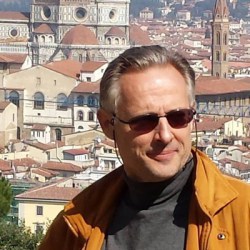
Image right: Prof. Bruno Guigue

Yes, thousands of young people have been brainwashed by your war propaganda and persuaded to take up arms against this despised state that you dream of bombing into oblivion. It is your foreign affairs minister, Laurent Fabius who launched this mission when he declared that Bashar al Assad does not deserve to live and that the Syrian Al Qaeda [Al Nusra Front] were doing a “good job” in Syria.

You can try to conceal your responsibility, but we all can see now how these attacks committed in France are a direct result of your failed foreign policy. Why are there no attacks in Italy, Argentina or Japan? Are the French being collectively punished for your refusal to co-operate with Syrian intelligence to identify the french jihadists and prevent their return to France?

Do our compatriots know that you expressly forbid the transfer of funds to the majority of the Syrian people living in government held areas inside Syria? Do they know that you have never once expressed your sorrow for the multitude of Syrian victims of Al Qaeda atrocities or that you persist in the imposition of sanctions upon these people enduring relentless mass terrorist attacks?

You decided to play a role in the Syrian conflict and you sugar-coated your involvement with humanitarian pretexts which are now collapsing like a house of cards, exuding the acrid stench of hydrocarbons. You have dragged France into a swamp which should have been avoided at all costs and you have exposed your people to a boomerang effect bringing with it, unimaginable devastation. You have brought home the violence that you and your neo-colonialist allies have unleashed.

Do you think the French will thank you especially once they have unraveled the truth of this dramatic event?

Mr Hollande, when the dust has settled on this drama, and the compassion photo-shoot is over, the patriotic unity celebrations finished, are you once more going to award medals to the bankrollers of terror? Overtly condemning terrorism while covertly entertaining its Saudi sponsors. The US has its Frankenstein in George W Bush, the sorcerer’s apprentice of geopolitical chaos. You are his equal – you are France’s own Frankenstein.

By affiliating France with a mafioso, manipulated, sectarian “rebellion”, thinking you were boxing clever while on the ropes, you have fed the monster that is now extending its tentacles into France. You allied yourself with DAESH while they were fighting Assad but condemned them after the first executions of westerners in Iraq. Thus you nourished resentment among these criminals from whom you seemed to expect greater understanding.

You have been advised by pseudo-experts whose intellectual independence is entirely dependent upon how much you pay them, so its impossible for you to extricate yourself from your errors without being overruled. Instead, you continue to throw dust in our eyes with the “State of Emergency” and to “windmill” your little arms. We are nine months away from the elections where, of course,  you will try to manipulate the facts.

Your legacy will be the rotting fruit of your political ineptitude, the manifestation of your incompetence as a minister who confuses Saddam Hussein with Bashar al Assad, an absurdity that does not even raise a smile on this day of universal grief.

Translation by Vanessa Beeley for 21st Century Wire.

The original article can be consulted at arretsurinfo.ch

Bruno Guigue is a French author and political analyst born in Toulouse 1962. Professor of philosophy and lecturer in international relations for highter education. The author of 5 books including  Aux origines du conflit Israélo-Arabe, l’invisible remords de l’Occident (L’Harmattan, 2002).

U.S.-South Korea hypocrisy: Wargame invasion of DPRK, decide to install THAAD Missile “Defense System”, violate UN Security Council Resolution

Global Research, July 10, 2016

The decision of Seoul and Washington to place on the territory of South Korea American missile defense systems THAAD violates the provisions of the UN security Council resolution No. 2270 on North Korea. That’s the words of an influential legal expert on international sanctions issued to the Rossiyskaya Gazeta on condition of anonymity.

Other experts noted that the United States and the Republic of Korea constantly allow themselves actions that are destabilizing the situation, which  is also contrary to the provisions of the resolution, although Seoul and Washington are in the forefront of those calling to comply with this resolution as closely as possible.

We can remind you that the UN security Council resolution No. 2270 was adopted on March 2, 2016 in response to the nuclear and missile tests by Pyongyang in January and February of this year. The main content of the document were the new sanctions against the DPRK, but there are also a number of General provisions. Yesterday, the United States and the Republic of Korea stated that they intend to place on the Korean peninsula American anti-missile complexes THAAD before the end of 2017, which caused a sharp condemnation from Russia and China, as well as a mixed reaction in South Korea.

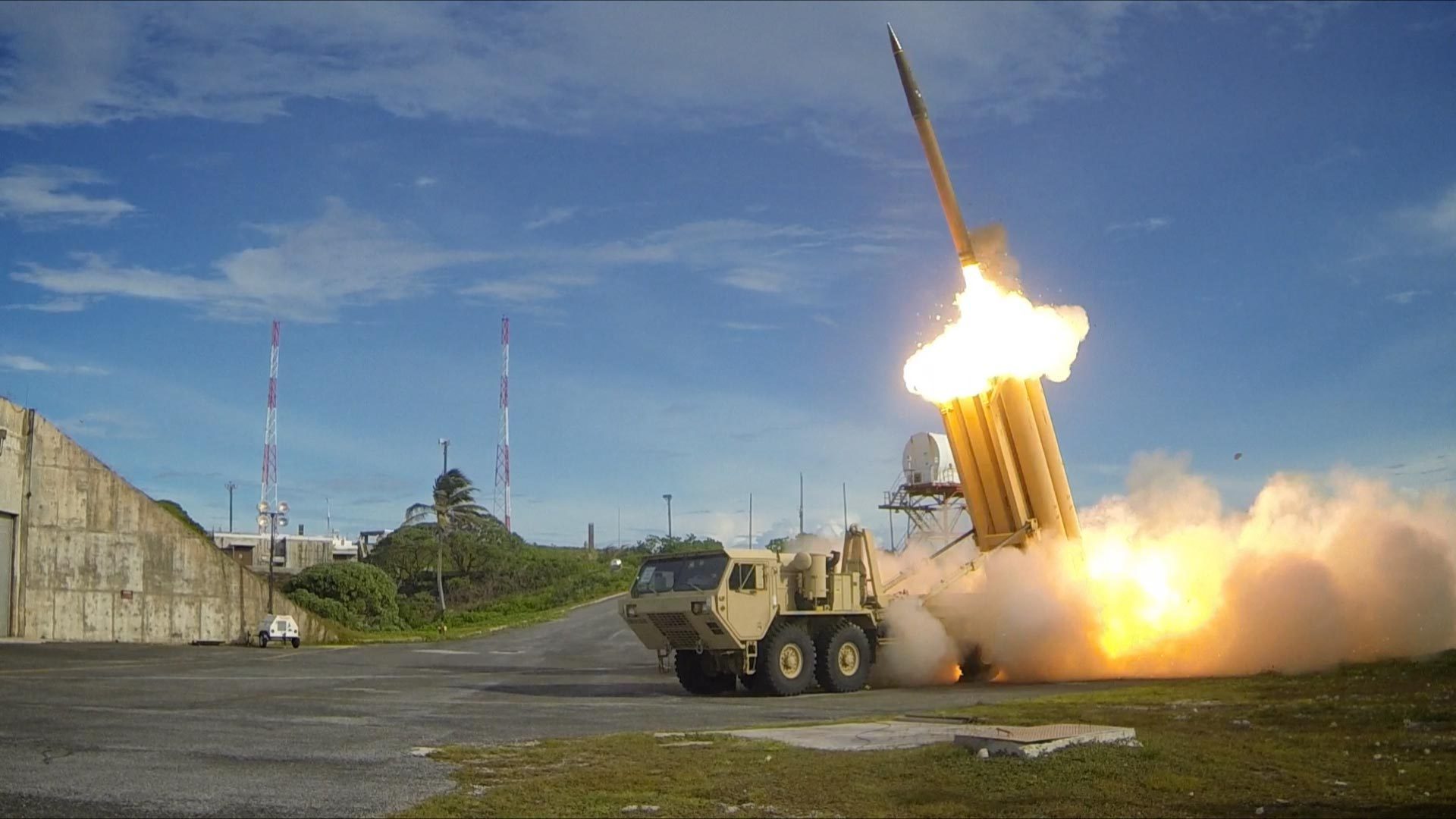
Terminal High Altitude Area Defense (THAAD) produced by Lockheed Martin

“Seoul and Washington are usually very keen on keeping an eye on othes, so that they would very strictly adhere to UN security Council resolution No. 2270, but they forget about their behavior. They should have to read the whole text if that resolution. Their decision on THAAD is totally contrary to the provisions of this resolution,” – said to Rossiyskaya Gazeta a competent source in the field of application of sanctions who asked not to be named.

The expert explained that it concerns in particular the paragraph 49 of the resolution No. 2270, where it is stressed that the UN security Council

“reaffirms the importance of maintaining peace and stability on the Korean Peninsula and throughout northeast Asia, reiterates its commitment to a peaceful, diplomatic and political solution to the situation and welcomes efforts by Council members as well as other States to facilitate a peaceful and comprehensive solution through dialogue and to avoid any action which might increase tensions”.

“Placing missile defense systems THAAD just increases the tension on the Korean Peninsula, in northeast Asia and does not contribute to the maintenance of peace and stability,” he said, pointing out that after the statement of Seoul and Washington about THAAD instability and tension in the region are increasing rapidly

He added that this view is supported by the Ministries of Foreign Affairs of the Russian Federation and of the People’s Republic of China who yesterday issued their statements about plans to place of antimissile systems. In particular, the statement of the Russian Foreign Ministry says that “such actions, no matter how they were substantiated, have the most negative impact on global strategic stability, the commitment about which they love to talk so much in Washington. They also increase regional tensions, creating new challenges to solve complex problems of the Korean Peninsula including its denuclearization”.

Another expert on regional issues said that the US and South Korea consistently make actions which are a violation of the resolution and do not contribute to stability.

“They like to say about THAAD in Seoul  that this is a purely defensive weapons. OK, then let’s talk about the following. Right now, artillery, aviation, and marine corps of South Korea and the United States are involved  in yet another exercises on the Korean Peninsula, which work out how to attack the DPRK, practicing the seizure of footholds and the development of further advance. The exercises started on June 27 and will last until July 14. Earlier, the US Army Command in the Asia Pacific region informed that they have conducted exercises the aim of which was also how to invade the DPRK, a practice on bombing of North Korea with the participation of the strategic B-52 bombers and attacking aircraft.

The military of both the United States and South Korea not only did not conceal the offensive nature of the exercises, but even emphasized it. So, they want to present such actions, too,  as “contributing to peace and stability”? And can after that anybody be surprised that Pyongyang is starting to get agitate?!”- he asked rhetorically, stressing that these exercises  also undoubtedly violate the UN security Council resolution No. 2270.

“… Please, let’s remember that this document has provisions mandatory for all, including the US and South Korea. Today they shout in unison that the launch of ballistic missile from a North Korean submarine violates the UN resolution. But they constantly allow themselves actions that are inconsistent with the document on the thorough implementation of which they themselves insist,” said the expert.

Abridged translation from Russian.

Original article in Russian:

https://rg.ru/2016/07/09/reshenie-seula-po-kompleksam-pro-thaad-narushilo-rezoliuciiu-sb-oon.html