Video: Russia and China challenge the Monroe Doctrine, Russia’s military facilities in Latin America

Global Research, July 16, 2016

One of the dogmas of US foreign policy is the so-called Monroe Doctrine dating back to, surprisingly enough, President James Monroe who in 1823 said, in an address before US Congress, that outside powers’ efforts to colonize or exploit Latin American countries would be viewed as acts of aggression by the United States. The sentence above pretty much encapsulates the average American’s understanding of the doctrine.

What is left unsaid is that the doctrine has no legal standing. It is not an international treaty or agreement, and the US Congress has not granted the Presidency a blanket authority to go to war against any external power encroaching upon the US “exclusive preserve.” What is equally left unsaid is Monroe’s quid pro quo: the US would likewise refrain from meddling in European politics, which radically changes the actual meaning of the doctrine. It is not merely an assertion of US dominance over a region, but rather a not reciprocated offer of a sphere of influence division between the US and European powers which actually came close to being codified in the form of the UN Security Council which, by granting veto power to its five permanent members, de facto divided the world into five spheres of influence.

Those days of US restraint and respect for international treaties are long gone. On the one hand, successive US administrations invoke various “open door” doctrines in order to intervene in every corner of the planet, usually with dire consequences, while at the same time seeking to preserve the Americas  for the US to exploit and colonize and deprive the sovereign states of that region the right to choose its allies and economic partners. Naturally, from the perspective of international law, such unilateral actions are untenable, and accepting them would set the precedent of recognizing the US as a privileged international actor, in effect making “American Exceptionalism” an internationally acknowledged reality.

This is the context in which Russian military installations in Latin America ought to be viewed. From the military point of view, their presence is as, if not more, important for political reasons than military ones.

These installations include the Lurdes Radioelectronic Reconnaissance Center which became operational in 1967, collecting intelligence for the GRU, KGB, and the Soviet Navy. Decommissioned in 2002, the site could be made operational should the circumstances require it, with Cuban government’s permission. At the moment there are no plans to do so, however.

In March 2016 the Russian Ministry of Foreign Affairs had stated that there are no plans to reactivate Lurdes, ostensibly because the Russian Federation can gather the necessary intelligence by other means. In actuality, the status of Lurdes likely depends on the degree of US military aggressiveness in Eastern Europe. Luckily at the moment NATO, for all its belligerent rhetoric, does not want to go too far in provoking Russia, hence the “rotating” NATO troop presence which would be politically less difficult to back out of than permanent bases.

While the status of Lurdes is frozen, another project, this time in Nicaragua, is moving forward. Russia is establishing a GLONASS navigation system station in the country, a move that instantly led some in the US claim it is a reconnaissance installation. The station is part of a larger package of Russia-Nicaragua cooperation that also entails the provision of 50 T-72 tanks to the country. In the preceding years, and most recently in 2013, Nicaragua has been visited by Russian strategic bombers that also took the opportunity to visit Venezuela.

Collectively, these measures are relatively modest and are not comparable to US initiatives in Eastern Europe. There is certainly no discussion of another “Cuban Missile Crisis” type confrontation. Here one has to keep in mind that Russia is not the only international actor interested in defying the US-imposed quarantine of Latin America.

China has similar interests for identical reasons, namely the need to respond to the US encroachment of its positions around the South China Sea. China’s interest in Latin America has also been evidenced by the discussions of a so-called Nicaragua Canal that would offer an alternative to the US-controlled Panama Canal, an initiative that Washington also strongly opposes. Therefore if the US provocations toward both Russia and China continue, Latin America could very easily become a catalyst for closer security cooperation between the two countries.

If you’re able, and if you like our content and approach, please support the project. Our work wouldn’t be possible without your help: PayPal: southfront@list.ru or via: http://southfront.org/donate/ or via: https://www.patreon.com/southfront

Terror attack in Nice: Open letter to President Hollande, the French Republic’s Frankenstein

Global Research, July 16, 2016

President Hollande, after this terrorist attack that has rocked our country, you addressed the nation with emotion and dignity, expressing your compassion for the victims.  We assume you have been well informed as you were able to immediately point the finger of blame at the perpetrators and you called upon France to display unity and solidarity against the “islamist terrorism”. You called upon us to close ranks and to harness all our energies in confronting this terrible threat.

But this entirely legitimate call for national cohesion, when our country is feeling so vulnerable, should not prohibit citizens from questioning your policies. From the day you were elected, you have claimed to be ceaselessly combatting terrorism. But in reality, you appear to be doing exactly the opposite.

Instead of combatting evil you have been focusing your efforts against those who are truly fighting it. You tell us you are fighting terrorism but you never cease your demonization of and campaign against Syria and Bashar al Assad.

You condemned this sovereign state to the horrors of the same criminals who open fire upon our cafes and restaurants, this sovereign state detested by your American-Zionist allies because it refuses to bow down to their diktat. The Jihadist mercenaries were looking for a target and you cynically gave them Damascus.

Image right: Prof. Bruno Guigue

Yes, thousands of young people have been brainwashed by your war propaganda and persuaded to take up arms against this despised state that you dream of bombing into oblivion. It is your foreign affairs minister, Laurent Fabius who launched this mission when he declared that Bashar al Assad does not deserve to live and that the Syrian Al Qaeda [Al Nusra Front] were doing a “good job” in Syria.

You can try to conceal your responsibility, but we all can see now how these attacks committed in France are a direct result of your failed foreign policy. Why are there no attacks in Italy, Argentina or Japan? Are the French being collectively punished for your refusal to co-operate with Syrian intelligence to identify the french jihadists and prevent their return to France?

Do our compatriots know that you expressly forbid the transfer of funds to the majority of the Syrian people living in government held areas inside Syria? Do they know that you have never once expressed your sorrow for the multitude of Syrian victims of Al Qaeda atrocities or that you persist in the imposition of sanctions upon these people enduring relentless mass terrorist attacks?

You decided to play a role in the Syrian conflict and you sugar-coated your involvement with humanitarian pretexts which are now collapsing like a house of cards, exuding the acrid stench of hydrocarbons. You have dragged France into a swamp which should have been avoided at all costs and you have exposed your people to a boomerang effect bringing with it, unimaginable devastation. You have brought home the violence that you and your neo-colonialist allies have unleashed.

Do you think the French will thank you especially once they have unraveled the truth of this dramatic event?

Mr Hollande, when the dust has settled on this drama, and the compassion photo-shoot is over, the patriotic unity celebrations finished, are you once more going to award medals to the bankrollers of terror? Overtly condemning terrorism while covertly entertaining its Saudi sponsors. The US has its Frankenstein in George W Bush, the sorcerer’s apprentice of geopolitical chaos. You are his equal – you are France’s own Frankenstein.

By affiliating France with a mafioso, manipulated, sectarian “rebellion”, thinking you were boxing clever while on the ropes, you have fed the monster that is now extending its tentacles into France. You allied yourself with DAESH while they were fighting Assad but condemned them after the first executions of westerners in Iraq. Thus you nourished resentment among these criminals from whom you seemed to expect greater understanding.

You have been advised by pseudo-experts whose intellectual independence is entirely dependent upon how much you pay them, so its impossible for you to extricate yourself from your errors without being overruled. Instead, you continue to throw dust in our eyes with the “State of Emergency” and to “windmill” your little arms. We are nine months away from the elections where, of course,  you will try to manipulate the facts.

Your legacy will be the rotting fruit of your political ineptitude, the manifestation of your incompetence as a minister who confuses Saddam Hussein with Bashar al Assad, an absurdity that does not even raise a smile on this day of universal grief.

Translation by Vanessa Beeley for 21st Century Wire.

The original article can be consulted at arretsurinfo.ch

Bruno Guigue is a French author and political analyst born in Toulouse 1962. Professor of philosophy and lecturer in international relations for highter education. The author of 5 books including  Aux origines du conflit Israélo-Arabe, l’invisible remords de l’Occident (L’Harmattan, 2002).

U.S.-South Korea hypocrisy: Wargame invasion of DPRK, decide to install THAAD Missile “Defense System”, violate UN Security Council Resolution

Global Research, July 10, 2016

The decision of Seoul and Washington to place on the territory of South Korea American missile defense systems THAAD violates the provisions of the UN security Council resolution No. 2270 on North Korea. That’s the words of an influential legal expert on international sanctions issued to the Rossiyskaya Gazeta on condition of anonymity.

Other experts noted that the United States and the Republic of Korea constantly allow themselves actions that are destabilizing the situation, which  is also contrary to the provisions of the resolution, although Seoul and Washington are in the forefront of those calling to comply with this resolution as closely as possible.

We can remind you that the UN security Council resolution No. 2270 was adopted on March 2, 2016 in response to the nuclear and missile tests by Pyongyang in January and February of this year. The main content of the document were the new sanctions against the DPRK, but there are also a number of General provisions. Yesterday, the United States and the Republic of Korea stated that they intend to place on the Korean peninsula American anti-missile complexes THAAD before the end of 2017, which caused a sharp condemnation from Russia and China, as well as a mixed reaction in South Korea.

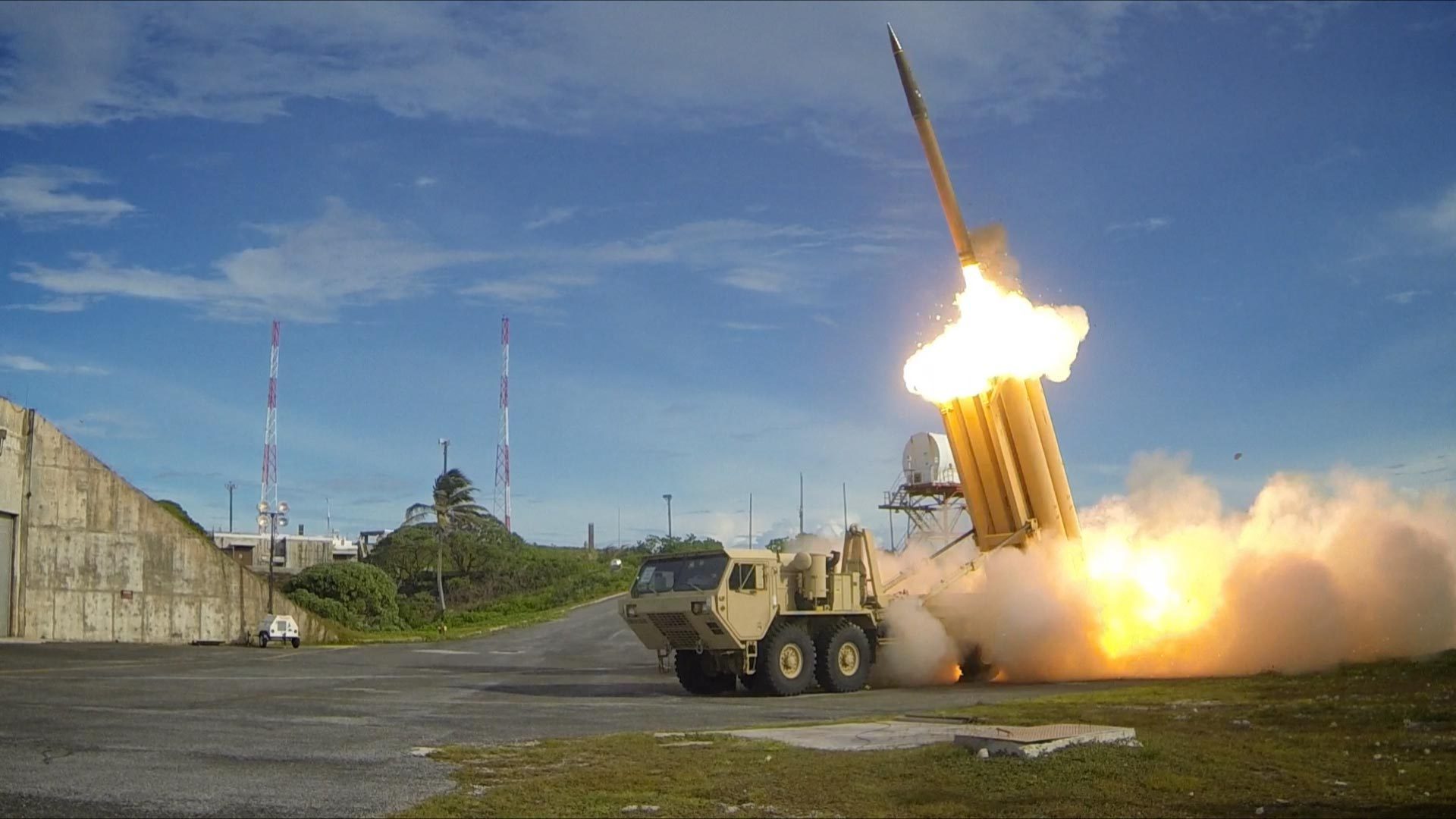
Terminal High Altitude Area Defense (THAAD) produced by Lockheed Martin

“Seoul and Washington are usually very keen on keeping an eye on othes, so that they would very strictly adhere to UN security Council resolution No. 2270, but they forget about their behavior. They should have to read the whole text if that resolution. Their decision on THAAD is totally contrary to the provisions of this resolution,” – said to Rossiyskaya Gazeta a competent source in the field of application of sanctions who asked not to be named.

The expert explained that it concerns in particular the paragraph 49 of the resolution No. 2270, where it is stressed that the UN security Council

“reaffirms the importance of maintaining peace and stability on the Korean Peninsula and throughout northeast Asia, reiterates its commitment to a peaceful, diplomatic and political solution to the situation and welcomes efforts by Council members as well as other States to facilitate a peaceful and comprehensive solution through dialogue and to avoid any action which might increase tensions”.

“Placing missile defense systems THAAD just increases the tension on the Korean Peninsula, in northeast Asia and does not contribute to the maintenance of peace and stability,” he said, pointing out that after the statement of Seoul and Washington about THAAD instability and tension in the region are increasing rapidly

He added that this view is supported by the Ministries of Foreign Affairs of the Russian Federation and of the People’s Republic of China who yesterday issued their statements about plans to place of antimissile systems. In particular, the statement of the Russian Foreign Ministry says that “such actions, no matter how they were substantiated, have the most negative impact on global strategic stability, the commitment about which they love to talk so much in Washington. They also increase regional tensions, creating new challenges to solve complex problems of the Korean Peninsula including its denuclearization”.

Another expert on regional issues said that the US and South Korea consistently make actions which are a violation of the resolution and do not contribute to stability.

“They like to say about THAAD in Seoul  that this is a purely defensive weapons. OK, then let’s talk about the following. Right now, artillery, aviation, and marine corps of South Korea and the United States are involved  in yet another exercises on the Korean Peninsula, which work out how to attack the DPRK, practicing the seizure of footholds and the development of further advance. The exercises started on June 27 and will last until July 14. Earlier, the US Army Command in the Asia Pacific region informed that they have conducted exercises the aim of which was also how to invade the DPRK, a practice on bombing of North Korea with the participation of the strategic B-52 bombers and attacking aircraft.

The military of both the United States and South Korea not only did not conceal the offensive nature of the exercises, but even emphasized it. So, they want to present such actions, too,  as “contributing to peace and stability”? And can after that anybody be surprised that Pyongyang is starting to get agitate?!”- he asked rhetorically, stressing that these exercises  also undoubtedly violate the UN security Council resolution No. 2270.

“… Please, let’s remember that this document has provisions mandatory for all, including the US and South Korea. Today they shout in unison that the launch of ballistic missile from a North Korean submarine violates the UN resolution. But they constantly allow themselves actions that are inconsistent with the document on the thorough implementation of which they themselves insist,” said the expert.

Abridged translation from Russian.

Original article in Russian:

https://rg.ru/2016/07/09/reshenie-seula-po-kompleksam-pro-thaad-narushilo-rezoliuciiu-sb-oon.html

What the West unleashed — possible nuclear blackmail from Ukraine against Europe, Russia, and U.S.

From Fort Russ

Zhuravko: Islyamov Could Engage in Nuclear Terrorism for the Sake of Blackmailing Russia

Translated by Ollie Richardson for Fort Russ

27th June, 2016

antifashist

The situation in Ukraine continues to be alarming, and, unfortunately, does not create hope and optimism. The state under the control of the coup is rapidly approaching collapse on all fronts. In this sense, unfortunately, the threat is not only to the State of the country or the welfare of its inhabitants, but also the lives of millions of people, and not only in Ukraine. The Kiev government largely does not control the situation in Ukraine, does not control its own militants, and cannot prevent many emergencies, among which the safety of Ukrainian Nuclear Power Plant has special status.

This was discussed on the TV programme “Special Status” on the TV channel “Zvezda”, which the Ukrainian opposition politician Alexei Zhuravko participated in.

“I am receiving disturbing information from Ukraine almost every day. The threat of a terrible collapse and many deaths exists. We mustn’t joke on the topic of nuclear plants. In addition, experts seak about one other threat: it is Islyamov, it is “Azov” militants, fighters of “Dnepr”. And no one knows where the gun will turn. The worst thing is that the safety of nuclear power plants, which was ensured by the State, internal security, no longer exists. That is, there is no protection, there are no guns that were defending the stations before, all was stolen, money for major repairs of the stations was looted, very little resources were allocated. In Zaporozhye, according to my real information, there was already a shutdown of this station, and it is linked with experiments. (I still have connections, I used to work with “Energoatom”) In this situation, we need to unite, to connect media, to reach out to the Ukrainians, otherwise there will be a disaster,” he said.

Zhuravko doesn’t exclude that the fugitive Crimean Tatar terrorist Lenor Islyamov and his fighters, who have repeatedly threatened Russia with terrorist attacks, can bring his threats to life. Among those may be the explosion of nuclear facilities, nuclear power plants.

“It is simple. If some fool will get guns and mortars, after that it can explode. It’s scary! If today Islyamov wants to blackmail Russia, he has everything to do it. He can order the militants to close the stations and just to install terror. Nuclear terror. Because in Ukraine, the President does not control the country! And this process must be controlled by specialists,” said the politician.

“I ring all the bells around and I hope god will forbid those bastards from entering into nuclear power plant and chemical plant, and it’s just hard to imagine what the consequences and human toll would be,” adds Zhuravko.

“If today Russia will not interpose, we will have such a blast that it will not look like something small. And it will be Belarus, Russia, Europe, and other countries that will suffer the most! It is necessary to “rear up” Europe… it is necessary to inform Ukrainians, it is necessary to show and to tell the truth on this matter. And to prove to people that they need to rise because a catastrophe will whip up, and humanity will be no more. Think about it for the time being it’s not too late,” warns the politician.

At this time, in the South of Ukraine, armed militants that are massively deployed in the region, continue criminal terror. According to Zhuravko, robbery of the population gains the scope of this disaster.

“Kherson region. 50 people armed to the teeth took away the farmer’s tractor, covers, chemicals, and seed material to the amount of twelve million hryvnias.

Mykolaiv region, Bashtansky district, 25th June 2016, 40 people armed with machine guns and other machetes seized the entire crop from this year.

According to available information, in Ukraine, on the black market and near the area of the ATO, you can buy any kind of weapons, machine guns, grenades, machine guns, explosives, anti-tank mines, and more.

Private territorial battalions in Ukraine are growing like mushrooms after rain. The example of Isylamov’s battalions and their ISIS-isation of the Kherson region is already enough of a problem.

The President does not control the situation in Ukraine, the Security Service of Ukraine is not fighting against private territorial battalions with radical ideas, and are not fighting terrorism,” writes the ex-MP on a social network.

Alexei Zhuravko’s data was unexpectedly confirmed by the famous Ukrainian militant, leader of “Brotherhood” Dmitry Korchinskiy. Battalions under the leadership of businessman Lenur Islyamov, formed on the border with Crimea in Kherson region, are engaged in robbery, he said to the TV channel “112 Ukraine”.

“They have already proclaimed the necessity of national autonomy of the Crimean Tatars, without asking the Ukrainian people. Crimean Tatars, even in the times of Geray (dynasty of Kahn in the 15th Century – O.R), were not a majority in Crimea. And today they say that Crimea should be a national autonomy of Crimean Tatars!

Today in two districts in Kherson region… Tatars under the command of Lenur Islyamov, the former Deputy Prime Minister of the occupational government of Crimea, already have military formations that are very well armed, and are also engaged in robbery and all sorts of boorishness,” said Korchinskiy.

http://www.fort-russ.com/2016/06/zhuravko-islyamov-could-engage-in.html

Article on nuclear power in Ukraine:

http://www.world-nuclear.org/info/Country-Profiles/Countries-T-Z/Ukraine/

Media Freedom Summit, October 21-22, Northern California

From Project Censored:

Project Censored cordially invites you to attend the Media Freedom Summit: Celebrating 40 Years of Project Censored, to be held at Sonoma State University (SSU) in scenic Northern California on October 21-22, 2016. The Summit will be an opportunity for journalists, students, faculty, activists, and community members to identify and address crucial threats to media freedom, to learn about and share effective strategies for advancing media freedom, and to promote critical media literacy education in service of social justice and positive, meaningful change in local communities and larger society. The Summit is co-sponsored by ACME: Action Coalition for Media Education and Sacred Heart University’s Media Education and Digital Culture MA Program. Registration and Summit information will be available at ProjectCensored.org after March 7, 2016, and will be updated with new information as details develop.

The Summit

The Summit will witness the official launch of the Global Critical Media Literacy Project (GCMLP at www.gcml.org ), a new joint venture between Project Censored and the Summit cosponsors. The GCMLP provides social justice oriented pedagogy and curricular models for educators working in a variety of disciplines. The GCMLP empowers students with meaningful learning and an educational pathway from junior college to graduate school and opportunities for civic engagement in their communities. The Summit will also inaugurate the process of determining the first recipient of a new annual Carl Jensen Award, named for Project Censored’s late founder, honoring a stellar educator dedicated to media literacy in the fight against censorship. The first award will be given in 2017.

A number of the Summit’s sessions and workshops will highlight how interested faculty, students, and members of the public can join in the GCMLP’s collaborative mission. The Summit opens Friday morning with registration followed by two concurrent panel discussions, a DIY lunch on campus, afternoon sessions with speakers leading conversations and workshops discussing Summit themes, followed by a dinner and celebration Friday night with keynote conversation led by journalist Abby Martin of The Empire Files. Saturday the program continues with workshops, dialogue, and strategy sessions from morning through late afternoon. One of the major goals of the Media Freedom Summit is the establishment of a working document, Priorities of Media Freedom for the World, which will serve as a practical guide to informed action. This will take place at the end of the Summit Saturday evening. Sunday will be a free day for summit participants to self organize and plan their own outings around the San Francisco Bay Area and carry on their own conversations building upon the Summit’s themes!

Throughout the Summit proceedings, in workshops and group discussions, participants will be identifying and addressing these priorities. The resulting document will be a joint statement by Summit attendees on how educators, activists, and students can best advocate for media freedom and education in a digital age. Come engage with award-winning journalists, professors, activists, and students and strategize how to better epitomize media freedom in action! Stay tuned for a more detailed calendar of events.

Registration Fees

Registration Cost: $125 (early bird rate until July 4th, $150 thereafter)

Students with valid college IDs are admitted free (Students Must Register even though there is no fee)

Click Here To Buy tickets for 2016 Media Freedom Summit

OR

Paste This URL Into Your Browser: http://www.brownpapertickets.com/event/2517792

Lodging

The Best Western Inn has discount rates available for this event. Please let them know that you are attending the Project Censored Media Freedom Summit at Sonoma State University for the discounted rate.

The Best Western Inn Address is:

6500 Redwood Dr, Rohnert Park, CA 94928

Phone:(707) 584-7435

Fee Include:

A signed copy of Censored 2017

Full Friday and Saturday program

Friday evening Hors d’oeuvres and celebration, Keynote panel conversation led by

Abby Martin of The Empire Files, cash bar (DIY lunch at SSU not included)

Friday celebration is open to the general public for $40

Saturday morning continental breakfast/coffee (DIY lunch at SSU not included)

Sunday, conference attendees plan their own outings from the beach to wine country to carry on the mission of the Summit outdoors as they see fit

http://projectcensored.org/the-media-freedom-summit-celebrating-40-years-of-project-censored-october-21-22-2016-at-sonoma-state-university/

June 22, the day Nazi Germany invaded the Soviet Union; President Putin addresses the State Duma

From Kremlin.ru

Vladimir Putin addresses the State Duma’s plenary session
April 22, 2016

The President reviewed the Duma deputies’ results and work over the last five-year parliamentary session.

President of Russia Vladimir Putin: Colleagues,

I wanted to meet with you as the parliament’s sixth convocation comes to the end of its mandate and thank you for your work over these years. I want to thank you and say a few words about the results of your work. Of course, I want to take a look forward too at the tasks the next parliament will have before it.

But first of all, let me turn to the tragic date we are marking today. Seventy-five years ago, Nazi Germany treacherously invaded the Soviet Union and the Great Patriotic War began. By this time, as we know, the Nazis has already enslaved many European countries.

The Soviet people took the brunt of the Nazis’ force, but they met the enemy with tremendous unity and resistance, and withstood the onslaught, fighting literally to the death to protect their homeland. They drove the enemy right back to its lair, inflicted a crushing defeat on the invaders and achieved the Great Victory.

Today, we bow our heads before this heroic generation. Our fathers and grandfathers gave their lives to save Russia and all of humanity from the fascist scourge. We will always remember their sacrifice and courage. We treasure the bright memory of all who gave their lives in that war, and all our veterans who are no longer with us now. I propose that we honour their memory with a minute of silence.

(Minute of silence)

It was the Nazis who unleashed this war. Their ideology of hatred, blind faith in their own exceptional nature and infallibility, and desire for world domination led to the twentieth century’s greatest tragedy.

We know the biggest lesson of that war: it could have been prevented. It could have been stopped if efforts had been made to firmly rein in the Nazis and their accomplices’ wild ambitions in time. But this did not happen. Our country, the Soviet Union, made direct proposals for joint action and collective defence, but these proposals were simply left hanging.

The leaders of a number of Western countries chose instead to pursue a policy of containing the Soviet Union and sought to keep it in a situation of international isolation. But it was Nazism that was the real and terrible global threat. Politicians underestimated its danger, overlooked the threat and did not want to admit that enlightened Europe could give birth to a criminal regime that was growing ever stronger.

The international community let its vigilance down and lacked the will and unity to prevent this war and save the lives of millions and millions of people. What other lesson do we need today to throw aside tattered old ideological differences and geopolitical games and unite our forces to fight international terrorism?

This common threat is spreading its danger before our very eyes. We must create a modern collective security system beyond blocs and with all countries on an equal footing. Russia is open to discussions on this most important issue and has repeatedly stated its readiness for dialogue.

For now though, as was the case on the eve of World War II, we see no positive response. On the contrary, NATO is stepping up its aggressive rhetoric and aggressive actions close to our borders. In this situation, we have no choice but to devote particular attention to the tasks we must address in order to increase our country’s defence capability.

I would like to thank the State Duma deputies for their deep and substantive understanding of Russia’s state interests and for knowing how to defend these interests decisively. Of course, I also want to thank you for your consolidated legislative support for the proposals on strengthening our country’s security.

Colleagues, your work and its results deserve a worthy assessment. It is particularly important that the laws you have adopted have played a big part in enabling us to fulfil our social obligations to our citizens, develop our most important economic sectors and improve our country’s political system. I want to stress this point.

You have accomplished a tremendous amount of work in all these areas. This successful work is the result of the efforts made by all parliamentary parties and their willingness to pursue a constructive dialogue with each other, with the Government, and with the other participants in the legislative initiative.

A truly historic result of this convocation’s work was the legal integration of Crimea and Sevastopol, which followed on your sincere and heartfelt moral support for the peninsula’s people on the eve of the referendum on joining the Russian Federation. You were active in supporting the view shared by the vast majority of Crimea and Sevastopol’s people, sometimes emotionally, and when needed, very professionally.

During this time, all parliamentary parties displayed a degree of unity of which your voters can be deservedly proud. In a very short period of time, you adopted more than 120 laws that smoothed the way for Crimea and Sevastopol’s entry into the Russian Federation. You helped people to get through the transition period’s difficulties, feel at home in Russia and know that their rights are reliably guaranteed and new opportunities have opened before them.

A readiness to consolidate for the sake of the tasks at hand and for Russia’s sake is this convocation’s distinguishing feature. It is very important now that the next parliamentary convocation continues these traditions, including this strict respect for the rules of parliamentary ethics. Continuity in law-making work is of tremendous importance.

This ensures the legislative base’s quality and also the authoritative reputation of the entire Russian jurisdiction. We should most definitely continue the practice of annual reports on the state of our country’s legislation. These reports are drafted by both chambers of the Federal Assembly together with the regional parliaments. This is a very useful practice, I think, very important work.

I want to stress particularly that the legislative branch is an independent branch of power and no opportunist, short term interests or desire to push some decision through as fast as possible should interfere with its work. There should be no hasty or superficial approach when examining and adopting laws. I particularly emphasise this point. The key task for the new convocation in the law-making process will be to ensure a well-planned and systemic legislative process with deep and substantive discussion of draft laws.

Colleagues, I particularly want to mention your great contribution to developing our political system. You have passed a whole swathe of laws that strengthen Russia’s democratic foundations, make the political system more transparent and effective, and set higher standards for political competition.

We now have ten times more political parties than we did five years ago. But we know very well that the political system’s quality cannot be measured by the number of parties, but by their ability to influence the decision-making process regarding the issues of greatest concern to our people.

The parliamentary parties have considerable advantages, and these opportunities are deservedly earned. But during the upcoming election campaign, you will have to pass the test once again before your voters. The executive order setting the date for the State Duma election has already been signed. The election will take place under the mixed-member system on September 18th.

Let me stress that the State Duma will soon get an influx of deputies elected in single-seat districts, and this will bolster considerably the parliament’s representative functions and ties with the regions. It is very important that your work gives our people added guarantees of their social rights. These rights should be guaranteed by laws that regulate education, healthcare, and the housing and utilities sector.

You have devoted much effort over these last years to precisely these issues, including support for motherhood and childhood. These are complicated issues of course, difficult problems, but their resolution is crucial for our country’s future. All of the different issues are important of course. Security and international affairs are important, but nothing is more important than the economy and the social sector.

We have put together an effective anti-corruption legal base over these last years, toughened requirements to all categories of civil servants, and introduced bans on opening accounts in foreign banks and possessing foreign companies’ assets.

Now we must ensure that all comply strictly with the law no matter what the office they hold. I am sure that we all share a unanimous position on this issue. I note too that the laws you have passed on strategic planning and industrial policy are extremely important, as is the law on priority development areas, for example.

The work on modernising civil law continues, including incentives for business and investment and measures to combat internet piracy. You have also passed the law on parliamentary oversight, which will most certainly raise the prestige and significance of the deputies’ work.

Improving our environmental legislation is an area of much importance today. Protecting nature and the animal and plant world and guaranteeing people’s right to a good natural environment are common tasks for all political parties. I know that during this parliament’s term you have examined draft laws on the preservation and restoration of forests and ensuring forest fire prevention. The new State Duma will have to continue this work just as actively as you have, all the more so as we have declared 2017 the Year of the Environment.

All parliamentary parties have also shown unity on foreign policy issues. I already mentioned this. Yes, there were some attempts to play up differences between parties, but no one succeeded in splitting your unity and splitting the consolidation in our society and between your voters. At the same time, your contacts with colleagues abroad have become more intensive.

Friends, many political parties have already set dates for holding their congresses to announce candidates and present their campaign programmes. Essentially, the election campaign has begun. Ahead of you is some fierce competition, debates with opponents, and a far from easy time for all who will be taking part in these elections.

I hope that you will do everything possible to ensure that this election is honest, open, and takes place in a spirit of mutual respect. It is also my hope that you will hold a battle not of mudslinging against each other, but of ideas, the implementation of which should strengthen our country and raise our people’s living standards. I appeal to you to do this.

It is very important that all political parties realise their responsibility for preserving social stability and strive not just for the best election results, but for voters’ trust in the election’s outcome. I am sure that stability and trust are key factors and foundations for our country’s successful development.

You are all experienced people and have traversed all the difficulties of election campaigns before. But let me say again nonetheless that the most important players now are not the parties and candidates, but the voters, our country’s people. They are most important. It is they who give you the powers to decide their biggest problems so as to make our country an independent and effectively functioning state in which people can live and work in comfort and safety.

I am sure that you understand well the tasks before our country today. You have already demonstrated this through your work as deputies based on the principles of patriotism and service to people. You have succeeded in developing high standards of political and parliamentary culture and applying them in practice in your everyday work. It will be useful for our country and for the voters if this constructive political style becomes the distinguishing feature of this election campaign too.

You all have much work ahead of you. No matter where you will be working in the future, I wish you professional success and satisfaction, and I want to thank you once again for the very important and responsible work you have done in the Russian parliament.

Thank you very much.

http://en.kremlin.ru/events/president/news/52198

U.S State Department’s collective madness: Launch military strikes against Syrian army

Global Research, June 18, 2016
Consortium News 18 June 2016

More than 50 U.S. State Department “diplomats” sent a “dissent” memo urging President Obama to launch military strikes against the Syrian army, another sign that Foggy Bottom has collectively gone nuts, writes Robert Parry.

Over the past several decades, the U.S. State Department has deteriorated from a reasonably professional home for diplomacy and realism into a den of armchair warriors possessed of imperial delusions, a dangerous phenomenon underscored by the recent mass “dissent” in favor of blowing up more people in Syria.

Some 51 State Department “diplomats” signed a memo distributed through the official “dissent channel,” seeking military strikes against the Syrian government of Bashar al-Assad whose forces have been leading the pushback against Islamist extremists who are seeking control of this important Mideast nation.

Secretary of State Hillary Clinton testifies before Congress on Jan. 23, 2013, about the fatal attack on the U.S. mission in Benghazi, Libya, on Sept. 11. 2012. (Photo from C-SPAN coverage)

Secretary of State Hillary Clinton testifies before Congress on Jan. 23, 2013, about the fatal attack on the U.S. mission in Benghazi, Libya, on Sept. 11. 2012. (Photo from C-SPAN coverage)

The fact that such a large contingent of State Department officials would openly advocate for an expanded aggressive war in line with the neoconservative agenda, which put Syria on a hit list some two decades ago, reveals how crazy the State Department has become.

The State Department now seems to be a combination of true-believing neocons along with their liberal-interventionist followers and some careerists who realize that the smart play is to behave toward the world as global proconsuls dictating solutions or seeking “regime change” rather than as diplomats engaging foreigners respectfully and seeking genuine compromise.

Even some State Department officials, whom I personally know and who are not neocons/liberal-hawks per se, act as if they have fully swallowed the Kool-Aid. They talk tough and behave arrogantly toward inhabitants of countries under their supervision. Foreigners are treated as mindless objects to be coerced or bribed.

So, it’s not entirely surprising that several dozen U.S. “diplomats” would attack President Barack Obama’s more temperate position on Syria while positioning themselves favorably in anticipation of a Hillary Clinton administration, which is expected to authorize an illegal invasion of Syria — under the guise of establishing “no-fly zones” and “safe zones” — which will mean the slaughter of young Syrian soldiers. The “diplomats” urge the use of “stand-off and air weapons.”

These hawks are so eager for more war that they don’t mind risking a direct conflict with Russia, breezily dismissing the possibility of a clash with the nuclear power by saying they are not “advocating for a slippery slope that ends in a military confrontation with Russia.” That’s reassuring to hear.

Risking a Jihadist Victory

There’s also the danger that a direct U.S. military intervention could collapse the Syrian army and clear the way for victory by Al Qaeda’s Nusra Front or the Islamic State. The memo did not make clear how the delicate calibration of doing just enough damage to Syria’s military while avoiding an outright jihadist victory and averting a clash with Russia would be accomplished.

Video of the Russian SU-24 exploding in flames inside Syrian territory after it was shot down by Turkish air-to-air missiles on Nov. 24, 2015.

Video of the Russian SU-24 exploding in flames inside Syrian territory after it was shot down by Turkish air-to-air missiles on Nov. 24, 2015.


Presumably, whatever messes are created, the U.S. military would be left to clean up, assuming that shooting down some Russian warplanes and killing Russian military personnel wouldn’t escalate into a full-scale thermonuclear conflagration.

In short, it appears that the State Department has become a collective insane asylum where the inmates are in control. But this madness isn’t some short-term aberration that can be easily reversed. It has been a long time coming and would require a root-to-branch ripping out of today’s “diplomatic” corps to restore the State Department to its traditional role of avoiding wars rather than demanding them.

Though there have always been crazies in the State Department – usually found in the senior political ranks – the phenomenon of an institutional insanity has only evolved over the past several decades. And I have seen the change.

I have covered U.S. foreign policy since the late 1970s when there was appreciably more sanity in the diplomatic corps. There were people like Robert White and Patricia Derian (both now deceased) who stood up for justice and human rights, representing the best of America.

But the descent of the U.S. State Department into little more than well-dressed, well-spoken but thuggish enforcers of U.S. hegemony began with the Reagan administration. President Ronald Reagan and his team possessed a pathological hatred of Central American social movements seeking freedom from oppressive oligarchies and their brutal security forces.

During the 1980s, American diplomats with integrity were systematically marginalized, hounded or removed. (Human rights coordinator Derian left at the end of the Carter administration and was replaced by neocon Elliott Abrams; White was fired as U.S. ambassador to El Salvador, explaining: “I refused a demand by the secretary of state, Alexander M. Haig Jr., that I use official channels to cover up the Salvadoran military’s responsibility for the murders of four American churchwomen.”)

The Neocons Rise

As the old-guard professionals left, a new breed of aggressive neoconservatives was brought in, the likes of Paul Wolfowitz, Robert McFarlane, Robert Kagan and Abrams. After eight years of Reagan and four years of George H.W. Bush, the State Department was reshaped into a home for neocons, but some pockets of professionalism survived the onslaughts.

Former Assistant Secretary of State Elliott Abrams, who was a leading neocon inside President George W. Bush's National Security Council.

Former Assistant Secretary of State Elliott Abrams, a leading neocon.

While one might have expected the Democrats of the Clinton administration to reverse those trends, they didn’t. Instead, Bill Clinton’s “triangulation” applied to U.S. foreign policy as much as to domestic programs. He was always searching for that politically safe “middle.”

As the 1990s wore on, the decimation of foreign policy experts in the mold of White and Derian left few on the Democratic side who had the courage or skills to challenge the deeply entrenched neocons. Many Clinton-era Democrats accommodated to the neocon dominance by reinventing themselves as “liberal interventionists,” sharing the neocons’ love for military force but justifying the killing on “humanitarian” grounds.

This approach was a way for “liberals” to protect themselves against right-wing charges that they were “weak,” a charge that had scarred Democrats deeply during the Reagan/Bush-41 years, but this Democratic “tough-guy/gal-ism” further sidelined serious diplomats favoring traditional give-and-take with foreign leaders and their people.

So, you had Democrats like then-U.S. Ambassador to the United Nations (and later Secretary of State) Madeleine Albright justifying Bill Clinton’s brutal sanctions policies toward Iraq, which the U.N. blamed for killing 500,000 Iraqi children, as “a very hard choice, but the price – we think the price is worth it.”

Bill Clinton’s eight years of “triangulation,” which included the brutal air war against Serbia, was followed by eight years of George W. Bush, which further ensconced the neocons as the U.S. foreign policy establishment.

By then, what was left of the old Republican “realists,” the likes of Henry Kissinger and Brent Scowcroft, was aging out or had been so thoroughly compromised that the neocons faced no significant opposition within Republican circles. And, Official Washington’s foreign-policy Democrats had become almost indistinguishable from the neocons, except for their use of “humanitarian” arguments to justify aggressive wars.

Media Capitulation

Before George W. Bush’s invasion of Iraq, much of the “liberal” media establishment – from The New York Times to The New Yorker – fell in line behind the war, asking few tough questions and presenting almost no obstacles. Favoring war had become the “safe” career play.

At the start of the U.S. invasion of Iraq in 2003, President George W. Bush ordered the U.S. military to conduct a devastating aerial assault on Baghdad, known as "shock and awe."

At the start of the U.S. invasion of Iraq in 2003, President George W. Bush ordered the U.S. military to conduct a devastating aerial assault on Baghdad, known as “shock and awe.”

At the start of the U.S. invasion of Iraq in 2003, President George W. Bush ordered the U.S. military to conduct a devastating aerial assault on Baghdad, known as “shock and awe.”

But a nascent anti-war movement among rank-and-file Democrats did emerge, propelling Barack Obama, an anti-Iraq War Democrat, to the 2008 presidential nomination over Iraq War supporter Hillary Clinton. But those peaceful sentiments among the Democratic “base” did not reach very deeply into the ranks of Democratic foreign policy mavens.

So, when Obama entered the White House, he faced a difficult challenge. The State Department needed a thorough purging of the neocons and the liberal hawks, but there were few Democratic foreign policy experts who hadn’t sold out to the neocons. An entire generation of Democratic policy-makers had been raised in the world of neocon-dominated conferences, meetings, op-eds and think tanks, where tough talk made you sound good while talk of traditional diplomacy made you sound soft.

By contrast, more of the U.S. military and even the CIA favored less belligerent approaches to the world, in part, because they had actually fought Bush’s hopeless “global war on terror.” But Bush’s hand-picked, neocon-oriented high command – the likes of General David Petraeus – remained in place and favored expanded wars in both Iraq and Afghanistan.

Obama then made one of the most fateful decisions of his presidency. Instead of cleaning house at State and at the Pentagon, he listened to some advisers who came up with the clever P.R. theme “Team of Rivals” – a reference to Abraham Lincoln’s first Civil War cabinet – and Obama kept in place Bush’s military leadership, including Robert Gates as Secretary of Defense, and reached out to hawkish Sen. Hillary Clinton to be his Secretary of State.

In other words, Obama not only didn’t take control of the foreign-policy apparatus, he strengthened the power of the neocons and liberal hawks. He then let this powerful bloc of Clinton-Gates-Petraeus steer him into a foolhardy counterinsurgency “surge” in Afghanistan that did little more than get 1,000 more U.S. soldiers killed along with many more Afghans.

Obama also let Clinton sabotage his attempted outreach to Iran in 2010 seeking constraints on its nuclear program and he succumbed to her pressure in 2011 to invade Libya under the false pretense of establishing a “no-fly zone” to protect civilians, what became a “regime change” disaster that Obama has ranked as his biggest foreign policy mistake.

The Syrian Conflict

Obama did resist Secretary Clinton’s calls for another military intervention in Syria although he authorized some limited military support to the allegedly “moderate” rebels and allowed Saudi Arabia, Qatar and Turkey to do much more in supporting jihadists connected to Al Qaeda and even the Islamic State.

Syrian women and children refugees at Budapest railway station. (Photo from Wikipedia)

Syrian women and children refugees at Budapest railway station. (Photo from Wikipedia)

Under Secretary Clinton, the neocon/liberal-hawk bloc consolidated its control of the State Department diplomatic corps. Under neocon domination, the State Department moved from one “group think” to the next. Having learned nothing from the Iraq War, the conformity continued to apply toward Libya, Syria, Afghanistan, Ukraine, Russia, China, Venezuela, etc.

Everywhere the goal was same: to impose U.S. hegemony, to force the locals to bow to American dictates, to steer them into neo-liberal “free market” solutions which were often equated with “democracy” even if most of the people of the affected countries disagreed.

Double-talk and double-think replaced reality-driven policies. “Strategic communications,” i.e., the aggressive use of propaganda to advance U.S. interests, was one watchword. “Smart power,” i.e., the application of financial sanctions, threats of arrests, limited military strikes and other forms of intimidation, was another.

Every propaganda opportunity, such as the Syrian sarin attack in 2013 or the Malaysia Airlines Flight 17 shoot-down over eastern Ukraine, was exploited to the hilt to throw adversaries on the defensive even if U.S. intelligence analysts doubted that evidence supported the accusations.

Lying at the highest levels of the U.S. government – but especially among the State Department’s senior officials – became epidemic. Perhaps even worse, U.S. “diplomats” seemed to believe their own propaganda.

Meanwhile, the mainstream U.S. news media experienced a similar drift into the gravity pull of neocon dominance and professional careerism, eliminating major news outlets as any kind of check on official falsehoods.

The Up-and-Comers

The new State Department star – expected to receive a high-level appointment from President Clinton-45 – is neocon Assistant Secretary of State for European Affairs Victoria Nuland, who orchestrated the 2014 putsch in Ukraine, toppling an elected, Russia-friendly president and replacing him with a hard-line Ukrainian nationalist regime that then launched violent military attacks against ethnic Russians in the east who resisted the coup leadership.

Assistant Secretary of State for European Affairs Victoria Nuland, who pushed for the Ukraine coup and helped pick the post-coup leaders.

Assistant Secretary of State for European Affairs Victoria Nuland, who pushed for the Ukraine coup and helped pick the post-coup leaders.

When Russia came to the assistance of these embattled Ukrainian citizens, including agreeing to Crimea’s request to rejoin Russia, the State Department and U.S. mass media spoke as one in decrying a “Russian invasion” and supporting NATO military maneuvers on Russia’s borders to deter “Russian aggression.”

Anyone who dares question this latest “group think” – as it plunges the world into a dangerous new Cold War – is dismissed as a “Kremlin apologist” or “Moscow stooge” just as skeptics about the Iraq War were derided as “Saddam apologists.” Virtually everyone important in Official Washington marches in lock step toward war and more war. (Victoria Nuland is married to Robert Kagan, making them one of Washington’s supreme power couples.)

So, that is the context of the latest State Department rebellion against Obama’s more tempered policies on Syria. Looking forward to a likely Hillary Clinton administration, these 51 “diplomats” have signed their name to a “dissent” that advocates bombing the Syrian military to protect Syria’s “moderate” rebels who – to the degree they even exist – fight mostly under the umbrella of Al Qaeda’s Nusra Front and its close ally, Ahrar al Sham.

The muddled thinking in this “dissent” is that by bombing the Syrian military, the U.S. government can enhance the power of the rebels and supposedly force Assad to negotiate his own removal. But there is no reason to think that this plan would work.

In early 2014, when the rebels held a relatively strong position, U.S.-arranged peace talks amounted to a rebel-dominated conference that made Assad’s departure a pre-condition and excluded Syria’s Iranian allies from attending. Not surprisingly, Assad’s representative went home and the talks collapsed.

Now, with Assad holding a relatively strong hand, backed by Russian air power and Iranian ground forces, the “dissenting” U.S. diplomats say peace is impossible because the rebels are in no position to compel Assad’s departure. Thus, the “dissenters” recommend that the U.S. expand its role in the war to again lift the rebels, but that would only mean more maximalist demands from the rebels.

Serious Risks

This proposed wider war, however, would carry some very serious risks, including the possibility that the Syrian army could collapse, opening the gates of Damascus to Al Qaeda’s Nusra Front (and its allies) or the Islamic State – a scenario that, as The New York Times noted, the “memo doesn’t address.”

Russian President Vladimir Putin greets Secretary of State John Kerry before meetings at the Kremlin on Dec. 15, 2015. (State Department photo)

Russian President Vladimir Putin greets Secretary of State John Kerry before meetings at the Kremlin on Dec. 15, 2015. (State Department photo)

Currently, the Islamic State and – to a lesser degree – the Nusra Front are in retreat, chased by the Syrian army with Russian air support and by some Kurdish forces with U.S. backing. But those gains could easily be reversed. There is also the risk of sparking a wider war with Iran and/or Russia.

But such cavalier waving aside of grave dangers is nothing new for the neocons and liberal hawks. They have consistently dreamt up schemes that may sound good at a think-tank conference or read well in an op-ed article, but fail in the face of ground truth where usually U.S. soldiers are expected to fix the mess.

We have seen this wishful thinking go awry in Iraq, Afghanistan, Libya, Ukraine and even Syria, where Obama’s acquiescence to provide arms and training for the so-called “unicorns” – the hard-to-detect “moderate” rebels – saw those combatants and their weapons absorbed into Al Qaeda’s or Islamic State’s ranks.

Yet, the neocons and liberal hawks who control the State Department – and are eagerly looking forward to a Hillary Clinton presidency – will never stop coming up with these crazy notions until a concerted effort is made to assess accountability for all the failures that that they have inflicted on U.S. foreign policy.

As long as there is no accountability – as long as the U.S. president won’t rein in these warmongers – the madness will continue and only grow more dangerous.

[For more on this topic, see Consortiumnews.com’s “Democrats Are Now the Aggressive War Party” and “Would a Clinton Win Mean More Wars?’]

Investigative reporter Robert Parry broke many of the Iran-Contra stories for The Associated Press and Newsweek in the 1980s. You can buy his latest book, America’s Stolen Narrative, either in print here or as an e-book (from Amazon andbarnesandnoble.com).

Read this before the US government uses the Orlando shooting to start another war

Global Research, June 19, 2016
Antimedia 17 June 2016

Late Thursday evening, the Wall Street Journal reported, 51 State Department officials signed a statement condemning U.S. policy in Syria in which they repeatedly call for “targeted military strikes against the Damascus government and urging regime change as the only way to defeat the Islamic State.”

“In other words,” as Zero Hedge summarized,

“over 50 top ‘diplomats’ are urging to eliminate [Syrian Pres. Bashar al] Assad in order to ‘defeat ISIS’, the same ISIS which top US ‘diplomats’ had unleashed previously in order to … eliminate Assad.”

This gordian knot created by United States foreign policy — and intensified by that same policy — means not only could war with Syria be on the horizon, but if that happens, the U.S. could be facing a far more serious threat.

While discontented officials used what’s known as the “Dissent Channel” — “an official forum that allows employees to express opposing views,” State Department spokesman John Kirby explained in the WSJ — Saudi government officials employed more direct means to press their interests with the U.S. in Syria.

In a meeting with President Obama on Friday, Saudi foreign minister Adel al Jubair asserted, “Saudi Arabia supports a more aggressive military approach in Syria to get Assad to agree to a political solution,” as CBS’ Mark Knoller tweeted.

Of course, this meeting and the push for increased military force couldn’t be more timely to drum up public support, as a heated national debate has ensued following the deadly attack on an Orlando nightclub purportedly carried out by Omar Mateen — who pledged loyalty to ISIS as he killed 49 people and wounded over 50 others.

Despite the CIA’s report acknowledging it found no tangible connectionsbetween Mateen and the so-called Islamic state — also released on Friday — the narrative concerning his ISIS ties saturated mainstream headlinesfor days, almost certainly cementing the link in the public’s mind.

Disgruntled politicians eager to overthrow Assad — thus also carrying out Saudi goals — can now facilely flip the script to assert deposing the Syrian government is necessary in the fight against everyone’s enemy, the Islamic State.

“Failure to stem Assad’s flagrant abuses will only bolster the ideological appeal of groups such as Daesh [ISIS, etc.], even as they endure tactical setbacks on the battlefield,” the WSJ reported the dissenting cable stated.

But concerns about bloating ISIS’ following borders on comical, except for the potential waterfall of repercussions from carrying out targeted strikes on the Syrian government, considering the U.S. government, itself, once expressed the desire for the rise of an Islamic State to aid in the overthrow of — you guessed it — Assad.

According to declassified documents obtained by Judicial Watch last year:

If the situation unravels there is the possibility of establishing a declared or undeclared Salafist Principality in eastern Syria (Hasaka and Der Zor), and this is exactly what the supporting powers to the opposition want, in order to isolate the Syrian regime, which is considered the strategic depth of the Shia expansion (Iraq and Iran).

Former Director of National Intelligence and retired U.S. Army Lt. Gen. Michael Flynn, however, spoke to Al Jazeera about this ill-fated, notorious strategical blunder.

“You’re on record as saying that the handling of Syria by this administration has been a mistake. Many people would argue that the U.S. actually saw the rise of ISIL coming and turned a blind eye, or even encouraged as a counterpoint to Assad,” journalist Mehdi Hasan prefaced his query, adding,“The U.S. saw the ISIL caliphate coming and did nothing.”

Flynn responded, “Yeah, I think that we — where we missed the point. I mean, where we totally blew it, I think, was in the very beginning.”

Besides backing and blessings from the Saudi government for aggression on the Syrian front, dissent among U.S. officials couldn’t be more imperative in their eyes, because, as the WSJ reported:

The internal cable may be an attempt to shape the foreign policy outlook for the next administration, the official familiar with the document said. President Barack Obama has balked at taking military action against Mr. Assad, while the Democratic hopeful Hillary Clinton has promised a more hawkish stance against the Syrian leader. Republican candidate Donald Trump has said he would hit Islamic State hard but has also said he would be prepared to work with Russia and Syria.

In fact, as Zero Hedge also noted, an albeit contested report from earlier this week claimed Saudi Deputy Crown Prince Mohammed bin Salman made comments including “a claim that Riyadh has provided 20 percent of the total funding to” Clinton’s campaign.

Politicians and officials, in other words, are fast aligning a narrative touting the need to wage war with Syria in order to have it carried out by the candidate they assume will next take the White House.

And despite being a risky move in its own right — not to mention a potentially superficial, if not muddying, solution to an almost solely U.S.-created problem — ramping up military airstrikes in Syria could quite literally spark war with Russia.

“The Russian Air Force bombed U.S.-trained rebels in southern Syria not once, but twice Thursday, and the second wave of attacks came after the U.S. military called Russia on an emergency hotline to demand that it stop,” an unnamed defense official with knowledge of the situation told Fox News.

Russia has repeatedly warned against U.S. moves to oust Assad, which President Vladimir Putin’s spokesman, Dmitry Peskov, reiterated following the tense situation Thursday and the report calling for increased military targeting of the Syrian government saying, it “wouldn’t help a successful fight against terrorism and could plunge the region into total chaos.”

As recently as February, Saudi Arabia proposed sending its own troops to join the fight against ISIS — which Russia wholly condemned. As head of the State Duma committee, Pavel Krasheninnikov, warned“Syria has to give official consent, to invite, otherwise it will be a war.”

Now, it appears, that war might be closer than ever.

Syria doesn’t constitute the only arena of contention between the U.S. and Russia. As Anti-Media reported this week, continued buildup of NATO forces along the old Cold War foe’s borders in the Balkans and Poland — and particularly also in the Black Sea — has provoked Russia sufficiently enough for officials to caution the move might amount to aggression.

“This is not NATO’s maritime space and it has no relation to the alliance,”Russia’s director of European affairs told Interfax.

Nonetheless, the U.S. and E.U. have proffered a policy whereby defense of its installations on foreign soil is being carried out under the cloak of the NATO alliance — possibly with the intent of posturing dominance in the region to create a buffer zone for operations in Syria.

Pipelines through Syria would specifically allow oil and natural gas to flow to the European Union, which currently sources that fuel primarily from Russia. In other words, if Russia wants to defend its profitable relationship with the E.U., it must defend against the U.S.-led, Saudi-supported overthrow of its Syrian ally, Assad.

Meanwhile, civilians in Syria have been treated like cannon fodder and are fleeing for their lives — but the intensifying geopolitical maneuvers appear more likely than ever to have brought us all to the brink of a third world war.

Syria: Russian surprise attack blows up Kerry’s delaying tactic

Global Research, June 19, 2016
Moon of Alabama 18 June 2016
U.S.-Russia-Syria-570x332

The U.S. is unwilling to stop the war on Syria and to settle the case at the negotiation table. It wants a 100% of its demands fulfilled, the dissolution of the Syrian government and state and the inauguration of a U.S. proxy administration in Syria.

After the ceasefire in Syria started in late February Obama broke his pledge to separate the U.S. supported “moderate rebels” from al-Qaeda. In April U.S. supported rebels, the Taliban like Ahrar al Sham and al-Qaeda joined to attack the Syrian government in south Aleppo. The U.S.proxies broke the ceasefire.

Two UN resolutions demand that al-Qaeda in Syria be fought no matter what. But the U.S. has at least twice asked Russia not to bomb al-Qaeda. It insists, falsely, that it can not separate its “moderates” from al-Qaeda and that al-Qaeda can not be attacked because that would also hit its “moderate” friends.

The Russian foreign minster Lavrov has talked wit Kerry many times about the issue. But the only response he received were requests to further withhold bombing. Meanwhile al-Qaeda and the “moderates” continued to break the ceasefire and to attack the Syrian government forces.

After nearly four month Kerry still insists that the U.S. needs even more time for the requested separation of its proxy forces from al-Qaeda. Foreign Minister Lavrov recently expressed the Russian consternation:

The Americans are now saying that they are unable to remove the ‘good’ opposition members from the positions held by al-Nusra Front, and that they will need another two-three months. I am under the impression that there is a game here and they may want to keep al-Nusra Front in some form and later use it to overthrow the [Assad] regime,” Lavrov said at the St. Petersburg International Economic Forum.

The bucket was full and Kerry’s latest request for another three month pause of attacking al-Qaeda was the drop that let it overflow. Russia now responded by hitting the U.S. where it did not expect to be hit:

Russian warplanes hit Pentagon-backed Syrian fighters with a barrage of airstrikes earlier this week, disregarding several warnings from U.S. commanders in what American military officials called the most provocative act since Moscow’s air campaign in Syria began last year.The strikes hit a base near the Jordanian border, far from areas where the Russians were previously active, and targeted U.S.-backed forces battling the Islamic State militants.

These latest strikes occurred on the other side of the country from the usual Russian operations, around Tanf, a town near where the borders of Jordan, Iraq, and Syria meet.

The Russian strike hit a small rebel base for staging forces and equipment in a desolate, unpopulated area near the border. About 180 rebels were there as part of the Pentagon’s program to train and equip fighters against Islamic State.

When the first strikes hit, the rebels called a U.S. command center in Qatar, where the Pentagon orchestrates the daily air war against Islamic State.

U.S. jets came and the Russian jets went away. The U.S. jets left to refuel, the Russian jets came back and hit again. Allegedly two U.S. proxy fighters were killed and 18 were wounded.

Earlier today another such attack hit the same target.

This was no accident but a well planned operation and the Russian spokesperson’s response makes the intend clear:

Kremlin spokesman Dmitry Peskov appeared to confirm the attack Friday, telling reporters it was difficult to distinguish different rebel groups from the air.

Translation: “If you can not separate your forces from al-Qaeda and differentiate and designate exclusively “moderate” zones we can not do so either.”

The forces near Tanf are supported by U.S. artillery from Jordan and air power via Iraq. British and Jordan special operations forces are part of the ground component (and probably the majority of the “Syrian” fighters.) There is no al-Qaeda there. The Russians know that well. But they wanted to make the point that it is either separation everywhere or separation nowhere. From now on until the U.S. clearly separates them from AQ all U.S. supported forces will be hit indiscriminately anywhere and anytime. (The Syrian Kurds fighting the Islamic State with U.S. support are for now a different story.)

The Pentagon does not want any further engagement against the Syrian government or against Russia. It wants to fight the Islamic State and its hates the CIA for its cooperation with al-Qaeda and other Jihadi elements. But John Brennan, the Saudi operative and head of the CIA, still seems to have Obama’s ear. But what can Obama do now? Shoot down a Russian jet and thereby endanger any U.S. pilot flying in Syria or near the Russian border? Risk a war with Russia? Really?

The Russian hit near Tanf was clearly a surprise. The Russians again caught Washington on the wrong foot. The message to the Obama administration is clear. “No more delays and obfuscations. You will separate your moderates NOW or all your assets in Syria will be juicy targets for the Russian air force.

The Russian hits at Tanf and the U.S. proxies there has an additional benefit. The U.S. had planned to let those forces move north towards Deir Ezzor and to defeat the Islamic State in that city. Eventually a “Sunni entity” would be established in south east Syria and west Iraq under U.S. control. Syria would be split apart.

The Syrian government and its allies will not allow that. There is a large operation planned to free Deir Ezzor from the Islamic State occupation. Several hundred Syrian government forces have held an isolated airport in Deir Ezzor against many unsuccessful Islamic State attacks. These troops get currently reinforced by additional Syrian army contingents and Hizbullah commandos. A big battle is coming. Deir Ezzor may be freed within the next few month. Any U.S. plans for some eastern Syrian entity are completely unrealistic if the Syrian government can take and hold its largest eastern city.

The Obama administration’s delaying tactic will now have to end. Russia will no longer stand back and watch while the U.S. sabotages the ceasefire and supports al-Qaeda.

What then is the next move the U.S. will make?