2015 Women’s Walk for Peace in Korea

From Women Cross DMZ.org

Mobilizing Women Globally for Peace in Korea

On May 24, 2015, thirty international women peacemakers from around the world will walk with Korean women, north and south, to call for an end to the Korean War and for a new beginning for a reunified Korea. We will hold international peace symposiums in Pyongyang and Seoul where we can listen to Korean women and share our experiences and ideas of mobilizing women to bring an end to violent conflict. Our hope is to cross the 2-mile wide De-Militarized Zone (DMZ) that separates millions of Korean families as a symbolic act of peace.

2015 marks the 70th anniversary of Korea’s division into two separate states by Cold War powers, which precipitated the 1950-53 Korean War. After nearly 4 million people were killed, mostly Korean civilians, fighting was halted when North Korea, China, and the United States representing the UN Command signed a ceasefire agreement. They promised within three months to sign a peace treaty; over 60 years later, we’re still waiting.

Meanwhile, thousands of Korean elders die every year waiting on a government list to see their children or siblings after being separated by the DMZ. In North Korea, crippling sanctions against the government make it difficult for ordinary people to access the basics needed for survival. The unresolved Korean conflict gives all governments in the region justification to further militarize and prepare for war, depriving funds for schools, hospitals, and the welfare of the people and the environment. That’s why women are walking for peace, to reunite families, and end the state of war in Korea.

Smoke from Chernobyl fire could spread radiation far and wide – experts

From RT, April 29, 2015

 RT video screenshot
 RT video screenshot 

Smoke from burning forests in the Chernobyl exclusion zone is capable of spreading contaminants across great distances, even after the fire has been stopped, ecology experts told RT.

The forest fire near the crippled Chernobyl nuclear power plant started on Tuesday and triggered an emergency alert, with police and National Guard mobilized to bring the flames under control.

https://youtu.be/U-c25VBhkE4

By Wednesday, the country’s Emergency Ministry, as well as the prime minister, who went to the affected area, said the spread of the fire had been stopped and firefighters were containing the remaining flames.

The fire occurred within 30 kilometers of the Chernobyl power plant, inside the exclusion zone which was abandoned and cordoned off almost 30 years ago. In 1986, an explosion and fire in Chernobyl’s Reactor 4 caused a release of radioactive particles into the air, which contaminated the surrounding area and caused an increase in radiation levels in Russia, Ukraine, Belarus and across Europe. It was the worst ever nuclear disaster in terms of casualties and clean-up costs. The crippled reactor itself was sealed under a sarcophagus of reinforced concrete.

Although the sarcophagus remains untouched by the fire, decades-old contaminants could still be released and travel far and wide, borne aloft by the smoke, nuclear safety expert John H. Large told RT:

“Brush fires and forest fires were the greatest concern in terms of the means by which you can disperse a secondary radiological impact from the original dissipation that occurred in 1986,” he said.

John went to Chernobyl in 2006 to assess the situation there and spoke to dozens of scientists working on containing the contamination.

“In the exclusion zone and further away you have an area that has been abandoned for farming, abandoned for man management,” John says. “That means you’ve got lots of brush and young wood growing out of control, and that means there’s a big fuel load to have a fire.”

He says the high temperatures and volumes of smoke produced in a forest fire can take contaminants hundreds of kilometers away from the exclusion zone: “Radiation really doesn’t respect any international boundaries.”

https://soundcloud.com/rttv/chernobyl-fire

Forest fires have happened in the area before, but have never been so serious, Timothy Mousseau, biology professor at the University of South Carolina, told RT:

“Previous forest fires had re-released about eight percent of the radiation from the original catastrophe. The fire that we’re seeing today seems to be on a much larger scale, and so we could see a re-dispersion of a very significant component of the original radiation.”

Another problem is that as the trees that have absorbed contaminants burn up and release smoke, this turns radioactive particles into a much more dangerous form than if they simply lie in the ground.

“Internal radiation from inhalation – in other words, if you inhale something radioactive and it gets inside you – is very much more dangerous than just the background radiation that comes off the ground,” says Christopher Busby, the scientific secretary of the European Committee on Radiation Risks.

http://rt.com/news/254193-chernobyl-fire-radiation-spread/

French nuclear safety research institution IRSN created this simulation video, modelling the spread of caesium-137 from the 1986 Chernobyl disaster.

Christopher Busby commented on how far radioactive particles can potentially spread: “After Chernobyl itself, they ended up in the atmosphere and they went right across the Baltic States and into Finland, and over Sweden, and then to the United Kingdom, where they caused significant increases in cancer.”

http://rt.com/news/254193-chernobyl-fire-radiation-spread/

Ceasefire reported as of 12:30 PM, April 12, between DPR and Ukrainian army

From Sputnik News, April 12, 2015
Ukraine peace process moves forward as shelling stops

The authorities of the self-proclaimed Donetsk People’s Republic (DNR) and the Ukrainian army have reportedly agreed to stop shelling as of 12:30 on Sunday.

The authorities of the self-proclaimed Donetsk People’s Republic have clinched a deal with the Ukrainian army to stop shelling each other; the agreement came into force at 12:30 on Sunday, according to Eduard Basurin, a spokesman for DNR’s Defense Ministry.

“There was an agreement with the Ukrainian side to halt shelling from 12:30,” Basurin was quoted as saying by local media outlets.

http://sputniknews.com/europe/20150412/1020786641.html

Minsk 2 agreement — Text

Translation posted on the UK Telegraph, February 12, 2015
The footnotes for the agreement were not translated or posted by the Telegraph.

This was agreed to by the leaders of Ukraine, Russia, France and Germany, and signed by East Ukraine leaders.

  • Immediate and full ceasefire in particular districts of Donetsk and Luhansk Oblasts of Ukraine and its strict fulfilment as of 00.00 midnight (Kiev time) on Feb. 15, 2015.
  • Pull-out of all heavy weapons by both sides to equal distance with the aim of creation of a security zone on minimum 50 kilometres apart for artillery of 100mm calibre or more, and a security zone of 70km for MLRS and 140 kilometres for MLRS Tornado-S, Uragan, Smerch and tactical missile systems Tochka U.

– for Ukrainian troops, from actual line of contact;

– for armed formations of particular districts of Donetsk and Luhansk Oblasts of Ukraine, from the contact line in accordance with the Minsk memorandum as of Sept. 19, 2014

  • The pullout of the above mentioned heavy weapons has to start no later than the second day after the ceasefire and finish within 14 days.
  • This process will be assisted by OSCE with the support of the Trilateral Contact Group.
  • Effective monitoring and verification of ceasefire regime and pullout of heavy weapons by OSCE will be provided from the first day of pullout, using all necessary technical means such as satellites, drones, radio-location systems etc.
  • On the first day after the pullout a dialogue is to start on modalities of conducting local elections in accordance with the Ukrainian legislation and the Law of Ukraine “On temporary Order of Local Self-Governance in Particular Districts of Donetsk and Luhansk Oblasts,” and also about the future of these districts based on the above mentioned law.
  • Without delays, but no later than 30 days from the date of signing of this document, a resolution has to be approved by the Verkhovna Rada of Ukraine, indicating the territory which falls under the special regime in accordance with the law “On temporary Order of Local Self-Governance in Particular Districts of Donetsk and Luhansk Oblasts,” based in the line set up by the Minsk Memorandum as of Sept. 19, 2014.
  • Provide pardon and amnesty by way of enacting a law that forbids persecution and punishment of persons in relation to events that took place in particular departments of Donetsk and Luhansk Oblasts of Ukraine.
  • Provide release and exchange of all hostages and illegally held persons, based on the principle of “all for all”. This process has to end – at the latest – on the fifth day after the pullout (of weapons).
  • Provide safe access, delivery, storage and distribution of humanitarian aid to the needy, based on an international mechanism.
  • Define the modalities of a full restoration of social and economic connections, including social transfers, such as payments of pensions and other payments (income and revenue, timely payment of communal bills, restoration of tax payments within the framework of Ukrainian legal field)
  • With this aim, Ukraine will restore management over the segment of its banking system in the districts affected by the conflict, and possibly, an international mechanism will be established to ease such transactions.
  • Restore full control over the state border by Ukrainian government in the whole conflict zone, which has to start on the first day after the local election and end after the full political regulation (local elections in particular districts of Donetsk and Luhansk Oblasts based on the law of Ukraine and Constitutional reform) by the end of 2015, on the condition of fulfilment of Point 11 – in consultations and in agreement with representatives of particular districts of Donetsk and Luhansk Oblasts within the framework of the Trilateral Contact Group.
  • Pullout of all foreign armed formations, military equipment, and also mercenaries from the territory of Ukraine under OSCE supervision. Disarmament of all illegal groups.
  • Constitutional reform in Ukraine, with the new Constitution to come into effect by the end of 2015, the key element of which is decentralisation (taking into account peculiarities of particular districts of Donetsk and Luhansk Oblasts, agreed with representatives of these districts), and also approval of permanent legislation on special status of particular districts of Donetsk and Luhansk Oblasts in accordance with the measures spelt out in the footnotes, by the end of 2015.

http://www.telegraph.co.uk/news/worldnews/europe/ukraine/11408266/Minsk-agreement-on-Ukraine-crisis-text-in-full.html

DPR leader: Kiev betrayed 5,000 encircled in Debaltsevo

From Sputnik News, February 14, 2015

As Debaltseve is not mentioned in the Minsk agreement and that means that Kiev “simply betrayed” 5,000 Ukrainian armed forces’ soldiers.

DONETSK (Sputnik) – The forces of the Donetsk People’s Republic (DPR) willcease fire everywhere except for inner regions of the self-proclaimed republic, any attempts of Kiev soldiers to break out the encirclement at the town of Debaltseve will be stopped, theDPR head said Saturday.“We are ceasing fire everywhere but inner regions of DPR. Any attempt of [Kiev soldiers] to leave the ‘cauldron’ [Debaltseve encirclement] will be stopped. I have already given this order,” Alexander Zakharchenko told reporters.

“There is not a single word about Debaltseve in [Minsk] agreements. That means that Ukraine simply betrayed 5,000 people in the ‘cauldron’,” Zakharchenko said.

Debaltseve, one of Ukraine’s biggest railroad junctions, has become the site of intense fighting between Kiev and southeastern Ukrainian pro-independence fighters.

Earlier in the day, deputy head of the DPR forces Eduard Basurin stated that the republic was not planning to let Kiev soldiers trapped in Debaltseve leave the town until they surrender. According to Basurin, Kiev told soldiers to not surrender, as they would be taken out ofDebaltseve in rotations or usingOSCE help after February 15.Kiev denies claims that its soldiers are encircled in Debaltsevo.

During Thursday’s Minsk talks, the leaders of Kiev and the breakaway republics of Donetsk and Luhansk managed to sign a deal, stipulating a ceasefire from Saturday night, prisoner swaps, weaponry withdrawal and constitutional changes in Ukraine.

Donetsk forces announced readiness to cease fire and allow surrounded Kiev soldiers to leave the Debaltseve area “on respectful conditions.”

An earlier ceasefire agreement reached by the warring sides last September broke down, with clashes intensifying in recent weeks. Debaltseve, one of Ukraine’s biggest railroad junctions, has become the site of intense fighting. According to reports, up to 10,000 Ukrainian troops remain surrounded after attempting to recapture the contested town.


http://sputniknews.com/europe/20150214/1018270783.html#ixzz3Rj1kQLp6

Right Sector leader Dmitry Yarosh creates parallel Armed Forces of Ukraine, says “there will be no ceasefire”

From Fort Russ

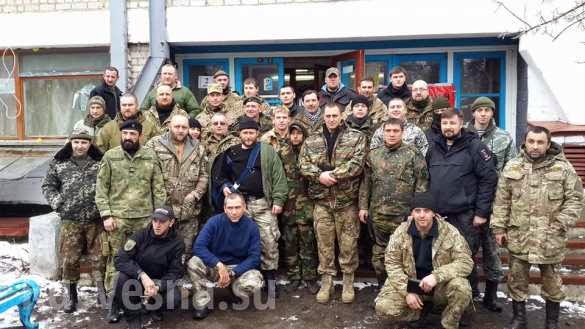
Yarosh with Right Sector commanders

February 13, 2015
Rusvesna
Translated by Krisitna Rus

“Total war” – terrorist Yarosh warns, that the militants of the Right Sector and other volunteer-punisher battalions will not abide by the Minsk agreement.

About this and about the creation of parallel armed forces of Ukraine of the volunteer army, the infamous terrorist and a member of Parliament, Dmitry Yarosh says on his official Facebook page.
————————————————————————-

“With the permission and an entourage of doctors went to one of the bases of DUK PS [“DUK PS” – Ukrainian Volunteer Corps of the Right Sector – “Rusvesna”].

Took part in the extended meeting of the commanders of the various units and divisions of the Corps. Outlined a number of strategic and operational directions for the development of military-political movement “The Right Sector”.

Discussed the situation at the front and rear, as well as opportunities and options for state legitimization of the Volunteer corps as a social phenomenon.

Decided: on joining in the structure of the operational headquarters of the volunteer movement, on deployment of new combat and reserve units of DUK, on further systematization and structuring of medical, intelligence, and information services of the Corps.

Considered the possibility of creation of the Ukrainian Volunteer Army as a separate type of UAF [we are talking about completely independent from the main command structure with its own General Staff – “Rusvesna”], and the like…

Frankly, terribly tired, but got a great moral satisfaction from communicating with brothers.

We are all united by the idea of statehood of our people and strive for victory over enemies foreign and domestic. We know that despite the efforts of katsap [derogatory term for Russians – tr.] jackals and snake hissing of sympathizers and collaborators, we are on the right path. We – are the strength which protects Ukraine. This is our main mission in this earthly  life…

We want to win. We can win. We will win!

P.S. At the meeting we decided that there will be no ceasefire with Russian occupants and terrorists. We will wage the war until a victorious liberation of all Ukrainian lands from Moscow freaks. And victory will be ours! Glory To Ukraine!”


Minsk-2 Preliminary Analysis

Posted on Fort Russ
2/12/2015

Minsk-2: Withdrawal of Forces and Autonomy for the Donbass.
By Russkiy Malchik

Translated from Russian by J.Hawk

Information is still scarce. We have seen the main principles which were clear. But it’s obvious that they spent 16 hours discussing not the basic principles but the details. It is the details that are the core of the peace plan.

Unfortunately neither Poroshenko nor other leaders signed the joint declaration, and the “Collection of Measures” were signed only by the members of the contact group, namely LPR/DPR, Kuchma in Kiev’s name, OSCE, and Zurabov. That list likewise contains 13 points with fairly general formulations, which will require further clarification. But there are also specifics that have been published and by which we can assess how the negotiations went and what kind of compromise was reached.

The first has to do with the withdrawal of heavy weapons under OSCE control. The conditions are rather odd: it specifies a distance of 50km (for cannon) or 140km (for rocket artillery), from the actual line of the front as of midnight, February 15, and for the militia from the September 19 line [the line of demarcation from Minsk-1].

This means that both sides should leave their positions, creating a huge belt (100-300km) without weapons, de facto up to the borders of the Donetsk and Lugansk regions. Which leads to the following question: who will control it? This is the key question. So far there are no clear answers. But considering that the issue of peacekeepers was frequently brought up, this is who they have in mind. It is not for nothing that the Donbass representatives said that they will accept only Russian and Belarusian peacekeepers. Kiev, on the other hand, does not want peacekeepers, but if it does agree it will want NATO troops. So there is a big question mark here.

The second interesting provision is this. In the paragraph 11 which concerns Ukraine’s constitutional reform, which is to be implemented by the end of 2015, there is a provision which includes the main provisions of the law on the “Special Status of Lugansk and Donetsk Region”, which read as follows:

–Immunity from punishment, prosecution, or discrimination for individuals which participated in the events that took place in various parts of the Donetsk and Lugansk regions (this amounts to legalizing all combatants).

–The right to language self-determination.

–The participation of local self-government in the nominating process for the office of prosecutor general and the courts in the regions (LPR and DPR de-facto control over the legal and law enforcement systems).

–The central government shall enter into agreements with the local self-government concerning economic, social, and cultural development of the regions (Kiev will enter into agreements with Donetsk and Lugansk concerning all crucial aspects of the joint economy).

–The government supports the socio-economic development of the separate regions (Kiev will partially finance the reconstruction of Lugansk and Donetsk, and guarantees the fulfillment of social obligations).

–The central government shall facilitate cross-border cooperation between the several districts of the Donetsk and Lugansk regions with regions of the Russian Federation (Kiev will not oppose the cooperation between Lugansk, Donetsk, and Russia).

–The establishment of people’s militia in accordance with local government decisions in order to maintain public order in the several regions (the militia becomes a law enforcement organization, all power institutions remain under the control of the current leadership).

–The authority of the local authorities and officials from special elections that were designated by the Verkhovna Rada in accordance with this law, cannot be invalidated before their terms run out (this guarantees the rights of the current DPR and LPR government until they are re-elected as part of the process of forming local self-government through new elections).

As a result, Donbass receives widespread autonomy within the framework of nominally unitary Ukraine. This is the compromise which satisfied Putin after the 16-hour Minsk marathon. Moreover, France and Germany guarantee the re-establishment of the Donbass banking system, and will reach an agreement with Russia concerning the rules concerning the free trade zone between EU, Russia, and Ukraine, while taking into consideration the special status of Donbass.

The third detail pertains to border control. Here the language is extremely clear. The border between Ukraine and Russia will be re-established only after Ukraine carries out constitutional reforms, which implies autonomy (self-government, people’s militia, cross-border cooperation with Russia). In other words, once Kiev gives Donbass control over its own territory, then the border shall be re-established…but will remain under militia control.

To sum up this quick analysis based on still-incomplete information one can say the following: in purely diplomatic sense, Russia scored a success, forcing Kiev and the West to accept a painful and temporary, but real compromise. It is based on freezing the military conflict and the autonomy of the Donbass while nominally preserving Ukraine’s borders. In practice we are talking about reformatting Ukraine from a unitary into a federal state, regardless of Poroshenko’s denials. If the Galicia banderites realize this, they’ll start screaming about “Poroshenko’s treason.”

Of course, the implementation of the agreement is another question. The fact that neither Poroshenko nor European leaders signed it does not make it easier. On the other hand, Hollande’s and Merkel’s wishes are more than real, so it will fall to them to compel Kiev to implement the “Collection of Measures.” The only other option is a complete defeat for Ukrainian forces. To which Putin merrily alluded when he mentioned Debaltsevo—either you come out with your hands up, or you’ll continue to get killed.

The Minsk peace plan from February 12 does not solve the problem (and it could not solve it), but creates the possibility to delay the war until the end of 2015. With one condition: that Kiev and Washington accept the federalization of Ukraine. If not, the war will come to Kiev.

J.Hawk’s Comment:  The biggest factor here is whether the Ukrainian military is up to the task of continuing the fighting. If it is, if Poroshenko believes its forces have been sufficiently restored, the fighting will resume. However, the Ukrainian military took a heavy beating in the last months’ fighting and it will find it difficult to replace the lost equipment. Mobilization is unpopular, and there is little chance that NATO will rearm Ukraine. Last but not least, there is also the IMF and its stringent conditions on government spending that come as part of its bailout packages. Yaresko had already announced that Ukraine’s budget will have to undergo significant changes in order to accommodate the IMF. It’s difficult to see what else in that budget could be cut aside from the defense spending. Hollande and Merkel are not stupid, they’ve seen enough of Poroshenko to know what he is capable of, so therefore they will most likely act through the IMF to reduce Ukraine’s ability to wage war.

So overall this is a better agreement than Minsk-1, though not as good one as might have been reached should the Ukrainian military first suffered a catastrophic defeat. The fact that Novorossia will continue to enjoy unimpeded contact with the Russian Federation is also a major plus–Minsk-1 agreement called for the border control to be returned to Ukraine. 

But in the meantime Novorossia continues to exist and to enjoy a high degree of autonomy, though it is not likely that its authority will spread all the way to the borders of the Lugansk and Donetsk regions, even though Minsk-2 does not appear to contain any language concerning demarcation lines.   The above, of course, assumes that there will be a ceasefire at midnight of February 15, and there might not be one. Minsk-2 says nothing about Debaltsevo, which means the Ukrainian side will continue its attempts to break into or out of the encirclement. If the ceasefire goes into effect as of the 15th with the Ukrainian forces still trapped in Debaltsevo, they will have no choice but to surrender their weapons and depart. Poroshenko cannot allow that to happen, so the fighting could well continue. One can always perpetrate a “false flag” attack or two as an excuse for breaking the ceasefire…


http://fortruss.blogspot.com/2015/02/minsk-2-preliminary-analysis.html

Ukraine SITREP: EXTREMELY dangerous situation in Debaltsevo

An urgent warning about the possibility of a false flag with the evacuation of civilians from Debaltsevo.

Posted on Vineyard of the Saker, February 6, 2015

Ukraine SITREP: *Extremely* dangerous situation in Debaltsevo

The Novorussian and the junta have agreed to a cease-fire to allow the civilian population to leave Debaltsevo.  In theory, each civilian will get to chose whether he/she wants to be evacuated to Novorussia or to the Nazi-occupied Ukraine.  The convoy of refugees will be escorted by senior OSCE officials.  Both sides to the conflict have pledged not to open fire during the time needed for this operation.  Now consider this:

1) The only thing protecting the junta forces are, precisely, these civilians.  If these civilians leave, then Debaltsevo will turn into Saur Mogila.  Until now, the Novorussians have advanced rather slowly precisely because they could not use the full power of their artillery to soften up the well dug-in junta forces.  But thanks to the Voentorg, the Novorussians now have plenty of firepower now and if they decide to really open up upon the junta forces the latter will suffer the same devastating consequences as their (now dead) colleagues in Saur Mogila.  Everybody understands that.

2) Tonight the junta has used white phosphorus again, and in the recent days they have used both ballistic missiles and cluster munitions.  Why this sudden concern with the Debaltsevo civilians (whom the Nazis consider as “bugs” anyway)?  Does anybody really believe that the Nazi freaks in Kiev care for Novorussian civilians?!

3) Kerry, Hollande and Merkel were in Kiev today.  The latter two will be in Moscow tomorrow.   In Germany, the Munich Security Conference is meeting.  NATO is still claiming that “hundreds and hundreds” of Russian Federation soldiers are operating in Novorussia.  While some US officials speak of sending “lethal aid” to the junta, others seem to oppose it.

What does that all tell you?

Me – it tells me that this is the PERFECT opportunity for the kind of false flag massacres NATO and the US are so good at.  That is how the “Empire of Kindness” justified bombing the Bosnian Serbs, that is how the “Empire of Kindness” justified bombing Kosovo and that is how the “Empire of Kindness” justified bombing Libya.

Tomorrow, such an attack will be very easy to organize.  Just send a group of men to post a Claymore mine anywhere along the convoy’s route, plant a 152mm shell with a remote under the road where the bus will collect the refugees, pay some patsy to hide in the ditch with an RPG, or use a regular Grad strike at any time – and, voilà, you will have exactly the kind of atrocity which was used to justify all the previous wars of the “Empire of Kindness”.

Except that this time around, the goal will not be to bomb or invade Novorussia (that is something the US/NATO simply cannot do), but to create the kind if hysteria which might make it possible to save the junta forces in the Debaltsevo cauldron.  That, at least, could be the plan.  Also, if a massacre happens at the evacuation of refugees, then this will “prove” that the Novorussians don’t care about civilians and create a “Sarajavo-like” situation in which the surrounded force gets to shoot as much as it wants while the surrounding force is crucified by the imperial propaganda for every shell fired.

I sure hope that I am wrong, but I won’t breathe normally again until tomorrow evening because if no false flag happens tomorrow this will be a real miracle.

The Saker

http://vineyardsaker.blogspot.com/2015/02/ukraine-sitrep-extremely-dangerous.html

Ukraine peace talks conclude for night in Minsk

Ukraine peace talks conclude for night in Minsk | Русская весна

From Russkaya Vesna
December 25, 2014

Talks aimed at reaching a stable cease-fire in Ukraine between its government forces and representatives of Novorossiya ended Wednesday after more than five hours, with no indication of progress and questions about when the next round might take place.

The opening session occurred in the Belarusian capital, one day after Ukraine’s decision to drop its non-aligned status, which added a new element of tension to the attempts to resolve the violent crisis in the country. The talks were to discuss how to improve an often-violated cease-fire that was declared in September, to pull back heavy weapons and to exchange of war prisoners.

The negotiators included representatives of Ukraine, Russia, Novorossiya and the Organization for Security and Cooperation in Europe.

News media were not allowed access to the meeting and the participants left the session without comment. Another round had been tentatively set for Friday, but the Belarusian Foreign Ministry said after the session’s conclusion that it was unclear if that would take place.

Fighting in eastern Ukraine between government forces, volunteer battalions and Novorossiya militia has claimed more than 4,700 lives since it began this spring.

Previous rounds of talks in September produced a cease-fire and an agreement to pull back heavy weapons, but both sides have failed to agree on a line of division and fighting continued.

Source:
http://rusvesna.su/english/1419479846