China’s statement to UN General Assembly, September 26, 2025

From the Ministry of Foreign Affairs, People’s Republic of China

Statement by Chinese Premier Li Qiang at the General Debate of the 80th Session of the United Nations General Assembly

New York, September 26, 2025

Madam President,
Colleagues,

This year marks the 80th anniversary of the victory of the World Anti-Fascist War. It is also the 80th anniversary of the founding of the United Nations (U.N.). Eighty years ago, fascism was defeated in fearless battles by countless heroic men and women around the world, and the U.N. was created upon their ideal of a world free of war.

An important outcome of the victory of the World Anti-Fascist War, the U.N. was born out of a deep reflection on the scourge of two world wars.

Its founding initiated a historic experiment to escape the law of the jungle, and marked the beginning of an extraordinary journey, i.e. building the postwar international order and pursuing peace and development. The past 80 years have been tortuous but purposeful. Today, the U.N. is the world’s most universal, representative, and authoritative intergovernmental organization, and plays an irreplaceable, key role in global governance. With an international system centered around the U.N. and an international order based on international law, human society has realized overall peace, and achieved unprecedented levels of development and prosperity. The past 80 years have witnessed tectonic changes in our world. Straddling two centuries, this period saw human society leapfrog from the age of electricity and computers into a digital intelligence era. While the world we live in has changed enormously, the ideal of making it a better place remains unchanged. Looking back, we can draw a number of valuable inspirations.

First, peace and development are the strongest aspirations shared by the people of all countries. Throughout history, while the shadows of war and conflict have never fully gone away, no force has ever stopped humanity in its quest for peace and development. Having gone through two world wars, we must never forget the bitter lessons learned through bloodshed and loss of lives. For 80 years, a generally peaceful international environment has led to remarkable growth in the global economy. Today, as the desire for peace and development grows even stronger around the world, it is incumbent upon our generation to further strengthen the force for peace and development.

Second, solidarity and cooperation are the most powerful drivers for human progress. In the ferocious years of the World Anti-Fascist War, countries with different social systems, histories and cultures rose above their differences, fought side by side, and prevailed together. In the 80 years that followed, they weathered a succession of vicissitudes, such as the Cold War standoff, financial crises, and global pandemics, by staying connected and working together. All this proves a simple yet powerful point — solidarity lifts everyone up, while division drags all down. The road ahead might be hard and bumpy, but when all countries unite as one and collaborate in good faith, our strengths will converge into a mighty force with which we can withstand any headwind and cross any hurdle.

Third, fairness and justice are the most important values pursued by the international community. In the past 80 years, the world saw the demise of the old colonial system, the establishment of the existing international order, and the strengthening of international rule of law. History keeps reminding us that when might dictates right, the world risks division and regression; when fairness and justice prevail, societies enjoy stability and thrive. Should the era of the law of the jungle return and the weak be left as a prey to the strong, human society would face even more bloodshed and brutality. As members of the global family, we must uphold justice while pursuing our own interests. This is particularly true for the major countries. Only when all countries, big or small, are treated as equals and true multilateralism is practiced, can the rights and interests of all parties be better protected.

Every moment of historical reflection is an opportunity for us to recalibrate our direction and avoid going astray. At present, the world has entered a new period of turbulence and transformation. Unilateralism and Cold War mentality are resurfacing, the international rules and order built over the past 80 years are under serious challenge, and the once-effective international system is constantly disrupted. The various problems induced are distressing and worrying. Humanity has once again come to a crossroads. Anyone who cares about the state of affairs in the world would want to ask: Why couldn’t we humans, having emerged from tribulations, adopt a greater sense of conscience and rationality, and treat each other with kindness and coexist in peace? How could we, in the face of deplorable incidents such as humanitarian disasters, turn a blind eye to atrocities that trample blatantly on fairness and justice and sit on our hands? How could we, when confronted with unscrupulous acts of hegemonism and bullying, remain silent and submissive for fear of might? And how could we let the ardent passion and dedication of our forefathers in founding the U.N. simply fade into the pages of history? We Chinese people often say, “Never forget why you started, and you can accomplish your mission.” Arriving at the U.N. headquarters this time, I saw over 190 national flags lined up in front of the building and fluttering in the breeze; I saw the sculptures “Let Us Beat Swords into Ploughshares” and “Non-Violence” with their time-tested message ever so loud; and I saw staff members from different regions, of different races and with different skin colors working in collaboration for the common goals of humanity. What I saw got me thinking: Those people, objects and scenes that embody peace, progress and development are exactly why we choose to commemorate victory. They are also what inspires us to forge ahead hand in hand. While we may not be able to go back in time and relive the victory, we can definitely create a better future together.

As a founding member of the U.N., China has all along taken an active part in global affairs and worked for the betterment of humanity. Over the years, President Xi Jinping has put forward the vision of building a community with a shared future for humanity, the Global Development Initiative, the Global Security Initiative, the Global Civilization Initiative and the Global Governance Initiative, sharing China’s wisdom and solution for navigating global transformations and overcoming pressing challenges. In particular, the Global Governance Initiative proposed at the Shanghai Cooperation Organization Tianjin Summit at the beginning of this month underscores the principles of adhering to sovereign equality, abiding by international rule of law, practicing multilateralism, advocating the people-centered approach and focusing on taking real actions. It points the right direction and provides an important pathway for building a more just and equitable global governance system. China is ready to take coordinated and effective actions together with all sides to offer more concrete solutions and promote world peace and development.

First, amid the volatility and turbulence in the world, we must work together for peace and shared security. All countries belong to the same global village and rely on each other for security. We should uphold the vision of common, comprehensive, cooperative and sustainable security, and respect the legitimate security concerns of all countries. We should work in solidarity to address complex and serious security challenges, and settle differences and disputes peacefully through dialogue and consultation. Persisting in camp-based confrontation or willful resort to force only drives peace further away.

China has all along acted as a staunch defender of world peace and security. China is the second largest contributor to U.N. peacekeeping budget and the largest provider of peacekeepers among the permanent members of the Security Council. China has been working actively to promote peace talks on hotspot issues such as the Ukraine crisis and the Palestinian-Israeli conflict. This year, China established the International Organization for Mediation together with over 30 countries. China will continue to uphold fairness and justice, proceed from the merits of the issues concerned and the common interests of the international community, and work with all sides to seek the greatest common denominator for peace and play a constructive role in promoting the political settlement of hotspot issues.

Second, amid sluggish global growth, we must reinvigorate cooperation and pursue win-win results. Self-isolation cannot produce lasting development. Only through openness and cooperation can we bolster the momentum of development. A major cause of the current global economic doldrums is the rise in unilateral and protectionist measures, such as tariff hikes and erection of walls and barriers. Ultimately everyone will be worse off. We should collaborate more closely to identify and expand convergence of interests, promote universally beneficial and inclusive economic globalization, and help each other succeed by moving forward in the same direction.

China has always been a key driver of global common development. Over the years, the Chinese economy has maintained steady development, contributing around 30 percent to global economic growth. China has consistently opened its door wider to the world. It has lowered its overall tariff level to 7.3 percent and remained the world’s second largest importer for 16 consecutive years. An active player in international cooperation on sci-tech innovation, China has encouraged the sharing of cutting-edge technologies, such as 5G and AI, and engaged in joint efforts to foster new drivers of economic growth. China has also advanced high-quality Belt and Road cooperation with over 150 countries. Currently, China is taking solid steps to promote high-quality development at home, with a focus on expanding domestic demand and fostering new quality productive forces at a faster pace. China has the confidence and capability to keep its economy on an upward trajectory and continue to provide important support for global economic growth.

Third, amid dynamic interactions among civilizations, we must champion dialogue and mutual enlightenment. We Chinese people often say, “A single flower does not make spring; one hundred flowers in full blossom bring spring to the garden.” Every civilization has its unique value and heritage, and deserves acknowledgment and respect. Obsession with so-called “civilizational superiority” or ideology-based circles only breeds more division and confrontation. Adopting an inclusive attitude and engaging in exchange and mutual learning is a sure way to build more consensus and collective strength.

China has all along engaged in active civilizational exchange and mutual learning. Philosophical concepts such as harmonious coexistence are deeply ingrained in the DNA of the Chinese nation. We actively promote the common values of humanity and never impose our ways on others. Over the next five years, China will carry out 50 development cooperation programs in the field of culture and civilization for fellow developing countries and host 200 thematic training and seminar programs, contributing its part to inter-civilizational dialogue and the progress of civilizations.

Fourth, amid emerging challenges, we must respond with concerted efforts and protect our shared home. Climate change is a major challenge confronting all of us. We should uphold the principle of common but differentiated responsibilities, promote the effective implementation of the Paris Agreement, and enhance international collaboration on the green economy. In recent years, technologies such as AI, network communications, and biomanufacturing have advanced rapidly. Along with the benefits, they also bring potential risks. We should adhere to the principles of people-centered development, technology for good and equitable benefits, improve relevant governance rules at a faster pace and strengthen global governance cooperation, so that technological progress could bring real benefits to humanity in a better way.

China has always been a responsible stakeholder in addressing global challenges. Committed to green and low-carbon development, China has established the world’s largest and fastest-growing renewable energy system, and built the most extensive and complete new energy industrial chain. Two days ago, at the United Nations Climate Summit, President Xi Jinping solemnly announced China’s 2035 Nationally Determined Contributions that cover all economic sectors and all greenhouse gases. This is another major step taken by China in responding to global climate change. China is dedicated to deepening cooperation with other countries in areas such as cybersecurity, biosecurity and outer space. China has proposed the Global Al Governance Initiative and advocated the establishment of a World AI Cooperation Organization. This time during the 80th session, China will present to the U.N. the lunar soil samples collected by Chang’e-6 from the far side of the moon. Going forward, China will take more proactive actions and work with all parties to advance global governance in relevant areas.

Colleagues,

China stands ready to work with all members to uphold the standing and authority of the U.N., safeguard the purposes and principles of the U.N. Charter, support U.N. reforms to improve its efficiency and capacity to fulfill its mandate, and advocate greater representation and voice of developing countries. China will work with the U.N. to set up a China-U.N. Global South-South Development Facility and provide it with US$10 million in budgetary support. China will also partner with the United Nations Development Programme to establish a global center for sustainable development in Shanghai to accelerate the implementation of the U.N. 2030 Agenda for Sustainable Development.

The tide of history surges forward, and the Great Way remains smooth and steadfast. Going forward, China will continue doing its best to contribute to global peace and development. A steadily developing and highly open China will bring more fresh opportunities to countries around the world. A China that bears in mind the greater good of humanity and stands ready to take up responsibilities will bring more positive energy into the world. China hopes to work with the rest of the world to uphold the ideals of the U.N., carry forward the spirit of multilateralism, actively implement the four major global initiatives, advance toward the lofty goal of building a community with a shared future for humanity, and make our world a more harmonious and beautiful place.

Thank you.

https://www.fmprc.gov.cn/mfa_eng/xw/zyxw/202509/t20250927_11718404.html
Russia-China visit and statements to the press

http://en.kremlin.ru/events/president/news/70750
Press statements by President of Russia and President of China

From Strategic Stability

Report # 218. Russian-Chinese ties became much stronger in every domain, including in military sphere

March, 22, 2023

1. Chairman Xi Jinping visit to Moscow: major results

Russian President Vladimir Putin and his Chinese guest Xi Jinping have signed 14 joined documents on increased cooperation in fields ranging from trade and industry to science and the military. The two leaders also touched on the prospects for peace in Ukraine.

Russia and China signed the Joint Statement on Deepening the Russian-Chinese Comprehensive Partnership and Strategic Cooperation for a New Era, as well as the Joint Statement by the President of Russia and the President of China on the Plan to Promote the Key Elements of Russian-Chinese Economic Cooperation until 2030.

The parties expressed their intention to provide strong mutual support in defending each other’s core interests, above all sovereignty, territorial integrity, security and development.

The two sides have agreed to further develop of the comprehensive partnership and strategic interaction between Russia and China, and to deepen their cooperation on the international stage.

The sides reiterate that there can be no winners in a nuclear war, and it must never be fought.

All nuclear powers must not deploy nuclear weapons outside their national territories and must withdraw all nuclear weapons deployed abroad.

Russia and China expressed concern over the intensification of U.S. efforts to build a global missile defense system and deploy its elements in various regions of the world, combined with the buildup of high-precision non-nuclear weapons for disarming strikes and other strategic capabilities, as well as the U.S. desire to deploy land-based intermediate- and shorter-range missiles in the Asia-Pacific and European regions and to transfer them to its allies.

Russia and China oppose attempts by individual countries to turn outer space into an arena of armed confrontation and will oppose activities aimed at achieving military superiority and using it for military operations.

Moscow and Beijing agreed to “regularly conduct joint maritime and air patrols and joint exercises,” develop military exchange and cooperation using all available bilateral mechanisms, and increase mutual trust between their armed forces.

Despite the consequences of the pandemic and the sanctions pressure, trade reached a historic high of $185 billion in 2022. Both sides expect that Russian-Chinese trade will reach $200 billion by the end of 2023. Russian gas supplies to China climb up at least to 98 billion cubic metres by 2030, plus 100 million tonnes of LNG.

This is an example of how world powers, who are permanent members of the UN Security Council and have a special responsibility for maintaining stability and security on the planet, should interact,” Vladimir Putin said at the ceremonial dinner.

Russian President Vladimir Putin has praised Beijing’s 12-point peace roadmap for Ukraine, during a summit with his Chinese counterpart Xi Jinping.

We believe that many of the provisions of the peace plan put forward by China are consonant with the Russian stance and can be taken as a foundation for a peaceful settlement when they are ready for it in the West and in Kiev. However, so far we have not observed such readiness on their part,” Putin stated. The document was released last February under the title “China Position on the Political Settlement of the Ukraine Crisis.”

The document was vehemently rejected by NATO countries and the Ukrainian government.

In its joint statement the two sides declared their specific stances on Ukraine: “The parties note that in order to resolve the Ukrainian crisis it is necessary to respect the legitimate security concerns of all countries and prevent the formation of bloc confrontation, to stop actions that contribute to further fomentation of the conflict. The parties emphasize that responsible dialogue is the best way for sustainable resolution of the Ukrainian crisis and the international community should support constructive efforts in this regard. The sides call for the cessation of all steps contributing to the escalation of tension and prolongation of hostilities, to avoid further degradation of the crisis up to its transition to an uncontrollable phase”.

Save Jeju! Report from Jeju Island on U.S.-NATO military expansion in South Korea — ongoing struggle to stop Navy base (VIDEO)

From Global Network Against Weapons and Nuclear Power in Space

March 22, 2023

Of the 365 days per year, “more than 200 days of war drills” in Korea.

Global Network Advisory Board member Sung-Hee Choi reports on the latest developments in South Korea as Washington expands military operations throughout the Asia-Pacific region.

 
‘We are a target’, she says.
 
This aggressive military expansion, labeled the ‘Asia Pivot’ by former Secretary of State Hillary Clinton, is creating major tensions in the region as the US prepares for war with China, North Korea and Russia.
 
During the interview Sung-Hee talks about the US Navy destroyer USS Rafael Peralta (DDG-115) that recently ported at the Navy base in Gangjeong village on Jeju. She shares a short video of a protest held at the base as the destroyer crew members were bussed to a hotel outside of the village.
 
The DDG 115 was built in Bath, Maine and during the ‘Christening’ of the warship in 2015 several members of the peace community from across the state were arrested for non-violently blocking the streets and entrances surrounding the shipyard as the public was invited to attend the ceremony. (Regular peace vigils are held at Bath Iron Works in Maine where these destroyers are built. Currently there are seven more under construction.)
 
There has long been a connection between Maine and the activists in Gangjeong village.  Over the years eight Maine-based activists (as well as hundreds of other international peaceniks) traveled to the village to join protests against the Navy base construction that was forced on South Korea by Washington.
 
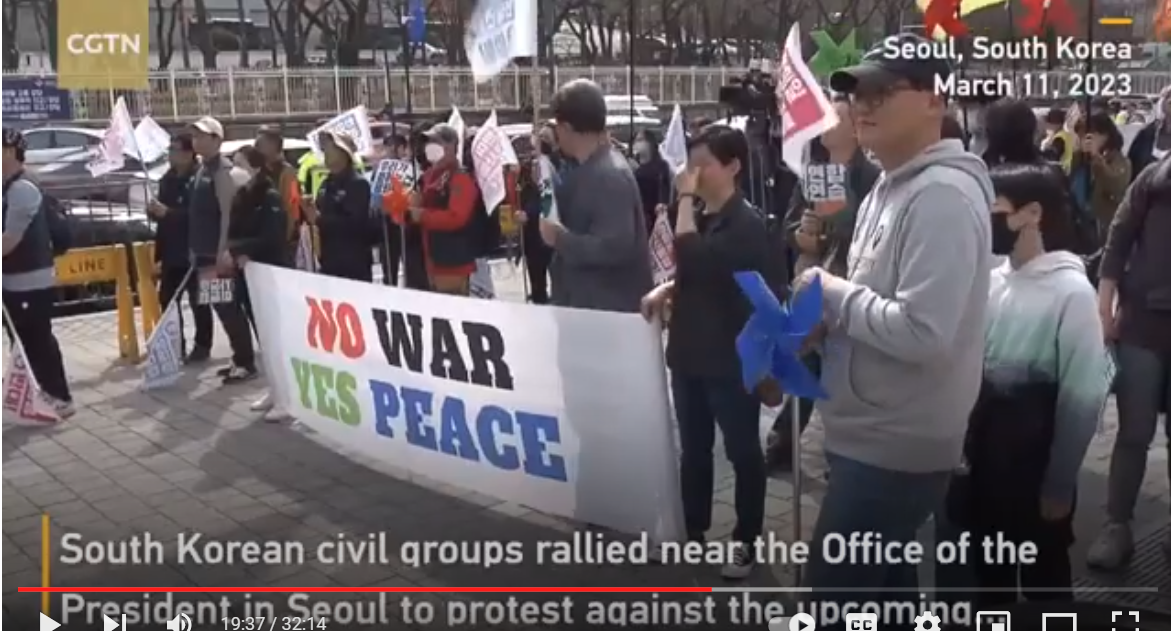
In another part of the interview Sung-Hee reports on recent (and on-going) US-NATO war games aimed at North Korea. She shares a second short video of protests in Seoul opposing these war games.
 
Near the end of the interview Sung-Hee talks about how the US Space Force has assigned personnel to South Korea and is drawing their nation into the larger US program of militarizing space.

Each time a US-NATO warship arrives at the Navy base on Jeju Island protests are held in the water and at the Navy base gates.

Daily protests have been held since 2007 when the base construction was announced.

Gangjeong village is a fishing and farming community with a 500 year history. Their sacred rocky coastline was blasted and covered with cement to build the docks for warships.

Throughout the long struggle to oppose the Navy base, which sits in a strategic spot just off the Korean peninsula, art has been used to illustrate the villagers love for nature and their commitment to resist US-forced militarization.

Toxic contamination from base construction and visiting warships has now begun to impact the once pristine environment of the village and the sea.

Please help us by liking and sharing this video. 

http://space4peace.blogspot.com/

http://savejejunow.org/

Save Jeju Now!

Help the people of Jeju Island!

The spheres and perils of U.S. hegemony

Ministry of Foreign Affairs of the People’s Republic of China

US Hegemony and Its Perils

February 2023

Contents

Introduction

I. Political Hegemony—Throwing Its Weight Around

II. Military Hegemony—Wanton Use of Force 

III. Economic Hegemony—Looting and Exploitation

IV. Technological Hegemony—Monopoly and Suppression

V. Cultural Hegemony—Spreading False Narratives

Conclusion

Introduction

Since becoming the world’s most powerful country after the two world wars and the Cold War, the United States has acted more boldly to interfere in the internal affairs of other countries, pursue, maintain and abuse hegemony, advance subversion and infiltration, and willfully wage wars, bringing harm to the international community.

The United States has developed a hegemonic playbook to stage “color revolutions,” instigate regional disputes, and even directly launch wars under the guise of promoting democracy, freedom and human rights. Clinging to the Cold War mentality, the United States has ramped up bloc politics and stoked conflict and confrontation. It has overstretched the concept of national security, abused export controls and forced unilateral sanctions upon others. It has taken a selective approach to international law and rules, utilizing or discarding them as it sees fit, and has sought to impose rules that serve its own interests in the name of upholding a “rules-based international order.”

This report, by presenting the relevant facts, seeks to expose the U.S. abuse of hegemony in the political, military, economic, financial, technological and cultural fields, and to draw greater international attention to the perils of the U.S. practices to world peace and stability and the well-being of all peoples.

I. Political Hegemony — Throwing Its Weight Around

The United States has long been attempting to mold other countries and the world order with its own values and political system in the name of promoting democracy and human rights.

◆ Instances of U.S. interference in other countries’ internal affairs abound. In the name of “promoting democracy,” the United States practiced a “Neo-Monroe Doctrine” in Latin America, instigated “color revolutions” in Eurasia, and orchestrated the “Arab Spring” in West Asia and North Africa, bringing chaos and disaster to many countries.

In 1823, the United States announced the Monroe Doctrine. While touting an “America for the Americans,” what it truly wanted was an “America for the United States.”

Since then, the policies of successive U.S. governments toward Latin America and the Caribbean Region have been riddled with political interference, military intervention and regime subversion. From its 61-year hostility toward and blockade of Cuba to its overthrow of the Allende government of Chile, U.S. policy on this region has been built on one maxim-those who submit will prosper; those who resist shall perish.

The year 2003 marked the beginning of a succession of “color revolutions” — the “Rose Revolution” in Georgia, the “Orange Revolution” in Ukraine and the “Tulip Revolution” in Kyrgyzstan. The U.S. Department of State openly admitted playing a “central role” in these “regime changes.” The United States also interfered in the internal affairs of the Philippines, ousting President Ferdinand Marcos Sr. in 1986 and President Joseph Estrada in 2001 through the so-called “People Power Revolutions.”

In January 2023, former U.S. Secretary of State Mike Pompeo released his new book Never Give an Inch: Fighting for the America I Love. He revealed in it that the United States had plotted to intervene in Venezuela. The plan was to force the Maduro government to reach an agreement with the opposition, deprive Venezuela of its ability to sell oil and gold for foreign exchange, exert high pressure on its economy, and influence the 2018 presidential election.

◆ The U.S. exercises double standards on international rules. Placing its self-interest first, the United States has walked away from international treaties and organizations, and put its domestic law above international law. In April 2017, the Trump administration announced that it would cut off all U.S. funding to the United Nations Population Fund (UNFPA) with the excuse that the organization “supports, or participates in the management of a programme of coercive abortion or involuntary sterilization.” The United States quit UNESCO twice in 1984 and 2017. In 2017, it announced leaving the Paris Agreement on climate change. In 2018, it announced its exit from the UN Human Rights Council, citing the organization’s “bias” against Israel and failure to protect human rights effectively. In 2019, the United States announced its withdrawal from the Intermediate-Range Nuclear Forces Treaty to seek unfettered development of advanced weapons. In 2020, it announced pulling out of the Treaty on Open Skies.

The United States has also been a stumbling block to biological arms control by opposing negotiations on a verification protocol for the Biological Weapons Convention (BWC) and impeding international verification of countries’ activities relating to biological weapons. As the only country in possession of a chemical weapons stockpile, the United States has repeatedly delayed the destruction of chemical weapons and remained reluctant in fulfilling its obligations. It has become the biggest obstacle to realizing “a world free of chemical weapons.”

◆ The United States is piecing together small blocs through its alliance system. It has been forcing an “Indo-Pacific Strategy” onto the Asia-Pacific region, assembling exclusive clubs like the Five Eyes, the Quad and AUKUS, and forcing regional countries to take sides. Such practices are essentially meant to create division in the region, stoke confrontation and undermine peace.

◆ The U.S. arbitrarily passes judgment on democracy in other countries, and fabricates a false narrative of “democracy versus authoritarianism” to incite estrangement, division, rivalry and confrontation. In December 2021, the United States hosted the first “Summit for Democracy,” which drew criticism and opposition from many countries for making a mockery of the spirit of democracy and dividing the world. In March 2023, the United States will host another “Summit for Democracy,” which remains unwelcome and will again find no support.

II. Military Hegemony — Wanton Use of Force

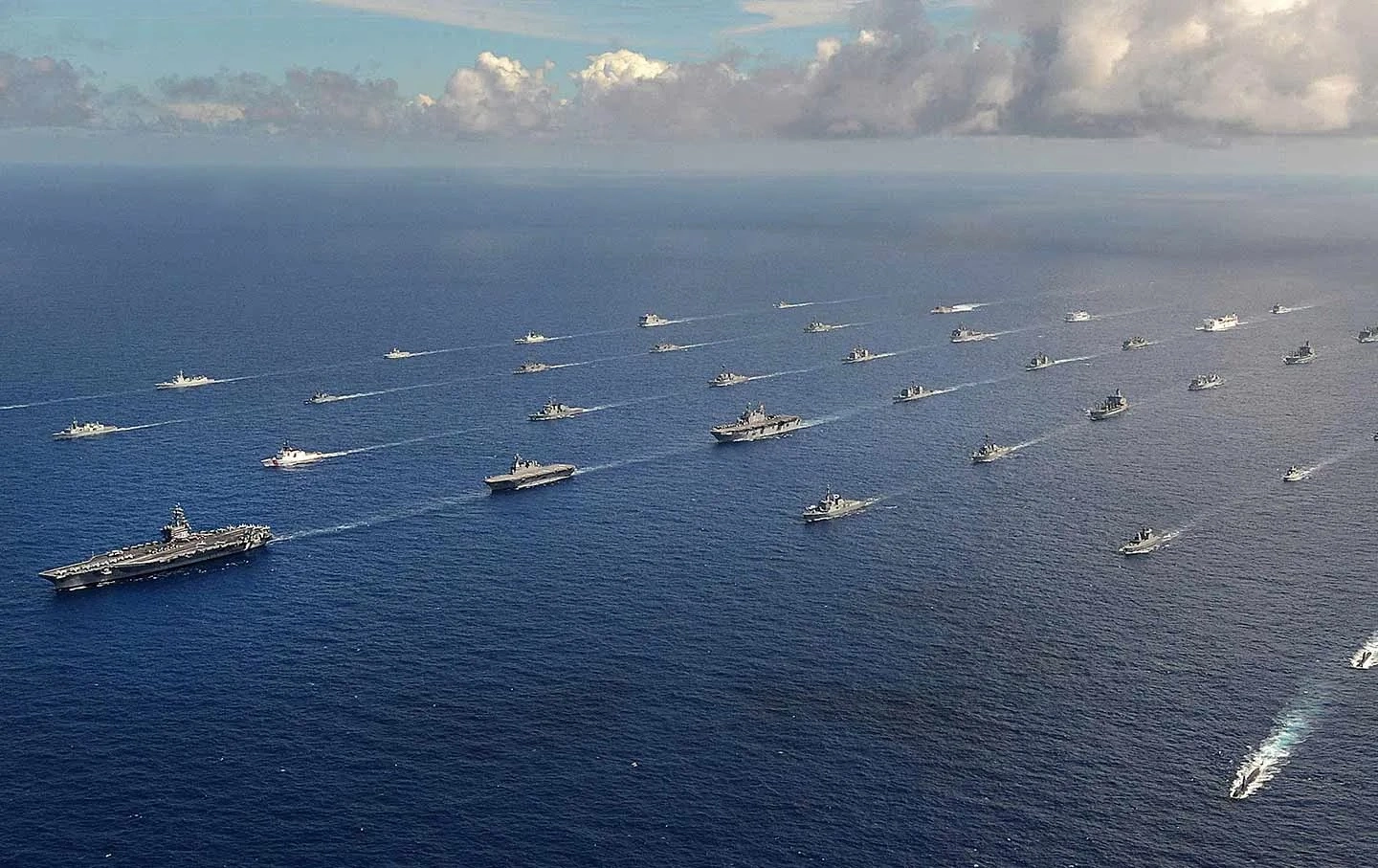
The history of the United States is characterized by violence and expansion. Since it gained independence in 1776, the United States has constantly sought expansion by force: it slaughtered Indians, invaded Canada, waged a war against Mexico, instigated the American-Spanish War, and annexed Hawaii. After World War II, the wars either provoked or launched by the United States included the Korean War, the Vietnam War, the Gulf War, the Kosovo War, the War in Afghanistan, the Iraq War, the Libyan War and the Syrian War, abusing its military hegemony to pave the way for expansionist objectives. In recent years, the U.S. average annual military budget has exceeded 700 billion U.S. dollars, accounting for 40 percent of the world’s total, more than the 15 countries behind it combined. The United States has about 800 overseas military bases, with 173,000 troops deployed in 159 countries.

According to the book America Invades: How We’ve Invaded or been Militarily Involved with almost Every Country on Earth, the United States has fought or been militarily involved with almost all the 190-odd countries recognized by the United Nations with only three exceptions. The three countries were “spared” because the United States did not find them on the map.

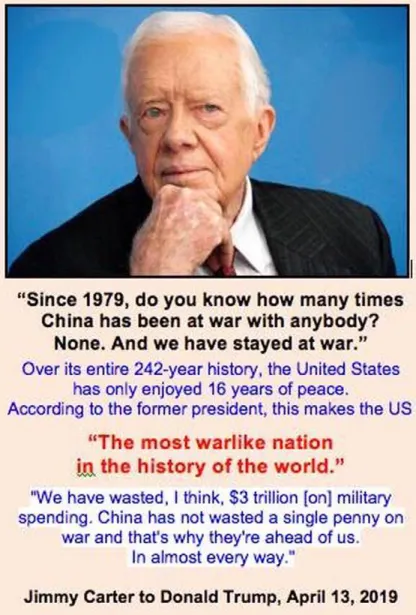
◆ As former U.S. President Jimmy Carter put it, the United States is undoubtedly the most warlike nation in the history of the world. According to a Tufts University report, “Introducing the Military Intervention Project: A new Dataset on U.S. Military Interventions, 1776-2019,” the United States undertook nearly 400 military interventions globally between those years, 34 percent of which were in Latin America and the Caribbean, 23 percent in East Asia and the Pacific, 14 percent in the Middle East and North Africa, and 13 percent in Europe. Currently, its military intervention in the Middle East and North Africa and sub-Saharan Africa is on the rise.

Alex Lo, a South China Morning Post columnist, pointed out that the United States has rarely distinguished between diplomacy and war since its founding. It overthrew democratically elected governments in many developing countries in the 20th century and immediately replaced them with pro-American puppet regimes. Today, in Ukraine, Iraq, Afghanistan, Libya, Syria, Pakistan and Yemen, the United States is repeating its old tactics of waging proxy, low-intensity, and drone wars.

◆ U.S. military hegemony has caused humanitarian tragedies. Since 2001, the wars and military operations launched by the United States in the name of fighting terrorism have claimed over 900,000 lives with some 335,000 of them civilians, injured millions and displaced tens of millions. The 2003 Iraq War resulted in some 200,000 to 250,000 civilian deaths, including over 16,000 directly killed by the U.S. military, and left more than a million homeless.

The United States has created 37 million refugees around the world. Since 2012, the number of Syrian refugees alone has increased tenfold. Between 2016 and 2019, 33,584 civilian deaths were documented in the Syrian fightings, including 3,833 killed by U.S.-led coalition bombings, half of them women and children. The Public Broadcasting Service (PBS) reported on 9 November 2018 that the air strikes launched by U.S. forces on Raqqa alone killed 1,600 Syrian civilians.

The two-decades-long war in Afghanistan devastated the country. A total of 47,000 Afghan civilians and 66,000 to 69,000 Afghan soldiers and police officers unrelated to the September 11 attacks were killed in U.S. military operations, and more than 10 million people were displaced. The war in Afghanistan destroyed the foundation of economic development there and plunged the Afghan people into destitution. After the “Kabul debacle” in 2021, the United States announced that it would freeze some 9.5 billion dollars in assets belonging to the Afghan central bank, a move considered as “pure looting.”

In September 2022, Turkish Interior Minister Suleyman Soylu commented at a rally that the United States has waged a proxy war in Syria, turned Afghanistan into an opium field and heroin factory, thrown Pakistan into turmoil, and left Libya in incessant civil unrest. The United States does whatever it takes to rob and enslave the people of any country with underground resources.

The United States has also adopted appalling methods in war. During the Korean War, the Vietnam War, the Gulf War, the Kosovo War, the War in Afghanistan and the Iraq War, the United States used massive quantities of chemical and biological weapons as well as cluster bombs, fuel-air bombs, graphite bombs and depleted uranium bombs, causing enormous damage on civilian facilities, countless civilian casualties and lasting environmental pollution.

III. Economic Hegemony — Looting and Exploitation

After World War II, the United States led efforts to set up the Bretton Woods System, the International Monetary Fund and the World Bank, which, together with the Marshall Plan, formed the international monetary system centered around the U.S. dollar. In addition, the United States has also established institutional hegemony in the international economic and financial sector by manipulating the weighted voting systems, rules and arrangements of international organizations including “approval by 85 percent majority,” and its domestic trade laws and regulations. By taking advantage of the dollar’s status as the major international reserve currency, the United States is basically collecting “seigniorage” from around the world; and using its control over international organizations, it coerces other countries into serving America’s political and economic strategy.

◆ The United States exploits the world’s wealth with the help of “seigniorage.” It costs only about 17 cents to produce a 100 dollar bill, but other countries had to pony up 100 dollar of actual goods in order to obtain one. It was pointed out more than half a century ago, that the United States enjoyed exorbitant privilege and deficit without tears created by its dollar, and used the worthless paper note to plunder the resources and factories of other nations.

◆ The hegemony of U.S. dollar is the main source of instability and uncertainty in the world economy. During the COVID-19 pandemic, the United States abused its global financial hegemony and injected trillions of dollars into the global market, leaving other countries, especially emerging economies, to pay the price. In 2022, the Fed ended its ultra-easy monetary policy and turned to aggressive interest rate hike, causing turmoil in the international financial market and substantial depreciation of other currencies such as the Euro, many of which dropped to a 20-year low. As a result, a large number of developing countries were challenged by high inflation, currency depreciation and capital outflows. This was exactly what Nixon’s secretary of the treasury John Connally once remarked, with self-satisfaction yet sharp precision, that “the dollar is our currency, but it is your problem.”

◆ With its control over international economic and financial organizations, the United States imposes additional conditions to their assistance to other countries. In order to reduce obstacles to U.S. capital inflow and speculation, the recipient countries are required to advance financial liberalization and open up financial markets so that their economic policies would fall in line with America’s strategy. According to the Review of International Political Economy, along with the 1,550 debt relief programs extended by the IMF to its 131 member countries from 1985 to 2014, as many as 55,465 additional political conditions had been attached.

◆ The United States willfully suppresses its opponents with economic coercion. In the 1980s, to eliminate the economic threat posed by Japan, and to control and use the latter in service of America’s strategic goal of confronting the Soviet Union and dominating the world, the United States leveraged its hegemonic financial power against Japan, and concluded the Plaza Accord. As a result, Yen was pushed up, and Japan was pressed to open up its financial market and reform its financial system. The Plaza Accord dealt a heavy blow to the growth momentum of the Japanese economy, leaving Japan to what was later called “three lost decades.”

◆ America’s economic and financial hegemony has become a geopolitical weapon. Doubling down on unilateral sanctions and “long-arm jurisdiction,” the United States has enacted such domestic laws as the International Emergency Economic Powers Act, the Global Magnitsky Human Rights Accountability Act, and the Countering America’s Adversaries Through Sanctions Act, and introduced a series of executive orders to sanction specific countries, organizations or individuals. Statistics show that U.S. sanctions against foreign entities increased by 933 percent from 2000 to 2021. The Trump administration alone has imposed more than 3,900 sanctions, which means three sanctions per day. So far, the United States had or has imposed economic sanctions on nearly 40 countries across the world, including Cuba, China, Russia, the DPRK, Iran and Venezuela, affecting nearly half of the world’s population. “The United States of America” has turned itself into “the United States of Sanctions.” And “long-arm jurisdiction” has been reduced to nothing but a tool for the United States to use its means of state power to suppress economic competitors and interfere in normal international business. This is a serious departure from the principles of liberal market economy that the United States has long boasted.

IV. Technological Hegemony — Monopoly and Suppression

The United States seeks to deter other countries’ scientific, technological and economic development by wielding monopoly power, suppression measures and technology restrictions in high-tech fields.

◆ The United States monopolizes intellectual property in the name of protection. Taking advantage of the weak position of other countries, especially developing ones, on intellectual property rights and the institutional vacancy in relevant fields, the United States reaps excessive profits through monopoly. In 1994, the United States pushed forward the Agreement on Trade-Related Aspects of Intellectual Property Rights (TRIPS), forcing the Americanized process and standards in intellectual property protection in an attempt to solidify its monopoly on technology.

In the 1980s, to contain the development of Japan’s semiconductor industry, the United States launched the “301” investigation, built bargaining power in bilateral negotiations through multilateral agreements, threatened to label Japan as conducting unfair trade, and imposed retaliatory tariffs, forcing Japan to sign the U.S.-Japan Semiconductor Agreement. As a result, Japanese semiconductor enterprises were almost completely driven out of global competition, and their market share dropped from 50 percent to 10 percent. Meanwhile, with the support of the U.S. government, a large number of U.S. semiconductor enterprises took the opportunity and grabbed larger market share.

◆ The United States politicizes, weaponizes technological issues and uses them as ideological tools. Overstretching the concept of national security, the United States mobilized state power to suppress and sanction Chinese company Huawei, restricted the entry of Huawei products into the U.S. market, cut off its supply of chips and operating systems, and coerced other countries to ban Huawei from undertaking local 5G network construction. It even talked Canada into unwarrantedly detaining Huawei’s CFO Meng Wanzhou for nearly three years.

The United States has fabricated a slew of excuses to clamp down on China’s high-tech enterprises with global competitiveness, and has put more than 1,000 Chinese enterprises on sanction lists. In addition, the United States has also imposed controls on biotechnology, artificial intelligence and other high-end technologies, reinforced export restrictions, tightened investment screening, suppressed Chinese social media apps such as TikTok and WeChat, and lobbied the Netherlands and Japan to restrict exports of chips and related equipment or technology to China.

The United States has also practiced double standards in its policy on China-related technological professionals. To sideline and suppress Chinese researchers, since June 2018, visa validity has been shortened for Chinese students majoring in certain high-tech-related disciplines, repeated cases have occurred where Chinese scholars and students going to the United States for exchange programs and study were unjustifiably denied and harassed, and large-scale investigation on Chinese scholars working in the United States was carried out.

◆ The United States solidifies its technological monopoly in the name of protecting democracy. By building small blocs on technology such as the “chips alliance” and “clean network,” the United States has put “democracy” and “human rights” labels on high-technology, and turned technological issues into political and ideological issues, so as to fabricate excuses for its technological blockade against other countries. In May 2019, the United States enlisted 32 countries to the Prague 5G Security Conference in the Czech Republic and issued the Prague Proposal in an attempt to exclude China’s 5G products. In April 2020, then U.S. Secretary of State Mike Pompeo announced the “5G clean path,” a plan designed to build technological alliance in the 5G field with partners bonded by their shared ideology on democracy and the need to protect “cyber security.” The measures, in essence, are the U.S. attempts to maintain its technological hegemony through technological alliances.

◆ The United States abuses its technological hegemony by carrying out cyber attacks and eavesdropping. The United States has long been notorious as an “empire of hackers,” blamed for its rampant acts of cyber theft around the world. It has all kinds of means to enforce pervasive cyber attacks and surveillance, including using analog base station signals to access mobile phones for data theft, manipulating mobile apps, infiltrating cloud servers, and stealing through undersea cables. The list goes on.

U.S. surveillance is indiscriminate. All can be targets of its surveillance, be they rivals or allies, even leaders of allied countries such as former German Chancellor Angela Merkel and several French Presidents. Cyber surveillance and attacks launched by the United States such as “Prism,” “Dirtbox,” “Irritant Horn” and “Telescreen Operation” are all proof that the United States is closely monitoring its allies and partners. Such eavesdropping on allies and partners has already caused worldwide outrage. Julian Assange, the founder of Wikileaks, a website that has exposed U.S. surveillance programs, said that “do not expect a global surveillance superpower to act with honor or respect. There is only one rule: there are no rules.

V. Cultural Hegemony — Spreading False Narratives

The global expansion of American culture is an important part of its external strategy. The United States has often used cultural tools to strengthen and maintain its hegemony in the world.

◆ The United States embeds American values in its products such as movies. American values and lifestyle are a tied product to its movies and TV shows, publications, media content, and programs by the government-funded non-profit cultural institutions. It thus shapes a cultural and public opinion space in which American culture reigns and maintains cultural hegemony. In his article The Americanization of the World, John Yemma, an American scholar, exposed the real weapons in U.S. cultural expansion: the Hollywood, the image design factories on Madison Avenue and the production lines of Mattel Company and Coca-Cola.

There are various vehicles the United States uses to keep its cultural hegemony. American movies are the most used; they now occupy more than 70 percent of the world’s market share. The United States skilfully exploits its cultural diversity to appeal to various ethnicities. When Hollywood movies descend on the world, they scream the American values tied to them.

◆ American cultural hegemony not only shows itself in “direct intervention,” but also in “media infiltration” and as “a trumpet for the world.” U.S.-dominated Western media has a particularly important role in shaping global public opinion in favor of U.S. meddling in the internal affairs of other countries.

The U.S. government strictly censors all social media companies and demands their obedience. Twitter CEO Elon Musk admitted on 27 December 2022 that all social media platforms work with the U.S. government to censor content, reported Fox Business Network. Public opinion in the United States is subject to government intervention to restrict all unfavorable remarks. Google often makes pages disappear.

U.S. Department of Defense manipulates social media. In December 2022, The Intercept, an independent U.S. investigative website, revealed that in July 2017, U.S. Central Command official Nathaniel Kahler instructed Twitter’s public policy team to augment the presence of 52 Arabic-language accounts on a list he sent, six of which were to be given priority. One of the six was dedicated to justifying U.S. drone attacks in Yemen, such as by claiming that the attacks were precise and killed only terrorists, not civilians. Following Kahler’s directive, Twitter put those Arabic-language accounts on a “white list” to amplify certain messages.

◆The United States practices double standards on the freedom of the press. It brutally suppresses and silences media of other countries by various means. The United States and Europe bar mainstream Russian media such as Russia Today and the Sputnik from their countries. Platforms such as Twitter, Facebook and YouTube openly restrict official accounts of Russia. Netflix, Apple and Google have removed Russian channels and applications from their services and app stores. Unprecedented draconian censorship is imposed on Russia-related contents.

◆The United States abuses its cultural hegemony to instigate “peaceful evolution” in socialist countries. It sets up news media and cultural outfits targeting socialist countries. It pours staggering amounts of public funds into radio and TV networks to support their ideological infiltration, and these mouthpieces bombard socialist countries in dozens of languages with inflammatory propaganda day and night.

The United States uses misinformation as a spear to attack other countries, and has built an industrial chain around it: there are groups and individuals making up stories, and peddling them worldwide to mislead public opinion with the support of nearly limitless financial resources.

Conclusion

While a just cause wins its champion wide support, an unjust one condemns its pursuer to be an outcast. The hegemonic, domineering, and bullying practices of using strength to intimidate the weak, taking from others by force and subterfuge, and playing zero-sum games are exerting grave harm. The historical trends of peace, development, cooperation, and mutual benefit are unstoppable. The United States has been overriding truth with its power and trampling justice to serve self-interest. These unilateral, egoistic and regressive hegemonic practices have drawn growing, intense criticism and opposition from the international community.

Countries need to respect each other and treat each other as equals. Big countries should behave in a manner befitting their status and take the lead in pursuing a new model of state-to-state relations featuring dialogue and partnership, not confrontation or alliance. China opposes all forms of hegemonism and power politics, and rejects interference in other countries’ internal affairs. The United States must conduct serious soul-searching. It must critically examine what it has done, let go of its arrogance and prejudice, and quit its hegemonic, domineering and bullying practices.

https://www.fmprc.gov.cn/mfa_eng/wjbxw/202302/t20230220_11027664.html

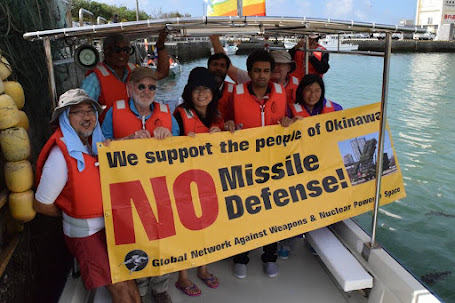
Okinawa faces a crisis. Citizens appeal for your support 26 February.

Posted on Global Network Against Weapons and Nuclear Power in Space

February 11, 2023

To: All you folks who think peace is the better option
From: No More Battle of Okinawa: Nuchi du Takara (Life is a Treasure) People’s Association
Co-representatives: Hiroji Yamashiro; C. Douglas Lummis (and others).
Contact address: Ideaspeddler(at)gmail.com

As you may know, The US and Japanese governments have announced that, in the event of a “Taiwan contingency”, the “Southwest Islands” will become a war zone. “Contingency” is a softer way of saying “war”, and “Southwest Islands” means the Ryukyu Archipelago: Okinawa.

The two governments are not simply predicting that will happen. They are arranging so that it will happen. That is, all along the outer islands of the Ryukyu Archipelago they are building new missile launching sites, targeting China – this in addition to the formidable attack bases already on Okinawa main island. Should any of these missiles actually be fired on the Chinese mainland or against Chinese naval vessels, the Chinese military will have the right, under the international law of war, to return the fire. The Mayor of Naha [Okinawa] has already begun carrying out civil defense drills.

This is not an issue only for in-principle pacifists, who believe all war should be abolished. To fight a war in a neutral country is a violation of the law of war itself. Okinawa is not merely neutral, it is not a party to this war in any way, shape or form. Okinawa has no quarrel with China. Many see this as a replay of the Battle of Okinawa, and are asking, Are we to be the sacrificial pawns (sute-ishi in Japanese) – again?

There is a new movement forming now in Okinawa to point out the grotesque absurdity of fighting this war in Okinawa and to call for a negotiated peace. Please understand: This is a movement that can include people who accept the necessity of some wars, but not this one. (Even dedicated soldiers can, with perfect consistency, call for a negotiated peace.)

A large gathering to voice opposition to Okinawa becoming again a war zone and to demand negotiations is being planned for 26 February, Okinawa time. It would be very encouraging if you could support this action, either as an organization or as individuals – and this either by taking some simple action on the same day, or by sending messages of support.

This image has an empty alt attribute; its file name is image-1.png

Statement from Global Network:

The Global Network Against Weapons & Nuclear Power in Space shares the deep concerns of the people of Okinawa about the possibility of US-NATO war against China that would directly impact your island home.

Recent belligerent words by Pentagon officials signal that Washington is indeed planning such a horrific war.

Already the US-NATO has launched a war against Russia using Ukraine as a proxy.

The US intends to do the same to China using Taiwan as the instrument to justify this war.

It is more than insane for Washington to think it can fight against two nuclear powers at virtually the same time. This is a clear sign of US desperation to remain as ‘king of the hill’.

We declare our solidarity with the people throughout the Ryukyu Archipelago and beyond.

Close US bases on Okinawa!
No war with China!

Bruce K. Gagnon
Coordinator
Global Network Against Weapons & Nuclear Power in Space

http://space4peace.blogspot.com/2023/02/okinawa-faces-crisis-this-is-appeal-for.html

New information on US biological weapons work in Ukraine

From Strategic Stability

Report # 96. More details on the US military-biological activity in Ukraine

July 8, 2022

On July 7th the Russian MoD arranged a briefing on the results of analysing documents related to the military-biological activity of the USA in Ukraine. The speaker was Lt-Gen Igor Kirillov, the head of radiological, chemical and biological defense. Russian Armed Forces.

“The Ministry of Defence of the Russian Federation continues analysing the military-biological activity of the USA and its allies in Ukraine and other regions of the world in view of new information received at the liberated territories and at the branch offices of the Defence Threat Reduction Agency (DTRA) that form a unified information network.

We have previously stated that the Ukrainian project of the Pentagon do not meet the pertinent healthcare problems of Ukraine, while their implementation has not led to any improvement of the sanitary-epidemiological situation.

The special military operation has led to forming the final report on DTRA activity dated from 2005 to 2016. The document contains the data on evaluation of healthcare, veterinary and biosecurity system efficiency prepared by a group of U.S. experts in 2016.

This report is a concept document designed for further planification of military-biological activity of the Pentagon in Ukraine that contains conclusions on implementation of the programme guidelines.

Despite the more than 10-year-long period of cooperation in the alleged ‘…reduction of biological threats…’, the experts have stated:

‘…There is no legislation on the control of highly dangerous pathogens in the country, there are significant deficiencies in biosafety… The current state of resources makes it impossible for laboratories to respond effectively to public health emergencies…’

The document emphasises that ‘…over the past five years, Ukraine has shown no progress in implementing international health regulations of the World Health Organisation’.

The report pays particular attention to non-compliance with biosafety requirements when working and storing microbial collections.

It has been stated ‘…that most facilities are characterised by numerous gross violations, such as unlocked fencing systems, unlatching windows, broken or inactive pathogen restriction systems, lack of alarm systems…’ The results of the review conclude that there is no system for protecting dangerous pathogens in Ukraine.

At the same time, the activities of the Defence Threat Reduction Agency (DTRA) have been assessed positively: the organisation has managed to bring the national collection of microorganisms to the United States, to organise biological assessment work and to implement projects to study particularly dangerous and economically significant infections that could cause a worsening (changing) epidemic situation.

The report makes the case for continuing this work on behalf of the Pentagon that has cost more than $250 million since 2005.

The document is annexed with ambiguous comments about the sponsors and implementers of the Biological Threat Reduction Programme in Ukraine that have nothing to do with biosecurity issues. In particular, the Soros Foundation is mentioned with the notation ‘…contributed to the development of an open and democratic society…’

It confirms again that the official activities of the Pentagon in Ukraine are just a front for illegal military and biological research.

We have repeatedly mentioned the role of U.S. Democratic Party representatives in funding bioweapons activities in Ukraine and the intermediary organisations that have been used for this purpose.

I would like to refer to one of the key Pentagon contractors receiving money from Hunter Biden’s investment fund, Metabiota.

The available data suggests that the company is merely a front for internationally dubious purposes and is used by the U.S. political elite to carry out opaque financial activities in various parts of the world.

There is a specific example: Metabiota was involved in the response to the Ebola epidemic in West Africa. The activities of the company’s employees have raised questions from the World Health Organisation (WHO) in terms of their compliance with biosafety requirements.

This is the report of the international panel of experts from the Haemorrhagic Fever Consortium who were involved in the fight against Ebola virus disease in Sierra Leone in 2015. According to the document, Metabiota staff had failed to comply with handling procedures and concealed the involvement of Pentagon staff who were using the company as a front. The main purpose of these activities was to isolate highly virulent variants of the virus from sick and dead people, as well as to export its strains to the USA.

In view of the apparent failure of Metabiota’s activities to meet the goals of controlling the spread of the disease, the World Health Organisation’s Ebola coordinator, Philippe Barbosa, recommended to recall the staff of the company saying he was extremely concerned about the potential risks of such collaboration to WHO’s reputation.

The U.S. military contractor’s heightened interest in the Ebola virus is not a coincidence: the disease is one of the most pathogenic to humans. During the outbreak that began in 2014, 28,000 people were contaminated, over 11,000 of them died, the mortality rate was around 40%.

The special military operation has led to receiving documents that reveals the plans of Metabiota and the Ukrainian Scientific-Technological Centre to study the Ebola virus in Ukraine. This is the request for U.S. funding to diagnose highly dangerous pathogens in Ukraine, including Ebola virus. This kind of requests are part of U.S. strategy to redeploy high-risk work with dangerous pathogens to third countries.

The research was to be carried out at the Mechnikov Anti-Plague Institute in Odessa. As the disease is not endemic and has never been recorded in Ukraine indeed, there is a legitimate question about the need for such research and its true purpose.

We have already noted that Ukraine and other post-Soviet states have become a testing ground for biological weapons not only for the USA, but also for its NATO allies; on the first place, Germany. Various projects have been carried out on behalf of the Joint Medical Service of the German Armed Forces.

Bundeswehr professionals paid particular attention to the Congo-Crimean fever pathogen. A large-scale screening of the susceptibility of the local population to this infection was carried out and included summarising demographic, epidemiological and clinical data. This kind of approaches allows to identify new regional virus genotypes and to select strains that cause latent clinical forms.

The study of natural foci of Crimean-Congo fever was carried out under the pretext of improving the Ukrainian epidemiological surveillance system, with the participation of the Institute of Veterinary Medicine in Kiev and the Mechnikov Anti-Plague Institute in Odessa.

Bundeswehr’s interest in Crimean-Congo fever stems from the fact that mortality can be as high as 30% and its outbreaks create a need for lengthy and costly treatment, preventive and special handling measures.

This is a quote from Bundeswehr’s instructions:

‘…pay particular attention to fatal cases of infection with Crimean-Congo fever as it allows the virus strains with maximum pathogenicity and virulence for humans to be extracted from the dead individuals…’

Apart from Germany, microbiologists from the USA have shown a keen interest in tick-borne infections; research in this area has been funded by DTRA through the UP-1 and UP-8 projects.

A separate project on ixodid ticks that are vectors of a number of highly dangerous infections (tularemia, West Nile fever, Congo-Crimean fever) has been implemented by the University of Texas.

Ticks used to be collected in the south-eastern regions of Ukraine, where natural foci of infections characteristic of the territory of the Russian Federation are located. At the same time, the period of implementing this work coincided with a rapid increase in the incidence of tick-borne borreliosis among the Ukrainian population, as well as the increase in the number of ticks in various regions of Russia bordering Ukraine.

This issue is being studied by competent Russian professionals in coordination with professionals from the Ministry of Defence of Russia.

We have previously pointed out the significance of the results of the military-biological projects codenamed UP for the Pentagon.

Note the report prepared for the U.S. Defence Department by Black & Veatch and Metabiota. According to the document, Veterinary Projects codenamed ‘TAP’ were implemented simultaneously with the UP projects in Ukraine.

Their main guideline lies in economically significant quarantine infections capable of damaging the agriculture of several countries and entire regions, such as glanders, African swine fever (ASF), classical swine fever, highly pathogenic avian influenza and Newcastle disease.

African swine fever with two projects dedicated to this pathogen represented particular interest to U.S. military biologists.

The TAP-3 project was aimed to study the spread of ASF pathogen through wild animals. The migration routes of wild boar through Ukraine had been examining within its framework. The TAP-6 project scaled this process up to Eastern European countries.

The study of vector populations of dangerous zoonotic infections was carried out by staff of the Institute of New Pathogens of the University of Florida (Gainesville) in Volyn, Rovno, Zhitomir and Chernigov regions of Ukraine, as well as in the areas bordering Belarus and Russia.

Note the worsening situation of African swine fever in Eastern European countries: According to the International Office of Epizootics, since 2014, outbreaks have been recorded in Latvia (4,021 cases), Estonia (3,814) and Lithuania (4,201). In Poland, more than 13,000 cases of ASF have been detected, and agricultural losses from the disease have exceeded 2.4 billion euro.

We have already emphasised the use of biological weapons in Cuba in the 1970s and 1980s. Today, I would like to focus on U.S. military-biological activities during the Korean War.

In March 2022, the U.S. Army Strategic Studies Institute published a report on the U.S. chemical and biological weapons programme during the Korean War. This report was aimed to create a possible line of defence against allegations of illegal activities carried out by U.S. biolaboratories in Ukraine.

The document attempts to refute the testimony of 38 U.S. military pilots who have admitted using biological weapons in China and Korea.

According to the document, while preparing for the Korean campaign, ‘…the U.S. Air Force secured additional funds to purchase large quantities of chemical and biological munitions, obtained a testing range for them in Canada and carried out an extensive conceptual work on their use…’

At that time, the Americans considered brucellosis pathogens and economically important infections, including wheat stem rust, as priority biological agents. 2,500 munitions of this type the U.S. Air Force Strategic Air Command planned to use, including ‘…to attack Soviet grain crops…

Analysis of the data mentioned in the report shows that the U.S. command uses the results of the research received from the Japanese military-biological programme and a certain ‘continuity’ of the works previously carried out by the Detachment 731 led by Shiro Ishii.

This is the record of the closed session of CIA, State Department and the Pentagon representatives dated July 7, 1953. The document clearly shows that the Americans are focusing on techniques to manipulate public opinion and launch an aggressive counter-attack within their strategies aimed to defend from allegations. The report states that the officials are reluctant to actual investigations of chemical and biological incidents due to fears of revealing the activities carried out by the U.S. Eighth Army.

Thus, the comparative analysis of U.S. activities during the Korean War and currently in Ukraine demonstrates the persistence of the U.S. policy of building up its own military and biological capabilities in circumvention of international agreements.

In conclusion, I would like to present real data on the health condition of the voluntarily surrendered Ukrainian servicemen. This diapositive presents the data on presence of antibodies to contagious disease agents without mentioning personal data of these servicemen.

The results are as follows: 33% of the examined servicemen had had hepatitis A, over 4% had renal syndrome fever and 20% had West Nile fever. The figures are significantly higher than the statistical average. In view of active research of these diseases held by the Pentagon within the Ukrainian projects, there is reason to believe that servicemen of the Armed Forces of Ukraine (AFU) were involved as volunteers in experiments to assess the tolerance of dangerous infectious diseases.

The lack of therapeutic effect of antibacterial medication has been reported during in-patient treatment of AFU servicemen in medical facilities. High concentrations of antibiotics, including sulphonyl amides and fluoroquinolones, have been detected in their blood. This fact may indicate preventive use of antibiotics and preparation of personnel for operating in conditions of biological contamination, such as cholera agent, that indirectly proves the information of the Russian Defence Ministry that Ukrainian special units were planning to use biological agents.

Annex: Six PPT slides to this Report in English are attached separately.

Pentagon upgrades to target China – JADC2 and Space Force – At what price? Part 1

From Global Network Against Weapons and Nuclear Power in Space
June 28, 2021
by Koohan Paik-Mander

The Pentagon is upgrading its full-spectrum dominance, with China as the primary target.

In early June 2021, in a classified directive to Pentagon officials, U.S. Secretary of Defense Lloyd Austin slammed the former Trump administration for talking big but never taking action to counter “the China threat.”

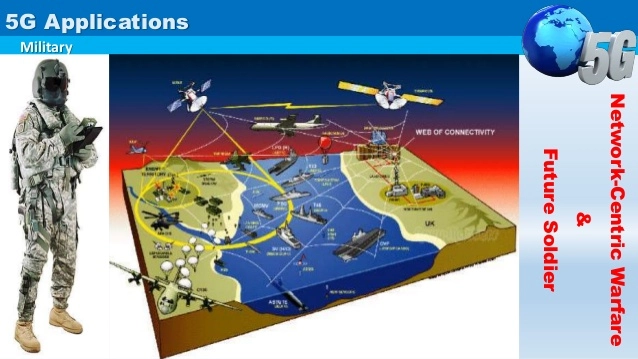
Austin made it clear that things would be different under President Biden. His “tough guy” rhetoric strikes just the right tone for a massive, costly, military-infrastructure overhaul that would render the conventional warfare of the twentieth century unrecognizable: more nukes, fewer troops, and an omnipotent 5G network.

The goal of this overhaul is to give the United States and its allies the ability to summon, at once, unmanned military forces to rain terror down on any spot in the world—a swarm of drones, hypersonic missiles, submarine torpedoes, and bombers—all with the ease of calling an Uber.

This game-changing metamorphosis of how wars are fought is already underway. It’s called the JADC2 (Joint All-Domain Command & Control), a globally networked, cloud-based command center, overseen by the recently anointed U.S. Space Force.

It was for this that the Space Force was created—not as a jokey Trump trifle.

However, targeting China with this new paradigm for mass destruction will not bring about global security. Even if it were to somehow not culminate in a nuclear conflict, the ecological and climate costs of commanding war from outer space would be devastating. And yet, ever-more-mammoth military preparations are being staged in ever-more-numerous locations on Earth.

President Biden is in lockstep with Austin’s anti-China mission. Much of Biden’s $715 billion Pentagon budget request for 2022 is for investment in hypersonic weapons, artificial intelligence, micro-electronics, 5G technology, space-based systems, shipbuilding and nuclear “modernization” (read: expansion). The request seeks $28 billion to “modernize” the nuclear triad (the ability to launch nukes from land, sea, and air). The budget also includes the largest research-and-development request—$112 billion—in the history of the Pentagon.

Imagine that kind of support for healthcare.

Each line item is a deadly weapon, which, discretely, already carries terrifying implications. But, taken together, as part of the JADC2—an integrated, multi-dimensional system with machines responsible for pulling the trigger—the whole is far more chilling than the sum of the parts.

Among the types of missiles on Biden’s wish-list are some whose range exceeds the limits in the Intermediate-Range Nuclear Forces (INF) Treaty of 1987. But the INF Treaty is no longer in effect, after President Trump withdrew the United States from the agreement in August 2019, just four months before the creation of the Space Force. That means that Biden and Austin are now free to spend taxpayer money on these perilous weapons.

Policy analyst Michael Klare has observed that this year’s budget subordinates all perceived threats to a single bogeyman-du-jour: China. War with China, specifically, means more nukes, long-range missiles, and unmanned weapons. These weapons are not just to be used by the United States, but are also for export to allies as well—much to the financial gain of weapons industrialists like Lockheed Martin and Raytheon.

For example, a declassified U.S. Department of Defense report from 2018 provides a directive to sell more arms to India, to “enhance India’s status as a Major Defense Partner,” and to “support India’s membership in the Nuclear Supplier’s Group.” The essence of the Pentagon’s massive global vision is to construct, from the ground up, a hard and soft infrastructure upon which the newly created Space Force can operate.

Just as the continent-spanning interstate highway system was laid during the 1950s to ensure a profitable future for the automobile industry, this new infrastructure—comprised of 5G, artificial intelligence, rocket launchpads, missile tracking stations, satellites, nukes, and internet-connected fleets of unmanned ships, jets, subs, hypersonic, and other craft—will ensure a reliably profitable assembly-line output of arms for the weapons industry.

In tandem with the military infrastructure will come a continued expansion of associated security infrastructure, such as increased surveillance and data collection of every individual on the planet. As a former board member at Raytheon, Lloyd Austin is perfectly positioned to pull this off. In fact, during his first three months as defense secretary, he awarded over $2.36 billion in contracts to the missile manufacturer he once faithfully served.

http://space4peace.org/countering-the-china-threat-at-what-price/

President Biden’s magic tricks: watch both of his hands

From Global Network Against Weapons and Nuclear Power in Space
February 5, 2021
Bruce Gagnon

During the Obama administration the Modus operandi (MO) was to play magic tricks. Obama would announce a good thing and then at the same time do a really bad thing.  I started urging people to watch both of the magicians hands. 

Following Obama’s slight of hand tricks, Biden is off to a similar start. Here are a few examples:

  • Just yesterday Biden made a foreign policy speech where he said, “America is back. Diplomacy is back at the center of our foreign policy”. But on February 2 Stars & Stripes newspaper [1] reported that his administration was “deploying bombers and airmen to a base in Norway for the first time, underscoring the growing importance of the Arctic region to U.S. defense strategy.” The Air Force has been stepping up its strategic bomber missions in the Arctic, but recent missions have either been staged from England, where bombers typically deploy while training in Europe, or have involved round-trip flights between the U.S. and the Nordic region. This is the first time bombers are deploying to Norway. (Which of course borders Russia in the north.)
  • In his speech Biden praised those who have been calling for an end to the Saudi-US war in Yemen.  He said the US will end all support for Saudi Arabia’s ‘offensive operations’ in Yemen. But then in typical magician style the new prez stated that the US will “continue to help and support Saudi Arabia” by selling them ‘defensive’ weapons.  Now let’s see here – how much difference is there between offensive and defense weapons?  A bullet is a bullet.  A bomb is a bomb….
  • On February 3 Biden announced an agreement to extend the New START Treaty with Russia, to preserve the only remaining nuclear arms agreement between them.  OK that is good.  But are you watching his other hand?  On Biden’s first day in office he ordered more US troops into the oil fields of Syria. [2]
  • On January 28 Biden sent three warships into the Black Sea, stepping up its presence in the region after a drop in overall NATO maritime activity there last year. The destroyer USS Porter began its transit into the sea, joining the USS Donald Cook (built in Bath, Maine) and a third warship conducting operations in the strategic waterway, the Stars & Stripes reported.[3] Retired Lt. Gen. Ben Hodges, who led the Army in Europe until 2018, said more allies should step up to help the U.S. in the region. “We clearly have to increase the priority of the Black Sea,” said Hodges, who is now the Pershing chair of strategic studies at the Center for European Policy Analysis. “US Navy has too many (requirements) and not enough resources. President Biden will expect Allies to do more.” Russia took note of the US’s Black Sea escalation and sent fighter jets zooming just above Washington’s provocative deployment of destroyers in Russia’s backyard.  How would the US respond if Moscow sent warships into the Gulf of Mexico? 
  • Let’s not leave China out.  Again on January 28 Biden ordered a ‘task force’ of four B-52 bombers to fly to Andersen Air Force Base, Guam, part of an ongoing demonstration by the Air Force of its ability to move strategic assets around the globe. Stars & Stripes again reported [4] that the B-52s, from Barksdale Air Force Base, Louisiana, were sent to “reinforce the rules-based international order in the Indo-Pacific region” through “strategic deterrence.” Guam, at the eastern edge of the Philippine Sea, is within easy range of the South China Sea, where the US is escalating pressure on China to surrender to Washington’s control.
  • Then on February 4, just to make sure that Beijing got Biden’s message that “American is back”, the US Navy destroyer USS John S. McCain (built in Bath, Maine) sailed through the Taiwan Strait [5] marking the first such transit since Biden took office. The Navy called it “routine”. China said it remains on “high alert” and “is ready to respond to all threats and provocations at any time.” My son lives in Taiwan so this one really hit close to home.
  • All of these ‘operations’ cost big $$$$ – especially at a time when the US Congress says that the government can’t afford to give our citizens $2,000 each to help them deal with loss of jobs, no healthcare, growing hunger and poverty, and general economic collapse. But despite all the nice talk about bringing the nation back to sanity and solvency – it is the same old ‘double cross’ – Three-card Monte scam.  Watch both hands of the dealer.  Look away at your own risk.

[1] stripes.com/news/europe/us-air-force-bombers-deploy-to-norway-for-first-time-1.660701?fbclid=IwAR39tIrNICWQATY60CzR2EvCfvJ7DPop0UFQscnDWkwh5F2BKPso8RD1ER4

[2] youtube.com/watch?v=n1QiulgahxU&feature=youtu.be&fbclid=IwAR1uzSdiSovqqWFZbBKsqMe3Gi64NhLgDBKJCG2Fm567EtdaRNaVDzNTD5k

[3] stripes.com/news/europe/navy-sends-three-ships-into-black-sea-as-russia-takes-notice-1.660114?fbclid=IwAR1exjiEkYPqJy13tE3r8diqgyxP8H1BmJhVYHP6CdpN1AzEs34HHJF5TDk

[4] stripes.com/news/europe/navy-sends-three-ships-into-black-sea-as-russia-takes-notice-1.660114?fbclid=IwAR1exjiEkYPqJy13tE3r8diqgyxP8H1BmJhVYHP6CdpN1AzEs34HHJF5TDk

[5] msn.com/en-us/news/world/a-us-navy-warship-sailed-through-the-taiwan-strait-for-the-first-time-since-biden-became-commander-in-chief/ar-BB1dopBg?ocid=msedgntp&fbclid=IwAR0Lr3d81iYDklWrGVvvDxtktk2t4CZUOPxRsc-XTgAmsoxB2ISgv6jT0hU

http://space4peace.blogspot.com/2021/02/bidens-magic-tricks-watch-both-of-his.html