From Consortium News
May 23, 2026
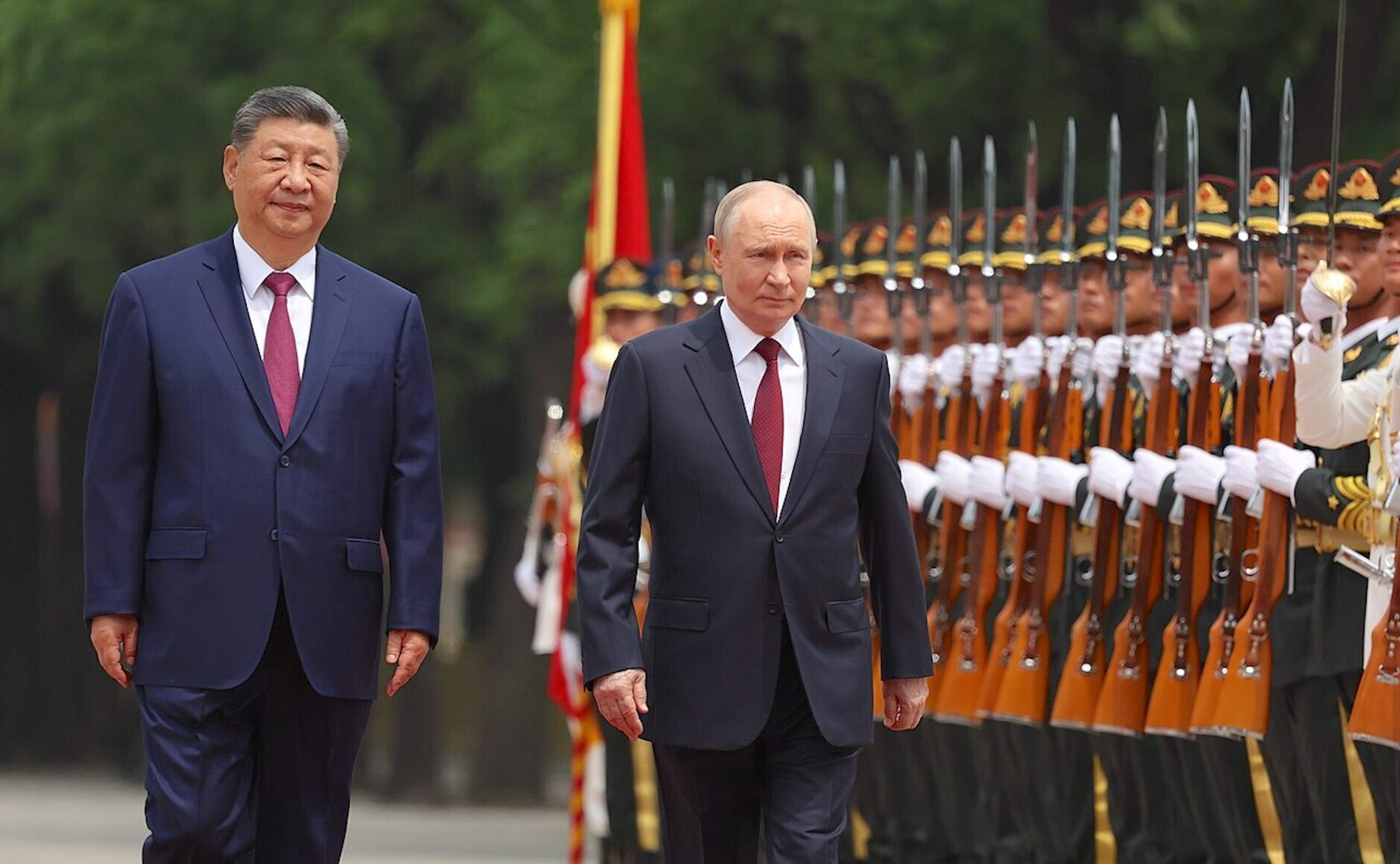
After their summit in Beijing on Wednesday, the Russian and Chinese presidents issued the following communiqué, declaring the failure of neocolonial hegemony and the emergence of a new era of international relations.
The Russian Federation and the People’s Republic of China (hereinafter referred to as the Parties), being civilizations with an ancient history, founding countries of the United Nations (U.N.) and permanent members of its Security Council, important centers of power in a multipolar world, playing a constructive role in maintaining the global balance of power and improving the system of international relations,
Guided by the ideas of the Russian-Chinese Joint Declaration on a Multipolar World and the Formation of a New International Order of April 23, 1997, the Joint Declaration between the Russian Federation and the People’s Republic of China on the International Order in the 21st Century of July 1, 2005, the Joint Statement of the Russian Federation and the People’s Republic of China on the Current Situation in the World and Major International Issues of July 4, 2017, the Joint Statement of the Russian Federation and the People’s Republic of China on International Relations Entering a New Era and Global Sustainable Development of February 4, 2022, state the following:
1. Since the end of World War II, changes in the international landscape and the balance of power in the world have accelerated.
On the one hand, the wave of decolonization and the end of the Cold War led to a significant increase in the number of sovereign states in the world. Global society has become more diverse and complex. The development and international influence of states in Asia, Africa, the Middle East, Latin America, and the Caribbean have risen. The number of regional and interregional associations, spanning all areas of international relations, from politics and security to economics and humanitarian affairs, has increased, and their role in global affairs is steadily growing. Global interconnectedness and interdependence have reached levels unprecedented in human history.
Attempts by a number of states to unilaterally manage global affairs, impose their interests on the entire world, and limit the sovereign development of other countries, in the spirit of the colonial era, have failed. The system of international relations in the 21st century is undergoing a profound transformation, evolving toward a long-term state of polycentricity and the emergence of a new type of international relations.
Most states, drawing on their historical experience, have deeply recognized the dawn of a new era and the need to pursue the path of forming a more cohesive international community, as well as mutual respect for fundamental interests, equality, justice, and mutually beneficial cooperation without dividing the world into opposing regions and blocs.
On the other hand, the global situation is becoming more complex. Negative neocolonial tendencies such as unilateral forceful approaches, hegemonism, and bloc confrontation are on the rise. Fundamental, universally recognized norms of international law and international relations are regularly violated, and it is becoming more difficult for states to coordinate their actions and resolve conflicts within global governance institutions, many of which are losing their effectiveness. The global peace and development agenda is facing new risks and challenges, and there is a danger of fragmentation of the international community and a return to the “law of the jungle.”
2. Advocating for a harmonious process of establishing an equal and orderly multipolar world and a new type of international relations, including a more just and rational system of global governance, the Parties undertake and call upon the international community to adhere to the following basic principles in their relations with each other:
1) the principle of openness of the world for inclusive and mutually beneficial cooperation.
It is important to overcome the divisions of the world and promote the elimination of cross-border barriers in various spheres, while respecting the sovereignty, territorial integrity, and identity of all sovereign states. There is no universal development path in the world, and no “first-class” countries or peoples exist. The natural differences between states in such a diverse and complex world should not be an obstacle to the development of equal, respectful, and mutually beneficial relations between them. It is essential to respect the choice of each sovereign state’s path and development model. Democratizing international political relations and building a more open global economy are in the fundamental interests of all countries. Unilateral approaches to resolving common problems, hegemony, and coercive policies in any form are unacceptable.
2) the principle of indivisible and equal security.
The emergence of a more cohesive international community amid growing common risks and challenges for humanity means that the security of one state cannot be achieved at the expense of another. All sovereign states have an equal right to security. It is necessary to pay due attention to the rational security concerns of all countries, focus on cooperation on security issues, reject bloc confrontation and zero-sum game strategies, oppose the expansion of military alliances, hybrid wars, and proxy wars, and promote the creation of a renewed, balanced, effective, and sustainable global and regional security architecture. Disagreements and disputes should be resolved peacefully, addressing the root causes of conflicts. It is unacceptable to coerce sovereign states into abandoning their neutrality.
3) the principle of democratization of international relations and improvement of the global governance system.
All states and their associations are free to choose their international partners and models of international interaction. Global hegemony is unacceptable and must be prohibited. No state or group of states should control international affairs, dictate the fate of others, or monopolize development opportunities. The system of global governance and regulation must ensure conditions for the equal participation of all states in political decision-making processes and their benefits, and it must be continuously improved. Global governance, an important instrument for regulating the system of international relations, must adhere to sovereign equality, the rule of international law, multilateralism, human-centeredness, and results-oriented approaches.
To this end, it is necessary to strengthen the role of multilateralism as the primary tool for resolving multifaceted and complex global problems and prevent the weakening of the U.N. Reform of the U.N. and other multilateral institutions must serve the interests of all humanity and consistently enhance the representativeness and voice of developing states in the international system. The U.N. Charter is the fundamental norm of international relations, and its principles must be observed in their entirety and interrelationship. Rules developed by a small group of states should not replace generally recognized international law. Large states must assume special responsibilities and missions, impose additional demands on themselves, and not abuse their advantages;
4) world civilizational and value diversity.
All human civilizations are valuable and equal in themselves; civilizations are not divided into highly developed and underdeveloped, strong and weak. The spiritual and moral system of no civilization can be considered exclusive or superior to others. All countries must advocate for a view of civilization based on equality, the mutual exchange of experiences, and dialogue. They must strengthen mutual respect, understanding, trust, and exchanges between different nationalities and civilizations, promote mutual understanding and friendship among the peoples of all countries, and protect the diversity of cultures and civilizations.
It is necessary to resolutely oppose the use of human rights as a pretext for interference in the internal affairs of other states, as well as the politicization and instrumentalization of human rights issues. Religion is an important conduit for human culture, playing a special role in building ties between peoples, and all states must create favorable conditions for interreligious dialogue and exchanges.
3. The parties will continue to develop a joint vision for the formation of a multipolar world and a new type of more equitable international relations.
https://consortiumnews.com/2026/05/23/the-russian-chinese-communique/
 Free Ukraine Now