US-NATO ground forces, escalation in Syria leading to global war

Global Research, December 05, 2015
turkey-syria

The recent developments show significant changes in the strategy of the Western countries involved in the Syrian conflict. The US has sent ground forces, including special operations units, into the region. French Air Force has sharply increased the number of sorties, and France’s rapid-reaction troops and naval units are being moved closer to Syria.

The United Kingdom has also begun to participate in the US-led anti-ISIS coalition strikes on Syrian soil. Likewise Germany has begun to deploy its aircraft and relocating almost 1200 quick-reaction troops to the Syria-Iraq battlefield. Turkey is deploying a large military attack force, including a number of armored units, at the border with Syria. It seems that NATO powers have realized the strategy aimed at Assad’s ouster by a diverse range of militant groups including ISIS which is backed by Turkey and the US has failed.

According to the initial scenario implemented by the West, ISIS and other militant groups, deceitfully called the moderate opposition, were to carry out a Libya-like scenario in Syria and oust or preferably kill Assad and plunge the whole country into chaos. Then the US-led coalition would start a full-scale military operation to stop the terrorists threatening the “moderate opposition” in Syria, deploy NATO forces on the ground and take control of the crucial oil and logistic infrastructure. Western oil corporations supported by NATO would then restore the state of affairs as it existed more than 40 years ago. Syria would fall victim to total exploitation by overseas powers. The Mediterranean would become Alliance’ internal lake.

Now it’s clear that Syria won’t fall under terrorist group pressure. The Syrian forces backed by Russia and Iran are gaining momentum, recapturing cities and facilities earlier controlled by militants. The NATO allies urgently need a new plan to hold control at least of the northern oil corridor from Iraq and try to take advantage of this opportunity to involve Russia in a long expensive war, in other words, to accomplish that which they failed to do in Ukraine. It means that the NATO contingent must occupy crucial infrastructure including oilfields before the Syrian government forces liberate it. Anti-government, meaning anti-Russian and anti-Iranian, forces would be established in parts of divided Syria. The need for an excuse to implement the changed approach could be the reason why the Nov.13 Paris attack wasn’t prevented by the Western special services.

The implication of the Western plan to divide Syria in a number of vassal entities leads to 3 main scenarios:

1)   Military buildup and escalation in the region could lead to open military conflict between NATO and the alternative anti-ISIS coalition that is led by Russia. This regional conflict could easily lead to a global war. Moreover, Turkey, a NATO member state, has already shown that it’s ready to escalate the situation to defend its illegal oil business linked with ISIS.

2)    If the Syrian Arab Army with support by militia forces, Iran, and Russia isn’t able to show a significant success on the battlefield, Syria could be easily divided by the Western-backed ground forces supported by NATO airpower and intelligence assets. A direct military intervention to take control of the oil structure and crucial logistical points also remains possible. Even if NATO and its regional allies successfully take control of a significant part of the country, this escalation is unlikely to be avoided. The situation will become more acute due to the establishment of an aggressive puppet regime on the Syria’s territory. Considering that the alternative anti-ISIS coalition won’t lay down its arms, an open conflict could be easily provoked by the interested powers.

3)   If the Syrian government forces supported by Russia and Iran take control of the country’s key areas, the US-led coalition will face the fact that Syria is de-facto liberated from terrorist groups. It could prevent a direct military intervention by NATO. In this case, the NATO countries would strengthen their presence in Iraq and use it as a foothold to launch further destructive actions against Syria. However, it’s the safest scenario most likely to avoid a global escalation.

Interview with Syrian President Bashar al-Assad; “Britain and France were the spearheads in supporting the terrorists in Syria”

Global Research, December 06, 2015
SANA News 6 December 2015

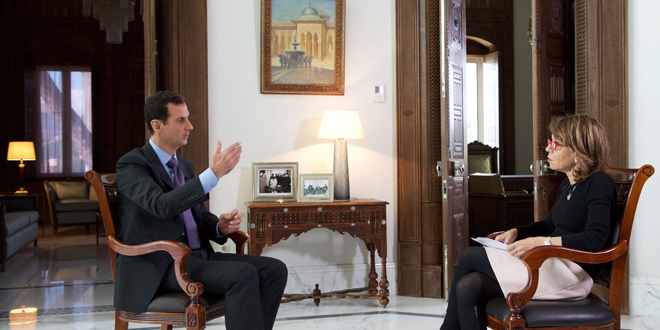
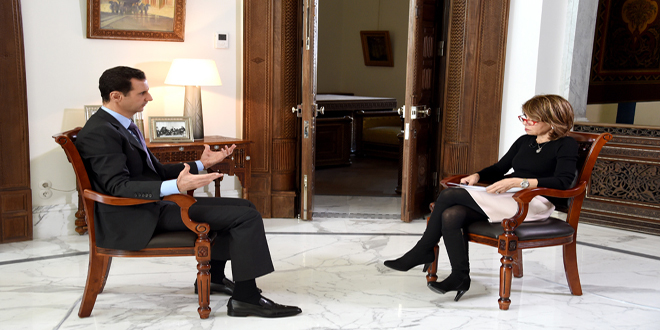
Damascus – President Bashar al-Assad gave an interview to The Sunday Times in which he said Britain and France have neither the will nor the vision on how to defeat terrorism and their airstrikes against ISIS will yield no results, but will rather be illegal and harmful in that they will help in spreading terrorism.

The following is the full text of the interview:

 Question 1:  Thank you for seeing us Mr President.  As you know, the British government today will be voting on whether it will join the coalition airstrikes against ISIS. Is Britain right to join airstrikes against ISIS in Syria? And do you welcome its involvement; and will it make things worse or not make a change?

President Assad:  If I want to let’s say, evaluate a book, I cannot take or single out a phrase from that book to evaluate the whole book.  I have to look at the headlines, then the titles of the chapters and then we can discuss the rest of the book.  So, what we are talking about is only an isolated phrase.  If we want to go back to the headline, it is “the will to fight terrorism.”  We know from the very beginning that Britain and France were the spearheads in supporting the terrorists in Syria, from the very beginning of the conflict.  We know that they don’t have that will, even if we want to go back to the chapter on military participation with the coalition, it has to be comprehensive, it has to be from the air, from the ground, to have cooperation with the troops on the ground, the national troops for the interference or participation to be legal.  It is legal only when the participation is in cooperation with the legitimate government in Syria.  So, I would say they don’t have the will and they don’t have the vision on how to defeat terrorism.

And if you want to evaluate, let’s evaluate from the facts.  Let’s go back to the reality on the ground.  Since that coalition started its operation a year or so, what was the result? ISIS and al-Nusra and other like-minded organizations or groups, were expanding, expanding freely.  What was the situation after the Russians participated in fighting terrorism directly?  ISIS and al-Nusra started shrinking.  So I would say, first they will not give any results.  Second, it will be harmful and illegal, and it will support terrorism as what happened after the coalition started its operation a year or so, because this is like a cancer.  You cannot cut the cancer.  You have to extract it.  This kind of operation is like cutting the cancer that will make it spread in the body faster.

Question 2:  Are you saying, just to clarify two things, are you saying that the British, if the British join the intervention, that includes also the other coalition, with that intervention you see that is illegitimate from an international-law perspective?

President Assad:  Definitely, definitely, we are a sovereign country.  Look at the Russians, when they wanted to make this alliance against terrorism, the first thing they did was they started discussions with the Syrian government before anyone else.  Then they started discussing the same issue with other governments.  Then they came.  So, this is the legal way to combat any terrorist around the world.

Britain and France helped in the rise of ISIS and al-Nusra in this region

Question 3:  You say that France and Britain are responsible for the rise of terrorism here. But they were not responsible for the rise of ISIS, for example, is not that a little bit a harsh accusation?

President Assad: Let’s start from what Blair said.  He said that invading Iraq led to the rise of ISIS.  And we know that ISIS started publically, announcing itself as a state in Iraq in 2006, and the leader was Abu Mosaab al-Zerqawi.  He was killed by American strikes; and they announced that they killed him.  So, they know he existed and they know that IS in Iraq at that time had existed; and that it moved to Syria after the beginning of conflict in Syria because of the chaos that happened.  So, they confess.  British officials confessed, mainly Blair; and the reality is telling, that they helped in the rise of ISIS and al-Nusra in this region.

President al-Assad-Sunday Times-interview 3

Question 4:  In your view, does al-Qaida’s branch in Syria, Jabhat al-Nusra, pose an equal or a greater long-term threat to the West than ISIS? And as such, is Britain’s Prime Minister, Cameron, going after the wrong enemy? I.e. he is going after ISIS instead of going after al-Nusra.

President Assad: The whole question is about the structure, and the problem is not about the structure of the organization.  It is about their ideology.  They do not base their actions on the structure, they base them on their dark, Wahhabi deviated ideology.  So, if we want to evaluate these two, the difference between the two, there is no difference because they have the same ideology.  This is one aspect.  The other aspect, if we want to talk about their grassroots, their followers, their members, you cannot have this distinction, because they move from one organization or one group to another.  And that is why sometimes they fight with each other, for their vested interests, on a local and small scale.  But in reality they are cooperating with each other on every level.  So, you cannot tell which is more dangerous because this is one mentality.  It is like if you say the first one is al-Qaida and the second one is al-Qaida.  The difference is the label, and maybe some other trivial things.

Question 5:  Last week, a key part of Cameron’s argument for extending UK airstrikes to Syria was a number that he used – 70 thousand moderate rebels – that he mentioned “don’t belong to extremist groups”, but are already on the ground, who the west can use to help them in the fight of ISIS. As far as you know, which groups are included in the 70 thousand? Are you aware of 70 thousand moderate rebels in Syria?

President Assad: Let me be frank and blunt about this.  This is a new episode in a long series of David Cameron’s classical farce, to be very frank.  This is not acceptable.  Where are they?  Where are the 70 thousand moderates that he is talking about?  That is what they always talk about: moderate groups in Syria.  This is a farce based on offering the public factoids instead of facts.

The Russians have been asking, since the beginning of their participation two months ago.  They have said: where are those moderates?  No one gave them an answer.  Actually, since the beginning of the conflict in Syria, there were no moderate militants in Syria.  All of them were extremists.  And in order not to say I am just giving excuses and so on, go back to the internet, go back to the social networking sites.  They uploaded their atrocities’ videos and pictures, with their faces and their rhetoric.  They use swords, they do beheadings; they ate the heart of a dismembered innocent person and so on.

And you know, the confession of a criminal is the incontrovertible fact.  So, those are the 70 thousand moderates he is taking about.  It is like if we describe the terrorists who committed the attack in Paris recently, and before that in Charlie Hebdo, and before that in the UK nearly ten years ago, and in Spain before that, and the 11th of September in New York, to describe them as moderate opposition.  That is not accepted anywhere in this world; and there is no 70 thousand, there is no 7 thousand, he does not have, maybe now ten of those.

Question 6:  Not even the Kurds and the FSA for example, the free Syrian army?

President Assad: The Kurds are fighting the terrorists with the Syrian army, in the same areas.

Question 7:  But they are also being supported and armed and trained and backed by the Americans to also launch, to fight …

President Assad:  Mainly by the Syrian army, and we have the documents.  We sent them armaments, because they are Syrian citizens, and they want to fight terrorism.  We do the same with many other groups in Syria, because you cannot send the army to every part of Syria.  So, it is not only the Kurds.  Many other Syrians are doing the same.

Question 8: U.S. Secretary of state John Kerry said last Friday that the Syrian government could cooperate with the opposition forces against the ISIS even if president Assad is still in office, but he said that this would be so difficult if the opposition fighters, who have been fighting the Syrian president, don’t have a faith that the Syrian president will eventually leave power.

Kerry also said that concerning the timing of leaving office, the answer is it is not obvious whether he will have to leave.

Meanwhile, the French Foreign Minister Laurent Fabius told Le Progres Newspaper on Saturday that he no longer believes that President Assad’s departure is essential to any political transition in Syria, adding that the political transition does not mean that President Assad should step down before it but there should be future insurances.

My question: Do you intend to complete your presidential term until 2021 or do you expect a referendum or presidential elections prior to that date? And if so, when can these elections be held? And what can make you decide to hold them? And if they are held, is it certain that you will be running for election? What can influence your decision?

President Assad: The answer depends on the context of the question. If it is related to a settlement in Syria, then early elections have nothing to do with ending the conflict. This can only happen by fighting terrorists and ceasing Western and regional support for terrorists…Early elections will only be held as part of a comprehensive dialogue about future by the political powers and the civil society groups in Syria.

Thus, it is not about the will of the President, but rather the will of the Syrian people…It is about a political process. If this process is agreed on, then I have the right to run for elections like any other Syrian citizen…My decision in this case will be based on my ability to deliver on my commitments…and on whether I have the support of the Syrian people or not….Anyway, It is early to talk about this, because as you know, this process was not agreed upon yet.

President al-Assad-Sunday Times-interview 2

Question 9:   Do you think ISIS can be defeated by airstrikes alone?

You cannot defeat ISIS through airstrikes alone without cooperation with forces on the ground

President Assad:  Did the coalition defeat them by airstrikes during the last year or so?  It didn’t.  Did the Americans achieve anything from the airstrikes in Afghanistan?  They achieved nothing.  Did they achieve anything in Iraq since the invasion in 2003?  Nothing.  You cannot defeat ISIS through airstrikes alone, without cooperation with forces on the ground.  You cannot defeat them if you do not have buy-in from the general public and the government.  They cannot defeat ISIS by airstrikes; they are going to fail again.  The reality is telling.

Question 10:     If the international coalition refuses, as it has so far, to coordinate with the Syrian Army, or with the local troops on the ground, what is your next plan?  I mean do you have a plan B beyond what is going on?  How do you plan to end this war?

President Assad:  This coalition is illusive, it’s virtual, because it has not made any achievements in fighting terrorism on the ground in Syria.  Since an illusion doesn’t exist, let’s not waste time with the ‘before and after.’  From the very beginning we started fighting terrorism irrespective of any global or world powers.  Whoever wants to join us is welcome, and whether they join us or not, we are going to continue.  This is our plan. It is the only plan we have and we will not change it.

Question 11:  Are you calling on them to ask the Syrian government to coordinate and cooperate with the Syrian army and the Syrian air force in the fight against terrorists?

President Assad:  We are very realistic.  We know that they are not going to do so and that they don’t have the will.  This is more about international law than anything else.  Is it possible that western governments, or regimes, don’t know the basics of international law, that they don’t understand the meaning of a sovereign state or that they haven’t read the UN Charter?  They have no respect for international law and we didn’t ask for their cooperation.

Question 12:  But would you like them to?

President Assad:  If they are ready – serious and genuine – to fight terrorism, we welcome any country or government, any political effort.  In that regard we are not radical, we are pragmatic.  Ultimately, we want to resolve the situation in Syria and prevent further bloodshed.  That is our mission.  So, it’s not about love or hate, accepting or not, it is about reality.  Are they truly ready to help us fight terrorism, to stop terrorists coming into Syria through their surrogate governments in our region, or not?  That is the real question.  If they are ready, we will welcome them.  This is not personal.

Question 13:  Do you think it is possible for you, in Syria, and for your allies – Russia, Iran, Hezbollah and other allies – to defeat ISIS militarily; and if so, how long do you think it might take?

President Assad:  The answer is based on two factors: our capabilities on the one hand, and the support the terrorists receive on the other.  From our perspective, if you were to remove the support these groups get from various countries in our region and the West in general, it will take a matter of months to achieve our mission.  It is not very complicated, the solution is very clear to usHowever, these groups have unlimited support from these countries, which makes the situation drag on, makes it more complicated and harder to resolve.  This means our mission will be achieved at a much higher price, which will ultimately be paid by Syrians.

Question 14:  But there has already been a high price: over 200,000 people have been killed.

President Assad:  You are right, and that is a consequence of the support I referred to.

Question 15:  But a lot of it is also blamed on the Syrian government and the Syrian use of force, sometimes indiscriminate or unnecessary force in certain areas that has brought about a large number of people killed.  How do you respond to that?

President Assad:  First, all wars are bad.  There is no such thing as a good war.  In every war there are always too many innocent casualties.  These are only avoidable by bringing that war to an end.  So it is self-evident that wars anywhere in the world will result in loss of life.  But the rhetoric that has been repeated in the West for a long time ignores the fact that from day one terrorists were killing innocent people, it also ignores that fact that many of the people killed were supporters of the government and not vice versa.  As a government, our only countermeasure against terrorists is to fight them.  There is no other choice.  We cannot stop fighting the terrorists who kill civilians for fear of being accused by the West of using force.

Question 16: Let us talk about the role of Russia.  How important has the role of Russia been?  Was Syria about to fall had Russia not intervened when it did at the time?

Russia and Iran’s support played important part in Syria’s steadfastness against terrorism

President Assad: The Russian role is very important.  It has had a significant impact on both the military and political arena in Syria.  But to say that without this role, the government or the state would have collapsed, is hypothetical.  Since the very beginning of the conflict in Syria, there were bets on the collapse of the government.  First it was a few weeks, then it was a few months and then a few years.  Every time it was the same wishful thinking.  What is definite is that the Russian support to the Syrian people and government from the very beginning, along with the strong and staunch support of Iran, has played a very important part in the steadfastness of the Syrian state in the fight against terrorism.

Question 17: You mean the previous one, or the recent military intervention?

President Assad:  No, the whole support; it is not only about their participation.  Their support from the very beginning in all aspects: political, military and economic.

Question 18: How and why did Russian involvement come about now?  And can you give us some details of the discussions between you and President Putin that brought it about?  Who took the first step?  Did you ask, or did they offer?

The Russians want to protect Syria, Iraq, the region, themselves and even Europe

President Assad:  You will have to ask the Russians why they got involved.  But from our perspective, since the Western coalition started in Syria, ISIS has expanded, al-Nusra has expanded and every other extremist and terrorist group has expanded and captured new territory in Syria and Iraq.  The Russians clearly saw how this posed a threat to Syria, Iraq and the region in general, as well as to Russia and the rest of the world.  We can see this as a reality in Europe today.  If you read and analyse what happened in Paris recently and at Charlie Hebdo, rather than view them as separate incidences, you will realize something very important.  How many extremists cells now exist in Europe?  How many extremists did you export from Europe to Syria?  This is where the danger lies.  The danger is in the incubator.  The Russians can see this very clearly.  They want to protect Syria, Iraq, the region, themselves and even Europe.  I am not exaggerating by saying they are protecting Europe today.

Question 19: So, did they come to you and say we would like to be involved? Or did you ask them: could you help us?

President Assad:  It was an accumulative decision; it didn’t happen by me having this idea or them having another.  As you know, our relationship with the Russians goes back more than five decades, and they have always had military staff in Syria: call them experts or by any other name.  This cooperation accelerated and increased during the crisis.  Their teams are here and can see the situation real-time with us.  This kind of decision doesn’t start from the top down, but rather from the bottom up.  There is a daily political and military discussion between our two countries.  When it reached a presidential level, it was mature enough and ready for the decision to be made quickly.

Question 20: But there must have been a point when they said: we think, or with your agreement, we think that we should actually now physically get involved.

President Assad: Again, this was started at the lower levels.  These officials jointly agreed that it was necessary to get involved and each party discussed it with their leaders.  When it reached the stage of discussion between us, I mean between President Putin and I, we focused our discussions on the how.  Of course this did not happen directly as we had not yet met and it’s impossible to discuss these issues on the phone.   It was mediated through senior officials from both sides.  That is what happened.  In terms of procedure, I sent a letter to President Putin which included an invitation for their forces to participate.

Question 21:  So you asked president Putin having been advised by your officials.

President Assad:  Exactly, after we reached that point I sent President Putin a formal letter and we released a statement announcing that we had invited them to join our efforts.  Let’s not forget that President Putin had already taken the step when he said he was willing to create a coalition.  My response to this was that we are ready if you want to bring your forces to participate.

Question 22:  So, what forces have been deployed? I am talking about Russian forces. There have been reports, for example, of a thousand ground troops plus Special Forces, is this correct? Is there anytime when you think that the Russians will be involved in Syria, not just by air but with ground troops as well?

President Assad:  No, so far there is no such thing.  There are no ground troops except for the personnel that they send with their military staff and airplanes to guard the airbase, and that is natural.  They don’t have any ground troops fighting with Syrian forces at all.

Question 23:  And there is no plan for that?

President Assad:  We have not discussed that yet, and I don’t think we need it now, because things are moving in the right direction.  The Russians may consider it with time or under different circumstances, but for the moment, this has not been discussed.

Question 24: There was a report, or a hint, that Syria might be receiving S-300 from the Russians, and the S-300 will allow Syria to protect its airspace. Is this something, for example, that Syria will use against the US-led coalition’s air force, even if Britain was involved, since their warplanes are in Syrian skies, as you said earlier, without official or sovereign permission. As Syria will receive S-300, then will it use this to impose, if you want, protection of its skies and impose a way to tell the coalition that you have to actually directly deal with us, or coordinate with us on the ground?

We will use any means available to us to protect our airspace

President Assad:  That is our right and it is only to be expected that we prevent any airplane from violating our airspace.  That is completely legal.  We are going to use any means available to us to protect our airspace.  It is not about that armament in particular.  Any air defense we have is for that reason.

Question 25:  Do you have that defense at the moment?

President Assad:  No. So far we don’t have it.

Question 26:  If you get that defense?

President Assad:  Any defense systems we are going to have are for that purpose.  If we are not going to protect our airspace, then why buy such armaments in the first place?  That is self-evident.

Question 27:  And if you get it …

President Assad: Not at the moment; it is not our priority now.  Our priority is fighting the terrorists on the ground.  This is the most important danger now.  Of course we are keen to protect our airspace and prevent foreign interference in our internal affairs, militarily or other.  But the priority now is to defeat the terrorists.  By defeating the terrorists, some of whom are Syrians, we can move further in protecting the whole country from foreigners.  It is a matter of priorities.

Question 28:  But I meant about the actual coalition airplanes that are actually flying over Syria. So, that is not a priority either at the moment?

President Assad:  No, not at the moment.  At the moment the priority is fighting terrorism.

Question 29:  If Saudi Arabia were to invite you for serious discussions on the future of Syria, would you accept such an invitation? Or have relations between Syria and Saudi Arabia been severely severed that you would never consider that?

President Assad:  No, there is nothing impossible in politics.  It is not about whether I accept or not, but rather about the policies of each government.  What are their policies towards Syria? Are they going to keep supporting the terrorists or not? Are they going to continue playing their dangerous games in Syria, Yemen and other places?  If they are ready and willing to change their policies, especially with regard to Syria, we don’t have a problem meeting with them.  So it is not about the meeting or whether we go or not, the issue is their approach to what is happening in Syria.

Question 30:  Do you expect any results from the talks in Vienna?  And what would be the shape of any possible deal that you see coming out of Vienna?

President Assad:  The most important clause in the Vienna communique is that the Syrians should come together to discuss the future of Syria.  Everything else is an accessory.  If you don’t have that main part, the accessories are of no use.  So, the only solution is for us to come together as Syrians.  Vienna itself is a meeting to announce intentions; it is not the actual process of siting down and discussing the future.  So, the question is not what results from Vienna, but rather what we Syrians are able to achieve when we sit down together.

Question 31:  But do you realize that some of the opposition’s leaders, and I’m talking about opposition figures who have been against taking up arms and what have you, but are also afraid of coming to Syria, because the moment they land in Syria, they will be arrested by the security officers and put in prison. And it has happened to others.

President Assad:  No, it has never happened.  There is an opposition in Syria, and they are free to do whatever they want.

Question 32:  No, I mean the external opposition. For example, somebody like Haitham Mannaa, cannot come back.

President Assad:  We have clearly stated that when there is a gathering in Syria, which they want to attend, we guarantee that they will not be arrested or held.  We have said this many times.  We don’t have any problems in this regard.

President al-Assad-Sunday Times-interview 1

Question 33:  Now, Saudi Arabia invited 65 figures, including opposition leaders, even rebel commanders, businessmen, religious figures for a meeting in Saudi Arabia to present a united front in preparation for the January Vienna talks. Yet, the Syrian government, which is the other major element in this whole thing for the future of Syria, has not been seen to be involved with the opposition. Are you conducting any talks with the opposition? Have you reached any consensus with them?

President Assad:  We have direct channels with some opposition groups; but others cannot communicate with us because they are not allowed to do so by the governments that control them.  From our perspective, we are open for discussions with every peaceful opposition party.  We don’t have any problems.  With regards to the meeting in Saudi Arabia, the Saudi’s have been supporting terrorism directly, publically and explicitly.  That meeting will not change anything on the ground.  Before the meeting and after the meeting Saudi Arabia has been supporting terrorists and will continue to do so.  It is not a benchmark or a critical juncture to discuss.  It will not change anything.

Question 34:  Do you see that anytime, in the future, that in order to protect Syria, or in order to save Syria, or to get the Syria process moving, that you might see yourself sitting with certain groups, one group, or certain groups, that perhaps now you deem terrorist, but in the future, it might be feasible that you would agree to negotiate with them because it would do well for the future?

President Assad:  We already have; since the very beginning one of the pillars of our policy, was to start a dialogue with all parties involved in the conflict, whether they were in Syria or not.  We negotiated with many terrorist groups, not organizations – to be very precise, who wanted to give up their armaments, and return to normal life.  These negotiations led to many amnesties being issued and has proven to be very successful in several areas.  Furthermore, some of these fighters have joined the Syrian Army and are now fighting with our forces.  So yes, we are sitting down with those who committed illegal acts in Syria, whether political or military, to negotiate settlements on the condition that they give up their arms and return to normal life.  This doesn’t mean that we negotiate with terrorist organizations like ISIS, al-Nusra and others. This is what I meant by groups, those who want out of the fight, regret their choices and want to have their lives back.

Question 35:  The rebels call them barrel bombs. You refuse to refer to them as barrel bombs. Irrespective of the name, these were indiscriminate. Do you accept that Syria used indiscriminate bombs in some areas, which resulted in the death of many civilians?

President Assad:  Let us suppose that this part of the propaganda is true, which it isn’t.  But for the sake of argument, let us ask the same question regarding the different attacks committed by the Americans and the British with their state-of-the-art airplanes and missiles in Afghanistan and in Iraq, not only after the invasion of Iraq in 2003, but also during the first Gulf war in 1990.  How many civilians and innocent people were killed by those airstrikes with these very high precision missiles?  They killed more civilians than terrorists.  So, the issue is not these so-called barrel bombs and this evil president killing the good people who are fighting for freedom.  This romantic image is not the case.  It is about how you use your armaments, rather than the difference between so called barrel bombs and high precision missiles.  It is about how you use these weapons, what kind of information you have and your intention.  Do we have the will to kill innocent people?  How is that possible when the state is defending them?  By doing so, we are pushing them towards the terrorists.  If we want to kill people, for any reason, innocent people or civilians, that will play directly into the hands of the terrorists.  And this is against our interests.  Are we going to shoot ourselves in the foot? That is not realistic and not logical.  This propaganda cannot be sold anymore.

Question 36: Mr President, the final question. As president of the country, and you always lead the military and everything. Do you, even if by default, not bear responsibility for some of the things that happened in Syria?

President Assad: I’ve been asked this question many times especially by western media and journalists.  The aim of the question is to corner me between two answers: if I were to say I was responsible, they would say look the President bears responsibility for everything that happened, if I were to say I am not responsible, they would say this is not true, you are the president, how can you not be responsible.

Question 37:  Because you are the head, like in a family …

President Assad:  Let me continue, that was only an introduction to my answer.  It is very simple.  Since the very beginning, we built our policy around two pillars, engaging in dialogue with everyone, and fighting terrorism everywhere in Syria.  Now, if you want to talk about the responsibility, you have to discuss many aspects of the conflict, and the reason why we are here today in this difficult and dire situation in Syria.  If I am to claim responsibility, do I also claim responsibility for asking the Qataris to pay the terrorists money?  Or for the Saudis to fund their activities?  Or for western governments allowing their terrorists to come to Syria?  Do I claim responsibility for asking western governments to offer a political umbrella to those terrorists and label them as moderates?  Or for the western embargos on the Syrian people?  This is how we have to discuss it.  We cannot simply say, that he takes responsibility or not.  We have to talk about every part; we have to differentiate between the policy decisions and the practices, between the strategy and the tactics.  So, it is very complicated to evaluate it.  Additionally, if you want to evaluate who bears responsibility in Syria, it could happen at the end of the war, when you can investigate the whole story before, during and after.

Interviewer:  Mr President, thank you very much.

The war by ISIS requires an immense coordinated supply network – who’s involved?

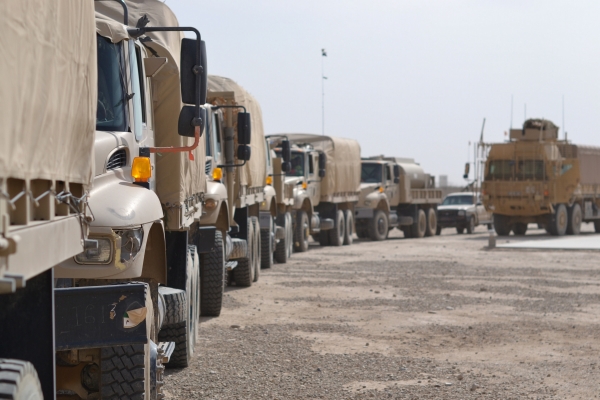
This critical side of the whole ISIS issue must be exposed. Miles and miles of supply convoys are not invisible. Coalition partners are not blind –they have satellites, planes, and eyeballs. The only possible conclusion is that the coalition partners are the supply chain.

History discloses the usual actors against the Middle East — Britain, America, France. Israel, Qatar, Saudi Arabia, Jordan are also involved.

Logistics 101: Where does ISIS get its guns?
By Tony Cartalucci
Global Research, November 26, 2015
New Eastern Outlook 9 June 2015

Article originally published in June 2015

Since ancient times an army required significant logistical support to carry out any kind of sustained military campaign. In ancient Rome, an extensive network of roads was constructed to facilitate not only trade, but to allow Roman legions to move quickly to where they were needed, and for the supplies needed to sustain military operations to follow them in turn.

In the late 1700′s French general, expert strategist, and leader Napoleon Bonaparte would note that, “an army marches on its stomach,” referring to the extensive logistical network required to keep an army fed, and therefore able to maintain its fighting capacity. For the French, their inability to maintain a steady supply train to its forces fighting in Russia, and the Russians’ decision to burn their own land and infrastructure to deny it from the invading forces, ultimately defeated the French.

Nazi Germany would suffer a similar fate when it too overextended its logical capabilities during its invasion of Russia amid Operation Barbarossa. Once again, invading armies became stranded without limited resources before being either cut off and annihilated or forced to retreat.

The other half of the war is logistics. Without a steady stream of supplies, armies no matter how strong or determined will be overwhelmed and defeated. What explains then ISIS’ fighting prowess and the immense logistical networks it would need to maintain it?

And in modern times during the Gulf War in the 1990′s an extended supply line trailing invading US forces coupled with an anticipated clash with the bulk of Saddam Hussein’s army halted what was otherwise a lighting advance many mistakenly believed could have reached Baghdad had there been the political will. The will to conquer was there, the logistics to implement it wasn’t.

The lessons of history however clear they may be, appear to be entirely lost on an either supremely ignorant or incredibly deceitful troupe of policymakers and news agencies across the West.

ISIS’ Supply Lines

The current conflict consuming the Middle East, particularly in Iraq and Syria where the so-called “Islamic State” (ISIS) is operating and simultaneously fighting and defeating the forces of Syria, Lebanon, Iraq, and Iran, we are told, is built upon a logistical network based on black market oil and ransom payments.

The fighting capacity of ISIS is that of a nation-state. It controls vast swaths of territory straddling both Syria and Iraq and not only is able to militarily defend and expand from this territory, but possesses the resources to occupy it, including the resources to administer the populations subjugated within it.

For military analysts, especially former members of Western armed forces, as well as members of the Western media who remember the convoys of trucks required for the invasions of Iraq in the 1990s and again in 2003, they surely must wonder where ISIS’ trucks are today. After all, if the resources to maintain the fighting capacity exhibited by ISIS were available within Syrian and Iraqi territory alone, then certainly Syrian and Iraqi forces would also posses an equal or greater fighting capacity but they simply do not.

And were ISIS’ supply lines solely confined within Syrian and Iraqi territory, then surely both Syrian and Iraqi forces would utilize their one advantage – air power – to cut front line ISIS fighters from the source of their supplies. But this is not happening and there is a good reason why.

Recent maps showing ISIS’ territory show obvious supply lines leading from Jordan and Turkey. Should Syria and its allies manage to cut these supply lines, one wonders just how long ISIS’ so-far inexplicable winning streak would last.

ISIS’ supply lines run precisely where Syrian and Iraqi air power cannot go. To the north and into NATO-member Turkey, and to the southwest into US allies Jordan and Saudi Arabia. Beyond these borders exists a logistical network that spans a region including both Eastern Europe and North Africa.

Terrorists and weapons left over from NATO’s intervention in Libya in 2011 were promptly sent to Turkey and then onto Syria – coordinated by US State Department officials and intelligence agencies in Benghazi – a terrorist hotbed for decades.

The London Telegraph would report in their 2013 article, “CIA ‘running arms smuggling team in Benghazi when consulate was attacked’,” that:

[CNN] said that a CIA team was working in an annex near the consulate on a project to supply missiles from Libyan armouries to Syrian rebels.

Weapons have also come from Eastern Europe, with the New York Times reporting in 2013 in their article, “Arms Airlift to Syria Rebels Expands, With Aid From C.I.A.,” that:

From offices at secret locations, American intelligence officers have helped the Arab governments shop for weapons, including a large procurement from Croatia, and have vetted rebel commanders and groups to determine who should receive the weapons as they arrive, according to American officials speaking on the condition of anonymity.

And while Western media sources continuously refer to ISIS and other factions operating under the banner of Al Qaeda as “rebels” or “moderates,” it is clear that if billions of dollars in weapons were truly going to “moderates,” they, not ISIS would be dominating the battlefield.

Recent revelations have revealed that as early as 2012 the United States Department of Defense not only anticipated the creation of a “Salafist Principality” straddling Syria and Iraq precisely where ISIS now exists, it welcomed it eagerly and contributed to the circumstances required to bring it about.

Just How Extensive Are ISIS’ Supply Lines? 

While many across the West play willfully ignorant as to where ISIS truly gets their supplies from in order to maintain its impressive fighting capacity, some journalists have traveled to the region and have video taped and reported on the endless convoys of trucks supplying the terrorist army.

Were these trucks traveling to and from factories in seized ISIS territory deep within Syrian and Iraqi territory? No. They were traveling from deep within Turkey, crossing the Syrian border with absolute impunity, and headed on their way with the implicit protection of nearby Turkish military forces. Attempts by Syria to attack these convoys and the terrorists flowing in with them have been met by Turkish air defenses.

Germany’s international broadcaster Deutsche Welle (DW) published the first video report from a major Western media outlet illustrating that ISIS is supplied not by “black market oil” or “hostage ransoms” but billions of dollars worth of supplies carried into Syria across NATO member Turkey’s borders via hundreds of trucks a day.

German national broadcaster DW reported on convoys of hundreds of trucks per day crossing into Syria from NATO-member Turkey with impunity, enroute to ISIS terrorists, finally explaining the source of the terrorist army’s fighting capacity. The trucks were reported by DW to have originated from deep within Turkish territory – most likely NATO air bases and ports.

The report titled, “‘IS’ supply channels through Turkey,” confirms what has been reported by geopolitical analysts since at least as early as 2011 – that ISIS subsides on immense, multi-national state sponsorship, including, obviously, Turkey itself.

Looking at maps of ISIS-held territory and reading action reports of its offensive maneuvers throughout the region and even beyond, one might imagine hundreds of trucks a day would be required to maintain this level of fighting capacity. One could imagine similar convoys crossing into Iraq from Jordan and Saudi Arabia. Similar convoys are likely passing into Syria from Jordan.

In all, considering the realities of logistics and their timeless importance to military campaigns throughout human history, there is no other plausible explanation to ISIS’s ability to wage war within Syria and Iraq besides immense resources being channeled to it from abroad.

If an army marches on its stomach, and ISIS’ stomachs are full of NATO and Persian Gulf State supplies, ISIS will continue to march long and hard. The key to breaking the back of ISIS, is breaking the back of its supply lines. To do that however, and precisely why the conflict has dragged on for so long, Syria, Iraq, Iran, and others would have to eventually secure the borders and force ISIS to fight within Turkish, Jordanian, and Saudi territory – a difficult scenario to implement as nations like Turkey have created defacto buffer zones within Syrian territory which would require a direct military confrontation with Turkey itself to eliminate.

With Iran joining the fray with an alleged deployment of thousands of troops to bolster Syrian military operations, overwhelming principles of deterrence may prevent Turkey enforcing its buffer zones.

What we are currently left with is NATO literally holding the region hostage with the prospect of a catastrophic regional war in a bid to defend and perpetuate the carnage perpetrated by ISIS within Syria, fully underwritten by an immense logistical network streaming out of NATO territory itself.

Tony Cartalucci, Bangkok-based geopolitical researcher and writer, especially for the online magazineNew Eastern Outlook”.


Video: 500 ISIS fuel tankers smuggling oil destroyed by Russian Air Force

Go, Russia!

By South Front
Global Research, November 20, 2015
South Front 19 November 2015

About 500 ISIS fuel tanker vehicles transporting illegal oil from Syria to Iraq for processing have been destroyed by the Russia’s Air Forces, Russian General Staff spokesman Colonel General Andrey Kartapolov said.

This week, Russia has dramatically increased its military operations in Syria. Russia is using long-range aviation bombers – Tu-22M3, Tu-95MC and Tu-160 – to target terrorist positions. Also, on Tuesday, the Russian cruiser Moskva fired a number of cruise missiles from the Mediterranean Sea and the militants’ positions at the ISIS Syrian capital, Raqqa.

This was just the start. Russian army Gen. Valery Gerasimov has announced that Russia is allocating 25 strategic bombers for the Syrian mission. Separately, Russian Air Forces will be strengthened with advanced 37 aircraft, including eight Su-34 bomber jets and four Su-27 fighter jets. Thus, Moscow is more than doubling the strike potential of the Russian Air Force in the region.

Moreover, the Russian Armed Forces will organize joint military operations with the French Navy to combat terrorists in Syria. According to chief of the main operations directorate of Russian army’s General Staff Andrey Kartapolov, it becomes possible with the arrival of the Charles de Gaulle warship to the Syrian shore. The sides are working on a draft plan for joint action on the sea and in the air.

France has also ramped up their air campaign against ISIS over the past days. Francois Hollande will meet Putin in Moscow on Nov. 26. A public idea of the event is to discuss how the countries’ militaries might work together.

The joint fight against ISIS may cause Russia and the West, as a first step France, to collaborate more closely in Syria. There are still limits to that cooperation because too many sides have different interests in the region. But it will become a step on the way to find a diplomatic solution of the crisis.

French say Assad must go, President Assad responds “No thanks, Get serious”

Global Research, November 20, 2015
Activist Post 19 November 2015
assad Paris

Even after the Paris attacks, an elaborate false flag operation that saw well over a hundred innocent civilians brutally murdered by the hands of ISIS-linked NATO patsies (and apparently unwilling patsies), the French government is holding to the nonsensical line that Bashar al-Assad, the number one enemy of ISIS, must step down and relinquish power.

France’s President Francois Hollande recently stated that Syrian President Bashar al-Assad could never be part of the solution because he was part of the problem, despite the fact that the problem was one that was created by the hands of NATO countries, notably France itself.

Indeed, before the crisis even got fully underway in Syria in 2011, France and the rest of NATO were already deeply engaged in divvying up the spoils of war in Libya, a country that NATO and France helped destroy and return to the living standards of a time before civilization.

Thus, Assad was quite right when he responded to a question about Hollande’s statement by asking, “was Hollande assigned by the Syrian population to speak on their behalf?” Of course he wasn’t. And neither was Obama or Merkel or Cameron. Nor was anyone else (although Putin seems to be doing a pretty good job of doing so at the moment).

Regardless, as Assad points out, it is an act of unmitigated arrogance to suggest that the government of France, which is not even popular at home, has the moral or legal right to deem and determine the government of the Syrian people, particularly when the Syrian people have demonstrated time and time again that Bashar al-Assad is their preferred leader.

Assad was also quite right to call out France and Hollande, as well as the entire Western world, on their crocodile tears being shed over the “Syrian people” and their “human rights” when these same nations are allies with some of the most brutal, autocratic, and un-democratic nations on the face of the earth such as the Gulf State Feudal monarchies of Saudi Arabia and Qatar.

Furthermore, it is entirely hypocritical and intentionally deceptive for France to ever complain about anyone being part of the problem when it comes to the acts committed by ISIS since France itself has played a major role in the funding, arming, training, and directing of ISIS fighters on the ground in Syria under a myriad of names and guises.

It is this very reason that Assad responded to the question of what message he may have for Hollande and Foreign Minister Fabius by saying “My message to Hollande and Fabius – be serious when you talk about fighting terrorists.”

But, of course, Holland and Fabius are not serious about fighting terrorists and they never have been. If they were, they would never have funded them in Syria and they would never have demanded that Assad, the mortal enemy of ISIS, step down. Indeed, they would never have allowed ISIS terrorists to run rampant with their plans at Charlie Hebdo or the Bataclan when it was clearly within the power of French intelligence to stop the attacks. France would have long ago demanded that the Jarablus corridor in Northern Syria on the Turkish border be closed. But France, Hollande, and Fabius never did any of those things. In fact, they have consistently done the opposite, proving that France is serious about imperialism, not fighting terror.

Below is the transcript of Assad’s interview with the French Magazine Valeurs Actuelles, so that readers may understand the position of the Syrian President and the cognitively dissonant nature of the propaganda coming from the West regarding both ISIS and Assad.

*

Interview with Bashar Al-Assad of Syria with Valeurs Actuelles:

Question 1: I want to have your comment on this: when our President Mr. Hollande, said that President Assad couldn’t be the solution because he was part of the problem. Does this represent a general view for you, and how you see this? What’s your reaction?

President Assad: First, the first part of my reaction is: was Hollande assigned by the Syrian population to speak on their behalf? That is the first question. Would you as a French citizen accept a similar comment from any other politician in this world, to say that President Hollande shouldn’t be the French President? Isn’t it a humiliation to the French people? We look at it the same way. It’s a humiliation to the Syrian people when he says such a thing. Doesn’t it mean that he doesn’t recognize them?

Second, for France as a country that’s always proud of its traditions and the principles of the French Revolution and maybe democracy and human rights, the first principle of that democracy is that peoples have the right to decide who leads them. So, it’s a shame on him, for somebody who represents the French population, to do and say something which is against the principles of the French republic and the French people. Second, it’s a shame on him to try to humiliate a population with a civilized, long, deep history for thousands of years like the Syrian people. So, that’s my reaction, and I think it will not affect the facts in Syria, because the facts will not be affected by certain statements.

Question 2: If you had a message, one message, for Mr. Hollande and Mr. Fabius, especially after what happened yesterday in Paris? Is it “please cut your relations urgently with Qatar and Saudi Arabia?”

President Assad: My message to Hollande and Fabius.. be serious when you talk about fighting terrorists

First of all, this message has many aspects. The first part of this message is a question: are they independent to send them a message they can implement? Actually, the French policy these days is not independent of the American one. This is first. So, sending a message will lead nowhere. In spite of that, if I have a hope that there will be some political change in France, the first one is go back to the real, independent, friendly politics of France toward the Middle East and toward Syria. Second, be away from the American, how to say, methodology, of double standards. So, if you want to support the Syrian people – allegedly – regarding democracy and freedom, it’s better to support the Saudi people first.

If you have a problem about democracy with the Syrian state, how could you have good relations and friendship with the worst states in the world, the most underdeveloped states in the world which are the Saudi and Qatari states? So, this contradiction doesn’t give credibility.

Third, it’s natural for any official to work for the sake and interest of his people. The question that I ask in any message is: did the French policy during the past five years bring any good to the French people? What is the benefit? I’m sure the answer is no, and the proof of that answer is what I said a few years ago, that messing with the fault line in Syria is messing with an earthquake that will reverberate in the rest of the world, first of all in Europe because we are the backyard of Europe, geographically and geopolitically, so that time they said “are you threatening?” I didn’t, and Charlie Hebdo happened at the beginning of this year, and I said after that incident that this is only the tip of the iceberg, and what happened yesterday is another proof. So, they need to change their policy toward the interests of their people, and this is where we’re going to have the same interests with the French population, mainly fighting terrorism. So, the final message is: be serious when you talk about fighting terrorists. That’s my message.

Question 3: French experts say that terrorists are certainly being trained in the Middle East, and we have a lack of information. What would be necessary to have that kind of cooperation between Paris and Damascus?

President Assad: You need first of all seriousness. If the French government is not serious about fighting terrorism, we wouldn’t waste our time cooperating with a country, or a government, let’s say, with an institution that is supporting terrorism. First of all, you need to change your policy, to have one standard regarding this and not multiple standards, and to have that country be part of an alliance with countries that only fight terrorism, not countries that support terrorism and are fighting terrorism. This is a contradiction. So, these are the first basics of having any cooperation. We would like to have this kind of cooperation, not only with France, but with any country, but this cooperation needs an atmosphere. It needs certain criteria, and needs certain conditions.

Question 4: And in the future, if the government changes, would it be possible?

President Assad: In politics you don’t have friendship and emotions, you have interests. That’s my role as a politician, and that’s their role as politicians in your country. It’s not whether they like Assad or don’t like him, it’s not whether I like Hollande or not. It’s not about that. My job is about what is best for the Syrians, and what is best for the French, that’s our job. So, in the future we don’t have a problem. The problem is the policies, not the emotions.

Question 5: You just met President Putin. I mean, I don’t want to ask you what he said to you, but I want to ask you; when somebody said that Putin is the last guy who defends the West, would you say that? That Putin is the last head of state who defends the Christian-Western civilization?

President Assad: So he defends Western Europe?

Question 6: Exactly.

President Assad: When you talk about terrorism, it’s one arena; it’s not the Syrian, Libyan, Yemeni and French arenas. It’s one arena. So, the incentive behind the Russian coalition that they announced a few months ago before they sent their military to Syria, is that if we don’t fight terrorism in Syria, or maybe in other parts of the world, it will be hitting everywhere including Russia, so that’s correct. When you fight terrorism in Syria, you’re defending Russia and defending Europe and defending other continents. That’s correct. This has been our view for decades now, since we have been fighting against the terrorist Muslim Brotherhood in the 1970s and 1990s. We had that impression, we always asked for an international coalition for fighting terrorism because terrorism doesn’t recognize political borders, doesn’t care about procedures. No matter what procedure you took in France after Charlie Hebdo, what happened yesterday proves that theory. So, that’s correct and that’s very precise; whoever fights terrorism, not only Putin, whoever fights terrorism somewhere, will protect the rest of the world.

Question 7: There is a conference in Vienna about Syria, and also tomorrow in Ankara with the G20, and at several times different presidents have said “the solution is Bashar Assad has to leave Syria.” Are you ready, personally, to leave power if it could be the best solution to protect Syria?

President Assad: This is a two-part question. The first part, is there anything I have to do in response to any foreign request? My answer is no. I will not do it, no matter what that request is; small, big, important, not important, because they have nothing to do with the Syrian decision. The only thing they did so far is to support terrorists in different ways, by [providing an] umbrella and by direct support. They could only create problems; they are not part of the solution. Those countries, whoever supports terrorists, are not part of the solution in Syria. So, whatever they say, we don’t respond because we don’t care about them, to be frank.

Second, for me, as a Syrian, I have to respond to any Syrian will. Of course, when I talk about Syrian will, there must be a kind of consensus, the majority of the Syrians, and the only way to know what the Syrians want is through the ballot box. This is second. Third, for any president, to come and go, in any state that respects itself, respects its civilization and respects its people, is through a political process that reflects the constitution. The constitution will bring the president and the constitution will make him leave, through the parliament, through elections, through referendum, and so on. This is the only way for the president to come and go.

Question 8: What are all these talks about that the only solution not only for Syria; Iraq and Lebanon: partition? We hear much, you know, this is what you talk about, secular and sectarian. But there is a lot of talk everywhere, you know that better than us, about Syria with the coast, and Iraq too, and Lebanon. What is you feeling about that?

President Assad: The impression that they try to give in the Western media is that the problem in this region is a civil war between different components, religions, and ethnicities that don’t want to live with each other. So, why don’t they divide their country? This is where they can stay. Actually, the problem is not like this, because now, under the government’s control in Syria, you can see that all these components live with each other a normal life, a natural life. So, if you want to make division, you have to create clear lines between the components, whether between sects, or between ethnicities. In that case, if you’re going to have that situation, if the region reaches that situation, I will tell you that the situation is going to be small states fighting with each other, never-ending wars for maybe centuries. Any situation like this means constant wars. For the rest of the world it means more sources of exporting instability and terrorism around the world. That’s the situation. So, this is a very dangerous way of thinking. We don’t have the incubator now, the social incubator for such partition. Actually, if you ask any Syrian now, whether they are with the government or against the government, they will tell you that we are supporting the unity of Syria.

Question 9: You spoke about the constitution. In several months, you will have elections inside Syria. Are you ready to have international observers for these elections?

President Assad: Yes, but we said international observation doesn’t mean UN organizations that have no credibility, to be frank, because they are under the control of the Americans and the West in general. So, when you talk about international observation or participation or cooperation, it means certain countries around the world that were not biased during the crisis, that didn’t support the terrorists, didn’t try to politicize their position toward what’s happening in Syria. Those are the countries that can participate in such coordination or observation, but we don’t have a problem with the principle.

Question 10: We talked about Qatar and Saudi Arabia, but we didn’t talk about Turkey, and they let go in Europe hundreds of thousands of refugees, and it seems that they let go in Syria jihadists. So, what is the role of Turkey?

President Assad: The most dangerous role, in the whole situation, because Turkey offered all kinds of support to those terrorists, and all the spectrums of the terrorists. Some countries support al-Nusra Front, which is Al Qaeda, some other countries support ISIS, while Turkey supports both, and other groups at the same time. They support them with, how to say, human resources, they recruit. They support them with money, logistics, armaments, surveillance, information, and even the maneuvers of their military through their borders during the fights in Syria. Even the money that’s being collected from the rest of the world passes through Turkey, and the oil that ISIS sells is through Turkey, so Turkey is playing the worst part of our crisis.

Second, that’s related directly to Erdogan himself and Davutoglu, because they both reflect the real ideology that they carry in their hearts, which is the Muslim Brotherhood ideology.

Question 11: You think he is Muslim Brotherhood?

President Assad: Not necessarily to be organized, but the mentality, a hundred percent. He cares a lot about politicized Islam which is the opportunistic part of Islam which is not Islam actually. That’s how we look at it, because you shouldn’t politicize religion. So, it’s related directly to him, to his will to see the Muslim Brotherhood governing in the rest of the Arab world so that he can control them as a sultan, but actually more as an imam, not a sultan. That is what Turkey is playing.

Question 12: You know we are in a situation right now, yesterday night and before, Charlie Hebdo, and before and before. You said that, but I want your confirmation; you think that France cannot fight terrorism if it stays with its links with Qatar and Saudi Arabia?

President Assad: Yes. In addition, you cannot fight if you don’t have relations with the power that’s fighting ISIS or terrorism on the ground. You cannot fight terrorism while you follow or pursue the wrong politics that, at the end, in the end result, support terrorism directly or indirectly. If you don’t have all these things, no, you cannot, and we don’t think that they can, so far.

Journalists: Thank you very much, Mr. President, for this interview.

President Assad: Thank you for coming.

Brandon Turbeville – article archive here – is an author out of Florence, South Carolina. He has a Bachelor’s Degree from Francis Marion University and is the author of six books, Codex Alimentarius — The End of Health Freedom, 7 Real Conspiracies, Five Sense Solutions and Dispatches From a Dissident, volume 1 and volume 2, The Road to Damascus: The Anglo-American Assault on Syria, and The Difference it Makes: 36 Reasons Why Hillary Clinton Should Never Be President. Turbeville has published over 500 articles dealing on a wide variety of subjects including health, economics, government corruption, and civil liberties. Brandon Turbeville’s podcast Truth on The Tracks can be found every Monday night 9 pm EST at UCYTV. He is available for radio and TV interviews. Please contact activistpost (at) gmail.com.

http://www.globalresearch.ca/french-say-assad-must-go-president-assad-responds-no-thanks-get-serious/5490262

“Humanitarian retribution” against the Islamic State? Illegal French airstrikes on Syria hit stadium, equestrian center, museum, clinics

Global Research, November 17, 2015
sott.net 16 November 2015

Anti-ISIS activists in Syria claim a stadium, a museum, medical clinics and a political building have been hit after France launched airstrikes in retaliation for the Paris terror attack.

Raqqa Is Being Slaughtered Silently, a group of anonymous activists inside the ISIS stronghold, wrote that heavy strikes had been taking place since this morning. The group began documented the airstrikes at around 8am and said it had increased to “30 airstrikes” this evening. No civilian casualties have been reported yet, according to the group.

A spokesperson for the group suggested it was France who were behind the bombs. They said water and electricity was cut due to the strikes. They added: “It’s sad how it always falls on our heads, god bless and safe [sic] the civilians of Raqqa.”

France retaliated to the Paris terror attack by launching deadly airstrikes on an Islamic State jihadi training camp in Syria tonight. Yesterday French president Francois Hollande vowed to crush the extremist group who massacred 129 people on Friday night. Less than 24 hours later, some 10 fighter jets pummeled the ISIS-held city of Raqqa with at least 20 bombs, according to the French defence ministry. The jets hit command and control center, jihadi recruitment center, munitions depot and a training camp.

Comment: The Guardian is saying the same:

The Raqqa strikes, 20 in total, targeted parts of the city that had not been hit before, including a sports stadium, a museum, an equestrian centre [how many horses were killed?] and several administration buildings.

Now, who is going to come out and state the obvious?

Regardless of what targets are hit or not, these airstrikes have no legal mandate. They are a violation of international law.

G20 press conference of Vladimir Putin: ISIS oil convoys “stretching for dozens of kilometers”, ISIS funding from 40 countries including G20

Vladimir Putin answered journalists’ questions after the G20 summit.

Vladimir Putin answered journalists’ questions after the G20 summit.

On ISIS funding:

We have established that financing is coming from 40 countries, including G20 countries. We discussed this issue.

On ISIS oil trade and how easy it is to strike ISIS:

I also showed our colleagues satellite images and aerial photographs that show very clearly the scale of this illegal trade in oil and petroleum products. You see columns of refuelling vehicles stretching for dozens of kilometres in lines so long that from a height of 4,000–5,000 metres they vanish over the horizon. It really looks more like an oil pipeline system.

On Ukraine’s $3 billion debt to Russia:

Our partners from the IMF have been convincing us that we could accept to restructure Ukraine’s debt of $3 billion, which was to have been paid by the end of next month, the end of this year… We were asked to defer this payment of $3 billion to next year. I said that we are ready to accept a deeper restructuring with no payment this year, a payment of $1 billion next year, $1 billion in 2017, and $1 billion in 2018. But our partners are sure that Ukraine’s solvency will grow and that we can be sure of receiving $3 billion next year. If this is the case, they see no risk in providing guarantees for this credit.

We have asked for such guarantees either from the United States government, the European Union, or one of the big international financial institutions. We hope that this matter will be settled by the start of December this year, given the International Monetary Fund’s work timetable.

If our partners are that certain that Ukraine’s solvency will improve, persuade us that this is so, and believe this themselves, let them provide guarantees. If they cannot provide guarantees, this means that they do not believe in the Ukrainian economy’s future. I think this would not be good for them if this is so, and if they are trying to convince us of something that is not in fact the case, this would not be good for our Ukrainian partners either.

We think that this proposal is a realistic possibility and we see no problems in sharing the risks with our partners.

On fighting ISIS, US-led coalition, and Syrian opposition groups:

Question: Mr President, we frequently hear your western partners accuse Russia’s Aerospace Forces of hitting targets in Syria that are not ISIS, but are so-called moderate opposition groups. Did their opinion change over the course of the summit? What were you feeling during the discussions?

And the second part of the question. The US-led anti-ISIS operation did not succeed in degrading ISIS. What difference do you see between Russia’s actions in Syria and those of the US-led coalition, from a military standpoint?

Vladimir Putin: In general, this criticism was practically not voiced. It’s hard to even criticise us. They tell us, “You’re hitting the wrong targets!” Then we say, “Tell us where we should strike, give us the targets!” But they don’t give them to us. “Then tell us where we shouldn’t hit.” And they don’t tell us that, either. How, then, can we be criticised?

You know, I don’t want to sneer at this. Strangely enough, they have their own reasons for it. And one of them, I will tell you point blank, is that they are afraid to give us a list of territories not to strike, because they fear that this is exactly where we will strike, that we will deceive them. It seems they judge us based on their own notions of decency.

But I can confirm that right now (on the battlefield, so to speak), we have established contacts with some (not all, of course) of the uncompromising, even armed Syrian opposition groups; they themselves asked us not to strike the territories they control. We have reached these agreements and are fulfilling them.

Moreover, this part of the armed opposition believes that it is possible to begin active operations against terrorist organisations – against ISIS first of all – with our support from the air. And we are prepared to provide that support. If this happens, it will mean that President al-Assad’s army on one side and the armed opposition on the other are fighting their common enemy. It seems to me that this can become a good foundation for subsequent work and a platform for political settlement.

…now is not the time to assess who is better or worse, or look for reasons why the previous steps have been more or less effective. Right now, we need to look forward and join forces in the fight against this common threat.

The full press conference on November 16 from Kremlin.ru:

President of Russia Vladimir Putin: Good evening, friends, ladies and gentlemen,

Before we start these questions and answers, I want to thank the President of Turkey, Mr Erdogan, and all of our Turkish colleagues for the very professional organisation of the G20 summit. They created a very good, trusting and open atmosphere in which to work and discuss the issues that were the whole point of our getting together.

I want to thank Turkey’s people for their welcoming attitude to our work and the help that we received at practically every step.

Question: It would seem that fighting terrorism was one of the summit’s main subjects of discussion. We know that there will be no resolving this problem unless we take more effective steps to prevent the financing of terrorism. Were any concrete measures discussed at the summit? What was the line of discussion on these measures, and did you reach any agreements?

Continue reading

Excerpt from “The Devil’s Chessboard”: CIA plots in France

JFK Assassination Plot Mirrored in 1961 France: Part I

Global Research, October 23, 2015
Who.What.Why. 20 October 2015

First published by WhoWhatWhy

As you watch, perhaps with alarm, as thousands of refugees from Muslim countries make their way through Europe in a seemingly endless parade, you may be wondering if some of them will end up living near you, and how this might affect your life.

If you step back and look at the bigger picture, you will see the situation in reverse: how much the dominating presence of those from the western world has affected the daily lives of people living in Muslim countries.

What the colonial powers have done in Muslim countries is well known. Less well known are the machinations of Allen Dulles and the CIA in one of these colonial powers, France.

Without the knowledge or consent of President John F. Kennedy, Allen Dulles orchestrated the efforts of retired French generals, rightwing French, Nazi sympathizers, and at least one White Russian, to overthrow Charles de Gaulle, who wanted to give Algeria its independence. Dulles et al feared an independent Algeria would go Communist, giving the Soviets a base in Africa.

And there was another reason to hang onto Algeria: its natural resources. According to the US Energy Information Administration, it is “the leading natural gas producer in Africa, the second-largest natural gas supplier to Europe outside of the region, and is among the top three oil producers in Africa.”

We note with great interest that the plot to bring down Charles De Gaulle — the kind of people involved, the role of Allen Dulles, the motive behind it — all bear an eerie similarity to the circumstances surrounding the assassination of John F. Kennedy. But that is another story.

As we have said earlier, Dulles’s job, simply put, was to hijack the US government to benefit the wealthy. And in this fascinating series of excerpts from David Talbot’s new biography on Dulles, we see how his reach extended deeply into the government of France.

WhoWhatWhy Introduction by Milicent Cranor

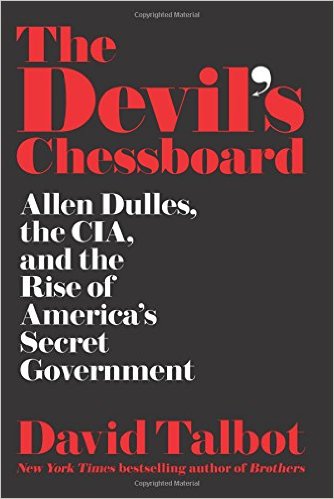
This is the first of a three-part series of excerpts, from Chapter 15 (“Contempt”) of The Devil’s Chessboard: Allen Dulles, the CIA, and the Rise of the American Secret Government. by David Talbot, HarperCollins Publishers, 2015.

PLOTS, PANIC, AND RUMORS OF CIA INVOLVEMENT

It was Cuba that created the first fracture between Kennedy and his national security chain of command. But while the Bay of Pigs was still dominating the front pages, the CIA mucked its way into another international crisis that required the president’s urgent attention. The Cuba invasion has all but erased this second crisis from history. But the strange events that occurred in Paris in April 1961 reinforced the disturbing feeling that President Kennedy was not in control of his own government.

Paris was in turmoil. At dawn on Saturday morning, April 22, a group of retired French generals had seized power in Algiers to block President Charles de Gaulle from settling the long, bloody war for Algerian independence. Rumors quickly spread that the coup plotters were coming next for de Gaulle himself, and that the skies over Paris would soon be filled with battle-hardened paratroopers and French Foreign Legionnaires from Algeria. Gripped by the dying convulsions of its colonial reign, France braced for a calamitous showdown.

After de Gaulle was elected president in 1958, he sought to purge the French government of its CIA-connected elements. Dulles had made heavy inroads into France’s political, cultural, and intelligence circles in the postwar years.

The threat to French democracy was actually even more immediate than feared. On Saturday evening, two units of paratroopers totaling over two thousand men huddled in the Forest of Orleans and the Forest of Rambouillet, not much more than an hour outside Paris. The rebellious paratroopers were poised for the final command to join up with tank units from Rambouillet and converge on the capital, with the aim of seizing the Élysée Palace and other key government posts.

By Sunday, panic was sweeping through Paris. All air traffic was halted over the area, the Metro was shut down, and cinemas were dark. Only the cafés remained open, where Parisians crowded anxiously to swap the latest gossip.

Continue reading

Western values: French troops rape and sexually abuse children

 “The regular sex abuse by peacekeeping personnel uncovered here and the United Nations’ appalling disregard for victims are stomach-turning, but the awful truth is that this isn’t uncommon. The UN’s instinctive response to sexual violence in its ranks – ignore, deny, cover up, dissemble – must be subjected to a truly independent commission of inquiry with total access, top to bottom, and full subpoena power.” — Paula Donovan, co-director of Aids Free World

From the Guardian, April 29, 2015
Sandra Laville

A senior United Nations aid worker has been suspended for disclosing to prosecutors an internal report on the sexual abuse of children by French peacekeeping troops in the Central African Republic.

Sources close to the case said Anders Kompass passed the document to the French authorities because of the UN’s failure to take action to stop the abuse. The report documented the sexual exploitation of children as young as nine by French troops stationed in the country as part of international peacekeeping efforts.

Kompass, who is based in Geneva, was suspended from his post as director of field operations last week and accused of leaking a confidential UN report and breaching protocols. He is under investigation by the UN office for internal oversight service (OIOS) amid warnings from a senior official that access to his case must be “severely restricted”. He faces dismissal.

The treatment of the aid worker, who has been involved in humanitarian work for more than 30 years, has taken place with the knowledge of senior UN officials, including Zeid Ra’ad Al Hussein, the high commissioner for human rights, and Susanna Malcorra, chef de cabinet in the UN, according to documents relating to the case.

Related: France’s poisoned legacy in the Central African Republic The abuses took place in 2014 when the UN mission in the country, Minusca, was in the process of being set up.

The Guardian has been passed the internal report on the sexual exploitation by Paula Donovan, of the advocacy group Aids Free World, who is demanding an independent commission inquiry into the UN’s handling of sexual abuse by peacekeepers.

It was commissioned by the UN office of the high commissioner for human rights after reports on the ground that children, who are among the tens of thousands displaced by the fighting, were being sexually abused.

Entitled Sexual Abuse on Children by International Armed Forces and stamped “confidential” on every page, the report details the rape and sodomy of starving and homeless young boys by French peacekeeping troops who were supposed to be protecting them at a centre for internally displaced people in Bangui, capital of the CAR.

Donovan, the co-director of Aids Free World. said: “The regular sex abuse by peacekeeping personnel uncovered here and the United Nations’ appalling disregard for victims are stomach-turning, but the awful truth is that this isn’t uncommon. The UN’s instinctive response to sexual violence in its ranks – ignore, deny, cover up, dissemble – must be subjected to a truly independent commission of inquiry with total access, top to bottom, and full subpoena power.”

The UN has faced several scandals in the past relating to its failure to act over paedophile rings operating in the Democratic Republic of Congo, Kosovo and Bosnia. It has also faced allegations of sexual misconduct by its troops in Haiti, Burundi and Liberia.

The treatment of Kompass, a Swedish national, threatens to spark a major diplomatic row.

This month, the Swedish ambassador to the United Nations warned senior UN officials “it would not be a good thing if the high commissioner for human rights forced” Kompass to resign. The ambassador threatened to go public if that happened and to engage in a potentially ugly and harmful debate.

The abuses detailed in the internal report took place before and after Minusca was set up last year. Interviews with the abused children were carried out between May and June last year by a member of staff from the office for the high commissioner of human rights and a Unicef specialist. The children identified represent just a snapshot of the numbers potentially being abused.

Related: Sex abuse poses ‘significant risk’ to UN peacekeeping, says leaked report The boys, some of whom were orphans, disclosed sexual exploitation, including rape and sodomy, between December 2013 and June 2014 by French troops at a centre for internally displaced people at M’Poko airport in the capital Bangui.

The children described how they were sexually exploited in return for food and money. One 11-year-old boy said he was abused when he went out looking for food. A nine-year-old described being sexually abused with his friend by two French soldiers at the IDP camp when they went to a checkpoint to look for something to eat.

The child described how the soldiers forced him and his friend to carry out a sex act. The report describes how distressed the child was when disclosing the abuse and how he fled the camp in terror after the assault. Some of the children were able to give good descriptions of the soldiers involved.

In summer 2014, the report was passed to officials within the office for the high commission of human rights in Geneva. When nothing happened, Kompass sent the report to the French authorities and they visited Bangui and began an investigation.

It is understood a more senior official was made aware of Kompass’s actions and raised no objections. But last month Kompass was called in and accused of breaching UN protocols by leaking details of a confidential report, according to sources.

Kompass’s emails have been seized as part of the investigation into the alleged leak. One senior UN official has said of Kompass that “it was his duty to know and comply” with UN protocols on confidential documents.

Bea Edwards, of the Government Accountability Project, an international charity that supports whistleblowers, condemned the UN for its witch-hunt against a whistleblower who had acted to stop the abuse of children.

“We have represented many whistleblowers in the UN system over the years and in general the more serious the disclosure they make the more ferocious the retaliation,” said Edwards. ”Despite the official rhetoric, there is very little commitment at the top of the organisation to protect whistleblowers and a strong tendency to politicise every issue no matter how urgent.”

UN sources confirmed an investigation by the French was ongoing – in cooperation with the UN – into allegations of a very serious nature against peacekeepers in the Central African Republic.

A spokesman for the UN Office of the High Commissioner for Human Rights confirmed an investigation was under way into the leaking of confidential information by a staff member.

http://www.theguardian.com/world/2015/apr/29/un-aid-worker-suspended-leaking-report-child-abuse-french-troops-car

Also:

http://rt.com/news/254205-french-soldiers-abuse-boys/

What are Germany and France doing about Minsk 2 violations? — Sample action letter

Germany and France are guarantors of Minsk 2. Ukraine is violating Minsk 2. Where are the protests by these two countries?

If you oppose what Ukraine is doing, contact the ambassadors for Germany and France in your country, as well as the consulate located in your nearest city.

Here is a letter written to the French Ambassador to the United States Gérard Araud.

—————————————————————

Dear Ambassador Araud:

Ukraine is in gross violation of the Minsk 2 agreement. France is a guarantor of Minsk 2. I urge you and the government of France to take aggressive action now to condemn these violations and the related actions by the United States

The Minsk 2 agreement requires that all foreign military personnel be removed from the country.

  • Pullout of all foreign armed formations, military equipment, and also mercenaries from the territory of Ukraine under OSCE supervision

However, the United States, with President Poroshenko’s support, is moving US military personnel into Ukraine and weaponry for constant NATO exercises starting this week. The Verkhovna Rada is considering a bill legalizing this – in complete defiance of Minsk 2.

There is also the question of whether Kiev has pulled its heavy weaponry from the line of contact, as required by the agreement. In addition, there are continuing violations of the ceasefire by Kiev forces.

The Kiev government and its forces are engaged in genocide and war crimes against Ukrainian citizens. The people of East Ukraine are acting in self-defense. The French government has not recognized that.

As France well knows, there is no Russian aggression against Ukraine; there is no Russian invasion. However, there has been constant aggression by the U.S. in Ukraine for years. This culminated in the Maidan violence and overthrow of President Yanukovich and the ongoing support for the present violence and ethnic genocide against the Ukrainian people. The French people experienced this same violence in the assassination attempts on President De Gaulle traced to NATO, the United States Defense Intelligence Agency, and the FBI.[1]

France must take aggressive action now against these violations of Minsk 2 to stop a European war that could easily turn nuclear.


[1]  http://www.globalresearch.ca/the-lessons-of-history-in-1966-president-de-gaulle-said-no-to-us-nato/5386501