U.S. “unofficially” waging war on Russia without a formal declaration of war

By Stephen Lendman
Global Research, December 12, 2015

Washington’s undeclared war on Russia (and China) is the greatest threat to world peace, risking the unthinkable – possible nuclear war.

Both countries stand in the way of unchallenged US global dominance – allied with NATO partners (mainly Britain, France, Germany and Turkey), Israel and the  Middle East regimes led by Saudi Arabia, a metastasizing cancer masquerading as a nation-state.

Two major flashpoint areas risk igniting global war – Ukraine and Syria.

Washington transformed Kiev into a de facto Neo-Nazi regime  (for the first time in Europe since WW II) – used as a dagger targeting Russia’s heartland, along with other Eastern European countries close to its border.

Preserving Syrian sovereign independence is the lynchpin of preventing Iran’s isolation and the entire region from becoming a US/Israeli colony, partnered with ruling Saudi tyrants using ISIS and other terrorist groups partnered with Washington to ravage Syria, Iraq and Yemen, ahead of what increasingly looks like an inevitable US/Russia clash.

On December 15, John Kerry will meet with Vladimir Putin and Sergey Lavrov in Moscow. Ongoing conflicts in Syria and Ukraine will be discussed – both countries at odds on resolving them.

Russia’s supports nation-state sovereignty, America wants all independent governments replaced by pro-Western ones it controls – using ISIS and other terrorist groups to achieve its objectives.

Next week’s meeting between US and Russian officials will resolve nothing, not as long as Washington’s hegemonic aims remain unchanged.

Russia’s Foreign Ministry called US/Moscow relations “difficult,” citing Washington’s “confrontational steps…under the pretext of the Ukrainian crisis.” They negatively “impacted cooperation between (both) countries.”

US support for ISIS and other terrorist groups in Syria, Iraq and elsewhere further exacerbated relations. Nothing in prospect suggests positive change.

“…Russia has been consistently stressing the necessity to observe the principles of equality, mutual respect and non-interference into (the) domestic affairs” of all nations, its Foreign Ministry said.

Moscow’s hope for better US/Russian relations furthered by Kerry’s upcoming visit is more pipe dream than reality.

Kerry heads to Moscow after a planned December 14 meeting in Paris with European and Arab foreign ministers. They’ll discuss ongoing Middle East conflicts, plotting strategy to continue them and ways to subvert Russia’s war on terrorism.

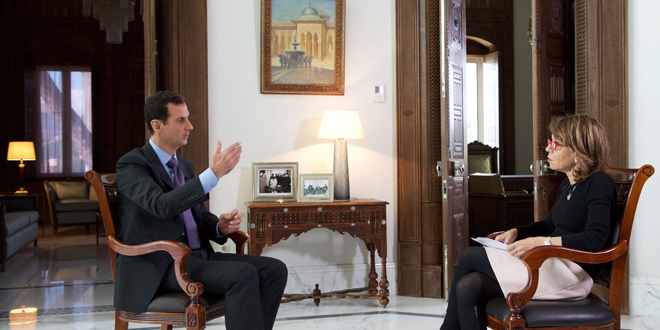
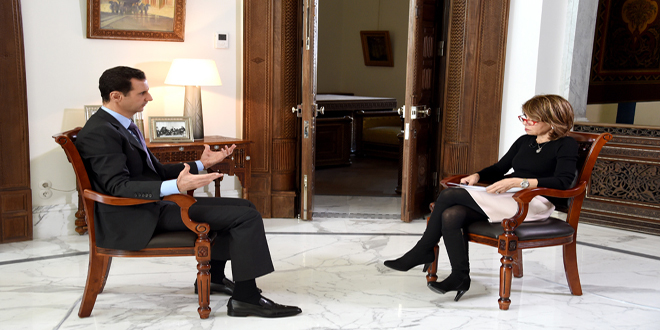
Separately, interviewed by Spanish EFE news on Friday, Bashar al-Assad stressed Washington, its NATO partners and regional allies aren’t serious about fighting terrorism. They’re the problem, not the solution.

Russia’s intervention alone achieved progress, Washington trying to subvert it. The struggle for Syria’s soul continues, along with Putin’s efforts to save humanity from the scourge of another global war. He deserves universal support against US-led pure evil.

Stephen Lendman lives in Chicago. He can be reached at lendmanstephen@sbcglobal.net.

His new book as editor and contributor is titled “Flashpoint in Ukraine: US Drive for Hegemony Risks WW III.”

http://www.claritypress.com/LendmanIII.html

Visit his blog site at sjlendman.blogspot.com.

Listen to cutting-edge discussions with distinguished guests on the Progressive Radio News Hour on the Progressive Radio Network.

It airs three times weekly: live on Sundays at 1PM Central time plus two prerecorded archived programs.

The original source of this article is Global Research

Copyright © Stephen Lendman, Global Research, 2015

http://www.globalresearch.ca/us-unofficially-waging-war-on-russia-without-a-formal-declaration-of-war/5495340


Kiev ready to support US-led coalition in Syria, as VP Biden promises $190 million to Kiev

From RT, 12-8-15

Ukraine is ready to support the US-led forces fighting Islamic State militants (former ISIS, ISIL) in Syria, Ukrainian President Petro Poroshenko told media in Kiev on Monday. “I have already confirmed to [US Vice President Joe] Biden that Ukraine is ready to show maximum support to coalition forces in Syria,” he said. On Monday, Biden arrived in Kiev for a two-day visit and talks with Poroshenko. Following their meeting in Kiev, Biden urged Ukraine to work on reforms and announced new financial aid of $190 million.

https://www.rt.com/news/line/

US-NATO ground forces, escalation in Syria leading to global war

Global Research, December 05, 2015
turkey-syria

The recent developments show significant changes in the strategy of the Western countries involved in the Syrian conflict. The US has sent ground forces, including special operations units, into the region. French Air Force has sharply increased the number of sorties, and France’s rapid-reaction troops and naval units are being moved closer to Syria.

The United Kingdom has also begun to participate in the US-led anti-ISIS coalition strikes on Syrian soil. Likewise Germany has begun to deploy its aircraft and relocating almost 1200 quick-reaction troops to the Syria-Iraq battlefield. Turkey is deploying a large military attack force, including a number of armored units, at the border with Syria. It seems that NATO powers have realized the strategy aimed at Assad’s ouster by a diverse range of militant groups including ISIS which is backed by Turkey and the US has failed.

According to the initial scenario implemented by the West, ISIS and other militant groups, deceitfully called the moderate opposition, were to carry out a Libya-like scenario in Syria and oust or preferably kill Assad and plunge the whole country into chaos. Then the US-led coalition would start a full-scale military operation to stop the terrorists threatening the “moderate opposition” in Syria, deploy NATO forces on the ground and take control of the crucial oil and logistic infrastructure. Western oil corporations supported by NATO would then restore the state of affairs as it existed more than 40 years ago. Syria would fall victim to total exploitation by overseas powers. The Mediterranean would become Alliance’ internal lake.

Now it’s clear that Syria won’t fall under terrorist group pressure. The Syrian forces backed by Russia and Iran are gaining momentum, recapturing cities and facilities earlier controlled by militants. The NATO allies urgently need a new plan to hold control at least of the northern oil corridor from Iraq and try to take advantage of this opportunity to involve Russia in a long expensive war, in other words, to accomplish that which they failed to do in Ukraine. It means that the NATO contingent must occupy crucial infrastructure including oilfields before the Syrian government forces liberate it. Anti-government, meaning anti-Russian and anti-Iranian, forces would be established in parts of divided Syria. The need for an excuse to implement the changed approach could be the reason why the Nov.13 Paris attack wasn’t prevented by the Western special services.

The implication of the Western plan to divide Syria in a number of vassal entities leads to 3 main scenarios:

1)   Military buildup and escalation in the region could lead to open military conflict between NATO and the alternative anti-ISIS coalition that is led by Russia. This regional conflict could easily lead to a global war. Moreover, Turkey, a NATO member state, has already shown that it’s ready to escalate the situation to defend its illegal oil business linked with ISIS.

2)    If the Syrian Arab Army with support by militia forces, Iran, and Russia isn’t able to show a significant success on the battlefield, Syria could be easily divided by the Western-backed ground forces supported by NATO airpower and intelligence assets. A direct military intervention to take control of the oil structure and crucial logistical points also remains possible. Even if NATO and its regional allies successfully take control of a significant part of the country, this escalation is unlikely to be avoided. The situation will become more acute due to the establishment of an aggressive puppet regime on the Syria’s territory. Considering that the alternative anti-ISIS coalition won’t lay down its arms, an open conflict could be easily provoked by the interested powers.

3)   If the Syrian government forces supported by Russia and Iran take control of the country’s key areas, the US-led coalition will face the fact that Syria is de-facto liberated from terrorist groups. It could prevent a direct military intervention by NATO. In this case, the NATO countries would strengthen their presence in Iraq and use it as a foothold to launch further destructive actions against Syria. However, it’s the safest scenario most likely to avoid a global escalation.

Interview with Syrian President Bashar al-Assad; “Britain and France were the spearheads in supporting the terrorists in Syria”

Global Research, December 06, 2015
SANA News 6 December 2015

Damascus – President Bashar al-Assad gave an interview to The Sunday Times in which he said Britain and France have neither the will nor the vision on how to defeat terrorism and their airstrikes against ISIS will yield no results, but will rather be illegal and harmful in that they will help in spreading terrorism.

The following is the full text of the interview:

 Question 1:  Thank you for seeing us Mr President.  As you know, the British government today will be voting on whether it will join the coalition airstrikes against ISIS. Is Britain right to join airstrikes against ISIS in Syria? And do you welcome its involvement; and will it make things worse or not make a change?

President Assad:  If I want to let’s say, evaluate a book, I cannot take or single out a phrase from that book to evaluate the whole book.  I have to look at the headlines, then the titles of the chapters and then we can discuss the rest of the book.  So, what we are talking about is only an isolated phrase.  If we want to go back to the headline, it is “the will to fight terrorism.”  We know from the very beginning that Britain and France were the spearheads in supporting the terrorists in Syria, from the very beginning of the conflict.  We know that they don’t have that will, even if we want to go back to the chapter on military participation with the coalition, it has to be comprehensive, it has to be from the air, from the ground, to have cooperation with the troops on the ground, the national troops for the interference or participation to be legal.  It is legal only when the participation is in cooperation with the legitimate government in Syria.  So, I would say they don’t have the will and they don’t have the vision on how to defeat terrorism.

And if you want to evaluate, let’s evaluate from the facts.  Let’s go back to the reality on the ground.  Since that coalition started its operation a year or so, what was the result? ISIS and al-Nusra and other like-minded organizations or groups, were expanding, expanding freely.  What was the situation after the Russians participated in fighting terrorism directly?  ISIS and al-Nusra started shrinking.  So I would say, first they will not give any results.  Second, it will be harmful and illegal, and it will support terrorism as what happened after the coalition started its operation a year or so, because this is like a cancer.  You cannot cut the cancer.  You have to extract it.  This kind of operation is like cutting the cancer that will make it spread in the body faster.

Question 2:  Are you saying, just to clarify two things, are you saying that the British, if the British join the intervention, that includes also the other coalition, with that intervention you see that is illegitimate from an international-law perspective?

President Assad:  Definitely, definitely, we are a sovereign country.  Look at the Russians, when they wanted to make this alliance against terrorism, the first thing they did was they started discussions with the Syrian government before anyone else.  Then they started discussing the same issue with other governments.  Then they came.  So, this is the legal way to combat any terrorist around the world.

Britain and France helped in the rise of ISIS and al-Nusra in this region

Question 3:  You say that France and Britain are responsible for the rise of terrorism here. But they were not responsible for the rise of ISIS, for example, is not that a little bit a harsh accusation?

President Assad: Let’s start from what Blair said.  He said that invading Iraq led to the rise of ISIS.  And we know that ISIS started publically, announcing itself as a state in Iraq in 2006, and the leader was Abu Mosaab al-Zerqawi.  He was killed by American strikes; and they announced that they killed him.  So, they know he existed and they know that IS in Iraq at that time had existed; and that it moved to Syria after the beginning of conflict in Syria because of the chaos that happened.  So, they confess.  British officials confessed, mainly Blair; and the reality is telling, that they helped in the rise of ISIS and al-Nusra in this region.

President al-Assad-Sunday Times-interview 3

Question 4:  In your view, does al-Qaida’s branch in Syria, Jabhat al-Nusra, pose an equal or a greater long-term threat to the West than ISIS? And as such, is Britain’s Prime Minister, Cameron, going after the wrong enemy? I.e. he is going after ISIS instead of going after al-Nusra.

President Assad: The whole question is about the structure, and the problem is not about the structure of the organization.  It is about their ideology.  They do not base their actions on the structure, they base them on their dark, Wahhabi deviated ideology.  So, if we want to evaluate these two, the difference between the two, there is no difference because they have the same ideology.  This is one aspect.  The other aspect, if we want to talk about their grassroots, their followers, their members, you cannot have this distinction, because they move from one organization or one group to another.  And that is why sometimes they fight with each other, for their vested interests, on a local and small scale.  But in reality they are cooperating with each other on every level.  So, you cannot tell which is more dangerous because this is one mentality.  It is like if you say the first one is al-Qaida and the second one is al-Qaida.  The difference is the label, and maybe some other trivial things.

Question 5:  Last week, a key part of Cameron’s argument for extending UK airstrikes to Syria was a number that he used – 70 thousand moderate rebels – that he mentioned “don’t belong to extremist groups”, but are already on the ground, who the west can use to help them in the fight of ISIS. As far as you know, which groups are included in the 70 thousand? Are you aware of 70 thousand moderate rebels in Syria?

President Assad: Let me be frank and blunt about this.  This is a new episode in a long series of David Cameron’s classical farce, to be very frank.  This is not acceptable.  Where are they?  Where are the 70 thousand moderates that he is talking about?  That is what they always talk about: moderate groups in Syria.  This is a farce based on offering the public factoids instead of facts.

The Russians have been asking, since the beginning of their participation two months ago.  They have said: where are those moderates?  No one gave them an answer.  Actually, since the beginning of the conflict in Syria, there were no moderate militants in Syria.  All of them were extremists.  And in order not to say I am just giving excuses and so on, go back to the internet, go back to the social networking sites.  They uploaded their atrocities’ videos and pictures, with their faces and their rhetoric.  They use swords, they do beheadings; they ate the heart of a dismembered innocent person and so on.

And you know, the confession of a criminal is the incontrovertible fact.  So, those are the 70 thousand moderates he is taking about.  It is like if we describe the terrorists who committed the attack in Paris recently, and before that in Charlie Hebdo, and before that in the UK nearly ten years ago, and in Spain before that, and the 11th of September in New York, to describe them as moderate opposition.  That is not accepted anywhere in this world; and there is no 70 thousand, there is no 7 thousand, he does not have, maybe now ten of those.

Question 6:  Not even the Kurds and the FSA for example, the free Syrian army?

President Assad: The Kurds are fighting the terrorists with the Syrian army, in the same areas.

Question 7:  But they are also being supported and armed and trained and backed by the Americans to also launch, to fight …

President Assad:  Mainly by the Syrian army, and we have the documents.  We sent them armaments, because they are Syrian citizens, and they want to fight terrorism.  We do the same with many other groups in Syria, because you cannot send the army to every part of Syria.  So, it is not only the Kurds.  Many other Syrians are doing the same.

Question 8: U.S. Secretary of state John Kerry said last Friday that the Syrian government could cooperate with the opposition forces against the ISIS even if president Assad is still in office, but he said that this would be so difficult if the opposition fighters, who have been fighting the Syrian president, don’t have a faith that the Syrian president will eventually leave power.

Kerry also said that concerning the timing of leaving office, the answer is it is not obvious whether he will have to leave.

Meanwhile, the French Foreign Minister Laurent Fabius told Le Progres Newspaper on Saturday that he no longer believes that President Assad’s departure is essential to any political transition in Syria, adding that the political transition does not mean that President Assad should step down before it but there should be future insurances.

My question: Do you intend to complete your presidential term until 2021 or do you expect a referendum or presidential elections prior to that date? And if so, when can these elections be held? And what can make you decide to hold them? And if they are held, is it certain that you will be running for election? What can influence your decision?

President Assad: The answer depends on the context of the question. If it is related to a settlement in Syria, then early elections have nothing to do with ending the conflict. This can only happen by fighting terrorists and ceasing Western and regional support for terrorists…Early elections will only be held as part of a comprehensive dialogue about future by the political powers and the civil society groups in Syria.

Thus, it is not about the will of the President, but rather the will of the Syrian people…It is about a political process. If this process is agreed on, then I have the right to run for elections like any other Syrian citizen…My decision in this case will be based on my ability to deliver on my commitments…and on whether I have the support of the Syrian people or not….Anyway, It is early to talk about this, because as you know, this process was not agreed upon yet.

President al-Assad-Sunday Times-interview 2

Question 9:   Do you think ISIS can be defeated by airstrikes alone?

You cannot defeat ISIS through airstrikes alone without cooperation with forces on the ground

President Assad:  Did the coalition defeat them by airstrikes during the last year or so?  It didn’t.  Did the Americans achieve anything from the airstrikes in Afghanistan?  They achieved nothing.  Did they achieve anything in Iraq since the invasion in 2003?  Nothing.  You cannot defeat ISIS through airstrikes alone, without cooperation with forces on the ground.  You cannot defeat them if you do not have buy-in from the general public and the government.  They cannot defeat ISIS by airstrikes; they are going to fail again.  The reality is telling.

Question 10:     If the international coalition refuses, as it has so far, to coordinate with the Syrian Army, or with the local troops on the ground, what is your next plan?  I mean do you have a plan B beyond what is going on?  How do you plan to end this war?

President Assad:  This coalition is illusive, it’s virtual, because it has not made any achievements in fighting terrorism on the ground in Syria.  Since an illusion doesn’t exist, let’s not waste time with the ‘before and after.’  From the very beginning we started fighting terrorism irrespective of any global or world powers.  Whoever wants to join us is welcome, and whether they join us or not, we are going to continue.  This is our plan. It is the only plan we have and we will not change it.

Question 11:  Are you calling on them to ask the Syrian government to coordinate and cooperate with the Syrian army and the Syrian air force in the fight against terrorists?

President Assad:  We are very realistic.  We know that they are not going to do so and that they don’t have the will.  This is more about international law than anything else.  Is it possible that western governments, or regimes, don’t know the basics of international law, that they don’t understand the meaning of a sovereign state or that they haven’t read the UN Charter?  They have no respect for international law and we didn’t ask for their cooperation.

Question 12:  But would you like them to?

President Assad:  If they are ready – serious and genuine – to fight terrorism, we welcome any country or government, any political effort.  In that regard we are not radical, we are pragmatic.  Ultimately, we want to resolve the situation in Syria and prevent further bloodshed.  That is our mission.  So, it’s not about love or hate, accepting or not, it is about reality.  Are they truly ready to help us fight terrorism, to stop terrorists coming into Syria through their surrogate governments in our region, or not?  That is the real question.  If they are ready, we will welcome them.  This is not personal.

Question 13:  Do you think it is possible for you, in Syria, and for your allies – Russia, Iran, Hezbollah and other allies – to defeat ISIS militarily; and if so, how long do you think it might take?

President Assad:  The answer is based on two factors: our capabilities on the one hand, and the support the terrorists receive on the other.  From our perspective, if you were to remove the support these groups get from various countries in our region and the West in general, it will take a matter of months to achieve our mission.  It is not very complicated, the solution is very clear to usHowever, these groups have unlimited support from these countries, which makes the situation drag on, makes it more complicated and harder to resolve.  This means our mission will be achieved at a much higher price, which will ultimately be paid by Syrians.

Question 14:  But there has already been a high price: over 200,000 people have been killed.

President Assad:  You are right, and that is a consequence of the support I referred to.

Question 15:  But a lot of it is also blamed on the Syrian government and the Syrian use of force, sometimes indiscriminate or unnecessary force in certain areas that has brought about a large number of people killed.  How do you respond to that?

President Assad:  First, all wars are bad.  There is no such thing as a good war.  In every war there are always too many innocent casualties.  These are only avoidable by bringing that war to an end.  So it is self-evident that wars anywhere in the world will result in loss of life.  But the rhetoric that has been repeated in the West for a long time ignores the fact that from day one terrorists were killing innocent people, it also ignores that fact that many of the people killed were supporters of the government and not vice versa.  As a government, our only countermeasure against terrorists is to fight them.  There is no other choice.  We cannot stop fighting the terrorists who kill civilians for fear of being accused by the West of using force.

Question 16: Let us talk about the role of Russia.  How important has the role of Russia been?  Was Syria about to fall had Russia not intervened when it did at the time?

Russia and Iran’s support played important part in Syria’s steadfastness against terrorism

President Assad: The Russian role is very important.  It has had a significant impact on both the military and political arena in Syria.  But to say that without this role, the government or the state would have collapsed, is hypothetical.  Since the very beginning of the conflict in Syria, there were bets on the collapse of the government.  First it was a few weeks, then it was a few months and then a few years.  Every time it was the same wishful thinking.  What is definite is that the Russian support to the Syrian people and government from the very beginning, along with the strong and staunch support of Iran, has played a very important part in the steadfastness of the Syrian state in the fight against terrorism.

Question 17: You mean the previous one, or the recent military intervention?

President Assad:  No, the whole support; it is not only about their participation.  Their support from the very beginning in all aspects: political, military and economic.

Question 18: How and why did Russian involvement come about now?  And can you give us some details of the discussions between you and President Putin that brought it about?  Who took the first step?  Did you ask, or did they offer?

The Russians want to protect Syria, Iraq, the region, themselves and even Europe

President Assad:  You will have to ask the Russians why they got involved.  But from our perspective, since the Western coalition started in Syria, ISIS has expanded, al-Nusra has expanded and every other extremist and terrorist group has expanded and captured new territory in Syria and Iraq.  The Russians clearly saw how this posed a threat to Syria, Iraq and the region in general, as well as to Russia and the rest of the world.  We can see this as a reality in Europe today.  If you read and analyse what happened in Paris recently and at Charlie Hebdo, rather than view them as separate incidences, you will realize something very important.  How many extremists cells now exist in Europe?  How many extremists did you export from Europe to Syria?  This is where the danger lies.  The danger is in the incubator.  The Russians can see this very clearly.  They want to protect Syria, Iraq, the region, themselves and even Europe.  I am not exaggerating by saying they are protecting Europe today.

Question 19: So, did they come to you and say we would like to be involved? Or did you ask them: could you help us?

President Assad:  It was an accumulative decision; it didn’t happen by me having this idea or them having another.  As you know, our relationship with the Russians goes back more than five decades, and they have always had military staff in Syria: call them experts or by any other name.  This cooperation accelerated and increased during the crisis.  Their teams are here and can see the situation real-time with us.  This kind of decision doesn’t start from the top down, but rather from the bottom up.  There is a daily political and military discussion between our two countries.  When it reached a presidential level, it was mature enough and ready for the decision to be made quickly.

Question 20: But there must have been a point when they said: we think, or with your agreement, we think that we should actually now physically get involved.

President Assad: Again, this was started at the lower levels.  These officials jointly agreed that it was necessary to get involved and each party discussed it with their leaders.  When it reached the stage of discussion between us, I mean between President Putin and I, we focused our discussions on the how.  Of course this did not happen directly as we had not yet met and it’s impossible to discuss these issues on the phone.   It was mediated through senior officials from both sides.  That is what happened.  In terms of procedure, I sent a letter to President Putin which included an invitation for their forces to participate.

Question 21:  So you asked president Putin having been advised by your officials.

President Assad:  Exactly, after we reached that point I sent President Putin a formal letter and we released a statement announcing that we had invited them to join our efforts.  Let’s not forget that President Putin had already taken the step when he said he was willing to create a coalition.  My response to this was that we are ready if you want to bring your forces to participate.

Question 22:  So, what forces have been deployed? I am talking about Russian forces. There have been reports, for example, of a thousand ground troops plus Special Forces, is this correct? Is there anytime when you think that the Russians will be involved in Syria, not just by air but with ground troops as well?

President Assad:  No, so far there is no such thing.  There are no ground troops except for the personnel that they send with their military staff and airplanes to guard the airbase, and that is natural.  They don’t have any ground troops fighting with Syrian forces at all.

Question 23:  And there is no plan for that?

President Assad:  We have not discussed that yet, and I don’t think we need it now, because things are moving in the right direction.  The Russians may consider it with time or under different circumstances, but for the moment, this has not been discussed.

Question 24: There was a report, or a hint, that Syria might be receiving S-300 from the Russians, and the S-300 will allow Syria to protect its airspace. Is this something, for example, that Syria will use against the US-led coalition’s air force, even if Britain was involved, since their warplanes are in Syrian skies, as you said earlier, without official or sovereign permission. As Syria will receive S-300, then will it use this to impose, if you want, protection of its skies and impose a way to tell the coalition that you have to actually directly deal with us, or coordinate with us on the ground?

We will use any means available to us to protect our airspace

President Assad:  That is our right and it is only to be expected that we prevent any airplane from violating our airspace.  That is completely legal.  We are going to use any means available to us to protect our airspace.  It is not about that armament in particular.  Any air defense we have is for that reason.

Question 25:  Do you have that defense at the moment?

President Assad:  No. So far we don’t have it.

Question 26:  If you get that defense?

President Assad:  Any defense systems we are going to have are for that purpose.  If we are not going to protect our airspace, then why buy such armaments in the first place?  That is self-evident.

Question 27:  And if you get it …

President Assad: Not at the moment; it is not our priority now.  Our priority is fighting the terrorists on the ground.  This is the most important danger now.  Of course we are keen to protect our airspace and prevent foreign interference in our internal affairs, militarily or other.  But the priority now is to defeat the terrorists.  By defeating the terrorists, some of whom are Syrians, we can move further in protecting the whole country from foreigners.  It is a matter of priorities.

Question 28:  But I meant about the actual coalition airplanes that are actually flying over Syria. So, that is not a priority either at the moment?

President Assad:  No, not at the moment.  At the moment the priority is fighting terrorism.

Question 29:  If Saudi Arabia were to invite you for serious discussions on the future of Syria, would you accept such an invitation? Or have relations between Syria and Saudi Arabia been severely severed that you would never consider that?

President Assad:  No, there is nothing impossible in politics.  It is not about whether I accept or not, but rather about the policies of each government.  What are their policies towards Syria? Are they going to keep supporting the terrorists or not? Are they going to continue playing their dangerous games in Syria, Yemen and other places?  If they are ready and willing to change their policies, especially with regard to Syria, we don’t have a problem meeting with them.  So it is not about the meeting or whether we go or not, the issue is their approach to what is happening in Syria.

Question 30:  Do you expect any results from the talks in Vienna?  And what would be the shape of any possible deal that you see coming out of Vienna?

President Assad:  The most important clause in the Vienna communique is that the Syrians should come together to discuss the future of Syria.  Everything else is an accessory.  If you don’t have that main part, the accessories are of no use.  So, the only solution is for us to come together as Syrians.  Vienna itself is a meeting to announce intentions; it is not the actual process of siting down and discussing the future.  So, the question is not what results from Vienna, but rather what we Syrians are able to achieve when we sit down together.

Question 31:  But do you realize that some of the opposition’s leaders, and I’m talking about opposition figures who have been against taking up arms and what have you, but are also afraid of coming to Syria, because the moment they land in Syria, they will be arrested by the security officers and put in prison. And it has happened to others.

President Assad:  No, it has never happened.  There is an opposition in Syria, and they are free to do whatever they want.

Question 32:  No, I mean the external opposition. For example, somebody like Haitham Mannaa, cannot come back.

President Assad:  We have clearly stated that when there is a gathering in Syria, which they want to attend, we guarantee that they will not be arrested or held.  We have said this many times.  We don’t have any problems in this regard.

President al-Assad-Sunday Times-interview 1

Question 33:  Now, Saudi Arabia invited 65 figures, including opposition leaders, even rebel commanders, businessmen, religious figures for a meeting in Saudi Arabia to present a united front in preparation for the January Vienna talks. Yet, the Syrian government, which is the other major element in this whole thing for the future of Syria, has not been seen to be involved with the opposition. Are you conducting any talks with the opposition? Have you reached any consensus with them?

President Assad:  We have direct channels with some opposition groups; but others cannot communicate with us because they are not allowed to do so by the governments that control them.  From our perspective, we are open for discussions with every peaceful opposition party.  We don’t have any problems.  With regards to the meeting in Saudi Arabia, the Saudi’s have been supporting terrorism directly, publically and explicitly.  That meeting will not change anything on the ground.  Before the meeting and after the meeting Saudi Arabia has been supporting terrorists and will continue to do so.  It is not a benchmark or a critical juncture to discuss.  It will not change anything.

Question 34:  Do you see that anytime, in the future, that in order to protect Syria, or in order to save Syria, or to get the Syria process moving, that you might see yourself sitting with certain groups, one group, or certain groups, that perhaps now you deem terrorist, but in the future, it might be feasible that you would agree to negotiate with them because it would do well for the future?

President Assad:  We already have; since the very beginning one of the pillars of our policy, was to start a dialogue with all parties involved in the conflict, whether they were in Syria or not.  We negotiated with many terrorist groups, not organizations – to be very precise, who wanted to give up their armaments, and return to normal life.  These negotiations led to many amnesties being issued and has proven to be very successful in several areas.  Furthermore, some of these fighters have joined the Syrian Army and are now fighting with our forces.  So yes, we are sitting down with those who committed illegal acts in Syria, whether political or military, to negotiate settlements on the condition that they give up their arms and return to normal life.  This doesn’t mean that we negotiate with terrorist organizations like ISIS, al-Nusra and others. This is what I meant by groups, those who want out of the fight, regret their choices and want to have their lives back.

Question 35:  The rebels call them barrel bombs. You refuse to refer to them as barrel bombs. Irrespective of the name, these were indiscriminate. Do you accept that Syria used indiscriminate bombs in some areas, which resulted in the death of many civilians?

President Assad:  Let us suppose that this part of the propaganda is true, which it isn’t.  But for the sake of argument, let us ask the same question regarding the different attacks committed by the Americans and the British with their state-of-the-art airplanes and missiles in Afghanistan and in Iraq, not only after the invasion of Iraq in 2003, but also during the first Gulf war in 1990.  How many civilians and innocent people were killed by those airstrikes with these very high precision missiles?  They killed more civilians than terrorists.  So, the issue is not these so-called barrel bombs and this evil president killing the good people who are fighting for freedom.  This romantic image is not the case.  It is about how you use your armaments, rather than the difference between so called barrel bombs and high precision missiles.  It is about how you use these weapons, what kind of information you have and your intention.  Do we have the will to kill innocent people?  How is that possible when the state is defending them?  By doing so, we are pushing them towards the terrorists.  If we want to kill people, for any reason, innocent people or civilians, that will play directly into the hands of the terrorists.  And this is against our interests.  Are we going to shoot ourselves in the foot? That is not realistic and not logical.  This propaganda cannot be sold anymore.

Question 36: Mr President, the final question. As president of the country, and you always lead the military and everything. Do you, even if by default, not bear responsibility for some of the things that happened in Syria?

President Assad: I’ve been asked this question many times especially by western media and journalists.  The aim of the question is to corner me between two answers: if I were to say I was responsible, they would say look the President bears responsibility for everything that happened, if I were to say I am not responsible, they would say this is not true, you are the president, how can you not be responsible.

Question 37:  Because you are the head, like in a family …

President Assad:  Let me continue, that was only an introduction to my answer.  It is very simple.  Since the very beginning, we built our policy around two pillars, engaging in dialogue with everyone, and fighting terrorism everywhere in Syria.  Now, if you want to talk about the responsibility, you have to discuss many aspects of the conflict, and the reason why we are here today in this difficult and dire situation in Syria.  If I am to claim responsibility, do I also claim responsibility for asking the Qataris to pay the terrorists money?  Or for the Saudis to fund their activities?  Or for western governments allowing their terrorists to come to Syria?  Do I claim responsibility for asking western governments to offer a political umbrella to those terrorists and label them as moderates?  Or for the western embargos on the Syrian people?  This is how we have to discuss it.  We cannot simply say, that he takes responsibility or not.  We have to talk about every part; we have to differentiate between the policy decisions and the practices, between the strategy and the tactics.  So, it is very complicated to evaluate it.  Additionally, if you want to evaluate who bears responsibility in Syria, it could happen at the end of the war, when you can investigate the whole story before, during and after.

Interviewer:  Mr President, thank you very much.

Russian Air Force launches 431 sorties against terrorists’ sites Nov. 26 – Dec. 4

From Syrian Arab News Agency
December 4, 2015

Damascus, SANA-A military source said on Friday that 12 oil refineries, 8 oil and gas extraction sites and 2 convoys consisting of 40 oil tankers of ISIS which were moving towards Turkish lands were destroyed in the past eight days.

The source added that the Russian Air Force, in cooperation with Syrian Air Force, launched 431 sorties against 1458 of terrorists’ sites in Aleppo, Idleb, and the countryside of Lattakia, Hama, Homs, Deir Ezzor and Raqqa since the26th of November.

The source added that 185 command centers, 109 arms depots, 2 workshops which terrorists were using to manufacture explosive devices, 23 training camps, 232 defense sites with a number of technical points and 887 terrorists’ gatherings were destroyed in the sorties.

On Thursday, the Russian Air Force destroyed a large arms depot in Morek town in Hama countryside while in al-Latamina area many terrorists’ leaders were killed during concentrated airstrikes against their gatherings.

A fortified position and 2 vehicles equipped with heavy machineguns were destroyed during the Russian sorties in Lattakia in addition to killing a group of terrorists’ leaders in Lattakia countryside.

The source added that an ISIS command center was destroyed along with all terrorists’ leaders inside it in Khneifis area in the southern countryside of Tadmour city (Palmyra).

http://sana.sy/en/?p=63468

News media reports that Israel is the main purchaser of ISIS oil

Global Research, December 05, 2015
Russian Insider 3 December 2015

Multiple reports claim that Israel is the top purchaser of smuggled ISIS oil

ISIS oil is transported to Israel via Turkey, according to reports

Citing multiple sources, the Israeli business press are now reporting that Israel is the main recipient of ISIS oil:

Kurdish and Turkish smugglers are transporting oil from ISIS controlled territory in Syria and Iraq and selling it to Israel, according to several reports in the Arab and Russian media. An estimated 20,000-40,000 barrels of oil are produced daily in ISIS controlled territory generating $1-1.5 million daily profit for the terrorist organization.

The oil is extracted from Dir A-Zur in Syria and two fields in Iraq and transported to the Kurdish city of Zakhu in a triangle of land near the borders of Syria, Iraq and Turkey. Israeli and Turkish mediators come to the city and when prices are agreed, the oil is smuggled to the Turkish city of Silop marked as originating from Kurdish regions of Iraq and sold for $15-18 per barrel (WTI and Brent Crude currently sell for $41 and $45 per barrel) to the Israeli mediator, a man in his 50s with dual Greek-Israeli citizenship known as Dr. Farid. He transports the oil via several Turkish ports and then onto other ports, with Israel among the main destinations.

In August, the “Financial Times” reported that Israel obtained 75% of its oil supplies from Iraqi Kurdistan. More than a third of such exports go through the port of Ceyhan, which the FT describe as a “potential gateway for ISIS-smuggled crude.”

It’s been well-established that Turkey is a major transportation hub for ISIS oil smuggling operations. But where is the oil sent? Someone has to buy it. The answer, apparently, is: Israel.

Al-Araby published an extensive investigation which lays out in detail how oil is transported from ISIS-controlled wells to Israel via Turkey.

Iraqi PM denounces U.S. ground forces deployment on Iraq’s territory as “a hostile act”

From RT
December 4, 2015

Iraqi Prime Minister Haider al-Abadi © Kirill Kudryavtsev

Iraq has not requested that any country send ground troops into its territory and will regard any such move as a “hostile act,” the country’s prime minister, Haider Al-Abadi, said in view of a US decision to deploy special forces in the country.

Iraq “will consider any country sending ground combat forces a hostile act and will deal with it on this basis,” Al-Abadi said in a statement published by the prime minister’s office on Thursday, adding that “the Iraqi government is committed to not allowing the presence of any ground force on the land of Iraq.”

“The Iraqi government confirms its firm and categorical rejection of any action of this kind issued by any country [that] violates our [Iraq’s] national sovereignty,”Al-Abadi also said in the statement.

Baghdad “did not request any side… to send ground forces to Iraq,” he added, thus refuting reports that the Iraqi government had called for deployment of foreign troops to help Iraqi forces fight Islamic State (IS, formerly ISIS?ISIL).

Iraq does not need any foreign forces from any state or international coalition, it only needs weapons, ammunition and training from its partners and allies in the fight against IS, the prime minister’s statement says.

Al-Abadi’s statement comes after the US announced plans to dispatch special forces to Iraq to fight Islamic State, both in Iraq and northern Syria. On November 24, a US Combined Joint Task Force spokesman, Colonel Steve Warren, said that about 100 Expeditionary Targeting Force personnel would be sent to Iraq with some US senators proposing tripling that number, AFP reports.

Even though US President Barack Obama had repeatedly claimed that there would be no US “boots on the ground,” he eventually approved the deployment of Special Forces against IS.

It is still unclear how the Iraqi prime minister’s statement will affect US deployment plans, with US officials yet to comment.

In October, Iraq’s ruling coalition calling on the prime minister to request Russian air support in the fight against IS, criticizing the actions of the US-led coalition in Iraq.

“The largest bloc has sent a request to the prime minister to add further forces to the fight against terrorism and not only to rely on the United States and the international coalition, which has up till now been rather shy in its efforts to destroy [Islamic State] bases in Iraq,” Saad Al-Matlabi, a member of the country’s State of Law Coalition, told RT at that time.

“The public mood is definitely in favor of Russian involvement because it has been over a year and a half now and ISIS has flourished in Iraq under the American airstrikes. One could question the honesty and integrity of the US airstrikes,” the Iraqi politician added, stressing that Russian strikes in Syria “have proved quite efficient in destroying [Islamic State] bases …”

In earlier statements, Al-Abadi also claimed he would “welcome” Russian air support.

“If we get the offer, we’ll consider it. In actual fact, I would welcome it,” he said in an interview with France-24 TV on October 1, referring to potential Russian air strikes against IS on Iraqi territory.

Al-Abadi also accused the US-led coalition of a lack of support in that interview and also questioned the will of the West to defeat Islamic State.


https://www.rt.com/news/324782-iraq-troops-hostile-act/

RT article has tweets from Al-Abadi and RT.

US gives ISIS 45 minute warning before bombs, “runs out of ammo” against ISIS targets

See also NY Times article: http://www.nytimes.com/2015/11/17/world/middleeast/us-strikes-syria-oil.html?action=Click&contentCollection=BreakingNews&contentID=54598433&pgtype=article&_r=1

Global Research, December 04, 2015
Activist Post 2 December 2015
isis-oil-1024x575

Ever since the Russians began dropping real bombs on real ISIS targets in Syria, the United States and NATO have been forced to engage in a two-sided propaganda campaign that swears opposition to ISIS while simultaneously doing everything it can to facilitate and protect ISIS forces on the ground. It has also found itself in the bizarre position of trying to facilitate the death squad army while, at the same time, attempting to play catch-up to the Russians in at least the appearance of bombing ISIS.

Thus, when Russian forces truly hit at one of the sources of ISIS funding – the captured oil being shipped from Syria and Iraq to Turkey where it is purchased by Turkish Prime Minister Erdogan’s son, Bilal – the United States must then engage in its own faux bombing campaign against ISIS oil trucks.

Yet, instead of actually bombing the trucks – drivers and all – and putting them out of commission permanently, the U.S. bombing campaign takes the form of a laughable formality that involves a 45-minute warning to the oil convoys that a U.S. bombing campaign is about to take place. The warning involves an airdrop of leaflets to the tankers that read

“Get out of your trucks now, and run away from them. Warning: air strikes are coming. Oil trucks will be destroyed. Get away from your oil trucks immediately. Do not risk your life.”

The justification is that the drivers of the tankers might be civilians and not actual ISIS members.

Of course, there is no mention of the fact that, in any other context, an individual who renders “material support to terrorists,” particularly in the form of driving tankers of stolen oil in a war zone that will be used to fund the terrorist organization would killed without question under that designation.

There is also no mention as to why these “potential civilians” received ample warning but true civilians receive no such courtesy. It is truly a pity that the U.S. did not drop leaflets to the million Iraqis it has killed over the last decade or the thousands of Libyans that died at the hands of NATO.

Still, one need only look at the numbers of destroyed oil tankers racked up by the U.S. in comparison to the Russians to see a distinct difference. The United States, according to Col. Steve Warren, has taken out only 116 tankers since the bombing campaign began while the Russians have eliminated over 1,000 in five days. Remember, until the Russians began bombing the oil tankers, the United States had yet to launch an attack on them.

Even more laughable was the response that came when the U.S. military was questioned as to why they were unable to destroy more trucks than they did after such a highly publicized strategy. According to Army Co. Steve Warren, the American jets simply “ran out of ammo” in the process. “The goal was to destroy every truck there. They ran out of ammunition before they were able to do that. But the desire was to destroy every single truck there,” he said.

Even with the new attempt to be seen as truly aimed at fighting ISIS in the eyes of the gullible American public, the U.S. has been forced to use videos and photographs from Russian bombings to purvey across the mainstream media due to the fact that American strikes on ISIS oil trucks are so rare.

The pathetic propaganda fail by the United States military now stands as yet one more example of how the United States is not at all interested in defeating ISIS but instead on defeating Assad, Iran, and the Russians.

Indeed, American foreign policy propaganda would be greeted as much needed comic relief if it were not so tragic and potentially dangerous to the rest of the world.

Brandon Turbeville – article archive here – is an author out of Florence, South Carolina. He has a Bachelor’s Degree from Francis Marion University and is the author of six books, Codex Alimentarius — The End of Health Freedom7 Real ConspiraciesFive Sense Solutions and Dispatches From a Dissident, volume 1 and volume 2The Road to Damascus: The Anglo-American Assault on Syria, and The Difference it Makes: 36 Reasons Why Hillary Clinton Should Never Be President. Turbeville has published over 500 articles dealing on a wide variety of subjects including health, economics, government corruption, and civil liberties. Brandon Turbeville’s podcast Truth on The Tracks can be found every Monday night 9 pm EST at UCYTV. He is available for radio and TV interviews. Please contact activistpost (at) gmail.com.

“Humanitarian” supplies for ISIS; NATO’s supply convoys halted at Syrian border

The US could be

“…securing the Turkish-Syrian border within Turkey’s territory itself – especially considering that the United States maintains an airbase, training camps, and intelligence outposts within Turkish territory and along the very border ISIS supply convoys are crossing over.”

But it doesn’t. $9 million per day “fighting” ISIS or supplying ISIS? The answer is obvious.

By Tony Cartalucci
Global Research, November 29, 2015
New Eastern Outlook 29 November 2015

For years, NATO has granted impunity to convoys packed with supplies bound for ISIS and Al Qaeda. Russian airstrikes have stopped them dead in their tracks. If a legitimate, well-documented aid convoy carrying humanitarian supplies bound for civilians inside Syria was truly destroyed by Russian airstrikes, it is likely the world would never have heard the end of it.

Instead, much of the world has heard little at all about a supposed “aid” convoy destroyed near Azaz, Syria, at the very edge of the Afrin-Jarabulus corridor through which the so-called Islamic State (ISIS) and Al Qaeda’s remaining supply lines pass, and in which NATO has long-sought to create a “buffer zone” more accurately described as a Syrian-based, NATO-occupied springboard from which to launch terrorism deeper into Syrian territory.

The Turkish-based newspaper Daily Sabah reported in its article, “Russian airstrikes target aid convoy in northwestern Syrian town of Azaz, 7 killed,” claims:

At least seven people died, 10 got injured after an apparent airstrike, reportedly by Russian jets, targeted an aid convoy in northwestern Syrian town of Azaz near a border crossing with Turkey on Wednesday.

Daily Sabah also reported:

Speaking to Daily Sabah, Serkan Nergis from the Humanitarian Relief Foundation (IHH) said that the targeted area is located some 5 kilometers southwest of the Öncüpınar Border Crossing. 

Nergis said that IHH has a civil defense unit in Azaz and they helped locals to extinguish the trucks. Trucks were probably carrying aid supplies or commercial materials, Nergis added.

Daily Sabah’s report also reveals that the Turkish-Syrian border crossing of Oncupinar is held by what it calls “rebels.” The border crossing of Oncupinar should be familiar to many as it was the scene of Germany’s international broadcaster Deutsche Welle’s (DW) investigative report where DW camera crews videotaped hundreds of trucks waiting at the border, bound for ISIS territory, apparently with full approval of Ankara.

The report was published in November of 2014, a full year ago, and revealed precisely how ISIS has been able to maintain its otherwise inexplicable and seemingly inexhaustible fighting capacity. The report titled, “‘IS’ supply channels through Turkey,” included a video and a description which read:

Every day, trucks laden with food, clothing, and other supplies cross the border from Turkey to Syria. It is unclear who is picking up the goods. The haulers believe most of the cargo is going to the “Islamic State” militia. Oil, weapons, and soldiers are also being smuggled over the border, and Kurdish volunteers are now patrolling the area in a bid to stem the supplies.

The report, and many others like it, left many around the world wondering why, if the US is willing to carry out risky military operations deep within Syrian territory to allegedly “fight ISIS,” the US and its allies don’t commit to a much less riskier strategy of securing the Turkish-Syrian border within Turkey’s territory itself – especially considering that the United States maintains an airbase, training camps, and intelligence outposts within Turkish territory and along the very border ISIS supply convoys are crossing over.

Ideally, NATO should have interdicted these supply convoys before they even crossed over into Syria – arresting the drivers and tracking those who filled the trucks back to their source and arresting them as well. Alternatively, the trucks should have been destroyed either at the border or at the very least, once they had entered into Syria and were clearly headed toward ISIS-occupied territory.

That none of this took place left many to draw conclusions that the impunity granted to this overt logistical network was intentional and implicated NATO directly in the feeding of the very ISIS terrorists it claimed to be “fighting.”

Russia Steps In 

ISIS_ConvoysObviously, any nation truly interested in defeating ISIS would attack it at its very source – its supply lines. Military weaponry may have changed over the centuries, but military strategy, particularly identifying and severing an enemy’s supply lines is a tried and true method of achieving victory in any conflict.

Russia, therefore, would find these convoys a natural target and would attempt to hit them as close to the Syrian-Turkish border as possible, to negate any chance the supplies would successfully reach ISIS’ hands. Russian President Vladmir Putin noted, regarding the Azaz convoy in particular, that if the convoy was legitimately carrying aid, it would have been declared, and its activities made known to all nations operating military aircraft in the region.

The trucks hit in the recent airstrikes, just as they were during the DW investigation, were carrying concrete and steel, not “milk and diapers” as the West would lead audiences to believe. That the supplies were passing through a “rebel” controlled crossing means that the supplies were surely headed to “rebel” controlled territory – either Al Qaeda’s Al Nusra Front in the west, or ISIS in the east.

Russian airstrikes insured that the supplies reached neither.

Strangling NATO’s Terrorists at the Border 

Russia’s increased activity along the Syrian-Turkish border signifies the closing phases of the Syrian conflict. With Syrian and Kurdish forces holding the border east of the Euphrates, the Afrin-Jarabulus corridor is the only remaining conduit for supplies bound for terrorists in Syria to pass. Syrian forces have begun pushing east toward the Euphrates from Aleppo, and then will move north to the Syrian-Turkish border near Jarabulus. Approximately 90-100 km west near Afrin, Ad Dana, and Azaz, it appears Russia has begun cutting off terrorist supply lines right at the border. It is likely Syrian forces will arrive and secure this region as well.

For those that have criticized Russia’s air campaign claiming conflicts can’t be won from the air without a ground component, it should be clear by now that the Syrian Arab Army is that ground component, and has dealt ISIS and Al Qaeda its most spectacular defeats in the conflict.

When this corridor is closed and supplies cut off, ISIS, Nusra, and all associated NATO-backed factions will atrophy and die as the Syrian military restores order across the country. This may be why there has been a sudden “rush” by the West to move assets into the region, the impetus driving the United States to place special forces into Syrian territory itself, and for Turkey’s ambush of a Russian Su-24 near the Syrian-Turkish border.

What all of this adds up to is a clear illustration of precisely why the Syrian conflict was never truly a “civil war.” The summation of support for militants fighting against the Syrian government and people, has come from beyond Syria’s borders. With that support being cut off and the prospect of these militants being eradicated, the true sponsors behind this conflict are moving more directly and overtly to salvage their failed conspiracy against the Syrian state.

What we see emerging is what was suspected and even obvious all along – a proxy war started by, and fought for Western hegemonic ambitions in the region, intentionally feeding the forces of extremism, not fighting them.

Tony Cartalucci, Bangkok-based geopolitical researcher and writer, especially for the online magazineNew Eastern Outlook”.

UN supports Russia’s war against ISIL / Da’esh

Global Research, November 25, 2015
Russia Insider 23 November 2015
From the Cold War to NATO's "Humanitarian Wars" - The Complicity of the United Nations
UN Security Council resolution authorises ‘all necessary means’ to be used against groups associated with al Qaeda

Russia’s diplomats have been as busy as Russia’s military.

They have now obtained UN Security Council as well as Syrian government approval for Russia’s military campaign.

They have also got the UN Security Council to scotch the myth of the “moderate jihadis” once and for all.

Back in September, when it became clear the Russians were intending to act in Syria, Russia Insider predicted the Russians would try to get a Resolution from the UN Security Council to give additional legal cover for their military action.

This is in contrast to the US, which avoids the Security Council whenever it can, and which usually prefers to act unilaterally without a UN Security Council mandate.

Thus US bombing of the Islamic State in Syria was doubly illegal under international law because it was carried out without permission from either the UN Security Council or from the Syrian government.

Russia’s military action by contrast is completely legal. It has the permission of both the UN Security Council and the Syrian government for it.

It took weeks for the Russians to get their Security Council Resolution. This was because the US did everything it could to stand in the way. However, after weeks of hard work, Russia’s diplomats have finally got the Resolution Russia wanted.

What changed the position was the terrorist outrage in Paris.

After the Paris attack the French backed Russia’s proposal for a UN Security Council Resolution. At that point the US could no longer block it. The US cannot veto a Resolution backed by its own ally France, especially in the immediate aftermath of a terrorist attack.

Something that suggests some people in the US might be unhappy with this development is the absence from the Security Council table of one person who would normally be expected to be there for such an important vote.

This was Samantha Power – the US’s UN ambassador – a hardline liberal interventionist and one of the most aggressive voices within the US administration calling for regime change in Syria and confrontation with Russia.

Her relations with Vitaly Churkin, Russia’s exceptionally able UN ambassador, are said to be poisonous (see the photo at the top of original article).

It looks as if voting for the Resolution was more than Samantha Power could bear. That probably explains why she stayed away.

In her absence it was left to her deputy, Michele Sison – a career diplomat – to speak and vote for the US.

The full text of the Resolution – which is not limited to Syria – is below.

The UN has also released – along with the full text of the Resolution – a summary of the debate in the Security Council that preceded the vote.

The key words in the Resolution are these:

“(The Security Council) Calls upon Member States that have the capacity to do so to take all necessary measures, in compliance with international law, in particular with the United Nations Charter, as well as international human rights, refugee and humanitarian law, on the territory under the control of ISIL also known as Da’esh, in Syria and Iraq, to redouble and coordinate their efforts to prevent and suppress terrorist acts committed specifically by ISIL also known as Da’esh as well as ANF, and all other individuals, groups, undertakings, and entities associated with Al-Qaida, and other terrorist groups”

The Security Council has not only backed Russia’s military campaign (“all necessary means”), but it has also made clear that Russia is fully entitled to extend this campaign to “all other individuals, groups, undertakings, and entities associated with Al-Qaeda, and other terrorist groups”.

The Resolution names amongst these terrorist groups the Al-Nusrah Front.

Russia is therefore fully authorised to bomb all the various jihadi groups in Syria that it is bombing.

Even the US has been forced to admit – at least in the Security Council – that the talk of Russia bombing the wrong people – the “moderate jihadis” – is nonsense.


Transcript of the Security Council’s Decision

The Security Council,

“Reaffirming its resolutions 1267 (1999), 1368 (2001), 1373 (2001), 1618 (2005), 1624 (2005), 2083 (2012), 2129 (2013), 2133 (2014), 2161 (2014), 2170 (2014), 2178 (2014), 2195 (2014), 2199 (2015) and 2214 (2015), and its relevant presidential statements,

“Reaffirming the principles and purposes of the Charter of the United Nations,

“Reaffirming its respect for the sovereignty, territorial integrity, independence and unity of all States in accordance with purposes and principles of the United Nations Charter,

“Reaffirming that terrorism in all forms and manifestations constitutes one of the most serious threats to international peace and security and that any acts of terrorism are criminal and unjustifiable regardless of their motivations, whenever and by whomsoever committed,

“Determining that, by its violent extremist ideology, its terrorist acts, its continued gross systematic and widespread attacks directed against civilians, abuses of human rights and violations of international humanitarian law, including those driven on religious or ethnic ground, its eradication of cultural heritage and trafficking of cultural property, but also its control over significant parts and natural resources across Iraq and Syria and its recruitment and training of foreign terrorist fighters whose threat affects all regions and Member States, even those far from conflict zones, the Islamic State in Iraq and the Levant (ISIL, also known as Da’esh), constitutes a global and unprecedented threat to international peace and security,

“Recalling that the Al-Nusrah Front (ANF) and all other individuals, groups, undertakings and entities associated with Al-Qaida also constitute a threat to international peace and security,

“Determined to combat by all means this unprecedented threat to international peace and security,

“Noting the letters dated 25 June 2014 and 20 September 2014 from the Iraqi authorities which state that Da’esh has established a safe haven outside Iraq’s borders that is a direct threat to the security of the Iraqi people and territory,

“Reaffirming that Member States must ensure that any measures taken to combat terrorism comply with all their obligations under international law, in particular international human rights, refugee and humanitarian law;

“Reiterating that the situation will continue to deteriorate further in the absence of a political solution to the Syria conflict and emphasizing the need to implement the Geneva communiqué of 30 June 2012 endorsed as Annex II of its resolution 2118 (2013), the joint statement on the outcome of the multilateral talks on Syria in Vienna of 30 October 2015 and the statement of the International Syria Support Group (ISSG) of 14 November 2015,

“1.   Unequivocally condemns in the strongest terms the horrifying terrorist attacks perpetrated by ISIL also known as Da’esh which took place on 26 June 2015 in Sousse, on 10 October 2015 in Ankara, on 31 October 2015 over Sinaï, on 12 November 2015 in Beirut and on 13 November 2015 in Paris, and all other attacks perpetrated by ISIL also known as Da’esh, including hostage-taking and killing, and notes it has the capability and intention to carry out further attacks and regards all such acts of terrorism as a threat to peace and security;

“2.   Expresses its deepest sympathy and condolences to the victims and their families and to the people and Governments of Tunisia, Turkey, Russian Federation, Lebanon and France, and to all Governments whose citizens were targeted in the above mentioned attacks and all other victims of terrorism;

“3.      Condemns also in the strongest terms the continued gross, systematic and widespread abuses of human rights and violations of humanitarian law, as well as barbaric acts of destruction and looting of cultural heritage carried out by ISIL also known as Da’esh;

“4.   Reaffirms that those responsible for committing or otherwise responsible for terrorist acts, violations of international humanitarian law or violations or abuses of human rights must be held accountable;

“5.   Calls upon Member States that have the capacity to do so to take all necessary measures, in compliance with international law, in particular with the United Nations Charter, as well as international human rights, refugee and humanitarian law, on the territory under the control of ISIL also known as Da’esh, in Syria and Iraq, to redouble and coordinate their efforts to prevent and suppress terrorist acts committed specifically by ISIL also known as Da’esh as well as ANF, and all other individuals, groups, undertakings, and entities associated with Al-Qaida, and other terrorist groups, as designated by the United Nations Security Council, and as may further be agreed by the International Syria Support Group (ISSG) and endorsed by the UN Security Council, pursuant to the statement of the International Syria Support Group (ISSG) of 14 November, and to eradicate the safe haven they have established over significant parts of Iraq and Syria;

“6.   Urges Member States to intensify their efforts to stem the flow of foreign terrorist fighters to Iraq and Syria and to prevent and suppress the financing of terrorism, and urges all Members States to continue to fully implement the above-mentioned resolutions;

“7.   Expresses its intention to swiftly update the 1267 committee sanctions list in order to better reflect the threat posed by ISIL also known as Da’esh;

“8.  Decides to remain seized of the matter.