Syrian Army closes in on M5 highway

From Fort Russ

By Ollie Richardson for Fort Russ
13th November, 2015

The strategic Aleppo-Idlib highway, the M5, is on the horizon for the Syrian Arab Army just west of Al Hadher. Since the capture of the Keweires airbase in Aleppo, the momentum has not stopped, with various villages being captured:
  • Al-Hadher 
  • Al-Eis + hill 
  • Tel Hadiya 
  • Banes. 
  • Tel Bajir 
  • Birnah 
  • Al-Barqoum

Of course, the Russian airstrikes have made this advance possible by driving the Takfiri rats backwards away from the Highway, with al-Nusra vehicles going up in smoke. With this section of the highway secured, Obama’s goons will lose a key supply route, and will suffer a huge blow to morale. Of course, this will anger Turkey too who cannot smuggle weapons to their proxies so easily either. With the recent suicide attacks in Beirut – one would imagine Hezbollah’s determination will be amplified somewhat.

Here is an example from October of an airstrike in Teir Maalah, a village nearby the M5 highway.

<iframe width=”600″ height=”500″ src=”https://www.youtube.com/embed/iX0rAcFlFFU&#8221; frameborder=”0″ allowfullscreen><!–iframe>
SAA storming Al-Eis:

Vladimir Putin talks to Interfax and Anadalu; Syria, lack of U.S. cooperation, Ukraine, TTP and TTIP

From the Kremlin

In the run-up to the G20 summit, Vladimir Putin gave an interview to Russia’s Interfax news agency and Turkish Anadolu Agency.

November 13, 2015

Question: During the 2008–2009 global financial crisis, the G20 became a popular format, a platform for solving global problems. Do you think that it still plays the same role? What problems that could really be solved in this format rather than in statements or declarations do you think are the most pressing today?

President of Russia Vladimir Putin: The role of the G20 in the global economic and financial governance is becoming increasingly important. Thanks to the decisions made by the G20, we have managed to create conditions not only for coping with the consequences of the 2008‑2009 crisis, but also for enhancing sustainability and transparency of the global financial markets.

However, nowadays, global economy is still unstable and cannot get onto a path towards sustainable and balanced development. In this context, the work that the G20 does is especially needed.

First and foremost, it is necessary to continue improving the international monetary and financial system; to impartially and equally redistribute quotas and voting shares among IMF members in favour of those developing economies that have gained greater weight; to improve the efficiency and legitimacy of the Fund’s activities. Besides, we see more often how politically motivated restrictions are imposed on the entry of sovereign borrowers and companies into the global financial markets. We consider G20 to be the main platform for dialogue on all of these issues.

The reform of international tax rules launched at the G20 Summit in St Petersburg is another important issue. The Base Erosion and Profit Shifting (BEPS) Action Plan should be finally adopted in Antalya. The next step is to introduce in practice the new rules in the G20 countries and beyond.

I would like to highlight such an important achievement made this year by the G20 as the development by our countries of investment strategies, which include specific commitments to encourage domestic demand through investment. Thus, the initiatives launched by Russia during its G20 Presidency have translated into practice.

Question: Western sanctions have substantially challenged Russia’s ability to attract funds from the Western capital markets. In these circumstances the ‘tilt towards the East’ seemed reasonable, however, it feels as though the East itself is reluctant to replace the West as a source of external capital for developing Russian economy. Is this notion right?

Vladimir Putin: Let me stress that Russia pursues multidimensional foreign policy. We seek to have as many equal partners as possible both in the West and in the East.

Russia’s geography and history determines the Asia-Pacific dimension as one of our foreign policy priorities. Therefore, cooperation between Russia and the Asia-Pacific region is a strategic and long-term one. It is worth mentioning that this region is the linchpin of global economy and politics. The Asia-Pacific region accounts for about 60 percent of global GDP, fifty percent of international trade and direct cross-border investment. Obviously, the role of this region in global affairs will be growing and we do take it into account.

As for the restrictive measures imposed against Russia in March 2014, they have, indeed, complicated the process of attracting investments from certain Western markets. Nevertheless, our domestic banking sector proved its resilience to external shocks. We managed to keep Russian stock market attractive. CEOs of the major multinational companies admit that investing in Russia’s economy is promising.

Obviously, cooperation with Asian partners in attracting funds gains special relevance in the current situation. In 2015, approximately 90 percent of investments in the Russian market came from Asia. Several large Russian enterprises are financed by China and we analyse the prospects of public borrowings from China. International investment mechanisms have been developed – the New Development Bank BRICS and Asian Infrastructure Investment Bank, each with an authorised capital of $100 billion. Pooled funds and investment platforms have been created with China, India, South Korea and the Gulf states to channel foreign investments into the real sector of Russia’s economy.

In order to strengthen our cooperation, we are streamlining taxation of profits from project financing in Russia and also propose new promising initiatives. Many opportunities for cooperation are now available under our programmes for developing Siberia and the Far East, which have been presented, among other things, in September 2015 at the first Eastern Economic Forum in Vladivostok, including the creation of Priority Development Areas (PDAs) and a free port in Vladivostok that would enjoy preferential tax and administrative regimes, modernisation of the Trans-Siberian and the Baikal-Amur mainline railways, the revival of the Northern Sea Route, and building the Power of Siberia pipeline.

Question: Did you expect such unanimous negative reaction in the West, in particular, the NATO countries, some of which are major Russian partners, to the start of the Russian Aerospace Forces’ operation in Syria, and is it possible that the Western partners’ negative reaction would affect the time frame of Russia’s military operation in Syria? Is there any risk that Russia could be dragged into a long-term conflict in Syria and how much will the costs of carrying out this operation affect the Russian Federation budget, which has been already cut?

Vladimir Putin: We officially informed the US and NATO leadership of the start of military actions in a reasonable time.

We hoped at least for the natural in such cases close military and expert coordination with the US‑led Global Coalition to Counter ISIL, even taking into account all the fundamental differences between the Russian and US approaches to the Syrian crisis.

However, the reaction of the United States and Western partners was quite restrained, although it would seem obvious that ISIL and other similar extremist groups operating in Syria represent a clear common threat to our countries.

We still have not managed to go beyond the joint approval of the Memorandum of Understanding on Prevention of Flight Safety Incidents in the Course of Operations in Syria, and even then with a reservation by the US that by no means such interaction should be regarded as the normalisation of military contacts, which were frozen on the US initiative.

The United States has been also reluctant to respond positively to our proposal to sign a special agreement for the rescue of military aircraft crews, notwithstanding the fact that at the time when the US operation in Afghanistan started, we immediately responded to their similar request.

Neither have we received any response to our request to provide Russia with relevant US intelligence data for planning operations of our Russian Aerospace Forces in Syria, although we have repeatedly asked the United States for such information.

However, in the course of our activities, we are ready to take into account any reliable information on the location of terrorist groups. We have even worked together with the Free Syrian Army (FSA). The Russian aviation has conducted several strikes on the targets identified by the FSA. We excluded areas, which had been indicated by FSA commanders as being under their control. By the way, this fact proves once again that we are not bombing the so‑called moderate opposition or the civilian population.

We are ready to cooperate with Washington despite the fact that the US operations in Syria are in violation of international law – without the resolution of the UN Security Council, without the request from the official Syrian government.

As for the time frame of the operation in Syria, a clear objective is set before the Russian forces – they should provide air support for the Syrian army’s offensive against the terrorists, that is why the duration of stay of our servicemen will be determined solely depending on the time this objective is achieved.

And the last thing. Our activities in Syria as well as potential risks and consequences have been carefully calculated many times, and all the resources needed for the operation, both financial and technological, have been allocated in advance.

Question: At the G20 meetings with the Western leaders the settlement of the situation in Southeast Ukraine might be touched upon along with other issues. Taking into account the decision of the DPR (Donetsk People’s Republic) and LPR (Lugansk People’s Republic) to put off local elections until 2016, does it mean that the implementation of other items of the Minsk Agreements would be automatically prolonged as well? Are you concerned that procrastination in implementing the Minsk Agreements could bring about another frozen conflict close to Russian borders similar to the Transnistrian issue? You have repeatedly mentioned that Kiev does not comply with the Minsk Agreements, including its economic part. Does it mean that Russia is now actually responsible for supporting Donbass?

Vladimir Putin: The decision of Donetsk and Lugansk to put off the local elections until next year is a last-choice measure. They could have been held this year, had Kiev fulfilled strictly the Minsk Agreements of February 12 and agreed with the DPR and LPR on organising the elections, and also enacted the Law on the special status of Donbass in its original form.

Now, when a ceasefire in the region has finally been established, it is important that the parties to the conflict start looking for the points of contact together so that they can move on towards their common goal. They need to learn to listen to each other and hear each other. Compromise solutions depend on this.

Given the fact that the hostilities have ceased and cases of shelling are rare, it is unclear why would the US Congress adopt resolutions making it possible to provide Ukraine with lethal weapons. The question arises as to whether there is a desire to spark a war or provoke hostilities.

I would not overdramatize the delay in implementing the Minsk Agreements. Despite some difficulties, they are being implemented and, which is most important, their provisions, principles and logic are not questioned. We are talking simply about technical prolongation of the time frame.

However, the threat of Donbass turning into another frozen conflict is still there. It stems from Kiev’s policy, which continues to strengthen the blockade of the Southeast and has stopped the supply of food and money there. Kiev has eliminated the banking system there and is blocking exports.

I would like to recall that, during the talks as far back as in September 2014, the parties to the conflict agreed not only on a ceasefire, but also on the steps to restore livelihoods in the region. It was fixed that a programme for economic revival of Donbass should be adopted. This issue was discussed last February in Minsk, where our partners from the Normandy Four group – Germany and France – agreed to provide technical assistance in the recovery of the banking and financial infrastructure in the conflict-affected areas.

It is fair to say that there is certain progress. The parties restored railway communication, making it possible now to deliver Donbass coal to other regions of Ukraine. Works are underway to restore energy supply. Ways to restore water supply are also being analysed.

Russia, for its part, continues to support Donbass, which is in a difficult humanitarian situation. Since August 2014, more than 50,000 tonnes of humanitarian aid has been delivered there. First of all, we think about people that were abandoned by Kiev authorities and put to the brink of survival. It is our duty to provide them with the necessary assistance.

Question: The US and the EU have imposed sanctions against Russia. But despite Western countries’ criticism, Turkey continues to maintain its economic and political ties with Moscow. In this context, what future do you see for Russian-Turkish relations? To what extent do the differences on the Syrian issue affect the bilateral relations?

Vladimir Putin: While the US and the European Union unilaterally introduced sanctions, Turkey took an independent stand. Such an independent policy pursued by Ankara to meet its national foreign policy interests deserves great respect.

Such a pragmatic approach opens up new horizons for the development of Russian-Turkish relations – first of all, their business dimension. Turkey is our major partner in foreign economic collaboration. Last year our bilateral trade exceeded $31 billion. We have been building up industrial cooperation by implementing major projects in construction, light industry, metallurgy and agriculture. We focus primarily on such knowledge-intensive and hi-tech industries as energy – including nuclear power – and telecommunications. Tourism is another important field of collaboration. Last year over 3.3 million Russian citizens visited Turkish resorts. But generally, the potential for our trade and economic interaction is far from being fully unlocked.

It is true that the two countries have different views on the ways to resolve the crisis in Syria. But the important thing is that Russia and Turkey share the same priorities – we both stand for settling the situation in the region and effectively combating terrorism. With this in mind, the existing differences should not hamper our bilateral relations. On the contrary, in looking for the common ground, we draw upon vast experience of constructive cooperation between our countries.

Question: Last December, you made a state visit to Turkey during which, among other things, the launch of the TurkStream project was announced. Since then, no progress in its implementation has been observed, and there has also been certain information that the pipeline capacity would be halved and only two instead of four strings would be built. What are the reasons behind the project’s downsizing? Does it have anything to do with some serious political discords between Russia and Turkey, or is it for economic reasons alone?

Vladimir Putin: I cannot agree with your opinion that the TurkStream is slowing down. Such a large-scale project cannot be developed and agreed overnight. There are many legal, technical and economic, technological and organisational issues – including the number of the pipeline strings taking into account the actual need in gas acquisition and pumping volumes – which we have to decide together with our Turkish colleagues. The better we resolve these issues, the faster and with fewer risks and resources we will be able to implement our plans and ensure an uninterrupted delivery of Russian gas directly to Turkish consumers. The main thing is that this project is fully in the interests of both Russia and Turkey. We are one on this with my Turkish colleague Recep Tayyip Erdogan.

We passed our ideas on the bilateral intergovernmental agreement, which should provide legal basis for project implementation, to the Turkish side last July. We expect that the new Turkish government would be able to organise work on the key aspects of the above-mentioned agreement in a short period of time.

The pace of the negotiation process has been definitely affected by the political situation on the eve of the elections in Turkey. We understood that and did not force the events.

It is known that the EU and Bulgaria torpedoed the implementation of the South Stream and did not let us implement this project. Though it was clearly in the interests of Bulgaria and the entire southern Europe. The TurkStream would make it possible to deliver the Russian natural gas to the border between Turkey and Greece, virtually to the border of the EU. European consumers would be able to buy it there. But the countries that refused to take part in constructing the new pipeline would have to count lost profits.

I would like to note that we will continue to be a strategic and reliable energy supplier to Turkey and Europe, and that we have everything necessary for this.

Question: On Syria, Russia maintains that only the Syrian people can determine the future of Syria and Bashar al‑Assad. Which road map does Russia propose to settle the Syrian crisis? How do you see the future of that country? Was the resignation of Bashar al‑Assad from the post of president discussed at the meeting in Moscow? Did you make an arrangement with the United States to launch the operation in Syria?

Besides, Western countries have repeatedly accused Russia that the aircraft of its Aerospace Forces bomb not only the Islamic State and Jabhat al‑Nusra but also other groups in Syria. Do you think that all armed groups currently fighting in Syria against al-Assad’s army are terrorists?

Vladimir Putin: Indeed, from the very outset we have insisted, and we still insist today, that it is the Syrian people who should determine its future. It is good to know that at the Vienna talks on Syria on October 30, foreign ministers of seventeen states and representatives of the United Nations and the European Union supported this approach and expressed it in their final statement as their collective opinion.

As for the elaboration of a detailed road map to settle the conflict in Syria, that is not our task. The map should be developed and adopted by the Syrians themselves. Yet, we have a few ideas about how external forces could help the Syrians to defeat the terrorists and resolve the crisis. At present, the Russian diplomacy is actively advancing these proposals. They are not a dogma; rather they encourage the partners to continue a serious dialogue. Its constructive nature would to a large extent determine how successful we would be in translating the proposals into decisive joint actions which would help defeat ISIL and restore Syria as a unified, sovereign and secular state, create safe living conditions for everyone regardless of their ethnicity or faith, and open prospects for social and economic revival of the country. Let me repeat it once again – only the Syrians themselves should choose their future and their government leaders.

We were guided by this very logic – the logic of international law – when receiving Syrian President Bashar al‑Assad in Moscow. Let’s think how legitimate or ethical would it be if we invited the leader of a friendly state to Moscow and demanded him/her to resign? Syria is a sovereign country and Bashar al‑Assad is its President elected by the people. So do we have any right to discuss such issues with him? Of course, we do not. Only those who believe in their exceptionality allow themselves to act in such a shameless manner and impose their will on others.

It is based on the official request from the Syrian government that Russia is carrying out a military operation involving its Aerospace Forces in Syria. Let me repeat once again that the main purpose of this operation is not to support President al-Assad but to fight international terrorism. They are constantly trying to accuse us of bombing the so-called ‘moderate’ opposition but no evidence was provided so far. Moreover, we are already cooperating with that ‘moderate’ opposition, including the Free Syrian Army (FSA). The Russian aviation has attacked several targets indicated by the FSA.

To make the fight against terrorism more effective, the global community needs to develop a common framework as to whom to consider terrorists. It is not about the name of an organisation, which can seem quite ‘innocent,’ it is about whether it uses terrorist methods. So we need to compile a single list of extremist organisations. And Russia has already submitted its suggestions on this account – this was done during the Vienna meeting of the Syrian Support Group.

Question: It is expected that there would be a discussion on combating international terrorism at the G20 Summit under the Turkish Presidency. What do you think of the Turkish Presidency in the G20? What are you planning to put on the Antalya Summit agenda? Has the schedule of bilateral meetings on the sidelines of the G20 Summit been set?

Vladimir Putin: Indeed, at the proposal of the Turkish Presidency, the fight against terrorism and the problem of refugees will be discussed at the G20 Summit. This is not surprising. In our opinion, there is a direct relationship between these issues and the Summit’s agenda. Sustainable development, economic growth, global trade expansion, investments, and employment greatly depend on how successful the international community is in responding to today’s most urgent challenge – terrorism, and the problem of refugees that stems from chaos and violence. Hundreds of thousands of refugees are already in Europe and other countries, who are trying to save their lives and the lives of their close ones, and still more are on their way.

I am sure that the coming discussion would contribute to the practical solution of these issues and would be backed by a final document reflecting our common approaches to combating terrorism and resolving the refugee crisis.

As for the work of the Summit itself, we propose focusing the G20 on tackling major financial and economic problems, for example, measures for sustainable and balanced economic growth, and strengthening the stability of the financial system.

At the Summit, we will discuss the implementation of what our countries endorsed last year – the Growth Strategies and Country Employment Plans, the reform of international tax rules and promoting investments and decisions on financial regulation.

I expect that in Antalya we will manage to substantively discuss the future of the world trade and existing mechanisms of multilateral trade and economic cooperation. We will exchange our views on the prospects of creating closed integration associations in the Asia-Pacific region and in the Atlantic (I mean the Trans‑Pacific Partnership – on October 5, 2015, it was announced that the agreement was reached, 12 countries participate in the Partnership – Australia, Brunei, Vietnam, Canada, Chile, Japan, Malaysia, Mexico, New Zealand, Peru, Singapore, the United States – and the Transatlantic Trade and Investment Partnership that is a proposed agreement between the European Union and the United States). We are concerned that the process of their creation is not transparent for business circles and for the public both in the member states and in their economic partners. It is in our common interests to make sure that these associations indeed supplement the multilateral trade system, work for the development of all economies in the world and do not produce new barriers and risks.

We have high expectations for the WTO Ministerial Conference that will take place in Nairobi in December. We hope that it will contribute to the strengthening of the multilateral trade system and propose concrete steps to finalise the Doha Round of trade negotiations.

We will focus our attention on sustainable development, as well as climate change. The UN summit for the adoption of the post‑2015 development agenda has recently finished in New York. Now, the world is looking forward to the UN Climate Change Conference that will be held in Paris in December 2015 and, hopefully, a new agreement on climate will be adopted.

On the whole, we are satisfied with the Turkish G20 Presidency which managed to preserve the succession in complying with the decisions taken at the G20 summits in Saint-Petersburg and Brisbane, add new ideas to the current agenda, including establishing the Women‑20 and launching the World SME Forum.

The first G20 Energy Ministers Meeting in the history of the G20 has become an important Turkish initiative. At the meeting, the ministers discussed access to modern energy in Sub-Saharan Africa, improved energy efficiency and development of renewable energy sources, and most importantly, promotion of investments into energy infrastructure development and introduction of clean technology.

As for the schedule of bilateral meetings, it is now being formed. I intend to meet with the President of the People’s Republic of China, presidents of Turkey, the Republic of South Africa and Argentina, the prime ministers of the United Kingdom, Italy and Japan. Before the start of the G20 Antalya Summit, we will traditionally hold an informal meeting of the BRICS leaders where Russia currently holds chair. We will compare notes on the key issues of the G20 agenda and important international and regional problems.

http://en.kremlin.ru/events/president/news/50682

Russia hits 285 terrorist targets in Syria in 3 days: Defense Ministry

Posted on Strategic Culture Foundation
Press TV
10-27-15

Russian warplanes have hit 285 targets belonging to the Daesh and al-Qaeda-linked al-Nusra Front terrorist groups in Syria over the past three days, the Defense Ministry says.

“Over the past three days, the warplanes of the Russian air group have carried out 164 sorties, hitting 285 targets,” said Defense Ministry spokesman Igor Konashenkov on Monday.

Konashenkov also said that in the past 24 hours, the Russian aviation group conducted 59 sorties and targeted 94 terrorist sites in Hama, Idlib, Latakia, Damascus, Aleppo and Deir Ezzor Provinces.

The Russian official also noted that the jets destroyed al-Nusra Front’s ammunition dump in Damascus province.

“Su-25 attack jets have destroyed three fortified points” of Daesh terrorists near the village of Salma in the province of Latakia, Konashenkov said, adding that the sites were equipped with “bunkers, pillboxes and mortar positions.”

The Russian jets also bombed a Daesh command post in Aleppo that was used to coordinate attacks against Syrian forces near the Quaires airport, the Russian official said, adding that another Daesh base with anti-aircraft guns, mortars and machine guns was bombed in the same region.

The spokesman also dismissed a claim by the Syrian-American Medical Society that the Russian jets had targeted medical facilities in Syria and killed civilians and medical staff.

“The true purpose of these organizations is to create unsourced information for designated media outlets to pick up,” Konashenkov said.

On September 30, Russia launched its airstrikes against Takfiri terrorists in Syria upon a request by Damascus, shortly after the upper house of the Russian parliament gave President Vladimir Putin the mandate to use the air force in the Arab country.

Since September 2014, the US along with some of its allies has been conducting airstrikes against purported Daesh extremists inside Syria without any authorization from Damascus or a UN mandate. The airstrikes in Syria are an extension of the US-led aerial campaign against alleged Daesh positions in Iraq, which started in August 2014.

http://www.strategic-culture.org/news/2015/10/27/russia-hits-285-terrorist-targets-in-syria-in-3-days-defense-ministry.html

http://presstv.ir/Detail/2015/10/26/435073/Russia-Konashenkov-Syria-Daesh-militants-Nusra-Front-

Aaron Klein’s “The Real Benghazi Story”: CIA Ops finally revealed

It seems the world owes the U.S. Republican Party a big “thank you” for keeping this story in the news, so that more details could become public.
Whether any of the Republicans in Congress or on Fox News care about this and other background information is another issue entirely. It will also be interesting if Democrats in Congress and in the public publicly denounce what was done, or continue making excuses or hiding this information.
Stay tuned to see if integrity still exists in the United States.
Global Research, October 23, 2015
World Net Daily 8 September 2015
What the US Ambassador in Benghazi was Really Doing
The U.S. special mission in Benghazi and the nearby CIA annex were utilized in part to coordinate arms shipments to the jihadist rebels fighting the Syrian regime, with Ambassador Christopher Stevens playing a central role, documents an explosive new book released today.

The activities, which included a separate, unprecedented multi-million-dollar weapons collection effort from Libyan militias who did not want to give up their weapons, may have prompted the Sept. 11, 2012, attack, charges the new book.

The findings and more are revealed in the new work by radio host and WND reporter Aaron Klein, “The REAL Benghazi Story: What the White House and Hillary Don’t Want You to Know.”

Klein asserts the arms-to-rebels scheme that ran through Benghazi “might amount to the Fast and Furious of the Middle East, the Iran-Contra of the Obama administration.”

real-beghaziA key issue is that until the end of April 2013, the White House had repeatedly denied it was involved in helping to arm the Syrian rebels. However, “The REAL Benghazi Story” cites evidence of arms transfers throughout the summer of 2012, escalating with a major shipment from Libya to Turkey just days prior to the Sept. 11 attack.

It’s finally here: “The REAL Benghazi Story: What the White House and Hillary Don’t Want You to Know.” Get it now at the WND Superstore!

(image: http://mobile.wnd.com/files/2014/09/real-beghazi.jpg)

The book finds members of the 17th of February Martyrs Brigade, a militia linked to the Ansar al-Sharia terrorist organization, may have been used as cut outs to aid in the weapons transfers to Syrian rebels.

Perplexingly, armed members of the Martyrs Brigade were hired by the State Department to provide internal “security” at the U.S. special mission.

Stevens an ‘arms dealer’?

According to information cited by Klein, Stevens served less as a diplomat and more as an arms dealer and intelligence coordinator for assistance to the so-called Arab Spring, with particular emphasis on the Syrian rebels.

As was widely reported, Stevens originally arrived in Libya during the revolution aboard a Greek cargo ship carrying equipment and vehicles. His original task in Libya was to serve as the main interlocutor between the Obama administration and the rebels based in Benghazi. Stevens never abandoned that role, even after becoming ambassador, according to Klein.

Indeed, the New York Times reported in December 2012 that Stevens himself facilitated an application to the State Department for the sale of weapons filed by one Marc Turi, whom the Times’ describes as an “American arms merchant who had sought to provide weapons to Libya.”

The Times reported Turi’s first application was rejected in March 2011 but was approved two months later after he stated “only that he planned to ship arms worth more than $200 million to Qatar.” Qatar was Turkey’s partner in aiding the Syrian rebels.

Klein notes the Times did not question why a U.S. ambassador would help facilitate government applications for arms dealers. Nor did the Times bother to investigate the possible connection of those activities to the Benghazi attack.

Continued Klein: “After all, it doesn’t take Sherlock Holmes to divine a possible link to the Benghazi assaults amid reports of Stevens supporting a weapons dealer’s application while American intelligence officers hiding in ‘secret locations’ were helping Arab governments shop for weapons to be sent to Mideast rebels, including some of the same groups linked to the September 11, 2012 attacks.”

Klein points out Stevens held his final meeting with a diplomat from Turkey, which was one of the main backers of the Syrian rebels.

What do YOU think? Has the Obama administration covered up the Benghazi truth? Sound off in today’s WND poll!

Arms to jihadists

Klein’s statement about U.S. intelligence officers aiding weapons shipments from “secret locations” is a reference to the larger arms-to-rebels pipeline that is thoroughly documented in the book.

The story began prior to the establishment of the U.S. mission in Benghazi, when the United States and NATO supported Arab airlifts of aid to the rebels who eventually toppled Libya’s Moammar Gadhafi.

The Obama administration’s “Arab Spring” adventures pivoted westward, reports Klein, when the CIA started helping Arab governments and Turkey obtain and ship weapons to the rebels fighting Bashar al-Assad’s regime in Syria.

The New York Times reported March 25, 2013, that the covert aid to the Syrian rebels started on a small scale and continued intermittently through the fall of 2012, expanding into a steady and much heavier flow later that year, including a large procurement from Croatia.

However, Klein cites sources saying the airlifts actually began several months before the fall of 2012, including a massive arm shipment from Benghazi to the Syrian rebels in August 2012 days before the Benghazi attack. That massive weapons shipment departed the port in Benghazi and arrived in early September at the Turkish port of Iskenderun, 35 miles from the Syrian border, purportedly to deliver humanitarian aid.

The Times, meanwhile, reported that from offices at “secret locations,” American intelligence officers “helped the Arab governments shop for weapons … and have vetted rebel commanders and groups to determine who should receive the weapons as they arrive.”

Jihadist cut outs

The exact nature of the U.S. involvement with the February 17 Brigade that guarded the U.S. special mission might have been unintentionally exposed when a Libyan weapons dealer formerly with the Brigade told Reuters in an in-person interview he had helped ship weapons from Benghazi to the rebels fighting in Syria.

Klein noted that no one seems to have connected the dots from what the weapons dealer said to the activities taking place inside the Benghazi compound and whether the Brigade serves as a cut out to ship weapons.

In the Reuters interview published June 18, 2013, Libyan warlord Abdul Basit Haroun declared he is behind some of the biggest shipments of weapons from Libya to Syria. Most of the weapons were sent to Turkey, he said, where they were, in turn, smuggled into neighboring Syria.

Ismail Salabi, a commander of the February 17 Brigade, told Reuters Haroun was a member of the brigade until he quit to form a group of his own.

Haroun told Reuters his weapons-smuggling operation was run with an associate, who helped him coordinate about a dozen people in Libyan cities collecting weapons for Syria.

Collecting weapons

Besides arming the Syrian rebels, Klein documents that from the U.S. mission and CIA annex, American agents ran an unprecedented multi-million-dollar U.S. effort to secure anti-aircraft weapons in Libya after the fall of Gadhafi’s regime.

This weapons-collection effort may go a long way to explain the motive behind the Benghazi attack. The various jihadist organizations that looted Gaddafi’s MANPAD reserves and the rebel groups that received weapons during the NATO campaign in Libya obviously would feel threatened by an American effort to try to retrieve the weapons.

In March 2013, Sen. Lindsey Graham, R-S.C., connected Stevens to that effort. He told Fox News that Stevens was in the Libyan city to keep weapons caches from falling into the hands of terrorists.

Previously, one source told Fox News that Stevens was in Benghazi the very night of the attack “to negotiate a weapons transfer in an effort to get SA-7 missiles out of the hands of Libya-based extremists.”

In August 2013, CNN reported there is “speculation” on Capitol Hill that U.S. agencies operating in Benghazi “were secretly helping to move surface-to-air missiles out of Libya, through Turkey, and into the hands of Syrian rebels.”

In “The REAL Benghazi Story,” Klein fully exposes the extent of the weapons-collection effort, which took place in Benghazi, where a leading U.S. expert was deployed.

Klein relates then-Secretary of State Hillary Clinton committed to providing $40 million to assist Libya’s efforts to secure and recover its weapons stockpiles. Of that funding, $3 million went to unspecified nongovernmental organizations that specialize in conventional weapons destruction and stockpile security.

The NGOs and a U.S. team coordinated all efforts with Libya’s Transitional National Council, or TNC. The U.S. team was led by Mark Adams, a State Department expert from the MANPADS Task Force.

Klein cites Andrew J. Shapiro, assistant secretary of state for the Bureau of Political-Military Affairs, who conceded that the Western-backed rebels did not want to give up the weapons, particularly Man-Portable-Air-Defense-Systems, or MANPADS, which were the focus of the weapons collection efforts.

Breaks new ground on Benghazi

Klein’s extensively sourced book breaks news on significant issues related to the Benghazi attack.

A sampling of what the publisher says is contained in the book:

  • Everything is covered from the secretive activities transpiring inside the doomed facility to shocking new details about the withholding of critical protection at the U.S. special mission.
  • Hillary Clinton’s personal role in the Benghazi scandal.
  • Information that raises new questions about what really happened to Ambassador Chris Stevens that night.
  • Answered for the first time is why the State Department hired armed members of the al-Qaida-linked February 17 Martyrs Brigade to “protect” the facility.
  • New reasons are revealed for not sending air support or Special Forces during the assault, while extensively probing jihadist groups behind the attack.
  • How Benghazi has implications that go beyond the Sept. 11, 2012, attack and may have created major national security threats we now face, fueling conflicts from Mali to Syria to Gaza and beyond.

Read more at http://mobile.wnd.com/2014/09/finally-revealed-what-ambassador-in-benghazi-was-really-doing/#XFc1gPY2m6cy2rLX.99

Iraq’s Hezbollah Battalions planning to “expel” US occupation forces from Anbar Province; Iraq debates US versus Russian support against ISIS

The US air force doesn’t cooperate with Iraq’s federal government and security and armed forces and refrains from providing any intelligence on ISIL’s concentration and field camps,”
Iraq Senior Member of Parliament and former National Security Adviser Mowaffakal-Rubaie
Global Research, October 22, 2015
Fars News Agency 21 October 2015

Spokesman of Iraq’s Kata’ib Hezbollah (Hezbollah Battalions) Jafar al-Hosseini underlined that his forces are planning to win back the city of Ramadi after expelling the American forces from Anbar province.

“Our forces have two operations underway; first seizing Ramadi from ISIL and second keeping away the American forces from Anbar province,” al-Hosseini told FNA on Wednesday.

He underlined that preventing the US forces from getting close to Anbar province will expedite operations for winning back the province, specially after the military operations in Salahuddin province that led to the liberation of the city of Beiji.

The Ramadi city is now the scene of massive military operations of Iraq’s joint forces against the ISIL militants.

Ramadi, the capital of Anbar province, was attacked by the jihadists in 2014 before being captured in February, 2015. Government forces succeeded in liberating the city in March, but withdrew two months later.

Iraq’s Western provinces have become a battlefield between Iraqi government forces and the ISIL fighters.

The Iraqi troops captured the refinery city of Beiji in the Western Salahuddin province on the second day of a fresh massive operation on Monday. Iraq’s Armed Forces Command Center made an official announcement on the groundbreaking victory on Tuesday.

In July, Iraqi armed forces launched a large-scale operation to roll back ISIL insurgency in Anbar province, however, its capital is still controlled by the Takfiris.

The messages sent by the US and Russia to Iraq indicate that the Baghdad government is under pressure resulting from the rivalries between the US and Russia over increasing their regional presence.

Such pressures will continue until Baghdad takes a final and resolute stance on US or Russian support in fighting the ISIL in the Arab country.

Meantime, the present information indicates that the Iraqi government is more inclined to take up a bigger role in the quadrilateral coalition with Russia, Iran and Syria.

Washington has not replied to Baghdad’s call for serious fight against the ISIL in action, while Moscow, Tehran and Damascus are still the most important supporters of Iraq in the fight against the ISIL; unlike Washington that is trying to weaken the Iraqi volunteer forces in their fight against the ISIL, the Russia, Iran and Syria reiterate strengthening the volunteer forces.

The US government in a message to Iraqi Prime Minister Haidar al-Abadi voiced Obama’s dissatisfaction with Baghdad’s inclination towards Tehran, Moscow and Damascus.

In the meantime, the Iraqi groups, specially the volunteer forces, believe he quadrilateral coalition has provided actual aid and backup to Iraq, while the US coalition did not, and this has resulted in Iraq’s inclination towards Iran, Russia and Syria.

Iraq’s Former National Security Adviser Mowaffak al-Rubaie underlined the necessity for replacing Washington with Moscow for joint war on terrorist groups.

“The parliament fractions are calling on the Iraqi government to request Russian airstrikes and use it to attack the ISIL military bases and oil centers,” Rubaie, who is now a senior legislator at the Iraqi parliament, told FNA on Tuesday.

The US air force doesn’t cooperate with Iraq’s federal government and security and armed forces and refrains from providing any intelligence on ISIL’s concentration and field camps,” he added.

Rubaie complained that in every 10 flight missions conducted by the US-led coalition planes, ISIL positions come under attack in only two missions, while nothing special happens in the remaining 8 missions.

In relevant remarks on Monday, Iraqi security expert Hesham al-Hashemi said the Baghdad government would ask for Russia’s direct military assistance in the fight against the ISIL in the coming days, adding that further military advances by Iraq’s joint forces would be a great achievement for the quadrilateral coalition.

“If the Iraqi security forces achieve considerable advances in their fight against the ISIL in the Northern parts of Salahudin province, Iraq will surely ask for Russia’s military aid to help them in the fight agaist the ISIL,” Al-Hashemi told FNA.

The Iraqi security expert reiterated that the Iraqi air force desperately needed the Russian air force’s help in the fight against the ISIL.

He pointed to a security agreement signed between Iraq and the US, and said, “The Baghdad-Washington agreement will not prevent Iraq from asking for further military aid in the ongoing fight against terrorism from any third country.”

On Saturday, Russia’s Deputy Defense Minister Anatoly Antonov told reporters after the 6th Xiangshan Security Forum in Beijing that Moscow had not received a request for military assistance in fight against the outlawed ISIL terrorist group, and it is ready to consider it.

“What I can say now is that as of today we do not have a request from Iraq like the one we have from (Syria’s President) Bashar Assad,” he said.

“In case we receive a request, we shall consider it accordingly.”

“As there are very many insinuations about Syria, I would like to stress we have a written request from Bashar Assad for a military and military-technical assistance in fighting IS(IL),” he said.

“We stress we are acting on a legal base and in compliance with the international law.”

U.S. tells Iraq: If you ally with Russia against ISIS, “you’re our enemy”

Global Research, October 22, 2015
Obama makes clear that America’s war against Russia is more important than America’s war against ISIS.

On October 14th, Russia’s Foreign Minister Sergey Lavrov said that the U.S. government had turned down the proposal from Russia’s President Vladimir Putin for the U.S. and Russia to cooperate together to eliminate ISIS and other jihadists in Syria and in Iraq. Lavrov said:

“We’ve made Americans the proposal announced by President Vladimir Putin yesterday. We suggested that they send a [US] military delegation to Moscow to coordinate a number of joint steps, and after that we could have sent to Washington a top-level delegation led by Prime Minister Dmitry Medvedev, [but] … It is sad that our American colleagues in this case in fact do not side with those who fight against terrorism.

Then, on Tuesday October 20th, as CBS News online reported the following day,

“The U.S. has told Iraq’s leaders they must choose between ongoing American support in the battle against militants of the Islamic State of Iraq and Syria (ISIS) and asking the Russians to intervene instead. Marine Gen. Joseph Dunford, chairman of the Joint Chiefs of Staff, said Tuesday that the Iraqis had promised they would not request any Russian airstrikes or support for the fight against ISIS.”

However, Iraq already had done precisely that — and had even said that Russia seemed more committed to defeating ISIS than America is. As I summed up on October 10th:

Wednesday, October 7th, Reuters headlined,

“Iraq Leans Toward Russia in War on Islamic State,” and reported, from Baghdad, that, “Iraq … wants Moscow to have a bigger role than the United States in the war against the militant group, the head of parliament’s defense and security committee said on Wednesday.”

Earlier, in an interview in English, with Iraqi Prime Minister Haider al-Abadi, telecast on October 2nd, France24 TV asked him how he would view an extension of Russia’s anti-ISIS bombing campaign into Iraq, and he said (7:54), “I would welcome it.” 

So, at some time between October 7th and October 20th, the U.S. convinced Iraq’s leaders to, in essence, dis-invite the Russians, instead of to ally with them against ISIS in Iraq.

Two alternative explanations are possible. Either the U.S. had promised the Iraqis that the U.S. will now really get serious about defeating ISIS in Iraq, or else the U.S. had promised the Iraqis that Iraq would be punished — at the IMF or elsewhere — if Iraq followed through on their announced intention to replace the U.S. with Russia. (Or, of course, the U.S. could have done both — the carrot, and the stick.)

In either case (or both), the U.S. has made clear, to the Iraqis, that America will do anything to defeat Russia — even abandon the fight against ISIS in Iraq, if need be — and that the U.S. will absolutely not ally with Russia against ISIS, under any circumstances.

This makes abundantly clear, to the whole world, that the current American government considers its main enemy to be not jihadists, but Russians.

However, already, U.S. President Barack Obama had made this clear when, in his National Security Strategy 2015, he named Russia on 17 of the 18 occasions in which he charged “aggression.” The 18th instance was not Saudi Arabia, the main funder of jihadists, but instead North Korea, which poses little real threat to any U.S. ally except South Korea, and none at all to the United States. (And, of course, the U.S. President didn’t cite the U.S., which in a 2013 WIN/Gallup International poll was overwhelmingly named the most throughout the world as “the country that represents the greatest threat to peace in the world today.”)

Investigative historian Eric Zuesse is the author, most recently, of  They’re Not Even Close: The Democratic vs. Republican Economic Records, 1910-2010, and of  CHRIST’S VENTRILOQUISTS: The Event that Created Christianity.

Terrorist training in America: ISIS Colonel was trained in “counter-terrorism” by Blackwater and U.S. State Department for 11 years

Global Research, October 22, 2015
The Anti Media 11 June 2015
 A former police commander from Tajikistan was featured in an ISIS video recently where he admitted he was trained by the U.S. State Department and former military contractor Blackwater all the way up until last year.At a Blackwater facility in North Carolina, Col. Gulmurod Khalimov received “counter-terrorism training.”

“From 2003-2014 Colonel Khalimov participated in five counterterrorism training courses in the United States and in Tajikistan, through the Department of State’s Diplomatic Security/Anti-Terrorism Assistance program,” said US State Department spokeswoman Pooja Jhunjhunwala.

According to CNN’s fearmongering report,

“The program is intended to train candidates from participating countries in the latest counterterrorism tactics, so they can fight the very kind of militants that Khalimov has now joined.”

In the video he spoke in Russian, giving a speech perfect for a mainstream media report: “Listen, you American pigs, I’ve been to America three times. I saw how you train soldiers to kill Muslims…we will come to your homes and we will kill you.”

What kind of extensive training spans 11 years and what did this person actually learn? Why and how did this person receive Russian training while simultaneously being deeply connected to the U.S.?

If you need more proof that the U.S. government doesn’t have a strategy to deal with ISIS, here it is. It doesn’t get much more blatant than this. The group has captured billions of dollars in American-supplied military equipment, is expanding its territory despite the western world bombing it, and recently leaked documents prove the U.S. predicted — even encouraged — the creation of ISIS. All the while, U.S. trained fighters continue to join the ranks of the ‘Islamic State,’ using weapons that American taxpayers paid for, against other forces equipped with U.S. financed military equipment. Seems legit.

Israeli IDF Colonel leading ISIS terrorists is captured in Iraq

Global Research, October 22, 2015
Fars News Agency 22 October 2015
The security and popular forces have held captive an Israeli colonel,” a commander of Iraq’s popular mobilization forces said on Thursday.“The Zionist officer is ranked colonel and had participated in the Takfiri ISIL group’s terrorist operations,” he added.

Noting that he was arrested along with a number of ISIL terrorists, the commander said, “The Israeli colonel’s name is Yusi Oulen Shahak and is ranked colonel in Golani Brigade of the Zionist regime’s army with the security and military code of Re34356578765az231434.”

He said that the relevant bodies are now interrogating the Israeli colonel to understand the reasons behind his fighting alongside the ISIL forces and the presence of other Zionist officers among ISIL terrorists.

The Iraqi security forces said the captured colonel has already made shocking confessions.

Several ISIL militants arrested in the last one year had already confessed that Israeli agents from Mossad and other Israeli espionage and intelligence bodies were present in the first wave of ISIL attacks on Iraq and capture of Mosul in Summer 2014, but no ranking Israeli agent had been arrested.

Political and military experts told FNA that the capture of the Israeli colonel will leave a grave impact on Iraq’s war strategy, including partnership with Israeli allies.

In a relevant development in July, Iraqi volunteer forces announced that they had shot down a drone that was spying on the Arab country’s security forces in the city of Fallujah, Western Iraq.

Iraq’s popular forces reported that they had brought down a hostile surveillance aircraft over the Southeastern Fallujah in Anbar Province.

They said that the wreckage of the ISIL’s spy drone carried ‘Israel-Made’ labels.

This was not the first Israeli-made drone downed in Iraq.

In August an Israeli Hermes drone was shot down in the vicinity of Baghdad Airport.

Canada’s new prime minister pledges to withdraw fighter jets from Syria and Iraq strikes

The end of the Harper era.

From the BBC, October 21, 2015

Canadian Prime Minister-designate Justin Trudeau has confirmed he will withdraw Canadian fighter jets from the air strikes against Islamic State (IS) in Iraq and Syria.

He informed US President Barack Obama of his decision hours after leading his Liberal party to victory in the polls.

As part of his election campaign, Mr Trudeau pledged to bring home the CF-18 fighter jets that were deployed to the region until March 2016.

He has not yet given a timescale.

Justin Trudeau’s Liberals swept to power in Monday election, ending nearly a decade of Conservative rule under Stephen Harper.

Mr Trudeau, an ex-high-school teacher, is the eldest son of late Prime Minister Pierre Trudeau.

Jets and refugees

In his first telephone conversation with the US president as Canada’s prime minister-designate, Mr Trudeau informed Barack Obama that he would make good on his election promise to withdraw the fighter jets.

“I committed that we would continue to engage in a responsible way that understands how important Canada has a role to play in the fight against ISIL (Islamic State), but he (Barack Obama) understands the commitments I’ve made around ending the combat mission,” he told reporters in Ottawa on Tuesday.

However, he said he would keep Canadian military trainers in northern Iraq, the AFP news agency reports.

Mr Trudeau has also vowed to take in 25,000 Syrian refugees by the end of the year – a move previously rejected by his predecessor Stephen Harper, who took a much harder line on the issue.

http://www.bbc.com/news/world-us-canada-34589250
Posted under Fair Use Rules.


NATO front crumbles: Slovakia welcomes Russian intervention in Syria

From Fort Russ

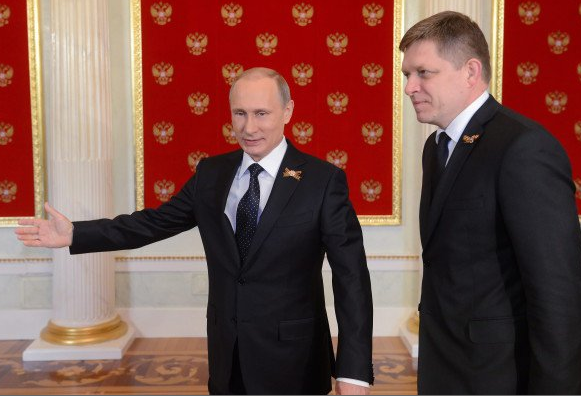
Russian President Putin with Slovak Premier Fico in Moscow
Fico’s view: it is necessary to include Bashar al Assad to resolve the conflict in Syria

Deutsche Wirtschafts Nachrichten
October 18, 2015
Translated from German by Tom Winter

The Russian intervention in Syria has now led to a rift in NATO with Slovakia becoming the first NATO country to side with the Russians. German Foreign Minister Steinmeier, meanwhile, tries to get Iran and Saudi Arabia to the table to promote a diplomatic solution.

But the Prime Minister of NATO member country Slovakia, Robert Fico, is not wedded to the Russian intervention in principle: “Whether an American attack or a Russian attack on ISIS targets is now successful, in either case it counts the same,” the Social Democrat said Saturday on Slovak Radio. He has no ideological blinkers. According to Fico’s view it is necessary to include longtime ruler Bashar al Assad to resolve the conflict in the country.

Russia continued its airstrikes against ISIS through the weekend. “First, we are defending our national interests, and second, we have the approval of the local leadership,” said Prime Minister Dmitry Medvedev in an interview with Russian state television.

Medvedev also slightly distanced himself from President Assad: “He is the legitimate president, but we aren’t fighting there for a particular politician. Who leads Syria — the people should decide,” he said in the interview broadcast on Saturday.

The Russians have already said at the beginning of their military strikes that they do not intendf to support Assad no matter what. However, they reject the overthrow of an elected head of state by military force from outside, as a breach of International Law.

According to the Defense Ministry in Moscow the Russian Air Force flew about 40 new attacks in Syria in 24 hours. “…in which 49 terrorist targets were destroyed,” said Major General Igor Konaschenkov.

The terrorist militia Islamic State (IS) have changed their tactics because of the bombing and are now having to decentralize ammunition dumps and command posts. The fighter jets discovered and destroyed several positions anyway, said Konaschenkov.

Foreign Minister Frank-Walter Steinmeier called on Iran to cooperate in the efforts to end the war in Syria. “My desire is that Iran use its influence on the government, and on Assad and his circle so we can take the first steps towards a de-escalation in Syria,” Steinmeier said on Saturday during a visit to Tehran.

All attempts to move Iran, along with other regional powers such as Turkey and Saudi Arabia, to Syrian peace talks, so far have been fruitless. On Sunday, Steinmeier will travel to Saudi Arabia, the main opponent of Iran in the region. At the same time German Chancellor Angela Merkel travels to Turkey.

Iranian Foreign Minister Mohammad Javad Zarif showed himself to be open, in principle, to participation in the search for a peaceful solution for Syria. His country was ready for a “constructive role” and also to hold talks with all its neighbors.

Steinmeier appealed to both to overcome the previous lack of discussion: “Every player in the region has a responsibility that goes beyond the national interest. This responsibility is more important than ambition and national pride. “

With a view to Iran’s role in Syria Steinmeier said: “It’s no secret that our position is not congruent in all respects. But we have a common interest in ensuring that the killing comes to an end and that Syria will remain as a state.” Zarif said that when it comes to Assad’s future, in the past we have focused too much on the fate of individuals. It would be better to take care of the preservation of the state institutions. “The people in Syria will decide who will be there at the beginning and who at the end.”

Your translator cannot resist a comment on Steinmeier’s assertion that Syria remain as a state: unlike some governments, Germany is thinking ahead realizing what will happen if the “rebels” win.