Is North Korea a diversion for a US-Jordan invasion of Syria?

Interesting idea.
However, it is difficult to believe that U.S. Pacific Command (or any of the other Pentagon world regional commands) would allow one command to see action and receive the “glory”, especially with all the preparation, war exercises, and rhetoric against North Korea, The competition for funds, programs, and accolades must be intense, which requires self-justification and proven benefit. And now President Trump is allowing Pentagon commanders to make more of their own decisions. 
Education, outreach, and real peace-making projects are urgently needed.
Global Research, May 04, 2017
Counter Punch 3 May 2017
“Syrian President Bashar Al-Assad said that his country has information that Jordan is planning to send its troops into southern Syria in cooperation with the United States….’Jordan is not an independent country. Whatever the United States wants, it will happen,’ said Assad.” — Middle East Monitor

“In the event of a de-facto partition of Syria, the US and its allies will get a strategically important region. It is through Deir Ezzor that the proposed gas pipeline from Qatar is supposed to run….The Deir Ezzor province is also home to Syria’s largest oil deposit, the Al-Omar. …the city and the province are of particular value since the deposits there contain the highly valuable light sweet crude usable in the production of gasoline and diesel fuel.” — South Front, “The Stronghold of Deir Ezzor; What You Need to Know”

The United States is not going to launch a preemptive attack on North Korea. The risks far outweigh the rewards and, besides, the US has no intention of getting bogged down in a conflict that doesn’t advance its geopolitical objectives. The saber-rattling is just an attempt to divert attention from the Syria-Jordan border where the US and Jordan are massing troops and equipment for an invasion of Syria. That’s what’s really going on. The Korean fiasco is a smokescreen.
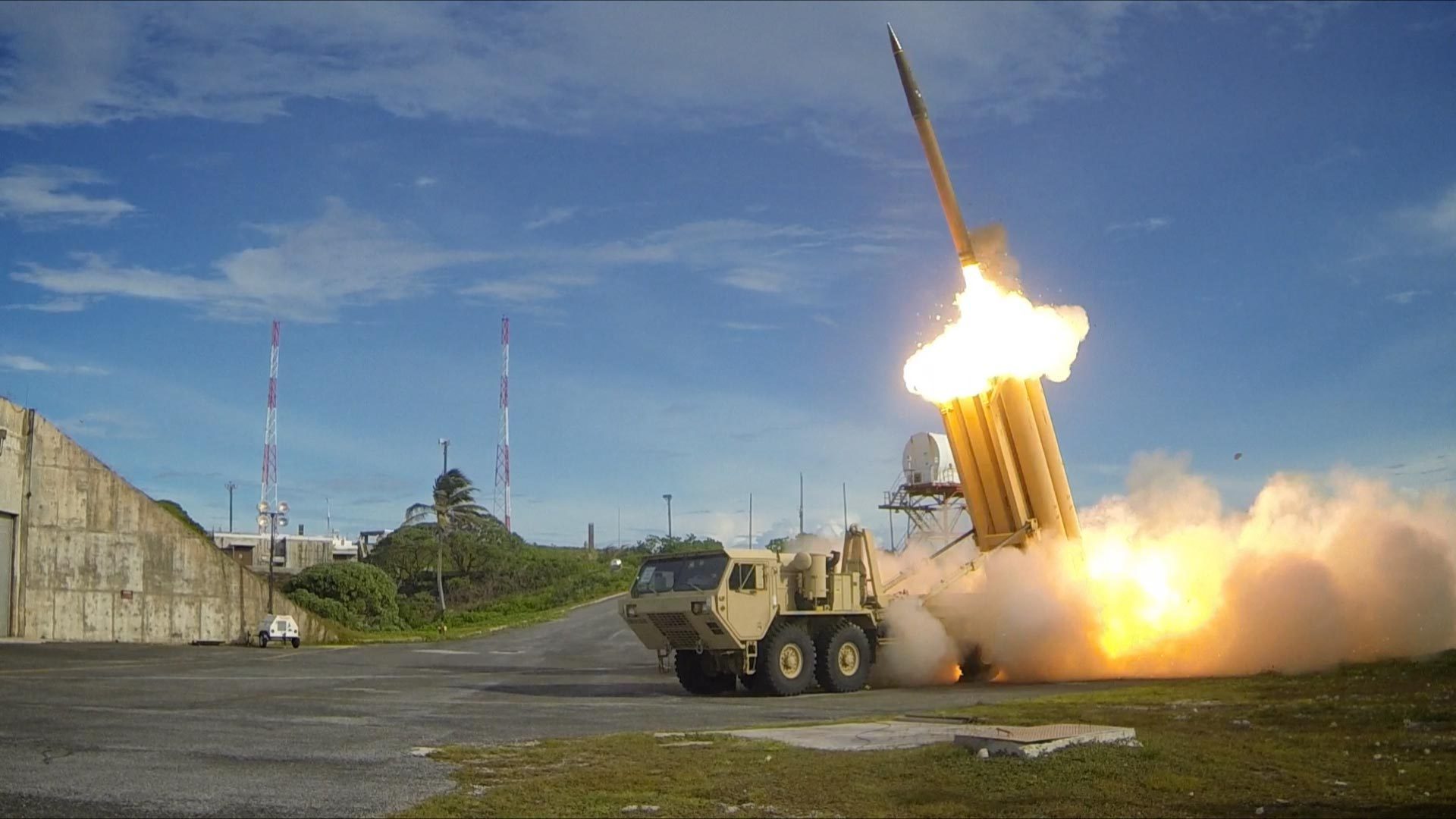
True, the Trump administration is milking the situation for all its worth, but that doesn’t mean that they want a war with the North. That’s not it at all.  Washington wants to deploy its controversial THAAD anti-missile system to South Korea, but it needs a pretext to do so. Hence, the ominous threat of an “unstable, nuclear-armed North Korea”, that’s all the justification Washington needed to get its new weapons system deployed. Mission Accomplished.

But the Terminal High Altitude Area Defense system (THAAD) isn’t aimed at North Korea, it’s aimed at China, and China knows it which is why it has protested its deployment repeatedly. The US wants to surround China and Russia with military bases and missile systems that are integrated into its broader nuclear weapons system. These lethal systems are a crucial part of Washington’s plan to pivot to Asia and rule the world into the next century. Here’s the rundown from Tass:

“Anti-missile elements that are being deployed around the world are part of a very dangerous global project aimed at securing US’ overall overwhelming superiority to the prejudice of security interests of other states….The US missile defense architecture is tilting the strategic balance of forces in the area of offensive weapons and creates more and more serious risks of global instability.” (“US anti-missile systems in Eastern Europe violate INF Treaty”)

And here’s how Russian President Vladimir Putin summed it up:

“The US is developing an anti-missile defense system which”….when it is operational… “there will be a moment in time when our entire nuclear capability will be neutralized, which means that the entire global balance of power will be overturned.. This means one of the powers will have absolute security and be able to do whatever it likes in regional conflicts. We’re talking about unrivaled power in global conflicts. ..This system forces us to create weapons that can nullify the system asymmetrically.” (Tass)

Is missile defense something the American people should want?

Heck no. Just think of the number of people that Uncle Sam has slaughtered in the last 16 years. Now try to imagine if all the constraints on Washington’s rampaging were removed allowing the US to conduct its bloody war on the world with complete impunity?

No one in their right mind would ever give the Washington crazies that kind of power. It’s a prescription for global annihilation. Besides, absolute security for one country means no security for everyone else.

But deploying the THAAD anti-missile system is just one part of Washington’s North Korea swindle. The fear-mongering is also being used to grease the wheels of the Military Industrial Complex (MIC). Here’s the scoop from The Hill:

Sen. John McCain

Sen. John McCain’s (R-Ariz.) push for a $7.5 billion fund to bulk up the U.S. military’s capabilities in the Asia-Pacific is gaining momentum as tensions with North Korea mount. The commander of U.S. forces in the region threw his support behind the idea this week, “This kind of money can help us bring together our allies and partners,” said Patrick Cronin, senior director of the Asia-Pacific Security Program at the Center for a New American Security. …The … proposal has gained more visibility amid the intensifying concerns over North Korea and its nuclear program.” (“McCain plan gains momentum amid North Korea threats”, The Hill)

So the MIC lackeys in Congress had already been pushing this latest boondoggle, but they needed a trumped up crisis in North Korea to put them over the finish line. Typically, the process is called “creative advertising”, which means scaring the shit out of the public so you can rip them off. Here’s more from the same article:

“I’d like to thank Chairman McCain and this committee for proposing and supporting the Asia-Pacific Stability Initiative,” Adm. Harry Harris, commander of U.S. Pacific Command, said at Thursday’s hearing. “This effort will reassure our regional partners and send a strong signal to potential adversaries of our persistent commitment to the region.”

The weapons manufacturers love sugar-daddy McCain who’s always on-hand with gobs of moolah.

Here’s more:

“We can thank North Korea for one thing in this,” said Harry Kazianis, director of defense studies at the Center for the National Interest”. “They’re amplifying the imbalance in the Asia-Pacific.” (The Hill)

Good idea, let’s thank North Korea for this latest windfall for the weapons makers. Why not? Let’s send Kim a nice big valentine from the American taxpayer with John McCain’s name writ large at the bottom.

In any event, Washington’s policy towards North Korea hasn’t changed. All the chest thumping and fireworks are just part of a circus sideshow designed to justify additional defense splurging and missile deployment. At the same time, the media is trying to divert attention from critical developments in the Middle East, particularly the Syria-Jordan border where Washington has rallied its proxy-fighters into a makeshift army that will (likely) invade southern Syria, charge northward to Deir Ezzor,  establish a no-fly zone over the occupied territory, and partition the area east of the Euphrates preventing loyalist forces from reestablishing Syria’s sovereign borders. That appears to be the basic game-plan. Check this out from the Middle East Monitor:

“The Syrian regime of President Bashar Al-Assad said that his country has information that Jordan is planning to send its troops into southern Syria in cooperation with the United States…

“We have this information, not only from mass media, but from different sources”…
Speaking to The Washington Post, King Abdullah of Jordan reiterated that a planned joint operation could take place against terrorists. “It is a challenge, but we are ready to face it in cooperation with the US and Britain.” (“Assad accuses Jordan of planning Syria invasion”,  Middle East Monitor)
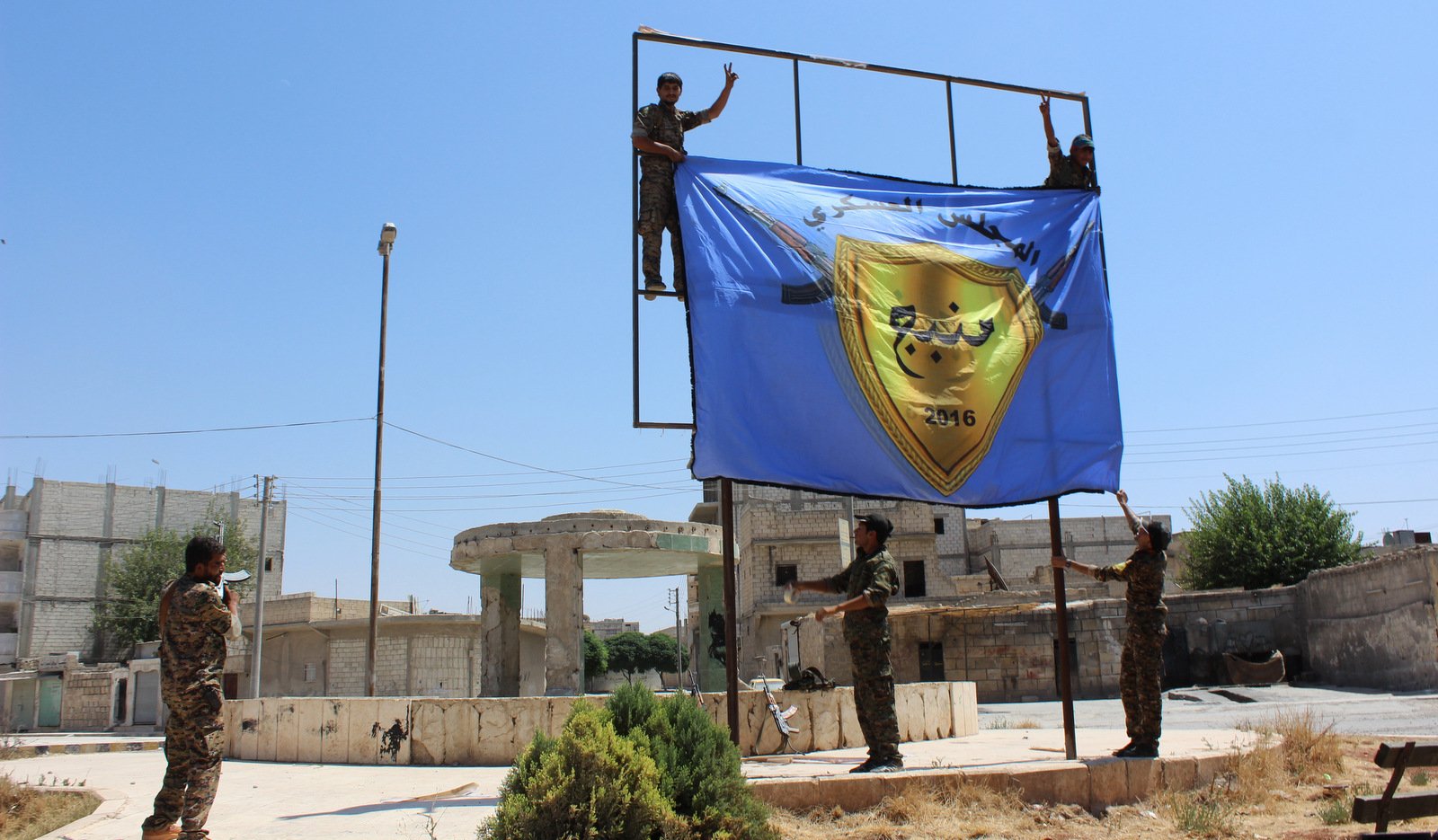
The pretext for the invasion will be to fight ISIS, but the real goal is to seize the eastern part of the country consistent with a plan that was concocted by the Brookings Institute two years ago. After 6 years of covert support for CIA-backed militants on the ground, the Trump administration appears to be leaning towards a more traditional military approach. Here’s more from the LA Times:

“Reports have also emerged of Jordanian and U.S. troops on the section of the Jordanian border opposite southwest Syria, a possible prelude to a campaign in which rebels, supported by Jordanian and coalition forces on the ground, would overrun Islamic State’s pocket in the Yarmouk basin, near southwestern Syria’s borders with Israel and Jordan.” (“How long can Jordan keep walking the Middle East tightrope?”, LA Times)

Naturally, Moscow is concerned about the developments on the Jordanian border. Last week, Russian Foreign Minister Sergei Lavrov issued a statement saying,

“We will pay special attention to the issues most important for us which concern the situation on the Jordan-Syria border.”

Also worrisome, is the fact that US Defense Secretary James “Mad Dog” Mattis has been traveling across the Middle East rallying Washington’s allies in Saudi Arabia, Egypt and Israel. Mattis sees the fighting in Syria as a proxy-war between the US and Iran for influence in the region. This same erroneous view is shared by all of the main powerbrokers in the Trump administration.

“Everywhere there’s trouble in the region, you find Iran,” Mr. Mattis said on a stop in Riyadh, adding that nations in the region are working to “checkmate Iran and the amount of disruption, the amount of instability they cause.”

These latest developments take place just days before the resumption of negotiations in Astana, Kazakhstan (May 3 and 4). Russia, Turkey, Iran and a number of the leaders from the rebel groups will gather to see if they can agree on the terms of a ceasefire and an eventual settlement to the 6 year-long war. The Trump administration’s cruise missile attack on a Syrian airbase in early April has boosted the morale of many of the jihadists militias and is keeping them away from the bargaining table. In other words,  Trump’s unexpected escalation has sabotaged Putin’s efforts to resolve the crisis and end the hostilities. The last thing Washington wants in Syria is peace.

A number of reports have confirmed that Trump has handed control of his foreign policy to his Generals, Mattis and McMaster. And while Mattis has shown little interest in getting more deeply involved in the Syrian conflict, McMaster sees Russia as a “hostile revisionist power” that “intimidates our allies, develops nuclear weapons, and uses proxies under the cover of modernized conventional militaries.”

McMaster is a hard-boiled militarist with a driving animus towards Russia.  In a speech he delivered at The Center for Strategic and International Studies, McMaster offered this remedy for so called ‘Russian aggression’. He said:

“what is required to deter a strong nation that is waging limited war for limited objectives… is forward deterrence,  …(is) convincing your enemy that (he) is unable to accomplish his objectives at a reasonable cost.”

McMaster can be expected to use his  “forward deterrence” theory in Syria by trying to lure Putin into a confrontation with US forces east of the Euphrates. But there’s no reason to think that Putin will fall into the trap, in fact, it seems highly unlikely given the potential for a catastrophic face-off between the two nuclear-armed superpowers. Instead, Putin will probably take the high-road, present his case to the UN Security Council, and denounce  the US intervention as another example of Washington’s destabilizing and expansionistic foreign policy.
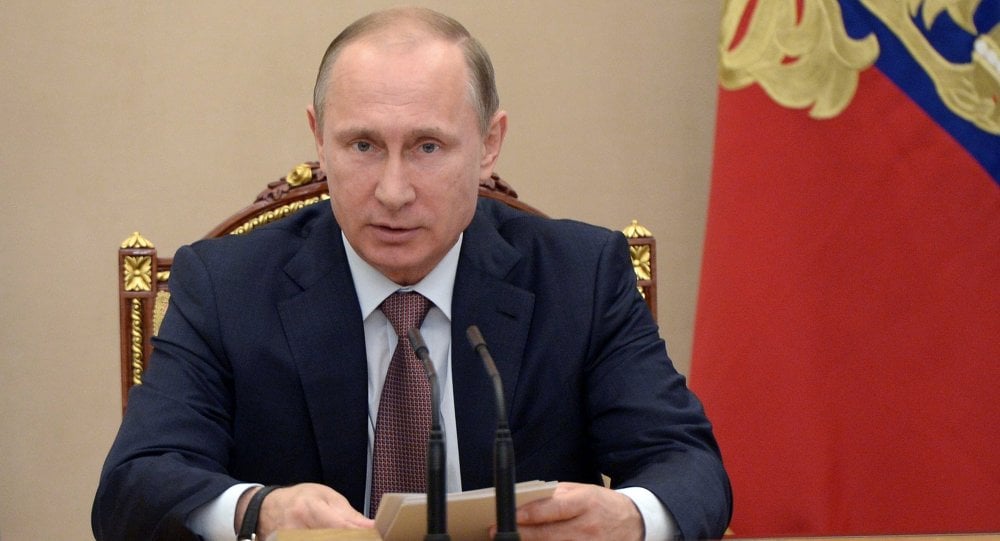
Putin’s worst mistake would be to base his strategy entirely on the situation on the battlefield. He doesn’t need to liberate every inch of Syrian soil to win the war. Let the US and its proxies seize the territory, establish their military bases and no-fly zones, throw up a DMZ along the Euphrates, and wade deeper into the Syrian morass. Putin has other fish to fry. He needs to focus on winning hearts and minds, strengthening alliances and building a broader coalition. He needs to look like the only adult in the room, the rational leader whose sole ambition is to end the dispute and restore security. He needs to establish a contrast between his behavior and that of his recklessly-violent and mentally-unstable rival, Washington, whose flagrant  disregard for international law and civilian lives has plunged the Middle East and Central Asia into chaos and carnage.

If Putin’s ultimate goal is to rebuild the system of global security based on the bedrock principles of national sovereignty and greater representation for all the countries in the world, he must lead by example. Restraint and maturity in Syria will move him closer to that goal.

Mike Whitney lives in Washington state. He is a contributor to Hopeless: Barack Obama and the Politics of Illusion (AK Press). Hopeless is also available in a Kindle edition. He can be reached at fergiewhitney@msn.com.
Responsible actions needed to ensure peace on the Korean Peninsula — a Chinese perspective

Global Research, May 01, 2017
People’s Daily 30 April 2017

Given the continued escalation of tensions on the Korean Peninsula over the past months, all concerned parties should implement the resolutions adopted by the UN Security Council in a more strict manner and return to peaceful negotiations, the People’s Daily said in an editorial published on Sunday.

The commentary came after Friday’s ministerial meeting on the nuclear issue of the Korean Peninsula hosted by the UN Security Council at the UN headquarters in New York.

The latest developments on the peninsula highlighted an imperative need for all parties to intensify their efforts to bring stakeholders to dialogue table, added the commentary published under the pen name Zhong Sheng, which is often used to express the paper’s views on foreign policy.

It is reasonable for the DPRK to pursue its own security, but its nuclear and missile ambitions have put itself and the whole region into dire peril, stressed the article titled “Responsible actions are needed to ensure peace of Korean Peninsula”.

The country has been immersed itself into a strong sense of insecurity given historic reasons and reality, the paper added.

The DPRK must not be obsessed in a wrong path of repeated nuclear tests and missile launches that resulted in rounds of sanctions, the commentary said, calling on the country to respect and comply with the relevant Security Council resolutions.

The article pointed out that the Republic of Korea(ROK) and the US also added fuel to the escalated tensions since the two allies, who have been maintaining a high-handed pressure on the nuclear issue of the Korean Peninsula, revealed a strategic intention to crush the DPRK.

It is almost impossible to ease the crisis on the peninsula if the ROK and the US continue their fantasy to settle the problem with more military actions but turn a blind eye to reasonable appeals of the DPRK, the paper stressed.

China is not a directly-concerned party of the peninsula crisis, and it does not hold the key to solving the nuclear issue on the peninsula, the commentary admitted.

But it emphasized that no matter what happens, China will never waiver in its clear-cut position regarding the nuclear issue on the Korean Peninsula, which means it will stay committed to the goal of denuclearization as well as the path of dialogue and negotiation.

In the next step, the DPRK should refrain from further nuclear test or missile launches, the article urged, adding that the ROK and the US, for their part, also need to stop launching or expanding their military drills or deployment against the DPRK.

All stakeholders need to comprehensively understand and fully implement the DPRK-related resolutions adopted by the Security Council, the paper said. The international community needs to step up their anti-proliferation efforts against the DPRK action. Meanwhile,all parties also need to do more to persuade stakeholders back to peaceful dialogues, it added.

China will, with its utmost sincerity and efforts, safeguard the peace and stability of Northeast Asia and realize the goal to denuclearize the Korean Peninsula along with relevant parties, the paper vowed, stressing that though a peace lover, the country is fearless of any provocations or tests.

China has proposed the “dual-track approach” and “suspension for suspension” plan for peaceful settlement of the issue, in an attempt to help the parties breakout of the security dilemma and return to the negotiating table.

The objective, reasonable and feasible proposals, according to the editorial, not only conform to the requirements of the UN resolutions, but also meet the fundamental interest of all parties including the US and the DPRK.

Translated from Chinese, People’s Daily, April 2017.

America’s war against the people of Korea: The historical record of U.S. war crimes

…we have about 50% of the world’s wealth but only 6.3% of its population. This disparity is particularly great as between ourselves and the peoples of Asia. …Our real task in the coming period is to devise a pattern of relationships which will permit us to maintain this position of disparity without positive detriment to our national security. To do so, we will have to dispense with all sentimentality and day-dreaming; and our attention will have to be concentrated everywhere on our immediate national objectives…

We should dispense with the aspiration to “be liked” or to be regarded as the repository of a high-minded international altruism. We should stop putting ourselves in the position of being our brothers’ keeper and refrain from offering moral and ideological advice. We should cease to talk about vague and—for the Far East—unreal objectives such as human rights, the raising of the living standards, and democratization. The day is not far off when we are going to have to deal in straight power concepts. The less we are then hampered by idealistic slogans, the better.

George F. Kennan, State Department Brief, Washington DC, 1948


Global Research, April 30, 2017
Global Research 13 September 2013

The following text by Michel Chossudovsky was presented in Seoul, South Korea in the context of the Korea Armistice Day Commemoration, 27 July 2013

A Message for Peace. Towards a Peace Agreement and the Withdrawal of US Troops from Korea.

Introduction

Armistice Day, 27 July 1953 is day of Remembrance for the People of Korea.

It is a landmark date in the historical struggle for national reunification and sovereignty.

I am privileged to have this opportunity of participating in the 60th anniversary commemoration of Armistice Day on July 27, 2013.

I am much indebted to the “Anti-War, Peace Actualized, People Action” movement for this opportunity to contribute to the debate on peace and reunification.

An armistice is an agreement by the warring parties to stop fighting. It does signify the end of war.

What underlies the 1953 Armistice Agreement is that one of the warring parties, namely the US has consistently threatened to wage war on the DPRK for the last 60 years.

The US has on countless occasions violated the Armistice Agreement. It has remained on a war footing. Casually ignored by the Western media and the international community, the US has actively deployed nuclear weapons targeted at North Korea for more than half a century in violation of article 13b) of the Armistice agreement. 

The armistice remains in force. The US is still at war with Korea. It is not a peace treaty, a peace agreement was never signed.

The US has used the Armistice agreement to justify the presence of 37,000 American troops on Korean soil under a bogus United Nations mandate, as well as establish an environment of continuous and ongoing military threats. This situation of “latent warfare” has lasted for the last 60 years. It is important to emphasize that this US garrison in South Korea is the only U.S. military presence based permanently on the Asian continent.

Our objective in this venue is to call for a far-reaching peace treaty, which will not only render the armistice agreement signed on July 27, 1953 null and void, but will also lay the foundations for the speedy withdrawal of US troops from Korea as well as lay the foundations for the reunification of the Korean nation.

Michel Chossudovsky Presentation: 60th anniversary commemoration of Armistice Day on July 27, 2013, Seoul, ROK. 

<iframe width=”690″ height=”400″ src=”https://www.youtube.com/embed/U2xO7Cn_xDU&#8221; frameborder=”0″ allowfullscreen><!–iframe>

Armistice Day in a Broader Historical Perspective.

This commemoration is particularly significant in view of mounting US threats directed not only against Korea, but also against China and Russia as part of Washington’s “Asia Pivot”, not to mention the illegal occupation of Afghanistan and Iraq, the US-NATO wars against Libya and Syria, the military threats directed against Iran, the longstanding struggle of the Palestinian people against Israel, the US sponsored wars and insurrections in sub-Saharan Africa.

Armistice Day July 27, 1953, is a significant landmark in the history of US led wars.  Under the Truman Doctrine formulated in the late 1940s, the Korean War (1950-1953) had set the stage for a global process of militarization and US led wars. “Peace-making” in terms of a peace agreement is in direct contradiction with Washington “war-making” agenda.

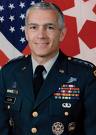
Washington has formulated a global military agenda. In the words of four star General Wesley Clark (Ret) [image right], quoting a senior Pentagon official:

“We’re going to take out seven countries in 5 years, starting with Iraq, and then Syria, Lebanon, Libya, Somalia, Sudan and, finishing off, Iran” (Democracy Now March 2, 2007)

The Korean War (1950-1953) was the first major military operation  undertaken by the US in the wake of  World War II,  launched at the very outset of  what was euphemistically called “The Cold War”. In many respects it was a continuation of World War II, whereby Korean lands under Japanese colonial occupation were, from one day to the next, handed over to a new colonial power, the United States of America.

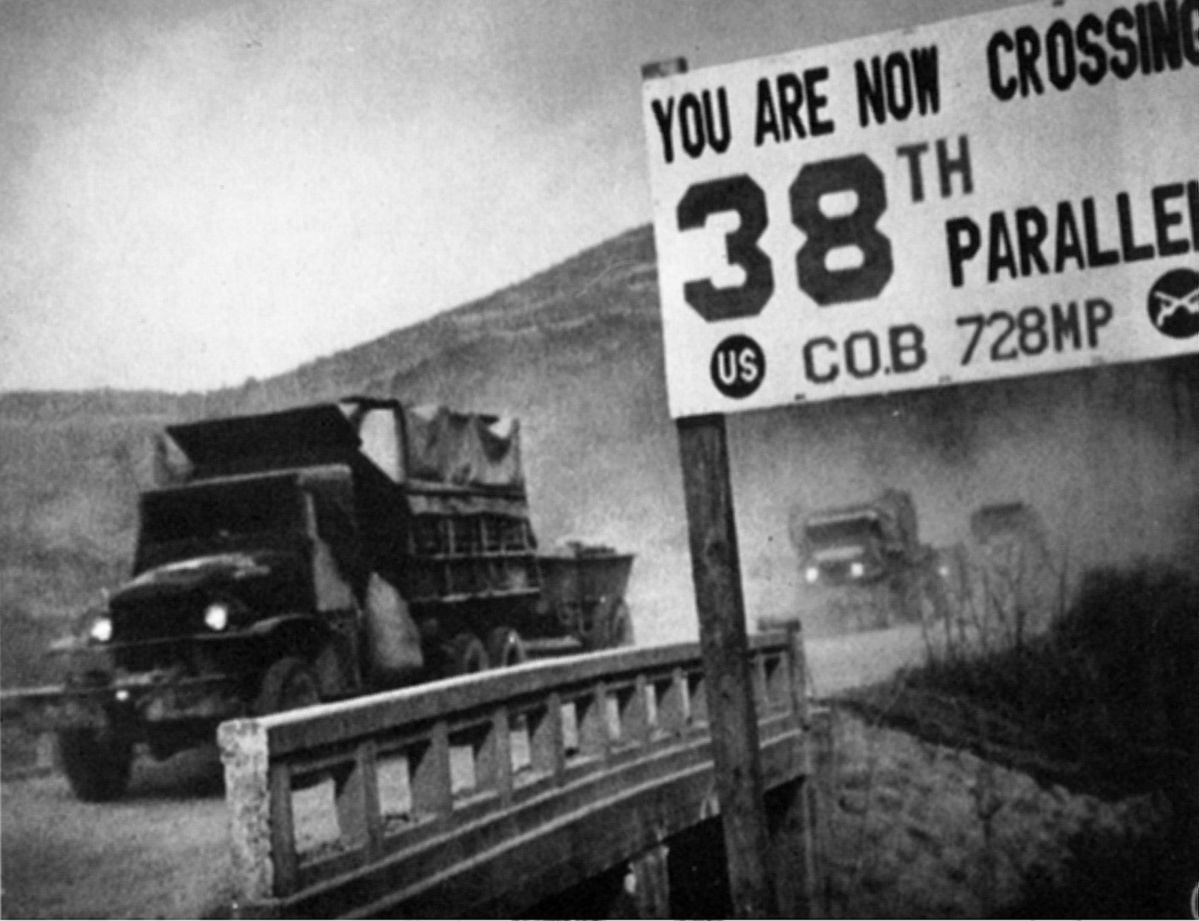
At the Potsdam Conference (July–August 1945), the US and the Soviet Union agreed to dividing Korea, along the 38th parallel.

There was no “Liberation” of Korea following the entry of US forces. Quite the opposite.

As we recall, a US military government was established in South Korea on September 8, 1945, three weeks after the surrender of Japan on August 15th 1945. Moreover,  Japanese officials in South Korea assisted the US Army Military Government (USAMG) (1945-48) led by General Hodge in ensuring this transition. Japanese colonial administrators in Seoul as well as their Korean police officials worked hand in glove with the new colonial masters.

From the outset, the US military government refused to recognize the provisional government of the People’s Republic of Korea (PRK), which was committed to major social reforms including land distribution, laws protecting the rights of workers, minimum wage legislation and  the reunification of North and South Korea.

The PRK was non-aligned with an anti-colonial mandate, calling for the “establishment of close relations with the United States, USSR, England, and China, and positive opposition to any foreign influences interfering with the domestic affairs of the state.”2

The PRK was abolished by military decree in September 1945 by the USAMG. There was no democracy, no liberation no independence.

While Japan was treated as a defeated Empire, South Korea was identified as a colonial territory to be administered under US military rule and US occupation forces.

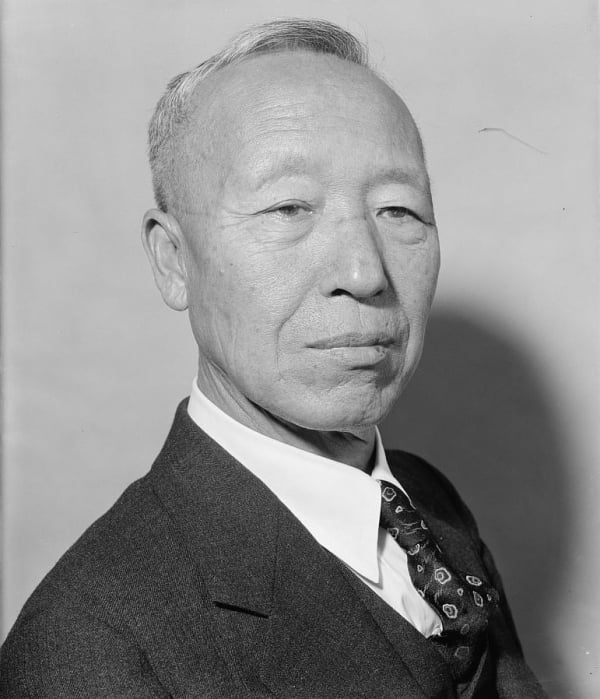
America’s handpicked appointee Sygman Rhee [left] was flown into Seoul in October 1945, in General Douglas MacArthur’s personal airplane.

The Korean War (1950-1953)

The crimes committed by the US against the people of Korea in the course of the Korean War but also in its aftermath are unprecedented in modern history.

Continue reading

How U.S. bio-weapons led to torture … and North Korean nukes

Global Research, April 28, 2017
Moon of Alabama 27 April 2017

In Why North Korea Needs Nukes – And How To End That we pointed to the utter destruction the U.S. and its allies waged in the war on Korea on all parts of the country. That North Korea seeks “weapons of mass destruction” is quite understandable when one takes into account the hundreds of thousands tons of napalm used against it. But even Napalm and the criminal destruction of North Korean dams were not the worst depravation the U.S. applied. Biological warfare agents, primarily anthrax, were dropped over North Korea and China and killed civilians. The U.S./UN command denied such use and covered it up. One consequence of that cover up was the development of torture methods in the U.S. SERE pilot training programs and their later proliferation into criminal abuses in Guantanamo, Abu Graibh and elsewhere. An important piece of evidence of this trail was recently and for the first time re-published on the web.

In the 1950s war on Korea heavy air to air fights were waged near the Chinese border which led to significant losses of airplane on both sides especially along the MiG Alley:

USAF pilots nicknamed April 12, 1951 “Black Thursday”, after 30 MiG-15s attacked three squadrons of B-29 bombers (36 planes) escorted by approximately 100 F-80s and F-84s. The MiGs were fast enough to engage the B-29s and extend away from their escorts. Three B-29s were shot down and seven more were damaged, with no casualties on the communist side.

On “Black Thursday” and other occasions U.S. bomber pilots were captured. Some of them admitted to have dropped biological weapons over China and northern Korea. Their confessions were published in writing and publicized on Korean, Chinese and Russian radio.

The U.S. (UN) command under U.S. General MacArthur denied any use of biological warfare agents. It claimed that the downed pilots were tortured to give false confessions.

Since World War II the U.S. Airforce and Navy had established training courses in Survival, Evasion, Resistance and Escape (SERE) for pilots that might be captured by enemies. During these courses “controlled” torture was used to provide realistic training. Decades later, during the war of terror and on Iraq, the CIA hired two psychologists as “behavioral science consultants” from the SERE training staff to teach its agents how to use torture on prisoners. The absolutely inhuman and dangerous methods those SERE “experts” devised proliferated to the U.S. military which, together with the CIA, used them on alleged enemy combatants in Abu Ghraib, Guantanamo and other places.

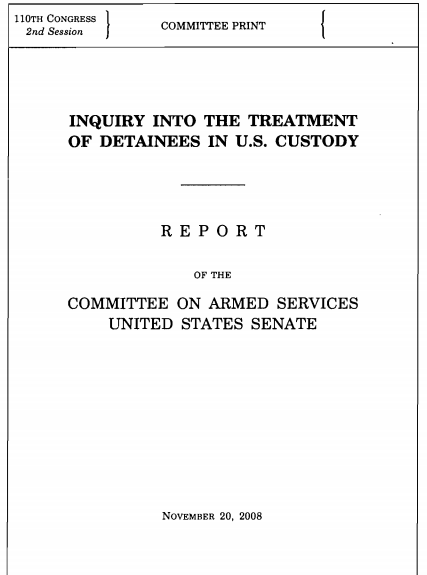
According to the Senate Armed Services Committee Report (pdf) on U.S. torturing of prisoners at Abu Ghraib, Guantanamo and CIA black sites, SERE techniques originated in Chinese Communist methods in the Korean War employed to extract false confessions from captured U.S. personal.

(During the 1960s the CIA itself developed additional “scientific” torture methods and published them in the KUBARK Counterintelligence Interrogation and Human Resource Exploitation Training Manual. U.S. personal as well as several south American militia were trained in and used these abusive and illegal methods.)

The torture training at the SERE schools and the abuse was all based on a big lie.

The U.S. had used biological weapons in the Korea war. It also used chemical weapons and suppressed investigations into it. Its pilots dropped bombs with biological warfare agents over China and Korea. Theirs were not false confessions extracted by Chinese Communist methods. The captured U.S. pilots were telling the truth.

The SERE torture resistance training and its abuse are based on the bigger lie about the non-use biological agents in the war on Korea.

(The Geneva Protocol of 1925 generally prohibited the use of biological agents but the specific Biological and Toxin Weapons Convention was only developed and signed in 1972.)

The U.S. and UK developed extensive biological warfare programs during World War II but those weapons were not put to use in the European theater. The Japanese used biological weapons, with mixed success, in China and elsewhere. At the end of World War II the Japanese biological warfare Unit 731 was taken over by the U.S. military:

[General] MacArthur struck a deal with Japanese informants—he secretly granted immunity to the physicians of Unit 731, including their leader, in exchange for providing America, but not the other wartime allies, with their research on biological warfare and data from human experimentation. American occupation authorities monitored the activities of former unit members, including reading and censoring their mail. The U.S. believed that the research data was valuable.

During and after the war on Korea the Chinese government alleged the use of biological weapons on Korean and Chinese civilians by the U.S. The U.S. denied. A commission was called upon to investigate:

To convince the world of the truth of their claims, the North Koreans and Chinese, sponsored a purported independent commission, using the auspices of the World Peace Council, gathering together a number of leftist scientists from around the world. Most surprisingly, this commission, which came to be known as the International Scientific Commission, or ISC, was headed by one of the foremost British scientists of his time, Sir Joseph Needham. The ISC travelled to China and North Korea in the summer of 1952 and by the end of the year produced a report that corroborated the Chinese and North Korean claims that the U.S. had used biological weapons in an experimental fashion on civilian populations.

For a long time the commission’s report and its appendices with the witness statements were suppressed and not available online. Jefferey Kay, a psychologist and author living in northern California, dug them up and recently published them (recommended) on the web for the first time. You can read them here:

Sir Joseph Needham was blacklisted by the U.S. during the McCarthy anti-communist campaign.

Needham’s investigations have since been confirmed by other scholars investigating the general case:

It is the purpose of this article to consider the validity of these [U.S. military denials] in light of the research which we conducted in preparing our recent book, The United States and Biological Warfare: secrets of the Early Cold War and Korea. In that book we conclude that the United States engaged in large-scale field tests of biological weapons against the Asian countries and with some additional evidence we continue to believe that is the case.

Image result for mcarthurGeneral MacArthur, one of the foremost war criminals ever, covered up the war crimes of the Japanese and especially of Unit 731. He took care to integrate the Japanese biological weapon experience into the U.S. military resources. Under his command biological agents were then used against Korean and and Chinese civilians and military units. When his pilots confessed, he denied all such reports and alleged “brainwashing” through  torture by the Chinese. This again led to torture “simulations” in U.S. SERE training from which recent U.S. torture in Iraq, Afghanistan and elsewhere derived.

U.S. media and the public have a general amnesia whenever it comes to U.S. war crimes – no matter how recent. The Senate report on CIA torture in Iraq and elsewhere is still suppressed. But U.S. war crimes do not end. Whenever “threatened” with compromise, the U.S. tends to seeks the belligerent way. As Noam Chomsky reiterates in relation to the current campaign for another war on Korea:

[V]ery strikingly [..] there’s one lesson that you discover when you carefully look at the historical record. What I just described about North Korea is pretty typical. Over and over again, there are possibilities of diplomacy and negotiation, which might not succeed—you can’t be sure if you don’t try them—but which look pretty promising, which are abandoned, dismissed, literally without comment, in favor of increased force and violence.

For an example see this influential sitting U.S. Senator who argues for “preemptive” strikes against North Korea’s missile program without any regard for the people who’s life would be destroyed by them:

“It would be bad for the Korean Peninsula. It would be bad for China. It would be bad for Japan, be bad for South Korea. It would be the end of North Korea. But what it would not do is hit America and the only way it could ever come to America is with a missile.”

Considering the historical record of the United States of committing and covering up warcrimes as well as its general belligerence, North Korea and other nations are probably well advised to stick to their nuclear and missile programs.

North Korea in the crosshairs: lively input from James Bradley, Ken O’Keefe, Mohammad Marandi (VIDEO)

From CrossTalk, RT

https://www.rt.com/shows/crosstalk/386416-north-korea-absent-diplomacy/video/

North Korea’s leader Kim Jong Un © KCNA / Reuters

We have heard it all before – all options are on the table – and of course, that means using force. This time, North Korea is in the crosshairs, with the usual bellicose language and threats being meted out. What is completely absent, however, is diplomacy.

CrossTalking with James Bradley, Ken O’Keefe, and Mohammad Marandi.

https://www.rt.com/shows/crosstalk/386416-north-korea-absent-diplomacy/

South Korea to quadruple reward fee for North Korean defectors to $860,000

From CNN
March 5, 2017

Seoul South Korea is quadrupling its reward fee for defectors from North Korea who are willing to hand over classified information on the reclusive country’s military secrets.

The Ministry of Unification announced Sunday that it would pay up to 1 billion won ($860,000) — eclipsing the previous maximum of 250 million won.
A bill outlining the changes is set to be submitted and would offer substantial financial rewards for those able to provide intelligence and knowledge, which could enhance South Korea’s security, according to the ministry.
The bill will be considered in the National Assembly between February 28 and March 9, a Unification Ministry official said.

Afraid of its nuclear ambitions, the U.S. sets sail towards North Korea

April 9th, 2017 – Fort Russ News –
– Almayadeen – –  translated by Samer Hussein –
An American aircraft carrier was dispatched towards the Korean Peninsula, due to an alleged nuclear threat posed by North Korea.
The move has since been confirmed by Dave Benham, the spokesman for the US Pacific Command, who said that the Carl Vinson strike group is “taking necessary precautionary measures”, adding that “the main threat in the region is still North Korea, mainly because of its nuclear programme and a continuous reckless and irresponsible research in order to acquire nuclear weapons.”
The group includes the USS Carl Vinson aircraft carrier from the Nimitz class, alongside fleet of missile launchers, destroyers and bombers.
Previously, North Korea conducted five nuclear tests, two of them in 2016. Satellite images are believed to be indicating that Pyongyang may be ready to conduct a sixth one in the nearby future.
While meeting his Chinese counterpart Xi Jinping on Thursday and Friday, the US President Donald Trump also discussed the North Korean nuclear ambitions and threatened of possible unilateral measures against Pyongyang, should the latter not give up his nuclear programme.
On Saturday, North Korean government condemned the US strike on Syria, calling it “an unacceptable act of aggression.”
“The reality of events today proves that we are facing an aggressor and, for the millionth time, confirms that our decision of strengthening our nuclear programme is the very right one”, an unnamed spokesman for the North Korean Foreign Ministry was quoted saying.
On Friday, the US Secretary of State Rex Tillerson “warned” that his country alone could go in war with North Korea.

North Korea: The Grand Deception Revealed — Report of the October 2003 National Lawyers Guild/American Association of Jurists Delegation to the Democratic Peoples Republic of Korea

From 4th Media

DPRK (aka, “NORTH KOREA”): THE GRAND DECEPTION REVEALED

The Preliminary Report of the October 2003 National Lawyers Guild/American Association of Jurists Delegation to the Democratic Peoples Republic of Korea
I. The Delegation and its Purpose
II. First Impressions
III. The Role of Lawyers
IV. War Crimes
V. The Demilitarized Zone (DMZ)
VI. The Countryside and Hours of Talk
VII. The Circus
VIII. Human Exchanges
IX. Particular Observations
A. The Juche idea of Socialism
B. The Role of Kim Il Sung and Kim Jong Il
C. The Legal System
D. Education
E. Health Care
F. Housing
G. Work Conditions
H. Political System
I. Military Service
J. Reunification
K. The Role of Women
X. War and Peace
XI. Final Observations and Future Activities

I. The Delegation and its Purpose

On September 29th, 2003 four lawyers from the National Lawyers Guild of the United States, Peter Erlinder, Professor of Law at the William Mitchell School of Law in St. Paul, Minnesota, Neil Berman, Attorney in Boston, Massachusetts and Eric Sirotkin and Jennie Lusk, Attorneys in Albuquerque, New Mexico as well as a member of the American Association of Jurists, Christopher Black, Barrister in Toronto, Canada, traveled to North Korea, formally the Democratic Peoples’ Republic of Korea (DPRK) at the invitation of the Korean Democratic Lawyers Association (KDLA).

We came to North Korea in order to increase bonds between lawyers in North Korea and the west, as well as to increase understanding between the peoples of North America and North Korea in order to reduce the risk of war between the DPRK and the United States of America.

The visit had several specific purposes: (1) to develop personal and professional relationships with lawyers in North Korea with a view toward understanding their legal system and its role in society, (2) to determine and understand the views of the people of the DPRK with respect to war and peace and its link to the problem of reunification of the “two” Koreas, and (3) to observe as best we could the real situation for the people of the DKRP in the context of the information being propagated in the western press of an Orwellian, totalitarian, impoverished and starving society – allegations which have been used by the United States to justify all its recent wars of aggression. We felt it essential to let the North Koreans know that many Americans and Canadians have a deep desire for peace and oppose the rhetorical “axis of evil” posture announced by the current U.S. administration.

Most of us met in Beijing as virtual strangers, but we parted company days later as friends, transformed by our experience. We came from different backgrounds, different areas of law and represented several political and philosophical points of view. We had one essential thing in common; the real fear of a war between the United States and the DPRK and a deep desire to know the truth.

All felt misled over the years by the U.S. government through its misinformation used to justify wars against Yugoslavia, Afghanistan and Iraq. We no longer accept bald allegations of “widespread violations of human rights”, the need for a “war on terrorism”, war to destroy “weapons of mass destruction,” or the need to fight wars to preserve and expand our Western way of life. As world citizens we felt obliged to reveal the truth and to take steps to build, rather than destroy, relationships, even with those whom we may disagree.

The delegation met with KDLA members, government officials and military officers, and discussed comparative judicial systems and strategies for building bridges for peace between DPRK and the United States. We toured Pyongyang, traveled hundreds of kilometers into the countryside, visited the Demilitarized Zone (DMZ) on the Northern side at the infamous joint use area of Panmunjom, and interviewed U.S. soldiers and business consultants from around the world who, much to our surprise, were discovered working in North Korea,

II. First Impressions

Continue reading

North Korea: The Grand Deception revealed. The people of the DPRK want peace

Global Research, March 15, 2017
New Eastern Outlook 13 March 2017

In 2003 I had, along with some American lawyers, members of the National Lawyers Guild, the good fortune to be able to travel to North Korea, that is the Democratic Peoples Republic of Korea, in order to experience first hand that nation, its socialist system and its people.

The joint report issued on our return was titled “The Grand Deception Revealed.” [1] That title was chosen because we discovered that the negative western propaganda myth about North Korea is a grand deception designed to blind the peoples of the world to the accomplishments of the Korean people in the north who have successfully created their own circumstances, their own independent socio-economic system, based on socialist principles, free of the domination of the western powers.

At one of our first dinners in Pyongyang our host, Ri Myong Kuk, a lawyer, stated, on behalf of the government, and in passionate terms, that the DPRK’s Nuclear Deterrent Force was necessary in light of US world actions and threats against the DPRK. He stated, and this was repeated to me in a high level meeting with DPRK government officials later on in the trip, that if the Americans would sign a peace treaty and non-aggression agreement with the DPRK, it would de-legitimize the American occupation and lead to reunification. Consequently there would be no need for nuclear weapons.

He stated sincerely that,

“It’s important that lawyers are gathering to talk about this as lawyers regulate the social interactions within society and within the world,”

and added just as sincerely that, “the path to peace requires an open heart.”

It appeared to us then and it is apparent now, in absolute contradiction to the claims of the western media, that the people of the DPRK want peace more than anything else so they can get on with their lives and endeavours without the constant threat of nuclear annihilation by the United States. But annihilation is what they in fact face and whose fault is that? Not theirs.

53452234

We were shown American documents captured in the Korean War that are compelling evidence that the US planned an attack on North Korea in 1950. The attack was carried out using American and south Korean forces with the assistance of Japanese Army officers who had invaded and occupied Korea decades before. The North Korean defence and counter-attack was then claimed by the US to be “aggression” which the United States manipulated in the media to get the UN to support a “police operation,” the euphemism they chose to use to carry on what was in fact their war of aggression against North Korea. Three years of war and 3.5 million Korean deaths followed and the US has threatened them with imminent war and annihilation ever since.

The UN vote in favour of a “police action” in 1950 was itself illegal since Russia was absent for the vote in the Security Council. The quorum required for the Security Council under its Rules of Procedure, is all member delegations so that all members must be present or a session cannot proceed. The Americans used a Russian boycott of the Security Council as their opportunity. The Russian boycott took place in defence of the position of the Peoples Republic of China that it should have the China seat at the Security Council table, not the defeated Kuomintang government. The Americans refused to do the right thing, so the Russians refused to sit at the table until the legitimate Chinese government could.

The Americans used this opportunity to carry out a type of coup in the UN, to take over its machinery for its own interests by arranging with the British, French and Kuomintang Chinese to back their actions in Korea by a vote in the absence of the Russians. The allies did as the Americans asked and voted for war with Korea, but the vote was invalid, and the “police action” was not a peace-keeping operation nor justified under Chapter VII of the UN Charter, since article 51states that all nations have the right of self defence against an armed attack, which is what the North Koreans faced and had reacted to. But the Americans have never cared much about legalities and they did not then for the American plan in its entirety was to conquer and occupy North Korea as a step towards the invasions of Manchuria and Siberia and the law was not going to get in their way.

Many in the west have little idea of the destruction carried out in Korea by the Americans and their allies; that Pyongyang was carpet bombed into oblivion, that civilians fleeing the carnage were strafed by American planes. The New York Times stated at the time that 17,000,000 pounds of napalm were used in Korea just in the first 20 months of the war. More bomb tonnage was dropped on Korea by the US than the US dropped on Japan in World War Two.

American forces hunted down and murdered not only communist party members but also their families. At Sinchon we saw the evidence that American soldiers forced 500 civilians into a ditch, doused them with gasoline and set them on fire. We stood in an air raid shelter with walls still blackened with the burnt flesh of 900 civilians, including women and children who had sought safety during an American attack. American soldiers were seen pouring gasoline down the air vents of the shelter and burning them all to death. This is the reality of the American occupation for Koreans. This is the reality they fear still and never want to repeat. Can we blame them?

But even with this history, Koreans are willing to open their hearts to former enemies. Major Kim Myong Hwan, who was then the main negotiator at Panmunjom on the DMZ line, told us that his dream was to be a writer, a poet, a journalist, but said in sombre tones, that he and his five brothers “walk the line” at the DMZ as soldiers because of what happened to his family. He said their struggle was not against the American people but their government. He was lonely for his family lost at Sinchon; his grandfather strung up a pole and tortured, his grandmother bayoneted in the stomach and left to die. He said,

“You see, we have to do it. We have to defend ourselves. We do not oppose the American people. We oppose the American policy of hostility and its efforts to exercise control over the whole world and inflict calamity on people.”

It was the opinion of the delegation that by maintaining instability in Asia, the U.S. can maintain a massive military presence and keep China at bay in its relations with South and North Korea and Japan and use it as a lever against China and Russia. 

With the continuing pressure within Japan to remove the U.S. bases in Okinawa, the Korean military operations and war exercises remain a central point of American efforts to dominate the region

The question is not whether the DPRK has nuclear weapons which it is legally entitled to have, but whether the United States, which has nuclear arms capability on the Korean peninsula, and which is now installing its THADD missile defence system there, a system that threatens the security of Russia and China, is willing to work with the North toward a peace treaty. We found North Koreans avid for peace and not attached to having nuclear weapons if peace can be established. But the American position remains as arrogant, aggressive threatening and dangerous as ever.

In this age of American “regime change,” “pre-emptive war” doctrines, and American efforts to develop low yield nuclear weapons as well as their abandonment and manipulation of international law it was not surprising that the DPRK plays the nuclear card. What choice do the Koreans have since United States threatens nuclear war on a daily basis and the two countries that logic dictates would support them against American aggression, Russia and China, join with the Americans in condemning the Koreans for arming themselves with the only weapon that can act as a deterrent against attack.

The reason for this is unclear since the Russians and Chinese have nuclear weapons and built them to act as a deterrent to an attack by the United States just as North Korea is doing. Some of their government statements indicate that they fear not being in control of the situation and that if North Korea’s acts of defence draw a US attack, they will be attacked as well. One can understand that anxiety. But it begs the question why they cannot support North Korea’s right to self-defence and put more pressure on the Americans to conclude a peace treaty, a non-aggression agreement, and to withdraw their nuclear and armed forces from the Korean peninsula. But the great tragedy is the clear inability of the American people to think for themselves, in the face of continual deceptions, and to demand that their leaders exhaust all avenues of dialogue and peacemaking before even contemplating aggression on the Korean Peninsula.

The fundamental foundation of North Korean policy is to achieve a non-aggression pact and peace treaty with the United States. The North Koreans repeatedly stated that they did not want to attack anyone, hurt anyone or be at war with anyone. But they have seen what has happened to Yugoslavia, Afghanistan, Iraq, Libya, Syria and countless other countries and they have no intention of having that happen to them. It is clear that any U.S. invasion would be defended vigorously and that the nation can endure a long, arduous struggle.

At another location on the DMZ we met a Colonel who set up field glasses through which we could see across the divide between north and south. We could see a concrete wall built on the South side, a violation of truce agreements. The major described such a permanent structure as a “disgrace for the Korean people who are a homogenous people.” A loud speaker continuously blared propaganda and music from speakers on the south side. The irritating noise goes on for 22 hours a day, he said. Suddenly, in another surreal moment, the bunker’s loudspeakers began belting out the William Tell overture, better known in America as the theme from the Lone Ranger. The Colonel urged us to help people see what is really going on in the DPRK, instead of basing their opinions on misinformation. He told us “We know that like us the peace loving people in America have children, parents and families.” We told him of our mission to return with a message for peace and that we hope to return someday and “walk with him together freely in these beautiful hills.” He paused and said, “I too believe it is possible.”

So while the people of the DPRK hope for peace and security the United States and its puppet regime in the south of the Korean peninsular wage war, carrying out for the next three months the largest war games ever conducted there, involving air craft carriers, nuclear armed submarines and stealth bombers, aircraft and large numbers of troops, artillery and armour.

The propaganda campaign has been taken to dangerous levels in the media with accusations that the North murdered a relative of the leader of the DPRK in Malaysia, though there is no proof of this, and no motive for the north to do it. The only ones to benefit from the murder are the Americans and their controlled media using it to whip up hysteria about the North and now allegations of the North having chemical weapons of mass destruction. Yes, friends, they think we were all born yesterday and that we haven’t learned a thing or two about the character of the American leadership and the nature of their propaganda. Is it any wonder that the North Koreans fear that any day these on going war “games” can be switched to the real thing, that these “games” are just a cover for an attack, and in the meantime to create an atmosphere of terror for the Korean people?

There is a lot that can be said about the real nature of the DPRK, its people and socio-economic system, its culture. But there is no space for that here. I hope people can visit as our group did and experience for themselves what we experienced. Instead I will close with the concluding paragraph of the joint report made on our return from the DPRK and hope that people take it in, think about it, and act to bring on its call for peace.

The people of the world have to be told the complete story about Korea and our government’s role in fostering imbalance and conflict. Action must be taken by lawyers, community groups, peace activists, and all citizens of the planet, to prevent the U.S. government from successfully generating a propaganda campaign to support aggression in North Korea. The American people have been subjected to a grand deception. There is too much at stake to get fooled again. This peace delegation learned in the DPRK a significant piece of truth essential in international relations. It’s how broader communication, negotiation followed by maintained promises, and a deep commitment to peace can save the world – literally – from a dark nuclear future. Experience and truth free us from the threat of war. Our foray into North Korea, this report and our on-going project are small efforts to make and set us free.

Christopher Black is an international criminal lawyer based in Toronto. He is known for a number of high-profile war crimes cases and recently published his novel “Beneath the Clouds. He writes essays on international law, politics and world events, especially for the online magazine “New Eastern Outlook.”

U.S. sends drones, assassination squad to South Korea. Massive “war games” directed against DPRK underway

“[T]o practice missions to infiltrate into the North, remove the North’s war command and demolition of its key military facilities”… The joint Foal Eagle drills are the biggest ever, involving more than 320,000 troops backed by a US aircraft carrier strike group, stealth fighters and strategic bombers.

By Peter Symonds
Global Research, March 15, 2017
World Socialist Web Site 14 March 2017

The Trump administration has further exacerbated the extremely tense standoff on the Korean Peninsula by dispatching attack drones to South Korea and sending special forces units to participate in massive war games already underway. The military build-up takes place as the White House considers launching strikes on North Korean nuclear and military sites.

US Forces Korea announced on Monday that the company of Gray Eagle Unmanned Aerial Systems (UAS) will be permanently stationed at Kunsan Air Base, south of Seoul. “The UAS adds significant intelligence, surveillance and reconnaissance capability to US Forces Korea and our [South Korean] partners,” it stated.

While the US announcement emphasized reconnaissance, the Gray Eagle drones can also carry up to four Hellfire missiles that have been used to carry out assassinations and strike military targets. The lethal drones can stay aloft for up to 24 hours.

The South Korean military was in no doubt as to the purpose of the deployment. An unnamed official told the Yonhap news agency: “In case of a war on the Korean Peninsula, the unmanned aircraft could infiltrate into the skies of North Korea and make a precision strike on the war command and other major military facilities.”

The dispatch of attack drones to South Korea coincides with the involvement of US special forces in annual Foal Eagle war games, including SEAL Team 6, the highly-trained assassination squad that killed Osama bin Laden. The SEAL team will take part in the joint exercises in South Korea along with US Army Rangers, Delta Force and Green Berets, according to Yonhap.

A military official told the news agency that bigger numbers and more diverse US special operations forces were taking part, in order “to practice missions to infiltrate into the North, remove the North’s war command and demolition of its key military facilities.” The joint Foal Eagle drills are the biggest ever, involving more than 320,000 troops backed by a US aircraft carrier strike group, stealth fighters and strategic bombers.

Commenting on US Secretary of State Rex Tillerson’s trip to Japan, South Korea and China later this week, State Department spokesman Mark Toner absurdly claimed that the US military was taking “defensive measures” against “an increasingly worrying, concerning threat from North Korea.”

Neither the drones nor the Terminal High Altitude Area Defence (THAAD) anti-ballistic missile system to which Toner was referring are “defensive” in character. The drones, along with the special forces units, are rehearsing for pre-emptive attacks on North Korean military sites and “decapitation raids” to kill North Korean leaders. This is in line with an aggressive new joint operational plan, OPLAN 5015, agreed to between the US and South Korea in late 2015.

The THAAD deployment is part of the Pentagon’s broader build-up of anti-ballistic missile systems and military forces in Asia, primarily for war against China. Beijing has repeatedly voiced strenuous objections to the THAAD installation in South Korea, which has a powerful radar system capable of peering deep into the Chinese mainland and giving the US military much greater advance warning of Chinese missile launches in the event of war.

The Trump administration, which is currently reviewing US strategy towards North Korea, is exploiting North Korea’s test launch of four ballistic missiles last week to advance longstanding military preparations on the Korean Peninsula. According to the Wall Street Journal, the White House is actively considering “regime change” in Pyongyang and military strikes on North Korea.

“We have to look at new ideas, new ways of dealing with North Korea,” US State Department spokesman Toner blandly declared. “China understands that threat. They’re not oblivious to what’s happening in North Korea.”

The reference to China underscores the aims of Tillerson’s upcoming trip. Firstly, he intends to brief Washington’s Japanese and South Korean allies on US plans and to encourage closer military cooperation in the event of conflict. Then he will fly to Beijing, where he will attempt to bully the Chinese government into taking tougher punitive action against Pyongyang.

The mounting US threats towards North Korea are also directed against China, which the Trump administration is targeting as the chief obstacle to maintaining US dominance in Asia and internationally. Tillerson has provocatively declared that the US should block Chinese access to islets under Beijing’s administration in the South China Sea. The only way to carry out such a reckless plan would be through a US military blockade—an act of war that could provoke conflict between the two nuclear-armed powers.

Tensions in the South China Sea have been further strained by the decision of the Japanese military to dispatch its largest warship, the JS Izumo, for three months of operations, including in disputed waters. According to Reuters, the Izumo will make stops in Singapore, Indonesia, the Philippines and Sri Lanka before joining the Malabar joint naval exercise with Indian and US naval vessels in the Indian Ocean in July. It will also train with the US navy in the South China Sea.

Over the eight years of the Obama administration and its “pivot to Asia,” the US has engaged in a systematic military expansion throughout the Asia Pacific, strengthened alliances and strategic partnerships and greatly aggravated dangerous regional flashpoints, including the Korean Peninsula and the South China Sea. The Trump administration, which has been critical of the “pivot” for not being sufficiently aggressive, is now embarking on a course that greatly heightens the danger of war.

The response of the North Korean regime to Washington’s actions is reactionary through and through. Its nuclear and missile tests, along with its bloodcurdling threats and Korean chauvinism, in no way defend the Korean people, but do provide the US with a pretext for its military build-up in North East Asia. According to the 38north.org web site, affiliated with John Hopkins University, commercial satellite imagery indicates that Pyongyang could be preparing for another nuclear test.

Confronted with an intense political crisis in Washington, the Trump administration is not simply considering, but actively preparing for reckless provocations and military moves against North Korea that have the potential to trigger a cataclysmic war that draws in the entire world.