Russian Foreign Ministry briefing: Venezuela; Syria; Silicon Valley is hacking the Foreign Ministry website

Briefing by Foreign Ministry spokesperson Maria Zakharova
April 12, 2017

Excerpts:

The situation in Venezuela

We’re receiving a lot of requests to explain Moscow’s position on this issue.

We’re watching with concern the situation in Venezuela, a country with which we maintain friendly relations, where opposition activists continue to clash with law-enforcers, even with the Easter holidays approaching. We feel sorry for the people who were killed or injured in street violence that is spiralling out of control. We cannot help mentioning a growing risk that the destructive scenarios which we have spoken about time and again and have warned against and which call to mind the grievous events in Chile in the 1970s might be implemented.

We believe that non-violence offers a way to end political confrontation – this is exactly our vision of how to resolve the political crisis and resume nationwide dialogue for the sake of searching jointly for answers and solutions to the socioeconomic challenges facing the country.

In this context, we’re concerned about the statements by the US Southern Command to the effect that further aggravation of the crisis in Venezuela might require a prompt response at a regional level. It should be understood that statements like these are adding to the instability, escalating the situation in that country. They cannot be treated otherwise than words to encourage Venezuelan radicals to create an atmosphere of uncertainty and instability and incite violent confrontation. We consider the fact that tensions are running high in Venezuela to be a very dangerous trend. Honestly, in our view, this would hardly be in the interests of the United States and the entire international community, including the countries in the region.

We would like to say again that all political processes unfolding in Venezuela should be strictly in line with the constitution, keep to both its letter and spirit in full, and comply with the governing laws. There is no alternative to a peaceful settlement of Venezuela’s internal problems reached at the negotiating table and in compliance with the constitution – and there cannot be any.

The situation in Syria

The military-political situation in Syria sharply deteriorated following the massive US strike on April 7 against the al-Shayrat airfield where Syrian Air Force planes are based. In this room, as well as for many other audiences, we have given an extended evaluation of that, issuing corresponding statements and explanations and making comments. As is known, Russia responded to that outright act of aggression against a sovereign UN member state by suspending the Russian-US memorandum on the prevention of air incidents in the course of operations in Syria. A corresponding explanation was provided via both the Defence Ministry and the Foreign Ministry. Washington’s use of force is a serious challenge not only to regional but also to international security.

Continue reading

Russia’s position on space cooperation; U.S. opposes space treaty

Press Briefing by Foreign Ministry spokesperson Maria Zakharova
April 12, 2017

As you know, today is Cosmonautics Day, and I would like to wish you a happy one. Traditionally it is observed on a wide scale as an important event. Cosmonautics Day (International Day of Human Space Flight declared by the UN) is a good opportunity for focusing on some of the most important aspects of Russia’s space activity, in particular its international dimension.

Developing the country’s space capabilities is one of Russia’s national priorities, as President Putin has repeatedly stated. Designed through 2025, the Federal Space Programme provides for the development of all fundamental areas, including the study of planets of the solar system and the moon with the help of automated spacecraft and a manned space flight programme. I would like to draw your attention once again, considering that members of international media outlets are present here, and it is very important for us to make our assessments and our vision of this area of international cooperation clear to our foreign partners.

Russia is ensuring guaranteed access to outer space from its territory. Foreign policy priorities have been defined and are being consistently followed. Russia advocates the peaceful use of outer space and the prevention of an arms race in space.

Back in 2008, a Russian-Chinese draft international treaty on the prevention of the placement of weapons in outer space and the threat or use of force against outer space objects was submitted for consideration to the Disarmament Conference in Geneva. In 2014 an amended version of that document was submitted.

Essentially the only state that is opposed to the international community’s efforts in this area is the US. Under these circumstances, to enhance mutual confidence and transparency, back in 2004, Russia assumed a unilateral political commitment not to be the first to place weapons in outer space, and urged all responsible countries to follow suit. Many of them, including those that have significant space potential, have already become full participants to this initiative. Even more countries have co-sponsored a corresponding resolution of the UN General Assembly, which has been approved by an overwhelming majority of votes for three years in a row. Today, the international initiative regarding no first placement of weapons in outer space is the most effective, viable, cost-free, and transparent confidence-building measure in this sphere and it is gaining momentum. Of course, the main goal is to prevent an arms race in outer space.

It is noteworthy that back in 2005, at the Russia-EU summit in Moscow, an agreement was reached on combined efforts to prevent an arms race in space. We believe that these agreements still stand. We therefore have quite a few questions about the EU’s collective position, which was formed under pressure from Washington and obligates all EU countries to refrain from endorsing this simple and understandable resolution of the UN General Assembly for the third time in a row, which calls for dialogue in this area without even requiring any new obligations from EU countries, which cannot boast independence in their actions.

Furthermore, at the UN Outer Space Committee in Vienna, Russia put forward a host of important proposals designed to ensure the safety of space operations and the preservation of outer space as a secure, stable and conflict-free environment. Substantive talks are under way.

We are ready to work constructively on all these issues with all states in the interest of preserving the peaceful skies over our planet.

This is the first time we are observing this day and this holiday without our outstanding cosmonaut Georgy Grechko. He will forever remain in our hearts. His shining memory will live on. We regard everything that he has done for the development of the space industry and international cooperation in the peaceful use of outer space as an invaluable contribution. His name has been inscribed in gold letters not only in national history but also in the world history of cosmonautics.

http://www.mid.ru/en/press_service/spokesman/briefings/-/asset_publisher/D2wHaWMCU6Od/content/id/2725573

CBS news reporter is grilled by Foreign Ministry spokesperson Zakharova on gas attacks and moderate rebels

April 5, 2017

Posted by Inessa S.

Published on Apr 7, 2017

On April 7th, US warships delivered an illegal blow to a Syrian airbase in Homs. Their justification was the recent “chemical weapon” attack on behalf of the Syrian government in Idlib. The Kremlin condemned the strike as an act of aggression against a sovereign state, and a violation of international law. Meanwhile, at the UN, representatives of Western governments attempt to push through a resolution that is based on information taken out of thin air. It includes the removal of Assad, whether or not he was behind the attack.

It is noteworthy, that the only real source of information on what took place, are the videos made by the White Helmets, an infamous propaganda organisation as it pertains to the Syrian civil war. In this clip, Maria Zakharova calls on Western respresenatives/ journalists to hear Russia, and what it has to say. The attack against the Syrian government, much like the Ghouta gas attack in 2013, which precipitated the Syrian civil war, is a giant facade for the military industrial warhawks in the US, to put their money where their mouth is.

Statement by Russian Deputy Foreign Minister at Brussels Conference “Supporting the Future of Syria and the Region”, 5 April 2017

From Foreign Ministry of the Russian Federation

Statement of H.E. Mr. Gennady Gatilov, Deputy Foreign Minister:

April 6, 2016

Ladies and gentlemen,

Indeed, the Syrian conflict is the worst crisis of our time. We are confident that it is not possible to resolve humanitarian problems without reaching a political solution. Certain positive changes have recently taken place. Russia jointly with Turkey and Iran launched the “Astana format”, within the framework of which the issues of strengthening the ceasefire regime are being discussed. Thanks largely to this initiative it has become possible to resume the intra-Syrian negotiations, the last round of which has just taken place in Geneva. Of course, the process is not easy. The parties have accumulated mutual distrust over the years of the conflict. However, the task before all of us is to help the Syrians reach sustainable agreements by themselves and in accordance with the parameters set forth in United Nations Security Council Resolution 2254, including on the issues related to the drafting of the constitution and the fight against terrorism. It is extremely important that the Syrians themselves determine the fate of Syria.

In this regard, we consider it unacceptable to use the humanitarian leverage to influence their sovereign choice. It is indispensable to depoliticize the humanitarian dossier, stop artificially inflating “tragedies of the day.” The provision of humanitarian assistance should be carried out in direct coordination and in a mutually respectful dialogue with the legitimate Government of the Syrian Arab Republic, which, unfortunately, once again was not invited to the conference. This is not the right approach.

Let us not forget that the majority of the population of the Syrian Arab Republic are concentrated in the territories under the control of the Government. Meanwhile only about 1.5 million people live in the territories under the mixed control of the forces of the so-called “moderate” armed opposition and terrorists from “Jabhat al-Nusra”.

Let me mention another point of utmost importance. One should not call for the provision of humanitarian assistance to the population of Syria and at the same time expand restrictions, which affect the most vulnerable segments of the population. This abnormal situation leads, in particular, to the shortage of medicines and imported raw materials required for the production of essential medicines in Syria.

Unfortunately, in the Syrian conflict the international community still faces a gap between pledges to allocate financial assistance and bringing real assistance “on the ground” to those in need, who often need bread and water more than money.

Russia provides humanitarian assistance to the Syrian Arab Republic via both international humanitarian organizations, through which we have already allocated more than 45 million dollars, and using bilateral channels, through which we supply food and medicines directly to Syria. The Russian military distribute on a daily basis humanitarian aid to the population, including in frontline areas. This is why we are really do not understand the position of those who paid much attention to humanitarian convoys in eastern Aleppo at the time when the warehouses there, as it transpired later, were stocked up with medicines. Why the same people forgot about the need to help this city after the terrorists had been expelled from it? This is yet another sign of “double standards”!

Ladies and gentlemen,

Now we should also focus our agenda on the issues of assisting Syria in restoring the social and economic infrastructure: providing electricity and water supply, reviving and setting up schools and hospitals in the areas liberated from terrorists, providing students with everything necessary to ensure a normal educational process. It is not humane to link the solution of this task with the so-called “day after agreement” and, under this pretext, to put forward preconditions for such agreement.

The reconstruction of the destroyed economy could constitute a powerful impetus for the return of refugees and IDPs to their homes. Such efforts would eradicate the social base of armed and terrorist activities in Syria. Also one should not lose sight of the desperate fate of Palestinian refugees sheltered in Syria.

Urgent measures are also required for the humanitarian demining of the Syrian territory, in particular aimed at preserving invaluable cultural treasures for future generations where terrorists and radicals have inflicted enormous damages. We call for the formation of an international coalition on demining of the Syrian territory. Russia is already actively working on it. We call upon all partners who are not indifferent to preserving the historical heritage to put aside their well-known differences and to contribute to this common cause, which requires, among other things, considerable financial investments. We expect that the UN, the Office for the Coordination of Humanitarian Affairs, and UNESCO will also actively join these efforts.

Last but not least. We understand that the Chairs are going to produce a summary of the Conference. Of course, we leave it for the Chairs’ own responsibility. We hope that the Chairs will be balanced and accurate in their assessments so that to reflect all the positions expressed at the meeting.

For its part, the Russian Federation is ready to develop, on a solid international legal basis, equitable cooperation with all those who wish to make a constructive contribution to the Syrian settlement.

http://www.mid.ru/en/foreign_policy/news/-/asset_publisher/cKNonkJE02Bw/content/id/2717297

U.S. State Dept. urges coroner to keep Russian UN Ambassador Churkin’s cause-of-death secret

Global Research, March 11, 2017
ZeroHedge 10 March 2017

Following the unexpected death of 65-year-old Russian ambassador to the United Nations Vitaly Churkin, conspiracy theorists were stirred up as the ongoing Russophobic Deep State war combined with the deaths of nine Russian diplomats in the last year raised many coincident-questioning eyebrows. Now, as The Hill reports, pouring further fuel on that fire, the State Department asked the New York Medical Examiner not to publicly release information about Churkin’s cause of death.

“In order to comply with international law and protocol, the New York City Law Department has instructed the Office of Chief Medical Examiner to not publicly disclose the cause and manner of death of Ambassador Vitaly Churkin, Permanent Representative of the Russian Federation to the United Nations,”  Office of Chief Medical Examiner spokesman Julie Bolcer said, according to New York Times reporter Michael Grynbaum.

As outlined in formal requests from the United States Department of State, Ambassador Churkin’s diplomatic immunity survives his death. Further questions concerning this matter should be directed to the United States Department of State.

Initial reports suggested that there was no foul play involved in the incident and that Churkin died from cardiac arrest, but, as a reminder, Churkin was not alone among Russian diplomats who died of ‘heart attacks’:

1. You probably remember Russia’s Ambassador to Turkey, Andrei Karlov — he was assassinated by a police officer at a photo exhibit in Ankara on December 19.

2. On the same day, another diplomat, Peter Polshikov, was shot dead in his Moscow apartment. The gun was found under the bathroom sink but the circumstances of the death were under investigation. Polshikov served as a senior figure in the Latin American department of the Foreign Ministry.

3. Russia’s Ambassador to the United Nations, Vitaly Churkin, died in New York this past week. Churkin was rushed to the hospital from his office at Russia’s UN mission. Initial reports said he suffered a heart attack, and the medical examiner is investigating the death, according to CBS.

4. Russia’s Ambassador to India, Alexander Kadakin, died after a “brief illness January 27, which The Hindu said he had been suffering from for a few weeks.

5. Russian Consul in Athens, Greece, Andrei Malanin, was found dead in his apartment January 9. A Greek police official said there was “no evidence of a break-in.” But Malanin lived on a heavily guarded street. The cause of death needed further investigation, per an AFP report. Malanin served during a time of easing relations between Greece and Russia when Greece was increasingly critiqued by the EU and NATO.

6. Ex-KGB chief Oleg Erovinkin, who was suspected of helping draft the Trump dossier, was found dead in the back of his car December 26, according to The Telegraph. Erovinkin also was an aide to former deputy prime minister Igor Sechin, who now heads up state-owned Rosneft.

If we go back further than 60 days…

7. On the morning of U.S. Election Day, Russian diplomat Sergei Krivov was found unconscious at the Russian Consulate in New York and died on the scene. Initial reports said Krivov fell from the roof and had blunt force injuries, but Russian officials said he died from a heart attack. BuzzFeed reports Krivov may have been a Consular Duty Commander, which would have put him in charge of preventing sabotage or espionage.

8. In November 2015, a senior adviser to Putin, Mikhail Lesin, who was also the founder of the media company RT, was found dead in a Washington hotel room according to the NYT. The Russian media said it was a “heart attack,” but the medical examiner said it was “blunt force injuries.”

9. If you go back a few months prior in September 2016, Russian President Vladimir Putin’s driver was killed too in a freak car accident while driving the Russian President’s official black BMW  to add to the insanity.

If you include these three additional deaths that’s a total of nine Russian officials that have died over the past 2 years that WeAreChange.com’s Aaron Kesel knows of – he notes there could be more.

*  *  *

So why is the State Department now trying to keep Churkin’s cause of death from the public?

“Still looking for Iraqi WMDs?” and other memorable quotes from Vitaly Churkin

From RusVesna.su

Februar 21, 2017

‘Still looking for Iraqi WMDs?’ & other most memorable quotes from Vitaly Churkin | Русская весна

On many occasions over the decade that he served as Russia’s ambassador to the UN, Vitaly Churkin has countered attacks by Western diplomats with a pointed turn of phrase. RT looks at six such moments from Churkin’s distinguished career.

The US envoy to the UN, Zalmay Khalilzad, received this response from Churkin on August 29, 2008, after he condemned Russia’s “invasion” of Georgia. \

The five-day conflict started when US-backed Georgian President Mikhail Saakashvili launched an attack on Russian peacekeepers in the breakaway region on South Ossetia. Russian forces responded by dismantling Georgia’s NATO-trained military, retreating from the country, and recognizing Ossetia’s independence.

This was Churkin’s reply to UK envoy Matthew Rycroft on February 3, 2017, after Rycroft called Russia’s position on Ukraine an “inversion of reality” and seconded new US Ambassador Nikki Haley’s demand for Russia to “return Crimea” to Ukraine.

“The people of Crimea quite clearly expressed their will in a referendum,” Churkin told Haley, pointing out that the US Constitution begins with the phrase, “We, the people.”

Churkin had this tongue-in-cheek retort for then US ambassador Samantha Power, after she spoke of meeting with the members of “Pussy Riot” on February 6, 2014. The self-described punk-rock activists gained notoriety in Russia and fame in the West after three of their members were arrested for a “performance” at Moscow’s Christ the Savior Cathedral in 2012.

That is how Churkin commented on Power’s emotional speech about the humanitarian situation in Aleppo, where the US-backed rebels were losing a battle to the Russian-backed Syrian Army, on December 13, 2016.

“Please, remember which country you represent. Please, remember the track record of your country,” Churkin told her.

That is how Churkin reacted to a report about the situation in Aleppo by Under-Secretary General for Humanitarian Affairs and Emergency Relief Coordinator Stephen O’Brien, on October 27, 2016.

“Give us one fact, please, or leave this kind of storytelling for the novel you may well write later,” the Russian envoy told O’Brien.

Speaking at the UN General Assembly on May 11, 2016, Churkin called on world leaders to remember the organization’s founding principles.

“One should not seek to expand their sphere of control, as it is happening as result of the unrestrained NATO expansion. One should not strive for military dominance, the way US aims to do by creating the global missile defense system,” he added.

“Instead, we should go back to the origins of sensible political thinking, to the slogan ‘the world is undivided,’ to the understanding that the wish to ensure your own security at the expense of others only undermines security globally.”

http://rusvesna.su/news/1487316685

Carla Stea: In memory of Vitali Churkin, Russia’s charismatic Ambassador to the UN

Global Research, March 03, 2017
28 February 2017
vitaly-churkin

Vitali Churkin succeeded in creating and sustaining a balance in the UN Security Council, a balance between East and West, a multipolar world crucial to global peace and economic justice.

On February 20, 2017 the shattering news reverberated throughout the United Nations, and the world:  the  charismatic and world renowned  Russian Ambassador to the United Nations, Vitali Churkin, was suddenly stricken in his office at the Russian Mission and pronounced dead upon arrival at Columbia Presbyterian Hospital. 

The New York City Medical Examiner failed to discover the cause of Ambassador Churkin’s sudden death, stating that the autopsy is inconclusive and ‘determining the cause and manner of his death requires further study, which could require weeks of further screenings.’  For ten years Churkin had illuminated the corridors of the United Nations, and  a surrealistic atmosphere of disbelief and incredulity now permeates the United Nations, as unanswered questions regarding Ambassador Churkin’s death increase.

Vitali Churkin’s colossal intellectual power prevailed over the crass propaganda and hypocrisy of his detractors at the UN Security Council.  In so doing, he restored the credibility of the UN Security Council, and restored the dignity and independence of the United Nations.  His moral force and courage, even in isolation,  towered above his detractors at the Security Council, and within the General Assembly.

His prodigious knowledge of the historic context and realities being distorted by his opponents was a formidable obstacle to their chronic attempts to hijack and deform both the Security Council, and the UN itself, into becoming a tool for geopolitical engineering antithetical to the very purposes for which the UN was established.

Following the first Persian Gulf War, authorized by Security Council Resolution 678, the United Nations had become regarded as an annex of the US State Department and the Pentagon.  Security Council Resolution 1973 reinforced that impression, and, indeed, when Lakhdar Brahimi, formerly Foreign Minister of Algeria and top United Nations envoy, was asked why UN offices were so often  bombed, he replied that the UN was becoming perceived as a “party to disputes.”

Churkin’s arrival at the UN, and the re-emergence of Russia as a world power, with the Presidency of Vladimir Putin, re-established the United Nations as a multipolar organization, and with the six vetoes cast by Vitali Churkin, the United Nations was prevented from further debasement, as those vetoes prohibited the UN endorsement of the barbaric slaughter of yet another country in the Middle East.  Vitali Churkin commanded the respect of even those attempting to discredit him, and he was admired by even those who hated him for his capacity to expose their duplicity.

More than 25 years ago I first met Vitali Churkin at his office in the Soviet Foreign Ministry in Moscow.  I had been invited to Russia by Vladimir Petrovsky, First Deputy Foreign Minister of the Soviet Union, and  I had been referred to Churkin by the International Editor of a major Soviet newspaper, who advised me that Mr. Churkin could solve an urgent problem I was confronting.

On the morning of December 21, 1991, Vitali Churkin immediately welcomed me to his office, assured me that he would take care of my problem – which he did with alacrity, and we then spoke for hours about subjects ranging from capitalism versus communism, my previous work in Santiago, Chile during the dictatorship of Augusto Pinochet, the consequences of the imminent dismembering of the Soviet Union, his close friendship with Boris D. Pyadyshev, the distinguished editor of the prestigious journal,  “Mezhdunarodnaya Zhizn,” and we discussed other subjects too numerous to mention.  Churkin’s presence was electrifying, his intellect dazzling, his warmth disarming and engaging, and he impressed me as a man who did not suffer fools gladly. We shared contempt for hypocrisy and double standards.  His personality could be described with two words:  formidable and unique.   But he was completely unpretentious, and retained that magnetic human warmth which charmed even the most dour opponents.

Two days after I first met Churkin,  Mikhail Gorbachev, Soviet President and General -Secretary of the Communist Party resigned, the Soviet Union collapsed, and an abyss opened, the catastrophic consequences of which would unfold throughout the ensuing decades.  But that freezing Moscow winter, with his world – (and ours, ultimately) disintegrating around him, Churkin’s steely discipline and good will guided the foreign press through the devastated terrain of the dying Soviet empire, as we instinctively shuddered at what was to come.

On January 31, 1992 we returned to the United Nations for the summit meeting of US President George H.W. Bush and Russian President Boris Yeltsin, held at Conference room 4 of the UN.  Prior to the meeting, he and I discussed my plans to return to Moscow, and following the boilerplate speeches of both the American and Russian Presidents, as they exited the chamber, with Churkin a member of that solemn entourage, he winked at me as they departed, a gesture revealing both his great sense of fun, and his utter disdain for stultifying bureaucratic restraint.

In the early weeks of February, 1992, I awaited the visa for my return to Moscow, which Alex, a Russian  foreign ministry official had promised to arrange.  After weeks sped by, without my Russian visa arriving at the Russian Consulate in Washington, I phoned Mr. Churkin in Moscow.  He immediately took my call, and I explained that Alex had not arranged for my return visa, as he had promised to do.  Mr. Churkin replied:  “I’m sure he will do as he promised, but I’ll look into it.” The following morning I received a telephone call from the Russian Consulate informing me that they had just received two visas for me!  That was typical of Churkin’s style:  he was extraordinarily effective, and totally sincere.

Following my return to Moscow in late February, 1992, Churkin informed me that he had been appointed Ambassador to Chile, which he regarded as a form of exile.  Andrei Kozyrev was now Foreign Minister.  Life in Moscow was becoming chaotic, and denial no longer shielded me from the reality of the collapse of the Soviet Union.  The deterioration of conditions of life following that collapse was inevitable and demoralizing, and, of course, only the beginning of what would become catastrophic.  Russia had been my sanctuary, following my exposure to fascism, in Chile, and, to certain elements of it in the USA, but that sanctuary in Moscow no longer existed.

On April 7, 1992, I wrote a long letter to Churkin to say good bye, and apologizing for having cut short my visit.  On April 8 we met again, at length, and Churkin tried to convince me to remain in Moscow.   That afternoon he spoke with sorrow  of the collapse of the socialist government of President Najibullah in Afghanistan, and I shared his grief, and perhaps we both, subliminally, at least, expected the disastrous consequences which ensued from the destruction of that last civilized and Soviet supported government in Afghanistan.  Churkin told me that he had just returned from Tbilisi, Georgia, where he had been meeting with Edouard Shevardnadze.  The conversation continued, and he offered to help me with my work.  Churkin ultimately succeeded in persuading me to stay in Moscow.

But, eventually, flashbacks and horrific memories of my experiences in Pinochet’s Chile, and elsewhere, and fear of the dire long-term consequences of the Soviet collapse continued troubling me, and in June  I finally left Russia, which, bitterly ruptured my friendship with Churkin.

Fifteen years later, unexpectedly,  I met Vitali Churkin again at the United Nations.   Miraculously, our friendship survived the preceding years of turmoil.  At times, we had argued ferociously, at times, incessantly.  But what we shared was indestructible.

Russia was being resuscitated as a world power, and Churkin was beginning his mastery of the United Nations environment.  On July  13, 2009, Churkin graciously invited me to participate in a roundtable celebration of the 100 year anniversary of the birth of Andrei  Gromyko, one of the founding fathers of the United Nations.  The meeting was held in Conference Room 8.

Participants included Henry Kissinger, Anatoly Gromyko, Ambassador William VandenHeuvel, Veronika Krasheninnikova and Alfred Ross.  When the translator failed to appear, Churkin blithely announced we would move to plan B, and speak in English, a language he commanded impeccably.  Gromyko’s son, Anatoly, summarized the history of Soviet diplomacy, and comments were requested of Ms. Krasheninnikova, one of Russia’s expert advisers who helped author the law requiring disclosure of the identity of funders of the many foreign organizations in Russia, a law she had observed in the USA, and which helped to protect Russia from pernicious and destabilizing “color revolutions.”  Ms. Krashenninikova then courteously invited Ambassador VandenHeuvel to contribute to the discussion.  Throughout that unforgettable morning, Vitaly Churkin glowed with pride at the splendid legacy of great Soviet diplomats who had helped to champion the cause of peace, economic justice, and a world based on humanitarian principles, above all.   That Gromyko roundtable seemed to be one of Churkin’s most joyous presentations.

Later, at a Vietnamese reception, to which I realized I was the only journalist invited, Ambassador Churkin came over to me and said:  “Carla, you were right all along.”  I was so astounded by his words I was unable to reply and ask him to specify about what, precisely, I had been “right all along,” and I’ll always regret that lost opportunity.

But Vitali Churkin attained his greatness of stature, that for which he will be remembered by the United Nations, and honored by history, following the UN Security Council’s ill advised and  reckless adoption of Resolution 1973, in 2011, authorizing, by “all necessary measures,” the barbarous NATO slaughter of Libya, one of the Arab world’s most progressive nations, an attack which pulverized that previously functioning state, and transformed it into an incubator of terrorism.  Thereafter, Churkin, indefatigably represented Russia’s categorical opposition to a UN sponsored attack on Syria, which would, otherwise, have been the third progressive Arab country destroyed  with collusion by the UN, and could, very likely, precipitate a World War.  Churkin was a great diplomat, but in his latter years at the UN, he emerged as a great statesman, transcending the technical limits of his position, at the zenith of his power.

Vitaly Churkin spearheaded the three famous “double vetoes” of Chapter VII draft resolutions which the dogs of war were attempting to force upon the UN.  And in this he was immeasurably strengthened by his friend and comrade, Li Baodong, China’s brilliant and noble Vice-Minister of Foreign Affairs, and formerly Ambassador to the UN.  Both Vitali Churkin and Li Baodong were intellectual aristocrats of the highest order.  When, together, they raised their arms to veto the draft war resolutions at the Security Council, spectators at the UN and worldwide gasped in awe at the enormity of their power to command peace and to halt in their lethal tracks the insane march of the merchants of death toward Armageddon. Again and again and again Churkin and Li Baodong cast double vetoes, repelling and defeating ravenous attempts to inflict on Syria the barbaric slaughter that had already been inflicted on Iraq and Libya.  Those moments were spellbinding.  Their triumphant double-vetoes were a legendary victory for peace and justice and a turning point in UN history, which laid the foundation for a progressive transformation of the global order.

Following Li Baodong’s transfer to Beijing, Churkin alone at the United Nations shouldered the huge burden of staving off  savage attacks on Syria, continuing to veto those draft resolutions that would have led, ominously and treacherously to ”regime change.”  As TASS so accurately described him, posthumously, “Churkin was like a rock against which were broken the attempts by our enemies to undermine what constitutes the glory of Russia.”  But he represented much more than that:  he was like a rock against which were broken the aggressive actions of neo-colonialists who attempted to mask their ruthless greed with sanctimonious and arrogant contrivances.  He exposed this prevarication.  But his was a Russian heroism – an unbreakable moral force reminiscent of Kutuzov at Borodino.

The deadly resurgence of Russophobia, a form of neo-McCarthyist fascism in America, a cancer infecting the Security Council and even the General Assembly reached ominous proportions recently, and an atmosphere targeting Russia as “fair game,” an atmosphere resembling the blood lust that precedes a lynching, and described by Chinese Ambassador Liu as “poisonous,” preceded the sixth and last veto cast by Ambassador Churkin.  China also cast a veto against this recent draft resolution,  with the Security Council again experiencing the titanic force of another double veto.  The date was December 5, 2016.  The Syrian Government had just recovered Aleppo.  Soon thereafter, the Russian Ambassador to Turkey was assassinated, followed by the death of the Russian Ambassador to India.

On February 21,  a Security Council meeting opened, commemorating the life and work of Ambassador Churkin.  One of the most moving and beautiful – and revealing – speeches was delivered by  Japanese Ambassador Koro Bessho who stated:  “I was deeply shocked and saddened by the news of the passing of Ambassador Vitaly Churkin.  I happened to meet him on Sunday (yesterday) at lunchtime, coincidentally, we were seated next to each other at a restaurant.  He was with his wife, I was with my wife, and we were all very happy at the time.  In fact, he had arrived a bit after I did, so I did not realize that he was there.  I suddenly heard a voice saying, ‘Koro, what do you recommend?’  I looked back and there was Vitaly, looking happy, looking very well and with his usual big smile.” According to Ambassador Bessho, he was ebullient, and evidently took a walk with his wife in the park afterward.  Within less than 24 hours Churkin was dead in his own office.  Three Russian Ambassadors have died in the line of duty within the past three months.

Like a great impresario, Vitali Churkin succeeded in creating and sustaining a balance in the UN Security Council, a balance between East and West, a multipolar world crucial to global peace and economic justice.  Churkin’s death destroys this balance, and leaves the Security Council, and the United Nations vulnerable to the manipulation and control by those member states and interests he succeeded in commanding and so skillfully held at bay.  Seldom is one person so indispensable.  But Vitali Churkin was such a person.  His star blazed brilliantly, but too briefly.

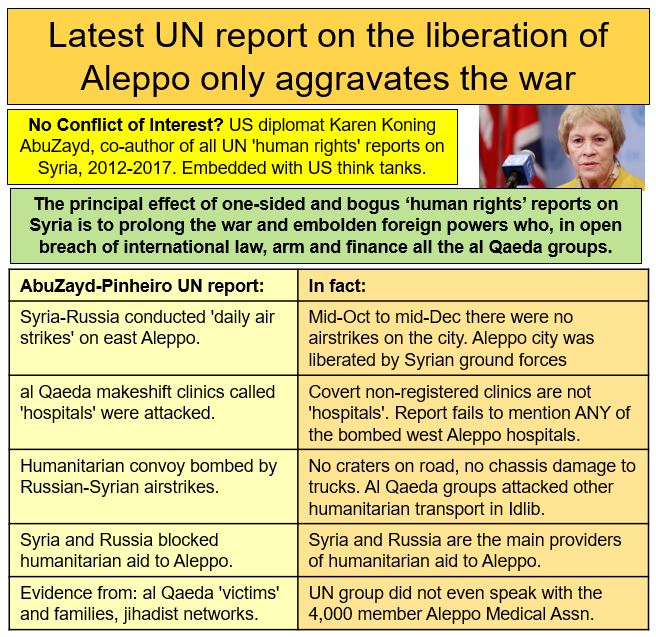
UN committee’s bogus Syria “human rights” report ignores evidence. Co-author’s blatant conflict of interest

[Co-author] Karen AbuZayd is a director of the Washington based Middle East Policy Council, itself a strong supporter of the US-led dirty war on Syria. Other MEPC directors include present and former US military, intelligence, oil industry and other US corporate figures.
Global Research, March 03, 2017

A UN committee has produced another one-sided, bogus ‘human rights’ report on last year’s liberation of Aleppo, Syria’s second city. Co-authored by US diplomat Karen AbuZayd and Brazilian Paulo Pinheiro, the report attacks both the Syrian Army and the al Qaeda groups (UNGA 2017).

However its stronger condemnation of the Syrian Army is notable, as part of constant attempts to delegitimise the Syrian people’s struggle to liberate their own country from the NATO-backed terrorists. This report follows similar partisan attacks from ‘watchdog’ groups embedded with the US State Department, Human Rights Watch and Amnesty USA.

None of these groups have condemned the anti-ISIS operation in Mosul (Iraq) in the way they did the anti-al Qaeda operations in Aleppo (Syria).

The principal effect of the one-sided and bogus ‘human rights’ reports on Syria is to prolong the war and embolden foreign powers who, in open breach of international law, arm and finance all the al Qaeda groups in Syria and Iraq.

Although the latest AbuZayd-Pinheiro report is poorly referenced it follows much the same method as other US-backed ‘human rights’ denunciations: (i) speak to a number of anonymous al Qaeda ‘victims’ and their families, mainly in Turkey but some also by phone in the al Qaeda occupied parts of Syria, (ii) collate the latest claims from US-funded and jihadist-linked groups, (iii) make no visit to Syria nor communicate with Syrian organisations (e.g. there is no sign the committee tried to speak with the 4,000 member Aleppo Medical Association) and then (iv) present a thoroughly one-sided judgement.

The western media mounted furious propaganda resistance to the Syrian Army’s operation to take back Aleppo, claiming there were ‘indiscriminate’ airstrikes, and so on. Syria and Russia denied these accusations and the AbuZayd-Pinheiro report has backed them all.

Notable features of the report include: obviously false assertions about supposed ‘daily airstrikes’ on Aleppo city, the suggestion that al Qaeda makeshift clinics were the only ‘hospitals’ in Aleppo, and the baseless claim that Syrian-Russian airstrikes destroyed a humanitarian convoy.

The report claims that “Syrian and Russian air forces conducted daily air strikes in Aleppo throughout most of the period under review”, that is July-December 2016. On this basis the committee adopts the armed groups’ claims that eastern Aleppo was subject to constant ‘barrel bomb’ and chemical weapons attacks (UNGA 2017).

However, unlike the AbuZayd-Pinheiro report, much of the western media did report that air strikes on the city were halted in mid-October, as humanitarian corridors were established for the evacuation of civilians. When Russian air strikes resumed several weeks later, in mid-November (despite efforts by the New York Times on 16 November to fudge this detail), they were on al Qaeda and ISIS groups in rural Idlib and rural Aleppo; not on the city. The liberation of Aleppo between October and December was almost entirely through Syrian ground forces smashing resistance street by street. So the ‘daily airstrikes’ on Aleppo city, spoken of in the AbuZayd-Pinheiro report, is an obvious falsehood.

On hospitals, the report names several armed group makeshift clinics in eastern Aleppo, none of which were marked and registered hospitals. (Clinics lose their protection under international law when they become covert military support installations.) By contrast there is not one single mention of the large hospitals of western Aleppo (Dabbit, Ibn Rush and al Razi), which were bombed by the al Qaeda groups in 2016.

The attack on a UN humanitarian convoy on 20 September (just days after the 17 September US-led airstrike massacre of 80 Syrian soldiers fighting ISIS in Deir Ezzor) was blamed squarely on a Syrian or Russian airstrike, it seems on the basis of evidence from anonymous ‘witnesses’. There is no plausible motive for this. Syria and Russia were and remain the largest providers of services and humanitarian aid to all Aleppo communities.

The report fails to mention the fact that the armed groups in eastern Aleppo had emphatically rejected humanitarian aid, holding a demonstration just one week before the burning of those trucks. A UN spokesperson at the time claimed the armed groups were blocking the delivery of aid for “political gain” (Sanchez 2016). Further, the Russian military had observed that there were no craters on the road nor destruction of the trucks’ chassis, as would be the case with aerial bombing (RT 2016). The area had been occupied by al Qaeda groups who have a record of murder of civilian drivers and burning trucks; they did this two months later when civilian trucks traveled through Idlib to the besieged Shi’a villages of al Fouaa and Kefraya (Pasha-Robinson 2016). The AbuZayd-Pinheiro claims about Russian-Syrian airstrikes on this convoy and therefore baseless and contrary to the known evidence.

The AbuZayd-Pinheiro committee is the same one which, from Geneva, fabricated a report on the terrible Houla massacre of May 2012, in which over 100 villagers were killed by the NATO-backed Farouq Brigade (FSA). At least 15 independent witnesses identified Farouq brigade (FSA) leaders (Abdulrazzq Tlass and Yahya Yusuf) and local collaborators (Haitham al Housan, Saiid Fayes al Okesh, Haitham al Halq and Nidal Bakkur) for the massacre (see Anderson 2016: Ch. 8). The AbuZayd-Pinheiro committee, however, tried to blame un-named “shabiha” militia loyal to President Assad. No motive was given. Some of these villagers had participated in the recent National Assembly elections, over which the jihadists had demanded a boycott. The obvious partisan nature of the Houla report led Russia, China, India and others to withdraw their support from this and future UN Security Council resolutions on Syria.

Karen AbuZayd is a director of the Washington based Middle East Policy Council, itself a strong supporter of the US-led dirty war on Syria. Other MEPC directors include present and former US military, intelligence, oil industry and other US corporate figures. On simple conflict of interest principles she should never have been appointed to such a committee, as a diplomat from one of the warring parties. Former UN Secretary general Ban Ki Moon was responsible for this error. Washington, for its part, has been too absorbed in hubris to notice that it is unseemly to pretend to be both assailant and mediator.

UN special envoy Stefan di Mistura, despite being ‘appalled and shocked’ that the armed gangs were targeting and killing ‘scores’ of civilians in western Aleppo by ‘relentless and indiscriminate’ rocket attacks (BBC 30 October), nevertheless proposed an ‘autonomous zone’ in eastern Aleppo to protect the al Qaeda controlled areas. The proposal was emphatically rejected by the Syrian Government (Reuters 20 November), which went on to eject all the al Qaeda groups from Aleppo in late December 2016.

Purchase Tim Anderson’s book “The Dirty War on Syria” directly from Global Research Publishers

ISBN Number: 978-0-9737147-8-4

Year: 2016

Pages: 240

Author: Tim Anderson

List Price: $23.95

Special Price: $15.00 – click to order

Sources:

Anderson, Tim (2016) The Dirty War on Syria, Global Research, Montreal

Barnard, Anne and Ivan Nechepurenko (2016) ‘Airstrikes on Aleppo Resume as Russia Begins New Offensive in Syria’, New York Times, 16 November, online: https://www.nytimes.com/2016/11/16/world/middleeast/syria-aleppo-russia-airstrikes.html

BBC (2016) ‘Aleppo siege: UN envoy Mistura ‘appalled’ by rebel attacks’, 30 October, online: http://www.bbc.com/news/world-middle-east-37816938

Pestano, Andrew (2016) ‘Aleppo airstrikes resume after 3-week pause’, UPI, 15 November, online: http://www.upi.com/Top_News/World-News/2016/11/15/Aleppo-airstrikes-resume-after-3-week-pause/8561479211543/

Pasha-Robinson, Lucy (2016) ‘Buses used to evacuate Syrians from villages ‘attacked and burned’’, 19 December, online: http://www.independent.co.uk/news/world/middle-east/syria-crisis-aleppo-what-is-happening-villages-buses-attacked-and-burned-a7482736.html

Reuters (2016) ‘Syria foreign minister says no to east Aleppo autonomous zone’, 20 November, online: http://www.reuters.com/article/us-mideast-crisis-syria-aleppo-idUSKBN13F0J1

RT (2016) ‘Russian, Syrian Air Forces did not strike UN aid convoy in Aleppo – Russian MoD’, 20 September, online: https://www.rt.com/news/359990-russia-denies-aleppo-strike/

Sanchez, Raf (2016) ‘UN says armed Syrian groups blocking Aleppo aid for ‘political gain’, UK telegraph, 14 September, online: http://www.telegraph.co.uk/news/2016/09/14/un-says-armed-syrian-groups-blocking-aid-to-aleppo-for-political/

SOTT (2016) ‘Keeping their word: No Russian or Syrian airstrikes on Aleppo for 7 days, humanitarian corridors open’, SOTT News, 25 October, online: https://www.sott.net/article/332069-Keeping-their-word-No-Russian-or-Syrian-airstrikes-on-Aleppo-for-7-days-humanitarian-corridors-open

UNGA (2017) ‘Report of the Independent International Commission of Inquiry on the Syrian Arab Republic’, 34th session, A/HRC/34/64, 2 February, online: https://documents-dds-ny.un.org/doc/UNDOC/GEN/G17/026/63/PDF/G1702663.pdf?OpenElement

Damascus demands UN action against illegal Turkish incursions, reveals location of main Turkish base inside Syria

From Fort Russ

February 18th, 2017 – Fort Russ News
– Al Binaa – translated by Samer Hussein –

Syrian Ministry of Foreign Affairs has renewed calls to the UN Security Council for an immediate end of the violations of The Syrian sovereignty by the Turkish Armed Forces.

The Ministry also published a list of all violations that occurred since last December.

The letter, which was addressed to the UN Secretary General and the President of the UN Security Council, mentions illegal incursions into Syrian territory, building a wall within the so-called Turkish buffer zones (which exist on the sovereign Syrian territory), destruction of the property belonging to the Syrian citizens such as uprooting of hundreds of olive trees in order to build roads for the tanks of the Turkish army (as recently seen in the village of Qljabreen in the Azaz area of Aleppo province) and illegal backing of the terrorist groups which are loyal to the regime in Ankara.
The letter further states that the Turkish authorities recently established a military base inside Syrian territory, more precisely in the village of Jtrar, North of the town of Tal Rifaat, located in the province of Aleppo. The base includes the headquarters for the Turkish army personnel and their allies who are stationed on the Syrian soil and are allegedly involved in the so-called “Operation Euphrates Shield”. Ammunition depots are also being mentioned.

The letter reads: “The Syrian Government renews calls to the UN Security Council to hold to its responsibilities and act in accordance with the International Law and to pressure Turkey in order to stop the violations of the Syrian Arab Republic’s sovereignty and territorial integrity. ”

Briefing by Foreign Ministry spokesperson Maria Zakharova, Moscow, January 19, 2017; on Obama’s impact on Russian-American relations and UN statement by Samantha Power

From the Ministry of Foreign Affairs of the Russian Federation
January 19, 2017

Excerpts:

Obama presidency impact on Russian-American relations


As you may know, the new US President, Donald Trump, is to be inaugurated on January 20. This offers hope that the tensions in Russian-US relations that were engineered by the former Obama team will be supplanted. In recent days, we have heard a lot about Russia, particularly on the foreign policy track, from the US administration and its representatives. Apart from the inauguration, today is the last day for the outgoing administration. It seems that the statements made by foreign policy officials – our colleagues, or our partners, as we call them – over the past few days present an occasion to sum up the relations between our two countries during Barack Obama’s eight years in power. There is a lot to talk about, and so I’ll take the time to talk about it.

The results, regrettably, are lamentable. The outgoing Democratic team has consciously ruined bilateral relations, allowing them to fall to Cold War levels. Moreover, this approach has continued to its final day and even continues in its last hours in an attempt to batter their foundation.

In retrospect, it will be recalled that it was Barack Obama who declared a reset in and an all-out development of relations with Russia at the start of his first term of office in 2009. At a certain stage, we managed to sign a number of important bilateral agreements, including the START Treaty (2010).

But our partnership didn’t last long. While in word promising to cooperate respectfully, Washington really envisioned a style of cooperation that looked more like the leader and the led. This is the approach that the White House is accustomed to using with the Western European countries. When it became clear that it would not work with Russia, the US began to fear that we would strengthen our position in the world and began steering towards a confrontation, which, among other things, included using various forms of pressure.

I would like to stress in particular that this began well before the events in Ukraine. Everything that was later covered up and explained by Crimea, Donbass and so on, had nothing to do with reality. We expressed this on many occasions. I can cite several examples: the anti-Russian Magnitsky Act of December 2012; we also recall that, even before the events in Ukraine, US secret services launched a real hunt for Russians in third countries. The most notorious case in point is the abduction of Viktor Bout, but there were another 27 Russian nationals who fell victim to this vile game thereafter. US secret services and the administration were acting on the sly: they did not advise Russian law enforcement about the grievances against our fellow citizens (although the laws needed for this were in place) but they abducted them during their travels abroad.

Washington even avoided consultations on a joint effort against cybercrime, although 60 per cent of the said arrests in third countries were related to accusations of stealing credit card data or account fraud. Russia regularly and repeatedly offered proposals to cooperate in this area. Similarly, they were reluctant to go along with us on other issues on the bilateral agenda.

Still fresh in our memory were attempts to discredit the Winter Olympic Games in Sochi (incidentally, this was also before Crimea), which were made both shortly before and directly during the Olympics. Later this took the form of an unprecedented public harassment campaign directed against Russia’s entire sports organisation. Symptomatically, the US Anti-Doping Agency played first string in attempts to cut Russian athletes from international competitions. Let me remind you that the USADA is financed by the US.

The coup in Kiev three years ago, in which the Obama administration was involved, put everything in the right perspective in our relations with it. Since the Obama administration openly proclaimed a policy for the systematic containment of Russia, our American partners have suspended many communication channels, including the Bilateral Presidential Commission and its 21 working groups.

Using sanctions to pressure Russia, Washington has imposed or expanded various restrictions against Russia 35 times under a variety of pretexts since 2014. The United States has blacklisted 172 Russian citizens and 350 legal entities, including Russia’s leading companies in energy, the defence industry and the financial sector.

To justify this policy, they have invented a completely unsubstantiated thesis about Russia’s “aggressive behaviour” and unleashed a powerful propaganda campaign to support it. The United States used this pretext to build up the Pentagon’s and NATO capabilities on the Russian border, continued with BMD deployment and carried out other military preparations. We have talked about this in detail and have provided our views on it. Acting within this policy, which has been undermining European and global security, the White House referred to the Baltic countries and Poland as “frontline states,” as if they seriously believed that a military confrontation with Russia was possible.

Initially, Washington’s policy of isolating Russia caused only misunderstanding. It was difficult to take the stated objectives seriously, and we were right, because this policy suffered a crushing defeat. But they provided a philosophical and politological basis for their defeat. US Secretary of State John Kerry said while on a visit in Moscow that the United States cannot do without Russia in tackling international issues. It took them only a few years – not decades – to invent an isolation concept, attempts to implement it and then explain why it failed.

I would like to provide proof of the absurdity of this concept: over 14 months from May 2015 to July 2016, US Secretary of State John Kerry visited Russia four times at his initiative. Also, 66 of the 70 telephone conversations with Foreign Minister Sergey Lavrov were held at his request last year alone, at the height of Russia’s alleged isolation. I wonder how many telephone conversations we could have had if the situation in bilateral relations were close to normal.

However, our attempts to work with the United States on some international issues were complicated by the Obama Administration’s inconsistency. For example, Washington kept advancing new demands regarding Syria but failed to implement its commitment to separate the so-called moderate opposition from the terrorist groups. They had more than enough time to do this. The United States made this commitment a year ago, but as you know, it has not implemented it. On the contrary, instead of following through on White House pledges to proceed towards a peaceful settlement, they did their best to protect the terrorists from strikes and even supplied weapons to them, including Jabhat al-Nusra. They planned to use the terrorists to overthrow the government in Damascus. Mind you, we are not talking about imaginary moderates but a combat division of al-Qaeda, an organisation that killed 3,000 Americans on September 11, 2001. Under American law, support for terrorists is a serious crime. Americans have all heard about the alleged Russian hackers, but nobody knows that the US administration supported an organisation that killed Americans.

The state of affairs in the economy was no better. Washington’s targeted efforts provided all the opportunities for this purpose, using all available leverage on the international scene to make life more difficult for Russian economic operators and the entire Russian economy. You may recall that Barack Obama noted with satisfaction some time later that the Russian economy was “in tatters.” Of course, this could have been true, but I would like to say that leading US companies did not want to leave the Russian market despite the White House’s insistence. It proved impossible to engineer Russia’s complete isolation even within the United States, although bilateral economic relations were damaged. As you understand, we had to do something. So, we took advantage of the emerging situation to promote our own economic development agenda and diversified our global trade ties.

It should be specially noted that, several years ago, the Obama administration started exerting routine pressure on Russian diplomatic missions in the United States. Unfortunately, attempts by the secret service to recruit Russian officials became an extremely unpleasant part of the daily routine. Last year, out of the blue, came a ban on Russian diplomatic missions using some of  their vehicles, including large-capacity buses, which lasted for several months. This was followed by toughening the regulations for the stay of official Russian delegations in the United States: now they had to notify the US Department of State about any trips outside the 25-mile (41-kilometre) zone around Russia’s diplomatic missions. Just think how much this limited their opportunities.

We are now discussing this openly. All this time, we tried to cooperate constructively with the US Department of State on all these issues. This was our day-to-day work which involved the Russian Embassy and the Foreign Ministry, and continued during talks between the Russian Foreign Minister and the US Secretary of State. We raised and discussed all these issues. On the other hand, we do perceive a desire of State Department representatives to sort things out; many of their efforts proved sincere but were blocked  at the administration level. Our work became increasingly difficult.

In 2013, US authorities began to persecute American citizens planning to take part in introductory tours organised by the Federal Agency for the Commonwealth of Independent States, Compatriots Living Abroad and International Humanitarian Cooperation (Rossotrudnichestvo). As you may remember, we have discussed this issue in the past. The FBI began to summon them for interrogations and openly intimidate them. In January 2016, US authorities went as far as to strip five of the six Russian honourary consuls of their accreditation in various states. These honourary consuls also helped expand bilateral ties, conducted practical work and maintained cooperation involving ordinary people. That is the environment in which we had to work.

It is also hard to assess from positions of common sense the russophobic hysteria that began to be incited in the US in the run-up to the presidential election. The US presidential election is a special factor and a special stage in bilateral Russian-US relations. In the summer of 2016, the White House leaked groundless accusations of Russia interfering in the election campaign and information about “Russian hackers” allegedly tampering with servers, websites, etc. to the media. The media and US secret services incited this all the time through “leaks” and through reports published by their “pocket” media. They forced the public to consume this media concoction involving pseudo-facts.

After the November 8 vote, as I see it, the Obama administration just went over the edge. One had the impression that they had decided to vent their entire wrath on us. It was not simply a conceptual story, where we were a factor in their political infighting. No sir, it was base household vengeance that admitted of all expedients. And the whole reason was that the Democratic candidate, Hillary Clinton, lost the election. This was done in order to maximally complicate things for the President-elect, Donald Trump, and call into question his victory. All of that, in our view, assumed morbid forms. Lies and not just concoctions about “hacking” and “Moscow’s stolen election” were pouring in torrents.

We have yet another version. Among other things, all of this might have been done and continues in the same vein today because the Democrats want to vindicate themselves before the numerous sponsors of their campaign. That campaign was not simply expensive: it was one of the costliest or even the costliest in history. A huge amount of money was circulating in the race. The mainstream media were trying to leave people in no doubt that Clinton and no other was to win. This was being done to attract even more money. Now they have to give an account to their donors. Some unseemly things are coming to the surface, like improper use of the media, plants and suppression of information. They have to bear not only moral but also financial responsibility before these people. But they always have an answer at the ready as to who is to blame. That’s right, Russia is to blame. Many millions of dollars were invested in the hope of future political and commercial dividends. Of course, they have to acquit themselves. But regardless of their motives, additional serious damage was done on purpose to our relations, primarily to the trust between our countries and peoples.

The expulsion from the United States of 35 Russian diplomats on New Year’s Eve and the barring of access to the Russian Embassy’s and the Russia UN Mission’s recreational facilities enjoying diplomatic immunity (for they have no other status under the law) is a story apart. This is a case of actual confiscation of property that is owned by the Russian government and enjoys diplomatic immunity, which is a gross violation of the 1961 Vienna Convention on Diplomatic Relations.

As you may know, we have decided to refrain from a mirror-like response to these totally inadequate escapades. But the principle of reciprocity in diplomacy is still in effect. The Obama administration’s behaviour is so absurd and shameful for such a great country as the United States that one is hard put to associate these convulsive actions with what the American people stand for.

We sincerely regret that the Obama presidency, particularly its second term, was a period of lost opportunities for bilateral relations. It did little good for the rest of the world as well, with instability increasing over the past eight years, including because of Washington’s reckless moves.

We would like to hope that following the changes in the White House it will become possible to reverse the dangerous trend towards decay in Russian-American ties and lead our relations out of the nosedive where they were sent by Barack Obama. We expect the new administration to display wisdom and willingness for a normal pragmatic dialogue, for which Russia has always been ready.


The situation with Russian recreation facility in Oyster Bay


I would like to note that according to our data and press reports, unidentified persons, accompanied by the police, broke the locks on the fence and entered the property. All this is clearly a violation of diplomatic immunity and ownership rights, and it is also a very dangerous trend that generally violates all the existing norms and ideas regarding the legality of the authorities’ actions.

Let me reiterate, we will monitor the situation, and we will definitely comment on it as soon as we get updates.


Statement by US Permanent Representative to the United Nations Ambassador Samantha Power


And the last remark to wrap up the topic. I cannot leave this without comment because to a large extent the actions taken by our American colleagues regarding Russia were based on unreasonably high ambitions, and at times it simply looked like ignorance. This is confirmed by a recent statement by US Permanent Representative to the United Nations Ambassador Samantha Power. She claims that the United States “defeated the forces of fascism and communism” and “now confront the forces of authoritarianism and nihilism.”  

Let us get this straight. She referred to four phenomena. Who defeated fascism? This claim is made by a person who works at the United Nations, which was established by the international community following the outcome of World War II. Isn’t it embarrassing to make such a claim? What about the anti-Hitler coalition and its members’ contribution? Is it the US alone that defeated Nazism? She should have said that they defeated fascism on their territory to testify to her total ignorance.

The United States “defeated the forces of communism.” The UNSC has 15 chairs around its table with five of them occupied by permanent members.  Every day Samantha Power faces the Permanent Representative of China. She might at least have wondered how big the membership of the Communist Party in that country is, so as not to feel embarrassed to enter the UNSC.

Now they “confront the forces of authoritarianism.” So much has been voiced during the election race! The administration was totally engaged in the US presidential election. We watched all that, there is nothing to hide. All the administrative backup was aimed at one thing – Hillary Clinton’s victory. I wonder if Samantha Power knows which countries made contributions to the Clinton Foundation? This is regarding confronting the forces of authoritarianism. Or maybe she believes they are fighting authoritarianism by getting money from it? The list of countries should be made public, and then it will become absolutely clear with whom the US cooperates and from whom the Democratic presidential candidate gets the funding.

I don’t even want to comment on confronting the forces of nihilism. It is nothing but historical and philosophical obscurantism to claim that the world’s largest country is fighting nihilism; this is beyond comment.

Those claims have cleared up a lot of things.


Persisting violations of migrant rights in EU countries


We have noticed the information coming from the European Border and Coast Guard Agency, that recorded 503,700 attempts to illegally cross European Union borders in 2016. Most of these people, 364,000 of 503,700, arrived in EU countries via the Mediterranean Sea.

We would like to note that, despite the reduced migrant traffic via the Aegean Sea, the situation in the central Mediterranean region remains tense. In 2016, 181,000 people arrived via Libya in Italy alone last year from Nigeria, Eritrea, Guinea and other African countries; this is 20 per cent more than 2015 levels. And this figure includes 24,000 unattended minors. Of course, this is the most vulnerable category in need of special attention and protection, so that it will not be victimised by organised crime. They arrive in another country absolutely illegally and completely unattended. Doubtless, a tragic fate awaits most of these children.

Obviously, illegal migration via the Mediterranean will continue through 2017, and could lead to new violations and fatalities. According to the International Organisation for Migration (IOM), 219 people died since early January 2017.

We would also like to voice our regret in connection with the absolute sluggishness of the concerned agencies of the EU member-states, including Germany, that have failed to review about 943,000 requests by asylum-seekers in a timely manner. As a result, people have to live in uncomfortable and degrading conditions while waiting for a decision. We urge our European partners to honour their obligations under the 1951 Convention Relating to the Status of Refugees and the 1967 Protocol Relating to the Status of Refugees.

We would like to once again recall that the migration situation has been aggravated by an irresponsible and ill-conceived policy aiming to destabilise states and replace undesirable governments in the Middle East and North Africa. Only a revision of this policy and the attainment of peace and stability in Syria, Libya, Iraq, Yemen and other countries can significantly change the situation for the better.


Anti-Russia insinuations in the context of talks on a Cyprus political settlement


We have reacted with dismay to comments by some Cypriot media outlets in the context of the recent conference on a Cyprus political settlement in Geneva. For example, some stories claim that Russia is allegedly trying to prevent the island’s reunification. According to the logic of these media outlets, EU-Turkey rapprochement, as well as EU-NATO cooperation that has been blocked by the unresolved situation at the talks between the two Cypriot communities, allegedly don’t meet Russian interests.

We clearly see the discontent of certain pro-US and pro-UK political circles with the principled Russian stand implying that ready-made prescriptions and artificial haste should not be imposed on the parties to the Cypriot conflict to quickly achieve a final resolution to the Cypriot issue at any cost.

In this connection, we would like to once again emphasise our conviction that a long-term and lasting resolution to the Cypriot issue is only possible if it reflects the political will of Greek and Turkish Cypriots, and if it is accepted by the entire population of the island. To the best of our knowledge, the leaders of both Cypriot communities agree with this precept. This is simply common sense.

Claims about any Russian attempts to block, obstruct or hamper the negotiating process are not backed by fact and are unreasonable.

We would like to note that anti-Russia insinuations are like a “smokescreen” for obscuring the real problems that need to be resolved in a Cypriot political settlement. For example, Russia only maintains a cultural-humanitarian and economic presence in Cyprus. At the same time, sovereign UK bases are still maintained on the island under the 1960 Zurich-London agreements. This is an obvious anachronism in the current situation. However, the Western press does not consider this situation in any way, and we are not seeing any mood of protest in the Western media.

Russia successfully develops its relations with the Republic of Cyprus in various areas, and we are confident that these relations will continue to be strengthened in the event of the island’s reunification. We know that Cypriot leaders advocate the sustained development of bilateral cooperation. We believe that anti-Russia comments by a number of media outlets do not benefit this process and do not meet the interests of the Cypriots themselves. We hope that the Cypriot authorities will respond accordingly.


Alleged Russian involvement in cyberattacks against the OSCE


Unfortunately, a new page has been added to the unprecedented campaign to discredit Russia in the eyes of the global public.

Washington tried to explain its losses by blaming the alleged Russian high-tech intervention in the US election system. It also did this to shift the image of the top global cyber aggressor from itself to Russia, although we know, from materials which have sent many people in the United States to prison, who staged cyberattacks and who were the targets. Instead of remorse and ceasing cyber interference in the global information space, some Western countries continue to work to present Russia as a cyber-aggressor country that is a threat to global cyberspace.

We regret that Germany has taken this path too, choosing to follow in the footsteps of its senior partners. In particular, German security services have accused Russia of attacking OSCE servers, an international organisation responsible for security and stability in Europe. How should we respond to this?

I don’t have to tell you that we have not received any response to the official requests we sent to the related organisations in charge of investigating any such incidents. You only find information in the information space, which prompts the conclusion that our partners never had and still have no proof or facts to implicate our alleged crimes.

These accusations sound especially absurd considering that a month ago Foreign Minister Sergey Lavrov proposed at the OSCE Ministerial Council meeting in Hamburg, Germany, an action plan aimed at strengthening confidence in the information space. The first measure was to identify ways to improve the OSCE role in resolving cyber incidents and for the OSCE to provide a platform for direct dialogue on this issue.

Russia has proposed many initiatives on international information security over the past years. These include a concept for a UN Convention on International Information Security, the International Code of Conduct for Information Security drafted by the SCO member states, the above action plan for the OSCE and many other documents.

Russia has long urged its partners to adopt a special legal instrument for fighting mercenary cybercrime and cyber bullying.

This could be the universal UN convention on cooperation in fighting information crime, which Russia drafted. The drafted convention includes several provisions on fighting the deliberate abuse of online information, which is, in plain English, hacking.

Russia is ready for any form of cooperation in fighting cyberattacks and has formulated certain proposals in this sphere, whereas the unconstructive Western position is hindering the development of international cooperation in this area. We hope our partners will stop shifting the blame onto us and will instead look at the situation soberly and without bias.


For the full press conference:

http://www.mid.ru/en/press_service/spokesman/briefings/-/asset_publisher/D2wHaWMCU6Od/content/id/2605982