Nemtsov’s killer was hired by the commander of Dzhokhar Dudaev Battalion in Ukraine, Adam Osmaev

Posted on Fort Russ

Adam Osmaev

March 12, 2015
Anna Veligzhanina for Komsomolskaya Pravda
Translated by Kristina Rus

FSB source to “Komsomolskaya Pravda”: “the customer of Nemtsov’s murder was preparing an assassination of Vladimir Putin”

The main suspect in the organization of the high-profile crime – is a commander of the Ukrainian battalion in the name of Dzhokhar Dudayev, Adam Osmayev.

The correspondent of “Komsomolskaya Pravda” met with the FSB agent, who is part of the team investigating the murder of Boris Nemtsov. In an exclusive interview he spoke about the new details of the crime and named the most likely customer of the murder.

The pistol was found

Today the investigators have irrefutable proof that all persons detained on suspicion of murder of the politician are the perpetrators, – said our source in the FSB. First of all, billing (data about calls and movements of the subscriber. – Ed.) from their mobile phones showed that they conducted surveillance of Nemtsov before the murder, following him closely. The suspects were tracked with their phones at the location where Nemtsov was present with his phone. During the murder all the detainees “were in the area”: some under the bridge, some in a car, some nearby.

Zaur Dadaev pulled the trigger. He first made a confession, and then, on the advice of his lawyers, took it back. But it changes nothing, the investigation has already collected compelling evidence of his guilt. I will not give details of how this was done. The pistol was thrown into the river after the crime, it was later recovered by divers. That Zaur Dadaev immediately said to the TV cameras: “I love prophet Muhammad” – is just a cover. There was no religious motive for the killings. They cynically carried out an order. They are far from devout Muslims. In fact, just real gangsters.

And the most important thing. The executor of the murder was in close contact with Adam Osmaev, who recently became the commander of the Ukrainian battalion in the name of Dzhokhar Dudayev. They met, talked a lot on the phone. Zaur Dadaev and his cronies worked with Osmaev on Ukrainian affairs. And also with Chechens, who fought on the territory of Ukraine for the new regime. Zaur Dadaev was listed in the battalion “North” (“Sever”) of the Chechen Interior Ministry, but while serving in it, in fact, was engaged in activities against Russia. He was associated with Osmaev by a certain relationship and mutual obligations.

Непосредственно нажал на курок Заур Дадаев, который сначала дал признательные показания, а потом, по совету адвокатов, отказался от них
Zaur Dadaev

When the journalists from the Russian TV channel “Life News” were recovered from Ukraine, Zaur Dadaev was involved in this operation. Held direct communication with Osmaev. I don’t have the right to disclose the details. The evidence is still being gathered. But I can say that today the main suspected customer of Nemtsov’s murder is Adam Osmayev.

“The main purpose of the crime is to show Russia in a bad light”

– The perpetrators were told to execute the order in the place where it was committed, – continues our source. – Another words not just to kill him in the alley, but do it in the heart of Moscow across from the Kremlin – deliberately to cause outrage around the world. Before the crime they received the advance payment, it was agreed that the remainder of the money for the “job” will be transferred to their bank account.

– Why did they have to kill Nemtsov, who spoke out against Putin’s policies? It turns out, they had killed their ideological ally!

– [Ultra-] Nationalists and criminals will not stop at anything. To kill their ally for them is not a question of morality. Nemtsov became a bargaining chip. The goal was – to slander Russia, to show it in a bad light, to prevent peace in Donbass (especially after talks with Merkel and Hollande). To show the President of Russia in the eyes of the world community as the “ultimate evil” – to show: look, how he strangled the opposition. The world just began to warm up to Putin’s politics, which he is following in relation to Ukraine. And this cynical murder of Nemtsov has caused a wave of discontent, fueled by the world media. The American and European press immediately began to show this murder in their own light, placing the responsibility on the President of Russia.

Националисты и бандиты не брезгуют ничем. Убить своего союзника для них - не вопрос морали. Немцов стал разменной монетой

Preparing to blow up the President’s motorcade

Adam Osmayev was previously suspected in the attempt to organize the 2012 assassination of Vladimir Putin, at that time a Prime Minister and presidential candidate. Osmayev  planned to blow up Putin’s motorcade, which was confirmed by a video, found in his laptop, of Prime Minister’s motorcade travelling through Moscow. Then Osmaev cooperated with the investigation – admitted he came to Odessa from the United Arab Emirates with instructions from field commander Doku Umarov. But in court Osmayev refused to testify, claiming he gave his testimony after a beating. His lawyers wrote a complaint to the Prosecutor’s office and the European Court of Human Rights.

– Osmaev failed to get to Putin himself, but it seems that he did not calm down, – says our source in the FSB. – And later the most accessible target to attack the President was selected – Boris Nemtsov. Nemtsov lately was not seen as an active member of the opposition, was no competition to Putin, but his name was known. The choice of a sacrificial lamb was quite successful. The gangsters do not stop at anything. And gangsters involved in politics is a devilish blend.

Адам Осмаев ранее подозревался в попытке организации в 2012 году покушения на Владимира Путина
Adam Osmaev

– Will Osmaev be charged?

– Now everything is in the stage of investigation and evidence collection. Some of the evidence we already gathered, but I don’t want to tell everything in order not to hinder the investigation.

“KP” Files

What was Adam Osmayev “famous” for…

In 2007 in Moscow on the eve of Victory Day a terrorist attack was averted – explosives were found in a parked car. A native of Grozny, Adam Osmayev, a suspect in the case, was arrested in absentia by the Lefortovsky district court of Moscow and declared for international search. The investigation found that Osmayev with a group of Chechens and Ingush was also preparing an assassination on May 9 of the head of Chechnya, Ramzan Kadyrov.

According to the press, after that Osmayev was hiding in the UK, where he was contacted by associates of Doku Umarov and was offered to organize a new terrorist attack. Adam agreed and went to Ukraine with a fake passport. In 2012, he was arrested after an explosion in a rented apartment – the terrorist was preparing homemade bombs. Osman and his “right hand”, a Kazakh citizen, Ilya Pyanzin, admitted: they were preparing an assassination of the head of the government of Russian Federation, Vladimir Putin. The suspects also reported that they recruited fighters for future terrorist attacks in Russia. But later they took back their testimony.

Russia demanded to extradite Adam Osmayev, however, the European Court of Human Rights had blocked it, declaring: “In Russia the detainee may be subjected to torture”. Pyanzin eventually was extradited to Russia, and in September 2013 he was sentenced to ten years in a colony with a strict regime.

On November 18, 2014, the court of Odessa declared a sentence for Osmaev: 2 years and 9 months imprisonment. He was released in the courtroom “for lack of evidence of preparation of assassination” – he was credited the time he already spent in jail. The court room reacted to the sentence of Osmaev with applause, and he, in turn, encouraged them to “protect Ukraine”.

In February of this year Osmayev headed the Ukrainian battalion  in the name of Dzhokhar Dudayev, succeeding the general, deceased under Debaltsevo, Isa Munaev.

OFFICIAL COMMENT

Dmitry Peskov: In the coming days, the prosecutors will announce the motives for the murder

“We hope that in the coming days all legal formalities will be completed and prosecutors will announce their versions of the murder, will name those who are behind this,” said the President’s press secretary Dmitry Peskov to the journalists of “AP”, answering the question about the prospects of completing the investigation of the murder of Boris Nemtsov.

Readers Comments:

– You can’t make up a better plan to frame Kadyrov through Osmaev (Kadyrov’s worst enemy) and Dadaev  (a traitor), and most importantly to smear Russia

– This looks like the truth. The volunteer battalion is likely curated by the SBU. And SBU is a branch of American special agencies. Classic sacrificial lamb. Technologies of color revolutions are very cynical. The fifth column doesn’t realize that it is just disposable material for the puppet-masters.

– What a present to Kadyrov and Putin – Nemtsov’s murder! How could Kadyrov be so fooled!

– If you continue down the trail, it might lead to the UK or Americans

Kristina Rus: 

Another important point to make, is that although in Russia Nemtsov was virtually forgotten, except to the old-timers and his direct followers (he complained that he has not been on Russian TV in 8 years), Nemtsov was quite popular in Ukraine, and was frequently invited on Ukrainian TV as a Putin’s critic and a supporter of the current regime, creating a perception that he was a major opposition player in Russia. Although it is true that Nemtsov was in charge of organizing the anti-Putin rallies in Russia, he himself admitted in personal conversations in his wire taps that he had no future chances in politics, because of his disastrous track record in the 1990’s, when he was a Deputy Prime Minister at the time of the economic collapse in 1998. It is possible that to Ukrainian and foreign observers Nemtsov’s importance looked more exaggerated then it was in reality, making him a likely candidate for a sacrificial lamb.

No matter how little attention was paid to Nemtsov by the Russian media, there is no one that the Western mainstream media can not make a celebrity overnight (even after their death) – and it was achieved.

The investigation, of course, learned about the connection to Ukraine much earlier. We can wonder if Putin tried to withhold these revelations until two weeks after the murder and after the Western media had a chance to pour all the dirt that they had on Putin and Russia, ending with the European Parliament resolution to demand independent investigation. 

Now Putin can get his popcorn and watch the West change their tune after the trail lead to Ukraine. Perhaps they will try to quickly forget about it and ignore it, just like the Boeing. 


http://fortruss.blogspot.com/2015/03/nemtsovs-killer-was-hired-by-commander.html

The Powell memo and the U.S. Chamber of Commerce

This memo, written in 1971 by Lewis Powell, an influential member of the corporate legal community, called on the U.S. Chamber of Commerce to take a more active and aggressive role in the country in promoting their voice. In it, he detailed the many avenues of influence the Chamber  could take in asserting their influence.

It is a key element to understanding the uniform voice coming from mainstream media, universities, public agencies, government officials — local, state, and federal — and the many “public-private” partnerships.

Lewis Powell became Associate Justice on the Supreme Court the following year, serving on the Supreme Court from 1972 – 1987.

This memo was cited in the Robert Parry article “The Victory of ‘Perception Management'”.

Background information:

From Wikipedia:

Powell was a partner for over a quarter of a century at Hunton, Williams, Gay, Powell and Gibson, a large Virginia law firm, with its primary office in Richmond (now known as Hunton & Williams LLP). Powell practiced primarily in the areas of corporate law (especially in the field of mergers and acquisitions) and in railway litigation law. He had been a board member of Philip Morris from 1964 until his court appointment in 1971 and had acted as a contact point for the tobacco industry with the Virginia Commonwealth University. Through his law firm, Powell represented the Tobacco Institute and various tobacco companies in numerous law cases…

On August 23, 1971, prior to accepting President Nixon’s request to become an Associate Justice of the Supreme Court, Powell sent the “Confidential Memorandum” titled “Attack on the American Free Enterprise System.” He argued, “The most disquieting voices joining the chorus of criticism came from perfectly respectable elements of society: from the college campus, the pulpit, the media, the intellectual and literary journals, the arts and sciences, and from politicians.” In the memorandum, Powell advocated “constant surveillance” of textbook and television content, as well as a purge of left-wing elements. He named consumer advocate Ralph Nader as the chief antagonist of American business.[19]

This memo foreshadowed a number of Powell’s court opinions, especially First National Bank of Boston v. Bellotti, which shifted the direction of First Amendment law by declaring that corporate financial influence of elections through independent expenditures should be protected with the same vigor as individual political speech. Much of the future Court opinion in Citizens United v. Federal Election Commission relied on the same arguments raised in Bellotti.

https://en.wikipedia.org/wiki/Lewis_F._Powell,_Jr.

Continue reading

Robert Parry: The victory of ‘perception management’

An exceptional and critically important article.

From Consortium News, December 28, 2014
By Robert Parry

Special Report: In the 1980s, the Reagan administration pioneered “perception management” to get the American people to “kick the Vietnam Syndrome” and accept more U.S. interventionism, but that propaganda structure continues to this day getting the public to buy into endless war, writes Robert Parry.

To understand how the American people find themselves trapped in today’s Orwellian dystopia of endless warfare against an ever-shifting collection of “evil” enemies, you have to think back to the Vietnam War and the shock to the ruling elite caused by an unprecedented popular uprising against that war.

While on the surface Official Washington pretended that the mass protests didn’t change policy, a panicky reality existed behind the scenes, a recognition that a major investment in domestic propaganda would be needed to ensure that future imperial adventures would have the public’s eager support or at least its confused acquiescence.
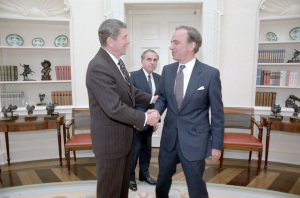
President Ronald Reagan meeting with media magnate Rupert Murdoch in the Oval Office on Jan. 18, 1983, with Charles Wick, director of the U.S. Information Agency, the the background. (Credit: Reagan presidential library)

President Ronald Reagan meeting with media magnate Rupert Murdoch in the Oval Office on Jan. 18, 1983, with Charles Wick, director of the U.S. Information Agency, in the background. (Photo credit: Reagan presidential library)

This commitment to what the insiders called “perception management” began in earnest with the Reagan administration in the 1980s but it would come to be the accepted practice of all subsequent administrations, including the present one of President Barack Obama.

In that sense, propaganda in pursuit of foreign policy goals would trump the democratic ideal of an informed electorate. The point would be not to honestly inform the American people about events around the world but to manage their perceptions by ramping up fear in some cases and defusing outrage in others – depending on the U.S. government’s needs.

Thus, you have the current hysteria over Russia’s supposed “aggression” in Ukraine when the crisis was actually provoked by the West, including by U.S. neocons who helped create today’s humanitarian crisis in eastern Ukraine that they now cynically blame on Russian President Vladimir Putin.

Yet, many of these same U.S. foreign policy operatives – outraged over Russia’s limited intervention to protect ethnic Russians in eastern Ukraine – are demanding that President Obama launch an air war against the Syrian military as a “humanitarian” intervention there.

In other words, if the Russians act to shield ethnic Russians on their border who are being bombarded by a coup regime in Kiev that was installed with U.S. support, the Russians are the villains blamed for the thousands of civilian deaths, even though the vast majority of the casualties have been inflicted by the Kiev regime from indiscriminate bombing and from dispatching neo-Nazi militias to do the street fighting.

In Ukraine, the exigent circumstances don’t matter, including the violent overthrow of the constitutionally elected president last February. It’s all about white hats for the current Kiev regime and black hats for the ethnic Russians and especially for Putin.

But an entirely different set of standards has applied to Syria where a U.S.-backed rebellion, which included violent Sunni jihadists from the start, wore the white hats and the relatively secular Syrian government, which has responded with excessive violence of its own, wears the black hats. But a problem to that neat dichotomy arose when one of the major Sunni rebel forces, the Islamic State, started seizing Iraqi territory and beheading Westerners.

Faced with those grisly scenes, President Obama authorized bombing the Islamic State forces in both Iraq and Syria, but neocons and other U.S. hardliners have been hectoring Obama to go after their preferred target, Syria’s President Bashar al-Assad, despite the risk that destroying the Syrian military could open the gates of Damascus to the Islamic State or al-Qaeda’s Nusra Front.

Lost on the Dark Side

You might think that the American public would begin to rebel against these messy entangling alliances with the 1984-like demonizing of one new “enemy” after another. Not only have these endless wars drained trillions of dollars from the U.S. taxpayers, they have led to the deaths of thousands of U.S. troops and to the tarnishing of America’s image from the attendant evils of war, including a lengthy detour into the “dark side” of torture, assassinations and “collateral” killings of children and other innocents.

But that is where the history of “perception management” comes in, the need to keep the American people compliant and confused. In the 1980s, the Reagan administration was determined to “kick the Vietnam Syndrome,” the revulsion that many Americans felt for warfare after all those years in the blood-soaked jungles of Vietnam and all the lies that clumsily justified the war.

So, the challenge for the U.S. government became: how to present the actions of “enemies” always in the darkest light while bathing the behavior of the U.S. “side” in a rosy glow. You also had to stage this propaganda theater in an ostensibly “free country” with a supposedly “independent press.”

From documents declassified or leaked over the past several decades, including an unpublished draft chapter of the congressional Iran-Contra investigation, we now know a great deal about how this remarkable project was undertaken and who the key players were.

Perhaps not surprisingly much of the initiative came from the Central Intelligence Agency, which housed the expertise for manipulating target populations through propaganda and disinformation. The only difference this time would be that the American people would be the target population.

For this project, Ronald Reagan’s CIA Director William J. Casey sent his top propaganda specialist Walter Raymond Jr. to the National Security Council staff to manage the inter-agency task forces that would brainstorm and coordinate this “public diplomacy” strategy.

Many of the old intelligence operatives, including Casey and Raymond, are now dead, but other influential Washington figures who were deeply involved by these strategies remain, such as neocon stalwart Robert Kagan, whose first major job in Washington was as chief of Reagan’s State Department Office of Public Diplomacy for Latin America.

Now a fellow at the Brookings Institution and a columnist at the Washington Post, Kagan remains an expert in presenting foreign policy initiatives within the “good guy/bad guy” frames that he learned in the 1980s. He is also the husband of Assistant Secretary of State for European Affairs Victoria Nuland, who oversaw the overthrow of Ukraine’s elected President Viktor Yanukovych last February amid a very effective U.S. propaganda strategy.

During the Reagan years, Kagan worked closely on propaganda schemes with Elliott Abrams, then the Assistant Secretary of State for Latin America. After getting convicted and then pardoned in the Iran-Contra scandal, Abrams reemerged on President George W. Bush’s National Security Council handling Middle East issues, including the Iraq War, and later “global democracy strategy.” Abrams is now a senior fellow at the Council on Foreign Relations.

These and other neocons were among the most diligent students learning the art of “perception management” from the likes of Raymond and Casey, but those propaganda skills have spread much more widely as “public diplomacy” and “information warfare” have now become an integral part of every U.S. foreign policy initiative.

A Propaganda Bureaucracy

Declassified documents now reveal how extensive Reagan’s propaganda project became with inter-agency task forces assigned to develop “themes” that would push American “hot buttons.” Scores of documents came out during the Iran-Contra scandal in 1987 and hundreds more are now available at the Reagan presidential library in Simi Valley, California.

What the documents reveal is that at the start of the Reagan administration, CIA Director Casey faced a daunting challenge in trying to rally public opinion behind aggressive U.S. interventions, especially in Central America. Bitter memories of the Vietnam War were still fresh and many Americans were horrified at the brutality of right-wing regimes in Guatemala and El Salvador, where Salvadoran soldiers raped and murdered four American churchwomen in December 1980.

The new leftist Sandinista government in Nicaragua also was not viewed with much alarm. After all, Nicaragua was an impoverished country of only about three million people who had just cast off the brutal dictatorship of Anastasio Somoza.

So, Reagan’s initial strategy of bolstering the Salvadoran and Guatemalan armies required defusing the negative publicity about them and somehow rallying the American people into supporting a covert CIA intervention inside Nicaragua via a counterrevolutionary force known as the Contras led by Somoza’s ex-National Guard officers.

Reagan’s task was made tougher by the fact that the Cold War’s anti-communist arguments had so recently been discredited in Vietnam. As deputy assistant secretary to the Air Force, J. Michael Kelly, put it, “the most critical special operations mission we have … is to persuade the American people that the communists are out to get us.”

At the same time, the White House worked to weed out American reporters who uncovered facts that undercut the desired public images. As part of that effort, the administration attacked New York Times correspondent Raymond Bonner for disclosing the Salvadoran regime’s massacre of about 800 men, women and children in the village of El Mozote in northeast El Salvador in December 1981. Accuracy in Media and conservative news organizations, such as The Wall Street Journal’s editorial page, joined in pummeling Bonner, who was soon ousted from his job.

But these were largely ad hoc efforts. A more comprehensive “public diplomacy” operation took shape beginning in 1982 when Raymond, a 30-year veteran of CIA clandestine services, was transferred to the NSC.

A slight, soft-spoken New Yorker who reminded some of a character from a John le Carré spy novel, Raymond was an intelligence officer who “easily fades into the woodwork,” according to one acquaintance. But Raymond would become the sparkplug for this high-powered propaganda network, according to a draft chapter of the Iran-Contra report.

Though the draft chapter didn’t use Raymond’s name in its opening pages, apparently because some of the information came from classified depositions, Raymond’s name was used later in the chapter and the earlier citations matched Raymond’s known role. According to the draft report, the CIA officer who was recruited for the NSC job had served as Director of the Covert Action Staff at the CIA from 1978 to 1982 and was a “specialist in propaganda and disinformation.”

“The CIA official [Raymond] discussed the transfer with [CIA Director] Casey and NSC Advisor William Clark that he be assigned to the NSC as [Donald] Gregg’s successor [as coordinator of intelligence operations in June 1982] and received approval for his involvement in setting up the public diplomacy program along with his intelligence responsibilities,” the chapter said.

“In the early part of 1983, documents obtained by the Select [Iran-Contra] Committees indicate that the Director of the Intelligence Staff of the NSC [Raymond] successfully recommended the establishment of an inter-governmental network to promote and manage a public diplomacy plan designed to create support for Reagan Administration policies at home and abroad.”

During his Iran-Contra deposition, Raymond explained the need for this propaganda structure, saying: “We were not configured effectively to deal with the war of ideas.”

One reason for this shortcoming was that federal law forbade taxpayers’ money from being spent on domestic propaganda or grassroots lobbying to pressure congressional representatives. Of course, every president and his team had vast resources to make their case in public, but by tradition and law, they were restricted to speeches, testimony and one-on-one persuasion of lawmakers.

But things were about to change. In a Jan. 13, 1983, memo, NSC Advisor Clark foresaw the need for non-governmental money to advance this cause. “We will develop a scenario for obtaining private funding,” Clark wrote. (Just five days later, President Reagan personally welcomed media magnate Rupert Murdoch into the Oval Office for a private meeting, according to records on file at the Reagan library.)

As administration officials reached out to wealthy supporters, lines against domestic propaganda soon were crossed as the operation took aim not only at foreign audiences but at U.S. public opinion, the press and congressional Democrats who opposed funding the Nicaraguan Contras.

At the time, the Contras were earning a gruesome reputation as human rights violators and terrorists. To change this negative perception of the Contras as well as of the U.S.-backed regimes in El Salvador and Guatemala, the Reagan administration created a full-blown, clandestine propaganda network.

In January 1983, President Reagan took the first formal step to create this unprecedented peacetime propaganda bureaucracy by signing National Security Decision Directive 77, entitled “Management of Public Diplomacy Relative to National Security.” Reagan deemed it “necessary to strengthen the organization, planning and coordination of the various aspects of public diplomacy of the United States Government.”

Reagan ordered the creation of a special planning group within the National Security Council to direct these “public diplomacy” campaigns. The planning group would be headed by the CIA’s Walter Raymond Jr. and one of its principal arms would be a new Office of Public Diplomacy for Latin America, housed at the State Department but under the control of the NSC.

CIA Taint

Worried about the legal prohibition barring the CIA from engaging in domestic propaganda, Raymond formally resigned from the CIA in April 1983, so, he said, “there would be no question whatsoever of any contamination of this.” But Raymond continued to act toward the U.S. public much like a CIA officer would in directing a propaganda operation in a hostile foreign country.

Raymond fretted, too, about the legality of Casey’s ongoing involvement. Raymond confided in one memo that it was important “to get [Casey] out of the loop,” but Casey never backed off and Raymond continued to send progress reports to his old boss well into 1986. It was “the kind of thing which [Casey] had a broad catholic interest in,” Raymond shrugged during his Iran-Contra deposition. He then offered the excuse that Casey undertook this apparently illegal interference in domestic politics “not so much in his CIA hat, but in his adviser to the president hat.”

As a result of Reagan’s decision directive, “an elaborate system of inter-agency committees was eventually formed and charged with the task of working closely with private groups and individuals involved in fundraising, lobbying campaigns and propagandistic activities aimed at influencing public opinion and governmental action,” the draft Iran-Contra chapter said. “This effort resulted in the creation of the Office of Public Diplomacy for Latin America and the Caribbean in the Department of State (S/LPD), headed by Otto Reich,” a right-wing Cuban exile from Miami.

Though Secretary of State George Shultz wanted the office under his control, President Reagan insisted that Reich “report directly to the NSC,” where Raymond oversaw the operations as a special assistant to the President and the NSC’s director of international communications, the chapter said.

“Reich relied heavily on Raymond to secure personnel transfers from other government agencies to beef up the limited resources made available to S/LPD by the Department of State,” the chapter said. “Personnel made available to the new office included intelligence specialists from the U.S. Air Force and the U.S. Army. On one occasion, five intelligence experts from the Army’s 4th Psychological Operations Group at Fort Bragg, North Carolina, were assigned to work with Reich’s fast-growing operation.”

A “public diplomacy strategy paper,” dated May 5, 1983, summed up the administration’s problem. “As far as our Central American policy is concerned, the press perceives that: the USG [U.S. government] is placing too much emphasis on a military solution, as well as being allied with inept, right-wing governments and groups. …The focus on Nicaragua [is] on the alleged U.S.-backed ‘covert’ war against the Sandinistas. Moreover, the opposition … is widely perceived as being led by former Somozistas.”

The administration’s difficulty with most of these press perceptions was that they were correct. But the strategy paper recommended ways to influence various groups of Americans to “correct” the impressions anyway, removing what another planning document called “perceptional obstacles.”

“Themes will obviously have to be tailored to the target audience,” the strategy paper said.

Casey’s Hand

As the Reagan administration struggled to manage public perceptions, CIA Director Casey kept his personal hand in the effort. On one muggy day in August 1983, Casey convened a meeting of Reagan administration officials and five leading ad executives at the Old Executive Office Building next to the White House to come up with ideas for selling Reagan’s Central American policies to the American people.

Earlier that day, a national security aide had warmed the P.R. men to their task with dire predictions that leftist governments would send waves of refugees into the United States and cynically flood America with drugs. The P.R. executives jotted down some thoughts over lunch and then pitched their ideas to the CIA director in the afternoon as he sat hunched behind a desk taking notes.

“Casey was kind of spearheading a recommendation” for better public relations for Reagan’s Central America policies, recalled William I. Greener Jr., one of the ad men. Two top proposals arising from the meeting were for a high-powered communications operation inside the White House and private money for an outreach program to build support for U.S. intervention.

The results from the discussions were summed up in an Aug. 9, 1983, memo written by Raymond who described Casey’s participation in the meeting to brainstorm how “to sell a ‘new product’ – Central America – by generating interest across-the-spectrum.”

In the memo to then-U.S. Information Agency director Charles Wick, Raymond also noted that “via Murdock [sic] may be able to draw down added funds” to support pro-Reagan initiatives. Raymond’s reference to Rupert Murdoch possibly drawing down “added funds” suggests that the right-wing media mogul had been recruited to be part of the covert propaganda operation. During this period, Wick arranged at least two face-to-face meetings between Murdoch and Reagan.

In line with the clandestine nature of the operation, Raymond also suggested routing the “funding via Freedom House or some other structure that has credibility in the political center.” (Freedom House would later emerge as a principal beneficiary of funding from the National Endowment for Democracy, which was also created under the umbrella of Raymond’s operation.)

As the Reagan administration pushed the envelope on domestic propaganda, Raymond continued to worry about Casey’s involvement. In an Aug. 29, 1983, memo, Raymond recounted a call from Casey pushing his P.R. ideas. Alarmed at a CIA director participating so brazenly in domestic propaganda, Raymond wrote that “I philosophized a bit with Bill Casey (in an effort to get him out of the loop)” but with little success.

Meanwhile, Reich’s Office of Public Diplomacy for Latin America (S/LPD) proved extremely effective in selecting “hot buttons” that would anger Americans about the Sandinistas. He also browbeat news correspondents who produced stories that conflicted with the administration’s “themes.” Reich’s basic M.O. was to dispatch his propaganda teams to lobby news executives to remove or punish out-of-step reporters – with a disturbing degree of success. Reich once bragged that his office “did not give the critics of the policy any quarter in the debate.”

Another part of the office’s job was to plant “white propaganda” in the news media through op-eds secretly financed by the government. In one memo, Jonathan Miller, a senior public diplomacy official, informed White House aide Patrick Buchanan about success placing an anti-Sandinista piece in The Wall Street Journal’s friendly pages. “Officially, this office had no role in its preparation,” Miller wrote.

Other times, the administration put out “black propaganda,” outright falsehoods. In 1983, one such theme was designed to anger American Jews by portraying the Sandinistas as anti-Semitic because much of Nicaragua’s small Jewish community fled after the revolution in 1979.

However, the U.S. embassy in Managua investigated the charges and “found no verifiable ground on which to accuse the GRN [the Sandinista government] of anti-Semitism,” according to a July 28, 1983, cable. But the administration kept the cable secret and pushed the “hot button” anyway.

Black Hats/White Hats

Repeatedly, Raymond lectured his subordinates on the chief goal of the operation: “in the specific case of Nica[ragua], concentrate on gluing black hats on the Sandinistas and white hats on UNO [the Contras’ United Nicaraguan Opposition].” So Reagan’s speechwriters dutifully penned descriptions of Sandinista-ruled Nicaragua as a “totalitarian dungeon” and the Contras as the “moral equivalent of the Founding Fathers.”

As one NSC official told me, the campaign was modeled after CIA covert operations abroad where a political goal is more important than the truth. “They were trying to manipulate [U.S.] public opinion … using the tools of Walt Raymond’s trade craft which he learned from his career in the CIA covert operation shop,” the official admitted.

Another administration official gave a similar description to The Miami Herald’s Alfonso Chardy. “If you look at it as a whole, the Office of Public Diplomacy was carrying out a huge psychological operation, the kind the military conduct to influence the population in denied or enemy territory,” that official explained. [For more details, see Parry’s Lost History.]

Another important figure in the pro-Contra propaganda was NSC staffer Oliver North, who spent a great deal of his time on the Nicaraguan public diplomacy operation even though he is better known for arranging secret arms shipments to the Contras and to Iran’s radical Islamic government, leading to the Iran-Contra scandal.

The draft Iran-Contra chapter depicted a Byzantine network of contract and private operatives who handled details of the domestic propaganda while concealing the hand of the White House and the CIA. “Richard R. Miller, former head of public affairs at AID, and Francis D. Gomez, former public affairs specialist at the State Department and USIA, were hired by S/LPD through sole-source, no-bid contracts to carry out a variety of activities on behalf of the Reagan administration policies in Central America,” the chapter said.

“Supported by the State Department and White House, Miller and Gomez became the outside managers of [North operative] Spitz Channel’s fundraising and lobbying activities. They also served as the managers of Central American political figures, defectors, Nicaraguan opposition leaders and Sandinista atrocity victims who were made available to the press, the Congress and private groups, to tell the story of the Contra cause.”

Miller and Gomez facilitated transfers of money to Swiss and offshore banks at North’s direction, as they “became the key link between the State Department and the Reagan White House with the private groups and individuals engaged in a myriad of endeavors aimed at influencing the Congress, the media and public opinion,” the chapter said.

The Iran-Contra draft chapter also cited a March 10, 1985, memo from North describing his assistance to CIA Director Casey in timing disclosures of pro-Contra news “aimed at securing Congressional approval for renewed support to the Nicaraguan Resistance Forces.”

The chapter added: “Casey’s involvement in the public diplomacy effort apparently continued throughout the period under investigation by the Committees,” including a 1985 role in pressuring Congress to renew Contra aid and a 1986 hand in further shielding the Office of Public Diplomacy for Latin America from the oversight of Secretary Shultz.

A Raymond-authored memo to Casey in August 1986 described the shift of the S/LPD office – where Robert Kagan had replaced Reich – to the control of the Bureau of Inter-American Affairs, which was headed by Assistant Secretary of State Elliott Abrams, who had tapped Kagan for the public diplomacy job.

Even after the Iran-Contra scandal unraveled in 1986-87 and Casey died of brain cancer on May 6, 1987, the Republicans fought to keep secret the remarkable story of the public diplomacy apparatus. As part of a deal to get three moderate Republican senators to join Democrats in signing the Iran-Contra majority report, Democratic leaders agreed to drop the draft chapter detailing the CIA’s domestic propaganda role (although a few references were included in the executive summary). But other Republicans, including Rep. Dick Cheney, still issued a minority report defending broad presidential powers in foreign affairs.

Thus, the American people were spared the chapter’s troubling conclusion: that a secret propaganda apparatus had existed, run by “one of the CIA’s most senior specialists, sent to the NSC by Bill Casey, to create and coordinate an inter-agency public-diplomacy mechanism [which] did what a covert CIA operation in a foreign country might do. [It] attempted to manipulate the media, the Congress and public opinion to support the Reagan administration’s policies.”

Kicking the Vietnam Syndrome

The ultimate success of Reagan’s propaganda strategy was affirmed during the tenure of his successor, George H.W. Bush, when Bush ordered a 100-hour ground war on Feb. 23, 1991, to oust Iraqi troops from Kuwait, which had been invaded the previous August.

Though Iraqi dictator Saddam Hussein had long been signaling a readiness to withdraw – and Soviet President Mikhail Gorbachev had negotiated a withdrawal arrangement that even had the blessings of top U.S. commanders in the field – President Bush insisted on pressing ahead with the ground attack.

Bush’s chief reason was that he – and his Defense Secretary Dick Cheney – saw the assault against Iraq’s already decimated forces as an easy victory, one that would demonstrate America’s new military capacity for high-tech warfare and would cap the process begun a decade earlier to erase the Vietnam Syndrome from the minds of average Americans.

Those strategic aspects of Bush’s grand plan for a “new world order” began to emerge after the U.S.-led coalition started pummeling Iraq with air strikes in mid-January 1991. The bombings inflicted severe damage on Iraq’s military and civilian infrastructure and slaughtered a large number of non-combatants, including the incineration of some 400 women and children in a Baghdad bomb shelter on Feb. 13. [For details, see Consortiumnews.com’s “Recalling the Slaughter of Innocents.”]

The air war’s damage was so severe that some world leaders looked for a way to end the carnage and arrange Iraq’s departure from Kuwait. Even senior U.S. military field commanders, such as Gen. Norman Schwarzkopf, looked favorably on proposals for sparing lives.

But Bush was fixated on a ground war. Though secret from the American people at that time, Bush had long determined that a peaceful Iraqi withdrawal from Kuwait would not be allowed. Indeed, Bush was privately fearful that the Iraqis might capitulate before the United States could attack.

At the time, conservative columnists Rowland Evans and Robert Novak were among the few outsiders who described Bush’s obsession with exorcising the Vietnam Syndrome. On Feb. 25, 1991, they wrote that the Gorbachev initiative brokering Iraq’s surrender of Kuwait “stirred fears” among Bush’s advisers that the Vietnam Syndrome might survive the Gulf War.

“There was considerable relief, therefore, when the President … made clear he was having nothing to do with the deal that would enable Saddam Hussein to bring his troops out of Kuwait with flags flying,” Evans and Novak wrote. “Fear of a peace deal at the Bush White House had less to do with oil, Israel or Iraqi expansionism than with the bitter legacy of a lost war. ‘This is the chance to get rid of the Vietnam Syndrome,’ one senior aide told us.”

In the 1999 book, Shadow, author Bob Woodward confirmed that Bush was adamant about fighting a war, even as the White House pretended it would be satisfied with an unconditional Iraqi withdrawal. “We have to have a war,” Bush told his inner circle of Secretary of State James Baker, national security adviser Brent Scowcroft and Gen. Colin Powell, according to Woodward.

“Scowcroft was aware that this understanding could never be stated publicly or be permitted to leak out. An American president who declared the necessity of war would probably be thrown out of office. Americans were peacemakers, not warmongers,” Woodward wrote.

The Ground War

However, the “fear of a peace deal” resurfaced in the wake of the U.S.-led bombing campaign. Soviet diplomats met with Iraqi leaders who let it be known that they were prepared to withdraw their troops from Kuwait unconditionally.

Learning of Gorbachev’s proposed settlement, Schwarzkopf also saw little reason for U.S. soldiers to die if the Iraqis were prepared to withdraw and leave their heavy weapons behind. There was also the prospect of chemical warfare that the Iraqis might use against advancing American troops. Schwarzkopf saw the possibility of heavy U.S. casualties.

But Gorbachev’s plan was running into trouble with President Bush and his political subordinates who wanted a ground war to crown the U.S. victory. Schwarzkopf reached out to Gen. [Colin] Powell, chairman of the Joint Chiefs of Staff, to make the case for peace with the President.

On Feb. 21, 1991, the two generals hammered out a cease-fire proposal for presentation to the NSC. The peace deal would give Iraqi forces one week to march out of Kuwait while leaving their armor and heavy equipment behind. Schwarzkopf thought he had Powell’s commitment to pitch the plan at the White House.

But Powell found himself caught in the middle. He wanted to please Bush while still representing the concerns of the field commanders. When Powell arrived at the White House late on the evening of Feb. 21, he found Bush angry about the Soviet peace initiative. Still, according to Woodward’s Shadow, Powell reiterated that he and Schwarzkopf “would rather see the Iraqis walk out than be driven out.”

In My American Journey, Powell expressed sympathy for Bush’s predicament. “The President’s problem was how to say no to Gorbachev without appearing to throw away a chance for peace,” Powell wrote. “I could hear the President’s growing distress in his voice. ‘I don’t want to take this deal,’ he said. ‘But I don’t want to stiff Gorbachev, not after he’s come this far with us. We’ve got to find a way out’.”

Powell sought Bush’s attention. “I raised a finger,” Powell wrote. “The President turned to me. ‘Got something, Colin?’,” Bush asked. But Powell did not outline Schwarzkopf’s one-week cease-fire plan. Instead, Powell offered a different idea intended to make the ground offensive inevitable.

“We don’t stiff Gorbachev,” Powell explained. “Let’s put a deadline on Gorby’s proposal. We say, great idea, as long as they’re completely on their way out by, say, noon Saturday,” Feb. 23, less than two days away.

Powell understood that the two-day deadline would not give the Iraqis enough time to act, especially with their command-and-control systems severely damaged by the air war. The plan was a public-relations strategy to guarantee that the White House got its ground war. “If, as I suspect, they don’t move, then the flogging begins,” Powell told a gratified president.

The next day, at 10:30 a.m., a Friday, Bush announced his ultimatum. There would be a Saturday noon deadline for the Iraqi withdrawal, as Powell had recommended. Schwarzkopf and his field commanders in Saudi Arabia watched Bush on television and immediately grasped its meaning.

“We all knew by then which it would be,” Schwarzkopf wrote. “We were marching toward a Sunday morning attack.”

When the Iraqis predictably missed the deadline, American and allied forces launched the ground offensive at 0400 on Feb. 24, Persian Gulf time.

Though Iraqi forces were soon in full retreat, the allies pursued and slaughtered tens of thousands of Iraqi soldiers in the 100-hour war. U.S. casualties were light, 147 killed in combat and another 236 killed in accidents or from other causes. “Small losses as military statistics go,” wrote Powell, “but a tragedy for each family.”

[Editor: This was only the beginning of casualties as Gulf War Illness surfaced. Destroying the lives of veterans, their family members, and non-Iraq soldiers, this ground war ended up being very costly for American soldiers, affecting even those who had never left the States, but unpacked  contaminated gear shipped home from Iraq. The Veterans Administration and the military establishment have denied their crippling and often fatal illnesses. A bioweapon organism, mycoplasma fermentans incognitus, with a United States patent, was discovered in many of these ill veterans. It is contageous.

 A simple treatment with the antibiotic doxycycline over a series of months often can eradicate the organism. However, if not eradicated, it can cause organ failure and death. Though the VA discovered the presence of this organism in a high percentage of ill veterans it tested, it has buried the information and refused to treat veterans and their families. It has often prescribed psychiatric drugs instead.

The excellent HBO film “Thanks of a Grateful Nation” covers some of this story.

Veterans have had no information, no diagnostic help, and no relief except from independent sources. Drs. Garth and Nancy Nicholson have been lead researchers and advocates for veterans and members of the public who have contracted this very serious disease — http://www.immed.org/index.htm. They have saved many people’s lives.]

On Feb. 28, the day the war ended, Bush celebrated the victory. “By God, we’ve kicked the Vietnam Syndrome once and for all,” the President exulted, speaking to a group at the White House. [For more details, see Robert Parry’s Secrecy & Privilege.]

So as not to put a damper on the post-war happy feelings, the U.S. news media decided not to show many of the grisliest photos, such as charred Iraqi soldiers ghoulishly still seated in their burned-out trucks where they had been incinerated while trying to flee. By that point, U.S. journalists knew it wasn’t smart for their careers to present a reality that didn’t make the war look good.

Enduring Legacy

Though Reagan’s creation of a domestic propaganda bureaucracy began more than three decades ago – and Bush’s vanquishing of the Vietnam Syndrome was more than two decades ago – the legacy of those actions continue to reverberate today in how the perceptions of the American people are now routinely managed. That was true during last decade’s Iraq War and this decade’s conflicts in Libya, Syria and Ukraine as well as the economic sanctions against Iran and Russia.

Indeed, while the older generation that pioneered these domestic propaganda techniques has passed from the scene, many of their protégés are still around along with some of the same organizations. The National Endowment for Democracy, which was formed in 1983 at the urging of CIA Director Casey and under the supervision of Walter Raymond’s NSC operation, is still run by the same neocon, Carl Gershman, and has an even bigger budget, now exceeding $100 million a year.

Gershman and his NED played important behind-the-scenes roles in instigating the Ukraine crisis by financing activists, journalists and other operatives who supported the coup against elected President Yanukovych. The NED-backed Freedom House also beat the propaganda drums. [See Consortiumnews.com’s “A Shadow Foreign Policy.”]

Two other Reagan-era veterans, Elliott Abrams and Robert Kagan, have both provided important intellectual support for continuing U.S. interventionism around the world. Earlier this year, Kagan’s article for The New Republic, entitled “Superpowers Don’t Get to Retire,” touched such a raw nerve with President Obama that he hosted Kagan at a White House lunch and crafted the presidential commencement speech at West Point to deflect some of Kagan’s criticism of Obama’s hesitancy to use military force.

A New York Times article about Kagan’s influence over Obama reported that Kagan’s wife, Assistant Secretary of State Victoria Nuland, apparently had a hand in crafting the attack on her ostensible boss, President Obama.

According to the Times article, the husband-and-wife team share both a common world view and professional ambitions, Nuland editing Kagan’s articles and Kagan “not permitted to use any official information he overhears or picks up around the house” – a suggestion that Kagan’s thinking at least may be informed by foreign policy secrets passed on by his wife.

Though Nuland wouldn’t comment specifically on Kagan’s attack on President Obama, she indicated that she holds similar views. “But suffice to say,” Nuland said, “that nothing goes out of the house that I don’t think is worthy of his talents. Let’s put it that way.”

Misguided Media

In the three decades since Reagan’s propaganda machine was launched, the American press corps also has fallen more and more into line with an aggressive U.S. government’s foreign policy strategies. Those of us in the mainstream media who resisted the propaganda pressures mostly saw our careers suffer while those who played along moved steadily up the ranks into positions of more money and more status.

Even after the Iraq War debacle when nearly the entire mainstream media went with the pro-invasion flow, there was almost no accountability for that historic journalistic failure. Indeed, the neocon influence at major newspapers, such as the Washington Post and the New York Times, only has solidified since.

Today’s coverage of the Syrian civil war or the Ukraine crisis is so firmly in line with the State Department’s propaganda “themes” that it would put smiles on the faces of William Casey and Walter Raymond if they were around today to see how seamlessly the “perception management” now works. There’s no need any more to send out “public diplomacy” teams to bully editors and news executives. Everyone is already onboard.

Rupert Murdoch’s media empire is bigger than ever, but his neocon messaging barely stands out as distinctive, given how the neocons also have gained control of the editorial and foreign-reporting sections of the Washington Post, the New York Times and virtually every other major news outlet. For instance, the demonizing of Russian President Putin is now so total that no honest person could look at those articles and see anything approaching objective or evenhanded journalism. Yet, no one loses a job over this lack of professionalism.

The Reagan administration’s dreams of harnessing private foundations and non-governmental organizations have also come true. The Orwellian circle has been completed with many American “anti-war” groups advocating for “humanitarian” wars in Syria and other countries targeted by U.S. propaganda. [See Consortiumnews.com’s “Selling ‘Peace Groups’ on US-Led Wars.”]

Much as Reagan’s “public diplomacy” apparatus once sent around “defectors” to lambaste Nicaragua’s Sandinistas by citing hyped-up human rights violations now the work is done by NGOs with barely perceptible threads back to the U.S. government. Just as Freedom House had “credibility” in the 1980s because of its earlier reputation as a human rights group, now other groups carrying the “human rights” tag, such as Human Rights Watch, are in the forefront of urging U.S. military interventions based on murky or propagandistic claims. [See Consortiumnews.com’s “The Collapsing Syria-Sarin Case.”]

At this advanced stage of America’s quiet surrender to “perception management,” it is even hard to envision how one could retrace the many steps that would lead back to the concept of a democratic Republic based on an informed electorate. Many on the American Right remain entranced by the old propaganda theme about the “liberal media” and still embrace Reagan as their beloved icon. Meanwhile, many liberals can’t break away from their own wistful trust in the New York Times and their empty hope that the media really is “liberal.”

To confront the hard truth is not easy. Indeed, in this case, it can cause despair because there are so few voices to trust and they are easily drowned out by floods of disinformation that can come from any angle – right, left or center. Yet, for the American democratic Republic to reset its goal toward an informed electorate, there is no option other than to build institutions that are determinedly committed to the truth.

Investigative reporter Robert Parry broke many of the Iran-Contra stories for The Associated Press and Newsweek in the 1980s. You can buy his latest book, America’s Stolen Narrative, either in print here or as an e-book (from Amazon and barnesandnoble.com). You also can order Robert Parry’s trilogy on the Bush Family and its connections to various right-wing operatives for only $34. The trilogy includes America’s Stolen Narrative. For details on this offer, click here.

A few of the informative comments under the original article:

MarkinPNW

This “Perception Management” is nothing knew. The argument has been made persuasively that the attack on Pearl Harbor actually resulted from a deliberate and successful campaign by FDR to change or “manage” the mass opinions or “Perceptions” of the US electorate from strongly pro-peace and anti-war (what could be called a “Great War syndrome” from the stupid and useless devastation of WW1) to all out pro-war for US involvement in WW2, by provoking the Japanese and refusing all peace negotiations with the Japanese who desperately were trying to avoid war.

In reference to “Orwellian Dystopia”, Orwell’s novels “Animal Farm” and “1984” were based in large part on Orwell’s experience in the Spanish Civil War and WW2, respectively.

hp

The ripened fruit of the pervert Freud’s pervert nephew Edward Bernays.

Jacob

“In the 1980s, the Reagan administration pioneered ‘perception management’ to get the American people to ‘kick the Vietnam Syndrome’ and accept more U.S. interventionism, . . .” 

The management of public perception within the U.S. regarding its imperialistic/colonial ambitions goes back much further than the 1980s. The Committee on Public Information, also known as “the Creel Commission,” was the likely model Reagan wanted to imitate. The purpose of the CPI was to convince the American public, which was mostly anti-war, to support America’s entry into the European war, also known as WWI. The CPI was in official operation from 1917 to 1919 during the Woodrow Wilson administration. But the paradigm for the use of mass propaganda to alter public perceptions is the Congregatio de propaganda fide (The Office for the Propagation of the Faith), a 1622 Vatican invention to undermine the spread of Protestantism by managing public perceptions on religious and spiritual matters.


The Victory of ‘Perception Management’


Breedlove’s bellicosity: Berlin alarmed by aggressive NATO stance on Ukraine — Spiegel

Spiegel, March 8, 2015
By Matthias Gebauer, Christiane Hoffmann, Marc Hujer, Gordon Repinski, Matthias Schepp, Christoph Schult, Holger Stark and Klaus Wiegrefe

—————————————————————-

Top NATO commander General Philip Breedlove has raised hackles in Germany with his public statements about the Ukraine crisis.

US President Obama supports Chancellor Merkel’s efforts at finding a diplomatic solution to the Ukraine crisis. But hawks in Washington seem determined to torpedo Berlin’s approach. And NATO’s top commander in Europe hasn’t been helping either.

It was quiet in eastern Ukraine last Wednesday. Indeed, it was another quiet day in an extended stretch of relative calm. The battles between the Ukrainian army and the pro-Russian separatists had largely stopped and heavy weaponry was being withdrawn. The Minsk cease-fire wasn’t holding perfectly, but it was holding.

On that same day, General Philip Breedlove, the top NATO commander in Europe, stepped before the press in Washington. Putin, the 59-year-old said, had once again “upped the ante” in eastern Ukraine — with “well over a thousand combat vehicles, Russian combat forces, some of their most sophisticated air defense, battalions of artillery” having been sent to the Donbass. “What is clear,” Breedlove said, “is that right now, it is not getting better. It is getting worse every day.”

German leaders in Berlin were stunned. They didn’t understand what Breedlove was talking about. And it wasn’t the first time. Once again, the German government, supported by intelligence gathered by the Bundesnachrichtendienst (BND), Germany’s foreign intelligence agency, did not share the view of NATO’s Supreme Allied Commander Europe (SACEUR).

The pattern has become a familiar one. For months, Breedlove has been commenting on Russian activities in eastern Ukraine, speaking of troop advances on the border, the amassing of munitions and alleged columns of Russian tanks. Over and over again, Breedlove’s numbers have been significantly higher than those in the possession of America’s NATO allies in Europe. As such, he is playing directly into the hands of the hardliners in the US Congress and in NATO.

The German government is alarmed. Are the Americans trying to thwart European efforts at mediation led by Chancellor Angela Merkel? Sources in the Chancellery have referred to Breedlove’s comments as “dangerous propaganda.” Foreign Minister Frank-Walter Steinmeier even found it necessary recently to bring up Breedlove’s comments with NATO General Secretary Jens Stoltenberg.

The ‘Super Hawk’

But Breedlove hasn’t been the only source of friction. Europeans have also begun to see others as hindrances in their search for a diplomatic solution to the Ukraine conflict. First and foremost among them is Victoria Nuland, head of European affairs at the US State Department. She and others would like to see Washington deliver arms to Ukraine and are supported by Congressional Republicans as well as many powerful Democrats.

Indeed, US President Barack Obama seems almost isolated. He has thrown his support behind Merkel’s diplomatic efforts for the time being, but he has also done little to quiet those who would seek to increase tensions with Russia and deliver weapons to Ukraine. Sources in Washington say that Breedlove’s bellicose comments are first cleared with the White House and the Pentagon. The general, they say, has the role of the “super hawk,” whose role is that of increasing the pressure on America’s more reserved trans-Atlantic partners.

German Chancellor Angela Merkel and US President Barack Obama after a Feb. 9 meeting in Washington: Increasing pressure on America’s more reserved trans-Atlantic partners.

A mixture of political argumentation and military propaganda is necessary. But for months now, many in the Chancellery simply shake their heads each time NATO, under Breedlove’s leadership, goes public with striking announcements about Russian troop or tank movements. To be sure, neither Berlin’s Russia experts nor BND intelligence analysts doubt that Moscow is supporting the pro-Russian separatists. The BND even has proof of such support.

But it is the tone of Breedlove’s announcements that makes Berlin uneasy. False claims and exaggerated accounts, warned a top German official during a recent meeting on Ukraine, have put NATO — and by extension, the entire West — in danger of losing its credibility.

There are plenty of examples. Just over three weeks ago, during the cease-fire talks in Minsk, the Ukrainian military warned that the Russians — even as the diplomatic marathon was ongoing — had moved 50 tanks and dozens of rockets across the border into Luhansk. Just one day earlier, US Lieutenant General Ben Hodges had announced “direct Russian military intervention.”

Senior officials in Berlin immediately asked the BND for an assessment, but the intelligence agency’s satellite images showed just a few armored vehicles. Even those American intelligence officials who supply the BND with daily situation reports were much more reserved about the incident than Hodges was in his public statements. One intelligence agent says it “remains a riddle until today” how the general reached his conclusions.

Much More Cautious

“The German intelligence services generally appraise the threat level much more cautiously than the Americans do,” an international military expert in Kiev confirmed.

At the beginning of the crisis, General Breedlove announced that the Russians had assembled 40,000 troops on the Ukrainian border and warned that an invasion could take place at any moment. The situation, he said, was “incredibly concerning.” But intelligence officials from NATO member states had already excluded the possibility of a Russian invasion. They believed that neither the composition nor the equipment of the troops was consistent with an imminent invasion.

The experts contradicted Breedlove’s view in almost every respect. There weren’t 40,000 soldiers on the border, they believed, rather there were much less than 30,000 and perhaps even fewer than 20,000. Furthermore, most of the military equipment had not been brought to the border for a possible invasion, but had already been there prior to the beginning of the conflict. Furthermore, there was no evidence of logistical preparation for an invasion, such as a field headquarters.

Breedlove, though, repeatedly made inexact, contradictory or even flat-out inaccurate statements. On Nov. 18, 2014, he told the German newspaper Frankfurter Allgemeine Zeitung that there were “regular Russian army units in eastern Ukraine.” One day later, he told the website of the German newsmagazine Stern that they weren’t fighting units, but “mostly trainers and advisors.”

He initially said there were “between 250 and 300” of them, and then “between 300 and 500.” For a time, NATO was even saying there were 1,000 of them.

The fact that NATO has no intelligence agency of its own plays into Breedlove’s hands. The alliance relies on intelligence gathered by agents from the US, Britain, Germany and other member states. As such, SACEUR has a wide range of information to choose from.

Influencing Breedlove

On Nov. 12, during a visit to Sofia, Bulgaria, Breedlove reported that “we have seen columns of Russian equipment — primarily Russian tanks, Russian artillery, Russian air defense systems and Russian combat troops — entering into Ukraine.” It was, he noted, “the same thing that OSCE is reporting.” But the OSCE had only observed military convoys within eastern Ukraine. OSCE observers had said nothing about troops marching in from Russia.

Breedlove sees no reason to revise his approach. “I stand by all the public statements I have made during the Ukraine crisis,” he wrote to SPIEGEL in response to a request for a statement accompanied by a list of his controversial claims. He wrote that it was to be expected that assessments of NATO’s intelligence center, which receives information from all 33 alliance members in addition to partner states, doesn’t always match assessments made by individual nations. “It is normal that not everyone agrees with the assessments that I provide,” he wrote.

He says that NATO’s strategy is to “release clear, accurate and timely information regarding ongoing events.” He also wrote that: “As an alliance based on the fundamental values of freedom and democracy, our response to propaganda cannot be more propaganda. It can only be the truth.” (Read Breedlove’s full statement here.)

The German government, meanwhile, is doing what it can to influence Breedlove. Sources in Berlin say that conversations to this end have taken place in recent weeks. But there are many at NATO headquarters in Brussels who are likewise concerned about Breedlove’s statements. On Tuesday of last week, Breedlove’s public appearances were an official item on the agenda of the North Atlantic Council’s weekly lunch meeting. Several ambassadors present criticized Breedlove and expressed their incredulity at some of the commander’s statements.

The government in Berlin is concerned that Breedlove’s statements could harm the West’s credibility. The West can’t counter Russian propaganda with its own propaganda, “rather it must use arguments that are worthy of a constitutional state.” Berlin sources also say that it has become conspicuous that Breedlove’s controversial statements are often made just as a step forward has been made in the difficult negotiations aimed at a political resolution. Berlin sources say that Germany should be able to depend on its allies to support its efforts at peace.

Pressure on Obama

German foreign policy experts are united in their view of Breedlove as a hawk. “I would prefer that Breedlove’s comments on political questions be intelligent and reserved,” says Social Democrat parliamentarian Niels Annen, for example. “Instead, NATO in the past has always announced a new Russian offensive just as, from our point of view, the time had come for cautious optimism.” Annen, who has long specialized in foreign policy, has also been frequently dissatisfied with the information provided by NATO headquarters. “We parliamentarians were often confused by information regarding alleged troop movements that were inconsistent with the information we had,” he says.

The pressure on Obama from the Republicans, but also from his own political camp, is intense. Should the ceasefire in eastern Ukraine not hold, it will likely be difficult to continue refusing Kiev’s requests for shipments of so-called “defensive weapons.” And that would represent a dramatic escalation of the crisis. Moscow has already begun issuing threats in anticipation of such deliveries. “Any weapons deliveries to Kiev will escalate the tensions and would unhinge European security,” Nikolai Patrushev, secretary of Russia’s national security council, told the Russian newspaper Komsomolskaya Pravda on Wednesday.

Although President Obama has decided for the time being to give European diplomacy a chance, hawks like Breedlove or Victoria Nuland are doing what they can to pave the way for weapons deliveries. “We can fight against the Europeans, fight against them rhetorically,” Nuland said during a private meeting of American officials on the sidelines of the Munich Security Conference at the beginning of February.

In reporting on the meeting later, the German tabloid Bild reported that Nuland referred to the chancellor’s early February trip to Moscow for talks with Putin as “Merkel’s Moscow stuff.” No wonder, then, that people in Berlin have the impression that important power brokers in Washington are working against the Europeans. Berlin officials have noticed that, following the visit of American politicians or military leaders in Kiev, Ukrainian officials are much more bellicose and optimistic about the Ukrainian military’s ability to win the conflict on the battlefield. “We then have to laboriously bring the Ukrainians back onto the course of negotiations,” said one Berlin official.

Nuland Diplomacy

Nuland, who is seen as a possible secretary of state should the Republicans win back the White House in next year’s presidential election, is an important voice in US policy concerning Ukraine and Russia. She has never sought to hide her emotional bond to Russia, even saying “I love Russia.” Her grandparents immigrated to the US from Bessarabia, which belonged to the Russian empire at the time. Nuland speaks Russian fluently.

She is also very direct. She can be very keen and entertaining, but has been known to take on an undiplomatic tone — and has not always been wrong to do so. Mykola Asarov, who was prime minister under toppled Ukrainian President Viktor Yanukovych, recalls that Nuland basically blackmailed Yanukovych in order to prevent greater bloodshed in Kiev during the Maidan protests. “No violence against the protesters or you’ll fall,” Nuland told him according to Asarov. She also, he said, threatened tough economic and political sanctions against both Ukraine and the country’s leaders. According to Asarov, Nuland said that, were violence used against the protesters on Maidan Square, information about the money he and his cronies had taken out of the country would be made public.

Nuland has also been open — at least internally — about her contempt for European weakness and is famous for having said “Fuck the EU” during the initial days of the Ukraine crisis in February of 2014. Her husband, the neo-conservative Robert Kagan, is, after all, the originator of the idea that Americans are from Mars and Europeans, unwilling as they are to realize that true security depends on military power, are from Venus.

When it comes to the goal of delivering weapons to Ukraine, Nuland and Breedlove work hand-in-hand. On the first day of the Munich Security Conference, the two gathered the US delegation behind closed doors to discuss their strategy for breaking Europe’s resistance to arming Ukraine.

On the seventh floor of the Bayerischer Hof hotel in the heart of Munich, it was Nuland who began coaching. “While talking to the Europeans this weekend, you need to make the case that Russia is putting in more and more offensive stuff while we want to help the Ukrainians defend against these systems,” Nuland said. “It is defensive in nature although some of it has lethality.”

Training Troops?

Breedlove complemented that with the military details, saying that moderate weapons aid was inevitable — otherwise neither sanctions nor diplomatic pressure would have any effect. “If we can increase the cost for Russia on the battlefield, the other tools will become more effective,” he said. “That’s what we should do here.”

In Berlin, top politicians have always considered a common position vis-a-vis Russia as a necessary prerequisite for success in peace efforts. For the time being, that common front is still holding, but the dispute is a fundamental one — and hinges on the question of whether diplomacy can be successful without the threat of military action. Additionally, the trans-Atlantic partners also have differing goals. Whereas the aim of the Franco-German initiative is to stabilize the situation in Ukraine, it is Russia that concerns hawks within the US administration. They want to drive back Moscow’s influence in the region and destabilize Putin’s power. For them, the dream outcome would be regime change in Moscow.

A massive troop training range is located in Yavoriv in western Ukraine near the Polish border. During Soviet times, it served as the westernmost military district in the Soviet Union. Since 1998, though, it has been used for joint exercises by Ukrainian forces together with the United States and NATO. Yavoriv is also the site where US soldiers want to train members of the Ukrainian National Guard for their future battle against the separatists. According to the Pentagon’s plans, American officers would train the Ukrainians on how to use American artillery-locating radar devices. At least that’s what US Army in Europe commander Lt. Gen. Hodges announced in January.

The training was actually supposed to start at the beginning of March. Before it began, however, President Obama temporarily put it on hold in order to give the ceasefire agreement reached in Minsk a chance. Still, the hawks remain confident that they will soon come a step closer to their goal. On Tuesday, Hodges said during an appearance in Berlin that he expects the training will still begin at some point this month.


http://www.spiegel.de/international/world/germany-concerned-about-aggressive-nato-stance-on-ukraine-a-1022193.html

http://www.strategic-culture.org/news/2015/03/08/breedloves-bellicosity-berlin-alarmed-aggressive-nato-stance-ukraine.html


Posted under Fair Use Rules.

U.S. private military companies used for arms supplies to Ukraine

By Boris Novoseltsev
Posted on Strategic Culture Foundation, March 5, 2015

CyberBerkut is a group of Ukrainian hackers set to fight neo-fascism, nationalism and power abuse in Ukraine. It has gained access to the files on the mobile device of the Green Group PMC (private military company) official who has recently visited Kiev as a member of American military delegation. It made the materials public on February 27 using its website (http://cyber-berkut.org/).

Green Group is a US private military company founded in 2007 with headquarters in Edmond, Oklahoma. It has a European branch in Tbilisi. The number of employees differs from 50 to 200, though the exact number is not known as quite often the personnel hired for a concrete mission are not put on pay roll. The company is licensed with the US Department of State and the State Department. CyberBerkut posted the documents to open access along with the Green Group advertisement. Two letters of Gregg Holmes, the CEO of the PMC, to the Ukrainian Armed Forces’ Chief of Staff Muzhenko became public domain. One of them written in Ukrainian and dated February 15, 2015 (the Minsk agreement was signed on February 12) is worth to be cited.

It goes like this: «As you know, the United States is in contact with NATO partners on lethal arms supplies to Ukraine. There has been no mutual understanding reached so far. As I am informed by my friends in State Department and the Pentagon, the United States is going to increase the pressure on European allies. During recent consultations with the Ministry of Foreign Affairs of France the US State Department team insisted on expediting the procedures for delivering anti-tank systems and heavy weapons to Ukrainian military. The United States believes that lethal arms will stop the advance of separatists inside Ukraine and prevent them from approaching the administrative border of the Luhansk and Donetsk regions. According to the US government estimates, the use of up-to-date weapons by Ukrainian military will inevitably inflict heavy losses upon Russian volunteers fighting in the terrorists ranks. It will be impossible to hide the fact of heavy casualties. In its turn, this information will cause tension in Russia and spur the emergence of anti-war movement to organize mass protests against the current Russian government. 

No matter the French Ministry of Foreign Affairs always supports the White house initiatives, the Government of France is hardly happy with our proposals. President Francois Hollande is not ready to drastically change his Ukraine policy but the US State Department came forward with a bright idea. The weapons will be delivered to “volunteers” fighting for Ukraine or the operatives of Western private military companies with great experience of using the weapons and equipment. Green Group is ready at any time to provide the Ukrainian military with volunteers in sufficient numbers. 

The US government believes that France could at least make a financial contribution with money transferred from the French Foreign Ministry to State Department accounts to hide the real purpose it is allocated for». 

It is known that the Ukraine-U.S. Joint Commission is responsible for arms supplies. A document of the US European Command (Eucom) contains a proposal to deliver lethal arms to Ukraine allocating $75 million for the purpose. The package includes Javelin anti-armor missiles, different kinds of light weapons, miscellaneous equipment and individual protection kits. $2 million are to be spent on some Maidan network. Another Eucom document mentions ammunition, including grenades. $45 million is to be allocated for the training of Ukraine’s military, first of all special forces. The arms will be transferred within the framework of Joint Multinational Training Group – Ukraine program in accordance with the Ukraine-U.S. Joint Commission.

Perhaps, the purpose of the Green Group’s mission was to get acquainted with the Ukraine’s military requirements and observe the situation on spot. The documents show that the US assessments were a bit different from what Ukraine requested. The US offers to make it a much bigger deal. For instance, Green Group proposes to increase the number of robotic systems and include 9 thousand optical devices. Communication systems top the list while Ukrainians give priority to drones.

According to the documents, Kiev started the talks on weapons supplies no later than mid-2014. The Ukraine-U.S. Joint Commission (its next session is slated for May or June 2015) serves as a cover. The geography is the whole Ukraine. The US does not trust Ukrainians with making assessments of their needs. This mission will be carried out by private contractors. They will also take part in combat actions and work as consultants and trainers.

Green Group is not the only private military company hired by the Pentagon and the State Department to provide for arms supplies to Ukraine. According to media, at least 3-4 thousand people employed by defense contractors operate in Ukraine. The decision is not taken at the political level but it does not prevent the organizers of military supplies from doing their job.

http://www.strategic-culture.org/news/2015/03/05/us-pmcs-used-for-arms-supplies-to-ukraine.html

Russia’s remarkable renaissance

If you read the remarkable series of books by Vladimir Megre entitled The Ringing Cedars of Russia, you will see that a renaissance has been occurring for a number of years, albeit quietly.

From New Eastern Outlook, March 9, 2015
By F. William Engdahl

Something remarkable is taking place in Russia, and it’s quite different from what we might expect. Rather than feel humiliated and depressed Russia is undergoing what I would call a kind of renaissance, a rebirth as a nation. This despite or in fact because the West, led by the so-called neo-conservatives in Washington, is trying everything including war on her doorstep in Ukraine, to collapse the Russian economy, humiliate Putin and paint Russians generally as bad. In the process, Russia is discovering positive attributes about her culture, her people, her land that had long been forgotten or suppressed.

My first of many visits to Russia was more than twenty years ago, in May, 1994. I was invited by a Moscow economics think-tank to deliver critical remarks about the IMF. My impressions then were of a once-great people who were being humiliated to the last ounce of their life energy. Mafia gangsters sped along the wide boulevards of Moscow in sparkling new Mercedes 600 limousines with dark windows and without license plates. Lawlessness was the order of the day, from the US-backed Yeltsin Kremlin to the streets. “Harvard boys” like Jeffrey Sachs or Sweden’s Anders Aaslund or George Soros were swarming over the city figuring new ways to rape and pillage Russia under the logo “shock therapy” and “market-oriented reform” another word for “give us your crown jewels.”

The human toll of that trauma of the total collapse of life in Russia after November 1989 was staggering. I could see it in the eyes of everyday Russians on the streets of Moscow, taxi-drivers, mothers shopping, normal Russians.

Today, some two decades later, Russia is again confronted by a western enemy, NATO, that seeks to not just humiliate her, but to actually destroy her as a functioning state because Russia is uniquely able to throw a giant monkey wrench into plans of those western elites behind the wars in Ukraine, in Syria, Libya, Iraq and well beyond to Afghanistan, Africa and South America.

Rather than depression, in my recent visits to Russia in the past year as well as in numerous discussions with a variety of Russian acquaintances, I sense a new feeling of pride, of determination, a kind of rebirth of something long buried.

Sanctions Boomerang

Take the sanctions war that the Obama administration has forced Germany, France and other unwilling EU states to join. The US Treasury financial warfare unit has targeted the Ruble. The morally corrupt and Washington-influenced Wall Street credit rating agencies have downgraded Russian state debt to “junk” status. The Saudis, in cahoots with Washington, have caused a free-fall in oil prices. The chaos in Ukraine and EU sabotage of the Russian South Stream gas pipeline to the EU, all this should have brought a terrified Russia to her knees. It hasn’t.

As we have earlier detailed, Putin and an increasing number of influential Russian industrialists, some of the same who a few years ago would have fled to their posh London townhouses, have decided to stand and fight for the future of Russia as a sovereign state. Oops! That wasn’t supposed to happen in a world of globalization, of dissolution of the nation-state. National pride was supposed to be a relic like gold. Not in Russia today.

On the first anniversary of the blatant US coup in Kiev that installed a hand-picked regime of self-professed Neonazis, criminals, and an alleged Scientologist Prime Minister Andriy Yansenyuk, hand-picked by the US State Department, there was a demonstration in downtown Moscow on February 22. An estimated 35,000 to 50,000 people showed up—students, teachers, pensioners, even pro-Kremlin bikers. They protested not against Putin for causing the economic sanctions by his intransigence against Washington and EU demands. They protested the blatant US and EU intervention into Ukraine. They called the protest “Anti-Maidan.” It was organized by one of many spontaneous citizen reactions to the atrocities they see on their borders. Internet satirical political blogs are making fun of the ridiculous Jan Paski, until last week the fumbling US State Department Press Spokesperson.

Not even an evident False Flag attempt in the London Financial Times and Western controlled media to blame Putin for “creating the climate of paranoia that caused” Boris Nemtsov’s murder is being taken seriously. Western “tricks” don’t work in today’s Russia.

And look at US and EU sanctions. Rather than weakening Putin’s popularity, sanctions have caused previously apolitical ordinary Russians to rally around the president, who still enjoys popularity ratings over 80%. A recent survey by the independent Levada Center found 81 percent of Russians feel negatively about the United States, the highest figure since the early 1990s “shock therapy” Yeltsin era. And 71 percent feel negatively about the European Union.

The renaissance I detect is evident in more than protests or polls, however. The US-instigated war in Ukraine since March 2014 has caused a humanitarian catastrophe, one which the US-steered German and other western media have blocked out of their coverage. More than one million Ukrainian citizens, losing their homes or in fear of being destroyed in the insane US-instigated carnage that is sweeping across Ukraine, have sought asylum in Russia. They have been welcomed as brothers according to all reports. That is a human response that has untold resonances among ordinary Russians. Because of the wonders of YouTube and smart phone videos, Russians are fully aware of the truth of the US war in eastern Ukraine. Russians are becoming politically sensitive for the first time in years as they realize that some circles in the West simply want to destroy them because they resist becoming a vassal of a Washington gone berserk.

Rather than bow to the US Treasury’s Ruble currency war and the threat that Russian banks will be frozen out of the SWIFT (Society for Worldwide Interbank Financial Telecommunication) international interbank clearing system, something likened to an act of war, on February 16, the Russian government announced that it had completed its own banking clearing network in which some 91 domestic credit institutions have been incorporated. The system allows Russian banks to communicate seamlessly through the Central Bank of Russia.

That is inside Russia among banks that otherwise were vulnerable even domestically to a SWIFT cut. Russia joined the Brussels-based private SWIFT system as the Berlin Wall crumbled in 1989. Today her banks are the second largest users of SWIFT. The new system is inside Russia. Necessary, but not sufficient, to protect against SWIFT cutoff. The next step in discussion is joint Russia-China interbank clearing independent of SWIFT and Washington. That is also coming.

The following day after Russia’s “SWIFT” alternative was announced as operational, Chinese Vice Foreign Minister Cheng Guoping said China will build up its strategic partnership with Russia in finance, space and aircraft building and “raise trade cooperation to a new level.” He added that China plans to cooperate more with Russia in the financial area and in January Russia’s First Deputy Prime Minister Igor Shuvalov said that payments in national currencies, de-dollarization, were being negotiated with China. China realizes that if Russia collapses, China is next. Failing empires try desperate measures to survive.

Russians also realize that their leaders are moving in unprecedented ways to build an alternative to what they see as a morally decadent and bankrupt American world. For most Russians the disastrous decade of poverty, chaos and deprivation of the Yeltsin era in the 1990’s was reminder enough what awaits should Russia’s leaders again prostitute themselves to American banks and corporations for takeover, Hillary Clinton’s infamous “reset” of US-Russian relations she attempted when Medvedev was President. Russians see what the US has done in neighboring Ukraine where even the Finance Minister, Natalia Jaresko, is an American, a former State Department person.

Russia and its leaders are hardly trembling behind Kremlin walls. They are forging the skeleton of a new international economic order that has the potential to transform the world from the present bankruptcy of the Dollar System. Moscow and Beijing recently announced, as I discussed in a previous posting, their project to create a joint alternative to the US credit rating monopoly of Moody’s, S&P and Fitch. President Putin’s travel agenda in the past year has been mind-boggling. Far from being the international paraiah Washington and Victoria Nuland hoped for, Russia is emerging as the land which has the courage to “just say No!” to Washington.

Russia’s president has been in Cyprus where possible basing for the Russian navy was discussed, in Egypt where General al-Sisi warmly welcomed the Russian leader and discussed significant economic and other joint cooperation. Late last year Russia and the BRICS states agreed to form a $100 billion infrastructure bank that makes the US-controlled World Bank irrelevant. The list grows virtually every day.

The special human side

For me, however, the most heartening feature of this Russian renaissance is in the generation which is today in their late thirties to early forties—young, highly intelligent and having experience of both the depravity of Soviet communist bureaucracy but as well of the hollow world of US-led so-called “free market capitalism.” I share some examples from the many Russians I have come to know in recent years.

What is unique in my mind about this generation is that they are the hybrid generation. The education they received in the schools and universities was still largely dominated by the classical Russian science. That classical Russian science, as I have verified from many discussion with Russian scientist friends over the years, was of a quality almost unknown in the pragmatic West. An American Physics professor from MIT who taught in Moscow universities in the early 1990s told me,

“When a Russian science student enters first year university, he or she already has behind them 4 years of biology, 4 of chemistry, of physics, both integral and differential calculus, geometry…they are starting university study at a level comparable to an American post-doctoral student.”

They grew up in a Russia where it was common for young girls to learn classical ballet or dance, for all children to learn to play piano or learn a musical instrument, to do sports, to paint, as in classical Greek education of the time of Socrates or Germany in the 1800s. Those basics which were also there in American schools until the 1950s, were all but abandoned during the 1980s. American industry wanted docile “dumbed-down” workers who asked no questions.

Russian biology, Russian math, Russian physics, Russian astrophysics, Russian geophysics—all disciplines approached their subject with a quality that had long before disappeared from American science. I know, as I grew up during the late 1950’s during the “Sputnik Shock,” where we were told as high school pupils we had to work doubly hard to “catch up to the Russians.” There was a kernel of truth, but the difference was not lack of American students working hard. In those days we worked and studied pretty hard. It was the quality of Russian scientific education that was so superior.

Teaching of the sciences especially, in Russia or the Soviet Union, had been strongly influenced by the German education system of the 1800s, the so-called Humboldt Reforms of Alexander von Humboldt and others.

The strong ties in Russian education with classical 19th Century German culture and science went deep, going back to the time under Czar Alexander II who freed the serfs in 1861, following the example of his friend, Abraham Lincoln. The ties were deepened to German classical culture later under Czar Alexander II prior to the 1905 Russo-Japanese War when the brilliant Sergei Witte was Transport Minister, then Finance Minister and finally Prime Minister before western intrigues forced his resignation. Witte translated the works of the German national economist Friederich List, the brilliant opponent of England’s Adam Smith, into Russian. Before foreign and domestic intrigues manipulated the Czar into the disastrous Anglo-Russian Entente of 1907 against Germany a pact which made England’s war in 1914 possible, the Russian state recognized the German classical system as superior to British empiricism and reductionism.

Many times I have asked Russians of the 1980s generation why they came back to Russia to work after living in the USA. Always the reply more or less, “The US education was so boring, no challenge…the American students were so shallow, no idea of anything outside the United States…for all its problems, I decided to come home and help build a new Russia…”

Some personal examples illustrate what I have found: Irina went with her parents to Oregon in the early 1990s. Her father was a high-ranking military figure in the USSR. After the collapse he retired and wanted to get away from Russia, memories of wars, to live his last years peacefully in Oregon. His daughter grew up there, went to college there and ultimately realized she could be so much more herself back in Russia where today as a famous journalist covering US-instigated wars in Syria and elsewhere including Ukraine, she is making a courageous contribution to world peace.

Konstantin went to the USA to work as a young broadcast journalist, did a master’s degree in New York in film and decided to return to Russia where he is making valuable TV documentaries on dangers of GMO and other important themes. Anton stayed in Russia, went into scientific and business publishing and used his facility with IT to found his own publishing house. Dmitry who taught physics at a respected German university, returned to his home St Petersburg to become a professor and his wife also a physicist, translates and manages a Russian language internet site as well as translating into Russian several of my own books.

What all these Russian acquaintances, now in their late 30s or forties share is that they were born when the remnants of the old Soviet Russia were still very visible, for better and for worse, but grew to maturity after 1991. This generation has a sense of development, progress, of change in their lives that is now proving invaluable to shape Russia’s future. They are also, through their families and even early childhood, rooted in the old Russia, like Vladimir Putin, and realize the reality of both old and new.

Now because of the brazen open savagery of Washington policies against Russia, this generation is looking at what was valuable. They realize that the stultifying bureaucratic deadness of the Soviet Stalin heritage was deadly in the USSR years. And they realize they have a unique chance to shape a new, dynamic Russia of the 21st Century not based on the bankrupt model of the now-dying American Century of Henry Luce and FD Roosevelt.

This for me is the heart of an emerging renaissance of the spirit among Russians that gives me more than hope for the future. And, a final note, it has been policy among the so-called Gods of Money, the bankers of London and New York, since at least the assassination in 1881 of Czar Alexander II, to prevent a peaceful growing alliance between Germany and Russia. A prime aim of Victoria Nuland’s Ukraine war has been to rupture that growing Russo-German economic cooperation. A vital question for the future of Germany and of Europe will be whether Germany’s politicians continue to kneel to the throne of Obama or his successor or define their true interests in closer cooperation with the emerging Eurasian economic renaissance that is being shaped by President Putin’s Russia and by President Xi’s China.

Ironically, Washington’s and now de facto NATO’s “undeclared war” against Russia has sparked this remarkable renaissance of the Russian spirit. For the first time in many years Russians are starting to feel good about themselves and to feel they are good in a world of some very bad people. It may be the factor that saves our world from a one world dictatorship of the bankers and their military.

F. William Engdahl is strategic risk consultant and lecturer, he holds a degree in politics from Princeton University and is a best-selling author on oil and geopolitics, exclusively for the online magazine “New Eastern Outlook”.

http://journal-neo.org/2015/03/09/russia-s-remarkable-renaissance-2/

http://www.globalresearch.ca/russias-remarkable-renaissance/5435643


Nemtsov’s role in the plunder of Russia in the 1990’s: links to Berezovsky, Khodorkovsky and Soros

From Fort Russ

Boris Nemtsov and Boris Berezovsky

March 9, 2015
Elena KREMENCOVA
Translated by Kristina Rus

Certainly, the performers of the savage murder should be caught and severely punished. However, we will likely not find the true customers. Well, except with nuclear missiles. However, listening last week to the praise for Boris Nemtsov, people in the know were puzzled: Oh my God, is this all really about Nemtsov?!

“Russia is rapidly becoming a colony of China. Russia is losing sovereignty. This is the main point of modern foreign policy of the Kremlin” – accused Vladimir Putin the opposition leader Nemtsov.

Apparently, he forgot that back in 1997 as Deputy Prime Minister himself he initiated this process and arrived in Beijing the day before President Yeltsin to finalize the agreement on the gas pipeline from the Kovyktinskij gas field in Irkutsk region and from Western Siberia to China.

His signature is under the agreement between the governments of Russia and China about the pipeline for transportation to the Chinese of crude oil from Eastern Siberia. Nemtsov participated in the negotiations on the demarcation of the Russian-Chinese border, which ended with the signing of a disadvantageous for us treaty. After which many Russians, to their astonishment, ended up on the Chinese territory.

And what about the agreement with Japan “About some of the types of cooperation in the field of harvesting of marine living resources”? Only business publications briefly reported that the Japanese were allowed to fish in our waters without compliance with the Russian legislation. And after seven years we saw terrible videos about how this is done. The damage to Russia was then estimated at $10 billion.

The Deputy Prime Minister also aided the Chechen terrorists. Personally signed an agreement on the transit of oil through Chechnya, through which the militants received from the federal budget about $10 million in excess fees for oil transit. This instrument of financial support for terrorism from the state worked properly prior to coming of Putin. At the first problems the press howled about human rights violations in Chechnya. And Boris Efimovich got the reputation of an irreconcilable opposition activist.

In one interview he admitted that he agreed to become first Deputy Prime Minister under pressure from Tatyana Dyachenko, who came to Nizhny Novgorod and “begged all night that the President always helped you and now the hour had come when you must help him”. But did not mention that Dyachenko begged him together with Boris Berezovsky, the corrupt alliance with whom by the time of the interview Nemtsov called an absolute lie. However, the jury in the High Court of England came to a different conclusion.

Boris and Boris quarreled about a blocking stake in Svyazinvest. Berezovsky wanted to buy it, but Nemtsov sold it to Soros!

In 1998 Nemtsov founded “The National Fund for Regional Policy” for the transfer of money from offshore companies, including TNK and YUKOS of Mikhail Khodorkovsky. Part of the funds went to Nemtsov, “The Union of Right Forces (SPS) and “the human rights defenders”, but most of the money was cashed and disappeared. The loss to the state was estimated at 370 billion rubles. But everything was on the fringes of law, since after the shelling of the White House [in Moscow] in October 1993, the laws were written by scoundrels for scoundrels. And were approved by the cohort of senators whom Nemtsov had joined in December.

His election to the Council of Federation [Russian Senate] was financed by a businessman with a criminal background,  Andrey Klimentyev.

But that’s not all. Two weeks before the default of 1998, Nemtsov announced that he had found $30 million for the Russian Space Agency, which was behind on the production timeline of the Russian segment of the International Space Station. Say, the amount needed for the construction of the ISS was found by VimpelCom for the right to operate at frequencies of GSM 900 in Moscow and the Moscow region. But ISS had received only $7 million. The promise to save “Mir” station has remained only on paper, and experts wondered how much Nemtsov received for assisting the project on ridding the state for the promised $30 million of what is worth $200 million. Financial analysts estimated the commission for the service at 15 percent of projected annual profits of $4.5 million per year.

That is, the story of this gentleman is clear. All the corrupt deals of Boris Nemtsov apparently we will never be discovered. But many still remember the story of the bankruptcy of Navashinsky shipyard and the credit affair with “Nizhegorodets” bank.

Vladimir Putin’s legendary speech at 2007 Munich Security Conference

A commenter stated that this speech has been taken down numerous times. Apparently, there was also a Q&A with reporters after the speech. These versions are just the speech.

Here are two versions.

Full speech  — poorer video quality

https://www.youtube.com/watch?v=frDYKeP1hnM

30:46

—————————————————————-

Part 1-4 — good video quality

https://www.youtube.com/watch?v=ZlY5aZfOgPA

https://www.youtube.com/watch?v=ZewZnZ13X-Q

https://www.youtube.com/watch?v=vf90nezYKwY

https://www.youtube.com/watch?v=VyBzNR-x6l8


How Vladimir Putin blocked the U.S. “pivot to Asia”

Posted on CounterPunch, March 8, 2015
By Mike Whitney

“The collapse of the Soviet Union removed the only constraint on Washington’s power to act unilaterally abroad…. Suddenly the United States found itself to be the Uni-power, the ‘world’s only superpower.’  Neoconservatives proclaimed ‘the end of history.’”

—  Paul Craig Roberts,  former Assistant Secretary of the US Treasury

“Don’t blame the mirror if your face is crooked.”

— Russian proverb

On February 10, 2007,   Vladimir Putin delivered a speech at the 43rd Munich Security Conference that created a rift between Washington and Moscow that has only deepened over time.  The Russian President’s blistering hour-long critique of US foreign policy provided a rational, point-by-point indictment of US interventions around the world and their devastating effect on global security.   Putin probably didn’t realize the impact his candid observations would have on the assembly in Munich or the reaction of  powerbrokers in the US who saw the presentation as a turning point in US-Russian relations. But, the fact is, Washington’s hostility towards Russia can be traced back to this particular incident, a speech in which Putin publicly committed himself to a multipolar global system, thus, repudiating the NWO pretensions of US elites. Here’s what he said:

“I am convinced that we have reached that decisive moment when we must seriously think about the architecture of global security. And we must proceed by searching for a reasonable balance between the interests of all participants in the international dialogue.”

With that one formulation, Putin rejected the United States assumed role as the world’s only superpower and steward of global security, a privileged position which Washington feels it earned by prevailing in the Cold War and which entitles the US to unilaterally intervene whenever it sees fit. Putin’s announcement ended years of bickering and deliberation among think tank analysts as to whether Russia could be integrated into the US-led system or not.  Now they knew that Putin would never dance to Washington’s tune.

In the early years of his presidency, it was believed that Putin would learn to comply with western demands and accept a subordinate role in the Washington-centric system. But it hasn’t worked out that way. The speech in Munich merely underscored what many US hawks and Cold Warriors had been saying from the beginning, that Putin would not relinquish Russian sovereignty without a fight.  The declaration challenging US aspirations to rule the world, left no doubt that  Putin was going to be a problem that had to be dealt with by any means necessary including harsh economic sanctions, a State Department-led coup in neighboring Ukraine, a conspiracy to crash oil prices, a speculative attack of the ruble, a proxy war in the Donbass using neo-Nazis as the empire’s shock troops, and myriad false flag operations used to discredit Putin personally while driving a wedge between Moscow and its primary business partners in Europe. Now the Pentagon is planning to send 600 paratroopers to Ukraine ostensibly to “train the Ukrainian National Guard”, a serious escalation that violates the spirit of Minsk 2 and which calls for a proportionate response from the Kremlin. Bottom line: The US is using all the weapons in its arsenal to prosecute its war on Putin.

Last week’s gangland-style murder of Russian opposition leader, Boris Nemtsov, has to be considered in terms of the larger geopolitical game that is currently underway. While we may never know who perpetrated the crime, we can say with certainly that the lack of evidence hasn’t deterred the media or US politicians from using the tragedy to advance an anti-Putin agenda aimed at destabilizing the government and triggering regime change in Moscow.  Putin himself suggested that the killing may have been a set-up designed to put more pressure on the Kremlin. The World Socialist Web Site summed up the political implications like this: Continue reading