US-Plan zur Teilung Syriens kann neue Fluchtbewegung auslösen

Deutsche Wirtschafts Nachrichten

Die Denkfabrik des Pentagon will Syrien nach dem Vorbild Bosniens aufteilen. Die Folge wären ethnische Säuberungen und neue, massive Fluchtbewegungen.

Vorschlag zur Verwaltung und Aufteilung Syriens. (Grafik: RAND Corporation)

Vorschlag zur Aufteilung Syriens. (Grafik: RAND Corporation)

Die RAND Corporation, eine führende US-Denkfabrik, die dem Pentagon nahe steht, hat einen Bericht veröffentlicht, in dem sie für eine Lösung des Syrien-Konflikts das „bosnische Modell“ vorschlägt. „In diesem Sinne wird der Frieden – wie in Bosnien Mitte der 1990er Jahre – durch demografische Veränderungen vor Ort, die externe Zustimmung für derartige Veränderungen und die Erschöpfung der Kampfparteien erleichtert werden. Anders als in Bosnien, würde der Frieden aber nicht aus einer detaillierten formalen Vereinbarung, sondern aus einer Reihe von lokalen und internationalen Verständnissen entstehen. Um die vielfältigen Verständnisse zu erreichen, ist das Waffenstillstandsabkommen von Russland, der Türkei und dem Iran ein guter Ausgangspunkt, aber es ist unzureichend. Nachhaltige langfristige Vereinbarungen werden am effektivsten sein, wenn sie das Einverständnis anderer wichtiger Akteure beinhalten, darunter die USA, ihre Golfpartner und andere Unterstützer der Opposition gegen Assad.“

Die RAND Corporation fordert eine Dezentralisierung des Landes in Kontrollzonen. Das Gebiet von der Westküste bis nach Deir Ezzor unter Ausschluss von Rakka soll von der Regierung in Damaskus und den Russen kontrolliert werden. Das von der Türkei im Rahmen der Operation Euphrates Shield befreite Gebiet und die Provinz Idlib würde unter türkischer Kontrolle stehen. Das südliche Gebiet in Daraa – an der Grenze zu Israel – würde ebenfalls unter einer von der RAND Corporation nicht näher beschriebenen „Opposition“ kontrolliert werden. Ein Großteil Nordsyriens würde von den Syrisch Demokratischen Kräften (SDF), die aus Kurden-Milizen bestehen und von den USA geführt werden, kontrolliert werden.

Besonders bemerkenswert ist, dass die RAND Corporation vorschlägt, die ISIS-Hochburgen und Öl-Zentren Rakka und Deir Ezzor unter eine „internationale Administration“ zu stellen. „Wir empfehlen daher, dass die USA die Provinz Rakka nach ihrer Befreiung unter eine internationale Übergangsverwaltung stellt, wodurch ein neutrales Gebiet geschaffen wird, das weder vom Regime noch von der Opposition bis zur endgültigen Lösung des Bürgerkriegs gehalten wird.“ Das Gebiet soll von der UN kontrolliert werden, die wiederum Provinzräte einsetzt. Die RAND Corporation spricht sich aber dagegen aus, dass eine reine UN-Friedenstruppe in die internationale Zone entsendet wird. Stattdessen müssten die USA und Russland den Einsatz einer „Koalitions-Truppe“ organisieren, die ein UN-Mandat erhält. Mit einer derartigen Lösung wären nicht nur die USA und Russland, sondern auch die Türkei „und weitere regionale US-Verbündete“ einverstanden, die Rakka und Deir Ezzor weder der Kontrolle durch die Terror-Miliz ISIS noch der Kontrolle durch die Kurden-Milizen überlassen möchte, so die RAND Corporation.

Auf der Landkarte zur Neuordnung Syriens fällt auf, dass die Stadt Manbidsch im Norden Syriens sich in der türkischen Zone befindet. Dabei hat die türkische Armee Manbidsch noch nicht eingenommen und die Kurden-Milizen der YPG sind dagegen, dass die Stadt von den Türken eingenommen wird. Allerdings hatte der türkische Staatspräsident Recep Tayyip Erdoğan zu Beginn der Woche gesagt, die Türkei werde nach der Befreiung von Al-Bab nach Manbidsch ziehen, um es einzunehmen.

Im vergangenen Jahr wurde Manbidsch von den Kurden-Milizen eingenommen. Derzeit befinden sich in Manbidsch zahlreiche Verbände der Kurden-Milizen, doch die Bevölkerung ist mehrheitlich arabisch und turkmenisch.

Die Pläne zur Teilung Syriens sind in höchstem Maße problematisch: Bereits jetzt ist es im Syrien-Krieg zu massiven ethnischen Säuberungen gekommen. Diese wurden anhand der geplanten Erdöl-Pipelines vorgenommen. Eine territoriale Gliederung nach Ethnien würde den Trend zu Vertreibung massiv beschleunigen. Neue Fluchtbewegungen wären die Folge. Diese kämen dann auf Europa zu – das gerade verzweifelt versucht, sich abzuschotten. 


https://deutsche-wirtschafts-nachrichten.de/2017/02/25/usa-planen-internationale-verwaltung-in-syrien/?nlid=82ffb9fcbc

Posted under Fair Use Rules.


RAND Corporation’s plan for dicing up Syria

February 26, – Fort Russ News –

– Deutsche Wirtschafts Nachrichten, translated by Tom Winter –

“Suggestion for the division of Syria. (Graphic: RAND Corporation)” Interesting note: But what about the Golan Heights?

US plan for the division of Syria may set off a new wave of refugees

The think tank of the Pentagon wants to divide Syria according to the model of Bosnia. The result would be ethnic cleansing and new, massive flood of immigrants.

The RAND Corporation, a leading US think tank close to the Pentagon, has published a report proposing a “Bosnian model” to resolve the Syrian conflict.

“In this sense, as in Bosnia in the mid-1990s, peace will be facilitated by demographic changes on the ground, external approval for such changes, and exhaustion of the combat parties. Unlike in Bosnia, however, peace would not arise from a detailed formal agreement but from a set of local and international understandings. In order to achieve the various understandings, the cease-fire agreement between Russia, Turkey and Iran is a good starting point, but it is insufficient. Sustainable long-term agreements will be most effective if they involve the consent of other key stakeholders, including the US, its golf partners and other supporters of the opposition to Assad.”

The RAND Corporation calls for a decentralization of the country in control zones. The area from the west coast to Deir Ezzor with the exclusion of Rakka is to be controlled by the government in Damascus and the Russians. The area liberated by Turkey under Operation Euphrates Shield and the province of Idlib would be under Turkish control. The southern area of Daraa, on the border with Israel, would also be controlled by an “opposition” not described in detail by the RAND Corporation. A large part of Northern Syria would be controlled by the Syrian Democratic Forces (SDF), consisting of Kurdish militia and led by the US.

It is particularly noteworthy that the RAND Corporation is proposing to place the ISIS strongholds and oil centers Rakka and Deir Ezzor under an “international administration.” “We therefore recommend that the United States place the Rakka province, after its liberation, under an international transitional administration, creating a neutral territory that is not held by either the regime or the opposition until the final solution of the civil war.” The area should be controlled by the UN, which in turn uses provincial councils. RAND Corporation, on the other hand, argues against sending a purely UN peacekeeping force to the international zone. Instead, the US and Russia would have to organize the deployment of a “coalition force,” which is given a UN mandate. Such a solution would not only tolerate the US and Russia, but also Turkey and other regional US allies, which would not leave Rakka and Deir Ezzor either under the control of the ISIS terrorist militia or control by the Kurdish militia, according to RAND Corporation.

On the Syrian map, it is noticeable that the city of Manbij is placed in the Turkish zone in northern Syria. The Turkish army has not yet taken Manbij, and the Kurdish militants of the YPG are against the city being occupied by the Turks. However, the Turkish President, Recep Tayyip Erdoğan, said at the beginning of the week that after the liberation of Al-Bab, Turkey would move to take Manbij.

Last year, Manbij was taken by the Kurdish militia. There are currently numerous associations of the Kurdish militia in Manbij, but the majority of the population is Arab and Turkmen.

The plans for the division of Syria are highly problematic: already in the Syrian war, massive ethnic cleansings have already taken place. These were carried out based on the planned petroleum pipelines. A territorial breakdown by ethnicity would greatly accelerate the trend towards expulsion. New escape movements would be the result. These would then come to Europe – which is desperately trying to shut itself off.

SOFA agreement with Baltic states quietly signed by Obama before departure clearing way for permanent US military presence

This will mean lucrative contracts for U.S. companies.

How much money was paid to secure this “agreement”, money which then disappeared into protected personal bank accounts?

From Fort Russ

-Our exercises are a warning to Russia!
– Should we beep?

March 2, 2016 – Fort Russ News
Rubaltic – Translated by Kristina Kharlova

The Baltic States have recognized the special status of the US military in its territory

By Alexander Shamshiev

The US soldiers will receive special legal treatment in Lithuania, Latvia and Estonia. New rules involve tax incentives, lower prices, immunity from criminal prosecution and potential conflicts with local population.

The Baltic States have agreed with the United States about status of presence of American troops on their territory.

Local media agreed in opinion that negotiations with the American party took place at an accelerated pace to wrap up before the inauguration of Donald Trump, scheduled for January 20. Previously American soldiers visited Lithuania, Latvia and Estonia to participate in military exercises and short-term maneuvers. The agreements actually create a legal framework for permanent presence of US military in the three republics. This is what is expected by local authorities. “I am convinced that the presence of US forces is one of the most important factors that will make people of Lithuania feel safer in the current situation, – said Lithuanian defense Minister Karoblis, – and I hope that a permanent presence will continue in the future.” Preparations to welcome Americans are in full swing.

The authorities are actively building barracks, and investing in upgrading infrastructure at the bases in Rukla, Adazhi and Tapa, which in the spring will begin to accept the multinational battalions of NATO.

The purpose of SOFAs [Status of Forces Agreements] is to: “Protect against U.S. personnel being subject to host country criminal or civil justice systems. This is important not only to protect U.S. personnel’s rights and to vindicate the U.S. interest in exercising disciplinary authority over its personnel, but also because U.S. willingness to deploy forces overseas – and public support for such deployments – could suffer significant setbacks if U.S. personnel were at risk of being tried in a potentially unfair system. The United States also has an interest in preserving the principle that U.S. military discipline is enforced by the U.S. military justice system.” – Lsm.lv


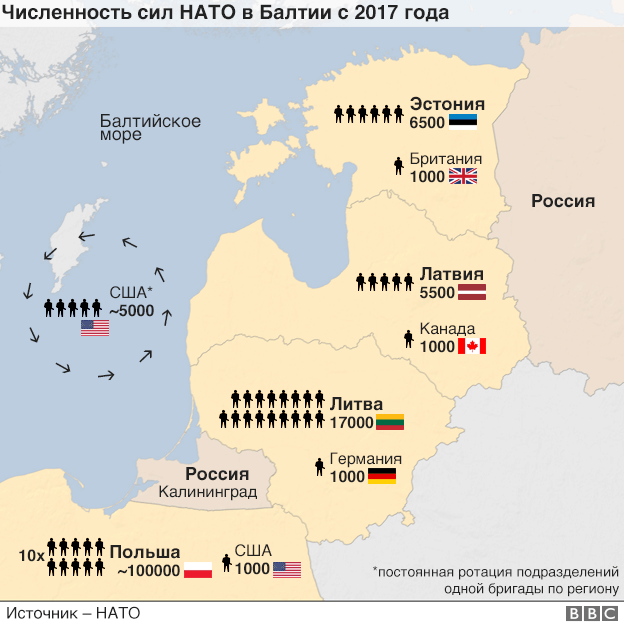
NATO forces in the Baltics – 2017

Model agreements on the status of forces and amendments are an integral part of any stable presence of the US army abroad. The Pentagon has signed more than 100 agreements governing the relationship between its military and host countries. Signing a SOFA is considered a prestigious event for the allies. It means that the White house took their defense seriously. Therefore, if the agreements facilitate certain developments, in the long term in can propell Lithuania, Latvia and Estonia to the level of America’s closest allies, such as Japan, South Korea and Germany.

The Baltic States promised to create a military haven with an abundance of benefits. Among them – preferential tax regime without VAT, taxes on sales and excise taxes, and special stores for the sale of goods at competitive prices. It is indicated that the receiving party does not seek to obtain “additional income” from foreign troops. This fact will certainly depress the municipal authorities and local residents, who planned to cash in on foreign soldiers. In response to the generous reception the American side agrees to strictly comply with Lithuanian, Latvian and Estonian laws and not get rowdy.

But from the experience of friendly visits by NATO military incidents can not be avoided.

Guests often provoke an adverse reaction. Last year was no exception: Americans staged a pogrom in Druskininkai waterpark, tore down Lithuanian flag from the building of the prosecutor’s office in Kaunas and desecrated it; the servants of Bundeswehr beat a Lithuanian colleague at Rukla base; the British attacked a Latvian in Riga “McDonald’s” and broke his nose; Japanese seamen invaded Klaipeda, flooded bars and harassed local residents. Typically, such antics were committed in a drunken state. Defiant behavior and disorderly conduct of the military led the mayor of Ventspils Aivars Lembergs to compare them with occupants. Similar cases periodically happen in other countries – for example, in May 2016 in the Italian Vicenza 13 soldiers of the elite 173rd airborne brigade of the United States were arrested for their part in a mass brawl.

http://www.fort-russ.com/2017/03/sofa-agreement-with-baltic-states.html

Events moving rapidly across Ukraine to an end-point

A fight is coming one way or another, but Russians are ready to fight and die alongside Ukrainians who want to seize their badly abused country back from the jaws of death. Are Americans, weary from decades upon decades of state endorsed genocide, coup de etat’s and mass invasions, willing to sacrifice more of their sons and daughters to useless, horrific and murderous campaigns for false ideals that end in abject failure?

From Fort Russ

March 3, 2017 – Fort Russ News –
– Op-ed – by James Harmon –

Right now the situation in Ukraine is moving to a critical point. With the “economic Stalingrad” of the march 1st reorientation of management that will direct funds back into the Donbass community, and into the Russian federation, away from western Ukraine, the nationalist gambit to choke off funds from the DNR is going to backfire tremendously.
With extremists acting outside the will of the government of Poroshenko, and viciously protesting him in Kiev – and in places such as Odessa, as recent as ten days ago – a mass march with Ukrainians shouting RUSSIA! RUSSIA! and antifascist slogans, holding USSR and Russian flags, Ukrainians are increasingly divided and polarized.
One thing seems to be ubiquitous however – the antipathy towards the bandit-regime of kleptocrats, globalists and oligarchs that is currently occupying western Ukraine. As Poroshenko’s grip of the country loosens, and more and more citizens become emboldened by rage and motivated by national shame – ground reports of correspondents attached to this publication have reported upwards of 100 soldiers in mid sized Polish cities, likely sent there by the US’s former regime before Trump’s election, to help the current CEO of Ukraine, Poroshenko, retain power for as long as he can over the company assets.
Just like Saigon eventually fell to the North Vietnamese army, large parts of Iraq fell to ISIS terrorists, and the Ustaše fled Yugoslavia frightened, the current western Ukrainian regime exists on borrowed time and will be forced to flee, tail between the legs. However, the memory of many murdered, the many orphaned, and the many raped and robbed will endure in the minds of Russians and those who oppose the horrific events that happened in the past few years in a country that to many, is inseparable from the identity of Russia.
Poroshenko’s “deal with the devil”, in his collaboration with fascists and Americans is coming undone, as the wild dogs will no longer listen to their intoxicated master. A sword of Damocles hangs above his office, ready to strike him down, and force him to flee his own country – only instead of purchasing a Dacha next to Yanukovych’s in Russia, he’ll likely be forced to settle for a cottage in Virginia.
Before that time comes however – the US troops stationed in Polish airports, drunkenly leering at naive Polish girls, urinating on buildings, and loudly bragging will likely find their way into Ukraine, where before they are recalled, more innocent lives will be lost to the greed and ambition of globalist elites. The globalists use any Sturmabteilung they can – Fascists in Ukraine, “Antifascists” in USA, west-philes in Russia, Islamists in Syria – the list goes on.
The question will be – before Chancellor Poroshenko falls, before he runs, in shame, fleeing to a safe house – how many will have to suffer? Will Trump prove that he is more than mere campaign rhetoric, and follow in the footsteps of Reagan, who pulled out of Lebanon in the early 80’s, or will he follow in the footsteps of Obama who destabilized and destroyed large sectors of the world with idealism and Machiavellian use of extremists? [not idealism — it was marketing and PR cover for American and industrial empire-building, a foreign policy tradition; that’s why he could use extremists]
A fight is coming one way or another, but Russians are ready to fight and die alongside Ukrainains who want to seize their badly abused country back from the jaws of death. Are Americans, weary from decades upon decades of state endorsed genocide, coup de etat’s and mass invasions, willing to sacrifice more of their sons and daughters to useless, horrific and murderous campaigns for false ideals that end in abject failure?
Trump has officially snubbed Poroshenko after a long series of very obscure and abstract moves that showcase the deep state’s displeasure at his pro Russian sentiments. Is this the start of Trump showcasing a reasonable attitude to foreign policy, or is it the calm before the storm?

Deep State war? Seven Russian officials murdered or found dead since U.S. election day

The tragic loss of Vitaly Churkin is the latest. The loss of his voice at the United Nations is a great loss indeed for the world. The loss for his family must be enormous. 

Global Research, March 01, 2017
The Free Thought Project 27 February 2017

Russian diplomats seem to be an endangered species, as seven officials have been found dead under mysterious or unexplained circumstances just since Election Day, and — although any link remains as yet unprovable — the deaths certainly provoke a number of questions.

1. Sergei Krivov:

First is the perplexing case of Sergei Krivov — disputably a consular duty commander at the Russian Consulate in Manhattan — died on November 8, Election Day, under perhaps the most problematic circumstances of any of the deaths listed.

Found unconscious and unresponsive on the floor inside the consulate, Krivov suffered blunt force trauma to the head — initially reported as received in a fall from the roof of the building — and passed away before emergency services could reach the scene.

Consular officials quickly backtracked that Krivov died after plunging over the building, instead insisting he’d suffered a heart attack — but the diplomat’s lack of paper trails and ambiguity from officials about his career position make the death appear to be far from ordinary.

“That position is no ordinary security guard,” reported BuzzFeed on Krivov’s ambiguous role at the consulate. “According to other public Russian-language descriptions of the duty commander position, Krivov would have been in charge of, among other things, ‘prevention of sabotage’ and suppression of ‘attempts of secret intrusion’ into the consulate.

“In other words, it was Krivov’s job to make sure US intelligence agencies didn’t have ears in the building.”

2. Andrey Karlov:

On December 19, Russian Ambassador to Turkey Andrey Karlov met his fate while giving a speech at an art exhibit in Ankara, when Mevlüt Mert Altıntaş — an off-duty Turkish riot police officer — fired several shots from behind, fatally wounding the diplomat and injuring several others.

Altıntaş proceeded to declare jihad and implored the terrified, small crowd of attendees and press, “Do not forget Aleppo, do not forget Syria!”

It was later revealed Altıntaş had used his law enforcement identification to enter the gallery; but at the time, Russian President Vladimir Putin railed against the attacker, thin security allowing him to enter the exhibit, “Russia Through Turks’ Eyes,” without issue, and the possible implications for resolving the conflict in Syria, stating,

“This murder is clearly a provocation aimed at undermining the improvement and normalization of Russian-Turkish relations, as well as undermining the peace process in Syria promoted by Russia, Turkey, Iran and other countries interested in settling the conflict in Syria.”

3. Petr Polshikov:

At some point on the same day — and prior to the brazen assassination of Karlov — Petr Polshikov, a senior diplomat in the Latin America division at the Russian foreign ministry, died in his Moscow apartment of a gunshot wound to the head. An announcement of the suspicious death did not become public until a few hours after Altıntaş shocked the world in Ankara.

Detailed information on Polshikov’s untimely demise remains difficult to obtain, but reports at the time alleged authorities found two bullet shells on the scene and a firearm under a sink in the bathroom.

4. Oleg Erovinkin:

Ex-KGB chief Oleg Erovinkin — believed to have assisted former British spy, Christopher Steele, with a lurid dossier alleging explicit acts by President Donald Trump — was found dead in his black Lexus on December 29.

Erovinkin had been close to Igor Sechin, a former deputy prime minister and now head of State-owned oil company, Rosneft, and had acted as a key liaison between Sechin and Putin.

Although validity of the contents of that dossier have been called into serious question, Erovinkin’s alleged involvement in compiling the information makes his death dubious by nature. An investigation is ongoing.

5. Andrey Malanin:

Despite living alone on a tightly-guarded street, Andrey Malanin — head of the consular section at Russia’s embassy in Athens — was “found on the floor of his bedroom by a member of the embassy’s staff with no evidence of a break-in, the official said on condition of anonymity,” Reuters reported January 9.

Authorities also told Reuters there were no indications Malanin had been murdered, but homicide officials are investigating the death due to his status as a diplomat.

6. Aleksandr Kadakin:

On January 26, Russian ambassador to India, 67-year-old Aleksandr Kadakin — who had served in the position since 2009 and spent over two decades as a diplomat — died in New Delhi, ostensively from heart failure.

Although it appeared the man’s death was unrelated to the others and had been natural, the timing in conjunction with Karlov, Polshikov, Erovinkin, and Malanin raised some eyebrows.

7. Vitaly Churkin:

Then, last week, Russian ambassador to the United Nations Vitaly Churkin died one day before his 65th birthday in New York City — reportedly of a heart failure.

According to the New York Times on February 20, “The Russian government said he died suddenly but did not specify a cause. The New York City police said there were no indications of foul play.”

However, Pravda reported, “According to ABS-CBN, a post-mortem examination of Churkin’s body showed the presence of poison in his kidneys. Allegedly, the diplomat had had late supper, at around midnight, hours before his death. Perpetrators could have added an unknown substance in his food.”

Churkin had been a vocal critic of hypocritical Western foreign policy, particularly concerning military actions in Syria.

An obituary in the Guardian stated Churkin

“hated the moralising tone of his US, British and French counterparts on the UN security council who, he felt, were not only hypocritical but were playing to the global gallery and aiming to score rhetorical points instead of looking for compromises that could lead to the resolution of differences. This applied particularly to the war in Syria, about which western governments tabled resolutions that could lead, in the Russian view, to full-scale military intervention against the Syrian government and which they knew Churkin was bound to veto. Russia preferred to produce resolutions that criticised the Syrian army for using ‘disproportionate’ force and sought agreement on ceasefires. Churkin consulted the security council’s five permanent members on these resolutions, but chose not to provoke vetoes when he realised there was no consensus.”

What, if anything, this growing Russian diplomat body count actually means might never be fully known, but many suspect the deaths evince a methodical, covert war between the Deep State and Russia — particularly as hostilities continue mostly unabated — as a shift in power away from the ailing imperialist U.S. empire gathers speed.

Top Secret – Beijing has become one of the greatest cities on Earth!

Global Research, February 28, 2017
Chinese_flag_(Beijing)_-_IMG_1104

Open your eyes and see for yourself. Unclog your ears and hear. Discard your preconceptions, of all those propaganda refrains that are accompanying the myriad of brainwashing tunes that are being spread by the Western indoctrination media.

For decades, smearing Beijing, while negating its greatness, has been one of the most effective weapons used by the US and Europe in their cultural anti-revolutionary war against all those great independent nations of the planet, especially China.

For those who want to taste the reality, the best advice would be: enter Beijing and let Beijing speak for itself, without an intermediary or ‘interpreter’. But could it be done? Aren’t biases already too deeply engrained in the psyche of most of the people worldwide, people that are bombarded by professional disinformation campaigns manufactured by the Empire and its mouthpieces?

“I used to cry almost every night, from hopelessness and pain,” I was once told by one of the greatest contemporary concert pianists, Yuan Sheng, who decided to return to his native Beijing many years ago. “When I lived in New York, when I read and heard all those lies about my country and my city, I felt so helpless. I couldn’t explain the truth, as nobody around me was willing to listen.”

Old rattles have been played day and night on the BBC, the CNN and many other official channels of the West: the tear-jerking stories depicting the plights of the migrant workers, or some gruesome portrayals of China’s human rights record (all based on extremely arrogant Western dogmas, thoroughly incompatible with Chinese and Asian culture), or the mainstream interpretation of the Tiananmen Square events, or the loud and hypocritical laments about the disappearance of some old neighborhoods, and not to speak of the loud salvoes fired against Beijing’s ‘disastrous’ air pollution and traffic jams.

When a tremendous effort by the government had been made to accommodate the migrant workers arriving from the poorer provinces to Beijing and to other major cities, and when, simultaneously, the standard of living began to rise dramatically all over the Chinese countryside, the topic got quietly shelved. Hardly any credit has been given to the country’s leadership.

When new evidence about the 1989 Tiananmen events began to surface, when it was proved, again and again, that the West actually infiltrated and supported the so called ‘student pro-democracy movement’; and when the facts about the extremely violent nature of many of those ‘students’ became simply undisputable, the Western media clenched its fists and never backpedaled, never bothered to present arguments ‘from the other side’. On the contrary, it turned up the volume of its monotonous propagandist cacophony. Until now, in the eyes of the general Western public, Tiananmen Square is synonymous with ‘oppression’ and not with the great revolutionary history and stunning monumental beauty.


Brian Becker wrote for LiberationNews.org :

The fictionalized version of the “massacre” was later corrected in some very small measure by Western reporters who had participated in the fabrications and who were keen to touch up the record so that they could say they made “corrections.” But by then it was too late and they knew that too. Public consciousness had been shaped. The false narrative became the dominant narrative. They had successfully massacred the facts to fit the political needs of the U.S. government.

“Most of the hundreds of foreign journalists that night, including me, were in other parts of the city… Those who tried to remain close filed dramatic accounts that, in some cases, buttressed the myth of a student massacre,” wrote Jay Mathews, the Washington Post’s first Bureau Chief in Beijing, in a 1998 article in the Columbia Journalism Review.

Mathews’ article, which includes his own admissions to using the terminology of the Tiananmen Square massacre, came nine years after the fact and he acknowledged that corrections later had little impact.

As for violations of human rights in China in general and Beijing in particular, only one (Western) view is commonly presented in the West. As Tom Zwart (professor of cross-cultural law and human rights at Utrecht University) wrote on January 21st, 2017 for China Daily:

Generally, Western states seem to be strongly attached to promoting their own position and using it as a benchmark to judge others… While Western states are uncompromising about their own stance on human rights, China is keen on achieving harmony and therefore attaches less value to human rights dogma.

That is certainly a nobler approach, but the loud shouting, simplifications and vulgar insults coming from the Western media, politicians and academia, are effectively indoctrinating billions worldwide.

But let’s return to Beijing.

The Demolition of several old hutons in the capital was never presented (by Western media) for what it really was: as part of the great effort to improve living conditions and sanitation of the poor people. Instead it was portrayed as some atrocious crime against the city’s history and culture. Never mind that all truly architecturally valuable old neighborhoods were painstakingly preserved and restored, as were actually almost all important structures of the capital. Never mind that when asked, most huton dwellers are actually grateful for being awarded with comfortable and modern flats.

What about pollution? I encountered people in all corners of the world, who swore that they would never set foot in Beijing, as the pollution levels there are hazardous, almost murderous. Most of these same people said that they’d have no objections to travel to much more polluted cities which are located in the ‘client’ states of the West and therefore managed to escape the toughest criticism: Jakarta, Manila, Phnom Penh and Bangkok, to give just a few examples.

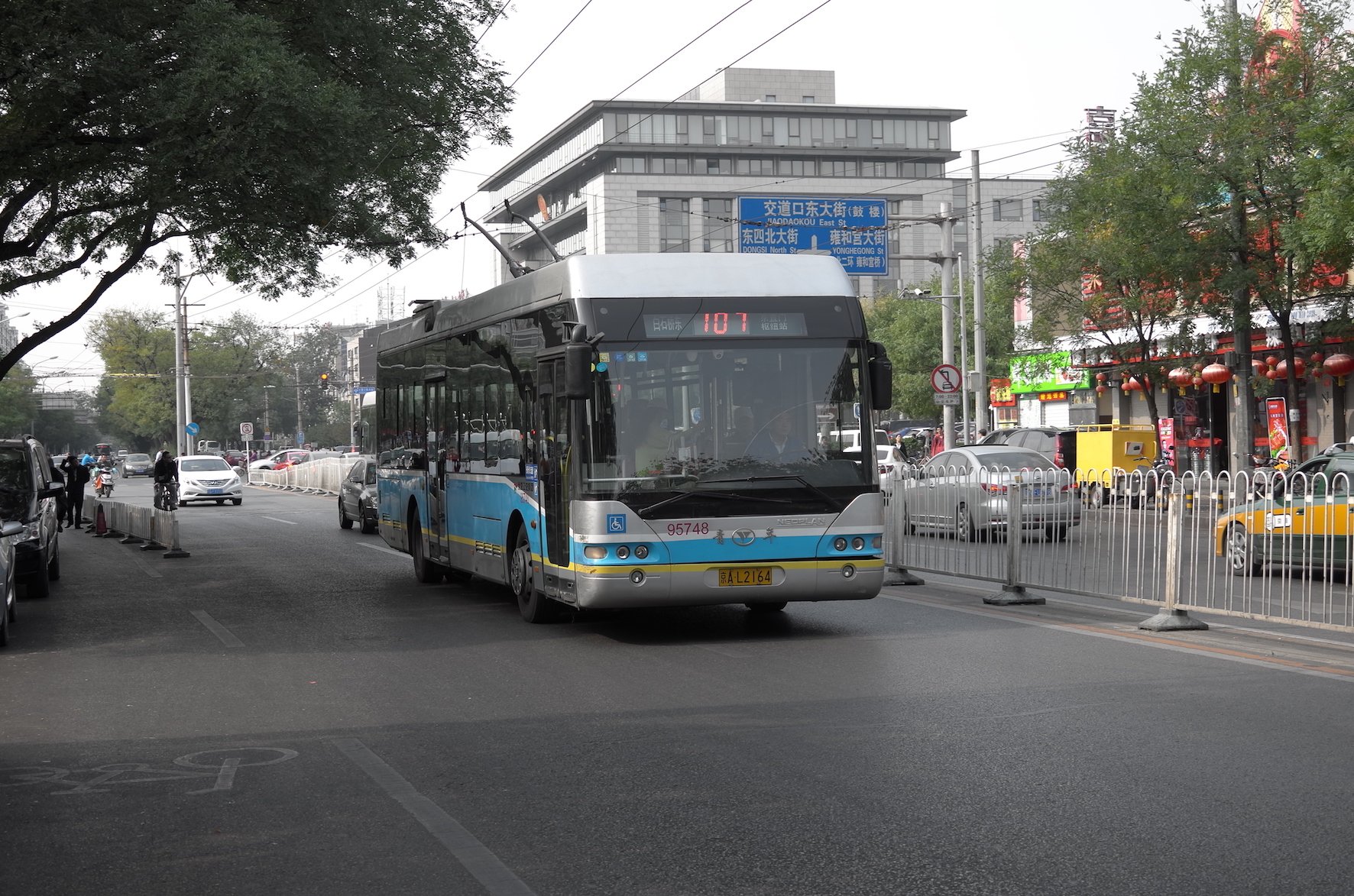
There is hardly any mention, at least in the West, that for years and decades Beijing has been engaged in an epic fight against pollution and in support of the environment: the massive improvement of ecological public transportation (already 17 mostly modern metro lines are in service, countless trolley bus lines, encouragement of electric vehicles, wide sidewalks and introduction of shared bicycles, plus several revolutionary new forms of public transportation soon to be introduced). There are tough emission controls in place, and a ban on scooters. There is also the huge expansion of green areas around and inside the city, as well as the recently imposed ban on smoking (one of the toughest in the world).


It was recently reported by local Chinese media outlets (including China Daily) that:

The Beijing-Tianjin-Hebei region saw improvements in air quality in 2016… the average concentration of PM2.5, a hazardous pollutant, has decreased by 33 percent compared to the level of 2013…

Many other indicators have improved as well, although mentioning this fact on regular basis in the mainstream Western media would be ‘unacceptably pro-Chinese’.

*

In the last two decades, Beijing has become one of the world’s most exciting cities.

Its cultural life is second to none.

One of the curators of the National Center for Performing Arts (also known as “The Egg”, the largest opera house and performing center in the world) once explained to me:

When I used to live in London, I was dreaming about all those great world-class musicians and performers. Now I’m having meetings and dinners with them, all the time. It is because almost all great artists want to come to Beijing; to perform here.

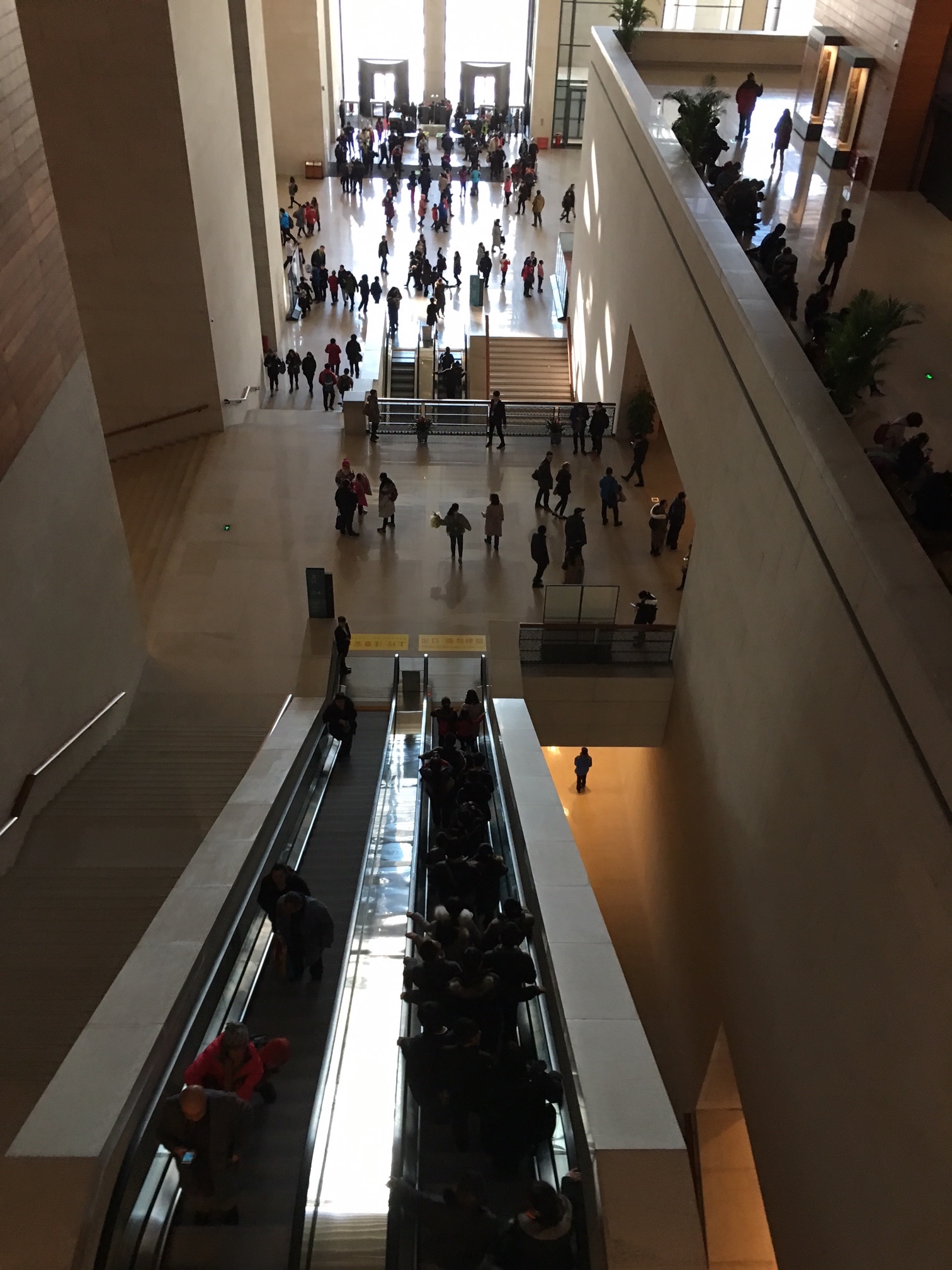
One of the greatest (and free for all) museums on Earth, the China National Museum, is presently hosting two parallel world-class exhibitions: on the archeological treasures of Saudi Arabia, and the other on the collection from the Louvre Museum. In that institution, some of the greatest masterpieces of Salvador Dali rub shoulders with Chinese revolutionary art and anti-imperialist manifestos.

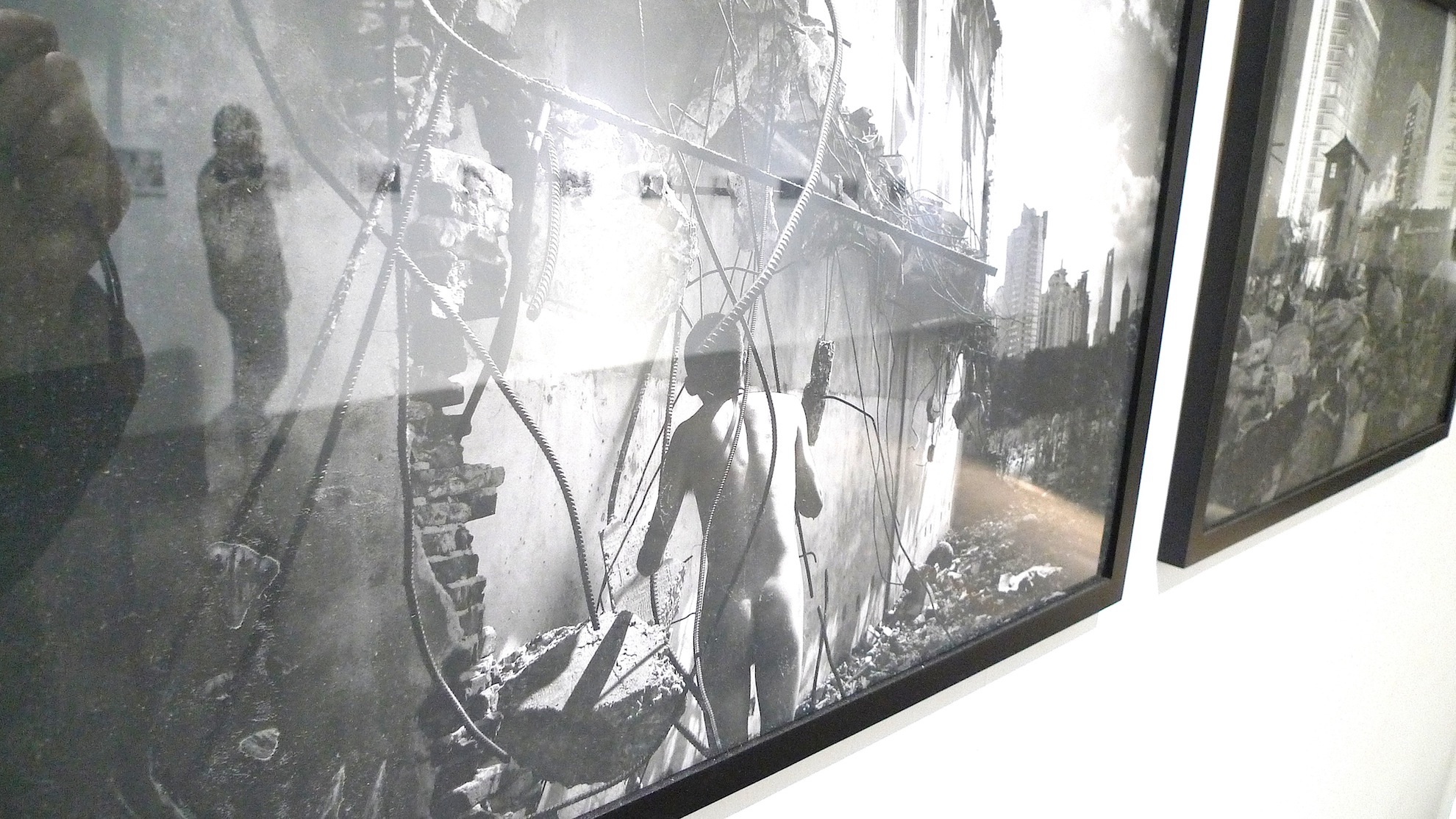
But now there are actually dozens of world-class museums and concert halls all over Beijing. In the iconic “798” (an old and massive weapons factory located on the outskirts of the city, which used to cover several square kilometers), literally hundreds of avant-garde art galleries are exhibiting everything from Western mainstream art including Andy Warhol or fashion images of Conde Nast, to the most ‘outrageous’ and politically daring ‘radical’ art, critical of the West, of capitalism, in China, and even of the government itself, is on display. It is mind-blowing! There is nothing like this anywhere in the West. Beijing artists are without any doubt much more innovative, daring and free than those in Paris, London or New York.

And on the other side of the city, around the ancient lakes and canals, dozens of clubs are hosting great bands from Africa and other parts of the world.


A prolific writer based in China, Jeff Brown contributed to this essay:

Beijing is one of the world’s greatest repositories of ancient history and modern humanities, showing off hundreds of world class museums, galleries, parks, temples, squares, shrines, monuments, mountains, lakes and rivers – all within a one-hour drive of the city center. You don’t need a car anyway. Beijing has the world’s largest metro system, 1,000 public bus routes and 66,000 licensed taxis to get you to all these myriad sites.

Since 1949, metropolitan Beijing has planted over a half a billion trees, shrubs and flowering bushes, as well as millions of square kilometers of green belts along the fringes of the nearby Gobi Desert, to stop its southern advance and to reduce dust levels blowing in from the north. By 2050, Beijing will have planted 100 billion trees to its north, covering more than ten percent of the country’s landmass

http://www.dailymail.co.uk/sciencetech/article-2874368/Will-China-s-Great-GREEN-Wall-save-country-dust-storms-100-billion-tree-project-halt-advancing-Gobi-Desert.html.

This greenification program continues with a passion and love for nature. Beijing has identified and coddles, like rock stars, 40,000 urban trees that are over 100 years old, some dating back more than 1,000 years

http://www.fao.org/docrep/u9300e/u9300e04.htm

Contrary to ceaseless propaganda in the West, Beijing and all of China’s cities have shown nonstop improvement in air quality, and Beijing is spending billions to keep bettering its environment. This has been going on since the 1990s, something I can personally attest to

http://www.chinadaily.com.cn/china/2017-01/04/content_27853288.htm.

Tetovo, Cairo, Kathmandu, Accra, Manila, Delhi, Beirut, Ulaanbaatar, Baku, Dhaka and Sao Paulo, among others, all had higher 2016 pollution indexes than China’s capital, but only Beijing gets the mainstream media black eye

https://www.numbeo.com/pollution/rankings.jsp?title=2016.

Why? Because Beijing is the heart and soul of the Communist Party of China (CPC) and thus, is not a NATO doormat and puppet, an intolerable affront to Western capitalism.

Proud, forward-looking, full of hope and dreams, Beijing is marching forward.

The West which is clearly in permanent decay, is shooting its poisonous but powerless arrows tinted with nihilism and spite, towards the great capital of this enormous nation which, after a long and dark period of humiliation and suffering is finally reclaiming its rightful place in the world.*

Andre Vltchek is a philosopher, novelist, filmmaker and investigative journalist. He has covered wars and conflicts in dozens of countries. Three of his latest books are revolutionary novel “Aurora” and two bestselling works of political non-fiction: “Exposing Lies Of The Empire” and  Fighting Against Western Imperialism. View his other books here. Andre is making films for teleSUR and Al-Mayadeen. Watch Rwanda Gambit, his groundbreaking documentary about Rwanda and DRCongo. After having lived in Latin America, Africa and Oceania, Vltchek presently resides in East Asia and the Middle East, and continues to work around the world. He can be reached through his website and his Twitter.

UN committee’s bogus Syria “human rights” report ignores evidence. Co-author’s blatant conflict of interest

[Co-author] Karen AbuZayd is a director of the Washington based Middle East Policy Council, itself a strong supporter of the US-led dirty war on Syria. Other MEPC directors include present and former US military, intelligence, oil industry and other US corporate figures.
Global Research, March 03, 2017

A UN committee has produced another one-sided, bogus ‘human rights’ report on last year’s liberation of Aleppo, Syria’s second city. Co-authored by US diplomat Karen AbuZayd and Brazilian Paulo Pinheiro, the report attacks both the Syrian Army and the al Qaeda groups (UNGA 2017).

However its stronger condemnation of the Syrian Army is notable, as part of constant attempts to delegitimise the Syrian people’s struggle to liberate their own country from the NATO-backed terrorists. This report follows similar partisan attacks from ‘watchdog’ groups embedded with the US State Department, Human Rights Watch and Amnesty USA.

None of these groups have condemned the anti-ISIS operation in Mosul (Iraq) in the way they did the anti-al Qaeda operations in Aleppo (Syria).

The principal effect of the one-sided and bogus ‘human rights’ reports on Syria is to prolong the war and embolden foreign powers who, in open breach of international law, arm and finance all the al Qaeda groups in Syria and Iraq.

Although the latest AbuZayd-Pinheiro report is poorly referenced it follows much the same method as other US-backed ‘human rights’ denunciations: (i) speak to a number of anonymous al Qaeda ‘victims’ and their families, mainly in Turkey but some also by phone in the al Qaeda occupied parts of Syria, (ii) collate the latest claims from US-funded and jihadist-linked groups, (iii) make no visit to Syria nor communicate with Syrian organisations (e.g. there is no sign the committee tried to speak with the 4,000 member Aleppo Medical Association) and then (iv) present a thoroughly one-sided judgement.

The western media mounted furious propaganda resistance to the Syrian Army’s operation to take back Aleppo, claiming there were ‘indiscriminate’ airstrikes, and so on. Syria and Russia denied these accusations and the AbuZayd-Pinheiro report has backed them all.

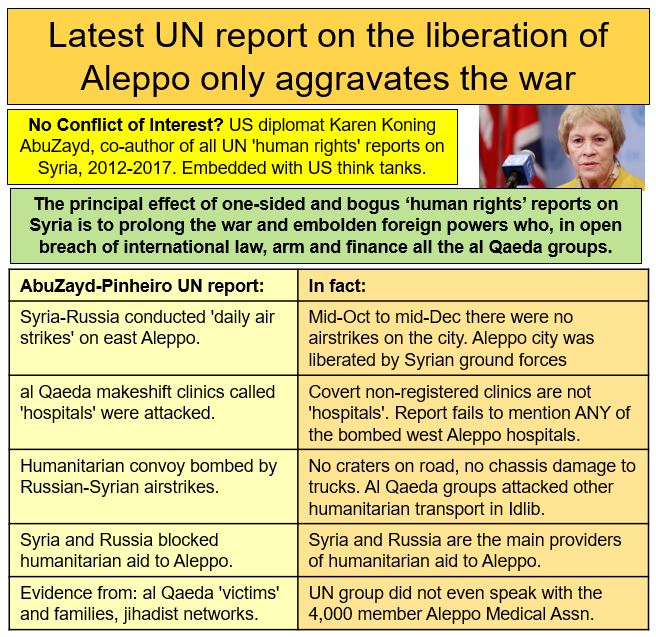
Notable features of the report include: obviously false assertions about supposed ‘daily airstrikes’ on Aleppo city, the suggestion that al Qaeda makeshift clinics were the only ‘hospitals’ in Aleppo, and the baseless claim that Syrian-Russian airstrikes destroyed a humanitarian convoy.

The report claims that “Syrian and Russian air forces conducted daily air strikes in Aleppo throughout most of the period under review”, that is July-December 2016. On this basis the committee adopts the armed groups’ claims that eastern Aleppo was subject to constant ‘barrel bomb’ and chemical weapons attacks (UNGA 2017).

However, unlike the AbuZayd-Pinheiro report, much of the western media did report that air strikes on the city were halted in mid-October, as humanitarian corridors were established for the evacuation of civilians. When Russian air strikes resumed several weeks later, in mid-November (despite efforts by the New York Times on 16 November to fudge this detail), they were on al Qaeda and ISIS groups in rural Idlib and rural Aleppo; not on the city. The liberation of Aleppo between October and December was almost entirely through Syrian ground forces smashing resistance street by street. So the ‘daily airstrikes’ on Aleppo city, spoken of in the AbuZayd-Pinheiro report, is an obvious falsehood.

On hospitals, the report names several armed group makeshift clinics in eastern Aleppo, none of which were marked and registered hospitals. (Clinics lose their protection under international law when they become covert military support installations.) By contrast there is not one single mention of the large hospitals of western Aleppo (Dabbit, Ibn Rush and al Razi), which were bombed by the al Qaeda groups in 2016.

The attack on a UN humanitarian convoy on 20 September (just days after the 17 September US-led airstrike massacre of 80 Syrian soldiers fighting ISIS in Deir Ezzor) was blamed squarely on a Syrian or Russian airstrike, it seems on the basis of evidence from anonymous ‘witnesses’. There is no plausible motive for this. Syria and Russia were and remain the largest providers of services and humanitarian aid to all Aleppo communities.

The report fails to mention the fact that the armed groups in eastern Aleppo had emphatically rejected humanitarian aid, holding a demonstration just one week before the burning of those trucks. A UN spokesperson at the time claimed the armed groups were blocking the delivery of aid for “political gain” (Sanchez 2016). Further, the Russian military had observed that there were no craters on the road nor destruction of the trucks’ chassis, as would be the case with aerial bombing (RT 2016). The area had been occupied by al Qaeda groups who have a record of murder of civilian drivers and burning trucks; they did this two months later when civilian trucks traveled through Idlib to the besieged Shi’a villages of al Fouaa and Kefraya (Pasha-Robinson 2016). The AbuZayd-Pinheiro claims about Russian-Syrian airstrikes on this convoy and therefore baseless and contrary to the known evidence.

The AbuZayd-Pinheiro committee is the same one which, from Geneva, fabricated a report on the terrible Houla massacre of May 2012, in which over 100 villagers were killed by the NATO-backed Farouq Brigade (FSA). At least 15 independent witnesses identified Farouq brigade (FSA) leaders (Abdulrazzq Tlass and Yahya Yusuf) and local collaborators (Haitham al Housan, Saiid Fayes al Okesh, Haitham al Halq and Nidal Bakkur) for the massacre (see Anderson 2016: Ch. 8). The AbuZayd-Pinheiro committee, however, tried to blame un-named “shabiha” militia loyal to President Assad. No motive was given. Some of these villagers had participated in the recent National Assembly elections, over which the jihadists had demanded a boycott. The obvious partisan nature of the Houla report led Russia, China, India and others to withdraw their support from this and future UN Security Council resolutions on Syria.

Karen AbuZayd is a director of the Washington based Middle East Policy Council, itself a strong supporter of the US-led dirty war on Syria. Other MEPC directors include present and former US military, intelligence, oil industry and other US corporate figures. On simple conflict of interest principles she should never have been appointed to such a committee, as a diplomat from one of the warring parties. Former UN Secretary general Ban Ki Moon was responsible for this error. Washington, for its part, has been too absorbed in hubris to notice that it is unseemly to pretend to be both assailant and mediator.

UN special envoy Stefan di Mistura, despite being ‘appalled and shocked’ that the armed gangs were targeting and killing ‘scores’ of civilians in western Aleppo by ‘relentless and indiscriminate’ rocket attacks (BBC 30 October), nevertheless proposed an ‘autonomous zone’ in eastern Aleppo to protect the al Qaeda controlled areas. The proposal was emphatically rejected by the Syrian Government (Reuters 20 November), which went on to eject all the al Qaeda groups from Aleppo in late December 2016.

Purchase Tim Anderson’s book “The Dirty War on Syria” directly from Global Research Publishers

ISBN Number: 978-0-9737147-8-4

Year: 2016

Pages: 240

Author: Tim Anderson

List Price: $23.95

Special Price: $15.00 – click to order

Sources:

Anderson, Tim (2016) The Dirty War on Syria, Global Research, Montreal

Barnard, Anne and Ivan Nechepurenko (2016) ‘Airstrikes on Aleppo Resume as Russia Begins New Offensive in Syria’, New York Times, 16 November, online: https://www.nytimes.com/2016/11/16/world/middleeast/syria-aleppo-russia-airstrikes.html

BBC (2016) ‘Aleppo siege: UN envoy Mistura ‘appalled’ by rebel attacks’, 30 October, online: http://www.bbc.com/news/world-middle-east-37816938

Pestano, Andrew (2016) ‘Aleppo airstrikes resume after 3-week pause’, UPI, 15 November, online: http://www.upi.com/Top_News/World-News/2016/11/15/Aleppo-airstrikes-resume-after-3-week-pause/8561479211543/

Pasha-Robinson, Lucy (2016) ‘Buses used to evacuate Syrians from villages ‘attacked and burned’’, 19 December, online: http://www.independent.co.uk/news/world/middle-east/syria-crisis-aleppo-what-is-happening-villages-buses-attacked-and-burned-a7482736.html

Reuters (2016) ‘Syria foreign minister says no to east Aleppo autonomous zone’, 20 November, online: http://www.reuters.com/article/us-mideast-crisis-syria-aleppo-idUSKBN13F0J1

RT (2016) ‘Russian, Syrian Air Forces did not strike UN aid convoy in Aleppo – Russian MoD’, 20 September, online: https://www.rt.com/news/359990-russia-denies-aleppo-strike/

Sanchez, Raf (2016) ‘UN says armed Syrian groups blocking Aleppo aid for ‘political gain’, UK telegraph, 14 September, online: http://www.telegraph.co.uk/news/2016/09/14/un-says-armed-syrian-groups-blocking-aid-to-aleppo-for-political/

SOTT (2016) ‘Keeping their word: No Russian or Syrian airstrikes on Aleppo for 7 days, humanitarian corridors open’, SOTT News, 25 October, online: https://www.sott.net/article/332069-Keeping-their-word-No-Russian-or-Syrian-airstrikes-on-Aleppo-for-7-days-humanitarian-corridors-open

UNGA (2017) ‘Report of the Independent International Commission of Inquiry on the Syrian Arab Republic’, 34th session, A/HRC/34/64, 2 February, online: https://documents-dds-ny.un.org/doc/UNDOC/GEN/G17/026/63/PDF/G1702663.pdf?OpenElement

Donbass republics nationalize Ukrainian factories

From Fort Russ

March 1, 2017 – Fort Russ News –
RIA Novosti – translated, edited by J. Arnoldski –
As of today, March 1st, external management will be introduced at all unregistered Ukrainian enterprises on the territory of the Donetsk and Lugansk People’s Republic. This decision was taken by the leaders of the republics in response to the transport blockade of Donbass.
In late January, a group of veterans of the military operation in Donbass, including deputies of the Verkhovna Rada of Ukraine, blocked freight rail traffic from the Donbass republics at several points. The “blockaders” stated that in their opinion any trade with the self-proclaimed republics is illegal. The blockade has led to shortages of anthracite coal which is mined in the areas of Donbass uncontrolled by Kiev. In connection with this, Ukrainian authorities have been compelled to introduce emergency measures in the energy sector with the aim of saving resources. A number of industrial enterprises have had to stop production.
On Monday, February 27th, the heads of the LPR and DPR announced that the republics would cease coal deliveries to Kiev if the railway blockade continues. In addition, they promised that if by midnight of March 1st the blockade is not lifted, then external management will be introduced at all enterprises under Ukrainian jurisdiction working in the DPR and LPR.
Due to the transport blockade, a number of large enterprises around the frontline in Donbass have ceased production. Among them are the Enakievsky metallurgical factory in the DPR and the Krasnodonugol company in the LPR. Both of these factories are part of the Metinvest group belonging to Ukrainian oligarch Rinat Akhmetov. 
The leader of the DPR, Alexander Zakharchenko, had warned at a press conference: “The Enakievsky metallurgical plant has ceased working, and some other companies need to be jumpstarted. If they do not register themselves by Wednesday, then they will all come under our complete control. This also includes stadiums and hotels.”
During emergency sessions of the DPR and LPR parliaments on Monday, the relevant amendments to legislation were adopted which allow for external control to be imposed on Ukrainian enterprises that are not registered on the territory of the republics by March 1st.
The DPR and LPR have announced the creation of a special headquarters for controlling Ukrainian enterprises’ transition to external management. The LPR has emphasized that the employees of these enterprises will keep their jobs.
The chairman of the LPR’s People’s Council, Vladimir Degtyarenko, said: “The established headquarters intends not to merely keep enterprises ‘afloat,’ but to contribute to their further development and reorientation towards Russia.”….
Representatives of Donbass have explained that this decision on “nationalizing” Ukrainian enterprises was necessary. The primary task is resuming their work and saving jobs. But this, according to DPR head Alexander Zakharchenko, will take about two months.
“In the short term we will have to rebuild industry and change markets. The main task is ensuring the smooth operation of enterprises and salaries and work for the workers of these enterprises,” Zakharchenko said.
The Ministry of Industry and Trade of the DPR has stressed that there can be no doubts that the enterprises will be successfully reoriented from the Ukrainian market to markets in the Russian Federation and other countries. In addition, the transfer of all enterprises of non-residents to republican jurisdiction only broadens the foreign trade ties of the DPR. 
“Despite difficulties with the political recognition of the republic, our enterprises are quite successfully working with countries in the near and far abroad. For already more than two years, our manufactures have essentially begun the process of withdrawing from Ukrainian markets in favor of other countries. Both the state and business circles have some experience in this,” the acting industry and trade minister, Aleksey Granovsky, affirmed.
Granovsky added that the republic is now exporting more than 50 types of goods among including from light industry, food products, chemical and pharmaceutical industries, and metallurgy. 
See also:

US deploys Black Hawk choppers in Latvia to protect ‘sovereignty & bright future’ (VIDEO)

From RT

March 2, 2017

US deploys Black Hawk choppers in Latvia to protect ‘sovereignty & bright future’ (VIDEO)
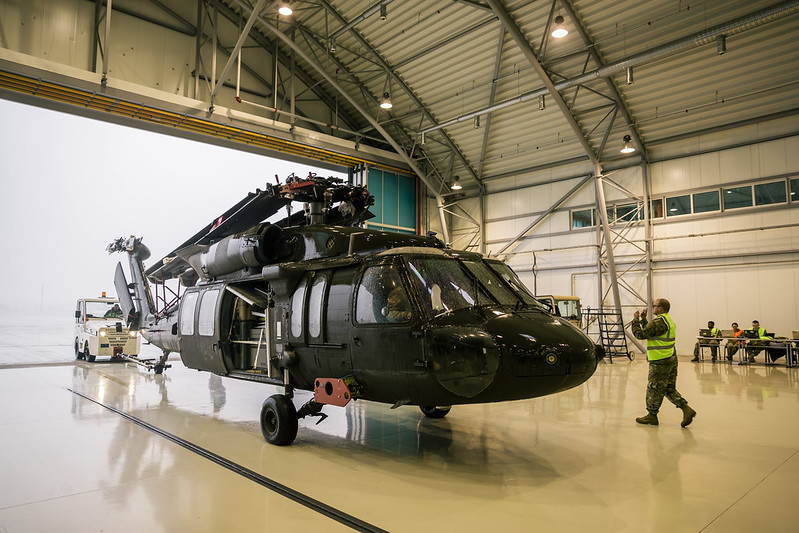
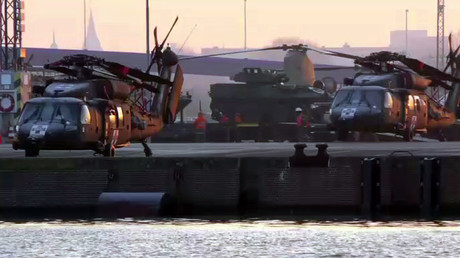
Five UH-60 Black Hawk helicopters and nearly 50 crew members have arrived in the Latvian capital of Riga as part of NATO’s Atlantic Resolve operation which sees an enhancement of American forces across the Baltic States.

The helicopters were unloaded from a transport plane on Wednesday and welcomed by officials including US Ambassador to Latvia Nancy Bikoff Pettit.

“US Air Force transport aircraft with UH-60 Black Hawk helicopters and military units Phoenix 10th Air Brigade of the US Army arrived at Riga airport,” the Latvian Defense Ministry reported. The ministry said earlier that the new arrivals will replace the existing unit of Black Hawk helicopters deployed at the Lielvarde Air Base in central Latvia.

“We are thrilled to welcome so many excellent American soldiers, who will serve as members of the continuing US aviation presence deployed to NATO’s eastern flank in support of Operation Atlantic Resolve,” Ambassador Pettit said at Riga International Airport.

“This year, thousands of US soldiers will rotate through Latvia…,” Pettit added. “You can be assured that they… are committed to standing shoulder to shoulder with our Latvian allies to protect the independence, sovereignty, and security of Latvia.”

“I see nothing but an incredibly bright future for US and Latvian relations because of how closely our two countries work together,”said Maj. Gen. Timothy Zadalis, US Air Forces in Europe vice commander.

The deployment of the choppers in Latvia marks another phase of Operation Atlantic Resolve, which began in April 2014, following the Crimean referendum where people voted to split from coup-stricken Ukraine and join Russia.

In total, the US Air Force is offering the Eastern European countries a total of 85 aircraft, including CH-47 Chinooks, UH-60 Black Hawks, and AH-64 Apaches. Medical evacuation helicopters and some 2,200 soldiers will also be deployed to assist the helicopter forces in Eastern Europe.

Ar lidmašīnu "Galaxy" no ASV Latvijā nogādā helikopterus "Black Hawk"

Atlantic Resolve is perceived by Washington as a demonstration of continued US commitment to the collective security of Europe in view of alleged Russian “assertiveness.” US troops and hardware will be constantly stationed in the Eastern European countries on a rotational basis in this operation.

“Task Force Phoenix, led by the 3rd General Support Aviation Battalion, 10th Aviation Regiment, signifies the first rotational combat aviation brigade deployed to provide a persistent presence in Eastern Europe,” the US Air Force said in a press release.

Russia has continuously criticized the buildup of NATO forces on its borders, where the military bloc has also fortified its naval positions in the Black Sea. In Romania, the US and NATO maintain a naval task force, along with Aegis Ashore ballistic missile defense sites which became operational earlier this year.

Last month, speaking at the Munich Security Conference in Germany, the Russian Foreign Minister Sergey Lavrov, noted that “NATO’s expansion has led to an unprecedented level of tension over the last 30 years in Europe.”

President Vladimir Putin has accused NATO of meddling in Russian affairs and trying to provoke a conflict. Putin warned that the alliance, with its “newly-declared official mission to deter Russia,” and repeated attempts to “draw us into a confrontation” poses a threat to global security.

READ MORE: NATO expansion led to tension in Europe unprecedented in last 30 years – Lavrov

“They are provoking us constantly and are trying to draw us into a confrontation,” the Russian leader stated in February, adding that NATO states are continuing their attempts to “interfere in our internal affairs in a bid to destabilize the social and political situation in Russia itself.”

https://www.rt.com/news/379127-us-black-hawk-helicopters-latvia/

To help refugees, stop arming terrorists – Rep. Tulsi Gabbard

From RT

March 1, 2017

To help refugees, stop arming terrorists – Rep. Tulsi Gabbard