Stratfor: Ukraine coup plotted by U.S. due to Russian stance on Syria

From Sputnik News, December 19, 2014

MOSCOW, December 19 (Sputnik) – The United States is behind the February coup in Kiev, which came in response to Russia’s stance on Syria, said George Friedman, the founder and CEO of Stratfor, a global intelligence company.

Russia has repeatedly said that the coup in Kiev was organized by the US, Friedman told Kommersant newspaper. Indeed, it was the most overt coup in history, the political analyst stressed.

The United States decided to act following Russia’s successes in the Middle East, a key region for the US. Americans saw that Russians could influence what was happening in the Middle East, Friedman said. Russians are one of the many challenges in the region that the US faces, he stated. The US thought Russia’s activities were an attempt to harm Washington, the political analyst told the newspaper, adding that events in Ukraine should be viewed in this context.

Russians seem to have underestimated how seriously the US would react to Moscow’s activities in the region and that they would easily respond, Friedman said. The US understood that the thing Russia wants the least is instability in Ukraine, he added.

Related article: Lavrov: Ukraine Freedom Act to Undermine US-Russia Relations for Long Time

The head of Stratfor, also known as “The Shadow CIA,” insisted that Russia’s involvement in Syria was not the only reason for the Ukrainian crisis. However, many in Washington started to perceive Russia as a problem, the expert told the newspaper, adding that at that time the US decided to divert Russia’s attention away from the Middle East.

Syria has been in a civil war since March 2011. Over 100,000 people have died as a result of the armed conflict. Russia repeatedly stated that the election of Syria’s president Bashar Assad was legitimate, and that the people of Syria should control their future. From the beginning of the war the US supported the opposition and stated that the conflict would not be over with Assad in power.


http://sputniknews.com/politics/20141219/1016024377.html

American military expert to Ukraine: The territories are lost, Ukraine has no army left, weapons won’t solve this situation

In the interview below are interesting comments about Hillary Clinton and the Democrats, John McCain, and the overall situation. However, Mr. Kofman does not acknowledge the political situation, and he parrots the American and Kiev regime lie that Russia is attacking Ukraine. This is, after all, a Ukrainian publication doing the interview.

“Sanctions have not changed the policy of Russia” —  American/NATO policy and American/Western actions are the things that need changing. Until American and NATO leaders and the American people, in particular, start living in the real world instead of the fantasy one they’ve created, and take responsibility for what they’ve done, they will continue to create disasters everywhere while pretending they are the victims.

For information on George Kennan, which the Kennan Institute is named for:

http://www.globalresearch.ca/americas-blueprint-for-global-domination-from-containment-to-pre-emptive-war-the-1948-truman-doctrine/5400067

Posted on Fort Russ


February 8, 2015
Tatiana Kozak, Novoe Vremia, nv.ua (Ukrainian publication)
Translated by Kristina Rus

No one in history has ever won a war with Russia at its borders – an American military expert

Why Ukraine can not win the war with Russia and why America will not supply the Ukrainians with weapons, explained the military expert of the Academy of Public Policy at the Kennan Institute, Michael Kofman

In his last statement, Obama opposed arms deliveries to Ukraine. Why did he decide this, given that the opinion of some of his surrounding is the opposite?

You must understand, there are several problems.

First, the presidential circle is not trying to persuade him. The most important thing, is that our National Security Council, which is headed by Susan Rice, believes that this approach to Ukraine is not reasonable and will not solve the problems.

The second problem is that the head of the European policy towards Ukraine and in general the European resistance against the actions of Russia – is Germany. And in Germany, in Berlin, they agree [that weapons will not solve the problem in Ukraine].

Yes, this was recently stated by Frank-Walter Steinmeier, Foreign Minister of Germany.

If the US changed its decision, it would also put Germany in an awkward position. They would also have to change their mind. But we have to follow the same policy towards Ukraine, as Europe.

It is clear that any weapons today will not change the situation in Ukraine – in the sense of hostilities that are waged by the militia and Russia.

Why? We really could use those drones.

Even if we decide today, those weapons will not appear on the front tomorrow. It takes time. That is, it will not change the current situation. The main thing is to hope for the future.

Many believe that all problems are in the Ukrainian army. The Ukrainian army is unfit for combat, it has no coordination with the volunteer battalions – they do not fight as a unified force. It has many structural problems, that weapons will not solve, even if we sent our best tanks, and put rockets and grenade launchers on top of them.

The US has a good experience in this [deliveries of weapons – NV]. We did this in Iraq, and it backfired. We sent antitank weapons to the rebels in Syria – it did not change their destiny. It prolonged the war, they [the rebels] were still destroyed by the Syrian army.

The US goal is to find a political way out of this conflict so that we can actually be able to engage in Ukraine. This conflict gradually destroys the chances of Ukraine to become a new country, to reform and to continue their European path. Most important for the United States and Germany is not to engage in this war with Russia. The war with Russia on the border with Russia is almost impossible to win. It’s absurd. No one in history has ever won a war with Russia on it’s border. The plan to simply send weapons to Ukraine and see: may be, there will be some result, doesn’t work. There is no strategy.

How can you explain then all the statements of Republican senators who advocate that these weapons are sent to Ukraine?

They are senators, they can talk. But to do something – it is not their job. They do not take responsibility for the outcome of their recommendations. The President is responsible.

If he sends weapons to Ukraine – Russia will change its tactics and its approach in the worst for all of us way. Russians have many ways to fight and they can easily respond.

For example, we will send you an antitank missiles, and they will destroy Russian tanks – then will everything change? Of course, the Russians are not stupid. They will not lose tanks like that. It is clear that they will change their tactics. It is easy to write this on paper, but we all understand, because we have a serious combat experience.

John McCain actively supports the delivery of weapons.

John McCain… You know, his policy is to send arms to all and always. We joke like that. He never met such a problem, that he would not want to bomb. His entire life he wanted to bomb Iraq, Syria, Libya, Georgia, by the way, and now Ukraine. He has one answer to all problems. If John McCain had been President, we would have had four more wars.

Yes, now there is huge political pressure on the President, and, by the way, not from Republicans. Most of the people who wrote the report [on the provision of weapons to Ukraine] are former players and very influential people from the administration of Hillary Clinton. That is, this attack mainly is from the Democratic party, not the Republican.

So all these statements should be seen, rather, in the context of the upcoming elections? They are more related to the domestic policy of the States?

Yes, of course, since this report was signed by the most important person of the campaign – Michelle Flournoy, who, most likely, will participate in the election campaign of Hillary Clinton.

We all expect if Hillary Clinton becomes President in two years, then Michelle Flournoy is likely to be the first woman to become Secretary of Defense. It’s the nuances of our domestic policy.

She is one of eight people who signed this report, participated in its creation. The main idea of this report is to seriously push the President to change his policy. I think this is the wrong approach to Ukraine. Sending weapons will not change anything, except it will extend the war.

Which option would be better for Ukraine?

The main goal is to achieve a ceasefire, truce and bring the conflict to the political plane.

As for Ukraine, the USA needs to have a strategy for longer-term to build an army in Ukraine. Ukraine does not need weapons, it needs an army. Weapons without an army do not work. Ukraine needs to create a real strategic partnership with the US. In this structure we can work together and cooperate to solve fundamental problems of Ukraine. It’s economic reforms, it is democratic and political reforms, the creation of an efficient army, which Ukraine will be able to finance itself.

But not so we will send $1 billion per year for the Ukrainian army. The entire budget of the Ukrainian army now – $2 billion. That is, the armed forces, which will be in Ukraine in three years, will be 50% dependent on the money that will come from the States, but we will not continue to give endlessly. That is, your army will be financially dependent on us. Our goal is to create an army that Ukraine will be able to maintain, otherwise it makes no sense.

Are such cooperation programs being developed? The States help to train our future police. And the army?

We started a very modest training plan for four Ukrainian companies in the West, near Poland. Help to train your UAF. For today there is no overall strategic approach. Each is doing what they can. We train, Lithuanians train Ukrainians, Poles also send weapons, training. Britain sends armored personnel carriers. Canadians send military uniform, we – body armor. This is a temporary situation, because the situation is extreme. There is no strategic approach.

And most importantly, there are no financial resources to help Ukraine – this is the main problem. People say – let’s send weapons. But don’t want to give real money on the reform in Ukraine.

Will there be a case, if there will be no cooperation with Ukraine? Or this will not happen?

I think Ukraine will always be supported. But now the question is not whether to help or not to help. The question is, how to help effectively, what works and what doesn’t. This is the discussion in Washington.

In Ukraine, many are convinced that Ukraine needs American weapons, because without it we cannot achieve the ceasefire.

You cannot achieve a ceasefire with the armed forces. You simply don’t have any.

When can we achieve something? Sanctions against Russia are not particularly enhanced. It begins to attack harder. So everyone sees the solution in armed resistance.

You see, these are the illusions of the Ukrainian government.

The real problem in Ukraine is that no one – neither Poroshenko nor Yatsenyuk – don’t want to sign a real agreement on a compromise with Russia. They don’t want to realize what had happened, and to give some political status to this militia. They are very afraid of the people, a third Maidan.

Indeed, the probability of the third Maidan exists.

The fact is that the West in Ukraine is not allowed to make serious adult decisions in this environment. They just keep saying “yes” to Ukraine.

Because of this, Ukrainians continue to live in the illusion that they with their fighters can stand against one of the largest armed military in the world. This can not happen. My colleagues in Russia, associated with the General staff, are well aware that any day, if Russia wants to, it can completely destroy the entire UAF in 72 hours. They have such plans.

We understand that.

That won’t happen, because Russia doesn’t want to. But people need to understand that the problem is not with anti-tank missiles. If we will send anti-tank missiles, then Russia will send something else – aircraft, artillery, simply will wipe the area from the face of the earth.

Should we recognize these territories are not Ukrainian, to abandon them?

What did the conflict reach? These territories are really lost. The only result that I see over the past year, is that Ukraine has been losing territory and soldiers. And there are no improvements. Sanctions have not changed the policy of Moscow.

Why do they attack? Because the Minsk agreements did not give Russia anything. Russia believes that it made a serious mistake when it signed an agreement in Minsk. Ukraine had no sincere interest to observe Minsk protocol. Plus everyone knows that in addition to this protocol, between Kiev and Moscow, there was the second protocol signed on September 19, where there was a map of control between the UAF and the militia. According to this map Ukraine had to give them Donetsk airport and areas that Ukraine was not going to ever give up. It’s all well known. Ukraine was in no way going to give up, despite the fact that it signed the agreement. Nobody wants to go for a real compromise in Ukraine.

http://fortruss.blogspot.com/2015/02/american-military-expert-to-ukraine.html

German intelligence says the death toll in East Ukraine is 50,000 people

Posted on Fort Russ

MOSCOW, 8 Feb – RIA Novosti. German intelligence agencies estimate the likely death toll in the ongoing military conflict in the East of Ukraine at 50 thousand people, which is almost ten times higher than the official data from Kiev, said a source in the intelligence services of Germany.

“Official figures are too low and not credible,” – reported the Sunday newspaper Frankfurter Allgemeine Sonntagszeitung, citing a source in German intelligence.

According to the latest official data of Kiev, the death toll is 1200 military and 5400 civilians. These figures were voiced by the President of Ukraine Petro Poroshenko, speaking on February 7 at the Munich security conference. In turn, the security sources claim that the data of the Kiev authorities is one-sided, for example, after heavy fighting often not more than about ten victims were reported, although in fact the losses were much higher.

RIA Novosti http://ria.ru/world/20150208/1046536246.html#ixzz3RAfXFf9k

Kristina Rus: 

Of course German intelligence knew the truth all along, but why spill it now? A. – either it is a leak, or B. – judging by the timing this a tool to cool heads in Ukraine, back off, sit down and talk to the “rebels”, to salvage whatever is left of Ukraine. 

On the other hand, it may backfire and shake the boat even more, exposing Poroshenko was lying all along.

http://fortruss.blogspot.com/2015/02/german-intelligence-death-toll-in.html

Ukrainian government forces are mining civilian infrastructure in Debaltsevo

Posted on Fort Russ

<iframe width=”480″ height=”270″ src=”https://www.youtube.com/embed/V9Re1P_7EAI&#8221; frameborder=”0″ allowfullscreen>

February 8, 2015
News Front
Eduard Basurin, Deputy Commander of DPR Ministry of Defense

Translated by Kristina Rus
During the last day DPR forces continued defensive operations along the entire line of contact.
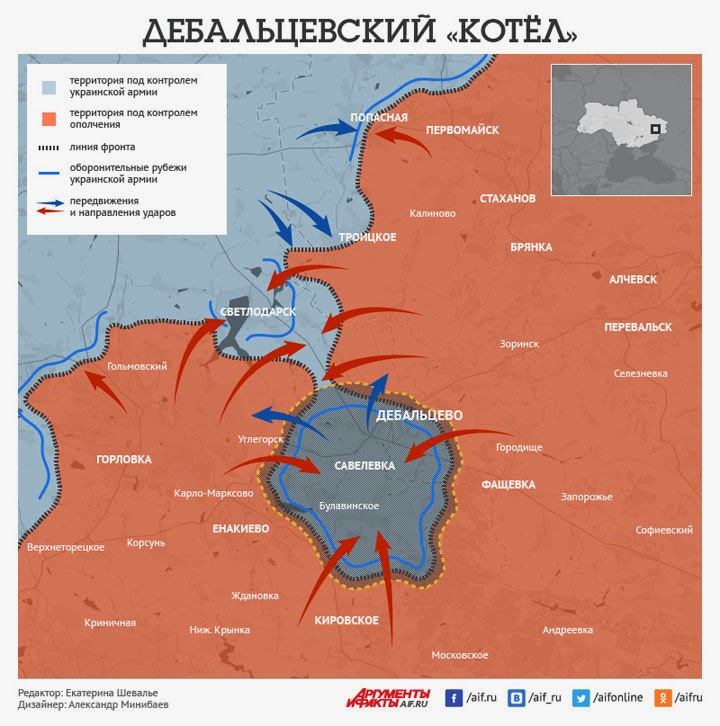
The most intense fighting was on the outskirts of Debaltsevo, where the enemy is making dire attempts to expand the encirclement, and return the localities, abandoned earlier.
Over the last 24 hours as a result of fighting along the entire frontline, DPR lost:
1 BMP, 1 SAU, 3 mortars, 11 killed, 29 wounded.
According to the information, received today while questioning two Ukrainian POW’s from the 25th brigade, captured on the outskirts of Chernukhino, Ukrainian command had ordered to mine railroad infrastructure in Debaltsevo. The goal is not to allow an opportunity of restoring railroad connection between Donetsk and Lugansk Republics after Ukrainian troops retreat from the encirclement towards Artemovsk. Locomotives, freight trains, junctions at the Debaltsevo-Sortirovochnaya station, Locomotive depoes, traffic control centers are mined, as well as the administrative zone of the Debaltsevo terminal. 
Besides, according to the POW’s, on Friday city pumping stations and electrical substations have already been mined in Debaltsevo.
Therefore, Kiev has already prepared for the destruction of the city after pulling out its troops. 
During the fighting today DPR had completely captured Kalinovka and Redkodub, abandoned by Ukrainian forces.
Military operations to repulse counterattacks continued in Chernukhino,
On the morning of February 8, DPR had captured a strategically important height 2 kilometers North-West of village Lozovoy, which had increased the opportunity of DPR to intercept supplies and reserves of Debaltsevo army group.
Two counterattacks by UAF attempted in order to return control of this height have been repulsed with heavy losses in mapower and equipment.
On Donetsk front, Ukrainian security forces continued attacks from Smerch and Grad, as well as large caliber artillery:
4 strikes on Donetsk residential neighborhoods
21 strikes on Donetsk suburbs
7 strikes on Donetsk airport
As well as strikes on Peski, Veseloye and Spartak
Mariupol front:
UAF fired heavily on militia positions from MRLS
21 Ukrainian armed vehicles arrived at the Eastern outskirts of Mariupol
Concentration of additional troops at this location is a sign of an upcoming attack on the defensive lines in  Novo-Azovsk.
Losses of Ukrainian security forces for the last day:
11 tanks (8 destroyed, 3 captured), 9 artillery installations, 6 BMP and BTR, (3 destroyed, 2 captured), 11 vehicles, 45 people killed
Total since the start of military operations over the last  22 days the enemy has lost:
3 airplanes, 1 helicopter, 168 tanks, 133 BMP, BTR, MTLB, 124 field artillery guns, 94 vehicles, 2,056 people killed
After strikes on populated areas of the Republic there are casualties among civillians.
Over the last day:
2 people killed, 9 wounded
Killed: one in Donetsk, one in Makeevka
Wounded: 8 people in Donetsk, one in Makeevka
Donetsk:
Petrovsky district – 2 people
Leninsky – 2
Kuibyshevsky – one
Kievsky -1 person.
The strike on Kievsky was on a store in the 7th quarter, but the suspicion is that a bus stop was targeted.
There were 9 fires recorded as a result of artillery strikes. Twice emergency services were fired on, when rushing to put out a fire, one in Donetsk, one in Makeevka.
Kristina Rus: There is a talk of a mysterious info blackout on frontline updates from militia. This update is from DPR Defense Ministry official, but there is suspicion that NAF is up to something and doesn’t want too many details to get out there for now…

 http://fortruss.blogspot.com/2015/02/ukrainian-forces-are-mining-civillian.html

Robert Parry: How the New York Times falsifies the Ukraine narrative

In late February, a conference is scheduled in New York City to discuss the risk of nuclear war if computers reach the level of artificial intelligence and take decisions out of human hands. But there is already the old-fashioned danger of nuclear war, started by human miscalculation, fed by hubris and propaganda.

That possible scenario is playing out in Ukraine, where the European Union and the United States provoked a political crisis on Russia’s border in November 2013, then backed a coup d’etat in February 2014 and have presented a one-sided account of the ensuing civil war, blaming everything on Russia.

Possibly the worst purveyor of this Cold War-style propaganda has been the New York Times, which has given its readers a steady diet of biased reporting and analysis, including now accusing the Russians for a resurgence in the fighting.

One way the Times has falsified the Ukraine narrative is by dating the origins of the crisis to several months after the crisis actually began. So, the lead story in Saturday’s editions ignored the actual chronology of events and started the clock with the appearance of Russian troops in Crimea in spring 2014.

The Times article by Rick Lyman and Andrew E. Kramer said: “A shaky cease-fire has all but vanished, with rebel leaders vowing fresh attacks. Civilians are being hit by deadly mortars at bus stops. Tanks are rumbling down snowy roads in rebel-held areas with soldiers in unmarked green uniforms sitting on their turrets, waving at bystanders — a disquieting echo of the ‘little green men’ whose appearance in Crimea opened this stubborn conflict in the spring.”

In other words, the story doesn’t start in fall 2013 with the extraordinary U.S. intervention in Ukrainian political affairs – spearheaded by American neocons, such as National Endowment for Democracy president Carl Gershman, Assistant Secretary of State for European Affairs Victoria Nuland and Sen. John McCain – nor with the U.S.-backed coup on Feb. 22, 2014, which ousted elected President Viktor Yanukovych and put one of Nuland’s chosen leaders, Arseniy Yatsenyuk, in as Prime Minister.

No, because if that history were included, Times readers might actually have a chance for a balanced understanding of this unnecessary tragedy. For propaganda purposes, it is better to start the cameras rolling only after the people of Crimea voted overwhelmingly to secede from the failed state of Ukraine and rejoin Russia.

Except the Times won’t reference the lopsided referendum or the popular will of the Crimean people. It’s better to pretend that Russian troops – the “little green men” – just invaded Crimea and conquered the place against the people’s will. The Russian troops were already in Crimea as part of an agreement with Ukraine for maintaining the Russian naval base at Sevastopol.

Which leads you to the next paragraph of the Times story: “The renewed fighting has dashed any hopes of reinvigorating a cease-fire signed in September [2014] and honored more in name than in fact since then. It has also put to rest the notion that Russia’s president, Vladimir V. Putin, would be so staggered by the twin blows of Western sanctions and a collapse in oil prices that he would forsake the separatists in order to foster better relations with the West.”

That last point gets us to the danger of human miscalculation driven by hubris. The key error committed by the EU and compounded by the U.S. was to assume that a brazen bid to get Ukraine to repudiate its longtime relationship with Russia and to bring Ukraine into the NATO alliance would not prompt a determined Russian reaction.

Russia sees the prospect of NATO military forces and their nuclear weapons on its borders as a grave strategic threat, especially with Kiev in the hands of rabid right-wing politicians, including neo-Nazis, who regard Russia as a historic enemy. Confronted with such a danger – especially with thousands of ethnic Russians inside Ukraine being slaughtered – it was a near certainty that Russia’s leaders would not succumb meekly to Western sanctions and demands.

Yet, as long as the United States remains in thrall to the propagandistic narrative that the New York Times and other U.S. mainstream media outlets have spun, President Barack Obama will almost surely continue to ratchet up the tensions. To do otherwise would open Obama to accusations of “weakness.”

During his State of the Union address, Obama mostly presented himself as a peacemaker, but his one major deviation was when he crowed about the suffering that U.S.-organized sanctions had inflicted on Russia, whose economy, he boasted, was “in tatters.”

So, with the West swaggering and Russia facing what it considers a grave strategic threat, it’s not hard to imagine how the crisis in Ukraine could escalate into a violent clash between NATO and Russian forces with the possibility of further miscalculation bringing nuclear weapons into play.

The Actual Narrative

There’s no sign that the New York Times has any regrets about becoming a crude propaganda organ, but just in case someone is listening inside “the newspaper of record,” let’s reprise the actual narrative of the Ukraine crisis. It began not last spring, as the Times would have you believe, but rather in fall 2013 when President Yanukovych was evaluating the cost of an EU association agreement if it required an economic break with Russia.

This part of the narrative was well explained by Der Spiegel, the German newsmagazine, even though it has generally taken a harshly anti-Russian line. But, in a retrospective piece published a year after the crisis began, Der Spiegel acknowledged that EU and German leaders were guilty of miscalculations that contributed to the civil war in Ukraine, particularly by under-appreciating the enormous financial costs to Ukraine if it broke its historic ties to Russia.

In November 2013, Yanukovych learned from experts at the National Academy of Sciences of Ukraine that the total cost to the country’s economy from severing its business connections to Russia would be around $160 billion, 50 times the $3 billion figure that the EU had estimated, Der Spiegel reported.

The figure stunned Yanukovych, who pleaded for financial help that the EU couldn’t provide, the magazine said. Western loans would have to come from the International Monetary Fund, which was demanding painful “reforms” of Ukraine’s economy, structural changes that would make the hard lives of average Ukrainians even harder, including raising the price of natural gas by 40 percent and devaluing Ukraine’s currency, the hryvnia, by 25 percent.

With Putin offering a more generous aid package of $15 billion, Yanukovych backed out of the EU agreement but told the EU’s Eastern Partnership Summit in Vilnius, Lithuania, on Nov. 28, 2013, that he was willing to continue negotiating. German Chancellor Angela Merkel responded with “a sentence dripping with disapproval and cool sarcasm aimed directly at the Ukrainian president. ‘I feel like I’m at a wedding where the groom has suddenly issued new, last minute stipulations,” according to Der Spiegel’s chronology of the crisis.

After the collapse of the EU deal, U.S. neocons went to work on one more “regime change” – this time in Ukraine – using the popular disappointment in western Ukraine over the failed EU agreement as a way to topple Yanukovych, the constitutionally elected president whose political base was in eastern Ukraine.

Assistant Secretary of State Nuland, a prominent neocon holdover who advised Vice President Dick Cheney, passed out cookies to anti-Yanukovych demonstrators at the Maidan Square in Kiev and reminded Ukrainian business leaders that the United States had invested $5 billion in their “European aspirations.”

Sen. McCain, who seems to want war pretty much everywhere, joined Ukrainian rightists onstage at the Maidan urging on the protests, and Gershman’s U.S.-funded National Endowment for Democracy deployed its Ukrainian political/media operatives in support of the disruptions. As early as September 2013, the NED president had identified Ukraine as “the biggest prize” and an important step toward toppling Putin in Russia. [See Consortiumnews.com’s “Neocons’ Ukraine-Syria-Iran Gambit.”]

By early February 2014, Nuland was telling U.S. Ambassador to Ukraine Geoffrey Pyatt “fuck the EU” and discussing how to “glue this thing” as she handpicked who the new leaders of Ukraine would be; “Yats is the guy,” she said about Arseniy Yatsenyuk.

As violent disorders at the Maidan grew worse – with well-organized neo-Nazi militias hurling firebombs at police – the State Department and U.S. news media blamed Yanukovych. On Feb. 20, when mysterious snipers – apparently firing from positions controlled by the neo-Nazi Right Sektor – shot to death police officers and protesters, the situation spun out of control – and the American press again blamed Yanukovych.

Though Yanukovych signed a Feb. 21 agreement with three European countries accepting reduced powers and early elections, that was not enough for the coup-makers. On Feb. 22, a putsch, spearheaded by neo-Nazi militias, forced Yanukovych and his officials to flee for their lives.

Remarkably, however, when the Times pretended to review this history in a January 2015 article, the Times ignored the extraordinary evidence of a U.S.-backed coup – including the scores of NED political projects, McCain’s cheerleading and Nuland’s plotting. The Times simply informed its readers that there was no coup. [See Consortiumnews.com’s “NYT Still Pretends No Coup in Ukraine.”]

But the Times’ propaganda on Ukraine is not just wretched journalism, it is also a dangerous ingredient in what could become a nuclear confrontation, if Americans come to believe a false narrative and thus go along with more provocative actions by their political leaders who, in turn, might feel compelled to act tough because otherwise they’d be attacked as “soft.”

In other words, even without computers seizing control of man’s nuclear weapons, man himself might blunder into a nuclear Armageddon, driven not by artificial intelligence but a lack of the human kind.

http://www.helencaldicott.com/nyt-lost-ukraine-propaganda/

NATO boosts Rapid Reaction Strike Force for war with Russia

“…biggest reinforcement of collective defense since the Cold War”

Posted on rickrozoff.wordpress.com

Stars and Stripes
February 5, 2015

NATO to boost rapid–reaction force in response to growing threats
By Slobodan Lekic

NATO defense ministers decided Thursday to significantly boost the size of the alliance’s rapid-reaction force to deal with growing threats such as the war in Ukraine and Islamic radicalism along its southern flank.

“In Ukraine, violence is getting worse and the crisis is deepening. Russia continues to disregard international rules and to support the separatists,” Secretary-General Jens Stoltenberg said. “In North Africa and the Middle East, violent extremism is spreading, (fueling) terrorism in our own countries.”

Outgoing Defense Secretary Chuck Hagel warned that those divergent concerns could cause a split in the alliance.

“I worry about the potential for division between our northern and southern allies,” he said. He added that this was a time for unity and that the alliance would have to address all challenges at the same time.

Stoltenberg said the alliance’s 28 ministers had agreed to increase the NATO Reaction Force  to about 30,000 troops — more than double its originally planned strength of 13,000.

He said ministers had also agreed on the composition of a brigade-strength Spearhead Force, whose lead elements would be ready to move into trouble spots within 48 hours of being activated. France, Germany, Italy, Poland, Spain and Britain had offered to provide the main elements of that force.

“This is a strong signal of NATO solidarity. And it shows that European allies are fully playing their part, taking the lead in protecting Europe,” Stoltenberg said at the end of the one-day meeting at NATO headquarters in Brussels.

The allies decided to immediately establish six multinational command and control centers in eastern Europe. These will be located in Bulgaria, Estonia, Latvia, Lithuania, Poland and Romania. The centers will be comprised of up to 50 staff officers, half of them from the home nation, officials said.

“If a crisis arises, they will ensure that national and NATO forces from across the Alliance are able to act as one from the start. They will make rapid deployment easier,” Stoltenberg said.

This is the biggest reinforcement of collective defense since the Cold War,” he declared.

The NATO meeting came amid a flurry of diplomatic activity on Ukraine.

U.S. Secretary of State John Kerry met with Ukrainian President Petro Poroshenko in Kiev on Thursday. In a surprise peace initiative, German Chancellor Angela Merkel and French President Francois Hollande were set to meet with Poroshenko on Thursday and with Russian leader Vladimir Putin in Moscow on Friday.

“We know there are now new initiatives undertaken by Hollande and Merkel, and we support those initiatives and we hope they will lead to concrete results,” Stoltenberg said.

The defense ministers’ meeting on Thursday was the first since NATO heads of state convened in September and decided to bolster the alliance’s defenses in eastern Europe in response to Russia’s annexation of Ukraine’s Crimea peninsula.

The nearly yearlong crisis has re-energized the Cold War alliance, which had been searching for a raison d’etre since the scaling back of the war in Afghanistan. At the end of last year, NATO announced it was ending combat operations in Afghanistan. But the alliance still maintains thousands of advisers and other troops in the country to help the Afghan army and police, who face threats from the Taliban and other insurgent groups.

In the meantime, NATO has established a more robust presence in Poland and the Baltic states, which lie on Russia’s periphery. The United States has taken a lead role in the rotational presence and training in those states.

Hagel said that in its initial phase, the 66-year-old alliance focused on defending its members from Soviet aggression; after 1990, it adapted to the collapse of communism and the end of the East-West divide by conducting out-of-area operations in the Balkans, Afghanistan, Libya and elsewhere. “Now, in its third phase, the alliance must be prepared to address all these challenges at once,” Hagel said.

Stoltenberg is scheduled to meet with Russian Foreign Minister Sergey Lavrov at the annual Munich Security Conference, which opens Friday. Although NATO suspended all practical cooperation with Russia last year, the alliance has kept channels open for political contacts.

https://rickrozoff.wordpress.com/2015/02/05/nato-boosts-rapid-reaction-strike-force-for-war-with-Russia/

See also https://rickrozoff.wordpress.com/2015/02/06/nato-defense-chiefs-endorse-spearhead-force-aimed-east/
NATO Defense Chiefs Endorse Spearhead Force – Aimed East

NATO to hold 25,000-troop war games in Norway

Apparently, NATO didn’t get the memo from the Ukrainian Chief of Staff. That’s their cover story, at least. They know that Russian troops haven’t invaded Ukraine.

All this “preparedness” is based on a fraud — a very, very dangerous fraud. In addition to the safety danger to the world, millions of taxpayer dollars are also being spend on these military “games” and more weaponry, while citizens in most countries are dealing with essential service cutbacks, cost increases, wage cuts, and job losses.

Posted on rickrozoff.wordpress.com
BarentsObserver
February 5, 2015

Norway will host high visibility NATO exercise
By Thomas Nilsen

“Last year was not a good year for European security,” NATO Secretary General Jens Stoltenberg said last week when presenting the alliance’s annual report.

A black year,” was words the Former Norwegian Prime Minister used pointing to Russian troops actively involved in the conflict in Eastern Ukraine.

On Wednesday, Stoltenberg met defense ministers from NATO’s 28 member states, including Norway’s Ine Eriksen Søreide.

Allied military cooperation must now be safeguarded and further strengthened through exercises and training. This is a main priority for NATO in the time to come. Last year, I offered that Norway could host the large NATO exercise in 2018. I’m very pleased that NATO now accepts the invitation. It contributes to strengthen preparedness and response capacity within the alliance,” says Ine Eriksen Søreide in a press-release from Brussels Wednesday evening.

She points to the fact that Norway also before has hosted NATO exercises. It is not said where in Norway the estimated 25.000 soldiers will go, but such large scale, multi-weaponry operations are normally carried out in Nordland and Troms.

The Defense Minister says allied training in the north will strengthen the defense of our neighboring areas.

https://rickrozoff.wordpress.com/2015/02/05/nato-to-hold-25000-troop-war-games-in-Norway/

Britain to spearhead NATO “Very High Readiness Force” aimed at Russia

“…the alliance’s political leaders and military planners now see Russia’s seizure of the Crimea and military forays into eastern Ukraine as much more than just a temporary crisis between Moscow and the West.”

Posted on rickrozoff.wordpress.com
BBC News
February 5, 2015

UK to lead ‘high readiness’ Nato force, Michael Fallon says

The UK will play a lead role in a “high readiness” Nato force that will be established in Eastern Europe, Defence Secretary Michael Fallon has announced.

Britain will send up to 1,000 troops and four RAF Typhoon jets for “air policing” in the region, he said.

The multinational force is the biggest reinforcement of Nato’s collective defence since the end of the Cold War.

BBC correspondent Jonathan Marcus said the move aimed to deter a perceived Russian threat to the Baltic states.

It comes as French and German leaders headed to the Ukrainian capital Kiev to try to negotiate an end to escalating fighting in the east of the country.

Mr Fallon said Nato’s credibility in the face of the security challenges depended on “everyone playing their part” to implement decisions taken to bolster its forces at a summit of member states in Wales last year.

“Strong words must be backed up with firm action,” he said.

Nato defence ministers have gathered in Brussels to discuss the details of the “Very High Readiness Joint Task Force” (VJTF), which will form Nato’s first response in the face of aggression.

It is expected to be made up of about 5,000 troops from Nato countries, with its lead units able to deploy at two days’ notice.

The UK will be the force’s lead nation in 2017 and then on rotation thereafter, Mr Fallon said.

He said the UK would contribute manpower to two regional headquarters in Poland and Romania, and to force integration units in Poland, Romania and Bulgaria.

The UK will also send four RAF Typhoon jets to support the Nato’s Baltic air policing mission in 2015, he confirmed.

The Typhoons will operate alongside Norwegian aircraft between May and August 2015, with the aim of securing Nato’s airspace over Latvia, Estonia and Lithuania, which do not have their own air defence fighters.

They will operate at Nato’s request from Amari Airbase in Estonia, he said.

BBC diplomatic correspondent Jonathan Marcus said the move was aimed to reassure Nato countries in eastern Europe and deter what is perceived as a potential Russian threat to the Baltic republics or other Nato members.

He said it was also a signal that the alliance’s political leaders and military planners now see Russia’s seizure of the Crimea and military forays into eastern Ukraine as much more than just a temporary crisis between Moscow and the West.

Fighting in eastern Ukraine began last April, when separatists seized government buildings after Russia annexed Ukraine’s southern Crimea peninsula.

More than 5,000 people have been killed in the conflict.

Nato secretary-general, Jens Stoltenberg has said that Russia continues to violate international law as fighting continues in Ukraine.

https://rickrozoff.wordpress.com/2015/02/05/britain-to-spearhead-nato-very-high-readiness-force-aimed-at-russia/