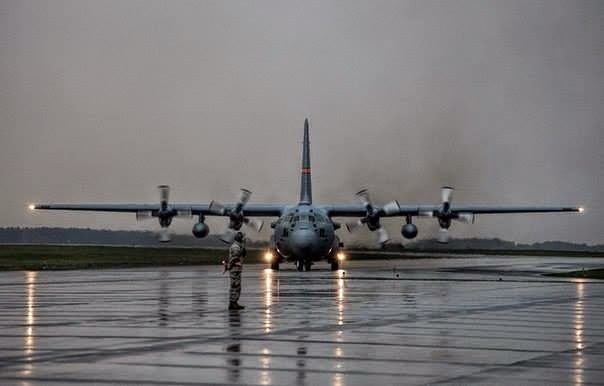
Germany to deploy “unprecedented” 1,700 troops for NATO war games in Poland

Posted on rickrozoff.wordpress.com
Polish Radio
February 5, 2015

Germany to send troops to Poland for NATO exercise

Germany is to send as many as 1,700 troops who are expected to take part in NATO exercises in Poland later this year.

The German initiative is part of a wider-ranging strategy to boost military cooperation between Poland and Germany in light of the crisis in Ukraine.

The move to send as many troops is unprecedented, writes Wednesday’s Rzeczpospolita daily, as Berlin changes its military policy and approach towards Russia in the wake of its engagement in eastern Ukraine.

Details of the Germany army’s manoeuvres in Poland are still under preparation, although it is clear that troops will take part in NATO’s “Sober Strike” exercise at the Drawsko Pomorskie military training area in June.

Rzeczpospolita reports that a joint Polish-German unit is to be set up along the lines of an existing Franco-German brigade. NATO’s Szczecin headquarters – Multinational Corps Northeast – is also to be bolstered by more Polish, German and Danish troops.

https://rickrozoff.wordpress.com/2015/02/04/germany-to-deploy-1700-troops-for-nato-war-games-in-Poland/

U.S. envoy: “These will be the first seven NATO flags In Eastern Europe”

Posted on rickrozoff.wordpress.com
Reuters
February 5, 2015

NATO to strengthen its presence in eastern Europe

(Excerpt)

20150203_150203-mod_rdax_775x440

NATO defence ministers will on Thursday strengthen the alliance’s presence in eastern Europe by setting up a network of…command centres that could rapidly reinforce the region…

Ministers will also decide on the make-up of a new rapid reaction force and agree to expand a corps-level headquarters in western Poland as part of a plan to bolster NATO’s eastern flank…

The U.S. ambassador to NATO, Douglas Lute, said NATO flags would fly over the Polish headquarters and the six command centres in Poland, Romania, Bulgaria and the three Baltic states, where the alliance has had little presence until now.

“These will be the first seven NATO flags in eastern Europe,” he told a news conference.

=====================================================================

North Atlantic Treaty Organization
February 3, 2015

Defence Ministers to take key decisions on the Readiness Action Plan

At their meeting on Thursday (5 February 2015), NATO Defence Ministers will review progress and take follow-up decisions on what Allied leaders agreed at last September’s Wales Summit. The ministers will particularly focus on the implementation of NATO’s Readiness Action Plan, NATO Spokesperson Oana Lungescu said in a briefing to the media.

====================================================================

North Atlantic Treaty Organization
February 4, 2015

NATO Defence Ministers to discuss the implementation of the Readiness Action Plan and Georgia

NATO Defence Ministers are expected to take important decisions on the implementation of the Readiness Action Plan agreed at the NATO Wales Summit last year, at their one-day meeting on Thursday (5 February 2015). Ministers will decide on the size and composition of the new Spearhead Force, which will enable the Alliance to respond to security challenges to the east posed by Russia and risks emanating from the southern neibourhood, the Middle East and North Africa. This will be the first opportunity since the Wales Summit for NATO Defence Ministers to look at the progress made and look forward to the 2016 Warsaw Summit.

NATO Defence Ministers will also meet in the NATO-Georgia Commission format, together with the Georgian Defence Minister Mindia Janeldidze. They will discuss the implementation of the Substantial NATO-Georgia Package endorsed at the Wales Summit. The package includes measures aimed at strengthening Georgia’s defence capabilities and helping Georgia advance its preparations for NATO membership. Ministers will also review the ongoing work to establish a Joint Training and Evaluation Centre in Georgia, which will help the country in further modernizing its security forces. NATO and Georgia have a long standing partnership. Georgia has provided a strong contribution to different NATO operations.

https://rickrozoff.wordpress.com/2015/02/04/u-s-envoy-these-will-be-the-first-seven-nato-flags-in-eastern-europe/

In Spain, U.S. Marines train for African interventions

From https://rickrozoff.wordpress.com/2015/02/03/spain-u-s-marines-train-for-african-interventions/

U.S. Marine Corps
February 2, 2015

Moment’s notice; Crisis Response Marines complete readiness rehearsal from Spain
By Sgt. Paul Peterson, Marine Forces Europe and Africa

MORON AIR BASE, Spain:- A platoon of Marines with Special-Purpose Marine Air-Ground Task Force Crisis Response – Africa completed an unscripted alert drill to test the unit’s ability to rapidly respond to regional crises, Jan. 29.

“At any given time we have an alert force ready to [respond] to crises in Africa,” said Capt. Daniel Lakhani, the platoon’s company commander.

SPMAGTF-CR-AF received an alert for a simulated medical evacuation mission at nearby Rota Air Base, Spain, early in the afternoon and gathered its on-call alert force to respond. The Marines assembled at a prearranged staging area, completed planning for their mission, and boarded two MV-22 Ospreys on Morón Air Base. The total time for conducting the rehearsal had to meet the requirement for the Marines to depart Spain within six hours of the order to begin their mission.

The two Ospreys, laden with Marines, departed the air field less than four hours after receiving the initial warning. Less than 30 minutes after landing at Rota Air Base, the Marines had successfully secured the area, pushed several hundred yards to their objective, and extracted the simulated casualty. The process was designed to test the command and alert force’s ability to come together, adapt, and react to the wide range of missions SPMAGTF-CR-AF was created to handle.

On any given day, the unit could participate in multinational training operations…or evacuate an embassy by direction of U.S. Africa Command.

“This mission is different from other missions or deployments the Marines have been on, whether it’s Iraq or Afghanistan, where they were conducting combat operations for a sustained period of time,” noted Lakhani…

CIA carried out terrorist bombing in Syria’s capital; why are they claiming it now?

By Richard Becker
Liberation News, February 4, 2015

The news that the U.S. Central Intelligence Agency carried out a meticulously planned terrorist car bombing in Damascus, Syria, in February 2008 appeared on the front page of the Jan. 31, 2015, Washington Post. It was an outrageous action in the capital of a sovereign state. By all definitions, a state-sponsored car bombing in the capital city of another nation is defined as terrorism.

It doesn’t take much imagination to picture what the U.S. response would be if the scenario were reversed and such an attack took place in Washington, D.C. At the very least, bombs and missiles would fall like rain on Syria.

That the CIA would carry out such an act is hardly a surprise. In its near-seven decades’ existence, the CIA has been responsible for the murder of millions and the destruction of scores of progressive movements and governments in Asia, Africa, Latin America and Europe.

Virtually every progressive leader in the countries liberated from colonialism or neo-colonialism in the post-World War II era has been targeted for assassination by the CIA at one time or another. From Vietnam to Haiti to Afghanistan and beyond, U.S. clients who had outlived their usefulness in the eyes of Washington were set up for elimination.

CIA engineered or assisted coups in Iran, Guatemala, Congo, Iraq, Indonesia, Greece, Brazil, Bolivia, Chile, Argentina, Uruguay and more, and brought to power regimes that used extreme brutality in the interests of U.S. corporations and local elites.

Organized in 1947, the agency’s first coup was in newly independent Syria just two years later. Its bloody trail confirms that the CIA is the deadliest terrorist organization in the world, bar none.

What was unusual about the 2008 assassination of a top Hezbollah commander, Imad Mughniyah, was the public revelation that the CIA, in partnership with Israel’s Mossad secret service, had carried it out.

While the CIA formally declined comment on the story, the sources for the article were past and present CIA officials, something unthinkable unless approved from inside the agency.

Standard CIA practice has long been to refuse to comment on its coups and murders—and for good reason. Regardless of whether they are “signed off on” by the president or any other U.S. official, all are blatant violations of international and U.S. domestic laws. Agency officials seek to maintain a “window of deniability” to protect themselves from possible future legal consequences.

Why, then, did the agency break with its usual practice of treating such an operation as classified and instead boast through the mass media of the assassination?

Targeting Hezbollah to derail Iran negotiations

The Post report followed two weeks after an Israeli air attack that killed six members of Hezbollah, including Jihad Mughniyah, son of Imad Mughniyah, and a high-ranking Iranian officer inside Syria. Both Hezbollah and Iran have been supporting the government of Bashar al-Assad in Syria against the armed opposition, led by al-Qaeda and the Islamic State.

Hezbollah responded to the Jan. 18 air assault by destroying an Israeli tank in the Shebaa Farms region, the last part of Lebanon still under Israeli occupation. Hezbollah played a key role in the Lebanese resistance that drove Israel out of much of Lebanese territory it occupied in 1982-2000. In 2006, it fought the powerful, U.S.-backed Israeli army to a standstill in a month-long war.

Two Israeli soldiers were killed and seven wounded in Shebaa Farms. Israeli shelling killed a Spanish soldier who was part of the UN “peacekeeping” force in southern Lebanon. The Hezbollah leadership made it clear that their response was a limited one.

The Jan. 18 attack in Syria was a clear provocation, intended to draw a Hezbollah reaction. So, too, was the Post article. The aim of both was to push Hezbollah – as an ally of Iran — toward stronger retaliation.

The publication of the Post story should be understood as a form of taunting Hezbollah by elements in the U.S. establishment who are seeking a pretext for subverting the Iran nuclear negotiations.

Talal Atrissi, a Lebanese political commentator reportedly close to Hezbollah, said of the leaked CIA report on the 2008 assassination: “The leak is meant to undermine the talks, and that benefits Israel because it opposes these negotiations.”

A Lebanese professor at the American University in Beirut, Imad Salamey, pointed to the psychological warfare aspect of the Post report: “Your [Hezbollah’s] leadership has been targeted by the United States, so what do you do?”

The negotiations with Iran are at a critical stage, with late March set as the deadline to reach an agreement. There is a major division in U.S. ruling-class political circles over the negotiations.

While the Obama administration and its allies are seeking an agreement that they believe would weaken Iran, an opposing faction wants to scuttle the negotiations and impose even harsher sanctions.

Iran has stated that additional sanctions would mean an end to the negotiating process. Such an outcome could well lead to a new U.S. or U.S.-Israeli war against Iran, something that Israeli Prime Minister Netanyahu as well as many in Washington clearly desire.

On Jan. 21, in a highly unusual breach of bourgeois protocol, Speaker of the House of Representatives John Boehner invited the rabidly anti-Iranian Netanyahu to lecture a Joint Session of Congress on Mar. 3 on the so-called “danger” from Iran and in support of imposing even tighter sanctions on that country. Boehner’s invitation was made without consultation with the administration.

Protests calling for “No New War Against Iran,” “End the Colonial Occupation of Palestine, “ and “End All U.S. Aid to Israel” are being planned to coincide with Netanyahu’s appearance before Congress on Mar. 3.

Source:

CIA carried out terrorist bombing in Syria’s capital — Why are they claiming it now?

http://www.globalresearch.ca/cia-carried-out-terrorist-bombing-in-syrias-capital-why-are-they-claiming-it-now/5429775

Russian Foreign Minister Lavrov’s speech in Munich

Posted on Fort Russ, February 7, 2015

February 7, 2015
Ministry of Foreign Affairs of Russian Federation
Translated from Russian by Kristina Rus

Remarks and replies to media questions by Russian Minister of Foreign Affairs, Sergey Lavrov, during the discussion at the 51st Munich Conference on Security Policy, Munich, February 7 2015

Ladies and gentlemen,

Mr. Wolfgang Ischinger included in the agenda the topic of “the collapse of world development”. It is impossible not to agree that the events unfolded not by the optimistic scenario. But you cannot accept arguments of some of our colleagues that a sudden, rapid collapse of the world order, which existed for decades, had occurred.

On the contrary, the events of the past year have confirmed the validity of our warnings regarding deep, systemic problems in the organization of European security and international relations in general. I would like to remind about the speech by President Putin spoken here eight years ago.

The design of stability, based on the UN Charter and the Helsinki principles was long ago undermined by the actions of the US and its allies in Yugoslavia, Iraq, Libya, by NATO expansion to the East, the creation of new lines of separation. The project of building a “common European home” failed because our partners in the West were guided not by the interests of building an open architecture of security with mutual respect for interests, but illusions and beliefs of the winners in the “cold war”.

Solemnly adopted in the framework of the OSCE and the Council of the Russia-NATO obligation not to provide own security at the expense of security of others, remained on paper, but in practice was ignored.

The issue of missile defense is a stark evidence of the powerful destructive impact of unilateral steps in the field of military building, contrary to the legitimate interests of other states. Our proposals for joint work on missile defense issue were rejected. Instead we were advised to join the creation of the US global missile defense system, strictly according to the designs of Washington, which, as we’ve outlined and explained factually, carries real risks for the Russian nuclear deterrence.

Any action that undermines strategic stability, inevitably entails response measures. Thereby a long-term damage is inflicted to the entire system of international treaties in the field of arms control, the viability of which directly depends on factors of missile defense.

We don’t even understand, what could be the reason for the American obsession of creating a global missile defense system? The desire for unquestionable military superiority? The faith in the possibility to technologically solve the problems that are essentially political? Anyway, the missile threats have not decreased, but in the Euro-Atlantic area emerged a strong irritant, which will take a long time to get rid of. But we are ready for it. Another destabilizing factor was the refusal of the United States and other NATO members to ratify the Agreement on Adaptation of the Treaty on Conventional Armed Forces in Europe (CFE), which buried this agreement.

Each difficult situation, created by themselves, our American colleagues are trying to blame on Russia. Take the revived in recent conversations The Intermediate-Range Nuclear Forces Treaty (INF) Specialists are well aware of the actions of the United States, contrary to the spirit and letter of this document. For example, in the framework of the creation of a global missile defense, Washington began a large-scale program of creating missile-targets with characteristics similar to or close to the forbidden ground-based ballistic missiles. Under a contractual definition of ground-based medium-range cruise missiles fall the widely used by the U.S. shock drones. Expressly prohibited by the treaty are the anti-missile interceptors, which will soon be deployed in Romania and Poland, as they can be used to launch medium-range cruise missiles.

Refusing to acknowledge these facts, the American colleagues claim they have some “reasonable” claims towards Russia in relation to INF, but carefully avoid specifics.

Taking into account these and many other factors, to try to narrow this crisis to the events of the past year, in our opinion, is to fall into a dangerous self-deception.

It is the culmination of the course of our Western colleagues over the last quarter-century to capture by any means their dominance in world affairs, to capture the geopolitical space in Europe. The CIS countries, our closest neighbors, connected with us by centuries of economic, humanitarian, historical, cultural, and even family ties, are demanded to make a choice – either with the West or against the West. Is a logic of zero sum game, which everyone wanted to leave in the past.

The strategic partnership between Russia and the European Union could not stand the test of strength, because the EU chose a confrontational path of development of the mechanisms for mutually beneficial interaction. How can one not remember the missed opportunity to implement nominated by the Chancellor A. Merkel in June 2010 in Meseberg initiative to establish a Committee of the Russia-EU Foreign and Security Policy at the level of Ministers of Foreign Affairs. Russia supported this idea, but the EU rejected it. But such a mechanism of permanent dialogue (if it was created) would allow to more quickly and effectively solve problems and to remove mutual concerns in advance.

As for the Ukraine, unfortunately, at each stage of the development of the crisis our American colleagues, and under their influence – the European Union, took steps leading to escalation. This happened when the EU refused to discuss with Russia the consequences of activating the economic bloc of the association agreement with Ukraine, and then directly supported the coup, and before that – the anti-government riots. This happened when our Western partners have repeatedly issued indulgences to Kiev authorities, who instead of fulfilling the promises of starting a national dialogue, began a large-scale military operation, declaring their own citizens “terrorists” for disagreeing with the unconstitutional change of government and a rampage of ultra-nationalists.

It is very difficult to explain why, in the minds of many of our colleagues, the universal principles of settlement of internal conflicts do not apply to Ukraine, involving, primarily, the inclusive political dialogue between the protagonists. Why in cases such as Afghanistan, Libya, Iraq, Yemen, Mali, South Sudan, our partners urge the government to negotiate with the opposition, the insurgents, in some cases even with extremists, and in relation to the Ukrainian crisis act differently, actually supporting the military operation in Kiev, up to attempts to justify the use of cluster munitions.

Unfortunately, our Western colleagues are apt to close their eyes to everything that is said and done by the Kiev authorities, including inciting xenophobic sentiments. Let me quote: “Ukrainian social-nationalism considers the Ukrainian nation a blood-racial community”. And further: “The question of total Ukranization in the future social-nationalist state will be resolved within three to six months with strict and prudent state policy.” The author is a deputy of the Ukrainian Verkhovnaya Rada, Andrey Biletsky, the commander of the regiment “Azov”, which actively participates in the fighting in Donbass. For ethnically pure Ukraine, the annihilation of Russians and Jews was repeatedly publicly called by the other figures, who broke into politics and power in Ukraine, including Yarosh,  Tiagnybok, and leaders of the Radical Party of Lyashko, represented in Verkhovna Rada. These statements did not cause any reaction in Western capitals. I do not think that today’s Europe can afford to ignore the danger of the spread of the neo-Nazi virus.

The Ukrainian crisis cannot be resolved by military force. This was confirmed last summer, when the situation on the battlefield forced to sign the Minsk agreements. It is confirmed now, when another attempt to win a military victory is drowning. But despite this, in some Western countries increasingly there are calls to strengthen support for the course of the Kiev authorities for militarization of society and the state, to “pump” Ukraine with deadly weapons and pull it into NATO. The growing opposition in Europe to such plans gives hope, as it may only exacerbate the tragedy of the Ukrainian people.

Russia will continue to seek to establish peace. We consistently advocate for the cessation of hostilities, the withdrawal of heavy weapons, the beginning of direct negotiations of Kiev with Donetsk and Lugansk about specific ways to restore the common economic, social and political space within the territorial integrity of Ukraine. This was the subject of numerous initiatives of Vladimir Putin within the “Normandy” format, which allowed to start the Minsk process, our subsequent efforts for its development, including yesterday’s talks in the Kremlin by leaders of Russia, Germany and France. As you know, these negotiations will continue. We believe that there is every opportunity to achieve results and to agree on recommendations that will allow the parties to really untangle this conflict web.

It is important that everyone realizes the real extent of risks. It’s time to get rid of the habit to consider each issue separately, not seeing “the forest behind the trees”. It is time to assess the situation comprehensively. The world today is on a steep fault associated with changing of historical periods. “Birth pains” of the new world order are manifested through the increase of conflicts in international relations. If instead of strategic global vision, prevail the tactical decisions made by politicians with an eye on the coming elections at home, there is a danger of a loss of control over the levers of global governance.

Let me remind you that at the initial stage of the Syrian conflict, many in the West urged not to exaggerate the threat of extremism and terrorism, claiming that it will somehow dissolve on its own, and that the main thing – is to bring about regime change in Damascus. We see what happened. The vast territory in the Middle East, Africa, the Afghanistan-Pakistan area became uncontrollable by legitimate authorities. Extremism overflows to other regions, including Europe, aggravating risks of proliferation of WMDs. The situation in the Middle East settlement, in other areas of regional conflicts is gaining an explosive nature. An adequate strategy for containment of these challenges is still not developed.

I would hope that today’s and tomorrow’s discussions here in Munich will bring us closer to estimating the level of the efforts to find collective answers to common threats. The conversation, if you count on significant results, can only be equal, without ultimatums and threats.

We remain convinced that the whole complex of problems would be much easier to solve if the major players have agreed on strategic orientations of their relationship. Recently, the permanent Secretary of the French Academy, Hélène Carrère d’Encausse, said that “the real Europe may not exist without Russia”. We would like to understand if our partners share this view, or do they plan to continue the course of deepening the division of the European space and setting its fragments against each another? If they want to create a security architecture with Russia, without Russia or against Russia? Of course, our American partners should answer this question.

We have long proposed to start building a common economic and humanitarian space from Lisbon to Vladivostok, a space based on the principles of equal and indivisible security, which would include the members of integrated unions, and other countries which are not part of those unions. Of particular relevance is the establishment of robust mechanisms for interaction between the Eurasian Economic Union (EEU) and the EU. We welcome the emerging support of this idea of responsible European leaders.

In the year of the 40th anniversary of the Helsinki act and the 25th anniversary of the Paris Charter, Russia would like to infuse these documents with real life, to prevent replacing of the principles, enshrined there, to ensure the stability and prosperity throughout the entire Euro-Atlantic space on the basis of genuine equality, mutual respect and consideration of each other’s interests. We wish success to the “group of the wise”, formed in the framework of the OSCE, which must reach a consensus in their recommendations.

Marking the 70th anniversary of the end of the Second World War, we should be aware of responsibility that rests on all of us.

Thank you for your attention.

Q&A

Question: I understand all the above-mentioned problems in relation to the United States and missile defense. Besides the fact that according to the INF, Russia equals drones to cruise missiles, I would like to note that the US President B. Obama had significantly reduced European missile defense. If there are problems in relation to the United States, why should Ukraine pay for it? Referring to the annexation of Crimea and attempts to divide Ukraine. What did the poor Ukrainians do that you punish them for the sins of the Americans?

Lavrov: I understand that you have, of course, a twisted perception. Don’t confuse apples and oranges. Now they say “we will resolve the Ukrainian crisis, and the whole system of security and stability will start working on its own.” On the contrary. The crisis needs to be resolved, it is the first priority, but we cannot ignore the fact that all the agreements concluded by the end of the “cold war” are not followed.

We have no desire to seek revenge, especially at someone else’s expense. We want to have normal relations with the United States. It was not us, who destroyed the deployed mechanisms which have been established in recent years and which provided daily contact and mutual clearing of concerns. It was not us who pulled out of the Missile Defense Treaty. It was not us who refused to ratify the adapted CFE Treaty. Now we need to collect bit by bit what we still have left and somehow based on the reconfirmation of the Helsinki principles to negotiate a new security system, which would be comfortable for everyone, including Ukraine, Georgia, Moldova – all whom our American colleagues had put before a choice: to go towards the West and to reduce cooperation with Russia. It is a fact.

I am aware that American ambassadors around the world receive such instructions. I see here A. Vershbow, who recently gave an interview, calling NATO “the most peaceful bloc in the world” and “the hope of the European stability and security.” And who bombed Yugoslavia, Libya, in violation of UN Security Council resolutions? The achievements brought by unilateral actions we are seeing now in the Middle East. We want NATO to not be just an exemplary organization, which it is presented as, but a participant in equal dialogue for stability. What’s wrong with that? Everyone wants us to recognize a subordinate role of all others in relation to the United States and NATO. I don’t think it is in the interests of world peace and stability.

With regard to the events in Ukraine, the U.S. President Barack Obama recently said openly that the United States was the broker in the process of transition (transit) of power in Ukraine. Modest formulation, but we know very well how it happened, who openly discussed on the phone the composition of personalities that should be represented in the new Ukrainian government, and much more. We know what happens now, who routinely monitored events on Maidan. There were no our military specialists and experts.

We want very much for the Ukrainian nation to regain its unity, but it must be done on the basis of real national dialogue. When the central government decided to celebrate as national holidays the birthdays of Stephan Bandera and Roman Shukhevych, the date of formation of the “Ukrainian Insurgent Army”, the question arises – how can these holidays be celebrated in the East of Ukraine? There is no way. And the West does not want to celebrate May 9th [Victory over Hitler in the Great Patriotic War -tr.]. Without mentioning other specific features of the Ukrainian society, just this requires some political arrangements.

They are probably embarrassed to say it here, but now Ukraine is undergoing mobilization, which is running into serious difficulties. Representatives of the Hungarian, Romanian minorities feel “positive” discrimination, because they are called up in much larger proportions than ethnic Ukrainians. Why not talk about it? Or that in Ukraine reside not only Ukrainians and Russians, but there are other nationalities which by fate ended up in this country and want to live in it. Why not provide them with equal rights and take into account their interests? During the elections to the Verkhovnaya Rada the Hungarian minority asked to organize constituencies in such a way that at least one ethnic Hungarian would make it to the Rada. The constituencies were “sliced” so that none of the Hungarians made it. All this suggests that there is something to discuss. There are real problems that don’t allow the Ukrainian state to get out of this severe crisis, but they are ignored in the West. I have talked to many, including those sitting here, when they introduced a law on lustration. One-on-one I was told that this is a terrible law, which urgently needs to be cancelled. I asked why this is not talked about publicly, and heard that there is an understanding that it is necessary to support the Ukrainian government, and not to criticize it. What else is there to say?

I hope that yesterday’s efforts made by the presidents of France, Russia and the Chancellor of Germany, will produce a result that will be supported by the parties of the conflict and will actually calm down the situation, starting the much-needed national dialogue on ways to solve all the problems – social, economic and political.

Question: Going Back to the results of yesterday’s talks in Moscow and the day before yesterday in Kiev, the good news is that the Minsk agreement is still on the agenda, but the bad news is that not all the signatories of these agreements agree to comply with them. Meaning the representatives from DPR and LPR are leading an offensive, artillery fire, etc. The Russian Federation also signed the Minsk agreement. Now there are attempts to revise the line of contact. There is no pressure on the militia, although Russia recognized that it can exert such pressure. Do you actually plan to implement the Minsk agreement? What guarantees of the implementation of all 12 points of the Minsk agreements and pressure on DPR and LPR can you give, as Minister of Foreign Affairs of the Russian Federation?

Lavrov: As soon as the main participants of the Minsk process – the Ukrainian authorities and representatives of the proclaimed republics of DPR and LPR – will reach an agreement on all practical aspects of implementation of each of Minsk points, I am convinced that Russia will be among those who will provide such guarantees – whether in the OSCE, or in the UN Security Council. I am convinced that Germany, France and other countries will also be able to provide such guarantees. But you can guarantee only what has been done and achieved. You have to agree directly. We should not pretend that these people will obey [Russia] unequivocally. They live on their own land and are fighting for it. When people say that they would not be able to provide superiority on the battlefield, I will say that theirs is a just cause. And Ukrainian soldiers don’t understand why they are thrown to battle. I repeat, direct negotiations are needed.

Once the US Administration was criticized for the fact that it actively maintained contacts with the Taliban via Doha (Qatar). In response to criticism the administration asked, why criticize: “Yes, they are enemies, but one does not negotiate with friends. Negotiations are held with the enemies”. If the Ukrainian authorities consider their citizens – enemies, they will have to negotiate in any case. Our Ukrainian colleagues should not hope that the blind support, they receive from the outside, will solve all the problems. Such support without any critical analysis of the events is spinning some heads. Just as in 2008, it spun the head of Mikhail Saakashvili. Everyone knows what came of it.

[Editor: Additional questions and answers translated below]

Kristina Rus: 

When Lavrov says, Russia supports the territorial integrity of Ukraine, it doesn’t mean that it wants Ukraine to remain in it’s current boundaries. What it means, is that it is not up to Russia, but up to the citizens of Ukraine to decide, whether to remain united or not. He also brings up the differences in the mentality and culture of Eastern and the Western Ukraine, which need to be addressed. “To be addressed,” does not mean “to be resolved”, especially when they are irreconcilable

http://fortruss.blogspot.com/2015/02/lavrovs-munich-speech-full-transcript.html

Editor: What follows are additional questions and answers not translated on Fort Russ from the text on

http://www.mid.ru/brp_4.nsf/0/5E26BDE162FEC0E643257DE5004B5FE0

This is a rough translation via Google — I hope to update with a better translation soon.

Foreign Minister Lavrov: We have an extensive network existed bilateral arrangements between Russia and NATO in the NATO-Russia Council, where the military daily contact with each other, had a special meeting of experts from capitals, there were many joint projects to combat terrorism, collective project to develop explosives a detector «STANDEX».

Additional area points of, and was a project on training for Afghanistan’s security services, equipment this service helicopters. There was also a project «Common airspace initiative» (joint initiative on the safety of air space). Now all this is “frozen”, although under these arrangements was quite possible to agree on how to avoid dangerous military activities.

With specific regard to the theme of activity of the Air Force, we have the relevant statistics, which shows that the activity on the NATO side has increased immeasurably more than on the side of Russia. In my opinion, at the end of Jan. our Permanent Representative to NATO Alexander Grushko met with Secretary General Jens Stoltenberg on the subject and gave him «fact-sheet» outlining ongoing contact statistics. We are open to reconstruct the mechanisms of interaction, but for the time being, they are all frozen. There was only the Permanent Representatives Council (the Council of Ambassadors) meetings which are held infrequently. Everything else is closed.

Now even the following problems arise. Apparently, our NATO colleagues want to reduce the physical presence of Russian diplomats in Russia’s permanent mission to NATO. To us restricted access to headquarters, where there is our premises. Perhaps this will promote additional the appearance of “dark spots” in our relationship and will not help to clarify each other’s intentions.

Question: You said that you want to define the general principles of European security. I am afraid that the principles of the EU are based on self-determination and does not correspond to the Russian principles. Do you believe in the sphere of influence, as he said Dzh.Kennon about 60 years ago, many of Russia’s neighbors must choose between being enemies and satellites. In view of the incompatibility of our values what the general rules are possible? Five years ago, Medvedev proposed the concept of a new European security architecture. It did not work, because Russia has a strong influence on its neighbors. Do you see a way out of this situation? Is it possible a compromise between Russian and European approaches to building security in Europe?

Lavrov: Perhaps you did not listen very closely. It was not that the necessary to develop new principles. I said that it is necessary retraining the principles contained in the Helsinki Final Act, the Charter of Paris, in the documents of the NRC, but this time to confirm with honesty/integrity. And most importantly – give them a binding form.

Mentioned by you, European Security Treaty also did not offer anything new. He only offered in a legally binding form enshrine the principle of the indivisibility of security, which is proclaimed in the OSCE and the NRC. Our NATO colleagues said that the legal guarantees of security have to remain the prerogative of NATO in order to it everyone strove to keep this visual line grew and deepened. Why give up that security was equal? It was proclaimed, and this obligation is have undertaken presidents and prime ministers of the Euro-Atlantic area, the OSCE. It turns out that NATO wants to make safety unequal. Wrote Dzh.Oruell [George Orwell, 1984] that someone was “more equal than others.”

You quoted Dzh.Kennon [George Kennan? Footnote 1 belw]. I can quote another of his statement that the “cold war” was a colossal mistake which the made the West.

No need to invent anything new. You just have to sit down and honestly and then faithfully fulfill what agreed a couple of decades ago.

Question: I agree with you that in the last 25 years, not everything was perfect. We had a lot of disagreements with Russia. We almost signed a partnership agreement aimed at modernizing Russia’s economy – and this is just one example. I believe that we have created such a scheme in Europe, which ensures the territorial integrity and sovereignty of States. Both of these principles have been violated, and we must recognize that Russia is a party to the conflict in Ukraine. We can overcome this crisis only if we properly analyze the political situation in the country. Your description of the situation in Ukraine is unacceptable.

There was an agreement with Viktor Yanukovych, approved by the parliamentary majority. Elections were held, in which 80% voted for the European course. Nationalists, communists and fascists received 2-3% of the vote. That’s what the real situation from which to draw on. In the twenty-first century there should not be grounds for a violation of the principles of sovereignty and territorial values enshrined in Helsinki. The principle of sovereignty is that every nation, including Ukraine, has the right to decide which country to enter into trade agreements. If the next state is trying to control this choice, it is a return to the old policy, and violation of the principle of sovereignty, which currently takes place in Ukraine.

Foreign Minister Lavrov: I am sure that your performance will be a good story on television.

There are international rules that, in fact, sometimes treated differently, different actions receive the opposite interpretation. In Crimea, something happened that is provided by the UN Charter – self-determination. In this document, there are several principles and the right of nations to self-determination stands on a key point. Read the Charter! Territorial integrity, sovereignty is obliged to respect. The UN General Assembly adopted a declaration in which they clarified the ratio of basic principles of international law. There it was confirmed that the sovereignty and territorial integrity inviolable and the countries that pretend to respect their sovereignty, have to respect the right of living in these countries and nations do not allow the prevention of self-determination by the use of brute force.

According to you, in Kiev, there was just something for the entire implementation of the agreement, which was signed by President Viktor Yanukovych, as there are elections were held. Firstly, the day after the signing of the agreement, regardless of the location of Viktor Yanukovych (he was in the Ukraine), were attacked his residence, the building of the presidential administration, government buildings, in addition to how many buildings and people burned at “Maidan” in the previous period. But in such a way trampled an agreement that witnessed the foreign ministers of Germany, France and Poland (by the way, in the hall there Sikorski, who probably can tell your story), in its first paragraph implied the creation of a national unity government. These are the key words. The goal of national unity can not depend on the fate of a single Viktor Yanukovych. If he is gone, now what – you can seize power by force of arms, and do not care about national unity? But you do not agree with this and rightly so, because it is not permissible. So, it happened instead of a national unity government, which by September had to prepare a new constitution, on which must have been a general election. Here are the sequence of actions. But the starting point -National unity. That’s where you need to build a constitution with the views of the entire country.

Instead, when the said agreement has already been consigned to oblivion, Yatsenyuk went to the “Maidan” and announced the creation of a “government of winners.” Then the regions of Ukraine, who have rebelled and began to protest, to organize events, to say that do not accept the results of the coup – they simply began to suppress. First began to arrest the leaders who opposed the coup, and then began to use force. Who attacked whom? Did Donetsk and Lugansk go to storm Kiev? Not at all. In the South-East was sent military groupings by means of which began to try to establish the rule force.

Occurs in Ukraine have seen in the Crimea. In the very early stages of the crisis there was an attempt by “Right Sector” to break through and seize administrative buildings. Thank God, there is an isthmus, and people’s guards stood up and did not let them. In Crimea, held a referendum on independence, and later on joining Russia. In Kosovo, there was no referendum, although US President Barack Obama recently stated that Kosovo – is an exemplary case because there people voted in a referendum. The referendum was not there, as well as many other “referendum”. The unification of Germany took place without a referendum, and we were the active supporters of this.

When World War II ended, if you remember, the Soviet Union opposed the division of Germany. Speaking about the methods that are used instead of direct dialogue, the trouble is that the current President of Ukraine has lost its monopoly on the use of force. The Ukraine created private battalions paid better than the regular army. These battalions under different names (including “Azov” that I quoted) from the regular army deserted the people.

Among those who lead them, there are frankly ultranationalists. We are with you, Mr. E. Brok have long communicate. You even came to Moscow. So my answer to you is very simple. If you want to say angry speeches that will reinforce your position in politics in the European Parliament is one thing, but if you want to talk, let’s sit down and in honesty all Helsinki principles, see why in some cases you do not think that they are violated, and in others – think that it was so.

By the way, recently based in Nuremberg Ukrainian credit rating agency «GFK Ukraine» conducted a survey in the Crimea. According to the results of more than 90% said that they supported the annexation of Crimea to Russia, were against 2%, and 3% said they still do not really understand (what is happening). This statistic is people. Here’s a colleague said that the main principle of the EU – is self-respect. Once you have talked about the country, and in this case there was determination of the people, while it was based on centuries history. We can discuss all this, if you really want to understand our position, and we were guided by. About this many times told Russian President Vladimir Putin. You can, of course, to laugh. If just someone from this to have fun. Laughter is also said to prolong life!


Footnote 1

http://www.globalresearch.ca/americas-blueprint-for-global-domination-from-containment-to-pre-emptive-war-the-1948-truman-doctrine/5400067
America’s Blueprint for Global Domination: From “Containment” to “Pre-emptive War”. The 1948 Truman Doctrine; ANNEX: Archive of (Declassified) Top Secret Policy Planning Document drafted by George F. Kennan

PACE refuses to recognize DPR, LPR as terrorist organizations

PACE is the Parliamentary Assembly of the Council of Europe.

From  Sputnik News, January 28, 2015

STRASBOURG, January 28 (Sputnik) — PACE on Wednesday rejected an amendment to a resolution on Russian credentials in the organization calling for recognizing the self-proclaimed Donetsk andLuhansk people’s republics (DPR andLPR) in eastern Ukraine as de-facto terrorist organizations.The amendment was introduced by the Ukrainian delegation.

In December 2014, media reports suggested that Ukraine’s parliament, the Verkhovna Rada, had introduced a bill, according to which DPR and LPR were recognized as terrorist organizations.

Russian Foreign Ministry’s spokesman Alexander Lukashevich said that this bill was “legal nonsense and absurdity” and an attempt to wind down efforts to find a political solution to the situation in Ukraine.

Lukashevich stressed that if one side of the Ukrainian crisis presented the other side as a terrorist organization, it was unclear whether further dialogue could be useful.

The Kiev forces and the independence supporters of eastern Ukraine have been fighting since April 2014 when Kiev launched a military operation in Donbas. The warring sides agreed to a ceasefire in Minsk in September, but truce violations have been reported from both sides ever since, with the violence seeing a sharp increase in the beginning of 2015.

http://sputniknews.com/politics/20150128/1017470300.html

Alexander Mercouris: Diplomatic talks in Moscow — a two-part analysis

Posted on Vineyard of the Saker, February 6, 2015

Talks in Moscow – a two-part analysis
by Alexander Mercouris

Part one (On 6th February 2015)
They have apparently continued for 5 hours and are still not finished though it seems some sort of document is being prepared for tomorrow.

Three comments:

1. If negotiations go on for 5 hours that does not suggest a smooth and conflict free discussion.

2. One of the most interesting things about the Moscow talks is that they mainly happened without the presence of aides and officials i.e. Putin, Hollande and Merkel were by themselves save for interpreters and stenographers. Putin and Merkel are known to be masters of detail and given his background as an enarque I presume Hollande also is. However the German and French officials will be very unhappy about this. The Russians less so because since the meeting is taking place in the Kremlin they are listening in to the discussions via hidden microphones.

One wonders why this is happening? Even if the Russian officials are not listening in Merkel and Hollande will assume they are. The fact that Russian officials were not present is therefore less significant than that German and French officials have been barred from the meeting by their respective chiefs, suggesting that Merkel and Hollande do not entirely trust them.

There has been an extraordinary degree of secrecy about this whole episode and it rather looks as if Merkel and Hollande were anxious to stop leaks and to prevent information about the talks from getting out. Presumably this is why their officials were barred from the meeting. From whom one wonders do Merkel and Hollande want to keep details of the meeting secret? From the media? From other members of their own governments? From the Americans? What do they need to keep so secret? The frustration and worry on the part of all these groups must be intense.

3. The fact that the British are excluded from the talks is going down very badly with many people here in London. It has not escaped people’s notice that this is the first major negotiation to settle a big crisis in Europe in which Britain is not involved since the one that ended the Franco-Prussian War in 1870. Of course it is largely the fault of the inept diplomacy of Cameron, who has taken such an extreme pro-Ukrainian position that Moscow simply doesn’t see him as someone worth talking to. Also one suspects Merkel and Hollande do not trust Cameron not to leak the whole discussion to whomever they want to keep it from. Having said that it is difficult to see this as anything other than further evidence of Britain’s decline into complete irrelevance. I cannot imagine Thatcher being excluded in this way. If the United Kingdom is indeed in the process of breaking up (and as I suspected the Scottish referendum settled nothing with polls indicating that the SNP may make an almost clean sweep of all the seats in Scotland in the election in May) then the slide into irrelevance still has a long way to go.

Part two (On 7th February 2015)
I am coming increasingly round to the view of Alastair Newman that Merkel and Hollande came with no plan to Moscow but with the purpose of having what diplomats call “a full and frank discussion” in private with Putin looking at all the issues in the one place in Europe – the Kremlin – where they can be confident the Americans are not spying on them. That must be why they sent their officials away.

It is also clear that Merkel’s and Hollande’s visit to Kiev before their flight to Moscow was just for show.

Poroshenko’s officials are insisting that the question of federalisation was not discussed during Poroshenko’s meeting with Hollande and Merkel. Hollande has however now come out publicly to support “autonomy” for the eastern regions i.e. federalisation, which makes it a virtual certainty that in the meeting in Moscow it was discussed. The point is that Merkel and Hollande did not want to discuss federalisation with Poroshenko because they know the junta adamantly opposes the idea and did not want him to veto it before the meeting in Moscow had even begun.

The problem is that since everyone pretends that federalisation is an internal Ukrainian issue to be agreed freely between the two Ukrainian sides, its terms will only be thrashed out once constitutional negotiations between the two Ukrainian sides begin. Since the junta will never willingly agree to federalisation, in reality its form will have to be hammered out in private by Moscow after consultations with the NAF and with Berlin and Paris and then imposed on the junta in the negotiations.

Saying this shows how fraught with difficulty this whole process is going to be.

Not only are there plenty of people in the Donbass who now oppose federalisation (and some in Moscow too I suspect) but this whole process if it is to work would somehow have to get round the roadblock of the Washington hardliners, who will undoubtedly give their full support to the junta as it tries to obstruct a process over which it has a theoretical veto. Frankly, I wonder whether it can be done.

If the process is to have any chance of success then Merkel and Hollande must screw up the courage to do what they failed to do last spring and summer, which is publicly stand up to the hardliners in Washington and Kiev and impose their will upon them. Are they really willing to do that? Given how entrenched attitudes have become over the last few months and given the false position Merkel and Hollande put themselves in by so strongly supporting Kiev, the chances of them pulling this off look much weaker than they did last spring.

I would add a few more points;

1. There is one major difference between the situation now and in the Spring, which might offer some hope of movement.

Anyone reading the Western media now cannot fail but see that there is a growing sense of defeat. Sanctions have failed to work, the Ukrainian economy is disintegrating and the junta’s military is being defeated.

That was not the case last spring, when many in the West had convinced themselves that the junta would win the military struggle with the NAF. The confrontation strategy Merkel opted for in July based on that belief has totally and visibly failed. It is not therefore surprising if she is now looking for a way-out by reviving some of the ideas that were being floated by the Russians in the spring. She now has a political imperative to look for a solution in order to avoid the appearance of defeat, which would leave her position both in Germany and Europe badly weakened. That political imperative was not there in the spring. It is now. In a sense the pressure is now on her.

2. I should stress that it is Merkel who is Putin’s key interlocutor. The reason Hollande is there and appears to be taking the lead is to provide Merkel with cover. The one thing Merkel cannot afford politically is the appearance of a Moscow-Berlin stitch-up that the hardliners in Washington, Kiev, London, Warsaw and the Baltic States will claim is a new Molotov-Ribbentrop Pact to divide Europe into German and Russian spheres of influence. Whether we like it or not in Germany the shadow of Hitler still hangs heavy and exposes Berlin to endless moral blackmail whenever it tries to pursue with Moscow an independent course. That is why Merkel needs Hollande present when she meets Putin for talks of the sort she’s just had in Moscow.

3. One other possible sign of hope is that there is some evidence that a sea-change in European and especially German opinion may be underway.

Whatever the purpose of the ongoing debate in Washington about sending weapons to the junta, whether it is a serious proposal or an attempt to secure diplomatic leverage or a combination of the two, it has horrified opinion in Europe, bringing home to many people there how fundamentally nihilistic US policy has become.

All the talk in the Western media yesterday and this morning is of a split between Europe and the US. That is going much too far. However for the first time there is public disagreement in Europe with Washington on the Ukrainian question. Whether that crystallises into an actual break with Washington leading to a serious and sustained European attempt to reach a diplomatic solution to the Ukrainian crisis against Washington’s wishes is an altogether different question. I have to say that for the moment I very much doubt it.

4. I remain deeply pessimistic about this whole process. The best opportunity to settle this conflict diplomatically was last spring. I cannot help but feel that as Peter Lavelle said on the Crosstalk in which I appeared yesterday, the train has now left the station.

A peaceful solution to the Ukrainian conflict ultimately depends on European resolve to face down the hardliners in Washington and Kiev. It is going to be much harder to do this now than it was last year.

Moreover, despite the bad news on the economy and on the front line in Debaltsevo, the hardliners in Kiev are bound to have been emboldened by all the talk in Washington about sending them arms, which is going to make the effort to bring them round even harder than it already is.

The besetting problem of this whole crisis is that the Europeans have never shown either the resolve or the realism to face the hardliners down though it is certainly within their power to do so. In Merkel’s case one has to wonder whether her heart is in it anyway. My view remains that this situation will only be resolved by war, and that the negotiations in Moscow will prove just another footnote to that.

5. If I am wrong and some autonomy really is granted to the Donbass, then I make one confident prediction. This is that the Ukraine will in that case disintegrate even more rapidly than it would have done if federalisation had been agreed upon last spring or summer.

Following such a terrible war, I cannot see people in the Donbass accepting federalisation as anything other than a stepping stone to eventual secession and union with Russia. If the Donbass secures autonomy, I cannot see people in places like Odessa and Kharkov failing to press for an at least equivalent degree of autonomy to that granted to the Donbass. If the Europeans are prepared to see the Donbass achieve autonomy, by what logic can they deny it to the people of Odessa and Kharkov?

More to the point, the November elections showed the emergence of what looks like an increasingly strong potential autonomy or even independence movement in Galicia.

Given that a terrible war has been fought and lost in the east to defeat “separatism” in the Donbass, and given the widespread disillusion with the junta in Kiev, it is difficult to see how many people in Galicia will not feel betrayed if the grant of federalisation to the Donbass is now imposed on them after so many of their men died to prevent it. If in reaction Galicia presses for the same sort of autonomy as the Donbass – which it could well do – then the Ukraine is finished. I doubt it would hold together for more than a few months. If federalisation had been granted last spring or summer before the war began then it is possible – likely even – that the Ukraine could have been held together in a sort of state of suspended animation at least for a while. I don’t think there’s much chance of that now.


http://vineyardsaker.blogspot.com/2015/02/talks-in-moscow-two-part-analysis.html


Order from Kiev: “Break Donetsk at any cost.”

Posted on Fort Russ, February 6, 2015

January 27, 2015
Translated from Russian by Tom Winter
The massive heavy artillery shelling on Donetsk has resumed. In several districts of the city natural gas lines and electric substations are now out of service. Dozens more homes are without power and heat. Dokuchaevsk and Gorlovka are under intense fire. Many wounded, mostly peaceful citizens. At the Donetsk Peoples Republic (DNR) they have no doubt that Kiev is intent on aggravating the situation to the limit, and on striking the most vulnerable.
Explosions are constantly heard, with fresh craters from the incoming shells. Close by, the roof of a house that people were still living in. The outskirts of the town are being systematically destroyed by artillery fire. There are dead and injured: the wounded are constantly being brought into hospitals, most with shrapnel wounds.
“Incoming. Unmistakeably from the Ukrainian side. Yesterday the rockets were flying in from the area between Yasnovatya and Makeevka. You could see the projectiles flying in. Multiple rocket launchers definitely, all with exhaust trails, all plain to see.” —Vladimir Alekseev.
The Ukrainian firing zone is constantly increasing. Reports of new bombardment come in every hour.
A woman in the street: “Right next to our house it came. Right next to our house. Roof, Bam! The trolleys have stopped running; we go by foot now. No public transit.”
“Isn’t walking more dangerous?”
“And where can you get to? All the same, we are still alive.”
Even as the infrastructure is being destroyed, repair crews are already at work, fixing gas and electric lines. “We live here. We keep  the city working,” says Alexander Kigol, repairman from the city gasworks.
“In spite of the continuing attacks?”
“Yes!” replies Mr. Kigol.
Many have gotten used to the mortal danger. After a strike on a residential building on Ochakovski Street, the residents return to their ruined apartment. The roof is gone. Life here without repair will be impossible. The woman from the ruined apartment says “My neighbor says two shells just came in on the other side.”
The people run in short dashes from home to the store. Since a shell may come in at any minute, it is safer to run alongside a wall. This is Gorlovka, and this is what it’s like to live here.
Throughout Gorlovka the Ukrainian forces have attacked with heavy weapons, destroying homes and ruining the streets. At the crossroads, a crater from a “Hurricane” rocket system [see http://en.wikipedia.org/wiki/BM-27_Uragan — Tr.] The hole is as deep as a man’s height. Useless for 500 meters. The people are afraid of new bombardments, and hide themselves in basements.
The Donetsk Prime Minister Alexander Zakharchenko has arrived in the city, which lies entirely within the destructive zone of Ukrainian artillery. But at least now it is easier to get to it from Donetsk. Since the DNR got the town of Krasniy Partisan, the short road has become clear.
“We’re running short on medicine; it’s hard to keep the hospitals supplied. You have to understand, there are still peaceful citizens here, and pills for internal and cardiac problems are needed, in addition to those medicines that are used to treat the wounded,” said the Prime Minister.
“The DNR militia is counter-attacking trying to drive the Ukrainian forces far enough away, out of range, so that the people can be safe. We have something to fight for.”
“The Donetsk Republic’s army is being restocked with captured trophies. They hit a BMP-2, and are using it for parts; they got a T-64 tank at the airport, damaged, but they’ve repaired it. It will soon be at the front, but now it’s just in the Donetsk tank brigade. Ukrainian forces stormed the Donetsk position there, but were repulsed, and took casualties. The combat continues at the front, as forces controlled by Kiev are attempting to strengthen the economic blockade of the region.”
“The economic blockade is in effect along the whole border, and is contrary to every stipulation of the Minsk accords. Functional checkpoints? No. The transport of any food supply? Stopped. Passenger traffic? No.” explains the Vice premier Denis Pushilin.
No let-up in the intensity of Ukrainian artillery fire on neighborhoods, ever striking deeper, even into the rear of the Donetsk Republic, including industrial zones. January 26, they got the mines, the mines at Skochinski, Abakumov, Trudovski. And at the Zasyadki mine, they got the power station, trapping about 600 miners underground.

EU threatened Ukraine with coup d’état over association agreement, while Washington masterminded the plan, says ex-Ukrainian PM

From RT, February 4, 2015

Top EU officials, rather than Russia, threatened Ukraine with a coup d’état if Kiev refused to sign an association agreement in 2013, Nikolay Azarov, Ukraine’s former prime minister, said.

“I’ve never heard neither Putin nor Medvedev saying that if you sign an agreement with the EU, you’ll have a different government. But I’ve heard [EU Commissioner for Enlargement and Neighborhood Policy, Stefan] Fule, repeatedly saying that if you don’t sign then the other government will sign it,” Azarov said at the presentation of his book ‘Ukraine at a crossroads. Prime Minister’s notes’ in Moscow.

The decision to delay the signing of the association agreement by then-Ukrainian president, Viktor Yanukovich, led to Euromaidan protests in the capital, Kiev, which turned violent and resulted in a regime change in February 2014.

According to Azarov, it was Washington which masterminded the plan to ouster Yanukovich and his government.

“As for the US, I think they initially applied the tactics of gradually forcing Yanukovich from power,” he said. But first, “their goal was to get rid of the government, because they saw the government as a key to the country’s stability.”

Washington needed to “knock out this foundation from under Yanukovich and they achieved this aim by introducing the idea of a national unity government,” he added.

Azarov quit his post as prime minister in late January 2014 amid the intensification of Euromaidan riots, stating it was in the hope that his resignation would create a chance for compromise between the government and the protesters.

Meanwhile, the US, Azarov said, managed to pull Yanukovich into “useless negotiations” with the Euromaidan demonstrators, while armed men from all over Ukraine were arriving in Kiev to seize power.

Over 100 were killed last February in clashes between the police and Euromaidan protesters in central Kiev, in which firearms were widely used.

Azarov insists Yanukovich had every opportunity to “maintain order in the country” and prevent the coup, but after the killings at the Euromaidan he was “was practically paralyzed.”

Following the coup, both Yanukovich and Azarov had to flee Ukraine and found refuge in Russia, saying that they feared for their lives.

In mid-January, Interpol put the former president and prime minster on the international wanted list after a request from Kiev. Yanukovich and Azarov stand accused of misappropriation and embezzlement during their time in office.

The new Kiev government signed the economic and political aspects of the association agreement last year, with Ukraine and the EU parliaments simultaneously ratifying them in September 2014.

The ex-PM described the current events in the south-east of Ukraine where the fighting continues between rebels and Kiev troops as a “catastrophe”.

With the sides being unable to reach a peaceful agreement on their own, the ex-PM urged the organization of an international conference, involving Russia, the US and Germany, to put an end to violence in Ukraine.

“If the forces inside the country don’t want to stop than – as it already happened in the world’s history – the Guarantor States gather and make a decision. Trust me, Germany, the US and Russia have enough influence to stop this war, they just need to come to an agreement,” he said.

The ex-PM also said that he doesn’t consider the new Ukrainian power, led by president Petro Poroshenko and prime minister Arseny Yatsenyuk, to be legitimate.

“How can I consider this a legitimate authority if it came to power through an armed coup, committed monstrous crimes and now continues a fratricidal war, doing nothing to stop (the violence)?” he wondered.

The Ukraine conflict began last April when Kiev sent regular forces and volunteer battalions to the southeastern Donetsk and Lugansk regions, after rebels within them refused to recognize the country’s new, coup-imposed authorities.

The death toll in the Ukraine conflict has exceeded 5,300 people, with over 12,000 injured, according to UN estimates.


Source:
http://rt.com/news/229355-ukraine-eu-washington-russia/

http://www.globalresearch.ca/europe-not-russia-pressed-kiev-over-eu-association-ex-ukrainian-pm/5429832

The Fallujah option for East Ukraine; why the US feels threatened by Russia

Tell me; what choice does Zakharchenko really have? If his comrades are killed in future combat because he let Kiev’s army escape, who can he blame but himself?

There are no good choices.

By Mike Whitney, February 6, 2015
Posted on Counterpunch

I want to appeal to the Ukrainian people, to the mothers, the fathers, the sisters and the grandparents. Stop sending your sons and brothers to this pointless, merciless slaughter. The interests of the Ukrainian government are not your interests. I beg of you: Come to your senses. You do not have to water Donbass fields with Ukrainian blood. It’s not worth it.”

Alexander Zakharchenko,  Prime Minister of the Donetsk People’s Republic

Washington needs a war in Ukraine to achieve its strategic objectives. This point cannot be overstated.

The US wants to push NATO to Russia’s western border. It wants a land-bridge to Asia to spread US military bases across the continent.  It wants to control the pipeline corridors from Russia to Europe to monitor Moscow’s revenues and to  ensure that gas continues to be denominated in dollars. And it wants a weaker, unstable Russia that is more prone to regime change, fragmentation and, ultimately, foreign control. These objectives cannot be achieved peacefully, indeed, if the fighting stopped tomorrow,  the sanctions would be lifted shortly after, and the Russian economy would begin to recover. How would that benefit Washington?

It wouldn’t. It would undermine Washington’s broader plan to integrate China and Russia into the prevailing economic system, the dollar system. Powerbrokers in the US realize that the present system must either expand or collapse. Either China and Russia are brought to heel and persuaded to accept a subordinate role in the US-led global order or Washington’s tenure as global hegemon will come to an end.

This is why hostilities in East Ukraine have escalated and will continue to escalate. This is why the U.S. Congress  approved a bill for tougher sanctions on Russia’s energy sector and lethal aid for Ukraine’s military. This is why Washington has sent military trainers to Ukraine and is preparing to provide  $3 billion in  “anti-armor missiles, reconnaissance drones, armored Humvees, and radars that can determine the location of enemy rocket and artillery fire.” All of Washington’s actions are designed with one purpose in mind, to intensify the fighting and escalate the conflict. The heavy losses sustained by Ukraine’s inexperienced army and the terrible suffering of the civilians in Lugansk and Donetsk  are of no interest to US war-planners. Their job is to make sure that peace is avoided at all cost because peace would derail US plans to pivot to Asia and remain the world’s only superpower. Here’s an except from an article in the WSWS: Continue reading