October 27, 2016
Sochi, Russian Federation
RT, Translated by Inessa Sinchougova
Published on Oct 28, 2016
[Valdai, Part 2 of 2. Watch Part 1 here: https://www.youtube.com/watch?v=Xs40t…]
October 27, 2016
Sochi, Russian Federation
RT, Translated by Inessa Sinchougova
[Valdai, Part 2 of 2. Watch Part 1 here: https://www.youtube.com/watch?v=Xs40t…]
15:54
October 27, 2016 — Part 1
Valdai Discussion Club
“The Future in Progress: Shaping the World of Tomorrow”, October 24-27, 2016
RT
Translated by Inessa Sinchougova
Transcript, Part 1:
Moderator Timothy Colton, Professor of Russian Studies, Harvard University:
So, good afternoon, ladies and gentleman. My name is Timothy Colton. I know quite a few of the people in the room. And I’m very happy to have been asked to moderate this final session of our 2016 Valdai, as you call it.
I’d like to start with a special welcome to our lead-off speaker and main speaker this afternoon [subtitled translation by Inessa S.:] Russian President Vladimir Putin. He found the time to be here today – we all know how busy he is!
We appreciate as always your ability to answer questions at the end as well. When you retire, Mr. President, and go to write your memoirs, try to analysis just how much time you spent in your career answering people’s questions [Q&A]. I think you will be astonished!. We are really appreciative of this. Thank you for being here today.
President Vladimir Putin
Thank you. Dear Tarja, Heinz, colleagues, ladies and gentlemen. It is a great pleasure to see you again.
I would like to start by thanking all Russia’s and international participants at the Valdai Discussion Club gor your constructive roles in this work, and I want to thank our distinguished guests for their willingness to take part in this open discussion.
Our esteemed moderator just wished me a sound departure into retirement, and I wish that for myself too – when the time comes. This is the right approach and will be the right thing to do.
But I am not yet retired! I am for now the leader of this big country. As such, it is fitting to show restraint and avoid displays of aggressive reactions. I don’t think that this is my style in any case.
But I do think we should be frank with each other, particularly here in this forum. I think we should hold candid, open discussions, otherwise, our dialogue is pointless, stale, and will not hold anyone’s interest for too long.
I think that this style of discussion is exceptionally needed today given the great changes taking place in the world. The theme of our meeting this year “The Future in Progress: Shaping the World of Tomorrow” is very topical.
Last year, the Valdai forum participants discussed the problems with the current world order. Unfortunately, little has changed for the better over these last months. Indeed, it would be more honest to say that nothing has changed for the better.
The tensions created by shifts in distribution of economic and political influence continue to increase. Mutual distrust creates a burden that narrows our possibilities for finding effective responses to the real threats and challenges facing the world today.
Essentially, the entire globalization project is in crisis today, and in Europe, as we know well and hear of all the time, that multiculturalism has failed.
I think this situation is in many respects the result of mistaken, hasty and to some extent over-confident choices made by some countries’ elites a quarter of a century ago. Back then, in the late 1980s – early 1990s, there was a chance not just to accelerate the globalization process, but also to give it a different quality and make it more harmonious and sustainable in nature.
But some countries that saw themselves as victors in the Cold War — not just saw themselves this way, but said it openly — they proceeded to simply reshape the global political and economic order to fit their own interests.
In their euphoria, they essentially abandoned substantive and equal dialogue with other members of the international community, and chose not to improve or create universal institutions, attempting to bring the entire world instead under the spread of their organizations, norms, and rules.
They chose the road of globalization and security for their own beloved selves, for the select few, but not for all. However, far from everyone was willing to abide.
We may as well be frank here, as we know full well that many did not agree with what was happening, but some were unable by then to respond, and others were not yet ready to respond.
The result though is that the system of international relations is forever feverish, and the global economy cannot free itself from systemic crisis.
At the same time, rules and principles, in the economy and in politics, are constantly being distorted. We see what only yesterday was accepted as a truth and raised to dogma status, manipulated to mean the exact opposite. If the powers that be today find some standard or norm to their advantage, they force everyone else to comply. But if tomorrow these same standards get in the way of their agenda, they are swift to throw them in the bin, declare them obsolete, and set new rules. Or attempt to do so.
Thus, we witnessed the decision to launch airstrikes in the center of Europe, in Belgrade, and then came Iraq, and then Libya. The operations in Afghanistan also started without a corresponding decision from the United Nations Security Council.
In their desire to shift the strategic balance in their favor, these countries broke apart the international legal framework that prohibited deployment of new missile defense systems. They created and armed terrorist groups, whose cruelty has sent millions of civilians into refuge, created millions of displaced persons and immigrants, and plunged entire regions into utter chaos.
We see the way free trade is being sacrificed and countries use sanctions as a means of political pressure, bypassing the WTO and attempting to establish closed economic alliances with strict rules and barriers, in which the main beneficiaries are their own multinational corporations.
And we know why this is happening, too. They see that they cannot resolve all of the problems within the WTO framework, and so why not throw the rules and the organisation itself aside and build a new one instead. This illustrates what I just said before.
At the same time, some of our partners demonstrate no desire to resolve the real international problems in the world today. In organizations such as NATO, for example, established during the Cold War and clearly out of date today, despite all the talk about the need to adapt to the new reality, no real adaptation takes place.
We see constant attempts to turn the OSCE, a crucial mechanism for ensuring common European and also trans-Atlantic security, into an instrument that services someone’s foreign policy interests. The result is that this very important organization has been hollowed out.
But they continue to churn out threats, imaginary and mythical threats such as the Russian military threat. This is a profitable business that can be used to pump new money into defense budgets at home, get allies to bend to a single superpower’s interests, expand NATO and bring its infrastructure, military units ,and arms closer to our borders. Of course, it can be a pleasing and even profitable task to portray oneself as the defender of civilization against the ‘new barbarians’.
The only thing is that Russia has no intention of attacking anyone. It’s hilarious, really.
I also read analytical materials, those written by you here today and by your colleagues in the USA and Europe. It is unthinkable, silly, and completely unrealistic. Europe alone has 300 million people. All of the NATO members together with the USA have a total population of 600 million, probably. Russia today has only 146 million people. It is simply absurd to even conceive such thoughts. But no – they use these irrational ideas in pursuit of their political aims.
Another mythical and imaginary problem is what I can only call the hysteria the USA has whipped up over supposed Russian meddling in the American presidential election. The United States has plenty of genuinely urgent problems, it would seem, from the colossal public debt, to the increase in firearms violence, to the cases of arbitrary action by the police. You would think that the election debates would concentrate on these and other unresolved problems, but the elite has nothing with which to reassure society, it seems, so they attempt to distract public attention by pointing instead to supposed Russian hackers, spies, agents of influence, and so forth.
I have to ask myself, and ask you, too: Does anyone seriously imagine that Russia can somehow influence the American people’s choice? America is not some sort of banana republic, after all, but is a great power. But do tell me if I am wrong!
The question is: if things continue like this, what awaits the world? What kind of world will we have tomorrow? Do we have answers to the questions of how to ensure stability, security and sustainable economic growth? Do we know how to create a more prosperous world?
Sad as it is to say, there is no consensus on these issues in the world today. Maybe you have come to some common conclusions through your discussions, and I would be interested, of course, to hear them. But it is very clear that there is a lack of strategy and ideas for the future. This creates a climate of uncertainty that has a direct impact on the public mood.
It is unfortunate that studies conducted around the world show that people in different countries and on different continents tend to see the future as murky and bleak. The future is not calling us forward – we are afraid of it. At the same time, people see no real opportunities for changing anything, influencing events and shaping policy. Yes, formally speaking, modern countries have all the attributes of democracy: elections, freedom of speech, access to information, freedom of expression. But even in the most advanced democracies, the majority of citizens have no real influence on the political process and no direct and real influence on power.
People sense an ever-growing gap between their interests and the elites’ vision of the only correct course, the course the elite itself chooses.
The result is that referendum and elections increasingly often create surprises for the authorities. People do not at all vote as the official and ‘respectable’ media outlets advised them to, nor as the mainstream parties advised them to.
Public movements that only recently were too far left or too far right are taking center stage and pushing the political heavyweights aside.
At first, these inconvenient results were hastily declared an anomaly or chance. But when they became more frequent, they started saying that society does not understand those at the helm of power and have not yet matured sufficiently to be able to assess authorities’ labor for the public good. Or they sink into hysteria and declare it the result of foreign, usually Russian, propaganda.
Sure, friends and colleagues, I would have liked to have such a propaganda machine here in Russia, but regrettably, this is not the case. Unlike you, we do not have global mass media outlets like CNN, BBC and others. We simply do not have this kind of capability at this stage.
As for the claim that the fringe and populists have defeated the “sensible, sober, and responsible minority,” we are not talking about populists at all, but about ordinary people, ordinary citizens who are losing trust in the ruling class. This is the issue.
By the way, with the political agenda already eviscerated as it is, the elections cease to be an instrument for change. They consist instead of nothing but scandals and digging up who pinched whom where, and who sleeps with whom, if you’ll excuse.
This has crossed all boundaries of decency.
And honestly, a look at various candidates’ platforms gives the impression that they were made from the same mold – the difference is slight, if there is any at all.
It seems as if the elites do not see the deepening stratification in society and the erosion of the middle class, while at the same time, they implant ideological ideas that, in my opinion, destroy cultural and national identity, and in certain cases, in some countries they subvert national interests and renounce sovereignty in exchange for the favor of the suzerain (feudal lord).
This begs the question: who is actually the ‘fringe’? The expanding class of the supranational oligarchy and bureaucracy, which is in fact often not elected and not controlled by a society? Or is it the majority of the citizens, who want simple and plain things – stability, free development of their countries, future prospects for their lives and the lives of their children, preservation of their cultural identity, and finally, basic security for themselves and their loved ones?
From RT
October 27, 2016
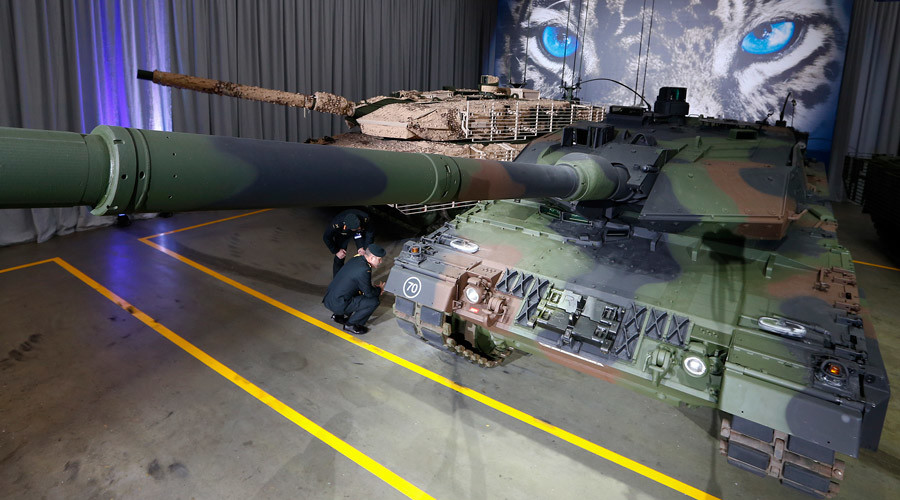
Leopard 2A7 © Michaela Rehle / Reuters
Germany is preparing to deploy its most modern ‘Leopard 2’ tanks and more than 600 infantrymen to Lithuania as it joins NATO’s biggest military buildup since the Cold War, German media reported citing the defense ministry.
The plans to deploy not infantry and tanks to the NATO member state bordering Russia were announced by the German Defense Minister Ursula von der Leyen at a two-day meeting of the alliance’s defense ministers in Brussels.
Deployment of “heavy weaponry” was then confirmed to the German daily Die Welt by a defense ministry spokesman, who said that tanks will be only part of the military equipment that Germany is going to deploy to the Baltic State.
A NATO battalion under German command will be stationed in Lithuania In February. The battalion’s personnel will amount to 1,000 soldiers, with from 450 to 650 of them coming from Germany and the rest being deployed by France, Belgium and Croatia.
According to the German daily Der Tagesspiegel daily, this will be an autonomous combat-ready unit equipped with tanks and armored vehicles that will also have snipers, engineering troops, military medics and even military police. The battalion will be fully operational starting from June 2017, German media reported.
The decision to send tanks alongside with the infantry to Lithuania should “send a clear signal” that Germany takes security concerns of the eastern NATO members “seriously,” von der Leyen said during the ministers’ meeting in Brussels.
“It should send a clear signal that an attack on any NATO member state would be regarded as an attack on all 28 members [of the bloc],” she said, as cited by Der Tagesspiegel. At the same time, she stressed that the deployment of German forces on the Russian border was a “strictly measured” step that has exclusively “defensive” purposes, as reported by Die Welt.
In 2015, von der Leyen ordered 100 new Leopard 2 tanks for the German army, the Bundeswehr, “in response to the Ukrainian crisis.” Additionally, all tanks that are currently in use by German forces should be modernized starting in 2017, according to the defense ministry’s plan.
The upper threshold for the number of tanks in the German army, which was set at 225 in 2011, was then increased to 328 in line with the ministry’s new plans, Die Welt reported.
However, the plans to station tanks almost on the Russian border provoked criticism from some German politicians.
“Sending tanks to the Russian border means forgetting the history,” Sara Wagenknecht, the head of the Left Party’s faction in the German parliament, told the news agency DPA. She also denounced the move as “a step towards further escalation of relations with Russia.”
“Those who really want to preserve peace in Europe should eventually return to relying on the traditions of the policy of détente instead of continuing to support the confrontational course that is neither in German interests, nor in the interests of the EU,” she said.

There is a fundamental weakness in the peoples’ movement in the United States and that is the necessity for anti-imperialist internationalism.
The struggles against racism, national oppression and class exploitation cannot be separated from the need to end Washington’s and Wall Street’s interference in the internal affairs of most states throughout the world.
In order to win recognition in these monumental struggles it is heavily dependent upon the degree to which we can create widespread awareness of the plight of the people of color communities and the working class in general. There are efforts underway to achieve these objectives although much more work has to be done.
International consciousness in regard to the character of the U.S. state is growing immensely. This is in part due to the mass demonstrations and urban rebellions which have sprung up by and large spontaneously in response to the vigilante death of Trayvon Martin in 2012 and the not-guilty verdict handed down in the trial of George Zimmerman. When Zimmerman’s acquittal was announced it did more to turn public opinion domestically and internationally against institutions which devalue African American life and democratic rights. It was during this period that the hashtag #BlackLivesMatter began to trend. Since then there have been efforts to build BLM chapters across the U.S., spreading internationally into the United Kingdom and Latin America.
Later on August 9, 2014, in Ferguson, Missouri, 18-year-old Michael Brown was gunned down by a white police officer. Immediately demonstrations erupted in Ferguson both nonviolent and violent. These manifestations spread nationally bringing attention to the false notion that America had become a so-called “post-racial society” in the period following the election of President Barack Obama in 2008.
Obama, who was forced to address the problems of the “special oppression” of African Americans after the unrest in Ferguson, the situation of African Americans gained international attention prompting editorials in leading periodicals both in the U.S. and internationally questioning this false assertion of post-racialism.
The administration responded in its signature dubious fashion leaning in favor of maintaining the status-quo of national oppression. Obama, of course, gave his view of what “African Americans feel” and in the next instance denounces violence saying it will not accomplish anything. This is a blatant falsehood because the U.S. state was born in violence and maintains its existence through brute force and coercion inside the country and abroad.
What these developments further exposed was the failure of the Obama administration to not only have refused to address the special oppression of African Americans but to also advance a policy of public avoidance in the face of worsening social conditions.
It was the African American masses and other oppressed groups who suffered the brunt of the economic crisis beginning in 2007. Detroit was one of the hardest hit urban areas and when Obama came into office in 2009, there was considerable “false hope” that these difficulties would attract the attention of the White House and the-then majority Democratic House and Senate (2008-2010).
Subsequent rebellions and waves of mass demonstrations in the streets, campuses, and now athletic fields, have stripped the administration of any pretense of political legitimacy. Colin Kapernick and others within professional, college and high school sports settings illustrated that no matter how they are classified as “privileged”, the specter of racist violence remains within their purview. No matter how “privileged” these people are the threats from the armed agents of the state remains with them at all times. Racism is on the increase in the U.S. and the refusal of the ruling class and the capitalist state to advance any reforms in this regard speaks volumes about the current phases of imperialism and its public posture.
The degree to which the capitalist class can claim any semblance of a “recovery” is related to the expansion of low-wage labor and the mega-profits of transnational corporations. This is reinforced by the systematic defunding of public education, municipal services and environmental safeguards.
The video below highlights President Vladimir Putin’s keynote presentation at the St Petersburg International Economic Forum, June 2016, including his conversations with members of the media.
Putin reviews the confrontation between Washington and Moscow and highlights the real dangers of nuclear war.
“Today, there is no instrument in international law that prevents the possibility of mutually assured destruction. Putin has been sending out warnings for over 10 years – all of which fell on deaf ears.”
English sub-titles and analysis (below): our thanks to Fort Russ
Nobody has anything to gain from a nuclear stand-off against Russia. The power hungry decision-makers are few in number, but powerful enough to have subverted mainstream media to misrepresent Russia as the main threat to international security.
Back in 2007, Putin informed the Western world that Russia will develop its weaponry to counter US advances. This was said in response to the US missile defense system that was starting to be developed at the time (previously prohibited in international law.)
With the NATO missile defense system on Russia’s doorstep – the threat to international security is very real; not that you would know it via mainstream Murdoch media.
In 2002, the United States unilaterally and without consultation, withdrew from the landmark Anti-Ballistic Missile (ABM) Treaty. President George W. Bush noted that the treaty is “now behind us,” describing the ABM Treaty as a Cold War relic.
Signed in 1972, the ABM Treaty barred both the US and the USSR from deploying national defenses against long-range ballistic missiles. The treaty was based on the premise that if either superpower constructed a strategic defense, the other would build up its offensive nuclear forces to offset the defense.
The superpowers would therefore quickly be put on a path toward a never-ending offensive-defensive arms race, as each tried to balance its counterpart’s actions. Until Bush took office, the Treaty was referred to as a “cornerstone of strategic stability” because it facilitated later agreements, reducing U.S. and Russian strategic nuclear arsenals.
The US, assuming that a weakened Russia will never again be in a position to counter US hegemonic power, proceeded to encroach on Russia’s borders through its manipulation of NATO objectives.
Today, there is no instrument in international law that prevents the possibility of mutually assured destruction. Putin has been sending out warnings for over 10 years – all of which fell on deaf ears.
Who will push the button first?

Norway is debating a “long-standing US wish” to allow American marines to deploy troops in the Scandinavian nation, furthering NATO’s encirclement of Russia.
Norway may allow the United States to deploy up to 300 marines “on a rotational basis” on its soil, advancing the North Atlantic Treaty Organization’s (NATO) long-standing goal of encircling Russia’s border with US-allied military assets.
The marines would be stationed in Vaernes, an air station just outside the Norwegian city of Trondheim – only 100 kilometers from Russia. NATO has claimed that this move is part of a long-standing effort to deter “Russian aggression” despite the fact that Russia has in no way threatened Norway or other countries on its borders. NATO ended cooperation with Russia following the Ukrainian coup of 2014, which led Russia to annex Crimea. According to Norwegian Defense Ministry spokeswoman Ann Kristin Salbuvik, “there is no question of permanent deployment” as the presence of the Marines would be temporary, though no timeline has been specified.

Credit – USMC Life
Not everyone in the Norwegian government was aware of the plan until it was publicly announced last week. Several members of the Foreign Affairs and Defense Committee were kept unaware of the plan, which has allegedly been in the planning stages for quite some time, according to local media. The plan, before being enacted, must first be approved by the Norwegian Parliament, where it faces opposition from several political parties. US officials, however, maintain that 300 US marines in Norway would be “beneficial.” Norway s already stockpiling NATO weapons and, according to some reports, has enough military equipment to support around 15,000 US Marines.
The move will undoubtedly further escalate tensions between Russia and Norway as any presence of US troops in the country would break Norway’s promise not to deploy foreign troops in its territory – a promise it made in 1949. However, the promise was conditional on Norway not feeling threatened. Norway has not publicly announced feeling threatened by Russia or any other country. Meanwhile, NATO has also announced plans to deploy 4,000 more troops to the Baltic region, also on Russia’s border, by next May. According to the commanding officer of NATO’s European forces, Czech Army General Petr Pavel, the troops will “serve as a deterrent and if necessary a fighting force.”
Since the Ukrainian coup of 2014, NATO has overseen a military buildup unprecedented since 1941, when Hitler invaded the Soviet Union. Russia has been on edge regarding the buildup and has threatened to respond numerous time, but neglected to militarize its Western border until relatively recently. The buildup has also coincided with increasingly dangerous developments in US-Russian relations over the Syrian conflict, with each side accusing the other of helping ISIS and needlessly killing civilians. With US-dominated NATO rubbing salt in the wound, it is no small wonder that Russians are preparing for the worst case scenario – a full-scale, global war between NATO and those who oppose its interests.
Washington’s public relations operations for the military contracting firms that surround the US Capitol aren’t by for-profit PR firms, so much as they’re by ‘non-profit’ foundations and think tanks, which present that ‘non-profit’ cover for their sales-promotion campaigns on behalf of the real beneficiaries: owners and top executives of these gigantic ‘defense’ contracting corporations, such as Lockheed Martin, and Booz Allen Hamilton.
Among the leading propagandists for invading Iraq back in 2002 were Kenn Pollack and Michael O’Hanlon, both with the Brookings Institution; and both propagandists still are frequently interviewed by American ‘news’ media as being ‘experts’ on international relations, when all they ever really have been is salesmen for US invasions, such as that 2003 invasion, which destroyed Iraq and cost US taxpayers $3 trillion+ or $4.4 trillion – benefiting only the few beneficiaries and their agents, such as the top executives of these ‘non-profits,’ which receive a small portion of the take, as servants usually do.
More recently, Brookings’s Shadi Hamid headlined on 14 September 2013, «The US-Russian Deal on Syria: A Victory for Assad», and the PR-servant there, Dr Hamid, argued that
«Syrian President Bashar al-Assad is effectively being rewarded for the use of chemical weapons, rather than ‘punished’ as originally planned… Assad and his Russian backers played on Obama’s most evident weakness, exploiting his desire to find a way – any way – out of military action… One might be forgiven for thinking that this was Assad’s plan all along, to use chemical weapons as bait, to agree to inspections after using them, and then to return to conventional killing».
Three weeks after that Brookings ‘expert’ had issued it, the great investigative journalist Christof Lehmann, on 7 October 2014, headlined and offered facts to the exact contrary at his nsnbc news site,
«Top US and Saudi Officials Responsible for Chemical Weapons in Syria», and he opened by summarizing his extensive case: «Evidence leads directly to the White House, the Chairman of the Joint Chiefs of Staff Martin Dempsey, CIA Director John Brennan, Saudi Intelligence Chief Prince Bandar, and Saudi Arabia´s Interior Ministry».
Then, on 14 January 2014, the MIT professor Theodore Postal and the former UN weapons-inspector Richard Lloyd performed a detailed analysis of the rocket that had delivered the sarin, and found that it had been fired from territory controlled by the anti-Assad rebels, not by Assad’s forces. Then, yet another great investigative journalist, Seymour Hersh, bannered in the London Review of Books, on 17 April 2014, «The Red Line and the Rat Line: Seymour M Hersh on Obama, Erdoğan and the Syrian rebels», and he reported that what had actually stopped Obama from invading Syria was Obama’s embarrassment at British intelligence having discovered that Obama’s case against Assad regarding the gas attack was fake.
Obama suddenly needed a face-saving way to cancel his pre-announced American bombing campaign to bring down the Assad government, since he wouldn’t have even the UK as an ally in it:
«Obama’s change of mind [weakening his ardor against Assad] had its origins at Porton Down, the [British] defense laboratory in Wiltshire. British intelligence had obtained a sample of the sarin used in the 21 August attack and analysis demonstrated that the gas used didn’t match the batches known to exist in the Syrian army’s chemical weapons arsenal. The message that the case against Syria wouldn’t hold up was quickly relayed to the US joint chiefs of staff».
Did Dr Hamid or any other Brookings ‘expert’ ever issue a correction and make note of of their earlier falsehoods, or did they all instead hide this crucially important reality – that not only was the rocket fired from rebel territory but its sarin formula was different from that in Syria’s arsenals, and the actual suppliers were the US, Sauds, Qataris, and Turks – did they not correct their prior war-mongering misrepresentations, but instead hide the fact that the Obama allegations had been exposed to have been frauds and that Obama himself had been one of the planners behind the sarin gas attack? They hid the truth.
Back on 14 June 2013, a Brookings team of Dr Hamid, with Bruce Riedel, Daniel L Byman, Michael Doran, and Tamara Cofman Wittes, had headlined, «Syria, the US, and Arming the Rebels: Assad’s Use of Chemical Weapons and Obama’s Red Line», and they alleged that, although «President Obama has been extremely reluctant to get involved in Syria», «Regime change is the only way to end this conflict», and they applauded the «confirmation that the Assad regime used chemical weapons in Syria», but doubted that Obama would bomb Syria hard enough and often enough. None of them ever subsequently acknowledged that, in fact, they had misstated (been suckered by a US government fraud, if even they had believed it), and that Obama actually drove this hoax harder than his Joint Chiefs of Staff had advised him to.
October 17th, 2016 – Fort Russ News –
From Fort Russ
October 16, 2016 – Fort Russ News –
By J. Arnoldski –

Military instructors from NATO countries were onboard a combat helicopter, shot down by servicemen of the Donetsk People’s Republic (DPR) on October 13, deputy commander of the Operational Command of the republic, Eduard Basurin, said on Friday.
“According to preliminary information, foreign mercenaries – instructors from the NATO, were in the downed helicopter. The area of the incidence [with the helicopter] is cordoned off for several days, cellular communication is disabled,” the RIA Novosti news agency quoted the words of the representative of the DPR Defense Ministry.
According to head of the DPR Alexander Zakharchenko, UAVs attempted to attack the territory of the republic under the cover of the military helicopter, which was put out of action, but managed to land on the territory of Donbass, occupied by the Kiev Forces. DPR soldiers shot the enemy’s helicopter down, while it was attacking their positions. According to the DPR intelligence, the incapacitated helicopter landed near Krasngotovka.
The use of combat aircraft and drones, with the exception of UAVs of the OSCE Special Monitoring Mission to Ukraine (SMM), is prohibited along the entire contact line by the Minsk Agreements.
The last time, Kiev used aircraft in Donbass on January 18, 2015. On that day, several the Su-25 fighter jets were noticed in the sky near Gorlovka.
 Free Ukraine Now