Posted on Fort Russ
Uncategorized
Novorossia acquires a treasure trove of UAF equipment abandoned at Debaltsevo
Four articles from Fort Russ
An apparently intact BMP-2 infantry fighting vehicle formerly of the 128th Mountain Infantry Brigade of the UAF
2/19/2015
On the trophies kindly left by the UAF for Novorossia in theDebaltsevo cauldron
By Aleksey Smirnitskiy
Translated from Russian by J.Hawk
We are receiving the first reports concerning the approximate numbers of equipment captured in the Debaltsevo cauldron.
- Armored vehicles. By first estimates, Novorossia captured over 80 tanks in repairable condition. Some of them were fully operational, even loaded with ammunition. Some have been abandoned without fuel, others were abandoned after their tracks were damaged, most of the vehicles captured have light or medium damage. This is sufficient for at least two tank battalions.
According to the official Kiev GenStaff announcement, as many as 15 tanks managed to leave the cauldron…out of at least 5 battalion tactical groups which were originally in the cauldron and 4 additional ones that were sent in to help.
Over 100 BMPs and BTRs have been captured in repairable condition. The junta managed to take out only about 50.
- Artillery. Not fewer than fifty 122mm and 152mm weapons (not counting 120mm mortars), many of which are repairable, and about 15 BM-21 122mm Grad launchers. At least 500 tons of artillery ammunition.
- A huge amount of small arms, including heavy machine guns, RPGs, RPOs [flame rocket launchers used for assaulting fortified positions and buildings]. Storehouses of food and medicine. Other goods.
- Novorossia commanders are especially grateful to the numerous volunteer organizations which have equipped the junta’s forces so well: the hundreds of night vision devices, digital radio stations, thermal imagers, modern ballistic computers and fire direction gear, wound treatment and anti-shock kits of Western origin, Kevlar helmets (even though Russian ones are better, there aren’t enough of them), modern body armor, will be of great use.
J.Hawk’s Comment: Just to reiterate, these are the weapons and equipment which are in repairable condition. Many of UAF’s losses were irretrievable—there are many photos circulating on the internet showing fields and roads littered with burned out armored vehicles left behind by the UAF.
http://www.fortruss.blogspot.com/2015/02/novorossia-acquires-treasure-trove-of.html
February 20, 2015
BMPD – Live Journal
Translated by Kristina Rus
Judging by the “LifeNews” report on February 19, 2015 about Novorossia fighters collecting trophies after Ukrainian troops withdrew from Debaltsevo, among other finds, NAF received one whole complex of LCMR (Lightweight Counter-Mortar Radar), supplied by the United States as part of military assistance to Ukraine.
The U.S. has decided to send to the armed forces of Ukraine 20 LCMR radars, the first three of which were delivered in November 2014. According to the information, received by our blog from the most serious sources, soon after the transfer one of the stations was damaged during transportation, and then another station was damaged by artillery fire of the enemy at the first attempt of its combat use by the Ukrainians. We can assume that the LCMR radar, abandoned by the Ukrainian troops in Debaltsevo is the third of this ill-fated first batch of the three stations.
K.R.: Please, McCain – do send more!
http://fortruss.blogspot.com/2015/02/naf-thanks-united-states-for-new-lcmr.html
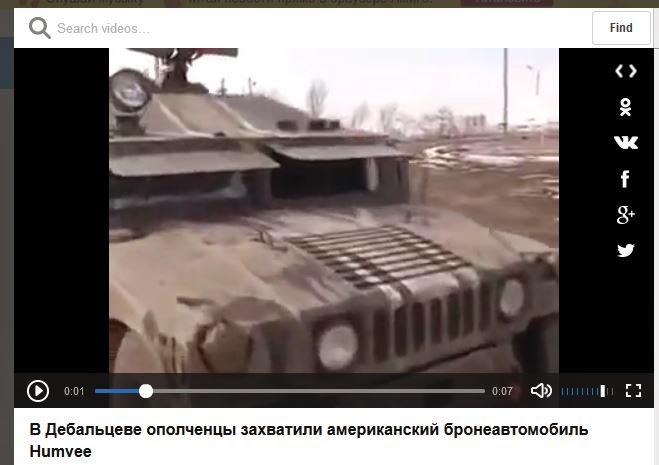
US-supplied armored Humvee captured by Novorossia militia
2/19/2015
US-supplied armored Humvee captured by Novorossia militia
By J.Hawk
The vehicle was one of the many seized from the UAF at Debaltsevo and its vicinity. It seems to be in perfectly good working order. I suppose the most surprising thing about it is that the UAF had no time to put it up for sale, as it did the British-supplied Saxon APCs…
http://www.fortruss.blogspot.com/2015/02/us-supplied-armored-humvee-captured-by.html
NAF: Thank you to Canadians and Ukrainians for supplies! (Video)
February 19, 2015
Western sanctions and Russian perceptions
From The Vineyard of the Saker
February 19, 2015
I parse the Russian media (corporate and social) on a daily basis and I am always amazed at the completely different way the issue of western sanctions is discussed. I think that it is important and useful for me to share this with those of you who do not speak Russian.
First, nobody in Russia believes that the sanctions will be lifted. Nobody. Of course, all the Russian politicians say that sanctions are wrong and not conducive to progress, but these are statements for external consumption. In interviews for the Russian media or on talk shows, there is a consensus that sanctions will never be lifted no matter what Russia does.
Second, nobody in Russia believes that sanctions are a reaction to Crimea or to the Russian involvement in the Donbass. Nobody. There is a consensus that the Russian policy towards Crimea and the Donbass are not a cause, but a pretext for the sanctions. The real cause of the sanctions is unanimously identified as what the Russians called the “process of sovereignization”, i.e. the fact that Russia is back, powerful and rich, and that she dares openly defy and disobey the “Axis of Kindness”.
Third, there is a consensus in Russia that the correct response to the sanctions is double: a) an external realignment of the Russian economy away from the West and b) internal reforms which will make Russia less dependent on oil exports and on the imports of various goods and technologies.
Fourth, nobody blames Putin for the sanctions or for the resulting hardships. Everybody fully understands that Putin is hated by the West not for doing something wrong, but for doing something right. In fact, Putin’s popularity is still at an all-time high.
Fifth, there is a wide agreement that the current Russian vulnerability is the result of past structural mistakes which now must be corrected, but nobody suggests that the return of Crimea to Russia or the Russian support for Novorussia were wrong or wrongly executed.
Finally, I would note that while Russia is ready for war, there is no bellicose mood at all. Most Russians believe that the US/NATO/EU don’t have what it takes to directly attack Russia, they believe that the junta in Kiev is doomed and they believe that sending the Russian tanks to Kiev (or even Novorussia) would have been a mistake.
The above is very important because if you consider all these factors you can come to an absolutely unavoidable conclusion: western sanctions have exactly zero chance of achieving any change at all in Russian foreign policy and exactly zero chance of weakening the current regime. In fact, if anything, these sanctions strengthen the Eurasian Sovereignists by allowing them to blame all the pain of economic reforms on the sanctions and they weaken the Atlantic Integrationists by making any overt support for, or association with, the West a huge political liability.
But the Eurocretins in Brussels don’t care I suppose, as long as they feel relevant or important, even if it is only in their heads.
The Saker
http://vineyardsaker.blogspot.ca/2015/02/western-sanctions-and-russian.html
BBC reports RAF jets scrambled after Russian bombers seen off Cornwall
The map below of just some of the “threatened” countries tells all. Just where is NATO parking its troops, headquarters, and equipment, and conducting exercises? Who is threatening who? Exactly how does President Putin pose a “real and present danger”?
“Ukraine is thus seen as a manifestation of a much broader policy shift on the part of the Russian President Vladimir Putin.”
“Mr Fallon’s belief that there is indeed a potential threat to Nato territory – in particular the Baltic Republics – is widely shared.”
That’s horrifying. Leaders must base their actions on facts, not beliefs, not ancestral prejudices, not what’s good for the ruling class. Unfortunately for the peace of the world, British, American, and European “beliefs” are driving all of us to war against Russia. And not just for the stated reasons of “threats”. Until Western leaders start living in a fact-based world, with a desire to serve the people of their countries, with a belief system reflective of reality and a value system that includes living together in harmony, we face mutual annihilation.
The BBC’s reporting and analysis are deplorable.
From the BBC, February 19, 2015
Mr Cameron says the incident should not be dignified with a response
RAF jets were scrambled on Wednesday after two Russian military aircraft were seen off the Cornwall coast, the Ministry of Defence has said.
The Russian Bear bombers did not enter sovereign airspace, it said.
On the same day, Defence Secretary Michael Fallon warned that Russia’s President Putin posed a “real and present danger” to three Baltic states.
Prime Minister David Cameron said the Russian action should not be dignified with “too much of a response”.
He added: “I think what this episode demonstrates is that we do have the fast jets, the pilots, the systems in place to protect the UK.
“I suspect the Russians were trying to make some sort of a point.”
BBC political correspondent Ross Hawkins said the appearance of Russian aircraft near the UK coast was a show of strength from the Russians, and such incidents were carried out with political intent because they would be reported on.
Our correspondent said it was part of a trend which had seen Russian aircraft flying close to UK airspace and there had also been concern about similar incidents in Europe.
The two Russian Bear bombers were “escorted” by RAF jets, the MoD says (file photo)
It comes amid increased concerns over Russian involvement in the conflict in Ukraine and suggestions of Russian President Vladimir Putin’s potential future interference in Latvia, Lithuania and Estonia.
A ceasefire deal between government and pro-Russian rebel separatists in Ukraine was reached a week ago.
But battles around the strategic town of Debaltseve have seen the withdrawal of Ukrainian troops, while there was shelling in several places in eastern Ukraine, including the region’s biggest city, Donetsk, on Thursday.
‘New’ Cold War
Russia has denied helping the separatists, but it has been accused repeatedly of sending weapons and troops and using propaganda to inflame tensions.
And Russia’s UN ambassador Vitaly Churkin has labelled Ukraine’s call for the deployment of UN peacekeepers in eastern Ukraine as a destructive move.
Mr Cameron has said rebels in eastern Ukraine are using Russian military hardware, and that Mr Putin must understand there would be “economic and financial consequences for many years to come” if he did not change his behaviour.
Speaking to journalists from the Times and Daily Telegraph on Wednesday, Mr Fallon said the increase in Russian defence spending was “clearly worrying” and that he was also “worried about Putin”.
“They are modernising their conventional forces, they are modernising their nuclear forces and they are testing Nato, so we need to respond.”
Mr Fallon also said the prospect of a new Cold War was “warming up”.
“You have tanks and armour rolling across the Ukrainian border and you have an Estonian border guard who has been captured and not yet still returned.”
Vladimir Chizhov, the Russian Ambassador to the EU: ”I entirely reject accusations that Russia is responsible for the destabilisation of Ukraine”
Previous incidents
He also said Russia was likely to use covert tactics such as those he said it had used to annex Crimea and during the current Ukraine conflict.
Mr Putin had also flown two other bombers “down the English Channel two weeks ago”, Mr Fallon added.
“We had to scramble jets very quickly to see them off.
“It’s the first time since the height of the Cold War, it’s the first time that’s happened.”
A French Air Force Mirage filmed from a Russian bomber during a recent encroachment on western European airspace. Pictures from Russian TV Zvedza
Analysis
Jonathan Marcus, BBC defence and diplomatic correspondent
The comments from Defence Secretary Michael Fallon are an indication of a fundamental shift in the Nato perception of the crisis in Ukraine.
Nato governments clearly believe that what began as a localised Ukraine problem that strained ties with Moscow has now become a Russia problem, and a Russia problem that is likely to persist for some time.
Ukraine is thus seen as a manifestation of a much broader policy shift on the part of the Russian President Vladimir Putin.
Mr Fallon’s belief that there is indeed a potential threat to Nato territory – in particular the Baltic Republics – is widely shared; hence Nato’s desire to underline in the most emphatic terms that its security guarantees to its members will be honoured in full.
Russian Foreign Ministry spokesman Alexander Lukashevich said Mr Fallon’s comments went “beyond diplomatic ethics” and used “unacceptable terminology”.
He also said Russia would “find a way to respond”.
According to the Department for Transport, there was no record of disruption to civil aviation as a result of the bombers’ presence on Wednesday.
The MoD said: “RAF Quick Reaction Alert Typhoon fighter aircraft were launched [on Wednesday] after Russian aircraft were identified flying close to UK airspace.
“The Russian planes were escorted by the RAF until they were out of the UK area of interest. At no time did the Russian military aircraft cross into UK sovereign airspace.”
A similar incident occurred in January, when the UK Foreign Office said two Russian Tu-95 Bear H bombers flying near UK airspace had caused “disruption to civil aviation” and were also escorted by RAF jets while near UK airspace.
Deputy Prime Minister Nick Clegg said the latest incident “shows that we are of course living in a time of heightened tension with Russia… and we should remain vigilant at all times”.
NATO to establish Command Center in Lithuania within months
Xinhua News Agency February 18, 2015
NATO to establish command center in Lithuania in summer
VILNIUS: A NATO command center in Lithuania will be established in the summer, General Hans-Lothar Domrose, commander of Allied Joint Force Command Brunssum, said during his visit here on Tuesday.
The top general held discussions on security issues and NATO’s presence in the region with heads of the Lithuanian army.
According to Domrose, the final decision on command centers would be made by defense ministers from NATO member countries in June, but in terms of military preparedness Lithuania was ready.
“Today, I saw an excellent readiness for the establishment of NATO force integration unit in Lithuania. In my view, this staff in Lithuania will be established in the summer and will reach its full capacity this year,” the general was quoted as saying in a press release from the Ministry of National Defense of Lithuania.
“We are on the right track,” he added.
According to Domrose, around 40 officers will work at the command center, with around half of them being Lithuanians and others being sent from other NATO member countries.
Two weeks ago, defense ministers from NATO member countries agreed on posting international military staff in Lithuania and five other Central and Eastern European countries in response to new security threats in the region.
During his visit, Domrose emphasized that this year there will be more NATO military force exercises in the region. Military exercises are to be attended not only by U.S. soldiers but also by the forces of Portugal, Germany, the Netherlands and Hungary, according to Lithuania’s national television LRT.
Game with no rules: “Legal Imperialism” against Russia
By Valentin Katasonov
Posted on Strategic Culture Foundation
The term legal imperialism was coined in relation to the Argentina’s public debt. A New York court admitted a number of private claims to hand down a verdict. By a stroke of hand a judge increased the country’s debt up to $120 billion, according to experts’ estimates. The essence of legal imperialism is the support rendered by Anglo-Saxon legal system to financial vultures.
Financial vultures vs. Argentina under the cover of American Themis
It all started in 2001. Argentina had to declare a sovereign default on around $130 billion. It was the biggest default on sovereign debt in history. The talks on restructuring started. As a result, the lenders agreed to write off the bulk of it (75%) and alter the conditions for paying off the rest. Some bondholders in possession of around $4 billion of Argentinian bonds refused to comply with the agreements’ terms. This included a small group of hedge funds holding over $1, 3 billion bonds headed by Elliott Management Corp. of billionaire Paul Singer. The hedge funds had already obtained the reputation of financial vultures. They acquired the bonds of the states that were on the verge of sovereign default or the ones already in default and then demanded 100% payments refusing to accept any compromises.
The audacity is supported by the fact that they normally win the trials demanding 100% payments on the bonds. The vultures went to the New York court to sue Argentina for the whole amount without restructuring. In October 2012 the United States Court of Appeals for the Second Circuit (New York) ruled on the pari passu clause that required they receive full payment. Moreover it forbade Argentina to pay off its restructured debts till it complies with the court’s decision. It was an uphill struggle for Argentina as it realized that other lenders would demand full payments too. The country was a hostage because its bonds were issued in compliance with the laws of the state of New York. According to the court’s decision, Argentina faced the June 31, 2014 deadline when it was supposed to pay the next installment of interest to all bondholders. No settlement had been reached so the leading rating agencies greatly lowered the country’s investment rating. The regular payments by Argentina to comply with the conditions of restructured debt were blocked by the court’s ruling. Argentina refuses to comply while the fines keep on growing each passing day…
Yukos case – first large-scale operation conducted by legal imperialism against Russia
The decision handed down by the Hague-based International Arbitration Court in the Russian oil giant Yukos case upon the claim of foreign shareholders is the example of how the legal imperialism works. Yukos ceased to exist as a legal entity in November 2007. For many years it avoided paying taxes. The taxes debts were to be paid in accordance with the court’s decision taken ten years ago. The company failed to comply. The bigger part of Yukos assets went to Russian oil producer Rosneft. Yukos foreign shareholders were disgruntled and went to courts abroad. Finally the claims were consolidated and sent to the Hague International Court. Initially the claimed sum was $114 billion (much more than the Yukos assets at the time of company’s liquidation). The Court let the claims be suspended, it was waiting for something. Finally it got what it was expecting. The West imposed sanctions against Russia in the spring of 2014. The court went back to the Yukos case and made public its verdict: Russia was to pay investors of the now non-existent company $50 billion – the largest compensation ever paid to shareholders upon an international arbitrary tribunal. According to the Court’s decision, Russia allegedly violated the Energy Charter Treaty and expropriated the company taking it from legal owners. A peculiar ruling in view that Russia never ratified the Charter. It is even more peculiar that the acquisition of the Yukos assets by another company is called «expropriation». In fact the verdict was an informal way of imposing sanctions by the West against Russia or the legal imperialism in force. As they say Russia was «put on the counter». After the ruling was announced Russia was given 180 days to comply. It did not. From January 15, the deadline set by the Court in the Hague for Russia to pay its fine, the fine will attract interest equal to the yield on a 10-year US Treasury bond. On January 15 the rate measured 1.91 percent. It means that the first year the sum of the debt will increase to $956, 6 million. That’s why over one billion dollars will surely be added to the $50 billion in 2015.
The Hague Court ruling: what does it mean for Russia?
The appeals made by Russian lawyers brought about no result. The Hague Court’s decision was not taken into account in the 2015 budget. The opposite side is very active. Right after the Court’s decision the former Yukos shareholders were involved in interesting activities – they started to look for Russian assets to be used to pay the debt. Russia’s state foreign assets could be confiscated. The Rosneft assets are to be arrested first, other companies with state participation (VTB, Gasprom, Aeroflot, VAB etc.) second and state agencies third. Embassies have immunity unlike ships visiting foreign ports.
Nobody cares about the fact that there are few companies with 100% state participation. There are non-state minority shareholders and the expropriation of companies’ assets would constitute a violation of their property rights. This is a classic game without rules. Actually there is one – punish Russia at any cost.
Legal imperialism as effective informal sanction against Russia
There have been three packages of sanctions introduced against Russia. Experts believe that the fourth will also come into effect. I don’t think so. The matter is – informal sanctions are more effective. There will be new claims to Russia, its companies and banks. Russian individuals and legal entities will be blacklisted; Western courts will hand down decisions on expropriating their foreign assets. The «case of Rotenberg» will be repeated. In the spring of 2014 Russian entrepreneur Arkady Rotenberg was blacklisted during the first wave of sanctions. In September Italian courts handed down a decision to arrest and confiscate his €30m assets. The March sanctions envisioned a ban on entering the territories of the countries that imposed sanctions and seizing the bank accounts of blacklisted persons. In the case of Rotenberg they took away his real estate that had no relation to business. I emphasize it to show that legal imperialism is a war without rules waged to satisfy the desire to plunder. In general, that’s how the algorithm of legal marauding works:
1) A Western vulture chooses an asset that belongs to a Russian legal entity of individual;
2) The vulture makes the Russian owner blacklisted;
3) A Western court hands down a decision to seize the asset;
4) The court’s decision is carried out; the asset becomes the property of the vulture.
Black lists as an instrument of legal imperialism
There are different grounds for being included into black lists: «suspicion of corruption involvement», «complicity in the annexation of Crimea and aggression against Ukraine», «the violation of human rights», «ties with terrorists» etc. The US has already introduced special laws, for instance, «the Magnitsky Act» allowing making lists of those who had connection to the death of lawyer Sergey Magnitsky. The lawyer represented the investment advisory firm Hermitage Capital Management. In 2008 he was arrested accused of few billion roubles tax evasion. He died in a prison cell. The West made him a martyr and responded with black lists.
Not the United States is mulling a possibility to turn the Magnitsky Act into a universal instrument of fighting Russia under the banner of defending human rights. It is planned to include into the list not only those who did anything wrong to Magnitsky, but also Alexey Navalny and his associates in «the struggle against totalitarianism». Washington wants to kill two birds with one stone: a) to exert political pressure on Russia; b) to reap benefit by seizing the assets of the persons included into the black lists (the Magnitsky Act envisions a ban on entry into the country and arrest of bank accounts). They want to get more out of it. It is considered to go beyond seizing the bank accounts but also spread the sanctions on bonds and equity.
(To be continued)
http://www.globalresearch.ca/game-with-no-rules-legal-imperialism-against-russia/5432153
Ukraine Finance Minister Jaresko’s questionable activities
From Consortium News, February 18, 2014
By Robert Parry
Ukraine’s new Finance Minister Natalie Jaresko, who has become the face of reform for the U.S.-backed regime in Kiev and will be a key figure handling billions of dollars in Western financial aid, was at the center of insider deals and other questionable activities when she ran a $150 million U.S.-taxpayer-financed investment fund.
Prior to taking Ukrainian citizenship and becoming Finance Minister last December, Jaresko was a former U.S. diplomat who served as chief executive officer of the Western NIS Enterprise Fund (WNISEF), which was created by Congress in the 1990s and overseen by the U.S. Agency for International Development (U.S. AID) to help jumpstart an investment economy in Ukraine.
But Jaresko, who was limited to making $150,000 a year at WNISEF under the U.S. AID grant agreement, managed to earn more than that amount, reporting in 2004 that she was paid $383,259 along with $67,415 in expenses, according to WNISEF’s public filing with the Internal Revenue Service.
Later, Jaresko’s compensation was removed from public disclosure altogether after she co-founded two entities in 2006: Horizon Capital Associates (HCA) to manage WNISEF’s investments (and collect around $1 million a year in fees) and Emerging Europe Growth Fund (EEGF) to collaborate with WNISEF on investment deals.
Jaresko formed HCA and EEGF with two other WNISEF officers, Mark Iwashko and Lenna Koszarny. They also started a third firm, Horizon Capital Advisors, which “serves as a sub-advisor to the Investment Manager, HCA,” according to WNISEF’s IRS filing for 2006.
U.S. AID apparently found nothing suspicious about these tangled business relationships – and even allowed WNISEF to spend millions of dollars helping EEGF become a follow-on private investment firm – despite the potential conflicts of interest involving Jaresko, the other WNISEF officers and their affiliated companies.
For instance, WNISEF’s 2012 annual report devoted two pages to “related party transactions,” including the management fees to Jaresko’s Horizon Capital ($1,037,603 in 2011 and $1,023,689 in 2012) and WNISEF’s co-investments in projects with the EEGF, where Jaresko was founding partner and chief executive officer. Jaresko’s Horizon Capital managed the investments of both WNISEF and EEGF.
From 2007 to 2011, WNISEF co-invested $4.25 million with EEGF in Kerameya LLC, a Ukrainian brick manufacturer, and WNISEF sold EEGF 15.63 percent of Moldova’s Fincombank for $5 million, the report said. It also listed extensive exchanges of personnel and equipment between WNISEF and Horizon Capital. But it’s difficult for an outsider to ascertain the relative merits of these insider deals and the transactions apparently raised no red flags for U.S. AID officials.
Bonuses for Officers
Regarding compensation, WNISEF’s 2013 filing with the IRS noted that the fund’s officers collected millions of dollars in bonuses for closing out some investments at a profit even as the overall fund was losing money. According to the filing, WNISEF’s $150 million nest egg had shrunk by more than one-third to $94.5 million and likely has declined much more during the economic chaos that followed the U.S.-back coup in February 2014.
But prior to the coup and the resulting civil war, Jaresko’s WNISEF was generously spreading money around. For instance, the 2013 IRS filing reported that the taxpayer-financed fund paid out as “expenses” $7.7 million under a bonus program, including $4.6 million to “current officers,” without identifying who received the money. Continue reading
IMF loans to Ukraine: deadly “economic medicine” aimed at total destabilization
A clear overview of the consequences of the IMF loans and economic program approved by Yatsenyuk and Poroshenko.
From Global Research, February 17, 2015
By Ernst Wolff
On February 12, Christine Lagarde, Managing Director of the International Monetary Fund, announced that the IMF had reached an agreement with the Ukrainian government on a new economic reform program. Ms Lagarde’s statement, made in Brussels, came only minutes after peace negotiations between the heads of the German, French, Russian und Ukrainian governments in Minsk, Belarus, had ended. The timing was no coincidence. Washington had been left out of the negotiations and now reacted by sending its most powerful financial organization to the forefront in order to deliver a clear message to the world: that the US will not loosen its grip on the Ukraine, if not by sending weapons, then at least economically and financially.
Mme Lagarde’s assertions that the program “would support immediate economic stabilization“ and spell “a turning point for the Ukraine“ are as far removed from reality as the main stream media’s depiction of the IMF as an aid organization helping a drowning country to survive in times of trouble. Not a single cent of the loans will go to the Ukrainian working people. Instead, the money will be used to prop up the Yatseniuk government which is totally subservient to US interests, and enable it to service the debts incurred by its predecessors in the aftermath of the financial crisis of 2008, to pay off most of its military expenses of around $ 250 million per month for the continuation of a war against its own population and to fill at least some holes in the state budget which are due to the country’s ongoing economic deterioration.
The loans will be based on the terms of an economic program for Ukraine for 2015 – 2020, passed by the Kiev parliament in December 2014, and are tied to harsh conditions laid down in a letter of intent, signed by prime minister Yatseniuk and president Poroshenko in August 2014. Some of the measures have already been implemented, others will follow. Among those already in force is the flexible exchange rate regime which has not only led to a 67% devaluation of the hrivna, lowering the average monthly wage of Ukrainian workers to less than $ 60, but has also opened the doors for international currency speculators who have already made millions by indebting themselves in hrivnia and repaying their debts in euros and dollars.
The rate of inflation, running at 25 % in 2014 and expected to rise even higher in 2015, and a hike in gas prices by 50 % in May 2014 made survival almost impossible for the weakest 20 % of the population who already lived below the poverty line in 2013. Among the measures still to come are the layoff of 10 % of the country’s public employees and the partial privatization of health care and education. The retirement age for women is to be raised by 10 years, that for men by 5 years, most benefits for old age pensioners are to be abolished, the pharmaceuticals market is to be deregulated. Retirement pensions will be frozen, and there will be no more free lunches for school children and patients in hospitals. Benefits for victims of the 1986 nuclear disaster in Chernobyl are to be cut, and the boundaries of the officially designated radioactive hazard zone will be revised. The country’s monthly minimum wage is to remain at 1,218.00 hrivna ($ 46 at the current rate of exchange) until at least November 2015.
None of these measures will serve to “improve the living standards for the Ukrainian people“, as cynically predicted by Ms Lagarde. Nor will they “restore robust growth“ in an economy which is teetering on the verge of collapse, with a central bank left with only $ 6 billion in currency reserves and incapable of raising new fundi

ng in foreign exchange auctions. However, they will contribute to an intensification of the suffering of the Ukrainian people, deepen the social divide of a country already torn apart by a bloody civil war and lead to its complete disintegration, nurturing separatist movements and thus creating perfect conditions for a future of violence and despair.
In pursuing this strategy, the IMF is totally in line with the geopolitical policies pursued by Wall Street and the government in Washington. Both are in deep trouble, with the US torn apart by ever-increasing social inequality threatening to explode in massive social unrest, while its rulers are drowning in debt and losing control over the world financial system. Having dominated global markets for seven decades, the United States’ economic decline and a shift in global power are ringing in the end of the US dollar as the world’s reserve currency and thereby heralding the end of the US’s status as the world’s super power.
In a reckless attempt to stop this unstoppable process, Wall Street and the White House are waging an extremely aggressive campaign against Russia and China who have dared to complete an energy deal outside the petro-dollar and whom the US fear to be preparing a new, possibly gold-backed, currency that might replace the US dollar as the world’s reserve currency. To prevent this from happening and to gain control of the vast natural riches of Russia which promise enormous profits, Wall Street and the White House are pursuing a strategy of regime change in Moscow, undertaking everything possible to replace the Russian government by one that is as subservient to US interests as that of Ukrainian premier Yatseniuk and his investment banker cronies in Kiev. One of the means to this end is the integration of Ukraine into NATO in order to step up the military threat against Russia. However, as the EU – and Germany in particular – do not seem to be willing to join forces in an all-out war against Russia (not out of humanitarian considerations, but because of their dependency on Russian gas and oil and their anticipation of a new monetary world order no longer dominated by the US) and as the majority of Americans, despite a massive media campaign demonizing Vladimir Putin, are unwilling to support a war that would cost more money and more lives than any war in the past and could end up in a nuclear catastrophe, the US government’s and the IMF’s main purpose in Ukraine is to deepen and widen the already existing economic, social and ethnic conflicts. By doing so, they hope to force Vladimir Putin into a long-lasting and costly war that will weaken his position at home and eventually pave the way for the installation of new rulers in Moscow.
Looking at Ukraine as a part of the present geopolitical struggle, one can see that the IMF’s new loans to Ukraine, announced by Christine Lagarde, are anything but a “turning point“ signalling the country’s stabilization. They will lead to unspeakable human suffering and contribute to the trail of blood which Ms Lagarde and the IMF are so used to leaving behind after intervening under the pretext of “helping“ countries in times of trouble.
Ernst Wolff is a freelance journalist and the author of the book “Pillaging the World. The History and Politics of the IMF”, published by Tectum Verlag, Germany.
USAF Global Strike Command Director says nuclear weapons have an important role for the world
From Sputnik News, February 19, 2015
US Air Force Global Strike Command Director Michael Fortney said that the role and utility of the US nuclear arsenal is as important in the current strategic climate as it was in previous decades.
WASHINGTON (Sputnik) — The role and utility of the US nuclear arsenal is as important in the current strategic climate as it was in previous decades, US Air Force Global Strike Command Director Michael Fortney said.
“The role of our [US] nuclear arsenal is at least as important today as it was in decades past,” Fortney stated at the annual nuclear deterrence summit in Washington, DC on Wednesday. “I believe US nuclear weapons have an important role for our country, our allies, and… a role for the world.”
Fortney raised concerns about certain nuclear states revising their military doctrines reflecting “a resurgent doctrinal utility” for their strategic nuclear forces.
The top nuclear powers on the planet, Russia and the United States, are currently engaged in extensive nuclear modernization, according to both countries’ defense agencies.
Russia announced an updated military doctrine at the end of 2014 re-emphasizing its right to use nuclear weapons in retaliation or if a conventional attack threatened the very existence of the state, according to the document. The new doctrine stopped short of including a nuclear pre-emptive strike notion.
Nazi hands that rock American cradles
It is natural when people move to a foreign country to form ethnically-based groups where they can share common traditions, foods, heritage, history, and teach their children about their heritage.
However, when the “heritage” involves Stepan Bandera and other Nazi collaborators, racists, and ultra-nationalists, when their version of history writes out, re-writes, or even glorifies genocidal activities, and when the group begins funding and promoting activities as well as a political agenda in their new country as well as in their original country, that is very dangerous and cannot be ignored.
This article describes the activities of OUNb-UCCA affiliated groups in America aimed at young people.
This article does not include the influence of Nazi officials and scientists brought to America under Operation Paperclip, and the alliances and mentoring they provided (with the blessing of the United States government) within many branches of government and industry as well as in the American neighborhoods where they lived. It does not include the homegrown Nazi and neo-Nazi individuals and groups in this country, or the industrialists who support Nazism and fascism. Those numbers dramatically increase the phenomenal level of influence and political pressure and power.
This is in addition to historic racism in America, which provides another layer of support.
— Editor
———————————————————————————
By George Eliason, February 15, 2015
Posted in Global Research
Are Ukrainian-American children brought up to be Bandera followers? If the children of all the Eastern European and Baltic emigre populations bring their children up in American this way, will it have an effect on non-emigre children in the US? With a combined population of 20 million career age emigre ultra nationalists according to their own estimates in the United States alone, you had better find out.
Was the Euromaidan which was funded heavily by the combined emigre populations about democracy? Answering this in a surprise statement at a cabinet meeting on February 10th 2015, Ukrainian President Petro Poroshenko opened up about the basis of the post-coup Ukrainian state and the ideology it is built on.
“I think to the contrary that the Galicians are the foundation of the Ukrainian state,”
This definitely throws a damper on anyone in the EU or USA calling the Euro-maidan a pro-democratic protest or revolution. The Galicians that Poroshenko is referring to formulated the ideology of Stepan Bandera that is now the foundation of post Maidan Ukraine.
According to Ukrainian-American George Masni, a former UCCA Arizona state president “The “simple nationalism” Poroshenko is talking about is love of ones nation that drives to defend it from invaders. This type of nationalism is better known as patriotism.”
If ultra-nationalist ideology wasn’t part of the Ukrainian political landscape pre-Maidan, where did it come from? Before 1991 this ideology was foreign in Ukraine except for a tiny minority in the Lviv region.
The Nazi/ nationalist ideology of Stepan Bandera made its home in the hearts of Eastern European emigres worldwide, particularly in the United States and Canada. Each succeeding generation has been taught to be more dedicated to it than their parents were. Continue reading