From Anti-Empire
February 12, 2022
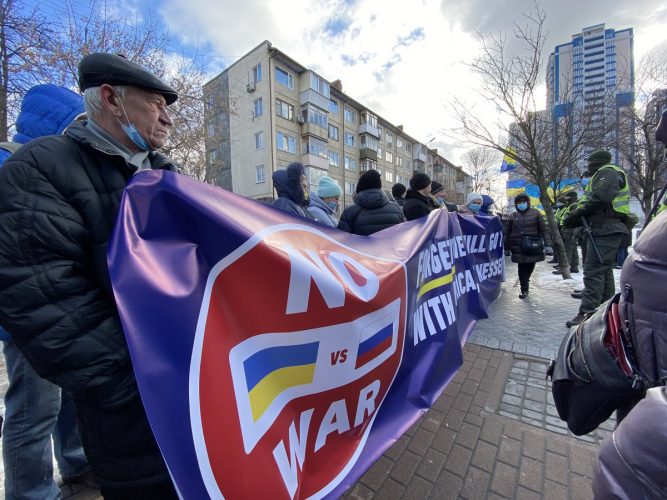
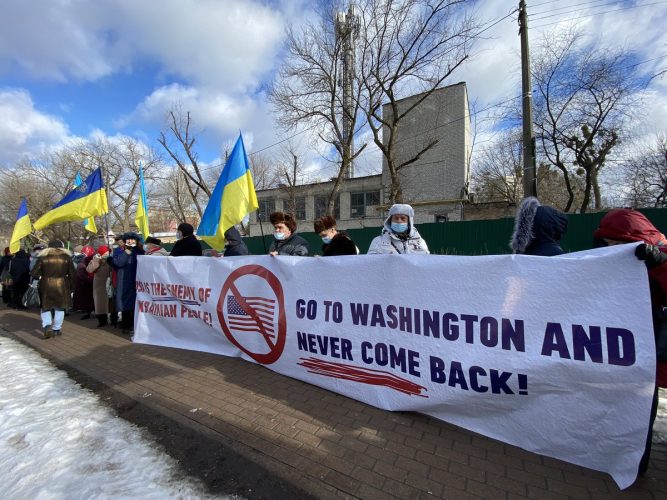
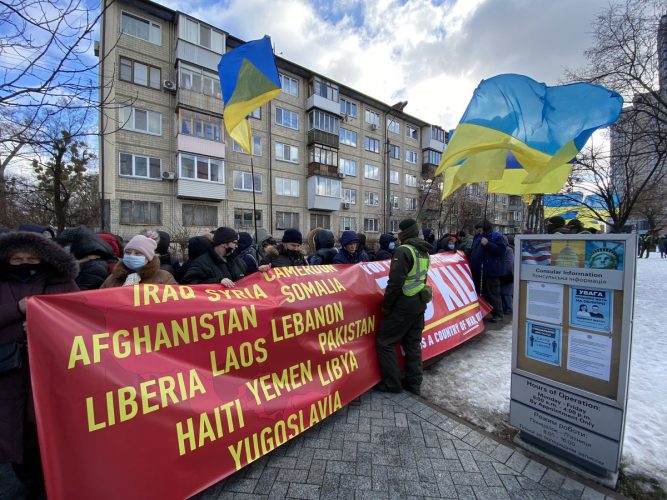
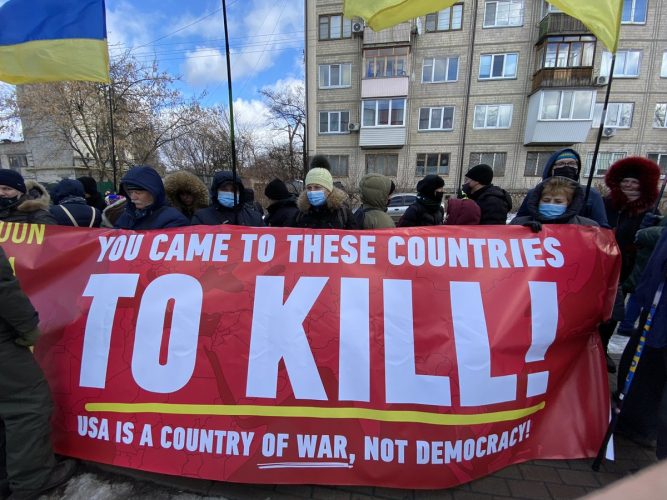
A rally in front of the US Embassy in Kiev.
From Anti-Empire
February 12, 2022
A rally in front of the US Embassy in Kiev.
Comment from Global Network against Weapons and Nuclear Power in Space
Let’s be honest here….
What most people in the west know about Vladimir Putin and Russia they learned from the corporate media over the last 25 years.
The same media that pushed ‘shock and awe’ in Iraq in 2003.
Time to find out for yourself before we all crash and burn.
http://space4peace.blogspot.com/2022/02/tell-me-who-are-real-warmongers.html
Briefing by Foreign Ministry Spokeswoman Maria Zakharova, Moscow, February 9, 2022
The 60th anniversary of the US economic, commercial and financial embargo against Cuba
February 3 marks the 60th anniversary of the odious phenomenon in modern history, which, unfortunately, has only worsened in recent years, namely, the US economic, commercial and financial blockade of Cuba. If previously it was only against Cuba, today sanctions, restrictions and unilateral measures are being imposed by the United States and its “partners and satellites” across the board on multiple countries. Today, I would like to discuss Cuba, which has been living under embargo for 60 years now. A great global power, one of the pillars of the world order, has thus settled accounts with a small country for it wanting to free itself from the colonial grip of its northern neighbour and embark on a path of independent development. Revenge. Exactly the same thing that we are now seeing with regard to Crimea residents who have made their choice. Our country did not turn them away and respectfully accepted their choice. And now they are retaliating with sanctions. There’s nothing new about it.
The entire international community believes that Washington’s anti-Cuban policy is inhumane and illegal. Just think of it: 60 years of sanctions. Then look at the map and compare the size of the United States and that of the island of Cuba. There were the UN General Assembly resolutions, the calls by international public organisations, business circles, and just people with common sense. There were numerous business calculations about self-inflicted damage. At some point there were even hints at common sense prevailing and, on the face of it, nothing seemed to stand in the way of finally embarking on the path of realism. But no such thing. With enviable tenacity worthy of a better cause (not in the sense that sanctions should be imposed on other geographical locations, but in the sense that developing and implementing them in circumvention of the UN Security Council is illegal), throughout decades, almost all US administrations, with an exception only during the “Obama thaw,” stick to the same discriminatory policy with the ever-exacerbating consequences. They are doing so contrary to common sense, in an unscrupulous and hypocritical manner, under the banner of protecting democracy and human rights, and subjugating their every move to domestic political bias and the fleeting and self-serving interests of their “political hawks.”
At the same time, no one in the United States seems to care about the fact that this policy impacts not the Cuban leadership, but ordinary Cubans. It strangles the life-supporting sectors of the economy, creates social problems and deprives these people of those very human rights that the American guardians of global democracy are so worried about in words only. Most interestingly, the economic performance is cited as proof of the inefficiency of the Cuban system. Listen, for 60 years now Cuba has not only survived, but lived and moved forward amid your sanctions. I often wonder what would become of the United States if similar sanctions were imposed on it for at least a year, or even a couple of months. That would be fun to watch. They would not just forget about democracy, there would simply be nothing left of the United States if at least a tenth of these restrictions had been imposed. Then, we would observe the competition of the systems. Washington is unlikely to run the risk of holding this experiment, isn’t it? You know, things like hidden resentment, revenge, delayed decision-making or retribution happen in history. Still, common sense must prevail in humanitarian situations, such as the pandemic. That is exactly what the world has been living through for the third year now.
Notably, many Cubans who live in the United States and other countries of that region have relatives in Cuba who are impacted by the embargo imposed amid the pandemic rather than the theoretical sanctions. However, no one in the United States seems to be worried about that. They are a different kind of “human rights” and do not need to be taken care of. So, instead of uniting efforts in the face of a common challenge and creating some kind of synergy and green corridors, the US authorities did everything the other way round: they tightened the screws by imposing more sanctions on the pharmaceutical industry in Cuba, that very Cuba that helps everyone in the region deal with the impact of the pandemic, and is the first to respond not even to requests, but to developments in neighbouring and outlying countries in connection with emergencies, man-made disasters, etc. Cuban doctors are always among the first responders. Sanctions were imposed on them, and an absurd campaign was unleashed to discredit the assistance that the Cuban health workers are providing to other countries. They even went as far as to call it “human trafficking.” However, in case the United States is unaware of what human trafficking is, we can tell them. It has nothing to do with Cuba whatsoever, and it’s just a flat-out offence.
Cuba is showing amazing fortitude and courage. It is decisively moving forward along a path of independence as it overcomes hardships and difficulties. It is reforming the economy, optimising production and management systems, and improving the efficiency of state regulation. It is promoting fundamental and applied research and development and attaining world-class achievements in medicine and pharmacology. At the same time, it remains politically active in the international arena, upholding its interests and finding ways to help others, as I have already mentioned, remaining a symbol of the struggle against the remnants of the post-colonial world order, and Cuba simply stands for freedom and independence with all its heart and soul.
This 60 year-old history of the anti-Cuban embargo is the history of the Cuban people’s selfless feat, a vibrant expression of national identity, pride and dignity, which have been honourably carried through generations. We pay tribute to the great fortitude of our Cuban friends. We wish them strength, patience, success, good health and we hope that they find a way to overcome the challenges that life has posed to all of us.
Your cause is just, hence the conclusion: you will come out a winner. In this regard, I would like to remind the audience about what Fidel Castro once said, “We must firmly fight against the blockade, since the blockade is the main obstacle to our progress and is more than a ban on trade with Cuba, but also a symbol of pressure that the United States is exerting on the world at large.”
https://www.mid.ru/en/press_service/spokesman/briefings/1797611/
From Global Network Against Weapons & Nuclear Power in Space.
Remember this time?
February 14
By Bruce Gagnon


Yes, remember
2003
shock and awe
WMD in Iraq
the mushroom cloud
the smoking gun
bio-logical weapons
Turned out to be all lies
Media,
White House,
Congress
hand-in-hand
pushed the war
No WMD ever
found in Iraq
Today same MO,
every criminal
has one
Modus Operandi,
a way of
repeating the same
bad behavior
In this case
we can call it
western,
US-UK-NATO,
insanity,
pure depravity,
pure evil
Virtually no one
in the Congress
mouthing
a mumbling word,
the Dems have gone
warmongering….
An election coming
soon you know,
can’t make any waves
in Washington,
can’t piss off
the MIC either
Democracy
is dead.
The wedding
of Mr. Big
and government
is complete.
Friendly Fascism
it’s called,
three-piece suit,
Wall Street
variety.
But the liberals
don’t want to
hear it,
got to support Biden
and hold onto the
Senate and House.
Forget about
holding onto
democracy,
it’s already
drifting away
with the rising
Atlantic waters.
http://space4peace.blogspot.com/2022/02/remember-this-time.html
Russian Federation Permanent Representative A.K. LUKASHEVICH to OSCE Permanent Council
February 10, 2022
Dear Madam President,
In recent days, we have seen a certain change in rhetoric in those countries where until recently the world was threatened with the threat of an “imminent attack” on Ukraine. Some media, such as the Bloomberg agency, managed to release fake news about the “invasion” that had already begun in the information field last Friday. Then removed. Adjusted the tone and US officials. The other day, the head of European diplomacy, J. Borrell, also said that he did not believe in a “Russian invasion” of Ukraine.
Let’s remember the zeal with which, not so long ago, representatives of a number of Western countries sought to convince everyone of the opposite. Even in this room. The terms were named: in November, in December, in January and so on. As the facts show, all these “horror stories” turned out to be nothing more than propaganda “zilch”, empty chatter.
Now let’s turn to the real situation in Ukraine. A protracted armed civil conflict continues in the country, caused and fueled by the aggressive and unceremonious interference of the West in the development of the Ukrainian state and society. In February, Ukraine will mark the eighth anniversary of the bloody 2014 armed coup d’état organized with foreign support. The coup that raised the most radical nationalist parties and movements to the firmament of Ukrainian politics, which began to aggressively impose ideas of militant nationalism and Russophobia alien to the majority of the population – all this under the guise of alleged patriotism. The uncontrolled circulation of weapons among nationalists and neo-Nazis, their desire to impose their own rules throughout the country led to a logical result: many Ukrainians opposed the artificial division of society and against the self-proclaimed authorities, who acted in conjunction with the nationalists. At that time, in the south-east of Ukraine, people began to organize themselves into people’s squads to protect their homes and a peaceful way of life from the encroachments of nationalists.
The refusal of the “Maidan” authorities from a civilized and respectful dialogue with the inhabitants of their own country led to an armed confrontation. A military operation was launched to suppress dissent. Even after signing the Minsk agreements under international control, the then leadership of Ukraine continued military planning for a “direct dialogue with the Donbass.” Dialogue with the help of artillery and mortars – in the form of shelling, casualties, destruction.
In choosing such tactics, the Ukrainian authorities were and are not independent. The notorious “external management” under which the country has fallen in recent years, saying goodbye to the remnants of state sovereignty, leaves its mark. There is no doubt that without the destructive impact from abroad, Ukrainians would be much faster able to find a common language and achieve peace among themselves. On both sides of the line of contact, relatives and friends of each other live who have fallen into the “millstones” of new political watersheds artificially imposed on the country – dividing lines introduced by geopolitical strategists from the West and other demagogues who generously distributed cookies and no less sweet ones on the “Maidan”, but empty promises.
In the midst of armed civil confrontation, instead of promoting an inclusive national dialogue for peace based on the Minsk “Package of Measures”, foreign patrons of the post-Maidan authorities decided to invest in the militarization of Ukraine. They began to send there not political signals about the need to fulfill “Minsk”, but military appropriations, equipment and weapons, shells and cartridges, with which some citizens of Ukraine continue to kill other citizens of Ukraine to this day. In a word, they began to push “hot heads” in every way to a military solution to the “Donbass problem” in the conditions of sabotage of the Minsk agreements.
Take a look at the numbers from the beginning of this year alone: at least twelve aircraft each from the US and the UK, two from Canada and one from Poland arrived in Ukraine, all carrying weapons and other military supplies. The United States alone sent about 700 tons of cargo. Immediately upon the arrival of these cargoes, the United States and Great Britain, using their so-called. “instructors” began training the Ukrainian military on the combat use of the delivered missile systems, grenade launchers and other weapons in urban areas. Specific plans to send at least 100 additional troops from the British Special Forces and 200 people from the Canadian Special Operations Forces have long been no secret. If the authorities in Kiev claim that they are not preparing offensive actions or armed provocations, what is all this for? By the way, Since the beginning of the year, the SMM has already counted over 8,000 ceasefire violations in Donbas. Will there be fewer of them after such military preparations?
Eight years later, the problems in Ukraine are the same as in 2014. Radical nationalists from illegal armed groups have not been disarmed. For example, the same “Right Sector”. They continue their attempts – with the support of the current authorities – to restore their order in the east of Ukraine with “fire and sword”. Their plans do not include the observance of the ceasefire or the implementation of the Minsk agreements. The authorities, in turn, cannot or do not want to do anything about this, acting, in fact, at the same time with them.
Let us recall how, in November 2019, representatives of the nationalist battalions did not allow President V. Zelensky to disengage forces and hardware in Zolote, they did not want to leave this disengagement area with weapons. Under their pressure and at the American “prompt”, V. Zelensky at the “Norman” summit in Paris on December 9, 2019 refused to approve the plan already agreed by experts and adopted by Donetsk and Lugansk on the disengagement of forces and hardware along the entire line of contact. Having agreed in the minutes of the meeting of the Contact Group on March 11, 2020, to have a direct dialogue with the authorized representatives of certain areas of Donbass, Kiev then actually disavowed the signature under the agreements on the establishment of the Consultative Council.
It is also not surprising that the meetings of the Contact Group and its working subgroups held on February 8-9 again ended without results. They reaffirmed that Kiev does not intend to conduct a direct dialogue with Donetsk and Luhansk. On February 3, Minister of Foreign Affairs of Ukraine D. Kuleba said on the air of one of the Ukrainian TV channels that the Minsk agreements “cannot be implemented on Russian terms, which are based on a direct dialogue between Ukraine and ORDLO, which is being imposed on us.” A day earlier, he said that Donbass would not receive any special status. With these instructions, as he stressed, the representative of Ukraine will also go to today’s meeting of foreign policy advisers to the leaders of the Normandy Four in Berlin. Should we expect progress on it?
It is worth emphasizing that the need to implement the provisions of “Minsk” in consultations and in agreement with representatives of certain areas of Donbass is not some kind of “Russian conditions”, but a direct prescription of the Minsk “Package of Measures”. Once again, we draw attention to the statement of the Secretary of the National Security and Defense Council of Ukraine A. Danilov in an interview with The Associated Press: he directly said that Kiev did not intend and is not going to implement the Minsk agreements, since their implementation “would mean the destruction of the country” .
Thus, the Ukrainian authorities, without encountering any criticism from foreign patrons, are trying to send a false signal to the Ukrainian society that the Minsk agreements are destructive in their essence, and their implementation will mean almost “surrender”.
Against this background, it is worth paying attention to what militant Ukrainian national radicals are saying today. Listen to the words of E. Karas, the leader of the infamous C14 movement – on February 5 in Kiev, at the nationalist forum Bandera Readings, he said: “We have now been given so many weapons, not because we are good, but because we are the only who is ready to carry out the tasks of the West. Because we have fun, it’s fun for us to kill and it’s fun to fight. Arguments about how “fun and cool” it is to fight with one’s own people do not find any proper legal assessment by the law enforcement agencies of Ukraine, neither politically by the country’s leadership, nor internationally, for example, within the framework of the OSCE.
New paramilitary nationalist groups continue to emerge, with the creation of a so-called “closed guerrilla network” called Honor of the Nation earlier this year, which now has about a thousand members. On February 6, under the instruction of the nationalists from the Aidar battalion, who had been in the Donbass, the members of this association, with weapons in their hands, conducted combat training exercises.
Mr Chairman,
These days, the OSCE Chairman-in-Office, Polish Foreign Minister Z. Rau is visiting Ukraine, he will also visit the areas of Donbass controlled by Kiev. We regret that Z. Rau did not respond to the invitation of the representatives of Donetsk and Luhansk in the Contact Group and did not find an opportunity to get acquainted with the real state of affairs on the other side of the line of contact.
Once again, we call on the foreign curators of the current Kiev regime to refrain from fostering the ideas of aggressive nationalism in Ukraine, to stop the destabilizing militarization of this country. It should be understood that the full implementation of the Minsk “Package of Measures” of February 12, 2015, approved by UN Security Council Resolution 2202, is the only way to peacefully, politically and diplomatically resolve the conflict. The implementation of the provisions of “Minsk” in their entirety, consistency and interconnection will not be a “surrender”, but a tool for ending the armed confrontation in the east of Ukraine, achieving sustainable peace and national reconciliation, as well as restoring territorial integrity.
In particular, we remind those member states of the UN Security Council that, on February 17, 2015, joined the unanimous support of the “Package of Measures”, which implies a direct dialogue between Kiev and Donetsk and Lugansk.
Thank you for attention
OSCE – Organization for Security and Co-operation in Europe
A lasting and sustainable peace is possible only on the basis of the exhaustive and conscientious implementation by the parties to the conflict – Kiev, Donetsk and Luhansk – of all the provisions of the “Package of Measures” in their entirety, consistency and interconnection.
Presentation of Russian Federation Representative A.K. Lukashevich to OSCE Permanent Council
January 27, 2022
On the deteriorating situation in Ukraine and the continued failure of the Ukrainian authorities to comply with the Minsk agreements
Dear Mr Chairman,
Foreign curators of today’s Ukraine have intensified their attempts to destabilize the situation inside this country and push the Kiev regime to rash and disastrous military decisions. This becomes absolutely obvious against the background of two trends.
First. Kiev is deliberately not sent any incentives in order to implement the key provision of the Minsk agreements by the Ukrainian authorities, namely, the implementation of a direct dialogue with representatives of certain areas of Donbass on ways to politically resolve the intra-Ukrainian crisis. Simply put, they encourage further sabotage of the implementation of the “Package of Measures”. The price of such sabotage is the pain of irreparable human losses, crippled destinies and new destruction in the Donbass.
Second. Some NATO countries have sharply stepped up the “pumping” of Ukraine with offensive weapons for allegedly “defensive” purposes. Over the past week, at least four planes have arrived in Kyiv carrying US military supplies, including lethal weapons and ammunition for use in the Donbass. Earlier, shuttle British military transport aviation “registered” on the route between Kiev and the British Isles.
According to reports, hundreds of American Javelins, thousands of British missile systems, over 400,000 rounds of ammunition, including for large-caliber weapons, and much more arrived in Ukraine in January alone. There are reports that American-made weapons from the Baltic republics, howitzers from the Czech Republic, millions of rounds of ammunition from Slovakia, more than a dozen Turkish Bayraktar attack drones and so on are scheduled to be transferred in February. So, this is what support for a peaceful politico-diplomatic settlement of the crisis in Ukraine on the basis of the Minsk agreements looks like?
According to US Secretary of State E. Blinken, his country “will supply even more weapons in the near future.” Last year, the United States gave Ukraine at least $650 million in “aid” in military appropriations, many of which were used to purchase weapons that could be used offensively. In total, since 2014, the United States has “pumped up” Ukraine with such “military aid” in the amount of about $2.7 billion.
All these actions are accompanied by disinformation, or, to put it simply, fakes like the British Foreign Office created and disseminated on January 23 some plan attributed to Russia to “establish a pro-Russian regime in Ukraine.” Apparently, London could not decide which of the two myths promoted there is more attractive – about the “imminent Russian invasion of Ukraine” or about the “establishment of a pro-Russian regime”, which, obviously, does not imply any “invasion”. A number of countries hastened to make statements about the evacuation of family members of diplomats from their embassies from the territory of Ukraine. All this is obviously intended to make people believe in the most negative scenarios and sow panic.
One thing is clear: all these insinuations are an attempt to divert attention from Kiev’s failure to comply with the Minsk agreements and the actual bankruptcy of the authorities in domestic, primarily socio-economic policy.
By the way, today’s Ukraine, which has experienced almost eight years of external control, is increasingly reminiscent of a serious patient on an “artificial lung ventilation” machine. Its economy cannot survive without manual loans, called “financial support.” So, on January 24, it was announced that the European Union would allocate another package in the amount of 1.2 billion euros. Or, for example, Canada’s decision two days earlier to issue a loan of $120 million. There are many examples of the provision of urgent loans for “patching holes” in the Ukrainian economy, we will not remember them all.
Remarkable moment. “Horror stories about the invasion”, sounding primarily from the United States, are not shared even in the leadership of Ukraine, urging them not to sow panic. Over the past week, President V. Zelensky, Secretary of the National Security and Defense Council A. Danilov, Minister of Defense A. Reznikov, official representative of the Ukrainian Foreign Ministry O. Nikolenko, head of the faction of the ruling party in parliament D. Arakhamia and others spoke on this subject. A. Danilov back in November of last year called such rumors “deliberate disinformation” within the framework of “information-psychological special operations”, and the other day he asked journalists to “slow down the heat”. Not to mention their concern about the worsening macroeconomic situation in the country and the investment climate as a result of military hysteria from the West.
Despite all this, in the United States, both from the lips of officials and representatives, and through the state-controlled media, they continue to call the statements of representatives of the Ukrainian authorities “contradictory”, assuring that they see “all signs of preparations for hostilities” in the coming weeks. It is no coincidence that recently a number of Ukrainian parliamentarians demanded an assessment of the actions of an employee of the US Embassy in Ukraine, E. Kravtsiv, in whose actions they saw “war propaganda”. As E. Kravtsiv herself previously reported, she, along with other employees of the American embassy, intends to explain to Ukrainians “the inevitability of war with Russia” and distribute some manuals.
At the same time, it is no less remarkable that, while talking about the absence of an imaginary threat of “invasion” from abroad, the military-political leadership of Ukraine continues to build up a military group not just anywhere, but along the line of contact in Donbass. About 150,000 servicemen are already near it. Recently, the Minister of Defense of Ukraine A. Reznikov announced an increase in the number of the Armed Forces of Ukraine by another 11,000 people. Arrive in the Donbass and representatives of paramilitary nationalist formations. Including the “Right Sector”, which was never disarmed in accordance with clause 10 of the Minsk “Package of Measures”. All this testifies to the active study in Kiev of plans for the preparation of armed provocations in the Donbass.
We are concerned about the presence of foreigners near the contact line – professional military personnel under the guise of “instructors”, as well as employees of private military companies, mercenaries and other persons. We paid attention to the Sky News material released on January 25, which showed footage of the stay in the area of the settlement. Pavlopol, Donetsk region, armed “contract soldiers” J. Wood and S. Pinner, who arrived in Ukraine from Great Britain.
Under these conditions, a special role falls on the OSCE Special Monitoring Mission in Ukraine, its capabilities in the framework of early warning of a dangerous escalation. It is necessary to carefully monitor the supply and movement of military equipment and weapons, establish cases of their placement in violation of the withdrawal lines, track the facts of their use, and timely record the destruction of civilian objects as a result of shelling. Strong efforts must be made, primarily for humanitarian purposes, to restore communication between representatives of the parties to the conflict and restart the mechanism for providing security guarantees, curtailed as a result of offensive actions by the Ukrainian military last autumn. All this, of course, without prejudice to the monitoring of the SMM in the rest of the country within the framework of mandated tasks.
On January 26, a video meeting of the Contact Group was held. On the same day, foreign policy advisers to the leaders of the Normandy Four countries held a contact in Paris. Diplomatic efforts were aimed at giving impetus to the implementation of the Minsk agreements. We regret that on both tracks this time again it was not possible to achieve practical results. Kiev continues its undisguised sabotage of the Minsk settlement process – first of all, by not providing any answers to the numerous proposals of Donetsk and Luhansk on the implementation of the “Package of Measures” of February 12, 2015, approved by UN Security Council Resolution 2202. In addition, Ukraine’s line of marginalization of the Contact Group, attempts to address issues within its competence to the “Normandy format” are obvious.
As has been repeatedly noted, Kiev’s key commitment under the Minsk Package of Measures is a direct dialogue with the representatives of Donetsk and Luhansk on all aspects of the settlement, including the special status of Donbass. Nevertheless, going to the meeting in the Normandy format, the head of the Office of the President of Ukraine Oleksandr Yermak defiantly announced that Kiev did not intend to fulfill the specific requirements of the Minsk agreements and specific Normandy agreements. Describing the events of recent days, he assessed them as “raising the stakes in order to persuade Ukraine to an amnesty and the F.-W. Steinmeier formula.” And then he added: “This will not happen.” Do I need to remind you that the amnesty is provided for in clause 5 of the “Complex of Measures”, and “the formula of F.-V. -Steinmeier” should be integrated into Ukrainian legislation in accordance with the final documents of the summit of the leaders of the “Normandy Four” on December 9, 2019? The above-mentioned actions of representatives of Ukraine are spinning the situation in a very dangerous spiral, fraught with a new flare-up of an armed conflict.
A few words about the work of the Normandy format. Undoubtedly, he can and must play a constructive role in promoting a settlement. However, this format will be effective only when there is an agreed understanding and interpretation of the Minsk agreements among its participants. Without eliminating the current discrepancies regarding the perception of the Minsk agreements, the Normandy format will not be able to send constructive signals to the Contact Group, which is the main work on the implementation of the Minsk Package of Measures.
Under these conditions, we call on the external curators of the authorities in Kiev to stop the destabilizing militarization of Ukraine and provide all possible assistance to the political and diplomatic way out of the crisis in this country. A lasting and sustainable peace is possible only on the basis of the exhaustive and conscientious implementation by the parties to the conflict – Kiev, Donetsk and Luhansk – of all the provisions of the “Package of Measures” in their entirety, consistency and interconnection.
From United Nations Security Council
Resolution 2202 (2015)
Adopted by the Security Council at its 7384th meeting, on 17 February 2015
Annex 1
Package of Measures for the Implementation of the Minsk Agreements
Minsk, 12 February 2015
1. Immediate and comprehensive ceasefire in certain areas of the Donetsk and Luhansk regions of Ukraine and its strict implementation as of 15 February 2015, 12 a.m. local time.
2. Withdrawal of all heavy weapons by both sides by equal distances in order to create a security zone of at least 50 km wide from each other for the artillery systems of calibre of 100 and more, a security zone of 70 km wide for MLRS and 140 km wide for MLRS “Tornado-S”, Uragan, Smerch and Tactical Missile Systems (Tochka, Tochka U):
– for the Ukrainian troops: from the de facto line of contact;
– for the armed formations from certain areas of the Donetsk and Luhansk regions of Ukraine: from the line of contact according to the Minsk Memorandum of Sept. 19th, 2014;
The withdrawal of the heavy weapons as specified above is to start on day 2 of the ceasefire at the latest and be completed within 14 days. The process shall be facilitated by the OSCE and supported by the Trilateral Contact Group.
3. Ensure effective monitoring and verification of the ceasefire regime and the withdrawal of heavy weapons by the OSCE from day 1 of the withdrawal, using all technical equipment necessary, including satellites, drones, radar equipment, etc.
4. Launch a dialogue, on day 1 of the withdrawal, on modalities of local elections in accordance with Ukrainian legislation and the Law of Ukraine “On interim local self-government order in certain areas of the Donetsk and Luhansk regions” as well as on the future regime of these areas based on this law. Adopt promptly, by no later than 30 days after the date of signing of this document a Resolution of the Parliament of Ukraine specifying the area enjoying a special regime, under the Law of Ukraine “On interim self-government order in certain areas of the Donetsk and Luhansk regions”, based on the line of the Minsk Memorandum of September 19, 2014.
5. Ensure pardon and amnesty by enacting the law prohibiting the prosecution and punishment of persons in connection with the events that took place in certain areas of the Donetsk and Luhansk regions of Ukraine.
6. Ensure release and exchange of all hostages and unlawfully detained persons, based on the principle “all for all”. This process is to be finished on the day 5 after the withdrawal at the latest.
7. Ensure safe access, delivery, storage, and distribution of humanitarian assistance to those in need, on the basis of an international mechanism.
8. Definition of modalities of full resumption of socioeconomic ties, including social transfers such as pension payments and other payments (incomes and revenues, timely payments of all utility bills, reinstating taxation within the legal framework of Ukraine). To this end, Ukraine shall reinstate control of the segment of its banking system in the conflict-affected areas and possibly an international mechanism to facilitate such transfers shall be established.
9. Reinstatement of full control of the state border by the government of Ukraine throughout the conflict area, starting on day 1 after the local elections and ending after the comprehensive political settlement (local elections in certain areas of the Donetsk and Luhansk regions on the basis of the Law of Ukraine and constitutional reform) to be finalized by the end of 2015, provided that paragraph 11 has been implemented in consultation with and upon agreement by representatives of certain areas of the Donetsk and Luhansk regions in the framework of the Trilateral Contact Group.
10. Withdrawal of all foreign armed formations, military equipment, as well as mercenaries from the territory of Ukraine under monitoring of the OSCE. Disarmament of all illegal groups.
11. Carrying out constitutional reform in Ukraine with a new constitution entering into force by the end of 2015 providing for decentralization as a key element (including a reference to the specificities of certain areas in the Donetsk and Luhansk regions, agreed with the representatives of these areas), as well as adopting permanent legislation on the special status of certain areas of the Donetsk and Luhansk regions in line with measures as set out in the footnote until the end of 2015. [Note]
12. Based on the Law of Ukraine “On interim local self-government order in certain areas of the Donetsk and Luhansk regions”, questions related to local elections will be discussed and agreed upon with representatives of certain areas of the Donetsk and Luhansk regions in the framework of the Trilateral Contact Group. Elections will be held in accordance with relevant OSCE standards and monitored by OSCE/ODIHR.
13. Intensify the work of the Trilateral Contact Group including through the establishment of working groups on the implementation of relevant aspects of the Minsk agreements. They will reflect the composition of the Trilateral Contact Group.
Note
Such measures are, according to the Law on the special order for local selfgovernment in certain areas of the Donetsk and Luhansk regions:
– Exemption from punishment, prosecution and discrimination for persons involved in the events that have taken place in certain areas of the Donetsk and Luhansk regions;
– Right to linguistic self-determination;
– Participation of organs of local self-government in the appointment of heads of public prosecution offices and courts in certain areas of the Donetsk and Luhansk regions;
– Possibility for central governmental authorities to initiate agreements with organs of local self-government regarding the economic, social and cultural development of certain areas of the Donetsk and Luhansk regions;
– State supports the social and economic development of certain areas of the Donetsk and Luhansk regions;
– Support by central government authorities of cross-border cooperation in certain areas of the Donetsk and Luhansk regions with districts of the Russian Federation;
– Creation of the people’s police units by decision of local councils for the maintenance of public order in certain areas of the Donetsk and Luhansk regions;
– The powers of deputies of local councils and officials, elected at early elections, appointed by the Verkhovna Rada of Ukraine by this law, cannot be early terminated.
Participants of the Trilateral Contact Group:
Ambassador Heidi Tagliavini
Second President of Ukraine, L. D. Kuchma
Ambassador of the Russian Federation to Ukraine, M. Yu. Zurabov
A.W. Zakharchenko
I.W. Plotnitski
Source:
securitycouncilreport.org/atf/cf/%7B65BFCF9B-6D27-4E9C-8CD3-CF6E4FF96FF9%7D/s_res_2202.pdf
Russian Federation Ministry of Foreign Affairs
Briefing by Foreign Ministry Spokeswoman Maria Zakharova
Moscow,
February 9, 2022
February 12 will mark seven years since Kiev, Donetsk and Lugansk, with the Russian and OSCE mediation and the assistance of the Normandy format, signed the Package of Measures, which has become the only basis, one that has no alternative, for the settlement of the internal Ukrainian crisis. After being approved by UN Security Council Resolution 2202, it has become part of international law, binding for all parties involved.
I would like to remind you that seven years ago, the parties to the conflict agreed to observe a ceasefire, withdraw their forces from the line of contact, grant Donbass a special status within Ukraine and an amnesty for its residents, carry out a constitutional reform with a focus on decentralisation, restoration of socioeconomic ties, and exchange of detained persons. Regrettably, none of this has been implemented. Kiev continues to sabotage its commitments, often demonstrating this in public with the tacit consent of its Western patrons.
Ukrainian Foreign Minister Dmitry Kuleba has made a number of notorious statements recently, declaring that “there will be no special status, as visualised by Russia, no veto right.” He has also alleged that the Minsk accords do not envisage a dialogue with Donetsk and Lugansk. I would like to inquire whether he can read. The Minsk accords are not some oral commitments; they exist as a text, this text is available, and it can be perused. Instead of claiming anything of the sort, Ukraine had better reread the Package of Measures.
I would like to respond once again to what he said, I quote: “There will be nothing of the kind, as visualised by Russia.” Russia visualises it exactly as it is written down, and it would be fine if the other parties to and signatories of the agreements, and the participants in the process itself proceeded from the text rather than their vision. Basically, it is a wonderful practice for all those who profess law. It is better to rely on the spirit and the letter of the law rather than engage in interpretations thereby sinking back into the times about which our common Russian-Ukrainian proverb says: “Every law has a loophole.” No! This text was not bequeathed to us by the past generations, with which we are no longer in contact because of the centuries that separate our epochs. The whole thing was done by the active and now living participants in the political process. It was recorded by TV cameras and explained after the signing by Ukrainian officials, among others. It would be good to show to Mr Kuleba, in particular, the video with comments by President Petr Poroshenko and his Foreign Minister Pavel Klimkin, who were speaking about a “breakthrough” Ukraine had achieved on the diplomatic track by signing these documents. They also explained in no uncertain terms what was written in the documents and how to interpret them, i.e., exactly as it was committed to paper. So, shall we look for the Poroshenko-Klimkin video or will you find it on your own? We don’t mind sharing. So, once again, returning to the Package of Measures: it states directly the need to discuss and coordinate with Donbass the issues concerning its future.
Unfortunately, we know who is encouraging Ukraine’s disdainful attitude towards the Package of Measures. This is being done by those who are actively operating, rather than merely standing behind Kiev’s back. Of course, we are talking about US handlers. US Secretary of State Antony Blinken said the other day that it was possible to implement the provisions of the Minsk agreements only if their due order of priority was selected. It is strange that the United States is trying to find an order of priority in a document that clearly sets forth the entire sequence of all the parties’ steps. What is the point of looking for this order of priority? It is necessary to read the document that stipulates everything. These statements, especially their synchronised nature, show one thing: the United States is in favour of revising the Package of Measures, and this may wreck the peace process. All this inspires the Kiev regime to continue treating its own population in a negative manner in the first place, and to continue disregarding international law and common sense, and so on. Unfortunately, we do not hear an adequate response to statements by Ukrainian leaders, including those on the part of the US Department of State, from Germany and France, our colleagues in the Normandy format.
All these double standards of our European colleagues were confirmed this week. Our European colleagues voice their readiness to facilitate a peace settlement and speak about a certain de-escalation. They are urging everyone to do anything, but, in reality, they are providing Kiev with weapons and ignoring the sufferings of Donbass residents. On February 7 and8, the foreign ministers of Germany, Austria, Slovakia and the Czech Republic visited the line of contact. This appears to be a noble mission, and the process, advocated by us, has apparently got underway. We are saying all the time that they should go there, see the situation, speak with the people and form an unbiased opinion without the help of their own media outlets, which they themselves provide with all kinds of methodological recommendations and theses. And so, helmeted Western diplomats clad in bulletproof vests rode towards the line of contact. But there is one problem and nuance: they visited an area controlled by Kiev and, for some reason, did not go any further. And I would say that the most tragic, if not interesting, developments are taking place there. Although many international experts, including OSCE observers, are working in the region, Western representatives are painstakingly turning a blind eye on what is happening in Donbass. They simply don’t see these developments and avoid visiting Donetsk and Lugansk. But, if they were in the vicinity, why didn’t they use this opportunity and speak with the people? I had a conversation with Western journalists the other day, and I asked the same question as Foreign Minister Sergey Lavrov. During his interviews and news conferences with Western journalists and while replying to their question about the domestic Ukrainian crisis, he asks them why they don’t go to Donbass. Why do they ask indirect questions, and why do they describe the situation without any first-hand knowledge? What is the problem? We have heard a lot. One of the most surprising and widespread replies is that it is dangerous there.
Our British colleagues compared Russia’s current alleged escalation of the situation regarding Ukraine with the situation in the North Caucasus in the 1990s. I recall that period quite well. They deemed it possible to draw analogies with those developments. Consequently, we should remind them that quite a few journalists, politicians and activists from these countries in Western and Eastern Europe and the United States visited the counter-terrorist operation’s zone then. That was fraught with real, not hypothetical, dangers because terrorists and militants abducted those journalists and public activists and demanded a ransom for them. I am talking about numerous, rather than isolated, incidents. Tremendous ransoms were paid, and journalists later described their own treatment in their books. You should read those books. I read them and was deeply impressed. If the British party considers it possible to draw such analogies, then it would be appropriate to do the same in other areas. We should ask why Western society does not speak with Donbass representatives, why it does not discuss human rights, and why its news reports do not begin with headlines about a humanitarian disaster in Donbass. I believe that it is high time this was done. They are interested in all the regions of the world to which the countries of their accreditation do not belong. Indeed, it is a noble business to cover the situation in all corners of our planet. Those living in the United States are concerned about the Uyghurs, and UK residents always ask questions about Myanmar. But there is one little nuance here: the UK and Ukraine are located on the European continent. One way or another, they are neighbours in terms of common European space, rather than geographic proximity. Why is London concerned about the human rights situation thousands and tens of thousands of kilometres away from the UK, and why do they begin their news reports with human rights matters? They forget about these human rights when this concerns their direct neighbour on the European continent and a country that has accepted all Western values. Does this not also concern Germany, the Czech Republic and other countries? Please don’t be afraid. The line of contact is not a red line for you, and you should cross it, you should pay attention to local residents and show respect for these people who have been suffering for many years because you once inspired Ukrainian politicians to stage an unconstitutional coup.
The West continues to supply weapons and military equipment to one of the parties to the conflict – Kiev. Earlier this week, Sweden and the Netherlands joined the list of countries supporting the Kiev regime’s aggressive, militarist approaches and principles. As you may know, if one is for peace, one is pumped full of weapons. On February 8, the Armed Forces of Ukraine (VSU) launched nationwide command-and-staff exercises, Metel-2022 (Snowstorm-2022). (I hope they will not end in the same way as Alexander Pushkin described in his short story “The Snowstorm.”) So, the troops will be trained to use the NLAW and Javelin antitank missile systems supplied by the UK and the US, respectively, as well as Turkish Bayraktar drones.
We are certain that the de-escalation in Ukraine, which our Western partners have been discussing so much, can be achieved very quickly. For this, they should stop weapon deliveries to Ukraine, withdraw their military advisers and instructors, discontinue joint VSU-NATO exercises, and pull out all earlier supplied foreign armaments to locations beyond the Ukrainian territory. Since the Western world is focused on Ukraine, it should start with the implementation of the Minsk agreements.
To strengthen regional security in the broad sense, NATO ought to announce that it is renouncing its open-doors policy. Kiev, for its part, should return to the neutral, non-bloc status enshrined in the Declaration of State Sovereignty of Ukraine of July 16, 1990. The need to implement this Declaration is sealed by the Act of Declaration of Independence of Ukraine of August 24, 1991. The now effective 1996 Constitution of Ukraine contains a provision to the effect that in approving the Fundamental Law the Verkhovna Rada was guided by the said Act.
We call on everyone to stop the artificial fomenting of tensions in and around Ukraine and take practical steps aimed at achieving a real de-escalation and settlement of the Donbass conflict on the no-alternative basis of the Package of Measures. We hope that today’s online meeting of the Contact Group and the upcoming contacts between the political advisers of the Normandy format leaders will lead to positive shifts in the process of peaceful settlement of the internal Ukrainian conflict.
https://www.mid.ru/en/press_service/spokesman/briefings/1797611/
From the Permanent Mission of the Russian Federation to the OSCE in Vienna
Dear Mr Chairman,
We welcome the Secretary General of the International Holocaust Remembrance Alliance, dear Catherine Meyer.
On January 27, 1944, the blockade of Leningrad was completely lifted, which can only be called one of the largest crimes against humanity in history. There is no and cannot be justification for the Nazis, who, as during the Holocaust, purposefully exterminated civilians en masse.
Exactly one year later, on January 27, 1945, the Red Army liberated the largest concentration camp – Auschwitz-Birkenau (Auschwitz). In this “death factory” up to 4 million people were killed, including about a million Jews. In 2005, the UN General Assembly proclaimed January 27 as International Holocaust Remembrance Day. It claimed the lives of 6 million Jews, 40% of whom were citizens of the Soviet Union. In the war with Nazi Germany, the Soviet people lost more than 26 million of their fellow citizens. Preserving the historical memory of those terrible events is a task, without exaggeration, of a global scale.
In our country, from January 17 to February 4, the “Week of Memory” is being held for the eighth time at the federal level, which is traditionally organized by the Russian Jewish Congress, the Moscow Government, the Holocaust Center and the Federal Agency for Nationalities. As part of the cycle of memorial and educational events, scientific and practical conferences, webinars, film and performance screenings, promotions in social networks and much more are held. Since 2009, more than eight dozen monuments and memorial plaques to the victims of the Holocaust have been erected as part of the Reclaim Dignity program.
In November 2021, the Third International Conference on Combating Anti-Semitism, Racism and Xenophobia “Let’s Protect the Future” was held in Moscow. Its organizers are the World and Russian Jewish Congresses, the Federal Agency for Nationalities and the Russian Foreign Ministry.
Our country is actively working to preserve the memory of the Holocaust and other crimes of Nazism at various international platforms. On January 20 of this year, the UN General Assembly, with the support of Moscow, adopted a resolution condemning attempts to deny the Holocaust. This document recalls that 80 years ago, on January 20, 1942, representatives of the Nazi Party and other high-ranking officials of Nazi Germany gathered at a conference in Wannsee to discuss their inhuman designs.
In addition, Russia and a number of other countries, including the OSCE participating States, annually initiate the adoption by the UN General Assembly of a resolution against the glorification of Nazism. The number of its co-authors is steadily growing. Only two countries from year to year, under far-fetched pretexts, vote against a document that condemns those who exterminated Jews and other peoples. In this regard, we would like to recall the words of the UN Secretary General Anatoly Guterres: “The Holocaust defined the United Nations. … Our very name was coined to denote an alliance fighting the Nazi regime and its allies .
Dear Mr Chairman,
The situation “on the ground” in the region of responsibility of our Organization is shocking. According to a report by a number of reputable Jewish associations, 2021 has become the “most anti-Semitic” in the last 10 years . Most of the incidents occurred in Europe, followed by the OSCE participating States across the ocean. By the way, other well-known non-governmental organizations, such as the Anti-Defamation League, also noted negative trends in North America . According to her, for example, in less than January, about 30 anti-Semitic incidents were committed in the United States, a significant part of which had a pronounced Nazi overtones.
There is something to work on and neighboring Canada with America. In a recent article in The Hill Times newspaper, experts and leadership of Jewish organizations unequivocally pointed out the lack of proper response from official Ottawa to attempts to distort the Holocaust and cases of glorifying Nazi accomplices. B’nai B’rith Canada President Michael Mostyn emphasized the need for a “loud and clear” government response to these facts, both inside and outside the country.
In the European “part” of the OSCE, the situation continues to worsen. In some countries, “rallies” and torchlight processions are held annually in honor of those who actively collaborated with the Nazis and were accomplices in their crimes. These are by no means “commemorative events,” as the respected Estonian ambassador said at a meeting of the Permanent Council on January 20, but blatant examples of the glorification of Nazism and attempts to distort history.
New memorials are being opened to those who fought on the side of Nazi Germany or collaborated with it, committing war crimes and crimes against humanity. Streets, schools and even stops are renamed in their honor. Ultra-nationalists openly threaten anti-fascists. A real “war” has been declared on the monuments to the soldiers-liberators. It is also deeply disturbing that those who fought against the anti-Hitler coalition or collaborated with the Nazis are increasingly being elevated to the rank of national heroes and heroes of national liberation movements. And this is happening in countries that survived the Nazi occupation during the Second World War and whose heroic peoples made a significant contribution to the defeat of Nazism.
The above confirms that attempts to deny the Holocaust, the spread of racism, Nazism, neo-Nazism and racial intolerance threaten international peace and security. We welcome the decision of the Polish OSCE Chairmanship-in-Office to dedicate the first event in the humanitarian dimension to the fight against anti-Semitism. However, this is clearly not enough. It is necessary to finally start discussing the sources of the phenomenon itself, to which the Personal Representative of the OSCE Chairman-in-Office on Combating Anti-Semitism, Rabbi Andrew Baker, among other things, attributed movements associated with neo-Nazis. In this regard, we would like to emphasize the imperativeness of taking this issue into account, including when agreeing on the “package” and agendas for humanitarian activities, primarily the annual Review Meeting.
Our Organization – for Security and Cooperation – cannot continue to turn a blind eye to these phenomena. As stated in his recent speech on the occasion of the International Day of Remembrance of the Victims of the Holocaust, UN Secretary-General A. Guterres: “Silence in the face of hatred is complicity . “
Thank you for attention
From Peace and Planet News
By Bruce Gagnon – Winter 2022 Edition
In an off-the-cuff interview at a vigil in Portland, ME, against war in Ukraine, lifelong peace and justice activist Bruce Gagnon lays out the undoctored truth about the “crisis” at the Russian/Ukraine border. Video by Brian Leonard
Bruce Gagnon is coordinator of the Global Network Against Weapons & Nuclear Power in Space. He offers his own reflections on organizing and the state of America’s declining empire on his blog Organizing Notes.
https://peaceandplanetnews.org/crisis-at-the-russia-ukraine-border/
 Free Ukraine Now