Sixteenth anniversary of NATO’s attack on Yugoslavia; the tragic plight of the Roma

Global Research, May 02, 2015
Once NATO’s 1999 war on Yugoslavia came to an end, units of the Kosovo Liberation Army (KLA) poured across the border. The KLA wasted little time in implementing its dream of an independent Kosovo purged of all other nationalities. Among those bearing the brunt of ethnic hatred were the Roma, commonly known in the West as Gypsies. Under the protective umbrella of NATO’s Kosovo Force (KFOR), the KLA was free to launch a pogrom in which they beat, tortured, murdered and drove out every non-Albanian and every non-secessionist Albanian they could lay their hands on.

Not long after the war, I was a member of a delegation that interviewed people who had been forced from their homes in Kosovo. We heard how attacks on people often took place in the presence of KFOR soldiers, who invariably did nothing. Indeed, by all accounts, the relationship between KFOR and the xenophobic KLA was mutually warm and supportive.

Albanians who wanted to live together in a multiethnic society, or even those who held ordinary government jobs such as mailman, were not immune from attack either. We talked with an Albanian man who had been a member of the Yugoslav government in Kosovo up until the arrival of KFOR. He told us that the KLA had driven out of Kosovo 150,000 Albanians did not share its extremist views. Another Albanian we talked with in Belgrade wanted to return to Kosovo but was concerned about his safety if he did so. In time, his feelings of homesickness overcame his fear. He returned home, only to be killed in a rain of automatic rifle bullets fired by KLA soldiers who broke into his home.

Typically, refugees of the “wrong” ethnicity went largely unnoticed in the West. To learn more about the forgotten ones, we joined Jovan Damjanovich, president of the Association of Romani Organizations of the Republic of Serbia, in his office in the slightly rundown Belgrade suburb of Zemun. A passionate man, Damjanovich briefed us on how his community had fared at the hands of the Kosovo Liberation Army.

The situation of the Roma was dire. The Yugoslav government, financially strapped by harsh Western sanctions and struggling to care for several hundred thousand refugees from earlier wars in Croatia and Bosnia, was now confronted with the sudden influx of hundreds of thousands more.

We were driven to a Roma settlement in Zemun Polje, located on the outskirts of the town. Romani residents here had taken more than five thousand refugees into their homes, placing an enormous strain on the local population’s personal finances. Those who had little opened their homes to help their fellow human beings. It said much for the people here.
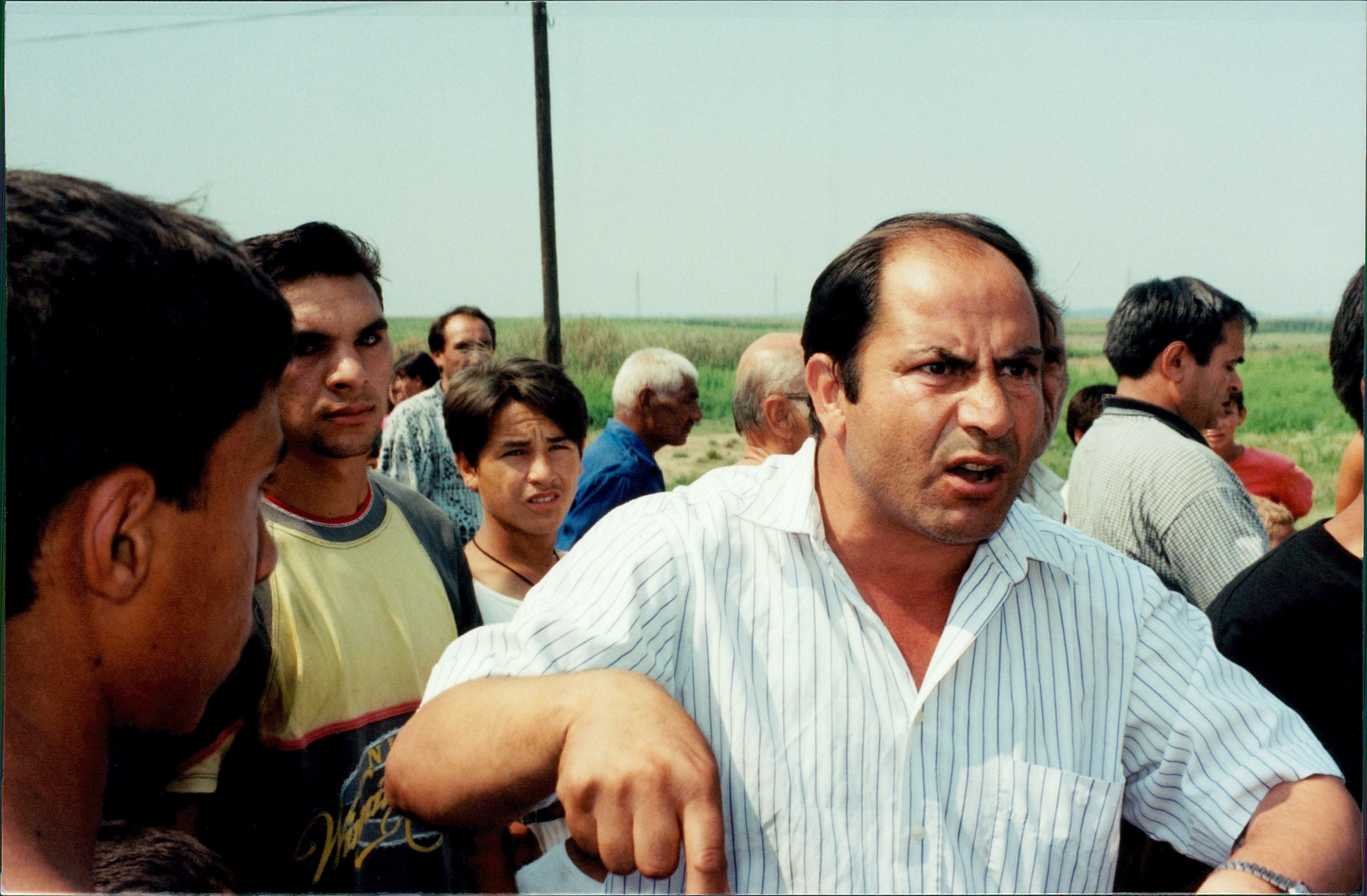
Caption: Roma refugees at Zemun Polje.  Photo: Gregory Elich

The moment our cars pulled to a stop at the end of the settlement, a crowd formed around us. We interviewed a number of Roma and Egyptian refugees from Kosovo. Tefiq Krashich brought his family here from Obilich after KLA soldiers came to his house and threatened to kill his family. For two months, his family had nowhere to sleep until being taken in by a local family. They now had shelter but life remained difficult. “We have no food,” Krashich said. “We are starving. We are begging in the streets for food.”

Threats drove Pucho Rezhezha and his family from their home. After murdering Pucho’s brother, the KLA warned that they would kill everyone in the family if they did not leave Kosovo.

We interviewed a few more people, all with similar tales to tell, but emotions soon started to flare out of control, prompting Damjanovich to cut short the interviews. As our cars drove down the dirt road that ran alongside the settlement, children ran excitedly behind us, enveloped in the dust kicked up by the cars. We sped past two boys standing by the side of the road, pumping their fists in the air while chanting, “Yugoslavia! Yugoslavia!”

The next day, Damjanovich arranged for us to resume our interviews, this time in the center of Zemun. Even before we managed to set up our video cameras, we were surrounded by refugees, anxious to tell us their stories and to hear what others had to say. The weather was sweltering, and sweat poured down my back as the crowd closed around us. Estref Ramdanovich, vice president of the Roma association, informed us that out of a total population of 150,000 Roma in Kosovo, the KLA had by that point expelled 120,000. “The KLA soldiers don’t want any other ethnic group to be in Kosovo,” he explained. “Only Albanians.” Ramdanovich was one of those who had sacrificed much to help others, having taken an astonishing twenty refugees into his home.

With rising emotion, Jovan Damjanovich described the situation. “How many refugees are in the streets, in the bus stations, in the railroad stations, in the parks!” He planned to issue appeals for aid.

“Soon winter will arrive. The international organizations cannot remain blind and deaf when people are dying at their feet. It is a humanitarian catastrophe. Not only is the KLA burning houses. Not only are they expelling people. Not only are they killing many people. They want to create an ethnically clean Kosovo. We think the international community, on the basis of the United Nations Charter, has to do something. Because if there exists humanity, if there exists civilization, we cannot watch the death of a nation.”

It was no surprise to me when the so-called “international community” – a term that somehow always means only powerful interests in the United States and Western Europe and excludes the vast majority of the world’s population – continued to ignore the plight of these politically inconvenient refugees. Little more than a week after our visit to Zemun, Nusret Saiti, leader of the largest remaining Roma community in Kosovo, reported that the KLA had torched over 99 percent of the town’s Romani homes, leaving only three standing. The KLA was stripping the demolished homes for building materials, Saiti said, but NATO’s KFOR mission made no effort to stop them. In just the first year and a half alone of NATO occupation, more than 800 Roma were either killed or had gone missing, a situation which Western officials willfully ignored. Only much later, after most of the Roma had been expelled from the province, were primitive and inadequate refugee camps set up under guard within Kosovo.

We began to talk with the refugees. A soon as Yugoslav forces departed from Kosovo, the KLA showed up, they all told us. Bajrosha Ahmeti burned with anger.

“My daughter, Enisa Ahmeti, was raped by KLA soldiers. At night, we were sleeping in our house, and KLA soldiers broke in and dragged my daughter out and raped her.”

The KLA gang then forced the family from their home, without allowing them to pack. “These are the only clothes I have. I have no food, nowhere to sleep,” she told us. “Should I sleep on the street? The children awake at night, calling ‘Mama, Mama,’ and I have nothing to give them. They can’t sleep well. They can’t eat.”
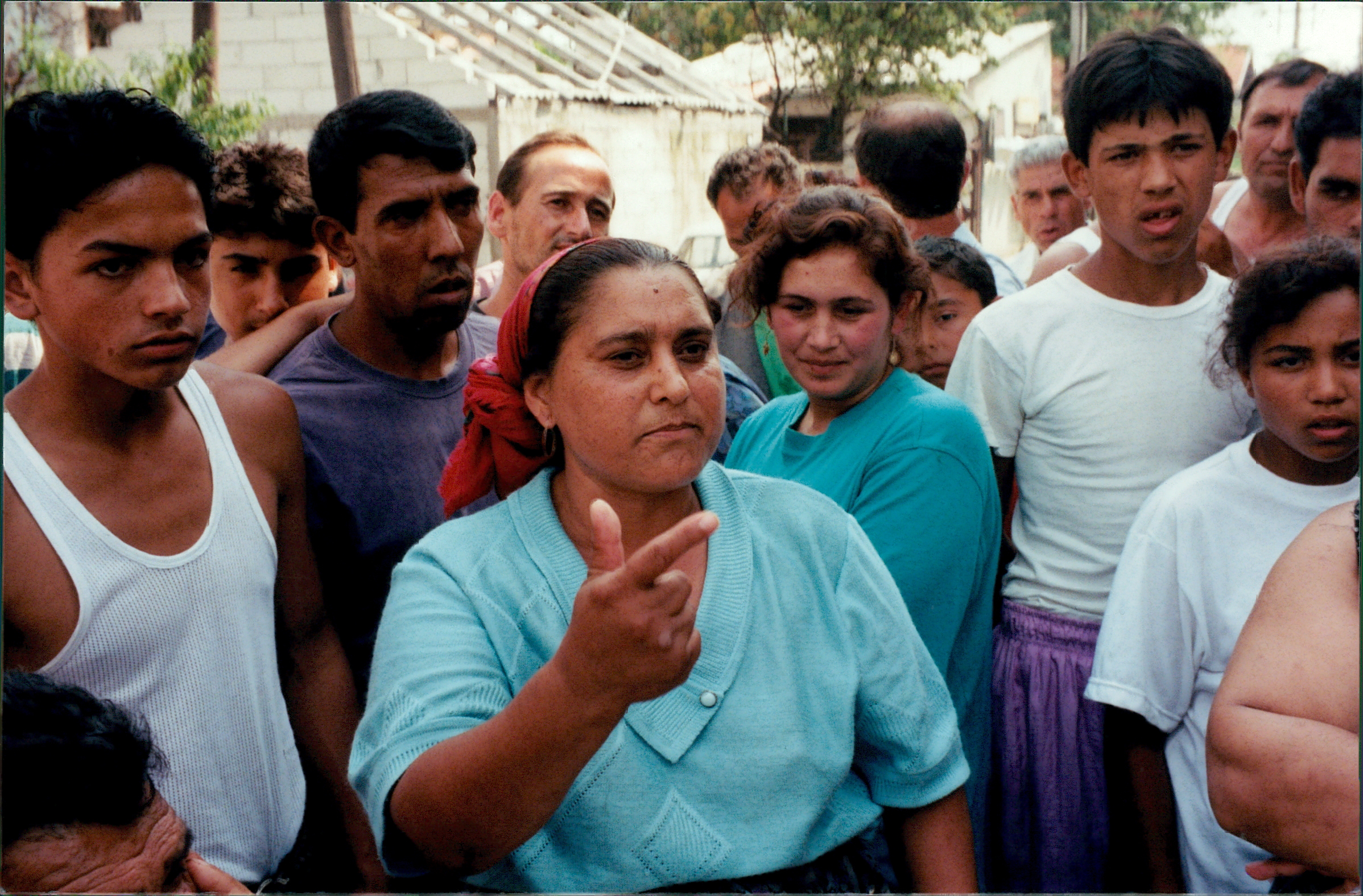
Caption: Bayrosha Ahmeti (center).  Photo: Gregory Elich

Adan Berisha told us that he and his wife were tortured by KLA soldiers. He pointed to his wife, whose face and arm were disfigured. It appeared that acid had been poured on her. But that was not the end of the family’s woes, for the KLA also murdered Berisha’s 12-year-old son. After killing the boy, the KLA soldiers threw Adnan, his wife, and grandson out of their home and began to haul away their possessions.

“A KLA soldier gave us only three hours to leave our home. He told us he would kill us if we stayed even half an hour longer than that. Three hours to leave Kosovo. I can’t go back to Kosovo because the militias will kill me.”

Lacking money or assets of any kind, the family’s trek from the province was difficult. Drawing attention to his grandson, Adnan said,

“This little baby, who is only three months old, went four days without eating. After we escaped from the Albanians, we went to Nish, where we didn’t have any food or water to give to this little baby.”

Adnan reached into his pocket for his wallet and produced a photograph of his son. There was a painful moment of silence as we gazed at the picture of the murdered boy. Then Adnan remarked in a quiet voice filled with anguish, “Sorrow. A world of sorrow.”

Four KLA soldiers broke into the home of Elas Raqmani one morning at about 6:00 AM. Two were armed with rifles and the others with knives. “KLA soldiers took everything – all of the furniture from my home,” he recounted.

“My stove was taken out. The washing machine, refrigerator, and freezer were taken out. We were watching, but I was so sick of the sight, I couldn’t bear to watch the Albanians taking my things right out front.”
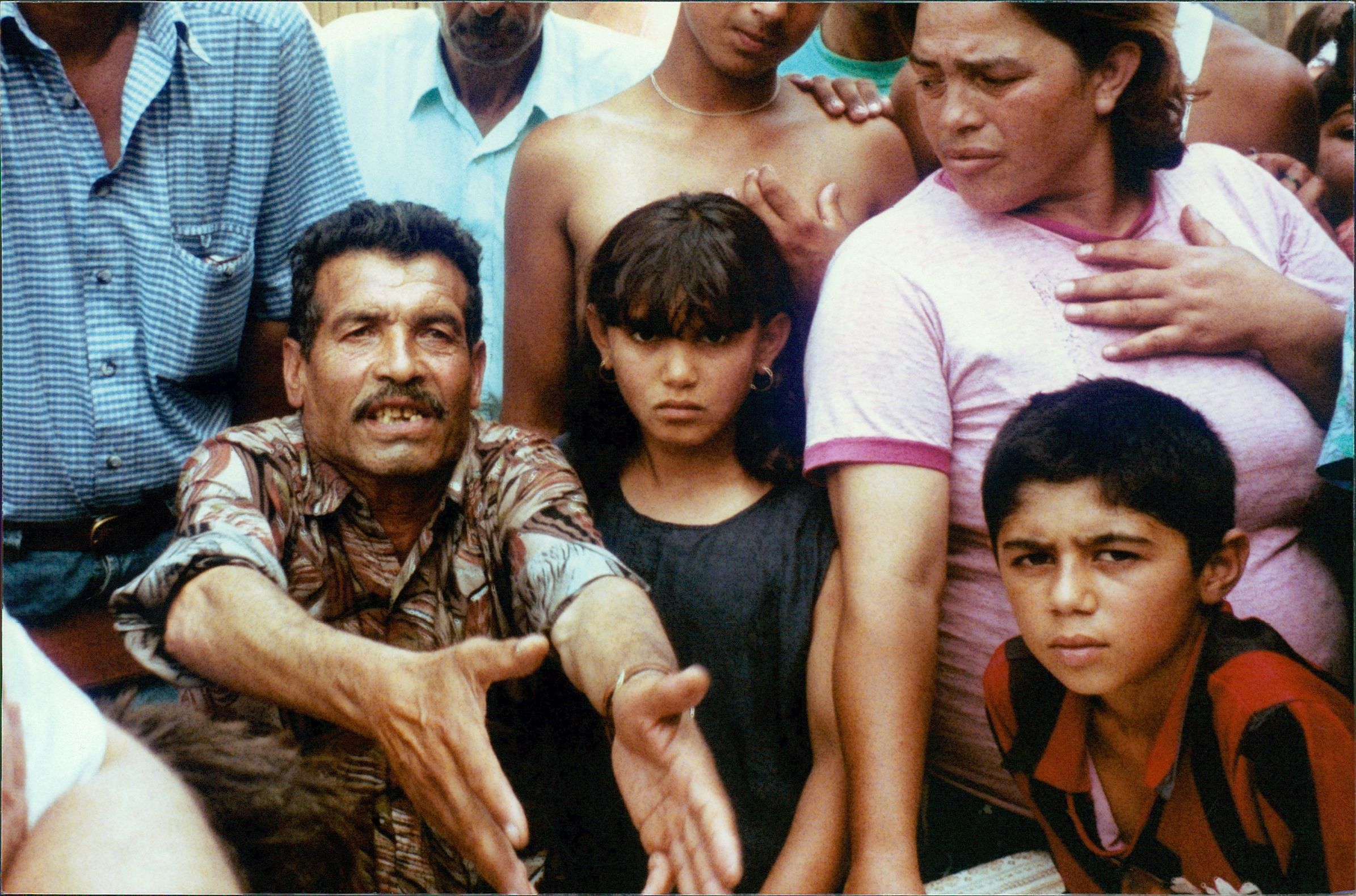
Caption: Elas Raqmani (seated).  Photo: Gregory Elich

The intruders then ordered the family to leave. Only later did Raqmani learn that many of his neighbors were killed that day. Raqmani told us that he had worked for fifty years, and his family lived very well until the day he lost his home. His wife was now reduced to visiting the markets each day and asking for leftover vegetables.

Raqmani expressed himself with a passion that swept all before it, and strong emotions spread throughout the crowd as he spoke. “Kosovo was taken away from us. I’m not against the American people, but this decision they made strikes me as loony. The rights of every people – the Serb, the Montenegrin, and the Gypsy – have been annulled.” Angrily slapping the table before him, Raqmani exclaimed,

“People are going out to kill, but you, as an army, just sit there. Did you come here to help or to watch this circus going on? Events now are making history. It is not acceptable what the American people are doing to us. If they came to help, let me see them help. But if they did not come to help, then everyone – Serbs and Gypsies – will be stamped out! They are allowing that to be done!”

Surrounded by her young children, Ajsha Shatili told us she was forced to leave her home on June 19, only a few days after the withdrawal of Yugoslav forces.

“KLA soldiers dragged my children and me from our home and started removing all of my furniture. I called three British KFOR soldiers for help. They came but did nothing. They only told me, “Good, good. Don’t cry. It will be good.” Wiping away her tears, she told us that a KLA soldier wounded her son by plunging a knife into his back when he attempted to stop the looting. Once the KLA soldiers had taken everything they wanted, they proceeded to burn down both of her homes under the indifferent gaze of the British soldiers. Like so many others, she now owned only the clothes she was wearing when she was driven out of Kosovo. Fortunately, all of her friends and relatives managed to escape from Kosovo before being killed. “They were all afraid for their lives,” she explained. When asked what would have happened had she and her family stayed in Kosovo, Shatili answered in a voice so filled with torment that it was almost a howl of pain. “Everyone would be killed! Everyone!”


Caption: Ajsha Shatili (center).   Photo: Gregory Elich

Five KLA soldiers came to the home of Hashim Berisha in search of his brother, who was a soldier in the Yugoslav army. Hashim was ordered to produce his brother, or they would kill his entire family. He went to his sister’s house and told her what had happened. His sister then ran to report the incident at the local British KFOR headquarters, where the matter failed to interest them. They merely pointed out that she could go wherever she would like to go just so she would not be killed. The next day, Hashim surreptitiously checked on his house and saw that it had been burned down. The KLA eventually caught up with his brother and subjected him to a severe beating. He was fortunate to have survived. Afterwards, Hashim’s brother went to KFOR headquarters in Prishtina, and told them his story. But KFOR’s translator was a KLA sympathizer, and it soon became apparent that what the translator was telling KFOR bore no resemblance to his story. Having no desire to wait around to be killed, he gathered his family and left Kosovo.

When KLA soldiers looted all of the furniture from his home in Uroshevac, Abdullah Shefik knew it was time to go. Shefik collected his family and friends, eleven people in all, and squeezed them all into his van, with the few possessions they managed to fit in. They headed north to escape Kosovo, but along the route they encountered a KLA roadblock. “They were waiting for us. KLA soldiers stopped me and ordered me to leave my van with them. KFOR soldiers stood nearby when my van was hijacked, but they did nothing.” The KFOR unit was American, Shefik added, but “viewed the whole thing and said nothing.”

Bechet Koteshi told us that as soon as British and French KFOR troops entered Gnjilane, KLA soldiers rampaged through the town, attacking Serbs and Roma. “KFOR did nothing because they were on the other side of the town, but the town is not very big, so they had to know what was happening.” Koteshi was in a pharmacy when the shooting began. He departed immediately, riding his bicycle home as fast as possible. “Three hundred meters behind me was another man riding a bicycle, and KLA soldiers threw a grenade at him and killed him.” Some weeks later, Koteshi snuck back into Kosovo to check briefly on his father, who was living in a tent after his home had been torched by the KLA. “It was so hard for him because he lived in a tent with no electricity and no water. Two days ago, KLA terrorists entered the camp and shouted at them, so they fled their tents in fear.”

NATO was complicit in these acts of terror, as borne out by our interviews and those conducted by others. The role of NATO was summed up by a refugee interviewed by Roma activist Sani Rifati:

“When NATO bombs stopped falling in Yugoslavia, my family returned to Kosovo. We were watching the KLA and KFOR soldiers hugging each other and celebrating their arrival in Kosovo. At that moment I thought, this can’t be happening! Why is that KLA terrorist soldier going to hug a KFOR soldier? I realized it is going to be like hell here. Within three days, all non-ethnic Albanians had to leave Kosovo. My house was burned by ethnic Albanians in front of KFOR forces. I went to report to the so-called foreign peacekeepers that my house was burning — and one of the soldiers was telling me it’s okay. My friend’s sister was raped by ethnic Albanians, and she went to report to the KFOR officer; he was telling her it’s okay. My neighbor was kidnapped by KLA and his wife went to report that he’s gone and the officer was telling her it’s okay. KLA was taking our brothers, relatives, friends and taking them to the KLA torture rooms, and wives went to report to the KFOR officers; they were telling them it’s okay. KLA and ethnic Albanians were killing Romani people and they were telling us it’s okay. Is that really okay? We were kicked out from my home in five minutes. KLA terrorists came to my house and told me that in five minutes we must leave our home and then they’re going to burn it.”

Roma leader Jovan Damjanovich issued a statement condemning the KLA’s campaign of terror. “This state of affairs calls into question the justification for the foreign presence. The exodus of Serbs, Montenegrins, and Romanies continues on the lines of the Nazi scenario of fifty years ago, while the world looks on.” Damjanovich’s plea did not go unnoticed in the West, and he was added to the European Union and U.S. sanctions list, whose members were banned from travel and their funds held in foreign accounts seized.

We met Bajram Haliti, who had been an official in the Yugoslav government in Kosovo. In addition to his role in the Kosovo government prior to NATO occupation, he also served in the national government as Secretary for Development of Information on the Languages of National Minorities. Haliti was gentle and soft-spoken, and I took an immediate liking to this scholarly man who described himself as a humanist. Haliti was a poet, and had also published a study entitled The Roma: a People’s Terrible Destiny, on the subject of the Nazi genocide against the Roma people in the Second World War. At his home in Kosovo, his personal library contained over 500 books on the subject, from all over the world. But KLA soldiers burned down both of Haliti’s homes, and the library he had spent a lifetime collecting went up in flames. “I can’t set a price on that library,” he sadly told us.

“The Roma people are in a very hard situation,” Haliti told us.

“It is the same situation Jewish people faced in 1939. At that time, Hitler persecuted every Jew in his territory. And now we have [KLA leader and present-day Kosovo foreign minister] Hashim Thaci. Now Romani houses are burned down, and Roma are expelled by the KLA.”

At the beginning of May 1999, Haliti sent an open letter to U.S. President Clinton, calling for an end to the war. “Only peaceful means can lead to a just settlement for all national communities which live in Kosovo and Metohija.” The letter made an impression in Washington: Haliti was placed on the first sanctions list. The swiftness in which sanctions were imposed on Jovanovich and Haliti demonstrated the West’s responsiveness to the Roma people’s situation.

Gregory Elich is on the Board of Directors of the Jasenovac Research Institute and the Advisory Board of the Korea Policy Institute. He is a columnist for Voice of the People, and one of the co-authors of Killing Democracy: CIA and Pentagon Operations in the Post-Soviet Period, published in the Russian language.
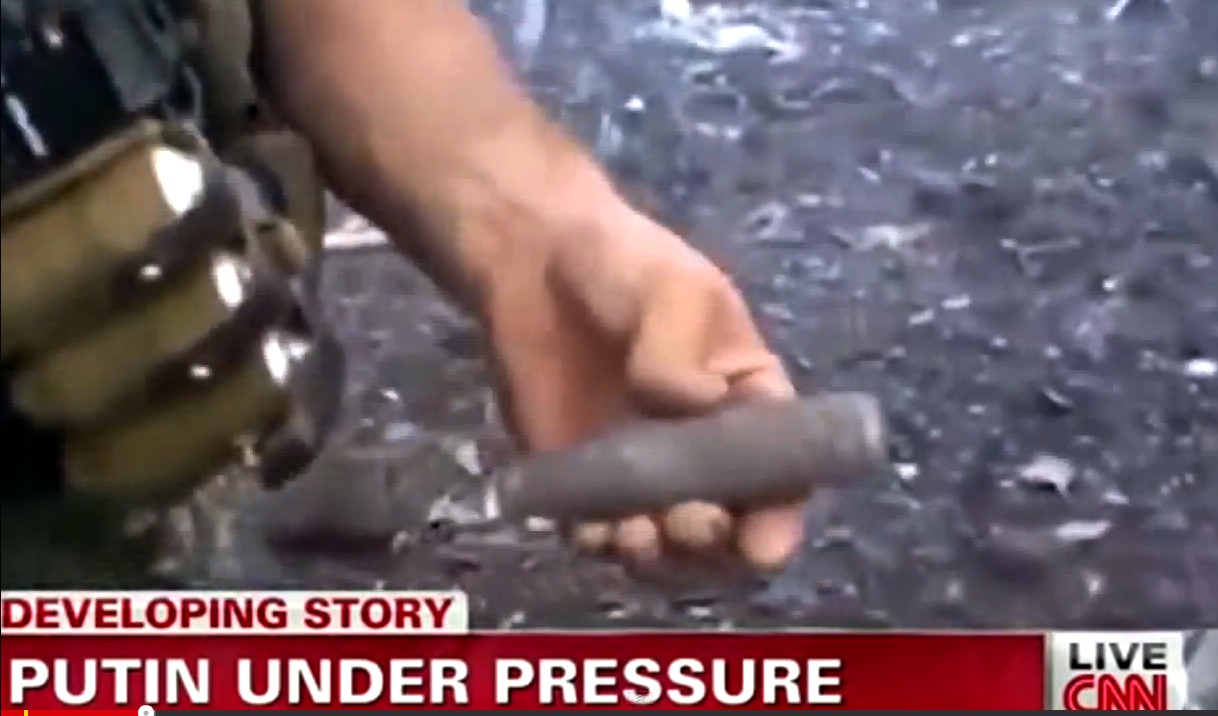
 

Malaysian Airlines MH17: CNN shows 30 mm cannon bullet discovered in wreckage

By Sam Nejad
Global Research, May 02, 2015

We’ve seen several photographs of the Malaysian Airlines MH17 cockpit remains on the ground in Eastern Ukraine. They show numerous 30mm entry & exit cannon holes. These have been fobbed off by the propaganda media as ‘shrapnel’ damage from a BUK ground to air missile.

The consistent circularity and size corresponding to 30mm bullet holes, or the fact that they are concentrated on the cockpit doesn’t bother apologists who have an agenda to promote.

In a CNN report (see below) there is footage of Donbass militia looking at the newly fallen wreckage of MH17, some of it still on fire. The video was broadcast by CNN. As the images run past us a barely noticeable item is briefly in view of the camera:

A combatant spots something amongst the debris. He bends down to pick it up. What he has retrieved is a 30mm bullet that was in the fallen material.

https://www.youtube.com/watch?v=bDtqf0cqOCE

The bullet is in view only for 3 seconds; from 1′ 36″ to 1′ 39″. And the way it was casually passed by the camera lens for so short a time indicates that the man who found it took it for granted that the plane was shot at by the trailing fighter jet(s).

This was within minutes of the shooting down, and before the mass media propaganda machine started its deception a few hours later about a rebel or Russian launched BUK missile. So the Donetsk combatant would not have known the significance of the 30mm cannon bullet he was holding.

Previously, Global Research has published articles showing the bullet holes and witness evidence about the downing of MH17 [1], but so far as I am aware no video clips have been noticed showing the damning evidence of this 30mm bullet.

A quick search of Global Research [1] and any web search engine [2] will give numerous links to evidence and photographs of the bullet holes, as well as witnesses who saw the fighter jet(s). This, together with the flight route diverted directly over the battle area indicates a premeditated plan to bring the plane down.

As to whether air to air missiles were fired from the fighter jet(s) or a bomb had been planted in the plane, those could well have been additional factors. But we now know for certain that the plane was machine gunned by fighter jets. The bullet holes in the cockpit, and now this 30mm bullet in plain view proves it.

One is left to wonder, what kind of irrational psychopaths would order such a murderous act, what brain-dead automatons would carry it out, and what supine and servile corporate mainstream media would try to deflect attention from the perpetrators and blame other parties.

Notes:

[1]  http://www.globalresearch.ca/who-was-behind-the-downing-of-mh17-osce-monitor-mentions-machine-gun-bullet-holes-in-mh17-no-evidence-of-missile/5394693

http://www.globalresearch.ca/dutch-safety-board-report-dsb-malaysian-mh17-was-brought-down-by-a-large-number-of-high-energy-objects-contradicts-us-claims-that-it-was-shot-down-by-a-russian-missile/5400526

http://www.globalresearch.ca/evidence-is-now-conclusive-two-ukrainian-government-fighter-jets-shot-down-malaysian-airlines-mh17-it-was-not-a-buk-surface-to-air-missile/5394814

http://www.globalresearch.ca/another-mh17-cover-up-hiding-a-key-autopsy/5421386

http://www.globalresearch.ca/how-the-malaysian-airlines-mh17-boeing-was-shot-down-examination-of-the-wreckage/5435094

[2]  https://www.google.com.au/search?q=MH17+30mm+bullet

http://www.globalresearch.ca/malaysian-airlines-m17-canon-bullet-discovered-in-mh17-wreckage/5446724

Killing Palestinians in Yarmouk — more evidence that ISIS is US and Israeli-backed

From Prayers for Syria
ISIS shows its true colours in Yarmouk! They are the enemy of the Palestinian people.
April 8, 2015

ISIS has shown its true colours! They are the enemies of the Palestinian people!

Commentators around the world are appalled at the ISIS take-over of Yarmouk refugee camp, still home to around 18,000 Palestinians, and supposedly only a ’10-minute bus ride’ from central Damascus.

The stories of brutal beheadings and other atrocities being committed by ISIS troops in Yarmouk are already emerging, along with concerns that this strategic battlefield success may empower the ISIS recruitment drive as they seem to be on the Syrian President’s doorstep. My reckoning though is that the attack on Yarmouk may have the opposite effect, and could  spell the beginning of the end for ISIS!

From a military perspective, the takeover of Yarmouk is no great threat to Damascus. When I was in Damascus in 2013 there were rebel forces on the edge of the city at multiple points.  They didn’t break through then and there’s no reason to assume that ISIS are going to succeed now where comparable forces have failed. Yarmouk itself has indeed been disputed territory for a number of years now which is why the Syrian Army sealed it off. This resulted in terrible suffering for the civilians remaining in Yarmouk but it simultaneously proved effective in stopping the advance of rebels into the capital.

Where the assault on Yarmouk could rebound negatively for ISIS is in the PR department.

The success of ISIS depends on their success in recruiting angry young Muslim men to their cause. There are no shortage of angry young Muslims around the world, of course, and this for very good reason. The US and its allies, including my country (Australia), have been on a murderous rampage across the Muslim world for more than twenty years, killing as many as 3.3 million Iraqis by some people’s reckoning, along with countless Afghans, Libyans, Syrians, etc. Mr Obama has indeed bombed no less than seven majority-Muslim countries since he took office! No wonder countless Muslim men and women feel angry, and no wonder so many young men are ready to fight for the one man who is standing up to the bloodthirsty West in the name of Allah!

Al Baghdadi has indeed succeeded in uniting many Muslim people under his banner. Even so, there is one other cause that resonates even more deeply with Muslim people everywhere. For the last generation there has been one thing that every Muslim in the world – from Iran to Yemen to Somalia to Indonesia – has in common. Every Muslim on the planet is opposed to the Palestinian Occupation! Support for the suffering Palestinian people is a fundamental part of what it means to be a Muslim in the 21st century, and now ISIS has started butchering Palestinians!

I don’t think we should underestimate the impact this may have worldwide on the ISIS recruitment drive. ISIS has shown itself to be the enemy of the Palestinian people!

I appreciate, of course, that relations between Palestinians and the Syrian government have also been strained in recent years, but it has always been a minority of Palestinians in Syria that are opposed to the Syrian government. Palestinian refugees receive full citizenship rights in Syria (unlike in Lebanon and Jordan) and many are open in their support of the Assad government. When  Khaled Meshaal and the Hamas leadership moved their headquarters from Damascus to Doha in 2012, this was not a reflection of broad Palestinian dissatisfaction with the Syrian government, but rather a reflection of the non-Palestinian forces controlling Hamas – namely, the Muslim Brotherhood.

Despite 2013 reports that Hamas was training rebel forces opposing the Syrian government, there has been no ongoing enmity between Palestinians and Bashar Al Assad. On the contrary, what we have seen in the last few days has been open cooperation between the Syrian Arab Army and Palestinian militias seeking to defend Yarmouk from ISIS, who are the real enemy!

ISIS has shown its true colours in the assault on Yarmouk. These people are not warriors of Allah, fighting to establish a holy state. They are brutal mercenaries, ready to sacrifice the lives of countless beleaguered Palestinians – men, women and children alike – for the sake of gaining a more strategic military position against the Syrian government.

The current humanitarian crisis in Yarmouk gives the Syrian government a significant opportunity to show itself to be a true friend and protector of the Palestinian people.  To an extent this is already happening (even though it is barely being reported).  Refugees fleeing in the direction of the Syrian Arab Army are being relocated to shelters, away from the fighting. We can only pray that this continues and that all civilians can extract themselves from the firing line.

ISIS, of course, are not going to want to let go of their human shields. Even so, the longer they use Palestinians as human shields, the more they betray their identity as Muslims!

Father Dave

ISIS shows its true colours in Yarmouk! They are the enemy of the Palestinian people.

What’s really going on in Yarmouk?
April 29, 2015
…

Yarmouk is only a few kilometres south of Damascus. It was once a thriving centre of colour and life with a vibrant market that made it much more than just a Palestinian enclave. Over the last four years though it has been the centre of so much violence and death that it is April 29, 2015now the most festering wound on the ailing Syrian body. And perhaps

the most tragic dimension of Yarmouk at the moment is the way the suffering of these people is being manipulated to provide a new rationale for Western military intervention.

The dominant narrative at the moment is that ISIS, by lodging themselves in Yarmouk, are on the doorstep of the Presidential palace, threatening to take over Damascus! The Assad government, in response, is throwing everything it has at Yarmouk (including its notorious ‘barrel bombs’), killing rebels and civilians alike, in a desperate attempt to stave off the inevitable. The only hope for the poor people of Yarmouk (so the narrative goes) is to send in the Marines!

Of course the Marines don’t have a great track record when it comes to solving other peoples’ problems, especially in the Middle-East (think Afghanistan, Iraq, Libya, …). Even so, if the people of Yarmouk are suffering at the hands of a reckless government in its death throes, can we really expect our benign super-powers to sit on their hands?

My thought was that I needed to get to Yarmouk to see for myself what was going on, and we got there.

We got to within about 300 meters of the border anyway, where the Syrian military made sure we stopped. We could see the front line from where we were but, as our guides pointed out, this meant that ISIS snipers could see us too, and so we soon moved off from the main entrance road and entered a school on the government controlled side of the border where a number of Yarmouk residents were being housed as well as schooled.

We spent our first few hours there teaching the children to box. I appreciate that most people would see that as a crazy thing to do but the kids certainly enjoyed themselves. There was lots of laughter and cheering as young and old put on the gloves and learnt how to throw punches against the pads without hurting their hands (which is not as easy as some think).

After we’d exhausted ourselves playing we sat down with the Principal of the school and some of the elders of the camp and talked, while enjoying the obligatory coffee that always accompanies such meetings.

From our day at Yarmouk, and through subsequent discussions with local Palestinians and with others in Damascus who knew what they were talking about, I came to some pretty firm conclusions about the situation in Yarmouk and, as I expected, the truth is pretty much the reverse of what we’re being told.

The Syrian Arab Army are not the chief villains in this drama. On the contrary, the Yarmouk residents that we met were being housed and fed by that army, and the children that we saw treated the army men like benign uncles. Indeed, when one of the officers who was with us put on the gloves and started throwing punches, all the children started cheering for him!

This is what I’d expected to find, as I’d spent time in a similar encampment for displaced persons from Yarmouk almost exactly 12 months earlier. There again we’d met hundreds of children, all of whom had been relocated to safe places by the army, and we’d taught them to box.

So let’s be clear on a few points:

  • Firstly, Syrian Army never enters Yarmouk. This isn’t contested by anyone on the ground. The army may work inside Yarmouk through their proxies in the Palestinian militia but army personnel never enter the camp themselves.
  • Likewise, the army does not shell Yarmouk. Clearly the Assad government does not want to be remembered for murdering Palestinians.
  • Finally (and predictably) those who are fleeing Yarmouk are running in the direction of the Syrian army in order to escape ISIS. They aren’t running to ISIS in order to escape the Syrian army. And the army is finding shelter and protection for the fleeing residents.

This is not to say that every Palestinian loves the Syrian army or the Assad government. Indeed, one Palestinian man I spoke to swore that the army had deliberately shelled ISIS in such a way as to force them into Yarmouk! “Why would they do that?” I asked? “In order to bring ISIS into contact with their other great enemy, Hamas, so that they would destroy each other”.

Whether or not that guy was right, his analysis highlights the absurdity of the other side of the media narrative. ISIS are not threatening the Presidential palace from Yarmouk. On the contrary, whether by design or by good fortune, the Syrian army is probably quite pleased to have ISIS in Yarmouk.

There are apparently only around 2000 ISIS militants in Yarmouk in total, and even with superior weapons (being channeled in from Qatar) it seems that they can still be contained by the Palestinian factions opposing them, let alone the Syrian army who have been containing rebels within Yarmouk for a number of years now. The residents have paid a terrible price for that, but the strategy has certainly been effective in protecting the capital.

And so the big lie needs to be turned on its head. The people of Yarmouk are not suffering at the hands of the Syrian army. They are suffering, but the Syrian Arab Army is probably the best friend they have at the moment.

And the army is not about to be overrun by ISIS troops streaming out of Yarmouk. That’s not to say that the army isn’t in trouble. Indeed, they have real problems to deal with in Aleppo and Idlib, but Yarmouk is a relatively minor headache.

In truth, I’m not sure what more can be done for the people of Yarmouk or for the Syrian army. One thing I am sure about though is that we don’t need the Marines, or any more foreign military intervention in Syria. Indeed, the further away our military stays the better are the chances for the people of Yarmouk and for the country as a whole.

Father Dave

What’s really going on in Yarmouk?

Stop Henoko! Okinawans protest against US military base expansion, rape of island women, and ocean destruction

RT, April 29, 2015
Interview with Center for Biological Diversity’s Peter Galvin:

If the US military base in Okinawa is relocated to Henoko, the habitat of the endangered Okinawa dugong sea mammal, will be wiped off the map, said Peter Galvin of the Center for Biological diversity. The species is already down to a few dozen, he added.

RT: What is so wrong about the re-location of the US base from an ecological prospective?

Peter Galvin: The organization I work for, The Center for Biological Diversity focuses on the wildlife environmental protection [of] endangered species. Our focus is to protect wildlife and animals and the environment where they are threatened. And in the case of Okinawa we have a situation where there is an endangered marine mammal, the Okinawa dugong – a very, very rare population of dugongs which is kind of like a sea cow, a little bit like a manatee that they have in the US. And these gentle giants of the ocean… there is between 12 and 15 dugongs remaining in Okinawa… They are a critically endangered population and the site of their habitat in Okinawa, the primary habitat is the site that US and Japanese governments want to fill in to expand a military base in Henoko.

READ MORE: ‘Don’t rape the sea!’ Hundreds protest US military base relocation plan in Japan

The base controversy has a strong environmental component to it, as well as folks in Okinawa that are concerned about peace issues, sovereignty issues, and military threat issues. Our focus is environmental issues. In this situation there is a convergence of a variety of issues including environmental issues, peace, Okinawa sovereignty issues – all playing together in one action. It is a very controversial proposal. The base plan would fill in a very rich area of coral reef in a place called Oura Bay which is on the eastern side of Okinawa, north east Okinawa. And it would be just an enormous landfill project into the ocean which has a huge number of people in Okinawa, in Japan, throughout the world up in arms that in this day and age the US and Japanese governments would pay so little heed to the local population, that they would basically just bulldoze over the local opposition and literally bulldoze over the coral reef and fill it in. So the dugong is a desperately endangered marine mammal that we’ve been working to protect for two decades. Our group along with several other groups launched a lawsuit in US Federal Court, a number of years ago to stop this base expansion project. Our case still continues through the court system. But unfortunately, the project is in the beginning phases now. And as you can see there’s a huge amount of controversy in Okinawa over it that is now manifesting.

RT: Could you give examples of how the re-location of the US base to Henoko is harming flora and fauna? We’ve heard about concrete blocks in the ocean. Any other examples?

PG: Literally, you used the word concrete. And yes, as a matter of fact one of the aspects of any kind of project like this is the contractors bore into the ocean at different places to see the strength of the material at the ocean floor. The sound of the drilling, the construction process, and all the ships out there dumping the concrete pilings into the ocean. … Dugongs are herbivores and they feed on sea grass, they graze like a cow… The huge amount of disturbance in the area is causing the dugongs to change their patterns and that’s a risk enough. But here is the real problem: after these boring surveys and the concrete blocks, if the project continues literally millions and millions of tons of soil are brought in and the ocean itself is filled and land is created from the ocean, the coral reef will be entirely decimated, the sea grass in that entire area will be gone. This is the prime feeding habitat for the endangered Okinawa dugong. These species is down to a few dozen individuals and this is its primary habitat. The impact from the base cannot be understated or overstated and will literally wipe this area of the habitat off the map.
http://rt.com/op-edge/

http://www.biologicaldiversity.org/news/press_releases/2014/okinawa-dugong-12-12-2014.html

‘Don’t rape the sea!’ Hundreds protest US military base relocation plan in Japan
RT, April 28, 2015

About 300 people protested against the planned relocation of a US military base in Japan’s Okinawa prefecture. The rally fell on the 63rd anniversary of the country’s regaining of sovereignty after its defeat in World War II.

The demonstrators gathered on Tuesday, at the gates of the US Marines’ Camp Schwab in the tourist seaside town of Nago, Kyodo news agency reported. The district has been proposed as a relocation site for the US Marine Corps Air Station Futenma.

The participants of the protest chanted slogans such as “we’re opposed to a new base” and “don’t destroy the beautiful sea.”

Continue reading →

Italian official says anti-Russian sanctions may be lifted

From Sputnik News, April 29, 2015

Ukraine’s Embassy in Rome has sent an official request to the Italian Foreign Ministry for comment on a recent statement by an official from the Italian Ministry of Economy and Finances about Italy possibly lifting anti-Russian sanctions in the near future, Ukrainian newspaper Evropeyskaya Pravda reported, citing a diplomatic source.

German Foreign Minister Frank-Walter Steinmeier, second left, welcomes his counterparts from France, Laurent Fabius, right, Russia, Sergey Lavrov, left, and Ukraine, Pavlo Klimkin, second right, for a meeting on the situation in Ukraine in Berlin, Germany, Monday, Jan. 12, 2015.
According to the newspaper, the diplomatic demarche, signed by Ukrainian Ambassador to Italy Heorhiy Chernyavskyi, was sent to the Italian Foreign Ministry on Tuesday. In the document, Chernyavskyi is said express doubts about the competence of Federico Eichberg, the Head of a Task Force on Foreign Investments at the Ministry of Economic Development. The Ambassador is also said to have proposed that the Foreign Ministry “respond to statements by Eichberg which directly contradict the government’s official position.”

Speaking at an Italian business conference in Milan earlier this week, Eichberg stated that Italy will not support the continuation of economic sanctions directed against Russia. “Italy has made it clear since February that the Council of Ministers will not vote for the extension of sanctions,” the official noted.

Russian analysts have commented that the Ukrainian Foreign Ministry’s protest seems to have come at rather an odd time, given that top Italian officials up to the ministerial level have been complaining about sanctions for several months now.

View image on Twitter

the Lemniscat @theLemniscat

Sanctions hurt Europe more than Russia Sanctions cost Italy over €5bn & 300,000 jobs http://www.eurasianbusinessbriefing.com/sanctions-cost-italy-over-e5bn-bank-chief-estimates/ …
3:18 AM – 17 Apr 2015
———————————————————————

On Monday, Italian Minister of Economy and Finance Pier Carlo Padoan told reporters at a press conference that he “sincerely hope[s] that we will come to canceling [the] sanctions as soon as possible, and that economic partnership between Europe and Russia, as well as Italy and Russia will continue to grow.”

Late last month, Italian Foreign Minister Paolo Gentiloni told German media that the EU is too fixated on the Ukrainian crisis, for which it has blamed Russia, while ignoring other, equally important problems, adding that he has recommended that Prime Minister Matteo Renzi restore relations with Moscow, including the “partial lifting of sanctions.”

Flags of Russia, EU, France and coat of arms of Nice on the city's promenade
Moreover, over the past year, Italian media have complained vigorously about the economic losses the country has suffered as a result of the sanctions policy. Italian businessmen last month stated that in 2014, trade turnover between the countries fell by 17 percent, with exports falling by 11.6 percent. The food and textile industries were most heavily hit, with supplies decreasing by 38 and 16 percent, respectively. In February, Banca Intesa estimated that the sanctions have caused 5.3 billion euros worth of losses for the Italian economy.

Already teetering on the brink of crisis, Europe’s economies have been dealt a heavy blow by sanctions and Russian countersanctions initiated last year over the Ukraine crisis.

http://sputniknews.com/europe/20150429/1021534129.html

Заявление Елены Бондаренко—депутата Верховной Рады Украины

Slavianushka.ru

In English: Statement by Elena Bondarenko—People’s Deputy of Verkhovna Rada of Ukraine 

Публичные угрозы, аресты блогеров, убийства представителей оппозиции, расправы с журналистами, которые писали “не в интересах власти”—это ли предел политики гордого европейского демократического государства Украины? Ситуация усугубляется всё более, а яма становится всё глубже. Нет, они не сумеют замолчать всех—скорее, эффект будет обратный. Хотя, пока мировая общественность продолжает игнорировать, если не поощрять, беспредел, устраиваемый пришедшей в результате государственного переворота власти.

Опубликованное ниже заявление народного депутата Украины, Елены Бондаренко, было сделанно еще в сентябре 2014 года, на ее странице Facebook. Тогда же его практически проигнорировали, однако вспыхнувшая волна убийств в Украине придала новой, чудовищной актуальности, обращая внимание еще раз на образ ведение политики новой власти: 


1381988016_dsc_5863

“Я, Елена Бондаренко, народный депутат от Партии регионов, которая находится в оппозиции к нынешней власти в Украине, хочу заявить о том, что власть опускается до прямых угроз физического устранения оппозиционных политиков в Украине, до лишения права на свободу слова оппозиции в парламенте и за его пределами, а также до соучастия в преступлениях против не только оппозиционных политиков, но и их детей.

Постоянные угрозы, негласный запрет на присутствие оппозиции в эфире большинства украинских каналов, целенаправленная травля—это уже как атрибут повседневной жизни оппозиционного депутата в Украине. Все, кто призывает к миру в Украине, сразу же записываются властью во враги народа, как это было, к примеру, в Германии 30-40 годов прошлого века или во времена политики маккартизма в США.

Несколько дней назад Министр внутренних дел Украины Арсен Аваков, который является ярым сторонником так называемой «партии войны» в Украине, заявил следующее: “Когда выходит на парламентскую трибуну выступать Елена Бондаренко, рука просто тянется к пистолету.”

Подчеркиваю: это сказал человек, наделенный полномочиями главного полицейского в государстве. Ровно неделю назад спикер украинского парламента Александр Турчинов также лишил меня права выступить с парламентской трибуны как представителя оппозиционной фракции «Партии регионов». Лишил только за то, что я заявила, что «власть, которая посылает армию бомбить мирные города,—преступна». После чего он же благодушно дал возможность парламентским радикалам озвучить призыв расстрелять оппозицию.

Памятуя то, что еще в конце прошлого года, когда в Киеве уже орудовали экстремисты, мой автомобиль был обстрелян и этот факт был зафиксирован мною заявлением в правоохранительных органах, отношусь к подобным угрозам в мой адрес вполне серьезно.Также информирую всех, кто еще этого не знает, что нынешняя власть покрывает преступников, которые посмели поднять руку на сына другого оппозиционного политика Владимира Олейника. Руслан Олейник, выполняя обязанности районного прокурора, был избит на своем рабочем месте, в результате чего его жизнь и здоровье оказались под угрозой. Вместо того, чтобы расследовать данный факт нападения на прокурора при выполнении его обязанностей и факт чудовищного давления на оппозиционера и его семью, власть уволила данного прокурора. От своих коллег еженедельно я слышу об избиении их помощников, об обысках на предприятиях их сторонников, об угрозах, а также посягательствах на их жизнь, здоровье и имущество.

Украинское информационное пространство почти целиком зачищено от данной информации и обычные украинцы даже не догадываются, что в Украине ведется преступная борьба с оппозицией, что данное Конституцией право на свободу слова всячески подавляется. Те же редакции, которые, превозмогая страх, работают честно подвергаются нападениям националистических группировок, а организаторы и участники погромов редакций, даже идентифицированные по видео и фотоматериалам, не привлекаются к ответственности.

Я призываю международные структуры, которые декларируют приверженность демократическим принципам, не просто обратить на это внимание, а и подключиться к борьбе за сохранение и соблюдение демократических прав и свобод украинских граждан. Методы украинской хунты в борьбе за власть, а точнее в борьбе за построение диктатуры в Украине не имеют ничего общего с понятием «демократия». Бездействие со стороны международного сообщества в отношении этих вопиющих фактов будет выглядеть как соучастие и молчаливое одобрение всех тех преступлений, которые сейчас совершаются в Украине. Свободный мир теряет еще один форпост—Украину. Все, кто не на словах, а на деле, борется за демократию, права и свободы человека могут сообща сделать многое. Ведь только сообща мы можем остановить хунту и братоубийственную войну в Украине!

С уважением,
народный депутат Украины, Елена БОНДАРЕНКО”

http://wp.me/p5Mj6P-3hhttp://slavianushka.ru/

Statement by Elena Bondarenko—People’s Deputy of Verkhovna Rada of Ukraine


Political assassinations in Ukraine — Statement by Rada Deputy Elena Bondarenko

By Olga Luzanova
Slavyangrad
Global Research, April 29, 2015

[translated from Russian]

Below, we publish a translation of a statement made by Rada deputy, Elena Bondarenko, on September 10, 2014 . The  statement was originally published on her facebook page, but went largely ignored at the time. The recent spate of assassinations in Ukraine has given the statement a new, grizzly relevance, and it is for this reason that we are publishing a translation of it at this late date.

Translated by Alya & Alan Bailey / Edited by Olga Luzanova

I, Elena Bondarenko, a deputy of Partiya Regionov [Party of the Regions –ed.], which is in opposition to the governing party in Ukraine, would like to make a statement about the fact that the government is directly threatening with assault opposition politicians, depriving them of freedom of speech in the parliament and in other places, as well as conniving in the crimes against opposition leaders and their children.

Persistent threats, an undeclared ban on opposition parties appearing in the majority of Ukrainian mass media, purposeful baiting—these are everyday things in the life of the opposition in Ukraine. Everybody who calls for peace in Ukraine immediately becomes an enemy to the regime as it was, for instance, in 30-40’s Germany or in the USA during the McCarthyite era.

A few days ago the Ukrainian Internal Affairs Minister, Arsen Avakov, said: “When Elena Bondarenko ascends the parliamentary tribune, I want to reach for my gun.”

I emphasise the fact that those are the words of the person who has the main authority over the police in the country. Exactly a week ago the Speaker of the Ukrainian Parliament, Alexander Turchinov, banned me from the parliamentary tribune as a representative of the opposition Party of the Regions. It was done solely because of my words, that “a regime that sends its army to bomb peaceful cities is criminal.” After that, he kindly allowed the parliamentary radicals to call for the shooting of the opposition .

I remember last year, when Kiev was flooded with extremists, my car was shot at. I reported this fact to the police. I take such threats to myself very seriously. I also would like to inform everyone who is not aware yet, that the regime protects the criminals who dared to raise their hand against the son of another opposition politician—Vladimir Oleynik. Ruslan Oleynik, a district public prosecutor, was beaten up in his work place, putting his life and health under threat. Instead of investigating the attack and threats against the politician and his family, the regime fired the prosecutor. My colleagues complain weekly about their assistants being beaten up, their supporters’ offices being searched, their lives, health and possessions threatened.

Ukrainian cyberspace is almost totally censored of this information, and ordinary Ukrainian citizens have no idea of the criminal fight against the opposition and of the fact that the constitutional right to freedom of speech is suppressed in many ways. The mass media who tell the truth in spite of their fear constantly get attacked by nationalist groups, and hooligans who assault publishing offices are never prosecuted, even when they are identified by video and photographic proof of their involvement is available.

I call upon international organisations who proclaim their democratic principles to not only pay attention to these facts but also to join the fight for democratic rights and freedoms of Ukrainian citizens. The methods used by the Junta in their struggle for power in Ukraine have nothing to do with democracy. Inactivity of the international community towards these outrageous facts looks like complicity and silent approval of all the crimes being committed in Ukraine. The free world is losing another outpost—Ukraine. All those who fight for democracy, peoples rights and freedoms, can bring about many changes together. Only together can we stop the Junta and the fratricidal war in Ukraine!

Yours sincerely,
People’s deputy of Ukraine, Elena BONDARENKO.

http://www.globalresearch.ca/political-assassinations-in-ukraine-statement-by-elena-bondarenko/5446075

Statement by Elena Bondarenko—People’s Deputy of Verkhovna Rada of Ukraine

Western values: French troops rape and sexually abuse children

 “The regular sex abuse by peacekeeping personnel uncovered here and the United Nations’ appalling disregard for victims are stomach-turning, but the awful truth is that this isn’t uncommon. The UN’s instinctive response to sexual violence in its ranks – ignore, deny, cover up, dissemble – must be subjected to a truly independent commission of inquiry with total access, top to bottom, and full subpoena power.” — Paula Donovan, co-director of Aids Free World

From the Guardian, April 29, 2015
Sandra Laville

A senior United Nations aid worker has been suspended for disclosing to prosecutors an internal report on the sexual abuse of children by French peacekeeping troops in the Central African Republic.

Sources close to the case said Anders Kompass passed the document to the French authorities because of the UN’s failure to take action to stop the abuse. The report documented the sexual exploitation of children as young as nine by French troops stationed in the country as part of international peacekeeping efforts.

Kompass, who is based in Geneva, was suspended from his post as director of field operations last week and accused of leaking a confidential UN report and breaching protocols. He is under investigation by the UN office for internal oversight service (OIOS) amid warnings from a senior official that access to his case must be “severely restricted”. He faces dismissal.

The treatment of the aid worker, who has been involved in humanitarian work for more than 30 years, has taken place with the knowledge of senior UN officials, including Zeid Ra’ad Al Hussein, the high commissioner for human rights, and Susanna Malcorra, chef de cabinet in the UN, according to documents relating to the case.

Related: France’s poisoned legacy in the Central African Republic The abuses took place in 2014 when the UN mission in the country, Minusca, was in the process of being set up.

The Guardian has been passed the internal report on the sexual exploitation by Paula Donovan, of the advocacy group Aids Free World, who is demanding an independent commission inquiry into the UN’s handling of sexual abuse by peacekeepers.

It was commissioned by the UN office of the high commissioner for human rights after reports on the ground that children, who are among the tens of thousands displaced by the fighting, were being sexually abused.

Entitled Sexual Abuse on Children by International Armed Forces and stamped “confidential” on every page, the report details the rape and sodomy of starving and homeless young boys by French peacekeeping troops who were supposed to be protecting them at a centre for internally displaced people in Bangui, capital of the CAR.

Donovan, the co-director of Aids Free World. said: “The regular sex abuse by peacekeeping personnel uncovered here and the United Nations’ appalling disregard for victims are stomach-turning, but the awful truth is that this isn’t uncommon. The UN’s instinctive response to sexual violence in its ranks – ignore, deny, cover up, dissemble – must be subjected to a truly independent commission of inquiry with total access, top to bottom, and full subpoena power.”

The UN has faced several scandals in the past relating to its failure to act over paedophile rings operating in the Democratic Republic of Congo, Kosovo and Bosnia. It has also faced allegations of sexual misconduct by its troops in Haiti, Burundi and Liberia.

The treatment of Kompass, a Swedish national, threatens to spark a major diplomatic row.

This month, the Swedish ambassador to the United Nations warned senior UN officials “it would not be a good thing if the high commissioner for human rights forced” Kompass to resign. The ambassador threatened to go public if that happened and to engage in a potentially ugly and harmful debate.

The abuses detailed in the internal report took place before and after Minusca was set up last year. Interviews with the abused children were carried out between May and June last year by a member of staff from the office for the high commissioner of human rights and a Unicef specialist. The children identified represent just a snapshot of the numbers potentially being abused.

Related: Sex abuse poses ‘significant risk’ to UN peacekeeping, says leaked report The boys, some of whom were orphans, disclosed sexual exploitation, including rape and sodomy, between December 2013 and June 2014 by French troops at a centre for internally displaced people at M’Poko airport in the capital Bangui.

The children described how they were sexually exploited in return for food and money. One 11-year-old boy said he was abused when he went out looking for food. A nine-year-old described being sexually abused with his friend by two French soldiers at the IDP camp when they went to a checkpoint to look for something to eat.

The child described how the soldiers forced him and his friend to carry out a sex act. The report describes how distressed the child was when disclosing the abuse and how he fled the camp in terror after the assault. Some of the children were able to give good descriptions of the soldiers involved.

In summer 2014, the report was passed to officials within the office for the high commission of human rights in Geneva. When nothing happened, Kompass sent the report to the French authorities and they visited Bangui and began an investigation.

It is understood a more senior official was made aware of Kompass’s actions and raised no objections. But last month Kompass was called in and accused of breaching UN protocols by leaking details of a confidential report, according to sources.

Kompass’s emails have been seized as part of the investigation into the alleged leak. One senior UN official has said of Kompass that “it was his duty to know and comply” with UN protocols on confidential documents.

Bea Edwards, of the Government Accountability Project, an international charity that supports whistleblowers, condemned the UN for its witch-hunt against a whistleblower who had acted to stop the abuse of children.

“We have represented many whistleblowers in the UN system over the years and in general the more serious the disclosure they make the more ferocious the retaliation,” said Edwards. ”Despite the official rhetoric, there is very little commitment at the top of the organisation to protect whistleblowers and a strong tendency to politicise every issue no matter how urgent.”

UN sources confirmed an investigation by the French was ongoing – in cooperation with the UN – into allegations of a very serious nature against peacekeepers in the Central African Republic.

A spokesman for the UN Office of the High Commissioner for Human Rights confirmed an investigation was under way into the leaking of confidential information by a staff member.

http://www.theguardian.com/world/2015/apr/29/un-aid-worker-suspended-leaking-report-child-abuse-french-troops-car

Also:

http://rt.com/news/254205-french-soldiers-abuse-boys/

American and Ukrainian lies continue as Kiev announces readiness to escalate war

By Stephen Lendman
Global Research, April 27, 2015

Hundreds of US combat troops are preparing Kiev’s Nazi-infested National Guard, Azov battalion and likeminded extremist paramilitary groups for escalated aggressive war on Donbass.

Nothing is reported on continuing low-level war on Donbass ahead of resuming it full-blown.

Novorossia Today explained “US-backed Nazi elements are integral to the continued illegal war against the East, and prominently in the future trajectory of the Ukrainian state.”

Ukraine is Obama’s war – using Kiev fascists to do his dirty work, by all available means without mercy.

“…US policy and media propaganda work hand-in-glove to inflame the situation in a country already on fire,” Novorossia explains.

Russia’s Defense Ministry accused Washington of destabilizing conditions in Ukraine more than already by provocatively training Kiev forces for combat – including near Southeastern cities of Mariupol, Severodonetsk, Artyomovsk and Volnovakha.

Russia’a Foreign Ministry issued a similar statement – saying increased bloodshed may follow US combat troops involved in Ukraine, including training and joint drills with Kiev forces.

On Thursday, State Department spokeswoman Marie Harf lied saying:

“It is really hard to get precise information about Russian troop numbers specifically, but we know there is a substantial Russian presence” in Ukraine.

On Wednesday, the State Department turned truth on its head accusing Russia of violating Minsk ceasefire terms by sending troops and weapons to Donbass.

Fact: No evidence suggests Russian Minsk violations – or any Russian military involvement since conflict began last April.

Fact: Repeated claims of “Russian aggression” are Big Lies. None whatever exists – not now, earlier or planned.

Fact: Plenty of evidence shows Washington arming Kiev’s military with heavy weapons and training its forces for escalated war on Donbass – in blatant violation of Minsk.

Poroshenko pronounced Kiev’s military ready for combat. “The lion’s share of military personnel is from the fourth wave of mobilization,” he said.

“Look what a high level was achieved in just two months,” he boasted.

“We are preparing for the defense of our country” – code language for intending resumed full-scale war, at Obama’s discretion.

“On the territory of Ukraine there is now an aggressor, the enemy and we must do everything possible on our end in order to ensure effective defense,” Poroshenko blustered.

“Those who participated in these exercises clearly demonstrated a high level … the Ukrainian army today is one of the most battle-ready,” he added.

He’s planning escalated war without mercy.

How “battle ready” Ukrainian forces are remains to be seen. Donbass freedom fighters routed them last year.

More of the same is likely if full-scale war resumes – unless America gets directly involved, perhaps with air power terror-bombing.

Head of Russia’s General Staff Main Operation Directorate Lt. General Andrey Kartapolov accused America of being the main initiator or all modern conflicts.

Washington and rogue allies attacked other countries aggressively without cause over 50 times in one decade, he said.

US policy intends mainly to marginalize, contain, weaken, and isolate Russia, he stressed.

In January, Putin said US political, economic and military support for Kiev aims to “achiev(e) the geopolitical goals of restraining Russia.”

Ukraine’s army is a US-controlled “NATO legion. We often say: Ukrainian Army, Ukrainian Army. But who is really fighting there?”

“There are, indeed, partially official units of armed forces, but largely there are the (Nazi-infested) so-called ‘volunteer nationalist battalions,’ ” Putin explained.

They don’t serve Ukrainian interests, Putin maintained. They target Russia on orders from Washington.

They comprise “a foreign NATO legion, which, of course, doesn’t pursue the national interests of Ukraine,” Putin stressed.

“Unfortunately official Kiev authorities refuse to follow the path of a peaceful solution. They don’t want to resolve (crisis conditions) using political tools.”

They want war, not peace. Kartapolov accused Washington of sending US combat troops “directly in the combat zone near Mariupol, Severodonetsk, Artyomovsk and Volnovakha.”

“The US appears to be the ultimate instigator of all military conflicts in the world,” he said.

“The Western countries have begun to hold themselves out as ‘architects’ of the international relations system, leaving to the US the role of the world’s only superpower.”

Nobel Peace Prize laureate Obama terror-bombed seven countries in six years in office. He has more naked aggression in mind.

The “deplorable results (of US wars) are known all to well,” Kartapolov stressed. They continue endlessly against nonbelligerent nations.

A UN report calls Syria and Iraq “international finishing schools for extremists.” Afghanistan, parts of Pakistan, Libya, Yemen and Somalia follow the same pattern.

Imported terrorists from scores of countries infest these nations. Washington bears full responsibility.

Stephen Lendman lives in Chicago. He can be reached at lendmanstephen@sbcglobal.net . His new book as editor and contributor is titled “Flashpoint in Ukraine: US Drive for Hegemony Risks WW III.” http://www.claritypress.com/LendmanIII.html Visit his blog site at sjlendman.blogspot.com. Listen to cutting-edge discussions with distinguished guests on the Progressive Radio News Hour on the Progressive Radio Network. It airs three times weekly: live on Sundays at 1PM Central time plus two prerecorded archived programs.

http://www.globalresearch.ca/kiev-announces-readiness-for-escalated-war/5445507

Smoke from Chernobyl fire could spread radiation far and wide – experts

From RT, April 29, 2015

 RT video screenshot
 RT video screenshot 

Smoke from burning forests in the Chernobyl exclusion zone is capable of spreading contaminants across great distances, even after the fire has been stopped, ecology experts told RT.

The forest fire near the crippled Chernobyl nuclear power plant started on Tuesday and triggered an emergency alert, with police and National Guard mobilized to bring the flames under control.

https://youtu.be/U-c25VBhkE4

By Wednesday, the country’s Emergency Ministry, as well as the prime minister, who went to the affected area, said the spread of the fire had been stopped and firefighters were containing the remaining flames.

The fire occurred within 30 kilometers of the Chernobyl power plant, inside the exclusion zone which was abandoned and cordoned off almost 30 years ago. In 1986, an explosion and fire in Chernobyl’s Reactor 4 caused a release of radioactive particles into the air, which contaminated the surrounding area and caused an increase in radiation levels in Russia, Ukraine, Belarus and across Europe. It was the worst ever nuclear disaster in terms of casualties and clean-up costs. The crippled reactor itself was sealed under a sarcophagus of reinforced concrete.

Although the sarcophagus remains untouched by the fire, decades-old contaminants could still be released and travel far and wide, borne aloft by the smoke, nuclear safety expert John H. Large told RT:

“Brush fires and forest fires were the greatest concern in terms of the means by which you can disperse a secondary radiological impact from the original dissipation that occurred in 1986,” he said.

John went to Chernobyl in 2006 to assess the situation there and spoke to dozens of scientists working on containing the contamination.

“In the exclusion zone and further away you have an area that has been abandoned for farming, abandoned for man management,” John says. “That means you’ve got lots of brush and young wood growing out of control, and that means there’s a big fuel load to have a fire.”

He says the high temperatures and volumes of smoke produced in a forest fire can take contaminants hundreds of kilometers away from the exclusion zone: “Radiation really doesn’t respect any international boundaries.”

https://soundcloud.com/rttv/chernobyl-fire

Forest fires have happened in the area before, but have never been so serious, Timothy Mousseau, biology professor at the University of South Carolina, told RT:

“Previous forest fires had re-released about eight percent of the radiation from the original catastrophe. The fire that we’re seeing today seems to be on a much larger scale, and so we could see a re-dispersion of a very significant component of the original radiation.”

Another problem is that as the trees that have absorbed contaminants burn up and release smoke, this turns radioactive particles into a much more dangerous form than if they simply lie in the ground.

“Internal radiation from inhalation – in other words, if you inhale something radioactive and it gets inside you – is very much more dangerous than just the background radiation that comes off the ground,” says Christopher Busby, the scientific secretary of the European Committee on Radiation Risks.

http://rt.com/news/254193-chernobyl-fire-radiation-spread/

French nuclear safety research institution IRSN created this simulation video, modelling the spread of caesium-137 from the 1986 Chernobyl disaster.

Christopher Busby commented on how far radioactive particles can potentially spread: “After Chernobyl itself, they ended up in the atmosphere and they went right across the Baltic States and into Finland, and over Sweden, and then to the United Kingdom, where they caused significant increases in cancer.”

http://rt.com/news/254193-chernobyl-fire-radiation-spread/