Ukraine Parliament Passes New Laws To Purge Russian Culture

From Anti-War.com

June 19, 2022
by Kyle Anzalone

Ukraine’s Parliament passed two bills that will restrict Russian music and books. If President Volodymyr Zelensky signs the legislation, it will be a significant step forward in Kiev’s attempt to purge the Russian culture.

The first bill will place heavy restrictions on any author who held Russian citizenship after the collapse of the Soviet Union in 1991. The law will ban the printing of books by Russian citizens, forbid importing the commercial import of any book printed in Russia, Belarus, or “occupied Ukrainian territory,” and requires special permission to import any book in Russian.

In the future, books in Ukraine can only be published in Ukrainian and official European Union languages. Russian is not one of the EU’s official 24 languages. Books in other languages can only be printed in the original language or translated into one of the 25 allowable languages.

The law provides an exemption for Russian authors who renounce their Russian passports and obtain Ukrainian citizenship. The bills make up the latest steps in the process of “derussification.”

The second law bars the playing of any Russian music on media or on public transportation. The legislation also increases quotas for Ukrainian language music and speech on television and radio.

Indications are Zelensky will sign the bills into law. Ukraine’s Culture Minister Oleksandr Tkachenko – a member of Zelensky’s Servent of the People party – welcomed the bills. “The laws are designed to help Ukrainian authors share quality content with the widest possible audience, which after the Russian invasion do not accept any Russian creative product on a physical level,” he said.

The bills are not Kiev’s first effort to stifle the Russian culture in Ukraine. After the 2014 coup in Ukraine, the US-backed government passed several restrictions on the Russian language. In 2018, a movie starring Zelensky – Love in the Big City 2 – was banned because it was produced in Russian.

As president, Zelensky has advanced the culture war. After the Russian invasion, Zelensky removed members of parliament from parties that were deemed “pro-Russian.” He also nationalized Ukraine’s media, giving him further control over the narrative in Ukraine.


Kyle Anzalone is the opinion editor of Antiwar.com, news editor of the Libertarian Institute, and co-host of Conflicts of Interest.

Links in article at
https://news.antiwar.com/2022/06/19/ukraine-parliament-passes-new-laws-seeking-to-purge-russian-culture/

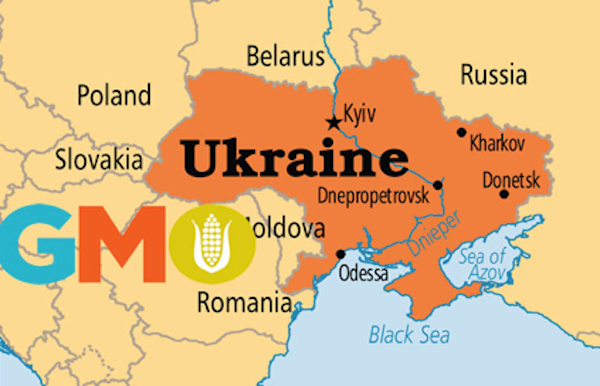
Ukraine — The War Within The War: The Fight Over Land and Genetically Engineered Agriculture

From CovertAction Magazine

by Mitchel Cohen
May 31, 2022

Source https://orientalreview.org/2015/04/06/land-grab-in-ukraine-is-monsantos-backdoor-to-the-eu/
Soon we shall be covered by wheat.
Did you say, wheat?
Wheat, wheat.– from Woody Allen’s “Love and Death”[1]

Ten months before Russian troops poured into Ukraine, that country’s President Volodymyr Zelensky signed a bill into law authorizing the private sale of farmland, reversing a moratorium that had been in place since 2001.

An earlier administration in Ukraine had instituted the moratorium in order to halt further privatization of The Commons and small farms, which were being bought up by oligarchs and concentrated in fewer and fewer hands. As documented in a series of critical reports over ten years by the Oakland Institute based in California, the moratorium on land sales in Ukraine aimed to prevent the acquisition and consolidation of farmland in the hands of the domestic oligarch class and foreign corporations.

The marketization of farmland is part of a series of policy “reforms” that the International Monetary Fund stipulated as a precondition enabling Ukraine to receive $8 billion in loans from the IMF.[2]

Even amid the pandemic there has been “wide-ranging opposition from the Ukrainian public to reversing that ban, with over 64 percent of the people opposed to the creation of a land market, according to an April 2021 poll.”[3]

Additionally, the IMF loan conditions required that Ukraine must also reverse its ban on genetically engineered crops, and enable private corporations like Monsanto to plant its GMO seeds and spray the fields with Monsanto’s Roundup. In that way, Monsanto hopes to break the boycott by a number of countries in Europe of its genetically engineered corn and soy.

[Source: interecophil.wordpress.com]

It is the thesis of this essay that agricultural competition over land use between the U.S. and Russia—two gigantic capitalist countries with the most powerful nuclear arsenals in the world—is a neglected but important force driving the war in Ukraine.


The U.S. government has for the last decade wrestled with Russia over who controls the energy pipelines through Ukraine into Europe, and in what currency costs for that so-called “natural” gas and oil are to be paid. At the same time, the war’s disruption of Ukraine’s wheat harvest and the historic droughts hitting the U.S.’s “wheat belt” have driven the cost of bread around the world through the roof. United Nations officials are making dire predictions concerning the world’s supply of grain.

According to the UN Food and Agriculture Organization, world food commodity prices made a significant leap in March 2022 to reach their highest levels ever, rising 12.6% in that month alone as war in the Black Sea region shocked the markets dependent on staple grains and vegetable oils.[4] Global wheat prices rose by 19.7%, vegetable oil by 23.2%, and grains 20.4%. In Tunisia and in other countries, cooking oil, semolina, and rice have all but disappeared from grocery stores, and flour shortages have led to a run on bakeries.[5]

In the Middle East, millions who already spend more than a third of their income on food, are being hit hardest by the war’s impact on the global food supply. Yet UN agencies have begun to divert sacks of grain that had been earmarked for other war zones to the Ukraine, leaving the people of Yemen and refugees from many areas in desperation.[6]

In peaceful times Ukraine harvests 80 million metric tons (MMT) of grain—a category that includes wheat, corn, barley, rice and millet. Between them Russia and Ukraine supply more than 25% of the world’s wheat. Russia recently overtook the U.S. and Canada to become the leading wheat-exporting country in the world; Ukraine is the world’s 6th largest exporter of wheat.

But this year, Ukraine’s harvest will likely reach less than half the norm. “A single MMT of wheat…is enough to feed every person in Europe for about two days, or the entire population of Africa for about a day and a half.…A country like the UK could only make it up by having everyone stop eating for three years. That’s the thing about tonnes of grain: a million here and a million there and pretty soon you’ve got a real issue on your plate.”[7]

People in France or Italy were never expecting to have any Ukrainian wheat shipped to them at all; but they are now competing against Egyptians and Moroccans, who are now suddenly looking for new sources of bread.[8]

The grains are not only used for bread and flour, but also for alcohol, fuel, and for feeding animals.[9] With more than half the tonnage grown in Ukraine last year never intended to be used for direct human consumption, shortages will impact other parts of the economy too.[10]

The Communist Party of Greece points out that “the military conflict in Ukraine is the result of the sharpening of competition between the two warring camps, primarily focused on spheres of influence, market shares, raw materials, energy plans and transport routes; competition which can no longer be resolved by diplomatic-political means and fragile compromises.”[11]

How much of the predicted food system collapse is a result of the war’s disruption of grain harvests, and—a question few in the U.S. mainstream media are asking—how much are skyrocketing food prices caused by plain old capitalist rivalry between two of the main grain-exporting countries of the world?

Competing systems for growing crops

U.S. agriculture relies on two main inputs: migrant farm labor and the monocropping of genetically engineered corn, soy, and other crops designed to tolerate—and thus be saturated with—Monsanto’s cancer-causing herbicide Roundup. The government’s regulatory process is broken, if it ever worked properly at all: Corporations such as Monsanto, Bayer, Dow, DuPont, Syngenta, Novartis, BASF and the other pesticide and pharmaceutical manufacturers are allowed to mask the truth about the dangers of their products.

They are facilitated in this by the complicity of federal (and global) regulatory agencies, allowing them to intentionally thwart the Precautionary Principle. Where the introduction of a new product or process whose ultimate effects are disputed or unknown, that product or process should be rejected. We need to support the development of international movements opposing the subservience of government agencies to the giant corporations.[12]

Continue reading

New York Times repudiates drive for ‘decisive military victory’ in Ukraine, calls for peace negotiations

From Anti-War.com

By John Walsh
May 23, 2022

Ukraine must negotiate based on a “realistic assessment” and “limits” to U.S./NATO commitment, says NYT

On May 11 The New York Times ran an article documenting that all was not going well for the U.S. in Ukraine, and a companion opinion piece hinting that a shift in direction might be in order.

Then on May 19, the editorial board, the full Magisterium of the Times, moved from hints to a clarion call for a change in direction, declaring that “total victory” over Russia is not possible and that Ukraine will have to negotiate a peace in a way that reflects a “realistic assessment” and the “limits” of U.S. commitment.  

The Times serves as one the main shapers of public opinion for the elite and so its pronouncements are not to be taken lightly.

US Limits

The editorial contains the following key passages:

“In March, this board argued that the message from the United States and its allies to Ukrainians and Russians alike must be: No matter how long it takes, Ukraine will be free. …”

“That goal cannot shift, but in the end, it is still not in America’s best interest to plunge into an all-out war with Russia, even if a negotiated peace may require Ukraine to make some hard decisions.” 

And, to ensure that there is no ambiguity, it went on: “A decisive military victory for Ukraine over Russia, in which Ukraine regains all the territory Russia has seized since 2014, is not a realistic goal. … Russia remains too strong…”

To make certain that President Joe Biden and the Ukrainians understand what they should do, it adds:

… Mr. Biden should also make clear to President Volodymyr Zelensky and his people that there is a limit to how far the United States and NATO will go to confront Russia, and limits to the arms, money and political support they can muster. It is imperative that the Ukrainian government’s decisions be based on a realistic assessment of its means and how much more destruction Ukraine can sustain.”

As Ukraine’s President Volodymyr Zelensky read those words, he must surely have begun to sweat.  The voice of his masters was telling him that he and Ukraine will have to make some sacrifices for the U.S. to save face.  As he contemplates his options, his thoughts must surely run back to February 2014, and the U.S.-backed Maidan coup that culminated in the hasty exit of President Viktor Yanukovych from his office, his country and almost from this earth.

Too dangerous

In the eyes of the Times editorial writers, the war has become a U.S. proxy war against Russia using Ukrainians as cannon fodder – and it is careening out of control:  “The current moment is a messy one in this conflict, which may explain President Biden and his cabinet’s reluctance to put down clear goal posts. “The United States and NATO are already deeply involved, militarily and economically. Unrealistic expectations could draw them ever deeper into a costly, drawn-out war …

“Recent bellicose statements from Washington — President Biden’s assertion that Mr. Putin ‘cannot remain in power,’ Defense Secretary Lloyd Austin’s comment that Russia must be ‘weakened’ and the pledge by the House speaker, Nancy Pelosi, that the United States would support Ukraine ‘until victory is won’ — may be rousing proclamations of support, but they do not bring negotiations any closer.”

While the Times dismisses these “rousing proclamations,” it is all too clear that for the neocons in charge of U.S. foreign policy, the goal has always been a proxy war to bring down Russia. This has not become a proxy war; it has always been a proxy war.

Continue reading

The Fantasy of Fanaticism, by Scott Ritter

From Consortium News
by Scott Ritter
June 25, 2022

For a moment in time, it looked as if reality had managed to finally carve its way through the dense fog of propaganda-driven misinformation that had dominated Western media coverage of Russia’s “Special Military Operation” in Ukraine.

In a stunning admission, Oleksandr Danylyuk, a former senior adviser to the Ukrainian Ministry of Defense and Intelligence Services, noted that the optimism that existed in Ukraine following Russia’s decision to terminate “Phase One” of the SMO (a major military feint toward Kiev), and begin “Phase Two” (the liberation of the Donbass), was no longer warranted. “The strategies and tactics of the Russians are completely different right now,” Danylyuk noted. “They are being much more successful. They have more resources than us and they are not in a rush.”

“There’s much less space for optimism right now,” Danylyuk concluded.

In short, Russia was winning.

Danylyuk’s conclusions were not derived from some esoteric analysis drawn from Sun Tzu or Clausewitz, but rather basic military math. In a war that had become increasingly dominated by the role of artillery, Russia simply was able to bring to bear on the battlefield more firepower than Ukraine.

Ukraine started the current conflict with an artillery inventory that included 540 122mm self-propelled artillery guns, 200 towed 122mm howitzers, 200 122mm multiple-rocket launch systems, 53 152mm self-propelled guns, 310 towed 152mm howitzers, and 96 203mm self-propelled guns, for approximately 1,200 artillery and 200 MLRS systems.

For the past 100-plus days, Russia has been relentlessly targeting both Ukraine’s artillery pieces and their associated ammunition storage facilities. By June 14, the Russian Ministry of Defense claimed that it had destroyed “521 installation of multiple launch rocket systems” and “1947 field artillery guns and mortars.”

Even if the Russian numbers are inflated (as is usually the case when it comes to wartime battle damage assessments), the bottom line is that Ukraine has suffered significant losses among the very weapons systems — artillery — which are needed most in countering the Russian invasion.

But even if Ukraine’s arsenal of Soviet-era 122mm and 152mm artillery pieces were still combat-worthy, the reality is that, according to Danylyuk, Ukraine has almost completely run out of ammunition for these systems and the stocks of ammunition sourced from the former Soviet-bloc Eastern European countries that used the same family of weapons have been depleted.

Ukraine is left doling out what is left of its former Soviet ammunition while trying to absorb modern Western 155mm artillery systems, such as the Caesar self-propelled gun from France and the U.S.-made M777 howitzer.

But the reduced capability means that Ukraine is only able to fire some 4,000-to-5,000 artillery rounds per day, while Russia responds with more than 50,000. This 10-fold disparity in firepower has proven to be one of the most decisive factors when it comes to the war in Ukraine, enabling Russia to destroy Ukrainian defensive positions with minimal risk to its own ground forces.

Casualties

This has led to a second level of military math imbalances, that being casualties.

Mykhaylo Podolyak, a senior aid to Ukrainian President Volodymyr Zelensky, recently estimated that Ukraine was losing between 100 and 200 soldiers a day on the frontlines with Russia, and another 500 or so wounded. These are unsustainable losses, brought on by the ongoing disparity in combat capability between Russia and Ukraine symbolized, but not limited to, artillery.

Continue reading

Report: Ukraine Armed Forces losses “considerable”; false flag attack planned by Kiev for Odessa using actors, foreign media, and UNICEF

From Strategic Stability

Report # 92. AFU suffer considerable losses on all fronts
July 2, 2022

1. Situation on the battlefields

Russian Defence Ministry reported on July 2nd about the progress of the special military operation in Ukraine. It claimed that the enemy suffers considerable losses on all fronts. Lisichansk has been captured.

Three battalions from 10th Mountain Assault and 72nd Mechanised Brigades have lost over 50% of their personnel near Verkhnekamenka and Zolotaryovka just in the past 24 hours.

Russian Aerospace Forces have launched a high-precision attack at provisional base of 1st Battalion from 30th Mechanised Brigade. The attack has resulted in the elimination of up to 120 Ukrainian servicemen and about 15 units of military equipment.

In addition, Russian aviation has neutralised a provisional armament and military equipment storage base of 10th Mountain Assault Brigade deployed at the territory of a tractor plant in Kharkov. The attack has resulted in the elimination of up to 30 servicemen and 10 units of armoured and motor vehicles.

Russian Federation Armed Forces continue launching attacks at other military facilities located in Ukraine.

High-precision attacks launched by Russian Aerospace Forces have resulted in the elimination of 5 command posts of the AFU near Artyomovsk and Chasov Yar (the DPR), Pervomayskoye, Zelyony Gay and Barmashovo (Nikolayev Region), 3 munitions depots near Shevchenkovo and Novogrigorovka (Zaporozhye Region), as well as AFU manpower and military equipment in 32 areas.

Within the counter-battery warfare, high-precision attacks launched by Russian Aerospace Forces have resulted in the neutralisation of 4 MLRS platoons near Novoluganskoye, Zhelannoye, Berdychi and Vozdvizhenka from where the AFU had been shelling the settlements of the DPR.

Operational-tactical and army aviation, missile troops and artillery have neutralised: 39 AFU command posts, 2 munitions depots near Nikolayev, as well as manpower and military equipment in 302 areas.

Russian air defence systems have shot down 1 MiG-29 of the Ukrainian Air Force near Yavkino (Nikolayev Region).

19 Ukrainian UAVs have been shot down near Voskresenovka, Glinskoye, Pitomnik, Zhovtnevoye, Rubezhnoye, Petrovka (Kharkov region), Rabotino, Novodanilovka (Zaporozhye region), Petrovskoye, Popasnaya, Kremennaya (the LPR), Snezhnoye, Vysokoye, Yasinovataya, Donetsk, Makeyevka, Dokuchayevsk, Komsomolskoye (the DPR).

4 projectiles launched by MLRS have been intercepted near Yasinovataya, Mineralnoye (the DPR) and Chernobayevka (Kherson Region).

In total, 227 airplanes and 134 helicopters, 1,430 unmanned aerial vehicles, 353 anti-aircraft missile systems, 3,886 tanks and other armored combat vehicles, 702 combat vehicles equipped with multiple rocket-launching systems, 3,073 field artillery cannons and mortars, as well as 3,954 units of special military equipment have been destroyed during the special military operation.

2. Humanitarian situation

Russian troops continue to carefully record the facts of the inhumane treatment of civilians and use of residential buildings, educational institutions, cultural buildings and other social infrastructure facilities for military purposes by Armed Forces of Ukraine (AFU):

1) in Zaporozhye, in the Children’s Art Palace (Zaporozhskaya Square), nationalists have deployed a strongpoint, an armament and munitions depot, as well as firing and sniper positions along the perimeter of the institution and at the upper floors of nearest residential buildings;

2) in Kramatorsk, the DPR, in the residence of technological vocational school (Uralskaya Street) and in the gymnasium №1 (Arkhangelskaya Street), militants of Ukrainian nationalist groups have deployed barracks, as well as armoured equipment and large-calibre artillery at Yubileyny park;

3) in Kramatorsk, in the school №35 (Yubileynaya Street), in the private residential buildings (Aktyubinskaya Street), servicemen of the AFU, foreign mercenaries and militants of Azov nationalist group have deployed strongpoints, sniper positions, armoured and mortar firing positions, while local residents remain forcibly detained in the basements and used as a human shield;

Continue reading

NATO summit urges Ukraine to keep fighting; updates on Ukraine situation

From Strategic Stability
June 29, 2022

Report #91

1. NATO is urging Kiev to continue war with Russia, Belgian Prime Minister said

Fighting against Russia with Western help is the only way forward for Ukraine, NATO members told President Volodymyr Zelensky, Alexander De Croo, the Belgian Prime Minister said on June 29 in Madrid.

“We make it very clear that this war can only be won on the battlefield and we should continue to support President Zelensky and the Ukrainian population as much as possible to be able to win the war on the battlefield,” Belgian Prime Minister told journalists on the sidelines of the NATO summit in Madrid.

In a new NATO Strategic Concept stamped at the NATO Summit in Madrid at the end of June, the transatlantic alliance neglected the fact that it is Ukraine who actually started three wars of aggression against Donbass in 2014-2022, but not the Russian Federation. In another document called Madrid Summit Declaration 30 NATO member-states promised to accelerate the delivery of non-lethal defence equipment to aggressive Ukrainian regime, improve its’s cyber defences and resilience, and support modernising its defence sector in its transition to strengthen long-term interoperability. In this phrase there is a clear-cut distortion dealt with transfer of “non-lethal defence equipment” to that ultra-nationalist regime. It reality, HATO began to deliver lethal offensive arms and ammunition toKiev a long time ago and is delivering them still. The phrase “to strengthen long-term interoperability” usually refers to a member of NATO.

Via a video link addressed to NATO summit on June 28 Ukrainian President Zelensky has urged the US-led NATO bloc to ramp up support of his country amid the ongoing conflict with Russia, claiming that Kiev’s defeat would result in a “delayed” war between Moscow and the whole West. The country needs both direct military and financial aid, Zelensky stated, adding that some $5 billion a month was needed to cover its budget deficit.

He has already spent nearly $ 7.0 donated his patron the USA from February 24 for gaining no victory and loosing nearly 150,000 troops on the battlefields. Will he be able to return such huge amount of money? Highly unlikely.

Despite this fact, German Chancellor Olaf Scholz at the NATO summit in Madrid outlined the North Atlantic Alliance’s position on military assistance for Ukraine. He said that Ukraine should be given so many weapons that it would be able to defend itself. And that means NATO will raise the stakes in the Ukrainian crisis. “The message is: we will continue to do this, we will do it intensively as long as it is necessary so that Ukraine can defend itself”, – the chancellor was quoted as saying.

It will be a tragic parallel: during WWII German “Tiger” tanks stormed Donbass, and today another types of German “Leopard” tanks are going to do the same aggressive job, killing innocent people in the same area. Seemingly, contemporary Berlin has NOT gained positive lessons from the past.

2. Kiev once again circulated fake news

Ukrainian President Zelensky is not satisfied with the absence of fake news from his General Staff and special services who staged two major lies of strategic importance – corpses intentionally delivered to Bucha and shelling a railway station in Kramatorsk controlled by Ukrainians by ballistic missile Tochka-U fired from the city also controlled by the Ukrainian side that time.

On June 27, in Kremenchug (Poltava Region), Russian Aerospace Forces launched a high-precision air attack at hangars with armament and munitions delivered by USA and European countries at Kremenchug road machinery plant called Kredmash [also named as Dormash].

Russian MoD official spokesman Lt-General Igor Konashenko said that high-precision attack has resulted in the neutralisation of the West-manufactured armament and munitions concentrated at the storage area at Dormash that was meant to be delivered to Ukrainian group of troops in Donbass. Detonation of the storaged munitions caused a fire in a non-functioning shopping centre named “Amstor” located 150 m away to the facilities of the plant.

The same information was articulated on June 28 at the UN Security Council (UNSC) by Dmitry Polyanskiy, Russian representative to the UN told the Security Council on meeting Russia does not target civilians in Ukraine and did not strike a shopping center in Kremenchug. He added that the mall caught fire due to an explosion of Western-supplied weapons and ammunition, stored at the nearby factory and intended to be used in shelling civilians in the Donbass.

“In reality, there was no strike on the mall,” Polyanskiy told the council, as Russia targeted a storage facility at the Kredmash factory. The weapons and ammunition stored there were bound for the front, where Ukrainian artillery has been bombarding the civilians of Donbass, for many years, to no objection from the UN, he added. “The Russian strike stopped that.”

Polyanskiy pointed out that Ukrainian media clearly shows images of intact merchandise inside the Amstor shopping center, and windows of nearby residential buildings that had not shattered. The fire was caused by explosions of the Western-supplied ammunition at Kredmash, he said.

Continue reading

President Putin’s speech to St. Petersburg International Economic Forum (SPIEF), 17 June 2022

From Kremlin.ru

The President attended the plenary session of the 25th St Petersburg International Economic Forum.

President of the Republic of Kazakhstan Kassym-Jomart Tokayev also took part in the session. President of the People’s Republic of China Xi Jinping and President of the Arab Republic of Egypt Abdel Fattah el-Sisi addressed the session via videoconference.

The theme this year is New Opportunities in a New World.

* * *

Plenary session moderator Margarita Simonyan: Good afternoon, or almost evening.

As you may know, we had a minor technical issue. Thankfully, it has been dealt with quickly. We are grateful to those who resolved this.

We are also grateful to the audience.

We are grateful to our leader, President Vladimir Putin, for traditionally fitting this forum into his schedule so that he can tell us about economic prospects and other plans.

We are grateful to President Kassym-Jomart Tokayev for attending our forum. We know that it is not an easy thing to do. Thank you for supporting our forum and our country. We really appreciate this.

We will have a lot of questions today. You may not like some of them, and I may not be happy to ask some of them. We would be much happier to speak only about good things, but this is impossible today.

Mr President, I would like to ask you to take the stand and to tell us what lies in store for us all. Thank you.

President of Russia Vladimir Putin: Thank you very much. President Tokayev, friends and colleagues,

I welcome all participants and guests of the 25th St Petersburg International Economic Forum.

It is taking place at a difficult time for the international community when the economy, markets and the very principles of the global economic system have taken a blow. Many trade, industrial and logistics chains, which were dislocated by the pandemic, have been subjected to new tests. Moreover, such fundamental business notions as business reputation, the inviolability of property and trust in global currencies have been seriously damaged. Regrettably, they have been undermined by our Western partners, who have done this deliberately, for the sake of their ambitions and in order to preserve obsolete geopolitical illusions.

Today, our – when I say “our,” I mean the Russian leadership – our own view of the global economic situation. I would like to speak in greater depth about the actions Russia is taking in these conditions and how it plans to develop in these dynamically changing circumstances.

When I spoke at the Davos Forum a year and a half ago, I also stressed that the era of a unipolar world order has come to an end. I want to start with this, as there is no way around it. This era has ended despite all the attempts to maintain and preserve it at all costs. Change is a natural process of history, as it is difficult to reconcile the diversity of civilisations and the richness of cultures on the planet with political, economic or other stereotypes – these do not work here, they are imposed by one centre in a rough and no-compromise manner.

The flaw is in the concept itself, as the concept says there is one, albeit strong, power with a limited circle of close allies, or, as they say, countries with granted access, and all business practices and international relations, when it is convenient, are interpreted solely in the interests of this power. They essentially work in one direction in a zero-sum game. A world built on a doctrine of this kind is definitely unstable.

After declaring victory in the Cold War, the United States proclaimed itself to be God’s messenger on Earth, without any obligations and only interests which were declared sacred. They seem to ignore the fact that in the past decades, new powerful and increasingly assertive centres have been formed. Each of them develops its own political system and public institutions according to its own model of economic growth and, naturally, has the right to protect them and to secure national sovereignty.

These are objective processes and genuinely revolutionary tectonic shifts in geopolitics, the global economy and technology, in the entire system of international relations, where the role of dynamic and potentially strong countries and regions is substantially growing. It is no longer possible to ignore their interests.

To reiterate, these changes are fundamental, groundbreaking and rigorous. It would be a mistake to assume that at a time of turbulent change, one can simply sit it out or wait it out until everything gets back on track and becomes what it was before. It will not.

However, the ruling elite of some Western states seem to be harbouring this kind of illusions. They refuse to notice obvious things, stubbornly clinging to the shadows of the past. For example, they seem to believe that the dominance of the West in global politics and the economy is an unchanging, eternal value. Nothing lasts forever.

Our colleagues are not just denying reality. More than that; they are trying to reverse the course of history. They seem to think in terms of the past century. They are still influenced by their own misconceptions about countries outside the so-called “golden billion”: they consider everything a backwater, or their backyard. They still treat them like colonies, and the people living there, like second-class people, because they consider themselves exceptional. If they are exceptional, that means everyone else is second rate.

Thereby, the irrepressible urge to punish, to economically crush anyone who does not fit with the mainstream, does not want to blindly obey. Moreover, they crudely and shamelessly impose their ethics, their views on culture and ideas about history, sometimes questioning the sovereignty and integrity of states, and threatening their very existence. Suffice it to recall what happened in Yugoslavia, Syria, Libya and Iraq.

If some “rebel” state cannot be suppressed or pacified, they try to isolate that state, or “cancel” it, to use their modern term. Everything goes, even sports, the Olympics, bans on culture and art masterpieces just because their creators come from the “wrong” country.

This is the nature of the current round of Russophobia in the West, and the insane sanctions against Russia. They are crazy and, I would say, thoughtless. They are unprecedented in the number of them or the pace the West churns them out at.

The idea was clear as day – they expected to suddenly and violently crush the Russian economy, to hit Russia’s industry, finance, and people’s living standards by destroying business chains, forcibly recalling Western companies from the Russian market, and freezing Russian assets.

This did not work. Obviously, it did not work out; it did not happen. Russian entrepreneurs and authorities have acted in a collected and professional manner, and Russians have shown solidarity and responsibility.

Step by step, we will normalise the economic situation. We have stabilised the financial markets, the banking system and the trade network. Now we are busy saturating the economy with liquidity and working capital to maintain the stable operation of enterprises and companies, employment and jobs.

The dire forecasts for the prospects of the Russian economy, which were made in early spring, have not materialised. It is clear why this propaganda campaign was fuelled and all the predictions of the dollar at 200 rubles and the collapse of our economy were made. This was and remains an instrument in an information struggle and a factor of psychological influence on Russian society and domestic business circles.

Incidentally, some of our analysts gave in to this external pressure and based their forecasts on the inevitable collapse of the Russian economy and a critical weakening of the national currency – the ruble.

Real life has belied these predictions. However, I would like to emphasise that to continue being successful, we must be explicitly honest and realistic in assessing the situation, be independent in reaching conclusions, and of course, have a can-do spirit, which is very important. We are strong people and can deal with any challenge. Like our predecessors, we can resolve any task. The entire thousand-year history of our country bears this out.

Continue reading

UNAC: Where is the War in Ukraine Going and What Should be the Response of the Peace Movement? (video)

From the United National Anti-War Coalition

Where is the War in Ukraine Going and What Should be the Response of the Peace Movement

May 23, 2022

Speakers:
Scott Ritter – Former UN Weapons Inspector,
Ajamu Baraka – Black Alliance for Peace,
Sara Flounders – International Action Center,
Alan Freeman – International Manifesto Group
Moderator – Joe Lombardo, UNAC Coordinator

The webinar discussed the present situation in Ukraine as well as what position the peace movement should take. Our movement has been affected by the massive propaganda and censorship that we are experiencing in the US. This war brings the US in direct confrontation with Russia, a major nuclear power. Join us for this important discussion.

Alan Freeman, War and the Left
https://www.academia.edu/79754530/War_and_the_Left

Fro more information:

https://www.unacpeace.org/

Webinar on Ukraine: Conversation with Scott Ritter

Presented by United National AntiWar Coalition – UNAC

A conversation with Scott Ritter

Hosted by Margaret Flowers and Joe Lombardo
Wednesday, April 6

Scott Ritter was the UN weapons inspector who, during the Iraq War told the truth that we found no weapons of mass destruction in Iraq.  He became outspoken about this, which undercut the main reason the US used to invade and occupy Iraq. As with the Iraq War, Scott Ritter is outspoken about the present war in Ukraine, in which we are again hearing US lies about the reasons for, and the events happening in the Ukraine War. His vast experience and knowledge working in the military and with various international agencies helps expose the truth about what is happening in Ukraine.

http://www.unacpeace.org/