U.S. shipped botulinum toxin to Ukraine in late 2021; Ukraine troops train in chemical weapons

From Donetsk News Agency

Basurin reveals details of US shipments of toxic substances to Ukraine

Donetsk, Dec 22 – DAN. Ukraine received several shipments of toxic substances from the United States, the deputy head of the DPR People’s Militia Eduard Basurin said.

According to him, botulinum toxin and its antidote were imported to Ukraine in the autumn. This toxic substance causes paralysis and is deadly. Basurin said that the toxin came in metal containers that can be used in grenade launcher attacks, as well as dropped by unmanned aerial vehicles.

The deputy head added that at the same time a 300 kg container with benzoxazepin chemical agent arrived to Mariupol.

Earlier, Russian Defence Minister Sergei Shoigu said that the Ukrainian side was preparing a provocation using poisonous substances. It was reported that tanks with unidentified chemical components were delivered to Avdeyevka and Krasnyi Liman. *ot

https://dan-news.info/en/ukraine/basurin-reveals-details-of-us-shipments-of-toxic-substances-to-ukraine/

Threat of Ukraine using chemical weapon persists – Basurin

Donetsk, Jan 21 – DAN. The threat of Ukrainian army using chemical weapons against Donbass Republics persists, the deputy chief-of-staff of the Republican People’s Militia Eduard Basurin said.

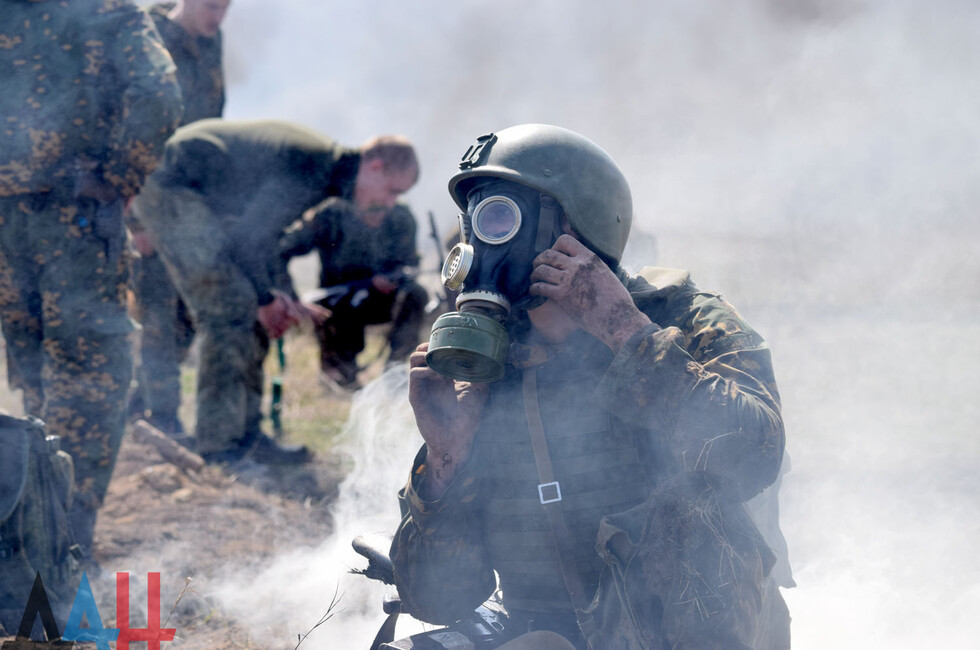
CBRN units, part of the 25th brigade, underwent intense training at the Anadol training range, thereby the possibility of the enemy using chemicals for provocations remains. Some chemicals were delivered to Avdeyevka and Krasnyi Liman in late 2021,” he said.

Ukraine received several shipments of toxic substances from the United States in autumn 2021.

Botulinum toxin causes paralysis and is deadly. Basurin said that the toxin came in metal containers that can be used in grenade launcher attacks, as well as dropped by unmanned aerial vehicles.

Earlier, Russian Defence Minister Sergei Shoigu said that the Ukrainian side was preparing a provocation using poisonous substances. It was reported that tanks with unidentified chemical components were delivered to Avdeyevka and Krasnyi Liman. *ot

https://dan-news.info/en/defence/threat-of-ukraine-using-chemical-weapon-persists—basurin/

US accelerates troop deployments as Biden threatens “world war” with Russia

From World Socialist Web Site
February 12, 2022
Alex Lantier, Johannes Stern

As Washington and its NATO allies work to militarily surround Russia, US officials yesterday declared that a US-Russia war is imminent.

US soldiers line up during the visit of NATO Secretary General Jens Stoltenberg at the Mihail Kogalniceanu airbase, near the Black Sea port city of Constanta, eastern Romania, Friday, Feb. 11, 2022 [Credit: AP Photo/Andreea Alexandru]

Yesterday, Washington announced the deployment of 3,000 troops from the 82nd Airborne Division to bases in Poland, which borders Ukraine. Britain and Germany will send hundreds of soldiers to strengthen NATO battlegroups in Estonia and Lithuania. This comes after NATO countries have for weeks delivered Javelin anti-tank missiles, Stinger anti-aircraft missiles and Turkish TB2 Bayraktar drones to the Ukrainian regime in Kiev.

The narrative NATO is peddling—that it is acting to defend Ukraine from Russia—is a pack of lies. Ukrainian President Volodymyr Zelensky has publicly declared that Russia’s military posture is not consistent with plans for an all-out invasion of Ukraine. Moreover, when reporters challenged US claims that Russia is preparing an attack, State Department spokesman Ned Price could do nothing but argue that undisclosed “intelligence information” meant his claims were true.

Nearly two decades after Washington invaded Iraq based on lies that it had “weapons of mass destruction,” US imperialism and its NATO allies are concocting a strategy to trigger a war with Russia, a nuclear-armed power, under conditions where they can blame Russia for it. Reports of mounting Ukrainian military activity in the Donbass region suggest that a NATO-backed military provocation can be staged there to trigger the war.

Yesterday, US National Security Advisor Jake Sullivan said Russia is “in a position to be able to mount a major military action” and refused to give any further details, stating: “I will not comment on the details of our intelligence information. But I do want to be clear, it could begin during the Olympics, despite a lot of speculation that it would only happen after the Olympics.” On this basis, Sullivan urged US citizens in Ukraine to “leave as soon as possible.”

Significantly, Sullivan added that the NATO alliance had concluded very detailed planning for a confrontation with Russia. He said, “We have achieved a remarkable level of unity and common purpose from the broad strategy down to the technical details. If Russia proceeds, its long-term power and influence will be diminished, not enhanced by an invasion. It will face a more determined transatlantic community.”

This followed a statement by Biden the day before calling on US citizens to leave Ukraine, adding that “things could go crazy quickly” and that a US-Russian conflict would be “world war.”

This strategy is coordinated with the European powers. Yesterday, Biden’s emergency call went to Prime Ministers Boris Johnson (UK), Justin Trudeau (Canada), and Mario Draghi (Italy); Presidents Emmanuel Macron (France), Andrzej Duda (Poland) and Klaus Iohannis (Romania), German Chancellor Olaf Scholz and EU and NATO officials. According to a White House report, they pledged “to impose massive consequences and severe economic costs on Russia, should it choose military escalation, and to continue reinforcing the defensive posture on NATO’s eastern flank.”

US officials insist war could begin next week, Der Spiegel reported, stating that “both the CIA and the US military informed the German government and other NATO states on Friday that they feared, based on new information, that the attack could take place as early as next Wednesday.”

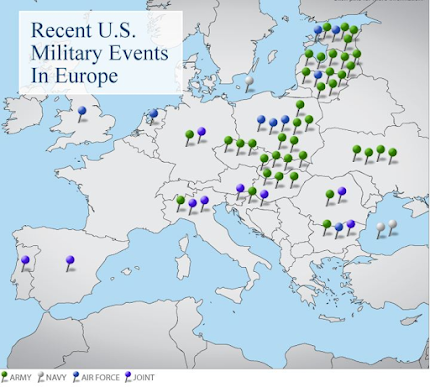
At the same time, NATO is holding several major military exercises. The “Dynamic Manta 22” anti-submarine exercise begins on February 20 in the Mediterranean, followed by the “Dynamic Guard” exercise in Norway two days later. Both transition into “Cold Response,” the largest “war game” in Norway since the 1980s, involving 35,000 troops from 28 countries.

Yesterday, at Romania’s Mihail Kogalniceanu Air Base, NATO General Secretary Jens Stoltenberg promised to reinforce Eastern Europe. About an upcoming Madrid summit, he said, “next week, NATO Defence Ministers will meet and discuss how we can further strengthen our presence in the Eastern part of the Alliance, including with new battlegroups. And I welcome France’s offer to lead a NATO battlegroup here in Romania.”

A war would be the product not of Russian aggression but of the imperialist powers’ aggressive response to the Stalinist dissolution of the Soviet Union in 1991. Over the last 30 years, Washington sought to establish its global primacy by dominating the Middle East and Central Asia. NATO waged wars, notably in Iraq, Afghanistan, Pakistan and Syria, that cost millions of lives and trillions of dollars.

Russia and, increasingly, China’s rising economic weight have become major obstacles to this strategy. In 2013, Russian warships based at Sevastopol in the Crimea confronted NATO warships that were threatening to bomb Syria, after which NATO backed down. Alongside Iran, Russia then intervened and defeated NATO-backed Islamist militias in Syria, whose government has now joined China’s “Belt and Road” global industrial infrastructure project.

In 2014, shortly after Russia helped prevent direct NATO intervention in Syria, the NATO powers backed a putsch in Kiev, where far-right militias toppled a pro-Russian Ukrainian president and set up a NATO puppet regime. As these militias backed by NATO mercenaries attacked Russian-speaking areas of Ukraine like Donbass and Crimea, these areas broke off from Ukraine, with Crimea voting to rejoin Russia. Since then, far-right Ukrainian militias have faced off against Russian troops in Crimea and Russian-backed militias in the Donbass.

NATO’s conflict with Russia has been escalating again after last year’s humiliating NATO defeat in Afghanistan. The alliance is now redeploying towards Ukraine, bidding to seize a vast swath of territory around the Black Sea, the Caucasus and the Caspian Sea. This would allow them to isolate and threaten Russia, cut off Russian military aid to the Middle East, and intervene in Central Asia up to China’s western borders. This plan is being set into motion in Ukraine.

Russian-speaking areas of Ukraine are reporting highly advanced NATO war preparations. Yesterday, Donetsk People’s Republic (DPR) leader Denis Pushilin cited Biden’s call on US citizens to leave Ukraine, warning that war was imminent. “The US President, probably, given US influence in Ukraine, has information that allows him to make such statements and take such a position. … Ukraine may attack at any moment. Ukraine has everything ready for that: the concentration of forces and means makes it possible to do it at any moment, as soon as a political decision is made.”

On February 9, the DPR Militia’s Deputy Chief Eduard Basurin said Ukrainian tanks are taking positions only 15 kilometers from theirs, near Avdeyevka, Gorlovka and Novgorodskoye. Yesterday, Basurin said Ukrainian forces also deployed an S-300 missile system.

Such deployments violate the 2015 Minsk accords, which temporarily froze the Ukraine conflict and sent the Organization for Security and Cooperation in Europe (OSCE) to monitor the front line. Basurin said, however, that Kiev regime forces are using electronic jamming to prevent OSCE observers from using drones to observe these deployments. “It seems that OSCE observers are quite content with a situation where it is impossible to record violations by Ukraine,” he said.

Significantly, DPR forces last month warned, based on their sources in Kiev, that they expect an attack to come as soon as Ukrainian armored assault brigades are assembled and in position.

On January 28, Basurin said: “According to our intelligence, the Ukrainian General Staff under the guidance of US advisers at the Ukrainian Defense Ministry is putting final touches to a plan for offensive operations in Donbas. The date of aggression against the people’s republics will be set when the attack groups have been created and the operation’s plan approved by Ukraine’s National Security and Defense Council.”

These are conditions in which NATO could goad Russia, a nuclear power, into war. Were such an attack to begin, DPR forces would likely require Russian military assistance to avoid being overrun by far-right Ukrainian militias, which call for killing Russians and have bombed Russian-speaking Ukrainian cities near Russia’s borders. If Moscow intervened against this, however, it would provide grounds for NATO war propaganda, denouncing Russian aid to the DPR as an “invasion” of Ukraine.

The decisive question more than ever is the building of an international movement in the working class against the mounting danger of a nuclear world war. It cannot be opposed based on Russian nationalist militarism, to which imperialism offers only the alternatives of total capitulation or all-out war. The broad opposition to militarism in the working class must be mobilized on an international basis, in a struggle against imperialism and for socialism.

https://www.wsws.org/en/articles/2022/02/12/ukra-f12.html
RAND Corporation study calls for ‘regime change’ in Moscow

From Global Network Against Weapons and Nuclear Power in Space
February 13, 2022

rand.org/pubs/research_briefs/RB10014.html

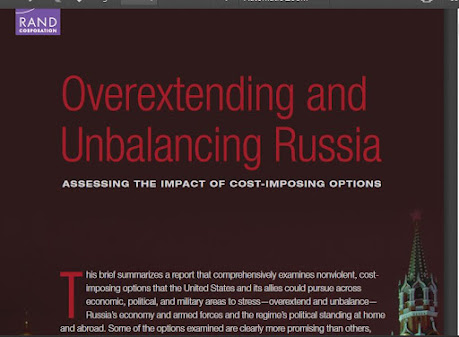
Imagine how Moscow felt when they first read this RAND Corporation study. When we look at current events can we notice the direct connection to the points from this study listed below? Whether it is US-NATO military expansion right up to Russian borders or efforts by Washington to kill the Nordstream 2 natural gas pipeline from Russia to Germany – it is clear that there is a method behind US-NATO madness. If you were sitting in Russia’s shoes how would you react to these proposals below – many of which have been or are now being implemented?

[Editor: The 12-page report also includes tables of their different proposals with “Likelihood of Success in Extending Russia”, “Benefits”, and “Costs and Risks”. The illustrations and video below were not in the report, but illustrate the implementation of proposals.]

Overextending and Unbalancing Russia – Assessing the Impact of Cost-Imposing Options, by James Dobbins, Raphael S. Cohen, Nathan Chandler, Bryan Frederick, Edward Geist, Paul DeLuca, Forrest E. Morgan, Howard J. Shatz, Brent Williams. Rand Corporation, 2019

Excerpts:

  • “Despite these vulnerabilities and anxieties, Russia remains a powerful country that still manages to be a U.S. peer competitor in a few key domains. Recognizing that some level of competition with Russia is inevitable, RAND researchers conducted a qualitative assessment of “cost-imposing options” that could unbalance and overextend Russia. Such cost-imposing options could place new burdens on Russia, ideally heavier burdens than would be imposed on the United States for pursuing those options.
  • Increasing Europe’s ability to import gas from suppliers other than Russia could economically extend Russia and buffer Europe against Russian energy coercion. Europe is slowly moving in this direction by building regasification plants for liquefied natural gas (LNG).
  • Encouraging the emigration from Russia of skilled labor and well-educated youth has few costs or risks and could help the United States and other receiving countries and hurt Russia, but any effects—both positive for receiving countries and negative for Russia—would be difficult to notice except over a very long period. This option also has a low likelihood of extending Russia.
  • Providing lethal aid to Ukraine would exploit Russia’s greatest point of external vulnerability. But any increase in U.S. military arms and advice to Ukraine would need to be carefully calibrated to increase the costs to Russia of sustaining its existing commitment without provoking a much wider conflict in which Russia, by reason of proximity, would have significant advantages.
  • Undermining Russia’s image abroad would focus on diminishing Russian standing and influence, thus undercutting regime claims of restoring Russia to its former glory.
  • Reposturing bombers within easy striking range of key Russian strategic targets has a high likelihood of success and would certainly get Moscow’s attention and raise Russian anxieties; the costs and risks of this option are low as long as the bombers are based out of range of most of Russia’s theater ballistic and ground-based cruise missiles.
  • Deploying additional tactical nuclear weapons to locations in Europe and Asia could heighten Russia’s anxiety enough to significantly increase investments in its air defenses.
  • There are also ways to get Russia to extend itself in strategic competition. In terms of benefits, such developments would exploit Moscow’s demonstrated fear of U.S. airpower capabilities and doctrines. Developing new low-observable, long-range bombers, or simply adding significantly more of types that are already available or programmed (B-2s and B-21s) would be worrisome for Moscow, as would developing autonomous or remotely piloted strike aircraft and producing them in high numbers.
  • Increasing U.S. and allied naval force posture and presence in Russia’s operating areas could force Russia to increase its naval investments, diverting investments from potentially more dangerous areas. 
  • Increasing naval R&D efforts would focus on developing new weapons that allow U.S. submarines to threaten a broader set of targets or enhance their ability to threaten Russian nuclear ballistic missile submarines (SSBNs), which could impose anti-submarine warfare costs on Russia.
  • Checking the Black Sea buildup would involve deploying strengthened North Atlantic Treaty Organization (NATO) anti-access and area denial over the Black Sea—perhaps in the form of long-range, land-based anti-ship missiles—to drive up the cost of defending Russian bases in Crimea and lower the benefit to Russia of having seized this area.
  • A general increase in NATO ground force capabilities in Europe—including closing European NATO member readiness gaps and increasing the number of U.S. forces stationed in traditional locations in Western Europe—would have limited risks.
  • Incremental investments in new technologies to counter Russian air defenses and increase U.S. long-range fires could significantly improve defense and deterrence while compelling increased Russian investment in countermeasures.  

VIDEO: youtu.be/nxeZFS9hTUg “On the road: Ambassador Pyatt”
Obama’s ambassador to Ukraine made a trip to US-NATO training base in western Ukraine (where the Nazis predominate). US Special Forces are rotated into the base from Ft. Carson, Colorado to train the Kiev regime’s Army. Many of the Nazis have been brought into this ‘new military unit’. More than 27 million people in the former Soviet Union died during Hitler’s WW II invasion. Imagine how Russians today feel when they see the US arming, training and directing Nazi forces to attack the Russian-ethnic citizens living in the Donbass region of Ukraine, right next to the Russian border.

  • Even if the Army were not directly involved in extending Russia per se, it would play a key role in mitigating the possible blowback. All the options to extend Russia incur some risk. As a result, enhancing U.S. deterrence posture in Europe and increasing U.S. military capabilities (e.g., an enhanced Javelin or active protection systems for Army vehicles) might need to go hand in hand with any move to extend Russia, as a way of hedging against the chance of tensions with Russia escalating into conflict.
  • The most-promising options to “extend Russia” are those that directly address its vulnerabilities, anxieties, and strengths, exploiting areas of weakness while undermining Russia’s current advantages. In that regard, Russia’s greatest vulnerability, in any competition with the United States, is its economy, which is comparatively small and highly dependent on energy exports.
  • Most of the options discussed, including those listed here, are in some sense escalatory, and most would likely prompt some Russian counterescalation. Thus, besides the specific risks associated with each option, there is additional risk attached to a generally intensified competition with a nuclear-armed adversary to consider. This means that every option must be deliberately planned and carefully calibrated to achieve the desired effect. Finally, although Russia will bear the cost of this increased competition less easily than the United States will, both sides will have to divert national resources from other purposes.”

http://space4peace.blogspot.com/2022/02/rand-corporation-study-calls-for-regime.html

President Putin urges dialogue and peace as Western media and leaders ignore dangerous reality they are creating (VIDEO)

Comment from Global Network against Weapons and Nuclear Power in Space

Let’s be honest here….

What most people in the west know about Vladimir Putin and Russia they learned from the corporate media over the last 25 years. 

The same media that pushed ‘shock and awe’ in Iraq in 2003.

Time to find out for yourself before we all crash and burn.

http://space4peace.blogspot.com/2022/02/tell-me-who-are-real-warmongers.html

Russian Federation remarks on 60th anniversary of US embargo against Cuba

Briefing by Foreign Ministry Spokeswoman Maria Zakharova, Moscow, February 9, 2022

The 60th anniversary of the US economic, commercial and financial embargo against Cuba

February 3 marks the 60th anniversary of the odious phenomenon in modern history, which, unfortunately, has only worsened in recent years, namely, the US economic, commercial and financial blockade of Cuba. If previously it was only against Cuba, today sanctions, restrictions and unilateral measures are being imposed by the United States and its “partners and satellites” across the board on multiple countries. Today, I would like to discuss Cuba, which has been living under embargo for 60 years now. A great global power, one of the pillars of the world order, has thus settled accounts with a small country for it wanting to free itself from the colonial grip of its northern neighbour and embark on a path of independent development. Revenge. Exactly the same thing that we are now seeing with regard to Crimea residents who have made their choice. Our country did not turn them away and respectfully accepted their choice. And now they are retaliating with sanctions. There’s nothing new about it.

The entire international community believes that Washington’s anti-Cuban policy is inhumane and illegal. Just think of it: 60 years of sanctions. Then look at the map and compare the size of the United States and that of the island of Cuba. There were the UN General Assembly resolutions, the calls by international public organisations, business circles, and just people with common sense. There were numerous business calculations about self-inflicted damage. At some point there were even hints at common sense prevailing and, on the face of it, nothing seemed to stand in the way of finally embarking on the path of realism. But no such thing. With enviable tenacity worthy of a better cause (not in the sense that sanctions should be imposed on other geographical locations, but in the sense that developing and implementing them in circumvention of the UN Security Council is illegal), throughout decades, almost all US administrations, with an exception only during the “Obama thaw,” stick to the same discriminatory policy with the ever-exacerbating consequences. They are doing so contrary to common sense, in an unscrupulous and hypocritical manner, under the banner of protecting democracy and human rights, and subjugating their every move to domestic political bias and the fleeting and self-serving interests of their “political hawks.”

At the same time, no one in the United States seems to care about the fact that this policy impacts not the Cuban leadership, but ordinary Cubans. It strangles the life-supporting sectors of the economy, creates social problems and deprives these people of those very human rights that the American guardians of global democracy are so worried about in words only. Most interestingly, the economic performance is cited as proof of the inefficiency of the Cuban system. Listen, for 60 years now Cuba has not only survived, but lived and moved forward amid your sanctions. I often wonder what would become of the United States if similar sanctions were imposed on it for at least a year, or even a couple of months. That would be fun to watch. They would not just forget about democracy, there would simply be nothing left of the United States if at least a tenth of these restrictions had been imposed. Then, we would observe the competition of the systems. Washington is unlikely to run the risk of holding this experiment, isn’t it? You know, things like hidden resentment, revenge, delayed decision-making or retribution happen in history. Still, common sense must prevail in humanitarian situations, such as the pandemic. That is exactly what the world has been living through for the third year now.

Notably, many Cubans who live in the United States and other countries of that region have relatives in Cuba who are impacted by the embargo imposed amid the pandemic rather than the theoretical sanctions. However, no one in the United States seems to be worried about that. They are a different kind of “human rights” and do not need to be taken care of. So, instead of uniting efforts in the face of a common challenge and creating some kind of synergy and green corridors, the US authorities did everything the other way round: they tightened the screws by imposing more sanctions on the pharmaceutical industry in Cuba, that very Cuba that helps everyone in the region deal with the impact of the pandemic, and is the first to respond not even to requests, but to developments in neighbouring and outlying countries in connection with emergencies, man-made disasters, etc. Cuban doctors are always among the first responders. Sanctions were imposed on them, and an absurd campaign was unleashed to discredit the assistance that the Cuban health workers are providing to other countries. They even went as far as to call it “human trafficking.” However, in case the United States is unaware of what human trafficking is, we can tell them. It has nothing to do with Cuba whatsoever, and it’s just a flat-out offence.

Cuba is showing amazing fortitude and courage. It is decisively moving forward along a path of independence as it overcomes hardships and difficulties. It is reforming the economy, optimising production and management systems, and improving the efficiency of state regulation. It is promoting fundamental and applied research and development and attaining world-class achievements in medicine and pharmacology. At the same time, it remains politically active in the international arena, upholding its interests and finding ways to help others, as I have already mentioned, remaining a symbol of the struggle against the remnants of the post-colonial world order, and Cuba simply stands for freedom and independence with all its heart and soul.

This 60 year-old history of the anti-Cuban embargo is the history of the Cuban people’s selfless feat, a vibrant expression of national identity, pride and dignity, which have been honourably carried through generations. We pay tribute to the great fortitude of our Cuban friends. We wish them strength, patience, success, good health and we hope that they find a way to overcome the challenges that life has posed to all of us.

Your cause is just, hence the conclusion: you will come out a winner. In this regard, I would like to remind the audience about what Fidel Castro once said, “We must firmly fight against the blockade, since the blockade is the main obstacle to our progress and is more than a ban on trade with Cuba, but also a symbol of pressure that the United States is exerting on the world at large.”

https://www.mid.ru/en/press_service/spokesman/briefings/1797611/

Remember 2003’s ‘weapons of mass destruction’ fraud?

From Global Network Against Weapons & Nuclear Power in Space.

Remember this time?
February 14
By Bruce Gagnon

Yes, remember

2003

shock and awe

WMD in Iraq

the mushroom cloud

the smoking gun

bio-logical weapons

Turned out to be all lies

Media,

White House,

Congress

hand-in-hand

pushed the war

No WMD ever

found in Iraq

Today same MO,

every criminal

has one

Modus Operandi,

a way of

repeating the same

bad behavior

In this case 

we can call it

western,

US-UK-NATO,

insanity,

pure depravity, 

pure evil

Virtually no one

in the Congress

mouthing

a mumbling word,

the Dems have gone

warmongering….

An election coming

soon you know,

can’t make any waves

in Washington,

can’t piss off

the MIC either

Democracy

is dead.

The wedding

of Mr. Big

and government

is complete.

Friendly Fascism 

it’s called,

three-piece suit,

Wall Street

variety.

But the liberals

don’t want to 

hear it,

got to support Biden 

and hold onto the

Senate and House.

Forget about 

holding onto 

democracy,

it’s already

drifting away

with the rising 

Atlantic waters.

http://space4peace.blogspot.com/2022/02/remember-this-time.html

February 10, 2022 report: worsening situation in Ukraine; Ukrainian authorities refuse to comply with Minsk-2 agreements

Russian Federation Permanent Representative A.K. LUKASHEVICH to OSCE Permanent Council
February 10, 2022

On the deteriorating situation in Ukraine

and continued non-compliance

Ukrainian authorities of the Minsk agreements

Dear Madam President,

In recent days, we have seen a certain change in rhetoric in those countries where until recently the world was threatened with the threat of an “imminent attack” on Ukraine. Some media, such as the Bloomberg agency, managed to release fake news about the “invasion” that had already begun in the information field last Friday. Then removed. Adjusted the tone and US officials. The other day, the head of European diplomacy, J. Borrell, also said that he did not believe in a “Russian invasion” of Ukraine.

Let’s remember the zeal with which, not so long ago, representatives of a number of Western countries sought to convince everyone of the opposite. Even in this room. The terms were named: in November, in December, in January and so on. As the facts show, all these “horror stories” turned out to be nothing more than propaganda “zilch”, empty chatter.

Now let’s turn to the real situation in Ukraine. A protracted armed civil conflict continues in the country, caused and fueled by the aggressive and unceremonious interference of the West in the development of the Ukrainian state and society. In February, Ukraine will mark the eighth anniversary of the bloody 2014 armed coup d’état organized with foreign support. The coup that raised the most radical nationalist parties and movements to the firmament of Ukrainian politics, which began to aggressively impose ideas of militant nationalism and Russophobia alien to the majority of the population – all this under the guise of alleged patriotism. The uncontrolled circulation of weapons among nationalists and neo-Nazis, their desire to impose their own rules throughout the country led to a logical result: many Ukrainians opposed the artificial division of society and against the self-proclaimed authorities, who acted in conjunction with the nationalists. At that time, in the south-east of Ukraine, people began to organize themselves into people’s squads to protect their homes and a peaceful way of life from the encroachments of nationalists.

The refusal of the “Maidan” authorities from a civilized and respectful dialogue with the inhabitants of their own country led to an armed confrontation. A military operation was launched to suppress dissent. Even after signing the Minsk agreements under international control, the then leadership of Ukraine continued military planning for a “direct dialogue with the Donbass.” Dialogue with the help of artillery and mortars – in the form of shelling, casualties, destruction.

In choosing such tactics, the Ukrainian authorities were and are not independent. The notorious “external management” under which the country has fallen in recent years, saying goodbye to the remnants of state sovereignty, leaves its mark. There is no doubt that without the destructive impact from abroad, Ukrainians would be much faster able to find a common language and achieve peace among themselves. On both sides of the line of contact, relatives and friends of each other live who have fallen into the “millstones” of new political watersheds artificially imposed on the country – dividing lines introduced by geopolitical strategists from the West and other demagogues who generously distributed cookies and no less sweet ones on the “Maidan”, but empty promises.

In the midst of armed civil confrontation, instead of promoting an inclusive national dialogue for peace based on the Minsk “Package of Measures”, foreign patrons of the post-Maidan authorities decided to invest in the militarization of Ukraine. They began to send there not political signals about the need to fulfill “Minsk”, but military appropriations, equipment and weapons, shells and cartridges, with which some citizens of Ukraine continue to kill other citizens of Ukraine to this day. In a word, they began to push “hot heads” in every way to a military solution to the “Donbass problem” in the conditions of sabotage of the Minsk agreements.

Take a look at the numbers from the beginning of this year alone: ​​at least twelve aircraft each from the US and the UK, two from Canada and one from Poland arrived in Ukraine, all carrying weapons and other military supplies. The United States alone sent about 700 tons of cargo. Immediately upon the arrival of these cargoes, the United States and Great Britain, using their so-called. “instructors” began training the Ukrainian military on the combat use of the delivered missile systems, grenade launchers and other weapons in urban areas. Specific plans to send at least 100 additional troops from the British Special Forces and 200 people from the Canadian Special Operations Forces have long been no secret. If the authorities in Kiev claim that they are not preparing offensive actions or armed provocations, what is all this for? By the way, Since the beginning of the year, the SMM has already counted over 8,000 ceasefire violations in Donbas. Will there be fewer of them after such military preparations?

Eight years later, the problems in Ukraine are the same as in 2014. Radical nationalists from illegal armed groups have not been disarmed. For example, the same “Right Sector”. They continue their attempts – with the support of the current authorities – to restore their order in the east of Ukraine with “fire and sword”. Their plans do not include the observance of the ceasefire or the implementation of the Minsk agreements. The authorities, in turn, cannot or do not want to do anything about this, acting, in fact, at the same time with them.

Let us recall how, in November 2019, representatives of the nationalist battalions did not allow President V. Zelensky to disengage forces and hardware in Zolote, they did not want to leave this disengagement area with weapons. Under their pressure and at the American “prompt”, V. Zelensky at the “Norman” summit in Paris on December 9, 2019 refused to approve the plan already agreed by experts and adopted by Donetsk and Lugansk on the disengagement of forces and hardware along the entire line of contact. Having agreed in the minutes of the meeting of the Contact Group on March 11, 2020, to have a direct dialogue with the authorized representatives of certain areas of Donbass, Kiev then actually disavowed the signature under the agreements on the establishment of the Consultative Council.

It is also not surprising that the meetings of the Contact Group and its working subgroups held on February 8-9 again ended without results. They reaffirmed that Kiev does not intend to conduct a direct dialogue with Donetsk and Luhansk. On February 3, Minister of Foreign Affairs of Ukraine D. Kuleba said on the air of one of the Ukrainian TV channels that the Minsk agreements “cannot be implemented on Russian terms, which are based on a direct dialogue between Ukraine and ORDLO, which is being imposed on us.” A day earlier, he said that Donbass would not receive any special status. With these instructions, as he stressed, the representative of Ukraine will also go to today’s meeting of foreign policy advisers to the leaders of the Normandy Four in Berlin. Should we expect progress on it?

It is worth emphasizing that the need to implement the provisions of “Minsk” in consultations and in agreement with representatives of certain areas of Donbass is not some kind of “Russian conditions”, but a direct prescription of the Minsk “Package of Measures”. Once again, we draw attention to the statement of the Secretary of the National Security and Defense Council of Ukraine A. Danilov in an interview with The Associated Press: he directly said that Kiev did not intend and is not going to implement the Minsk agreements, since their implementation “would mean the destruction of the country” .

Thus, the Ukrainian authorities, without encountering any criticism from foreign patrons, are trying to send a false signal to the Ukrainian society that the Minsk agreements are destructive in their essence, and their implementation will mean almost “surrender”.

Against this background, it is worth paying attention to what militant Ukrainian national radicals are saying today. Listen to the words of E. Karas, the leader of the infamous C14 movement – on February 5 in Kiev, at the nationalist forum Bandera Readings, he said: “We have now been given so many weapons, not because we are good, but because we are the only who is ready to carry out the tasks of the West. Because we have fun, it’s fun for us to kill and it’s fun to fight. Arguments about how “fun and cool” it is to fight with one’s own people do not find any proper legal assessment by the law enforcement agencies of Ukraine, neither politically by the country’s leadership, nor internationally, for example, within the framework of the OSCE.

New paramilitary nationalist groups continue to emerge, with the creation of a so-called “closed guerrilla network” called Honor of the Nation earlier this year, which now has about a thousand members. On February 6, under the instruction of the nationalists from the Aidar battalion, who had been in the Donbass, the members of this association, with weapons in their hands, conducted combat training exercises.

Mr Chairman,

These days, the OSCE Chairman-in-Office, Polish Foreign Minister Z. Rau is visiting Ukraine, he will also visit the areas of Donbass controlled by Kiev. We regret that Z. Rau did not respond to the invitation of the representatives of Donetsk and Luhansk in the Contact Group and did not find an opportunity to get acquainted with the real state of affairs on the other side of the line of contact.

Once again, we call on the foreign curators of the current Kiev regime to refrain from fostering the ideas of aggressive nationalism in Ukraine, to stop the destabilizing militarization of this country. It should be understood that the full implementation of the Minsk “Package of Measures” of February 12, 2015, approved by UN Security Council Resolution 2202, is the only way to peacefully, politically and diplomatically resolve the conflict. The implementation of the provisions of “Minsk” in their entirety, consistency and interconnection will not be a “surrender”, but a tool for ending the armed confrontation in the east of Ukraine, achieving sustainable peace and national reconciliation, as well as restoring territorial integrity.

In particular, we remind those member states of the UN Security Council that, on February 17, 2015, joined the unanimous support of the “Package of Measures”, which implies a direct dialogue between Kiev and Donetsk and Lugansk.

Thank you for attention

https://osce.mid.ru/ru_RU/-/a-k-lukasevic-ob-uhudsausejsa-situacii-na-ukraine-i-prodolzausemsa-nevypolnenii-ukrainskimi-vlastami-minskih-dogovorennostej-10-fevrala-2022-goda?inheritRedirect=true&redirect=%2Fru_RU%2Fweb%2Fosce

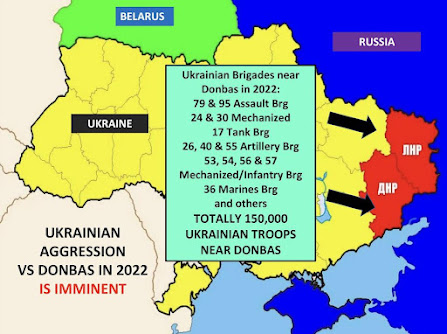
January 27, 2022: Deteriorating situation in Ukraine, foreign weapon shipments arriving, Kiev sent 150,000 soldiers to Donbass — Russian OSCE representative

OSCE – Organization for Security and Co-operation in Europe

A lasting and sustainable peace is possible only on the basis of the exhaustive and conscientious implementation by the parties to the conflict – Kiev, Donetsk and Luhansk – of all the provisions of the “Package of Measures” in their entirety, consistency and interconnection.

Presentation of Russian Federation Representative A.K. Lukashevich to OSCE Permanent Council
January 27, 2022

On the deteriorating situation in Ukraine and the continued failure of the Ukrainian authorities to comply with the Minsk agreements

Dear Mr Chairman,

Foreign curators of today’s Ukraine have intensified their attempts to destabilize the situation inside this country and push the Kiev regime to rash and disastrous military decisions. This becomes absolutely obvious against the background of two trends.

First. Kiev is deliberately not sent any incentives in order to implement the key provision of the Minsk agreements by the Ukrainian authorities, namely, the implementation of a direct dialogue with representatives of certain areas of Donbass on ways to politically resolve the intra-Ukrainian crisis. Simply put, they encourage further sabotage of the implementation of the “Package of Measures”. The price of such sabotage is the pain of irreparable human losses, crippled destinies and new destruction in the Donbass.

Second. Some NATO countries have sharply stepped up the “pumping” of Ukraine with offensive weapons for allegedly “defensive” purposes. Over the past week, at least four planes have arrived in Kyiv carrying US military supplies, including lethal weapons and ammunition for use in the Donbass. Earlier, shuttle British military transport aviation “registered” on the route between Kiev and the British Isles.

According to reports, hundreds of American Javelins, thousands of British missile systems, over 400,000 rounds of ammunition, including for large-caliber weapons, and much more arrived in Ukraine in January alone. There are reports that American-made weapons from the Baltic republics, howitzers from the Czech Republic, millions of rounds of ammunition from Slovakia, more than a dozen Turkish Bayraktar attack drones and so on are scheduled to be transferred in February. So, this is what support for a peaceful politico-diplomatic settlement of the crisis in Ukraine on the basis of the Minsk agreements looks like?

According to US Secretary of State E. Blinken, his country “will supply even more weapons in the near future.” Last year, the United States gave Ukraine at least $650 million in “aid” in military appropriations, many of which were used to purchase weapons that could be used offensively. In total, since 2014, the United States has “pumped up” Ukraine with such “military aid” in the amount of about $2.7 billion.

All these actions are accompanied by disinformation, or, to put it simply, fakes like the British Foreign Office created and disseminated on January 23 some plan attributed to Russia to “establish a pro-Russian regime in Ukraine.” Apparently, London could not decide which of the two myths promoted there is more attractive – about the “imminent Russian invasion of Ukraine” or about the “establishment of a pro-Russian regime”, which, obviously, does not imply any “invasion”. A number of countries hastened to make statements about the evacuation of family members of diplomats from their embassies from the territory of Ukraine. All this is obviously intended to make people believe in the most negative scenarios and sow panic.

One thing is clear: all these insinuations are an attempt to divert attention from Kiev’s failure to comply with the Minsk agreements and the actual bankruptcy of the authorities in domestic, primarily socio-economic policy.

By the way, today’s Ukraine, which has experienced almost eight years of external control, is increasingly reminiscent of a serious patient on an “artificial lung ventilation” machine. Its economy cannot survive without manual loans, called “financial support.” So, on January 24, it was announced that the European Union would allocate another package in the amount of 1.2 billion euros. Or, for example, Canada’s decision two days earlier to issue a loan of $120 million. There are many examples of the provision of urgent loans for “patching holes” in the Ukrainian economy, we will not remember them all.

Remarkable moment. “Horror stories about the invasion”, sounding primarily from the United States, are not shared even in the leadership of Ukraine, urging them not to sow panic. Over the past week, President V. Zelensky, Secretary of the National Security and Defense Council A. Danilov, Minister of Defense A. Reznikov, official representative of the Ukrainian Foreign Ministry O. Nikolenko, head of the faction of the ruling party in parliament D. Arakhamia and others spoke on this subject. A. Danilov back in November of last year called such rumors “deliberate disinformation” within the framework of “information-psychological special operations”, and the other day he asked journalists to “slow down the heat”. Not to mention their concern about the worsening macroeconomic situation in the country and the investment climate as a result of military hysteria from the West.

Despite all this, in the United States, both from the lips of officials and representatives, and through the state-controlled media, they continue to call the statements of representatives of the Ukrainian authorities “contradictory”, assuring that they see “all signs of preparations for hostilities” in the coming weeks. It is no coincidence that recently a number of Ukrainian parliamentarians demanded an assessment of the actions of an employee of the US Embassy in Ukraine, E. Kravtsiv, in whose actions they saw “war propaganda”. As E. Kravtsiv herself previously reported, she, along with other employees of the American embassy, ​​intends to explain to Ukrainians “the inevitability of war with Russia” and distribute some manuals.

At the same time, it is no less remarkable that, while talking about the absence of an imaginary threat of “invasion” from abroad, the military-political leadership of Ukraine continues to build up a military group not just anywhere, but along the line of contact in Donbass. About 150,000 servicemen are already near it. Recently, the Minister of Defense of Ukraine A. Reznikov announced an increase in the number of the Armed Forces of Ukraine by another 11,000 people. Arrive in the Donbass and representatives of paramilitary nationalist formations. Including the “Right Sector”, which was never disarmed in accordance with clause 10 of the Minsk “Package of Measures”. All this testifies to the active study in Kiev of plans for the preparation of armed provocations in the Donbass.

We are concerned about the presence of foreigners near the contact line – professional military personnel under the guise of “instructors”, as well as employees of private military companies, mercenaries and other persons. We paid attention to the Sky News material released on January 25, which showed footage of the stay in the area of ​​the settlement. Pavlopol, Donetsk region, armed “contract soldiers” J. Wood and S. Pinner, who arrived in Ukraine from Great Britain.

Under these conditions, a special role falls on the OSCE Special Monitoring Mission in Ukraine, its capabilities in the framework of early warning of a dangerous escalation. It is necessary to carefully monitor the supply and movement of military equipment and weapons, establish cases of their placement in violation of the withdrawal lines, track the facts of their use, and timely record the destruction of civilian objects as a result of shelling. Strong efforts must be made, primarily for humanitarian purposes, to restore communication between representatives of the parties to the conflict and restart the mechanism for providing security guarantees, curtailed as a result of offensive actions by the Ukrainian military last autumn. All this, of course, without prejudice to the monitoring of the SMM in the rest of the country within the framework of mandated tasks.

On January 26, a video meeting of the Contact Group was held. On the same day, foreign policy advisers to the leaders of the Normandy Four countries held a contact in Paris. Diplomatic efforts were aimed at giving impetus to the implementation of the Minsk agreements. We regret that on both tracks this time again it was not possible to achieve practical results. Kiev continues its undisguised sabotage of the Minsk settlement process – first of all, by not providing any answers to the numerous proposals of Donetsk and Luhansk on the implementation of the “Package of Measures” of February 12, 2015, approved by UN Security Council Resolution 2202. In addition, Ukraine’s line of marginalization of the Contact Group, attempts to address issues within its competence to the “Normandy format” are obvious.

As has been repeatedly noted, Kiev’s key commitment under the Minsk Package of Measures is a direct dialogue with the representatives of Donetsk and Luhansk on all aspects of the settlement, including the special status of Donbass. Nevertheless, going to the meeting in the Normandy format, the head of the Office of the President of Ukraine Oleksandr Yermak defiantly announced that Kiev did not intend to fulfill the specific requirements of the Minsk agreements and specific Normandy agreements. Describing the events of recent days, he assessed them as “raising the stakes in order to persuade Ukraine to an amnesty and the F.-W. Steinmeier formula.” And then he added: “This will not happen.” Do I need to remind you that the amnesty is provided for in clause 5 of the “Complex of Measures”, and “the formula of F.-V. -Steinmeier” should be integrated into Ukrainian legislation in accordance with the final documents of the summit of the leaders of the “Normandy Four” on December 9, 2019? The above-mentioned actions of representatives of Ukraine are spinning the situation in a very dangerous spiral, fraught with a new flare-up of an armed conflict.

A few words about the work of the Normandy format. Undoubtedly, he can and must play a constructive role in promoting a settlement. However, this format will be effective only when there is an agreed understanding and interpretation of the Minsk agreements among its participants. Without eliminating the current discrepancies regarding the perception of the Minsk agreements, the Normandy format will not be able to send constructive signals to the Contact Group, which is the main work on the implementation of the Minsk Package of Measures.

Under these conditions, we call on the external curators of the authorities in Kiev to stop the destabilizing militarization of Ukraine and provide all possible assistance to the political and diplomatic way out of the crisis in this country. A lasting and sustainable peace is possible only on the basis of the exhaustive and conscientious implementation by the parties to the conflict – Kiev, Donetsk and Luhansk – of all the provisions of the “Package of Measures” in their entirety, consistency and interconnection.

https://osce.mid.ru/ru_RU/-/a-k-lukasevic-ob-uhudsausejsa-situacii-na-ukraine-i-prodolzausemsa-nevypolnenii-ukrainskimi-vlastami-minskih-dogovorennostej-27-anvara-2022-goda?inheritRedirect=true&redirect=%2Fru_RU%2Fweb%2Fosce

International Law: Minsk-2 Package of Measures, signed February 12, 2015; adopted by UN Security Council, February 17, 2015

From United Nations Security Council

Resolution 2202 (2015)
Adopted by the Security Council at its 7384th meeting, on 17 February 2015
Annex 1

Package of Measures for the Implementation of the Minsk Agreements

Minsk, 12 February 2015

1. Immediate and comprehensive ceasefire in certain areas of the Donetsk and Luhansk regions of Ukraine and its strict implementation as of 15 February 2015, 12 a.m. local time.

2. Withdrawal of all heavy weapons by both sides by equal distances in order to create a security zone of at least 50 km wide from each other for the artillery systems of calibre of 100 and more, a security zone of 70 km wide for MLRS and 140 km wide for MLRS “Tornado-S”, Uragan, Smerch and Tactical Missile Systems (Tochka, Tochka U):

– for the Ukrainian troops: from the de facto line of contact;

– for the armed formations from certain areas of the Donetsk and Luhansk regions of Ukraine: from the line of contact according to the Minsk Memorandum of Sept. 19th, 2014;

The withdrawal of the heavy weapons as specified above is to start on day 2 of the ceasefire at the latest and be completed within 14 days. The process shall be facilitated by the OSCE and supported by the Trilateral Contact Group.

3. Ensure effective monitoring and verification of the ceasefire regime and the withdrawal of heavy weapons by the OSCE from day 1 of the withdrawal, using all technical equipment necessary, including satellites, drones, radar equipment, etc.

4. Launch a dialogue, on day 1 of the withdrawal, on modalities of local elections in accordance with Ukrainian legislation and the Law of Ukraine “On interim local self-government order in certain areas of the Donetsk and Luhansk regions” as well as on the future regime of these areas based on this law. Adopt promptly, by no later than 30 days after the date of signing of this document a Resolution of the Parliament of Ukraine specifying the area enjoying a special regime, under the Law of Ukraine “On interim self-government order in certain areas of the Donetsk and Luhansk regions”, based on the line of the Minsk Memorandum of September 19, 2014.

5. Ensure pardon and amnesty by enacting the law prohibiting the prosecution and punishment of persons in connection with the events that took place in certain areas of the Donetsk and Luhansk regions of Ukraine.

6. Ensure release and exchange of all hostages and unlawfully detained persons, based on the principle “all for all”. This process is to be finished on the day 5 after the withdrawal at the latest.

7. Ensure safe access, delivery, storage, and distribution of humanitarian assistance to those in need, on the basis of an international mechanism.

8. Definition of modalities of full resumption of socioeconomic ties, including social transfers such as pension payments and other payments (incomes and revenues, timely payments of all utility bills, reinstating taxation within the legal framework of Ukraine). To this end, Ukraine shall reinstate control of the segment of its banking system in the conflict-affected areas and possibly an international mechanism to facilitate such transfers shall be established.

9. Reinstatement of full control of the state border by the government of Ukraine throughout the conflict area, starting on day 1 after the local elections and ending after the comprehensive political settlement (local elections in certain areas of the Donetsk and Luhansk regions on the basis of the Law of Ukraine and constitutional reform) to be finalized by the end of 2015, provided that paragraph 11 has been implemented in consultation with and upon agreement by representatives of certain areas of the Donetsk and Luhansk regions in the framework of the Trilateral Contact Group.

10. Withdrawal of all foreign armed formations, military equipment, as well as mercenaries from the territory of Ukraine under monitoring of the OSCE. Disarmament of all illegal groups.

11. Carrying out constitutional reform in Ukraine with a new constitution entering into force by the end of 2015 providing for decentralization as a key element (including a reference to the specificities of certain areas in the Donetsk and Luhansk regions, agreed with the representatives of these areas), as well as adopting permanent legislation on the special status of certain areas of the Donetsk and Luhansk regions in line with measures as set out in the footnote until the end of 2015. [Note]

12. Based on the Law of Ukraine “On interim local self-government order in certain areas of the Donetsk and Luhansk regions”, questions related to local elections will be discussed and agreed upon with representatives of certain areas of the Donetsk and Luhansk regions in the framework of the Trilateral Contact Group. Elections will be held in accordance with relevant OSCE standards and monitored by OSCE/ODIHR.

13. Intensify the work of the Trilateral Contact Group including through the establishment of working groups on the implementation of relevant aspects of the Minsk agreements. They will reflect the composition of the Trilateral Contact Group.

Note

Such measures are, according to the Law on the special order for local selfgovernment in certain areas of the Donetsk and Luhansk regions:

– Exemption from punishment, prosecution and discrimination for persons involved in the events that have taken place in certain areas of the Donetsk and Luhansk regions;

– Right to linguistic self-determination;

– Participation of organs of local self-government in the appointment of heads of public prosecution offices and courts in certain areas of the Donetsk and Luhansk regions;

– Possibility for central governmental authorities to initiate agreements with organs of local self-government regarding the economic, social and cultural development of certain areas of the Donetsk and Luhansk regions;

– State supports the social and economic development of certain areas of the Donetsk and Luhansk regions;

– Support by central government authorities of cross-border cooperation in certain areas of the Donetsk and Luhansk regions with districts of the Russian Federation;

– Creation of the people’s police units by decision of local councils for the maintenance of public order in certain areas of the Donetsk and Luhansk regions;

– The powers of deputies of local councils and officials, elected at early elections, appointed by the Verkhovna Rada of Ukraine by this law, cannot be early terminated.

Participants of the Trilateral Contact Group:

Ambassador Heidi Tagliavini

Second President of Ukraine, L. D. Kuchma

Ambassador of the Russian Federation to Ukraine, M. Yu. Zurabov

A.W. Zakharchenko

I.W. Plotnitski

Source:
securitycouncilreport.org/atf/cf/%7B65BFCF9B-6D27-4E9C-8CD3-CF6E4FF96FF9%7D/s_res_2202.pdf