The threat of nuclear war: North Korea or the United States?

Global Research, February 08, 2016
RT Op-Edge 23 July 2013

This article was first published in July 2013. North Korea is not a threat to global security. The threat of nuclear war largely emanates from the US under the doctrine of pre-emptive nuclear (self-defense) against both nuclear and non-nuclear states.

While the Western media portrays North Korea’s nuclear weapons program as a threat to Global Security, it fails to acknowledge that the US has being threatening North Korea with a nuclear attack for more than half a century.

On July 27, 2013, Armistice Day, Koreans in the North and the South will be commemorating the end of the Korean war (1950-53). Unknown to the broader public, the US had envisaged the use of nuclear weapons against North Korea at the very outset of the Korean War in 1950. In the immediate wake of the war, the US deployed nuclear weapons in South Korea for use on a pre-emptive basis against the Democratic People’s Republic of Korea (DPRK) in violation of the July 1953 Armistice Agreement. 

Michel Chossudovsky’s keynote address at the 60th anniversary commemoration of the end of the Korean war, Seoul, South Korea, July 26, 2013 

“The Hiroshima Doctrine” applied to North Korea

US nuclear doctrine pertaining to Korea was established following the bombings of Hiroshima and Nagasaki in August 1945, which were largely directed against civilians.

The strategic objective of a nuclear attack under the “Hiroshima doctrine” was to trigger a “massive casualty producing event” resulting in tens of thousands of deaths. The objective was to terrorize an entire nation, as a means of military conquest. Military targets were not the main objective: the notion of “collateral damage” was used as a justification for the mass killing of civilians, under the official pretence that Hiroshima was “a military base” and that civilians were not the target.

In the words of President Harry Truman:

“We have discovered the most terrible bomb in the history of the world. … This weapon is to be used against Japan … [We] will use it so that military objectives and soldiers and sailors are the target and not women and children. Even if the Japs are savages, ruthless, merciless and fanatic, we as the leader of the world for the common welfare cannot drop that terrible bomb on the old capital or the new. …  The target will be a purely military one… It seems to be the most terrible thing ever discovered, but it can be made the most useful.” (President Harry S. Truman, Diary, July 25, 1945)

“The World will note that the first atomic bomb was dropped on Hiroshima a military base. That was because we wished in this first attack to avoid, insofar as possible, the killing of civilians..” (President Harry S. Truman in a radio speech to the Nation, August 9, 1945).

[Note: the first atomic bomb was dropped on Hiroshima on August 6, 1945; the Second on Nagasaki, on August 9, on the same day as Truman’s radio speech to the Nation]

Nobody within the upper echelons of the US government and military believed that Hiroshima was a military base, Truman was lying to himself and to the American public. To this day the use of nuclear weapons against Japan is justified as a necessary cost for bringing the war to an end and ultimately “saving lives”.

US Nuclear Weapons Stockpiled and Deployed in South Korea

Barely a few years after the end of the Korean War, the US initiated its deployment of nuclear warheads in South Korea. This deployment in Uijongbu and Anyang-Ni had been envisaged as early as 1956.

It is worth noting that the US decision to bring nuclear warheads to South Korea was in blatant violation of  Paragraph 13(d) of the Armistice Agreement which prohibited the warring factions from introducing new weapons into Korea.

The actual deployment of nuclear warheads started in January 1958, four and a half years after the end of the Korean War, “with the introduction of five nuclear weapon systems: the Honest John surface-to-surface missile, the Matador cruise missile, the Atomic-Demolition Munition (ADM) nuclear landmine, and the 280-mm gun and 8-inch (203mm) howitzer.” (See The nuclear information project: US Nuclear Weapons in Korea)

The Davy Crockett projectile was deployed in South Korea between July 1962 and June 1968. The warhead had selective yields up to 0.25 kilotons. The projectile weighed only 34.5 kg (76 lbs). Nuclear bombs for fighter bombers arrived in March 1958, followed by three surface-to-surface missile systems (Lacrosse, Davy Crockett, and Sergeant) between July 1960 and September 1963. The dual-mission Nike Hercules anti-air and surface-to-surface missile arrived in January 1961, and finally the 155-mm Howitzer arrived in October 1964. At the peak of this build-up, nearly 950 warheads were deployed in South Korea.

Four of the weapon types only remained deployed for a few years, while the others stayed for decades. The 8-inch Howitzer stayed until late 1991, the only weapon to be deployed throughout the entire 33-year period of U.S. nuclear weapons deployment to South Korea. The other weapons that stayed till the end were the air delivered bombs (several different bomb types were deployed over the years, ending with the B61) and the 155-mm Howitzer nuclear artillery. (Ibid)

Officially the US deployment of nuclear weapons in South Korea lasted for 33 years. The deployment was targeted against North Korea as well as China and the Soviet Union.

This composite image shows the LGM-30G Minuteman intercontinental ballistic missile (ICBM) (L) and the LG-118A Peacekeeper missile(R). (AFP Photo/US DoD)

This composite image shows the LGM-30G Minuteman intercontinental ballistic missile (ICBM) (L) and the LG-118A Peacekeeper missile(R). (AFP Photo/US DoD)

South Korea’s Nuclear Weapons Program

Concurrent and in coordination with the US deployment of nuclear warheads in South Korea, the ROK had initiated its own nuclear weapons program in the early 1970s. The official story is that the US exerted pressure on Seoul to abandon their nuclear weapons program and “sign the Treaty on the Non-Proliferation of Nuclear Weapons (NPT) in April 1975 before it had produced any fissile material.” (Daniel A. Pinkston, “South Korea’s Nuclear Experiments,” CNS Research Story, 9 November 2004, http://cns.miis.edu.]

The ROK’s nuclear initiative was from the outset in the early 1970s under the supervision of the US and was developed as a component part of the US deployment of nuclear weapons, with a view to threatening North Korea.

Moreover, while this program was officially ended in 1978, the US promoted scientific expertise as well as training of the ROK military in the use of nuclear weapons. And bear in mind: under the ROK-US CFC agreement, all operational units of the ROK are under joint command headed by a US General. This means that all the military facilities and bases established by the Korean military are de facto joint facilities. There are a total of 27 US military facilities in the ROK (See List of United States Army installations in South Korea – Wikipedia)

The Planning of Nuclear Attacks against North Korea from the Continental US and from Strategic US Submarines

According to military sources, the removal of US nuclear weapons from South Korea was initiated in the mid 1970s. It was completed in 1991:

The nuclear weapons storage site at Osan Air base was deactivated in late 1977. This reduction continued over the following years and resulted in the number of nuclear weapons in South Korea dropping from some 540 in 1976 to approximately 150 artillery shells and bombs in 1985. By the time of the Presidential Nuclear Initiative in 1991, roughly 100 warheads remained, all of which had been withdrawn by December 1991. (The nuclear information project: withdrawal of US nuclear weapons from South Korea)

According to official statements, the US withdrew its nuclear weapons from South Korea in December 1991.

This withdrawal from Korea did not in any way modify the US threat of nuclear war directed against the DPRK. On the contrary: it was tied to changes in US military strategy with regard to the deployment of nuclear warheads. Major North Korean cities were to be targeted with nuclear warheads from US continental locations and from US strategic submarines (SSBN)  rather than military facilities in South Korea:

After the withdrawal of [US] nuclear weapons from South Korea in December 1991, the 4th Fighter Wing at Seymour Johnson Air Force Base has been tasked with nuclear strike planning against North Korea. Since then, strike planning against North Korea with non-strategic nuclear weapons has been the responsibility of fighter wings based in the continental United States. One of these is the 4th Fighter Wing at Seymour Johnson Air Force Base in North Carolina. …

“We simulated fighting a war in Korea, using a Korean scenario. … The scenario…simulated a decision by the National Command Authority about considering using nuclear weapons….We identified aircraft, crews, and [weapon] loaders to load up tactical nuclear weapons onto our aircraft….

With a capability to strike targets in less than 15 minutes, the Trident D5 sea-launched ballistic missile is a “mission critical system” for U.S. Forces Korea. Ballistic Missile Submarines and Long-Range Bombers

In addition to non-strategic air delivered bombs, sea-launched ballistic missiles onboard strategic Ohio-class submarines (SSBNs) patrolling in the Pacific appear also to have a mission against North Korea. A DOD General Inspector report from 1998 listed the Trident system as a “mission critical system” identified by U.S. Pacific Command and U.S. Forces Korea as “being of particular importance to them.”

Although the primary mission of the Trident system is directed against targets in Russia and China, a D5 missile launched in a low-trajectory flight provides a unique very short notice (12-13 minutes) strike capability against time-critical targets in North Korea. No other U.S. nuclear weapon system can get a warhead on target that fast. Two-three SSBNs are on “hard alert” in the Pacific at any given time, holding Russian, Chinese and North Korean targets at risk from designated patrol areas.

Long-range strategic bombers may also be assigned a nuclear strike role against North Korea although little specific is known. An Air Force map (see below) suggests a B-2 strike role against North Korea. As the designated carrier of the B61-11 earth penetrating nuclear bomb, the B-2 is a strong candidate for potential nuclear strike missions against North Korean deeply buried underground facilities.

As the designated carrier of the B61-11 earth penetrating nuclear bomb [with an explosive capacity between one third and six times a Hiroshima bomb] and a possible future Robust Nuclear Earth Penetrator, the B-2 stealth bomber could have an important role against targets in North Korea. Recent upgrades enable planning of a new B-2 nuclear strike mission in less than 8 hours. (Ibid)

“Although the South Korean government at the time confirmed the withdrawal, U.S. affirmations were not as clear. As a result, rumors persisted for a long time — particularly in North and South Korea — that nuclear weapons remained in South Korea. Yet the withdrawal was confirmed by Pacific Command in 1998 in a declassified portion of the CINCPAC Command History for 1991.” (The nuclear information project: withdrawal of US nuclear weapons from South Korea, emphasis added))

The Bush Administration’s 2001 Nuclear Posture Review: Pre-emptive Nuclear War

The Bush administration in its 2001 Nuclear Posture Review established the contours of a new post 9/11 “pre-emptive” nuclear war doctrine, namely that nuclear weapons could be used as an instrument of “self-defense” against non-nuclear states

“Requirements for U.S. nuclear strike capabilities” directed against North Korea were established as part of  a Global Strike mission under the helm of  US Strategic Command Headquarters in Omaha Nebraska, the so-called CONPLAN 8022, which was directed against a number of “rogue states” including North Korea as well as China and Russia.

On November 18, 2005, the new Space and Global Strike command became operational at STRATCOM after passing testing in a nuclear war exercise involving North Korea.

Current U.S. Nuclear strike planning against North Korea appears to serve three roles: The first is a vaguely defined traditional deterrence role intended to influence North Korean behavior prior to hostilities.

This role was broadened somewhat by the 2001 Nuclear Posture Review to not only deter but also dissuade North Korea from pursuing weapons of mass destruction.

Why, after five decades of confronting North Korea with nuclear weapons, the Bush administration believes that additional nuclear capabilities will somehow dissuade North Korea from pursuing weapons of mass destruction [nuclear weapons program] is a mystery. (Ibid, emphasis added)

Who is the Threat? North Korea or the United States?

The asymmetry of nuclear weapons capabilities between the US and the DPRK must be emphasised. According to ArmsControl.org (April 2013) the United States:

“possesses 5,113 nuclear warheads, including tactical, strategic, and non-deployed weapons.”

According to the latest official New START declaration, out of more than 5113 nuclear weapons,

“the US deploys 1,654 strategic nuclear warheads on 792 deployed ICBMs, SLBMs, and strategic bombers…” ArmsControl.org (April 2013).

Moreover, according to The Federation of American Scientists the U.S. possesses 500 tactical nuclear warheads. (ArmsControl.org April 2013)

In contrast  the DPRK, according to the same source:

 “has separated enough plutonium for roughly 4-8 nuclear warheads. North Korea unveiled a centrifuge facility in 2010, buts ability to produce highly-enriched uranium for weapons remains unclear.”

According to expert opinion:

“there is no evidence that North Korea has the means to lob a nuclear-armed missile at the United States or anyone else. So far, it has produced several atomic bombs and tested them, but it lacks the fuel and the technology to miniaturize a nuke and place it on a missile” ( North Korea: What’s really happening – Salon.com April 5, 2013)

According to Siegfried Hecker, one of America’s pre-eminent nuclear scientists:

“Despite its recent threats, North Korea does not yet have much of a nuclear arsenal because it lacks fissile materials and has limited nuclear testing experience,” (Ibid)

The threat of nuclear war does not emanate from the DPRK but from the US and its allies.

The Democratic People’s Republic of Korea, the unspoken victim of US military aggression, has been incessantly portrayed as a war mongering nation, a menace to the American Homeland and a  “threat to World peace”. These stylized accusations have become part of a media consensus.

Meanwhile, Washington is now implementing a $32 billion refurbishing of strategic nuclear weapons as well as a revamping of its tactical nuclear weapons, which according to a 2002 Senate decision “are harmless to the surrounding civilian population.”

These continuous threats and actions of latent aggression directed against the DPRK should also be understood as part of the broader US military agenda in East Asia, directed against China and Russia.

It is important that people across the land, in the US, Western countries, come to realize that the United States rather than North Korea or Iran is a threat to global security.

World without War proposes major changes to the U.S. budget

A Proposal from World Beyond War
David Swanson, Director
http://WorldBeyondWar.org

The Congressional Progressive Caucus has requested budget proposals from organizations and members of the public. Here is a friendly suggestion from World Beyond War.

Last year’s Congressional Progressive Caucus budget proposed to cut military spending by, in my calculation, 1%. In fact, no statement from the Progressive Caucus even mentioned the existence of military spending; you had to hunt through the numbers to find the 1% cut. This was not the case in other recent years, when the CPC prominently proposed to end wars and cut particular weapons. With all due respect, how is this censoring of any mention of the military evidence of progressing, rather than regressing?

Military spending is 53.71% of discretionary spending, according to the National Priorities Project. No other item adds up to even 7%. Whether a budget proposal is progressive, communist, fascist, conservative, or libertarian, how can it avoid mentioning this elephant in the room? Military spending, of course, produces the need for ongoing additional spending on debt, care for veterans, etc., so that total U.S. military spending is somewhere over twice the figure used by NPP.

Using the numbers of the Stockholm International Peace Research Institute, which leaves out huge U.S. military expenses (which are of course in several departments of the government), U.S. military spending is as much as the next several nations’ combined — and most of those nations are close U.S. allies and major U.S. weapons industry customers. Because SIPRI almost certainly leaves out more U.S. spending than spending by other nations, in reality U.S. spending on militarism is probably the equivalent of a great many, if not all other, foreign nations combined.

In addition, U.S. military spending is extremely high by historical standards. Looking at the biggest piece of military spending, which is the budget of the Department of so-called Defense, that department’s annual “Green Book” makes clear that it has seen higher spending under President Barack Obama than ever before in history. Here are the numbers in constant 2016 dollars, thanks to Nicolas Davies:

Obama      FY2010-15      $663.4 billion per year
Bush Jr      FY2002-09*   $634.9    ”       ”      ”
Clinton       FY1994-2001  $418.0    ”       ”      ”
Bush Sr      FY1990-93     $513.4    ”       ”      ”
Reagan      FY1982-89     $565.0    ”       ”      ”
Carter         FY1978-81    $428.1     ”       ”      ”
Ford            FY1976-77    $406.7     ”      ”       ”
Nixon          FY1970-75    $441.7     ”      ”       ”
Johnson      FY1965-69    $527.3     ”      ”       ”
Kennedy     FY1962-64    $457.2     ”      ”       ”

Eisenhower FY1954-61    $416.3     ”      ”      ”
Truman       FY1948-53    $375.7     ”      ”      ”
*Excludes $80 billion supplemental added to FY2009 under Obama.

War Spending Drains an Economy:

It is common to think that, because many people have jobs in the war industry, spending on war and preparations for war benefits an economy. In reality, spending those same dollars on peaceful industries, on education, on infrastructure, or even on tax cuts for working people would produce more jobs and in most cases better paying jobs — with enough savings to help everyone make the transition from war work to peace work.

War Spending Increases Inequality:

Military spending diverts public funds into increasingly privatized industries through the least accountable public enterprise and one that is hugely profitable for the owners and directors of the corporations involved.

War Spending Is Unsustainable, As Is Exploitation it Facilitates:

While war impoverishes the war making nation, can it nonetheless enrich that nation more substantially by facilitating the exploitation of other nations? This is far from clear, and if it were, it would not be sustainable in light of the dangers created by war, the environmental destruction of war, and the economic drain of militarism.

The Money Is Needed Elsewhere:

Green energy and infrastructure would surpass their advocates’ wildest fantasies if some of the funds now invested in war were transferred there. Morally, they must be. As a matter of simple continued human existence, they must be, as they must be transferred to housing, education, infrastructure, and healthcare — at home and abroad.

It would cost about $30 billion per year to end starvation and hunger around the world. It would cost about $11 billion per year to provide the world with clean water. U.S. foreign aid right now is about $23 billion a year. Increasing it would have a number of interesting impacts, including the saving of a great many lives and the prevention of a tremendous amount of suffering. It would also, if one other factor were added, make the nation that did it the most beloved nation on earth. A recent poll of 65 nations found that the United States is far and away the most feared country, the country considered the largest threat to peace in the world. Were the United States responsible for providing schools and medicine and solar panels, the idea of anti-American terrorist groups would be as laughable as anti-Switzerland or anti-Canada terrorist groups, but only if one other factor were added — only if the funding came from where it really ought to come from — reductions in militarism.

Some U.S. states are setting up commissions to work on the transition from war to peace industries.

Popular opinion polls show huge support for cutting militarism and increasing spending in useful areas. In 2011 numerous polls found the top public solution to a budget “crisis” was to tax the super-rich, and the second most popular solution was to cut the military. This support increases dramatically when people find out how high military spending now is. Polls show that people have no idea. The Program on International Policy Attitudes at the University of Maryland showed people the budget and then asked them about it. The results were very encouraging.

If a supposedly “progressive” caucus will not so much as tell people what the basic outlines of the budget look like, why produce a progressive budget? If you will tell people what the budget looks like, you really ought to follow through by proposing to change it.

We recommend eliminating nuclear weapons and working with the rest of the world to do the same globally. We recommend closing foreign bases, removing foreign and ocean-based weapons, and keeping U.S. troops within 200 miles of the United States. We recommend eliminating aircraft carriers, long-range missiles and other weapons that serve an offensive rather than a defensive purpose. We recommend eliminating secret “special” forces and weaponized drones that allow presidential killing sprees without Congressional oversight. This should, of course, be done through a program of conversion or transition that strategically retools and retrains to benefit U.S. and world workers, infrastructure, energy systems, the natural environment, and international relations.

We thank you for your consideration and encourage you to contact us for additional information.

What Does a Progressive Budget Look Like?


American football Super Bowl promotes war and the American war industry

By David Swanson, teleSUR
February 6, 2016

Super Bowl 50 will be the first National Football League championship to happen since it was reported that much of the pro-military hoopla at football games, the honoring of troops and glorifying of wars that most people had assumed was voluntary or part of a marketing scheme for the NFL, has actually been a money-making scheme for the NFL. The U.S. military has been dumping millions of our dollars, part of a recruitment and advertising budget that’s in the billions, into paying the NFL to publicly display love for soldiers and weaponry.

Of course, the NFL may in fact really truly love the military, just as it may love the singers it permits to sing at the Super Bowl halftime show, but it makes them pay for the privilege too. And why shouldn’t the military pay the football league to hype its heroism? It pays damn near everybody else. At $2.8 billion a year on recruiting some 240,000 “volunteers,” that’s roughly $11,600 per recruit. That’s not, of course, the trillion with a T kind of spending it takes to run the military for a year; that’s just the spending to gently persuade each “volunteer” to join up. The biggest military “service” ad buyer in the sports world is the National Guard. The ads often depict humanitarian rescue missions. Recruiters often tell tall tales of “non-deployment” positions followed by free college. But it seems to me that the $11,600 would have gone a long way toward paying for a year in college! And, in fact, people who have that money for college are far less likely to be recruited.

Despite showing zero interest in signing up for wars, and despite the permanent presence of wars to sign up for, 44 percent of U.S. Americans tell the Gallup polling company that they “would” fight in a war, yet don’t. That’s at least 100 million new recruits. Luckily for them and the world, telling a pollster something doesn’t require follow through, but it might suggest why football fans tolerate and even celebrate military national anthems and troop-hyping hoopla at every turn. They think of themselves as willing warriors who just happen to be too busy at the moment. As they identify with their NFL team, making remarks such as “We just scored,” while firmly seated on their most precious assets, football fans also identify with their team on the imagined battlefield of war.

The NFL website says: “For decades the NFL and the military have had a close relationship at the Super Bowl, the most watched program year-to-year throughout the United States. In front of more than 160 million viewers, the NFL salutes the military with a unique array of in-game celebrations including the presentation of colors, on-field guests, pre-game ceremonies and stadium flyovers. During Super Bowl XLIX week [last year], the Pat Tillman Foundation and the Wounded Warriors Project invited veterans to attend the Salute to Service: Officiating 101 Clinic at NFL Experience Engineered by GMC [double payment? ka-ching!] in Arizona. …”

Pat Tillman, still promoted on the NFL website, and eponym of the Pat Tillman Foundation, is of course the one NFL player who gave up a giant football contract to join the military. What the Foundation won’t tell you is that Tillman, as is quite common, ceased believing what the ads and recruiters had told him. On September 25, 2005, the San Francisco Chronicle reported that Tillman had become critical of the Iraq war and had scheduled a meeting with the prominent war critic Noam Chomsky to take place when he returned from Afghanistan, all information that Tillman’s mother and Chomsky later confirmed. Tillman couldn’t confirm it because he had died in Afghanistan in 2004 from three bullets to the forehead at short range, bullets shot by an American. The White House and the military knew Tillman had died from so-called friendly fire, but they falsely told the media he’d died in a hostile exchange. Senior Army commanders knew the facts and yet approved awarding Tillman a Silver Star, a Purple Heart, and a posthumous promotion, all based on his having died fighting the “enemy.” Clearly the military wants a connection to football and is willing to lie as well as to pay for it. The Pat Tillman Foundation mis-uses a dead man’s name to play on and prey on the mutual interest of football and the military in being connected to each other.

Those on whom the military’s advertising succeeds will not typically die from friendly fire. Nor will they die from enemy fire. The number one killer of members of the U.S. military, reported yet again for another year this week, is suicide. And that’s not even counting later suicides by veterans. Every TV pundit and presidential debate moderator, and perhaps even a Super Bowl 50 announcer or two, tends to talk about the military’s answer for ISIS. What is its answer for people being stupidly ordered into such horrific hell that they won’t want to live anymore?

It’s in the ads

At least as big a focus of the Super Bowl as the game itself is the advertising. One particularly disturbing ad planned for Super Bowl 50 is an ad for a war video game. The U.S. military has long funded war video games and viewed them as recruiting tools. In this ad Arnold Schwarzenegger shows what fun it is to shoot people and blow up buildings on the game, while outside of the game people are tackling him more or less as in a football game. Nothing here is remotely warlike in a realistic sense. For that I recommend playing with PTSD Action Man instead. But it does advance the equation of sport with war — something both the NFL and the military clearly desire.

An ad last year from Northrop Grumman, which has its own “Military Bowl,” was no less disturbing. Two years ago an ad that appeared to be for the military until the final seconds turned out to be for Jeeps. There was another ad that year for Budweiser beer with which one commentator found legal concerns:

“First, there’s a violation of the military’s ethics regulations, which explicitly state that Department of Defense personnel cannot ‘suggest official endorsement or preferential treatment’ of any ‘non-Federal entity, event, product, service, or enterprise. … Under this regulation, the Army cannot legally endorse Budweiser, nor allow its active-duty personnel to participate in their ads (let alone wear their uniforms), any more than the Army can endorse Gatorade or Nike.”

Two serious issues with this. One: the military routinely endorses and promotes the NFL. Two: despite my deep-seated opposition to the very existence of an institution of mass murder, and my clear understanding of what it wants out of advertisements (whether by itself or by a car or beer company), I can’t help getting sucked into the emotion. The technique of this sort of propaganda (here’s another ad) is very high level. The rising music. The facial expressions. The gestures. The build up of tension. The outpouring of simulated love. You’d have to be a monster not to fall for this poison. And it permeates the world of millions of wonderful young people who deserve better.

It’s in the stadium

If you get past the commercials, there’s the problem of the stadium for Super Bowl 50, unlike most stadiums for most sports events, being conspicuously “protected” by the military and militarized police, including with military helicopters and jets that will shoot down any drones and “intercept” any planes. Ruining the pretense that this is actually for the purpose of protecting anyone, military jets will show off by flying over the stadium, as in past years, when they have even done it over stadiums covered by domes.

The idea that there is anything questionable about coating a sporting event in military promotion is the furthest thing from the minds of most viewers of the Super Bowl. That the military’s purpose is to kill and destroy, that it’s recent major wars have eventually been opposed as bad decisions from the start by a majority of Americans, just doesn’t enter into it. On the contrary, the military publicly questions whether it should be associating with a sports league whose players hit their wives and girlfriends too much.

My point is not that assault is acceptable, but that murder isn’t. The progressive view of the Super Bowl in the United States will question the racism directed at a black quarterback, the concussions of a violent sport that damages the brains of too many of its players (and perhaps even the recruitment of new players from the far reaches of the empire to take their place), sexist treatment of cheerleaders or women in commercials, and perhaps even the disgusting materialism of some of the commercials. But not the militarism. The announcers will thank “the troops” for watching from “over 175 countries” and nobody will pause, set down their beer and dead animal flesh and ask whether 174 countries might not be enough to have U.S. troops in right now.

The idea that the Super Bowl promotes is that war is more or less like football, only better. I was happy to help get a TV show canceled that turned war into a reality game. There is still some resistance to that idea that can be tapped in the U.S. public. But I suspect it is eroding.

The NFL doesn’t just want the military’s (our) money. It wants the patriotism, the nationalism, the fervent blind loyalty, the unthinking passion, the personal identification, a love for the players to match love of troops — and with similar willingness to throw them under a bus.

The military doesn’t just want the sheer numbers of viewers attracted to the Super Bowl. It wants wars imagined as sporting events between teams, rather than horrific crimes perpetrated on people in their homes and villages. It wants us thinking of Afghanistan not as a 15-year disaster, murder-spree, and counter-productive SNAFU, but as a competition gone into double quadruple overtime despite the visiting team being down 84 points and attempting an impossible comeback. The military wants chants of “USA!” that fill a stadium. It wants role models and heroes and local connections to potential recruits. It wants kids who can’t make it to the pros in football or another sport to think they’ve got the inside track to something even better and more meaningful.

I really wish they did.

http://davidswanson.org/node/5045

Presidential candidate Jill Stein’s platform more viable than Sanders’

Jill Stein offers a new vision and a real change from Democrat/Republican foreign and domestic policy. Her website is http://www.jill2016.com.

30 January 2016

By David Swanson, American Herald Tribune

I asked Green Party presidential candidate Jill Stein about her platform this week and came away believing it had a better chance of winning than Bernie Sanders’. I know that platforms don’t run, people do, and they do so within a two-party dominated system. But this already crazy presidential election could turn into a crazier five-way race. And, even if it doesn’t, or if it does but still nobody ever learns that Jill Stein exists, there is nonetheless much for us and for the other candidates to learn from her platform.

If you think free college is popular, you should see what young people think of free college and erasing all existing student debt.

If single-payer healthcare with raised taxes (but net savings, if you make it to that fine print) excites voters, how do you think they’d respond to single-payer healthcare with no raised taxes?

If fewer wars and asking Saudi Arabia to do more of the funding and fighting sounds promising, what would you say to no more wars, a 50 percent cut in the $1 trillion/year military spending, no more weapons sales to Saudi Arabia which is doing more than enough killing, thank you, no more free weapons for Israel either, and investment of some of the savings in a massive green energy jobs campaign producing a sustainable energy policy and a full-employment economy?

Senator Bernie Sanders’ domestic proposals have got millions excited, but the (unfair and misleading) criticism that he’ll raise taxes may be a tragic flaw, and it’s one he opens himself up to by refusing to say that he’ll cut the military. Stein would cut at least half of the single biggest item in the discretionary budget, an item that takes up at least half of that budget: military spending. She’d cut fossil fuel subsidies, as well, and expect savings to come from healthcare, including as a result of cutting pollution and improving food quality. But the big immediate item is the military. Cutting it is popular with voters, but not with Democratic or Republican presidential candidates. Sanders will be labeled the Tax Man by the corporate media, while Jill Stein will have to be attacked in a different way if she gets mentioned.

“Cutting the military budget is something that we can do right now,” Stein told me, “but we want to be clear that we are putting an end to wars for oil – period. And that is part of our core policy of a Green New Deal which creates an emergency program, establishing twenty million living wage jobs, full-time jobs, to green the economy, our energy, food, and transportation systems, building critical infrastructure, restoring ecosystems, etc. This is an emergency program that will get to 100 percent renewable energy by 2030. So this is a war-time-level mobilization in order to completely detoxify our energy system, and that means both nuclear and fossil fuel. In doing that, we deprive the empire of this major justification for wars and bases all around the world. So we want to be clear that that emphasis is gone, and goading the American public into war so as to feed our fossil fuel energy system – that ends and makes all the more essential and possible the major cutting of the military budget.”

Which 50 percent of the military would Stein cut? Two places she named that she would start with (there would have to be much more) are foreign bases (she’d close them) and the U.S. nuclear weapons program. Would she unilaterally scrap U.S. nukes? I asked.

“We don’t even need to do it unilaterally,” Stein said, “because the Russians have been begging to revive the process of nuclear disarmament, which the U.S., in its wisdom, undercut. … The Russians have been persistently trying to restore those nuclear talks for the purpose of disarmament. And that would be step one – is to make major reductions between the U.S. and Russia and then to convene a world forum to put an end to nuclear weapons altogether.”

The “war on terror,” Stein pointed out, has only created more terror, while costing each U.S. household $75,000. “That’s not going to make people terribly enthusiastic for it, particularly when you point out that all this has done is create failed states, worse terrorist threat, whether you look at the Taliban, the globalization of al-Qaeda, the creation of ISIS. This has been an utter, unmitigated disaster, and the massive refugee crisis which is threatening to tear apart the European Union. This is absolutely unsustainable by any count.”

To change U.S. foreign policy, Stein proposed financial reforms unheard of in any presidential debate thus far. She suggested that military and other government contractors should face “pay to play protections” preventing them from “buying their way into policy.” Stein explained: “If you establish that anyone who contributes, who provides campaign contributions, or who lobbies is not eligible for contracting with the government, the minute you break that umbilical cord, then the industry loses its power to corral Congress and dictate foreign policy.” Stein said such protections could also block U.S. government facilitation of weapons sales to foreign buyers.

“War profiteering should not be allowed,” Stein explained, “in the same way that energy profiteering is not compatible with our survival.” Ultimately, the big profits, Stein said, are in healthcare: “We spend a trillion dollars plus on the military industrial complex every year, but we spend three trillion and counting every year on the sick care system, which doesn’t make us well. It just enables us to tread water while we cope with these disastrous health impacts of the war economy and the fossil fuel economy.”

Stein did not hesitate to highlight differences when I asked her about Bernie Sanders. She cited his “support, for example, for the F-35 weapons system which has been an incredible boondoggle.” While Sanders would keep killing with drones and “fighting terrorism,” Stein calls “fighting terrorism” an oxymoron and points to counterproductive results: “Terrorism is a response to drones that sneak up on you in the night and to night raids and this is where we recruit and we enable ISIS and al-Qaeda to continue expanding … something Bernie hasn’t quite gotten straight by saying the solution here is to turn the Saudis loose; the Saudi’s need to ‘get their hands dirty’.”

“We can actually begin to rein in the Saudis with a weapons embargo and by impounding their bank accounts,” Stein said. The same goes for Israel, she added, stressing the need to respect the law. Should the United States join the International Criminal Court, I asked. “Oh, my god, of course!” was Stein’s reply. “And the treaty on land mines?” “Of course! My god. Yes. … There are all sorts of treaties that are ready to move forward. In fact the Soviets and the Chinese have been prime movers in expansion of treaties to prohibit weapons in space and to establish the rule of law in cyberspace.”

So, what would President Jill Stein do about ISIS? She answered that question with no hesitation: “Number 1: we don’t stop ISIS by doing more of what created ISIS. This is like the elephant in the room that none of the other presidential candidates are willing to acknowledge, even Rand Paul, I might say, surprisingly. So we don’t bomb ISIS and try to shoot ISIS out. We’ve got to stop ISIS in its tracks by ending the funding of ISIS and by ending the arming of ISIS. How do we do that? We do that with a weapons embargo. And so the U.S. can unilaterally move forward on that, but we need to sit down and talk with the Russians as well, and Putin tried to do this.

“You know, Putin, our arch enemy Putin, was actually trying to create a peace process in Syria. … We need to begin talking with Russia and with other countries. We need to build on our relative détente with Iran to engage them, and we need to bring our allies into the process. Right now, the peace process, as I understand it, is held up by, guess who — Saudi Arabia, who wants to bring in known terrorist groups as the representatives of the opposition. The Saudis should not be defining the way forward here … Our ally Turkey needs to understand that their membership in NATO or their position with the U.S. and other allies around the world should not be taken for granted, and that they cannot be in the business either of funding ISIS and related groups through the purchase of their oil [or of] shipping weapons. They also need to close down their border to the movement of the militias.”

Stein was sounding an awful lot like the leader of the Labour Party in Britain, Jeremy Corbyn, and I asked her about him. “I have already met with Jeremy Corbyn,” she said, “when I was in Paris for the climate talks, … and we had a surprising amount of time to talk and we agreed completely on collaborating on this ‘peace offensive,’ which is the name we have given to our solution to the problem of ISIS. Peace is not passive. We need an active, interventionist program based on peace which means to stop the flow or arms and money, etc. So, we’ve already agreed that we see eye-to-eye on foreign policy.”

But Corbyn is in office with a shot at becoming prime minister. With the U.S. public completely sold on the hopelessness of third-party bids, at least by non-multi-billionaires, what is Stein’s plan for actually becoming president?

“First of all,” she says, “there are 43 million young people and not-so-young people who are trapped in debt, in student debt. My campaign is the only campaign that will be on the ballot that will abolish student debt. We did it for the bankers who plunged us into this economic crisis that persists in spite of what they say. And they did that by way of their waste, fraud, and abuse. Yet we bailed them out to the tune of $16 trillion and counting.

“So, isn’t it about time we bail out the victims of that waste, fraud, and abuse — the young people of this country whose leadership and whose civic engagement is essential for blazing the trail to our future? It has always required a fresh generation to re-envision, you know, what our future looks like. So, we need to bail out the young people, for their benefit and for ours. That can be done through another quantitative easing which is relatively simple, does not cost us, essentially expands the money supply in a way that works as a stimulus to the economy, unlike the bailout that they provided to Wall Street which has only created a stimulus for more reckless gambling – waste, fraud, and abuse. … I have yet to find a young person in debt who doesn’t become a missionary for our campaign the minute they learn that we will cancel their debt. … The 43 million young people – that is a plurality of the vote. In a three-way race, that’s enough to win the vote.”

Stein also pointed to 25 million Latinos who, she said, “have learned that the Democrats are the party of deportation, of night raids, and of detention, of refugees who are fleeing a crisis in their home countries that we created. How? Through NAFTA, though illegal coups and CIA-sponsored regime changes, and through the drug wars. … If people want to fix the immigration problem, the answer is, ‘Stop causing it.'”

But will Stein be in the debates for the general election? “In my experience,” she told me, “all you have to do is have a real conversation, have an open mic, a true presidential debate that actually allows presidential candidates to debate who have broad enough support that they are on the ballot for a majority of Americans and could numerically win the election. We are challenging the Commission on Presidential Debates in court and we will be challenging them soon with a direct action campaign, so stay tuned, because the American public deserves to know about the issues. The American public deserves the right to vote. And they have a right to know who they can vote for and what they are voting about.”

Here’s audio of the interview that produced this report.

http://davidswanson.org/node/5038
Flu epidemic emerged from U.S. bacteriologic laboratory in Kramatorsk

Americans may think they are safe but they are not. There are many of these labs in the United States, and the US government has conducted experiments on Americans with biological, chemical, EMF, and radioactive substances and weapons.

From Fort Russ

Translated by Ollie Richardson for Fort Russ
31st January, 2016

The epidemic of an artificial strain of flu was deliberately released from the USA bacteriologic lab in Kramatorsk. This was reported by sources among the doctors of the town who spoke to blogger Viktor Peshkov.
“In the area of Kramatorsk there is bacteriologic laboratory belonging to the USA. There was a leak, of the virus H1N1, so-called Swine flu, but it has menacing potential, as there was a leak of the virus causing fulminant of severe pneumonia. Very often the carriers of virus have them both. In the beginning it affected Ukrainian soldiers en masse, DPR intelligence  reported that bodies were just left in the snow and nearly 40 bodies were taken from a single unit. Then it spreaded to the front line. The situation is very difficult” – he wrote on his page on LiveJournal.
“All the doctors are aware of what they are facing. These are artificially derived viruses!
Now the specifics. I recommend right now to take a double dosage of vitamin C and ‘ингавирин’ for prevention – 1 dose per week. When your temperature rises above 38 degrees, start taking a dose of ‘ингавирин’ per day. If on the third day your temperature drops – URGENTLY GO TO THE DOCTOR. With this disease it is impossible to recover from it without treatment from powerful anti-virus drugs. 4 – 6 days without treatment, the individual falls into a delusional state, fluid fills the lungs and they collapse, the agony, a corpse. A lot of deaths in Novorossia, and a decent amount in St. Petersburg, for example, one hospital I know has about 6 dead bodies. Humans burnt out. The weaker the immune system the faster the process, there were cases of disease to death in only three days” – said Viktor.
Recall, as was previously reported by Novorosinform, similar assumptions were made by the Deputy of the state Duma and the Deputy commander of the DPR corps, Eduard Basurin.
One of the first reports about the use of this strain of the virus as a biological weapon was our own investigation, “Geopolitics of the flu. Russian field experiments”, said our editor of publications – Ruslan Lyapin.

The crimes of NATO and the United States

From Fort Russ

Translated by Ollie Richardson for Fort Russ
30th January, 2016

Today, Ratko Mladić, Radovan Karadžić and Vojislav Šešelj are in the Hague prison. “The most fair court in the world” – the Hague – accused the former leader and former military leader of the army of Republika Srpska, for crimes against humanity and called them “the most bloody dictators of the late twentieth century”. However, the European Themis has obvious problems with memory, eyesight and hearing. Because, how does one explain that those responsible for the death of millions of people are not sat next to the “Serbian criminals”? Namely, the top leadership of NATO, who have unleashed over the last 20 years, several bloody conflicts, which they diplomatically called “peacekeeper wars”.
Afghanistan, 2011 – The victim of a mistaken NATO airstrike 
This section being dedicated not only to NATO crimes but also the United States of America is not accidental. Being one of the founding members of a military bloc and its main driving force, as well as having their representatives as the leaders of majority committees to the headquarters of NATO, the US often acts as a main initiator of the military operations.
STATISTICS FOR NATO’S “PEACEKEEPING OPERATIONS”
Yugoslavia
  • Dead – 5,700 people, including 400 children
  • Wounded – nearly 7,000 civilians, 30% of them children
  • Missing – 821 people
  • Excess mortality as a result of deterioration of conditions of existence not estimated
Afghanistan
  • Dead – 35,000 people
  • Refugees – 500,000 people
  • As well as the aggravation of inter-ethnic conflicts, terrorist attacks, increased drug trafficking
Iraq
  • During the war in Iraq over 1 million Iraqis were killed – this is a greatest loss in modern history. A quarter of them women and children.
  • During the operation, NATO forces used forbidden weapons, namely white phosphorus.
Libya
  • Killed more than 20,000 people (military and civilians)
  • Refugees – more than 350,000 people
In August 2011, NATO Secretary General Anders Fogh Rasmussen claimed that the actions of the aviation of NATO forces in Libya caused no civilian casualties.
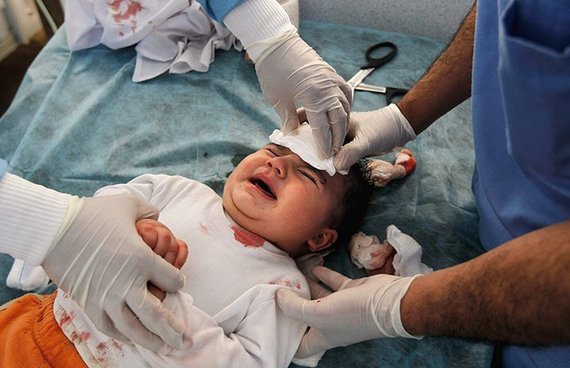
Libya, 2011 – Doctors help child who suffered from wounds in the besieged Libyan city of Misrata
LIST OF NATO’S CRIMES
1. DECEIVING THE WORLD COMMUNITY
Someone wise once said, “Anyone who has once proclaimed violence as his method must inexorably choose lying as his principle”. The US alone, or via the use of NATO forces, have started all military conflicts with deception, distorting the true reasons of the start of hostilities.
Vietnam
The incident in the Gulf of Tonkin in August 1964 may serve as the beginning of the great American fraud, which unleashed the bloody campaign of Vietnam, which began due to the fact that North Vietnamese speedboats, allegedly, attacked the United States fleet. After 40 years, the U.S. government declassified archival military documents from which it became clear that the cause of the beginning of the Vietnam campaign was shamelessly fabricated (mywebs.su/blog/1310.html). Following the Tonkin incident, the bombing of settlements in Vietnam resulted in thousands of victims among the civilian population.
Vietnam, 1 January 1966 – Women and children hide in a ditch from the intense shelling 
The countries of former Yugoslavia
After the collapse of the Soviet Union and the dissolution of the Warsaw Pact, the Alliance began to feverishly look for a reason for their continued existence. The main one was the so-called “peacekeeping mission” when NATO entered in the resolution of ethnic conflicts, pursuing purely personal goals (especially the extension of their influence). As, for example, in the Balkans, when they invaded the region, and directly participated in the escalation of ethnic wars.
The military action of NATO against the former Republic of Yugoslavia, marking the beginning of the modern operations unit, is an example of flagrant violations of all norms and legislation, including the Organization of the North Atlantic Alliance (beta-press.ru/article/34). First of all, NATO violated its own Charter, the Washington Treaty, the 1st article of which stipulates that members of the Alliance must “settle all international disputes in which they may be involved in by peaceful means in such a way as not to endanger international peace, security and justice, and to refrain in their international relations from the threat or use of force in any manner inconsistent with the purposes of the United Nations”. The 6th article of the Treaty was also grossly violated, which states that the competence of NATO is limited to the territory of member countries of the Alliance, and Yugoslavia, Macedonia, Albania and Bosnia were not members of NATO. What can we say about the 7th article of the Washington Treaty, which clearly stipulates that the Alliance recognizes “the responsibility of the Security Council for the maintenance of international peace and security” (nato.int/cps/ru/natolive/official_texts_17120.htm).
American TIME magazine on September 11, 1995 was published under the title “Bringing the Serbs to heel. Massive bombing opens the door to peace”
NATO’s aggression against the former Yugoslavia almost negated all UN peacekeeping missions. The main reason for the invasion of the bloc in the Balkan country became its steadfast refusal to the ultimatum of NATO to concede its territory to the military forces of the Alliance. The condition of the Alliance meant nothing other than hard intervention in the internal affairs of a sovereign state and a threat to its territorial integrity. All of these actions violated the 1st article of the UN Resolution of 1974: “Aggression is the use of armed force by a state (group of States) against the sovereignty, territorial integrity or political independence of another state or in any other manner inconsistent with the Charter of the United Nations, as set out in this definition” (politics.ru/articles/database/global/pravoviie_dokumentii/rezoliutsiia_generalnoij_assamblei_oon_%C2%ABopredelen.shtml).
The best thing about the crimes of the U.S. and NATO in Yugoslavia was, the once the best friend of the West, dissident and human rights activist Alexander Solzhenitsyn, comparing the actions of the Alliance with Nazi crimes: “The worst thing that is happening today is not even the bombing of Serbia, while it is difficult to pronounce, – the most terrible thing is that NATO has transferred us into a new era. Just as Hitler once was, playing another adventures, withdrawing Germany from the League of Nations… USA and NATO removed the UN system of collective security, the recognition of the sovereignty of states. They started a new era: who ever is stronger, will crush. It’s scary…” (aif.ru/politics/article/comments/53043).
Iraq
The U.S invaded Iraq under the pretext of the presence of weapons of mass destruction, namely bacteriological (anthrax) (newsru.com/world/05feb2003/powellun.html). An additional reason was already familiar by that point – the fight for democracy. “Democratization” of Iraq has cost the lives of a million civilians (excluding losses for the military). “The dictator” Hussein was publicly executed, and weapons of mass destruction, which allegedly threatened the world, were never found. Later, in 2004, the U.S. Secretary of State Colin Powell admitted the published data, which marked the beginning of a bloody war, were, to put it mildly, “inaccurate” or simply falsified. “When I did a report in February 2003, it was based on the best information which was provided by the CIA. Unfortunately, over time, it became clear that the sources were inaccurate and wrong and in some cases, deliberately misleading. I’m deeply disappointed and I regret it” – Powell told the press (aif.ru/politics/article/comments/53043). He is sorry.
Iraq, 2003 – A father carries his mutilated, dead daughter after NATO’s bombing 
2. THE USE OF PROHIBITED WEAPONS
Vietnam
They used Napalm bombs – a weapon that is an incendiary, flamethrower mixture. As gelled gasoline, Napalm literally burnt them alive. Later, in 1980, the UN adopted the Convention on the prohibition of certain types of weapons, the 3rd Protocol would read that the use of incendiary weapons, including Napalm, against civilians is a crime. But during the Vietnam war these bombs had already killed and affected hundreds of thousands of Vietnamese.
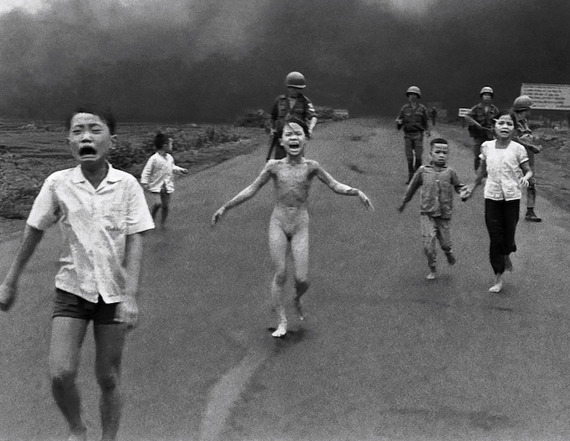
8 June 1972 –  9 year-old Kim Phuc (center) flees from a Napalm bombing on the highway near Trang Bang. This photo went around the world and raised a storm of protest against the criminal policy of the USA in Vietnam
The countries of former Yugoslavia
In military operations against that country, NATO used weapons that were banned by the Nuremberg Charter and Geneva and Hague conventions. Firstly, in Yugoslavia, shells with a low concentration of uranium were used. This kind of weapon is not only highly accurate, but radioactive and highly toxic, and is dangerous to humans and the environment. Secondly, NATO used so-called cluster bombs – weapons of indirect fire, explosive projectiles, prohibited from the later “Ottawa process minefield” (icbl.org/intro.php). The peculiarity of this weapon is that the explosion occurs only in 50% of cases. Other bombs can lie for years in the ground, activating only in case of accidental contact.
Iraq
The Iraqi venture was marked by a number of high-profile crimes of the Alliance. Torture and abuse of Iraqi detainees at the Abu Ghraib prison stirred up the whole world…
Iraq, 2004 – Americans are photographed in the background of a dumped pile of naked prisoners in Abu Ghraib 
There was violence against civilians (murder, rape, robbery). And, of course, the use of one of the most dreaded types of incendiary chemical weapons, white phosphorus, (during the battle for Nasiriyah in April 2003, as well as the assaults on Fallujah in April and November 2004). This type of weapon, which burns the body and dissolves the flesh to the bone, was banned by the UN Convention on certain weapons in 1980, but the US never ratified it.
Photos of casualties from the use of white phosphorus we will not publish, because it is indeed a very scary sight.
Libya
There is information, which the leadership of NATO stubbornly refuses to acknowledge, that during the conflict in Libya, the military also used cluster bombs and white phosphorus, as was the case during the operations in Yugoslavia and Iraq (oko-planet.su/fail/failvideo/videoweapon/86827-nato-ispolzovalo-klasternye-bomby-v-livii-hotya-otricaet-eto-smotrite-sami.html). Also there is a possibility that NATO dumped uranium dust – a radioactive substance, banned by UN Convention, on Iraqi facilities (voltairenet.org/Voennye-prestupleniya-NATO-uchenye). Finally, many sources claim that in Libya, NATO used mustard gas in combat, a toxic substance “tested” during the years of World wars, and prohibited under various conventions as it is extremely dangerous (newsland.ru/news/detail/id/778279).
3. THE ARMS RACE
One of the main NATO crimes is pulling the world into a new arms race era. NATO is not only placing missile defense systems on the European continent, but also heavily increasing its nuclear capabilities. By the way, the official military doctrine of the Alliance recognizes the right to use nuclear weapons – the kind of weapons banned in 1996 by the world court (beta-press.ru/print.php?id=34), because it can lead to the destruction of humanity. Today, if we add up full military potential of the country-members of the bloc, NATO has 60% of the world’s nuclear arsenal.
The countries of the Alliance from year to year are increasing their military capabilities under the pretext: to “force protection, mobility, and high efficiency” (beta-press.ru/print.php?id=34). They spend huge money on it. For example, the military budget of the EU is about 11%. The spending for defense in the USA and Canada is growing. In the conditions of crisis, this money could go to peaceful humanitarian purposes, who preach to the West for medical services and education, on the development of social policies and environmental protection. But NATO needs a strong army to establish fully and definitively their hegemony in the world.
WHY DOES NATO START MILITARY CONFLICTS?
Americans themselves like to say that they are people of practical storage. They, like anyone else, know how to count money. And like all of history, humanity has fought over resources – be it gold, timber, or oil, and today, Americans aim to establish their influence in all strategically important regions of the planet. Petroleum countries have recently found problems with democracy and their mandatory dictator leader. It is in these countries that NATO tries to dominate, with the help of the world community, or by simply ignoring their opinion. As they say, morality in business is the concept of losing. So was Iraq and so was Libya. And in turn – Damascus.
The Expert Council for Foreign and Defense Policy, Sergey Karaganov, characterizes the current policy of the NATO countries – a priori cannot be a guarantor of stability and security in the world: “For example, Europe has officially announced that one of the main objectives of its policy – the access of European companies to the African market and resources. At any cost! It, above all, affects the interests of China, who, incidentally, are assessing the situation in the Middle East, having serious levers of pressure on Europe, and have not yet said their weighty word. This concerns Russia: in Guinea, the Europeans are already trying to remove RUSAL, “LUKOIL” from Côte d’Ivoire… And in the battle for Africa, the Europeans need to turn the Mediterranean sea into a “NATO Lake”. To solve this problem, Syria could become another Algeria (newsland.ru/news/detail/id/984811/).
So NATO, in this business scheme, is just a means to achieve the goal.

Russian military advisor killed in Syria

From Fort Russ

Translated by Ollie Richardson for Fort Russ
4th February, 2016

A Russian military Advisor killed in Syria has been presented with a state award.
This was reported by the Ministry of Defense. “The Russian military adviser in Syria was instructing the Syrian army in the development of new weapons included in the framework of existing interstate contracts of military-technical cooperation”, reported the military. On 1st February, as a result of a mortar attack by terrorists of the Islamic State (group banned in Russia) at the military garrison, which is stationed one of the compounds of the Syrian army, the officer received a fatal wound. The soldier was presented the state award posthumously.
[O.R: It is not yet known whether this incident is related to the round of Turkish artillery fire on 1st February on the border.]

VISA lifts sanctions against Crimea

From Fort Russ

Translated by Ollie Richardson for Fort Russ
1st February, 2016

GenBank, the largest financial institution of the Republic of Crimea under the anti-Russian Western sanctions, resumed work with the cards of Visa, the international payment system.
They now accept payment with cards from Russian issuing banks. The operation takes place through a national system of payment cards (NCBI) – all points are connected to the system of GenBank in Crimea and Sevastopol. They are also accepted for Visa services at ATMs. Earlier, the Peninsula started to use the Chinese system UnionPay.
An event all the more curious is that GenBank, the main Bank of the government of Crimea, 50% of its share capital belongs to the Executive authorities of the Republic of Kazakhstan. There are more than 170 branches, 580 ATMs and POS terminals 960 of the Bank.
International payment system MasterCard and Visa stopped working within Russian Crimea at the end of December 2014. It was one of the first strikes of the sanctions, which was inflicted on the rebellious Russia by the United States.
It seems that times are changing. According to the authoritative American Agency Bloomberg, France and Germany are nervous about Ukraine, as are the USA.
Journalists, analysts and officials that were interviewed have predicted that the lifting of sanctions against Russia will happen later this year.
“The signs are obvious after the statement of U.S Secretary of State John Kerry, saying that in the coming months, the Minsk agreements will be implemented and it will to come to the point where sanctions could be lifted. After Kerry — not in Davos — German Finance Minister Wolfgang Schaeuble and France’s Economic Minister Emmanuel Macron both said: “Europe needs to maintain close ties with Russia to resolve the Syrian conflict. They repeated what the Secretary of State said about the sanctions in exchange for the Minsk agreements”, — wrote Bloomberg.

New rules of engagement on the Syrian battlefield and in the diplomatic arena

From Fort Russ

Translated by Sufyan Jan for Fort Russ
1st February, 2016
Written by Elijah J. Magnier (@ejmalrai)

Abstract

  • Russia upgraded & refurnished 9 Syrian MiG-29 into Fulcrum MiG-29SMT.
  • Russia imposed new rules of engagement on the Turkish-Syrian borders.
  • Russia put an end to the Syrian – Turkish 1998 agreement

A source who’s a senior officer within the joint operation command consisting of Syria, Russia, Iran, Hezbollah has said “Russia has established new rules of engagement on the Syrian-Turkish border, and has retained the upper hand for the Syrian air force and the Syrian army, Russia also refurbished and upgraded custom made Syrian MiG29SMT, to protect the Russian air force squadrons, with clear orders to shoot down Turkish planes that enter the Syrian air space”

The source goes on to say to Al Rai, “The agreement previously concluded with Turkey during the presidency of the late Hafez Assad in 1998, which says no Syrian air force units should come within 15 Km of the Turkish-Syrian border on Syria’s side (the agreement by which Syria expelled the Kurdish leader Abdullah Öcalan, after Turkey, having amassed 10,000 soldiers, threatened to invade Syria), the agreement also included that no army battalions are to be deployed, and that only officers and border control personnel are allowed, this has all gone down the drain”, adding “gone is the time of retracting the statement “Iskandaron strip will be liberated” from school books, gone also is the time of Turkey downing a Syrian air craft and/or helicopter. Turkey’s dream of creating a safe zone is dead in the water, and with it the supply lines to send men and arms to the Syrian Turkmen to undermine Damascus. After Russia’s direct intervention in Syria, there has been drastic changes, especially after the downing of the Russian bomber Sukhoi Su-24 by Turkish F16’s last November, thus making this particular bomber the costliest of its kind, causing strategic and economic losses to Istanbul”

The source further explains “that Russia since the downing of its plane, brought in Sukhoi Su-30, which will deliver to the Russians air-supremacy that was missing before, also posting the anti-aircraft S400 missile system, Russia has further deployed heavier assault weapons and regained most of the Latakia governorate, it has broken the Syrian Turkmen militias that’s considered the military arm of Turkey, most importantly it has given the SAA a moral boost, having upgraded the MiG29 to MiG29-SMT, installing them with ZHUK-M radar that is able to track 10 targets, and engage with 4 at one particular moment, covering 120Km having 5Km width, it is now able to launch the lethal R77 missiles, also installed on these air crafts along with other gadgets is a radio jamming device, and the upgrading enables it to carry other highly developed missiles and bombs such as the KAB-500S-E. These upgrades make the MiG29-SMT the most advanced in the fourth generation line up”.

The senior source confirms “Russia has requested from Syria to conduct around the clock patrols on the Syrian-Turkish border, to ensure the safety of the Russian bombers, Russia having established new rules of engagement have authorized the Syrian air force, specifically the MiG29-SMT squadron, to engage with any Turkish targets that have violated Syrian air space or attempts to violate. By doing this Russia has given Syria its sovereignty back having lost it in 1998, and completely losing it in 2011 at the start of the revolution in Syria, as of today Syria air forces have a mandate to strike any violation without confirming with HQ, this in turn has given the Syrians a boost of morale, especially as they have been given a mandate by a super power like Russia that is physically present in Syria”

Adding “On the battlefield, there are many media reports, citations on social media networks, as well as Intelligence reports, that conclude that the insurgents are turning on each other due to the defeats incurred on them by the SAA, accusing each other of treason, and not supporting the many fronts that were lost to Hezbollah and SAA in Latakia, Hama,  Aleppo, and Dara’a. It is expected that several military units within Al-Nusra and the Army of Conquest (Al Qaida) will defect. On the other side, the SAA and NDF volunteers have increased with large numbers having graduated, pro-government forces are increasing, conversely the number of insurgents joining the cause is steadily decreasing, since Amman has stopped assistance to the southern front, this happened as Russia reached an agreement with the Jordanians, it is also Russia’s intent to shut the porous borders with Turkey and Jordan, to prevent any reinforcements to reach the insurgents, even the region West of the Euphrates where both the Russians and Syrians are bombing the supply routes to hinder any military or non-military assistance to arrive.

Russia has taken the initiative in Syria and established its dominance on the full breadth and width of the country. Politically, in Geneva on Monday the Russians are determined not to yield to the opposition anything that would endanger the grounds gained on the battlefield, and not to accept anyone who has been or still is in communication with Salafi-Jihadis ( Al-Nusra, Ahrar Al-Sham, and whoever pledged their allegiance to them or fights within their ranks). Furthermore Russia will not halt any military advancements during the Geneva talks as stated in the UN resolution, especially now that Damascus and the Kremlin hold all the cards”.

http://www.fort-russ.com/2016/01/new-rules-of-engagement-on-battlefield.html

“It was you who created ISIS!”; John Kerry almost beaten up in Rome

From Fort Russ

Translated by Ollie Richardson for Fort Russ
4th February, 2016

The voyage of US Secretary of State to Italy almost ended in him getting a black eye. Having arrived on the Apennine Peninsula to talk about the victories of American democracy around the world, Kerry was not expecting such a warm reception.
Officially the purpose of the visit of the Secretary was a “small group meeting of the international coalition to combat “Daesh”. During his visit, he met with Italian foreign Minister Paolo Gentiloni, representatives from 23 countries and authorized persons of the EU. What they said actually, for me personally, is a mystery, because to discuss their “coalition successes” would take two seconds: “We fight? Fight! Thanks everybody, all are free to leave.”
Although, it’s likely that they discussed the cost of increasing support to “moderate opposition”, the kind like Jabhat al-Nusra, reducing the debit on the loan and everything. Kerry, as I see it, passionately spoke about the necessity of completing an unconditional victory over Assad, called to democratise the whole of Syria and not to pay attention to victims among civilians as a result of the “accurate” bombing of the coalition forces. But what do I know.
The most interesting thing happened at a joint press conference between Kerry and Gentiloni. When the Secretary of State said all of his memorized phrases on combating international terrorism and the Assad regime, and the Ministers were about to leave the room, suddenly one of the journalists sitting in the front row raised a banner denouncing the U.S. policy rhetoric, shouting at him “It was you who created ISIS!” and tried to charge at him with her fists.
Naturally, the woman was immediately pounced on by the carabinieri, a scuffle ensued. But she quickly left the room.
To be honest, I am saddened. Saddened by the fact that temperamental Italian women who spoke the truth in the face of even the US Secretary of State, was so quick to shut up. Even more frustrating is the fact that brave Italian macho kept silent in a rage and allowed the women to be insulted. It would be great if at least one of them completed the plans of the Italian journalist and gave John Kerry a black eye. It’s the least they could have done.