“Russia and China together”: the greatest fear of Donald Trump

From New Eastern Outlook

09.09.2015
by Caleb Maupin

In his interview with Bill O’Reilly, Republican presidential candidate Donald Trump ranted against Barack Obama’s foreign policy. Within his tirade, he proclaimed:

“You can’t have everybody hating you. The whole world hates us. One of the things that I heard for years and years, never drive Russia and China together, and Obama has done that.”

These are very interesting words that point to a fundamental reality of US foreign policy. The fear of a world where these two massive countries stand arm in arm — with economies independent of western banking institutions — is nothing new. Since the creation of the People’s Republic of China in 1949, the strategy of the ruling financial elite of the United States, often openly stated, has been to divide the leaders of Russia and China, in order to effectively undermine both, and keep their position of dominance within the global market.

The Kremlin Meets the Rifle Faction

In attempting to drive the two countries apart, the intelligence agencies of the United States and western countries have often exploited real tensions and differences.

Even before the victory of the People’s Republic of China in 1949, underlying tensions existed between the Chinese Communist Party and the Communist Party of the Soviet Union. In 1927, the overwhelming majority of Communist Party members in China were exterminated. The nationalist leader Chiang Kai-shek, who had been embraced by the leaders of the Soviet Union, reversed his policy and began rounding up communists, putting them in prison camps and slaughtering them. The death or imprisonment of so many of its members, less than a decade after its founding conference, completely reshuffled the leadership and political line of the party. The extreme repression carried out by Chiang Kai-shek impacted the young party and effectively secured the rise of one of the most influential people in the 20th century Mao Zedong.

Mao Zedong was a university librarian who had previously been an anarchist, and led a small faction among Chinese communists. Mao Zedong’s followers had been dubbed the “Rifle Faction” by their opponents because they constantly promoted armed struggle, and had embedded themselves in the wave of peasant uprisings in the Chinese countryside. Mao’s polemical “Report on an investigation of the Peasant in the Hunan Province,” now considered to be one of the most important documents in the history of Chinese Communism, had harshly criticized the tactics recommended by the Communist International, and urged a complete reorientation away from nationalism and organized labor, toward China’s overwhelming peasant majority.

When Mao Zedong secured his dominant position within the party, the Chinese Communists adopted a political strategy far different than what was being globally directed by Moscow. The Chinese Communists rarely spoke in the stereotypical Marxist-Leninist language of the 1930s. Their rhetoric did not refer to “surplus value,” “exploitation,” or “dictatorship of the proletariat.” Figures like Edgar Snow, Anna Louise Strong, and Agnes Smedley visited the People’s Liberation Army in the Chinese countryside and described it as a kind of military expansionist utopian commune. The bulk of the People’s Liberation Army’s leaders were university students recruited on the basis of “building a new China” for “the people.” With guns in their hands, they recruited hundreds of thousands of peasants on the basis of land reform, opposing corruption and bribery, and establishing “people’s courts” that could facilitate revenge against the land-owning aristocracy.

While Soviet money and guns were instrumental in strengthening the Chinese Communist Party, the Chinese Communists were not “Soviet puppets” by any means. They clearly had their own independent ideas and strategy, and were not going to surrender it. The innovative rural policy of the Chinese communists was probably the personal brainchild of Mao Zedong. It was officially called “New Democracy.”

Stalin’s “Shock Brigade” Scares Wall Street

When the 1949 Chinese Revolution was victorious, the US political establishment went into a panic. The revolution resulted in two great Eurasian powers, the Soviet Union and China, standing united in their opposition to the rule of the world by British and Wall Street bankers. Constant warnings of a Soviet-Chinese invasion were broadcast into U.S. households on the screens of the newly invented television. The Republicans blasted Truman for “losing China,” and the Democratic Party faced a wave of defeats amid the anticommunist hysteria dubbed McCarthyism.

When the United States went to war in order to prevent the reunification of Korea, the Soviet Union, China, Korea, and most of Eastern Europe were all united against the US. Mao Zedong’s own son died in this conflict, along with thousands of Chinese and Korean people, who received weapons, funding, training, and instruction from the Soviet Union. The US was humiliated in this conflict as armed peasants from Korea and China forced a superpower with atomic bombs to a stalemate. This conflict that Koreans called the “Fatherland Liberation War” was the only time in history that a US military general has ever been taken prisoner.

In his final public speech given in 1952, Soviet leader Joseph Stalin hailed the Chinese Communist Party as a “shock brigade” in spreading world revolution. The speech declared: “Now, from China and Korea to Czechoslovakia and Hungary, new ‘shock brigades’ have appeared on the map, in the form of people’s democracies; now the struggle has been eased for our Party and also the work proceeds better.”

This final address from the political leader still most admired among Russians called for a global uprising to ensure the national liberation of historically colonized countries: “Now the bourgeoisie sell the rights and independence of their nations for dollars. The banner of national independence and national sovereignty has been thrown overboard. Without doubt, you, the representatives of the communist and democratic parties must raise this banner and carry it forward if you want to be patriots of your countries, if you want to be the leading powers of the nations. There is nobody else to raise it.”

In the early months of 1950, the New York Times blatantly declared that the intent of US policy was to end this highly important relationship, and convince China to view the USSR as “imperialist.” On January 23, 1950, the New York Times declared: “In carrying out its long range policy the United States might do well to remind Eastern nations that if they believe in the slogan of ‘Asia for the Asiatics,’ Russian imperialism is not the answer.” On January 29, 1950, a New York Times editorial declared: “The United States’ aim indeed is to ‘drive a wedge’ between the Chinese and the Russians.”

Ripped Apart by “Peaceful Coexistence”

In 1956, Khruschev delivered his infamous “secret speech” denouncing Joseph Stalin. China at first embraced the speech, and praised “de-Stalinization” efforts in the USSR. However, by 1961, it became very apparent that the foreign policy of the Chinese Communist Party and the foreign policy of the Soviet Union were incompatible. China, like Stalin in his final speech, urged peoples in Africa, Asia, and Latin America to take up arms in order to secure their economic and political independence. Khruschev and the Soviet Communist Party completely reoriented their international strategy, and urged “peaceful transition” to socialism, as well as “peaceful coexistence” with the United States.

In 1961, the Soviet Union officially terminated its relationship with the People’s Republic of China. Soviet foreign aid was pulled out. Buildings remained half-constructed as Soviet architects burned the blueprints. Chinese students in Moscow brawled with the police as they protested Khruschev’s policies. Aging US communist leader William Z. Foster shouted at Khruschev from his Moscow hospital bed, urging him not to end the important geopolitical relationship between the Soviet Union and China.

Following the Cuban Missile Crisis, Khruschev established a friendly relationship with the United States, as China sounded the trumpet of world communist revolution. The Soviet press referred to Mao Zedong as a “dictator.” The Soviet Union urged its followers around the world to participate in elections, align with capitalist parties, and cease any action toward armed revolution.

With the Soviet Union speaking in more conservative terms, China became the beacon that revolutionaries were attracted to, as radicalism swept the globe in the late 1960s and early 70s. The Soviet Union, with its proclamations of “peaceful coexistence,” seemed far less exciting than the government representing one quarter of humanity that proclaimed “Revolution is The Main Trend in the World Today.”

Various “anti-revisionist” parties, who sought political direction from China, were established around the world in opposition to the parties formed as part of Lenin’s Communist International.

China’s critique of Soviet foreign policy took a vulgar turn when Chinese leaders started saying that the USSR was “imperialist.” By the early 1970s, Chinese leaders had declared that Soviet “social imperialism” was the “main danger to the people of the world.” Mao Zedong met with US President Richard Nixon.

In Angola, the Chinese government opposed the Soviet-aligned forces that won independence, instead supporting CIA-trained forces aligned with the United States.

Behind Reagan’s “Victory”

The China-aligned Revolutionary Communist Party of Chile wrote a document condemning China for its friendly relations with the Pinochet regime that was torturing and slaughtering their members with help from the CIA. China happily embraced the brutal anticommunist, US-backed Chilean dictator, seeing him as a strong ally against “Soviet social imperialism.”

The Chinese government also embraced the Shah of Iran during this period, causing mass confusion among the China-inspired “People’s Fedayeen Guerillas,” who were waging an armed insurgency in the Iranian countryside.

By the late 70s, after Mao died, and Deng Xiaoping rose to power in China, the Cold War no longer seemed to make any ideological sense. The idea that it was a battle between free markets and Marxist-Leninists had been forgotten. A Vietnam veteran addressed a large antiwar gathering in 1979, declaring: “They sent us to Vietnam, telling us we were going there to fight the communists. But now, we are signing deals with Chinese communists, who are killing the Vietnamese communists, while our government supports the Kampuchean communists, who are fighting the Vietnamese communists, saying they are just agents of Russian communists.”

After the US removed its forces from southeast Asia, the pro-Chinese government of Pol Pot battled the pro-Soviet government of Vietnam. The Central Intelligence Agency quietly armed the Kampuchean forces while the Soviet Union sent money and weapons to Vietnam. The Chinese government rallied the remnants of the increasingly confused “Maoist” movement to support Pol Pot against “Soviet social imperialism.”

As Jimmy Carter sat in the White House, the dream of his top adviser Brzezinski became reality. As Brzezinski put it in his book “The Grand Chessboard,” the strategy was: “Keep the barbarians killing each other.” In Afghanistan, China supported the Mujahadeen, while the Soviet Union sent troops to defend the People’s Democratic government.

The common neoconservative narrative of the 1980s credits Reagan’s “toughness” for “defeating the Soviet Union” and “winning the cold war.” This is only half the story. When Reagan entered the White House, the world communist movement — which had almost completely been united in 1950 — was in a state of complete disarray and confusion. The Soviet Union and China were at each other’s throats, with their allies killing each other all across the planet. Various European communist parties were officially ending their relationship with both the USSR and China and calling themselves “Eurocommunists.” Cuba and the Democratic People’s Republic of Korea attempted to maintain some level of neutrality. In Africa, armed Marxist-Leninist revolutionaries were divided along even more complex lines.

Reagan’s “hardline” policies against the USSR took place in the context of an anti-imperialist movement that was in complete ruin and confusion. The Soviet Union could not muster a strong international alliance of supporters as it had in the 1950s. China often supported the US in international affairs, and Third World insurrections were scattered and confused.

The Iranian revolution shocked the world in 1979. No Marxist faction, whether Soviet or Chinese aligned, could win the support of the Iranian people. Imam Khomeini established the Islamic Republic on a program of “Not Capitalism But Islam” and a “War of Poverty Against Wealth.” The Islamic Republic successfully defended itself in a costly war with Iraq, and maintained power with an international position of “neither East nor West.” Various anti-imperialist uprisings continued to take place, but like the Iranian revolution, many of them were not communist-led, and had no international allegiance.

Neoliberalism as the “New World Order”

When the Soviet Union collapsed in 1991, George H.W. Bush spoke of a “New World Order.” The defenders of neoliberal capitalism proclaimed that their system of unregulated free markets was the only way forward for the human race.

As the globalist market cult announced its New World Order after the demise of the USSR, the differences among political forces in the west became merely tactical. In the early 1990s, European Social-Democrats publicly abandoned the goal of creating an egalitarian society. British “New Labour,” French Socialism, and German Social-Democracy all declared that “socialism” was merely a synonym for economic prosperity, and embraced privatizations and neoliberal restructuring. In the United States, the Democratic Leadership Council made the left flank of the US political establishment into a party that hailed the sacredness of markets and profits. The Clintons echoed Tony Blair, talking about how “the world has changed.” Collectivism, class struggle, and cooperation were considered outmoded concepts from a previous era.

In the US and Europe, the various voices of conservatism and the “right wing” abandoned their economic nationalism and protectionism, and embraced “free trade.” The goal of maximizing profits and “integrating” every country into Wall Street’s economic empire became the official party line of all major political forces in western societies.

At the dawn of the 21st Century, a program of global transformation was in progress, as global elites began tearing down economic borders, eliminating social services, expanding international military coalitions along with policing agencies and prisons — all to defend the “sacredness of private property.” The goal was to create the “unknown ideal” of “true capitalism” as envisioned in the texts of the Austrian Economics and the Chicago School.

A variety of governments incurred the wrath of the highly ideological and aggressive new world order. Many of them had committed no real crime other than their existence. Saddam Hussein was happy to serve Wall Street with ruthless crimes against Iran, but the exports from his state-owned oil company and the Ba’ath Arab Socialist Party’s tight control of domestic affairs still could not be tolerated. Iraq was blown to bits by Bush’s “shock and awe” and has been a mess of chaos ever since.

Russia’s leaders have attempted to keep the friendship with the United States that began after the collapse of the Soviet Union. Their efforts to maintain healthy diplomacy have been ignored. The Wall Street clique sees Russia’s state-owned oil and natural gas corporations as intolerable. Furthermore, Putin’s stabilization of Russian society has unforgivably involved renewed feelings of national unity and pride, as well as a large public sector of the economy.

Wall Street and the Pentagon don’t want to destroy Putin. They want to destroy Russia. A stable country, united in its rejection of neoliberalism and cooperating to strengthen its economy is something Wall Street will never tolerate. Publicly owned natural resources, stability, and national unity are always a threat to the power of western finance, whether done in the name of communism, nationalism, Christianity, Islam, or anything else.

The United States encouraged its Georgian puppets to attack South Ossetia in 2008, and more recently backed and funded the violent overthrow of the elected Ukrainian government in 2014. The CIA’s “National Endowment for Democracy” works to foment unrest within Russia, while the US facilitates and arms hostile anti-Russian forces on the country’s borders. The presence of US and NATO military forces is rapidly expanding in Eastern Europe. Whatever the intentions of the Russian leaders, Wall Street is looking to provoke a continued state of crisis and weaken the forces of independence in the world’s geographically largest country.

Chinese leaders have also attempted to maintain their friendly ties with the United States. China has worked hard to facilitate investment by US corporations. Since the 1980s, the Chinese government has effectively abandoned any effort to spread communist ideas around the world.

Regardless of China’s attempts to accommodate the global capitalists, the CIA still facilitates efforts to destabilize the country. The Falun Gong, the Tibetan separatists, “Occupy Hong Kong,” and a variety of bizarre dissidents are propped up by the United States in the hopes of overthrowing the Chinese Communist Party and transforming the country into Wall Street’s playground. The US is militarily surrounding China with its Asian pivot. The US is also looking to economically weaken China’s influence throughout Asia with the Trans-Pacific Partnership.

US media and politicians have responded to Xi Jinping’s recent anti-corruption crackdown with an escalating anti-China frenzy. All of the major presidential candidates in the United States, from Bernie Sanders to Donald Trump, preach hatred for the People’s Republic of China, and seek to somehow blame it for the rising economic woes of working families across the United States.

Two Global Economies: Destruction vs. Construction

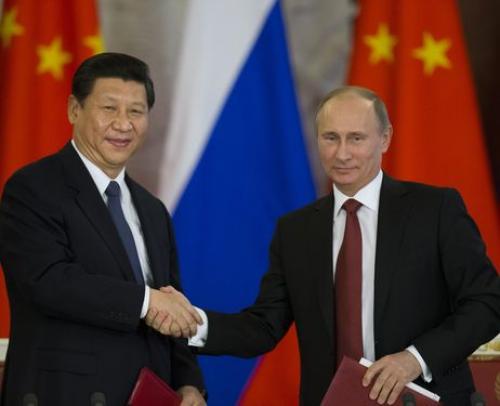
It is in this context that Russia, no longer led by communists, and China, led by the world’s largest communist party, have been able to rekindle the relationship that abruptly ended in 1961. Chinese President Xi Jinping currently hails a “New Silk Road,” connecting the formerly colonized countries of the world. A new global economy that does not involve Wall Street and London is coming into existence. China and Russia have conducted joint military exercises.

A natural gas pipeline connecting Russia and China is currently being constructed. Chinese forces are working in Nicaragua to construct a new canal to rival the US-controlled Panama Canal. Vladimir Putin has visited Latin America, and befriended the Bolivarian Bloc, where countries seeking the goal of “21st Century Socialism” are bound together in a bank called the “Bolivarian Alternative for Latin America.”

Conversation about a new currency for Brazil, Russia, India, and China (known collectively as BRICs) continue to take place. China continues its investment in many African countries, including Nigeria, the top oil exporter on the continent.

As the United States is on the verge of a nuclear agreement with Iran, it has become clear that Russia and China are happy to cooperate with the Islamic Republic. If the nuclear conclusion is somehow blocked by the US Congress, Russia and China are likely not to comply. Russia recently sold Iran SB-300 missiles with which to defend itself in the context of an Israeli or US attack.

China and Russia are both looking to build. Their economies are based on construction, development, and expansion. Western neoliberal capitalism has oriented itself completely toward destruction.

Oil prices have fallen because too much oil exists. Hydraulic fracking, drilling, and other technological innovations have made it more efficient to produce crude oil than ever before. The only hope for reviving oil profits is to somehow reduce the huge apparatus of oil extraction and production. The only hope for raising the profits of Exxon-Mobil, BP, and Shell is a large amount of destruction.

The billionaires who own Raytheon, General Electric, Boeing, and the many other Pentagon contractors actively fear, not a new world war, but a rise of stability, tolerance, and cooperation between countries. The universal human dream of peace on earth would put the war profiteers and weapons manufacturers out of business. The US economy is tightly centered around Pentagon contracts. Wall Street depends on military aggression.

Banks in the United States have made huge profits, not by lending people to money to buy homes, but with “predatory lending” practices that result in home foreclosure. The government has cooperated with banking institutions to create a situation where profits can be made by transforming prosperous residential neighborhoods into eerie overgrown ghost towns.

Wells Fargo Bank, along with a number of other key financial players, has turned crime and imprisonment into a business opportunity. The Corrections Corporation of America, GEO Group, and other private entities bring in billions of dollars every year from locking people away. In order to ensure Wall Street profits, the US prison population has grown to be astronomical. The highly profitable US policing agencies have been given far more power than ever before, “stopping and frisking” people without a proper cause, tapping millions of phones, reading personal e-mails, and indefinitely detaining and torturing people.

The drive for profits that pushed the United States and Western Europe, as they violently conquered their central place in the world economy, has taken a predictable yet horrific turn. The world wants to continue developing, but the invisible hand behind western neoliberal capitalism mandates nothing but war, imprisonment, and poverty.

The neoliberal mythology of capitalism as a system that encourages innovation and freedom is being exposed on a global level. The rise of the New World Order and its market cult in the early 1990s has meant the destruction of civil liberties, the impoverishment of millions, and an end to the hopes and dreams of an entire generation.

Russia and China, friends once again, are cooperating to provide an alternative. Trump’s words reflect the real concerns about the wealthy elite. Not only does “the whole world hate us;” they have another option to turn toward. The New Silk Road, the rising economic bloc oriented toward construction, points to a way out of war, fascism, and chaos. The unity and cooperation of Russia and China is an essential part of the Eurasian alternative to the destructive, cannibalistic capitalism that has taken power in western countries.

Donald Trump is very concerned about it, because it points the human race toward a world that is no longer ruled by people like him, where human life is valued, and selfishness is no longer considered to be a virtue.

Caleb Maupin is a political analyst and activist based in New York. He studied political science at Baldwin-Wallace College and was inspired and involved in the Occupy Wall Street movement, especially for the online magazine “New Eastern Outlook”.

Senior NATO official claims we’ll be at war by summer

By Joshua Krause
Global Research, May 28, 2015
The Daily Sheeple 25 May 2015

Last week, former NSA intelligence analyst John Schindler posted a rather disturbing tweet. With a statement that one could only assume to be a reference towards Russia, Schindler wrote “Said a senior NATO (non-US) GOFO to me today: “We’ll probably be at war this summer. If we’re lucky it won’t be nuclear.” Let that sink in.”

So who is John Schindler? As a ten-year veteran of the NSA, he was in the news a bit more when Snowden was making frequent headlines. He used to be a professor at the U.S. Naval War College, and is currently a frequent contributor to Business Insider. According to his biography on Business Insider, he used to teach classes on security, strategy, intelligence, and terrorism, and he has “collaborated closely with other government agencies who would probably prefer he didn’t mention them.” It’s safe to say that Schindler probably brushes shoulders with high-ranking officials from time to time, so his tweet should be taken seriously.

It’s frightening to think that members of NATO may actually be preparing for, and expecting a war with Russia this summer, but unfortunately it’s not all that surprising. Given some of the activity we’re seeing around the world, it’s safe to assume that superpowers like the US, Russia, and China, are preparing for something big.  Infowars also reported on Schindler’s tweet, and noted some of the provocative moves that have been going on around the world lately.

Earlier this month NATO launched its biggest ever wargame exercise on Russia’s doorstep. Moscow responded by conducting “provocative” wargames in the Mediterranean Sea in coordination with the Chinese PLA, the first ever naval drill involving both superpowers.

NATO powers are also taking part in one of Europe’s largest ever fighter jet drills from today, with the United States, the United Kingdom, Switzerland, the Netherlands, Germany, France, Finland, Norway and Sweden all involved in the 12 day exercise.

Tensions are also building between the U.S. and China, with The Global Times, a state media outlet owned by the ruling Communist Party, today warning that “war is inevitable” if Washington doesn’t halt its demands that Beijing stop building artificial islands in the South China Sea.

“If the United States’ bottom line is that China has to halt its activities, then a U.S.-China war is inevitable in the South China Sea,” the newspaper said. “The intensity of the conflict will be higher than what people usually think of as ‘friction’.”

Last week, CNN revealed how China’s Navy has repeatedly issued warnings to U.S. surveillance planes flying over the South China Sea.

While these sorts of warnings come and go all the time, that in and of itself is kind of scary. The fact that we now live in a world where high-ranking officials just assume nuclear war is right around the corner, means we should be very concerned. Wars rarely, if ever, happen out of the blue. There are always quiet rumors of wars before the real deal comes to pass.

Contributed by Joshua Krause of The Daily Sheeple.

Joshua Krause is a reporter, writer and researcher at The Daily Sheeple. He was born and raised in the Bay Area and is a freelance writer and author. You can follow Joshua’s reports at Facebook or on his personal Twitter. Joshua’s website is Strange Danger .

http://www.globalresearch.ca/senior-nato-official-claims-well-be-at-war-by-summer/5452220


Is the US planning a “Gulf of Tonkin” incident in the South China Sea?

This is one example of US verbrecherische. [1]

By Peter Symonds
From the World Socialist Web Site
Posted on Global Research, May 18, 2015

Following weeks of scaremongering by American officials over China’s activities in the South China Sea, US Secretary of State John Kerry used his visit to Beijing last weekend to issue an ultimatum to Chinese leaders to halt land reclamation on islets and shoals. His Chinese counterpart Wang Yi bluntly refused, insisting that China would safeguard its sovereignty and territorial integrity “as firm as a rock.”

Washington is not going to take no for an answer. In what is already an explosive situation, the question has to be asked: Is the US preparing a “Gulf of Tonkin” incident as the pretext for direct military action against Chinese facilities and armed forces in the South China Sea? Such reckless brinkmanship would risk war between two nuclear armed powers.

The historic parallels are chilling. In 1964, President Lyndon B. Johnson needed a justification for decisions that had already been made to dramatically escalate US military involvement in a civil war in Vietnam and to begin bombing targets in North Vietnam. Pentagon planners had concluded that Washington’s widely reviled puppet regime in Saigon was incapable of defeating the North Vietnamese-backed National Liberation Front on its own.

Preparations for massively expanding US involvement were drawn up well in advance. In the summer of 1964, the US worked with the South Vietnamese to stage a series of provocations—probes by US-supplied patrol boats to expose North Vietnamese radar systems. On August 2, the USS Maddox was monitoring one of these raids in the Gulf of Tonkin, part of the South China Sea, eight miles offshore and well within the North Vietnam’s 12-mile territorial waters, that provoked an exchange of fire with small North Vietnamese boats.

Two days later the USS Maddox, accompanied by the destroyer C. Turner Joy, reported coming under fire. There was, in fact, no attack. The entirely manufactured incident, surrounded by a barrage of media sensationalism and official lies, was exploited to paint North Vietnam as the aggressor. The belligerent response of the United States was presented as justified, defensive actions to maintain “international peace and security in Southeast Asia.”

The Gulf of Tonkin Resolution was passed by the US Congress on August 7, 1964, with just two votes against. It provided the quasi-legal cover for a criminal, open-ended war in Vietnam that claimed millions of lives, devastated the country’s economy and left a legacy of destruction that remains to this day.

Far more is at stake today. For decades, the US showed little interest in the festering territorial disputes in the South China Sea between China and its South East Asian neighbours. In 2010, however, US Secretary of State Hillary Clinton, as part of the Obama administration’s “pivot to Asia” against China, declared that the US had “a national interest” in ensuring “freedom of navigation” in the strategic waters.

Over the past year, Washington has abandoned its pretence of neutrality in the maritime disputes. It has aggressively challenged the legitimacy of China’s claims and thus its administration of various shoals and reefs. Ignoring similar activities by other claimants, such as the Philippines and Vietnam, the US has portrayed land reclamation in the South China Sea as an aggressive threat to US national interests. In late March, Admiral Harry Harris, commander of the US Pacific Fleet, denounced China’s actions as the construction of “a great wall of sand.”

From words, the US is turning to actions. As part of the “pivot” to Asia, the Pentagon is already engaged in a massive military build-up and strengthening of alliances and strategic partnerships throughout Asia directed against China. One of the latest warships, the USS Fort Worth, has just completed a week-long “freedom of navigation” patrol in the South China Sea designed to test and challenge China’s presence.

While the USS Fort Worth remained outside China’s claimed territorial waters, US Defence Secretary Ashton Carter has called on the Pentagon to draw up plans for US warships and warplanes to enter the 12-mile limit and directly challenge Chinese sovereignty. Undoubtedly behind the scenes, far more detailed war plans have been drawn up.

Significantly in the midst of a US Senate Foreign Relations Committee hearing last week entitled “Safeguarding American Interests in the East and South China Seas,” Assistant Defence Secretary David Shear blurted out that the US was preparing to base B1 bombers in northern Australia as part its military “rebalance” against China. Although later denied, nuclear-capable B-52 bombers are already rotating through Australia air bases.

Layers of the US foreign policy establishment are already braying for more concerted US action in the South China Sea to teach China a lesson. In the course of last week’s Senate Foreign Relations Committee hearing, Chairman Bob Corker repeatedly expressed the review that the Obama administration was not doing enough.

In an article published in the National Interest entitled “Time to Stand Up To China in the South China Sea,” analyst Michael Mazza from the right-wing American Enterprise Institute praised the Pentagon’s plans for more “freedom of navigation” exercises, then added: “It is important that the president make the decision to act, and soon. The longer he waits, the more entrenched Chinese positions will become, both figuratively and literally.”

This logic is unquestioningly being applied more broadly. What is driving the provocative actions of US imperialism in Asia and around the world is the determination to use its still formidable military force to stem its historic decline. From Washington’s standpoint, the longer it waits, the greater the difficulty and dangers in subordinating Beijing to its interests. Thus the willingness to provoke a confrontation in the South China Sea as a test of strength, regardless of its potentially calamitous consequences.

But in confronting China, Washington faces widespread anti-war opposition at home and around the world, born of two decades of continuous wars including the invasions of Afghanistan and Iraq. No one should be surprised by a new “Gulf of Tonkin incident” suddenly emerging in order to try to stampede public opinion behind US aggressive military operations against China.

http://www.globalresearch.ca/is-the-us-planning-a-gulf-of-tonkin-incident-in-the-south-china-sea/5450245

[1] http://www.nakedcapitalism.com/2015/05/john-helmer-how-angela-merkel-has-been-abandoned-by-john-kerry-victoria-nuland-and-vladimir-putin.html

Engdahl: Why I wept at the Russian parade

Posted on New Eastern Outlook, May 13, 2015
by F. William Engdahl

k1Bs7ECqu7dOvKwnTmbImqhKFrofL6Zd

Something extraordinary just took place in Russia and it may have moved our disturbed world one major step nearer to peace and away from a looming new world war. Of all unlikely things, what took place was a nationwide remembrance by Russians of the estimated 27 to perhaps 30 million Soviet citizens who never returned alive from World War II. Yet in what can only be described in a spiritual manner, the events of May 9, Victory Day over Nazism, that took place across all Russia, transcended the specific day of memory on the 70th anniversary of the end of World War II in 1945. It was possible to see a spirit emerge from the moving events unlike anything this author has ever witnessed in his life.

The event was extraordinary in every respect. There was a sense in all participants that they were shaping history in some ineffable way. It was no usual May 9 annual show of Russia’s military force. Yes, it featured a parade of Russia’s most advanced military hardware, including the awesome new T-14 Armata tanks, S-400 anti-missile systems and advanced Sukhoi Su-35 fighter jets. It was indeed impressive to watch.

The military part of the events also featured for the first time ever elite soldiers from China’s Peoples’ Liberation Army marching in formation along with Russian soldiers. That in itself should shivers down the spines of the neoconservative warhawks in the EU and Washington, had they any spines to shiver. The alliance between the two great Eurasian powers—Russia and China—is evolving with stunning speed into a new that will change the economic dynamic of our world from one of debt, depression, and wars to one of rising general prosperity and development if we are good enough to help make it happen.

During his visit, China’s President XI, in addition to his quite visible honoring of the Russian Victory event and its significance for China, met separately with Vladimir Putin and agreed that China’s emerging New Silk Road high-speed railway infrastructure great project will be integrated in planning and other respects with Russia’s Eurasian Economic Union which now consists of Russia, Belarus, Kazakhstan and Armenia with several prospective candidates waiting to join. While it may seem an obvious step, it was not at all certain until now.

The two great Eurasian countries have now cemented the huge oil and gas deals between them, the trade deals and the military cooperation agreements with a commitment to fully integrate their economic infrastructure. Following his meeting with Xi, Putin told the press, “The integration of the Eurasian Economic Union and Silk Road projects means reaching a new level of partnership and actually implies a common economic space on the continent.”

It’s Zbigniew Brzezinski’s worst geopolitical nightmare come to fruition. And that, thanks to the stupid, short-sighted geopolitical strategy of Brzezinski and the Washington war faction that made it clear to Beijing and to Moscow their only hope for sovereign development and to be free of the dictates of a Washington-Wall Street Sole Superpower was to build an entire monetary and economic space independent of the dollar world.

The Parade of the Good

Yet the most extraordinary part of the day-long events was not the show of military hardware at a time when NATO is not only rattling sabres at Russia, but even intervening militarily in Ukraine to provoke Russia into some form of war.

What was extraordinary about the May 9 Victory Day Parade was the citizens’ remembrance march, a symbolic parade known as the March of the Immortal Regiment, a procession through the streets of Moscow into the famous and quite beautiful Red Square. The square, contrary to belief of many in the West was not named so by the “Red” Bolsheviks. It took its name from Czar Alexei Mikhailovich in the mid-17th Century from a Russian word which now means red. Similar Immortal Regiment parades involving an estimated twelve million Russians took place all over Russia at the same time, from Vladivostock to St. Petersburg to Stevastopol in what is now Russian Crimea.

In an atmosphere of reverence and quiet, some three hundred thousand Russians, most carrying photos or portraits of family members who never returned from the war, walked on the beautiful, sunny spring day through downtown Moscow into Red Square where the President’s residence, the famous Kremlin, is also located.

To see the faces of thousands and thousands of ordinary Russians walking, optimism about their future beaming from their faces, young and the very old, including surviving veterans of the Great Patriotic War as it is known to Russians, moved this writer to quietly weep. What was conveyed in the smiles and eyes of the thousands of marchers was not a looking back in the sense of sorrow at the horrors of that war. Rather what came across so clearly was that the parade was a gesture of loving respect and gratitude to those who gave their lives that today’s Russia might be born, a new, future-looking Russia that is at the heart of building the only viable alternative to a one-world dictatorship under a Pentagon Full Spectrum Dominance and a dollar system choking on debt and fraud. The entire Russian nation exuded a feeling of being good and of being victorious. Few peoples have that in today’s world.

When the television cameras zoomed in on President Vladimir Putin who was also marching, he was walking freely and open amid the thousands of citizens, holding a picture of his deceased father who had served in the war and was severely wounded in 1942. Putin was surrounded not by bulletproof limousines that any US President since the assassination of Kennedy in 1963 would have, were he even to dare to get close to a crowd. There were three or four presidential security people near Putin, but there were thousands of ordinary Russians within arm’s length of one of the most influential world leaders of the present time. There was no climate of fear visible anywhere.

My tears

My tears at seeing the silent marchers and at seeing Putin amid them was an unconscious reaction to what, on reflection, I realized was my very personal sense of recognition how remote from anything comparable in my own country, the United States of America, such a memorial march in peace and serenity would be today. There were no “victory” marches after US troops destroyed Iraq; no victory marches after Afghanistan; no victory marches after Libya. Americans today have nothing other than wars of death and destruction to commemorate and veterans coming home with traumas and radiation poisonings that are ignored by their own government.

That transformation in America has come about in those same 7o years since the end of the war, a war when we–Americans and Russians, then the Soviet Union of course—had fought side-by-side to defeat Hitler and the Third Reich. Today the Government of the United States is siding with and backing neo-nazis in Ukraine to provoke Russia.

I reflected how much my countrymen have changed over those few decades. From the world’s most prosperous nation, the center of invention, innovation, technology, prosperity, in the space of seven decades we have managed to let our country be ruined by a gaggle of stupid and very rich oligarchs with names like Rockefeller, Gates, Buffett and their acolytes in the Bush dynasty. Those narcissistic oligarchs cared not a whit for the greatness of the American people, but saw us as a mere platform to realize their sick dream of world dominion.

We let that happen.

I’ll let you in on a secret that I recently discovered. The American oligarchs ain’t all-powerful; they ain’t some new Illuminati or gods as some try to convince us. They ain’t omniscient. They get away with murder because we allow them. We are hypnotized by their aura of power.

Yet were we to stand tall and clear in the open and say, “These silly would-be Emperors have no clothes!,” their power would evaporate like cotton candy in hot water.

That’s what they’re terrified of. That’s why they are deploying the US Armed Forces into Texas to stage war games aimed at US citizens; that’s why they have torn up the Constitution and Bill of Rights after 911. That’s why the Created a Department of Homeland Security. It’s why they try to terrify our citizens to vaccinate with untested Ebola or other vaccines. It’s why they are desperate to control free expression of political ideas in the Internet.

Now, when I reflect on the true state of America today compared with Russia, it brings tears. Today the economy of the USA is in ruins. It has been “globalized” by its Fortune 500 global companies and the banks of Wall Street. Its industrial jobs have been outsourced to China, Mexico, even Russia over the past 25 or so years. Investment in the education of our youth has become a politically-correct sick joke. College students must go deep into debt to private banks, some $1 trillion worth today, to get a piece of paper called a degree in order to look for non-existent jobs.

Our Washington government has become serial liars who have lied to us about the true state of the economy ever since Lyndon Johnson during the Vietnam War ordered the Commerce and Labor departments to find ways to fake the numbers to hide the developing internal economic rot. The consequence, followed by every president since, is that we live in a fairy tale world where the mainstream media tells us we are in the “sixth year of economic recovery” and have a mere 5.4% unemployment. The reality is that more than 23% of Americans today are unemployed but through clever tricks have been defined out of the statistics. Some 93 million Americans are unable to get full time work. It isn’t the fault of Obama or Bush before him or Clinton, Bush, Reagan or Jimmy Carter. It’s our own fault because we were passive; we gave them the power because we did not believe in ourselves enough. We let billionaires decide for us who will be our President and Congress because we no longer believed that we were good.

By the same token, Russians today, amid brutal Western economic and financial warfare sanctions; amid a NATO war in Ukraine that has led more than one million Russian-speaking Ukrainians to flee to Russia for safety, despite the demonization in the western media of their country, exude a new optimism about their future. What makes Vladimir Putin so extraordinarily popular, with over 83% approval, is that he acts out that growing sense of representing that Russian soul, the people who are good, being just, being right, the sense that the vast majority of Russians today have.

That was overwhelmingly visible in the faces of the May 9 marchers. You could feel that Putin on the speaker’s podium felt it when he looked into the vast crowd. It was clear when Defense Minister Shoigu, a Russian-Mongolian Tuvan-born Buddhist, respectfully and humbly made the Orthodox sign of the cross with bowed head as he passed through the Kremlin’s Saviour Tower to take his place aside Putin. As Victor Baranets, a noted Russian journalist put it: ”At that moment I felt that with his simple gesture Shoigu brought all of Russia to his feet. There was so much kindness, so much hope, so much of our Russian sense of the sacred in this gesture.“  The legendary Russian Soul was manifest on May 9 and its alive and very well, thank you.

And that’s why I shed the tears on May 9, watching hundreds of thousands of peaceful Russians walk through their capital city, the city that saw the defeat of Napoleon’s army and of Hitler’s. I was moved deeply watching them slowly and deliberately walking into the Red Square next to their President’s residence at a time when Washington’s White House is surrounded by concrete barriers, barbed wire and armed guards.

You could see it in the eyes of the Russians on the street: they knew that they were good. They were good not because their fathers or grandfathers had died defeating Nazism. They were good because they could be proud Russians, proud of their country after all the ravages of recent decades, most recently the US-backed looting during the 1990’s Harvard Shock Therapy in the Yeltsin era.

I shed tears being deeply moved by what I saw in those ordinary Russians and tears for what I felt had been destroyed in my country. We Americans have lost our sense that we are good or even perhaps again could be. We have accepted that we are bad, that we kill all around the world, that we hate ourselves and our neighbors, that we fear, that we live in a climate of race war, that we are despised for all this around the world.

We feel ourselves to be anything but good because we are in a kind of hypnosis induced by those narcissistic oligarchs to be so. Hypnosis, however, can be broken under the right circumstances. We only have to will it so.

Postscript:

The last time I wept at a public event was in November 1989 when the Berlin Wall came down and Germans—east and west—danced together on the symbol of the Cold War division between East and West, Beethoven’s Ode to Joy rang out. The German Chancellor made a speech to the Bundestag proposing the vision of a high-speed rail linking Berlin to Moscow. Then, Germany was not strong enough, not free enough from guilt feelings from the war, to reject the pressure that came from Washington. The architect of that vision, Alfred Herrhausen, was assassinated by the ‘Red Army Fraction’ of Langley, Virginia. Russia was deliberately thrown into chaos by IMF shock therapy and the criminal Yeltsin family. Today the world has a new, far more beautiful possibility to realize Herrhausen’s dream—this time with Russia, China and all Eurasia. This is what was so beautiful about the May 9 parade.

F. William Engdahl is strategic risk consultant and lecturer, he holds a degree in politics from Princeton University and is a best-selling author on oil and geopolitics, exclusively for the online magazine “New Eastern Outlook”.
First appeared: http://journal-neo.org/2015/05/13/why-i-wept-at-the-russian-parade/

Chinese President Xi Jinping on Russian-Chinese partnership in WW II– “To remember history, to open the future”

Translation in Unz Review, May 9, 2015
By Anatoly Karlin

xi-jinping-and-patriarch

Xi Jinping (pictured right, meeting the Patriarch Kirill) penned an op-ed in a Russian newspaper on May 6th in which, in stark contrast to the typical Western bile and hostility, he acknowledges the role of the Soviet Union in defeating Nazism and warns off against attempts to revise that outcome, be it on paper or in real life.

I am translating it in full for two reasons.

First, it constitutes a first-hand glance at official relations between China and Russia, which – much to the consternation of neocons, Russophobes, Sinophobes, and Western imperialists – are instead of fighting each other for make benefit of the US are instead building strong relations and continuing to ink dozens of deals whose total value now probably stands at close to a trillion dollars.

Second, to explicitly give the lie to Western propaganda that Russia is somehow “isolated” by the fact that none of Washington’s European stooges turned up at the Victory Day parade in Moscow this May 9th. Who cares? Not many Russians, at any rate. China, India, and dozens of other countries did turn up. That’s the world’s second superpower and the representatives of half of humanity. As for Obama, Merkel, Hollande, and Dave – quite frankly, the air is cleaner for their absence.

*Soundtrack – Russians and Chinese are Brothers Forever*

To Remember History, To Open the Future

by Xi Jinping

On May 9th, Victory Day in the world war against fascism, at the invitation of Russia’s President Vladimir Putin, I will visit Russia and take part in the celebrations in Moscow devoted to the 70th anniversary of Victory in the Great Patriotic War. This sacred day I will celebrate together with the Russian people and the entire world.

Everyone remembers that the aggressive wars begun by the fascists and militarists inflicted unprecedented damage and suffering on the peoples of China, Russia, and the countries of Europe, Asia, and other parts of the world. The relentless struggle between justice and evil, light and darkness, freedom and slavery, was joined by the peoples of China, Russia, and more than 50 other countries, as well as by all the other peace-loving peoples of the world, who stood up as one and formed a broad international anti-fascist and anti-militarist front. All these nations fought in bloody battles against the enemy, and in so doing defeated the most evil and brutal aggressors, bringing peace to the world.

I remember, in March 2013, when I first visited Russia on a state visit, I laid a wreath at the Tomb of the Unknown Soldier near the Kremlin walls. There was a depiction of a soldier’s helmet and a red banner on the tomb, and there burned an eternal fire, symbolizing the unbroken life and unwavering fearlessness of our fallen heroes. “Your name is unknown, your deeds are immortal.” They will never be forgotten by the Russian people, the Chinese people, or anyone else.

China was the main theater of military operations in Asia during the Second World War. The Chinese people stood up before anyone else in the struggle against the Japanese militarists, waged the longest war, fought in the hardest conditions, and, like Russia, suffered the most enormous losses. The Chinese army and people fought stoically and persistently, locking down and destroying numerous contingents of the Japanese aggressors. At the cost of a huge national sacrifice – the lives of more than 35 million people – a great victory was finally won and an enormous contribution was made to victory in the world struggle against fascism. The exploits of the Chinese people in the war against the militarists, just like the exploits of the Russian people, will be immortalized forever in history and will never die.

The Chinese and Russian peoples supported each other, helped each other, they were comrades in arms in the war against fascism and militarism, and built a friendship with each other forged with blood and life. In the most difficult times of the Great Patriotic War, many of the best sons and daughters of the Chinese people decisively joined in the battle against German fascism. Mao Anying – the eldest son of Chairman Mao Zedong – fought on many battles as a political officer of a tank company of the 1st Belorussian Front, up to the storming of Berlin. The Chinese fighter pilot Tang Duo, as deputy commander of a fighter company of the Soviet Army, distinguished himself in air battles against the fascist forces. Children of the leaders of the Chinese Communist Party and descendants of the fallen heroes of the Chinese Revolution, when studying at the Ivanovo international boarding school, despite that they were still only children, nonetheless went off to dig trenches, prepared Molotov cocktails, prepared food and clothes for the fighters, chopped trees, dug out potatoes, and looked after the wounded in hospitals. Apart from that, many of them regularly donated blood – 430 millilitres once per month for the soldiers at the front. The Chinese female journalist Hu Jibang, small and weak, underwent the entire war from the first day to the last, through bullets and fire, writing about the resilience and courage of the Soviet people, the barbarous cruelty of the fascist hordes, and the joy of the Russian soldiers and people in their times of triumph. It emboldened the armies and peoples of both countries, raising their will to fight to the end, to the final victory. Alongside the above heroes there are many other representatives of the Chinese people who contributed to the Great Patriotic War while remaining unknown soldiers.

The Russian people gave the Chinese people valuable political and moral support in their war against Japanese invaders. This included large convoys of arms and war material. More than 2,000 Soviet fighter pilots joined the Chinese air force and helped in the air battles over China. More than 200 of them died in battles over Chinese soil. In the closing phase of the war, Red Army soldiers of the Soviet Union were sent to north-east China. Together with the Chinese army and people they fought against the Japanese militarists, which helped China tremendously in achieving final victory. The Chinese people will always remember the Russians, both soldiers and civilians, who gave their lives for the independence and liberation of the Chinese nation.

The famous Russian historian Vasily Klyuchevsky said, that, having forgotten history, our soul can get lost in the darkness. To forget history is to commit treason. The Chinese and Russian peoples stand ready, together with all peace-loving countries and peoples, and with the automost determination and decisiveness, to oppose any actions or attempts to deny, distort, and rewrite the history of the Second World War.

This year, China and Russia will hold a series of events to mark the 70th anniversary of Victory in the Second World War. There will also be many other events conducted by the UN and other international and regional organizations. The purpose of these events and celebrations is to demonstrate our determination to defend the results of the Second World War, to protect international equality and justice, and to remind out contemporaries that it is necessary to preserve and guard the peace that was won for humanity at too high a price.

The hard lessons of the Second World War tell people, that humanity’s coexistence is not subject to the laws of the jungle; that world politics is diametrically contradictory to belligerent and hegemonic power politics; and that the path of human development is not founded on the principle of “winner takes all” or in games with zero-sum outcomes. Peace – yes, war – no, cooperation – yes, confrontation – no, mutual gains are honored, while zero-sum results – are not: This is what constitutes the unchanging core and essence of peace, progress, and the development of human society.

Today, mankind has unprecedentedly good opportunities for the realization of our goal – peace, development, and the formation of a system of international relations that is ever more strongly based on the spirit of cooperation and mutual benefits. “Unity – is strength, while self-isolation – is weakness.” Cooperation and the win-win principle should be adopted as the basic orientation of all countries in international affairs. We have to unite our own interests with the common interests of all countries, find and expand on the common points of interests of different parties, develop and establish a new conception of multilateral win-win, to always be ready to extend a helping hand to each other at difficult times, to partake together of rights, interests, and responsibilities, and to collectively collaborate to solve growing global problems such as climate change, energy security, cybersecurity, national disasters, and so on. In short, we are in it together on our planet Earth – the homeland of all humanity.

The Chinese people and the Russian people – they are both great peoples. In the years of grief and misery, our indestructible camaraderie was cemented in place with blood. Today the peoples of China and Russian will hand in hand and shoulder to shoulder defend peace, promote development, and make their contributions to lasting world peace and human progress.

Copyright  RG.ru (Russian) and the Unz Review 2015

http://www.unz.com/akarlin/translation-xi-jinping-remember-history/?utm_source=rss&utm_medium=rss&utm_campaign=translation-xi-jinping-remember-history

http://www.globalresearch.ca/chinese-president-on-russias-role-in-crushing-fascism-to-remember-history-to-open-the-future/5448750

The coming color revolution chaos in Kyrgyzstan

From Russia Insider, March 19, 2015
By Andrew Korybko

It can be certain that the arrival of the ‘Male Nuland’ to Kyrgyzstan, freshly forced out of retirement to take on this pivotal role, portends the Central Asian anti-Russian equivalent of what Nuland unleashed in Eastern Europe over a year ago with EuroMaidan.

The first part of the article discussed Richard Miles’ Color Revolution credentials and why the arrival of the ‘Male Nuland’ in Bishkek likely portends an oncoming destabilization there. It also looked at American policy towards Uzbekistan and the importance of Ambassador Spratlen’s appointment to Tashkent. An overview of the US’s grand strategy against Russia, as adapted for the Central Asian vector, was also explored in that section. At this juncture, the article forecasts what the chaos that Miles is about to unleash in Kyrgyzstan will look like, including the tempting ‘media Crimea’ scenario that is bound to split Tashkent from Moscow and crown Uzbekistan as the US’s long-term Lead From Behind proxy in Central Asia.

The Kyrgyz Game Plan:

Zeroing in on Kyrgyzstan and Richard Miles’ ‘temporary’ appointment as the de-facto ambassador there, it’s likely that the general course of Color Revolutionary chaos will take on a relatively predetermined path. Parliamentary elections are scheduled for October, and will likely serve as ‘the event’ needed to ‘justify’ a Color Revolution. This is a very opportune time for the destabilization to commence, since Kyrgyzstan would have already joined the Eurasian Union, and ‘opposition’ candidates and/or activists can attempt to manipulate this into a campaign issue (either within the country or in front of the foreign media). Also, October represents the tail end of fall and the beginning of winter, which in Kyrgyzstan, leads to a de-facto months-long division between the North and the South owing to the blocking of critical mountain passes connecting the two.

With the country having almost splitduring the last spate of externally driven instability in 2010, the prospects remain for it to do so once more if there’s a repeat of similar violence. This is because the North-South Kyrgyzstan rivalry hasn’t gone away in the years since, but only went underground and outside of the international public’s attention. The emergence of ‘South Kyrgyzstan’ in fact or in form could become an epicenter of future conflicts and easily follow the Afghan model of drug trafficking and terrorism. These fears could create the conditions needed to force Russia and the CSTO into a Reverse Brzezinski intervention, made even more difficult by the mountainous terrain that favors insurgency over counter-guerrilla operations. Left to its own, ‘South Kyrgyzstan’s’ black hole of destabilization could combine with a renewed Taliban threat in Afghanistan to existentially endanger Tajikistan, which aside from further pressuring Russia to intervene and crush the fledgling ‘Central Asian Islamic State’, could raise fears in China that Uighur terrorists will exploit the disorder to establish bases for carrying out attacks in Xinjiang.

The entire dynamic would be complicated by the re-eruption of ethnic violence in Kyrgyzstan’s portion of the Fergana Valley, where the ethnic Uzbeks’ grievances and the tensions between them and ethnic Kyrgyz were simply swept under the rug for the past few years in the same way that the North-South Kyrgyzstan rivalry was. In the event that Miles succeeds in initiating any type of Color Revolution disorder in the country (which given its existing instability, isn’t that difficult to do), it’s expected that the 2010 ethnic chaos will return, when about 300,000 Uzbeks were displaced and 100,000 fled to Uzbekistan. This time, however, instead of Uzbekistan sitting on the sidelines and reacting to the crisis, it’s forecasted that it will directly intervene in the country, which is the tripwire that will irrevocably break Uzbek-Russian bilateral relations and herald in Tashkent’s role as the US’ Lead From Behind partner in Central Asia.

Breaking Kyrgyzstan

If the Kyrgyz authorities and their Eurasian Union and SCO allies aren’t successful in quickly containing and extinguishing Miles’ planned Color Revolutionary violence, then the prospects for foreign military intervention dramatically increase, due to all actors’ fears that the situation will rapidly spiral out of control if left unattended. While it’s never known exactly how any campaign can play out in advance, if the oncoming crisis in Kyrgyzstan even remotely mirrors that which the country experienced in 2010 (as was forecasted above), then the following is the most likely way that events could play out:

The Kant Air Base And Northern Kyrgyzstan:

Russia retains an air base in Kant, located on the outskirts of Bishkek, and it’s forecasted that this would form the nucleus of any stabilization force deployed to Kyrgyzstan. As previously mentioned, Russia will try its best not to get trapped in the Kyrgyz cauldron, meaning that it would likely limit any boots on the ground to Northern Kyrgyzstan, where they can more easily assist in restoring peace and order in cooperation with their legitimate counterparts there. This intervention only becomes possible if the Kyrgyz security forces begin to lose control of the capital and other

major cities in the north straddling the Kazakh border, and specifically request external assistance in restoring governance there. Even then, the Russians could always take a ‘wait-and-see’ approach to avoid being drawn into a Reverse Brzezinski, but if the violence becomes uncontrollable, they’ll be forced to intervene, especially if the Kant Air Base is threatened.

On the other hand, unlike in 2010 when Russia refused to conventionally intervene in support of the friendly revolutionary government, in 2015, the situation may be that the friendly legitimate authorities request Moscow’s help in order to beat back violent anti-Russian mobs trying to seize control of the state a la the EuroMaidan model. In such a situation, it may be hard for Russia to say no, understanding that failure to shore up stability in Kyrgyzstan could either create the black hole of chaos that it’s been dreading or lead to the establishment of a radical pro-Western government obsessed with purusing a Russophobic foreign policy. Not only that, but a serious crisis of that nature sprouting up inside the Eurasian Union could destabilize the entire organization and increase pressure on Russia and the other members (all of which are part of the CSTO) to actively respond.

In any case, it is highly unlikely that Russia and its partners will intervene in Fergana Valley, because just like in 2010, they don’t want to dangerously get caught between two warring ethnicities and/or create the impression (which would be obviously manipulated by the hypocritical Western media) that they’re waging a ‘war on Islam’ by ‘occupying’ conservative Muslim strongholds there. As for Southern Kyrgyzstan, it will most probably remain a ‘no-go’ zone for all foreign military parties due to the forthcoming winter snow (if the destabilization commences in October as predicted) that would hinder all but the most essential military operations in that mountainous and sparsely populated area.

Uzbekistan And The ‘Media Crimea’:

Seeing as how the Fergana Valley isn’t anticipated to have any Russian or CSTO military intervention in the event of any forthcoming Kyrgyz destabilization, this leaves Uzbekistan as the only probable actor that can flex its muscles in that area. At this moment, one needs to recall the first part of this article dealing with the US’ strategy towards Uzbekistan, Ambassador Pamela Spratlen, and Washington’s desire to see the country become the pro-Western Lead From Behind proxy for Central Asia. It should also not be forgotten that Uzbekistan and Russia appear to be on the cusp of a minor renaissance of relations, and that the US has a vested interest in tearing Tashkent and Moscow apart just it did Kiev and Moscow after EuroMaidan. Keeping this in mind, it becomes understandable why the US would press for an Uzbek ‘humanitarian intervention’/’Responsibility 2 Protect’ in the Fergana Valley in the foreseeable event that ethnic clashes resume between Uzbeks and Kyrgyz there amidst a statewide meltdown. Considering that this would amount to Uzbekistan invading a CSTO-member state (Kyrgyzstan), such an action would certainly bring Uzbek-Russian relations to a crisis level, which is exactly what the US wants.

In fact, Pamela Spratlen’s ultimate strategic objective is to convince Uzbekistan to perform a ‘media Crimea’ in the Fergana Valley in order to lay the seeds for prolonged tension between it and Russia for the years to come. By this, it is meant that Uzbekistan actually perform in the Fergana Valley what the Western media falsely stated that Russia had done in Crimea, which is a military invasion and subsequent annexation of its neighbor’s territory on the grounds of protecting one’s ethnic compatriots.

Russia never did any of this, but it doesn’t matter, since it’s still guilty of these ‘crimes’ in the eyes of the Western media, and the international audience is now largely attuned to understanding what the fake ‘Crimea precedent’ means. Thus, if Uzbekistan stages a ‘media Crimea’ and invades and annexes Kyrgyzstan’s Uzbek-populated parts in the Fergana Valley (perhaps even spreading to include all or parts of Osh and Jalal-Abad, Kyrgyzstan’s most important cities in the area), then this would not come as a surprise, and ironically, would actually be cheered on by the West.

Other than precipitating a major crisis between Uzbekistan and Russia/CSTO (which would automatically make Tashkent turn to the West), it would also be a way to ‘stick it to Russia’ by using the fake ‘Crimea precedent’ as a weapon to harm its interests, which could then be touted as an informational victory in its own right (despite not having any real connection to Russia’s actual actions vis-à-vis Crimea). If Uzbekistan balks at Spratlen’s initial ‘suggestion’ of a ‘media Crimea’, then she could always turn up the heat by utilizing existing Color Revolution infrastructure within the country to launch a massive ‘grassroots’ campaign to pressure the authorities to accede to her demands. This could realistically be coupled with Western governments ‘guilting’ Uzbekistan for its failure to intervene next door, much as they attempted to do with Turkey over Ayn al-Arab (Kobani in Kurdish). If the Uzbek authorities continue to refuse Spratlen’s ‘suggestion’, then the ‘grassroots’ movement for a ‘media Crimea’ in the Kyrgyz Fergana Valley can morph into an actual Color Revolution attempt against the government, which might just be the straw that breaks the state’s back.

Chinese Mediation:

Throughout all of this, China’s mediation role is assured due to its strategic interests in all three actors. The Russian-Chinese Strategic Partnership guarantees that Moscow and Beijing have no intention of ever butting heads over something as relatively minor to their bilateral relationship as Uzbekistan, while China’s hefty energy investments and pivotal pipeline transit through Uzbekistan makes it so that Beijing will not turn a blind eye towards Tashkent’s interests as well. While China may publicly chastise Uzbekistan through the SCO format for its ‘media Crimea’ in Fergana, it will by no means support a Russian/CSTO military counter-measure against it (which is unlikely anyhow) because it believes that such a move could further destabilize the country and endanger its pipeline security.

Russia is not expected to behave unilaterally and/or militarily respond to Uzbekistan, and in any case, it will not risk jeopardizing the Russian-Chinese Strategic Partnership after Beijing warns it not to do so. The Strategic Partnership is thus that it is fully dependent on trust between Moscow and Beijing, and that if either one violates this understanding and begins behaving in a manner that is seen as counter to the other’s interests, a classic security dilemma can emerge that could speedily lead to the dismantlement of the ‘gentleman’s agreement’ and a possible Sino-Russian split. Both sides are acutely aware of this and know that the US fantasizes about such a scenario, hence why they will not risk a falling out over something as relatively trivial to them (in the global perspective) as Uzbekistan.

Concerning Kyrgyzstan, China is currently involved in an anti-terror campaign in Xinjiang against militant Uighur separatists, and it fears that a destabilized Kyrgyzstan abutting the province could serve as a terrorist rear base. Thus, it is in Beijing’s interests to see overall stability returned to Kyrgyzstan if it becomes wracked with violence after another US-directed Color Revolution, but due to its tradition of non-interference, it will stop short of committing its troops to any operation on its territory. Instead, it will likely fortify the border as much as it can and take the diplomatic lead in helping all parties in the country reach a negotiated settlement in order to restore peace as soon as possible. Once this is achieved, albeit even partially, then all the countries can begin to (jointly?) tackle the shared problem of Southern Kyrgyzstan.

The Conundrum Over Southern Kyrgyzstan:

Amidst turbulence in Northern Kyrgyzstan and possible Uzbek annexation in the Fergana Valley, Southern Kyrgyzstan will be largely forgotten until these two issues are first dealt with. As was discussed earlier, October (the time of the Parliamentary elections, the suspected Color Revolution onset event) is very close to the beginning of winter, and if the period of destabilization described above is not resolved soon enough, then the inclement weather may de-facto intervene to divide the country by cutting off the few mountain passages linking the north and south. This would have the effect of incubating Southern Kyrgyzstan’s drug and terrorism threats and preventing all but the most serious and determined external interventions from eradicating them before they spread throughout the region.

Of course, the mountainous population of this portion of Kyrgyzstan (minus the Fergana Valley, of course) is very small, but still, the area it covers is large enough to present a critical non-state actor threat that can directly affect Uzbekistan, Tajikistan, and China’s Xinjiang Province. Indirectly, but no less important, the problems festering in Southern Kyrgyzstan can quickly make their way north into the Eurasian Union and further afield into Russia proper, thereby compelling Moscow into some type of action to stem this virus before it becomes uncontrollable (to say nothing of the immediate danger it presents for Russian forces in Tajikistan). Some type of foreign action would have to be taken to resolve this issue, but it’s impossible to know what it will look like. The only thing that can be ascertained is that it would involve the Kyrgyz authorities and potentially a multilateral force incorporating Tajik and/or Russian elements, with Uzbekistan and China notably not taking part (the former due to tensions over the ‘media Crimea’ and the latter due to its policy of non-interference).

Concluding Thoughts

Richard Miles’ return from retirement in order to staff the US Embassy in Bishkek is more than just a random event. The Color Revolution specialist was ordered to Kyrgyzstan not to gently shuffle papers, but to forcibly shuffle the composition of the government. This is in accordance with the 21st-century Reagan Doctrine that Hillary Clinton publicly unveiled in December 2012, whereby it was decreed that the US will do whatever it can to roll back Russian influence in the Near Abroad. In conjunction with the US-inspired destabilization that is projected to hit the country around the October Parliamentary elections, Washington also envisions pulling Tashkent away from its flirtation with Moscow through coaxing it into a ‘media Crimea’ in the Kyrgyz Fergana Valley. Dividing Uzbekistan from Russia in the same manner that Ukraine was separated from it a year prior is the ultimate strategic goal of the US in the region, since it would create a long-term Lead From Behind proxy to challenge Russian influence in Central Asia. Kyrgyzstan’s role, or more precisely, that of Southern Kyrgyzstan, is intended as nothing more than a permanently failed state abutting the Eurasian Union, Uzbekistan, and China, in order to continuously inflict destabilizing pressure on them. No matter which shape the oncoming chaos takes, it can be certain that the arrival of the ‘Male Nuland’ to Kyrgyzstan, freshly forced out of retirement to take on this pivotal role, portends the Central Asian anti-Russian equivalent of what Nuland unleashed in Eastern Europe over a year ago with EuroMaidan.

http://russia-insider.com/en/2015/03/18/4656

The US is juggling chaos and coordination in order to contain China

An exceptional, in-depth article on the threats to China, and the U.S. involvement.

From Oriental Review.org
By Andrew Korybko
March 16, 2015

It’s no secret by now that the US is dead set on containing China, yet it’s shying away from engaging in a direct confrontation with it. Instead, the US is managing a dual policy of creating chaos along China’s western and southwest reaches, while coordinating a containment alliance along its southeastern and northeastern periphery. Central Asia, northeast India, and Myanmar represent the chaos components, while the ‘unsinkable aircraft carriers’ of Japan and the Philippines are the coordinated ones. In this manner, the US is literally surrounding the country with hostile situations and states (with the obvious exception being the Russian frontier), hoping that this can disorient China’s decision makers and consequently pave the way for the external destabilization to infiltrate inwards. Amidst all this plotting, China isn’t sitting on its hands and behaving passively, since it has three specific strategies in mind to break the Chinese Containment Coalition (CCC) and counter the US’ Pivot to Asia.

Cultivating Chaos

The western and southwestern strategy of the CCC is to create a destabilized ‘rimland’ capable of infecting China’s vulnerable peripheral provinces with contagious chaos. This section examines how American grand strategy in Central and West Southeast Asia is designed to do just that, while a previous publication by the author already explored the prospects of a chain reaction of Color Revolutions emanating from Hong Kong.

Turkmenistan:
The Central Asian ‘hermit state’ is identified as the country most vulnerable to a transnational Taliban offensive sometime in the future. Should this come to pass and the country is not properly prepared to defend itself, then the disastrous consequences would immediately spread to Russia, Iran, and China, as was explained in a previous article by the author. Pertaining to the latter, this involves the massive destabilization of China’s regional gas imports from its largest current supplier, which would of course have negative reverberations in Xinjiang, the ultimate target of the US’ Central Asian chaos policies as they apply to the People’s Republic. The more endangered and insecure China’s continental energy imports are, the more reliant the country becomes on receiving them via maritime channels, which given the US’ naval superiority, places them directly under Washington’s control in the event of a crisis.

Kyrgyzstan:
The chaotic threat originating in Kyrgyzstan is more tangible than the one in Turkmenistan, as the Map_of_Central_Asiamountainous republic directly abuts Xinjiang. When looking at the US’ destructive Central Asian strategy, it becomes evident that it has an interest in ushering in the collapse of the Kyrgyz government via a new Color Revolution in order to, among other things, create an Uighur terrorist haven that can enflame the externally directed ethno-religious insurgency against Beijing. From the perspective of American foreign policy, then, a crisis in Kyrgyzstan is a geopolitical lever that can be ‘pulled’ to activate more instability in Xinjiang, with the aim of potentially luring the People’s Liberation Army into a quagmire. In the general scheme of things, both Central Asian republics, Turkmenistan and Kyrgyzstan, are essentially anti-Chinese weapons waiting to be (de)constructed by the US for use against the strategic province of Xinjiang, with Uzbekistan also playing a similar role if it implodes (or is prodded to do so by the US).

Northeast India:
In this corner of India, which could culturally be considered the northwestern fringe of Southeast Asia, the myriad ethnic tensions and bubbling insurgencies there could make the leap from being a domestic to an international crisis. The author previously assessed that one of the repercussions of last year’s Bodo-inspired violence was to destabilize the proposed Bangladesh-China-India-Myanmar (BCIM) trade corridor, which would negatively affect Beijing’s plans for a ‘Bay of Bengal Silk Road’. Internationalizing the situation, however, could see ethnic warfare emboldening militant non-state actors in Myanmar, with the end goal that they finally destabilize Yunnan Province, the most culturally diverse area in China that has even been liked to “a perfect microcosm” of it. Although there is no evidence that has yet been procured to suggest that the US played any role in instigating the latest violence in Assam, it doesn’t mean that it can’t do so in the future, especially now that the die of ethnic tension has already been cast. This Damocles’ Sword is continually hanging over the head of India’s decision makers, since they understand that it can be applied against them in the event that they resist Washington’s pressure to commit more closely to the Chinese Containment Coalition (CCC).

Myanmar:
The greatest conventional threat to China along its southern edge (notwithstanding a hostile India) lies in the overspill of ethnic warfare from Myanmar into Yunnan. This is actually already happening, since the recent violence in Kokang (Shan State) has forced thousands from their homes and into China as refugees, where they are reportedly being seen as ‘burdensome’ to the authorities. Quite obviously, China comprehends the vulnerabilities of Yunnan to Xinjiang-like external destabilization, albeit manifested in a different manner, hence its sensitivity to what may be the reignition of Myanmar’s civil war. After all, the unexpected outbreak of violence has yet again delayed the country’s long-awaited peace talks from being concluded, which were reportedly set to be finalized prior to this.

Now, however, other ethnic groups have become emboldened by the clashes, and are sending their own fighters and mercenaries to Kokang, which has also been put under martial law. It now looks like the fragile nationwide peace process is on the verge of being completely shattered, and the fighting may spread to other ethnic regions if their respective militias decide to take advantage of any perceived government setbacks in Kokang to launch their own offensives. All of this would lead to the deterioration of Yunnan’s security and the influx of thousands of more refugees, some of whom may even be militant-affiliated and intent on starting their own uprisings inside China. It is this factor that scares Beijing the most, namely, that Yunnan’s jungles could one day become home to Xinjiang-like fighters intent on throwing another corner of the country into chaos.

Chaotic Patterns:
Making sense out of this grand chaos is the fact that it does follow some semblance of order in terms of US strategy. The countries in focus are along China’s western and southwestern edge, which is already j09-xinj-340ripe for ethnic provocations. Additionally, two of the states abutting the targeted provinces, Kyrgyzstan for Xinjiang and Myanmar for Yunnan, are inherently unstable for their own reasons, thus making them ‘ticking time bombs’ that could be prodded by the US to explode on China’s doorstep. As regards Turkmenistan, Uzbekistan, and northeast India, their destabilizations are tripwires for the two main ‘bombs’, Kyrgyzstan and Myanmar, although the disruption of any of the three aforementioned areas does undermine China in its own right. In short, this vector of American grand strategy is aimed at the destruction of key peripheral states surrounding China in order to chip away at the strength of the central government along its own peripheral areas, two of which (Xinjiang and Yunnan) are susceptible to outside-directed destabilization aimed at ethnic agitation.

Coordinating Containment

On the other side of China, the US is crafting a Chinese Containment Coalition (CCC) to confront Beijing and provoke it into a Reverse Brzezinski intervention in the South China Sea (if it isn’t dragged into one in Myanmar first). Japan and the Philippines are the centerpieces of this strategy, and South Korea and Vietnam are envisioned as playing crucial roles as well. Let’s take a look at Washington’s plans for each highlighted country, as well as how they all fit together into the bigger picture:

Continue reading

China sides with Russia over Ukraine conflict

From Zero Hedge, February 27, 2015
By Tyler Durden

When it comes to the Ukraine proxy war, which started in earnest just about one year ago with the violent coup that overthrew then president Yanukovich and replaced him with a local pro-US oligarch, there has been no ambiguity who the key actors were: on the left, we had the west, personified by the US, the European Union, and NATO in general; while on the right we had Russia. In fact, if there was any confusion, it was about the role of that other “elephant in the room” – China.

To be sure, a question few asked throughout the Ukraine civil war is just whose side is China leaning toward. After all the precarious balance of power between NATO and Russia had resulted in a stalemate in which neither side has an obvious advantage (even as the Ukraine economy died, and its currency hyperinflated, waiting for a clear winner), and the explicit or implicit support of China to either camp would make all the difference in the world, not to mention the world’s most formidable axis.

Today we finally got the answer, and the winner is… this guy:

Xinhua reported that late on Thursday Qu Xing, China’s ambassador to Belgium, was quoted as blaming competition between Russia and the West for the Ukraine crisis, urging Western powers to “abandon the zero-sum mentality” with Russia.

Cited by Reuters, Xing said that Western powers should take into consideration Russia’s legitimate security concerns over Ukraine.

Reuters’ assessment of Xing speech: “an unusually frank and open display of support for Moscow’s position in the crisis.

At least it is not a warning to the US to back off or else. Yet.

Speaking in very clear and explicit language, something diplomats are not used to doing, the Chinese ambassador said the “nature and root cause” of the crisis was the “game” between Russia and Western powers, including the United States and the European Union.

He said external intervention by different powers accelerated the crisis and warned that Moscow would feel it was being treated unfairly if the West did not change its approach.

“The West should abandon the zero-sum mentality, and take the real security concerns of Russia into consideration,” Qu was quoted as saying.

His comments were an unusually public show of understanding from China for the Russian position. China and Russia see eye-to-eye on many international diplomatic issues but Beijing has generally not been so willing to back Russia over Ukraine.

As noted above, China has long been very cautious not to be drawn into the struggle between Russia and the West over Ukraine’s future, not wanting to alienate a key ally. And yet, something changed overnight, with this very clear language, warning some could say, that China will no longer tolerate Pax Americana, and even the mere assumption of a unipolar western world, let alone the reality.

Qu’s comments take place just as talks between the United States and its European allies over harsher sanctions against Moscow.

On Monday, Russian Foreign Minister Sergei Lavrov accused Western powers of trying to dominate and impose their ideology on the rest of world. The United States and European delegations slammed Moscow for supporting rebels in eastern Ukraine.

Qu said Washington’s involvement in Ukraine could “become a distraction in its foreign policy”.

And then, Qu’s slap in the face of Obama: “The United States is unwilling to see its presence in any part of the world being weakened, but the fact is its resources are limited, and it will be to some extent hard work to sustain its influence in external affairs.

Especially if and when China decides to send a few peacekeepers of its own into Ukraine. You know – just to make sure US influence in external affairs isn’t “sustained” too much.

http://www.zerohedge.com/news/2015-02-27/china-just-sided-russia-over-ukraine-conflict