Cuban Minister of Foreign Affairs speaks to the UN Security Council – US violates international law and sovereign rights


From the Cuban Ministry of Foreign Affairs – Ministerio de Relaciones Exteriores

Statement by H.E. Mr. Bruno Rodríguez Parrilla, Minister of Foreign Affairs of the Republic of Cuba, at the General Debate of the Eighty First Session of the General Assembly of the United Nations. New York, September 26, 2026.
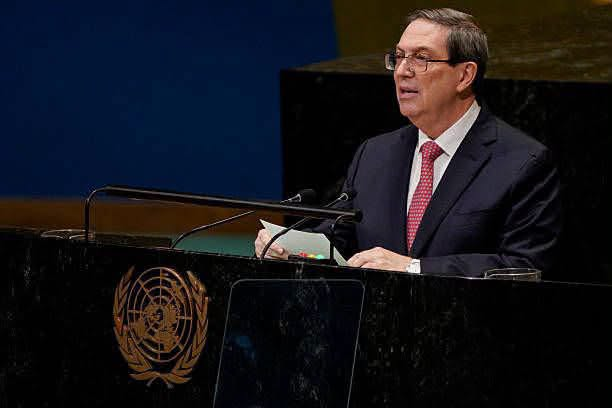
Mr. President of the General Assembly;

Madam Deputy Secretary-General:

In approximately three hours, exactly 66 years will have elapsed since Commander in Chief Fidel Castro Ruz, in a memorable speech from this rostrum, said, and I quote: “Let the philosophy of plunder disappear, and the philosophy of war will have disappeared! Let the colonies disappear; let the exploitation of countries by monopolies disappear; and then humanity will have reached a true stage of progress!”.

However, the advance of expansionism, usurpation, conquest as well as military and economic aggressions are alarming. The US government aspiration to impose peace through force is absurd and unrealizable. The fundamental pillars of International Law and the United Nations Organization, such as the sovereign equality among States, are under permanent attack.

The genocidal crime of Zionism against the Palestinian people; the pirate attacks against vessels and the extrajudicial executions in the Caribbean Sea and some areas in the Pacific; the military aggression against the Bolivarian Republic of Venezuela and the war against the Islamic Republic of Iran are new expressions of this atrocity.

They are also a reflection of the crisis of identity and relevance imposed on this United Nations Organization, and even on the General Assembly, the most universal, democratic and representative body of the international community.

We are convinced of the indispensable need to preserve and strengthen the United Nations, as we make it more democratic and effective; and of placing it closer to the peoples.

As is well known, in Cuba we are facing a multidimensional aggression from the United States government; a permanent, abusive and ruthless hostility that has lasted for almost seven decades already. Since January, 2026, this aggression has strengthened and become crueler and more dangerous, with the imposition of an energy blockade that, by resorting to intimidation and coercion, prevents any country from exporting fuel to Cuba -an equivalent to a naval blockade-, which is classified by International Law as an act of war.

Through the adoption of successive measures, the government of the United States has been applying new prohibitions on all countries with regard to products and services that cannot be exported or transported to Cuba. More than 7 thousand containers remain stranded in different ports; many of them are loaded with foodstuffs, medicines and medical devices or have even been paid for by Cuban private companies.

It is an unusual and unprecedented action. A superpower unilaterally deprives all States of their right to export the commodities that they wish to the country that they wish and continuously and comprehensively violates freedom of trade and navigation.

Added to this is the intimidation of entrepreneurs of different countries so that they abandon, against their will, their investments and businesses in Cuba; the obstacles and tricks to prevent the arrival of absolutely legitimate commercial shipments; the pressures to prevent the entry of visitors and tourists; and the efforts aimed at restricting as much as possible Cuba’s legitimate access to financing, technology and markets.

The United States has gone as far as to exert unsuspected pressures on sovereign governments so that they renounce the medical services they requested from us for the benefit of their respective populations and which are offered altruistically by Cuban professionals, because the US government is opposed to such cooperation, regardless of the impact and harm this may cause to those populations if they are deprived of free, quality medical care; that is to say, deprived of an elemental human right. On Thursday last, while this General Assembly was in session, the State Department convened a humiliating meeting, specifically with the States that are the recipients of this cooperation, in order to exert pressure and make threats.

According to the Secretary of State, the US official policy is to shut down every relief valve, block every possible way out and eliminate any form of survival for Cuba.

The impact of such an iron-clad and ruthless siege has a human face. The economic warfare is aimed against the people. It harms the Cuban people as a whole. It takes a toll on human lives. It causes individual and collective pain; it causes anguish. It is not “collateral damage”. It is a policy deliberately designed to wound the deepest sensibilities of Cuban families; disturb their wellbeing and hurt the dignity of the people.

It is an act of collective punishment; a crime proscribed by International Humanitarian Law. The obvious short-term goal pursued by such policy is to induce a humanitarian crisis in Cuba, which is also a crime.

The government of the United States and the US State Department have been forced to recognize the suffering inflicted on the Cuban people, but they have the impudence and cynicism to insist in putting the blame on the government of Cuba. The executioner blames the victim.

They are following the formula recommended by the State Department since 1960 in the infamous Mallory Memorandum, which established as an official policy, [in] force up until today, the overthrowing of the Cuban government through the economic suffocation and the extreme suffering of the Cuban people out of material shortages, hunger and desperation.

A few days ago, the President of the United States declared in this podium that Cuba was ‘a failed State’. If that were the case, why did they have to impose a fuel blockade? Why did they impose secondary sanctions? Why do they have to threaten, persecute and exert pressures on every State on the planet? He also recognized that his government is putting on Cuba the biggest pressure ever applied against any other State. A few months before, he had said that “all that is left is to go in and destroy everything.”

The threat of the use of military force against Cuba persists. This behavior is a violation of International Law and an infringement of the San Francisco Charter.

Should it materialize, it would be a major crime. It would cause the death of Cuban and American youths as well as huge destruction. We expect it never happens. Cuba will exercise, with utmost resolve and energy, its legitimate right to defend itself. This aggression is being accompanied by a brutal media and cognitive warfare aimed, not only against the Cuban people, but also against the US citizens and the international public opinion. It is characterized by its gross and brazen attempts to interfere in the internal affairs of Cuba, which likewise is another international crime.

We are often asked what is the US pursuing with such an aggressive behavior, and the question usually surprises us, because the representatives of that government have outrightly declared their purpose to take Cuba, control the country and dominate the economy. In other words, nullify, through an aggression or economic suffocation, the national sovereignty which several generations of Cubans have struggled for since the nineteenth century -first to achieve it, and later on, after conquering the full freedom in 1959, to tenaciously defend it against the biggest risks, including that of a holocaust.

The US behavior relies on the fallacy, proclaimed early on this year, that Cuba is an unusual and extraordinary threat to the national security and the foreign policy of the United States -a nonsense shamelessly repeated by that government. In a futile attempt to substantiate such an assertion, the US government inundates its huge communication platforms with false claims using the spokespersons and publications it hires and pays, taking advantage of the increasing control exercised by its government over them. The US President himself repeated it a few days ago in this room.

Any minimally informed observer would understand the unrealistic and evil intention to portray a relatively small and developing nation like Cuba, with a modest economic performance, as a threat to the biggest nuclear, military, technological and economic power in the planet.

This Organization and its member States have abundant evidence of the fact that we are a peace-loving country; of the efforts of Cuba in favor of international cooperation, understanding and the peaceful settlement of disputes as well as of the active role that we have played in support of the United Nations.

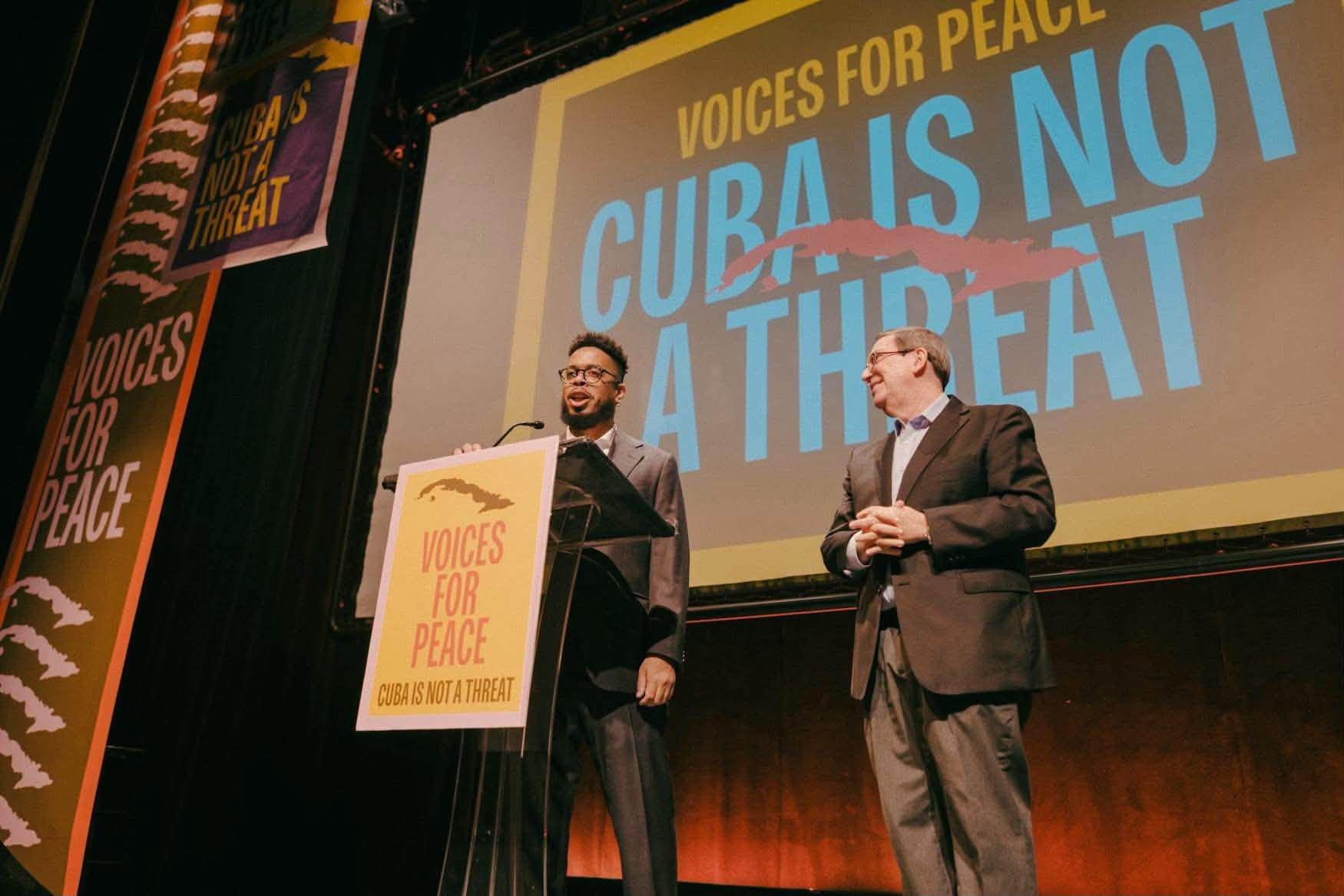
Cuba is not a threat, the blockade is!

Cuba is not a threat; the blockade certainly is!

We have always been and we will continue to be ready to engage in a dialogue with the government of the United States to try to find a solution to bilateral differences, on the basis of responsibility, respect, sovereign equality, the observance of International Law, without any interference in the internal affairs of States and without preconditions.

We are open to trade and business relations with United States companies, just as we are with those of any other country.

We are aware of the immense challenge our country faces in terms of its security, survival, the wellbeing of the people and the destiny of the homeland. We are not facing this challenge passively. We are doing it firmly and with dignity. Based on that, we are moving on in a process of changes that would lead to profound transformations of the economic and social model of the country, based on our historical experience.

On July 30 last, during the Seventh Session of the National People’s Power Assembly, President Miguel Díaz-Canel said: “In view of the complex situation I have described, how can we prevail in the construction of socialism? How could we find the material and financial resources needed to preserve the social achievements attained by the Revolution? As it already happened on former occasions, when we were faced with particularly complex situations -such as the Special Period-; when, under the guidance, first of Commander in Chief, and later of Army General Raúl Castro, the economic model was transformed to adapt it to the challenging foreign circumstances demanded by the times, under the leadership of the Party, in a collective and democratic way, in consultation with the people, without compromising the independence, the national sovereignty or the social achievements of the Revolution”, end of quote.

At that session, the National People’s Power Assembly adopted a new program, with new practices, actors and economic concepts. All of that is being done in accordance with the Constitution in force -. which was adopted through a free and universal referendum- and the conception of our socialist State of law and social justice.

As was pointed out by the leader of the Cuban Revolution, Army General Raúl Castro Ruz, the most important thing will be, and I quote: “the appropriate and timely implementation process, with well-defined priorities and the conscious participation of the people.”

This process relies on the strengths that we have built; the potential of our human resources and the determination to respond to the needs of the people with the greatest possible social justice, without ceasing in our efforts to defend, with utmost vigor and resolve, the sovereignty and the right to self-determination.

We know that we count on the support of the international community and the solidarity of millions, among them, an increasing number of US citizens.

That is reflected in the numerous gestures and statements in support of Cuba and against the abusive aggression. It is reflected in the fraternal material assistance received by our people, seeking to mitigate the huge damage caused to the Cuban economy and society.

That spirit of solidarity and empathy is also expressed with particular special emphasis among Cubans who reside permanently or temporarily outside the national territory and among their descendants, particularly here in the United States.

Mr. President;

We reject the Monroe Doctrine and its Corollaries as much as we refuse every attempt of imperialist militarization, intervention or domination in Latin America and the Caribbean, a region that was proclaimed as a Zone of Peace in 2014, precisely in Havana.

As a Small Island Developing State, we stand in solidarity with our brothers and sisters who share a similar condition and with their warning about the worrying and inexorable advance of climate change.

It is necessary to promote a governance that makes a more intensive use of the new ICTs, particularly the disruptive technologies, such as artificial intelligence.

We reject the implementation of unilateral coercive measures. We express our support to and solidarity with each and every nation which are victim of them.

We ratify our solidarity with the Government of National Reconciliation and Unity of Nicaragua.

We reiterate our support to the inalienable right of the people of Puerto Rico to self-determination and independence.

The sister nations of Africa and the Caribbean deserve a fair and differentiated treatment, as well as the reparations for the horrors of colonialism and the transatlantic slave trade.

We reaffirm our solidarity with the Saharan people and their right to self-determination.

We ratify our support to the “One China” principle.

We strongly believe that the current trend of international relations of disrespect for International Law and the United Nations, the imposition of the unilateral will of the mightiest over other countries by means of intimidation and coercion, is dangerous and unsustainable. The law of the jungle cannot be the future of humanity.

To prevent those practices, in addition of promoting peace and justice, the preceding generations founded the United Nations and for decades developed and tried to enrich its activity. Let us recover its role today, when we are perhaps in time to do so, before the Organization goes down in history as an unrealized dream of great promises.

In the year of the centennial birthday of Fidel Castro Ruz, the historical leader of the Cuban Revolution, let us be confident, as he was, that if we struggle with resolve, a better world will be possible.

Homeland or Death!

We Shall Overcome!

https://news.un%5Bdot%5Dorg/en/story/2026/09/1168458 — video

https://www.facebook%5Bdot%5Dcom/CubaMINREX/posts/-statement-by-he-mr-bruno-rodr%C3%ADguez-parrilla-minister-of-foreign-affairs-of-the-/1538902638275672/

Also
https://www.c-span%5Bdot%5Dorg/program/washington-journal/cuban-deputy-foreign-minister-carlos-fernndez-de-cosso-on-us-cuba-relations/685796
Cuban Deputy Foreign Minister Carlos Fernández de Cossío talked about the Trump administration’s approach to U.S.-Cuba relations, September 27, 2026
Why does the West hate North Korea?

That the Russians and Chinese have joined the US in [imposing sanctions] instead of calling for sanctions against the US for its threats against the DPRK and its new military exercises which are a clear and present danger to the DPRK is shameful. If the Russians and Chinese are sincere why don’t they insist that the US draw down its forces there so the DPRK feels less threatened and take steps to guarantee the security of the DPRK?  They do not explain their actions but their actions make them collaborators with the USA against the DPRK.”

— Christopher Black, international attorney

By Andre Vltchek

Global Research, March 08, 2016

New sanctions, and once again, new US-ROK military exercises right next door; new intimidations and new insults. For no other reason than because the country that never attacked anyone, is still determined to defend itself against appalling military, economic and propaganda provocations.

How much more can one country endure?

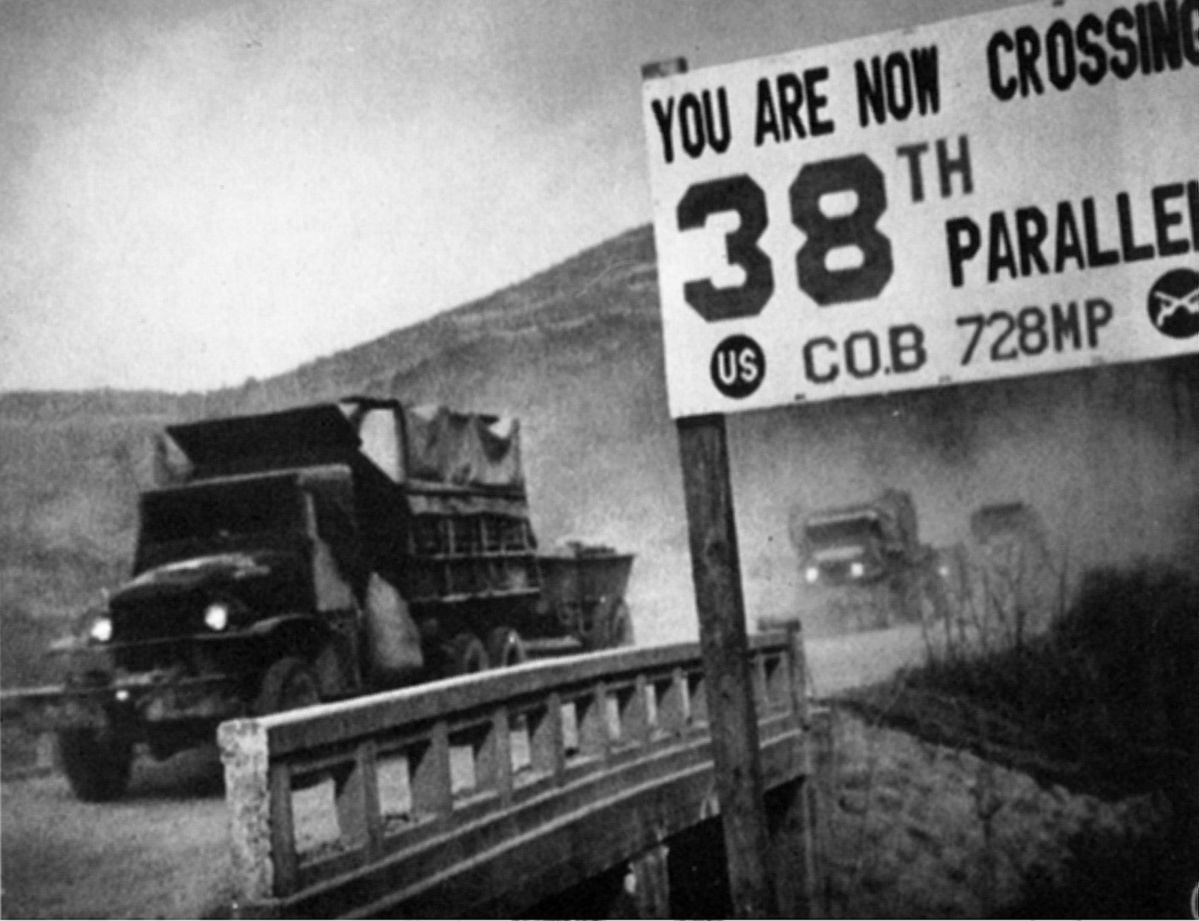
More than 60 years ago, millions of people above the 38th parallel died, were literally slaughtered by the US-led coalition.

After that, after its victory, the North Korea was never left in peace. The West has been provoking it, threatening it, imposing brutal sanctions and of course, manipulating global public opinion.

Why? There are several answers. The simple one is: because it is Communist and because it wants to follow its own course! As Cuba has been doing for decades… As several Latin American countries were doing lately.

But there is one more, much more complex answer: because the DPRK fought for its principles at home, and it fought against Western imperialism abroad. It helped to liberate colonized and oppressed nations. And, like Cuba, it did it selflessly, as a true internationalist state.

African continent benefited the most, including Namibia and Angola, when they were suffering from horrific apartheid regimes imposed on them by South Africa. It goes without saying that these regimes were fully sponsored by the West, as was the racist madness coming from Pretoria (let us also not forget that the fascist, apartheid South Africa was one of the countries that was fighting, on the side of the West, during the Korean War).

The West never forgot nor ‘forgave’ the DPRK’s internationalist help to many African nations. North Korean pilots were flying Egyptian fighter planes in the 1973 Arab-Israeli War. The DPRK was taking part in the liberation struggle in Angola (it participated in combat operations, alongside the People’s Armed Forces for the Liberation of Angola (FAPLA)), it fought in Rhodesia, Lesotho, Namibia (decisively supporting SWAPO) and in the Seychelles. It aided African National Congress and its struggle against the apartheid in South Africa. In the past, it had provided assistance to then progressive African nations, including Guinea, Ethiopia, Zimbabwe, Mali and Tanzania.

The fact that people of the DPRK spilled their blood for freedom of the most devastated (by the Western imperialism) continent on earth – Africa – is one of the main reasons why the West is willing to go ‘all the way’, trying to “punish”, systematically discredit, even to liquidate this proud nation. The West is obsessed with harming North Korea, as it was, for decades, obsessed with destroying Cuba.

The West plundered Africa, an enormous continent rich in resources, for centuries. It grew wealthy on this loot. Anybody who tried to stop it, had to be liquidated.

The DPRK was pushed to the corner, tormented and provoked. When Pyongyang reacted, determined to protect itself, the West declared that defense was actually “illegal” and that it represented true “danger to the world”.

The DPRK refused to surrender its independence and its path – it continued developing its defensive nuclear program. The West’s propaganda apparatus kept going into top gear, spreading toxic fabrications, and then polluting entire Planet with them. As a result, entire world is convinced that the “North Korea is evil”, but it has absolutely no idea, why? Entire charade is only built on clichés, but almost no one is challenging it.

Christopher Black, a prominent international lawyer based in Toronto, Canada, considers new sanctions against the DPRK as a true danger to the world peace:

 “Chapter VII of the UN Charter states that the Security Council can take measures against a country if there is a threat to the peace and this is the justification they are using for imposing the sanctions. However, it is not the DPRK that is creating a threat to the peace, but the USA which is militarily threatening the DPRK with annihilation. The DPRK has clearly stated its nuclear weapons are only to deter an American attack which is the threat to the peace.

The fact that the US, as part of the SC is imposing sanctions on a country it is threatening is hypocritical and unjust. That the Russians and Chinese have joined the US in this instead of calling for sanctions against the US for its threats against the DPRK and its new military exercises which are a clear and present danger to the DPRK is shameful. If the Russians and Chinese are sincere why don’t they insist that the US draw down its forces there so the DPRK feels less threatened and take steps to guarantee the security of the DPRK?  They do not explain their actions but their actions make them collaborators with the USA against the DPRK.”

US/NATO Threatens the DPRK, China and Russia’s Far East

The US/NATO military bases in Asia (and in other parts of the world) are actually the main danger to the DPRK, to China and to the Russian “Far East”.

Enormous air force bases located in Okinawa (Kadena and Futenma), as well as the military bases on the territory of the ROK, are directly threatening North Korea, which has all rights to defend itself and its citizens.

It is also thoroughly illogical to impose sanctions on the victim and not on the empire, which is responsible for hundreds of millions of lost human lives in all corners of the Globe.

Andre Vltchek is a philosopher, novelist, filmmaker and investigative journalist. He covered wars and conflicts in dozens of countries. His latest books are: “Exposing Lies Of The Empire” and  “Fighting Against Western Imperialism”.  Discussion with Noam Chomsky: On Western Terrorism. Point of No Return is his critically acclaimed political novel. Oceania – a book on Western imperialism in the South Pacific. His provocative book about Indonesia: “Indonesia – The Archipelago of Fear”. Andre is making films for teleSUR and Press TV. After living for many years in Latin America and Oceania, Vltchek presently resides and works in East Asia and the Middle East. He can be reached through his website or his Twitter.

The US is juggling chaos and coordination in order to contain China

An exceptional, in-depth article on the threats to China, and the U.S. involvement.

From Oriental Review.org
By Andrew Korybko
March 16, 2015

It’s no secret by now that the US is dead set on containing China, yet it’s shying away from engaging in a direct confrontation with it. Instead, the US is managing a dual policy of creating chaos along China’s western and southwest reaches, while coordinating a containment alliance along its southeastern and northeastern periphery. Central Asia, northeast India, and Myanmar represent the chaos components, while the ‘unsinkable aircraft carriers’ of Japan and the Philippines are the coordinated ones. In this manner, the US is literally surrounding the country with hostile situations and states (with the obvious exception being the Russian frontier), hoping that this can disorient China’s decision makers and consequently pave the way for the external destabilization to infiltrate inwards. Amidst all this plotting, China isn’t sitting on its hands and behaving passively, since it has three specific strategies in mind to break the Chinese Containment Coalition (CCC) and counter the US’ Pivot to Asia.

Cultivating Chaos

The western and southwestern strategy of the CCC is to create a destabilized ‘rimland’ capable of infecting China’s vulnerable peripheral provinces with contagious chaos. This section examines how American grand strategy in Central and West Southeast Asia is designed to do just that, while a previous publication by the author already explored the prospects of a chain reaction of Color Revolutions emanating from Hong Kong.

Turkmenistan:
The Central Asian ‘hermit state’ is identified as the country most vulnerable to a transnational Taliban offensive sometime in the future. Should this come to pass and the country is not properly prepared to defend itself, then the disastrous consequences would immediately spread to Russia, Iran, and China, as was explained in a previous article by the author. Pertaining to the latter, this involves the massive destabilization of China’s regional gas imports from its largest current supplier, which would of course have negative reverberations in Xinjiang, the ultimate target of the US’ Central Asian chaos policies as they apply to the People’s Republic. The more endangered and insecure China’s continental energy imports are, the more reliant the country becomes on receiving them via maritime channels, which given the US’ naval superiority, places them directly under Washington’s control in the event of a crisis.

Kyrgyzstan:
The chaotic threat originating in Kyrgyzstan is more tangible than the one in Turkmenistan, as the Map_of_Central_Asiamountainous republic directly abuts Xinjiang. When looking at the US’ destructive Central Asian strategy, it becomes evident that it has an interest in ushering in the collapse of the Kyrgyz government via a new Color Revolution in order to, among other things, create an Uighur terrorist haven that can enflame the externally directed ethno-religious insurgency against Beijing. From the perspective of American foreign policy, then, a crisis in Kyrgyzstan is a geopolitical lever that can be ‘pulled’ to activate more instability in Xinjiang, with the aim of potentially luring the People’s Liberation Army into a quagmire. In the general scheme of things, both Central Asian republics, Turkmenistan and Kyrgyzstan, are essentially anti-Chinese weapons waiting to be (de)constructed by the US for use against the strategic province of Xinjiang, with Uzbekistan also playing a similar role if it implodes (or is prodded to do so by the US).

Northeast India:
In this corner of India, which could culturally be considered the northwestern fringe of Southeast Asia, the myriad ethnic tensions and bubbling insurgencies there could make the leap from being a domestic to an international crisis. The author previously assessed that one of the repercussions of last year’s Bodo-inspired violence was to destabilize the proposed Bangladesh-China-India-Myanmar (BCIM) trade corridor, which would negatively affect Beijing’s plans for a ‘Bay of Bengal Silk Road’. Internationalizing the situation, however, could see ethnic warfare emboldening militant non-state actors in Myanmar, with the end goal that they finally destabilize Yunnan Province, the most culturally diverse area in China that has even been liked to “a perfect microcosm” of it. Although there is no evidence that has yet been procured to suggest that the US played any role in instigating the latest violence in Assam, it doesn’t mean that it can’t do so in the future, especially now that the die of ethnic tension has already been cast. This Damocles’ Sword is continually hanging over the head of India’s decision makers, since they understand that it can be applied against them in the event that they resist Washington’s pressure to commit more closely to the Chinese Containment Coalition (CCC).

Myanmar:
The greatest conventional threat to China along its southern edge (notwithstanding a hostile India) lies in the overspill of ethnic warfare from Myanmar into Yunnan. This is actually already happening, since the recent violence in Kokang (Shan State) has forced thousands from their homes and into China as refugees, where they are reportedly being seen as ‘burdensome’ to the authorities. Quite obviously, China comprehends the vulnerabilities of Yunnan to Xinjiang-like external destabilization, albeit manifested in a different manner, hence its sensitivity to what may be the reignition of Myanmar’s civil war. After all, the unexpected outbreak of violence has yet again delayed the country’s long-awaited peace talks from being concluded, which were reportedly set to be finalized prior to this.

Now, however, other ethnic groups have become emboldened by the clashes, and are sending their own fighters and mercenaries to Kokang, which has also been put under martial law. It now looks like the fragile nationwide peace process is on the verge of being completely shattered, and the fighting may spread to other ethnic regions if their respective militias decide to take advantage of any perceived government setbacks in Kokang to launch their own offensives. All of this would lead to the deterioration of Yunnan’s security and the influx of thousands of more refugees, some of whom may even be militant-affiliated and intent on starting their own uprisings inside China. It is this factor that scares Beijing the most, namely, that Yunnan’s jungles could one day become home to Xinjiang-like fighters intent on throwing another corner of the country into chaos.

Chaotic Patterns:
Making sense out of this grand chaos is the fact that it does follow some semblance of order in terms of US strategy. The countries in focus are along China’s western and southwestern edge, which is already j09-xinj-340ripe for ethnic provocations. Additionally, two of the states abutting the targeted provinces, Kyrgyzstan for Xinjiang and Myanmar for Yunnan, are inherently unstable for their own reasons, thus making them ‘ticking time bombs’ that could be prodded by the US to explode on China’s doorstep. As regards Turkmenistan, Uzbekistan, and northeast India, their destabilizations are tripwires for the two main ‘bombs’, Kyrgyzstan and Myanmar, although the disruption of any of the three aforementioned areas does undermine China in its own right. In short, this vector of American grand strategy is aimed at the destruction of key peripheral states surrounding China in order to chip away at the strength of the central government along its own peripheral areas, two of which (Xinjiang and Yunnan) are susceptible to outside-directed destabilization aimed at ethnic agitation.

Coordinating Containment

On the other side of China, the US is crafting a Chinese Containment Coalition (CCC) to confront Beijing and provoke it into a Reverse Brzezinski intervention in the South China Sea (if it isn’t dragged into one in Myanmar first). Japan and the Philippines are the centerpieces of this strategy, and South Korea and Vietnam are envisioned as playing crucial roles as well. Let’s take a look at Washington’s plans for each highlighted country, as well as how they all fit together into the bigger picture:

Continue reading →

UN Resolution 2131 — On the Inadmissibility of Intervention in the Domestic Affairs of States and the Protection of Their Independence and Sovereignty; Adopted by General Assembly, 21 December, 1965

United Nations A/RES/20/2131  

General Assembly

Distr: General 21 December 1965


Twentieth session
Agenda item 107

Resolution adopted by the General Assembly

 2131 (XX). Declaration on the Inadmissibility of Intervention in the Domestic Affairs of States and the Protection of Their Independence and Sovereignty

The General Assembly,Deeply concerned at the gravity of the international situation and the increasing threat to universal peace due to armed intervention and other direct or indirect forms of interference threatening the sovereign personality and the political independence of States,

Considering that the United Nations, in accordance with their aim to eliminate war, threats to the peace and acts of aggression, created an Organization, based on the sovereign equality of States, whose friendly relations would be based on respect for the principle of equal rights and self-determination of peoples and on the obligation of its Members to refrain from the threat or use of force against the territorial integrity or political independence of any State,

Recognizing that, in fulfilment of the principle of self-determination, the General Assembly, in the Declaration on the Granting of Independence to Colonial Countries and Peoples contained in resolution 1514 (XV) of 14 December 1960, stated its conviction that all peoples have an inalienable right to complete freedom, the exercise of their sovereignty and the integrity of their national territory, and that, by virtue of that right, they freely determine their political status and freely pursue their economic, social and cultural development,

Recalling that in the Universal Declaration of Human Rights the General Assembly proclaimed that recognition of the inherent dignity and of the equal and inalienable rights of all members of the human family is the foundation of freedom, justice and peace in the world, without distinction of any kind,

Reaffirming the principle of non-intervention, proclaimed in the charters of the Organization of American States, the League of Arab States and the Organization of African Unity and affirmed at the conferences held at Montevideo, Buenos Aires, Chapultepec and Bogotá, as well as in the decisions of the Asian-African Conference at Bandung, the First Conference of Heads of State or Government of Non-Aligned Countries at Belgrade, in the Programme for Peace and International Cooperation adopted at the end of the Second Conference of Heads of State or Government of Non-Aligned Countries at Cairo, and in the declaration on subversion adopted at Accra by the Heads of State and Government of the African States,

Recognizing that full observance of the principle of the non-intervention of States in the internal and external affairs of other States is essential to the fulfilment of the purposes and principles of the United Nations,

Considering that armed intervention is synonymous with aggression and, as such, is contrary to the basic principles on which peaceful international cooperation between States should be built,

Considering further that direct intervention, subversion and all forms of indirect intervention are contrary to these principles and, consequently, constitute a violation of the Charter of the United Nations,

Mindful that violation of the principle of non-intervention poses a threat to the independence, freedom and normal political, economic, social and cultural development of countries, particularly those which have freed themselves from colonialism, and can pose a serious threat to the maintenance of peace,

Fully aware of the imperative need to create appropriate conditions which would enable all States, and in particular the developing countries, to choose without duress or coercion their own political, economic and social institutions,

In the light of the foregoing considerations, solemnly declares:

1.No State has the right to intervene, directly or indirectly, for any reason whatever, in the internal or external affairs of any other State. Consequently, armed intervention and all other forms of interference or attempted threats against the personality of the State or against its political, economic and cultural elements, are condemned.

2.No State may use or encourage the use of economic, political or any other type of measures to coerce another State in order to obtain from it the subordination of the exercise of its sovereign rights or to secure from it advantages of any kind. Also, no State shall organize, assist, foment, Finance, incite or tolerate subversive, terrorist or armed activities directed towards the violent overthrow of the regime of another State, or interfere in civil strife in another State.

3.The use of force to deprive peoples of their national identity constitutes a violation of their inalienable rights and of the principle of non-intervention.

4.The strict observance of these obligations is an essential condition to ensure that nations live together in peace with one another, since the practice of any form of intervention not only violates the spirit and letter of the Charter of the United Nations but also leads to the creation of situations which threaten international peace and security.

5.Every State has an inalienable right to choose its political, economic, social and cultural systems, without interference in any form by another State.

6.All States shall respect the right of self-determination and independence of peoples and nations, to be freely exercised without any foreign pressure, and with absolute respect for human rights and fundamental freedoms. Consequently, all States shall contribute to the complete elimination of racial discrimination and colonialism in all its forms and manifestations.

7.For the purpose of the present Declaration, the term “State” covers both individual States and groups of States.

8.Nothing in this Declaration shall be construed as affecting in any manner the relevant provisions of the Charter of the United Nations relating to the maintenance of international peace and security, in particular those contained in Chapters VI, VII and VIII.

1408th plenary meeting
21 December 1965