From Global Research
By S. Brian Willson
Originally published in 2001: When will the United States apologize for its war crimes?
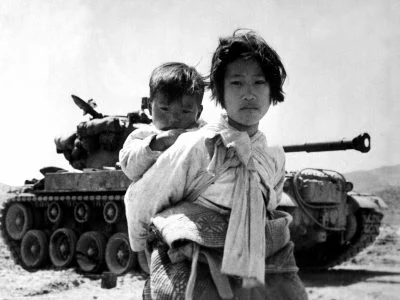
U.S. President Clinton’s recent refusal to explicitly apologize for the murder of Korean civilians by U.S. military forces during the Korean War is another lost moment of desperately needed “American” honesty.
*
The United States inquiry, and Clinton’s statement of mere “regret,” was focused on only one crime scene at a particular location. It implied that the deaths were merely unfortunate rather than part of a systematic pattern that cumulatively murdered as many as three million civilians. Careful examination of the empirical record reveals multiple dozens, perhaps a couple hundred, massacre sites at various locations throughout the entire Korean Peninsula. The suggestion of malicious intent is incontrovertible. There was an overwhelming pattern of systematic targeting the Korean people, with no serious effort to distinguish “civilians” from “combatants.”
This should come as no surprise! Beginning in 1945 the U.S. record in Korea is horrendous! It would behoove our political leaders, and academicians, to learn an authentic history of Korea. Simply relying on popular comic book demonization of North Koreans without recognizing the U.S. role in creating the conditions that led to the war in the first place continues a tragic disservice to history. When the Japanese were finally defeated on August 15, 1945, the vast majority of the people who resided on the Korean Peninsula immediately began to celebrate, then organize for a return to Korean sovereignty after 40 years of hated foreign occupation. When the U.S. immediately insisted on creating the peninsula as a Cold War arena with the Russians, people throughout Korea organized resistance, at first nonviolent, later in the form of a guerrilla war. The U.S. created a puppet government, similar to what it later did in Vietnam, and between 1945-1950 oversaw the systematic repression and murder of hundreds of thousands of Koreans who rightfully demanded independence. That U.S. military and political policy to this day does not understand this fundamental Korean history continues one of the most tragic chapters of the Twentieth Century.
During the Korean “hot” war, General Douglas MacArthur ordered the U.S. Air Force to “destroy every means of communication, every installation, factory, city, and village” south of the Yalu River boundary with China. Massive saturation bombings alone, especially with napalm and other incendiaries, murdered perhaps 2.5 million civilians. Major General William B. Kean of the 25th Infantry Division ordered “civilians in the combat zone” to be considered enemies. The famous July 25, 1950 Fifth Air Force memorandum to General Timberlake declared that adherence to Army orders to “strafe all civilian refugees [have been] complied with.” USA Today (Oct. 1, 1999) and the New York Times (Dec. 29, 1999) reported from declassified U.S. Air Force documents the “deliberate” strafings and bombings of Korean “civilians” and “people in white.” In the August 21, 1950 issue of Life, John Osborne reported that U.S. officers ordered troops to fire into clusters of civilians.
U.S. racism has been an unfortunate but tragic feature (along with arrogant ethnocentrism) of the origins of the U.S. American Republic. This institutionalized racism has substantially contributed to the cruelty of a long imperial history under the rubric of “American Manifest Destiny” that has engineered well over 400 overt military, and as many as 6,000-10,000 covert, interventions in over 100 countries. Directed toward the Korean (and later Vietnamese) people, who we regularly called “gooks,” racism helped justify commission of a gruesome, almost unlimited and careless war. In Korea this included use of germ warfare and the regular threat of dropping nuclear bombs. The highest law officer in the land, President Truman’s second Attorney General, J. Howard McGrath, referred to the Koreans as “rodents.” During World War II, massive saturation bombings in Germany and Japan had been conducted with no pretense of striking only military targets. This precedent legitimized bombing with no concern for civilians, despite explicit prohibition by the U.S. Field Manual 27-10 Rules of Land Warfare. Such indiscriminate saturation bombings were routinely and relentlessly continued in Korea.
The roots of U.S. racism are deep and historic. The defining and enabling experience of the Republic of the United States of America continues to be the genocidal elimination of the human beings who originally lived on our lands. Eurocentric racism and so-called divinely inspired ethnocentrism have been inherent characteristics facilitating the “development ” of our civilization. This development has been accomplished through a long history of exploitation of land, labor, and natural resources that first began on the North American Continent, but now stretches to every corner of the globe.
In the early 1600s Captain John Smith of the Virginia colony referred to our original inhabitants as “subanimals” and “beasts” worthy only of “extermination.” Puritan leader John Endecott of the Massachusetts Bay Colony regularly ordered “death” to the Pequot Indians. Our founding document, the Declaration of Independence, refers to our original inhabitants as “merciless savages” and George Washington termed them “beasts of prey” to be “destroyed.” European settlers regularly called them “brutes” or “vermin” to be “destroyed.” General William Tecumseh Sherman in the 1870s ordered “extermination” as the “final solution” to the “Indian problem.”
During what we call the Spanish-American War U.S. forces fought against Filipino citizens, calling them “goo-goos,” while murdering upwards of a half million of them under orders such as “burn and kill the natives” issued by General Jacob H. (“Hell-Raising”) Smith to U.S. Marines.
Lyman Frank Baum, author of the ever popular The Wonderful Wizard of Oz (1900), called for the “annihilation” of all Native Americans.
Another name for our racism is native-hating, whether “Redskins,” “Niggers,” “Chinks,” “Japs,” “Greasers,” “Dagoes,” “Wops,” – or “Gooks.” The fact is that from the very beginning the people whom our European ancestors were demonizing, both here and abroad, were real human beings, tragically caught in the path of merciless “American Manifest Destiny.” Under any legal or moral definition, virtually all would be considered “civilians,” until some chose to defend their sovereignty and land from the invaders and exploiters from the West in which case they became “combatants.”
With the advent of aerial bombings during World War I, the number of civilians murdered in war dramatically increased. The bombing of civilian targets by U.S. forces preceded similar crimes by Italy in Ethiopia in 1936-37 and Germany in Guernica, Spain in 1937. The U.S. used aerial bombings in Haiti in 1919 and Nicaragua in 1927 in efforts to rout native people resisting U.S. occupation forces, murdering countless civilians in the process, always disregarding the cries of the people for due recognition. The stage was set for the massive indiscriminate bombings of World War II, Korea, Vietnam, Iraq, and Serbia/Kosovo.
This cultural trait also contributes to a long pattern of misrepresentations and out-and-out lies. For example, in 1973, as part of the Paris Peace Accords ending the U.S. War against Vietnam, Henry Kissinger, representing President Nixon, promised the Vietnamese over $4 billion in reparations as part of the cease-fire agreement. The United States dishonored that agreement, consistent with Native Americans’ long-standing conclusion that the “White Man speaks with forked tongue,” citing the U.S. government’s violation of each of the 400 treaties signed with the Indigenous.
President Clinton came close to apologizing to Guatemala in 1999 for the earlier decades-long role of the U.S. in supporting repressive forces that murdered over 200,000 Mayan Indians. He stated that U.S. policy was “wrong,” even as it continues to support economic policies destined to preserve miserable poverty there. Former U.S. Defense Secretary Robert McNamara confessed in his book, In Retrospect (1995), that what the U.S. did in Vietnam was “wrong,” though he did not acknowledge that we had violated moral or legal codes. When Clinton’s Defense Secretary William Cohen visited Vietnam in March 1999, he explicitly refused to apologize. Clinton, during his visit to Vietnam in November 1999, also failed to issue an apology or to explain why the reparations promised in 1973 have never been paid.
The question continues to beg: when will the United States ‘fess up to its long history of crimes against humanity, thereby revealing that a genuine humility has replaced U.S. arrogance? Failing that, the lives of all the people of the world, including our own, are endangered by an arrogance continually nourished by insidious racism that seeks to mercilessly spread its unwanted “neoliberal” values. The American Way Of Life (AWOL) inevitably creates rage among billions of people who resent the forced imposition of U.S. values and policies.
An apology by the United States, followed by an offer of appropriate reparations to the Korean people, would be a tremendous new omen for a peaceful world based on mutual respect and justice.
*
Brian Willson, Viet Nam veteran and trained lawyer, has been a lifelong critic of US domestic and foreign policy. His essays and biography are found at his website: brianwillson.com. His recent book, “Don’t Thank Me for My Service: My Viet Nam Awakening to the Long History of US Lies” is published by Clarity Press (2018). His psycho-historical memoir, “Blood on the Tracks: The Life and Times of S. Brian Willson” was published by PM Press (2011). A documentary, “Paying the Price for Peace: The Story of S. Brian Willson” was produced in 2016 by Bo Boudart Productions.
He is a Research Associate of the Centre for Research on Globalization (CRG).
Featured image: With her brother on her back a war weary Korean girl tiredly trudges by a stalled M-46 tank, at Haengju, Korea (Public Domain)
https://www.globalresearch.ca/when-united-states-apologize-war-crimes/5939653


