Origins of the American Empire: Rockefellers, Rothschilds, Revolution, World Wars and World Order

Why does the West fear Russia, communism, and socialism? 

Russia, then and now, constituted the greatest potential competitive threat to American industrial and financial supremacy.”

“The gigantic Russian market was to be converted into a captive market and a technical colony to be exploited by a few high-powered American financiers and the corporations under their control.”
— Antony Sutton

Global Research, July 28, 2009
28 July 2009
[PDF]
This essay is Part 2 of “Global Power and Global Government.” Part 1, “The Evolution and Revolution of the Central Banking System”  published by Global Research can be viewed here:

Russia, Oil and Revolution

By the 1870s, John D. Rockefeller’s Standard Oil Empire had a virtual monopoly over the United States, and even many foreign countries. In 1890, the King of Holland gave his blessing for the creation of an international oil company called Royal Dutch Oil Company, which was mainly founded to refine and sell kerosene from Indonesia, a Dutch colony. Also in 1890, a British company was founded with the intended purpose of shipping oil, the Shell Transport and Trading Company, and it “began transporting Royal Dutch oil from Sumatra to destinations everywhere,” and eventually, “the two companies merged to become Royal Dutch Shell.”[1]

Russia entered into the Industrial Revolution later than any other large country and empire of its time. By the 1870s, “Russia’s oil fields, including those in Baku, were challenging Standard Oil’s supremacy in Europe. Russia’s ascendancy in natural resources disrupted the strategic balance of power in Europe and troubled Britain.” Britain thus attempted to begin oil explorations in the Middle East, specifically in Persia (Iran), first through Baron Julius de Reuter, the founder of Reuters News Service, who gained exploration rights from the Shah of Iran.[2] Reuter’s attempt at uncovering vast quantities of oil failed, and a man named William Knox D’Arcy took the lead in Persia.

By the middle of the 19th century, “the Rothschilds were the richest family in the world, perhaps in all of history. Their five international banking houses comprised one of the first multinational corporations.” Alfonse de Rothschild was “heavily invested in Russian oil at least forty years before William Knox D’Arcy began tying up Persian oil concessions for the British. Russian oil, which in the 1860s was already emerging as the European rival to the American monopoly Standard Oil, was the Baron [Rothschild]’s pet project.” In the early 1880s, “almost two hundred Rothschild refineries were at work in Baku,” Russia’s oil rich region.[3]

By the mid-1880s, “the Rothschilds were poised to become the chief oil supplier, not only to Europe but to the Far East,” however, “the Baku-Batum railroad was already proving inadequate to transport the volume of oil being produced. Another route was needed, and came in the form of the recently opened Suez Canal, which shortened the journey to the Far East by four thousand miles. Palestine was suddenly of interest to the Rothschilds as it provided access to the Suez.”[4] When the Egyptian government was bankrupt in 1874, British Prime Minister Benjamin Disraeli turned to his close friends, the Rothschilds, “for the colossal cash advance necessary” to buy shares in the Suez Canal Company.[5] By this time, the Rothschilds were already principle shareholders in the Bank of France,[6] and the Bank of England, sitting alongside other notable shareholders such as Baring Brothers, Morgan Grenfell and Lazard Brothers.[7]

The Rothschilds “had long been involved in developing Czarist Russia’s nascent industry and banking system, while that country’s growing network of railroads was largely financed by Rothschild-managed loans.”[8] When the Czar died, he was succeeded by his son, Czar Nicholas II, who instituted anti-Semitic pogroms, discriminating against Jews, which had the effect of stimulating a massive emigration of Jews out of Russia and Eastern Europe and into Western Europe. However, these East European and Russian Jewish émigrés grew up in a newly industrializing nation in which the tyranny of the government and collusion between it and powerful financial and industrial interests left the great majority of people dispossessed and incited more socialist tendencies in thought and action.

The English Rothschilds were very alarmed “when the socialist tendencies of the émigrés contributed to a massively disruptive tailors’ strike in the East End of London in 1888. A young Georgian communist who would become known to the world as Joseph Stalin was already organizing laborers to strike at the Rothschild oil interests in Batum.” The British Rothschilds were very concerned with this wave of Jewish immigrants into Western Europe and Britain, as they were intensely anti-Czarist and progressively socialist, and the Rothschilds were known for their heavy collaboration with the Czarist regimes of Russia. One potential solution considered to the problem of increased socialist-leaning Jewish immigrants in Britain was to institute restrictions on immigration. However, this would likely backlash, in the sense that it would be viewed as comparable to expulsion. So, Edmond Rothschild began his personal campaign to create a Jewish homeland in Palestine in order to create a release valve for Jewish émigrés to put their political action behind a new cause, and to promote them emigrating to Palestine, and out of Western Europe.[9]

On top of this, as the pre-eminent Zionist in Britain, his proposal for the creation of a Jewish homeland in Palestine served major economic interests of the Rothschilds and of the British Empire, in that several years prior, Rothschild bought the Suez Canal for the British, and it was the primary transport route for Russian oil. Palestine, thus, would be a vital landmass as a protectorate for British and Rothschild imperial-economic interests.

The Rothschilds, despite their overtly pro-Zionist and pro-Jewish rhetoric, did not stop their support of the Russian regime and economic activities within anti-Semitic Russia. In 1895, the Rothschilds, then one of the world’s leading producers and distributors of oil, “had gone so far as to co-sign an agreement with rival producers – including America’s Standard Oil [of Rockefeller interests] – to divide up world markets. It never took effect, presumably because of the opposition of the Russian government.” In 1902, the Rothschilds “entered into a partnership with Royal Dutch and Shell (soon to become a single global company) to form the Asiatic Petroleum Company for exploiting the fields of Southern Russia.”[10]

In the early 1900s, the Rothchilds were the primary oil interests in Russia, second in the world only to the Rockefellers. As industrialization was under way, conditions worsened for the great majority of Russian people. This spurred protests and riots, and a “young Stalin himself led the agitation against the Caucasian oil industry in general, [and] the Rothschilds in particular. Mass action by oil workers in Baku [the major oil fields in Russia] in 1903 was the spark that set off the first general strike across the Russian landmass.” Then with the Russian loss in the Russo-Japanese War of 1904, and further protests, came the Revolution of 1905. In the following years, the Rothschilds sold their Russian oil interests to Royal Dutch Shell, gaining significant shares in the international oil company.[11]

The specter of political and social instability within Russia was high and did not go without notice from international banking, oil, and industrial interests. Naturally, the international banking houses were keeping a close eye on developments within Russia. The Rothschilds had to lessen their overt involvement with Russia, as they could not maintain such a relationship with the most anti-Jewish nation in the world at the time, while also claiming to be the primary advocates of Jewish aspirations for a homeland. This is why they sold their Russian oil interests to Royal Dutch Shell, but then gained significant shares in the company itself. So while publicly cutting their ties with Russia, they still held massive interests in its industrial capacity. Following the Russo-Japanese War, the Rothschilds “refused to participate in underwriting a major loan, this at a time when Russia desperately needed funds to stabilize the regime.”[12]

So, in 1906, John D. Rockefeller stepped in to aid Czarist Russia, and offered $200,000,000, or “400,000,000 rubles for a concession for railroads from Tashkend to Tomsk and from Tehita to Polamoshna and a grant of land on both sides of the prospective lines.”[13] These international financiers were still clearly intent upon maintaining their interests within Russia.

However, the Russian governments refusal to allow the deal between the Rockefellers and Rothschilds and other major oil monopolies to divide up the world’s oil reserves, may well have spurred discontent among these powerful interests. If Russia refused to allow them to control all the oil and have a right to all oil, did this mean that Russia was planning on building a domestic oil industry? If this were the case, it could pose a threat to all the entrenched economic and financial interests, particularly those of the Rockefellers and Rothschilds, as Russia’s significant oil reserves and resources would allow it to possibly even surpass the United States in industrialization. Further, Czarist Russia became an increasingly unstable investment environment, controlled by an increasingly unpredictable monarchy.

The 1917 October Revolution “inspired workers’ uprisings in the oil fields against low wages and harsh working conditions. In 1919, Azerbaijan took advantage of the political unrest to declare sovereignty over the Baku fields. That same year SONJ [Standard Oil of New Jersey] made an agreement with the Azerbaijani government to purchase undeveloped land for exploration in the Baku region. Amidst the chaos, foreign oil companies rushed into Russia hoping to collect concessions at reduced rates. The Nobel brothers sold much of their operations to SONJ (today ExxonMobil) to build an alliance in 1920.”[14]

Antony C. Sutton, economist, historian and author, as well as research fellow at Stanford University’s Hoover Institution, wrote in Wall Street and the Bolshevik Revolution, that both fascist and communist systems are “based on naked, unfettered political power and individual coercion. Both systems require monopoly control of society. While monopoly control of industries was once the objective of J.P. Morgan and J.D. Rockefeller, by the late nineteenth century the inner sanctums of Wall Street understood that the most efficient way to gain an unchallenged monopoly was to ‘go political’ and make society go to work for the monopolists,” and that, “the totalitarian socialist state is a perfect captive market for monopoly capitalists, if an alliance can be made with the socialist powerbrokers.”[15] Thus, the major money powers of the west decided to put their money behind the creation of a totalitarian communist state in Russia, in order to create a captive economy, which they could exploit and remove from competition.

When the Revolution began, Trotsky was in New York, and was immediately granted an American passport by President Wilson, and then given a Russian entry permit and a British transit visa, in order to return to Russia and “carry forward” the revolution.[16] Trotsky, while traveling, was arrested in Canada, but was released as a result of British intervention.[17]

Trotsky traveled on board a ship in 1917, leaving New York, along with an interesting cast of fellow passengers, including “other Trotskyite revolutionaries, Wall Street financiers, American Communists, and a man named Charles Crane. Charles Richard Crane, former chairman of the Democratic Party’s finance committee, whose son, Richard Crane, was an assistant to U.S. Secretary of State Robert Lansing, played a significant part in what occurred in Russia. Former U.S. Ambassador to Germany, William Dodd, said that Crane, “did much to bring on the [Alexander] Kerensky revolution which gave way to Communism.” Kerensky was the second Prime Minister in the Russian Provisional Government, which followed the collapse of the Czarist government, and preceded the Bolshevik. Crane also thought that the Kerensky government “is the revolution in its first phase only.”[18]

The Revolution occurred in the midst of World War I, which broke out in 1914, and had all the major European powers at war. Morgan and Rockefeller interests, organized in Wall Street and centralized in the Federal Reserve Bank of New York, the most powerful of all the regional Federal Reserve Banks, used “the Red Cross Mission as its operational vehicle” in Russia at the time of the Bolshevik Revolution. The Red Cross Mission in Russia got its endowment from wealthy people such as J.P. Morgan, Mrs. E. H. Harriman, Cleveland H. Dodge, and Mrs. Russell Sage, and “in World War I the Red Cross depended heavily on Wall Street, and specifically the Morgan firm.” When the American Red Cross set up a mission to Russia, “William Boyce Thompson, director of the Federal Reserve Bank of New York, had ‘offered to pay the entire expense of the commission’.”[19] All expenses were paid for by William Boyce Thompson, who was a major stockholder in Chase National Bank, whose President had Thompson appointed head of the New York Fed.[20]

The Mission was primarily made up of lawyers, financiers, their assistants, people affiliated with Standard Oil and the Rockefeller’s National City Bank.[21] The Mission supported through a loan, the Provisional government of Alexander Kerensky, yet, William B. Thompson of the New York Fed “made a personal contribution of $1,000,000 to the Bolsheviki for the purpose of spreading their doctrine in Germany and Austria.” Interestingly, when the Bolsheviks took control, “The National City Bank branch in Petrograd had been exempted from the Bolshevik nationalization decree – the only foreign or domestic Russian bank to have been so exempted.”[22] Ultimately, the Red Cross mission in Russia “was in fact a mission of Wall Street financiers to influence and pave the way for control, through either Kerensky or the Bolshevik revolutionaries, of the Russian market and resources.”[23]

The American International Corporation (AIC), was “created in 1915 to develop domestic and foreign enterprises, to extend American activities abroad, and to promote the interests of American and foreign bankers, business and engineering.” It was created and controlled by Morgan, Stillman and Rockefeller interests, and its directors were affiliated with National City Bank (Rockefeller), the Carnegie Foundation, General Electric, the DuPont family, New York Life Insurance, American Bankers Association and the Federal Reserve Bank of New York. Members of its board financially supported the Bolsheviks and urged the US State Department to recognize the Bolshevik government.[24]

In 1920, Russian gold was being siphoned through Sweden, where it was melted down and stamped with the Swedish mint, funneled through the Federal Reserve Bank of New York and into Kuhn, Loeb & Company and Guaranty Trust Company (Morgan), two of the primary banking interests behind the creation of the Federal Reserve System. [25] During the civil war in Russia between the Reds and the Whites, while Wall Street financiers were aiding the Bolsheviks quietly, they also began to finance Aleksandr Kolchak (of the Whites) with millions of dollars, in order to ensure that whoever emerged victorious in the war, Wall Street would win.[26]

As Antony Sutton wrote, “Russia, then and now, constituted the greatest potential competitive threat to American industrial and financial supremacy,” and that, “The gigantic Russian market was to be converted into a captive market and a technical colony to be exploited by a few high-powered American financiers and the corporations under their control.”[27]

Eventually, the Bolsheviks emerged victorious, and Wall Street won. Under Stalin’s Five-Year Plans in the early 1930s, Soviet industrialization “required Western technology and expertise,” and in a “frequently overlooked contribution” that came “from abroad,” American firms aided in the industrialization of the USSR, including Ford, General Electric and DuPont,[28] with Standard Oil, General Electric, Austin Co., General Motors, International Harvester, and Caterpillar Tractor trading heavily with the Soviet Union.[29]

Standard Oil bought “gargantuan quantities of Red Oil,” General Electric received a $100,000,000 contract from the Soviet Union to build “the four largest hydroelectric generators in the world,” Austin Co., got a $50,000,000 contract to erect the City of Austingrad, “complete with tractor and automobile factories involving an additional $30,000,000 contract for parts and technical assistance with Ford Motor Corp.” On top of this, “Other [Soviet] business friends are General Motors, DuPont de Nemours, International Harvester, John Deere Co., Caterpillar Tractor, Radio Corp. and the U. S. Shipping Board, which sold the Reds a fleet of 25 cargo steamers.” Banks with close ties to the Russian economy included Chase National, National City Bank and Equitable Trust, all of which are either Rockefeller or Morgan interests.[30]

World War Restructures World Order

Continue reading

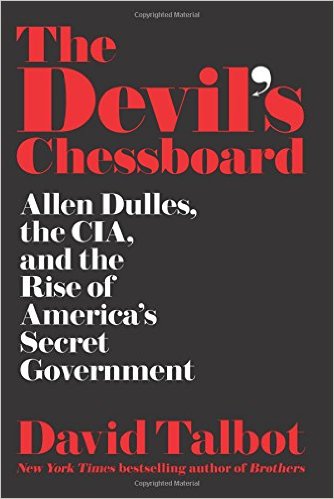
Excerpt from “The Devil’s Chessboard”: CIA plots in France

JFK Assassination Plot Mirrored in 1961 France: Part I

Global Research, October 23, 2015
Who.What.Why. 20 October 2015

First published by WhoWhatWhy

As you watch, perhaps with alarm, as thousands of refugees from Muslim countries make their way through Europe in a seemingly endless parade, you may be wondering if some of them will end up living near you, and how this might affect your life.

If you step back and look at the bigger picture, you will see the situation in reverse: how much the dominating presence of those from the western world has affected the daily lives of people living in Muslim countries.

What the colonial powers have done in Muslim countries is well known. Less well known are the machinations of Allen Dulles and the CIA in one of these colonial powers, France.

Without the knowledge or consent of President John F. Kennedy, Allen Dulles orchestrated the efforts of retired French generals, rightwing French, Nazi sympathizers, and at least one White Russian, to overthrow Charles de Gaulle, who wanted to give Algeria its independence. Dulles et al feared an independent Algeria would go Communist, giving the Soviets a base in Africa.

And there was another reason to hang onto Algeria: its natural resources. According to the US Energy Information Administration, it is “the leading natural gas producer in Africa, the second-largest natural gas supplier to Europe outside of the region, and is among the top three oil producers in Africa.”

We note with great interest that the plot to bring down Charles De Gaulle — the kind of people involved, the role of Allen Dulles, the motive behind it — all bear an eerie similarity to the circumstances surrounding the assassination of John F. Kennedy. But that is another story.

As we have said earlier, Dulles’s job, simply put, was to hijack the US government to benefit the wealthy. And in this fascinating series of excerpts from David Talbot’s new biography on Dulles, we see how his reach extended deeply into the government of France.

WhoWhatWhy Introduction by Milicent Cranor

This is the first of a three-part series of excerpts, from Chapter 15 (“Contempt”) of The Devil’s Chessboard: Allen Dulles, the CIA, and the Rise of the American Secret Government. by David Talbot, HarperCollins Publishers, 2015.

PLOTS, PANIC, AND RUMORS OF CIA INVOLVEMENT

It was Cuba that created the first fracture between Kennedy and his national security chain of command. But while the Bay of Pigs was still dominating the front pages, the CIA mucked its way into another international crisis that required the president’s urgent attention. The Cuba invasion has all but erased this second crisis from history. But the strange events that occurred in Paris in April 1961 reinforced the disturbing feeling that President Kennedy was not in control of his own government.

Paris was in turmoil. At dawn on Saturday morning, April 22, a group of retired French generals had seized power in Algiers to block President Charles de Gaulle from settling the long, bloody war for Algerian independence. Rumors quickly spread that the coup plotters were coming next for de Gaulle himself, and that the skies over Paris would soon be filled with battle-hardened paratroopers and French Foreign Legionnaires from Algeria. Gripped by the dying convulsions of its colonial reign, France braced for a calamitous showdown.

After de Gaulle was elected president in 1958, he sought to purge the French government of its CIA-connected elements. Dulles had made heavy inroads into France’s political, cultural, and intelligence circles in the postwar years.

The threat to French democracy was actually even more immediate than feared. On Saturday evening, two units of paratroopers totaling over two thousand men huddled in the Forest of Orleans and the Forest of Rambouillet, not much more than an hour outside Paris. The rebellious paratroopers were poised for the final command to join up with tank units from Rambouillet and converge on the capital, with the aim of seizing the Élysée Palace and other key government posts.

By Sunday, panic was sweeping through Paris. All air traffic was halted over the area, the Metro was shut down, and cinemas were dark. Only the cafés remained open, where Parisians crowded anxiously to swap the latest gossip.

Continue reading

Aaron Klein’s “The Real Benghazi Story”: CIA Ops finally revealed

It seems the world owes the U.S. Republican Party a big “thank you” for keeping this story in the news, so that more details could become public.
Whether any of the Republicans in Congress or on Fox News care about this and other background information is another issue entirely. It will also be interesting if Democrats in Congress and in the public publicly denounce what was done, or continue making excuses or hiding this information.
Stay tuned to see if integrity still exists in the United States.
Global Research, October 23, 2015
World Net Daily 8 September 2015
What the US Ambassador in Benghazi was Really Doing
The U.S. special mission in Benghazi and the nearby CIA annex were utilized in part to coordinate arms shipments to the jihadist rebels fighting the Syrian regime, with Ambassador Christopher Stevens playing a central role, documents an explosive new book released today.

The activities, which included a separate, unprecedented multi-million-dollar weapons collection effort from Libyan militias who did not want to give up their weapons, may have prompted the Sept. 11, 2012, attack, charges the new book.

The findings and more are revealed in the new work by radio host and WND reporter Aaron Klein, “The REAL Benghazi Story: What the White House and Hillary Don’t Want You to Know.”

Klein asserts the arms-to-rebels scheme that ran through Benghazi “might amount to the Fast and Furious of the Middle East, the Iran-Contra of the Obama administration.”

real-beghaziA key issue is that until the end of April 2013, the White House had repeatedly denied it was involved in helping to arm the Syrian rebels. However, “The REAL Benghazi Story” cites evidence of arms transfers throughout the summer of 2012, escalating with a major shipment from Libya to Turkey just days prior to the Sept. 11 attack.

It’s finally here: “The REAL Benghazi Story: What the White House and Hillary Don’t Want You to Know.” Get it now at the WND Superstore!

(image: http://mobile.wnd.com/files/2014/09/real-beghazi.jpg)

The book finds members of the 17th of February Martyrs Brigade, a militia linked to the Ansar al-Sharia terrorist organization, may have been used as cut outs to aid in the weapons transfers to Syrian rebels.

Perplexingly, armed members of the Martyrs Brigade were hired by the State Department to provide internal “security” at the U.S. special mission.

Stevens an ‘arms dealer’?

According to information cited by Klein, Stevens served less as a diplomat and more as an arms dealer and intelligence coordinator for assistance to the so-called Arab Spring, with particular emphasis on the Syrian rebels.

As was widely reported, Stevens originally arrived in Libya during the revolution aboard a Greek cargo ship carrying equipment and vehicles. His original task in Libya was to serve as the main interlocutor between the Obama administration and the rebels based in Benghazi. Stevens never abandoned that role, even after becoming ambassador, according to Klein.

Indeed, the New York Times reported in December 2012 that Stevens himself facilitated an application to the State Department for the sale of weapons filed by one Marc Turi, whom the Times’ describes as an “American arms merchant who had sought to provide weapons to Libya.”

The Times reported Turi’s first application was rejected in March 2011 but was approved two months later after he stated “only that he planned to ship arms worth more than $200 million to Qatar.” Qatar was Turkey’s partner in aiding the Syrian rebels.

Klein notes the Times did not question why a U.S. ambassador would help facilitate government applications for arms dealers. Nor did the Times bother to investigate the possible connection of those activities to the Benghazi attack.

Continued Klein: “After all, it doesn’t take Sherlock Holmes to divine a possible link to the Benghazi assaults amid reports of Stevens supporting a weapons dealer’s application while American intelligence officers hiding in ‘secret locations’ were helping Arab governments shop for weapons to be sent to Mideast rebels, including some of the same groups linked to the September 11, 2012 attacks.”

Klein points out Stevens held his final meeting with a diplomat from Turkey, which was one of the main backers of the Syrian rebels.

What do YOU think? Has the Obama administration covered up the Benghazi truth? Sound off in today’s WND poll!

Arms to jihadists

Klein’s statement about U.S. intelligence officers aiding weapons shipments from “secret locations” is a reference to the larger arms-to-rebels pipeline that is thoroughly documented in the book.

The story began prior to the establishment of the U.S. mission in Benghazi, when the United States and NATO supported Arab airlifts of aid to the rebels who eventually toppled Libya’s Moammar Gadhafi.

The Obama administration’s “Arab Spring” adventures pivoted westward, reports Klein, when the CIA started helping Arab governments and Turkey obtain and ship weapons to the rebels fighting Bashar al-Assad’s regime in Syria.

The New York Times reported March 25, 2013, that the covert aid to the Syrian rebels started on a small scale and continued intermittently through the fall of 2012, expanding into a steady and much heavier flow later that year, including a large procurement from Croatia.

However, Klein cites sources saying the airlifts actually began several months before the fall of 2012, including a massive arm shipment from Benghazi to the Syrian rebels in August 2012 days before the Benghazi attack. That massive weapons shipment departed the port in Benghazi and arrived in early September at the Turkish port of Iskenderun, 35 miles from the Syrian border, purportedly to deliver humanitarian aid.

The Times, meanwhile, reported that from offices at “secret locations,” American intelligence officers “helped the Arab governments shop for weapons … and have vetted rebel commanders and groups to determine who should receive the weapons as they arrive.”

Jihadist cut outs

The exact nature of the U.S. involvement with the February 17 Brigade that guarded the U.S. special mission might have been unintentionally exposed when a Libyan weapons dealer formerly with the Brigade told Reuters in an in-person interview he had helped ship weapons from Benghazi to the rebels fighting in Syria.

Klein noted that no one seems to have connected the dots from what the weapons dealer said to the activities taking place inside the Benghazi compound and whether the Brigade serves as a cut out to ship weapons.

In the Reuters interview published June 18, 2013, Libyan warlord Abdul Basit Haroun declared he is behind some of the biggest shipments of weapons from Libya to Syria. Most of the weapons were sent to Turkey, he said, where they were, in turn, smuggled into neighboring Syria.

Ismail Salabi, a commander of the February 17 Brigade, told Reuters Haroun was a member of the brigade until he quit to form a group of his own.

Haroun told Reuters his weapons-smuggling operation was run with an associate, who helped him coordinate about a dozen people in Libyan cities collecting weapons for Syria.

Collecting weapons

Besides arming the Syrian rebels, Klein documents that from the U.S. mission and CIA annex, American agents ran an unprecedented multi-million-dollar U.S. effort to secure anti-aircraft weapons in Libya after the fall of Gadhafi’s regime.

This weapons-collection effort may go a long way to explain the motive behind the Benghazi attack. The various jihadist organizations that looted Gaddafi’s MANPAD reserves and the rebel groups that received weapons during the NATO campaign in Libya obviously would feel threatened by an American effort to try to retrieve the weapons.

In March 2013, Sen. Lindsey Graham, R-S.C., connected Stevens to that effort. He told Fox News that Stevens was in the Libyan city to keep weapons caches from falling into the hands of terrorists.

Previously, one source told Fox News that Stevens was in Benghazi the very night of the attack “to negotiate a weapons transfer in an effort to get SA-7 missiles out of the hands of Libya-based extremists.”

In August 2013, CNN reported there is “speculation” on Capitol Hill that U.S. agencies operating in Benghazi “were secretly helping to move surface-to-air missiles out of Libya, through Turkey, and into the hands of Syrian rebels.”

In “The REAL Benghazi Story,” Klein fully exposes the extent of the weapons-collection effort, which took place in Benghazi, where a leading U.S. expert was deployed.

Klein relates then-Secretary of State Hillary Clinton committed to providing $40 million to assist Libya’s efforts to secure and recover its weapons stockpiles. Of that funding, $3 million went to unspecified nongovernmental organizations that specialize in conventional weapons destruction and stockpile security.

The NGOs and a U.S. team coordinated all efforts with Libya’s Transitional National Council, or TNC. The U.S. team was led by Mark Adams, a State Department expert from the MANPADS Task Force.

Klein cites Andrew J. Shapiro, assistant secretary of state for the Bureau of Political-Military Affairs, who conceded that the Western-backed rebels did not want to give up the weapons, particularly Man-Portable-Air-Defense-Systems, or MANPADS, which were the focus of the weapons collection efforts.

Breaks new ground on Benghazi

Klein’s extensively sourced book breaks news on significant issues related to the Benghazi attack.

A sampling of what the publisher says is contained in the book:

  • Everything is covered from the secretive activities transpiring inside the doomed facility to shocking new details about the withholding of critical protection at the U.S. special mission.
  • Hillary Clinton’s personal role in the Benghazi scandal.
  • Information that raises new questions about what really happened to Ambassador Chris Stevens that night.
  • Answered for the first time is why the State Department hired armed members of the al-Qaida-linked February 17 Martyrs Brigade to “protect” the facility.
  • New reasons are revealed for not sending air support or Special Forces during the assault, while extensively probing jihadist groups behind the attack.
  • How Benghazi has implications that go beyond the Sept. 11, 2012, attack and may have created major national security threats we now face, fueling conflicts from Mali to Syria to Gaza and beyond.

Read more at http://mobile.wnd.com/2014/09/finally-revealed-what-ambassador-in-benghazi-was-really-doing/#XFc1gPY2m6cy2rLX.99

“Je suis CIA”

Global Research, October 16, 2015
17 January 2015

Note: This article was first published in January 2015.

Since 9/11, the imperial playbook has consisted of a favorite and time-tested tactic: the false flag operation.

Carry out or facilitate a spectacular atrocity. Blame it on the enemy of choice. Issue a lie-infested official narrative, and have the corporate media repeat the lie. Rile up ignorant militant crowds, stoke the hatred, and war-mongering imperial policy planners and their criminal functionaries get what they want: war with the public stamp of approval.

Here we are again.

The Charlie Hebdo incident is being sold as “the French 9/11”. It certainly is, in all of the most tragic ways: France, like the United States on 9/11, has been used. The masses of the world have been deceived, and march in lockstep to NATO’s drumbeat again.

All signs lead from French intelligence back to Washington—and Langley, Virginia—directly and indirectly. Red herrings and deceptions comprise the official narrative.

The Al-Qaeda narrative, the classic CIA deception, gets fresh facelift. The fact that Al-Qaeda is CIA-created Anglo-American military-intelligence is ignored. The agenda behind the ISIS war—a massive and elaborate regional CIA false flag operation—registers even less.

The Charlie Hebdo terrorists have ties to Anglo-American intelligence and the Pentagon that the masses do not bother to think about. They are also tied to the (conveniently dead) 9/11-connected Al-Qaeda mastermind/CIA military-intelligence asset Anwar Al-Awlaki. These and other obvious connections to Washington and the CIA do not raise alarm bells among the ardent ones waving Je Suis Charlie signs (which “magically” appeared, and seem to have been mass-produced in advance).

Signs of an inside job and a still unfolding cover-up are significant, from pristine, undamaged passports found on scene to the convenient suicide of Helric Fredou, the Paris police commissioner in charge of the Hebdo investigation.

The Kouachi brothers and Amedy Coulibaly were not only well known by French authorities, French intelligence and the CIA. The Kouachis were tracked and monitored—guided—over the course of many years, arrested many times, yet were allowed to continue training and plotting with fellow Al-Qaeda in Iraq, Yemen, Syria, etc. These are telltale signs of a guided military-intelligence operation. A blatantly obvious terror cell, known to authorities, “drops out of sight”, and then set loose at an appropriate moment. And then executed.

None of these things, which alarm seasoned observers, registers among the emotional masses; the lemmings who willfully refuse to address its real source: the architects of Anglo-American war policy.

Only the NATO war agenda benefits from any of this.

“France’s 9/11” is more accurately France’s latest Operation Gladio. As noted by Paul Craig Roberts, there is a reason why the Charlie Hebdo attacks took place when it did:

France is suffering from the Washington-imposed sanctions against Russia. Shipyards are impacted from being unable to deliver Russian orders due to France’s vassalage status to Washington, and other aspects of the French economy are being adversely impacted by sanctions that Washington forced its NATO puppet states to apply to Russia.

This week the French president said that the sanctions against Russia should end (so did the German vice-chancellor).

This is too much foreign policy independence on France’s part for Washington. Has Washington resurrected “Operation Gladio,” which consisted of CIA bombing attacks against Europeans during the post-WW II era that Washington blamed on communists and used to destroy communist influence in European elections? Just as the world was led to believe that communists were behind Operation Gladio’s terrorist attacks, Muslims are blamed for the attacks on the French satirical magazine.

Now France is militarized, just as the US was in the wake of 9/11. And the French right-wing has newfound cache.

The hostile takeover of the public mind

Notice that the last two false flag operations in recent months—the false flagging of North Korea over Sony and the film The Interview, and the Charlie Hebdo deception—both revolve around the ideas of “free speech” and “free expression”.

This is a phantom battle, choreographed by those who could not care less for “freedoms”. In fact, the masses are being manipulated towards supporting war and mass murder, and police state agendas that specifically curtail freedoms.

What more creative way to take away freedoms than to make people give them up voluntarily?

The hordes of American citizens that supported the “war on terrorism” to “defend freedom” got the Patriot Act, which gutted what liberties they had; the Constitution and the Bill of Rights will not be restored. This process continues all over the world. Ask the average uninformed French citizen today suffering from post-traumatic stress, and they will gladly give up their rights, anything so that “terrorists” are stopped.

Note how the powers that be have taken to inserting their pro-war messages even more forcefully where the ignorant public spends the majority of its time: in popular entertainment. In Hollywood products, in their cartoons, in their magazines, in their celebrities.

Let George Clooney, Seth Rogen and James Franco transmit the messages of war for the CIA and the Pentagon.

Weaponize stupid movies like The Interview and crude magazines like Charlie Hebdo, and watch people become bloodthirsty, vengeful, unthinking and war-loving.

It is the CIA’s ongoing mission to plant its assets and its propaganda into the media and the arts, controlling the perception of culture as well as framing all debate. It is making a huge push at the moment, relishing the speed and effectiveness of technology and social media.

Hundreds and thousands of innocent lives have been lost in this endless, brutal and criminal war. Yet its architects and functionaries remain untouched.

Je Suis Langley

No Anglo-American war of conquest, no Charlie Hebdo massacre.

No CIA, no Militant Islam, no Al-Qaeda, no ISIS, no Charlie Hebdo massacre.

No 9/11, no “war on terrorism”, no ISIS deception, no Charlie Hebdo massacre.

No war against Russia, no Charlie Hebdo massacre.

Je Suis Charlie? No.

To the naïve ones who believe the lies and march on the streets carrying the signs, you are the victims, the gullible, the dupes, the pawns.

Tu es CIA.

Tu es NATO.

Brzezinski: CIA assets in Syria struck by Moscow; says U.S. should retaliate

From Fort Russ

October 6, 2015
Press TV

US foreign policy expert Zbigniew Brzezinski says the United States should retaliate if Russia does not stop bombing its assets in Syria.

Brzezinski, the national security adviser for former President Jimmy Carter, advised President Barack Obama to attempt to disarm the Russians if they keep attacking the CIA-trained militants in Syria.

“The Russian naval and air presences in Syria are vulnerable, isolated geographically from their homeland,” Brzezinski wrote in an article published by the Financial Times on Sunday.They could be ‘disarmed’ if they persist in provoking the US.”

“But, better still, Russia might be persuaded to act with the US in seeking a wider accommodation to a regional problem that transcends the interests of a single state,” he added.

[Russia will not joined the illegal US coalition – FR]

A new US intelligence assessment has found Russia has targeted militant groups backed by the Central Intelligence Agency (CIA) in Syria.

The assessment, shared by commanders on the ground, has led American officials to conclude that Russian warplanes have intentionally struck CIA-backed militants in a string of attacks running for days, the Wall Street Journal reported.

Moscow’s apparent decision to strike CIA’s militants “at best” reflects “Russian military incompetence,” and worst, “evidence of a dangerous desire to highlight American political impotence,” wrote Brzezinski.

He added that if Moscow continues to target these people, then Washington should retaliate against Russians.

“In these rapidly unfolding circumstances the US has only one real option if it is to protect its wider stakes in the region: to convey to Moscow the demand that it cease and desist from military actions that directly affect American assets,” he said.

[Syria must bow to the global master – FR]

Obama administration officials are debating how the United States can come to the aid of its proxy forces on the ground without risking a broader conflict, according to the Wall Street Journal.

US officials said Russia’s moves in Syria posed a direct challenge to the Obama administration’s foreign policy on the Middle East.

Moscow’s commitment to the Syrian government runs counter to current US policy, which calls for the ouster of Syrian President Bashar al-Assad.

Russia has been beefing up its military presence in neighboring Syria, deploying warplanes, tanks and personnel to an airfield in the western port city of Latakia. It launched a coordinated air campaign to fight Daesh (ISIL) and other terrorists.

Senior Russian officials have said the current campaign is limited to airstrikes, but have not ruled out “volunteers” on the ground.

Syria has been gripped by a foreign-backed militancy since March 2011 aimed at toppling the Assad government. The violence has claimed the lives of more than 250,000 people so far.

Guatemala’s current situation can be traced back to the 1954 CIA-led coup. U.S. guidebook on political assassination

Part II of Why Americans Should Closely Watch Unfolding Events in Guatemala

By Prof. Edward Curtin
Global Research, October 08, 2015
Who.What.Why. 7 October 2015

For the first part in this two-part series, go here.

Guatemala’s current situation and tragic history can be traced back to the CIA-led coup in 1954 that ousted the democratically elected government of President Jacobo Arbenz and installed the military dictator Carlos Armas. Arbenz was an advocate for land reform and was loved by the poor. The wealthy hated him. And when the CIA couldn’t bribe him, they ousted him in a most humiliating way. Even after he went into exile, the agency used constant disinformation to smear him in every way imaginable until his strange death in a bathtub in 1971.

Since the 1954 coup, and with the ongoing support of the CIA and the School of the Americas (SOA), the Guatemalan people have lived a nightmare. What follows should give you a sense of the CIA’s thinking behind the coup and its aftermath. It is a transcription of a CIA document released to The National Security Archive, a research institute, on May 23, 1997 under a Freedom of Information Act request.

A hammer, axe, wrench, screwdriver, fire poker, kitchen knife, lamp stand, or anything hard, heavy and handy will suffice.” For an assassin using “edge weapons,” the manual notes in cold clinical terms, “puncture wounds of the body cavity may not be reliable unless the heart is reached.

United Fruit Company Building. Photo credit: Michael Bentley / Flickr (CC BY 2.0)

United Fruit Company Building. Photo credit: Michael Bentley / Flickr (CC BY 2.0)

“A Study of Assassination,” unsigned, undated:

Among the documents found in the training files of Operation PBSUCCESS and declassified by the Agency is a “Study of Assassination.” A how-to guide book in the art of political killing, the 19-page manual offers detailed descriptions of the procedures, instruments, and implementation of assassination. “The simplest local tools are often much the most efficient means of assassination,” counsels the study. “A hammer, axe, wrench, screwdriver, fire poker, kitchen knife, lamp stand, or anything hard, heavy and handy will suffice.” For an assassin using “edge weapons,” the manual notes in cold clinical terms, “puncture wounds of the body cavity may not be reliable unless the heart is reached…. Absolute reliability is obtained by severing the spinal cord in the cervical region.” The manual also notes that to provide plausible denial, “no assassination instructions should ever be written or recorded.” Murder, the drafters state, “is not morally justifiable,” and “persons who are morally squeamish should not attempt it.”

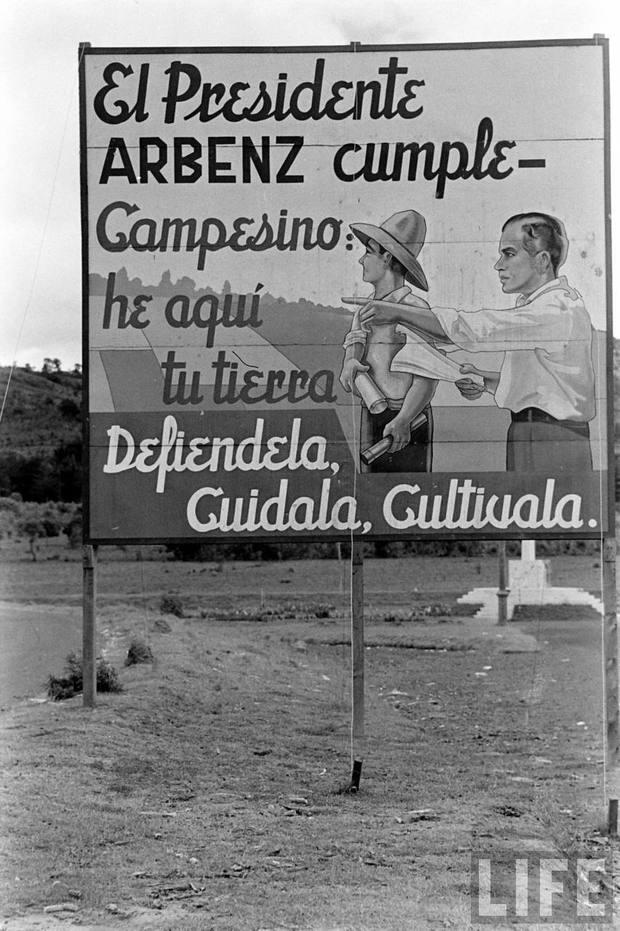
“President Arbenz delivers on his promise — Farmers: here is your land. Defend it, care for it, cultivate it.” (1954) One of a series of photos by Cornell Capa, documenting the sweet,short-lived dream of life under a democracy. Photo credit: Cornell Capa

“President Arbenz delivers on his promise — Farmers: here is your land. Defend it, care for it, cultivate it.” (1954) One of a series of photos by Cornell Capa, documenting the sweet,short-lived dream of life under a democracy. Photo credit: Cornell Capa

No, this dirty work is not for the “morally squeamish.”

If one is searching for the truth about the coup, the document above is accurate and revealing. However, if one searched the web and discovered a posting at globalsecurty.org (see sidebar at the end of the article) one would be misled. That posting is nothing more than a summary of a Congressional Research Service report. It never mentions Guatemala, although it includes other Latin American countries — Argentina, Bolivia, Ecuador, El Salvador, Honduras, Panama, and Peru. A gullible reader might come away with the impression that the School of the Americas had nothing to do with Guatemala, when, in fact, it had a great deal to do with it. Why leave out this country in particular?

Could it be that GlobalSecurity.org is unfamiliar with documents such as the one described above? Is it one of those glib sites that posts articles that do not give the full picture, even if inadvertently? Or is it a site that presents disinformation? The web is filled with questionable information, so one must proceed skeptically.

Those interested in the truth must probe much deeper, but that is difficult as the following account of the propagandist Edward Bernays makes clear.

From PR to “The Engineering of Consent”

The 1954 coup d’etat was ably assisted by American Edward Bernays, Sigmund Freud’s nephew, who is often called the “father of public relations.” He is barely known to the general public and is part of our secret history. A war propagandist for the US during World War I, Bernays used his propaganda techniques — now called PR — to “engineer the consent” of the American people on behalf of the power elite.

Leading up to the 1954 coup, he was the chief propagandist for The United Fruit Company and in that capacity created a vast media campaign painting the Arbenz government as communist and in cahoots with the U.S.S.R.

This was the height of the Cold War, and the American government was consumed with using anti-communist and anti-Soviet rhetoric to defend its spheres of interest; for a long time the American government, in conjunction with American corporations, had considered Latin America and the Caribbean their de facto colonies.

The United Fruit Company — now Chiquita Brands International — was an American corporation that had controlled vast tracts of land and numerous businesses in Guatemala and throughout Latin America since the early 1900s. The company was known for its support of dictators and the exploitation of the people and the land.

Intimately linked to the power elite within the US government, United Fruit extracted huge profits and rejected any reforms that challenged its control of the land. It was the largest landholder and employer in Guatemala. It owned railroads and discouraged the building of highways. It had long controlled Guatemala’s politicians. It’s power was so extensive that one historian compares it to the Dutch East India Company in its influence. It’s shareholders and supporters were amply distributed throughout the foreign policy establishment in the US.

As US Marine Corps Major General Smedley Butler made clear in 1935, the US military was used to deal with any resistance to American corporations’ business interests overseas. Guatemala is a case study in this regard. President Arbenz’s land reform act of 1952Decree 900 — expropriated rural farm land, 70 per cent of which was in the hands of 2 percent of the landowners, including vast acreage controlled by United Fruit but, significantly, only land not under cultivation by the company. The land was redistributed to poor peasants. The owners ( who included Arbenz himself) were to be compensated at fair market value.

But this arrangement was not acceptable to United Fruit or their backers in Washington. The American Ambassador to Guatemala, John Peurifoy (CIA Director Allen Dulles’s handpicked man), then tried to bribe Arbenz with a $2 million payoff to terminate the land reforms.

Arbenz refused, and his overthrow was set in motion by the CIA. Bernays was called upon to present the land redistribution as a communist takeover and a threat to US national security. His media propaganda campaign, presenting Arbenz as a communist in league with the USSR, together with the CIA’s additional propaganda, created the justification for the CIA-led coup.

What wasn’t revealed at the time was that the Eisenhower administration had intimate ties to United Fruit. Secretary of State John Foster Dulles had represented United Fruit at his law firm Sullivan and Cromwell, and his brother, Allen Dulles, the CIA chief in charge of the 1954 coup, once sat on United Fruit’s board of directors and had also done legal work for them. Both brothers had large financial stakes in the company. Such clear-cut conflicts of interest were not an anomaly within the Eisenhower administration. Many other administration officials were connected in one way or another to United Fruit. Bernays’s propaganda, using anti-communist rhetoric, served perfectly the interests of his conjoined clients — United Fruit and the CIA. As a result of Dulles’s and Bernays’s machinations, hundreds of thousands of Guatemalans were eventually massacred

The excellent documentary by Adam Curtis, The Century of Self, documents Bernays’s profound and largely pernicious influence on American life with a section specifically devoted to his propaganda efforts on behalf of the 1954 coup. Today’s “mainstream media” has learned a lot from Bernays, so if one wishes to see through the vast amount of propaganda and dissimulation in current news coverage, learning about Bernays is crucial.

The recent arrest of Guatemalan President Otto Perez Molina on corruption charges cannot be understood except within the larger context of US interference in Latin American countries going back more than a century. And that record of US meddling in Central and South America has been largely left out of official histories of the United States.

The rise of the CIA to virtually unchallenged supremacy in Washington’s power structure is but one part of this backstory. Peter Dale Scott, who has written voluminously on the subject, calls this phenomenon of a de facto shadow government hidden behind the public facade while serving corporate interests, “the deep state.” This secretive power elite, through its decades-long support of coups and death squads in Guatemala, has linked that country’s fate inextricably to US interests and policies.

***

Sometimes even when the mind knows and assents, the heart stays frozen. But music, like poetry, can often break the ice within. Here is the acclaimed singer and former Panamanian reform presidential candidate Ruben Blades, singing a song from his album, Nothing but the Truth. The song is called “In Salvador,” but his words could apply to what goes on in many Latin American countries. The “regular guys” of Ruben’s song are often death squad killers, “made in America” at the “School of the Assassins.”

http://www.globalresearch.ca/guatemalas-current-situation-can-be-traced-back-to-the-1954-cia-led-coup-us-guide-book-on-political-assassination/5480546

Washington wants “regime change” in Ecuador: “What is the CIA planning before Ecuador’s 2017 elections?”

Global Research, September 15, 2015
Silent Crow 14 September 2015

The United States does not lack institutions that continue to conspire, and that’s why I am using this gathering to announce that we have decided to expel USAID from Bolivia” Bolivian President Evo Morales

Washington wants Ecuador’s President Rafael Correa removed from power. Washington says it is concerned about the freedom of the press in Ecuador because their non-government organization ‘Fundamedios’ funded and supported by United States Agency for International Development (USAID), the National Endowment for Democracy (NED) and Freedom House among others is in the process of being shut down by the Correa government. According to Telesur’s report on September 10th “Fundamedios engaged “partisan political activities” by sharing material on its social media accounts, publishing articles unrelated to its stated mission and inserting itself into political debates in the country”which according to the National Secretariat of Communication or ‘Secom’ is prohibited under Ecuadorian law. The White House released a press statement on the same day:

We are very concerned about the increasing restrictions on freedom of expression and freedom of association in Ecuador, particularly the Ecuadorian government’s September 8 decision to initiate legal steps intended to dissolve Fundamedios, a non-governmental organization that monitors and defends press freedom.

An active civil society and tolerance of dissenting views are vital components of any democracy. We share international concern over the Ecuadorian government’s efforts to silence critical voices and deny its citizens access to a diversity of information and ideas. Freedom House, Human Rights Watch, the Committee to Protect Journalists, among others, have all spoken out in opposition to the government’s latest action against Fundamedios.

According to TeleSur ‘Fundamedios’ is funded by the NED and USAID:

The work of the organization mostly consists of issuing “alerts” regarding alleged attacks against journalists in Ecuador.  The organization is funded in part through a US$84,000 grant from the U.S.-funded National Endowment for Democracy. U.S. Ambassador to Ecuador Adam Namm told El Telegrafo that Fundamedios received US$300,000 in 2012 from USAID, which is receives its funds from the U.S. government

USAID and NED are in the business of “Democracy Promotion” which uses public money (from U.S. taxpayers) for secretive operations with the intention to support pro-U.S. governments with the help of political and social movements abroad. The goal is regime change.

Why Washington wants Correa Removed from Power

Since 2009, the world has seen what the Obama administration has done to sovereign nations in the name of democracy. Libya, Honduras and the Ukraine are some of the recent examples of U.S. foreign policy that has only proved to be disastrous on many levels. Ecuador would be added to Obama’s list of countries ripe for regime change.

First, Correa is a staunch ally of Latin America’s leftist governments of Bolivia, Venezuela, Nicaragua, Argentina and Brazil who are critical of U.S. Foreign policy. What makes matters worse for Washington was the closure of the Manta Air Force Base in 2009, a promise made by Correa in a 2006 campaign.

Washington wants a new government in Ecuador to reopen the Manta Air Force Base for surveillance and the so-called “War on Drugs”. In 2008, the New York Times reported that President Correa fired high ranking military officials who were loyal subjects of Washington:

Mr. Correa — who this month dismissed his defense minister, army chief of intelligence and commanders of the army, air force and joint chiefs — said that Ecuador’s intelligence systems were “totally infiltrated and subjugated to the C.I.A.” He accused senior military officials of sharing intelligence with Colombia, the Bush administration’s top ally in Latin America

The New York Times admitted that Correa’s administration is a challenge for U.S. policy makers regarding the “War on Drugs” and its presence in Latin America:

The gambit also poses a clear challenge to the United States. For nearly a decade, the base here in Manta has been the most prominent American military outpost in South America and an important facet of the United States’ drug-fighting efforts. Some 100 antinarcotics flights leave here each month to survey the Pacific in an elaborate cat-and-mouse game with drug traffickers bound for the United States.

But many Ecuadoreans have chafed at the American presence and the perceived challenge to the country’s sovereignty, and Mr. Correa promised during his campaign in 2006 to close the outpost

Reuters’ also reported in 2007 what Correa had said about the possibility of renewing the lease to the U.S. military“We’ll renew the base on one condition: that they let us put a base in Miami — an Ecuadorean base,” Correa said in an interview during a trip to Italy. “If there’s no problem having foreign soldiers on a country’s soil, surely they’ll let us have an Ecuadorean base in the United States.” Correa did make a good point.

Another reason Correa is on Washington’s “hit list” involves Wikileaks. Its founder Julian Assange was granted political asylum in an Ecuadorian embassy in London because he feared that if he ended up in U.S. custody over the secret files he released from Chelsea Manning to the world, could have him face an unfair trial in a U.S. courtroom. Ecuador granted Assange political asylum status where he still remains to this day. Neoconservative and former Presidential contender Sarah Palin said that Assange is an “anti-American operative with blood on his hands…Why was he not pursued with the same urgency we pursue al Qaeda and Taliban leaders?” Palin was saying that Julian Assange is in the same league as Al Qaeda so killing him is justified. Ecuador did take a stand to protect the life and liberty of Julian Assange, something Washington does not take lightly.

Ecuador’s Lawsuit against Big Oil

Litigation and various lawsuits against Chevron-Texaco has been going on for more than two decades which oil drilling operations which occurred between 1972 and 1990 in the Amazon as RT News reported in 2013:

Ecuador’s foreign ministry announced on Friday that the US has seemingly denied visas to a delegation that was set to travel to the UN General Assembly in New York to present their case regarding an ongoing dispute against Chevron-Texaco. According to the ministry’s official announcement, the visas for the five Ecuadorian nationals were returned by the US Embassy in Quito “without any explanation.”

That group was to present testimony during a special event at the UN regarding the ecological impact caused by Chevron-Texaco’s oil operations in the Amazon rainforest region of Ecuador – which contaminated two million hectares, according to the country’s government. At stake is a US$19 billion judgment awarded by an Ecuadorean court against Chevron for cleanup and ecological damage, which is currently being fought at The Hague.

Correa in Washington’s Crosshairs

From alliances with anti-Washington governments to the closure of the Manta Air Force Base, to protecting Julian Assange and a lawsuit against Chevron-Texaco for environmental damages to the Amazon, Correa is a target for regime change. Just remember back in history when the CIA orchestrated a coup against Ecuadorian President Carlos Julio Arosemena simply because he criticized the U.S. government and supported the Cuban revolution led by Fidel Castro. Correa has done a lot more to diminish U.S. power in Latin America than any other president in its current history.

Correa has accused the Central Intelligence Agency (CIA) earlier this year of “being increasingly involved in the political opposition with the avowed aim of dragging the country into chaos” and weaken the Ecuadorian government by “a series of coordinated nationwide protests.” Something Correa should be familiar with, after all the CIA attempted a coup in 2010 under Obama’s watch. One of the key reasons of the attempted coup by the Ecuadorian police was the Public Service Organic Law signed in 2010. It was designed to place regulations on public service workers namely the police and military and create a standard base of compensation instead of receiving their bonuses from foreign sources (the U.S. government) under Ecuadorian law. The main problem before the law was passed was that the police of Ecuador was receiving bonuses from the US embassy to spy on Ecuadorian politicians and others who were considered opponents of Washington.

Interestingly, Presidential hopeful Hillary Clinton was in Ecuador in June of that year to convince Correa to join the“Dark Side” but ultimately failed. U.S. Ambassador at the time was Heather Hodges who was assigned to disrupt and weaken the Correa government through USAID which contributed $40 million. The Ecuadorian police, military officials, USAID, NED, the CIA and a former president and a puppet of Washington during the Bush years, Lucio Gutiérrez who was ousted by the Ecuadorian people who demanded his resignation were all behind the coup plot.

Obama has 16 Months Left in Office

Will the Obama administration authorize another coup between now and 2016? It is Obama’s last 16 months in office since the first coup attempt. Correa knows he is on Washington’s “hit list” following his actions on Fundamedios who claim the freedom of speech is threatened as Washington threatens Julian Assange for exposing their crimes in Afghanistan and Iraq by killing of tens of thousands of civilians, which they tried to keep secret. Washington is consistent when it ignores the sovereignty of nations and bypasses international law on a regular basis.

Recently, the Confederation of Indigenous Nationalities of Ecuador (Conaie) and various trade unions called for a nationwide strike against the government, but many indigenous organizations opposed it. Telesur reported that WikiLeaks published diplomatic cables from the U.S. embassy in Ecuador from 2005 and 2006 that suggest members of CONAIE were interested in talking to U. S. Representatives within their own ranks including Vice President Santiago de la Cruz and Congressman Jorge Guaman who according to one cable “expressed interest in open dialogue.”Members of CONAIE also “asked the U.S. government to intervene with the president to get Conaie representatives back in these government institutions.” De La Cruz is described as “very interested in the possibility of visiting the U.S. on an exchange program,” and that he “appeared eager to engage in dialogue” with the U.S.  Wikileaks also released documents on Auki Tituana, a member of Pachakutik who also seemed interested.

Although representatives in both organizations have shown an interest in meeting with U.S. officials, other members are not so keen on the idea including Luis Macas, head of CONAIE. This is a positive sign that members within these indigenous organizations do not want to meet with U.S. diplomats.  Macas “has advised his organization to avoid dialogue with the U.S. government.” According to the cables “There appears to be division within the ranks of Pachakutik and (Conaie) on the level of interaction they should have with the Embassy”.

In 2007, Correa was an anti-neoliberal advocate was voted into power and has brought Ecuador political and economic stability. One other issue Washington is concerned about is what Correa said about the Dollarization” of the Ecuadorian economy; he said it was a “technical error” after pro-US president Jamil Mahuad adopted the U.S. dollar in 2000. Correa did acknowledge that it is a difficult process to move out of the U.S. dollar at this time, however, he does support a regional South American currency that would allow Ecuador to move out of the dollar which is something U.S. officials’ do not like to hear especially when the dollar is about to lose its reserve currency status.

What is the CIA planning before Ecuador’s elections in 2017?

It is important to note that if a presidential recall vote were to take place in Ecuador today at least 60% of the people would vote for Correa according to the main-stream media’s ‘CNN Spanish’ poll this past June. Correa proposed constitutional reforms including two bills that would increase inheritance and capital gains taxes on the ultra-wealthy. Anti-government protests followed, which later turned violent. That is something Washington wants to see more of right before Ecuador’s 2017 presidential elections.

Why Russia shut down National Endowment for Democracy (NED) fronts

Global Research, July 31, 2015
Consortium News 30 July 2015

The Washington Post’s descent into the depths of neoconservative propaganda – willfully misleading its readers on matters of grave importance – apparently knows no bounds as was demonstrated with two deceptive articles regarding Russian President Vladimir Putin and why his government is cracking down on “foreign agents.”

If you read the Post’s editorial on Wednesday and a companion op-ed by National Endowment for Democracy President Carl Gershman, you would have been led to believe that Putin is delusional, paranoid and “power mad” in his concern that outside money funneled into non-governmental organizations represents a threat to Russian sovereignty.

The Post and Gershman were especially outraged that the Russians have enacted laws requiring NGOs financed from abroad and seeking to influence Russian policies to register as “foreign agents” – and that one of the first funding operations to fall prey to these tightened rules was Gershman’s NED.

The Post’s editors wrote that Putin’s “latest move, announced Tuesday, is to declare the NED an ‘undesirable’ organization under the terms of a law that Mr. Putin signed in May. The law bans groups from abroad who are deemed a ‘threat to the foundations of the constitutional system of the Russian Federation, its defense capabilities and its national security.’

“The charge against the NED is patently ridiculous. The NED’s grantees in Russia last year ran the gamut of civil society. They advocated transparency in public affairs, fought corruption and promoted human rights, freedom of information and freedom of association, among other things. All these activities make for a healthy democracy but are seen as threatening from the Kremlin’s ramparts. …

“The new law on ‘undesirables’ comes in addition to one signed in 2012 that gave authorities the power to declare organizations ‘foreign agents’ if they engaged in any kind of politics and receive money from abroad. The designation, from the Stalin era, implies espionage.”

But there are several salient facts that the Post’s editors surely know but don’t want you to know. The first is that NED is a U.S. government-funded organization created in 1983 to do what the Central Intelligence Agency previously had done in financing organizations inside target countries to advance U.S. policy interests and, if needed, help in “regime change.”

The secret hand behind NED’s creation was CIA Director William J. Casey who worked with senior CIA covert operation specialist Walter Raymond Jr. to establish NED in 1983. Casey – from the CIA – and Raymond – from his assignment inside President Ronald Reagan’s National Security Council – focused on creating a funding mechanism to support groups inside foreign countries that would engage in propaganda and political action that the CIA had historically organized and paid for covertly. To partially replace that CIA role, the idea emerged for a congressionally funded entity that would serve as a conduit for this money.

But Casey recognized the need to hide the strings being pulled by the CIA. “Obviously we here [at CIA] should not get out front in the development of such an organization, nor should we appear to be a sponsor or advocate,” Casey said in one undated letter to then-White House counselor Edwin Meese III – as Casey urged creation of a “National Endowment.”

NED Is Born

The National Endowment for Democracy took shape in late 1983 as Congress decided to also set aside pots of money — within NED — for the Republican and Democratic parties and for organized labor, creating enough bipartisan largesse that passage was assured. But some in Congress thought it was important to wall the NED off from any association with the CIA, so a provision was included to bar the participation of any current or former CIA official, according to one congressional aide who helped write the legislation.

This aide told me that one night late in the 1983 session, as the bill was about to go to the House floor, the CIA’s congressional liaison came pounding at the door to the office of Rep. Dante Fascell, a senior Democrat on the House Foreign Affairs Committee and a chief sponsor of the bill. The frantic CIA official conveyed a single message from CIA Director Casey: the language barring the participation of CIA personnel must be struck from the bill, the aide recalled, noting that Fascell consented, not fully recognizing the significance of the demand.

The aide said Fascell also consented to the Reagan administration’s choice of Carl Gershman to head the National Endowment for Democracy, again not recognizing how this decision would affect the future of the new entity and American foreign policy. Gershman, who had followed the classic neoconservative path from youthful socialism to fierce anticommunism, became NED’s first (and, to this day, only) president.

Though NED is technically independent of U.S. foreign policy, Gershman in the early years coordinated decisions on grants with Raymond at the NSC. For instance, on Jan. 2, 1985, Raymond wrote to two NSC Asian experts that

“Carl Gershman has called concerning a possible grant to the Chinese Alliance for Democracy (CAD). I am concerned about the political dimension to this request. We should not find ourselves in a position where we have to respond to pressure, but this request poses a real problem to Carl.”

Currently, Gershman’s NED dispenses more than $100 million a year in U.S. government funds to various NGOs, media outlets and activists around the world. The NED also has found itself in the middle of political destabilization campaigns against governments that have gotten on the wrong side of U.S. foreign policy. For instance, prior to the February 2014 coup in Ukraine, overthrowing elected President Viktor Yanukovych and installing an anti-Russian regime in Kiev, NED was funding scores of projects.

A second point left out of the Post’s editorial was the fact that Gershman took a personal hand in the Ukraine crisis and recognized it as an interim step toward regime change in Moscow. On Sept. 26, 2013, Gershman published an op-ed in the Washington Post that called Ukraine “the biggest prize” and explained how pulling it into the Western camp could contribute to the ultimate defeat of Russian President Putin.

“Ukraine’s choice to join Europe will accelerate the demise of the ideology of Russian imperialism that Putin represents,” Gershman wrote. “Russians, too, face a choice, and Putin may find himself on the losing end not just in the near abroad but within Russia itself.” In other words, NED is a U.S. government-financed entity that has set its sights on ousting Russia’s current government.

A third point that the Post ignored is that the Russian law requiring outside-funded political organizations to register as “foreign agents” was modeled on a U.S. law, the Foreign Agent Registration Act. In other words, the U.S. government also requires individuals and entities working for foreign interests and seeking to influence U.S. policies to disclose those relationships with the U.S. Justice Department or face prison.

If the Post’s editors had included any or all of these three relevant factors, you would have come away with a more balanced understanding of why Russia is acting as it is. You might still object but at least you would be aware of the full story. By concealing all three points, the Post’s editors were tricking you and other readers into accepting a propagandistic viewpoint – that the Russian actions were crazy and that Putin was, according to the Post’s headline, “power mad.”

Gershman’s Op-Ed

But you might think that Gershman would at least acknowledge some of these points in his Post op-ed, surely admitting that NED is financed by the U.S. government. But Gershman didn’t. He simply portrayed Russia’s actions as despicable and desperate.

“Russia’s newest anti-NGO law, under which the National Endowment for Democracy on Tuesday was declared an “undesirable organization” prohibited from operating in Russia, is the latest evidence that the regime of President Vladimir Putin faces a worsening crisis of political legitimacy,”

Gershman wrote, adding:

“This is the context in which Russia has passed the law prohibiting Russian democrats from getting any international assistance to promote freedom of expression, the rule of law and a democratic political system. Significantly, democrats have not backed down. They have not been deterred by the criminal penalties contained in the ‘foreign agents’ law and other repressive laws. They know that these laws contradict international law, which allows for such aid, and that the laws are meant to block a better future for Russia.”

The reference to how a “foreign agents” registration law conflicts with international law might have been a good place for Gershman to explain why what is good for the goose in the United States isn’t good for the gander in Russia. But hypocrisy is a hard thing to rationalize and would have undermined the propagandistic impact of the op-ed.

So would an acknowledgement of where NED’s money comes from. How many governments would allow a hostile foreign power to sponsor politicians and civic organizations whose mission is to undermine and overthrow the existing government and put in someone who would be compliant to that foreign power?

Not surprisingly, Gershman couldn’t find the space to include any balance in his op-ed – and the Post’s editors didn’t insist on any.

Investigative reporter Robert Parry broke many of the Iran-Contra stories for The Associated Press and Newsweek in the 1980s. You can buy his latest book, America’s Stolen Narrative, either in print here or as an e-book (from Amazon and barnesandnoble.com). You also can order Robert Parry’s trilogy on the Bush Family and its connections to various right-wing operatives for only $34. The trilogy includes America’s Stolen Narrative. For details on this offer, click here.

http://www.globalresearch.ca/why-russia-shut-down-national-endowment-for-democracy-ned-fronts/5466119

U.S.-orchestrated coup attempt in Ecuador

Global Research, July 07, 2015

Washington wants all independent governments toppled – regime change by US-orchestrated color revolutions, coups or naked aggression.

Ecuador is in the eye of the storm. Obama’s earlier 2010 attempt to forcibly unseat popular President Rafael Correa failed.

He’s trying again. Ecuadorean democracy is being attacked. Since early June, US-orchestrated right-wing protests (mainly in Quito and Guayaquil) erupted. They continue at times violently to replace Correa with fascist rule.

They began on the pretext of announced higher inheritance and capital gains taxes affecting about 2% of the population – the Law to Redistribute the Wealth now being debated after Correa halted its implementation to make rich Ecuadorians pay more along with creating more social enterprises, collectives and cooperatives.

Protest leaders want Correa forcibly ousted. Interior Minister Jose Serrano revealed a plot to storm the presidential palace, block airports and bridges on the Colombian and Peruvian borders, as well as attack security forces.

Serrano said opposition lawmakers Andres Paez and Lourdes Tiban conspired with former Col. Mario Pazmino to instigate violence and chaos during protests.

Pazmino was former army military intelligence head – “very close to the CIA,” according to Correa. In 2008, he was sacked for colluding with Colombia’s bombing of Ecuador.

The coup plotters’ plan involved advancing from north and south to converge around Quito’s presidential palace – intending to occupy it forcibly.

They planned to use pointed sticks to break police shields, throw balloons filled with paint for police to lose visibility, pepper-spray police horses and dogs” to scare and scatter them, Serrano explained.

They intended publishing letters in two national newspapers – El Universo and La Hora – as well as anti-government letters to Pope Francis to undermine his forthcoming visit, an American tour beginning in Ecuador on July 5 followed by Bolivia, Paraguay, Cuba and the United States.

Serrano said “if they were not able to seize power, (they) would have created national chaos” to force Pope Francis to cancel his visit, as well as “maintain…indefinite protest(s).

Correa commented on “clear evidence of a plot meant to take over the (presidential) palace. They want to defeat violently a government internationally and domestically supported,” he explained.

They’ll be defeated like September 30, 2010 plotters (called 30S) “peacefully but firmly,” Correa said. “We are more, many more,” he stressed.

On Thursday, violent clashes erupted. Right-wing extremists attacked Ecuadorean police near Quito’s presidential palace. Their plan to breach their lines failed. Four officers sustained injuries.

Journalists were attacked. Culture Minister Guillaume Long said “(t)oday we are facing (a) real threat of destabilization. It is fundamental (for) the people of Ecuador to come here and (defend) democracy. We’re not going to allow more coups.”

Thousands of Correa supporters rallied Thursday night to defend their government in Quito’s Independence Plaza, its main square (the Carondolet).

Correa addressed them saying “(w)e are ready to defend the revolution against coup plotters. We will remain firm in defending the revolution against the ultra-right.”

“(M)obilizations to tire us out…to prevent us from governing (won’t) work. We are willing to defend our history and our citizen’s revolution. Here we have democracy. Here the majority rule and the past will never return.”

Washington wants Correa’s government replaced by a regime it controls, neo-colonial rule most Ecuadoreans oppose – following the pattern of earlier failed Venezuelan protests.

So far, popular support for Correa prevails. At the same time, dark forces headquartered in Washington never end their dirty game for unchallenged global dominance – a plot to create unfit to live in ruler-serf societies worldwide.

Stephen Lendman lives in Chicago. He can be reached at lendmanstephen@sbcglobal.net .

His new book as editor and contributor is titled “Flashpoint in Ukraine: US Drive for Hegemony Risks WW III.”

http://www.claritypress.com/LendmanIII.html

Visit his blog site at sjlendman.blogspot.com.

Listen to cutting-edge discussions with distinguished guests on the Progressive Radio News Hour on the Progressive Radio Network.

It airs three times weekly: live on Sundays at 1PM Central time plus two prerecorded archived programs. 

Senior CIA official says everything must be done to draw Russia into war with Ukraine

Comments follow.

From Pravosudija.net
ПРАВОСУДИЯ.НЕТ
May 21, 2015

Urgent news: meeting of the warmongers

Last weekend, one of the owners of Vanguard Eric G. Wintemute (Eric G WINTEMUTE), Chairman of the Board and CEO of American Vanguard Corporation (Chairman and Chief Executive Officer at American Vanguard Corp. http://www.bloomberg.com/research/stocks/people/person.asp?personId=250538&ticker=AVD), met with senior policy makers in Washington.

The meeting was attended by Lt. Gen. John F. Mulholland (Lieutenant General John F. Mulholland), a person can say with a heroic biography, who served four years until July 24, 2012 in the Special Operations Command of the US Army (SOCOM), where he even served as deputy commander. (http://en.wikipedia.org/wiki/John_F._Mulholland,_Jr.)

In the words of the other guests who were present at the meeting, it is known that Mulholland told Wintemute that everything should be done to involve Russia in the war with Ukraine. Mulholland said he had made it clear that the United States will install part of its missile defense system in Ukraine.

Mulholland said “this should make the case,” but Vanguard should help to “make the case” through its Russian mercenaries.

Mulholland from January 2015 is Deputy Director of the Office of Military Affairs at the CIA.

http://pravosudija.net/article/srochnaya-novost-vstrecha-podzhigateley-voyny

So here is a top CIA official reportedly saying, we’ve got to get Russia involved in Ukraine.

In other words,

  1. Russia isn’t involved in Ukraine right now — very, very important — and
  2. the U.S. wants to find a way to get Russia into the conflict.

And American Vanguard has Russian mercenaries????

American Vanguard is a chemical company.

…”through its subsidiaries, develops, manufactures, and markets specialty chemicals for agricultural, commercial, and consumer uses in the United States and internationally. The company manufactures and formulates chemicals, including insecticides, fungicides, herbicides, molluscicides, growth regulators, and soil fumigants in liquid, powder, and granular forms for crops, turf and ornamental plants, and human and animal health protection. It distributes its products through national distribution companies and buying groups or co-operatives in the United States; and through sales offices and sales force executives internationally. American Vanguard Corporation was founded in 1969 and is headquartered in Newport Beach, California.
http://www.bloomberg.com/research/stocks/snapshot/snapshot.asp?ticker=AVD

So, how can Eric Wintemute and his company get Russia embroiled in Ukraine? Does he do this in other countries? Does he work for the CIA? American Vanguard is a great name for a CIA front company.

Any question about the morality and sanity in Washington DC and the Pentagon? None appears to exist.