Iraq War was based on lies: top Bush-era CIA official

Global Research, May 27, 2015
The Anti-Media
by Claire Bernish

Twelve years after George W Bush initiated the illegal invasion of Iraq, ostensibly under the premise of preemptive self-defense, a stark majority — as many as 75% in 2014 — feel the so-called war was a mistake. As evidence rapidly accumulates that Bush’s yearning to launch an aggressive attack was likelier due to a personal grudge than anything else, that number will surely swell. This past Tuesday, the former president’s intelligence briefer lent yet more plausibility to that theory in an interview on MSNBC’s Hardball, making an admission that the Bush White House misrepresented intelligence reports to the public on key issues.

Michael Morell’s stint with the CIA included deputy and acting director, but during the time preceding the US invasion of Iraq, he helped prepare daily intelligence briefings for Bush. One of those briefings, from October 2002, is an infamous example in intelligence history as how not to compile a report. This National Intelligence Estimate, titled “Iraq’s Continuing Programs for Weapons of Mass Destruction”, was the ostensibly flawed intelligence cited continuously by Bush supporters as justification to pursue a war of aggression against Iraq. However, this claim is dubious at best, and serves more as a smokescreen to lend credence to a president who was otherwise hellbent on revenge against Saddam Hussein, as evidenced in his statement a month before the report, “After all, this is the guy who tried to kill my dad.”

In the Hardball interview, host Chris Matthews asked Morell about Cheney’s notorious statement in 2003:

“We know he [Saddam Hussein] has been absolutely devoted to trying to acquire nuclear weapons. And we believe he has, in fact, reconstituted nuclear weapons.” 

The following is the conversation that ensued:

MATTHEWS: Was that true?

MORELL: We were saying—

MATTHEWS: Can you answer that question? Was that true?

MORELL: That’s not true.

MATTHEWS: Well, why’d you let them get away with it?

MORELL: Look, my job Chris—

MATTHEWS: You’re the briefer for the president on intelligence, you’re the top person to go in and tell him what’s going on. You see Cheney make this charge he’s got a nuclear bomb and then they make subsequent charges he knew how to deliver it…and nobody raised their hand and said, “No that’s not what we told him.”

MORELL: Chris, Chris Chris, what’s my job, right? My job—

MATTHEWS: To tell the truth.

MORELL: My job—no, as the briefer? As the briefer?

MATTHEWS: Okay, go ahead.

MORELL: As the briefer, my job is to carry CIA’s best information and best analysis to the president of the United States and make sure he understands it. My job is to not watch what they’re saying on TV.

Discussion continued:

MATTHEWS: So you’re briefing the president on the reasons for war, they’re selling the war, using your stuff, saying you made that case when you didn’t. So they’re using your credibility to make the case for war dishonestly, as you just admitted.

MORELL: Look, I’m just telling you—

MATTHEWS: You just admitted it.

MORELL: I’m just telling you what we said—

MATTHEWS: They gave a false presentation of what you said to them.

MORELL: On some aspects. On some aspects.

And the host pushed just a little further:

MATTHEWS: That’s a big deal! Do you agree? If they claimed they had a [nuclear] weapon, when you know they didn’t.

MORELL: It’s a big deal. It’s a big deal.

He’s absolutely right, of course, and even further to that point, Morell made another admission of a direct misrepresentation: “What they were saying about the link between Iraq and Al Qaeda publicly was not what the intelligence community” had found. “I think they were trying to make a stronger case for the war.” Which the administration had to do, considering no such case existed. As a matter of fact, Cheney’s statement directly conflicts with what the NIE actually stated, which is that the intelligence community only found a “[lack of] persuasive evidence that Baghdad has launched a coherent effort to reconstitute its nuclear weapons program.” Which is in line with the International Atomic Energy Agency report that came to the same conclusion: “[W]e have to date found no evidence that Iraq has revived its nuclear weapons program.”

All of this solidifies what former UN Secretary General Kofi Annan resolutely stated about the US invasion of Iraq in 2004: “I have indicated it was not in conformity with the UN charter. From our point of view and from the charter point of view it was illegal.”

The question most deserving an answer, and increasingly posed by the populace at large: If George W Bush, Dick Cheney, and others in the administration, deliberately misled the public on false pretenses, directly contradicted intelligence information through misrepresentation, and ultimately initiated a wholly illegal invasion of Iraq that led to the deaths of well over 1 million civilian, non-combatants; WHY have they not been charged with war crimes?

This article (Top Bush Era CIA Official Just Confirmed the Iraq War Was Based On Lies) is free and open source. You have permission to republish this article under a Creative Commons license with attribution to the author and TheAntiMedia.org. Tune in! The Anti-Media radio show airs Monday through Friday @ 11pm Eastern/8pm Pacific. Help us fix our typos: edits@theantimedia.org .

Copyright Claire Bernish, The Anti-Media 2015


http://www.globalresearch.ca/the-iraq-war-was-based-on-lies-top-bush-era-cia-official/5451817

Book — Operation Gladio: The Untold Story of the Unholy Alliance Between the Vatican, the CIA, and the Mafia

Review of Paul L. Williams Book

Posted on Global Research, May 13, 2015
The Washington Book Review 26 February 2015

by Arif Jamal

After the Second World War ended, The Vatican, the CIA, the ex-Nazis, and the Sicilian/American Mafia forged an alliance to fight the Cold War against the former Soviet Union and the rising pro-Soviet governments in Europe and the rest of the world.

In a new book, Paul L. Williams offers new and disturbing evidence to expose what he calls the unholy alliance. Operation Gladio is likely to be a controversial book and may even be contested by several quarters. However, it would be difficult to reject the evidence author Paul L. Williams has provided.

The story started as early as 1942 with the formation of the Vatican Bank. The same year ONI (Office of Naval Intelligence) recruited Lucky Luciano, a pre-eminent drug lord. The Swiss director of the US Office of Strategic Services (OSS) Allen Dulles came to the conclusion, “We’re fighting the wrong enemy.” Schutzstaffel (SS) sent Dulles a message through the Vatican that the Nazi government wanted to establish a separate peace with the United States; they wanted to fight the Soviets. Dulles met Prince Max von Hohenlohe in Bern. Hohenlohe found Dulles in agreement with him. Later, Dulles also met other Nazi officials to forge the new alliance. Chief of Special Intelligence for the OSS in China Col. Paul E Helliwell thought of another unholy alliance between the US intelligence community and organized crime groups. Consequently, the US intelligence agencies got drug lord Lucky Luciano released from jail, allowed him to build his narcotic empire, and simply watched the flow of drugs into the largely black ghettos of New York and Washington. The unholy alliance of the American spies and criminals was replicated everywhere, from Laos and Burma to Marseilles and Panama.

After Richard Nixon became president in 1969, the strategy of tension gained more impetus.  National Adviser Henry Kissinger issued orders to Licio Gelli to carry out terror attacks and coup attempts. The United States and the Vatican channeled millions of dollars for these operations. Most of the money was raised in questionable ways. The first major attack in Europe took place on December 12, 1969 when a bomb went off in the lobby of Banca Nazionale Dell’ Agricoltura in Milan, Italy. Seventeen people died in the explosion. Within an hour, three bombs exploded in Rome. According to official figures, 14,591 acts of violence with a political motivation took place between January 1, 1969 and December 31, 1987. In these terror attacks, 491 people died and 1,181 were injured. A large number of terror attacks took place in other European countries from 1965 to 1981. After a series of assassination attempts to kill French President De Gaulle failed, he denounced “the secret warfare of the Pentagon” and expelled the European headquarters of NATO.

In the Latin America, the CIA and the Vatican launched Operation Condor as the Latin American version of the Operation Gladio. The label was applied very liberally by the US intelligence agencies that “any government risked being so labeled if it advocated nationalization of private industry (particularly foreign-owned corporations), radical land reform, autarkic trade policies, acceptance of soviet aid, or an anti-American foreign policy.” The CIA and the Vatican started Operation Condor in the early 1970s when Opus Dei elicited support from Chilean bishops for the overthrow of the government of President Allende. The Catholic group was closely working with the CIA-funded organizations such as the Fatherland and Liberty, which was later turned into the dreaded Chilean secret police. “In 1971, the CIA began shelling out millions to the Chilean Institute for General Studies (IGS), an Opus Dei think tank, for the planning of the revolution.” Many members of the IGS joined the government after the coup. Hernan Cubillos became the foreign minister. He was the founder of Que Pasa, an OPUS Dei magazine, and publisher of El Mercurio, the largest newspaper in Santiago which was subsidized by the CIA.

Williams shows that the Vatican was fully involved in Operation Condor. The Pope was fully behind the purging of the left wing clerics; leaders of the military junta were devout Catholics. The Vatican did not abandon General Pinochet even when he was arrested in Britain for the murder of thousands of Chileans. Vatican Secretary of State Cardinal Angelo Sodano wrote to the British government on behalf of the Pope to demand his release. Under Pinochet, hundreds of thousands Chileans had disappeared while more than four thousands had died. More than fifty thousand Chileans were tortured in the name of Catholic god. CIA’s dirty war was perpetuated in many Latin American countries with the help and blessing of the Vatican.

Williams quotes FBI whistle blower Sibel Edmonds who said,

“Between 1996 and 2002, we, the United States, planned, financed, and helped execute every major terrorist incident by Chechen rebels (and the Mujahideen) against Russia. Between 1996 and 20002, we, the United States, planned, financed, and helped execute every single uprising and terror related scheme in Xinjiang (aka East Turkistan and Uyhurstan). Between 1996 and 2002, we, the United States, planned and carried out at least two assassination schemes against pro-Russian officials in Azerbaijan.”

Operation Gladio is a highly well-researched book with some 1,100 endnotes and footnotes. This work is highly rich in details. It is an estimable scholarly and intellectual accomplishment which is unrivaled. His scholarly work fills a major lacuna in the study of the US foreign policy which was left by scholars such as Alfred McCoy, Peter Dale Scot, Martin A. Lee, Dale Yallop, and Sibel Edmonds.

Reviewed by Arif Jamal

Paul L. Williams is a journalist and author of The Vatican Exposed, Crescent Moon Rising, The Day of Islam, Osama’s revenge, and the Al-Qaeda Connection. He has written articles for The Wall Street Journal, USA Today, The Counter-Terrorist, NewsMax, and National Review. He is the winner of three first-place Keystone Press Awards for journalism. He has also served as a consultant for the FBI and as an adjunct professor of Humanities at the University of Scranton and Wilkes University.

Copyright Arif Jamal, The Washington Book Review, 2015

http://www.globalresearch.ca/the-untold-story-of-unholy-alliance-between-the-vatican-the-cia-and-the-mafia/5449288

Reposted under Fair Use Rules.

Former CIA official on the secret wars of the CIA — Part 2

From The Other Americas Radio
http://www.informationclearinghouse.info//article4069.htm

Transcript: THE SECRET WARS OF THE CIA

by John Stockwell

A lecture given in October, 1987

Part II – Part I Here

I just got my latest book back from the CIA censors. If I had not submitted it to them, I would have gone to jail, without trial – blow off juries and all that sort of thing – for having violated our censorship laws….

In that job [Angola] I sat on a sub-committee of the NSC, so I was like a chief of staff, with the GS-18s (like 3-star generals) Henry Kissinger, Bill Colby (the CIA director), the GS-18s and the CIA, making important decisions and my job was to put it all together and make it happen and run it, an interesting place from which to watch a covert action being done….

When the world’s gotten blocked up before, like a monopoly game where everything’s owned and nobody can make any progress, the way they erased the board and started over has been to have big world wars, and erase countries and bomb cities and bomb banks and then start from scratch again. This is not an option to us now because of all these 52,000 nuclear weapons….

The United States CIA is running 50 covert actions, destabilizing further almost one third of the countries in the world today….

By the way, everything I’m sharing with you tonight is in the public record. The 50 covert actions – these are secret, but that has been leaked to us by members of the oversight committee of the Congress. I urge you not to take my word for anything. I’m going to stand here and tell you and give you examples of how our leaders lie. Obviously I could be lying. The only way you can figure it out for yourself is to educate yourselves. The French have a saying, `them that don’t do politics will be done’. If you don’t fill your mind eagerly with the truth, dig it out from the records, go and see for yourself, then your mind remains blank and your adrenaline pumps, and you can be mobilized and excited to do things that are not in your interest to do….

Nicaragua is not the biggest covert action, it is the most famous one. Afghanistan is, we spent several hundred million dollars in Afghanistan. We’ve spent somewhat less than that, but close, in Nicaragua….

[When the U.S. doesn’t like a government], they send the CIA in, with its resources and activists, hiring people, hiring agents, to tear apart the social and economic fabric of the country, as a technique for putting pressure on the government, hoping that they can make the government come to the U.S.’s terms, or the government will collapse altogether and they can engineer a coup d’etat, and have the thing wind up with their own choice of people in power.

Now ripping apart the economic and social fabric of course is fairly textbook-ish. What we’re talking about is going in and deliberately creating conditions where the farmer can’t get his produce to market, where children can’t go to school, where women are terrified inside their homes as well as outside their homes, where government administration and programs grind to a complete halt, where the hospitals are treating wounded people instead of sick people, where international capital is scared away and the country goes bankrupt. If you ask the state department today what is their official explanation of the purpose of the Contras, they say it’s to attack economic targets, meaning, break up the economy of the country. Of course, they’re attacking a lot more.

To destabilize Nicaragua beginning in 1981, we began funding this force of Somoza’s ex-national guardsmen, calling them the contras (the counter-revolutionaries). We created this force, it did not exist until we allocated money. We’ve armed them, put uniforms on their backs, boots on their feet, given them camps in Honduras to live in, medical supplies, doctors, training, leadership, direction, as we’ve sent them in to de-stabilize Nicaragua. Under our direction they have systematically been blowing up graineries, saw mills, bridges, government offices, schools, health centers. They ambush trucks so the produce can’t get to market. They raid farms and villages. The farmer has to carry a gun while he tries to plow, if he can plow at all.

If you want one example of hard proof of the CIA’s involvement in this, and their approach to it, dig up `The Sabotage Manual’, that they were circulating throughout Nicaragua, a comic-book type of a paper, with visual explanations of what you can do to bring a society to a halt, how you can gum up typewriters, what you can pour in a gas tank to burn up engines, what you can stuff in a sewage to stop up the sewage so it won’t work, things you can do to make a society simply cease to function.

Systematically, the contras have been assassinating religious workers, teachers, health workers, elected officials, government administrators. You remember the assassination manual? that surfaced in 1984. It caused such a stir that President Reagan had to address it himself in the presidential debates with Walter Mondale. They use terror. This is a technique that they’re using to traumatize the society so that it can’t function.  Continue reading

Former CIA official on the secret wars of the CIA — Part 1

From The Other Americas Radio:

Our ambassador to the United Nations, Patrick Moynihan, he read continuous statements of our position to the Security Council, the general assembly, and the press conferences, saying the Russians and Cubans were responsible for the conflict, and that we were staying out, and that we deplored the militarization of the conflict.

And every statement he made was false. And every statement he made was originated in the sub-committee of the [National Security Council] that I sat on as we managed this thing. The state department press person read these position papers daily to the press. We would write papers for him. Four paragraphs. We would call him on the phone and say, `call us 10 minutes before you go on, the situation could change overnight, we’ll tell you which paragraph to read. And all four paragraphs would be false. Nothing to do with the truth. Designed to play on events, to create this impression of Soviet and Cuban aggression in Angola. When they were in fact responding to our initiatives.

And the CIA director was required by law to brief the Congress. This CIA director Bill Colby – the same one that dumped our people in Vietnam – he gave 36 briefings of the Congress, the oversight committees, about what we were doing in Angola. And he lied. At 36 formal briefings. And such lies are perjury, and it’s a felony to lie to the Congress.
— John Stockwell, former CIA official
October 1987

 Transcript:THE SECRET WARS OF THE CIA:

by John Stockwell

A lecture given in October, 1987

Audio: http://www.informationclearinghouse.info//article4068.htm

Part I – Part II

John Stockwell is the highest-ranking CIA official ever to leave the agency and go public. He ran a CIA intelligence-gathering post in Vietnam, was the task-force commander of the CIA’s secret war in Angola in 1975 and 1976, and was awarded the Medal of Merit before he resigned. Stockwell’s book In Search of Enemies, published by W.W. Norton 1978, is an international best-seller.

“I did 13 years in the CIA altogether. I sat on a subcommittee of the NSC, so I was like a chief of staff, with the GS-18s (like 3-star generals) Henry Kissinger, Bill Colby (the CIA director), the GS-18s and the CIA, making the important decisions and my job was to put it all together and make it happen and run it, an interesting place from which to watch a covert action being done…

I testified for days before the Congress, giving them chapter and verse, date and detail, proving specific lies. They were asking if we had to do with S. Africa, that was fighting in the country. In fact we were coordinating this operation so closely that our airplanes, full of arms from the states, would meet their airplanes in Kinshasa and they would take our arms into Angola to distribute to our forces for us….

What I found with all of this study is that the subject, the problem, if you will, for the world, for the U.S. is much, much, much graver, astronomically graver, than just Angola and Vietnam. I found that the Senate Church committee has reported, in their study of covert actions, that the CIA ran several thousand covert actions since 1961, and that the heyday of covert action was before 1961; that we have run several hundred covert actions a year, and the CIA has been in business for a total of 37 years.

What we’re going to talk about tonight is the United States national security syndrome. We’re going to talk about how and why the U.S. manipulates the press. We’re going to talk about how and why the U.S. is pouring money into El Salvador, and preparing to invade Nicaragua; how all of this concerns us so directly. I’m going to try to explain to you the other side of terrorism; that is, the other side of what Secretary of State Shultz talks about. In doing this, we’ll talk about the Korean war, the Vietnam war, and the Central American war.

Continue reading

Report: NATO military and mercenary numbers and losses in Donbass, May 2014 – February 2015

From Newsli.ru
March 12, 2015
Translated on Voices of Sevastopol

Russian Professor, Doctor of Political Sciences and a member of the Academy of Military Sciences Igor Panarin counted the losses of foreign military as a result of participation in the so-called ATO, in the territory of Donbass. The document published is called: “The losses of foreign mercenaries and NATO troops in Donbass in the period from 2 May 2014 to 15 February 2015“. As a result of calculations it became known that the foreign mercenary troops suffered losses of about 1,200 people killed.

The greatest losses among foreign mercenaries operating in the punitive units of Ukrainian junta were suffered by:

Polish PMC «ASBS Othago» – 394 people (killed and wounded)
American PMCGreystone” -180 people,
American PMC “Academi” (until 2009 known as Blackwater) – 269 people.
Baltic sniper women lost 26 people.
CIA – 25 people.

In addition, according to some expert data, there were about 25% of the personnel (approximately 2,200 people) of NATO troops and foreign mercenaries as a part of the encircled punitive group in Debaltsevo. This explains the diplomatic activity of the Western leaders and arrival of the leaders of France and Germany in Moscow.

We can assume the losses among NATO military and its allies (killed and wounded) in Debaltsevo pocket:

1.Soldiers of UK Airborne Service – about 20 people
2.The military forces of SOF (Special Operations Forces) of the United States – about 15 people
3.Soldiers of Foreign French Legion – 10 people.
4.Polish military -10 people
4.Soldiers from Israel -10 people.
5.Soldiers from Croatia -10 people.

http://www.newsli.ru/news/world/proisshestviya/14172

http://en.voicesevas.ru/news/3613-losses-of-foreign-legions-and-nato-mercenaries-in-donbass.html


Surveillance Valley: Why Google is eager to align itself with America’s military-industrial complex

It is surprising how many people still use gmail, including those involved in community advocacy and social and environmental issues. All data can be taken, and all email recipients recorded with data archives created. This puts everyone at such risk.

Other writers have reported how the U.S. government sends “relevant” information to private companies and industries, like the fracking industry, to thwart protests, etc. There are many other email services, including encrypted ones like Start Mail, that are far better choices.

By Yasha Levine / AlterNet
March 1, 2015

Is it wise for us to hand over the contents of our private lives to private companies?

The following is an excerpt from Yasha Levine’s ongoing investigative project, Surveillance Valley, which you can help support on KickStarter.

Oakland, California: On February 18, 2014, several hundred privacy, labor, civil rights activists packed Oakland’s city hall.

It was a rowdy crowd, and there was a heavy police presence. The people were there to protest the construction of a citywide surveillance center that would turn a firehouse in downtown Oakland into a high-tech intelligence hub straight out of Mission Impossible — a federally funded project that linking up real time audio and video feeds from thousands of sensors across the city into one high-tech control hub, where analysts could pipe the data through face recognition software and enrich its intelligence with data coming in from local, state and federal government and law enforcement agencies.

Residents’ anger at the fusion surveillance center was intensified by a set of internal documents showing that city officials were more interested in using the surveillance center monitor political protests rather than fighting crime: keeping tabs on activists, monitoring non-violent political protests and tracking union organizing that might shut down the Port of Oakland. It was an incendiary find — especially in Oakland, a city with a large marginalized black population, a strong union presence and a long, ugly history of police brutality aimed at minority groups and political activists.

But buried deep in the thousands of pages of planning documents was another disturbing detail. Emails that showed Google — the largest and most powerful corporation in Silicon Valley — was among several other defense contractors vying for a piece of Oakland’s $11 million surveillance contract. What was Google doing there? What could a company known for superior search and cute doodles offer a controversial surveillance center?

Turns out, a lot.

Continue reading

Greece: Fascists at the gate

By Conn M. Hallinan
From Dispatches From The Edge, March 20, 2015

When some 70 members of the neo-Nazi organization Golden Dawn go on trial sometime this spring, there will be more than street thugs and fascist ideologues in the docket, but a tangled web of influence that is likely to engulf Greece’s police, national security agency, wealthy oligarchs, and mainstream political parties. While Golden Dawn—with its holocaust denial, its swastikas, and Hitler salutes—makes it look like it inhabits the fringe, in fact the organization has roots deep in the heart of Greece’s political culture.

Which is precisely what makes it so dangerous.

Golden Dawn’s penchant for violence is what led to the charge that it is a criminal organization. It is accused of several murders, as well as attacks on immigrants, leftists, and trade unionists. Raids have uncovered weapon caches. Investigators have also turned up information suggesting that the organization is closely tied to wealthy shipping owners, as well as the National Intelligence Service (EYP) and municipal police departments.

Several lawyers associated with two victims of violence by Party members—a 27-year old Pakistani immigrant stabbed to death last year, and an Afghan immigrant stabbed in 2011— charge that a high level EYP official responsible for surveillance of Golden Dawn has links to the organization. The revelations forced Dimos Kouzilos, director of EYP’s third counter-intelligence division, to resign last September.

There were several warning flags about Kouzilos when he was appointed to head the intelligence division by rightwing New Democracy Prime Minister Antonis Samaras. Kouzilos is a relative of a Golden Dawn Parliament member, who is the Party’s connection to the shipping industry. Kouzilos is also close to a group of police officers in Nikea, who are currently under investigation for ties to Golden Dawn. Investigators charge that the Nikea police refused to take complaints from refugees and immigrants beaten by Party members, and the police Chief, Dimitris Giovandis, tipped off Golden Dawn about surveillance of the Party.

In handing over the results of their investigation, the lawyers said the “We believe that this information provides an overview of the long-term penetration ands activities of the Nazi criminal gang with the EYP and the police.” A report by the Office of Internal Investigation documents 130 cases where Golden Dawn worked with police.

It should hardly come as a surprise that there are close ties between the extreme right and Greek security forces. The current left-right split goes back to 1944 when the British tried to drive out the Communist Party—the backbone of the Greek resistance movement against the Nazi occupation. The split eventually led to the 1946-49 civil war when Communists and leftists fought royalists and former German collaborationists for power. However, the West saw the civil war through the eyes of the then budding Cold War, and, at Britain’s request, the U.S. pitched in on the side of the right to defeat the left. In the process of that intervention—then called the Truman Doctrine—U.S. intelligence services established close ties with the Greek military.

Those ties continued over the years that followed and were tightened once Greece joined NATO in 1952. The charge that the U.S. encouraged the 1967 fascist coup against the Greek government has never been proven, but many of the “colonels” that initiated the overthrow had close ties to the CIA and the U.S. military.

Golden Dawn was founded by some of the key people who ruled during the 1967-74 junta, and Greek dictator Georgios Papadopoulos, the leader of the “colonels” who led the 1967 coup, groomed the Party’s founder and current leader, Nikos Michaloliakos. Papadopoulos was a Nazi collaborator and served with the German “security battalions” that executed 130,000 Greek civilians during WW II. Papadopoulos was trained by the U.S. Army and recruited by the CIA. Indeed, he was the first CIA employee to govern a European country.

Golden Dawn’s adherence to Hitler, the symbols of Nazism, and the “Fuehrer principle”—investing the Party’s leader with absolute authority—is, in part, what has gotten the organization into trouble. According to an investigation by Greek Supreme Court Deputy Prosecutor Haralambos Vourliotis, Golden Dawn is split into two wings, a political wing responsible for the Party’s legal face and an operational wing for “carrying out attacks on those deemed enemies of the party.” Michaloiakos oversees both wings.

Prosecutors will try to demonstrate that attacks and murders are not the actions of individuals who happen to be members of Golden Dawn, because independent actions are a contradiction to the “Fuehrer principle.” Many of the attacks have featured leading members of Golden Dawn and, on occasion, members of Parliament. Indeed, since the leadership and core of the Party were jailed last September, attacks on non-Greeks and leftists have fallen off.

There is a cozy relationship between Golden Dawn and some business people as well, with the Party serving as sort of “Thugs-R-Us” organization. Investigators charge that shortly after two Party MPs visited the shipyards at Piraeus, a Golden Dawn gang attacked Communists who were supporting union workers. Golden Dawn also tried to set up a company union that would have resulted in lower pay and fewer benefits for shipyard workers. In return, shipping owners donated 240,000 Euros to Golden Dawn.

Investigators charge that the Party also raises funds through protection rackets, money laundering and blackmail.

Journalist Dimitris Psarras, who has researched and written about Golden Dawn for decades, argues that the Party is successful not because it plays on the economic crisis, but because for years the government—both socialists and conservatives—mainstream parties, and the justice system have turned a blind eye to Golden Dawn’s growing use of force. It was the murder of Greek anti-fascist rapper/poet Pavlos Fyssas that forced the authorities to finally move on the organization. Killing North Africans was one thing, killing a Greek quite another.

Instead of challenging Golden Dawn in the last election, the New Democracy Party railed against “Marxists,” “communists” and—pulling a page from the 1946-49 civil war—“bandits.” Even the center parties, like the Greek Socialist Party (PASOK) and the new Potami Party, condemned both “left and right” as though the two were equivalent.

Golden Dawn did see its voter base shrink from the 426,025 it won in 2012, to 388,000 in the January election that brought left party Syriza to power. But then Golden Dawn is less interested in numbers than it is in wielding violence. According to Psarras, the Party’s agenda is “to create a climate of civil war, a divide where people have to choose between leftists and rightists.” 

Some of the mainstream parties have eased Golden Dawn’s path by adopting the Party’s attacks on Middle East and African immigrants and Muslims, albeit at a less incendiary level. But, as Psarras points out, “Research in political science has long since showed that wherever conservative European parties adopt elements of far-right rhetoric and policy during pre-election periods, the upshot is the strengthening of the extreme far right parties.”

That certainly was the case in last year’s European Parliamentary elections, when center and right parties in France and Great Britain refused to challenge the racism and Islamophobia of rightwing parties, only to see the latter make strong showings.

According to the Supreme Court’s Vourliotis, Golden Dawn believes that “Those who do not belong to the popular community of the race are subhuman. In this category belong foreign immigrants, Roma, those who disagree with their ideas and even people with mental problems.” The Party dismisses the Holocaust: “There were no crematoria, it’s a lie. Or gas chambers,” Michaloliakos said in a 2012 national TV interview. Some 60,000 members of Greece’s Jewish population were transported and murdered in the death camps during World War II. 

The trial is scheduled for April 20 but might delayed. Golden Dawn members, including Michaloliakos and many members of Parliament, were released Mar. 18 because they can only be held for 18 months in pre-trial detention. The Party, with its ties in the business community and its “wink of the eye” relationship to New Democracy—that mainstream center right party apparently printed Golden Dawn’s election brochures—has considerable resources to fight the charges. Golden Dawn has hired more than 100 attorneys.

If convicted, Golden Dawn members could face up to 20 years in prison, but there is not a great deal of faith among the anti-fascist forces in the justice system. The courts have remained mute in the face of Golden Dawn’s increasing use of violence, and some magistrates have been accused of being sympathetic to the organization. Golden Dawn is charged with being a criminal organization, murder, assault, and illegal weapons possession under Article 187.

Thanasis Kampagiannis of “Jail Golden Dawn” warns that the Party will not vanish on its own. “Many are under the impression that if we stop talking about Golden Dawn the problem will somehow disappear. That is not the case. The economic crisis has burnished the organization, but there are other causes that have contributed to its existence and prominence, such as the intensification of state repression and the institutionalization of racism by the dominant parties.”

But courts are political entities and respond to popular movements. Anti-fascists are calling on the Greeks and the international community to stay in the streets and demand that Golden Dawn be brought to justice. Germans missed that opportunity with the Nazi Party and paid a terrible price for it.

Thanks to Kia Mistilis, journalist, photographer and editor, for providing material for this column

https://dispatchesfromtheedgeblog.wordpress.com/

Agent Orange funding opens door to U.S. militarism and covert action In Vietnam

Posted on Global Research, March 26, 2015

Is the United States finally accepting responsibility for the devastating ongoing effects of Agent Orange in Vietnam,

Or is this funding just a way to get USAID in the door to meddle in the country’s affairs as part of Obama’s “Asian Pivot” strategy?

Originally published by MintPress News.
By Kevin Zeese and Margaret Flowers 

Martin Dempsey

U.S. Chairman of the Joint Chiefs of Staff, Gen. Martin Dempsey, right, and Vietnamese Chief of General Staff of the Army, Lt. Gen. Do Ba Ty, left, during an honor guard review before their talks in Hanoi, Vietnam. The easing of an arms embargo against Vietnam and a military agreement with the Philippines show the Obama administration wants deeper security ties with Asia. On Thursday, Oct. 2, 2014, the State Department announced it would allow sales, on a case-by-case basis, of lethal equipment to help the maritime security of Vietnam, easing a ban that has been in place since communists took power at the end of the Vietnam War in 1975. Hanoi welcomed the step, saying it would promote the U.S.-Vietnam partnership. 

The use of Agent Orange constitutes a war crime with devastating effects on the people in Vietnam not only during the war but even today. The U.S. military knew that its use of Agent Orange would be damaging, but, as an Air Force scientist wrote to Congress, “because the material was to be used on the enemy, none of us were overly concerned.”

Ecocide was committed when “the U.S. military sprayed 79 million liters of herbicides and defoliants over about one-seventh of the land area of southern Vietnam.” The 2008-2009 President’s Cancer Panel Report found that nearly five million Vietnamese were exposed to Agent Orange, resulting in “400,000 deaths and disabilities and a half million children born with birth defects.”

In this photo taken on Wednesday, Aug. 8, 2012, Le Van Tam, 14, is picked up by his father at a rehabilitation center in Danang, Vietnam. The children were born with physical and mental disabilities that the center's director says were caused by their parents' exposure to the chemical dioxin in the defoliant Agent Orange. On Thursday, the U.S. for the first time will begin cleaning up leftover dioxin that was stored at the former military base that's now part of Danang's airport.  (AP Photo/Maika Elan)

Le Van Tam, 14, is picked up by his father at a rehabilitation center in Danang, Vietnam. The children were born with physical and mental disabilities that the center’s director says were caused by their parents’ exposure to the chemical dioxin in the defoliant Agent Orange used by the U.S. military during the Vietnam war. Wednesday, Aug. 8, 2012. 

No one has been held accountable for this crime. U.S. courts have blocked lawsuits brought by the people of Vietnam, and the United States has never paid adequate war reparations to assist in caring for the victims of Agent Orange or to clean up the environment.

In recent years, however, the U.S. has begun to fund cleanup and treatment programs for Agent Orange victims. The timing of this change in policy comes as the U.S. military has been building a relationship with the Vietnamese military as part of the so-called “Asian Pivot.” Yet this relationship has been impaired by the United States’ failure to properly deal with Agent Orange.

Funding for Agent Orange damages is being used to open the door to greater U.S. military involvement and influence in the region, but it will also allow an expansion of U.S. covert operations in Vietnam that set the stage for the U.S. to install a “friendlier” government, if necessary for U.S. hegemony in the region.

This funding is coming through the U.S. Agency for International Development (USAID), which has close ties to the CIA and a long history of covert intelligence and destabilization. Vietnam is experiencing a greater U.S. military presence along with USAID and the National Endowment for Democracy, also known for fomenting regime change.

 Drawing Vietnam into US militarism

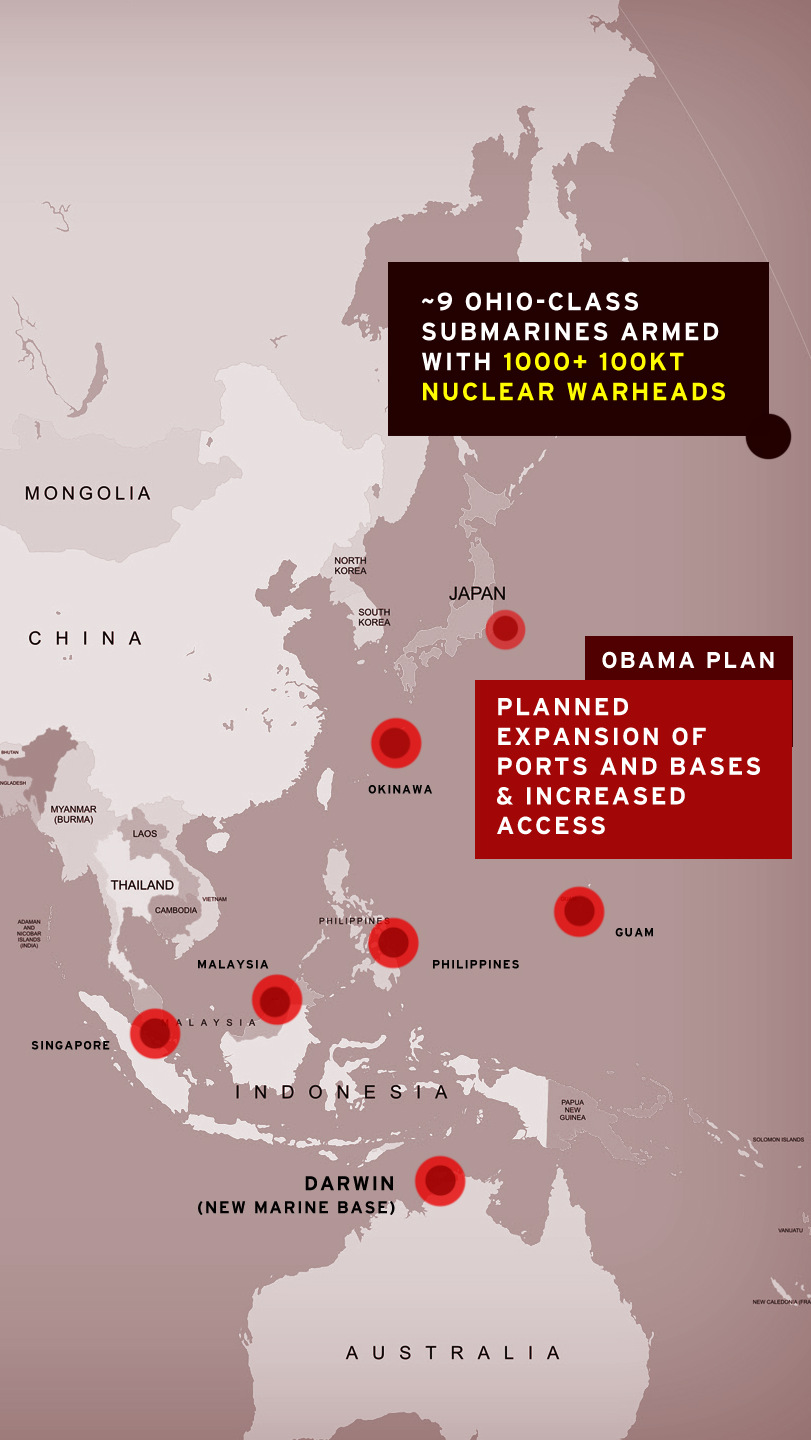
With its Asian Pivot, the U.S. intends to surround and isolate China by moving 60 percent of its Navy to the Asia-Pacific region, developing military agreements with countries there, and conducting joint military exercises with Pacific countries. The U.S. is also negotiating a massive corporate power-expanding treaty, the Trans-Pacific Partnership (TPP), which excludes China.

Map of current US military deployments in S.E. Asia.  (Courtesy of the   Copyright Schiller Institute, Inc. 2015. All Rights Reserved.)

Map of current US military deployments in S.E. Asia. (Courtesy of the Schiller Institute, Inc. 2015. All Rights Reserved.)

Vietnam has been a focal point for the U.S. military since the end of the George W. Bush administration, a prelude to the Asian Pivotthat was formally announced by President Obama. For the last five years, the U.S. and Vietnam have been involved in joint military exercises. The U.S. has also started to sell weapons to Vietnam, seeking to transition the Vietnamese from Russian weapons to American weapons. And there has been a series of high-level meetings between the two countries.

In June 2013, The Diplomat reported, “the Chairman of the U.S. Joint Chiefs of Staff hosted the first visit by the Chief of the General Staff of the Vietnam People’s Army (and Deputy Minister of National Defense), General Do Ba Ty. Ty’s delegation included the commander of Vietnam’s Air Force and the deputy commanders of the Navy and General Intelligence Department. His trip included a visit to the Joint Base Lewis-McChord in Washington state suggesting future possible joint activities.”

On July 25, 2013 Obama met with President Truong Tan Sang in Washington to form a U.S.-Vietnam Comprehensive Partnership, covering a range of concerns including war legacy and security issues. They agreed to cooperate militarily through the U.S.-Vietnam Defense Policy Dialogue and the bilateral Political, Security, and Defense dialogue to discuss future military cooperation.

That meeting was followed by two high-level meetings between the U.S. and Vietnamese militaries. On Oct. 1, 2013 they held the 6th U.S.-Vietnam Political, Security and Defense Dialogue. The U.S. delegation included representatives from the State Department, Defense Department, USAID and the U.S. Pacific Command, while the Vietnamese delegation included representatives from the foreign affairs, public security and national defense ministries. The agenda included counterterrorism, counternarcotics, human trafficking, cyber law enforcement, defense and security, disaster response, search and rescue, war legacy and cooperation in regional organizations.

On Oct. 28 to 29, 2013 a second meeting was held in Washington. The 4th U.S.-Vietnam Defense Policy Dialogue was a deputy minister-level meeting and involved officials from their respective defense ministries. The Diplomat reported that “both dialogues were held within the framework of the Memorandum of Understanding on Advancing Bilateral Defense Cooperation signed on September 19, 2011 and the U.S.-Vietnam Joint Statement of July 25, 2013.”

“What was new?” The Diplomat continued. “The two sides agreed to step up cooperation between their navies and their respective defense academies and institutions.”

Yet the Vietnamese are continuing to move slowly in building a military relationship with the U.S. Vietnam limits the U.S. Navy to one port call per year and continues to bar U.S. Navy warships from entry to Cam Ranh Bay. Further, Vietnam has yet to approve a request made by Defense Secretary Leon Panetta in June 2012 to set up an Office of Defense Cooperation in the U.S. Embassy in Hanoi.

A key factor holding back a closer military relationship is the inadequate cleanup of Agent Orange and the United States’ insufficient commitment to dealing with war legacies. After the 4th Defense Policy Dialogue, Vietnamese Deputy Defense Minister Nguyen Chi told Voice of Vietnam, “A better defense relationship should be based on the efficiency of practical cooperation, including overcoming [the] war aftermath… General speaking (sic), the U.S. has offered Vietnam active cooperation in the issue, but it is not enough as the consequences of war are terrible.”

Bloomberg reported last year on the fifth year of joint military operations, tying them to the Asian Pivot: “Two U.S. Navy ships began six days of non-combat exercises with the Vietnamese military as the U.S. seeks to bolster its presence in Asia at a time of growing tension between China and its neighbors.” Lt. Comm. Clay Doss, a Navy public affairs officer, described the evolution, saying: “The quality and depth of the exchanges is increasing each year as our navies get to know each other better.”

Chairman of the Joint Chiefs of Staff Martin Dempsey visited Vietnam in August – the first visit of a Joint Chiefs chairman since 1971. Dempsey’s trip came amid an escalation in conflicts between China and Vietnam. Among other things, he visited a U.S. military base where toxic defoliants had been stored.

In October, the U.S. eased a ban on lethal weapons sales to Vietnam. The U.S. said the arms sales would improve the maritime military capabilities of Vietnam so it could be more effective in conflicts in the Asia-Pacific region. In December 2013, Secretary of State John Kerry announced $18 million in assistance to Vietnam to provide its coast guard with five unarmed, high-speed patrol boats.

An October commentary in the People’s Daily, the flagship newspaper of China’s Communist Party, described these acts as destabilizing and “a clear extension of America’s interference with the balance of power in the region.” Maritime conflicts between Vietnam and China have been increasing as the U.S. adds military strength to Vietnam’s navy and coast guard. China maintains that disputes should be resolved through negotiations. Citing the Declaration of the Conduct of Parties in the South China Sea, the Chinese side maintains that “related countries should solve maritime disputes peacefully.”

Meanwhile, in Vietnam there are also concerns about an escalation of disputes: “Some senior Vietnam Communist Party leaders have worried over the years that moving to upgrade military-to-military ties with the US would provoke China to increase its pressure on Vietnam and its assertiveness in the South China Sea.”

In addition to challenging China, the U.S. also seeks to undermine the relationship between Vietnam and Russia. Russia, an arch rival of the U.S., has been the main weapons supplier for Vietnam since 2009. The U.S. wants to reorient Vietnam’s military away from Russia, which holds multi-billion dollar arms sales contracts with Vietnam, including the sale of submarines and fighter jets.

Sputnik, a Russian government-owned news media outlet, reported earlier this month that the U.S. “bullied” Vietnam to stop allowing Russia to use the Cam Ranh Bay naval base. The State Department says it has “urged Vietnamese officials to ensure that Russia is not able to use its access to Cam Ranh Bay to conduct activities that could raise tensions in the region.” Igor Korotchenko, director general of the Russian Center for Analysis of World Arms Trade, described the U.S. as stirring up tensions, instituting an arms race and creating regional instability.

Agent Orange funding a tool for US militarism — and what else?

A U.S. Air Force C-123 flies low along a South Vietnamese highway spraying Agent Orange on dense jungle growth beside the road to eliminate ambush sites for the Viet Cong during the Vietnam War. During the Vietnam War, Air Force C-123 planes sprayed millions of gallons of herbicides over the jungles of Southeast Asia to destroy enemy crops and tree cover.

A U.S. Air Force C-123 flies low along a South Vietnamese highway spraying Agent Orange on dense jungle growth beside the road to eliminate ambush sites for the Viet Cong during the Vietnam War. During the Vietnam War, Air Force C-123 planes sprayed millions of gallons of herbicides over the jungles of Southeast Asia to destroy enemy crops and tree cover.

The Vietnamese government told the U.S. that one thing preventing a closer relationship between the U.S. and Vietnamese militaries is the failure of the U.S. to deal with the lasting effects of Agent Orange. After 50 years of the Agent Orange crisis the U.S. is finally beginning to fund some cleanup efforts. This funding is coming from USAID, which has a sordid history of serving as a cover for U.S. militarism and the CIA in Vietnam and around the world.

In William Blum’s 2004 book “Killing Hope,” John Gilligan, director of USAID under the Carter administration, describes the depth of the CIA-USAID relationship: “At one time, many AID [USAID] field offices were infiltrated from top to bottom with CIA people. The idea was to plant operatives in every kind of activity we had overseas, government, volunteer, religious, every kind.”

Likewise, The Washington Post reported in 2010 that, “In South Vietnam, the USAID provided cover for CIA operatives so widely that the two became almost synonymous.”

During the Vietnam War, USAID operated a police training program that was tied to death squadsFormer New York Times correspondent A. J. Langguth wrote that “the two primary functions” of the USAID police training program were to allow the CIA to “plant men with local police in sensitive places around the world,” and bring to the U.S. “prime candidates for enrollment as CIA employees.”

The covert role of USAID has persisted. As The Washington Post reported in 2010, then-CIA Director Leon Panetta promised spies “new cover” for secret ops, and agencies that provide such cover include USAID and the State Department.

USAID has recently used health crises as cover for its covert operations. In 2011, Pakistan had a polio crisis, recording the highest number of polio cases in the world; it was a spiraling health catastrophe. USAID used a vaccination program organized by Save the Children, which had operated for 30 years in Pakistan, as cover to find Osama bin Laden.

The USAID-funded vaccination program used a Pakistani doctor and a local group, Lady Health Workers, to gain entrance to bin Laden’s home by going door-to-door to administer vaccinations. When vaccinations were administered to bin Laden’s children and grandchildren USAID tested the DNA of the used needles. It is likely that the doctor and two organizations were not aware they were being used by USAID. Save the Children staff members were expelled from Pakistan and the doctor was sentenced to 33 years in prison. His lawyer was murdered last week, and 74 health care workers have been killed since December 2012.

Last year, The Associated Press uncovered a USAID HIV-prevention program in Cuba used for covert operations. Beginning in October 2009, USAID, working through the Washington-based Creative Associates International, sent “Venezuelan, Costa Rican and Peruvian young people to Cuba in hopes of ginning up rebellion. The travelers worked undercover, often posing as tourists, and traveled around the island scouting for people they could turn into political activists.” They created an HIV-prevention workshop that “memos called ‘the perfect excuse’ for the program’s political goals.” Cuba uncovered the covert mission when the youth were questioned about their funding.

David Shear Nguyen Chi VinhU.S. Ambassador to Vietnam David Shear, center, and Vietnam’s Deputy Defense Minister Nguyen Chi Vinh, third left, along with delegates, attend a ceremony marking the start of a project to clean up dioxin left over from the Vietnam War, at a former U.S. military base in Danang, Vietnam Thursday Aug. 9, 2012. 

Noting that USAID has “a long history of engaging in intelligence work and meddling in the domestic politics of aid recipients,” Foreign Policy reported on another USAID program in Cuba, also exposed in 2014, where USAID covertly launched a social media platform in 2010, creating a Twitter-like service that would spark a “Cuban Spring.” The digital Bay of Pigs failed to spark a revolt, but it did expose the political leanings of 40,000 Cubans. This was reportedly not a CIA project, but a USAID project meant to undermine the Cuban government. Indeed, USAID has evolved to carry out its own meddling in the affairs of governments.

A 2006 State Department cable, released by WikiLeaks in 2013, outlined the United States’ strategy for undermining the Venezuelan government of Hugo Chávez by “Penetrating Chavez’ Political Base,” “Dividing Chavismo,” and “Isolating Chavez internationally.” The same office responsible for the digital Bay of Pigs in Cuba, USAID’s Office of Transition Initiatives, also carried out the program in Venezuela.

Bolivia expelled USAID in 2013 because it was meddling in Bolivian politics. President Evo Morales was upset that USAID money reached lowland regional governments that attempted to overthrow him in 2008. A Freedom of Information Act (FOIA) request showed that USAID provided “$10.5 million for ‘democracy-building’ awarded to Chemonics International in 2006 ‘to support improved governance in a changing political environment.’” (Democracy development is a common cover for programs to foment rebellion.)

Bolivia is one of the many countries that have recently expelled USAID over the organization’s meddling in internal politics. The Los Angeles Times reported in 2013 that “about 50 countries have adopted laws to limit foreign funding of civic groups or more strictly control their activities. About 30 other countries are considering restrictions.”

Meanwhile, U.S. covert actions in Vietnam have not ended. A blogger and lawyer who spent a year in the U.S. as a fellow the National Endowment for Democracy was arrested in December 2012 for pro-democracy activities. The National Endowment for Democracy has been providing hundreds of thousands of dollars to various Vietnamese projects related to changing the government in recent years. USAID has a major presence with 38 ongoing projects in Vietnam.

It may be that regime change activities are already beginning in Vietnam. In 2014, there were large anti-China protests and attacks on Chinese businesses in Vietnam. Some speculated that the Vietnamese government was behind the protests, but David Koh, a reporter for Singapore’s Straits Times, who works with NGOs in Vietnam, interviewed officials and businessmen in Vietnam and reported that the government was surprised by the protests.

The protests were also against economic conditions and other issues in Vietnam, and it remains unclear who planned and funded the events. Researchers in Singapore who interviewed people on the ground in Vietnam wrote:

“A large number of Vietnamese flags and T-shirts had been purchased before the demonstrations suggesting that the attacks were not spontaneous. Even maps locating Chinese and Taiwanese factories had been photocopied in large numbers. The leaders of the riots have been reported to have been using walkie-talkies to communicate with each other. The fact that the violence affected as many as 200 factories in a single day already suggests that a high level of professionalism and organization was involved. This suggests that the riots were premeditated, although unlike the earlier peaceful demonstration of the patriots, they were not announced openly. Workers were believed to receive from VND50,000 to VND300,000 VND (equivalent to US$2.3 to US$14) to follow the agitators. This begs the question: where did the money come from?”

It’s important to note that people were paid more than a day’s labor to participate.

The Singapore researchers ultimately concluded that the Vietnamese government was the big loser:

“However, for now, the notion that the riots and violence were simply the result of a wave of blind nationalism and anti-Chinese sentiments must be re-examined. The current crisis presents major challenges for not only Vietnam-China relations, regional stability and ASEAN’s unity, but most of all, for Vietnam’s political system.”

Agent Orange Trojan Horse compounds war crimes

In addition to opening up Vietnam to a deeper relationship with the U.S. military – which is dangerous enough for Vietnam, China, Russia and the broader Asia-Pacific region – what else will USAID do with its foothold in Vietnam? As USAID so routinely involves itself in the affairs of foreign governments, it would be foolish to assume that USAID does not have other plans for Vietnam.

Rather than paying war reparations, the U.S. is using Agent Orange as a Trojan Horse to further U.S. militarization in Vietnam, escalate conflict with China and break the Vietnamese relationship with Russia. It may also be laying the groundwork for regime change if Vietnam does not comply as a tool of U.S. empire.

Vietnam should continue to demand war reparations that are adequate for the problems the U.S. created and keep the U.S. military at arm’s length. Vietnam should kick out USAID and the National Endowment for Democracy, and demand that payments be made directly to Vietnam to keep U.S. meddling out of their country. Indeed, the U.S. should not be allowed to leverage the war crime of its use of Agent Orange as a tool for more U.S. militarism and intervention.

Agent Orange Funding Opens Door To US Militarism And Covert Action In Vietnam

http://www.globalresearch.ca/agent-orange-funding-opens-door-to-us-militarism-and-covert-action-in-vietnam/5438809


The Western connection in the assassination of Serbia’s Prime Minister Djindjic on March 14, 2003

Posted on the Saker, March 20, 2015

by Nikola Vrzic

Several days ago, on March 12th, Serbia marked another – twelfth – anniversary of the assassination of Serbia’s prime minister Zoran Djindjic. The official narrative of Djindjic, as a reformer who was killed by criminals and Serbian nationalists, this year was confronted with evidence revealing the story as much more complex, with a strong presence of Western, primarily British and US secret services…

The official version of Djindjic’s death, established on a day of his assassination in 2003 and later confirmed by the court, says that Djindjic, pro-Western reformer, “the quisling of Belgrade” as Neil Clark called him in The Guardian on March 14 2003, was killed by members of (Belgrade suburb) Zemun criminal clan and “red berets”, Serbian secret police unit for special operations which had fought in wars in Croatia, Bosnia, and Kosovo. Criminals, the story goes, wanted Djindjic dead as they wanted to avoid their imminent arrest, while the “red berets”, allegedly supported by nationalistic circles in Serbian society (in the army, in political parties, Serbian orthodox church…), wanted Djindjic dead for his cooperation with The Hague Tribunal and, broadly speaking, betraying Serbian national interests by collaborating with the West.

Djindjic was killed as his motorcade came to the building of Serbian government. According to the official version, he got out of his car, walked (on crutches, he previously injured his left leg playing football) to the door which was closed, turned against the door in an attempt to open it himself by pushing it with his back, and at that point he was shot with a single bullet (which was never recovered). After Djindjic was shot, there was a second shot which injured Djindjic’s bodyguard Milan Veruovic and, piercing his body, ended in a stone wall next to the door where Djindjic was shot.

That is the official version.

This is where our investigation started.

In a recently published book “The Third Bullet. The Political Background of the Assassination of Zoran Djindjic” by Milan Veruovic, Djindjic’s wounded bodyguard, and the author of this article, journalist Nikola Vrzic, the official version of Serbian PM’s assassination is scrutinized through comprehensive analysis of all the evidence presented to the court, testimonies, police documents…, and, as a result, the book refuted the official version of Djindjic’s assassination both in terms of what really happened on March 12 2003, as well as regarding the political motives that led to his death. In short, conspiracy seems to be much, much wider, going beyond Serbia’s borders.

Both witnesses’ testimonies and material evidence show there were three, not just two bullets fired on that day, which means – to make a longer story short – there was another sniper; again, both witnesses and all the material evidence prove that Djindjic was shot by that other sniper, as he did not turn his back to the government building trying to open the door himself (with nine bodyguards around him) – the door, in fact, was open – but he was shot facing the government building, meaning, from exactly the opposite direction than officially acknowledged; Djindjic’s entry wound (33×20 mm), consistent with damages on his clothes, is significantly larger than Veruovic’s entry wound (6×7 mm), which also proves that they were shot from two different rifles of different calibers, with Veruovic’s wound being consistent with the caliber (diameter of a bullet) 7,62 mm of the only rifle that was, officially, used on March 12 2003; as far as that rifle is concerned, the comparison of Serbian police’s documentation with the documentation of German police (which examined the rifle afterwards) show strong indications that different rifle was planted instead of the one originally found; in a days after Djindjic was shot, a man from Croatia, with criminal contacts, was identified as possibly being one of the assassins, however, Serbian police did not even present his photograph to the witnesses and did not follow up on this lead, but, instead, directed the public attention to an innocent Belgrade man in order to divert the attention from the Croatian trail; furthermore, the police concealed the automobile used by the Croatian man, and this automobile – black “Volvo” 240 – belonged to one of Serbian security services…

To cut a long story short, the official version proved to be the official lie about Djindjic’s assassination.

Which leads to the crucial question – who is guilty for this lie? One answer is obvious: police who investigated the crime, prosecutors and judges who confirmed the false official version, despite all the evidence and testimonies suggesting the opposite. Above them, Djindjic’s successors in his party and Serbian government, who had provided strong political support for the false official version, actively participating in establishing this, i.e. their version of Djindjic’s assassination.

These successors of Zoran Djindjic, it should be noted, are among the most pro-Western political forces in Serbia.

And this brings us to the, possibly, crucial aspect of the story. West’s involvement in the events preceding Djindjic’s assassination, as well as after it, in the establishment of the false official version, is profound.

Based on public documents, Serbian police and secret service documents, court testimonies, US diplomatic cables revealed by the WikiLeaks, we can be certain that:

– CIA’s agents in Hungary helped in arranging the protection of the crucial “protected witness” Ljubisa Buha Cume, former boss of Zemun criminal clan, who started the chain of events that led to Djindjic’s murder. British intelligence service also played its part in protecting this man, by arranging his transfer from Turkey to Slovakia when Zemun clan’s hitmen were after Buha.

– CIA had its agent inside the Zemun clan, Cedomir Mihajlovic (alias Igor Baruh). British service, according to court testimonies, also had the clan under the surveillance, and even had the information they were about to assassinate Djindjic – this according to Vladimir Popovic, former Djindjic’s associate with whom Djindjic parted in the fall of 2002.

– This man, Vladimir Popovic, who came to the government building exactly 5 minutes after Djindjic’s assassination and who can be regarded as the creator of the official version, was accused by former Serbian secret police chief Jovica Stanisic for being recruited by the British intelligence. Stanisic said this in the statement to the Serbian police when he was arrested. Popovic himself, in his court testimony, spoke about his contacts with British intelligence.

– UBPOK, Serbian police unit that conducted the investigation, was created shortly beforehand under the British auspice.

– Anthony Monckton, who was revealed as the MI6 agent in Serbia, also participated in the investigation, according to The Sunday Times and The Guardian.

– Special prosecutor Jovan Prijic, the author of the indictment based on the false official version, enjoyed political protection from then US ambassador in Belgrade Michael Polt, EU high representative Javier Solana and other Western diplomats, which was revealed when the government of Vojislav Kostunica tried to remove Prijic from the office. Eventually he was removed, however, on a condition to remain leading prosecutor in Djindjic’s case.

– US diplomatic cables, revealed by WikiLeaks, showed that US embassy in Belgrade, supervising the trial, was in constant contact with the presiding judge in Djindjic case, even consulting with him about who will, among Zemun clan members, become a protected witness, i.e. collaborator of the prosecution.

– Finally, German intelligence, during Djindjic’s lifetime, conducted a security check of his places of work and residence, which could mean that they knew exactly from which locations his life could be threatened. Their report was never presented to the Serbian authorities. Germans also officially participated in the investigation of Djindjic’s assassination.

And then, there is also Djindjic’s policy. Even though he was brought to power in Serbia with Western help, by the beginning of 2003, from being part of the solution when he was removing Slobodan Milosevic, he became part of the problem, endangering pax Americana in the Balkans by demanding Kosovo to remain part of Serbia and to immediately start negotiations on Kosovo’s final status, which was strongly opposed by both the US and the EU. He demanded Serbian police to return to Kosovo, according to the UN Security Council’s Resolution 1244. He threatened with the independence of Serbian republic in Bosnia in the case of Kosovo’s independence sponsored by Western powers. He refused to hand over the archives of Serbian police and army to The Hague Tribunal, refusing also to extradite Serbian generals which were about to be indicted by the Tribunal.

Before he was killed, Zoran Djindjic had been labeled as a “new Slobodan Milosevic” for his confronting the West.

After his death, this Djindjic’s policy of confronting the West was completely overturned by his successors, who made every attempt to make the public forget about Djindjic’s clash with the West prior to his assassination. Furthermore, Western engineering of Serbian political scene accelerated in the years following Djindjic’s death, eventually resulting in total consensus in Serbia’s parliament on country’s EU integrations.

Last, but not the least, after Djindjic’s death every party in Serbia held the power at some point. During this turmoil, everything could change but two things: Serbia continued to approach NATO – this also started after Djindjic’s assassination – and nobody dared to publicly question the official version of the murder of Zoran Djindjic. There must be a strong reason for this.

Western Connection in the Assassination of Serbia’s Prime Minister Djindjic

Argo vs. Waking up in Tehran — what happened in 1979? Hollywood propaganda vs. historical reality

The book Waking Up in Tehran by Margot Lachlan White, which David Swanson describes as a “magnificent modern epic”, was apparently never published. What happened to her and the book? It is not hard to imagine the pressure from Israel and the United States to make sure it did not see the light of day, especially in light of the experiences she describes. There are a few reviews online and a podcast interview.

It’s more timely than ever to get this book published and/or posted online.

Posted on War is a Crime.org, January 11, 2013
Waking up in Tehran
by David Swanson

According to one theory, U.S.-Iranian relations began around November 1979 when a crowd of irrational religious nutcases violently seized the U.S. embassy in Iran, took the employees hostage, tortured them, and held them until scared into freeing them by the arrival of a new sheriff in Washington, a man named Ronald Reagan.  From that day to this, according to this popular theory, Iran has been run by a bunch of subhuman lunatics with whom rational people couldn’t really talk if they wanted to.  These monsters only understand force.  And they have been moments away from developing and using nuclear weapons against us for decades now.  Moments away, I tell you!

According to another theory — a quaint little notion that I like to refer to as “verifiable history” — the CIA, operating out of that U.S. embassy in Tehran in 1953, maliciously and illegally overthrew a relatively democratic and liberal parliamentary government, and with it the 1951 Time magazine man of the year Prime Minister Mohammad Mossadegh, because Mossadegh insisted that Iran’s oil wealth enrich Iranians rather than foreign corporations.  The CIA installed a dictatorship run by the Shah of Iran who quickly became a major source of profits for U.S. weapons makers, and his nation a testing ground for surveillance techniques and human rights abuses.  The U.S. government encouraged the Shah’s development of a nuclear energy program.  But the Shah impoverished and alienated the people of Iran, including hundreds of thousands educated abroad.  A secular pro-democracy revolution nonviolently overthrew the Shah in January 1979, but it was a revolution without a leader or a plan for governing.  It was co-opted by rightwing religious forces led by a man who pretended briefly to favor democratic reform.  The U.S. government, operating out of the same embassy despised by many in Iran since 1953, explored possible means of keeping the Shah in power, but some in the CIA worked to facilitate what they saw as the second best option: a theocracy that would substitute religious fanaticism and oppression for populist and nationalist demands.  When the U.S. embassy was taken over by an unarmed crowd the next November, immediately following the public announcement of the Shah’s arrival in the United States, and with fears of another U.S.-led coup widespread in Tehran, a sit-in planned for two or three days was co-opted, as the whole revolution had been, by mullahs with connections to the CIA and an extremely anti-democratic agenda.  They later made a deal with U.S. Republicans, as Robert Parry and others have well documented, to keep the hostage crisis going until Carter lost the 1980 presidential election to Ronald Reagan.  Reagan’s government secretly renewed weapons sales to the new Iranian dictatorship despite its public anti-American stance and with no more concern for its religious fervor than for that of future al Qaeda leaders who would spend the 1980s fighting the Soviets with U.S. weapons in Afghanistan.  At the same time, the Reagan administration made similarly profitable deals with Saddam Hussein’s government in Iraq, which had launched a war on Iran and continued it with U.S. support through the length of the Reagan presidency.  The mad military investment in the United States that took off with Reagan and again with George W. Bush, and which continues to this day, has made the nation of Iran — which asserts its serious independence from U.S. rule — a target of threatened war and actual sanctions and terrorism.

Ben Affleck was asked by Rolling Stone magazine, “What do you think the Iranians’ reaction is gonna be?” to Affleck’s movie Argo, which depicts a side-story about six embassy employees who, in 1979, avoided being taken hostage.  Affleck, mixing bits of truth and mythology, just as in the movie itself, replied:

“Who the FUCK knows – who knows if their reaction is going to be anything? This is still the same Stalinist, oppressive regime that was in place when the hostages were taken. There was no rhyme or reason to this action. What’s interesting is that people later figured out that Khomeini just used the hostages to consolidate power internally and marginalize the moderates and everyone in America was going, ‘What the fuck’s wrong with these people?’ You know, ‘What do they want from us?’ It was because it wasn’t about us. It was about Khomeini holding on to power and being able to say to his political opponents, of which he had many, ‘You’re either with us or you’re with the Americans’ – which is, of course, a tactic that works really well. That revolution was a students’ revolution. There were students and communists and secularists and merchants and Islamists, it’s just that Khomeini fucking slowly took it for himself.”

The takeover of the embassy is an action virtually no one would advocate in retrospect, but asserting that it lacked rhyme or reason requires willful ignorance of Iranian-U.S. relations.  Claiming that nobody knew what the hostage-takers wanted requires erasing from history their very clear demands for the Shah to be returned to stand trial, for Iranian money in U.S. banks to be returned to Iran, and for the United States to commit to never again interfering in Iranian politics.  In fact, not only were those demands clearly made, but they are almost indisputably reasonable demands.  A dictator guilty of murder, torture, and countless other abuses should have stood trial, and should have been extradited to do so, as required by treaty.  Money belonging to the Iranian government under a dictatorship should have been returned to a new Iranian government, not pocketed by a U.S. bank.  And for one nation to agree not to interfere in another’s politics is merely to agree to compliance with the most fundamental requirement of legal international relations.

Argo devotes its first 2 minutes or so to the 1953 background of the 1979 drama.  Blink and you’ll miss it, as I’m betting most viewers do.  For a richer understanding of what was happening in Iran in the late 1970s and early 1980s I have a better recommendation than watching Argo.  For a truly magnificent modern epic I strongly encourage getting a hold of the forthcoming masterpiece by M. Lachlan White, titled Waking Up in Tehran: Love and Intrigue in Revolutionary Iran, due to be published this spring.  Weighing in at well over 300,000 words, or about 100,000 more than Moby Dick, Waking Up in Tehran is the memoir of Margot White, an American human rights activist who became an ally of pro-democracy Iranian student groups in 1977, traveled to Iran, supported the revolution, met with the hostage-takers in the embassy, became a public figure, worked with the Kurdish resistance when the new regime attacked the Kurds for being infidels, married an Iranian, and was at home with her husband in Tehran when armed representatives of the government finally banged on the door.  I’m not going to give away what happened next.  This book will transport you into the world of a gripping novel, but you’ll emerge with a political, cultural, and even linguistic education.  This is an action-adventure that would, in fact, make an excellent movie — or even a film trilogy.  It’s also an historical document.

There are sections in which White relates conversations with her friends and colleagues in Iran, including their speculations as to who was behind what government intrigue.  A few of these speculations strike me as in need of more serious support.  They also strike me as helpful in understanding the viewpoints of Iranians at the time.  Had I edited this book I might have framed them a little differently, but I wouldn’t have left them out.  I wouldn’t have left anything out.  This is a several-hundred-page love letter from a woman to her husband and from an activist to humanity.  It is intensely romantic and as honest as cold steel.  It starts in 1977.

Continue reading