US-NATO launch new proxy war front in Crimea: Neo-Nazis bomb electrical grid causing national blackouts

Global Research, November 26, 2015
21st Century Wire 26 November 2015
140227-map-crimea-1250_5f00f6012cf34480d5b588e14677df11 (1)

In 2014, US and EU installed its own hand-picked puppet regime in Kiev, Ukraine. This caused a chain of epic failures that have made many ardent cheerleaders for ‘regime change’ to question whether or not tipping over the elected government in 2014 was a very good idea.

The worst part of the whole operation was that US and EU central planners thought it prudent to activate and partner with NeoNazis and proto-fascist militants in order to achieve their short-term regime change goals. Once the coup d’etat had taken place in February 2014, western agents of change were stuck with a horrific political Frankenstein they had created.

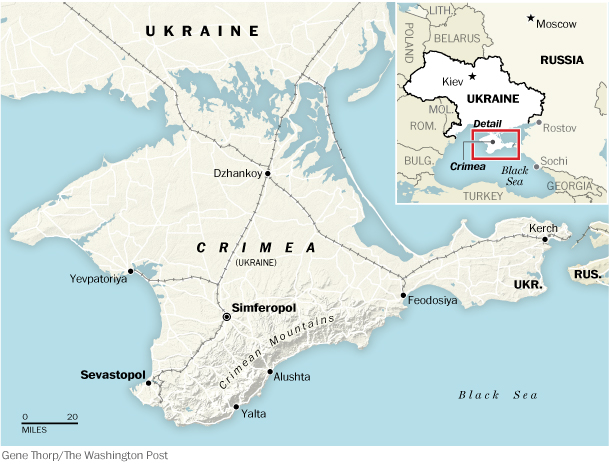
While the battles have been raging in Syria and elsewhere, few in the west have been aware that the architects of instability have been busy opening up a new front for proxy, asymmetric warfare – in Crimea. To add to the shock and awe, western agents have brought together two of the worst groups of miscreants the world has ever known.
ukraine-crimea-V3
Counterpunch
reports on the western media and government collusion in recent attacks on Crimea:

“Ever since the Maidan coup of February 2014, Western media and governments have all but incited violent actions by extremists against the Crimean people. Unknown to people in the West is the aforementioned, food transport blockade, ongoing since September 20. Western media has self-censored reports of that, including the central role played by the neo-Nazi Right Sector group.”

That’s not all…

Ever since then, Crimea has been the focal point of the NATO strategic offensive against Russia in the region. Most disturbingly recently, a GLADIO-style terror campaign seems to have targeted Crimea, and like clock-work, western media outlets in the process of inventing a tidy narrative in order to package what is clearly new campaign of terror that’s currently being unleashed in the region.


WASHINGTON’S PROXY: US planners would refer to working with Ukraine’s Nazis as a ‘necessary evil’ in order to achieve geopolitical objectives in the region.

After putting NeoNazi paramilitary groups to work terrorizing the Russian-speaking population in eastern Ukraine, even Kiev struggled to get them back under control. It seems someone has decided to put them to work doing another ‘off-the-books’ operation which requires a lot of deniability – terrorizing the population of newly independent Crimea peninsula.

On Monday,the Crimea government declared a “State of Emergency” this week when Kiev-backed ‘nationalists’ blew up the country’s electrical infrastructure causing mass blackouts, with “Crimea is completely cut off,” says Director of Crimea Energy, Viktor Plakida, .

In what appears to be a true-to-form, classic false flag attack – a ‘Crimean Tatar’ flag was placed at the site of explosion. It’s more likely that the guiding hand of NATO Intelligence is active behind the scenes to intensify the situation.

Naturally, western media outlets are trying to frame the narrative as a ‘internal dispute’ between ethnic Tartars and ‘Russian speakers in Crimea’ (as part of the western media’s ongoing effort to isolate and demonize Russia at every turn). Still, a number of likely CIA-run editorial desks, and Mockingbird-type media outlets still refer to the Crimean referendum in winter of 2014 as “Russia’s bloodless invasion in February and March 2014”.

The reality on the ground is everyone’s worst nightmare come true: fighting has now begun between US-backed proxy militants and ethnic Russian and Russian-speaking forces as Washington and NATO continues to arm-up a flagging Ukrainian military, and supply their new ‘deniability brigades’, NeoNazis paramilitary platoons, Right Sector and Tatar militias, some of whom have been implicated in terrorist attacks in recent months.

CIA-NATO Dream Team: Nazis and ISIS Fighting Side-By-Side in Ukraine

Other US State Department-aligned foreign policy blogs have even admitted that US military Special Forces have been training new Ukrainian special forces, and seem to be ramping-up the rhetoric in the hopes of trigger more instability in the region.

Another disturbing development which has been all but blacked-out by US TV media, is that either CIA or NATO Intelligence (or both) appear to have drafted in Islamic Battalions, stocked with militant Chechens (likely many of the same fighters rotating through Syria fighting for ISIS), to help the US-backed regime in Kiev defeat Russian-speaking Rebels in eastern Ukraine.

So it’s another US-NATO proxy war beginning in Crimea.

As the US hasn’t done enough damage by funding and creating ISIS and other Jihadist terrorists in Syria.

Looks like Washington is really keeping busy these days…
Russian navy holds drills to ‘repel strikes’ on Crimea

From Strategic Culture Foundation
Press TV
10-27-15

Russian military forces have staged a navy exercise off the coast of the city of Sevastopol in the Black Sea Crimean peninsula to “thwart any possible aggression by the West.”

“Today and tomorrow ships… will practice the organization of repelling strikes by the enemy from the air in the Black Sea fleet’s naval range near the Crimean coast,” fleet spokesman Nikolai Voskresensky was quoted by Russian news agencies as saying on Monday.

Russian navy’s guided missile hovercraft, Samum, as well as several smaller ships, in addition to Su-24 bombers, will take part in drills for preparing Russian navy forces to “repel strikes” on Crimea, he said.

The spokesman added that the naval exercise will be wrapped up by launching a cruise missile strike.

Russia military forces were deployed in military bases across Crimea after the region separated from Ukraine in March last year and re-joined Moscow in a referendum.

The Ukrainian crisis last year and Crimea’s reunion with Russia has plunged Kremlin’s relations with the West to their lowest point since the Cold War.

This as the North Atlantic Treaty Organization (NATO) forces have escalated their military maneuvers along the Russian border, in the Baltic States and Eastern Europe.

Russia and the West are also at loggerheads over the conflict in Syria.

http://www.strategic-culture.org/news/2015/10/27/russian-navy-holds-drills-to-repel-strikes-on-crimea.html

Lugansk conference discusses Donbass vs. Crimea scenarios

From Fort Russ

September 21, 2015 –
NCN
Translated for Fort Russ by J. Arnoldski 

 
“Polish political scientist: Donbass clearly wants to become a second Crimea”
The polish political scientist Mateusz Piskorski participated in a conference in Lugansk, where his colleagues discussed the idea of the accession of Donbass to the Russian Federation. 
The leadership and people of the unrecognized Donetsk and Lugansk people’s republics are in favor of joining Russia if Kiev will continue to not abide by the Minsk agreements. The director of the European Center for Geopolitical Analysis, Mateusz Piskorski, stated to the National News Service this while participating in the Lugansk conference “The Path of Integrating Donbass into Russia.”
“Sooner or later, if the Ukrainian side will not be up to implementing the Minsk agreements and Kiev will continue to call the leadership and population of the DPR and LPR terrorists and separatists, then Donbass will not be left another exit other than joining the Russian Federation,” the Polish expert said.
This topic is not being discussed on a political level, but nevertheless it is a reflection of public opinion, Piskorski noted. According to him, the political scientists and participants of the conference were interested in understanding “whether Novorossiya will become a second Crimea for Russia, that is, acceding to Russia through a referendum, through direct democracy.” 
“At the conference in Lugansk, there were participants not only from the DPR and LPR, but also from Russia and European countries. In addition to political experts, politicians, in particular the head of the LP Igor Plotnitsky and the speaker of the parliament of the DPR, Denis Pushilin, attended,” Piskorski told the National News Service.
Let us recall that since April, 2014, Kiev is conducting the so-called anti-terrorist operation. Ukrainian security forces use armored vehicles and heavy artillery against disgruntled locals who are against the February coup and who held a referendum on secession from Ukraine. 
In more than a year of fighting, the local militia has managed to defend a part of the territory of the Donetsk and Lugansk regions, proclaiming there two republics which have so far not received international recognition.
A plan for settling the armed conflict was written in the Minsk agreements which implied the preservation of Donbass as part of Ukraine by granting the region a special status. 
According to the United Nations, nearly 8 thousand people have been killed over the course of the conflict. 

http://fortruss.blogspot.com/2015/09/lugansk-conference-discusses-donbass-vs.html

How Crimeans greeted Putin versus Poroshenko

From Fort Russ

September 14, 2015 – 

RusVesna – 
Translated for Fort Russ by J. Arnoldski

“Crimean Tatars joyfully greeted Putin in Bakhchisarae”

A video has been published which captures rare footage of Vladimir Putin that did not pass through the sieve of official press services.

It shows how very emotionally, yet happily, residents of the Crimean regional center, where a large part of the Crimean Tatar population resides, met the Russian president.

For comparison, Russian Spring is also publishing footage of the meeting between Poroshenko and locals in Simferopol in February, 2014. 

<iframe width=”320″ height=”266″ src=”https://www.youtube.com/embed/8DQCo0Yhro4&#8243; frameborder=”0″ allowfullscreen><!–iframe>

State Dept. briefing May 15 via Nuland contradicts Kerry

From the US State Department
http://www.state.gov/r/pa/prs/dpb/2015/05/242432.htm

Daily Press Briefing – May 15, 2015 – US Department of State

TRANSCRIPT:

excerpt

…Second item, Ukraine. As the Secretary said at the NATO ministerial meeting in Antalya, Turkey, earlier this week, this is a critical moment for action by Russia and the separatists to live up to the Minsk agreements. Ukraine’s leaders continue to implement their Minsk commitments, just as they have answered the call of the Ukrainian people on the Maidan by delivering the largest reforms since Ukraine’s independence in less than a year, and they aren’t stopping. Assistant Secretary Nuland’s ongoing visit to Kyiv and her discussions with Prime Minister Yatsenyuk and President Poroshenko reaffirm the United States’ full and unbreakable support for Ukraine’s government, sovereignty, and territorial integrity. We continue to stand shoulder to shoulder with the people of Ukraine and reiterate our deep commitment to a single Ukrainian nation, including Crimea, and all the other regions of Ukraine.

QUESTION: In your opening statement you mentioned what you called a critical moment. Considering that there are ongoing concerns about Russia’s engagement in Ukraine, has there been any movement in the U.S. position to consider selling defensive lethal weapons to Ukraine? And if not, is there a point in which the U.S. would consider such sales?

MR RATHKE: Well, our focus from the outset of the crisis has been on supporting Ukraine and on pursuing a diplomatic solution that respects Ukraine’s sovereignty and territorial integrity. We constantly assess our policies on Ukraine to ensure that they are calibrated to achieve our objectives. I’m not going to go into the details of internal policy discussions, but we continue to assess how best to asses Ukraine. I don’t have an announcement to make now, but we continue to assess that.

QUESTION: So are you saying the door is possibly open or —

MR RATHKE: I’d just say we continue to assess that, that we are constantly looking at our policies on Ukraine. But I don’t have an announcement to make.

MR RATHKE: I’m sorry. Any other questions on Ukraine?

I would – if I could take the opportunity, I would also just want to go back to what I said at the top, and just to review what has happened this week with regard to Ukraine. Secretary Kerry was in Sochi at the start of the week, where the Secretary was clear with Russia – President Putin, Foreign Minister Lavrov – about Ukraine and about the consequences for failing to uphold the Minsk commitments. Right after that discussion, he called President Poroshenko to update him and to reaffirm our support for Ukraine. He went from there immediately to the meeting of NATO foreign ministers in Antalya, where he briefed them and also underscored the United States’ commitment when he met with Foreign Minister Klimkin in Antalya. Assistant Secretary Nuland is in Kyiv right now, and the message of all of these engagements is that we stand for the implementation of Minsk. We stand in support of the Ukrainian Government, President Poroshenko, Prime Minister Yatsenyuk, and the Ukrainian people. And I wanted just to make sure that I took that opportunity.

[on the topic of Okinawa’s opposition to continued US military presence there]

QUESTION: Okay. Today is the 43rd anniversary of the Okinawa’s reversion to Japan and sovereignty from the United States occupies, but still Okinawa have been hosting the large – the U.S. military facility since the World War II. And Okinawa governor Onaga and is strongly opposite to constructing the new U.S. military base in Henako. And also this Sunday, major rally against the base construction will be held in Okinawa, and they expected even to draw up at least 30,000 participants. So how do you think about that Okinawa situation?

MR RATHKE: Well, this is an issue on which we’re working with the Japanese Government. We are committed to the – to moving to the replacement facility. We’re working with the Japanese Government to that end. The Japanese Government as well is committed to it. They can speak to those details for themselves. So I don’t have an update to offer except to say that our commitment to Japan remains. It was underscored yet again during Prime Minister Abe’s visit and during the 2+2 meeting that happened during that same week. And so our commitment and our policy remains the same.

US State Dept. chief Kerry strongly warns Poroshenko about attempting to retake Donbass and Crimea: “Think twice”

By Eric Zuesse
Posted on Global Research, May 19, 2015

On Tuesday, May 12th, U.S. Secretary of State John Kerry was asked at a press conference in Sochi Russia, to respond to Ukrainian President Petro Poroshenko’s recent statements promising renewed war against Donbass, which were made first on April 30th, “The war will end when Ukraine regains Donbass and Crimea,” and which were repeated on May 11th, by his saying, “I have no doubt, we will free the [Donetsk] Airport, because it is our land.” In other words, Poroshenko had repeatedly made clear that he plans a third invasion of Donbass, and, ultimately, also to invade and retake Crimea. (The Western press, however, had not reported any of these threats that were being made by Poroshenko.)

Kerry responded:

 I have not had a chance – I have not read the speech. I haven’t seen any context. I have simply heard about it in the course of today [which would be shocking if true]. But if indeed President Poroshenko is advocating an engagement in a forceful effort at this time, we would strongly urge him to think twice not to engage in that kind of activity, that that would put Minsk in serious jeopardy. And we would be very, very concerned about what the consequences of that kind of action at this time may be.”

For the rest of the article:

http://www.globalresearch.ca/obama-gave-up-on-ukraine-towards-a-plan-b-for-ukraine/5450396
Obama Gave Up on Ukraine? Towards a Plan B for Ukraine?

Link to press conference:
http://www.state.gov/secretary/remarks/2015/05/242214.htm


Putin wages a quiet revolution during his time off

From Fort Russ

April 3, 2015
Crimson Alter for PolitRussia
Translated by Kristina Rus

I was always surprised by the conspiracy theories surrounding our president. Putin is a unique politician. He is extremely sincere; sincere exactly to the extent possible for the head of a nuclear superpower. Putin’s style of communication inevitably has the strongest effect on the work of his subordinates. Accordingly, when Peskov live on Echo Moscow declared that “The agenda is now very intense – related to crises, and so on. Currently there is a constant communication with the government, and state-owned companies, and the banking sector. Naturally, it is very time consuming, then his version of events should be considered the most reliable. There is no need for conspiracy theories, when on the economic front, in Russia and abroad, there are truly revolutionary changes taking place. Why does the media pay so little attention to that? This is another question to which we shall return.

So what happened in the international and Russian economy during the period of Putin’s “disappearance” from TV screens?

1. China announced about the creation of their own analog of the inter-bank payment system SWIFT, announcing the deadline – the end of 2015. December 2015 – January 2016 can now be considered the moment of transition of the economic war between the US and the rest of the world into an active phase.

2. Putin instructed the Ministry of Finance and the Central Bank to develop a plan of financing the construction of power plants in Crimea. Quoting Minister of Energy, Novak:

“The Central Bank in this case helps us execute a financial transaction in order to provide liquidity to the creditor bank… There is a request to the Central Bank and the Ministry of Finance to develop and present a financing plan … subject to the payment of interest on loans, this is around 80 billion rubles” 

According to the [colonizing – KR] constitution [from the 1990’s – KR], Putin (or Medvedev) has no right to give instructions to the Central Bank. Our Central Bank is independent, but it turns out that not anymore. If the president’s order will be fulfilled as stated by Novak (the Central Bank gives money to the bank, the bank gives money to the Russian company for the construction of power plants in Crimea), then we get, what patriots of all stripes had long demanded: the Central Bank begins to finance the economic development of the country with its emission. This is a revolution. A quiet revolution. 

By the way, mortgage and agricultural loans will be subsidized – this is also a big success.

3. After approval by the government, the Central Bank of Kazakhstan announced a plan for the de-dollarization of the economy until the end of 2016.

The main goal is to get rid of macroeconomic instability, which is created by the U.S. currency. Nazarbayev is a politician with great intuition and serious connections in Beijing and Moscow. A final approval of the policy of de-dollarization right now is a clear signal about the position of Kazakhstan in the context of impending acute phase of economic confrontation.

4. President Putin on March 10 instructed the Central Bank of the Russian Federation and the government to determine the feasibility of creation of a monetary union of the EEU (Eurasian Economic Union). RIA Novosti leaked that the new currency of EEU, Altyn (or Evraz) may appear in 2016. 

5. Goldman Sachs, one of the top U.S. banks, the shadow comptroller of the Fed, and the “wallet” of that portion of the global elite, which Khazin calls “the conditional Rothschilds”, produces an analytical forecast, which recommends… to buy Russian bonds. To buy Russian bonds! Top American Bank recommends buying the bonds of the country, whose economy Obama supposedly “ripped to shreds”!

6. Britain expresses the desire to enter into the capital of the Asian Infrastructure Investment Bank – international financial institution, which China has founded as a rival and a replacement of the International Bank, which is controlled by the USA. London dumps Washington in front of the entire world. Washington’s reaction is reminiscent of a reaction of a redneck who caught his British bride in bed with a Chinese boyfriend – furious. A senior official from the Obama administration told the Financial Times that the British initiative to enter the Chinese capital project “is not the best way to interact with emerging power”. Under “emerging power” the American cuckold implies China! The interesting thing is that London did not even bother to respond to the outrage of Washington.

In this context it is easy to guess what Putin was occupied with. He tamed the Central Bank, maintained international contacts and did everything so that Russia will be on top after the hot phase of the emerging global economic conflict is over.

So far, everything is going well. The victory will be ours.

The Normandy landing, World War II, and the misrepresentation by the West

Global Research, June 7, 2014
The Normandy Landing and World War II: The Lies Grow More Audacious
By Dr. Paul Craig Roberts

If there were any doubts that Western “leaders” live in a fantasy make-believe world constructed out of their own lies, the G-7 meeting and 70th anniversary celebration  of the Normandy landing dispelled the doubts. 

The howlers issuing from these occasions are enough to split your sides.  Obama and his lap dog Cameron described the Normandy landing on June 6, 1944, as “the greatest liberation force that the world has ever known” and took all the credit for the US and Britain for the defeat of Hitler.  No mention was made of the Soviet Union and the Red Army, which for three years prior to the Normandy landing had been fighting and defeating the Wehrmacht. 

The Germans lost World War II at the Battle of Stalingrad, which was fought from August 23, 1942 until February 2, 1943, when most of the remnants of the powerful German Sixth Army surrendered, including 22 generals.  

Nineteen months previously the largest invasion force ever assembled on planet earth invaded Russia across a one thousand mile front. Three million crack German troops; 7,500 artillery units, 19 panzer divisions with 3,000 tanks, and 2,500 aircraft rolled across Russia for 14 months. 

By June 1944, three years later, very little of this force was left. The Red Army had chewed it up.  When the so-called “allies” (a term which apparently excludes Russia) landed in France, there was little to resist them.  The best forces remaining to Hitler were on the Russian front, which collapsed day by day as the Red Army approached Berlin.

The Red Army won the war with Germany. The Americans and the British showed up after the Wehrmacht was exhausted and in tatters and could offer little resistance. Joseph Stalin believed that Washington and London stayed out of the war until the last minute and left Russia with the burden of defeating Germany.

Hollywood and popular writers have, of course, buried the facts.  Americans have all sorts of movies, such as “A Bridge Too Far,” that portray insignificant events, however heroic, as turning points in the war.  Nevertheless, the facts are clear.  The war was won on the Eastern front by Russia. Hollywood’s movies are fun, but they are nonsense. 

Russia is again on the outs with “the world community,”  because Obama’s plan to seize Ukraine and to evict Russia from its Black Sea base in Crimea has come a cropper.  Crimea has been a part of Russia for as long as the US has existed.  Khrushchev, a Ukrainian, stuck Crimea into the Ukrainian Socialist Republic in 1954 when Russia and Ukraine were part of the same country.  

When the Washington-imposed stooge government in Kiev recently declared that it was abolishing the use of the Russian language and arresting Ukrainians who had dual Russian citizenship and began tearing down Russian war memorials consecrated to the liberation of Ukraine from the Nazis, the people in Crimea used the ballot box to disassociate from Washington’s stooge government in Kiev, first voting their independence and then voting for reunification with their mother country.

Washington, and the other G-7 countries following Washington’s orders, described this Crimean act of self-determination, which is exactly comparable to the act of self-determination declared by Britain’s American colonies, to be a case of “Russian invasion and annexation.”  Similar efforts to disassociate from Kiev are underway in other former Russian territories that today comprise eastern and southern Ukraine.

Washington has equated self-determination in eastern and southern Ukraine with “terrorism” and has encouraged its stooge in Kiev to use military violence against protesting civilians. The reason for branding separatists “terrorists” is to make it OK to kill them.

Continue reading

The West won’t admit: Crimeans still saying no to Ukraine

From Consortium News, March 22, 2015
By Robert Parry

A central piece of the West’s false narrative on the Ukraine crisis has been that Russian President Vladimir Putin “invaded” Crimea and then staged a “sham” referendum purporting to show 96 percent support for leaving Ukraine and rejoining Russia. More recently, Assistant Secretary of State Victoria Nuland claimed that Putin has subjected Crimea to a “reign of terror.”

Both elements have been part of the “group think” that dominates U.S. political and media circles, but this propagandistic storyline simply isn’t true, especially the part about the Crimeans being subjugated by Russia.

Consistently, over the past year, polls conducted by major Western firms have revealed that the people of Crimea by overwhelming numbers prefer being part of Russia over Ukraine, an embarrassing reality that Forbes business magazine has now acknowledged.

An article by Kenneth Rapoza, a Forbes specialist on developing markets, cited these polls as showing that the Crimeans do not want the United States and the European Union to force them back into an unhappy marriage with Ukraine. “The Crimeans are happy right where they are” with Russia, Rapoza wrote.

“One year after the annexation of the Ukrainian peninsula in the Black Sea, poll after poll shows that the locals there — be they Ukrainians, ethnic Russians or Tartars are all in agreement: life with Russia is better than life with Ukraine,” he wrote, adding that “the bulk of humanity living on the Black Sea peninsula believe the referendum to secede from Ukraine was legit.”

Rapoza noted that a June 2014 Gallup poll, which was sponsored by the U.S. government’s Broadcasting Board of Governors, found that 82.8 percent of Crimeans said the March 16 referendum on secession reflected the views of the Crimean people. In the poll, when asked if joining Russia would improve their lives, 73.9 percent said yes and only 5.5 percent said no.

A February 2015 poll by German polling firm GfK found similar results. When Crimeans were asked “do you endorse Russia’s annexation of Crimea,” 93 percent gave a positive response, with 82 percent saying, “yes, definitely.” Only 2 percent said no, with the remainder unsure or not answering.

In other words, the West’s insistence that Russia must return Crimea to Ukraine would mean violating the age-old U.S. principle of a people’s right of self-determination. It would force the largely ethnic Russian population of Crimea to submit to a Ukrainian government that many Crimeans view as illegitimate, the result of a violent U.S.-backed coup on Feb. 22, 2014, that ousted elected President Viktor Yanukovych.

The coup touched off a brutal civil war in which the right-wing regime in Kiev dispatched neo-Nazi and other extremist militias to spearhead a fierce “anti-terrorism operation” against resistance from the ethnic Russian population in the east, which – like Crimea – had supported Yanukovych. More than 6,000 Ukrainians, most of them ethnic Russians, have been killed in the fighting.

Despite this reality, the mainstream U.S. news media has misreported the crisis and distorted the facts to conform to U.S. State Department propaganda. Thus, many Americans believe the false narrative about Russian troops crushing the popular will of the Crimean people, much as the U.S. public was misled about the Iraq situation in 2002-03 by many of the same news outlets.

Or, as Forbes’ Rapoza put it: “At some point, the West will have to recognize Crimea’s right to self rule. Unless we are all to believe that the locals polled by Gallup and GfK were done so with FSB bogey men standing by with guns in their hands.” The FSB is a Russian intelligence agency.

The GfK survey also found that Crimeans considered the Ukrainian media, which has been wildly anti-Russian, unreliable. Only 1 percent said the Ukrainian media “provides entirely truthful information” and only 4 percent said it was “more often truthful than deceitful.”

So, the people at the frontline of this conflict, where Assistant Secretary Nuland, detected a “reign of terror,” say they are not only satisfied with being restored to Russia, which controlled Crimea since the 1700s, but don’t trust the distorted version of events that they see on Ukrainian TV.

Practical Reasons

Some of the reasons for the Crimean attitudes are simply pragmatic. Russian pensions were three times larger than what the Ukrainian government paid – and now the Ukrainian pensions are being slashed further in compliance with austerity demands from the International Monetary Fund.

This month, Nuland boasted about those pension cuts in praising the Kiev regime’s steps toward becoming a “free-market state.” She also hailed “reforms” that will force Ukrainians to work harder and into old age and that slashed gas subsidies which helped the poor pay their heating bills.

Last year, the New York Times and other U.S. news outlets also tossed around the word “invasion” quite promiscuously in discussing Crimea. But you may recall that you saw no images of Russian tanks crashing into the Crimean peninsula or an amphibious landing or paratroops descending from the skies. The reason was simple: Russian troops were already in Crimea.

The Russians had a lease agreement with Ukraine permitting up to 25,000 military personnel in Crimea to protect the Russian naval base at Sevastopol. About 16,000 Russian troops were on the ground when the Feb. 22, 2014 putsch occurred in Kiev – and after a crisis meeting at the Kremlin, they were dispatched to prevent the coup regime from imposing its control on Crimea’s people.

That Russian intervention set the stage for the March 16 referendum in which the voters of Crimea turned out in large numbers and voted overwhelmingly for secession from Ukraine and reintegration with Russia, a move that the Russian parliament and President Putin then approved.

Yet, as another part of its false reporting, the New York Times claimed that Putin denied that Russian troops had operated inside Crimea – when, in fact, he was quite open about it. For instance, on March 4, 2014, almost two weeks before the referendum, Putin discussed at a Moscow press conference the role of Russian troops in preventing the violence from spreading from Kiev to Crimea. Putin said:

“You should note that, thank God, not a single gunshot has been fired there. … Thus the tension in Crimea that was linked to the possibility of using our Armed Forces simply died down and there was no need to use them. The only thing we had to do, and we did it, was to enhance the defense of our military facilities because they were constantly receiving threats and we were aware of the armed nationalists moving in. We did this, it was the right thing to do and very timely.”

Two days after the referendum, which recorded the 96 percent vote in favor of seceding from Ukraine and rejoining Russia, Putin returned to the issue of Russian involvement in Crimea. In a formal speech to the Russian Federation, Putin justified Crimea’s desire to escape the grasp of the coup regime in Kiev, saying:

“Those who opposed the [Feb. 22] coup were immediately threatened with repression. Naturally, the first in line here was Crimea, the Russian-speaking Crimea. In view of this, the residents of Crimea and Sevastopol turned to Russia for help in defending their rights and lives, in preventing the events that were unfolding and are still underway in Kiev, Donetsk, Kharkov and other Ukrainian cities.

“Naturally, we could not leave this plea unheeded; we could not abandon Crimea and its residents in distress. This would have been betrayal on our part.”

But to make it appear that Putin was denying a military intervention, the Times and other U.S. news outlets truncated Putin’s statement when he said, “Russia’s Armed Forces never entered Crimea.” The Western press stopped there, ignoring what he said next: “they were there already in line with an international agreement.”

Putin’s point was that Russian troops based in Crimea took actions that diffused a possibly violent situation and gave the people of Crimea a chance to express their wishes through the ballot. But that version of events didn’t fit with the desired narrative pushed by the U.S. State Department and the New York Times. So the problem was solved by misrepresenting what Putin said.

But the larger issue now is whether the Obama administration and the European Union will insist on forcing the Crimean people – against their will – to rejoin Ukraine, a country that is rapidly sliding into the status of a failed state and a remarkably cruel one at that.

Investigative reporter Robert Parry broke many of the Iran-Contra stories for The Associated Press and Newsweek in the 1980s. You can buy his latest book, America’s Stolen Narrative, either in print here or as an e-book (from Amazon andbarnesandnoble.com). You also can order Robert Parry’s trilogy on the Bush Family and its connections to various right-wing operatives for only $34. The trilogy includes America’s Stolen Narrative. For details on this offer, click here.

Crimeans Keep Saying No to Ukraine

http://www.globalresearch.ca/crimeans-keep-saying-no-to-ukraine/5438563

Atlantic Resolve — continuous NATO war games on Russia’s western, southern borders

Washington and NATO control the narrative. Here, Lt. Gen. Hodges meets with “defense writers”, and tells them the spin.

Was he able to talk about diplomacy with a straight face?

From Rick Rozoff

U.S. Department of Defense
March 19, 2015
Army Commander in Europe Details Assurance Efforts
By Jim Garamone

nato2-aa05c-2-e50f3

WASHINGTON: Thirteen months after Russia began its occupation of Crimea, the United States and its European allies must remain steadfast against the threat such actions pose, the commander of U.S. Army Europe said here this week.

Lt. Gen. Ben Hodges told the Defense Writers Group at a March 17 breakfast that the Russian action of illegally annexing Crimea from Ukraine and its continuing threat to the eastern part of Ukraine is a game-changer on the continent.

Atlantic Resolve Enables Cooperation

…Hodges told reporters to think of Atlantic Resolve as a continuous series of exercises, with American troops operating with troops in Estonia, Latvia, Lithuania and Poland, demonstrating America’s commitment to the defense of these NATO allies. Later this month, Atlantic Resolve exercises will expand to include Bulgaria and, later in the year, Romania, he said.

An airborne battalion from Vicenza, Italy, will jump into Romania and link up with a Stryker squadron coming by rail from Vilseck, Germany, Hodges said. “That will begin the introduction of [Operation Atlantic Resolve] into the south,” he added.

U.S. Army Europe also is working with countries in NATO’s Partnership for Peace program, including Georgia and Ukraine. Beginning next month, troopers from the 173rd Airborne Brigade will train Ukrainian Interior Ministry troops, and in May, U.S. paratroopers and tankers will exercise in Georgia, Hodges said.

Using Diplomatic, Economic Pressures

Reporters pressed Hodges on whether the United States should provide weapons to Ukraine. He said he can see both sides of the argument, but that the focus should not be on the weapons decision. “The focus should be on what is the desired end state, and can we get there using diplomatic and economic pressures and support,” he said.

https://rickrozoff.wordpress.com/2015/03/21/atlantic-resolve-continuous-nato-war-games-on-russias-western-southern-borders/