Sergey Lavrov’s interview with Tucker Carlson, December 6, 2024

Transcript from Russia Ministry of Foreign Affairs

Foreign Minister Sergey Lavrov’s interview to Tucker Carlson, Moscow, December 6, 2024

Question: Minister Lavrov, thank you for doing this. Do you believe the United States and Russia are at war with each other right now?

Sergey Lavrov: I wouldn’t say so. And in any case, this is not what we want. We would like to have normal relations with all our neighbors, of course, but generally with all countries especially with the great country like the United States. And President Vladimir Putin repeatedly expressed his respect for the American people, for the American history, for the American achievements in the world, and we don’t see any reason why Russia and the United States cannot cooperate for the sake of the universe.

Question: But the United States is funding a conflict that you’re involved in, of course, and now is allowing attacks on Russia itself. So that doesn’t constitute war?

Sergey Lavrov: Well, we officially are not at war. But what is going on in Ukraine is that some people call it hybrid war. I would call it hybrid war as well, but it is obvious that the Ukrainians would not be able to do what they’re doing with long-range modern weapons without direct participation of the American servicemen. And this is dangerous, no doubt about this.

We don’t want to aggravate the situation, but since ATACMS and other long-range weapons are being used against mainland Russia as it were, we are sending signals. We hope that the last one, a couple of weeks ago, the signal with the new weapon system called Oreshnik was taken seriously.

However, we also know that some officials in the Pentagon and in other places, including NATO, started saying in the last few days something like that NATO is a defensive alliance, but sometimes you can strike first because the attack is the best defense. Some others in STRATCOM, Thomas Buchanan is his name, representative of STRATCOM, said something which allows for an eventuality of exchange of limited nuclear strikes.

And this kind of threats are really worrying. Because if they are following the logic which some Westerners have been pronouncing lately, that don’t believe that Russia has red lines, they announced their red lines, these red lines are being moved again and again. This is a very serious mistake. That’s what I would like to say in response to this question.

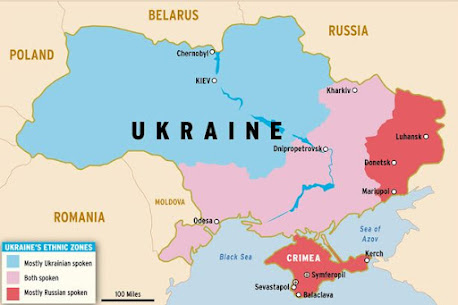
It is not us who started the war. Putin repeatedly said that we started the special military operation in order to end the war which Kiev regime was conducting against its own people in the parts of Donbass. And just in his latest statement, the President Putin clearly indicated that we are ready for any eventuality. But we strongly prefer peaceful solution through negotiations on the basis of respecting legitimate security interest of Russia, and on the basis of respecting the people who live in Ukraine, who still live in Ukraine being Russians, and their basic human rights, language rights, religious rights, have been exterminated by a series of legislation passed by the Ukrainian parliament. They started long before the special military operation. Since 2017, legislation was passed prohibiting Russian education in Russian, prohibiting Russian media operating in Ukraine, then prohibiting Ukrainian media working in Russian language, and the latest, of course there were also steps to cancel any cultural events in Russian, Russian books were thrown out of libraries and exterminated. The latest was the law prohibiting canonic Orthodox Church, Ukrainian Orthodox Church.

You know it’s very interesting when people in the West say we want this conflict to be resolved on the basis of the UN Charter and respect for territorial integrity of Ukraine, and Russia must withdraw. The Secretary General of the United Nations says similar things. Recently his representative repeated that the conflict must be resolved on the basis of international law, UN Charter, General Assembly resolutions, while respecting territorial integrity of Ukraine. It’s a misnomer, because if you want to respect the United Nations Charter, you have to respect it in its entirety. The United Nations Charter, among other things, says that all countries must respect equality of states and right of people for self-determination. And they also mentioned the United Nations General Assembly resolutions, and this is clear that what they mean is the series of resolutions which they passed after the beginning of this special military operation and which demand condemnation of Russia, Russia to get out of Ukraine territory in 1991 borders. But there are other United Nations General Assembly resolutions which were not voted, but which were consensual, and among them is a Declaration on principles of relations between states on the basis of the Charter. And it clearly says, by consensus, everybody must respect territorial integrity of states whose governments respect the right of people for self-determination, and because of that represent the entire population living on a given territory.

To argue that the people who came to power through military coup d’état in February 2014 represented Crimeans or the citizens of eastern and southern Ukraine is absolutely useless. It is obvious that Crimeans rejected the coup. They said, leave us alone, we don’t want to have anything with you. So we did: Donbass, Crimeans held referendum, and they rejoined Russia. Donbass was declared by the putschists who came to power terrorist group. They were shelled, attacked by artillery. The war started, which was stopped in February 2015.

The Minsk agreements were signed. We were very sincerely interested in closing this drama by seeing Minsk agreements implemented fully. It was sabotaged by the government, which was established after the coup d’état in Ukraine. There was a demand that they enter into a direct dialogue with the people who did not accept the coup. There was a demand that they promote economic relations with that part of Ukraine. And so on and so forth. None of this was done.

The people in Kiev were saying we would never talk to them directly. And this is in spite of the fact that the demand to talk to them directly was endorsed by the Security Council. And putschists said they are terrorists, we would be fighting them, and they would be dying in cellars because we are stronger.

Had the coup in February 2014 had it not happened and the deal which was reached the day before between the then president and the opposition implemented, Ukraine would have stayed one piece by now with Crimea in it. It’s absolutely clear. They did not deliver on the deal. Instead they staged the coup. The deal, by the way, provided for creation of a government of national unity in February 2014, and holding early elections, which the then president would have lost. Everybody knew that. But they were impatient and took the government buildings next morning. They went to this Maidan Square and announced that they created the government of the winners. Compare the government of national unity to prepare for elections and the government of the winners.

How can the people whom they, in their view, defeated, how can they pretend that they respect the authorities in Kiev? You know, the right for self-determination is the international legal basis for decolonization process, which took place in Africa on the basis of this charter principle, the right for self-determination. The people in the colonies, they never treated the colonial powers, colonial masters, as somebody who represent them, as somebody whom they want to see in the structures which govern those lands. By the same token, the people in east and south of Ukraine, people in Donbass and Novorossiya, they don’t consider the Zelensky regime as something which represents their interests. How can they do that when their culture, their language, their traditions, their religion, all this was prohibited?

And the last point is that if we speak about the UN Charter, resolutions, international law, the very first article of the UN Charter, which the West never, never recalls in the Ukrainian context, says, “Respect human rights of everybody, irrespective of race, gender, language, or religion.”

Take any conflict. The United States, UK, Brussels, they would interfere, saying, “Oh, human rights have been grossly violated. We must restore the human rights in such and such territory.” On Ukraine, never, ever they mumbled the words “human rights,” seeing these human rights for the Russian and Russian-speaking population being totally exterminated by law. So when people say, “Let’s resolve the conflict on the basis of the Charter,” – yes. But don’t forget that the Charter is not only about territorial integrity. And territorial integrity must be respected only if the governments are legitimate and if they respect the rights of their own people.

Question: I want to go back to what you said a moment ago about the introduction or the unveiling of the hypersonic weapons system that you said was a signal to the West. What signal exactly? I think many Americans are not even aware that this happened. What message were you sending by showing it to the world?

Sergey Lavrov: Well, the message is that you, I mean the United States, and the allies of the United States who also provide this long-range weapons to the Kiev regime, they must understand that we would be ready to use any means not to allow them to succeed in what they call strategic defeat of Russia.

They fight for keeping the hegemony over the world on any country, any region, any continent. We fight for our legitimate security interests. They say, for example, 1991 borders. Lindsey Graham, who visited some time ago Vladimir Zelensky for another talk, he bluntly, in his presence said that Ukraine is very rich with rare earth metals and they cannot leave this richness to the Russians. We must take it. We fight.

So they fight for the regime which is ready to sell or to give to the West all the natural and human resources. We fight for the people who have been living on these lands, whose ancestors were actually developing those lands, building cities, building factories for centuries and centuries. We care about people, not about natural resources which somebody in the United States would like to keep and to have Ukrainians just as servants sitting on these natural resources.

So the message which we wanted to send by testing in real action this hypersonic system is that we will be ready to do anything to defend our legitimate interests.

We hate even to think about war with the United States, which will take nuclear character. Our military doctrine says that the most important thing is to avoid a nuclear war. And it was us, by the way, who initiated in January 2022 the message, the joint statement by the leaders of the five permanent members of the Security Council saying that we will do anything to avoid confrontation between us, acknowledging and respecting each other’s security interests and concerns. This was our initiative.

And the security interests of Russia were totally ignored when they rejected about the same time the proposal to conclude a treaty on security guarantees for Russia, for Ukraine in the context of coexistence and in the context where Ukraine would not be ever member of NATO or any other military bloc. These security interests of Russia were presented to the West, to NATO and to the United States in December 2021. We discussed them several times, including during my meeting with Antony Blinken in Geneva in January 2022. And this was rejected.

So we would certainly like to avoid any misunderstanding. And since the people, some people in Washington and some people in London, in Brussels, seemed to be not very capable to understand, we will send additional messages if they don’t draw necessary conclusions.

Question: The fact that we’re having a conversation about a potential nuclear exchange and it’s real thought I’d ever see.

And it raises the question, how much back-channel dialogue is there between Russia and the United States? Has there been for the last two and a half years? Is there any conversation ongoing?

Sergey Lavrov: There are several channels, but mostly on exchange of people who serve terms in Russia and in the United States. There were several swaps.

There are also channels which are not advertised or publicized, but basically the Americans send through these channels the same message which they send publicly. You have to stop, you have to accept the way which will be based on the Ukrainian needs and position. They support this absolutely pointless ‘peace formula’ by Vladimir Zelensky, which was additioned recently by ‘victory plan’. They held several series of meetings, Copenhagen format, Burgenstock. And they brag that first half of next year they will convene another conference and they will graciously invite Russia that time. And then Russia would be presented an ultimatum.

All this is seriously repeated through various confidential channels. Now we hear something different, including Vladimir Zelensky’s statements that we can stop now at the line of engagement, line of contact. The Ukrainian government will be admitted to NATO, but NATO guarantees at this stage would cover only the territory controlled by the government, and the rest would be subject to negotiations. But the end result of these negotiations must be total withdrawal of Russia from Russian soil, basically. Leaving Russian people to the Nazi regime, which exterminated all the rights of the Russian and Russian-speaking citizens of their own country.

Question: If I could just go back to the question of nuclear exchange. So there is no mechanism by which the leaders of Russia and the United States can speak to each other to avoid the kind of misunderstanding that could kill hundreds of millions of people.

Sergey Lavrov: No. We have this channel which is automatically engaged when ballistic missile launch is taking place.

As regards this Oreshnik hypersonic mid-range ballistic missile. 30 minutes in advance the system sent the message to the United States. They knew that this was the case and that they don’t mistake it for anything bigger and real dangerous.

Question: I think the system sounds very dangerous.

Sergey Lavrov: Well, it was a test launch, you know.

Question: Yes. Oh, you’re speaking of the test, okay. But I just wonder how worried you are that, considering there doesn’t seem to be a lot of conversation between the two countries. Both sides are speaking about exterminating the other’s populations. That this could somehow get out of control in a very short period and no one could stop it. It seems incredibly reckless.

Sergey Lavrov: No, we are not talking about exterminating anybody’s population. We did not start this war. We have been, for years and years and years, sending warnings that pushing NATO closer and closer to our borders is going to create a problem.

In 2007, Putin started to explain to the people who seemed to be overtaken by the ‘end of history’ and being dominant, no challenge, and so on and so forth.

And of course, when the coup took place, the Americans did not hide that they were behind it. There is a conversation between Victoria Nuland and the then American ambassador in Kiev when they discuss personalities to be included in the new government after the coup. The figure of $5 billion spent on Ukraine after independence was mentioned as the guarantee that everything would be like the Americans want.

So we don’t have any intention to exterminate Ukrainian people. They are brothers and sisters to the Russian people.

Question: How many have died so far, do you think, on both sides?

Sergey Lavrov: It is not disclosed by Ukrainians. Vladimir Zelensky was saying that it is much less than 80,000 persons on Ukrainian side.

But there is one very reliable figure. In Palestine during one year after the Israelis started their operation in response to this terrorist attack, which we condemned. And this operation, of course, acquired the proportion of collective punishment, which is against international humanitarian law as well. So during one year after the operation started in Palestine, the number of Palestinian civilians killed is estimated at 45,000. This is almost twice as many as the number of civilians on both sides of Ukrainian conflict who died during ten years after the coup. One year and ten years. So it is a tragedy in Ukraine. It’s a disaster in Palestine, but we never, ever had as our goal killing people.

And the Ukrainian regime did. The head of the office of Vladimir Zelensky once said that we will make sure that cities like Kharkov, Nikolaev will forget what Russian means at all. Another guy in his office stated that Ukrainians must exterminate Russians through law or, if necessary, physically. Ukrainian former ambassador to Kazakhstan Pyotr Vrublevsky became famous when giving an interview and looking into the camera (being recorded and broadcast) he said: ”Our main task is to kill as many Russians as we can so that our children have less things to do”. And statements like this are all over the vocabulary of the regime.

Question: How many Russians in Russia have been killed since February of 2022?

Sergey Lavrov: It’s not for me to disclose this information. In the time of military operations special rules exist. Our ministry of defense follows these rules.

But there is a very interesting fact that when Vladimir Zelensky was playing not in international arena, but at his comedy club or whatever it is called, he was (there are videos from that period) bluntly defending the Russian language. He was saying: “What is wrong with Russian language? I speak Russian. Russians are our neighbors. Russian is one of our languages”. And get lost, he said, to those who wanted to attack the Russian language and Russian culture. When Vladimir Zelensky became president, he changed very fast.

Before the military operation, in September 2021, he was interviewed, and at that time he was conducting war against Donbass in violation of the Minsk agreements. And the interviewer asked him what he thought about the people on the other side of the line of contact. He answered very thoughtfully there are people and there are species. And if you, living in Ukraine, feel associated with the Russian culture, my advice to you, for the sake of your kids, for the sake of your grandkids, get out to Russia.

And if this guy wants to bring Russians and people of Russian culture back under his territorial integrity, I mean, it shows that he’s not adequate.

Question: So, what are the terms under which Russia would cease hostilities? What are you asking for?

Sergey Lavrov: Ten years ago, in February 2014, we were asking only for the deal between the president and the opposition to have government of national unity, to hold early elections, to be implemented. The deal was signed. And we were asking for the implementation of this deal. They were absolutely impatient and aggressive. And they were, of course, pushed, I have no slightest doubt, by the Americans, because if Victoria Nuland and the U.S. ambassador agreed the composition of the government, why wait for five months to hold early elections?

The next time we were in favor of something was when the Minsk Agreements were signed. I was there. The negotiations lasted for 17 hours (well, Crimea was lost by that time because of referendum). And nobody, including my colleague John Kerry, meeting with us, nobody in the West was worry about the issue of Crimea. Everybody was concentrated on Donbass. And the Minsk Agreements provided for territorial integrity of Ukraine, minus Crimea (this was not even raised) and a special status for a very tiny part of Donbass, not for the entire Donbass, not for Novorossiya at all. Part of Donbass, under these Minsk Agreements, endorsed by the Security Council, should have the right to speak Russian language, to teach Russian language, to study in Russian, to have local law enforcement (like in the states of U.S.), to be consulted when judges and prosecutors are appointed by the central authority, and to have some facilitated economic connections with neighboring regions of Russia. That’s it. Something which President Macron promised to give to Corsica and still is considering how to do this.

And when these agreements were sabotaged all along by Piotr Poroshenko and then by Vladimir Zelensky. Both of them, by the way, came to presidency, running on the promise of peace. And both of them lied. So when these Minsk Agreements were sabotaged to the extent that we saw the attempts to take this tiny part of Donbass by force, and we, as President Putin explained, at that time, we suggested these security arrangements to NATO and the United States, which was rejected. And when the Plan B was launched by Ukraine and its sponsors, trying to take this part of Donbass by force, it was then that we launched the special military operation.

Had they implemented the Minsk Agreements Ukraine would be one piece, minus Crimea. But even then, when Ukrainians, after we started the operation, suggested to negotiate, we agreed, there were several rounds in Belarus, and one later they moved to Istanbul. And in Istanbul, Ukrainian delegation put a paper on the table saying: “Those are the principles on which we are ready to agree.” And we accepted those principles.

Question: The Minsk Principles?

Sergey Lavrov: No. The Istanbul Principles. It was April 2022.

Question: Right.

Sergey Lavrov: Which was: no NATO, but security guarantees to Ukraine, collectively provided with the participation of Russia. And these security guarantees would not cover Crimea or the east of Ukraine. It was their proposal. And it was initialed. And the head of the Ukrainian delegation in Istanbul, who is now the chair of the Vladimir Zelensky faction in the parliament, he recently (a few months ago) in an interview, confirmed that this was the case. And on the basis of these principles, we were ready to draft a treaty.

But then this gentleman who headed the Ukrainian delegation in Istanbul said that Boris Johnson visited and told them to continue to fight. Then there was…

Question: But Boris Johnson, on behalf of…

Sergey Lavrov: He said no. But the guy who initialed the paper, he said it was Boris Johnson. Other people say it was President Putin who ruined the deal because of the massacre in Bucha. But they never mentioned any more massacre in Bucha. I do. And we do.

In a sense, they are on the defensive. Several times in the United Nations Security Council, sitting at the table with Antonio Guterres, I (last year and this year) at the General Assembly, I raised the issue of Bucha and said, guys, it is strange that you are silent about Bucha because you were very vocal when BBC team found itself on the street where the bodies were located. I inquired, can we get the names of the persons whose bodies were broadcast by BBC? Total silence. I addressed Antonio Guterres personally in the presence of the Security Council members. He did not respond. Then at my press conference in New York after the end of the General Assembly last September, I asked all the correspondents: guys, you are journalists. Maybe you’re not an investigative journalists but journalists normally are interested to get the truth. And Bucha thing, which was played all over the media outlets condemning Russia, is not of any interest to anyone – politicians, UN officials. And now even journalists. I asked when I talked to them in September, please, as professional people, try to get the names of those whose bodies were shown in Bucha. No answer.

Just like we don’t have any answer to the question, where is the results of medical analysis of Alexey Navalny, who died recently, but who was treated in Germany in the fall of 2020. When he fell bad on a plane over Russia, the plane landed. He was treated by the Russian doctors in Siberia. Then the Germans wanted to take him. We immediately allowed the plane to come. They took him. In less than 24 hours, he was in Germany. And then the Germans continued to say that we poisoned him. And now the analysis confirmed that he was poisoned. We asked for the test results to be given to us. They said, no, we give it to the organization on chemical weapons. We went to this organization, we are members, and we said, can you show to us, because this is our citizen, we are accused of having poisoned him. They said that the Germans told us not to give it to you. They found nothing in the civilian hospital, and the announcement that he was poisoned was made after he was treated in the military Bundeswehr hospital. So it seems that this secret is not going…

Question: So how did Navalny die?

Sergey Lavrov: Well, he died serving the term in Russia. As far as it was reported, every now and then he felt not well. Which was another reason why we continued to ask the Germans: can you show us the results which you found? Because we did not find what they found. And what they did to him, I don’t know.

Question: What the Germans did to him?

Sergey Lavrov: Yeah, because they don’t explain to anybody, including us. Or maybe they explain to the Americans. Maybe this is credible.

But they never told us how they treated him, what they found, and what methods they were using.

Question: How do you think he died?

Sergey Lavrov: I am not a doctor. But for anybody to guess, even for the doctors to try to guess, they need to have information. And if the person was taken to Germany to be treated after he had been poisoned, the results of the tests cannot be secret.

We still cannot get anything credible on the fate of Skripals – Sergei Skripal and his daughter. The information is not provided to us. He is our citizen, she is our citizen. We have all the rights and the conventions which the UK is party to, to get information.

Question: Why do you think that Boris Johnson, former Prime Minister of the UK, would have stopped the peace process in Istanbul? On whose behalf was he doing that?

Sergey Lavrov: Well, I met with him a couple of times, and I wouldn’t be surprised if he was motivated by some immediate desire or by some long-term strategy. He is not very predictable.

Question: But do you think he was acting on behalf of the U.S. government, on behalf of the Biden administration, or he was doing this independently.

Sergey Lavrov: I don’t know. And I wouldn’t guess. The fact that the Americans and the Brits are leading in this “situation” is obvious.

Now it is becoming also clear that there is a fatigue in some capitals, and there are talks every now and then that the Americans would like to leave it with the Europeans and to concentrate on something more important. I wouldn’t guess.

We would be judging by specific steps. It’s obvious, though, that the Biden administration would like to leave a legacy to the Trump administration as bad as they can.

And similar to what Barack Obama did to Donald Trump during his first term. Then late December 2016, President Obama expelled Russian diplomats. Just very late December. 120 persons with family members. Did it on purpose. Demanded them leave on the day when there was no direct flight from Washington to Moscow. So they had to move to New York by buses with all their luggage, with children, and so on and so forth.

And at the same time, President Obama announced the arrest of pieces of diplomatic property of Russia. And we still never were able to come and see what is the state of this Russian property.

Question: What was the property?

Sergey Lavrov: Diplomatic. They never allowed us to come and see it though under all conventions. They just say that these pieces we don’t consider as being covered by diplomatic immunity, which is a unilateral decision, never substantiated by any international court.

Question: So you believe the Biden administration is doing something similar again to the incoming Trump administration.

Sergey Lavrov: Because that episode with the expulsion and the seizure of property certainly did not create the promising ground for beginning of our relations with the Trump administration. So I think they’re doing the same.

Question: But this time President Trump was elected on the explicit promise to bring an end to the war in Ukraine. So I mean, he said that in appearance after appearance. So given that, there is hope for a resolution, it sounds like. What are the terms to which you’d agree?

Sergey Lavrov: Well, the terms, I basically alluded to them. When President Putin spoke in this Ministry of Foreign Affaires on the 14th of June he once again reiterated that we were ready to negotiate on the basis of the principles which were agreed in Istanbul and rejected by Boris Johnson, according to the statement of the head of the Ukrainian delegation.

The key principle is non-block status of Ukraine. And we would be ready to be part of the group of countries who would provide collective security guarantees to Ukraine.

Question: But no NATO?

Sergey Lavrov: No NATO. Absolutely. No military bases, no military exercises on the Ukrainian soil with participation of foreign troops. And this is something which he reiterated. But of course, he said, it was April 2022, now some time has passed, and the realities on the ground would have to be taken into account and accepted.

The realities on the ground are not only the line of contact, but also the changes in the Russian Constitution after referendum was held in Donetsk, Lugansk republics and Kherson and Zaporozhye regions. And they are now part of the Russian Federation, according to the Constitution. And this is a reality.

And of course, we cannot tolerate a deal which would keep the legislation which are prohibiting Russian language, Russian media, Russian culture, Ukrainian Orthodox Church, because it is a violation of the obligations of Ukraine under the UN Charter, and something must be done about it. And the fact that the West (since this russophobic legislative offensive started in 2017) was totally silent and it is silent until now, of course we would have to pay attention to this in a very special way.

Question: Would sanctions against Russia be a condition?

Sergey Lavrov: You know, I would say probably many people in Russia would like to make it a condition. But the more we live under sanctions, the more we understand that it is better to rely on yourself, and to develop mechanisms, platforms for cooperation with ‘normal’ countries who are not unfriendly to you, and don’t mix economic interests and policies and especially politics. And we learned a lot after the sanctions started.

The sanctions started under President Obama. They continued in a very big way under the first term of Donald Trump. And these sanctions under the Biden administration are absolutely unprecedented.

But what doesn’t kill you makes you stronger, you know. They would never kill us, so they are making us stronger.

Question: And driving Russia east. And so the vision that I think same policymakers in Washington had 20 years ago is why not to bring Russia into a Western bloc, sort of as a balance against the rising east. But it doesn’t seem like that. Do you think that’s still possible?

Sergey Lavrov: I don’t think so. When recently President Putin was speaking at Valdai Club to politologists and experts, he said we would never be back at the situation of early 2022. That’s when he realized (for himself, apparently, not only he, but he spoke publicly about this) that all attempts to be on equal terms with the West have failed.

It started after the demise of the Soviet Union. There was euphoria, we are now part of the ‘liberal world’, democratic world, ‘end of history’. But very soon it became clear to most of the Russians that in the 1990s we were treated as – at best as junior partner, maybe not even as a partner, – but as a place where the West can organize things like it wants, striking deals with oligarchs, buying resources and assets. And then probably the Americans decided that Russia is in their pocket. Boris Yeltsin, Bill Clinton, buddies, laughing, joking.

But even at the end of Boris Yeltsin’s term, he started to contemplate that this was not something he wanted for Russia. And I think this was very obvious when he appointed Vladimir Putin prime minister, and then left earlier, and blessed Vladimir Putin as his successor for the elections which were coming and which Putin won.

But when Vladimir Putin became president, he was very much open to cooperation with the West. And he mentions about this quite regularly when he speaks with interviewers or at some international events.

I was present when he met with George Bush Jr., with Barack Obama. Well, after the meeting of NATO in Bucharest, which was followed by NATO-Russia summit meeting in 2008, when they announced that Georgia and Ukraine will be in NATO. And then they tried to sell it to us. We asked: why? There was lunch and President Putin asked what was the reason for this? Good question. And they said this is something which is not obligatory. How come?

Well to start the process of joining NATO, you need a formal invitation. And this is a slogan – Ukraine and Georgia will be in NATO. But this slogan became obsession for some people in Tbilisi first, when Mikhail Saakashvili lost his senses and started the war against his own people under the protection of OSCE mission with the Russian peacekeepers on the ground. And the fact that he launched this was confirmed by the European Union investigation, which they launched and which concluded that he gave the order to start.

And for Ukrainians, it took a bit longer. They were cultivating this pro-Western mood. Well, pro-Western is not bad, basically. Pro-Eastern is also not bad. What is bad is that you tell people, either/or, either you go with me or you’re my enemy.

What happened before the coup in Ukraine? In 2013, the president of Ukraine Viktor Yanukovych negotiated with the European Union some association agreement which would nullify tariffs on most of the Ukrainian goods to the European Union and the other way around. And at some point, when he was meeting with Russian counterparts, we told him, Ukraine was part of the free trade area of the Commonwealth of Independent States. No tariffs for everybody. And we, Russia, negotiated agreement with World Trade Organization for some 17 years, mostly because we bargained with European Union. And we achieved some protection for many of our sectors, agriculture and some others. We explained to the Ukrainians that if you go zero in your trade with European Union, we would have to protect our customs border with Ukraine. Otherwise the zero tariff European goods would flood and would be hurting our industries, which we tried to protect and agreed for some protection. And we suggested to the European Union: guys, Ukraine is our common neighbor. You want to have better trade with Ukraine. We want the same. Ukraine want to have markets both in Europe and in Russia. Why don’t we sit three of us and discuss it like grownups? The head of the European Commission was the Portuguese José Manuel Barroso. He responded it’s none of your business what we do with Ukraine. We, for example, the European Union, we don’t ask you to discuss with us your trade with Canada. Absolutely arrogant answer.

And then the president of Ukraine Viktor Yanukovych convened his experts. And they said, yes, it would be not very good if we have opened the border with European Union, but the customs border with Russia would be closed. And they would be checking, you know, what is coming. So that the Russian market is not affected.

So he announced in November 2013 that he cannot sign the deal immediately, and he asked the European Union to postpone it for until next year. That was the trigger for Maidan, which was immediately thrown up and ended by the coup.

So my point is that this either/or. Actually, the first coup took place in 2004, when after second round of elections, the same Viktor Yanukovych won presidency. The West raised hell and put pressure on the Constitutional Court of Ukraine to rule that there must be a third round. The Constitution of Ukraine says there may be only two rounds. But the Constitutional Court, under the pressure of the West, violated the Constitution for the first time then. And pro-Western candidate was chosen. At that time, when all this was taking place and boiling, the European leaders were publicly saying Ukrainian people must decide: are they with us or with Russia?

Question: But it is the way that big countries behave. I mean, there are certain orbits, and now it’s BRICS versus NATO, U.S. versus China. And it sounds like you’re saying the Russian-Chinese alliance is permanent.

Sergey Lavrov: Well, we are neighbors. And of course geography is very important.

Question: But you’re also neighbors with Western Europe. And you’re part of it, in effect.

Sergey Lavrov: Through Ukraine the Western Europe wants to come to our borders.

And there were plans that were discussed almost openly to put British naval bases on the Sea of Azov. Crimea was eyed. Dreaming about creating NATO base in Crimea and so on and so forth.

Look, we have been very friendly with Finland, for example. Overnight, the Finns came back to the early years of preparation for World War II when they were best allies of Hitler. And all this neutrality, all this friendship, going to sauna together, playing hockey together, all this disappeared overnight. So maybe this was deep in their hearts, and the neutrality was burdening them, and niceties were burdening for them. I don’t know.

Question: They’re mad about the ‘winter war’. That’s totally possible.

Can you negotiate with Zelensky? You’ve pointed out that he has exceeded his term. He’s not democratically elected president of Ukraine anymore. So do you consider him a suitable partner for negotiations?

Sergey Lavrov: President Putin addressed many times this issue as well. In September 2022, during the first year of the special military operation, Vladimir Zelensky, in his conviction that he would be dictating the terms of the situation also to the West, he signed a decree prohibiting any negotiations with Putin’s government.

During public events after that episode, President Vladimir Putin is asked why Russia is not ready for negotiations. He said, don’t turn it upside down. We are ready for negotiations, provided it will be based on the balance of interest, -tomorrow. But Vladimir Zelensky signed this decree prohibiting negotiations. For starters, why don’t you tell him to cancel it publicly? This will be a signal that he wants negotiations. Instead, Vladimir Zelensky invented his ‘peace formula’. Lately, it was complemented by a ‘victory plan’. They keep saying, we know what they say when they meet with European Union ambassadors and in other formats, they say no deal unless the deal is on our terms.

I mentioned to you that they are planning now the second summit on the basis of this peace formula, and they don’t shy away from saying, we will invite Russia to put in front of it the deal which we agreed already with the West.

When our Western colleagues sometimes say nothing about Ukraine without Ukraine in effect, this implies that anything about Russia without Russia. Because they discuss what kind of conditions we must accept.

By the way, recently they already violated, tacitly, the concept nothing about Ukraine without Ukraine. There are passes, there are messages. They know our position. We are not playing double game. What President Putin announced is the goal of our operation. It’s fair. It’s fully in line with the United Nations Charter. First of all, the rights: language rights, minority rights, national minority rights, religious rights, and it’s fully in line with OSCE principles.

There is an Organization for Security and Cooperation in Europe which is still alive. And well, several summits of this organization clearly stated that security must be indivisible, that nobody should expand his security at the expense of security of others, and that, most important, no organization in Euro-Atlantic space shall claim dominance. This was last time it was confirmed by OSCE in 2010.

NATO was doing exactly the opposite. So we have legitimacy in our position. No NATO on our doorsteps because OSCE agreed that this should not be the case if it hurts us. And please restore the rights of Russians.

Question: Who do you think has been making foreign policy decisions in the United States? This is a question in the United States. Who is making these decisions?

Sergey Lavrov: I wouldn’t guess. I haven’t seen Antony Blinken for years. When it was the last time? Two years ago, I think, at the G20 summit. Was it in Rome or somewhere? In the margins. I was representing President Putin there. His assistant came up to me during a meeting and said that Antony wants to talk just for 10 minutes. I left the room. We shook hands, and he said something about the need to de-escalate and so on and so forth. I hope he’s not going to be angry with me since I am disclosing this. But we were meeting in front of many people present in the room, and I said, “We don’t want to escalate. You want to inflict strategic defeat upon Russia.” He said, “No. It is not strategic defeat globally. It is only in Ukraine.”

Question: You’ve not spoken to him since?

Sergey Lavrov: No.

Question: Have you spoken to any officials in the Biden administration since then?

Sergey Lavrov: I don’t want to ruin their career.

Question: But have you had meaningful conversations?

Sergey Lavrov: No. Not at all.

When I met in international events one or another person whom I know, an American, some of them say hello, some of them exchange a few words, but I never impose myself.

It’s becoming contagious when somebody sees an American talking to me or a European talking to me. Europeans are running away when they see me. During the last G20 meeting, it was ridiculous. Grown-up people, mature people. They behave like kids. So childish. Unbelievable.

Question: So you said that when in 2016, in December, the final moments of the Biden administration, Biden made the relationship between the United States and Russia more difficult.

Sergey Lavrov: Obama. Biden was vice-president.

Question: Exactly. I’m so sorry.

The Obama administration left a bunch of bombs, basically, for the incoming Trump administration.

In the last month since the election, you have all sorts of things going on politically in bordering states in this region. In Georgia, in Belarus, in Romania, and then, of course, most dramatically in Syria, you have turmoil.

Does this seem like part of an effort by the United States to make the resolution more difficult?

Sergey Lavrov: There is nothing new, frankly. Because the U.S., historically, in foreign policy, was motivated by making some trouble and then to see if they can fish in the muddy water.

Iraqi aggression, Libyan adventure – ruining the state, basically. Fleeing from Afghanistan. Now trying to get back through the back door, using the United Nations to organize some ‘event’ where the U.S. can be present, in spite of the fact that they left Afghanistan in very bad shape and arrested money and don’t want to give it back.

I think this is, if you analyze the American foreign policy steps, adventures, most of them are the right word – the pattern. They create some trouble, and then they see how to use it.

When the OSCE monitors elections, when it used to monitor elections in Russia, they would always be very negative, and in other countries as well, Belarus, Kazakhstan. This time, in Georgia, the monitoring mission of OSCE presented a positive report. And it is being ignored.

So when you need endorsement of the procedures, you do it when you like the results of the election. If you don’t like the results of elections, you ignore it.

It’s like when the United States and other Western countries recognized unilateral declaration of independence of Kosovo, they said this is the self-determination being implemented. There was no referendum in Kosovo – unilateral declaration of independence. By the way, after that the Serbs approached International Court of Justice, which ruled that (well, normally they are not very specific in their judgment, but they ruled) that when part of a territory declares independence, it is not necessarily to be agreed with the central authorities.

And when a few years later, Crimeans were holding referendum with invitation of many international observers, not from international organizations, but from parliamentarians in Europe, in Asia, in post-Soviet space, they said, no, we cannot accept this because this is violation of territorial integrity.

You know, you pick and choose. The UN Charter is not a menu. You have to respect it in all its entirety.

Question: So who’s paying the rebels who’ve taken parts of Aleppo? Is the Assad government in danger of falling? What is happening exactly, in your view, in Syria?

Sergey Lavrov: Well, we had a deal when this crisis started. We organized the Astana process (Russia, Turkey and Iran). We meet regularly. Another meeting is being planned before the end of the year or early next year, to discuss the situation on the ground.

The rules of the game are to help Syrians to come to terms with each other and to prevent separatist threats from getting strong. That’s what the Americans are doing in the east of Syria when they groom some Kurdish separatists using the profits from oil and grain sold, the resources which they occupy.

This Astana format is a useful combination of players, if you wish. We are very much concerned. And when this happened, with Aleppo and surroundings, I had a conversation with the Turkish minister of foreign affairs and with Iranian colleague. We agreed to try to meet this week. Hopefully in Doha at the margins of this international conference. We would like to discuss the need to come back to strict implementation of the deals on Idlib area, because Idlib de-escalation zone was the place from where the terrorists moved to take Aleppo. The arrangements reached in 2019 and 2020 provided for our Turkish friends to control the situation in the Idlib de-escalation zone and to separate the Hayat Tahrir al-Sham (former Nusra) from the opposition, which is non-terrorist and which cooperates with Turkey.

And another deal was the opening of M5 route from Damascus to Aleppo, which is also now taken completely by the terrorists. So we, as ministers of foreign affairs, would discuss the situation, hopefully, this coming Friday. And the military of all three countries and the security people are in contact with each other.

Question: But the Islamist groups, the terrorists you just described, who is backing them?

Sergey Lavrov: Well, we have some information. We would like to discuss with all our partners in this process the way to cut the channels of financing and arming them.

The information which is being floated and it’s in the public domain mentions among others the Americans, the Brits. Some people say that Israel is interested in making this situation aggravate. So that Gaza is not under very close scrutiny. It’s a complicated game. Many actors are involved. I hope that the context which we are planning for this week will help stabilize the situation.

Question: What do you think of Donald Trump?

Sergey Lavrov: I met him several times when he was having meetings with President Putin and when he received me twice in the Oval Office when I was visiting for bilateral talks.

Well, I think he’s a very strong person. A person who wants results. Who doesn’t like procrastination on anything. This is my impression. He’s very friendly in discussions. But this does not mean that he’s pro-Russian as some people try to present him. The amount of sanctions we received under the Trump administration was very big.

We respect any choice which is made by the people when they vote. We respect the choice of American people. As President Putin said, we are and we have been open all along to the contacts with the current administration. We hope that when Donald Trump is inaugurated, we will understand. The ball, as President Putin said, is on their side. We never severed our contacts, our ties in the economy, trade, security, anything.

Question: My final question is: how sincerely worried are you about an escalation in conflict between Russia and the United States, knowing what you do?

Sergey Lavrov: Well, we started with this question, more or less.

Question: It seems the central question.

Sergey Lavrov: Yes. The Europeans whisper to each other that it is not for Vladimir Zelensky to dictate the terms of the deal – it’s for the U.S. and Russia.

I don’t think we should be presenting our relations as two guys decide for everybody. Not at all. It is not our style.

We prefer the manners which dominate in BRICS, in Shanghai Cooperation Organization, where the UN Charter principle of sovereign equality of states is really embodied.

The U.S. is not used to respect sovereign equality of states. When the U.S. says we cannot allow Russia to win on Ukraine because this would undermine our rules-based world order. And rules-based world order is American domination.

Now, by the way, NATO, at least under Biden administration, is eyeing the entire Eurasian continent, Indo-Pacific strategies, South China Sea, East China Sea, is already on NATO agenda. NATO is moving infrastructure there. AUKUS, building ‘quartet’ Indo-Pacific Four as they call it (Japan, Australia, New Zealand, South Korea). U.S., South Korea, and Japan are building military alliance with some nuclear components. And Jens Stoltenberg, the former Secretary General of NATO, last year after the summit he said that the Euro-Atlantic security is indivisible from Indo-Pacific security. When he was asked does it mean that you go beyond territorial defense, he answered – no, it doesn’t go beyond territorial defense, but to defend our territory, we need to be present there. This element of preemption is more and more present.

We don’t want war with anybody. And as I said, five nuclear states declared at the top level in January 2022 that we don’t want confrontation with each other and that we shall respect each other’s security interests and concerns. And it also stated nuclear war can never be won, and therefore nuclear war is not possible.

And the same was reiterated bilaterally between Russia and the United States, Putin-Biden, when they met in 2021 in Geneva in June. Basically, they reproduced the statement by Reagan-Gorbachev of 1987 ‘no nuclear war’. And this is absolutely in our vital interest, and we hope that this is also in vital interest of the United States.

I say so because some time ago John Kirby, who is the White House communications coordinator, was answering questions about escalation and about possibility of nuclear weapons being employed. And he said, “Oh, no, we don’t want escalation because then if there is some nuclear element, then our European allies would suffer.” So even mentally, he excludes that the United States can suffer. And this is something which makes the situation a bit risky. It might – if this mentality prevails, then some reckless steps would be taken, and this is bad.

Question: What you’re saying is American policy makers imagine there could be a nuclear exchange that doesn’t directly affect the United States, and you’re saying that’s not true.

Sergey Lavrov: That’s what I said, yes. But professionals in deterrence, nuclear deterrence policy, they know very well that it’s a very dangerous game. And to speak about limited exchange of nuclear strikes is an invitation to disaster, which we don’t want to have.  
https://www.mid.ru/en/foreign_policy/news/1985783/

Anti-NATO events in Washington DC

From Global Network Against Weapons and Nuclear Power in Space
by Bruce Gagnon
July 9, 2024

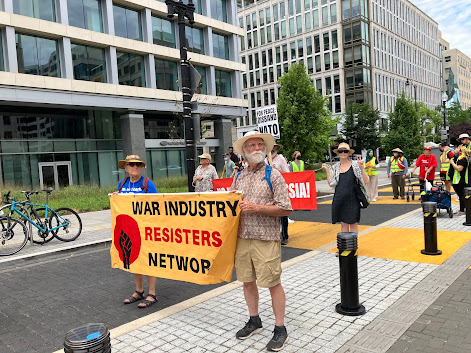
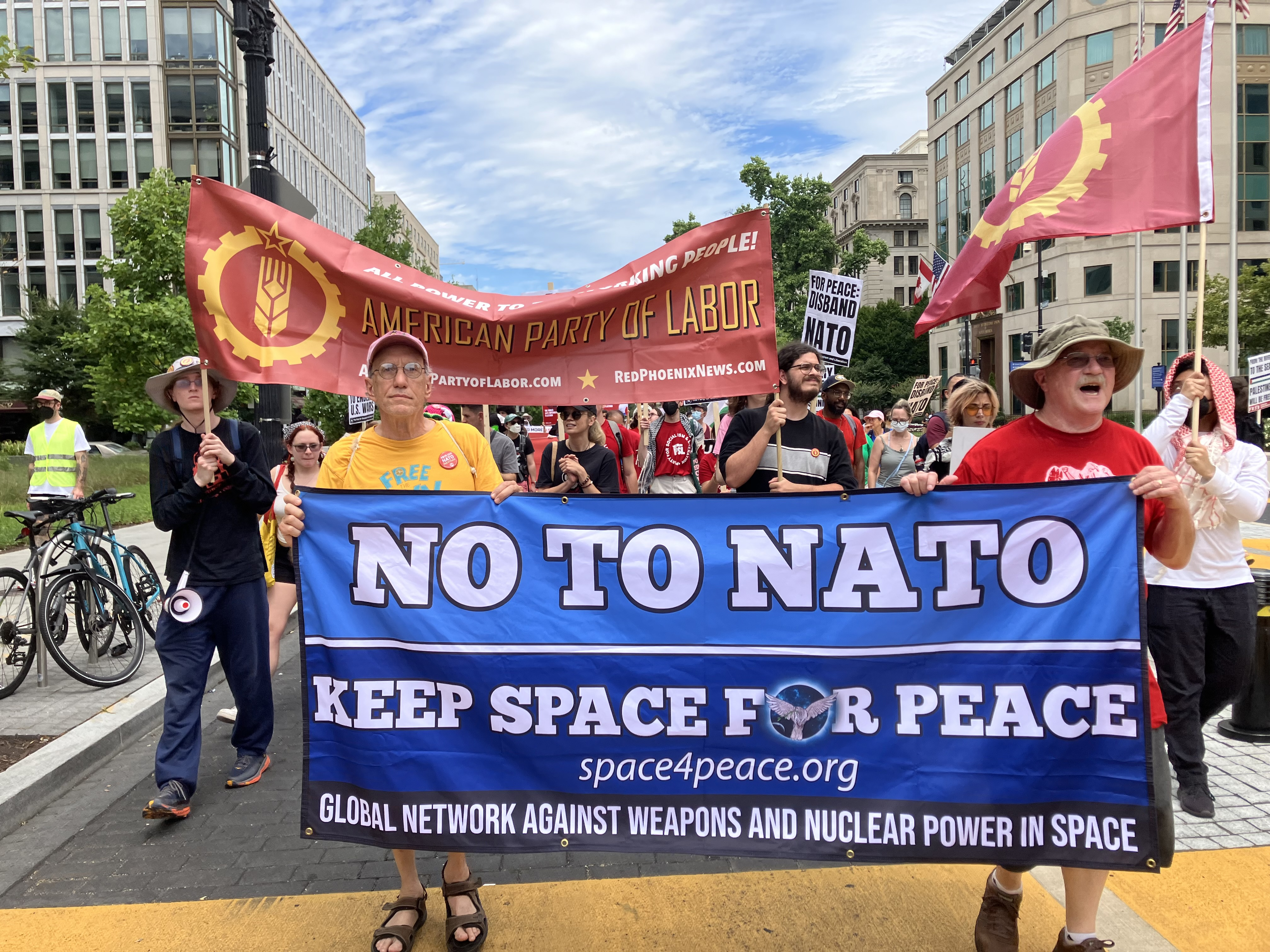
Bruce Gagnon and Rick Staggenborg in the march on Sunday

Four of us from Maine (MB Sullivan, Lisa Savage, Mark Roman and I) made the 10-hour drive to Washington DC last Friday to join the anti-NATO events planned to protest NATO’s ’75th anniversary celebration’ which begins on July 10. We were joined by former Mainers Melody Shank and Ken Jones  now living in North Carolina. 

Things began with a conference on Saturday morning at a local church attended by about 150 people and organized by a coalition led by World Beyond War. Disappointingly (but not surprising) several of the speakers once again blamed Russia for the war in Ukraine with words like ‘illegal, immoral, provocative’ Russian invasion. Sadly there are still some in the ‘peace movement’ who continue to be reluctant to pin the blame for the proxy war on US-NATO which was particularly uncalled for at an anti-NATO summit. Those that do at some point admit that US-NATO did in fact instigate the ‘tensions’ always seem to say that Russia should not have responded to protect the Donbass. That option was of course unacceptable to Moscow which I fully agree with.

This of course has been going on ever since the 2014 US-NATO orchestrated coup d’etat in Kiev which was led by the Obama-Biden administration under the direction of Victoria Nuland, Hillary Clinton and Joe Biden [and John Kerry]. Soon thereafter the US-NATO regime in Kiev (infused with Nazis from Western Ukraine) began attacking the Donbass region of Ukraine where Russian-ethnics predominate and killed more than 15,000 and wounded around 35,000. 

Moscow made repeated attempts to create mechanisms to end the siege on the Donbass including the Minsk 1 & 2 agreements that leaders of Ukraine, France and Germany later admitted they never intended to honor – they just used the agreements to buy time to build up Ukraine’s US-NATO funded, trained, armed and directed army for a final charge against their own citizens whose only crime was they spoke Russian.

By early 2022 Russia knew that the western controlled Ukrainian military would soon launch a full scale attack on the Donbass so Moscow decided to preempt that move and began the slow and deliberate effort to push the Nazi-led forces away from the Donbass which sits on Russia’s border.

Later Saturday around 5:00 pm a larger conference began at another church in Washington. Oh, what a difference it was. This event was led by anti-imperialist organizations that have no doubt the US-NATO were in fact responsible for the war in Ukraine – to be used in a now failed strategy to force ‘regime change’ in Moscow in order for western resource extraction corporations to grab Russia’s vast resource base (among other reasons).

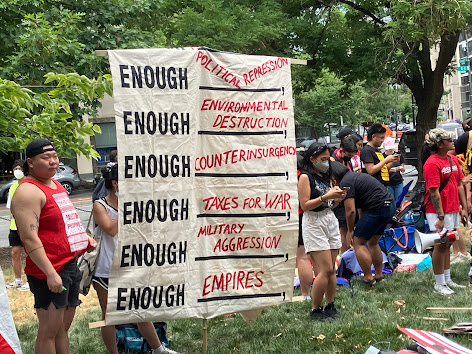
More than 300 (mostly young activists) gathered at this event with powerful speakers talking about a myriad of regions of the world where the US-NATO war machine is trying to regain their settler colonial domination. Good luck with that one.

This multi-ethnic coalition was a stark difference from the smaller event we had attended earlier that day. 

I learned years ago about the US anti-imperialist movement led by Mark Twain during Washington’s war on the Philippines.  At this event an impressive video was shown about the long US occupation of the Philippines that continues today as the Biden administration now floods that island nation with new missiles, warships, war planes and troops aimed at China. All part of NATO’s ‘pivot’ into the Asia-Pacific.

We also heard from young activists speaking about Palestine, Puerto Rico, black liberation movements across the US and much more. The Nicaraguan ambassador to the US also spoke and was roundly received. 

Fascism is growing worldwide in order to protect corporate interests and to suppress the resulting people’s movements for liberation. US-NATO wars in the Middle East have cost 4.5 million lives in the last 25 years. Israel is a ‘partner’ of NATO and takes part in its war games. NATO also trains Middle Eastern reactionary regimes that have served as western puppets for many years – Saudi Arabia, Bahrain, UAE, Jordan and more.

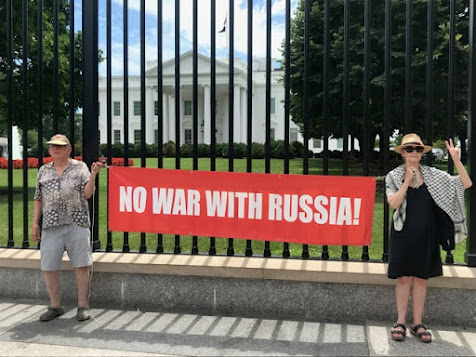
On Sunday we joined a march led by the anti-imperialist/anti-capitalist coalition to the White House. A rally was set up in Lafayette Park next to the White House led by the World Beyond War coalition. When we arrived very few people were at the rally site. Thanks to the 400 in the anti-imperialist march the rally began to look more respectable though I didn’t see any of the anti-imperialist leaders invited to the stage to speak to the largely younger crowd.

Despite the long drive from Maine to DC we all agreed that it was well worth the trip – especially to be with emerging activists. We often hear elder ‘peace movement’ folks wonder where are the ‘young people’? Actually they are out there leading the protests against zionist genocide in Palestine and doing great anti-NATO work against the empire’s ever expanding war machine. Some might call them radicals – but I stand by the definition of radical as those getting to the root of the problems that we face.

The half-stepping reformist peace groups (sometimes linked to the Democratic party and their foundation funders) have a long way to go if they hope to more fully integrate with the next generation of activism.

https://space4peace.blogspot.com/2024/07/anti-nato-events-in-washington-dc.html

Why does the collective West wage a direct war against Russia?

From Strategis Stability
January 31, 2023

Report # 197.

1. NATO and non-NATO countries are waging a multifaceted direct war against Russia

The bellicose and provocative statement made publicly by Annalena Baerbock, German Foreign Minister, at the PACE session on January 24 that “… we are fighting a war against Russia …”, where “we” can be interpreted as the FRG or NATO or Europe, evoked many debates as to what is really happening in Ukraine. No doubt that such countries that regularly supply heavy weapons to ultra-Nazi regime in Kiev may well be characterized as “aggressors” or as countries that are waging a multifaceted direct war against Russia. They include the majority of NATO member-states (29 from 30 in the full list), and nearly 20 that are not considered as NATO participants.

Earlier it was called as ‘undeclared war” against Russia. Since Baerbock’s statement it clearly became as “a declared war’ against Russia.

Why such war is called as a multifaceted direct war?

A) In terms of military-technical and military-political factors:

It is called as such because it is unleashed with the use of heavy NATO-made offensive weapons. It is coordinated by NATO HQ. It is supplied with NATO intelligence, including that of collected by space-based assets. It is financed by NATO money. It is staffed with NATO military men. E.g. all US-made MLRS HIMERS are operated by exclusively the US GIs. The German and the US tanks that are be sent to Ukraine in violation of the OSCE rules will be operated by the FRG and the US servicemen.

B) In terms of other factors, it is called as a multifaceted direct war because it is a religious war against Russia conducted by Ukraine against Orthodox Christianity.

It is also an information war against Russia because it is waged by a huge NATO and the EU propaganda machine using distortions and lies across the globe.

It is a genocide war against Eastern Slav nations – Ukrainians and Russians. Ukrainian and NATO leaders intend to kill more and more Ukrainians and Russians only because they speak Russian language, profess Orthodox Christianity, have their own ethnic culture and traditions, different assessment of historic events in the past, and bravely fought [against] Nazi Germany in 1941-1945.

Vyacheslav Volodin, the speaker of the State Duma, noted “the direct participation of the USA in combat operations in Ukraine.” He argued that the US military instructors and mercenaries are there in order to save the Kiev regime and for fear of losing its colony in Europe.

2. What are the phases of the NATO/non-NATO aggression against Russia?

The first stage began since April 2014 when Kiev decided to attack Donbass, the second took place after the second part of the Minsk Agreement was reached in March 2015, and the third stage started on February 14, 2022.

A proxy war involving Ukraine started since April 2014.

A combined direct Ukrainian-NATO aggression (or war) against Russia began on February 14, 2022, when Zelensky ordered to attack Donbass on a massive scale. On February 18, 2022, millions of Ukrainian refugees rushed into Western Europe and Russia seeking shelter and escaping from Ukrainian attacks.

Russia launched the Special Military Operation (SMO) in response to Ukrainian aggression on February 24, 2022.

3. Can Russian again win Western aggression against it?

Yes, it can, and it will. Offsetting Ukrainian-NATO aggression against Russia became the nation’s major goal. The country is united. All confessions are fighting together against attackers. All political Parties sitting in the Parliament and the rank-and-file citizens are supporting Russian Armed Forces. Mobilization targets were fully reached. Russian defense-industrial complex operates in three shifts during 24 hours.

If one counts a large-scale foreign multilateral armed aggressions against the Russian Empire, the Soviet Union and the Russian Federation since the Napoleonic War in 1812, any person will find out that since that time the country won all five major wars: the Napoleonic War (1812), the Crimean War (1853-1856), the Allied 14 States War (1918), and Nazi War (1941-1945).

The current Ukrainian- NATO war against Russia began initially against Donbass in April 2014 when Ukrainian neo-Nazi and Banderists started attacking two Republics in that region – the DPR and LPR wishing to separate from newly-entrenched ultra-nationalist regime in Kiev due to direct moral, financial and military support of the USA that spent by February 2014 ten billion dollars to engineer a military coup in the capital Kiev, including $ 5.0 billion spent by the US State Department, and the rest – by the CIA – mainly by bribing Ukrainian opposition leaders and by using widely and effectively the local NGOs created with the purpose of making a radical regime change in Ukraine.

Continue reading

President Putin on signing of treaties on accession of Donetsk and Lugansk people’s republics and Zaporozhye and Kherson regions to Russia

From the Kremlin
September 30, 2022

A ceremony for signing the treaties on the accession of the Donetsk People’s Republic, the Lugansk People’s Republic, the Zaporozhye Region and the Kherson Region to the Russian Federation took place in of the Grand Kremlin Palace’s St George Hall.

President of Russia Vladimir Putin: Citizens of Russia, citizens of the Donetsk and Lugansk people’s republics, residents of the Zaporozhye and Kherson regions, deputies of the State Duma, senators of the Russian Federation,

As you know, referendums have been held in the Donetsk and Lugansk people’s republics and the Zaporozhye and Kherson regions. The ballots have been counted and the results have been announced. The people have made their unequivocal choice.

Today we will sign treaties on the accession of the Donetsk People’s Republic, Lugansk People’s Republic, Zaporozhye Region and Kherson Region to the Russian Federation. I have no doubt that the Federal Assembly will support the constitutional laws on the accession to Russia and the establishment of four new regions, our new constituent entities of the Russian Federation, because this is the will of millions of people. (Applause.)

It is undoubtedly their right, an inherent right sealed in Article 1 of the UN Charter, which directly states the principle of equal rights and self-determination of peoples.

I repeat, it is an inherent right of the people. It is based on our historical affinity, and it is that right that led generations of our predecessors, those who built and defended Russia for centuries since the period of Ancient Rus, to victory.

Here in Novorossiya, [Pyotr] Rumyantsev, [Alexander] Suvorov and [Fyodor] Ushakov fought their battles, and Catherine the Great and [Grigory] Potyomkin founded new cities. Our grandfathers and great-grandfathers fought here to the bitter end during the Great Patriotic War.

We will always remember the heroes of the Russian Spring, those who refused to accept the neo-Nazi coup d’état in Ukraine in 2014, all those who died for the right to speak their native language, to preserve their culture, traditions and religion, and for the very right to live. We remember the soldiers of Donbass, the martyrs of the “Odessa Khatyn,” the victims of inhuman terrorist attacks carried out by the Kiev regime. We commemorate volunteers and militiamen, civilians, children, women, senior citizens, Russians, Ukrainians, people of various nationalities; popular leader of Donetsk Alexander Zakharchenko; military commanders Arsen Pavlov and Vladimir Zhoga, Olga Kochura and Alexei Mozgovoy; prosecutor of the Lugansk Republic Sergei Gorenko; paratrooper Nurmagomed Gadzhimagomedov and all our soldiers and officers who died a hero’s death during the special military operation. They are heroes. (Applause.) Heroes of great Russia. Please join me in a minute of silence to honour their memory.

(Minute of silence.)

Thank you.

Behind the choice of millions of residents in the Donetsk and Lugansk people’s republics, in the Zaporozhye and Kherson regions, is our common destiny and thousand-year history. People have passed this spiritual connection on to their children and grandchildren. Despite all the trials they endured, they carried the love for Russia through the years. This is something no one can destroy. That is why both older generations and young people – those who were born after the tragic collapse of the Soviet Union – have voted for our unity, for our common future.

In 1991 in Belovezhskaya Pushcha, representatives of the party elite of that time made a decision to terminate the Soviet Union, without asking ordinary citizens what they wanted, and people suddenly found themselves cut off from their homeland. This tore apart and dismembered our national community and triggered a national catastrophe. Just like the government quietly demarcated the borders of Soviet republics, acting behind the scenes after the 1917 revolution, the last leaders of the Soviet Union, contrary to the direct expression of the will of the majority of people in the referendum of 1991, destroyed our great country, and simply made the people in the former republics face this as an accomplished fact.

I can admit that they didn’t even know what they were doing and what consequences their actions would have in the end. But it doesn’t matter now. There is no Soviet Union anymore; we cannot return to the past. Actually, Russia no longer needs it today; this isn’t our ambition. But there is nothing stronger than the determination of millions of people who, by their culture, religion, traditions, and language, consider themselves part of Russia, whose ancestors lived in a single country for centuries. There is nothing stronger than their determination to return to their true historical homeland.

For eight long years, people in Donbass were subjected to genocide, shelling and blockades; in Kherson and Zaporozhye, a criminal policy was pursued to cultivate hatred for Russia, for everything Russian. Now too, during the referendums, the Kiev regime threatened schoolteachers, women who worked in election commissions with reprisals and death. Kiev threatened millions of people who came to express their will with repression. But the people of Donbass, Zaporozhye and Kherson weren’t broken, and they had their say.

I want the Kiev authorities and their true handlers in the West to hear me now, and I want everyone to remember this: the people living in Lugansk and Donetsk, in Kherson and Zaporozhye have become our citizens, forever. (Applause.)

We call on the Kiev regime to immediately cease fire and all hostilities; to end the war it unleashed back in 2014 and return to the negotiating table. We are ready for this, as we have said more than once. But the choice of the people in Donetsk, Lugansk, Zaporozhye and Kherson will not be discussed. The decision has been made, and Russia will not betray it. (Applause.) Kiev’s current authorities should respect this free expression of the people’s will; there is no other way. This is the only way to peace.

Continue reading

Prelim results for referenda: majority voted to join Russia; U.S. weapons shell residential areas; Kiev continues shelling Zaporozhye

From Strategic Stability

Report # 146. Breaking news: The majority voted to live in Russia

September 27, 2022

1. The majority of voters in four regions expressed their wish to live in Russia

Four separate referenda held in two independent republics in Donbass and in two regions in southern Ukraine, namely Kherson and Zaporozhye Oblast or Regions between September 23-27 ended at 16:00 hours local time on September 27th, 2022.

According to preliminary results (with 15% of ballot papers counted by 17:00 Moscow time) overwhelming majority of voters have OKeyed admission of all these regions to the Russian Federation as equal subjects.

All referenda have been recognized as valid. They have witnessed very high level of participation of voters despite permanent heavy shelling of the residential areas in all four regions by heavy weapons, including the U.S.-made MLRS HIMARS, by Armed Forces of Ukraine in violation of the UN Charter, the OSCE decisions and the EU basic principles.

The preliminary results in full will be announced on September 28th, and final results – some days later.

Such fantastic returns ran counter to Mrs Annalena Baerbock, German Foreign Minister’s allegations, who in a Marcus Lanza’s TV program have disseminated false information about the referenda by claiming that the voters are shot, they are raped, and then they have to put crosses for three days while soldiers with Kalashnikovs [assault rifles] in their hands stand next to them.

Where she has got this false information? Nowhere. Such cases have not been recorded during the referenda. More than 200 foreign observers who have arrived to these regions have not confirmed such false allegations. And no local citizen has lodged any respective complaint, by the way.

The German Ambassador in Moscow should be summoned to the Russian MFA to give explanations why Baerbock has used such unverified propaganda with a very bad smell. She has undermined her political carrier by many coarse and unverified false statements earlier.

This is one more and the latest vivid example of her wrong behavior. Shame that she still represents Germany as the head of the German diplomatic service.

2. Why the majority of citizens in four named regions have voted for joining Russia?

No long arguments and explanations – there are plenty of them to catalogue them here. No time. Later. Just official figures:

In LPR

Since 2014 till February 24, 2022:

killed – 1771 (here and in all other cases atrocities have been done by Armed Forces of Ukraine);
wounded – 3350;
children killed – 38;
children wounded – 91;
social infrastructure buildings destroyed – more than 7200;
social infrastructure buildings damaged – more than 26000

Since February 24 till September 23, 2022:

killed – 91;
wounded – 292;
children killed – 7;
children wounded – 26;
social infrastructure buildings destroyed – 252;
social infrastructure buildings damaged – 2846.

Continue reading

Kiev continued shelling residential areas during referenda; international observers — referenda conducted lawfully

From Strategic Stability

Report # 145. Despite barbaric Ukrainian shelling, four referenda go on

September 25,2022

1. Four referenda are conducted in a democratic way

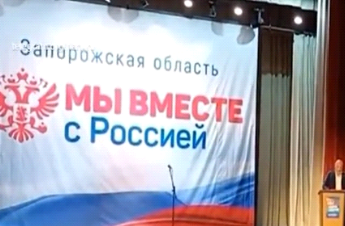
Four separate referenda started on September 23, 2022 in four regions uncontrolled by Ukraine, namely in Donetsl and Lugansk People’s Republics, as well as in Kherson and Zaporozhye Regions where the majority of populations expressed their wish join the Russian Federation as equal subjects (the slogan displayed at the public rally on the picture runs: We are together with Russia”)

Such referenda that are permitted by international law will end on September 27. Final results will be announced the next day. If the majority of voters say positive to the accession with Russia, the Russian State Duma, the lower house of Parliament will pass its decision to the President who is understood will sign a decree on the admission of all four regions to Russia. It may happen on September 30, 2022.

During last two days since the beginning of the referenda so far nearly 55% of voters participated in them in the DPR, 46% in LPR, 36% in Kherson Region and 32% in Zaporozhye Region. It has been announced by four referenda commissions by 17:30 Moscow time on September 25. The referenda commissions predicted that by evening September 27 around 80-90% of voters would take part in these events.

Locals are explaining their desire to participate in the referenda by noting: “Ukraine killed us, while Russia defended us. Do you see the difference?”

International observers (there are 179 of them in Donbass only) who came to all these territories are noting that the referenda are conducted in accordance with the international law and European standards. Voters can cast there will freely and without any intimidation from local authorities.

Unfortunately, Armed Forces of Ukraine or AFU controlled by a neo-Nazi regime implanted in Kiev continued shelling residential areas in all four regions intending to disrupt these will-expression process in violation of the UN Charter, OSCE and ODIHR principles (The Office for Democratic Institutions and Human Rights). It is irrelevant that the UNO, OSCE and ODIHR have said no single word of criticism about such cruelty and barbarism during the days when referenda are being held. What for they are paid?

Kiev also sent several saboteur groups to stop referenda. All teams have been eliminated.

The DPR representative office in the Joint Coordination and Ceasefire Commission or JCCC reported that on September 23 there have been 55 instances of shelling by the AFU and 297 rounds of ammunition were fired. In the Donetsk direction, the enemy used 155mm and 152mm artillery. In the Yasynuvata direction – artillery of 155 and 152 mm. On the Gorlovka direction – Grad MLRS, artillery of 155, 152 and 122 mm, tanks, 120 mm mortars have been used,

Continue reading

Russia accuses U.S. of genocide denial

From RT
February 18, 2022

US is ignoring the targeting of Russian speakers in Ukraine, Moscow’s envoy in Washington said

By Alexey Viryasov

America’s willful ignorance of atrocities being committed against Russian-speaking people in Ukraine is causing “outrage and indignation” in Moscow and is an example of Washington’s “double standards,” Russia’s ambassador to the US claimed on Thursday.

Anatoly Antonov’s statement came in response to a comment made by US State Department spokesman Ned Price, who accused Russian President Vladimir Putin of spreading allegations with “no basis of truth.” On Tuesday, Putin claimed that Kiev was committing “genocide” in Donbass, in east Ukraine.

In a statement published on Facebook, Antonov listed the shelling of residential areas and the 2014 Trade Unions House fire in Odessa as examples of Kiev targeting Russian speakers.

He also claimed that mass graves with almost 300 people had been found in the Donbass, and asserted that they had been killed because of their native language. Similar claims have been slammed by the US of being “false narratives.” [Editor: The US denies the genocide and forced assimilation their ancestors did as they advanced across and claimed land on the American continent.]

“Washington’s beautiful slogans about the supreme value of human rights are not worth a penny. The main geopolitical goal of the United States is to push Russia back to the East as far as possible,” the envoy said. “To that end, a policy to force the Russian-speaking population out of their current places of residence is needed.”

“Americans prefer not only to ignore the attempts of forced assimilation of Russians in Ukraine but also strongly condone them with political and military support,” he continued, adding that the interests of millions of Russians living in Ukraine must be protected, which he called “a guarantee of Ukraine’s statehood and territorial integrity.”

The armed conflict in Ukraine began in 2014, following the events of the Maidan, when violent street protests toppled the democratically elected government in Kiev. Shortly after, two regions declared themselves independent states, named the Donetsk (DPR) and Lugansk (LPR) People’s Republics.

Moscow has repeatedly refused to recognize the breakaway states as sovereign, instead calling for them to be integrated into Ukraine with a special status. However, earlier this week, the Russian State Duma adopted a resolution urging Putin to recognize their independence.

https://www.rt.com/russia/549870-accusing-us-genocide-denial/

US accelerates troop deployments as Biden threatens “world war” with Russia

From World Socialist Web Site
February 12, 2022
Alex Lantier, Johannes Stern

As Washington and its NATO allies work to militarily surround Russia, US officials yesterday declared that a US-Russia war is imminent.

US soldiers line up during the visit of NATO Secretary General Jens Stoltenberg at the Mihail Kogalniceanu airbase, near the Black Sea port city of Constanta, eastern Romania, Friday, Feb. 11, 2022 [Credit: AP Photo/Andreea Alexandru]

Yesterday, Washington announced the deployment of 3,000 troops from the 82nd Airborne Division to bases in Poland, which borders Ukraine. Britain and Germany will send hundreds of soldiers to strengthen NATO battlegroups in Estonia and Lithuania. This comes after NATO countries have for weeks delivered Javelin anti-tank missiles, Stinger anti-aircraft missiles and Turkish TB2 Bayraktar drones to the Ukrainian regime in Kiev.

The narrative NATO is peddling—that it is acting to defend Ukraine from Russia—is a pack of lies. Ukrainian President Volodymyr Zelensky has publicly declared that Russia’s military posture is not consistent with plans for an all-out invasion of Ukraine. Moreover, when reporters challenged US claims that Russia is preparing an attack, State Department spokesman Ned Price could do nothing but argue that undisclosed “intelligence information” meant his claims were true.

Nearly two decades after Washington invaded Iraq based on lies that it had “weapons of mass destruction,” US imperialism and its NATO allies are concocting a strategy to trigger a war with Russia, a nuclear-armed power, under conditions where they can blame Russia for it. Reports of mounting Ukrainian military activity in the Donbass region suggest that a NATO-backed military provocation can be staged there to trigger the war.

Yesterday, US National Security Advisor Jake Sullivan said Russia is “in a position to be able to mount a major military action” and refused to give any further details, stating: “I will not comment on the details of our intelligence information. But I do want to be clear, it could begin during the Olympics, despite a lot of speculation that it would only happen after the Olympics.” On this basis, Sullivan urged US citizens in Ukraine to “leave as soon as possible.”

Significantly, Sullivan added that the NATO alliance had concluded very detailed planning for a confrontation with Russia. He said, “We have achieved a remarkable level of unity and common purpose from the broad strategy down to the technical details. If Russia proceeds, its long-term power and influence will be diminished, not enhanced by an invasion. It will face a more determined transatlantic community.”

This followed a statement by Biden the day before calling on US citizens to leave Ukraine, adding that “things could go crazy quickly” and that a US-Russian conflict would be “world war.”

This strategy is coordinated with the European powers. Yesterday, Biden’s emergency call went to Prime Ministers Boris Johnson (UK), Justin Trudeau (Canada), and Mario Draghi (Italy); Presidents Emmanuel Macron (France), Andrzej Duda (Poland) and Klaus Iohannis (Romania), German Chancellor Olaf Scholz and EU and NATO officials. According to a White House report, they pledged “to impose massive consequences and severe economic costs on Russia, should it choose military escalation, and to continue reinforcing the defensive posture on NATO’s eastern flank.”

US officials insist war could begin next week, Der Spiegel reported, stating that “both the CIA and the US military informed the German government and other NATO states on Friday that they feared, based on new information, that the attack could take place as early as next Wednesday.”

At the same time, NATO is holding several major military exercises. The “Dynamic Manta 22” anti-submarine exercise begins on February 20 in the Mediterranean, followed by the “Dynamic Guard” exercise in Norway two days later. Both transition into “Cold Response,” the largest “war game” in Norway since the 1980s, involving 35,000 troops from 28 countries.

Yesterday, at Romania’s Mihail Kogalniceanu Air Base, NATO General Secretary Jens Stoltenberg promised to reinforce Eastern Europe. About an upcoming Madrid summit, he said, “next week, NATO Defence Ministers will meet and discuss how we can further strengthen our presence in the Eastern part of the Alliance, including with new battlegroups. And I welcome France’s offer to lead a NATO battlegroup here in Romania.”

A war would be the product not of Russian aggression but of the imperialist powers’ aggressive response to the Stalinist dissolution of the Soviet Union in 1991. Over the last 30 years, Washington sought to establish its global primacy by dominating the Middle East and Central Asia. NATO waged wars, notably in Iraq, Afghanistan, Pakistan and Syria, that cost millions of lives and trillions of dollars.

Russia and, increasingly, China’s rising economic weight have become major obstacles to this strategy. In 2013, Russian warships based at Sevastopol in the Crimea confronted NATO warships that were threatening to bomb Syria, after which NATO backed down. Alongside Iran, Russia then intervened and defeated NATO-backed Islamist militias in Syria, whose government has now joined China’s “Belt and Road” global industrial infrastructure project.

In 2014, shortly after Russia helped prevent direct NATO intervention in Syria, the NATO powers backed a putsch in Kiev, where far-right militias toppled a pro-Russian Ukrainian president and set up a NATO puppet regime. As these militias backed by NATO mercenaries attacked Russian-speaking areas of Ukraine like Donbass and Crimea, these areas broke off from Ukraine, with Crimea voting to rejoin Russia. Since then, far-right Ukrainian militias have faced off against Russian troops in Crimea and Russian-backed militias in the Donbass.

NATO’s conflict with Russia has been escalating again after last year’s humiliating NATO defeat in Afghanistan. The alliance is now redeploying towards Ukraine, bidding to seize a vast swath of territory around the Black Sea, the Caucasus and the Caspian Sea. This would allow them to isolate and threaten Russia, cut off Russian military aid to the Middle East, and intervene in Central Asia up to China’s western borders. This plan is being set into motion in Ukraine.

Russian-speaking areas of Ukraine are reporting highly advanced NATO war preparations. Yesterday, Donetsk People’s Republic (DPR) leader Denis Pushilin cited Biden’s call on US citizens to leave Ukraine, warning that war was imminent. “The US President, probably, given US influence in Ukraine, has information that allows him to make such statements and take such a position. … Ukraine may attack at any moment. Ukraine has everything ready for that: the concentration of forces and means makes it possible to do it at any moment, as soon as a political decision is made.”

On February 9, the DPR Militia’s Deputy Chief Eduard Basurin said Ukrainian tanks are taking positions only 15 kilometers from theirs, near Avdeyevka, Gorlovka and Novgorodskoye. Yesterday, Basurin said Ukrainian forces also deployed an S-300 missile system.

Such deployments violate the 2015 Minsk accords, which temporarily froze the Ukraine conflict and sent the Organization for Security and Cooperation in Europe (OSCE) to monitor the front line. Basurin said, however, that Kiev regime forces are using electronic jamming to prevent OSCE observers from using drones to observe these deployments. “It seems that OSCE observers are quite content with a situation where it is impossible to record violations by Ukraine,” he said.

Significantly, DPR forces last month warned, based on their sources in Kiev, that they expect an attack to come as soon as Ukrainian armored assault brigades are assembled and in position.

On January 28, Basurin said: “According to our intelligence, the Ukrainian General Staff under the guidance of US advisers at the Ukrainian Defense Ministry is putting final touches to a plan for offensive operations in Donbas. The date of aggression against the people’s republics will be set when the attack groups have been created and the operation’s plan approved by Ukraine’s National Security and Defense Council.”

These are conditions in which NATO could goad Russia, a nuclear power, into war. Were such an attack to begin, DPR forces would likely require Russian military assistance to avoid being overrun by far-right Ukrainian militias, which call for killing Russians and have bombed Russian-speaking Ukrainian cities near Russia’s borders. If Moscow intervened against this, however, it would provide grounds for NATO war propaganda, denouncing Russian aid to the DPR as an “invasion” of Ukraine.

The decisive question more than ever is the building of an international movement in the working class against the mounting danger of a nuclear world war. It cannot be opposed based on Russian nationalist militarism, to which imperialism offers only the alternatives of total capitulation or all-out war. The broad opposition to militarism in the working class must be mobilized on an international basis, in a struggle against imperialism and for socialism.

https://www.wsws.org/en/articles/2022/02/12/ukra-f12.html

February 10, 2022 report: worsening situation in Ukraine; Ukrainian authorities refuse to comply with Minsk-2 agreements

Russian Federation Permanent Representative A.K. LUKASHEVICH to OSCE Permanent Council
February 10, 2022

On the deteriorating situation in Ukraine

and continued non-compliance

Ukrainian authorities of the Minsk agreements

Dear Madam President,

In recent days, we have seen a certain change in rhetoric in those countries where until recently the world was threatened with the threat of an “imminent attack” on Ukraine. Some media, such as the Bloomberg agency, managed to release fake news about the “invasion” that had already begun in the information field last Friday. Then removed. Adjusted the tone and US officials. The other day, the head of European diplomacy, J. Borrell, also said that he did not believe in a “Russian invasion” of Ukraine.

Let’s remember the zeal with which, not so long ago, representatives of a number of Western countries sought to convince everyone of the opposite. Even in this room. The terms were named: in November, in December, in January and so on. As the facts show, all these “horror stories” turned out to be nothing more than propaganda “zilch”, empty chatter.

Now let’s turn to the real situation in Ukraine. A protracted armed civil conflict continues in the country, caused and fueled by the aggressive and unceremonious interference of the West in the development of the Ukrainian state and society. In February, Ukraine will mark the eighth anniversary of the bloody 2014 armed coup d’état organized with foreign support. The coup that raised the most radical nationalist parties and movements to the firmament of Ukrainian politics, which began to aggressively impose ideas of militant nationalism and Russophobia alien to the majority of the population – all this under the guise of alleged patriotism. The uncontrolled circulation of weapons among nationalists and neo-Nazis, their desire to impose their own rules throughout the country led to a logical result: many Ukrainians opposed the artificial division of society and against the self-proclaimed authorities, who acted in conjunction with the nationalists. At that time, in the south-east of Ukraine, people began to organize themselves into people’s squads to protect their homes and a peaceful way of life from the encroachments of nationalists.

The refusal of the “Maidan” authorities from a civilized and respectful dialogue with the inhabitants of their own country led to an armed confrontation. A military operation was launched to suppress dissent. Even after signing the Minsk agreements under international control, the then leadership of Ukraine continued military planning for a “direct dialogue with the Donbass.” Dialogue with the help of artillery and mortars – in the form of shelling, casualties, destruction.

In choosing such tactics, the Ukrainian authorities were and are not independent. The notorious “external management” under which the country has fallen in recent years, saying goodbye to the remnants of state sovereignty, leaves its mark. There is no doubt that without the destructive impact from abroad, Ukrainians would be much faster able to find a common language and achieve peace among themselves. On both sides of the line of contact, relatives and friends of each other live who have fallen into the “millstones” of new political watersheds artificially imposed on the country – dividing lines introduced by geopolitical strategists from the West and other demagogues who generously distributed cookies and no less sweet ones on the “Maidan”, but empty promises.

In the midst of armed civil confrontation, instead of promoting an inclusive national dialogue for peace based on the Minsk “Package of Measures”, foreign patrons of the post-Maidan authorities decided to invest in the militarization of Ukraine. They began to send there not political signals about the need to fulfill “Minsk”, but military appropriations, equipment and weapons, shells and cartridges, with which some citizens of Ukraine continue to kill other citizens of Ukraine to this day. In a word, they began to push “hot heads” in every way to a military solution to the “Donbass problem” in the conditions of sabotage of the Minsk agreements.

Take a look at the numbers from the beginning of this year alone: ​​at least twelve aircraft each from the US and the UK, two from Canada and one from Poland arrived in Ukraine, all carrying weapons and other military supplies. The United States alone sent about 700 tons of cargo. Immediately upon the arrival of these cargoes, the United States and Great Britain, using their so-called. “instructors” began training the Ukrainian military on the combat use of the delivered missile systems, grenade launchers and other weapons in urban areas. Specific plans to send at least 100 additional troops from the British Special Forces and 200 people from the Canadian Special Operations Forces have long been no secret. If the authorities in Kiev claim that they are not preparing offensive actions or armed provocations, what is all this for? By the way, Since the beginning of the year, the SMM has already counted over 8,000 ceasefire violations in Donbas. Will there be fewer of them after such military preparations?

Eight years later, the problems in Ukraine are the same as in 2014. Radical nationalists from illegal armed groups have not been disarmed. For example, the same “Right Sector”. They continue their attempts – with the support of the current authorities – to restore their order in the east of Ukraine with “fire and sword”. Their plans do not include the observance of the ceasefire or the implementation of the Minsk agreements. The authorities, in turn, cannot or do not want to do anything about this, acting, in fact, at the same time with them.

Let us recall how, in November 2019, representatives of the nationalist battalions did not allow President V. Zelensky to disengage forces and hardware in Zolote, they did not want to leave this disengagement area with weapons. Under their pressure and at the American “prompt”, V. Zelensky at the “Norman” summit in Paris on December 9, 2019 refused to approve the plan already agreed by experts and adopted by Donetsk and Lugansk on the disengagement of forces and hardware along the entire line of contact. Having agreed in the minutes of the meeting of the Contact Group on March 11, 2020, to have a direct dialogue with the authorized representatives of certain areas of Donbass, Kiev then actually disavowed the signature under the agreements on the establishment of the Consultative Council.

It is also not surprising that the meetings of the Contact Group and its working subgroups held on February 8-9 again ended without results. They reaffirmed that Kiev does not intend to conduct a direct dialogue with Donetsk and Luhansk. On February 3, Minister of Foreign Affairs of Ukraine D. Kuleba said on the air of one of the Ukrainian TV channels that the Minsk agreements “cannot be implemented on Russian terms, which are based on a direct dialogue between Ukraine and ORDLO, which is being imposed on us.” A day earlier, he said that Donbass would not receive any special status. With these instructions, as he stressed, the representative of Ukraine will also go to today’s meeting of foreign policy advisers to the leaders of the Normandy Four in Berlin. Should we expect progress on it?

It is worth emphasizing that the need to implement the provisions of “Minsk” in consultations and in agreement with representatives of certain areas of Donbass is not some kind of “Russian conditions”, but a direct prescription of the Minsk “Package of Measures”. Once again, we draw attention to the statement of the Secretary of the National Security and Defense Council of Ukraine A. Danilov in an interview with The Associated Press: he directly said that Kiev did not intend and is not going to implement the Minsk agreements, since their implementation “would mean the destruction of the country” .

Thus, the Ukrainian authorities, without encountering any criticism from foreign patrons, are trying to send a false signal to the Ukrainian society that the Minsk agreements are destructive in their essence, and their implementation will mean almost “surrender”.

Against this background, it is worth paying attention to what militant Ukrainian national radicals are saying today. Listen to the words of E. Karas, the leader of the infamous C14 movement – on February 5 in Kiev, at the nationalist forum Bandera Readings, he said: “We have now been given so many weapons, not because we are good, but because we are the only who is ready to carry out the tasks of the West. Because we have fun, it’s fun for us to kill and it’s fun to fight. Arguments about how “fun and cool” it is to fight with one’s own people do not find any proper legal assessment by the law enforcement agencies of Ukraine, neither politically by the country’s leadership, nor internationally, for example, within the framework of the OSCE.

New paramilitary nationalist groups continue to emerge, with the creation of a so-called “closed guerrilla network” called Honor of the Nation earlier this year, which now has about a thousand members. On February 6, under the instruction of the nationalists from the Aidar battalion, who had been in the Donbass, the members of this association, with weapons in their hands, conducted combat training exercises.

Mr Chairman,

These days, the OSCE Chairman-in-Office, Polish Foreign Minister Z. Rau is visiting Ukraine, he will also visit the areas of Donbass controlled by Kiev. We regret that Z. Rau did not respond to the invitation of the representatives of Donetsk and Luhansk in the Contact Group and did not find an opportunity to get acquainted with the real state of affairs on the other side of the line of contact.

Once again, we call on the foreign curators of the current Kiev regime to refrain from fostering the ideas of aggressive nationalism in Ukraine, to stop the destabilizing militarization of this country. It should be understood that the full implementation of the Minsk “Package of Measures” of February 12, 2015, approved by UN Security Council Resolution 2202, is the only way to peacefully, politically and diplomatically resolve the conflict. The implementation of the provisions of “Minsk” in their entirety, consistency and interconnection will not be a “surrender”, but a tool for ending the armed confrontation in the east of Ukraine, achieving sustainable peace and national reconciliation, as well as restoring territorial integrity.

In particular, we remind those member states of the UN Security Council that, on February 17, 2015, joined the unanimous support of the “Package of Measures”, which implies a direct dialogue between Kiev and Donetsk and Lugansk.

Thank you for attention

https://osce.mid.ru/ru_RU/-/a-k-lukasevic-ob-uhudsausejsa-situacii-na-ukraine-i-prodolzausemsa-nevypolnenii-ukrainskimi-vlastami-minskih-dogovorennostej-10-fevrala-2022-goda?inheritRedirect=true&redirect=%2Fru_RU%2Fweb%2Fosce

January 27, 2022: Deteriorating situation in Ukraine, foreign weapon shipments arriving, Kiev sent 150,000 soldiers to Donbass — Russian OSCE representative

OSCE – Organization for Security and Co-operation in Europe

A lasting and sustainable peace is possible only on the basis of the exhaustive and conscientious implementation by the parties to the conflict – Kiev, Donetsk and Luhansk – of all the provisions of the “Package of Measures” in their entirety, consistency and interconnection.

Presentation of Russian Federation Representative A.K. Lukashevich to OSCE Permanent Council
January 27, 2022

On the deteriorating situation in Ukraine and the continued failure of the Ukrainian authorities to comply with the Minsk agreements

Dear Mr Chairman,

Foreign curators of today’s Ukraine have intensified their attempts to destabilize the situation inside this country and push the Kiev regime to rash and disastrous military decisions. This becomes absolutely obvious against the background of two trends.

First. Kiev is deliberately not sent any incentives in order to implement the key provision of the Minsk agreements by the Ukrainian authorities, namely, the implementation of a direct dialogue with representatives of certain areas of Donbass on ways to politically resolve the intra-Ukrainian crisis. Simply put, they encourage further sabotage of the implementation of the “Package of Measures”. The price of such sabotage is the pain of irreparable human losses, crippled destinies and new destruction in the Donbass.

Second. Some NATO countries have sharply stepped up the “pumping” of Ukraine with offensive weapons for allegedly “defensive” purposes. Over the past week, at least four planes have arrived in Kyiv carrying US military supplies, including lethal weapons and ammunition for use in the Donbass. Earlier, shuttle British military transport aviation “registered” on the route between Kiev and the British Isles.

According to reports, hundreds of American Javelins, thousands of British missile systems, over 400,000 rounds of ammunition, including for large-caliber weapons, and much more arrived in Ukraine in January alone. There are reports that American-made weapons from the Baltic republics, howitzers from the Czech Republic, millions of rounds of ammunition from Slovakia, more than a dozen Turkish Bayraktar attack drones and so on are scheduled to be transferred in February. So, this is what support for a peaceful politico-diplomatic settlement of the crisis in Ukraine on the basis of the Minsk agreements looks like?

According to US Secretary of State E. Blinken, his country “will supply even more weapons in the near future.” Last year, the United States gave Ukraine at least $650 million in “aid” in military appropriations, many of which were used to purchase weapons that could be used offensively. In total, since 2014, the United States has “pumped up” Ukraine with such “military aid” in the amount of about $2.7 billion.

All these actions are accompanied by disinformation, or, to put it simply, fakes like the British Foreign Office created and disseminated on January 23 some plan attributed to Russia to “establish a pro-Russian regime in Ukraine.” Apparently, London could not decide which of the two myths promoted there is more attractive – about the “imminent Russian invasion of Ukraine” or about the “establishment of a pro-Russian regime”, which, obviously, does not imply any “invasion”. A number of countries hastened to make statements about the evacuation of family members of diplomats from their embassies from the territory of Ukraine. All this is obviously intended to make people believe in the most negative scenarios and sow panic.

One thing is clear: all these insinuations are an attempt to divert attention from Kiev’s failure to comply with the Minsk agreements and the actual bankruptcy of the authorities in domestic, primarily socio-economic policy.

By the way, today’s Ukraine, which has experienced almost eight years of external control, is increasingly reminiscent of a serious patient on an “artificial lung ventilation” machine. Its economy cannot survive without manual loans, called “financial support.” So, on January 24, it was announced that the European Union would allocate another package in the amount of 1.2 billion euros. Or, for example, Canada’s decision two days earlier to issue a loan of $120 million. There are many examples of the provision of urgent loans for “patching holes” in the Ukrainian economy, we will not remember them all.

Remarkable moment. “Horror stories about the invasion”, sounding primarily from the United States, are not shared even in the leadership of Ukraine, urging them not to sow panic. Over the past week, President V. Zelensky, Secretary of the National Security and Defense Council A. Danilov, Minister of Defense A. Reznikov, official representative of the Ukrainian Foreign Ministry O. Nikolenko, head of the faction of the ruling party in parliament D. Arakhamia and others spoke on this subject. A. Danilov back in November of last year called such rumors “deliberate disinformation” within the framework of “information-psychological special operations”, and the other day he asked journalists to “slow down the heat”. Not to mention their concern about the worsening macroeconomic situation in the country and the investment climate as a result of military hysteria from the West.

Despite all this, in the United States, both from the lips of officials and representatives, and through the state-controlled media, they continue to call the statements of representatives of the Ukrainian authorities “contradictory”, assuring that they see “all signs of preparations for hostilities” in the coming weeks. It is no coincidence that recently a number of Ukrainian parliamentarians demanded an assessment of the actions of an employee of the US Embassy in Ukraine, E. Kravtsiv, in whose actions they saw “war propaganda”. As E. Kravtsiv herself previously reported, she, along with other employees of the American embassy, ​​intends to explain to Ukrainians “the inevitability of war with Russia” and distribute some manuals.

At the same time, it is no less remarkable that, while talking about the absence of an imaginary threat of “invasion” from abroad, the military-political leadership of Ukraine continues to build up a military group not just anywhere, but along the line of contact in Donbass. About 150,000 servicemen are already near it. Recently, the Minister of Defense of Ukraine A. Reznikov announced an increase in the number of the Armed Forces of Ukraine by another 11,000 people. Arrive in the Donbass and representatives of paramilitary nationalist formations. Including the “Right Sector”, which was never disarmed in accordance with clause 10 of the Minsk “Package of Measures”. All this testifies to the active study in Kiev of plans for the preparation of armed provocations in the Donbass.

We are concerned about the presence of foreigners near the contact line – professional military personnel under the guise of “instructors”, as well as employees of private military companies, mercenaries and other persons. We paid attention to the Sky News material released on January 25, which showed footage of the stay in the area of ​​the settlement. Pavlopol, Donetsk region, armed “contract soldiers” J. Wood and S. Pinner, who arrived in Ukraine from Great Britain.

Under these conditions, a special role falls on the OSCE Special Monitoring Mission in Ukraine, its capabilities in the framework of early warning of a dangerous escalation. It is necessary to carefully monitor the supply and movement of military equipment and weapons, establish cases of their placement in violation of the withdrawal lines, track the facts of their use, and timely record the destruction of civilian objects as a result of shelling. Strong efforts must be made, primarily for humanitarian purposes, to restore communication between representatives of the parties to the conflict and restart the mechanism for providing security guarantees, curtailed as a result of offensive actions by the Ukrainian military last autumn. All this, of course, without prejudice to the monitoring of the SMM in the rest of the country within the framework of mandated tasks.

On January 26, a video meeting of the Contact Group was held. On the same day, foreign policy advisers to the leaders of the Normandy Four countries held a contact in Paris. Diplomatic efforts were aimed at giving impetus to the implementation of the Minsk agreements. We regret that on both tracks this time again it was not possible to achieve practical results. Kiev continues its undisguised sabotage of the Minsk settlement process – first of all, by not providing any answers to the numerous proposals of Donetsk and Luhansk on the implementation of the “Package of Measures” of February 12, 2015, approved by UN Security Council Resolution 2202. In addition, Ukraine’s line of marginalization of the Contact Group, attempts to address issues within its competence to the “Normandy format” are obvious.

As has been repeatedly noted, Kiev’s key commitment under the Minsk Package of Measures is a direct dialogue with the representatives of Donetsk and Luhansk on all aspects of the settlement, including the special status of Donbass. Nevertheless, going to the meeting in the Normandy format, the head of the Office of the President of Ukraine Oleksandr Yermak defiantly announced that Kiev did not intend to fulfill the specific requirements of the Minsk agreements and specific Normandy agreements. Describing the events of recent days, he assessed them as “raising the stakes in order to persuade Ukraine to an amnesty and the F.-W. Steinmeier formula.” And then he added: “This will not happen.” Do I need to remind you that the amnesty is provided for in clause 5 of the “Complex of Measures”, and “the formula of F.-V. -Steinmeier” should be integrated into Ukrainian legislation in accordance with the final documents of the summit of the leaders of the “Normandy Four” on December 9, 2019? The above-mentioned actions of representatives of Ukraine are spinning the situation in a very dangerous spiral, fraught with a new flare-up of an armed conflict.

A few words about the work of the Normandy format. Undoubtedly, he can and must play a constructive role in promoting a settlement. However, this format will be effective only when there is an agreed understanding and interpretation of the Minsk agreements among its participants. Without eliminating the current discrepancies regarding the perception of the Minsk agreements, the Normandy format will not be able to send constructive signals to the Contact Group, which is the main work on the implementation of the Minsk Package of Measures.

Under these conditions, we call on the external curators of the authorities in Kiev to stop the destabilizing militarization of Ukraine and provide all possible assistance to the political and diplomatic way out of the crisis in this country. A lasting and sustainable peace is possible only on the basis of the exhaustive and conscientious implementation by the parties to the conflict – Kiev, Donetsk and Luhansk – of all the provisions of the “Package of Measures” in their entirety, consistency and interconnection.

https://osce.mid.ru/ru_RU/-/a-k-lukasevic-ob-uhudsausejsa-situacii-na-ukraine-i-prodolzausemsa-nevypolnenii-ukrainskimi-vlastami-minskih-dogovorennostej-27-anvara-2022-goda?inheritRedirect=true&redirect=%2Fru_RU%2Fweb%2Fosce