Kremlin: Putin’s declaration of war on ISIS

September 30, 2015
Kremlin.ru

President of Russia Vladimir Putin:

Good afternoon, colleagues,

We will start with an issue that will likely be the subject of much discussion today, namely, my request to the Federation Council on using Russia’s Armed Forces beyond our country’s borders. The Federation Council has examined this request and approved it.

Syria is the issue here. The only real way to fight international terrorism (and international terrorist groups are creating chaos in Syria and the territory of neighboring countries right now) is to take the initiative and fight and destroy the terrorists in the territory they have already captured rather than waiting for them to arrive on our soil.

We all know that thousands of people from European countries, Russia, and the post-Soviet region have joined the ranks of the so-called Islamic State, a terrorist organisation that – I want to stress again – has nothing to do with genuine Islam. There is no need to be an expert to realize that if they succeed in Syria, they will inevitably return to their own countries, and this includes Russia.

We all know too that the Islamic State long since declared our country its enemy. Today, a number of countries, including the United States, Australia and France, are using their air forces to carry out air strikes against the Islamic State’s positions in Syria.

We have always consistently supported the fight against international terrorism. At the same time, we believe that it must proceed strictly in accordance with international law, in other words, on the basis of UN Security Council resolutions or at the request of the country in need of military assistance. Our partners’ operations in Syria have neither of these things as their basis, but we nonetheless think it possible and necessary to unite the efforts of all concerned countries in the fight against international terrorism and base this common effort on the UN Charter.

At this stage, I propose that all countries concerned, in particular the countries in the region, start taking part in the work of the international information and eventually coordination center in Bagdad.

We have informed all of our partners about Russia’s plans and actions in Syria. Let me repeat: Russia’s involvement in the anti-terrorist operations in Syria is in accordance with international law and based on the official request from the President of the Syrian Arab Republic.

I want to stress the point though that the conflict in Syria has deep roots and is the result of many factors. This includes interstate and domestic political factors, and religious and interethnic differences, which have been exacerbated by unceremonious foreign intervention in the region’s affairs.

Given these circumstances, we naturally have no intention of getting deeply entangled in this conflict. We will act strictly in accordance with our set mission. First, we will support the Syrian army only in its lawful fight against terrorist groups. Second, our support will be limited to airstrikes and will not involve ground operations. Third, our support will have a limited time frame and will continue only while the Syrian army conducts its anti-terrorist offensive.

Our view is that a final and long-term solution to the situation in Syria is possible only on the basis of political reform and dialogue between all healthy forces in the country. I know that President al-Assad knows this and is ready for this process. We are counting on his active and flexible position and his readiness to make compromises for the sake of his country and people.

To finish with the military theme, let me congratulate our naval personnel, who today, for the first time in the history of the Russian and Soviet submarine fleet, travelled a long way beneath the Arctic ice from Severodvinsk to Kamchatka. The atomic submarine Alexander Nevsky has now begun its battle duty. This is a big event in the navy’s life. I want to congratulate everyone – the sailors and the shipbuilders – on this successful work.
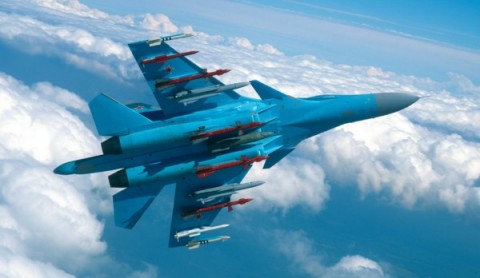
Russia begins bombing ISIS

Translated by Kristina Rus

MOSCOW, September 30  — RIA News. Russian Air and Space forces began conducting air operations with targeted strikes on the terrorists from the “Islamic state” in Syria, said the official representative of the Defense Ministry, major general, Igor Konashenkov.

“In accordance with the decision of the commander-in-chief of the Armed Forces of the Russian Federation, Vladimir Putin, the Russian planes of the Air and Space forces (VKS) today began conducting air operations with point strikes on ground targets of ISIS terrorists on the territory of the Syrian Arab Republic,” – he told reporters.

Konashenkov also said that the Russian defense minister, army general Sergei Shoigu informed his colleagues in the CSTO that during the air operations in Syria, the Russian VKS aircraft strike military equipment, communications, vehicles, weapons, ammunition and fuel warehouses of ISIS terrorists.

On Wednesday the President of Russia Vladimir Putin submitted to the Federation Council a request for the approval to use the armed forces abroad. The Federation Council issued permission. The head of the Kremlin administration Sergei Ivanov told journalists that Syria’s President Bashar al-Assad appealed to the Russian Federation with the request for military assistance. Ivanov stressed the actions of the Russian armed forces abroad only pertain to air operations.

The use of military personnel in ground operations is out of question.

Russia enters a new war

September 30, 2015
Oleg Nemen
Translated by Kristina Rus

Russia entered a war. A major war, probably long.
The result is not guaranteed, its course hard to predict.
Russia is forced to do it. Indeed, soon it will be too late but we will still have to fight, only in a worse position.

But I don’t understand this universal joy. Like a holiday!

That the USA is forced to concede defeat in the Middle East policy and agree with the Russian plan is, of course, cool. It really changes the international position of Russia.

But the very fact that Russia took responsibility for all the mess, brewed by Washington in the Middle East, is not encouraging. Russia had no choice. This is a risky and dangerous step.

To think that Russia will now shoot and solve all the problems, on which the US with the EU broke its teeth, is naive. This is a huge, very expensive and very hard war. And, of course, not only in Syria.

At the same time the West will lead a global information war against Russia – every day they will show “children murdered by the Russians,” etc.

This does not mean that we should not engage. It is necessary, we have to, but it’s not an occasion to celebrate.

God willing, it is successful. But a natural feeling at its beginning – worry. But all around – “Hooray, we won, we are a world power!”

A “world power” which cannot even defend Russians near our  borders…

Germany moves away from the US anti-Putin alliance. Joins forces with Russia in coalition to defeat ISIS?

Global Research, September 18, 2015
Sott.net 14 September 2015

This article originally appeared at DWN, translated by Frank Jakob exclusively for SouthFront 

In a surprise move Germany left the anti-Putin-alliance formed by the USA: Germany is now officially welcoming Moscow’s readiness to act in Syria and is starting an initiative together with the Russians and the French to bring an end to the war. This is to stop the constant stream of refugees. Germany has ordered thousands of soldiers into readiness. 

Germany surprisingly left the alliance formed together with the United States which intended to block Russia’s entry into the Syrian conflict.

Minister of Defence Ursula von der Leyen told Der Spiegel that she welcomed president Putin’s intentions of joining the fight against the extremist organization “Islamic State”. It would be a matter of mutual interests, she said.

© Deutsche Presse‑Agentur
Frank-Walter Steinmeier and his Russian counterpart Sergei Lavrov have been working hard in the background on a plan for Syria . The picture shows the two foreign ministers during the visit of Stalingrad memorial in Volgograd in May this year .

A speaker of the Ministry of Foreign Affairs added, Germany would welcome additional efforts of Russia in the fight against IS. Foreign Minister Frank-Walter Steinmeier even announced the starting of a joint venture between him, Russian foreign minister Lavrov and their French colleague Laurent Fabius with the aim of bringing the Syrian civil war to an end. Lavrov and Fabius are expected to arrive in Berlin this Saturday.

Russian Foreign Minister Sergey Lavrov called upon the US-Ministry of Defence to coordinate their efforts with the Russian military.Because both sides are actively invested in Syria it would be paramount for the US to reinstate the previously ceased operational cooperation with Russia, said Lavrov on Friday in Moscow. This was intended to avoid “unintentional incidents”. Russia’s military drills in the Mediterranean would be in accordance to international law. Larvrov explained furthermore, that Russia would keep delivering weapons to the troops of Syrian president Bashar al-Assad to support their struggle against the extremist organization of Islamic State (IS).

Russia already began a diplomatic offensive weeks ago. The Americans did not precisely indicate whether they would support the Russian initiative. Under no circumstances would the US give Russia credit for solving the deadlocked situation, should Russia in fact be successful. Therefore the US-government warned precautionary of a worsening in the refugee crisis should Russia intervene.

Especially the neocons are issuing warnings of any cooperation with Russia in whatever matter. US-President Obama did not clearly state whether the Russian initiative was done in coordination with the White House. Foreign Minister John Kerry went on a surprise visit to Russia in spring which, however, remained without results regarding the Syrian matter. It is likely that the US-government changed their mind in the face of the worsening of the refugee crisis so that they are now willing to cooperate with Russia in the middle east.

German Frank-Walther Steinmeier has long been trying to conciliate behind the curtains and is therefore constantly in touch with his Russian colleague Lavrov. It looks like he is the only one in the German government who realizes that the refugee crisis will get completely out of control if the war in the Middle East continues. Austria and Spain signaled days ago that a Russian participation in the battle against IS was crucial. Russia began expanding its military activities in Syria.

German Minister of Defence Ursula von der Leyen wants to expand the deployment of the Bundeswehr in Iraq. Bundeswehr would be ready to continue its successful work in Kurdish regions in cooperation with the Iraqi government, she told Der Spiegel on Saturday. First steps would already be undertaken. Germany delivered medical supplies, helmets and hazard-protections masks. Up to 100 Bundeswehr soldiers are training Kurdish Peshmerga fighters in northern Iraq. Weapons were also delivered.

Von-der Leyen also ordered thousands of German soldiers into readiness in the wake of the refugee crisis. If this was done because of the refugees or hints of terror threats is still unknown. The order was given to the troops a day before, said a speaker of the ministry on Friday in response to a report by Der Spiegel. Up to 4000 soldiers are under constant readiness to be deployed. Hundreds of soldiers were deployed to help accommodate newly-arrived refugees last weekend. The solders are financially compensated for their services under this deployment order.

Translators comment:

It has been reported that Russian Foreign Minister Sergey Lavrov called into question the effectiveness of the US-led coalition against Islamic State (IS). According to PNP magazine he stated, that concerned colleagues from within the US-led coalition turned to him. They informed him that the US-military did not give clearances to their fighter pilots even though they clearly located and identified Islamic State positions.

Lavrov: US knows ISIS positions, refuses to bomb

From Fort Russ

September 13th, 2015 –
Pnp.ru – translated for Fort Russ by Joaquin Flores –

“Lavrov: Russia has information that the US knows the position of the IS, but does not bomb them”
Russia has information that the US know the specific location points of the “Islamic State” (extremist organization banned in Russia), but did not give an order to strike on the positions “of the IS,” said Russian Foreign Minister Sergei Lavrov.
In the program “Sunday times” on “Channel 1” Lavrov said that the US government “was not originally very careful in creating a coalition, or conspired towards goals that were not the declared ones.”
According to the foreign minister, the coalition was created spontaneously, “within just a few days it was announced that it includes a number of countries and then begun strikes.”
Lavrov said that the analysis of aviation operations in countries included in the coalition, “creates a strange impression,” – as if in addition to fighting “the IS” “there is something else which is a concern of the coalition.”
The minister said: “I hope not to disappoint anyone in saying that some of our colleagues from the incoming coalition of countries have information on where exactly and on what positions are “IS” or other subdivisions, and the commander of the coalition (the United States ) does not give consent to striking them. “

The ISIL is in Ukraine: America’s “agents of chaos” unleashed in Eurasia

Global Research, August 02, 2015
Strategic Culture Foundation 3 May 2015

Is the so-called Islamic State in Iraq and Syria (ISIS)/Islamic State in Iraq and the Levant (ISIL) / Islamic State (IS) / Al-Dawlah Al-Islamiyah fe Al-Iraq wa Al-Sham (DAISH/DAESH) active in post-EuroMaidan Ukraine? The answer is not exact. In other words, the answer is both yes and no.

Then again, what is the ISIS/ISIL/IS/DAISH/DAESH? It is a loosely knit band of militias, just like its predecessor Al-Qaeda. Included in its network are groups from the Caucasus, which have been fighting in Syria and Iraq. Now they are in Ukraine and using it as a steppingstone into Europe.

The Agents of Chaos and the War for Eurasia

The conflicts in Ukraine, Syria, Iraq, Libya, and Yemen are all fronts in a multi-dimensional war being waged by the US and its allies. This multi-dimensional war aims to encircle Eurasia. China, Iran, and Russia are the main targets.

The US also has an order of operations with which to takeout these countries. Iran is first, followed by Russia, with China as the last part of the Eurasian set comprised of this «Eurasian Triple Entente.» It is no coincidence that the conflicts in Ukraine, Syria, Iraq, Libya, and Yemen are near the borders of Iran and Russia, because Tehran and Moscow are the nearer term targets of Washington.

In the same vein as the interlinked nature of the conflicts in Ukraine, Syria, Iraq, Libya, and Yemen, there is also a connection between the violent, racist, xenophobic, and sectarian forces that have been unleashed as «agents of chaos.» It is no mere coincidence that Newsweek had a headline saying «Ukrainian Nationalist Volunteers Committing ‘ISIS-Style’ War Crimes» on September 10, 2014. [1] Whether they know it or not, these deviant forces, whether they are the ultra-nationalist Pravy Sektor militias in Ukraine or the head-cutting gangs of Al-Nusra and the ISIS/ISIL/IS/DAISH/DAESH in Syria and Iraq, all serve one master. These agents of chaos are unleashing different waves of constructive chaos to prevent Eurasian integration and a world order that is free of US dictates.

The «constructive chaos» that is being unleashed in Eurasia will eventually wreck havoc in India. If New Delhi thinks that it will be left alone, it is foolishly mistaken. The same agents of chaos will plague it as well. It too is a target like China, Iran, and Russia.

Strange Alliances: Alliance between the ISIL/DAESH and Ukraine’s Ultra-Nationalists?

It should not come as a surprise that the different agents of chaos are loosely aligned. They serve the same master and they have the same enemies, one of which is the Russian Federation.

It is in this context that Marcin Mamon has reported about the ISIS/ISIL/IS/DAISH/DAESH connection in Ukraine. He even explains that some of the fighters from the Caucasus feel that they have a debt to Ukrainians like Oleksandr Muzychko. [2]

Mamon is a Polish documentary filmmaker who has produced a number of documentaries about Chechnya, such as The Smell of Paradise with Mariusz Pilis in 2005, for the British Broadcasting Corporation’s Storyville program. He is also openly sympathetic to the cause of the Chechen separatists against Russia in the North Caucasus.

Mamon’s travels to Afghanistan and his interaction with Chechen separatist fighters have resulted in the Polish filmmaker having contacts with the ISIS/ISIL/IS/DAISH/DAESH inside Syria and Turkey. This extraordinarily led him down a new path to Ukraine.

«I didn’t even know, at that point, whom I was meeting. I knew only that Khalid, my contact in Turkey with the Islamic State [ISIS/ISIL/IS/DAISH/DAESH], had told me his ‘brothers’ were in Ukraine, and I could trust them», he writes about his meeting in a «potholed street in Kiev, east of the Dnieper River, in an area known as the Left Bank.» [3] In an earlier article Mamon explains that these so-called «‘brothers’ are members of ISIS and other underground Islamic organizations» who «are on every continent, and in almost every country, and now they are in Ukraine, too.» [4] He also explains that «Khalid, who uses a pseudonym, leads the Islamic State’s underground branch in Istanbul. He came from Syria to help control the flood of volunteers arriving in Turkey from all over the world, wanting to join the global jihad. Now, he wanted to put me in touch with Ruslan, a ‘brother’ fighting with Muslims in Ukraine». [5]

Ukrainian ultra-nationalists like Muzychko also became so-called «brothers» and accepted into this network. Mamon explains that the Chechen fighters accepted him «even though he never converted to Islam» and that «Muzyczko, along with other Ukrainian volunteers, joined Chechen fighters and took part in the first Chechen war against Russia» where they «commanded a branch of Ukrainian volunteers, called ‘Viking,’ which fought under famed Chechen militant leader Shamil Basayev.» [6]

Why is the ISIL manning Private Battalions in Ukraine?

What does it say when Chechen separatists and the transnational network of so-called «brothers» tied to the ISIS/ISIL/IS/DAISH/DAESH are being recruited or used to fill the ranks of private militias being using by Ukrainian oligarchs? This is a very important question. It also clearly demonstrates how these elements are agents of chaos.

Marcin Mamon travelled to Ukraine to meet the Chechen fighter Isa Munayev. Munayev’s background is explained thus: «Even before he arrived in Ukraine, Munayev was well-known. He fought against Russian forces in both Chechen wars; in the second, he was the commander of the war in Grozny. After the Chechen capital was captured by Russian forces between 1999 and 2000, Munayev and his men took refuge in the mountains. He fought from there until 2005, when he was seriously injured and went to Europe for treatment. Munayev lived in Denmark until 2014. Then war broke out in Ukraine, and he decided it was time to fight the Russians again.» [7]

The above is an important passage, because it illustrates how the US and EU have supported militants fighting against Russia. In the US and the EU, the refuge that Denmark gave Isa Munayev is not questioned, whereas the allegations leveled against Moscow for supporting the soldiers of the Donetsk People’s Republic and Lugansk People’s Republic are seen as criminal. Why the double standards? Why is it okay for the US, EU, and NATO to support separatist movements and militias in other parts of the world, but criticized and forbidden for other countries to do the same?

«An older man in a leather jacket introduced me to Munayev. ‘Our good brother Khalid recommended this man,’ the man said. (Khalid is today one of the most important leaders of the Islamic State. Khalid and Munayev knew each other from years spent fighting together in Chechnya),» Marcin Mamon explains about the connections between the Chechen separatists and ISIS/ISIL/IS/Daish/Daesh. [8]

Munayev has come to Ukraine to establish «one of what would become several dozen private battalions that sprang up to fight on the side of the Ukrainian government, operating separately from the military.» [9] His militia was named the Dzhokhar Dudayev battalion, which was named after the separatist president of Chechnya.

NOTES

[1] Damien Sharkov, «Ukrainian Nationalist Volunteers Committing ‘ISIS-Style’ War Crimes,» Newsweek, September 10, 2014.

[2] Marcin Mamon, «In Midst of War, Ukraine Becomes Gateway for Jihad,» Intercept, February 26, 2015.

[3] Marcin Mamon, «Isa Munayev’s War: The Final Days of a Chechen Commander Fighting in Ukraine», Intercept, February 27, 2015.

[4-6] Marcin Mamon, «In Midst of War,» op. cit.

[7-9] Marcin Mamon, «Isa Munayev’s War,» op. cit.

This article was originally published by the Strategic Culture Foundation on May 3, 2015.

http://www.globalresearch.ca/the-isil-is-in-ukraine-americas-agents-of-chaos-unleashed-in-eurasia/5446989

The fake war on ISIS: US and Turkey escalate in Syria

Global Research, August 03, 2015
New Eastern Outlook 2 August 2015

It is late July 2015, and the media is abuzz with the news that Turkey will allow US jets to use its bases to bomb Islamic State (ISIS) targets in Syria. There is much talk about how this development is a “game-changer,” and how this is a clear escalation of the much ballyhooed, but more fictional than real, US war on ISIS: the terror organization that US intelligence welcomed as a positive development in 2012 in their continued attempts to instigate regime change against the Syrian government led by Bashar al-Assad.

The western public is told that “This is a significant shift…It’s a big deal,” as a US military official told the Wall Street Journal. What the corporate media fail to mention, however, is the fact that Turkey has been, and continues to be, a central actor in the war in Syria and, consequently, in the development and maintenance of ISIS. So, while Washington waxes poetic about stepping up the fight against the terror group, and lauds the participation of its allies in Ankara, the barely concealed fact is that Turkey is merely further entrenching itself in a war that it has fomented.

Of equal importance is the simple fact that a “war on ISIS” is merely a pretext for Turkey’s military engagement in Syria and throughout the region. Not only does Turkey’s neo-Ottoman revanchist President Erdogan want to flex his military muscles in order to further the regime change agenda in Syria, he also is using recent tragic events as political and diplomatic cover for waging a new aggressive war against the region’s Kurds, especially Turkey’s longtime foe the Kurdish Workers Party (PKK).

In this way, Turkey’s recent moves should be seen as merely a new phase of its engagement in the regional war that it has helped foment. Contrary to western corporate media talking points, Turkey has not just recently become actively engaged in the conflict; Ankara has merely shifted its strategy and its tactics, moving from covert engagement to overt participation.

Same War, New Phase

The immediate justification for the launching of renewed airstrikes by Turkey and the US is the expansion of the war against ISIS. In the wake of the bombing in Turkey’s majority Kurdish town of Suruç, which killed 32 youth activists, the Turkish government has allegedly struck hard against both ISIS and PKK targets. It is against this backdrop that any analysis of the new phase of this war must be presented.

First and foremost is the fact that even if one were to accept the Turkish government’s official story – the suicide bomber was linked to the Islamic State (ISIS) – not at all a certainty, the question of ultimate responsibility becomes central. While Ankara would have the world believe that its hands are clean, and that it is the innocent victim of international terrorism, the reality is that Turkey has done everything to foster and promote the growth of ISIS from the very beginning. As such, it is the Turkish government who must shoulder much of the blame for the Suruç bombing.

Since at least 2012, Turkey has been the principal conduit for weapons flowing into Syria. In June of that year, the NY Times confirmed that the CIA was smuggling weapons to anti-Assad forces from the Turkish side of the border using agents of the Syrian Muslim Brotherhood, long-time assets of US intelligence. Also in 2012, Reuters revealed that Turkey had “set up a secret base with allies Saudi Arabia and Qatar to direct vital military and communications aid to Syria’s rebels from a city near the border… ‘It’s the Turks who are militarily controlling it. Turkey is the main coordinator/facilitator. Think of a triangle, with Turkey at the top and Saudi Arabia and Qatar at the bottom,’ said a Doha-based source.”

It is now also documented fact that Turkish intelligence (MIT) has been an active player in the ongoing campaign to arm and resupply the terror groups such as the al Nusra Front and others. The evidence of this fact was made public by the Turkish daily Cumhuriyet which published video footage along with transcripts from wiretaps confirming what many eyewitnesses have stated:  Turkish security forces have been directly involved in shelling and support operations for Nusra front and other jihadi groups in and around Kassab, Syria, among other sites. Many of the very same terrorists who have been armed and supported by the Turkish government are today being held up as enemies of Turkey, and rationalization of the need for Turkish military intervention.

So, with the inescapable understanding that Turkey’s government is the primary supporter and sponsor of terrorist groups in Syria, the justification for war becomes flimsy at best. But, if it’s not about fighting terror, then what exactly is Ankara’s objective? What does it hope to gain?

At the top of Erdogan’s agenda is using ISIS as a pretext for effecting the regime change in Syria that he has failed to bring about for these past four years. Despite providing weapons and cash, training sites and political cover, Turkey’s terror proxies have been roundly defeated by the Syrian Arab Army, Hezbollah, and allied forces. As such, Erdogan now needs to provide the overwhelming military superiority required to get the job done. This means air support and a “No Fly Zone” along the Turkey-Syria border, one which ostensibly will allow Turkey to fight ISIS, but in actuality is a means of securing territory for the terrorists who otherwise have been unable to do so. It is a de facto military intervention into Syria. Perhaps not even de facto, but outright declaration of war – a clear war crime.

Secondly, the alleged war on ISIS is a politically expedient cover for Erdogan to wage a full-scale war on the Kurds, and the PKK specifically. Within hours of announcing the new phase of the war, Turkish forces were bombing Kurdish targets in Syria and Iraq, effectively declaring war on both countries, in blatant violation of international law, to whatever extent such a thing still exists. Indeed, Erdogan made his position quite clear when he stated, “It is not possible for us to continue the peace process with those who threaten our national unity and brotherhood.” Essentially, Erdogan has declared war on all Kurds of the region.

Perhaps most important, and almost never discussed in the West, is the simple fact that Turkey is perpetuating an outright myth in their supposed strategy to create “Islamic State-free zones” along the border; Turkey plans to work with “moderate opposition” and “Free Syrian Army” in this endeavor. However, the fact remains that there is really no such thing as the “moderates,” and those terrorists that had at one time been labeled such have all either gone home, fled the country, gone over to the Al Qaeda-affiliated Nusra Front, or are now fighting under the ISIS banner. And so, by stating such a plan, Erdogan is unwittingly admitting what this author has already reported numerous times – Turkey acts as military muscle for ISIS and al Qaeda in Syria and now Iraq.

But of course, were Turkey the only relevant party, these developments would not be of nearly the same global significance. Rather, it is the participation and collusion of the US and NATO that makes this troubling escalation far more dangerous.

Making Overt the Covert War

As of writing, NATO has not yet been convened to discuss Turkey’s war on Syria and the Kurds, though Ankara has called for the meeting under Article 4 of the NATO treaty which provides for consultation, but not necessarily collaborative military action. However, regardless of how the meeting proceeds, Turkey has been given overt support in its war by the US, which is, in effect, NATO.

Although the US feigns concern for the Kurds and the expansion of the war, Washington has in fact endorsed Turkey’s policy. White House spokesman Alistair Baskey noted that the US “strongly condemns” recent attacks by the PKK, reiterating the fact that Turkey is an important US and NATO ally. As Obama’s close adviser on national security matters Ben Rhodes stated, “The US, of course, recognises the PKK specifically as a terrorist organisation. And, so, again Turkey has a right to take action related to terrorist targets.”

While it would appear that Washington is taking a measured approach, cautiously supporting Turkey while trying to limit the scope of the operation, that illusion is merely for appearance’s sake. In fact, the Brookings Institution just last month issued a policy paper entitled Deconstructing Syria: Towards a regionalized strategy for a confederal country, which brazenly laid out a plan to, as political analyst Tony Cartalucci astutely pointed out, “divide, destroy, then incrementally occupy” Syria using the pretext of ISIS and terrorism. And that is precisely what we’re witnessing now.

But neither Cartalucci, nor this author, nor any other colleagues who have predicted this turn of events are clairvoyant. Rather, this development was very much expected. As noted above, those terrorists who now provide the rationale for a new war were the very same ones openly supported by the countries now waging the war. It was clear at the time that this would be their ultimate role. Sadly, the world has not effectively mobilized to stop this imperialist war thus far.

The question remains: will Syria survive? The answer depends on the continued resolve of the Syrian Arab Army and its allies, and on the global Resistance’s capacity to organize itself to effectively oppose the Empire in Syria and beyond.

Eric Draitser is an independent geopolitical analyst based in New York City, he is the founder of StopImperialism.org and OP-ed columnist for RT, exclusively for the online magazine “New Eastern Outlook”.

http://www.globalresearch.ca/the-fake-war-on-isis-us-and-turkey-escalate-in-syria/5466593

Evidence of Western support for ISIS continues – Turkish president’s daughter leads covert medical corps to help wounded ISIS members

By Global Research News
Global Research, July 17, 2015
AWD News 15 July 2015

A discontented nurse working clandestinely for a covert medical corps in Şanlıurfa—a city in south-eastern Turkey, close to the border with neighboring Syria— divulges information about the alleged role which Sümeyye Erdoğan plays in providing extended medical care for ISIS wounded militants transferred to Turkish hospitals.

Living in a dilapidated apartment in Istanbul’s outskirts along with her two children, a 34-year- old emaciated nurse who spoke on the condition of anonymity for fear of retribution, disclosed her seven-week agonizing ordeal of working in secret military hospital in Şanlıurfa, 150 km (93 miles) east of Gaziantep and 1,300 km (808 miles) southeast of Istanbul. “Almost every day several khaki Turkish military trucks were bringing scores of severely injured, shaggy ISIS rebels to our secret hospital and we had to prepare the operating rooms and help doctors in the following procedures.

I was given a generous salary of $ 7,500 but they were unaware of my religion. The fact is that I adhere to Alawite faith and since Erdoğan took the helm of the country the system shows utter contempt for Alawite minority – Alawite faith is an esoteric offshoot of Shia Islam,” Said the nurse, recoiling in horror from the thought of imminent persecution by Turkish much-vaunted secret police, known by its acronym MİT.

Since the eruption of al-Qaeda inspired rebellion in Syria aiming to topple the secular President Bashar al-Assad, the Turkish government spearheaded efforts to transfer all possible mercenaries as far as Chinese Turkestan to newly converted Wahhabis in Buenos Aires– Wahhabism adopts an extremist interpretation of Islam and is the official religion of Saudi Arabia –, albeit, the Turkish government always rejects all allegations concerning its mischievous role in Syria’s 4-year civil war.

Sümeyye Erdoğan

Turkish public opinion in the past three months became increasingly critical of President Erdoğan’s warlike policy in the volatile Middle-East and his popularity rate slumped to a record low of %15. Once praised of being a nationalist and secular politician, Erdoğan’s has been marred by his ever more pro-Jihad rhetoric. They had no confidence in Alawites, added the nurse weeping bitterly, no sooner did they become cognizant of my faith than the wave of intimidation began, for I knew many things as who was running the corps, I saw Sümeyye Erdoğan frequently at our headquarter in Şanlıurfa … I am indeed terrified , I rue the day I enrolled in that program.

A London-educated scion of wealthy family and the eldest daughter of totalitarian President Erdoğan, Sümeyye Erdoğan, more than once announced her intention to be dispatched to Mousl , Iraq’s once second-biggest city and Islamic State’s stronghold to do relief works as a volunteer which drew public ire and vast condemnation from Turkey’s opposition parties. Moreover, the Turkish opposition parties accuse the administration of Recep Tayyip Erdoğan of seeking diligently to hide the truth concerning numerous financial malfeasances Mr. Erdoğan son, Bilal Erdoğan, is involved.

Mr. Erdoğan who always sheds crocodile tears for the plight of Syrian trapped between the hammer of hunger and the anvil of ISIS’ extremism, conceals the fact that his own son, Bilal Erdoğan, is involved in lucrative business of smuggling the Iraqi and Syrian plundered oil. Bilal Erdoğan who owns several maritime companies, had allegedly signed contracts with European operating companies to carry Iraqi stolen oil to different Asian countries.

Turkish government unwittingly supports ISIS by buying Iraqi plundered oil which is being produced from the Iraqi sized oil wells. Bilal Erdoğan’s maritime companies own special wharfs in Beirut and Ceyhan ports transporting ISIS’ smuggled crude oil in Japan-bound oil tankers. The Turkish opposition parties also accuse the belicose President Erdoğan of desperately trying to whitewash inordinate number of scandals concerning Bilal’s involvement in transporting Iraqi oil and thus making ISIS the wealthiest global terrorist group. “President Erdoğan claims that according to international transportation conventions there is no legal infraction concerning Bilal’s illicit activities and his son is doing an ordinary business with the registered Japanese companies, but in fact Bilal Erdoğan is up to his necks in complicity with terrorism, but as long as his father holds office he will be immune from any judicial prosecution,” Gürsel Tekin ,a senior CHP party official said in Ankara on Tuesday.

The leading CHP official further underscored that Bilal Erdoğan’s maritime company, BMZ Ltd, is considered a family business and president Erdoğan’s close relatives hold shares in BMZ and they misused public funds and took illicit loans from Turkish banks. Weak, dependent, lugubrious though defiant; the Turkish nurse pleaded for Turkish judiciary help, imploring the last bastion of freedom, Turkish Army, to overthrow Erdoğan’s corrupt regime.

http://www.globalresearch.ca/turkish-presidents-daughter-heads-a-covert-medical-corps-to-help-isis-injured-members-reveals-a-disgruntled-nurse/5462896


Belgium exits from anti-ISIL coalition’s bombing campaign in Syria and Iraq

Global Research, July 04, 2015
Sputnik 3 July 2015
Signs of Disillusionment

On Friday, Belgian media announced that their country’s contribution to the anti-ISIL coalition mission has been suspended. Commenting on the announcement, a senior Syrian official told Sputnik that that Brussels’ move comes as no surprise, given the growing divide between the coalition’s stated military aims and its actual activities.

Friday’s announcement came after Belgium’s six F-16 fighter bombers had already returned from their base in Jordan, where they had spent the last nine months participating in the US-led bombing campaign against ISIL in Iraq. Brussels has declared that it could no longer afford to continue funding the air operation.

Asked for comment by Sputnik, Syrian Information Minister assistant Ali al-Ahmed stated that Brussels’ announcement comes as no surprise, given repeated reports of Europeans’ growing doubts “about the effectiveness of the coalition and its operations.” Noting that the Belgian government has been plagued by high rates of disapproval of “this enormous and ineffective spending,” al-Ahmed told Sputnik that “Belgium has now come to personify European countries’ dissatisfaction over the coalition’s actions.”

The Syrian civil servant lamented that “from the very beginning, this coalition has not been serious in its approach to fighting the terrorists. We have noticed that the coalition only strikes at those ISIL and al-Nusra objects which threaten Western interests. The coalition’s military aviation is fighting terrorism not out of the need to fight evil, but based on the narrow self-interest of the parties involved.” According to al-Ahmed, “this explains why air strikes regularly miss ISIL targets and facilities,” or strike “military targets of the forces of the people’s militia leading the real fight against ISIL.” The advisor notes that “even civilians who assist the army and the militia have repeatedly been subjected to coalition airstrikes.”

Al-Ahmed criticized Western nations’ use of limited financial resources for expensive airstrikes, noting that these funds could have been much more effectively spent by providing assistance to the countries directly involved in the fight against ISIL terror, including Iraq and Syria.

Ultimately, Al-Ahmed, whose country has been involved in a battle against radical Islamic groups for over four years now, pessimistically noted that “the main goal of this coalition is to preserve the balance of forces on the ground, so that no one can win, with the shedding of blood continuing for a long time, until the US is able to implement its interests in the region.”